𝙍𝙚𝙖𝙙𝙈𝙤𝙧𝙚👉 The College Girl in the BMW Said Blocking My Driveway Wasn’t Her Problem, So I Made It the Only Problem She Had
part2
My coworkers noticed before lunch.
“You good?” one of them asked while we were restocking shelves.
“Fine.”
“You look like you’re mentally suing someone.”
“Close.”
All day, I kept thinking about that BMW sitting in my driveway. I knew she had said an hour or two. I also knew the kind of person who reads a sign, blocks a driveway, says “not my problem,” and expects the world to bend around her class schedule does not suddenly develop respect because the clock moves.
By three o’clock, I was checking my phone during breaks even though I had no camera view of the driveway yet. By five, I was imagining the car still there. By six, I told myself I was being dramatic. Surely, even she would not leave it there all day.
My shift ended close to seven.
I drove home faster than usual, though still legally, because unlike certain BMW drivers, I had an interest in traffic laws. The whole way, I tried to calm myself down.
Maybe she moved.
Maybe she had some emergency.
Maybe she realized she had been wrong and left a note apologizing.
Then I turned onto my street.
The BMW was still there.
Snug in my driveway.
Perfectly parked in the exact place it had no right to be.
For a second, I just sat in my car at the curb and laughed.
Not because it was funny.
Because the alternative was getting out and kicking the nearest mailbox.
The evening light reflected off the BMW’s white paint. There was no driver. No movement. No sign of remorse. Just the car, sitting there like a smug marble statue built to honor inconvenience.
Then I noticed the paper.
A folded white slip tucked under the windshield wiper.
I got out and pulled it free.
Running late.
Will come back later.
Thanks.
Thanks.
Thanks.
That word nearly sent me into orbit.
She had not just blocked my driveway after reading my signs. She had not just lied to my face about being gone in an hour or two. She had not just left her luxury car on my property for almost half a day.
She had thanked me.
As if I had agreed.
As if my driveway were some generous campus overflow lot with complimentary homeowner frustration.
I stood there holding the note while the neighborhood settled into evening around me. Someone was mowing two houses down. A dog barked. A kid rode past on a bike. Normal people doing normal things, while one spoiled medical student’s BMW squatted in the middle of my life.
I looked at my car.
Then at hers.
Then back at the note.
I thought about calling a tow truck.
I should say that first. I thought about it seriously. But our area had weird response times, and I had learned from previous calls that unless the car was blocking a public road or emergency access, it could turn into paperwork, waiting, proof, fees, and a whole evening of standing around outside explaining what a driveway was.
I was tired.
I was hungry.
I was done asking.
So I went inside, grabbed a pen, and wrote on the back of her note.
Sure. Come back for your car later.
Then I put the note back under her windshield wiper.
After that, I moved my own car.
I parked it directly in front of my driveway, perpendicular to her BMW, close enough to block her exit completely but still on my property and not blocking the public street. It was not elegant. It was not subtle. It was not the kind of thing my mother would call mature.
But it was satisfying.
Her car could not leave unless mine moved.
And mine was not moving.
I went inside, locked the door, took a long hot shower, changed into sweats, opened a beer, and sat down in front of YouTube with the deep, exhausted satisfaction of a man who had finally stopped being polite to a problem.
About two hours later, the doorbell rang.
I checked the security camera.
There she was.
BMW girl.
Now without sunglasses, and somehow even angrier.
She was standing on my porch in leggings, a cropped sweatshirt, and the expression of someone who had never before encountered a consequence that did not apologize. Her face was flushed. Her phone was in one hand. She jabbed the doorbell again, then knocked like she expected the door to confess.
I took a slow sip of beer.
Then I did nothing.
She rang again.
Knocked again.
Called out, “Hello? I know you’re in there.”
I smiled at the screen.
Not proudly.
Maybe a little proudly.
She started pounding on the door.
That was when I decided my neighbors had suffered enough from the college parking war and did not deserve her turning my porch into a percussion instrument. I opened the door with the beer still in my hand.
“What?” I said.
Her eyes widened, not because she recognized her own tone from that morning, but because entitled people hate mirrors.
“You blocked me in!”
“You parked in my driveway.”
“I told you I was coming back.”
“Later,” I said. “You wrote later.”
“I need my car.”
“And I needed my driveway.”
She pointed toward the street. “Move your car.”
“No.”
Her mouth opened.
Then closed.
Then opened again.
“You can’t do that.”
“I did.”
“I will call the police.”
“Okay.”
That answer clearly irritated her because it did not contain fear.
“I’m serious.”
“So am I.”
“You’re trapping my car.”
“Your car is trespassing on my property.”
“I’m a student,” she snapped, as if that were a diplomatic immunity category. “The parking lot was full.”
“I’m a homeowner. My driveway was full too. Because of you.”
She stared at me with complete disbelief, like I had rejected the most reasonable argument ever made.
“I had class.”
“I had work.”
“You got out this morning.”
“And when I came back after a ten-hour shift, I couldn’t get into my own driveway.”
“It’s not my problem the college doesn’t have enough parking.”
“No, it isn’t. It’s also not my problem that your car can’t leave.”
Her face turned redder.
“You’re being insane.”
“I’m being parked.”
She took a step closer, and I could smell expensive perfume mixed with the heat of anger.
“You need to move your car right now.”
I looked down at the beer in my hand.
Then back at her.
“I can’t.”
“Why not?”
I raised the can slightly.
“I’ve been drinking.”
For a second, she just blinked.
“It’s one beer.”
“I’ve had more inside.”
“You’re lying.”
“I’m not driving after drinking. That would be irresponsible.”
The irony hung between us so heavily I almost expected it to make a sound.
Her jaw tightened. “You did this on purpose.”
“You parked here on purpose.”
“I need to get home.”
“I offered you the same consideration you offered me.”
“I’m a young woman alone at night.”
“And you chose to leave your car in a stranger’s driveway all day after being told not to.”
She switched tactics then. Her voice softened, but not with humility. With performance.
“Look, this is really unsafe. You don’t know what could happen to me.”
“I can help you call an Uber.”
Her eyes flashed. “I’m not paying for an Uber.”
“You drive a BMW.”
“That doesn’t mean anything.”
“It means you can probably manage a ride.”
She lifted her phone. “I’m calling the cops.”
I shrugged.
“Tell them everything. Tell them you read the Private Property sign, parked in my driveway anyway, refused to move, left your car here all day, and came back after I had been drinking. Then tell them you want me to drive drunk so your trespassing vehicle can leave.”
She hesitated.
That hesitation was the first honest thing she had done all day.
She knew.
Not enough to apologize, obviously. But enough to understand that calling the police might not deliver the scene she had imagined, where an officer scolded the tired homeowner and escorted the BMW princess back to her rightful road.
Instead, she started insulting me.
Selfish.
Creepy.
Pathetic.
Power-tripping.
Poor.
That last one came out sharp and ugly.
“You’re just mad because I have a nicer car than you.”
I looked past her at the white BMW sitting in my driveway.
“You’re right,” I said. “Your car is very nice. It can enjoy its stay.”
She called someone.
A friend, I assumed, because the conversation involved a lot of furious whispering and dramatic phrases like literally trapped and psycho homeowner. Eventually, a dark sedan pulled up. Another young woman got out, glared at me from the sidewalk, and helped BMW girl gather whatever she needed from the car.
Before leaving, BMW girl turned back.
“This isn’t over.”
I lifted my beer.
“It is for tonight.”
She left.
I watched from my porch as the sedan pulled away.
Then I went inside and had another beer.
Then another.
I will not pretend I was acting like a saint.
I was being petty.
Fully, deliberately, with both hands on the wheel until I could no longer legally be behind one.
The next morning, my doorbell rang at 7:12.
I was hungover enough that sunlight felt like an accusation. My mouth tasted like regret and cheap lager. My head pulsed. I shuffled to the door wearing yesterday’s sweatpants and the expression of a man who had not yet decided whether being awake was worth it.
BMW girl stood there with her arms crossed.
“Move your car,” she demanded.
I looked at her.
Then at the empty beer can I had picked up from the side table on my way to the door.
I lifted it.
“Can’t.”
Her eyes narrowed. “Have you been drinking again?”
I had not.
Not that morning.
But I was also not about to let her treat my driveway like a twenty-four-hour valet service and then leave the second she found the correct tone.
“Yes,” I lied.
Her face fell in disbelief.
“It’s seven in the morning.”
“I make poor lifestyle choices.”
“You’re disgusting.”
“And yet still not driving.”
She clenched her fists. “I have places to be.”
“So did I yesterday.”
“I’m going to miss class.”
“You told me you were supporting your education. Consider this a field experience in consequences.”
She stared at me like she wanted to set me on fire with medical terminology.
“You can’t just keep my car here.”
“I am not keeping your car anywhere. Your car is exactly where you left it.”
“Because you blocked it.”
“After you blocked me.”
She made a strangled sound.
I closed the door.
At noon, she came back.
This time she tried politeness, or something wearing its skin.
“Can we just be adults about this?”
I almost laughed.
“Absolutely. Adults respect property signs.”
“I said I was sorry.”
“No, you didn’t.”
She paused.
Then looked away.
“I’m sorry if you felt inconvenienced.”
“That is not an apology.”
She exhaled sharply. “What do you want?”
“I wanted you not to park here.”
“Fine. I won’t do it again. Move your car.”
I held up a new beer.
This one was real.
“I can’t.”
She stared at the can.
“You have got to be kidding me.”
“I told you last night I wouldn’t drive after drinking.”
“You opened that just now.”
“Still counts.”
She called me several names I will not repeat because my mother did raise me with some standards, even if the last twenty-four hours had tested them.
Then she left again.
That evening, she returned with backup.
The same friend from the night before stood behind her, arms crossed, giving me a look that said she had heard a very edited version of events and had chosen to believe all of it. BMW girl looked smug this time. Too smug.
“Move your car,” she said.
“No.”
“You’re claiming you’ve been drinking again?”
“I am not claiming. I am informing.”
Her friend stepped forward.
“Prove it.”
I looked at her. “Excuse me?”
She pulled a small breathalyzer from her bag.
I stared at it.
Then at BMW girl.
Then back at the friend.
“You brought a breathalyzer to a driveway dispute?”
BMW girl lifted her chin. “If you’re lying, we’ll know.”
I should have refused on principle.
A sober, mature person would have refused.
But a petty man on day two of the driveway hostage crisis, who had cracked open a beer thirty minutes earlier specifically because he suspected something like this might happen, saw an opportunity wrapped in absurdity.
“Fine,” I said.
Her friend handed it to me like she was presenting evidence at trial.
I blew.
We waited.
The number appeared.
Their smug expressions collapsed at the same time.
I handed it back.
“Looks like I won’t be operating heavy machinery.”
BMW girl’s friend looked at her.
“You said he was faking.”
“I thought he was!”
I smiled.
“Have a good night.”
“You’re ruining my weekend!” BMW girl shouted.
I glanced at the BMW.
“No. I’m preserving mine.”
Sunday came.
No doorbell.
No shouting.
No breathalyzer ambush.
The BMW stayed in the driveway, silent and gleaming and increasingly ridiculous. Neighbors walked by slower than usual. One man from across the street, Mr. Alvarez, stopped near my mailbox and looked from my car to hers.
“You okay?” he asked.
“Yep.”
“Student parking?”
“Student learning.”
He laughed once and kept walking.
By Sunday afternoon, word had spread. I could feel it. Curtains shifted. People took oddly timed walks. A couple of students passed by, saw the trapped BMW, whispered, and hurried away. I hoped they told everyone on campus. I hoped the story grew legs, wore running shoes, and sprinted through group chats.
Monday morning, I woke up early for work.
No BMW girl.
No friend.
No police.
No angry parents.
No tow truck.
I checked the driveway camera, half expecting to see someone trying to move my car by hand during the night. Nothing.
So I got ready, grabbed my keys, moved my car, and drove to work.
When I came home that evening, the BMW was gone.
My driveway was empty.
Beautifully, gloriously empty.
I stood there for a moment before pulling in, appreciating the plain concrete like it was a scenic overlook.
After that, the parking problem changed.
Not vanished completely, but changed.
Students stopped treating my driveway like public infrastructure. The occasional car still tried the curb, but never the driveway. Never the grass. Never across the entrance. If I saw someone slowing near my signs, they usually moved along quickly after noticing the cameras.
Word had spread.
I never saw BMW girl again, though once or twice I thought I saw a white BMW pass the far end of the street a little too fast. Maybe it was her. Maybe not. Either way, it never stopped.
A few weeks later, I added another sign.
Not because I needed it legally.
Because it made me smile.
PRIVATE DRIVEWAY.
DO NOT PARK.
OWNER MAY BE PETTY.
Mr. Alvarez saw it while walking his dog.
He read it, looked at me, and said, “Accurate.”
I shrugged.
“Truth in advertising.”
Looking back, I know some people would say I should have just called a tow truck. Maybe they’re right. That would have been cleaner. More official. Less beer involved.
But the thing about being pushed around by entitled strangers is that sometimes the official route feels too slow for the lesson required. She did not misunderstand. She did not make a mistake. She read the sign, heard my warning, dismissed my job, dismissed my home, dismissed my driveway, and then told me her convenience mattered more than my access to my own property.
She expected me to absorb the inconvenience because she had class.
She expected me to wait because she drove something expensive.
She expected me to move because she demanded it.
She expected her problem to become mine.
So I returned it.
Carefully.
Legally enough for my comfort.
Pettily enough for my soul.
And effectively enough that no student ever blocked my driveway again.
The lesson was simple.
If you park where you do not belong and tell the homeowner it is not his problem, you might come back later and discover he believed you.
It wasn’t my problem.
Until I made sure it was hers.
𝗧𝗛𝗘 𝗘𝗡𝗗
The College Girl in the BMW Said Blocking My Driveway Wasn’t Her Problem, So I Made It the Only Problem She Had
She read the Private Property signs, looked me in the eye, and parked in my driveway anyway. All she wanted was a free spot near campus, and all I wanted was to get home from work without begging a stranger to move. By the time she came back for her BMW, I had already given her exactly what she gave me: no way out.
I used to think living near a college would mean noise, bad parking, and the occasional kid walking past my house with a backpack, iced coffee, and the haunted expression of someone who had three exams and no plan.
I was right about all of that.
But I underestimated the parking.
The building near my neighborhood was part of a medical school, or nursing program, or some kind of college health sciences campus. I never cared enough to learn the exact department. It was a few blocks away, close enough that if students found parking near my street, they could walk to class without dealing with whatever nightmare lot the school provided. I understood the temptation. I really did.
Understanding something does not mean volunteering your property for it.
My house sat on a narrow residential street in the suburbs, the kind of street where driveways were short, lawns were trimmed, and people noticed when an unfamiliar car sat too long. I had a small garage, a narrow driveway, and just enough space in front of the house for one car if everyone parked like they had common sense and depth perception.
For years, it worked fine.
Then the college expanded.
At first, it was one car now and then. A student would park along the curb near my yard, grab a backpack, and hurry off. Annoying, but manageable. Then one car became two. Two became four. Soon I was coming home from work to find cars parked in front of my driveway, partly on my grass, angled near the curb, tucked along the side of my property, or blocking the easiest turn into my own garage.
I worked retail.
Not glamorous retail either. The kind where you spend eight to ten hours on your feet, smiling at people who blame you personally for prices, coupons, product shortages, store policies, weather, and the fact that their card declined. By the time I got home, I did not want to play detective, traffic cop, or campus parking enforcement. I wanted to pull into my own driveway, take off my shoes, and forget that customers existed until morning.
Instead, I kept finding strangers’ cars.
At first, I tried being polite.
If I caught a student parking, I would say, “Hey, this is private property. You can’t park here.”
Most acted surprised.
Some apologized and moved.
Some rolled their eyes and moved.
A few gave me that look young people give when they think thirty-five is elderly and homeownership is a personality disorder.
One guy in a hoodie actually said, “I’m only going to be gone for one lecture.”
I said, “I’m only going to call a tow truck once.”
He moved.
After weeks of this, I put up signs.
Clear ones.
PRIVATE PROPERTY.
DO NOT PARK.
DRIVEWAY MUST REMAIN CLEAR.
UNAUTHORIZED VEHICLES MAY BE TOWED.
I put one near the driveway, one by the curb, and one on the small patch of grass students seemed to think had been created by God specifically for compact sedans with campus stickers. For a while, it helped. The number of cars dropped. Maybe word spread. Maybe the threat of towing worked. Maybe the school finally opened another lot for exactly twenty-seven minutes before filling it again.
Whatever the reason, peace returned.
Not perfect peace. A student might still park too close once in a while, and I would leave a note or glare at them until they decided to remember civilization. But compared to the chaos before, it was manageable.
Then she showed up.
Friday morning.
That detail matters because Fridays at my job were always miserable. Weekend shoppers started early. Deliveries came late. The manager scheduled too few people and then acted shocked when the store looked like it had been looted by noon. I had pulled out of my garage a little after eight, already irritated because I was running behind and hadn’t had enough coffee.
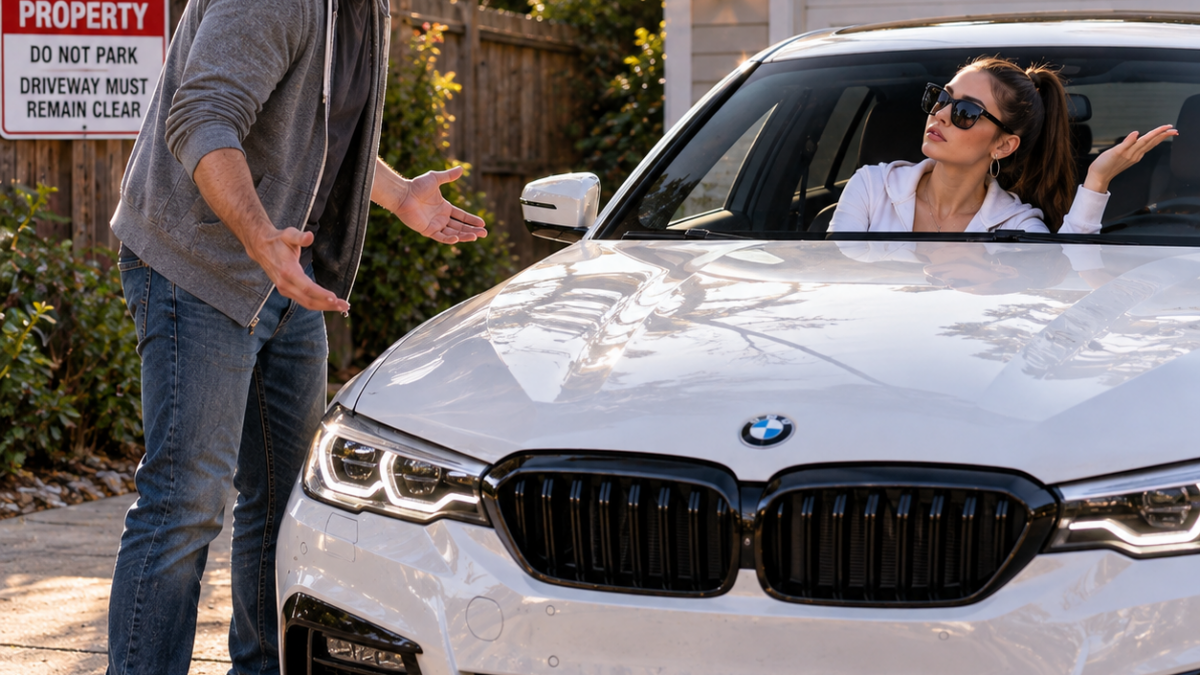
As I rolled down the driveway, I saw the BMW.
It was sleek, white, and new enough that I immediately knew the driver was not worried about rent the way I was. The paint gleamed. The windows were tinted just enough to be annoying. The whole car had that polished, entitled look certain vehicles get when you can practically hear the owner saying, “It’s fine, I’ll only be a minute.”
She stopped right in front of my house.
I paused at the end of the driveway.
The driver’s window lowered.
A young woman leaned her head out and looked directly at my sign.
Not glanced.
Read it.
I know she read it because her eyes moved across the words. She frowned slightly, like the sign had personally inconvenienced her. Then she pulled her head back inside, rolled up the window, and turned the car into my driveway.
Right into it.
Not along the curb.
Not near the edge.
Not half on the street.
She parked straight across the narrow driveway, blocking it like she had been assigned by a film crew to demonstrate selfishness.
I sat there in my car for two full seconds, staring.
Then I parked at the curb, got out, and walked toward her.
She was still inside, gathering her bag. Early twenties, maybe. Dark hair pulled into a glossy ponytail, big sunglasses, gold hoops, manicured nails, expensive athleisure outfit, and the impatient face of someone who had never considered that other people’s schedules were real.
I knocked on her window.
She ignored me.
I knocked again.
She adjusted something in her purse.
I knocked a third time, harder.
Finally, she rolled the window down just a few inches.
“What?” she said.
No hello.
No apology.
Just what, like I had interrupted her during an emergency instead of catching her actively blocking my property.
“You can’t park here,” I said.
She looked at me like I had spoken in a language she didn’t respect.
“I’m not going to be here long.”
“You’re in my driveway.”
“It’s just for class.”
“It’s private property. The sign is right there.”
“I saw it.”
That should have embarrassed her.
It did not.
“You saw the sign telling you not to park here,” I said slowly, “and parked here anyway.”
She shrugged.
Actually shrugged.
“I couldn’t find a spot.”
“That is not my problem.”
Her eyes narrowed.
“I have class.”
“I have work.”
“Then go to work.”
I stared at her.
“You’re blocking my driveway.”
“You’re already out.”
“I need to be able to get back in when I come home.”
“I’ll be gone by then.”
“How long?”
“An hour or two.”
She said it the way people say things when they know they are lying but expect you to accept the lie because challenging it would be socially inconvenient.
“Move your car,” I said.
She crossed her arms and sank back into the seat.
“No.”
I felt my jaw tighten.
“No?”
“I’m not moving. I’m late.”
“You’re going to make me late.”
“That sounds like a you problem.”
There it was.
The sentence that turned a parking issue into a moral education.
I looked at the BMW, then at the sign, then at her.
“You and your car had better be gone when I get back,” I said.
She gave me a fake little smile.
“Sure.”
I did not believe her.
But I was already late, and if I stood there arguing with a brick wall wearing lip gloss, I was going to lose money I could not afford to lose. So I got back in my car, pulled away, and drove to work with the kind of anger that sits behind your eyes and makes every red light feel personal.
part2
My coworkers noticed before lunch.
“You good?” one of them asked while we were restocking shelves.
“Fine.”
“You look like you’re mentally suing someone.”
“Close.”
All day, I kept thinking about that BMW sitting in my driveway. I knew she had said an hour or two. I also knew the kind of person who reads a sign, blocks a driveway, says “not my problem,” and expects the world to bend around her class schedule does not suddenly develop respect because the clock moves.
By three o’clock, I was checking my phone during breaks even though I had no camera view of the driveway yet. By five, I was imagining the car still there. By six, I told myself I was being dramatic. Surely, even she would not leave it there all day.
My shift ended close to seven.
I drove home faster than usual, though still legally, because unlike certain BMW drivers, I had an interest in traffic laws. The whole way, I tried to calm myself down.
Maybe she moved.
Maybe she had some emergency.
Maybe she realized she had been wrong and left a note apologizing.
Then I turned onto my street.
The BMW was still there.
Snug in my driveway.
Perfectly parked in the exact place it had no right to be.
For a second, I just sat in my car at the curb and laughed.
Not because it was funny.
Because the alternative was getting out and kicking the nearest mailbox.
The evening light reflected off the BMW’s white paint. There was no driver. No movement. No sign of remorse. Just the car, sitting there like a smug marble statue built to honor inconvenience.
Then I noticed the paper.
A folded white slip tucked under the windshield wiper.
I got out and pulled it free.
Running late.
Will come back later.
Thanks.
Thanks.
Thanks.
That word nearly sent me into orbit.
She had not just blocked my driveway after reading my signs. She had not just lied to my face about being gone in an hour or two. She had not just left her luxury car on my property for almost half a day.
She had thanked me.
As if I had agreed.
As if my driveway were some generous campus overflow lot with complimentary homeowner frustration.
I stood there holding the note while the neighborhood settled into evening around me. Someone was mowing two houses down. A dog barked. A kid rode past on a bike. Normal people doing normal things, while one spoiled medical student’s BMW squatted in the middle of my life.
I looked at my car.
Then at hers.
Then back at the note.
I thought about calling a tow truck.
I should say that first. I thought about it seriously. But our area had weird response times, and I had learned from previous calls that unless the car was blocking a public road or emergency access, it could turn into paperwork, waiting, proof, fees, and a whole evening of standing around outside explaining what a driveway was.
I was tired.
I was hungry.
I was done asking.
So I went inside, grabbed a pen, and wrote on the back of her note.
Sure. Come back for your car later.
Then I put the note back under her windshield wiper.
After that, I moved my own car.
I parked it directly in front of my driveway, perpendicular to her BMW, close enough to block her exit completely but still on my property and not blocking the public street. It was not elegant. It was not subtle. It was not the kind of thing my mother would call mature.
But it was satisfying.
Her car could not leave unless mine moved.
And mine was not moving.
I went inside, locked the door, took a long hot shower, changed into sweats, opened a beer, and sat down in front of YouTube with the deep, exhausted satisfaction of a man who had finally stopped being polite to a problem.
About two hours later, the doorbell rang.
I checked the security camera.
There she was.
BMW girl.
Now without sunglasses, and somehow even angrier.
She was standing on my porch in leggings, a cropped sweatshirt, and the expression of someone who had never before encountered a consequence that did not apologize. Her face was flushed. Her phone was in one hand. She jabbed the doorbell again, then knocked like she expected the door to confess.
I took a slow sip of beer.
Then I did nothing.
She rang again.
Knocked again.
Called out, “Hello? I know you’re in there.”
I smiled at the screen.
Not proudly.
Maybe a little proudly.
She started pounding on the door.
That was when I decided my neighbors had suffered enough from the college parking war and did not deserve her turning my porch into a percussion instrument. I opened the door with the beer still in my hand.
“What?” I said.
Her eyes widened, not because she recognized her own tone from that morning, but because entitled people hate mirrors.
“You blocked me in!”
“You parked in my driveway.”
“I told you I was coming back.”
“Later,” I said. “You wrote later.”
“I need my car.”
“And I needed my driveway.”
She pointed toward the street. “Move your car.”
“No.”
Her mouth opened.
Then closed.
Then opened again.
“You can’t do that.”
“I did.”
“I will call the police.”
“Okay.”
That answer clearly irritated her because it did not contain fear.
“I’m serious.”
“So am I.”
“You’re trapping my car.”
“Your car is trespassing on my property.”
“I’m a student,” she snapped, as if that were a diplomatic immunity category. “The parking lot was full.”
“I’m a homeowner. My driveway was full too. Because of you.”
She stared at me with complete disbelief, like I had rejected the most reasonable argument ever made.
“I had class.”
“I had work.”
“You got out this morning.”
“And when I came back after a ten-hour shift, I couldn’t get into my own driveway.”
“It’s not my problem the college doesn’t have enough parking.”
“No, it isn’t. It’s also not my problem that your car can’t leave.”
Her face turned redder.
“You’re being insane.”
“I’m being parked.”
She took a step closer, and I could smell expensive perfume mixed with the heat of anger.
“You need to move your car right now.”
I looked down at the beer in my hand.
Then back at her.
“I can’t.”
“Why not?”
I raised the can slightly.
“I’ve been drinking.”
For a second, she just blinked.
“It’s one beer.”
“I’ve had more inside.”
“You’re lying.”
“I’m not driving after drinking. That would be irresponsible.”
The irony hung between us so heavily I almost expected it to make a sound.
Her jaw tightened. “You did this on purpose.”
“You parked here on purpose.”
“I need to get home.”
“I offered you the same consideration you offered me.”
“I’m a young woman alone at night.”
“And you chose to leave your car in a stranger’s driveway all day after being told not to.”
She switched tactics then. Her voice softened, but not with humility. With performance.
“Look, this is really unsafe. You don’t know what could happen to me.”
“I can help you call an Uber.”
Her eyes flashed. “I’m not paying for an Uber.”
“You drive a BMW.”
“That doesn’t mean anything.”
“It means you can probably manage a ride.”
She lifted her phone. “I’m calling the cops.”
I shrugged.
“Tell them everything. Tell them you read the Private Property sign, parked in my driveway anyway, refused to move, left your car here all day, and came back after I had been drinking. Then tell them you want me to drive drunk so your trespassing vehicle can leave.”
She hesitated.
That hesitation was the first honest thing she had done all day.
She knew.
Not enough to apologize, obviously. But enough to understand that calling the police might not deliver the scene she had imagined, where an officer scolded the tired homeowner and escorted the BMW princess back to her rightful road.
Instead, she started insulting me.
Selfish.
Creepy.
Pathetic.
Power-tripping.
Poor.
That last one came out sharp and ugly.
“You’re just mad because I have a nicer car than you.”
I looked past her at the white BMW sitting in my driveway.
“You’re right,” I said. “Your car is very nice. It can enjoy its stay.”
She called someone.
A friend, I assumed, because the conversation involved a lot of furious whispering and dramatic phrases like literally trapped and psycho homeowner. Eventually, a dark sedan pulled up. Another young woman got out, glared at me from the sidewalk, and helped BMW girl gather whatever she needed from the car.
Before leaving, BMW girl turned back.
“This isn’t over.”
I lifted my beer.
“It is for tonight.”
She left.
I watched from my porch as the sedan pulled away.
Then I went inside and had another beer.
Then another.
I will not pretend I was acting like a saint.
I was being petty.
Fully, deliberately, with both hands on the wheel until I could no longer legally be behind one.
The next morning, my doorbell rang at 7:12.
I was hungover enough that sunlight felt like an accusation. My mouth tasted like regret and cheap lager. My head pulsed. I shuffled to the door wearing yesterday’s sweatpants and the expression of a man who had not yet decided whether being awake was worth it.
BMW girl stood there with her arms crossed.
“Move your car,” she demanded.
I looked at her.
Then at the empty beer can I had picked up from the side table on my way to the door.
I lifted it.
“Can’t.”
Her eyes narrowed. “Have you been drinking again?”
I had not.
Not that morning.
But I was also not about to let her treat my driveway like a twenty-four-hour valet service and then leave the second she found the correct tone.
“Yes,” I lied.
Her face fell in disbelief.
“It’s seven in the morning.”
“I make poor lifestyle choices.”
“You’re disgusting.”
“And yet still not driving.”
She clenched her fists. “I have places to be.”
“So did I yesterday.”
“I’m going to miss class.”
“You told me you were supporting your education. Consider this a field experience in consequences.”
She stared at me like she wanted to set me on fire with medical terminology.
“You can’t just keep my car here.”
“I am not keeping your car anywhere. Your car is exactly where you left it.”
“Because you blocked it.”
“After you blocked me.”
She made a strangled sound.
I closed the door.
At noon, she came back.
This time she tried politeness, or something wearing its skin.
“Can we just be adults about this?”
I almost laughed.
“Absolutely. Adults respect property signs.”
“I said I was sorry.”
“No, you didn’t.”
She paused.
Then looked away.
“I’m sorry if you felt inconvenienced.”
“That is not an apology.”
She exhaled sharply. “What do you want?”
“I wanted you not to park here.”
“Fine. I won’t do it again. Move your car.”
I held up a new beer.
This one was real.
“I can’t.”
She stared at the can.
“You have got to be kidding me.”
“I told you last night I wouldn’t drive after drinking.”
“You opened that just now.”
“Still counts.”
She called me several names I will not repeat because my mother did raise me with some standards, even if the last twenty-four hours had tested them.
Then she left again.
That evening, she returned with backup.
The same friend from the night before stood behind her, arms crossed, giving me a look that said she had heard a very edited version of events and had chosen to believe all of it. BMW girl looked smug this time. Too smug.
“Move your car,” she said.
“No.”
“You’re claiming you’ve been drinking again?”
“I am not claiming. I am informing.”
Her friend stepped forward.
“Prove it.”
I looked at her. “Excuse me?”
She pulled a small breathalyzer from her bag.
I stared at it.
Then at BMW girl.
Then back at the friend.
“You brought a breathalyzer to a driveway dispute?”
BMW girl lifted her chin. “If you’re lying, we’ll know.”
I should have refused on principle.
A sober, mature person would have refused.
But a petty man on day two of the driveway hostage crisis, who had cracked open a beer thirty minutes earlier specifically because he suspected something like this might happen, saw an opportunity wrapped in absurdity.
“Fine,” I said.
Her friend handed it to me like she was presenting evidence at trial.
I blew.
We waited.
The number appeared.
Their smug expressions collapsed at the same time.
I handed it back.
“Looks like I won’t be operating heavy machinery.”
BMW girl’s friend looked at her.
“You said he was faking.”
“I thought he was!”
I smiled.
“Have a good night.”
“You’re ruining my weekend!” BMW girl shouted.
I glanced at the BMW.
“No. I’m preserving mine.”
Sunday came.
No doorbell.
No shouting.
No breathalyzer ambush.
The BMW stayed in the driveway, silent and gleaming and increasingly ridiculous. Neighbors walked by slower than usual. One man from across the street, Mr. Alvarez, stopped near my mailbox and looked from my car to hers.
“You okay?” he asked.
“Yep.”
“Student parking?”
“Student learning.”
He laughed once and kept walking.
By Sunday afternoon, word had spread. I could feel it. Curtains shifted. People took oddly timed walks. A couple of students passed by, saw the trapped BMW, whispered, and hurried away. I hoped they told everyone on campus. I hoped the story grew legs, wore running shoes, and sprinted through group chats.
Monday morning, I woke up early for work.
No BMW girl.
No friend.
No police.
No angry parents.
No tow truck.
I checked the driveway camera, half expecting to see someone trying to move my car by hand during the night. Nothing.
So I got ready, grabbed my keys, moved my car, and drove to work.
When I came home that evening, the BMW was gone.
My driveway was empty.
Beautifully, gloriously empty.
I stood there for a moment before pulling in, appreciating the plain concrete like it was a scenic overlook.
After that, the parking problem changed.
Not vanished completely, but changed.
Students stopped treating my driveway like public infrastructure. The occasional car still tried the curb, but never the driveway. Never the grass. Never across the entrance. If I saw someone slowing near my signs, they usually moved along quickly after noticing the cameras.
Word had spread.
I never saw BMW girl again, though once or twice I thought I saw a white BMW pass the far end of the street a little too fast. Maybe it was her. Maybe not. Either way, it never stopped.
A few weeks later, I added another sign.
Not because I needed it legally.
Because it made me smile.
PRIVATE DRIVEWAY.
DO NOT PARK.
OWNER MAY BE PETTY.
Mr. Alvarez saw it while walking his dog.
He read it, looked at me, and said, “Accurate.”
I shrugged.
“Truth in advertising.”
Looking back, I know some people would say I should have just called a tow truck. Maybe they’re right. That would have been cleaner. More official. Less beer involved.
But the thing about being pushed around by entitled strangers is that sometimes the official route feels too slow for the lesson required. She did not misunderstand. She did not make a mistake. She read the sign, heard my warning, dismissed my job, dismissed my home, dismissed my driveway, and then told me her convenience mattered more than my access to my own property.
She expected me to absorb the inconvenience because she had class.
She expected me to wait because she drove something expensive.
She expected me to move because she demanded it.
She expected her problem to become mine.
So I returned it.
Carefully.
Legally enough for my comfort.
Pettily enough for my soul.
And effectively enough that no student ever blocked my driveway again.
The lesson was simple.
If you park where you do not belong and tell the homeowner it is not his problem, you might come back later and discover he believed you.
It wasn’t my problem.
Until I made sure it was hers.