𝗙𝗨𝗟𝗟 𝗦𝗧𝗢𝗥𝗬 The Chains Around My Wrists Were the Last Mistake They Ever Made
𝗣𝗔𝗥𝗧 𝟮
He stopped talking.
Good lawyers read people.
Better ones know when they have misread them.
“Captain Brennan,” I said quietly, “do you believe in the chain of command?”
He blinked.
“Of course.”
“And do you believe that sometimes following that chain requires sacrifices that cannot be explained to people outside the loop?”
His face changed.
“What are you trying to tell me?”
Brick opened the door before I could answer.
“Recess is over.”
He grabbed my arm too hard and yanked me upright.
As he pulled me past Brennan, I lowered my voice.
“Watch Foster.”
Then I let Brick drag me back into the courtroom.
The afternoon changed everything.
Blackwood took the stand like a man accepting applause.
He spoke of Walsh, Johansson, and Dawson as “his men.” He spoke of the command center, the satellite imagery, the final transmissions. He said he had watched soldiers die because support never came.
He did not say he had sold their coordinates.
Not yet.
Under cross-examination, Brennan asked about the classified after-action report.
Blackwood said the full report could not be entered into evidence for operational security reasons.
“Then this court is expected to convict Sergeant Thornton based on a report none of us have seen?” Brennan asked.
“The relevant portions have been provided.”
“Selected by whom?”
Harding objected.
Brennan pushed.
He had found the first real thread.
Then Major Claudette Foster stood from the prosecution table and announced that portions of my file were classified at presidential level.
The courtroom stirred.
Even Judge Morrison looked troubled.
Presidential classification was not a phrase thrown around in ordinary military trials. It was reserved for secrets so deep most generals never touched them.
Brennan turned toward me.
For the first time, I saw fear in his eyes.
Not fear of me.
Fear that he had been assigned to defend a case designed to be impossible.
Good.
He was catching up.
Then the doors opened.
Fletcher Quinn walked in wearing a civilian suit and carrying a federal court order.
“Fletcher Quinn,” he said. “Central Intelligence Agency. I have a federal order requiring immediate suspension of these proceedings.”
The courtroom exploded.
Blackwood rose.
Harding objected.
Judge Morrison demanded verification.
Quinn gave almost nothing away, but when his eyes met mine, he nodded once.
Small.
Controlled.
Enough.
Solomon Garrett saw it.
I watched his posture change.
Old soldiers can smell hidden war even when it enters wearing a suit.
The judge recessed the court for one hour to verify the order. When proceedings resumed, she allowed the trial to continue under observation, but Quinn remained in the back, eyes fixed on me.
That was when Brennan started watching Foster.
He saw what I had already known. Her eyes moving to Blackwood before answers. Her watch checks. Her careful refusal to look directly at me. Her nervous stillness.
Foster had helped him.
Maybe at first because she was afraid.
Maybe later because money had a way of teaching cowards to call fear loyalty.
Captain Ryan Hollister testified next.
A communications officer.
Young.
Nervous.
Still idealistic enough to believe facts mattered if spoken clearly.
Harding called him expecting support.
Instead, he gave her a grenade.
Encrypted transmissions had originated from within fifty meters of Blackwood’s forward command post during Desert Lance.
Not standard military encryption.
Not from my relay position.
When Brennan asked who had access to that area, Hollister answered: the general, his staff, security personnel, and communications support.
“Was Sergeant Thornton assigned to the forward command post?” Brennan asked.
“No, sir.”
“So these unknown encrypted transmissions could not have originated from her position?”
“No, sir. The math doesn’t work.”
The room changed.
Not fully.
Not yet.
But doubt had entered wearing boots.
During the next recess, Brick lost control.
He shoved me into the holding room harder than before.
“You think your CIA friend is going to save you?” he said. “The general wants you in Leavenworth. That’s where you’re going.”
I stayed silent.
He leaned close.
“When this is over, I’ll personally escort you to your cell. I’ll make sure you learn what happens to cowards in military prison.”
Still, I said nothing.
His frustration boiled over.
He grabbed my arm and spun me around.
“Look at me when I’m talking to you.”
The sleeve of my uniform tore.
Cold air touched my shoulder.
Brick froze.
The tattoo was small but unmistakable.
A black widow spider curled around the number seven.
His face drained.
He did not know what it meant.
But some symbols carry their own warning.
“What is that?” he whispered.
I finally looked at him.
Not as the prisoner.
Not as the broken woman they had paraded through the courtroom.
As myself.
Brick stepped back before he understood why.
Brennan burst in.
“Step away from my client now.”
Brick did.
Smartest thing he had done all day.
Brennan saw the tattoo before I pulled the torn sleeve over it.
“What is that?” he asked.
“Not here,” I said. “There are ears everywhere.”
“Then where?”
“Call Agent Quinn. Tell him Ghost 7 has been compromised.”
The name hit him like a slap.
He had heard the myth.
Most serious military lawyers had.
Ghost 7.
The operative no one could confirm existed.
The one attached to impossible extractions, disappeared hostages, dead warlords, rescued diplomats, and operations that ended before anyone admitted they had begun.
Ghost 7 was supposed to be a rumor.
In that holding room, Captain Silas Brennan realized he had been defending a ghost.
When court resumed, the room watched me differently.
Some people had heard whispers about the tattoo.
Others had simply sensed that the trial was no longer moving the way Blackwood intended.
Brennan requested a recess to confer with a material witness. Judge Morrison gave him fifteen minutes.
In the corridor, Solomon Garrett told Brennan what he had seen.
My stance.
My scanning.
My Morse code.
The way I moved even when chained.
“She’s not a communications sergeant,” Garrett said. “She’s tier one. Special mission unit. Her file says what someone wanted it to say.”
Then Brigadier General Ambrose Hartley arrived.
Even before I saw him, I felt the building react.
Some men carry rank.
Hartley carried history.
He had commanded units that officially did not exist, supervised operations that never appeared in records, and sent people like me into countries where no American was supposed to be.
When he entered the holding room, I was sitting alone with my wrists still chained.
For a moment, neither of us spoke.
Then I said, “Ambrose.”
His expression softened.
“Ghost 7.”
I closed my eyes.
“It’s early.”
“The sleeve changed the timeline.”
“I know.”
“It’s time to stop hiding.”
I had imagined that moment for eighteen months.
The moment the mask could fall.
The moment I could tell the truth.
But when it finally came, I felt no relief.
Only exhaustion.
Because the truth would clear my name.
It would not bring back the dead.
Hartley took the stand after Solomon Garrett testified.
Garrett told the court what he had observed. That my bearing was not that of a support soldier. That I had signaled in Morse code. That I moved like someone trained for the kinds of missions most people never learned existed.
Harding objected until her voice sharpened into panic.
Blackwood shouted until Morrison threatened removal again.
Then Hartley rose from the gallery.
“Let us provide evidence,” he said.
The courtroom seemed to hold its breath.
He took the oath.
Brennan asked if he had knowledge of my real assignments.
“I do,” Hartley said.
Then he turned toward the gallery.
“What I am about to reveal has been classified at the highest levels of national security. Under direct authorization, I may disclose what is relevant to this proceeding.”
My heartbeat slowed.
This was it.
Hartley looked at Judge Morrison.
“Sergeant Hazel Thornton is not who the prosecution has portrayed her to be. She is not a communications specialist who abandoned her post. She is not a coward who fled under fire.”
He paused.
“She is Ghost 7.”
The room erupted.
Reporters started writing so fast their pens scratched audibly.
Connor Walsh stared at me like the world had tilted under his feet.
Willow Dawson’s mouth opened, but no sound came out.
Hartley continued over the chaos once Morrison restored order.
“Ghost 7 is a designation known to fewer than a dozen people in the United States government. Colonel Hazel Thornton answers directly to presidential authority, bypassing normal chains of command when national security requires it. In the past six years, she has conducted forty-seven successful hostage rescue and intelligence extraction operations.”
Colonel.
The word reached the room like a second explosion.
Harding looked as if she might be sick.
Blackwood went still.
That was the first honest thing he had done all day.
Judge Morrison leaned forward.
“General Hartley, are you stating that the defendant is a top-secret operative acting under presidential authority?”
“I am not stating it as theory, Your Honor. I am stating it as fact.”
“Then why is she here facing charges?”
Hartley’s eyes moved to Blackwood.
“Because eighteen months ago, during Operation Desert Lance, three American soldiers were killed in an ambush created by a leak inside our own command structure. Ghost 7 was ordered to identify the source of that leak no matter what it cost.”
He turned fully toward Blackwood.
“She found him.”
For the first time since I entered that courthouse, no one moved.
Hartley’s voice lowered.
“Major General Cyrus Blackwood sold the coordinates of American forces to an ISIS affiliate for one point six million dollars transferred through offshore accounts. He knew our men would walk into an ambush. He knew they would die. He did it anyway.”
Blackwood lunged up.
“That is a lie!”
Hartley did not flinch.
“We have bank records. Communications transcripts. Testimony from the intelligence asset Ghost 7 extracted after you compromised his cover. We have enough to bury you under the prison.”
Foster tried to slip toward the side door.
Quinn was faster.
“Major Foster,” he said, blocking her path, “you are under arrest for conspiracy to commit espionage and accessory to murder.”
Her face collapsed.
“He made me,” she whispered. “He said he would destroy my career.”
Quinn secured her wrists.
“Tell it to your own court-martial.”
Blackwood continued shouting as military police moved toward him.
I watched him fight the inevitable with the same arrogance that had killed better men than he would ever be.
And then, for the first time in eighteen months, I let myself breathe.
The mission was not over.
But the lie was.
A large screen was wheeled into the courtroom minutes later.
Ivory Mitchell, the National Security Adviser, appeared from the White House Situation Room.
She confirmed everything.
My designation.
My rank.
The presidential order.
The real reason I had left my relay position in Syria.
I had not abandoned my post.
I had received a direct order to extract an intelligence asset whose cover had been compromised by Blackwood’s leak.
That asset carried proof of the betrayal.
If I had stayed at the relay, the evidence would have died with him.
If I left, communications would fail, and men might die.
There had been no clean choice.
There never is.
I made the choice the mission required.
And for eighteen months, I carried the cost.
Judge Morrison dismissed all charges.
The military police removed my chains with hands that had become suddenly gentle.
I rubbed the raw skin beneath my wrists.
“Colonel Thornton,” Morrison said, her voice thick, “on behalf of this court and the United States Army, I offer my deepest apologies.”
I looked at her.
“No apology is necessary, Your Honor. I knew what the mission required.”
That was true.
It was also not enough.
Solomon Garrett stepped forward and saluted me.
Then another veteran rose.
Then another.
Soon half the room was standing.
Old soldiers.
Young officers.
Enlisted men and women.
People who had entered that courtroom believing they were watching a traitor fall and now stood at attention before a woman they had helped condemn.
I returned the salute.
My arm felt heavier than the chains.
Connor Walsh pushed through the crowd.
His eyes were red.
“My father,” he said. “He used to tell stories about a ghost in Raqqa. Someone who appeared out of nowhere and saved his unit. He never knew who it was.”
“I remember Raqqa,” I said.
I remembered his father too.
Michael Walsh had carried a wounded soldier across open ground while rounds kicked up dust around his boots. He had cursed at me over the radio when I told him to move faster. Brave men often do.
“He protected his people until his last breath,” I said. “When I reached them in Syria, I was ninety seconds too late. I am sorry.”
Connor stared at me for a long time.
Then he raised his hand in salute.
“You tried,” he whispered. “That’s all anyone can ask.”
Willow Dawson came next.
She looked smaller up close.
Grief had hollowed her out.
“I wanted you to suffer,” she whispered. “I said terrible things about you.”
“You wanted justice for Tommy,” I said. “You should have wanted that.”
“I hated you.”
“I know.”
“I’m sorry.”
I took her hands.
“What happened to him was not your fault. Wanting someone to answer for it was not wrong.”
Her eyes moved toward Blackwood as he was led away in handcuffs.
“Someone is answering now,” I said. “The right someone.”
Outside the courthouse, sunlight hit my face for the first time as a free woman in eighteen months.
Blackwood was loaded into a military vehicle.
Foster followed separately, still crying.
Soldiers had gathered across the parade ground. Word had spread through Fort Bragg faster than any official announcement could control. They watched from a distance, unsure whether they were seeing a criminal exonerated or a legend revealed.
Quinn appeared beside me with a folder.
“Briefing for your next mission,” he said. “Whenever you’re ready.”
I looked at him.
“You have terrible timing.”
“You would be disappointed if I didn’t.”
I did not take the folder immediately.
Across the parade ground, soldiers whispered my name.
Ghost 7.
The name had protected me.
Buried me.
Resurrected me.
“They’re calling me a hero,” I said.
“You are one.”
“Heroes get parades. I get classified files and another impossible assignment.”
Quinn’s expression softened.
“That’s the work.”
“I know.”
I took the folder.
A photograph slid out.
A senator in a perfect suit shaking hands with the man who haunted my sleep.
The face was older than when I had last seen it, but I knew him instantly.
Viper.
He had tortured me for seventy-two hours in a Syrian basement, asking for names I would not give him.
He had smiled while electricity tore through my body.
He had promised that if I survived, he would find everything I loved and burn it down.
“Blackwood took money from him,” Quinn said. “But Viper takes orders from someone higher.”
“How high?”
Quinn said nothing.
That was answer enough.
A black SUV pulled up.
Ronan Caldwell stepped out, beard thicker than before, grin unchanged.
“Ghost 7,” he said. “You look like you could use a ride.”
I almost smiled.
“I thought you retired after Mosul.”
“I tried. Then I heard you were in trouble.”
“You hate courtrooms.”
“I hate anyone putting you in chains more.”
For a moment, the world softened.
Then my phone buzzed.
Unknown number.
I answered.
“Ghost 7.”
The voice on the other end was distorted, but recognition crawled down my spine before the second word.
“I thought you were dead.”
Viper.
My hand tightened around the phone.
“I survived.”
“So you did.”
“Blackwood failed you.”
“Blackwood was a useful idiot with gambling debts and wounded pride. The real game has not even begun.”
“Then begin it.”
A cold laugh.
“You took something from me in Syria. A year of work gone in one night. I’ve spent every moment since planning my response.”
“Threats don’t impress me.”
“This is not a threat, Colonel. It is a promise. Everything you care about, everyone you love, every cause you have served—I will burn it all to the ground and make you watch.”
The line went dead.
Ronan’s grin vanished.
Quinn looked at me.
“Who was that?”
I stared at the phone.
“The mission.”
Ronan straightened.
“Orders, Ghost?”
I looked at the folder in my lap.
Blackwood was only one rotten branch.
Viper was the root.
My eyes lifted.
“Begin.”
Site November sat behind miles of forest and more security than most foreign embassies. From the air, it looked like a corporate retreat. Underground, it held technology, weapons, intelligence systems, and ghosts.
My team waited on the steps.
Marcus Chen embraced me first.
Dr. Sarah Webb stood behind him with a medical kit already over her shoulder, because Sarah assumed any reunion involving me would require stitches eventually.
Then I saw Diana Reyes leaning against a pillar.
My breath caught.
“Diana.”
She had been declared dead eighteen months earlier.
“I was,” she said. “For a while. Then I got better.”
It was the kind of joke people like us made because the alternative was crying in hallways we were too proud to collapse in.
Hartley arrived by helicopter and ordered everyone into the briefing room.
Blackwood had talked.
Cowards always do when the consequences finally arrive at their door.
The money trail led through Cyprus, the Caymans, and London, then toward a consortium tied to Senator William Ashworth, chairman of the Senate Intelligence Committee.
One of the most powerful men in Washington.
One of the few with access to secrets deep enough to expose people like me.
“He tried to eliminate me before I could find the connection,” I said.
Hartley nodded.
“Blackwood was supposed to get you convicted and buried somewhere you could be silenced.”
“What about Viper?”
Quinn brought up three maps, five photographs, and a list of intercepted chatter.
“Rebuilding. Recruiting. Targeting military installations, embassy personnel, and…”
He hesitated.
I already knew.
“Say it.”
“Your family.”
My body went cold.
My mother in Vermont.
My brother in Seattle.
My niece and nephew, who knew me only as Aunt Hazel, the one who missed too many birthdays but always sent cards.
“He can’t know about them,” I said.
“Blackwood knew,” Hartley said quietly. “He gave Viper names, addresses, routines.”
I closed my eyes.
I had accepted danger for myself.
I had never accepted it for them.
“Where are they now?”
“Safe houses. Your mother thinks she won a vacation. Your brother was redirected through a fabricated corporate security conference. The children are with him.”
I opened my eyes.
“We move fast.”
“Defensive posture?” Ronan asked.
“No. Offensive. Viper expects me to guard what I love. Instead, we hunt him before he acts.”
Diana nodded.
“And Ashworth?”
“We build the case. Clean. Legal. Public. When he falls, no one gets to call it politics.”
For three weeks, we hunted Viper’s network.
Victor Petrov fell first in Prague.
He woke to find me sitting on the edge of his bed holding the gun he kept under his pillow.
“You’ve been busy, Victor,” I said. “Fifteen million moved through your accounts in six months.”
He lied for four minutes.
Then he told the truth for forty-five.
Petrov gave us names, locations, and access codes to a server farm in Lithuania. That server gave us years of records—money, assets, communications, targets, and a partial dossier on me.
Viper knew more than he should have.
Training records.
Mission reports.
Psychological evaluations.
Family vulnerabilities.
Recommended exploitation.
I read the line twice.
Then I asked to see my family.
Hartley resisted.
I insisted.
The meeting took place in a safe house in Montana.
My mother looked older than the last time I had hugged her.
My brother Thomas listened as I told the truth I had hidden for years.
When I finished, he sat back and stared at me.
“So,” he said slowly, “you’re some kind of super spy, and now a terrorist is targeting us because of you.”
“That’s simplified, but yes.”
“And our choices are live with targets on our backs or disappear.”
“I’m sorry.”
“Don’t.”
His voice cracked.
“Don’t apologize for protecting people.”
My mother took my hand.
“We raised you to serve something greater than yourself,” she said. “Your father would be proud.”
“He would be terrified.”
“That too.”
In the end, they chose to disappear.
New names.
New lives.
A country I would not be allowed to know.
At the airstrip, Thomas hugged me hard.
“Finish it,” he whispered. “Then come find us.”
“I will.”
That promise became the center of me.
Three months later, we found Viper.
Montenegro.
A converted monastery in the mountains, turned into a command center behind stone walls, armed patrols, and electronic countermeasures.
A direct assault would have been suicide.
So I went in alone.
Disguised as a Ukrainian arms dealer, wearing another man’s face, using access codes extracted from one of Viper’s lieutenants.
The first thirty minutes went clean.
I reached the communications center inside the old chapel.
Servers hummed where monks once prayed.
The download began.
Fifteen minutes.
At twelve, the alarm sounded.
A voice came from behind me.
“I wondered when you would finally visit.”
I turned.
Viper stood in the doorway with twelve armed guards.
He looked smaller than my nightmares had made him.
Average height.
Plain face.
Cold eyes.
The kind of man who survived by being forgettable until it was too late.
“Ghost 7,” he said. “Or should I say Colonel Thornton?”
“I remember you well enough.”
“I should hope so. Seventy-two hours is a long time to get acquainted.”
His smile made my skin remember pain.
“You impressed me. Most break in twelve.”
“Sorry to disappoint.”
“On the contrary. Worthy adversaries are rare.”
The guards raised their weapons.
“But all good things end.”
“Before you kill me,” I said, “you should know something.”
He tilted his head.
“What?”
“You weren’t the only one planning for this moment.”
I pressed the trigger on my belt.
Charges I had planted during entry detonated across the fortress.
Not enough to destroy the structure.
Enough to kill power, blind cameras, and throw trained men into darkness.
I moved before the lights died completely.
Night vision contacts adjusted.
Guards shouted.
Bodies fell.
For two minutes, the chapel became a storm of muzzle flashes, shattered glass, and close-quarters violence.
Then Viper got behind me.
His arm locked around my throat.
His strength surprised me.
“Did you think it would be easy?” he hissed. “I prepared for you for years.”
Air vanished.
My vision narrowed.
His mouth brushed my ear.
“Your family is safe for now. But I know where they are. I always know.”
Something inside me went still.
Not calm.
Not rage.
Something older.
Survival stripped to bone.
I went limp.
He loosened his grip by instinct.
It was enough.
I drove my elbow into his ribs, turned, struck his throat, and watched him fall to his knees gasping.
I stood over him.
“You were right about one thing,” I said. “You prepared for me for years. But you prepared for the woman you tortured in that basement.”
I leaned closer.
“I am not her anymore.”
The backup lights came on as my team breached the room.
Ronan entered first, weapon trained on Viper.
“Ghost?”
“I’m fine.”
He looked at the bodies.
“Your definition of fine remains concerning.”
“Get him out. We have questions.”
Two weeks later, I stood in a Washington courtroom and watched Senator William Ashworth hear the word guilty on every count.
Treason.
Conspiracy.
Accessory to murder.
Espionage.
The evidence was overwhelming.
The server records.
The financial trail.
Viper’s cooperation, offered only because men like him love survival more than loyalty.
I felt no triumph.
Only completion.
Outside the courtroom, Connor Walsh waited in uniform.
Military intelligence insignia.
“I requested a transfer,” he said. “Training starts next month.”
I studied him.
“This path takes things from you.”
“I know.”
“No,” I said. “You don’t. Not yet. You’ll lose friends. You’ll lie to people you love. You’ll make choices between bad and worse and live with both.”
His eyes did not move.
“My father believed service mattered even when no one saw it.”
“He was right.”
“You showed me that too.”
I reached into my pocket and pulled out a black challenge coin marked with a widow spider and the number seven.
“This belonged to someone who didn’t make it back,” I said. “I carried it until I found someone worthy.”
I placed it in his palm.
“Be worthy.”
His fingers closed around it.
“Yes, ma’am.”
That evening, I walked alone across Memorial Bridge as the sun set over the Potomac.
Viper was in custody.
Ashworth would die in prison.
Blackwood would spend whatever remained of his life remembered not as a decorated general, but as the man who sold his soldiers for money.
My record was clean.
My name, at least in the rooms allowed to know it, had been restored.
But I knew better than to mistake resolution for peace.
The work was never finished.
It only changed names.
My phone buzzed.
Hartley.
Situation developing in Southeast Asia. Asset extraction required. Team requested. Briefing in six hours.
I read the message twice.
Then I looked across the river toward the monuments glowing in the fading light.
Stone promises.
Names carved into silence.
Lives spent for words like freedom, justice, duty, country.
I thought of Willow Dawson holding her husband’s photograph.
Connor Walsh standing with his father’s grief in his eyes.
My mother and brother living under names I could not know.
Ronan carrying coffee into rooms where neither of us could sleep.
The courtroom where they had put me in chains and called me a traitor.
And the moment the chains came off.
Some people believe heroes are the ones standing in the light.
They are wrong.
Sometimes the people holding the line do it from shadows so deep their own families never know where they are.
Sometimes duty means letting the world misunderstand you because the truth would cost more than your pride.
Sometimes justice arrives late, bruised, exhausted, and wearing the face of someone everyone thought was already defeated.
I put the phone away and started walking.
My wrists still bore faint marks from the chains.
I did not hate them anymore.
They reminded me what I had endured.
What I had chosen.
What I was still willing to pay.
My name is Hazel Thornton.
Some people call me Ghost 7.
And somewhere beyond the reach of daylight, another life was waiting to be saved.
So I walked toward the next mission.
Because some battles are worth fighting when the cost is everything.
Especially then.
𝗧𝗛𝗘 𝗘𝗡𝗗
The Chains Around My Wrists Were the Last Mistake They Ever Made
They dragged me into that courtroom like a traitor, but the real traitor was sitting close enough to smell his own medals.
For eighteen months, I let soldiers spit my name like a curse because the mission required me to stay silent.
By the time they finally learned who I was, it was already too late for the men who had sold American blood.
The chains made the first sound anyone heard.
Not my footsteps.
Not the guards breathing beside me.
Not the angry murmurs waiting behind the courtroom doors.
The chains.
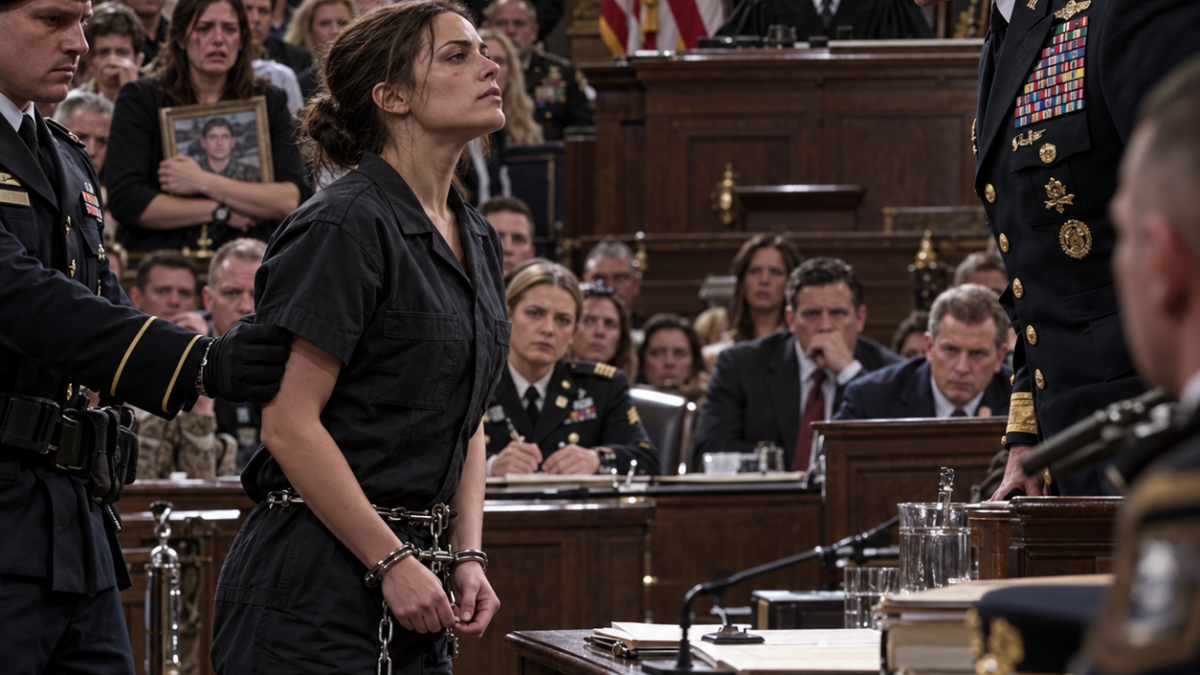
Steel scraping concrete, cold around my wrists, heavy enough to remind everyone watching that I had already been judged before the trial even began.
I kept my head bowed when the doors opened.
Two hundred pairs of eyes turned toward me.
I felt every one of them.
Hatred has weight. People think silence is empty, but it is not. That morning, inside the military courthouse at Fort Bragg, silence pressed against me like a wall. The widows, the sons, the veterans, the officers, the reporters who had been allowed inside because somebody wanted this to be seen—they all looked at me and saw the same thing.
Coward.
Traitor.
Murderer.
I let them.
A woman in the third row clutched a photograph against her chest so tightly her fingers had gone white. I knew her name before I entered the room.
Willow Dawson.
Twenty-six years old.
Married to Private First Class Thomas Dawson for eleven months before he died in Syria.
She had driven from Oklahoma to watch me answer for his death.
Three rows behind her sat Connor Walsh, son of Staff Sergeant Michael Walsh. He had his father’s eyes. I knew that because I had seen Michael Walsh’s eyes through dust and smoke in Raqqa, years before the world decided I had abandoned him.
Connor hated me.
He had every reason to.
At least, every reason he had been given.
“Bring the traitor forward.”
Major General Cyrus Blackwood’s voice cut across the courtroom.
He stood near the front, tall and broad in a uniform weighed down with medals. His face was carved into grief and righteous fury, the kind of expression men like him knew how to wear when an audience needed convincing.
Three of his men had died in Syria.
That part was true.
The lie was everything that came after.
Staff Sergeant Brick Lawson shoved me toward the defense table hard enough to make me stumble. I caught myself before I hit the floor.
A few people laughed.
I heard Colonel Priscilla Harding whisper from the prosecution table, “Look at her. She can’t even raise her head. This is what cowardice looks like.”
I kept my eyes down.
I had spent eighteen months learning the shape of restraint.
In black sites.
In holding cells.
In rooms where men called me butcher, coward, ghost, monster.
The trick was not to stop feeling.
The trick was to feel everything and move nothing.
But when my boots touched the defendant’s platform, instinct moved before permission. My feet shifted shoulder-width apart. My spine straightened. My weight centered itself. My eyes lifted just enough to sweep the room once.
Exits.
Threats.
Weapons.
Uniforms.
Faces.
Blackwood in front.
Harding at prosecution.
Foster beside her, pretending to be invisible.
Fletcher Quinn in the back row, not yet revealed.
Master Sergeant Solomon Garrett three seats from the rear, watching me too closely.
Good.
Somebody in this room still knew how to look.
Judge Candace Morrison entered through the side door, and everyone rose. I did too, chains dragging against the wood in front of me.
“This court-martial is now in session,” she said. “The United States Army versus Sergeant Hazel Anne Thornton. The charges are desertion of post under fire, willful disobedience of a direct order, and conduct unbecoming, resulting in the deaths of three American service members.”
Those names came next.
Staff Sergeant Michael Walsh.
Specialist Eric Johansson.
Private First Class Thomas Dawson.
Every name landed inside my chest.
Not because the charges were true.
Because the men were dead.
And the dead do not care why you failed them.
They only remain dead.
“How does the defendant plead?” Judge Morrison asked.
The courtroom turned toward me.
I said nothing.
Not because I had no answer.
Because my answer belonged to a chain of command no one in that courtroom was supposed to know existed.
Captain Silas Brennan, my assigned defense counsel, stood beside me. He had met me forty-eight hours earlier, had been given almost no access to my file, and had still looked at me with the exhausted frustration of a man trying to defend a locked door.
“Your Honor,” he said, “my client pleads not guilty to all charges.”
The gallery erupted.
Blackwood rose so fast his chair scraped backward.
“This is an outrage,” he barked. “We have video evidence, witness testimony, and three flag-draped coffins.”
Judge Morrison slammed her gavel.
“General Blackwood, you will control yourself or be removed.”
He sat slowly, but his eyes stayed on me.
He wanted me afraid.
He had wanted that since the day he learned I was alive.
Colonel Harding gave the opening statement like a woman laying flowers on a grave she had dug herself.
She told them I had been assigned to a communications relay position during Operation Desert Lance in Deir ez-Zor Province, Syria. She said my job had been simple. Maintain communications. Provide logistical support. Warn the assault team if hostile forces moved.
She said when the moment came, I vanished.
She said I left my equipment behind and disappeared into the night.
She said three American soldiers died because I chose myself over duty.
The widows cried.
The sons clenched their jaws.
The veterans shifted in their seats.
I listened without moving.
Every word she said had been sharpened for pain. Not truth—pain. She knew exactly where to aim. Harding had built a career on making juries feel before they thought.
And this time, she had help.
At the defense table, Captain Brennan tried to fight with a dull blade. He told the court that the story was not as simple as the prosecution claimed. He said evidence had been withheld. He said my service record was incomplete. He said the defense intended to prove that I was not the coward they had made me out to be.
It was weak.
But it was something.
While he spoke, I folded a sheet of paper into a triangle.
Crease.
Turn.
Fold.
Press.
The kind of precise flag fold I had done too many times for coffins no one outside certain rooms ever saw.
Brennan noticed.
Good.
He was starting to see details.
Details save lives.
The first witness was Sergeant First Class Marcus Webb, a communications specialist who had been present during Desert Lance. He looked older than his file photo, heavier around the eyes. War does that. So does guilt.
He testified that he had tried to reach me when enemy movement was detected.
No response.
He found my station empty.
My radio, laptop, and equipment still in place.
I was gone.
Communications failed.
The assault team walked into an ambush.
Walsh, Johansson, and Dawson died before contact could be restored.
When Harding asked whether their deaths could have been prevented if I had stayed at my post, Webb looked at me.
There was no hatred in his eyes.
Only exhaustion.
“Yes, ma’am,” he said. “If we had maintained communications, we could have warned them. We could have called air support. We could have done something other than listen to our brothers die on a radio that didn’t work.”
That almost broke me.
Not the hatred.
Not the names.
That sentence.
Because Webb believed it.
And in a narrow, brutal way, he was right.
If I had remained at that post, the radio might have worked longer.
If the radio had worked longer, maybe a warning would have reached the team.
Maybe.
War is full of maybes.
Maybes are where ghosts live.
Brennan cross-examined Webb carefully. He asked whether Webb had searched my position thoroughly. Whether he had looked for evidence of a struggle. Whether he had considered that I might have been taken, redirected, or acting under orders he did not know about.
Webb admitted his inspection had been brief.
A crack.
Tiny.
But cracks let light in.
By lunch, the prosecution had built their wall.
Soldiers testified.
Reports were quoted.
Edited video was shown from angles chosen to make absence look like guilt.
Through it all, I kept my head bowed and my hands still.
Except once.
While Harding replayed the clipped footage of my empty relay station, I tapped two fingers against the table.
Short.
Long.
Short.
Short.
Stand by.
Again.
Stand by.
Again.
I did not look toward the back row.
I did not need to.
If Quinn was there, he would know.
If anyone else recognized it, that might become useful too.
During recess, they led me to the holding room.
Brick Lawson shoved me into a chair.
“Still quiet?” he sneered. “Nothing to say for yourself?”
There were many things I could have said.
That his grip was lazy.
That his right knee carried an old injury.
That if I chose to stand, he would be on the floor before his hand reached his sidearm.
Instead, I looked at the table.
He hated that most.
Men like Brick confuse silence with weakness because weakness is the only language they understand.
Captain Brennan came in a few minutes later, frustration radiating from him.
“I need you to help me,” he said, sitting across from me. “They’re going to bury you if you keep giving me nothing.”
I looked at him for the first time.
He stopped talking.
Good lawyers read people.
Better ones know when they have misread them.
“Captain Brennan,” I said quietly, “do you believe in the chain of command?”
He blinked.
“Of course.”
“And do you believe that sometimes following that chain requires sacrifices that cannot be explained to people outside the loop?”
His face changed.
“What are you trying to tell me?”
Brick opened the door before I could answer.
“Recess is over.”
He grabbed my arm too hard and yanked me upright.
As he pulled me past Brennan, I lowered my voice.
“Watch Foster.”
Then I let Brick drag me back into the courtroom.
The afternoon changed everything.
Blackwood took the stand like a man accepting applause.
He spoke of Walsh, Johansson, and Dawson as “his men.” He spoke of the command center, the satellite imagery, the final transmissions. He said he had watched soldiers die because support never came.
He did not say he had sold their coordinates.
Not yet.
Under cross-examination, Brennan asked about the classified after-action report.
Blackwood said the full report could not be entered into evidence for operational security reasons.
“Then this court is expected to convict Sergeant Thornton based on a report none of us have seen?” Brennan asked.
“The relevant portions have been provided.”
“Selected by whom?”
Harding objected.
Brennan pushed.
He had found the first real thread.
Then Major Claudette Foster stood from the prosecution table and announced that portions of my file were classified at presidential level.
The courtroom stirred.
Even Judge Morrison looked troubled.
Presidential classification was not a phrase thrown around in ordinary military trials. It was reserved for secrets so deep most generals never touched them.
Brennan turned toward me.
For the first time, I saw fear in his eyes.
Not fear of me.
Fear that he had been assigned to defend a case designed to be impossible.
Good.
He was catching up.
Then the doors opened.
Fletcher Quinn walked in wearing a civilian suit and carrying a federal court order.
“Fletcher Quinn,” he said. “Central Intelligence Agency. I have a federal order requiring immediate suspension of these proceedings.”
The courtroom exploded.
Blackwood rose.
Harding objected.
Judge Morrison demanded verification.
Quinn gave almost nothing away, but when his eyes met mine, he nodded once.
Small.
Controlled.
Enough.
Solomon Garrett saw it.
I watched his posture change.
Old soldiers can smell hidden war even when it enters wearing a suit.
The judge recessed the court for one hour to verify the order. When proceedings resumed, she allowed the trial to continue under observation, but Quinn remained in the back, eyes fixed on me.
That was when Brennan started watching Foster.
He saw what I had already known. Her eyes moving to Blackwood before answers. Her watch checks. Her careful refusal to look directly at me. Her nervous stillness.
Foster had helped him.
Maybe at first because she was afraid.
Maybe later because money had a way of teaching cowards to call fear loyalty.
Captain Ryan Hollister testified next.
A communications officer.
Young.
Nervous.
Still idealistic enough to believe facts mattered if spoken clearly.
Harding called him expecting support.
Instead, he gave her a grenade.
Encrypted transmissions had originated from within fifty meters of Blackwood’s forward command post during Desert Lance.
Not standard military encryption.
Not from my relay position.
When Brennan asked who had access to that area, Hollister answered: the general, his staff, security personnel, and communications support.
“Was Sergeant Thornton assigned to the forward command post?” Brennan asked.
“No, sir.”
“So these unknown encrypted transmissions could not have originated from her position?”
“No, sir. The math doesn’t work.”
The room changed.
Not fully.
Not yet.
But doubt had entered wearing boots.
During the next recess, Brick lost control.
He shoved me into the holding room harder than before.
“You think your CIA friend is going to save you?” he said. “The general wants you in Leavenworth. That’s where you’re going.”
I stayed silent.
He leaned close.
“When this is over, I’ll personally escort you to your cell. I’ll make sure you learn what happens to cowards in military prison.”
Still, I said nothing.
His frustration boiled over.
He grabbed my arm and spun me around.
“Look at me when I’m talking to you.”
The sleeve of my uniform tore.
Cold air touched my shoulder.
Brick froze.
The tattoo was small but unmistakable.
A black widow spider curled around the number seven.
His face drained.
He did not know what it meant.
But some symbols carry their own warning.
“What is that?” he whispered.
I finally looked at him.
Not as the prisoner.
Not as the broken woman they had paraded through the courtroom.
As myself.
Brick stepped back before he understood why.
Brennan burst in.
“Step away from my client now.”
Brick did.
Smartest thing he had done all day.
Brennan saw the tattoo before I pulled the torn sleeve over it.
“What is that?” he asked.
“Not here,” I said. “There are ears everywhere.”
“Then where?”
“Call Agent Quinn. Tell him Ghost 7 has been compromised.”
The name hit him like a slap.
He had heard the myth.
Most serious military lawyers had.
Ghost 7.
The operative no one could confirm existed.
The one attached to impossible extractions, disappeared hostages, dead warlords, rescued diplomats, and operations that ended before anyone admitted they had begun.
Ghost 7 was supposed to be a rumor.
In that holding room, Captain Silas Brennan realized he had been defending a ghost.
When court resumed, the room watched me differently.
Some people had heard whispers about the tattoo.
Others had simply sensed that the trial was no longer moving the way Blackwood intended.
Brennan requested a recess to confer with a material witness. Judge Morrison gave him fifteen minutes.
In the corridor, Solomon Garrett told Brennan what he had seen.
My stance.
My scanning.
My Morse code.
The way I moved even when chained.
“She’s not a communications sergeant,” Garrett said. “She’s tier one. Special mission unit. Her file says what someone wanted it to say.”
Then Brigadier General Ambrose Hartley arrived.
Even before I saw him, I felt the building react.
Some men carry rank.
Hartley carried history.
He had commanded units that officially did not exist, supervised operations that never appeared in records, and sent people like me into countries where no American was supposed to be.
When he entered the holding room, I was sitting alone with my wrists still chained.
For a moment, neither of us spoke.
Then I said, “Ambrose.”
His expression softened.
“Ghost 7.”
I closed my eyes.
“It’s early.”
“The sleeve changed the timeline.”
“I know.”
“It’s time to stop hiding.”
I had imagined that moment for eighteen months.
The moment the mask could fall.
The moment I could tell the truth.
But when it finally came, I felt no relief.
Only exhaustion.
Because the truth would clear my name.
It would not bring back the dead.
Hartley took the stand after Solomon Garrett testified.
Garrett told the court what he had observed. That my bearing was not that of a support soldier. That I had signaled in Morse code. That I moved like someone trained for the kinds of missions most people never learned existed.
Harding objected until her voice sharpened into panic.
Blackwood shouted until Morrison threatened removal again.
Then Hartley rose from the gallery.
“Let us provide evidence,” he said.
The courtroom seemed to hold its breath.
He took the oath.
Brennan asked if he had knowledge of my real assignments.
“I do,” Hartley said.
Then he turned toward the gallery.
“What I am about to reveal has been classified at the highest levels of national security. Under direct authorization, I may disclose what is relevant to this proceeding.”
My heartbeat slowed.
This was it.
Hartley looked at Judge Morrison.
“Sergeant Hazel Thornton is not who the prosecution has portrayed her to be. She is not a communications specialist who abandoned her post. She is not a coward who fled under fire.”
He paused.
“She is Ghost 7.”
The room erupted.
Reporters started writing so fast their pens scratched audibly.
Connor Walsh stared at me like the world had tilted under his feet.
Willow Dawson’s mouth opened, but no sound came out.
Hartley continued over the chaos once Morrison restored order.
“Ghost 7 is a designation known to fewer than a dozen people in the United States government. Colonel Hazel Thornton answers directly to presidential authority, bypassing normal chains of command when national security requires it. In the past six years, she has conducted forty-seven successful hostage rescue and intelligence extraction operations.”
Colonel.
The word reached the room like a second explosion.
Harding looked as if she might be sick.
Blackwood went still.
That was the first honest thing he had done all day.
Judge Morrison leaned forward.
“General Hartley, are you stating that the defendant is a top-secret operative acting under presidential authority?”
“I am not stating it as theory, Your Honor. I am stating it as fact.”
“Then why is she here facing charges?”
Hartley’s eyes moved to Blackwood.
“Because eighteen months ago, during Operation Desert Lance, three American soldiers were killed in an ambush created by a leak inside our own command structure. Ghost 7 was ordered to identify the source of that leak no matter what it cost.”
He turned fully toward Blackwood.
“She found him.”
For the first time since I entered that courthouse, no one moved.
Hartley’s voice lowered.
“Major General Cyrus Blackwood sold the coordinates of American forces to an ISIS affiliate for one point six million dollars transferred through offshore accounts. He knew our men would walk into an ambush. He knew they would die. He did it anyway.”
Blackwood lunged up.
“That is a lie!”
Hartley did not flinch.
“We have bank records. Communications transcripts. Testimony from the intelligence asset Ghost 7 extracted after you compromised his cover. We have enough to bury you under the prison.”
Foster tried to slip toward the side door.
Quinn was faster.
“Major Foster,” he said, blocking her path, “you are under arrest for conspiracy to commit espionage and accessory to murder.”
Her face collapsed.
“He made me,” she whispered. “He said he would destroy my career.”
Quinn secured her wrists.
“Tell it to your own court-martial.”
Blackwood continued shouting as military police moved toward him.
I watched him fight the inevitable with the same arrogance that had killed better men than he would ever be.
And then, for the first time in eighteen months, I let myself breathe.
The mission was not over.
But the lie was.
A large screen was wheeled into the courtroom minutes later.
Ivory Mitchell, the National Security Adviser, appeared from the White House Situation Room.
She confirmed everything.
My designation.
My rank.
The presidential order.
The real reason I had left my relay position in Syria.
I had not abandoned my post.
I had received a direct order to extract an intelligence asset whose cover had been compromised by Blackwood’s leak.
That asset carried proof of the betrayal.
If I had stayed at the relay, the evidence would have died with him.
If I left, communications would fail, and men might die.
There had been no clean choice.
There never is.
I made the choice the mission required.
And for eighteen months, I carried the cost.
Judge Morrison dismissed all charges.
The military police removed my chains with hands that had become suddenly gentle.
I rubbed the raw skin beneath my wrists.
“Colonel Thornton,” Morrison said, her voice thick, “on behalf of this court and the United States Army, I offer my deepest apologies.”
I looked at her.
“No apology is necessary, Your Honor. I knew what the mission required.”
That was true.
It was also not enough.
Solomon Garrett stepped forward and saluted me.
Then another veteran rose.
Then another.
Soon half the room was standing.
Old soldiers.
Young officers.
Enlisted men and women.
People who had entered that courtroom believing they were watching a traitor fall and now stood at attention before a woman they had helped condemn.
I returned the salute.
My arm felt heavier than the chains.
Connor Walsh pushed through the crowd.
His eyes were red.
“My father,” he said. “He used to tell stories about a ghost in Raqqa. Someone who appeared out of nowhere and saved his unit. He never knew who it was.”
“I remember Raqqa,” I said.
I remembered his father too.
Michael Walsh had carried a wounded soldier across open ground while rounds kicked up dust around his boots. He had cursed at me over the radio when I told him to move faster. Brave men often do.
“He protected his people until his last breath,” I said. “When I reached them in Syria, I was ninety seconds too late. I am sorry.”
Connor stared at me for a long time.
Then he raised his hand in salute.
“You tried,” he whispered. “That’s all anyone can ask.”
Willow Dawson came next.
She looked smaller up close.
Grief had hollowed her out.
“I wanted you to suffer,” she whispered. “I said terrible things about you.”
“You wanted justice for Tommy,” I said. “You should have wanted that.”
“I hated you.”
“I know.”
“I’m sorry.”
I took her hands.
“What happened to him was not your fault. Wanting someone to answer for it was not wrong.”
Her eyes moved toward Blackwood as he was led away in handcuffs.
“Someone is answering now,” I said. “The right someone.”
Outside the courthouse, sunlight hit my face for the first time as a free woman in eighteen months.
Blackwood was loaded into a military vehicle.
Foster followed separately, still crying.
Soldiers had gathered across the parade ground. Word had spread through Fort Bragg faster than any official announcement could control. They watched from a distance, unsure whether they were seeing a criminal exonerated or a legend revealed.
Quinn appeared beside me with a folder.
“Briefing for your next mission,” he said. “Whenever you’re ready.”
I looked at him.
“You have terrible timing.”
“You would be disappointed if I didn’t.”
I did not take the folder immediately.
Across the parade ground, soldiers whispered my name.
Ghost 7.
The name had protected me.
Buried me.
Resurrected me.
“They’re calling me a hero,” I said.
“You are one.”
“Heroes get parades. I get classified files and another impossible assignment.”
Quinn’s expression softened.
“That’s the work.”
“I know.”
I took the folder.
A photograph slid out.
A senator in a perfect suit shaking hands with the man who haunted my sleep.
The face was older than when I had last seen it, but I knew him instantly.
Viper.
He had tortured me for seventy-two hours in a Syrian basement, asking for names I would not give him.
He had smiled while electricity tore through my body.
He had promised that if I survived, he would find everything I loved and burn it down.
“Blackwood took money from him,” Quinn said. “But Viper takes orders from someone higher.”
“How high?”
Quinn said nothing.
That was answer enough.
A black SUV pulled up.
Ronan Caldwell stepped out, beard thicker than before, grin unchanged.
“Ghost 7,” he said. “You look like you could use a ride.”
I almost smiled.
“I thought you retired after Mosul.”
“I tried. Then I heard you were in trouble.”
“You hate courtrooms.”
“I hate anyone putting you in chains more.”
For a moment, the world softened.
Then my phone buzzed.
Unknown number.
I answered.
“Ghost 7.”
The voice on the other end was distorted, but recognition crawled down my spine before the second word.
“I thought you were dead.”
Viper.
My hand tightened around the phone.
“I survived.”
“So you did.”
“Blackwood failed you.”
“Blackwood was a useful idiot with gambling debts and wounded pride. The real game has not even begun.”
“Then begin it.”
A cold laugh.
“You took something from me in Syria. A year of work gone in one night. I’ve spent every moment since planning my response.”
“Threats don’t impress me.”
“This is not a threat, Colonel. It is a promise. Everything you care about, everyone you love, every cause you have served—I will burn it all to the ground and make you watch.”
The line went dead.
Ronan’s grin vanished.
Quinn looked at me.
“Who was that?”
I stared at the phone.
“The mission.”
Ronan straightened.
“Orders, Ghost?”
I looked at the folder in my lap.
Blackwood was only one rotten branch.
Viper was the root.
My eyes lifted.
“Begin.”
Site November sat behind miles of forest and more security than most foreign embassies. From the air, it looked like a corporate retreat. Underground, it held technology, weapons, intelligence systems, and ghosts.
My team waited on the steps.
Marcus Chen embraced me first.
Dr. Sarah Webb stood behind him with a medical kit already over her shoulder, because Sarah assumed any reunion involving me would require stitches eventually.
Then I saw Diana Reyes leaning against a pillar.
My breath caught.
“Diana.”
She had been declared dead eighteen months earlier.
“I was,” she said. “For a while. Then I got better.”
It was the kind of joke people like us made because the alternative was crying in hallways we were too proud to collapse in.
Hartley arrived by helicopter and ordered everyone into the briefing room.
Blackwood had talked.
Cowards always do when the consequences finally arrive at their door.
The money trail led through Cyprus, the Caymans, and London, then toward a consortium tied to Senator William Ashworth, chairman of the Senate Intelligence Committee.
One of the most powerful men in Washington.
One of the few with access to secrets deep enough to expose people like me.
“He tried to eliminate me before I could find the connection,” I said.
Hartley nodded.
“Blackwood was supposed to get you convicted and buried somewhere you could be silenced.”
“What about Viper?”
Quinn brought up three maps, five photographs, and a list of intercepted chatter.
“Rebuilding. Recruiting. Targeting military installations, embassy personnel, and…”
He hesitated.
I already knew.
“Say it.”
“Your family.”
My body went cold.
My mother in Vermont.
My brother in Seattle.
My niece and nephew, who knew me only as Aunt Hazel, the one who missed too many birthdays but always sent cards.
“He can’t know about them,” I said.
“Blackwood knew,” Hartley said quietly. “He gave Viper names, addresses, routines.”
I closed my eyes.
I had accepted danger for myself.
I had never accepted it for them.
“Where are they now?”
“Safe houses. Your mother thinks she won a vacation. Your brother was redirected through a fabricated corporate security conference. The children are with him.”
I opened my eyes.
“We move fast.”
“Defensive posture?” Ronan asked.
“No. Offensive. Viper expects me to guard what I love. Instead, we hunt him before he acts.”
Diana nodded.
“And Ashworth?”
“We build the case. Clean. Legal. Public. When he falls, no one gets to call it politics.”
For three weeks, we hunted Viper’s network.
Victor Petrov fell first in Prague.
He woke to find me sitting on the edge of his bed holding the gun he kept under his pillow.
“You’ve been busy, Victor,” I said. “Fifteen million moved through your accounts in six months.”
He lied for four minutes.
Then he told the truth for forty-five.
Petrov gave us names, locations, and access codes to a server farm in Lithuania. That server gave us years of records—money, assets, communications, targets, and a partial dossier on me.
Viper knew more than he should have.
Training records.
Mission reports.
Psychological evaluations.
Family vulnerabilities.
Recommended exploitation.
I read the line twice.
Then I asked to see my family.
Hartley resisted.
I insisted.
The meeting took place in a safe house in Montana.
My mother looked older than the last time I had hugged her.
My brother Thomas listened as I told the truth I had hidden for years.
When I finished, he sat back and stared at me.
“So,” he said slowly, “you’re some kind of super spy, and now a terrorist is targeting us because of you.”
“That’s simplified, but yes.”
“And our choices are live with targets on our backs or disappear.”
“I’m sorry.”
“Don’t.”
His voice cracked.
“Don’t apologize for protecting people.”
My mother took my hand.
“We raised you to serve something greater than yourself,” she said. “Your father would be proud.”
“He would be terrified.”
“That too.”
In the end, they chose to disappear.
New names.
New lives.
A country I would not be allowed to know.
At the airstrip, Thomas hugged me hard.
“Finish it,” he whispered. “Then come find us.”
“I will.”
That promise became the center of me.
Three months later, we found Viper.
Montenegro.
A converted monastery in the mountains, turned into a command center behind stone walls, armed patrols, and electronic countermeasures.
A direct assault would have been suicide.
So I went in alone.
Disguised as a Ukrainian arms dealer, wearing another man’s face, using access codes extracted from one of Viper’s lieutenants.
The first thirty minutes went clean.
I reached the communications center inside the old chapel.
Servers hummed where monks once prayed.
The download began.
Fifteen minutes.
At twelve, the alarm sounded.
A voice came from behind me.
“I wondered when you would finally visit.”
I turned.
Viper stood in the doorway with twelve armed guards.
He looked smaller than my nightmares had made him.
Average height.
Plain face.
Cold eyes.
The kind of man who survived by being forgettable until it was too late.
“Ghost 7,” he said. “Or should I say Colonel Thornton?”
“I remember you well enough.”
“I should hope so. Seventy-two hours is a long time to get acquainted.”
His smile made my skin remember pain.
“You impressed me. Most break in twelve.”
“Sorry to disappoint.”
“On the contrary. Worthy adversaries are rare.”
The guards raised their weapons.
“But all good things end.”
“Before you kill me,” I said, “you should know something.”
He tilted his head.
“What?”
“You weren’t the only one planning for this moment.”
I pressed the trigger on my belt.
Charges I had planted during entry detonated across the fortress.
Not enough to destroy the structure.
Enough to kill power, blind cameras, and throw trained men into darkness.
I moved before the lights died completely.
Night vision contacts adjusted.
Guards shouted.
Bodies fell.
For two minutes, the chapel became a storm of muzzle flashes, shattered glass, and close-quarters violence.
Then Viper got behind me.
His arm locked around my throat.
His strength surprised me.
“Did you think it would be easy?” he hissed. “I prepared for you for years.”
Air vanished.
My vision narrowed.
His mouth brushed my ear.
“Your family is safe for now. But I know where they are. I always know.”
Something inside me went still.
Not calm.
Not rage.
Something older.
Survival stripped to bone.
I went limp.
He loosened his grip by instinct.
It was enough.
I drove my elbow into his ribs, turned, struck his throat, and watched him fall to his knees gasping.
I stood over him.
“You were right about one thing,” I said. “You prepared for me for years. But you prepared for the woman you tortured in that basement.”
I leaned closer.
“I am not her anymore.”
The backup lights came on as my team breached the room.
Ronan entered first, weapon trained on Viper.
“Ghost?”
“I’m fine.”
He looked at the bodies.
“Your definition of fine remains concerning.”
“Get him out. We have questions.”
Two weeks later, I stood in a Washington courtroom and watched Senator William Ashworth hear the word guilty on every count.
Treason.
Conspiracy.
Accessory to murder.
Espionage.
The evidence was overwhelming.
The server records.
The financial trail.
Viper’s cooperation, offered only because men like him love survival more than loyalty.
I felt no triumph.
Only completion.
Outside the courtroom, Connor Walsh waited in uniform.
Military intelligence insignia.
“I requested a transfer,” he said. “Training starts next month.”
I studied him.
“This path takes things from you.”
“I know.”
“No,” I said. “You don’t. Not yet. You’ll lose friends. You’ll lie to people you love. You’ll make choices between bad and worse and live with both.”
His eyes did not move.
“My father believed service mattered even when no one saw it.”
“He was right.”
“You showed me that too.”
I reached into my pocket and pulled out a black challenge coin marked with a widow spider and the number seven.
“This belonged to someone who didn’t make it back,” I said. “I carried it until I found someone worthy.”
I placed it in his palm.
“Be worthy.”
His fingers closed around it.
“Yes, ma’am.”
That evening, I walked alone across Memorial Bridge as the sun set over the Potomac.
Viper was in custody.
Ashworth would die in prison.
Blackwood would spend whatever remained of his life remembered not as a decorated general, but as the man who sold his soldiers for money.
My record was clean.
My name, at least in the rooms allowed to know it, had been restored.
But I knew better than to mistake resolution for peace.
The work was never finished.
It only changed names.
My phone buzzed.
Hartley.
Situation developing in Southeast Asia. Asset extraction required. Team requested. Briefing in six hours.
I read the message twice.
Then I looked across the river toward the monuments glowing in the fading light.
Stone promises.
Names carved into silence.
Lives spent for words like freedom, justice, duty, country.
I thought of Willow Dawson holding her husband’s photograph.
Connor Walsh standing with his father’s grief in his eyes.
My mother and brother living under names I could not know.
Ronan carrying coffee into rooms where neither of us could sleep.
The courtroom where they had put me in chains and called me a traitor.
And the moment the chains came off.
Some people believe heroes are the ones standing in the light.
They are wrong.
Sometimes the people holding the line do it from shadows so deep their own families never know where they are.
Sometimes duty means letting the world misunderstand you because the truth would cost more than your pride.
Sometimes justice arrives late, bruised, exhausted, and wearing the face of someone everyone thought was already defeated.
I put the phone away and started walking.
My wrists still bore faint marks from the chains.
I did not hate them anymore.
They reminded me what I had endured.
What I had chosen.
What I was still willing to pay.
My name is Hazel Thornton.
Some people call me Ghost 7.
And somewhere beyond the reach of daylight, another life was waiting to be saved.
So I walked toward the next mission.
Because some battles are worth fighting when the cost is everything.
Especially then.