𝗙𝗨𝗟𝗟 𝗦𝗧𝗢𝗥𝗬 The Captain Whispered the Name I Had Buried Six Years Ago
𝗣𝗔𝗥𝗧 𝟮
Most people carried chargers, toiletries, headphones, maybe a sweater.
Mine had a paperback jacket folded around a pressure sleeve, medical tape, a thumb-sized flash drive, two improvised restraints, a strip of reflective mylar, and a compact access tool capable of opening nearly any panel on a Boeing aircraft if a person knew where to press.
I had promised myself I would stop carrying things like that.
I had broken that promise every time I entered an airport.
My hands were steady as I stood.
The fog lifted.
Emma Price stayed in seat 9A with the unopened paperback.
The woman who followed Captain Ror down the aisle was someone else.
Someone I had hoped never to become again.
The passengers barely noticed us.
That was the trick. People notice panic. They notice running. They notice raised voices and sudden instructions. They rarely notice purpose if purpose wears the right expression.
We reached the forward galley, where a flight attendant looked up in surprise.
She was in her thirties, sharp-eyed, with a name tag that read Cheryl. She saw me, then the captain, and knew enough to be confused without becoming loud.
“She’s assisting with a systems review,” Ror said. “I need a spare crew shirt and access to the service panel.”
Cheryl hesitated for one second.
Not because she doubted him.
Because good crew members notice when normal changes shape.
Then she handed me a folded blue uniform top.
“Name tag?” I asked.
She unclipped a spare from the galley drawer and gave it to me.
It read M. Ellis.
Close enough.
I changed quickly in the narrow service space, tucking my hoodie into my bag. With the shirt buttoned and the tag clipped high enough to be visible but not memorable, I looked like staff to anyone who didn’t know the crew list.
The old self slid over me like a shadow.
Nobody.
Nowhere.
Useful.
Ror led me to the secondary access area behind the galley. The panel looked ordinary from a distance, but I saw the signs before I touched it.
A faint scrape along the latch.
Dust disturbed near the lower edge.
A partial tread mark too narrow for standard crew shoes.
I crouched.
“Someone opened this.”
“Could maintenance have missed a closure before departure?”
“No.”
I ran one gloved finger along the floor and held it up.
Fresh dust split cleanly against skin.
“This was accessed in flight.”
Ror crouched beside me.
“What are we looking at? Sabotage?”
“Something more precise.”
I opened the latch and studied the wiring beyond the panel. Nothing obvious. No crude explosive. No severed connection. No loose relay hanging in plain sight.
That made me more afraid, not less.
“Someone doesn’t want to crash this plane,” I said.
Ror stared at me.
“Then what do they want?”
“To control where it goes.”
His face tightened.
“Why not hijack it the old-fashioned way?”
“Because the old-fashioned way creates witnesses. Panic. Cell phone footage. Military response. This way, the aircraft reroutes quietly, goes dark gradually, lands somewhere it was never supposed to be, and everyone aboard becomes a mystery.”
He whispered the phrase before I did.
“Ghost flight.”
I nodded.
“Exactly.”
His radio crackled.
Cheryl’s voice came through calm, but too controlled.
“Captain, we have a passenger disturbance near the forward economy restroom. Nothing alarming yet, but the behavior is unusual.”
Ror looked at me.
I closed the panel.
“Show me.”
We moved through the curtain and into the aisle.
Near row 13, the beige-jacketed man I had noticed during boarding stood close to the restroom door. He wasn’t speaking to anyone. Wasn’t waiting like a passenger who needed the lavatory. He held one hand too near his coat pocket and kept glancing toward the cockpit, then toward the underfloor access area.
Too calculated.
Too patient.
“He’s watching access points,” I murmured.
The man looked at me.
Only for a second.
It was enough.
Recognition flashed across his face—not of who I was, but of what I was. Trained bodies recognize trained bodies. Predators know when another predator enters the room.
He turned toward the restroom.
His hand moved inside his jacket.
“Move,” I said.
Ror stepped back without argument.
I grabbed a coffee tray from the service cart as I passed. Not because I needed it to serve coffee. Because anything flat and rigid can become a shield, a wedge, or a weapon if desperation asks nicely.
The man slipped into the lavatory.
I waited five seconds.
Ten.
Then knocked.
“Sir? Flight attendant. Just checking if everything’s all right.”
No answer.
I waited two more seconds, because procedure matters even when time doesn’t.
Then I opened the exterior latch with my tool and disengaged the lock.
The door clicked open an inch.
Inside, the man froze in a crouch beside the sink panel.
Something black and rectangular rested in his hand.
Not a gun.
Worse.
A portable transmitter, wired through an exposed service connection, pulsing with a low green light.
I drove my shoulder into the door.
It slammed inward, catching him off balance.
He reacted fast.
Faster than I expected.
He shoved upward, trying to pin my arm against the doorframe. I jammed the coffee tray into his ribs and used the impact to break his line. His hand clawed toward the device. I caught his wrist, twisted, and drove him face-first against the lavatory wall.
The space was too small for graceful fighting.
There was only breath, bone, metal, and the ugly intimacy of violence at arm’s length.
He tried to throw his weight back.
I stepped outside his base, folded his arm behind him, and pushed until his body understood I could take the joint if I wanted.
“You’re done,” I hissed.
The transmitter hit the floor with a soft clunk.
He went still.
I zip-tied his hands behind his back, stripped him of anything obvious, and checked his mouth for capsules or blades. He carried no ID. No phone. No wallet.
A ghost passenger with equipment.
Bad sign.
I dragged him into the aisle by the collar.
A few heads turned.
I smiled with the kind of calm people accept from flight crews because they need to.
“Passenger’s unwell,” I said. “We’re moving him forward.”
The lie held.
For now.
In the galley, Cheryl locked the curtain while Ror stared at the transmitter in my hand.
“What does it do?”
I turned it over.
“Midair override relay. It taps into navigation input. Not strong enough to take full control by itself, but enough to redirect signals, maybe mask course deviations.”
“Do we land?”
“Not yet.”
His eyes widened.
“Not yet?”
“This feels too obvious.”
“It’s a transmitter hidden in a lavatory wall.”
“Exactly.”
Ror understood then.
“A decoy.”
“Or the first layer.”
The man we had restrained said nothing. His face was pale, but his eyes stayed flat.
Professional.
I looked toward the cabin.
Dozens of passengers sat behind thin curtains, sipping coffee, watching movies, sleeping through the first stage of their own disappearance.
“We have a second operative onboard,” I said.
Ror went quiet.
“How sure are you?”
“Certain.”
I asked for the flight manifest.
He handed me his tablet.
I scrolled through the names, seat assignments, boarding scans, and ID confirmations. Most looked routine. Then my finger stopped.
14C.
No verified boarding scan.
No ID image.
No payment trail.
No security clearance.
Nothing.
But I had seen a man near row 14 during boarding.
The same beige jacket.
“Seat 14C doesn’t exist,” I said.
Ror leaned closer.
“There’s a passenger in that seat.”
“No. There was a person sitting there. That’s different.”
I stepped back into the cabin.
Seat 14C was empty.
Tray table down. Magazine open. Half-read appearance. Too staged.
“Where did he go?” I asked Cheryl.
She followed my gaze.
“Forward restroom ten minutes ago. Alone.”
That couldn’t be right. The man we restrained had entered the forward lavatory near row 13, not from 14C. Either we had misread the seat movement, or someone had used him as cover.
My stomach tightened.
I moved toward first class.
The passengers there were quieter, more insulated by money and curtains. Drinks on trays. Tablets propped on knees. Shoes removed with entitlement. Only one person looked wrong.
A woman in sunglasses sat near the window, hands folded, posture too still.
No carry-on at her feet.
No phone.
No headphones.
No drink.
She sat like a person waiting inside a decision.
I paused beside her row.
Her face turned toward mine.
She didn’t blink.
I looked up.
The overhead bin above her seat sat slightly ajar.
Mid-flight, bins stayed latched unless someone had touched them.
“Ma’am,” I said, “is this your bag?”
She didn’t answer.
I reached up and opened the bin.
A sleek black carry-on rested inside. I pulled it down carefully.
Too heavy.
Something shifted within it with a dense metallic clunk.
The woman moved.
Not much.
A twitch in her fingers. A shift in her neck.
Enough.
I stepped back, set the bag on the floor, and unzipped it just enough to see inside.
Gray metal box.
Clean edges.
No branding.
Digital screen active.
Blue light pulsing faintly.
This transmitter was not crude. It was elegant. Expensive. Built by people who did not expect to be caught and did not fear whoever might try.
The woman smiled.
“You’re not just here to ride along,” I said.
“Neither are you,” she replied.
Then she lunged.
I expected it and still barely had time.
She came across the aisle with controlled violence, not panic. Military or private operations—I couldn’t tell which. She struck for my throat, not my face. That told me enough.
Passengers screamed.
A drink tray overturned.
Glass shattered somewhere behind me.
I caught her wrist, turned with the momentum, and drove her shoulder into the side of a seat. She shifted, hooked her leg behind mine, and nearly took me down. Good technique. Too good for a courier.
I gave ground instead of fighting for it, then slammed my forearm across her line and used the narrow aisle against her. She tried to reach for the bag. I blocked her with my hip.
Cheryl appeared with restraints.
Smart woman.
The attacker twisted hard enough to tear skin from my knuckles, but I got leverage on the wrist, folded her down, and pinned her against the armrest.
Twenty seconds after she moved, she was cuffed to the seat.
The cabin had become chaos.
“What is happening?” someone shouted.
“Are we in danger?”
“Sit down!” Ror ordered, using the voice captains reserve for storms and panic. “Everyone remain seated. Now.”
Authority worked when delivered by someone who believed in it.
Most obeyed.
I knelt by the bag.
The device was still active.
“Scanner,” I said. “Or a mirror. Anything reflective.”
Ror handed me his phone.
I used the screen to view the display at an angle without touching the box directly.
Biometric lock.
Fingerprint or retinal scan.
Possibly a dead switch.
If I tampered with it wrong, it could wipe data, activate a command, or transfer control to whatever system it was already communicating with.
I looked at the woman.
“What’s the broadcast target?”
She said nothing.
“Altitude?” I asked Ror.
He checked his panel through the cockpit feed.
“Thirty-seven thousand. We should be tracking east.”
“Should be?”
His face went pale.
I knew before he said it.
“We’ve been diverted.”
I looked at the device again.
Slowly. Quietly. Over the past thirty minutes, the aircraft’s navigation had been nudged away from its approved route, not sharply enough to trigger panic, but steadily enough to matter.
“This isn’t a hijack,” I said. “It’s an extraction.”
Ror stared.
“Extraction of what?”
“Either someone onboard, or something.”
The screen showed coordinates.
Remote northern Canada.
An unmarked landing strip.
No commercial traffic.
No witnesses.
The woman in sunglasses finally spoke.
“You’re very good.”
I met her eyes.
“And you’re not good enough.”
Her smile didn’t fade.
That bothered me.
Cheryl brought the med kit, alcohol pads, and duct tape.
Ror crouched beside me.
“What are you doing?”
“Biometric locks use sensor loops. If I can lift enough of her print and reduce distortion, I might bypass the primary lock.”
“You can do that with tape?”
“I’ve done it with worse.”
That was true.
Syria. A basement under a pharmacy. Two minutes of battery left and a dead man’s thumb cooling in my hand.
I pushed the memory away.
I pressed duct tape firmly to the restrained woman’s thumb and peeled it off slowly. Fine ridges glistened in the adhesive. Primitive, unreliable, ridiculous.
Sometimes survival is all three.
I pressed the lifted print to my own thumb, dampened the surface lightly with alcohol, and placed it on the scanner.
Denied.
I adjusted the angle.
Denied.
Ror whispered, “We have twelve minutes until full external integration.”
“I know.”
Third try.
Beep.
Access granted.
Admin mode.
I exhaled.
“We’re in.”
“Can you shut it down?”
“No,” I said. “But I can lie to it.”
I entered the internal shell and redirected the transmission path, sending false feedback to the destination node while scrambling the command chain. The code pushed back. Dynamic defenses. Adaptive.
Whoever built this had money, access, and patience.
Sweat gathered at my temple.
The countdown ticked lower.
Seven minutes.
Five.
Three.
The device vibrated once.
Then the blue pulse stopped.
“Done,” Ror said.
“No.”
I stared at the screen.
The transmitter had stopped broadcasting, but it hadn’t died.
It had transferred command.
The woman smiled.
Ror saw it too.
“Why is she smiling?”
“There’s another component,” I said.
The words tasted like metal.
“This one was bait.”
We searched fast.
Cheryl and the crew moved through the cabin under the cover of a “temporary systems inspection.” Ror kept his voice calm over the intercom. I used my phone camera, modified through a scanner attachment, to search for heat signatures from active circuitry.
Row by row.
Bag by bag.
Faces watched me now. Some afraid. Some angry. Some too shocked to understand that fear was late.
At row 7, my phone beeped.
Overhead bin 7B.
I opened it carefully.
Inside was a standard black backpack.
Under a travel pillow sat a palm-sized cylinder blinking red.
Countdown active.
Two minutes, thirty-three seconds.
“Found it,” I said into the radio. “It’s counting down.”
Ror’s voice came back tight.
“We’re three minutes from the reroute trigger.”
I sat on the aisle floor and opened the device with my multitool.
No schematics.
No labels.
Three wires.
Red. Blue. Yellow.
Classic triple failsafe, or designed to look like one.
Wrong cut wouldn’t explode the aircraft.
That would be too crude.
It would lock the navigation system irreversibly and finish the ghost flight.
I forced my breathing to slow.
Think.
Red carried power. Blue stabilized timing. Yellow sat too cleanly near the initiator circuit.
Too obvious.
Or obvious because it was true.
My cutter hovered over red.
Behind me, someone prayed.
I cut.
The blinking stopped.
The entire cabin seemed to exhale.
Ror’s voice came through seconds later.
“Systems returning. Chicago has us on radar. We’re back on course.”
I stood slowly, cylinder in hand.
“It’s over,” Cheryl whispered.
I wanted to believe her.
Then the woman in sunglasses spoke from first class.
“You stopped the plane,” she said. “Not the delivery.”
I turned toward her.
“What delivery?”
She leaned back against the seat, cuffed and bruised, and said nothing more.
The second stage of fear is quieter than the first.
The first stage screams.
The second asks what you missed.
I walked back to row 14.
The beige-jacketed man sat restrained and sedated near the service area now, but his seat remained in my mind like an unfinished sentence. I checked the area beneath and around it.
That was when I saw the duffel.
Slightly torn zipper. Too exposed. Too available.
Planted within reach, but not hidden well enough for a bomb.
I pulled it out.
Inside, wrapped in black cloth and carbon-lined mesh, was a reinforced steel case.
No commercial tags.
No airline scan sticker.
No serial.
Too heavy for ordinary luggage.
I placed it on an empty seat and opened the outer latches.
A titanium briefcase sat inside.
Digital lock.
Shielded core.
Military-grade construction or better.
Ror stared at it.
“What the hell is that?”
“Data storage,” I said.
“Stolen?”
“Almost certainly.”
“And valuable enough to reroute a commercial flight.”
I looked toward the restrained woman.
“That’s why she didn’t care if we stopped the transmitters. The plane only had to get far enough off course before we found the case.”
Cheryl approached with a folded boarding document.
“You need to see this.”
The document was nearly perfect.
Nearly.
Wrong spacing near the seal. Slight font inconsistency on the seat assignment. Forged by someone talented, but rushed.
Seat 10A.
A young man sat there wearing a hoodie, earbuds, and a backpack across his lap.
When we approached, he looked up and smiled.
Not confused.
Not frightened.
Waiting.
“Mind stepping into the galley?” I asked.
“Sure,” he said. “Let me grab my bag.”
“No need.”
His smile thinned.
I placed one hand lightly on his shoulder.
“We’ll come back to it.”
He stood without resistance.
That alone told me he had been trained to be caught.
In the galley, I faced him.
“You’re not on the manifest.”
“Lucky seat, I guess.”
“Is the case yours?”
“Haven’t seen it.”
“You’re too calm for a passenger caught in federal-level interference.”
He shrugged.
“You’re the mule,” I said. “The woman was a distraction. The man in the beige jacket triggered the alert and drew me into the system. But you were the carrier. You were supposed to walk off this aircraft with the payload after everyone else looked the wrong way.”
His smile faltered.
There it was.
A crack.
“That case contains stolen data,” I said. “Maybe state secrets. Maybe agency profiles. Maybe weapons protocols. You don’t know exactly what it is, do you? You only know where you’re supposed to take it.”
He stayed quiet.
“Who activated you?”
“I don’t know.”
“Who trained you?”
Silence.
I leaned closer.
“Someone from my world.”
His eyes flicked up.
Not enough for an answer.
Enough for confirmation.
I radioed the cockpit.
“We have the payload and the carrier. Full lockdown when we land. No one leaves without federal clearance.”
“Understood,” Ror said. “O’Hare is being alerted.”
The young man sat on the galley floor, still smiling faintly.
I hated that smile.
It didn’t look like defeat.
As we began descending toward Chicago, I returned to row 9 and sat with the titanium case secured at my feet.
The clouds below us opened in torn layers.
Chicago appeared under gray light, huge and ordinary and completely unaware that an aircraft full of civilians had almost vanished into a northern nowhere because someone wanted a box delivered quietly.
My hands rested in my lap.
For six years, I had tried to build a life small enough that no one would come looking for me.
Now someone had used a commercial flight, three operatives, spoofed navigation, and a dead code name to drag me back into the open.
The question was not whether they knew where I was.
The question was why they wanted me seen.
Flight 717 touched down at O’Hare with a soft jolt.
Passengers clapped the way passengers do when they don’t understand how close the ground came to never receiving them.
We taxied toward the gate.
Captain Ror came back and sat beside me for a moment, his face pale with exhaustion.
“Federal agents are waiting,” he said. “Marshals are sweeping the terminal.”
“The kid?”
“Nothing. No fingerprints. No identity match. He’s a ghost.”
“He was never meant to be caught,” I said.
Ror looked at the case.
“This whole thing was noise.”
“Yes.”
“To cover one quiet delivery.”
I nodded.
Cheryl approached us, holding a phone in both hands as if it might bite her.
“Emma,” she said, voice tight. “A secure message just came through ground control. It’s addressed to you.”
My skin went cold.
“What does it say?”
She handed me the phone.
The message was short.
You weren’t supposed to be on that plane.
But now that you are—
Welcome back, Valkyrie One.
I stared at the words.
Oracle was one name.
Valkyrie One was older.
Deeper.
Buried under ash and blood and a file no one alive was supposed to have opened again.
Ror read over my shoulder.
“That’s a warning.”
“No,” I whispered. “That’s a call sign.”
The seat belt sign chimed off.
No one moved until agents boarded.
Four federal officers entered with two TSA enforcement personnel behind them. The lead agent was stiff-jawed, impatient, and already annoyed that the scene did not belong fully to him.
“Ma’am,” he said, reaching toward the titanium case, “we’re under instruction to confiscate—”
“Don’t touch it.”
He stopped.
I stood.
“That case contains classified material. If you put your hands on it without proper clearance and chain-of-custody protocol, your fingerprints will end up in a file you’ll never be allowed to read.”
He looked at Ror.
The captain’s voice was quiet but firm.
“Chain of custody starts with her.”
After a moment, the agent stepped back.
The three suspects were removed one by one.
The woman in sunglasses did not look at me.
The beige-jacketed man kept his head down.
The young courier turned at the jet bridge and gave me the smallest smile.
As if he had still completed the mission.
An hour later, I sat in a secure lounge deep inside Terminal 3 with the titanium case on a metal table in front of me.
Across from me sat a man in a gray federal coat with no name badge.
He dropped a folder between us.
ECHO DIRECTIVE — DEACTIVATED.
“Funny thing,” he said. “We were told this project was mothballed. Then someone uses a defunct agent’s code name to divert a national flight and smuggle classified intelligence, and you just happen to be sitting in row nine.”
“I was on vacation.”
He didn’t smile.
“Of course.”
“What’s your name?”
“Quinn.”
“First or last?”
“Yes.”
I almost smiled.
Almost.
He opened the folder.
“How did the pilot recognize Oracle?”
“You should ask whoever sent the message.”
“I’m asking you.”
“If I knew who reopened Echo, Agent Quinn, I wouldn’t be sitting here. I’d be hunting them.”
He studied me for a long moment.
Then he slid a surveillance still across the table.
Airport terminal.
Departure board.
Crowds moving in blurred lines.
One man standing still.
Black suit. Silver at the temples. Hands folded in front of him. Watching the gate.
My throat tightened.
Thomas Varelli.
My handler.
My mentor.
The man declared killed in Istanbul three years earlier when a car bomb burned so hot they identified him by dental fragments and the shape of a watch recovered from the wreckage.
“He’s dead,” I said.
Quinn watched me carefully.
“He was.”
I picked up the photo.
Varelli looked older, sharper, but alive.
And he was watching my flight.
Quinn said, “Your case just changed classification.”
“No,” I said, still staring at the image. “It just got honest.”
“What does he want?”
I thought of the message.
Welcome back, Valkyrie One.
“He wants me back on the board,” I said. “And he used a plane full of civilians to move the first piece.”
The titanium case took two hours to open safely.
When Quinn returned, his face had changed.
Not fear exactly.
Something worse.
Respect for danger.
“We decrypted part of the contents,” he said. “There’s metadata buried inside a dummy file three levels deep. One name appears again and again.”
I already knew.
Still, hearing him say it hurt.
“Mine.”
He nodded.
“They planted it,” I said. “Varelli wanted me flagged, monitored, tracked.”
“Why?”
“Because I’m the only person who understands how he thinks.”
Quinn placed a laptop in front of me.
A file opened.
OPERATION GLASS CITADEL.
The screen filled with a map of the United States.
Red markers pulsed across Los Angeles, New York, Seattle, Norfolk, and other sites most civilians would never know existed. Secure intelligence hubs. Cyber defense relays. Offshore server routes. Naval communications. Satellite routing stations.
Not targets to destroy.
Targets to blind.
The plan was not to bomb cities.
It was to sever the country’s nervous system before anyone knew a war had begun.
Quinn’s voice lowered.
“What is this?”
I stared at the pulsing map.
“The first strike in a war no one knows has already started.”
That night, I entered a safe house outside Chicago under a name that hadn’t been used in seven years.
The place smelled like dust, old wiring, and wet pavement. Rain ticked softly against the cracked window.
I stood beside the table while Quinn worked official channels he knew better than to fully trust.
At 11:43 p.m., someone knocked.
Three short.
One long.
My hand moved before I thought.
Then I opened the door.
Lena Torres stood in the rain wearing a leather jacket and the same expression she had worn the night Echo burned—half fury, half grief, all survival.
She had been my closest ally once. A tech operative who could make locked systems confess secrets and make satellites look the wrong way. Officially, she had vanished into Mexico after Echo dissolved.
Unofficially, I had hoped she was alive.
Seeing her proved hope could hurt.
“Didn’t think I’d see you again,” she said.
“Didn’t think I’d still be alive.”
She stepped inside.
“They sent the message through the case?”
I nodded.
“Varelli’s alive.”
Her face hardened.
“Then he’s not chasing ghosts. He’s making one.”
We worked through the night.
Files. Maps. Old kill orders. Buried authorizations. A list of Echo team members marked compromised after the directive was supposedly dismantled.
Lena found the worst one.
My file.
Photo attached.
Status: compromised asset.
Priority: elimination.
Authorization: T. Varelli.
For a moment, the room narrowed until all I could see was his signature.
The man who trained me had not died.
He had killed the program around himself and taken its bones with him.
“He didn’t go rogue,” Lena said quietly.
“No,” I replied. “He became the system.”
By dawn, we had one lead.
A hacker in Brooklyn known as Dustwatch had brushed against Glass Citadel’s outer architecture months earlier and lived long enough to sell rumors about it.
Midnight in Brooklyn was cold and mean.
Lena and I found him in an abandoned subway terminal beneath a line nobody admitted still had power. He sat surrounded by modified laptops, battery banks, and cables like black vines.
He looked barely twenty.
“You brought Valkyrie,” he said without looking up. “That’s either brave or stupid.”
“We need the key code Varelli embedded inside Glass Citadel,” I said.
That made him look up.
“You know its name.”
“I know enough.”
I tossed the decrypted drive onto his keyboard.
He worked fast.
Too fast for comfort.
Screens flickered. Code spilled across displays. A digital globe spun and then narrowed to four points.
Latvia.
Romania.
Ukraine.
Switzerland.
A diamond pattern.
Lena leaned closer.
“What are those?”
“Routing beacons,” Dustwatch said. “Not command centers. Mirrors.”
The center point resolved.
Geneva.
A diplomatic shadow zone.
No ordinary warrant would reach it fast enough. No official strike would avoid starting five arguments between agencies and three between countries.
Varelli had chosen the location perfectly.
Of course he had.
Ror rejoined us through Quinn’s unofficial network. He had no business coming deeper into this, but some people discover who they are only after terror gives them a mirror.
“We have two options,” he said. “Leak this and trigger chaos, or cut the head off quietly.”
I looked at the Geneva coordinates.
“Quietly.”
The infiltration began before sunrise two days later.
No official gear. No insignia. No operation name anyone would admit existed.
Just me, Lena, Ror in a support role he had no clearance for but enough courage to accept, and the truth Varelli had buried under too many bodies.
The facility sat beneath a dormant private bank in Geneva, wrapped in surveillance, diplomatic protections, and enough counterintrusion systems to trap a small army.
We weren’t a small army.
That helped.
Armies are loud.
Ghosts are not.
Lena spoofed the outer access. Ror watched timing windows. I moved through sterile underground corridors with a suppressed weapon in my hands and the old life breathing against the back of my neck.
At the end of a steel-paneled chamber, the lights flickered on.
Thomas Varelli stood waiting.
Older.
Leaner.
Dressed in a white shirt open at the throat.
Calm as a priest before confession.
“Emma,” he said.
Hearing my real name in his voice made something in me go dangerously still.
“I wondered how long it would take.”
I raised my weapon.
“You sent the case. You baited me.”
“I resurrected you.”
“You framed me.”
“I reminded the world you existed.”
“You used civilians.”
His expression didn’t change.
“I used leverage.”
That was Varelli. Always language first. Dress brutality in strategy and call it necessity.
“Glass Citadel gives us control,” he said. “Not chaos. Control. The world is too fragile to be left to elected amateurs, competing agencies, and frightened committees.”
“You’re not protecting the world,” I said. “You’re blackmailing it.”
“Perspective.”
“You signed kill orders on your own team.”
He looked almost sad.
“Echo was compromised.”
“No,” I said. “Echo became inconvenient.”
He stepped closer.
“You were always the best of us.”
“I was the last person you failed to own.”
His smile faded.
For the first time, I saw anger under the silk.
“That’s why I needed you back.”
Then the lights died.
Movement flashed in the dark.
I fired once.
The muzzle flash carved his face out of blackness for half a second.
Varelli dropped.
Alarms erupted.
Red light flooded the chamber.
Lena’s voice cracked in my ear.
“Emma, you’ve got ninety seconds!”
I ran to Varelli and tore the encrypted core from the watch on his wrist. Beneath his collar, hidden under skin-colored adhesive, was a data ring.
I took that too.
His hand caught my wrist.
Blood darkened his shirt.
He looked up at me, smiling through pain.
“You’ll understand eventually.”
“No,” I said. “That’s the difference between us.”
I pulled free and ran.
Guards flooded the corridor.
Ror met me near the stairwell, covering the exit while bullets sparked off steel behind us.
“You got it?” he shouted.
I held up the ring.
“I got enough.”
Glass Citadel collapsed within forty-eight hours.
Not publicly.
The public received weather, traffic, market updates, celebrity scandals, and a brief statement about “international cyber irregularities” resolved through interagency cooperation.
Behind closed doors, the data ring reached a secure Senate subcommittee. Rogue assets were arrested. Intelligence hubs were patched. Foreign partners denied involvement while quietly burning compromised channels. Varelli’s network fractured because men like him always mistake fear for loyalty.
And me?
I left before anyone could build a podium.
I sat alone on a bench at O’Hare Airport three days later in a wig, glasses, and civilian clothes.
Another flight was boarding.
Another seat waited.
Another attempt at disappearance.
Captain Ror passed near the gate. He was not in uniform this time. He paused beside me and leaned down.
“Valkyrie One,” he whispered.
My heart clenched.
For one terrible second, I thought it was beginning again.
Then he slipped a folded note into my hand and kept walking.
I opened it only after he disappeared into the crowd.
It contained one sentence.
This time, choose yourself.
I sat there until the final boarding call ended.
Then I stood, walked away from the gate, and vanished into the terminal.
Weeks later, a small outlet reported that the Glass Citadel data ring had self-wiped within twenty-four hours of entering federal custody. No backups. No recoverable trace. Analysts called it a catastrophic failure. Officials called it unfortunate.
They were wrong.
I wiped it myself.
Not to protect Varelli.
Not to protect Echo.
To protect the world from every person who would look at that machinery of control and convince themselves they were righteous enough to use it.
Power like that never stays locked in the hands of good people.
It teaches good people how to become something else.
After that, Emma Price disappeared too.
No dramatic goodbye. No grave. No medal. No name carved into stone.
Just an empty apartment, dead basil in a clay pot, a mailbox full of ordinary flyers, and a paperback left open on a kitchen table.
People like me don’t get clean endings.
We get quieter ones.
And somewhere beyond every manifest, every watchlist, every dead directive men like Varelli tried to resurrect, I finally found the kind of silence I had been chasing for six years.
Not the silence of hiding.
The silence of choosing not to become the weapon they built.
The woman in row 9 was gone.
But for the first time in my life, I was not lost.
𝗧𝗛𝗘 𝗘𝗡𝗗
The Captain Whispered the Name I Had Buried Six Years Ago
I boarded the flight as Emma Price, just another quiet woman in a blue hoodie with a paperback in her hands.
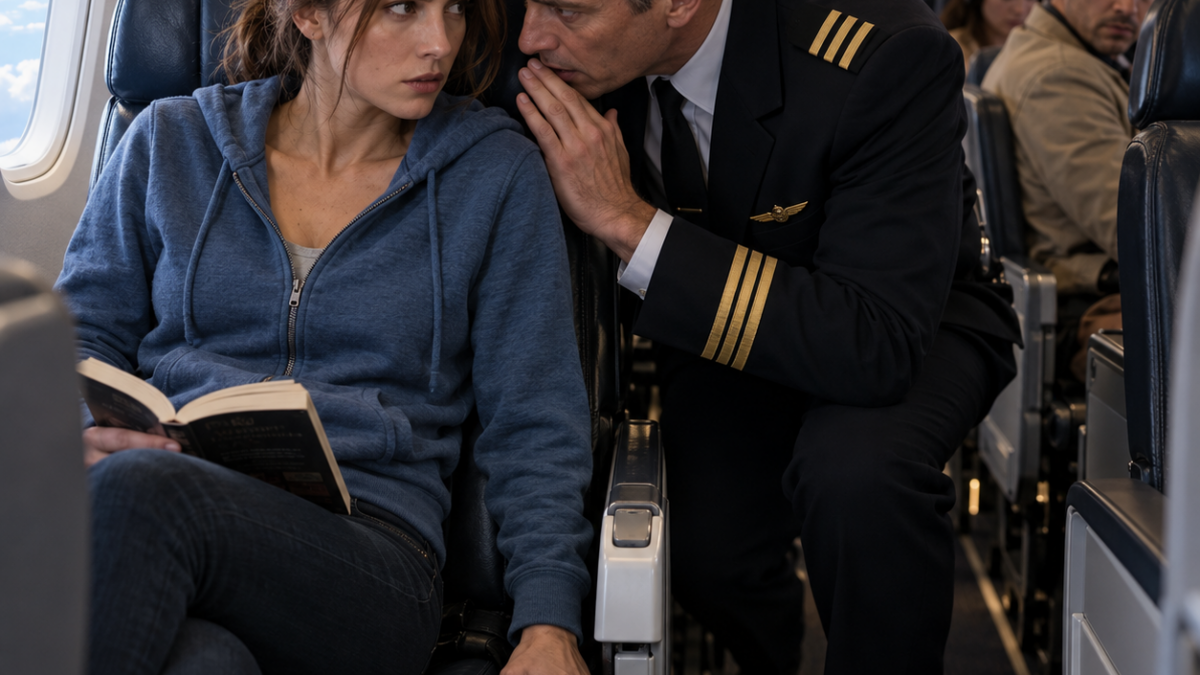
Thirty minutes later, the captain leaned beside my seat and spoke a code name that should have been dead.
By the time I understood why, every person on that plane had already become part of someone else’s escape plan.
I used to be very good at disappearing.
Not the dramatic kind of disappearing people imagine when they watch spy movies, with fake passports, foreign train stations, and a gun hidden under a dinner jacket. Mine was quieter. Cleaner. I learned how to make myself forgettable.
Soft clothes. Neutral colors. No sharp perfume. No expensive jewelry. No eye contact held too long. No impatience at boarding gates. No military posture unless I caught myself in time and corrected it. I learned to blend into airports, classrooms, grocery stores, rainy sidewalks, and hotel lobbies until even people who passed within inches of me forgot me before they reached the next door.
That was the life I had earned after the old one burned itself down.
Emma Price was supposed to be harmless.
Emma Price taught part-time. Emma Price kept basil and mint in small clay pots near her kitchen window. Emma Price went to therapy every other Thursday, pretended she was sleeping better than she was, and had finally learned to sit through an entire meal with her back to a restaurant entrance.
Emma Price did not carry a firearm.
She did not break into embassies.
She did not memorize emergency exits out of every room before learning anyone’s name.
And she absolutely did not answer to Oracle.
Not anymore.
That morning, I was sitting in row 9, seat A, on a nonstop commercial flight out of Denver International Airport to Chicago O’Hare. I had chosen the window because old habits die hard and because I liked controlling at least one side of my world. A slim black carry-on rested beneath the seat in front of me. My paperback was open in my lap, though I had no idea what page I was on.
The plane climbed smoothly through a pale Colorado morning.
Families settled in behind me. Businessmen opened laptops. A young couple whispered over shared earbuds. Somewhere in the back, a baby gave a tired protest and then surrendered to sleep.
Flight 717 carried 186 passengers, plus crew.
I knew that because I had counted during boarding without meaning to.
Counting was another habit I hadn’t killed.
A man with a limp in row 4. Two college students in row 11. A nervous flyer gripping the armrest in 18D. A woman in sunglasses in first class who never removed them, even inside the cabin. A beige-jacketed man near row 13 who watched too little and noticed too much.
Nothing stood out enough to matter.
Not yet.
I put in my earbuds without music and looked out the window as Denver became geometry beneath us. Roads thinned. Buildings shrank. Clouds opened ahead like torn cotton.
For the first time in weeks, my body loosened.
Maybe this was all there was.
A flight. A book. A quiet arrival. A rental car in Chicago. A conference I didn’t really want to attend but had agreed to because normal people did normal things and I was trying, very hard, to become one of them.
I took a sip of water and closed my eyes.
Inside the cockpit, normal broke.
I didn’t know it at the time, of course. I learned the details later from Captain James Ror himself, while federal agents argued outside a secure terminal room and a titanium case hummed on the table between us like a bomb that didn’t need explosives.
According to him, the alert appeared on the co-pilot’s side screen without warning.
No tone.
No standard airline code.
Just a silent encrypted message flashing across a channel most civilian pilots never saw.
CODE BLACK.
ORACLE PRESENT.
IDENTIFY AND ENGAGE DISCREETLY.
Captain Ror leaned toward the screen, expecting a system glitch, a malformed ATC packet, anything ordinary enough to explain what he was seeing.
But the message carried an encrypted military timestamp.
Live.
Authenticated.
Illegal to ignore.
The co-pilot went pale.
“Captain,” he said, “you need to see this.”
Ror read it once.
Then again.
“Oracle?” he asked.
The co-pilot’s voice dropped. “I’ve heard that name once. National emergency protocols. Off-book continuity file.”
“Is this a drill?”
“No, sir.”
Ror pulled up the manifest. At first, everything looked normal—names, seat numbers, meal requests, loyalty status, disability notes, infant tags.
Then a symbol appeared beside one passenger.
A circle inside a triangle.
My seat.
My name.
Emma Price.
Row 9A.
No agency. No clearance level. No explanation.
Just the glyph.
Ror later admitted his hands shook when he stood up. I respected him for admitting it. People who pretend they never feel fear are usually the ones fear controls most easily.
He told the co-pilot to keep the plane steady.
Then he came into the cabin.
I was looking at my book when I felt someone stop beside me.
At first I thought it was a flight attendant. I could sense the presence more than see it—a body angled carefully, close enough to speak, far enough not to alarm anyone nearby.
Then a man’s voice said, very softly, “Oracle.”
My blood went cold.
Not metaphorically.
There are words that enter the body like impact. That name had been buried under six years of therapy, sealed files, fake civilian paperwork, and the hard daily work of convincing myself that I no longer belonged to any government, directive, or mission clock.
Oracle.
I didn’t move.
The man leaned lightly against the seat in front of me as if checking on a passenger.
“It’s time,” he said.
The cabin continued around us.
A child asked for juice. Someone coughed. A woman laughed softly two rows back. The engines maintained their steady roar. Life, unaware, kept happening.
I turned my head just enough to see him.
Captain’s uniform. Calm face. Controlled breathing. Eyes scanning without looking like they were scanning.
“Where did you get that name?” I asked.
He didn’t answer directly.
Instead, he slipped a small laminated card halfway from his breast pocket.
The symbol caught the cabin light.
Circle inside triangle.
I felt something twist behind my ribs.
I hadn’t been activated since 2019.
Back then, the agreement had been clear. My slate was closed. My identity was sealed. My past was to remain dead unless the country itself was bleeding and no one else could reach the wound.
I had signed the documents with a hand that didn’t tremble.
Then I had walked out of that life and spent the next six years learning how to breathe in quiet rooms.
“What’s the situation?” I whispered.
Ror’s jaw tightened.
“Details are thin. Minutes after takeoff, the avionics system triggered a minor alert. An access panel under the cabin was opened briefly. No one had a reason to be there mid-flight. We thought it was a sensor glitch until that message came through.”
“Who sent it?”
“I don’t know.”
That answer should have made things simpler.
It made them worse.
If someone had enough access to wake Oracle, enough authority to reach a civilian cockpit through an encrypted military band, and enough knowledge to find me on a Denver-to-Chicago flight under a civilian identity, then this wasn’t a routine threat.
This was personal.
“Do you trust your crew?” I asked.
“With my life.”
“Good. Don’t alert them yet. Not all of them. Not until I know more.”
He absorbed that without flinching.
“What do you need?”
“Crew controls. Security feeds if you have them. Access to the avionics service panel.”
He nodded.
“And a uniform shirt,” I added.
His eyebrows lifted.
“I need to move without looking like a passenger.”
He glanced at the paperback in my lap, the hoodie, the bottle of water tucked into the seat pocket.
For half a second, he saw what everyone else saw.
Then his eyes shifted, and I watched him see past it.
“All right,” he said. “Follow me.”
As he walked away, I reached beneath my seat and pulled out my slim carry-on.
Most people carried chargers, toiletries, headphones, maybe a sweater.
Mine had a paperback jacket folded around a pressure sleeve, medical tape, a thumb-sized flash drive, two improvised restraints, a strip of reflective mylar, and a compact access tool capable of opening nearly any panel on a Boeing aircraft if a person knew where to press.
I had promised myself I would stop carrying things like that.
I had broken that promise every time I entered an airport.
My hands were steady as I stood.
The fog lifted.
Emma Price stayed in seat 9A with the unopened paperback.
The woman who followed Captain Ror down the aisle was someone else.
Someone I had hoped never to become again.
The passengers barely noticed us.
That was the trick. People notice panic. They notice running. They notice raised voices and sudden instructions. They rarely notice purpose if purpose wears the right expression.
We reached the forward galley, where a flight attendant looked up in surprise.
She was in her thirties, sharp-eyed, with a name tag that read Cheryl. She saw me, then the captain, and knew enough to be confused without becoming loud.
“She’s assisting with a systems review,” Ror said. “I need a spare crew shirt and access to the service panel.”
Cheryl hesitated for one second.
Not because she doubted him.
Because good crew members notice when normal changes shape.
Then she handed me a folded blue uniform top.
“Name tag?” I asked.
She unclipped a spare from the galley drawer and gave it to me.
It read M. Ellis.
Close enough.
I changed quickly in the narrow service space, tucking my hoodie into my bag. With the shirt buttoned and the tag clipped high enough to be visible but not memorable, I looked like staff to anyone who didn’t know the crew list.
The old self slid over me like a shadow.
Nobody.
Nowhere.
Useful.
Ror led me to the secondary access area behind the galley. The panel looked ordinary from a distance, but I saw the signs before I touched it.
A faint scrape along the latch.
Dust disturbed near the lower edge.
A partial tread mark too narrow for standard crew shoes.
I crouched.
“Someone opened this.”
“Could maintenance have missed a closure before departure?”
“No.”
I ran one gloved finger along the floor and held it up.
Fresh dust split cleanly against skin.
“This was accessed in flight.”
Ror crouched beside me.
“What are we looking at? Sabotage?”
“Something more precise.”
I opened the latch and studied the wiring beyond the panel. Nothing obvious. No crude explosive. No severed connection. No loose relay hanging in plain sight.
That made me more afraid, not less.
“Someone doesn’t want to crash this plane,” I said.
Ror stared at me.
“Then what do they want?”
“To control where it goes.”
His face tightened.
“Why not hijack it the old-fashioned way?”
“Because the old-fashioned way creates witnesses. Panic. Cell phone footage. Military response. This way, the aircraft reroutes quietly, goes dark gradually, lands somewhere it was never supposed to be, and everyone aboard becomes a mystery.”
He whispered the phrase before I did.
“Ghost flight.”
I nodded.
“Exactly.”
His radio crackled.
Cheryl’s voice came through calm, but too controlled.
“Captain, we have a passenger disturbance near the forward economy restroom. Nothing alarming yet, but the behavior is unusual.”
Ror looked at me.
I closed the panel.
“Show me.”
We moved through the curtain and into the aisle.
Near row 13, the beige-jacketed man I had noticed during boarding stood close to the restroom door. He wasn’t speaking to anyone. Wasn’t waiting like a passenger who needed the lavatory. He held one hand too near his coat pocket and kept glancing toward the cockpit, then toward the underfloor access area.
Too calculated.
Too patient.
“He’s watching access points,” I murmured.
The man looked at me.
Only for a second.
It was enough.
Recognition flashed across his face—not of who I was, but of what I was. Trained bodies recognize trained bodies. Predators know when another predator enters the room.
He turned toward the restroom.
His hand moved inside his jacket.
“Move,” I said.
Ror stepped back without argument.
I grabbed a coffee tray from the service cart as I passed. Not because I needed it to serve coffee. Because anything flat and rigid can become a shield, a wedge, or a weapon if desperation asks nicely.
The man slipped into the lavatory.
I waited five seconds.
Ten.
Then knocked.
“Sir? Flight attendant. Just checking if everything’s all right.”
No answer.
I waited two more seconds, because procedure matters even when time doesn’t.
Then I opened the exterior latch with my tool and disengaged the lock.
The door clicked open an inch.
Inside, the man froze in a crouch beside the sink panel.
Something black and rectangular rested in his hand.
Not a gun.
Worse.
A portable transmitter, wired through an exposed service connection, pulsing with a low green light.
I drove my shoulder into the door.
It slammed inward, catching him off balance.
He reacted fast.
Faster than I expected.
He shoved upward, trying to pin my arm against the doorframe. I jammed the coffee tray into his ribs and used the impact to break his line. His hand clawed toward the device. I caught his wrist, twisted, and drove him face-first against the lavatory wall.
The space was too small for graceful fighting.
There was only breath, bone, metal, and the ugly intimacy of violence at arm’s length.
He tried to throw his weight back.
I stepped outside his base, folded his arm behind him, and pushed until his body understood I could take the joint if I wanted.
“You’re done,” I hissed.
The transmitter hit the floor with a soft clunk.
He went still.
I zip-tied his hands behind his back, stripped him of anything obvious, and checked his mouth for capsules or blades. He carried no ID. No phone. No wallet.
A ghost passenger with equipment.
Bad sign.
I dragged him into the aisle by the collar.
A few heads turned.
I smiled with the kind of calm people accept from flight crews because they need to.
“Passenger’s unwell,” I said. “We’re moving him forward.”
The lie held.
For now.
In the galley, Cheryl locked the curtain while Ror stared at the transmitter in my hand.
“What does it do?”
I turned it over.
“Midair override relay. It taps into navigation input. Not strong enough to take full control by itself, but enough to redirect signals, maybe mask course deviations.”
“Do we land?”
“Not yet.”
His eyes widened.
“Not yet?”
“This feels too obvious.”
“It’s a transmitter hidden in a lavatory wall.”
“Exactly.”
Ror understood then.
“A decoy.”
“Or the first layer.”
The man we had restrained said nothing. His face was pale, but his eyes stayed flat.
Professional.
I looked toward the cabin.
Dozens of passengers sat behind thin curtains, sipping coffee, watching movies, sleeping through the first stage of their own disappearance.
“We have a second operative onboard,” I said.
Ror went quiet.
“How sure are you?”
“Certain.”
I asked for the flight manifest.
He handed me his tablet.
I scrolled through the names, seat assignments, boarding scans, and ID confirmations. Most looked routine. Then my finger stopped.
14C.
No verified boarding scan.
No ID image.
No payment trail.
No security clearance.
Nothing.
But I had seen a man near row 14 during boarding.
The same beige jacket.
“Seat 14C doesn’t exist,” I said.
Ror leaned closer.
“There’s a passenger in that seat.”
“No. There was a person sitting there. That’s different.”
I stepped back into the cabin.
Seat 14C was empty.
Tray table down. Magazine open. Half-read appearance. Too staged.
“Where did he go?” I asked Cheryl.
She followed my gaze.
“Forward restroom ten minutes ago. Alone.”
That couldn’t be right. The man we restrained had entered the forward lavatory near row 13, not from 14C. Either we had misread the seat movement, or someone had used him as cover.
My stomach tightened.
I moved toward first class.
The passengers there were quieter, more insulated by money and curtains. Drinks on trays. Tablets propped on knees. Shoes removed with entitlement. Only one person looked wrong.
A woman in sunglasses sat near the window, hands folded, posture too still.
No carry-on at her feet.
No phone.
No headphones.
No drink.
She sat like a person waiting inside a decision.
I paused beside her row.
Her face turned toward mine.
She didn’t blink.
I looked up.
The overhead bin above her seat sat slightly ajar.
Mid-flight, bins stayed latched unless someone had touched them.
“Ma’am,” I said, “is this your bag?”
She didn’t answer.
I reached up and opened the bin.
A sleek black carry-on rested inside. I pulled it down carefully.
Too heavy.
Something shifted within it with a dense metallic clunk.
The woman moved.
Not much.
A twitch in her fingers. A shift in her neck.
Enough.
I stepped back, set the bag on the floor, and unzipped it just enough to see inside.
Gray metal box.
Clean edges.
No branding.
Digital screen active.
Blue light pulsing faintly.
This transmitter was not crude. It was elegant. Expensive. Built by people who did not expect to be caught and did not fear whoever might try.
The woman smiled.
“You’re not just here to ride along,” I said.
“Neither are you,” she replied.
Then she lunged.
I expected it and still barely had time.
She came across the aisle with controlled violence, not panic. Military or private operations—I couldn’t tell which. She struck for my throat, not my face. That told me enough.
Passengers screamed.
A drink tray overturned.
Glass shattered somewhere behind me.
I caught her wrist, turned with the momentum, and drove her shoulder into the side of a seat. She shifted, hooked her leg behind mine, and nearly took me down. Good technique. Too good for a courier.
I gave ground instead of fighting for it, then slammed my forearm across her line and used the narrow aisle against her. She tried to reach for the bag. I blocked her with my hip.
Cheryl appeared with restraints.
Smart woman.
The attacker twisted hard enough to tear skin from my knuckles, but I got leverage on the wrist, folded her down, and pinned her against the armrest.
Twenty seconds after she moved, she was cuffed to the seat.
The cabin had become chaos.
“What is happening?” someone shouted.
“Are we in danger?”
“Sit down!” Ror ordered, using the voice captains reserve for storms and panic. “Everyone remain seated. Now.”
Authority worked when delivered by someone who believed in it.
Most obeyed.
I knelt by the bag.
The device was still active.
“Scanner,” I said. “Or a mirror. Anything reflective.”
Ror handed me his phone.
I used the screen to view the display at an angle without touching the box directly.
Biometric lock.
Fingerprint or retinal scan.
Possibly a dead switch.
If I tampered with it wrong, it could wipe data, activate a command, or transfer control to whatever system it was already communicating with.
I looked at the woman.
“What’s the broadcast target?”
She said nothing.
“Altitude?” I asked Ror.
He checked his panel through the cockpit feed.
“Thirty-seven thousand. We should be tracking east.”
“Should be?”
His face went pale.
I knew before he said it.
“We’ve been diverted.”
I looked at the device again.
Slowly. Quietly. Over the past thirty minutes, the aircraft’s navigation had been nudged away from its approved route, not sharply enough to trigger panic, but steadily enough to matter.
“This isn’t a hijack,” I said. “It’s an extraction.”
Ror stared.
“Extraction of what?”
“Either someone onboard, or something.”
The screen showed coordinates.
Remote northern Canada.
An unmarked landing strip.
No commercial traffic.
No witnesses.
The woman in sunglasses finally spoke.
“You’re very good.”
I met her eyes.
“And you’re not good enough.”
Her smile didn’t fade.
That bothered me.
Cheryl brought the med kit, alcohol pads, and duct tape.
Ror crouched beside me.
“What are you doing?”
“Biometric locks use sensor loops. If I can lift enough of her print and reduce distortion, I might bypass the primary lock.”
“You can do that with tape?”
“I’ve done it with worse.”
That was true.
Syria. A basement under a pharmacy. Two minutes of battery left and a dead man’s thumb cooling in my hand.
I pushed the memory away.
I pressed duct tape firmly to the restrained woman’s thumb and peeled it off slowly. Fine ridges glistened in the adhesive. Primitive, unreliable, ridiculous.
Sometimes survival is all three.
I pressed the lifted print to my own thumb, dampened the surface lightly with alcohol, and placed it on the scanner.
Denied.
I adjusted the angle.
Denied.
Ror whispered, “We have twelve minutes until full external integration.”
“I know.”
Third try.
Beep.
Access granted.
Admin mode.
I exhaled.
“We’re in.”
“Can you shut it down?”
“No,” I said. “But I can lie to it.”
I entered the internal shell and redirected the transmission path, sending false feedback to the destination node while scrambling the command chain. The code pushed back. Dynamic defenses. Adaptive.
Whoever built this had money, access, and patience.
Sweat gathered at my temple.
The countdown ticked lower.
Seven minutes.
Five.
Three.
The device vibrated once.
Then the blue pulse stopped.
“Done,” Ror said.
“No.”
I stared at the screen.
The transmitter had stopped broadcasting, but it hadn’t died.
It had transferred command.
The woman smiled.
Ror saw it too.
“Why is she smiling?”
“There’s another component,” I said.
The words tasted like metal.
“This one was bait.”
We searched fast.
Cheryl and the crew moved through the cabin under the cover of a “temporary systems inspection.” Ror kept his voice calm over the intercom. I used my phone camera, modified through a scanner attachment, to search for heat signatures from active circuitry.
Row by row.
Bag by bag.
Faces watched me now. Some afraid. Some angry. Some too shocked to understand that fear was late.
At row 7, my phone beeped.
Overhead bin 7B.
I opened it carefully.
Inside was a standard black backpack.
Under a travel pillow sat a palm-sized cylinder blinking red.
Countdown active.
Two minutes, thirty-three seconds.
“Found it,” I said into the radio. “It’s counting down.”
Ror’s voice came back tight.
“We’re three minutes from the reroute trigger.”
I sat on the aisle floor and opened the device with my multitool.
No schematics.
No labels.
Three wires.
Red. Blue. Yellow.
Classic triple failsafe, or designed to look like one.
Wrong cut wouldn’t explode the aircraft.
That would be too crude.
It would lock the navigation system irreversibly and finish the ghost flight.
I forced my breathing to slow.
Think.
Red carried power. Blue stabilized timing. Yellow sat too cleanly near the initiator circuit.
Too obvious.
Or obvious because it was true.
My cutter hovered over red.
Behind me, someone prayed.
I cut.
The blinking stopped.
The entire cabin seemed to exhale.
Ror’s voice came through seconds later.
“Systems returning. Chicago has us on radar. We’re back on course.”
I stood slowly, cylinder in hand.
“It’s over,” Cheryl whispered.
I wanted to believe her.
Then the woman in sunglasses spoke from first class.
“You stopped the plane,” she said. “Not the delivery.”
I turned toward her.
“What delivery?”
She leaned back against the seat, cuffed and bruised, and said nothing more.
The second stage of fear is quieter than the first.
The first stage screams.
The second asks what you missed.
I walked back to row 14.
The beige-jacketed man sat restrained and sedated near the service area now, but his seat remained in my mind like an unfinished sentence. I checked the area beneath and around it.
That was when I saw the duffel.
Slightly torn zipper. Too exposed. Too available.
Planted within reach, but not hidden well enough for a bomb.
I pulled it out.
Inside, wrapped in black cloth and carbon-lined mesh, was a reinforced steel case.
No commercial tags.
No airline scan sticker.
No serial.
Too heavy for ordinary luggage.
I placed it on an empty seat and opened the outer latches.
A titanium briefcase sat inside.
Digital lock.
Shielded core.
Military-grade construction or better.
Ror stared at it.
“What the hell is that?”
“Data storage,” I said.
“Stolen?”
“Almost certainly.”
“And valuable enough to reroute a commercial flight.”
I looked toward the restrained woman.
“That’s why she didn’t care if we stopped the transmitters. The plane only had to get far enough off course before we found the case.”
Cheryl approached with a folded boarding document.
“You need to see this.”
The document was nearly perfect.
Nearly.
Wrong spacing near the seal. Slight font inconsistency on the seat assignment. Forged by someone talented, but rushed.
Seat 10A.
A young man sat there wearing a hoodie, earbuds, and a backpack across his lap.
When we approached, he looked up and smiled.
Not confused.
Not frightened.
Waiting.
“Mind stepping into the galley?” I asked.
“Sure,” he said. “Let me grab my bag.”
“No need.”
His smile thinned.
I placed one hand lightly on his shoulder.
“We’ll come back to it.”
He stood without resistance.
That alone told me he had been trained to be caught.
In the galley, I faced him.
“You’re not on the manifest.”
“Lucky seat, I guess.”
“Is the case yours?”
“Haven’t seen it.”
“You’re too calm for a passenger caught in federal-level interference.”
He shrugged.
“You’re the mule,” I said. “The woman was a distraction. The man in the beige jacket triggered the alert and drew me into the system. But you were the carrier. You were supposed to walk off this aircraft with the payload after everyone else looked the wrong way.”
His smile faltered.
There it was.
A crack.
“That case contains stolen data,” I said. “Maybe state secrets. Maybe agency profiles. Maybe weapons protocols. You don’t know exactly what it is, do you? You only know where you’re supposed to take it.”
He stayed quiet.
“Who activated you?”
“I don’t know.”
“Who trained you?”
Silence.
I leaned closer.
“Someone from my world.”
His eyes flicked up.
Not enough for an answer.
Enough for confirmation.
I radioed the cockpit.
“We have the payload and the carrier. Full lockdown when we land. No one leaves without federal clearance.”
“Understood,” Ror said. “O’Hare is being alerted.”
The young man sat on the galley floor, still smiling faintly.
I hated that smile.
It didn’t look like defeat.
As we began descending toward Chicago, I returned to row 9 and sat with the titanium case secured at my feet.
The clouds below us opened in torn layers.
Chicago appeared under gray light, huge and ordinary and completely unaware that an aircraft full of civilians had almost vanished into a northern nowhere because someone wanted a box delivered quietly.
My hands rested in my lap.
For six years, I had tried to build a life small enough that no one would come looking for me.
Now someone had used a commercial flight, three operatives, spoofed navigation, and a dead code name to drag me back into the open.
The question was not whether they knew where I was.
The question was why they wanted me seen.
Flight 717 touched down at O’Hare with a soft jolt.
Passengers clapped the way passengers do when they don’t understand how close the ground came to never receiving them.
We taxied toward the gate.
Captain Ror came back and sat beside me for a moment, his face pale with exhaustion.
“Federal agents are waiting,” he said. “Marshals are sweeping the terminal.”
“The kid?”
“Nothing. No fingerprints. No identity match. He’s a ghost.”
“He was never meant to be caught,” I said.
Ror looked at the case.
“This whole thing was noise.”
“Yes.”
“To cover one quiet delivery.”
I nodded.
Cheryl approached us, holding a phone in both hands as if it might bite her.
“Emma,” she said, voice tight. “A secure message just came through ground control. It’s addressed to you.”
My skin went cold.
“What does it say?”
She handed me the phone.
The message was short.
You weren’t supposed to be on that plane.
But now that you are—
Welcome back, Valkyrie One.
I stared at the words.
Oracle was one name.
Valkyrie One was older.
Deeper.
Buried under ash and blood and a file no one alive was supposed to have opened again.
Ror read over my shoulder.
“That’s a warning.”
“No,” I whispered. “That’s a call sign.”
The seat belt sign chimed off.
No one moved until agents boarded.
Four federal officers entered with two TSA enforcement personnel behind them. The lead agent was stiff-jawed, impatient, and already annoyed that the scene did not belong fully to him.
“Ma’am,” he said, reaching toward the titanium case, “we’re under instruction to confiscate—”
“Don’t touch it.”
He stopped.
I stood.
“That case contains classified material. If you put your hands on it without proper clearance and chain-of-custody protocol, your fingerprints will end up in a file you’ll never be allowed to read.”
He looked at Ror.
The captain’s voice was quiet but firm.
“Chain of custody starts with her.”
After a moment, the agent stepped back.
The three suspects were removed one by one.
The woman in sunglasses did not look at me.
The beige-jacketed man kept his head down.
The young courier turned at the jet bridge and gave me the smallest smile.
As if he had still completed the mission.
An hour later, I sat in a secure lounge deep inside Terminal 3 with the titanium case on a metal table in front of me.
Across from me sat a man in a gray federal coat with no name badge.
He dropped a folder between us.
ECHO DIRECTIVE — DEACTIVATED.
“Funny thing,” he said. “We were told this project was mothballed. Then someone uses a defunct agent’s code name to divert a national flight and smuggle classified intelligence, and you just happen to be sitting in row nine.”
“I was on vacation.”
He didn’t smile.
“Of course.”
“What’s your name?”
“Quinn.”
“First or last?”
“Yes.”
I almost smiled.
Almost.
He opened the folder.
“How did the pilot recognize Oracle?”
“You should ask whoever sent the message.”
“I’m asking you.”
“If I knew who reopened Echo, Agent Quinn, I wouldn’t be sitting here. I’d be hunting them.”
He studied me for a long moment.
Then he slid a surveillance still across the table.
Airport terminal.
Departure board.
Crowds moving in blurred lines.
One man standing still.
Black suit. Silver at the temples. Hands folded in front of him. Watching the gate.
My throat tightened.
Thomas Varelli.
My handler.
My mentor.
The man declared killed in Istanbul three years earlier when a car bomb burned so hot they identified him by dental fragments and the shape of a watch recovered from the wreckage.
“He’s dead,” I said.
Quinn watched me carefully.
“He was.”
I picked up the photo.
Varelli looked older, sharper, but alive.
And he was watching my flight.
Quinn said, “Your case just changed classification.”
“No,” I said, still staring at the image. “It just got honest.”
“What does he want?”
I thought of the message.
Welcome back, Valkyrie One.
“He wants me back on the board,” I said. “And he used a plane full of civilians to move the first piece.”
The titanium case took two hours to open safely.
When Quinn returned, his face had changed.
Not fear exactly.
Something worse.
Respect for danger.
“We decrypted part of the contents,” he said. “There’s metadata buried inside a dummy file three levels deep. One name appears again and again.”
I already knew.
Still, hearing him say it hurt.
“Mine.”
He nodded.
“They planted it,” I said. “Varelli wanted me flagged, monitored, tracked.”
“Why?”
“Because I’m the only person who understands how he thinks.”
Quinn placed a laptop in front of me.
A file opened.
OPERATION GLASS CITADEL.
The screen filled with a map of the United States.
Red markers pulsed across Los Angeles, New York, Seattle, Norfolk, and other sites most civilians would never know existed. Secure intelligence hubs. Cyber defense relays. Offshore server routes. Naval communications. Satellite routing stations.
Not targets to destroy.
Targets to blind.
The plan was not to bomb cities.
It was to sever the country’s nervous system before anyone knew a war had begun.
Quinn’s voice lowered.
“What is this?”
I stared at the pulsing map.
“The first strike in a war no one knows has already started.”
That night, I entered a safe house outside Chicago under a name that hadn’t been used in seven years.
The place smelled like dust, old wiring, and wet pavement. Rain ticked softly against the cracked window.
I stood beside the table while Quinn worked official channels he knew better than to fully trust.
At 11:43 p.m., someone knocked.
Three short.
One long.
My hand moved before I thought.
Then I opened the door.
Lena Torres stood in the rain wearing a leather jacket and the same expression she had worn the night Echo burned—half fury, half grief, all survival.
She had been my closest ally once. A tech operative who could make locked systems confess secrets and make satellites look the wrong way. Officially, she had vanished into Mexico after Echo dissolved.
Unofficially, I had hoped she was alive.
Seeing her proved hope could hurt.
“Didn’t think I’d see you again,” she said.
“Didn’t think I’d still be alive.”
She stepped inside.
“They sent the message through the case?”
I nodded.
“Varelli’s alive.”
Her face hardened.
“Then he’s not chasing ghosts. He’s making one.”
We worked through the night.
Files. Maps. Old kill orders. Buried authorizations. A list of Echo team members marked compromised after the directive was supposedly dismantled.
Lena found the worst one.
My file.
Photo attached.
Status: compromised asset.
Priority: elimination.
Authorization: T. Varelli.
For a moment, the room narrowed until all I could see was his signature.
The man who trained me had not died.
He had killed the program around himself and taken its bones with him.
“He didn’t go rogue,” Lena said quietly.
“No,” I replied. “He became the system.”
By dawn, we had one lead.
A hacker in Brooklyn known as Dustwatch had brushed against Glass Citadel’s outer architecture months earlier and lived long enough to sell rumors about it.
Midnight in Brooklyn was cold and mean.
Lena and I found him in an abandoned subway terminal beneath a line nobody admitted still had power. He sat surrounded by modified laptops, battery banks, and cables like black vines.
He looked barely twenty.
“You brought Valkyrie,” he said without looking up. “That’s either brave or stupid.”
“We need the key code Varelli embedded inside Glass Citadel,” I said.
That made him look up.
“You know its name.”
“I know enough.”
I tossed the decrypted drive onto his keyboard.
He worked fast.
Too fast for comfort.
Screens flickered. Code spilled across displays. A digital globe spun and then narrowed to four points.
Latvia.
Romania.
Ukraine.
Switzerland.
A diamond pattern.
Lena leaned closer.
“What are those?”
“Routing beacons,” Dustwatch said. “Not command centers. Mirrors.”
The center point resolved.
Geneva.
A diplomatic shadow zone.
No ordinary warrant would reach it fast enough. No official strike would avoid starting five arguments between agencies and three between countries.
Varelli had chosen the location perfectly.
Of course he had.
Ror rejoined us through Quinn’s unofficial network. He had no business coming deeper into this, but some people discover who they are only after terror gives them a mirror.
“We have two options,” he said. “Leak this and trigger chaos, or cut the head off quietly.”
I looked at the Geneva coordinates.
“Quietly.”
The infiltration began before sunrise two days later.
No official gear. No insignia. No operation name anyone would admit existed.
Just me, Lena, Ror in a support role he had no clearance for but enough courage to accept, and the truth Varelli had buried under too many bodies.
The facility sat beneath a dormant private bank in Geneva, wrapped in surveillance, diplomatic protections, and enough counterintrusion systems to trap a small army.
We weren’t a small army.
That helped.
Armies are loud.
Ghosts are not.
Lena spoofed the outer access. Ror watched timing windows. I moved through sterile underground corridors with a suppressed weapon in my hands and the old life breathing against the back of my neck.
At the end of a steel-paneled chamber, the lights flickered on.
Thomas Varelli stood waiting.
Older.
Leaner.
Dressed in a white shirt open at the throat.
Calm as a priest before confession.
“Emma,” he said.
Hearing my real name in his voice made something in me go dangerously still.
“I wondered how long it would take.”
I raised my weapon.
“You sent the case. You baited me.”
“I resurrected you.”
“You framed me.”
“I reminded the world you existed.”
“You used civilians.”
His expression didn’t change.
“I used leverage.”
That was Varelli. Always language first. Dress brutality in strategy and call it necessity.
“Glass Citadel gives us control,” he said. “Not chaos. Control. The world is too fragile to be left to elected amateurs, competing agencies, and frightened committees.”
“You’re not protecting the world,” I said. “You’re blackmailing it.”
“Perspective.”
“You signed kill orders on your own team.”
He looked almost sad.
“Echo was compromised.”
“No,” I said. “Echo became inconvenient.”
He stepped closer.
“You were always the best of us.”
“I was the last person you failed to own.”
His smile faded.
For the first time, I saw anger under the silk.
“That’s why I needed you back.”
Then the lights died.
Movement flashed in the dark.
I fired once.
The muzzle flash carved his face out of blackness for half a second.
Varelli dropped.
Alarms erupted.
Red light flooded the chamber.
Lena’s voice cracked in my ear.
“Emma, you’ve got ninety seconds!”
I ran to Varelli and tore the encrypted core from the watch on his wrist. Beneath his collar, hidden under skin-colored adhesive, was a data ring.
I took that too.
His hand caught my wrist.
Blood darkened his shirt.
He looked up at me, smiling through pain.
“You’ll understand eventually.”
“No,” I said. “That’s the difference between us.”
I pulled free and ran.
Guards flooded the corridor.
Ror met me near the stairwell, covering the exit while bullets sparked off steel behind us.
“You got it?” he shouted.
I held up the ring.
“I got enough.”
Glass Citadel collapsed within forty-eight hours.
Not publicly.
The public received weather, traffic, market updates, celebrity scandals, and a brief statement about “international cyber irregularities” resolved through interagency cooperation.
Behind closed doors, the data ring reached a secure Senate subcommittee. Rogue assets were arrested. Intelligence hubs were patched. Foreign partners denied involvement while quietly burning compromised channels. Varelli’s network fractured because men like him always mistake fear for loyalty.
And me?
I left before anyone could build a podium.
I sat alone on a bench at O’Hare Airport three days later in a wig, glasses, and civilian clothes.
Another flight was boarding.
Another seat waited.
Another attempt at disappearance.
Captain Ror passed near the gate. He was not in uniform this time. He paused beside me and leaned down.
“Valkyrie One,” he whispered.
My heart clenched.
For one terrible second, I thought it was beginning again.
Then he slipped a folded note into my hand and kept walking.
I opened it only after he disappeared into the crowd.
It contained one sentence.
This time, choose yourself.
I sat there until the final boarding call ended.
Then I stood, walked away from the gate, and vanished into the terminal.
Weeks later, a small outlet reported that the Glass Citadel data ring had self-wiped within twenty-four hours of entering federal custody. No backups. No recoverable trace. Analysts called it a catastrophic failure. Officials called it unfortunate.
They were wrong.
I wiped it myself.
Not to protect Varelli.
Not to protect Echo.
To protect the world from every person who would look at that machinery of control and convince themselves they were righteous enough to use it.
Power like that never stays locked in the hands of good people.
It teaches good people how to become something else.
After that, Emma Price disappeared too.
No dramatic goodbye. No grave. No medal. No name carved into stone.
Just an empty apartment, dead basil in a clay pot, a mailbox full of ordinary flyers, and a paperback left open on a kitchen table.
People like me don’t get clean endings.
We get quieter ones.
And somewhere beyond every manifest, every watchlist, every dead directive men like Varelli tried to resurrect, I finally found the kind of silence I had been chasing for six years.
Not the silence of hiding.
The silence of choosing not to become the weapon they built.
The woman in row 9 was gone.
But for the first time in my life, I was not lost.