𝗙𝗨𝗟𝗟 𝗦𝗧𝗢𝗥𝗬 The Call Sign I Buried Came Screaming Back Through the Tower
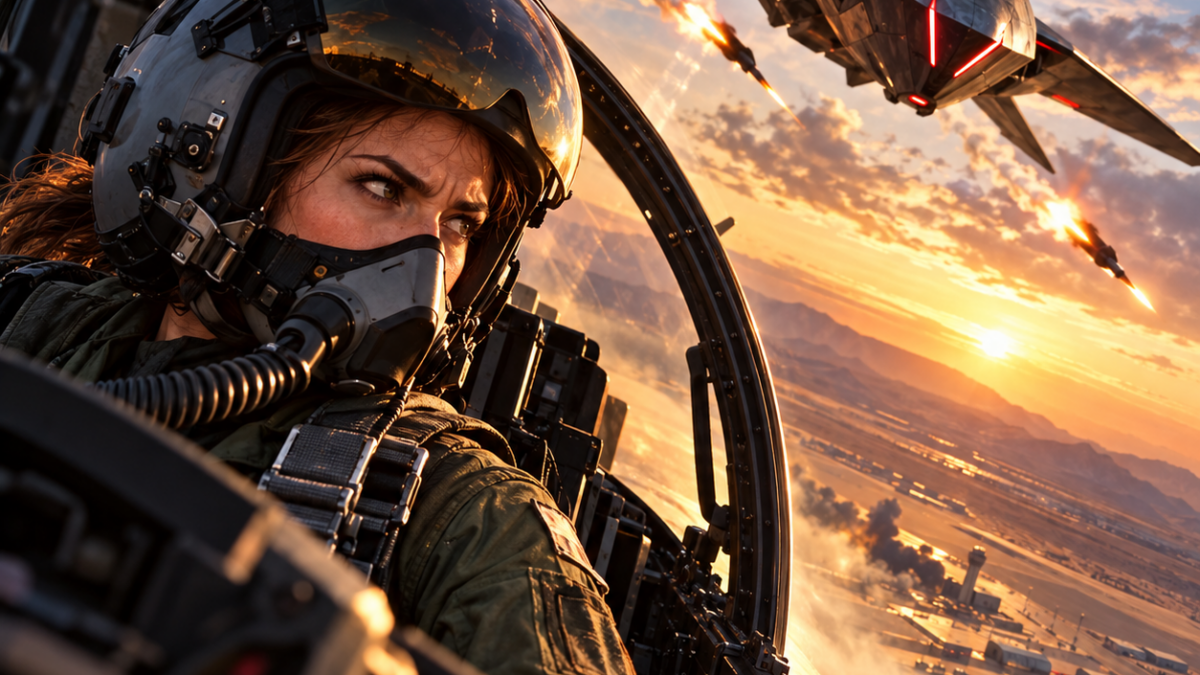
𝗣𝗔𝗥𝗧 𝟮
He didn’t answer.
The hangar doors were wide open. Heat rolled in from outside, heavy with the smell of jet fuel and sunbaked concrete. The F-22 waited under floodlights, sleek and lethal, its gray skin alive with reflections.
For a moment, I could not move.
Five years collapsed.
I saw another aircraft, another runway, another night. Falcon’s jet burning against the dark. My headset full of static. My own voice screaming his call sign until command ordered me to break pursuit and come home.
I had survived that mission.
People called that victory.
I had never understood how.
A young technician rushed toward me carrying a helmet.
“Ma’am,” he said, breathless, “Raptor is being armed. Fuel is good. Weapons check in progress.”
He looked at me the way rookies look at stories they have heard too many times.
With awe.
With hope.
With fear.
I took the helmet.
“Don’t look at me like that.”
He blinked.
“Ma’am?”
“Legends don’t save people.”
I looked toward the jet.
“Work does.”
He nodded quickly and ran back.
I climbed the ladder.
The cockpit smelled exactly as I remembered.
Metal.
Plastic.
Oxygen.
Old danger.
I lowered myself into the seat.
The harness came over my shoulders, across my chest, tight against my ribs. The canopy above me reflected the hangar lights. My gloved hands hovered over the controls for half a second.
Then muscle memory returned.
Switches.
Displays.
Systems.
Sequence.
The jet woke around me.
“Ghost Hawk,” Mercer’s voice crackled through my headset, and I closed my eyes at the sound of it. “Do you copy?”
I wanted to correct him.
Tell him that name was dead.
Tell him Emily Roads copied just fine.
Instead, I opened my eyes.
“Copy.”
“Drone visuals uploading to your HUD.”
The visor display came alive.
A sharp black aircraft cut across the projected sky. Angular. Sleek. Too fast for conventional surveillance. Too controlled for malfunction.
Combat-capable.
My breathing changed again.
“Control,” I said, “what am I looking at?”
“Unknown unmanned aircraft. We suspect autonomous guidance. It has ignored all warnings.”
“Armament?”
“Unconfirmed.”
“That means yes.”
Mercer paused.
“Assume hostile.”
The engine rose beneath me, a deep animal roar building through the frame.
Outside, ground crew cleared the path.
On the edge of the hangar, my trainees stood in a tight cluster, staring at me. Harris looked as if the world had betrayed him by becoming too real.
I looked away.
“Ghost Hawk,” the tower said, “you are cleared for immediate launch.”
My hand closed over the throttle.
For five years, I had told myself that climbing back into a cockpit would break me.
I had imagined panic.
Grief.
The crushing weight of Falcon’s voice.
But as the Raptor began rolling toward the runway, something inside me didn’t break.
It aligned.
Checklist.
Controls.
Wind.
Weight.
Heat.
Runway.
I pushed the throttle forward.
The Raptor screamed.
The runway blurred.
My body pressed into the seat.
And when the ground fell away beneath me, the fear went quiet.
Not gone.
Never gone.
But quiet.
The sky opened around me.
I climbed hard, angling toward the drone’s last known position. Below, the air base shrank into a grid of concrete, hangars, and emergency vehicles. Ahead, the horizon stretched bright and cruel.
“Ghost Hawk, target is twenty-seven miles east-northeast of your position,” the tower reported. “Still accelerating. Six minutes to civilian airspace.”
“Copy.”
“Do not engage until visual confirmation.”
“Understood.”
I adjusted course.
The aircraft responded like a body remembering a song.
Every vibration made sense. Every data stream entered my mind already sorted into threat, opportunity, weather, angle, distance.
I hated how much I had missed it.
That was the cruelest part.
Not that flying hurt.
That it still felt like coming home.
The drone appeared on radar as a red icon, shifting erratically across my HUD.
I narrowed my eyes.
“Control, it’s not flying randomly.”
“What do you mean?”
“It’s testing response patterns.”
“Explain.”
“It’s changing vector after each intercept calculation. It wants to know how we’ll chase it.”
“You think it’s being controlled?”
“Either controlled or programmed by someone who understands pilots.”
The red icon darted left, then climbed sharply.
I followed.
The G-force pressed into my body, familiar and brutal. My ribs tightened beneath the harness. My breathing slowed into the rhythm I had once trusted with my life.
“Ghost Hawk,” Mercer said, “status?”
“I’m closing.”
“Remember, priority is preventing breach.”
“I know the priority.”
The drone came into visual range through a veil of cloud.
Black.
Angular.
Beautiful in the way knives can be beautiful.
It banked hard as if it knew I was there.
“Visual confirmed,” I said. “Combat platform. Not reconnaissance.”
“Can you take it down?”
“Not over populated land.”
“You have four minutes.”
“Then clear my airspace.”
A beat of silence.
“Already done,” Mercer said. “You’re alone up there.”
Alone.
The word slipped beneath my skin.
I had been alone the night Falcon died too.
No.
That wasn’t true.
He had been there.
Until he wasn’t.
I heard him then, not as a memory exactly, but as the shape of a voice my grief had worn smooth.
Stay with the fight, Ghost.
The drone banked suddenly and dropped altitude.
I followed.
It moved fast, too fast for a machine relying only on basic guidance. It corrected like something that understood pursuit. Like something that wanted me frustrated. Like something designed to draw mistakes out of human hands.
My radar chirped.
Then my warning system shrieked.
The drone had locked onto me.
“Control,” I said, calm despite the spike of adrenaline, “target is armed.”
“Missile lock?” Mercer snapped.
“Confirmed.”
“Break!”
The drone fired.
I rolled hard right and dumped countermeasures. Flares burst behind me, bright blossoms of heat against the sky. The missile veered away and detonated in a white flash that rocked the Raptor.
For one heartbeat, I was back over Kandahar.
Fire behind me.
Falcon shouting.
My own breath too loud in my mask.
I forced the memory down.
“Ghost Hawk, report!”
“Still here.”
The control room erupted in overlapping voices before Mercer silenced them.
“Take the shot.”
“Negative.”
“Ghost Hawk—”
“We’re still too close to civilian lanes. If it breaks apart here, debris could come down over populated areas.”
“We are out of time.”
“I know.”
I pushed the Raptor into a climb, then cut across the drone’s path, deliberately exposing myself.
“Emily,” Hayes said quietly over the comm, his voice slipping past protocol, “what are you doing?”
“Making it choose me.”
The drone followed.
Good.
I angled toward open water.
Behind me, it adjusted immediately, abandoning its original route.
“It’s taking the bait,” I said.
“Ghost Hawk,” Mercer warned, “you are pulling it farther from support.”
“There is no support.”
I heard nothing after that but my breathing and the aircraft.
The drone closed the distance.
It fired again.
This time the rounds weren’t missiles but cannon fire, rapid flashes cutting through the air.
I rolled inverted, dropped altitude, then snapped left, letting the fire pass where I had been. The Raptor groaned beneath the strain.
“Your vitals are spiking,” a technician said in my ear.
“I’m busy.”
“Ma’am, your heart rate—”
“Unless my heart stops, stop reading numbers at me.”
A startled silence followed.
Then Hayes laughed once under his breath.
I almost smiled.
The drone tried to flank me.
I anticipated it before the tower called the warning. I cut power briefly, letting the Raptor dip, then slammed the throttle forward and corkscrewed behind it.
For one perfect second, the target filled my HUD.
Lock tone.
My thumb hovered over the trigger.
Falcon’s voice came again.
Don’t chase the shot. Let the shot come to you.
I didn’t fire.
The drone shifted, folding into a steep drop that broke lock.
“Damn it.”
“Ghost Hawk, you had it,” Mercer barked.
“I know what I had.”
“Then why didn’t you fire?”
“Because it wanted me to.”
Silence.
The drone climbed into the sun.
I followed, squinting through glare despite the visor’s filters.
This thing wasn’t just running. It was shaping the fight. It wanted me aggressive. Impatient. Angry.
That meant whoever designed it knew the weakness of aces.
We love clean victories.
We love the impossible shot.
We love proving the sky is ours.
I had survived because Falcon taught me to love something else.
Patience.
I banked wide and let the drone think it had distance.
It took the space.
Then I came in beneath it through its blind angle.
“Target lock,” I said.
“Fire,” Mercer ordered.
“Not yet.”
“For God’s sake, Emily.”
I ignored him.
The coastline fell behind us.
Open water stretched below, endless and unforgiving.
Forty miles.
Forty-five.
Fifty.
The radar officer came through.
“Ghost Hawk, you are clear of the coast.”
My thumb settled.
The drone deployed decoys.
Three false signatures split across my HUD.
A lesser pilot might have chosen wrong.
I switched tracking modes and watched for heat behavior, not signal brightness. The false targets burned too clean. Too perfect.
The real drone limped slightly through its turn.
“There you are,” I whispered.
The lock tone returned.
“This is Ghost Hawk. Target acquired.”
I fired.
The missile streaked forward, a white line carved across blue.
It hit the drone’s wing.
Fire bloomed.
In the control room, I could hear shouting.
But my eyes stayed on the target.
The drone did not fall.
Its damaged wing tore away in fragments, but the body stabilized. Internal control systems compensated. It dipped, shuddered, then kept flying.
My mouth went dry.
“It’s still airborne,” I said.
The cheering on the comm vanished.
“Finish it,” Mercer said.
The drone fired a desperate volley.
I rolled through the incoming missiles, dropping countermeasures and pulling so hard the edges of my vision darkened. The Raptor shook. Warning lights blinked and vanished.
Fuel.
Heat.
Stress.
Distance.
Time.
The drone was wounded, but wounded things are often more dangerous because they no longer waste energy on survival. They spend everything left on damage.
I pursued.
It juked toward the water, then climbed.
I followed.
It tried to jam my radar.
I switched to manual targeting.
The world became narrow.
Crosshair.
Horizon.
Breath.
The drone cut across the ocean’s surface, close enough that salt mist rose beneath us.
My hands steadied.
The fear was gone now.
So was the part of me that had been pretending to be only Emily Roads.
Ghost Hawk was not a legend.
Not a call sign.
Not a story other people told when they wanted to make courage sound easy.
Ghost Hawk was what remained when everything else burned away.
A choice.
Keep flying.
The drone suddenly climbed behind me.
My alarm screamed.
Missile lock.
Falcon’s voice again, clearer than before.
Make them think they won.
I cut power.
For one terrifying heartbeat, the Raptor fell.
The drone overshot.
I slammed the throttle forward, rolled back, and came in behind it.
“Lock acquired,” the system chimed.
Mercer’s voice came through, low now.
“Take it.”
The drone veered.
I tracked.
It fired two smaller missiles.
I dropped flares, but one stayed locked.
I climbed sharply, dragging it with me, then rolled at the top and forced the missile to overshoot into empty sky. The explosion rattled my canopy.
“Ghost Hawk, fuel state is becoming critical.”
“Noted.”
“You need to end this.”
“I’m working on it.”
The drone turned head-on.
For a split second, it looked almost alive, black nose pointed directly at me, damaged frame burning, weapons still hot.
A game of chicken.
Machine against woman.
Calculation against memory.
It came at me.
I came at it.
“Ghost Hawk, pull away,” Mercer shouted.
“Not yet.”
“Pull away now!”
“Closer.”
The drone filled my canopy.
The collision alarm screamed.
My body wanted to live.
My training wanted separation.
But Falcon had once told me the sky rewards the pilot who understands timing better than fear.
At the last possible moment, I rolled and fired a burst from the Vulcan cannon.
The rounds tore through the drone’s fuselage.
We missed each other by a margin so thin my breath stopped.
The drone staggered through the air, sensors shredded, frame burning.
Still, it fought.
It swung wide and fired again.
I weaved through the barrage, teeth clenched.
My aircraft protested with every turn.
The old hunger rose in me—not for glory, not for victory, but for an end.
This thing would not reach people on the ground.
Not while I was still breathing.
“Emily,” Hayes said softly, “you’re pushing the Raptor too hard.”
“I know.”
“You don’t have to save the aircraft too.”
I looked at the drone.
I looked at the ocean.
I thought of Falcon.
I thought of every young pilot I had trained to believe that discipline mattered more than ego.
Then I pulled into a vertical climb.
The drone followed.
At fifty thousand feet, the air thinned. My oxygen alarm chirped. The world below became curved and distant, clouds stretched like torn cotton beneath us.
My vision blurred at the edges.
The drone stayed with me.
Relentless.
Inhuman.
Perfect.
But perfection has a weakness.
It trusts patterns.
I rolled into a corkscrew, cut power, and let the Raptor fall at an angle that forced the drone to overshoot. The maneuver slammed me against the harness. For a second, black spots crowded my sight.
Then the drone slipped ahead.
Exposed.
Rear thruster visible.
Lock.
I fired the Sidewinder.
The missile struck dead center.
The drone came apart in the sky.
Fire and metal scattered across the blue, burning fragments tumbling toward open water.
For several seconds, nobody spoke.
Then the control tower erupted.
Voices cheered in my headset. Someone shouted my call sign. Someone else laughed with the wild relief of a person who had just seen disaster miss by inches.
I should have felt victory.
Instead, my cockpit lit up red.
Warnings screamed.
The blast wave had damaged the Raptor.
Left engine failing.
Hydraulic pressure dropping.
Flight control instability.
My jet shuddered violently.
The cheers died.
“Ghost Hawk,” Mercer said, voice sharp, “you’re hit.”
“I see it.”
“Eject.”
“No.”
“That is an order.”
“No.”
The Raptor bucked beneath me.
Smoke trailed from the left side. The aircraft dragged unevenly, forcing me to fight the controls just to maintain attitude.
“Emily,” Hayes said, “you may not make the runway.”
“I’m aware.”
“Then eject.”
I looked down at the ocean.
Five years ago, I had watched Falcon’s burning jet fall through the night. I had heard command telling him to eject. I had heard him say his system was gone. I had heard him apologize to me as if dying was rude.
I had carried that apology inside me ever since.
Now my aircraft was wounded but still answering.
Not dead.
Not yet.
“I can bring her home,” I said.
Mercer’s voice hardened.
“You destroyed the threat. You did your job.”
“No,” I said. “I finish my job when I land.”
The distance back to the base felt longer than the battle.
Without the adrenaline of combat sharpening every second, pain began to seep into my body. My shoulders burned from the strain. Sweat ran down my back. My throat tasted metallic beneath the oxygen mask.
The Raptor fought me.
Hydraulics bled away slowly. Every adjustment required more pressure. Every vibration threatened to become a spin.
The coastline appeared in the distance.
A thin, bright line between sea and land.
Beyond it, the base.
Home, if I could reach it.
“Ghost Hawk,” the tower said, “you are five minutes out.”
“Copy.”
“Emergency crews are positioned.”
“Clear the runway.”
“Already done.”
My warning systems kept screaming.
I shut off every alarm I could spare.
Noise kills focus.
The runway appeared ahead, shimmering in the heat.
My altitude was dropping too quickly.
I adjusted.
The nose fought me.
“Hydraulics at thirty percent,” the system announced.
“I know,” I muttered.
“Ghost Hawk, you’re coming in fast,” Mercer said.
“I can’t slow further.”
“You’ll overshoot.”
“Not if the brakes hold.”
“That’s not comforting.”
“It wasn’t meant to be.”
A strange calm settled over me.
Not peace.
Peace was something people imagined when they wanted survival to look graceful.
This was acceptance.
The kind that comes when there are no more choices to fear.
I remembered Falcon sitting across from me in a briefing room years earlier, tossing a pen into the air and catching it like he owned gravity.
“You know your problem?” he had said.
“I have one?”
“You think control means forcing the aircraft to obey.”
“It doesn’t?”
He smiled.
“No. Control means listening when it tells you how badly it wants to kill you.”
I almost laughed now.
“Still teaching me, Falcon.”
The runway rushed closer.
Two hundred feet.
The Raptor wobbled hard left.
I corrected.
One hundred feet.
Too fast.
Too heavy.
Too damaged.
The landing gear deployed with a groan that vibrated through the frame.
“Come on,” I whispered. “Stay with me.”
Fifty feet.
The jet dropped.
I pulled the nose up.
The wheels slammed into the runway.
The impact drove the breath out of me.
The Raptor bounced once, slammed down again, and skidded hard. Sparks flew past the canopy. The aircraft veered right. I fought the controls with everything left in my arms.
“Brake,” I hissed. “Brake, brake, brake.”
The damaged systems responded unevenly.
The runway blurred.
Emergency vehicles raced parallel on both sides.
The nose yawed left.
I corrected.
My shoulders screamed.
The jet slid, shuddered, fought, and finally slowed.
When it stopped, the silence was so sudden it felt unreal.
For a moment, I sat there gripping the controls, unable to let go.
My breathing filled the cockpit.
I was alive.
The tower was silent too.
Then I keyed the comm.
“Tower,” I said, voice rough, “Ghost Hawk is home.”
The response nearly deafened me.
Cheers exploded through the headset. People shouted. Someone cursed. Someone cried. Over all of it, I heard Hayes say softly, almost to himself, “Told you. She never lost it.”
I closed my eyes.
The canopy lifted.
Heat rushed in.
Fire crews swarmed the aircraft. Foam trucks waited nearby. Mechanics approached cautiously, staring at the battered Raptor like they couldn’t believe it had stayed in one piece.
I unbuckled slowly.
My hands were shaking now.
Not in the air.
Never when it mattered.
Only after.
I climbed out onto the ladder.
The moment my boots touched the tarmac, my knees nearly gave.
A medic reached for me.
“I’m fine.”
“You don’t look fine.”
“I didn’t say I looked fine.”
She wisely didn’t argue.
I walked to the side of the jet and placed my hand against the fuselage.
The metal was hot beneath my palm.
Smoke curled from the damaged engine.
“You did good,” I whispered. “You stubborn girl.”
Colonel Mercer marched toward me, face caught between fury and astonishment.
“Do you have any idea how reckless that was?”
I looked at him.
“Yes.”
“You ignored direct orders to eject.”
“Yes.”
“You risked your life bringing back a damaged aircraft.”
“Yes.”
His jaw worked.
Then his voice softened.
“And you saved a city.”
I said nothing.
The trainees approached slowly.
The loud ones weren’t loud anymore.
Harris stepped forward first.
His face was pale, eyes wide.
“Ma’am,” he said, “are you really Ghost Hawk?”
For years, that question would have made me retreat.
For years, I would have smiled, deflected, and disappeared into another quiet room.
But the sky behind me was still marked faintly by smoke.
The drone was gone.
The city was safe.
The aircraft was home.
And Falcon’s voice was no longer screaming in my memory.
It was quiet.
Waiting.
I looked at Harris.
“I was.”
He swallowed.
“And now?”
I turned toward the horizon.
The sun was beginning to lower, laying gold across the runway and the damaged aircraft behind me.
For five years, I had believed the ghosts of my past were chains.
But maybe some ghosts were not there to drag us backward.
Maybe some walked beside us until we remembered how to move forward.
I looked back at the young pilots.
“Now,” I said, “I’m still here.”
Hayes smiled.
Mercer nodded once.
The recruits stood straighter.
And for the first time in years, I felt something inside my chest loosen.
I had not returned to the sky because I missed the danger.
I had not flown again because I wanted people to whisper my name.
I had flown because people were in danger and I knew how to help.
That was the part I had forgotten.
Ghost Hawk had never been about war.
Not really.
It had been a promise.
That when the sky turned hostile, when fear filled the tower, when no one else could get there in time, I would still climb.
I would still fight.
I would still bring whatever I could home.
Later, after medical cleared me and the reports began multiplying across desks I would never see, I returned to the simulator building alone.
The spilled coffee had been cleaned up.
The room was quiet.
Three empty training pods sat in the dim light, waiting for the next morning, the next lesson, the next group of rookies who would think flying was about speed until the sky taught them otherwise.
I stood there for a long time.
Then I picked up my headset and rested it on the console.
In the dark reflection of the simulator glass, I saw myself clearly.
Emily Roads.
Instructor.
Survivor.
Pilot.
Ghost Hawk.
Not a legend.
Not a ghost.
Not a broken woman pretending the sky had never belonged to her.
Just someone who had fallen, grieved, hidden, and finally climbed again.
The next morning, Harris was the first trainee to arrive.
He stood awkwardly in the doorway, helmet tucked under one arm.
“Ma’am?”
“Yes?”
He hesitated.
“Are we still running basic dogfight exercises?”
I looked at him.
Then at the simulator.
Then out the window, where the repaired rhythm of the base had begun again.
Pilots crossing the tarmac.
Engines waking.
The sky waiting.
“Yes,” I said. “But today, you’re going to learn something more important than winning.”
He frowned.
“What’s that?”
I put on my headset.
“How to come home.”
He sat down without another word.
Outside, sunlight spread across the runway.
Inside, the simulator screens flickered to life.
And when I spoke into the headset, my voice was steady.
“Loosen your grip,” I told him. “Listen to the aircraft. Don’t wrestle the sky.”
I smiled faintly.
“Dance with it.”
𝗧𝗛𝗘 𝗘𝗡𝗗
The Call Sign I Buried Came Screaming Back Through the Tower
I had spent five years teaching young pilots how not to die in the sky.
Then one morning, an alarm split the air base open, and everyone remembered the name I had tried to bury.
By the time I stepped back into a cockpit, the thing coming toward us was no longer just a drone—it was every ghost I had ever failed to outrun.
The Texas heat had a way of making even steel look tired.
By eight in the morning, the tarmac outside the simulator building was already shimmering, waves of heat rising from the concrete like the runway itself was breathing. Flight crews moved between hangars with clipboards and headsets. Mechanics shouted over the roar of engines. Somewhere beyond the maintenance bays, an F-35 screamed into the morning sky, climbing hard enough to shake the glass in the control room.
I stood by the window with a paper cup of black coffee cooling in my hand and told myself, as I did every day, that none of it belonged to me anymore.
Not the engines.
Not the flight line.
Not the sky.
I was a civilian simulator instructor now. That was what my badge said. Emily Roads. Flight Simulation Specialist. No rank. No squadron patch. No call sign stitched across my chest. Just an olive-green jumpsuit, plain boots, and a key card that let me into rooms where young pilots learned how quickly arrogance could turn into wreckage.
Most of them thought I had spent my career behind screens.
That suited me fine.
The rookies came in loud at first, full of confidence and caffeine, convinced flying a fighter was mostly reflexes, swagger, and video-game hands. They talked about thrust-to-weight ratios and weapons systems like men reciting poetry they didn’t understand. Then I put them in the simulator.
After that, they got quieter.
“Your throttle hand is too stiff,” I said into my headset that morning, watching Cadet Harris overcorrect again on a basic dogfight scenario. “You’re fighting the aircraft.”
On the monitor, his simulated jet rolled too late and bled altitude like a wounded bird.
“I’m trying to stay on target, ma’am,” he said, frustration cracking through the comm.
“You’re trying to force the sky to behave,” I said. “It won’t. Loosen your grip. Feel the aircraft respond. You’re not wrestling it.”
I paused, watching him reset.
“You’re dancing with it.”
The three trainees in the simulator pods went quiet.
They always did when I said things like that.
I could feel their curiosity sometimes. It sat behind their eyes when I demonstrated a maneuver too cleanly or corrected an error before the data appeared on their screens. Every so often, one of them would ask.
“You’ve flown before, haven’t you?”
I always smiled and let the question die.
Nobody needed to know what I had been before I became the woman who drank bad coffee in a windowless training room.
Nobody needed to know that five years earlier, another name had followed me through classified briefings, enemy radar nets, and skies lit orange by burning fuel.
Ghost Hawk.
Some people had called me a legend.
Legends sound clean when other people tell them.
They leave out the smoke, the screaming, the smell of hydraulic fluid, the way a man’s voice changes when he knows he is not coming home.
They leave out Falcon.
My hand tightened around the coffee cup before I realized it.
I forced my fingers to relax.
The trainee in pod two banked too wide again.
“Reset the exercise,” I said. “Run it slower this time.”
“Yes, ma’am.”
That was my life now.
Slow.
Controlled.
Contained.
A world where mistakes ended in flashing screens instead of funerals.
Then the alarm sounded.
At first, it was distant enough that I thought some maintenance crew had tripped a hangar warning system. A low, pulsing siren bleeding through the walls.
Then it rose.
The entire building seemed to stiffen around it.
Red lights snapped to life over the doors.
The intercom crackled.
“Unidentified aircraft approaching restricted airspace. All active pilots report to stations immediately. Repeat, all active pilots report to stations immediately.”
My coffee slipped from my fingers.
The cup hit the floor and burst open, black liquid spreading across the tile.
For a second, nobody moved.
Then the base exploded into motion.
The trainees ripped off their headsets. Outside the window, pilots sprinted toward hangars. Ground crews scattered across the tarmac. Radios came alive in jagged bursts of voices, orders, coordinates, and panic dressed up as procedure.
I stood frozen.
Not because I didn’t understand what was happening.
Because I understood too well.
There is a tone military alarms take when something has gone wrong in a way nobody rehearsed properly. It cuts beneath the words. It enters the spine before it enters the mind.
I had heard that tone over Kandahar.
I had heard it the night Falcon died.
A young airman rushed past the open door, then skidded to a stop when he saw me.
“Ma’am, you need to move to the bunker.”
I nodded.
My feet didn’t move.
“Ma’am?”
“I heard you.”
He looked torn between duty and fear.
“Please. All nonessential personnel are being evacuated.”
Nonessential.
I almost laughed.
Five years ago, men with stars on their shoulders had whispered my call sign like a prayer when missions went bad.
Now I was nonessential.
Maybe I had earned that. Maybe I had fought hard enough to become exactly that.
I should have followed him.
I should have gone to the bunker with the clerks, contractors, and civilian staff. I should have let the active pilots do what active pilots were trained to do.
Instead, I turned toward the command tower.
My body made the decision before my mind approved it.
The hallway outside was chaos. Boots pounded against the floor. Security personnel directed people toward shelters. Somewhere nearby, a mechanic shouted about fuel pressure. The alarm kept screaming over all of it.
I moved against the current.
Every step brought the old world closer.
Every step made my chest tighter.
By the time I reached the command center, the air inside was electric.
Officers stood around glowing tactical displays. Radar screens tracked a fast-moving contact cutting across restricted airspace. The base commander, Colonel Adrian Mercer, stood at the center of the room with his sleeves rolled up and his jaw clenched hard enough to crack bone.
“Speed?” he barked.
“Mach-capable, sir,” a radar officer answered. “Profile suggests unmanned platform. Possibly experimental. It’s altering course unpredictably.”
“Trajectory?”
The officer hesitated.
“Toward civilian airspace.”
The room seemed to shrink.
“How long?”
“Ten minutes to breach if it maintains current vector.”
Mercer slammed his hand against the table.
“Get the Raptors up.”
“Sir,” another officer said, voice tight, “we’ve got a problem.”
Mercer turned on him.
“What problem?”
“Raptor One’s pilot collapsed during preflight. Medical thinks seizure. He’s out.”
“Raptor Two?”
“Grounded. Engine fault. Maintenance still has the panel open.”
Mercer stared at him.
The alarm wailed on.
“Who else is ready?”
Silence.
The kind of silence that kills people.
“We need a pilot now,” Mercer said.
Nobody answered.
I stood near the back of the room, half hidden behind two communications technicians, trying to convince myself I was only watching.
But the radar screen pulled at me.
The unidentified aircraft wasn’t behaving like a malfunctioning drone. It wasn’t wandering. It was probing. Adjusting. Pushing toward the line it wasn’t supposed to cross.
It was testing the base.
Testing response time.
Testing us.
An older officer at the tactical station turned slowly. His name was Lieutenant Colonel Hayes. I remembered him vaguely from another lifetime. He had aged since then, but his eyes were the same.
He looked straight at me.
My stomach dropped.
“Sir,” Hayes said carefully, “I know someone who can fly.”
Mercer followed his gaze.
When he saw me, disbelief flashed across his face.
“Her?”
The room began turning.
Not physically.
Emotionally.
Heads shifted. Eyes found me.
I wanted to step back.
Hayes didn’t look away.
“She’s not just a simulator instructor.”
“Then what is she?”
The old officer’s voice softened.
“That’s Ghost Hawk.”
The name struck the room like a dropped weapon.
Nobody spoke.
I felt the blood leave my face.
For five years, I had lived inside the fragile mercy of being forgotten. I had folded myself into routine, into silence, into small safe habits. I had let younger pilots walk past me without knowing I had once flown missions their instructors still used as classified training examples.
And now, with one sentence, Hayes had dug me out of the grave I had built for myself.
Mercer’s eyes narrowed.
“You flew Echo Squadron?”
I said nothing.
He stepped toward me.
“You’re Emily Roads.”
“That’s what my badge says.”
“You were Ghost Hawk?”
I heard Falcon laughing in my memory.
Tell them you’re just lucky, Em. Legends make people stupid.
I swallowed.
“I was.”
Mercer looked back at the radar screen.
The drone had shifted again.
Eight minutes.
“You current on the Raptor?”
“No.”
The room tightened.
He cursed under his breath.
“When did you last fly one?”
“Five years ago.”
“That’s not reassuring.”
“No,” I said quietly. “It isn’t.”
His expression hardened.
“Then why are you still standing here?”
Because my feet had carried me.
Because every instinct I had tried to bury was awake.
Because somewhere beyond that glowing red dot on the radar map were neighborhoods, schools, highways, and people who had no idea death was approaching them at the speed of sound.
Because I had already walked away from one burning sky and left a friend behind.
I looked at the trainees gathered near the command center entrance. Harris was among them, pale and silent. He had been wrestling a simulated aircraft ten minutes ago. Now he was watching a decision form that none of them were ready to carry.
My pulse slowed.
Not because I was calm.
Because something older than calm had taken over.
I looked at Mercer.
“Prep the Raptor.”
The room erupted.
Technicians shouted. Mercer snapped orders. Ground crews scrambled across the flight line before I even reached the hangar.
Hayes fell into step beside me.
“You sure?” he asked.
“No.”
“At least you’re honest.”
I kept walking.
“You shouldn’t have said that name.”
His face softened.
“I know.”
“Then why did you?”
“Because they needed to understand.”
“No,” I said. “They needed a pilot.”
He didn’t answer.
The hangar doors were wide open. Heat rolled in from outside, heavy with the smell of jet fuel and sunbaked concrete. The F-22 waited under floodlights, sleek and lethal, its gray skin alive with reflections.
For a moment, I could not move.
Five years collapsed.
I saw another aircraft, another runway, another night. Falcon’s jet burning against the dark. My headset full of static. My own voice screaming his call sign until command ordered me to break pursuit and come home.
I had survived that mission.
People called that victory.
I had never understood how.
A young technician rushed toward me carrying a helmet.
“Ma’am,” he said, breathless, “Raptor is being armed. Fuel is good. Weapons check in progress.”
He looked at me the way rookies look at stories they have heard too many times.
With awe.
With hope.
With fear.
I took the helmet.
“Don’t look at me like that.”
He blinked.
“Ma’am?”
“Legends don’t save people.”
I looked toward the jet.
“Work does.”
He nodded quickly and ran back.
I climbed the ladder.
The cockpit smelled exactly as I remembered.
Metal.
Plastic.
Oxygen.
Old danger.
I lowered myself into the seat.
The harness came over my shoulders, across my chest, tight against my ribs. The canopy above me reflected the hangar lights. My gloved hands hovered over the controls for half a second.
Then muscle memory returned.
Switches.
Displays.
Systems.
Sequence.
The jet woke around me.
“Ghost Hawk,” Mercer’s voice crackled through my headset, and I closed my eyes at the sound of it. “Do you copy?”
I wanted to correct him.
Tell him that name was dead.
Tell him Emily Roads copied just fine.
Instead, I opened my eyes.
“Copy.”
“Drone visuals uploading to your HUD.”
The visor display came alive.
A sharp black aircraft cut across the projected sky. Angular. Sleek. Too fast for conventional surveillance. Too controlled for malfunction.
Combat-capable.
My breathing changed again.
“Control,” I said, “what am I looking at?”
“Unknown unmanned aircraft. We suspect autonomous guidance. It has ignored all warnings.”
“Armament?”
“Unconfirmed.”
“That means yes.”
Mercer paused.
“Assume hostile.”
The engine rose beneath me, a deep animal roar building through the frame.
Outside, ground crew cleared the path.
On the edge of the hangar, my trainees stood in a tight cluster, staring at me. Harris looked as if the world had betrayed him by becoming too real.
I looked away.
“Ghost Hawk,” the tower said, “you are cleared for immediate launch.”
My hand closed over the throttle.
For five years, I had told myself that climbing back into a cockpit would break me.
I had imagined panic.
Grief.
The crushing weight of Falcon’s voice.
But as the Raptor began rolling toward the runway, something inside me didn’t break.
It aligned.
Checklist.
Controls.
Wind.
Weight.
Heat.
Runway.
I pushed the throttle forward.
The Raptor screamed.
The runway blurred.
My body pressed into the seat.
And when the ground fell away beneath me, the fear went quiet.
Not gone.
Never gone.
But quiet.
The sky opened around me.
I climbed hard, angling toward the drone’s last known position. Below, the air base shrank into a grid of concrete, hangars, and emergency vehicles. Ahead, the horizon stretched bright and cruel.
“Ghost Hawk, target is twenty-seven miles east-northeast of your position,” the tower reported. “Still accelerating. Six minutes to civilian airspace.”
“Copy.”
“Do not engage until visual confirmation.”
“Understood.”
I adjusted course.
The aircraft responded like a body remembering a song.
Every vibration made sense. Every data stream entered my mind already sorted into threat, opportunity, weather, angle, distance.
I hated how much I had missed it.
That was the cruelest part.
Not that flying hurt.
That it still felt like coming home.
The drone appeared on radar as a red icon, shifting erratically across my HUD.
I narrowed my eyes.
“Control, it’s not flying randomly.”
“What do you mean?”
“It’s testing response patterns.”
“Explain.”
“It’s changing vector after each intercept calculation. It wants to know how we’ll chase it.”
“You think it’s being controlled?”
“Either controlled or programmed by someone who understands pilots.”
The red icon darted left, then climbed sharply.
I followed.
The G-force pressed into my body, familiar and brutal. My ribs tightened beneath the harness. My breathing slowed into the rhythm I had once trusted with my life.
“Ghost Hawk,” Mercer said, “status?”
“I’m closing.”
“Remember, priority is preventing breach.”
“I know the priority.”
The drone came into visual range through a veil of cloud.
Black.
Angular.
Beautiful in the way knives can be beautiful.
It banked hard as if it knew I was there.
“Visual confirmed,” I said. “Combat platform. Not reconnaissance.”
“Can you take it down?”
“Not over populated land.”
“You have four minutes.”
“Then clear my airspace.”
A beat of silence.
“Already done,” Mercer said. “You’re alone up there.”
Alone.
The word slipped beneath my skin.
I had been alone the night Falcon died too.
No.
That wasn’t true.
He had been there.
Until he wasn’t.
I heard him then, not as a memory exactly, but as the shape of a voice my grief had worn smooth.
Stay with the fight, Ghost.
The drone banked suddenly and dropped altitude.
I followed.
It moved fast, too fast for a machine relying only on basic guidance. It corrected like something that understood pursuit. Like something that wanted me frustrated. Like something designed to draw mistakes out of human hands.
My radar chirped.
Then my warning system shrieked.
The drone had locked onto me.
“Control,” I said, calm despite the spike of adrenaline, “target is armed.”
“Missile lock?” Mercer snapped.
“Confirmed.”
“Break!”
The drone fired.
I rolled hard right and dumped countermeasures. Flares burst behind me, bright blossoms of heat against the sky. The missile veered away and detonated in a white flash that rocked the Raptor.
For one heartbeat, I was back over Kandahar.
Fire behind me.
Falcon shouting.
My own breath too loud in my mask.
I forced the memory down.
“Ghost Hawk, report!”
“Still here.”
The control room erupted in overlapping voices before Mercer silenced them.
“Take the shot.”
“Negative.”
“Ghost Hawk—”
“We’re still too close to civilian lanes. If it breaks apart here, debris could come down over populated areas.”
“We are out of time.”
“I know.”
I pushed the Raptor into a climb, then cut across the drone’s path, deliberately exposing myself.
“Emily,” Hayes said quietly over the comm, his voice slipping past protocol, “what are you doing?”
“Making it choose me.”
The drone followed.
Good.
I angled toward open water.
Behind me, it adjusted immediately, abandoning its original route.
“It’s taking the bait,” I said.
“Ghost Hawk,” Mercer warned, “you are pulling it farther from support.”
“There is no support.”
I heard nothing after that but my breathing and the aircraft.
The drone closed the distance.
It fired again.
This time the rounds weren’t missiles but cannon fire, rapid flashes cutting through the air.
I rolled inverted, dropped altitude, then snapped left, letting the fire pass where I had been. The Raptor groaned beneath the strain.
“Your vitals are spiking,” a technician said in my ear.
“I’m busy.”
“Ma’am, your heart rate—”
“Unless my heart stops, stop reading numbers at me.”
A startled silence followed.
Then Hayes laughed once under his breath.
I almost smiled.
The drone tried to flank me.
I anticipated it before the tower called the warning. I cut power briefly, letting the Raptor dip, then slammed the throttle forward and corkscrewed behind it.
For one perfect second, the target filled my HUD.
Lock tone.
My thumb hovered over the trigger.
Falcon’s voice came again.
Don’t chase the shot. Let the shot come to you.
I didn’t fire.
The drone shifted, folding into a steep drop that broke lock.
“Damn it.”
“Ghost Hawk, you had it,” Mercer barked.
“I know what I had.”
“Then why didn’t you fire?”
“Because it wanted me to.”
Silence.
The drone climbed into the sun.
I followed, squinting through glare despite the visor’s filters.
This thing wasn’t just running. It was shaping the fight. It wanted me aggressive. Impatient. Angry.
That meant whoever designed it knew the weakness of aces.
We love clean victories.
We love the impossible shot.
We love proving the sky is ours.
I had survived because Falcon taught me to love something else.
Patience.
I banked wide and let the drone think it had distance.
It took the space.
Then I came in beneath it through its blind angle.
“Target lock,” I said.
“Fire,” Mercer ordered.
“Not yet.”
“For God’s sake, Emily.”
I ignored him.
The coastline fell behind us.
Open water stretched below, endless and unforgiving.
Forty miles.
Forty-five.
Fifty.
The radar officer came through.
“Ghost Hawk, you are clear of the coast.”
My thumb settled.
The drone deployed decoys.
Three false signatures split across my HUD.
A lesser pilot might have chosen wrong.
I switched tracking modes and watched for heat behavior, not signal brightness. The false targets burned too clean. Too perfect.
The real drone limped slightly through its turn.
“There you are,” I whispered.
The lock tone returned.
“This is Ghost Hawk. Target acquired.”
I fired.
The missile streaked forward, a white line carved across blue.
It hit the drone’s wing.
Fire bloomed.
In the control room, I could hear shouting.
But my eyes stayed on the target.
The drone did not fall.
Its damaged wing tore away in fragments, but the body stabilized. Internal control systems compensated. It dipped, shuddered, then kept flying.
My mouth went dry.
“It’s still airborne,” I said.
The cheering on the comm vanished.
“Finish it,” Mercer said.
The drone fired a desperate volley.
I rolled through the incoming missiles, dropping countermeasures and pulling so hard the edges of my vision darkened. The Raptor shook. Warning lights blinked and vanished.
Fuel.
Heat.
Stress.
Distance.
Time.
The drone was wounded, but wounded things are often more dangerous because they no longer waste energy on survival. They spend everything left on damage.
I pursued.
It juked toward the water, then climbed.
I followed.
It tried to jam my radar.
I switched to manual targeting.
The world became narrow.
Crosshair.
Horizon.
Breath.
The drone cut across the ocean’s surface, close enough that salt mist rose beneath us.
My hands steadied.
The fear was gone now.
So was the part of me that had been pretending to be only Emily Roads.
Ghost Hawk was not a legend.
Not a call sign.
Not a story other people told when they wanted to make courage sound easy.
Ghost Hawk was what remained when everything else burned away.
A choice.
Keep flying.
The drone suddenly climbed behind me.
My alarm screamed.
Missile lock.
Falcon’s voice again, clearer than before.
Make them think they won.
I cut power.
For one terrifying heartbeat, the Raptor fell.
The drone overshot.
I slammed the throttle forward, rolled back, and came in behind it.
“Lock acquired,” the system chimed.
Mercer’s voice came through, low now.
“Take it.”
The drone veered.
I tracked.
It fired two smaller missiles.
I dropped flares, but one stayed locked.
I climbed sharply, dragging it with me, then rolled at the top and forced the missile to overshoot into empty sky. The explosion rattled my canopy.
“Ghost Hawk, fuel state is becoming critical.”
“Noted.”
“You need to end this.”
“I’m working on it.”
The drone turned head-on.
For a split second, it looked almost alive, black nose pointed directly at me, damaged frame burning, weapons still hot.
A game of chicken.
Machine against woman.
Calculation against memory.
It came at me.
I came at it.
“Ghost Hawk, pull away,” Mercer shouted.
“Not yet.”
“Pull away now!”
“Closer.”
The drone filled my canopy.
The collision alarm screamed.
My body wanted to live.
My training wanted separation.
But Falcon had once told me the sky rewards the pilot who understands timing better than fear.
At the last possible moment, I rolled and fired a burst from the Vulcan cannon.
The rounds tore through the drone’s fuselage.
We missed each other by a margin so thin my breath stopped.
The drone staggered through the air, sensors shredded, frame burning.
Still, it fought.
It swung wide and fired again.
I weaved through the barrage, teeth clenched.
My aircraft protested with every turn.
The old hunger rose in me—not for glory, not for victory, but for an end.
This thing would not reach people on the ground.
Not while I was still breathing.
“Emily,” Hayes said softly, “you’re pushing the Raptor too hard.”
“I know.”
“You don’t have to save the aircraft too.”
I looked at the drone.
I looked at the ocean.
I thought of Falcon.
I thought of every young pilot I had trained to believe that discipline mattered more than ego.
Then I pulled into a vertical climb.
The drone followed.
At fifty thousand feet, the air thinned. My oxygen alarm chirped. The world below became curved and distant, clouds stretched like torn cotton beneath us.
My vision blurred at the edges.
The drone stayed with me.
Relentless.
Inhuman.
Perfect.
But perfection has a weakness.
It trusts patterns.
I rolled into a corkscrew, cut power, and let the Raptor fall at an angle that forced the drone to overshoot. The maneuver slammed me against the harness. For a second, black spots crowded my sight.
Then the drone slipped ahead.
Exposed.
Rear thruster visible.
Lock.
I fired the Sidewinder.
The missile struck dead center.
The drone came apart in the sky.
Fire and metal scattered across the blue, burning fragments tumbling toward open water.
For several seconds, nobody spoke.
Then the control tower erupted.
Voices cheered in my headset. Someone shouted my call sign. Someone else laughed with the wild relief of a person who had just seen disaster miss by inches.
I should have felt victory.
Instead, my cockpit lit up red.
Warnings screamed.
The blast wave had damaged the Raptor.
Left engine failing.
Hydraulic pressure dropping.
Flight control instability.
My jet shuddered violently.
The cheers died.
“Ghost Hawk,” Mercer said, voice sharp, “you’re hit.”
“I see it.”
“Eject.”
“No.”
“That is an order.”
“No.”
The Raptor bucked beneath me.
Smoke trailed from the left side. The aircraft dragged unevenly, forcing me to fight the controls just to maintain attitude.
“Emily,” Hayes said, “you may not make the runway.”
“I’m aware.”
“Then eject.”
I looked down at the ocean.
Five years ago, I had watched Falcon’s burning jet fall through the night. I had heard command telling him to eject. I had heard him say his system was gone. I had heard him apologize to me as if dying was rude.
I had carried that apology inside me ever since.
Now my aircraft was wounded but still answering.
Not dead.
Not yet.
“I can bring her home,” I said.
Mercer’s voice hardened.
“You destroyed the threat. You did your job.”
“No,” I said. “I finish my job when I land.”
The distance back to the base felt longer than the battle.
Without the adrenaline of combat sharpening every second, pain began to seep into my body. My shoulders burned from the strain. Sweat ran down my back. My throat tasted metallic beneath the oxygen mask.
The Raptor fought me.
Hydraulics bled away slowly. Every adjustment required more pressure. Every vibration threatened to become a spin.
The coastline appeared in the distance.
A thin, bright line between sea and land.
Beyond it, the base.
Home, if I could reach it.
“Ghost Hawk,” the tower said, “you are five minutes out.”
“Copy.”
“Emergency crews are positioned.”
“Clear the runway.”
“Already done.”
My warning systems kept screaming.
I shut off every alarm I could spare.
Noise kills focus.
The runway appeared ahead, shimmering in the heat.
My altitude was dropping too quickly.
I adjusted.
The nose fought me.
“Hydraulics at thirty percent,” the system announced.
“I know,” I muttered.
“Ghost Hawk, you’re coming in fast,” Mercer said.
“I can’t slow further.”
“You’ll overshoot.”
“Not if the brakes hold.”
“That’s not comforting.”
“It wasn’t meant to be.”
A strange calm settled over me.
Not peace.
Peace was something people imagined when they wanted survival to look graceful.
This was acceptance.
The kind that comes when there are no more choices to fear.
I remembered Falcon sitting across from me in a briefing room years earlier, tossing a pen into the air and catching it like he owned gravity.
“You know your problem?” he had said.
“I have one?”
“You think control means forcing the aircraft to obey.”
“It doesn’t?”
He smiled.
“No. Control means listening when it tells you how badly it wants to kill you.”
I almost laughed now.
“Still teaching me, Falcon.”
The runway rushed closer.
Two hundred feet.
The Raptor wobbled hard left.
I corrected.
One hundred feet.
Too fast.
Too heavy.
Too damaged.
The landing gear deployed with a groan that vibrated through the frame.
“Come on,” I whispered. “Stay with me.”
Fifty feet.
The jet dropped.
I pulled the nose up.
The wheels slammed into the runway.
The impact drove the breath out of me.
The Raptor bounced once, slammed down again, and skidded hard. Sparks flew past the canopy. The aircraft veered right. I fought the controls with everything left in my arms.
“Brake,” I hissed. “Brake, brake, brake.”
The damaged systems responded unevenly.
The runway blurred.
Emergency vehicles raced parallel on both sides.
The nose yawed left.
I corrected.
My shoulders screamed.
The jet slid, shuddered, fought, and finally slowed.
When it stopped, the silence was so sudden it felt unreal.
For a moment, I sat there gripping the controls, unable to let go.
My breathing filled the cockpit.
I was alive.
The tower was silent too.
Then I keyed the comm.
“Tower,” I said, voice rough, “Ghost Hawk is home.”
The response nearly deafened me.
Cheers exploded through the headset. People shouted. Someone cursed. Someone cried. Over all of it, I heard Hayes say softly, almost to himself, “Told you. She never lost it.”
I closed my eyes.
The canopy lifted.
Heat rushed in.
Fire crews swarmed the aircraft. Foam trucks waited nearby. Mechanics approached cautiously, staring at the battered Raptor like they couldn’t believe it had stayed in one piece.
I unbuckled slowly.
My hands were shaking now.
Not in the air.
Never when it mattered.
Only after.
I climbed out onto the ladder.
The moment my boots touched the tarmac, my knees nearly gave.
A medic reached for me.
“I’m fine.”
“You don’t look fine.”
“I didn’t say I looked fine.”
She wisely didn’t argue.
I walked to the side of the jet and placed my hand against the fuselage.
The metal was hot beneath my palm.
Smoke curled from the damaged engine.
“You did good,” I whispered. “You stubborn girl.”
Colonel Mercer marched toward me, face caught between fury and astonishment.
“Do you have any idea how reckless that was?”
I looked at him.
“Yes.”
“You ignored direct orders to eject.”
“Yes.”
“You risked your life bringing back a damaged aircraft.”
“Yes.”
His jaw worked.
Then his voice softened.
“And you saved a city.”
I said nothing.
The trainees approached slowly.
The loud ones weren’t loud anymore.
Harris stepped forward first.
His face was pale, eyes wide.
“Ma’am,” he said, “are you really Ghost Hawk?”
For years, that question would have made me retreat.
For years, I would have smiled, deflected, and disappeared into another quiet room.
But the sky behind me was still marked faintly by smoke.
The drone was gone.
The city was safe.
The aircraft was home.
And Falcon’s voice was no longer screaming in my memory.
It was quiet.
Waiting.
I looked at Harris.
“I was.”
He swallowed.
“And now?”
I turned toward the horizon.
The sun was beginning to lower, laying gold across the runway and the damaged aircraft behind me.
For five years, I had believed the ghosts of my past were chains.
But maybe some ghosts were not there to drag us backward.
Maybe some walked beside us until we remembered how to move forward.
I looked back at the young pilots.
“Now,” I said, “I’m still here.”
Hayes smiled.
Mercer nodded once.
The recruits stood straighter.
And for the first time in years, I felt something inside my chest loosen.
I had not returned to the sky because I missed the danger.
I had not flown again because I wanted people to whisper my name.
I had flown because people were in danger and I knew how to help.
That was the part I had forgotten.
Ghost Hawk had never been about war.
Not really.
It had been a promise.
That when the sky turned hostile, when fear filled the tower, when no one else could get there in time, I would still climb.
I would still fight.
I would still bring whatever I could home.
Later, after medical cleared me and the reports began multiplying across desks I would never see, I returned to the simulator building alone.
The spilled coffee had been cleaned up.
The room was quiet.
Three empty training pods sat in the dim light, waiting for the next morning, the next lesson, the next group of rookies who would think flying was about speed until the sky taught them otherwise.
I stood there for a long time.
Then I picked up my headset and rested it on the console.
In the dark reflection of the simulator glass, I saw myself clearly.
Emily Roads.
Instructor.
Survivor.
Pilot.
Ghost Hawk.
Not a legend.
Not a ghost.
Not a broken woman pretending the sky had never belonged to her.
Just someone who had fallen, grieved, hidden, and finally climbed again.
The next morning, Harris was the first trainee to arrive.
He stood awkwardly in the doorway, helmet tucked under one arm.
“Ma’am?”
“Yes?”
He hesitated.
“Are we still running basic dogfight exercises?”
I looked at him.
Then at the simulator.
Then out the window, where the repaired rhythm of the base had begun again.
Pilots crossing the tarmac.
Engines waking.
The sky waiting.
“Yes,” I said. “But today, you’re going to learn something more important than winning.”
He frowned.
“What’s that?”
I put on my headset.
“How to come home.”
He sat down without another word.
Outside, sunlight spread across the runway.
Inside, the simulator screens flickered to life.
And when I spoke into the headset, my voice was steady.
“Loosen your grip,” I told him. “Listen to the aircraft. Don’t wrestle the sky.”
I smiled faintly.
“Dance with it.”