𝗙𝗨𝗟𝗟 𝗦𝗧𝗢𝗥𝗬 Three Seconds Was All It Took for the Truth to Hear Me
𝗣𝗔𝗥𝗧 𝟮
The drive from Mom’s house to Rocky Mountain Military Medical Center usually took twelve minutes.
I made it in nine.
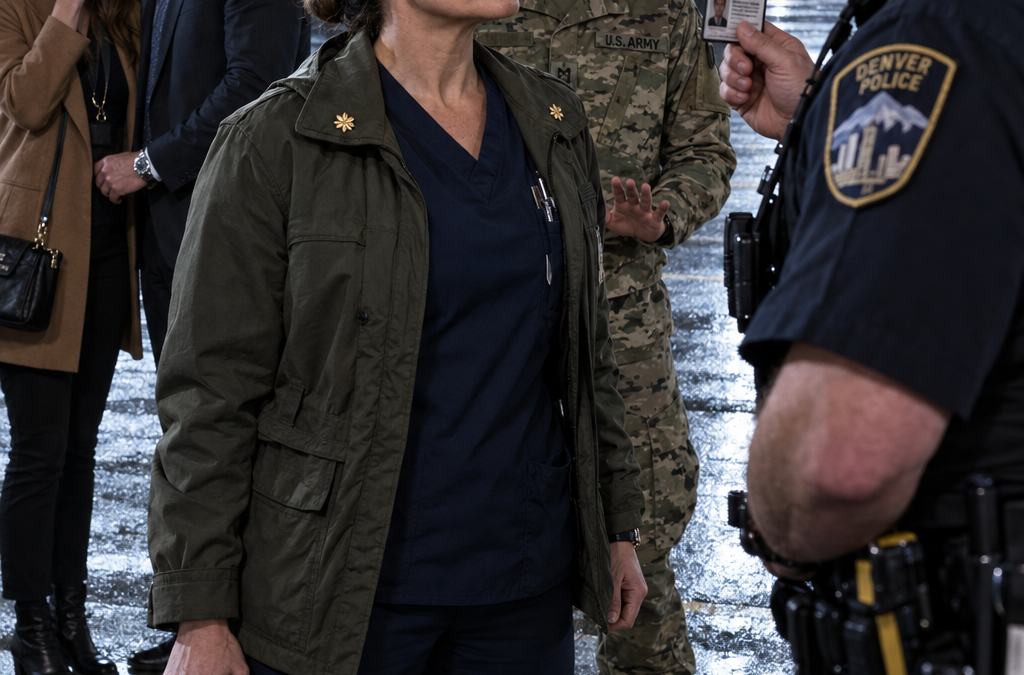
The north staff lot sat beneath harsh white lights, half empty after midnight. The air had that cold, dry Denver bite that makes every breath feel sharper than it should. I saw Lucas near the perimeter barrier, still in uniform, standing with his shoulders squared and his hands visible.
Two police officers stood in front of him.
One was holding his military ID.
I parked crookedly and got out before my headlights had finished sweeping across the curb.
Natalie jumped from Grant’s SUV behind me.
I heard one officer say, “You expect me to believe this is yours?”
Lucas answered calmly. “It has my photograph on it.”
The officer smiled. “People borrow things.”
That sentence did something to me.
There are phrases that reveal more than the speaker realizes. People borrow things. It was not a question. It was not a concern. It was an accusation dressed as procedure.
I approached without rushing.
“What seems to be the problem?”
Both officers turned.
The stockier one looked me up and down—hospital scrubs beneath my open field jacket, Army rank insignia at my collar, medical bag over my shoulder. His badge read KEENE.
“This doesn’t involve you,” he said.
“He’s my soldier.”
Natalie shouted from behind me, “He’s my son!”
Lucas closed his eyes briefly. “Aunt Claire, I’m okay.”
Officer Travis Keene looked between us. “Everybody needs to back up.”
I showed my military ID. “Colonel Claire Holloway. Army Nurse Corps. Lucas is assigned to my medical command. What is the basis for the detention?”
“Suspicious behavior.”
“What behavior?”
“Loitering.”
“This is a staff break area.”
Keene’s partner glanced toward the posted sign.
Keene did not.
Then Grant arrived.
Keene saw him.
And something passed between them.
It was tiny. Almost nothing. A flicker of recognition, quickly buried.
But I saw it.
Grant immediately looked away.
My stomach tightened.
“Grant,” I said slowly, “do you know this officer?”
“No.”
Too fast.
Keene stepped toward me. “Colonel or not, I’ve told you to step back.”
“I’m standing on the public side of the barrier.”
Natalie suddenly grabbed my shoulder. “Claire, stop.”
I looked at her.
She was panicking.
But not about Lucas.
She was panicking because I had asked Grant the wrong question.
Keene pointed toward my vehicle. “Go home.”
“No.”
His eyes changed.
People think violence announces itself. They imagine raised voices, dramatic gestures, warnings loud enough for everyone to understand. But most violence I had seen in my life came quietly. A shift in weight. A decision made behind the eyes. A hand moving before the body admits what it is doing.
One second Keene’s hand was at his side.
The next, it was locked around my left wrist.
Hard.
Natalie screamed.
Lucas stepped forward.
Keene’s partner blocked him, but his voice dropped when he said, “Don’t.”
Keene twisted my arm behind my back.
“You’re under arrest for obstruction.”
“This is an unlawful detention.”
“That’s for somebody else to decide.”
I could hear my mother calling Natalie’s phone. I could hear Natalie crying. I could hear Grant saying absolutely nothing.
And with Keene pulling me toward his cruiser, I moved my right hand toward the military emergency watch beneath my sleeve.
Grant noticed.
His face went white.
That was the moment I knew this was not just an arrogant police officer having a bad night.
I pressed the emergency contact panel for three seconds.
A silent military distress signal began transmitting.
Keene shoved me into the back seat.
As the cruiser door slammed, I saw Grant leaning toward Natalie and saying something I could not hear.
But I could read his lips.
She knows.
That was when I realized the inheritance papers on my mother’s dining table might not have been the most dangerous thing my family had tried to hide from me that night.
Westbridge Police District Four smelled like old coffee, disinfectant, and fluorescent lights that had been burning too long.
Keene brought me through a processing door at 12:19 a.m.
He had taken Lucas too.
Natalie and Grant were left outside at first, though I knew Natalie well enough to know she would follow as far as someone allowed her. Grant would follow only as far as it benefited him.
Keene’s partner, Officer Aaron Doyle, walked several steps behind us. He looked uncomfortable.
That mattered.
I had spent enough years managing medical teams under pressure to recognize the difference between silence that meant agreement and silence that meant fear.
Doyle’s silence was fear.
Keene placed my military ID on the processing counter.
“Full name.”
“You already have it.”
“Say it.”
“Colonel Claire Elise Holloway. United States Army Nurse Corps.”
He wrote slowly, as though each letter required personal effort.
“Address?”
“Fort Kessler officer housing.”
He looked up. “You actually expect me to believe you’re a colonel?”
“You’re holding my identification.”
“A card doesn’t make you important in here.”
“I didn’t say I was important.”
Keene smiled.
“This is my building. Your rank means nothing in here.”
A camera sat in the upper corner of the processing room.
I looked at it.
Keene followed my eyes.
“That thing’s offline.”
“Good to know.”
His smile widened. “You think this is funny?”
“No.”
I turned my wrist slightly. The emergency watch was still active.
“What you’re doing is being recorded.”
His expression changed.
Only for a second.
Then he recovered.
“By what?”
I said nothing.
He leaned closer. “Here’s what’s going to happen. You’re going into holding. Tomorrow I call your command. I tell them Colonel Holloway interfered with a police investigation and became aggressive.”
“I never raised my voice.”
“My report will say otherwise.”
Doyle looked at him.
Keene noticed. “You got something to add?”
Doyle’s throat moved. “No.”
“Then process the medic.”
I said, “What is Lucas charged with?”
“Failure to comply.”
“With what lawful order?”
Keene slammed his palm against the counter. “This isn’t your hospital.”
“No,” I said. “Which is exactly why I’m documenting everything.”
That was when he lost the last of his patience.
He ordered another officer to put me in holding.
The room had two metal chairs, a narrow window near the ceiling, and walls painted the color of surrender. I sat down. I counted my breaths. I listened.
That was something the Army had taught me early: panic wastes information.
At 12:43, I heard Keene arguing outside.
At 12:51, a phone rang repeatedly.
At 12:57, somebody said, “Why is Fort Kessler calling us?”
I closed my eyes.
At 1:03, I heard engines.
Several.
Heavy.
Coordinated.
Then boots.
Many of them.
The atmosphere outside changed instantly.
A voice barked, “Who authorized military police inside my station?”
Another voice answered, calm and firm.
“Federal-military jurisdiction has been invoked. Step away from the corridor.”
Silence.
Then Keene.
“This is a local arrest.”
“No, Officer. At this point, it is evidence.”
My door opened.
A captain in military police uniform stepped inside.
Captain Samuel Vance, assistant provost marshal at Fort Kessler.
He looked at my wrist first.
“Colonel Holloway, are you injured?”
“Bruising. Nothing serious.”
“We received your emergency signal at 12:11. Audio transmission was continuous.”
“All of it?”
“All of it.”
Behind him, military police had secured the corridor. Not violently. Not theatrically. They simply occupied every exit with the quiet efficiency of people who had arrived knowing exactly what authority they had.
Keene stood near the processing desk with two MPs beside him. His face had changed completely. The man who had told me my rank meant nothing was now trying to explain himself to three people at once.
Vance lowered his voice. “Ma’am, there’s a DOJ civil-rights liaison downstairs.”
“Why?”
“Because Fort Kessler already had open complaints involving this district.”
I stared at him. “How many?”
“Seven involving military personnel in the last year.”
Lucas.
I stood. “Where is my nephew?”
“Secondary interview room. He’s safe.”
I walked out.
Keene saw me.
His eyes moved from my face to the military police, then to the federal identification badge hanging from a woman’s neck near the station entrance.
He finally understood.
But my attention had already shifted.
Grant was standing inside the lobby.
Natalie was beside him.
And he was arguing with a federal agent.
Grant spotted me and stopped talking.
Natalie ran toward me. “Claire.”
I raised one hand. “Not yet.”
She stopped.
Her face crumpled. “Lucas is okay?”
“He’s alive. That’s all I know.”
I looked directly at Grant. “You told me you didn’t know Officer Keene.”
“I don’t.”
Keene’s head snapped toward him.
Too late.
The federal agent noticed.
“So why,” I asked, “did he recognize you?”
Grant laughed nervously. “He works police. I work security. Maybe we’ve crossed paths.”
A woman in a dark blazer approached. She had the steady gaze of someone trained to miss very little.
“Colonel Holloway?”
“Yes.”
“Special Agent Marissa Cole. Department of Justice Civil Rights Section.”
She glanced at Grant. “Mr. Bennett, please remain here.”
Grant’s confidence collapsed so quickly it was almost soundless.
Natalie whispered, “What is happening?”
Agent Cole opened a thin file.
“Officer Keene has conducted thirty-one documented stops involving active-duty personnel near Rocky Mountain Military Medical Center in the last sixteen months.”
My sister went still.
Cole continued. “Twenty-eight resulted in station processing. None resulted in sustained criminal charges.”
I looked at Grant.
He was staring at the floor.
And suddenly I remembered what he had said at dinner.
Our company needs collateral.
Not my company.
Not Summit Strategic Protection.
Our company.
I looked at Agent Cole. “What does my brother-in-law’s company have to do with those stops?”
Her face told me before her answer did.
“We were hoping you could help us figure that out.”
Lucas was sitting alone with a paper cup of water when I entered the interview room.
He stood the moment he saw me.
I hugged him before military protocol could stop me.
That surprised both of us.
“You okay?” I asked.
“Yes, ma’am.”
“Tonight, I’m your aunt first.”
His jaw tightened.
Then he nodded.
“I’m okay, Aunt Claire.”
He told me Keene had stopped him after his break began. He had been outside the north staff area, cooling off after a difficult shift, when the officers approached. Keene had asked for identification, then examined Lucas’s military ID as if he expected the laminate itself to confess a crime.
“He asked if it belonged to somebody else,” Lucas said.
My hands curled slowly.
Then he said something that turned my blood cold.
“This isn’t the first time.”
I stared at him. “What?”
“August. Different officer. Same district.”
“Why didn’t you tell me?”
Lucas looked down. “Mom asked me not to.”
I slowly turned toward the door.
Natalie stood outside.
She had heard him.
“Why?” I asked.
She began crying. “Grant said making complaints would hurt Lucas’s record.”
I looked past her.
Grant had been separated from us by federal agents.
“How would Grant know?”
“He said his company worked with police departments.”
I felt the entire evening rearrange itself inside my head.
The deed.
The debt.
Grant’s panic.
Keene recognizing him.
Natalie stopping Lucas from reporting a previous incident.
Agent Cole entered. “Colonel, we need to brief you.”
The conference room became a command center.
Cole placed eleven complaint summaries on the table. Seven involved soldiers. Two involved civilian employees at the military hospital. Two involved military spouses. Four reports contained obvious inconsistencies.
One said there had been no injury even though an emergency-room record documented six stitches.
Another claimed security-camera footage supported the stop even though no camera existed in that section of the parking lot.
I knew that because I had requested additional cameras eight months earlier.
The request had been denied.
“Who rejected it?” Cole asked.
“Hospital administrative director. Patrick Sloan.”
Cole wrote the name down.
Captain Vance entered carrying a flash drive.
“Officer Doyle wants to cooperate.”
Keene’s partner.
“What does he have?” I asked.
“Photographs. Audio. Eight months of personal documentation.”
Doyle had apparently realized long ago that Keene’s conduct was not normal. He had been too afraid to report it internally, so he saved everything privately. Notes. Recordings. Shift details. Photographs of altered paperwork. Copies of complaints before and after supervisors touched them.
Cowardice and conscience had fought inside him for months.
That night, conscience finally won.
One recording changed the investigation.
Keene was speaking with his lieutenant. The lieutenant said complaints involving military personnel were easier to contain because soldiers usually reported through military channels while local complaints stayed inside the police department.
Then a third voice entered the conversation.
Grant Bennett.
My brother-in-law.
Natalie was in the hallway when the recording played.
She heard his voice.
“No,” she whispered.
Nobody answered her.
On the recording, Grant said, “If the incident numbers keep climbing, I can justify enhanced private coverage to the procurement people.”
My sister put both hands over her mouth.
I felt no satisfaction.
Only a deep, heavy disgust.
Grant had spent years telling us Summit Strategic Protection was one contract away from exploding. Apparently, he had been trying to manufacture the need for that contract.
Agent Cole looked at Natalie. “Did your husband ever ask about your son’s hospital schedule?”
Natalie’s eyes filled with horror. “Yes.”
“When?”
“All the time.”
“Why?”
“He said he worried about Lucas working nights.”
Lucas stared at his mother.
She began shaking. “Oh my God.”
Grant had not merely known his son worked near the north parking lot. He had access to his schedule through Natalie. And Natalie had believed his questions were parental concern.
At 3:18 a.m., federal digital-forensics technicians obtained emergency authority to preserve the station’s complaint-management system.
They found deleted attachments.
Medical records.
Witness statements.
Officer notes.
Then they found user-access logs showing someone above Keene’s lieutenant repeatedly modifying complaints before review.
Deputy Police Commissioner Howard Ralston.
Second-highest-ranking official in the Westbridge department.
That discovery widened everything.
But the next one made it personal again.
One archived message thread contained four participants: Ralston, Keene’s lieutenant, Patrick Sloan from the military hospital, and a private email associated with Summit Strategic Protection.
The messages went back almost five years.
The language was careful. No one wrote, manufacture police incidents. No one wrote, hide complaints. Men like Grant loved clean phrases for dirty things.
They used terms like risk-environment development, contract readiness, incident visibility, and administrative containment.
Then a technician found the message sent forty-eight hours before Lucas’s arrest.
North employee area active this week. Medical rotation favorable. Increase visibility.
The message came from Summit Strategic Protection.
Account holder: Grant Bennett.
Natalie slid down into a chair.
Her face looked empty.
I stood across from her. “Did you give him Lucas’s schedule?”
She could barely speak. “He asked what nights Lucas worked.”
“That’s not what I asked.”
She looked at me.
“Yes.”
Lucas left the room.
Natalie tried to follow.
I blocked the doorway.
“Give him a minute.”
“I didn’t know.”
“I believe you.”
That made her cry harder.
She grabbed my arm. “Claire, I swear I didn’t know.”
“I said I believe you.”
But belief did not erase consequence.
Her husband had used information about their own son’s hospital rotation to support a scheme designed to make the area appear dangerous enough to justify a lucrative security contract.
Maybe Grant never intended Lucas himself to be stopped.
Maybe he had.
I no longer cared which version made him feel better.
Agent Cole’s phone rang.
She listened.
Then she looked directly at me.
“Grant Bennett just requested an attorney.”
“Good.”
“There’s more.”
She turned toward Natalie. “His company’s financial records show an emergency loan application submitted yesterday.”
The room seemed to narrow.
Cole continued. “The collateral listed on the application was a residential property in Denver.”
My father’s house.
For a moment, I could not breathe.
The deed Natalie had thrown across my mother’s birthday table had not simply been an ugly family demand. Grant needed my signature because he was trying to pledge my inheritance as collateral before his entire operation collapsed.
I looked at my sister.
Finally, she understood why he had pushed so hard for my half of Dad’s house.
Her husband had known federal investigators were getting close before we ever sat down for birthday cake.
At 4:06 a.m., Natalie asked to speak with me privately.
We stood in a small hallway near the station’s rear exit. Her makeup had streaked down her face. She looked ten years older than she had at Mom’s dinner table.
“I need to tell you something,” she said.
I waited.
“Grant made me move money last week.”
“How much?”
“Eighty thousand dollars.”
“From where?”
“Our personal savings into an account in Nevada.”
“Why?”
“He said it was for taxes.”
“Do you believe that now?”
“No.”
She wrapped her arms around herself as if she were cold from the inside.
Then she said the sentence that finally broke whatever loyalty she had left to her husband.
“He told me if anything happened with Lucas tonight, I should call him before I called you.”
I stared at her. “When did he say that?”
“Yesterday.”
Agent Cole heard the rest five minutes later.
Natalie gave consent for investigators to examine her phone. They found messages from Grant. Some were ordinary—dinner plans, grocery lists, complaints about traffic.
Then came a message sent two days earlier.
If Luke gets questioned around the hospital, tell him to cooperate and keep Claire out of it. She’ll turn it into a command issue.
That was enough to establish something important.
Grant knew an incident was possible before it happened.
A second message was worse.
Need Holloway signature by Tuesday. After that the house won’t matter.
My sister read it three times.
Then she handed the phone back.
“What does after that mean?”
Cole answered carefully. “We believe Mr. Bennett knew search warrants or asset freezes were imminent.”
Natalie closed her eyes. “My husband used me.”
Lucas stood at the far end of the hall.
He had come back.
He heard her.
“Yes,” he said.
Natalie turned. “Lucas—”
“No.”
It was quiet.
Not angry.
Somehow that made it worse.
“You told me Aunt Claire cared more about the Army than family.”
Natalie’s face folded. “I was angry.”
“You told me not to report August because Dad knew how police systems worked.”
“I thought he was protecting you.”
“He was protecting himself.”
She started toward him.
Lucas stepped back.
I had watched young soldiers receive casualty notifications with more composure than my sister had in that moment.
But Lucas was not one of my soldiers now.
He was her son.
And he had every right to decide how close she was allowed to stand.
Federal agents moved on Grant’s business office before sunrise.
Computers were seized. Bank records were preserved. Contracts were frozen.
By 6:30, investigators had identified two additional military-adjacent facilities where Summit Strategic Protection had sought contracts after unexplained spikes in police incidents.
One was outside Phoenix.
Another near San Diego.
Different officers.
Different departments.
Same consulting language.
Same pattern.
Create instability. Suppress complaints. Then sell security as the solution.
What Grant had described for years as brilliant business development was looking more and more like a multi-state criminal conspiracy.
At 7:15, Agent Cole told me Deputy Commissioner Ralston had been detained.
Patrick Sloan, the administrator who rejected my camera proposal, had disappeared.
His vehicle was found at Denver International Airport.
Federal agents stopped him before he boarded a flight to Mexico City.
Then Grant’s attorney arrived.
The lawyer walked into the station carrying a leather briefcase and the confidence of a man who had not yet read enough.
That changed quickly.
Officer Doyle’s private archive contained another recording.
Grant talking with Keene.
Grant complained that the north hospital lot had become too quiet.
Keene laughed.
Grant replied, “Quiet doesn’t sell contracts.”
No one said anything after the audio stopped.
There was not much left to say.
At 8:02 a.m., Grant was formally taken into federal custody.
Natalie stood behind a glass partition and watched agents remove his belt, watch, and phone. He saw her and mouthed her name.
She turned away.
Then he saw me.
The expression on his face surprised me.
Not hatred.
Not fear.
Resentment.
As if I had somehow done this to him.
As if I had forced him to use my nephew’s schedule.
As if I had forced him to manipulate police incidents.
As if I had made him try to mortgage my father’s house to rescue the company he had built on other people’s fear.
Grant pointed at me through the glass.
“You ruined this family.”
The entire processing area went quiet.
Natalie turned back.
For one second, I thought she might defend him. Habit is powerful. Denial can survive evidence longer than people want to admit.
Instead, she walked toward the glass.
“You used our son.”
Grant shook his head. “Natalie, listen—”
“You used Lucas.”
“I was building something for us.”
“You put police around my son so your company could make money.”
“That’s not what happened.”
“You knew.”
“I never told Keene to stop Lucas specifically.”
That sentence destroyed him more completely than any confession could have.
Because it admitted everything around it.
Natalie stepped backward.
Grant realized too late what he had said.
Agent Cole looked toward the recording technician.
The technician nodded.
Captured.
Natalie took my hand.
Not because everything between us was fixed.
It was not.
She had blamed me for years. She had tried to take my inheritance. She had silenced her own son because she trusted her husband over both of us.
But for the first time that night, my sister stopped choosing the lie that made her life easier.
She chose the truth that was going to destroy it.
The arrests made national news three days later.
Grant Bennett faced charges involving conspiracy, obstruction, bribery, wire fraud, and civil-rights violations. Officer Keene was charged separately with unlawful detention, falsification of official reports, and deprivation of rights under color of law. His lieutenant was charged with conspiracy and obstruction. Deputy Commissioner Howard Ralston faced record-tampering and corruption charges. Patrick Sloan, the hospital administrator, agreed to cooperate after investigators showed him the access logs tying his office to altered security assessments.
The federal case eventually stretched across Colorado, Arizona, and California.
Forty-nine incidents became seventy-two.
Seventy-two became ninety-one.
Some victims had filed reports.
Many had not.
That was the part people struggled to understand when reporters began calling. They wanted one dramatic explanation. One villain. One moment when everything turned bad.
But systems like Grant’s survive because most people experience only a tiny piece of them.
A soldier gets stopped one night.
A military spouse gets threatened over an invented parking violation.
A nurse files a complaint that disappears.
A camera request gets denied.
An officer lies in a report.
A family member says, Don’t make trouble.
Individually, each event looks survivable.
Together, they form machinery.
My emergency beacon did not create the case.
It simply made the machinery visible.
Lucas returned to duty after four days.
I tried to give him more time. He refused.
“You’d tell anybody else not to let one bad night decide what kind of medic they become,” he said.
I smiled. “I hate when people use my own advice against me.”
“You should give less advice.”
He became one of the best trauma medics in our unit.
Natalie’s life changed faster.
She filed for divorce. She sold the house she had shared with Grant and moved into a small apartment near our mother. She withdrew the deed-transfer request.
Dad’s house remained exactly what he intended it to be.
Half hers.
Half mine.
One Sunday afternoon, two months after the arrests, Natalie and I stood in Dad’s garage sorting through boxes.
The garage still smelled faintly of motor oil, sawdust, and the peppermint gum he used to chew while working. His old tools hung on the pegboard in the same careful arrangement he had kept for thirty years. I had forgotten how exact he was about ordinary things. Screwdrivers by size. Wrenches by type. Extension cords wrapped so neatly they looked new.
Natalie found his old Army photographs in a cardboard box marked HEATER PARTS, which was exactly the kind of mislabeled system Dad trusted more than any filing cabinet.
Our father had served six years when he was young.
Nothing dramatic. No legendary war stories. No medals he displayed under glass. He had simply done his job, come home, raised two daughters, and spent three decades repairing heating systems across Colorado.
Natalie sat on the floor with one photograph in her hand.
“I hated that Lucas wanted to be like you,” she said.
I stopped sorting.
She continued, “I thought if he admired you, it meant I wasn’t enough.”
“That was never what it meant.”
“I know that now.”
I waited.
“I blamed you because blaming you was easier than admitting my son was becoming an adult.”
She looked down at the photograph.
“And then Grant kept telling me you looked down on us.”
“I never did.”
“I know.”
Another pause.
“I’m sorry about the deed.”
“That’s not the biggest thing you need to apologize for.”
She nodded.
“I know.”
“And Lucas decides when he forgives you.”
“I know that too.”
That was the first conversation we had in years where neither of us tried to win.
Our relationship did not magically heal. I do not believe relationships work that way. Trust grows back in inches. Sometimes less.
But Natalie started doing the work.
She testified.
She turned over financial records.
She admitted publicly that she had discouraged Lucas from reporting his first police stop because Grant convinced her it could damage his military career.
That admission humiliated her.
She made it anyway.
Months later, Grant accepted a plea agreement after prosecutors produced enough evidence to make trial extraordinarily dangerous for him. He admitted that Summit Strategic Protection had funded “incident-development strategies” designed to make targeted areas appear in need of additional private security.
The language was sanitized.
The consequences were not.
His cooperation exposed two corporate executives, three police supervisors, one procurement official, and a consultant in California.
Officer Keene went to trial.
I testified.
He avoided looking at me during most of it.
Then prosecutors played the station recording.
His own voice filled the courtroom.
Your rank means nothing in here.
A few minutes later, another recording played.
Quiet doesn’t sell contracts.
Keene finally looked at me.
I did not smile.
I did not need to.
He was convicted.
Afterward, reporters surrounded the courthouse. Their microphones crowded the air in front of me. Cameras clicked. Voices overlapped.
One asked whether I felt vindicated.
“No,” I said.
“Why not?”
“Because vindication would mean none of the other people had to go through it first.”
The answer made headlines.
I wish it had not.
The people who mattered already understood.
One of them was Lucas.
He stood several feet behind the reporters in his dress uniform. When our eyes met, he gave me the smallest nod.
That meant more to me than every camera in front of the courthouse.
The Army later offered me a new assignment.
It was not really a promotion.
It was something harder.
A newly created liaison role coordinating military medical facilities with civilian civil-rights oversight and complaint-protection systems. I would help design channels that prevented military personnel from disappearing between jurisdictions when something went wrong outside a base.
My mother wanted me to stay in Denver.
Natalie wanted me to stay.
Lucas told me to take it.
“What if I’m tired of fixing systems?” I asked him.
He smiled. “You’re terrible at pretending you are.”
He was right.
I accepted.
A year after the night at District Four, I returned to Denver for my mother’s seventy-first birthday.
Same dining room.
Different cake.
Only eleven candles because Mom said seventy-one candles were a fire hazard and she had no interest in testing the smoke alarm after dinner.
Natalie brought food in aluminum pans. Lucas arrived late from a training rotation, still carrying that exhausted energy medics get after too many hours spent pretending their bodies do not need rest.
Nobody put legal papers beside the cake.
That felt like progress.
After dinner, Mom disappeared into the bedroom and came back carrying a small wooden box.
I recognized it immediately.
Dad’s.
Inside were documents, photographs, and the old brass key to the Denver house.
Mom placed it between Natalie and me.
“Your father always said this house wasn’t supposed to make either of you rich.”
Natalie laughed softly. “He failed.”
Mom ignored her.
“He said it was supposed to make sure both of you always had somewhere to come home.”
Nobody spoke.
I looked at the key.
For months, I had thought of that house as the thing Grant tried to steal. But Mom was right. That had never been its value.
Grant saw collateral.
Natalie, for a while, saw rescue.
I saw principle.
Dad saw shelter.
The same object can become completely different things depending on the person looking at it.
I thought about Officer Keene.
He had looked at Lucas and seen someone whose identity could be questioned. He had looked at me and seen a tired woman in scrubs who could be bullied. Grant had looked at soldiers, nurses, and military spouses and seen data points that could be turned into a contract. Ralston looked at complaints and saw documents that could be edited. Sloan looked at cameras and saw evidence that needed not to exist.
Every person in that scheme had made the same fundamental mistake.
They looked at human beings and saw uses.
Not lives.
That mistake eventually cost them everything.
After cake, Lucas and I stepped onto the porch.
Denver was cold. The mountains were barely visible in the darkness beyond the city lights. He leaned against the railing with his hands in his jacket pockets.
“Mom told me about Dad’s plea,” he said.
“What did she say?”
“That she hopes he gets help someday.”
“And you?”
He shrugged. “I hope he becomes somebody I could forgive.”
That was a wiser answer than I would have given at twenty-three.
“You don’t have to forgive him,” I said.
“I know.”
“That includes your mother.”
“I know.”
He looked toward the house. Through the window, Natalie was laughing at something Mom said. The sound reached us faintly through the glass.
“I think I will, though,” he said.
I nodded.
Lucas looked at my wrist.
The bruising had disappeared months earlier.
“You still have that watch?”
I raised my sleeve.
Same military emergency watch.
Same scratched casing.
“Of course.”
“Three seconds changed a lot.”
“No.”
He looked at me. “What?”
“Three seconds exposed a lot. That’s different.”
The corruption already existed. Grant had already betrayed our family. Keene had already stopped dozens of people. Complaints had already vanished. My sister had already been manipulated. Lucas had already learned that sometimes the people telling you not to make trouble were protecting something other than you.
None of it began when I pressed the emergency beacon.
That moment simply stopped everyone involved from controlling who knew.
And secrecy had been the one thing their entire system required.
Several months later, the liaison program I joined launched a pilot across twelve military-adjacent medical facilities.
Independent reporting.
Protected documentation.
Automatic cross-jurisdiction notifications.
External audits of complaint alterations.
Clear pathways for soldiers, families, and civilian medical staff who previously had no idea which institution was responsible for hearing them.
Was it perfect?
No.
Nothing involving three government systems, civilian police departments, military facilities, and human beings will ever be perfect.
But complaints stopped disappearing.
That mattered.
One Friday afternoon, I received an email from a nurse at a military clinic in Arizona. She had reported an officer after witnessing an inappropriate detention involving a young soldier. The new system automatically preserved her statement. Two oversight offices contacted her within twenty-four hours.
She wrote one line I could not stop reading.
I expected nobody to answer. Someone did.
I printed that sentence.
Not the entire email.
Just that line.
I kept it in my desk.
Not because I thought I had saved anyone.
That kind of thinking is dangerous.
Systems should not depend on heroes.
They should function when ordinary people need them.
That was the entire point.
A few weeks later, Natalie called me.
She and Lucas had gone to dinner. Just the two of them. Their first real dinner together since Grant’s arrest.
“How did it go?” I asked.
“He made me pay.”
I laughed. “That sounds promising.”
“He ordered steak.”
“Very promising.”
Then she became quiet.
“Claire?”
“Yeah?”
“I spent so many years thinking you were taking my family away from me.”
I waited.
“You weren’t.”
“No.”
“I was helping somebody else break it.”
I could have told her she should have known. Part of me wanted to. But accountability does not require cruelty.
So I said, “You know now.”
“I do.”
“That’s what you work with.”
After the call ended, I sat alone in my office. Outside my window, Washington, D.C. traffic moved beneath a gray evening sky.
On my desk sat three things.
The printed email from Arizona.
A photograph of Lucas graduating from an advanced trauma course.
And an old picture Natalie had mailed me from Dad’s garage.
Two little girls in Denver.
Natalie was eight.
I was eleven.
Dad stood behind us with both hands on our shoulders.
None of us knew what our lives would become.
Families almost never break in one dramatic moment. They crack quietly. A resentment here. A secret there. A lie somebody accepts because the truth would demand more courage.
The same is true of institutions.
That night in Denver, those two kinds of damage collided.
My family’s secrets.
A police department’s secrets.
A corporation’s secrets.
For a few hours, they all depended on me staying quiet.
I did not.
Not because I knew what would happen.
I did not.
Not because I knew military police were coming.
I only knew the emergency signal had transmitted.
Not because I knew my brother-in-law was involved.
When Keene grabbed my wrist, I still thought Grant was merely a selfish businessman trying to steal my half of our father’s house.
I stayed because Lucas was standing behind me.
Because someone had questioned whether his own military identification belonged to him.
Because I had spent twenty years teaching young soldiers that professionalism did not mean surrendering your dignity to somebody abusing authority.
And because if those words meant anything when I said them to other people, they had to mean something when saying them cost me personally.
Officer Keene had told me my rank meant nothing inside his station.
In one narrow sense, he had been right.
Rank was never the point.
The point was evidence.
The point was accountability.
The point was refusing to let somebody else write the only version of what happened.
That lesson outlasted the trial.
It outlasted the headlines.
It even outlasted the bruise around my wrist.
Today, the house in Denver still belongs to Natalie and me.
Mom still lives there.
Lucas still complains that she feeds him too much when he visits.
Natalie is rebuilding a life without Grant.
And every year on Mom’s birthday, somebody jokes about checking the dining table for surprise legal documents before we cut the cake.
We laugh now.
But I still remember the original deed sliding across that table.
I remember Grant telling me I owed the family.
I remember Natalie telling me not to come back if I walked out.
And I remember walking out anyway.
Because sometimes leaving the room where your family demands your silence is exactly how you finally protect the people inside it.
And sometimes the person who grabs your wrist has no idea that three seconds later, the entire world he built around secrecy is already beginning to collapse.
THE END
Three Seconds Was All It Took for the Truth to Hear Me
My sister thought guilt would make me surrender my father’s house.
A police officer thought fear would make me surrender my voice.
Neither of them understood that I had spent twenty years learning how to stay calm when everything worth protecting was under attack.
Twenty-three minutes before a police officer put his hands on me, my sister threw the deed to our dead father’s house across our mother’s dining table and told me that if I walked out that door, I should never come back pretending I was still part of the family.
The strangest part was not the threat.
It was the cake.
My mother’s seventieth-birthday cake sat between us like some absurd witness to the ugliness unfolding around it. White frosting. Seventy thin candles. Blue icing that said, WE LOVE YOU, MOM, in letters that had started to melt at the edges because no one had remembered to move it away from the heat vent.
Beside it lay a legal document that would have transferred my half of my late father’s Denver house to my sister Natalie and her husband, Grant.
For one dollar.
I looked at the signature line.
Then at Grant.
Then at my mother, whose hands were folded so tightly in her lap that her knuckles had gone pale.
“Who prepared this?” I asked.
Natalie folded her arms across her chest. “Why does that matter?”
“Because Dad left that house fifty-fifty to us.”
“And you don’t need your half.”
For a second, I almost laughed.
Not because anything was funny. Nothing about that room was funny. But sometimes cruelty arrives in such a familiar voice, wearing such ordinary clothes, that your mind needs a moment to decide whether it should treat it as real.
My sister had not shouted at first. That would have been easier. She had said it like she was stating something obvious, like the fact that I had spent twenty years serving in the Army somehow erased my claim to the last thing our father had left us equally.
Grant leaned back in his chair with the relaxed posture of a man who believed every room eventually rearranged itself around him. He wore an expensive charcoal suit, no tie, and a silver watch that caught the dining room light every time he moved his wrist. For eight years, he had been telling us his private security company, Summit Strategic Protection, was about to land a major contract.
Every Thanksgiving, it was the same story.
One more meeting.
One more proposal.
One more investor who loved the model.
One more opportunity that would change everything.
And every year, Natalie believed him a little more desperately.
“You make colonel money,” Grant said.
“I’m an Army nurse,” I replied. “Not an oil tycoon.”
“You have housing. Benefits. Retirement. You’re fine.”
“So that means you get Dad’s house?”
Natalie slammed her palm against the table. The candles trembled. My mother flinched.
“Our company needs collateral.”
There it was.
Not Mom’s security.
Not Dad’s legacy.
Not some emergency that had left them no other choice.
Their company.
Summit Strategic Protection.
Three weeks earlier, I had learned through a mutual acquaintance that Grant’s business was drowning in debt. Nearly a quarter of a million dollars, maybe more. The numbers had bothered me, but I had told myself it was none of my business unless Natalie asked for help.
Now I understood that she had not wanted help.
She had wanted my signature.
Mom whispered, “Girls, please. Not tonight.”
Natalie turned on her. “Then tell Claire to stop acting like she’s better than us.”
I felt my jaw tighten.
That accusation had followed me for most of my adult life. I had been too serious as a teenager, too ambitious when I left Colorado for college, too military when I joined the Army Nurse Corps, too distant when deployments took me overseas, and now, apparently, too successful to keep what my father had specifically left me.
I slid the deed back across the table.
“No.”
The word landed harder than I expected.
Grant’s smile vanished.
Natalie stood. “You owe us.”
“For what?”
“For Lucas.”
That stopped me.
Lucas was her son. My nephew. Private First Class Lucas Bennett, twenty-three years old, combat medic, assigned to Rocky Mountain Military Medical Center at Fort Kessler. He was smart, steady, compassionate, and too young to have already learned how often adults used love as a leash.
Natalie hated that he had enlisted.
And she blamed me.
“You encouraged him,” she said. “You filled his head with all your stories about service and purpose.”
“I answered his questions.”
“You stole my son into the Army.”
“He was twenty-one when he signed.”
“He worshipped you.”
“He made his own decision.”
“And you let him.”
That was the center of it. Not the house. Not even the money. Natalie had never forgiven me for becoming the person Lucas called when he had questions he did not trust anyone else to answer.
Grant pointed at the deed. “The least you can do is help the family now.”
I looked at him. “You mean help your company.”
His face hardened.
Before he could answer, my phone vibrated on the table.
Once.
Then again.
I glanced down.
Lucas.
The first message contained five words.
Aunt Claire, are you nearby?
The second arrived immediately.
Police stopped me outside hospital.
I was on my feet before I finished reading.
Natalie grabbed my wrist. “Where are you going?”
“Lucas.”
Her face changed. “What happened?”
“He’s being questioned outside the medical center.”
Grant stood too quickly. The chair legs scraped hard against the floor.
“Police?” he asked.
Something about his reaction caught my attention.
Not fear.
Recognition.
But I did not have time to examine it. I grabbed my field jacket from the back of my chair and moved toward the front door.
Natalie followed me outside. So did Grant.
The drive from Mom’s house to Rocky Mountain Military Medical Center usually took twelve minutes.
I made it in nine.
The north staff lot sat beneath harsh white lights, half empty after midnight. The air had that cold, dry Denver bite that makes every breath feel sharper than it should. I saw Lucas near the perimeter barrier, still in uniform, standing with his shoulders squared and his hands visible.
Two police officers stood in front of him.
One was holding his military ID.
I parked crookedly and got out before my headlights had finished sweeping across the curb.
Natalie jumped from Grant’s SUV behind me.
I heard one officer say, “You expect me to believe this is yours?”
Lucas answered calmly. “It has my photograph on it.”
The officer smiled. “People borrow things.”
That sentence did something to me.
There are phrases that reveal more than the speaker realizes. People borrow things. It was not a question. It was not a concern. It was an accusation dressed as procedure.
I approached without rushing.
“What seems to be the problem?”
Both officers turned.
The stockier one looked me up and down—hospital scrubs beneath my open field jacket, Army rank insignia at my collar, medical bag over my shoulder. His badge read KEENE.
“This doesn’t involve you,” he said.
“He’s my soldier.”
Natalie shouted from behind me, “He’s my son!”
Lucas closed his eyes briefly. “Aunt Claire, I’m okay.”
Officer Travis Keene looked between us. “Everybody needs to back up.”
I showed my military ID. “Colonel Claire Holloway. Army Nurse Corps. Lucas is assigned to my medical command. What is the basis for the detention?”
“Suspicious behavior.”
“What behavior?”
“Loitering.”
“This is a staff break area.”
Keene’s partner glanced toward the posted sign.
Keene did not.
Then Grant arrived.
Keene saw him.
And something passed between them.
It was tiny. Almost nothing. A flicker of recognition, quickly buried.
But I saw it.
Grant immediately looked away.
My stomach tightened.
“Grant,” I said slowly, “do you know this officer?”
“No.”
Too fast.
Keene stepped toward me. “Colonel or not, I’ve told you to step back.”
“I’m standing on the public side of the barrier.”
Natalie suddenly grabbed my shoulder. “Claire, stop.”
I looked at her.
She was panicking.
But not about Lucas.
She was panicking because I had asked Grant the wrong question.
Keene pointed toward my vehicle. “Go home.”
“No.”
His eyes changed.
People think violence announces itself. They imagine raised voices, dramatic gestures, warnings loud enough for everyone to understand. But most violence I had seen in my life came quietly. A shift in weight. A decision made behind the eyes. A hand moving before the body admits what it is doing.
One second Keene’s hand was at his side.
The next, it was locked around my left wrist.
Hard.
Natalie screamed.
Lucas stepped forward.
Keene’s partner blocked him, but his voice dropped when he said, “Don’t.”
Keene twisted my arm behind my back.
“You’re under arrest for obstruction.”
“This is an unlawful detention.”
“That’s for somebody else to decide.”
I could hear my mother calling Natalie’s phone. I could hear Natalie crying. I could hear Grant saying absolutely nothing.
And with Keene pulling me toward his cruiser, I moved my right hand toward the military emergency watch beneath my sleeve.
Grant noticed.
His face went white.
That was the moment I knew this was not just an arrogant police officer having a bad night.
I pressed the emergency contact panel for three seconds.
A silent military distress signal began transmitting.
Keene shoved me into the back seat.
As the cruiser door slammed, I saw Grant leaning toward Natalie and saying something I could not hear.
But I could read his lips.
She knows.
That was when I realized the inheritance papers on my mother’s dining table might not have been the most dangerous thing my family had tried to hide from me that night.
Westbridge Police District Four smelled like old coffee, disinfectant, and fluorescent lights that had been burning too long.
Keene brought me through a processing door at 12:19 a.m.
He had taken Lucas too.
Natalie and Grant were left outside at first, though I knew Natalie well enough to know she would follow as far as someone allowed her. Grant would follow only as far as it benefited him.
Keene’s partner, Officer Aaron Doyle, walked several steps behind us. He looked uncomfortable.
That mattered.
I had spent enough years managing medical teams under pressure to recognize the difference between silence that meant agreement and silence that meant fear.
Doyle’s silence was fear.
Keene placed my military ID on the processing counter.
“Full name.”
“You already have it.”
“Say it.”
“Colonel Claire Elise Holloway. United States Army Nurse Corps.”
He wrote slowly, as though each letter required personal effort.
“Address?”
“Fort Kessler officer housing.”
He looked up. “You actually expect me to believe you’re a colonel?”
“You’re holding my identification.”
“A card doesn’t make you important in here.”
“I didn’t say I was important.”
Keene smiled.
“This is my building. Your rank means nothing in here.”
A camera sat in the upper corner of the processing room.
I looked at it.
Keene followed my eyes.
“That thing’s offline.”
“Good to know.”
His smile widened. “You think this is funny?”
“No.”
I turned my wrist slightly. The emergency watch was still active.
“What you’re doing is being recorded.”
His expression changed.
Only for a second.
Then he recovered.
“By what?”
I said nothing.
He leaned closer. “Here’s what’s going to happen. You’re going into holding. Tomorrow I call your command. I tell them Colonel Holloway interfered with a police investigation and became aggressive.”
“I never raised my voice.”
“My report will say otherwise.”
Doyle looked at him.
Keene noticed. “You got something to add?”
Doyle’s throat moved. “No.”
“Then process the medic.”
I said, “What is Lucas charged with?”
“Failure to comply.”
“With what lawful order?”
Keene slammed his palm against the counter. “This isn’t your hospital.”
“No,” I said. “Which is exactly why I’m documenting everything.”
That was when he lost the last of his patience.
He ordered another officer to put me in holding.
The room had two metal chairs, a narrow window near the ceiling, and walls painted the color of surrender. I sat down. I counted my breaths. I listened.
That was something the Army had taught me early: panic wastes information.
At 12:43, I heard Keene arguing outside.
At 12:51, a phone rang repeatedly.
At 12:57, somebody said, “Why is Fort Kessler calling us?”
I closed my eyes.
At 1:03, I heard engines.
Several.
Heavy.
Coordinated.
Then boots.
Many of them.
The atmosphere outside changed instantly.
A voice barked, “Who authorized military police inside my station?”
Another voice answered, calm and firm.
“Federal-military jurisdiction has been invoked. Step away from the corridor.”
Silence.
Then Keene.
“This is a local arrest.”
“No, Officer. At this point, it is evidence.”
My door opened.
A captain in military police uniform stepped inside.
Captain Samuel Vance, assistant provost marshal at Fort Kessler.
He looked at my wrist first.
“Colonel Holloway, are you injured?”
“Bruising. Nothing serious.”
“We received your emergency signal at 12:11. Audio transmission was continuous.”
“All of it?”
“All of it.”
Behind him, military police had secured the corridor. Not violently. Not theatrically. They simply occupied every exit with the quiet efficiency of people who had arrived knowing exactly what authority they had.
Keene stood near the processing desk with two MPs beside him. His face had changed completely. The man who had told me my rank meant nothing was now trying to explain himself to three people at once.
Vance lowered his voice. “Ma’am, there’s a DOJ civil-rights liaison downstairs.”
“Why?”
“Because Fort Kessler already had open complaints involving this district.”
I stared at him. “How many?”
“Seven involving military personnel in the last year.”
Lucas.
I stood. “Where is my nephew?”
“Secondary interview room. He’s safe.”
I walked out.
Keene saw me.
His eyes moved from my face to the military police, then to the federal identification badge hanging from a woman’s neck near the station entrance.
He finally understood.
But my attention had already shifted.
Grant was standing inside the lobby.
Natalie was beside him.
And he was arguing with a federal agent.
Grant spotted me and stopped talking.
Natalie ran toward me. “Claire.”
I raised one hand. “Not yet.”
She stopped.
Her face crumpled. “Lucas is okay?”
“He’s alive. That’s all I know.”
I looked directly at Grant. “You told me you didn’t know Officer Keene.”
“I don’t.”
Keene’s head snapped toward him.
Too late.
The federal agent noticed.
“So why,” I asked, “did he recognize you?”
Grant laughed nervously. “He works police. I work security. Maybe we’ve crossed paths.”
A woman in a dark blazer approached. She had the steady gaze of someone trained to miss very little.
“Colonel Holloway?”
“Yes.”
“Special Agent Marissa Cole. Department of Justice Civil Rights Section.”
She glanced at Grant. “Mr. Bennett, please remain here.”
Grant’s confidence collapsed so quickly it was almost soundless.
Natalie whispered, “What is happening?”
Agent Cole opened a thin file.
“Officer Keene has conducted thirty-one documented stops involving active-duty personnel near Rocky Mountain Military Medical Center in the last sixteen months.”
My sister went still.
Cole continued. “Twenty-eight resulted in station processing. None resulted in sustained criminal charges.”
I looked at Grant.
He was staring at the floor.
And suddenly I remembered what he had said at dinner.
Our company needs collateral.
Not my company.
Not Summit Strategic Protection.
Our company.
I looked at Agent Cole. “What does my brother-in-law’s company have to do with those stops?”
Her face told me before her answer did.
“We were hoping you could help us figure that out.”
Lucas was sitting alone with a paper cup of water when I entered the interview room.
He stood the moment he saw me.
I hugged him before military protocol could stop me.
That surprised both of us.
“You okay?” I asked.
“Yes, ma’am.”
“Tonight, I’m your aunt first.”
His jaw tightened.
Then he nodded.
“I’m okay, Aunt Claire.”
He told me Keene had stopped him after his break began. He had been outside the north staff area, cooling off after a difficult shift, when the officers approached. Keene had asked for identification, then examined Lucas’s military ID as if he expected the laminate itself to confess a crime.
“He asked if it belonged to somebody else,” Lucas said.
My hands curled slowly.
Then he said something that turned my blood cold.
“This isn’t the first time.”
I stared at him. “What?”
“August. Different officer. Same district.”
“Why didn’t you tell me?”
Lucas looked down. “Mom asked me not to.”
I slowly turned toward the door.
Natalie stood outside.
She had heard him.
“Why?” I asked.
She began crying. “Grant said making complaints would hurt Lucas’s record.”
I looked past her.
Grant had been separated from us by federal agents.
“How would Grant know?”
“He said his company worked with police departments.”
I felt the entire evening rearrange itself inside my head.
The deed.
The debt.
Grant’s panic.
Keene recognizing him.
Natalie stopping Lucas from reporting a previous incident.
Agent Cole entered. “Colonel, we need to brief you.”
The conference room became a command center.
Cole placed eleven complaint summaries on the table. Seven involved soldiers. Two involved civilian employees at the military hospital. Two involved military spouses. Four reports contained obvious inconsistencies.
One said there had been no injury even though an emergency-room record documented six stitches.
Another claimed security-camera footage supported the stop even though no camera existed in that section of the parking lot.
I knew that because I had requested additional cameras eight months earlier.
The request had been denied.
“Who rejected it?” Cole asked.
“Hospital administrative director. Patrick Sloan.”
Cole wrote the name down.
Captain Vance entered carrying a flash drive.
“Officer Doyle wants to cooperate.”
Keene’s partner.
“What does he have?” I asked.
“Photographs. Audio. Eight months of personal documentation.”
Doyle had apparently realized long ago that Keene’s conduct was not normal. He had been too afraid to report it internally, so he saved everything privately. Notes. Recordings. Shift details. Photographs of altered paperwork. Copies of complaints before and after supervisors touched them.
Cowardice and conscience had fought inside him for months.
That night, conscience finally won.
One recording changed the investigation.
Keene was speaking with his lieutenant. The lieutenant said complaints involving military personnel were easier to contain because soldiers usually reported through military channels while local complaints stayed inside the police department.
Then a third voice entered the conversation.
Grant Bennett.
My brother-in-law.
Natalie was in the hallway when the recording played.
She heard his voice.
“No,” she whispered.
Nobody answered her.
On the recording, Grant said, “If the incident numbers keep climbing, I can justify enhanced private coverage to the procurement people.”
My sister put both hands over her mouth.
I felt no satisfaction.
Only a deep, heavy disgust.
Grant had spent years telling us Summit Strategic Protection was one contract away from exploding. Apparently, he had been trying to manufacture the need for that contract.
Agent Cole looked at Natalie. “Did your husband ever ask about your son’s hospital schedule?”
Natalie’s eyes filled with horror. “Yes.”
“When?”
“All the time.”
“Why?”
“He said he worried about Lucas working nights.”
Lucas stared at his mother.
She began shaking. “Oh my God.”
Grant had not merely known his son worked near the north parking lot. He had access to his schedule through Natalie. And Natalie had believed his questions were parental concern.
At 3:18 a.m., federal digital-forensics technicians obtained emergency authority to preserve the station’s complaint-management system.
They found deleted attachments.
Medical records.
Witness statements.
Officer notes.
Then they found user-access logs showing someone above Keene’s lieutenant repeatedly modifying complaints before review.
Deputy Police Commissioner Howard Ralston.
Second-highest-ranking official in the Westbridge department.
That discovery widened everything.
But the next one made it personal again.
One archived message thread contained four participants: Ralston, Keene’s lieutenant, Patrick Sloan from the military hospital, and a private email associated with Summit Strategic Protection.
The messages went back almost five years.
The language was careful. No one wrote, manufacture police incidents. No one wrote, hide complaints. Men like Grant loved clean phrases for dirty things.
They used terms like risk-environment development, contract readiness, incident visibility, and administrative containment.
Then a technician found the message sent forty-eight hours before Lucas’s arrest.
North employee area active this week. Medical rotation favorable. Increase visibility.
The message came from Summit Strategic Protection.
Account holder: Grant Bennett.
Natalie slid down into a chair.
Her face looked empty.
I stood across from her. “Did you give him Lucas’s schedule?”
She could barely speak. “He asked what nights Lucas worked.”
“That’s not what I asked.”
She looked at me.
“Yes.”
Lucas left the room.
Natalie tried to follow.
I blocked the doorway.
“Give him a minute.”
“I didn’t know.”
“I believe you.”
That made her cry harder.
She grabbed my arm. “Claire, I swear I didn’t know.”
“I said I believe you.”
But belief did not erase consequence.
Her husband had used information about their own son’s hospital rotation to support a scheme designed to make the area appear dangerous enough to justify a lucrative security contract.
Maybe Grant never intended Lucas himself to be stopped.
Maybe he had.
I no longer cared which version made him feel better.
Agent Cole’s phone rang.
She listened.
Then she looked directly at me.
“Grant Bennett just requested an attorney.”
“Good.”
“There’s more.”
She turned toward Natalie. “His company’s financial records show an emergency loan application submitted yesterday.”
The room seemed to narrow.
Cole continued. “The collateral listed on the application was a residential property in Denver.”
My father’s house.
For a moment, I could not breathe.
The deed Natalie had thrown across my mother’s birthday table had not simply been an ugly family demand. Grant needed my signature because he was trying to pledge my inheritance as collateral before his entire operation collapsed.
I looked at my sister.
Finally, she understood why he had pushed so hard for my half of Dad’s house.
Her husband had known federal investigators were getting close before we ever sat down for birthday cake.
At 4:06 a.m., Natalie asked to speak with me privately.
We stood in a small hallway near the station’s rear exit. Her makeup had streaked down her face. She looked ten years older than she had at Mom’s dinner table.
“I need to tell you something,” she said.
I waited.
“Grant made me move money last week.”
“How much?”
“Eighty thousand dollars.”
“From where?”
“Our personal savings into an account in Nevada.”
“Why?”
“He said it was for taxes.”
“Do you believe that now?”
“No.”
She wrapped her arms around herself as if she were cold from the inside.
Then she said the sentence that finally broke whatever loyalty she had left to her husband.
“He told me if anything happened with Lucas tonight, I should call him before I called you.”
I stared at her. “When did he say that?”
“Yesterday.”
Agent Cole heard the rest five minutes later.
Natalie gave consent for investigators to examine her phone. They found messages from Grant. Some were ordinary—dinner plans, grocery lists, complaints about traffic.
Then came a message sent two days earlier.
If Luke gets questioned around the hospital, tell him to cooperate and keep Claire out of it. She’ll turn it into a command issue.
That was enough to establish something important.
Grant knew an incident was possible before it happened.
A second message was worse.
Need Holloway signature by Tuesday. After that the house won’t matter.
My sister read it three times.
Then she handed the phone back.
“What does after that mean?”
Cole answered carefully. “We believe Mr. Bennett knew search warrants or asset freezes were imminent.”
Natalie closed her eyes. “My husband used me.”
Lucas stood at the far end of the hall.
He had come back.
He heard her.
“Yes,” he said.
Natalie turned. “Lucas—”
“No.”
It was quiet.
Not angry.
Somehow that made it worse.
“You told me Aunt Claire cared more about the Army than family.”
Natalie’s face folded. “I was angry.”
“You told me not to report August because Dad knew how police systems worked.”
“I thought he was protecting you.”
“He was protecting himself.”
She started toward him.
Lucas stepped back.
I had watched young soldiers receive casualty notifications with more composure than my sister had in that moment.
But Lucas was not one of my soldiers now.
He was her son.
And he had every right to decide how close she was allowed to stand.
Federal agents moved on Grant’s business office before sunrise.
Computers were seized. Bank records were preserved. Contracts were frozen.
By 6:30, investigators had identified two additional military-adjacent facilities where Summit Strategic Protection had sought contracts after unexplained spikes in police incidents.
One was outside Phoenix.
Another near San Diego.
Different officers.
Different departments.
Same consulting language.
Same pattern.
Create instability. Suppress complaints. Then sell security as the solution.
What Grant had described for years as brilliant business development was looking more and more like a multi-state criminal conspiracy.
At 7:15, Agent Cole told me Deputy Commissioner Ralston had been detained.
Patrick Sloan, the administrator who rejected my camera proposal, had disappeared.
His vehicle was found at Denver International Airport.
Federal agents stopped him before he boarded a flight to Mexico City.
Then Grant’s attorney arrived.
The lawyer walked into the station carrying a leather briefcase and the confidence of a man who had not yet read enough.
That changed quickly.
Officer Doyle’s private archive contained another recording.
Grant talking with Keene.
Grant complained that the north hospital lot had become too quiet.
Keene laughed.
Grant replied, “Quiet doesn’t sell contracts.”
No one said anything after the audio stopped.
There was not much left to say.
At 8:02 a.m., Grant was formally taken into federal custody.
Natalie stood behind a glass partition and watched agents remove his belt, watch, and phone. He saw her and mouthed her name.
She turned away.
Then he saw me.
The expression on his face surprised me.
Not hatred.
Not fear.
Resentment.
As if I had somehow done this to him.
As if I had forced him to use my nephew’s schedule.
As if I had forced him to manipulate police incidents.
As if I had made him try to mortgage my father’s house to rescue the company he had built on other people’s fear.
Grant pointed at me through the glass.
“You ruined this family.”
The entire processing area went quiet.
Natalie turned back.
For one second, I thought she might defend him. Habit is powerful. Denial can survive evidence longer than people want to admit.
Instead, she walked toward the glass.
“You used our son.”
Grant shook his head. “Natalie, listen—”
“You used Lucas.”
“I was building something for us.”
“You put police around my son so your company could make money.”
“That’s not what happened.”
“You knew.”
“I never told Keene to stop Lucas specifically.”
That sentence destroyed him more completely than any confession could have.
Because it admitted everything around it.
Natalie stepped backward.
Grant realized too late what he had said.
Agent Cole looked toward the recording technician.
The technician nodded.
Captured.
Natalie took my hand.
Not because everything between us was fixed.
It was not.
She had blamed me for years. She had tried to take my inheritance. She had silenced her own son because she trusted her husband over both of us.
But for the first time that night, my sister stopped choosing the lie that made her life easier.
She chose the truth that was going to destroy it.
The arrests made national news three days later.
Grant Bennett faced charges involving conspiracy, obstruction, bribery, wire fraud, and civil-rights violations. Officer Keene was charged separately with unlawful detention, falsification of official reports, and deprivation of rights under color of law. His lieutenant was charged with conspiracy and obstruction. Deputy Commissioner Howard Ralston faced record-tampering and corruption charges. Patrick Sloan, the hospital administrator, agreed to cooperate after investigators showed him the access logs tying his office to altered security assessments.
The federal case eventually stretched across Colorado, Arizona, and California.
Forty-nine incidents became seventy-two.
Seventy-two became ninety-one.
Some victims had filed reports.
Many had not.
That was the part people struggled to understand when reporters began calling. They wanted one dramatic explanation. One villain. One moment when everything turned bad.
But systems like Grant’s survive because most people experience only a tiny piece of them.
A soldier gets stopped one night.
A military spouse gets threatened over an invented parking violation.
A nurse files a complaint that disappears.
A camera request gets denied.
An officer lies in a report.
A family member says, Don’t make trouble.
Individually, each event looks survivable.
Together, they form machinery.
My emergency beacon did not create the case.
It simply made the machinery visible.
Lucas returned to duty after four days.
I tried to give him more time. He refused.
“You’d tell anybody else not to let one bad night decide what kind of medic they become,” he said.
I smiled. “I hate when people use my own advice against me.”
“You should give less advice.”
He became one of the best trauma medics in our unit.
Natalie’s life changed faster.
She filed for divorce. She sold the house she had shared with Grant and moved into a small apartment near our mother. She withdrew the deed-transfer request.
Dad’s house remained exactly what he intended it to be.
Half hers.
Half mine.
One Sunday afternoon, two months after the arrests, Natalie and I stood in Dad’s garage sorting through boxes.
The garage still smelled faintly of motor oil, sawdust, and the peppermint gum he used to chew while working. His old tools hung on the pegboard in the same careful arrangement he had kept for thirty years. I had forgotten how exact he was about ordinary things. Screwdrivers by size. Wrenches by type. Extension cords wrapped so neatly they looked new.
Natalie found his old Army photographs in a cardboard box marked HEATER PARTS, which was exactly the kind of mislabeled system Dad trusted more than any filing cabinet.
Our father had served six years when he was young.
Nothing dramatic. No legendary war stories. No medals he displayed under glass. He had simply done his job, come home, raised two daughters, and spent three decades repairing heating systems across Colorado.
Natalie sat on the floor with one photograph in her hand.
“I hated that Lucas wanted to be like you,” she said.
I stopped sorting.
She continued, “I thought if he admired you, it meant I wasn’t enough.”
“That was never what it meant.”
“I know that now.”
I waited.
“I blamed you because blaming you was easier than admitting my son was becoming an adult.”
She looked down at the photograph.
“And then Grant kept telling me you looked down on us.”
“I never did.”
“I know.”
Another pause.
“I’m sorry about the deed.”
“That’s not the biggest thing you need to apologize for.”
She nodded.
“I know.”
“And Lucas decides when he forgives you.”
“I know that too.”
That was the first conversation we had in years where neither of us tried to win.
Our relationship did not magically heal. I do not believe relationships work that way. Trust grows back in inches. Sometimes less.
But Natalie started doing the work.
She testified.
She turned over financial records.
She admitted publicly that she had discouraged Lucas from reporting his first police stop because Grant convinced her it could damage his military career.
That admission humiliated her.
She made it anyway.
Months later, Grant accepted a plea agreement after prosecutors produced enough evidence to make trial extraordinarily dangerous for him. He admitted that Summit Strategic Protection had funded “incident-development strategies” designed to make targeted areas appear in need of additional private security.
The language was sanitized.
The consequences were not.
His cooperation exposed two corporate executives, three police supervisors, one procurement official, and a consultant in California.
Officer Keene went to trial.
I testified.
He avoided looking at me during most of it.
Then prosecutors played the station recording.
His own voice filled the courtroom.
Your rank means nothing in here.
A few minutes later, another recording played.
Quiet doesn’t sell contracts.
Keene finally looked at me.
I did not smile.
I did not need to.
He was convicted.
Afterward, reporters surrounded the courthouse. Their microphones crowded the air in front of me. Cameras clicked. Voices overlapped.
One asked whether I felt vindicated.
“No,” I said.
“Why not?”
“Because vindication would mean none of the other people had to go through it first.”
The answer made headlines.
I wish it had not.
The people who mattered already understood.
One of them was Lucas.
He stood several feet behind the reporters in his dress uniform. When our eyes met, he gave me the smallest nod.
That meant more to me than every camera in front of the courthouse.
The Army later offered me a new assignment.
It was not really a promotion.
It was something harder.
A newly created liaison role coordinating military medical facilities with civilian civil-rights oversight and complaint-protection systems. I would help design channels that prevented military personnel from disappearing between jurisdictions when something went wrong outside a base.
My mother wanted me to stay in Denver.
Natalie wanted me to stay.
Lucas told me to take it.
“What if I’m tired of fixing systems?” I asked him.
He smiled. “You’re terrible at pretending you are.”
He was right.
I accepted.
A year after the night at District Four, I returned to Denver for my mother’s seventy-first birthday.
Same dining room.
Different cake.
Only eleven candles because Mom said seventy-one candles were a fire hazard and she had no interest in testing the smoke alarm after dinner.
Natalie brought food in aluminum pans. Lucas arrived late from a training rotation, still carrying that exhausted energy medics get after too many hours spent pretending their bodies do not need rest.
Nobody put legal papers beside the cake.
That felt like progress.
After dinner, Mom disappeared into the bedroom and came back carrying a small wooden box.
I recognized it immediately.
Dad’s.
Inside were documents, photographs, and the old brass key to the Denver house.
Mom placed it between Natalie and me.
“Your father always said this house wasn’t supposed to make either of you rich.”
Natalie laughed softly. “He failed.”
Mom ignored her.
“He said it was supposed to make sure both of you always had somewhere to come home.”
Nobody spoke.
I looked at the key.
For months, I had thought of that house as the thing Grant tried to steal. But Mom was right. That had never been its value.
Grant saw collateral.
Natalie, for a while, saw rescue.
I saw principle.
Dad saw shelter.
The same object can become completely different things depending on the person looking at it.
I thought about Officer Keene.
He had looked at Lucas and seen someone whose identity could be questioned. He had looked at me and seen a tired woman in scrubs who could be bullied. Grant had looked at soldiers, nurses, and military spouses and seen data points that could be turned into a contract. Ralston looked at complaints and saw documents that could be edited. Sloan looked at cameras and saw evidence that needed not to exist.
Every person in that scheme had made the same fundamental mistake.
They looked at human beings and saw uses.
Not lives.
That mistake eventually cost them everything.
After cake, Lucas and I stepped onto the porch.
Denver was cold. The mountains were barely visible in the darkness beyond the city lights. He leaned against the railing with his hands in his jacket pockets.
“Mom told me about Dad’s plea,” he said.
“What did she say?”
“That she hopes he gets help someday.”
“And you?”
He shrugged. “I hope he becomes somebody I could forgive.”
That was a wiser answer than I would have given at twenty-three.
“You don’t have to forgive him,” I said.
“I know.”
“That includes your mother.”
“I know.”
He looked toward the house. Through the window, Natalie was laughing at something Mom said. The sound reached us faintly through the glass.
“I think I will, though,” he said.
I nodded.
Lucas looked at my wrist.
The bruising had disappeared months earlier.
“You still have that watch?”
I raised my sleeve.
Same military emergency watch.
Same scratched casing.
“Of course.”
“Three seconds changed a lot.”
“No.”
He looked at me. “What?”
“Three seconds exposed a lot. That’s different.”
The corruption already existed. Grant had already betrayed our family. Keene had already stopped dozens of people. Complaints had already vanished. My sister had already been manipulated. Lucas had already learned that sometimes the people telling you not to make trouble were protecting something other than you.
None of it began when I pressed the emergency beacon.
That moment simply stopped everyone involved from controlling who knew.
And secrecy had been the one thing their entire system required.
Several months later, the liaison program I joined launched a pilot across twelve military-adjacent medical facilities.
Independent reporting.
Protected documentation.
Automatic cross-jurisdiction notifications.
External audits of complaint alterations.
Clear pathways for soldiers, families, and civilian medical staff who previously had no idea which institution was responsible for hearing them.
Was it perfect?
No.
Nothing involving three government systems, civilian police departments, military facilities, and human beings will ever be perfect.
But complaints stopped disappearing.
That mattered.
One Friday afternoon, I received an email from a nurse at a military clinic in Arizona. She had reported an officer after witnessing an inappropriate detention involving a young soldier. The new system automatically preserved her statement. Two oversight offices contacted her within twenty-four hours.
She wrote one line I could not stop reading.
I expected nobody to answer. Someone did.
I printed that sentence.
Not the entire email.
Just that line.
I kept it in my desk.
Not because I thought I had saved anyone.
That kind of thinking is dangerous.
Systems should not depend on heroes.
They should function when ordinary people need them.
That was the entire point.
A few weeks later, Natalie called me.
She and Lucas had gone to dinner. Just the two of them. Their first real dinner together since Grant’s arrest.
“How did it go?” I asked.
“He made me pay.”
I laughed. “That sounds promising.”
“He ordered steak.”
“Very promising.”
Then she became quiet.
“Claire?”
“Yeah?”
“I spent so many years thinking you were taking my family away from me.”
I waited.
“You weren’t.”
“No.”
“I was helping somebody else break it.”
I could have told her she should have known. Part of me wanted to. But accountability does not require cruelty.
So I said, “You know now.”
“I do.”
“That’s what you work with.”
After the call ended, I sat alone in my office. Outside my window, Washington, D.C. traffic moved beneath a gray evening sky.
On my desk sat three things.
The printed email from Arizona.
A photograph of Lucas graduating from an advanced trauma course.
And an old picture Natalie had mailed me from Dad’s garage.
Two little girls in Denver.
Natalie was eight.
I was eleven.
Dad stood behind us with both hands on our shoulders.
None of us knew what our lives would become.
Families almost never break in one dramatic moment. They crack quietly. A resentment here. A secret there. A lie somebody accepts because the truth would demand more courage.
The same is true of institutions.
That night in Denver, those two kinds of damage collided.
My family’s secrets.
A police department’s secrets.
A corporation’s secrets.
For a few hours, they all depended on me staying quiet.
I did not.
Not because I knew what would happen.
I did not.
Not because I knew military police were coming.
I only knew the emergency signal had transmitted.
Not because I knew my brother-in-law was involved.
When Keene grabbed my wrist, I still thought Grant was merely a selfish businessman trying to steal my half of our father’s house.
I stayed because Lucas was standing behind me.
Because someone had questioned whether his own military identification belonged to him.
Because I had spent twenty years teaching young soldiers that professionalism did not mean surrendering your dignity to somebody abusing authority.
And because if those words meant anything when I said them to other people, they had to mean something when saying them cost me personally.
Officer Keene had told me my rank meant nothing inside his station.
In one narrow sense, he had been right.
Rank was never the point.
The point was evidence.
The point was accountability.
The point was refusing to let somebody else write the only version of what happened.
That lesson outlasted the trial.
It outlasted the headlines.
It even outlasted the bruise around my wrist.
Today, the house in Denver still belongs to Natalie and me.
Mom still lives there.
Lucas still complains that she feeds him too much when he visits.
Natalie is rebuilding a life without Grant.
And every year on Mom’s birthday, somebody jokes about checking the dining table for surprise legal documents before we cut the cake.
We laugh now.
But I still remember the original deed sliding across that table.
I remember Grant telling me I owed the family.
I remember Natalie telling me not to come back if I walked out.
And I remember walking out anyway.
Because sometimes leaving the room where your family demands your silence is exactly how you finally protect the people inside it.
And sometimes the person who grabs your wrist has no idea that three seconds later, the entire world he built around secrecy is already beginning to collapse.
THE END