𝗙𝗨𝗟𝗟 𝗦𝗧𝗢𝗥𝗬 She Tried to Ban Me From a Public Pool Because I Was a Marine—Then She Called 911 to Have Me Removed
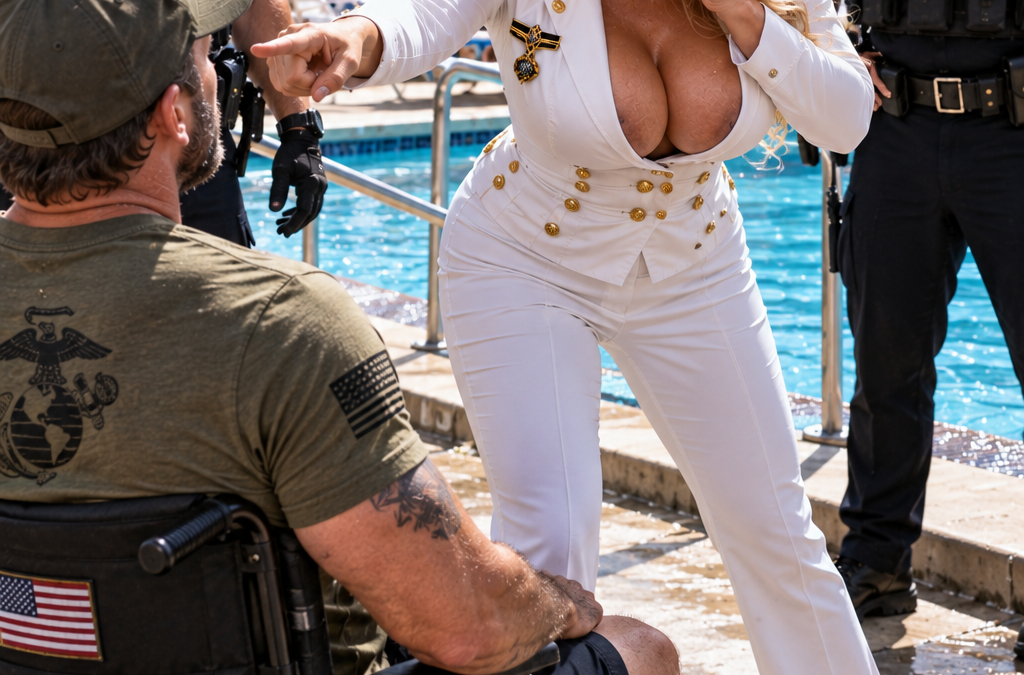
𝗣𝗔𝗥𝗧 𝟮
She pointed toward me.
“You can’t be in there.”
At first, I thought I’d misunderstood.
“Sorry?”
“You cannot be in this pool.”
I looked around.
Nobody was evacuating.
No whistle.
No emergency.
No sign saying the pool had closed.
“What are you talking about?”
Karen straightened.
“This is a private facility.”
I actually glanced toward the city parks logo painted on a nearby sign.
Then back at her.
“No, it isn’t.”
Her eyebrows lifted.
“I’m sorry?”
“It’s a municipal pool.”
“I know what it is.”
“Apparently not.”
A man swimming in the lane beside me slowed down.
Karen stepped closer to the edge.
“I own this facility.”
That sentence was so absurd I almost laughed.
Almost.
I’ve spent enough time dealing with bureaucracies to know that sometimes things you assume are public can have unusual management arrangements.
But I’d been paying the city for my pass for two years.
City employees staffed the front desk.
City logos were everywhere.
So I said, “No, you don’t.”
Karen’s mouth tightened.
“Excuse me?”
“I’ve had a season pass here for two years. It’s run by the city.”
She gave me a condescending smile.
“You don’t understand the arrangement.”
“What arrangement?”
“I have authority here.”
“Are you the manager?”
“I oversee things.”
That was already a different claim.
I rested my arms on the pool edge.
“Do you work for Parks and Recreation?”
Karen exhaled sharply.
“I don’t need to explain my position to you.”
“Then don’t.”
I pushed away from the wall.
“I have exercises to finish.”
“Stop.”
I turned back.
She pointed toward the ramp.
“You need to get out.”
Several people were openly watching now.
I felt that familiar tension beginning behind my ribs.
The feeling you get when you realize somebody isn’t going to let you simply walk—or in my case wheel—away from a confrontation.
I kept my voice even.
“Why?”
Karen looked around before answering.
It was almost theatrical.
Like she wanted witnesses.
“I don’t think your presence is appropriate.”
There it was.
Not rules.
Not a closed lane.
Not maintenance.
Me.
“What exactly is inappropriate?”
She seemed surprised I asked.
I wanted her to say it.
I had learned something since my injury: when people hide ugly beliefs behind vague words, sometimes the best thing you can do is make them explain themselves clearly.
Karen folded her arms tighter.
“I’ve heard about you.”
“Congratulations.”
“You’re military.”
“Former Marine.”
Her face changed.
A little flash of satisfaction, as if I had just admitted to something.
“Exactly.”
I stared at her.
“Exactly what?”
“I’m a pacifist.”
I waited.
She clearly expected that sentence to carry more weight.
“Okay.”
“I don’t support war.”
“Okay.”
“I don’t support violence.”
“Still okay.”
“And I don’t think people associated with violent organizations belong in spaces where families are trying to relax.”
For several seconds, I genuinely had no response.
Not because I was hurt.
Not yet.
Because I couldn’t believe an adult had said that out loud.
Finally, I laughed.
It escaped before I could stop it.
Karen’s eyes narrowed.
“I’m glad you find discrimination funny.”
That almost made me laugh again.
“Discrimination?”
“You don’t respect my beliefs.”
“I’m trying to understand them.”
“They’re very simple.”
“Apparently not.”
She leaned slightly forward.
Her white jacket pulled tightly across her chest as she gestured toward me.
“People come here for peace.”
“And I’m swimming.”
“You represent violence.”
“I’m doing physical therapy.”
“You served in the military.”
“Years ago.”
“It doesn’t change what you participated in.”
Something inside me tightened.
I had heard ignorant things before.
Veterans do.
You learn quickly that everybody has a theory about what you did, why you did it, what war is, what service means, what kind of person signs up.
Most people are entitled to their opinions.
I don’t need strangers thanking me.
I don’t need strangers agreeing with every conflict my country has ever participated in.
I don’t even need them to respect the military.
But this was different.
Karen wasn’t criticizing policy.
She was looking at my wheelchair and telling me I didn’t belong in a public place because of what she imagined I represented.
I said, “So let me make sure I’ve got this right.”
She lifted her chin.
“You want me to leave a city pool because I was a Marine.”
“I want you to respect that families shouldn’t have to be around violent energy.”
A woman with two children in the shallow end turned fully toward us.
The older man in the neighboring lane stopped swimming.
I looked at Karen.
“What violent energy?”
“People with your background carry it.”
“My background?”
“Military culture.”
I looked down at myself.
I was chest-deep in water.
No weapon.
No uniform.
No raised voice.
A wheelchair waited at the top of the accessible ramp.
“I’ve been swimming quietly for ten minutes.”
“You’re blocking the ramp.”
That was new.
“No, I’m not.”
“You move slowly.”
My stomach turned.
“What?”
“Other people may need to use it.”
“Nobody is waiting.”
“That’s not the point.”
“Then what is?”
Karen’s face hardened.
“The point is that some people should be conscious of the amount of space they take up.”
There are insults you recognize immediately.
And then there are ones that hit you in pieces.
You move slowly.
The amount of space you take up.
For months after I was injured, I had worried about exactly those things.
Was my chair in somebody’s way?
Was I slowing people down?
Was a friend choosing a restaurant based on my accessibility needs?
Were people waiting for me to transfer?
Was I forcing everybody else to adjust?
Therapy helped.
Time helped.
The people who loved me helped.
I had eventually learned that needing space did not make me undeserving of it.
And now a stranger stood above me at the edge of a public pool trying to weaponize every insecurity I’d spent years learning to quiet.
I felt anger.
Real anger.
But underneath it was something more dangerous.
Shame.
For one second.
Maybe two.
Then I looked around.
At the ramp.
At my chair.
At the city logo.
And something settled inside me.
No.
I wasn’t giving her that.
“I’m not going anywhere.”
Karen blinked.
“I’ve asked you to leave.”
“You don’t have the authority.”
“I’m banning you.”
“You can’t.”
“I absolutely can.”
“Show me identification.”
“What?”
“If you manage this facility, show me something.”
Her face flushed.
“I don’t carry employee identification when I’m relaxing.”
“Convenient.”
“You are becoming aggressive.”
My voice had not risen.
That was the moment I understood what she was doing.
She wasn’t just trying to win the argument.
She was building a story.
Disabled veteran.
Aggressive.
Dangerous.
Refusing orders.
Karen pulled out her phone.
“Fine.”
“What are you doing?”
“I’m calling the police.”
A few people murmured.
I looked at her phone.
Then at her.
“Go ahead.”
That clearly wasn’t the response she expected.
Her finger paused over the screen.
“You think I’m bluffing?”
“No.”
“I’ll have you escorted out.”
“Call them.”
“You are banned from this establishment.”
“Call them.”
Her lips tightened.
She dialed.
I stayed where I was.
Part of me wanted to get out.
Not because she had won.
Because I hated being watched.
Around a dozen people had stopped what they were doing.
Every instinct I’d developed since the injury told me to minimize the spectacle.
Get dressed.
Leave.
Come back tomorrow.
Complain later.
But if I left, Karen would learn something.
She would learn that lying confidently enough could move me.
I couldn’t let that happen.
So I stayed.
A woman from the shallow area walked closer through the water.
She kept her voice low.
“Is she serious?”
“Seems like it.”
“She doesn’t own this place.”
“I know.”
“My kids have been coming here since it opened.”
Karen paced several yards away, phone against her ear.
Her voice carried.
“Yes, I need officers here.”
Pause.
“There’s an individual refusing to leave.”
Pause.
“He’s making people uncomfortable.”
Pause.
“Yes, I consider him dangerous.”
The woman beside me stared at her.
“Dangerous?”
I shrugged.
“Apparently I’m terrifying.”
She looked at my wheelchair.
Then at me.
“This is insane.”
I was beginning to agree.
Karen kept talking.
“He’s former military.”
Pause.
“Marine, yes.”
Pause.
“I don’t know whether he’s armed.”
That changed everything.
My blood went cold.
I called out.
“Karen.”
She turned away.
“Karen.”
She kept talking.
I raised my voice.
“Do not tell them I might be armed.”
She covered the phone.
“Stop interrupting.”
“I’m in swimming trunks.”
Several people laughed.
Karen’s face reddened.
She returned to the call.
I suddenly understood how easily this could become dangerous.
Police responding to a report of a “dangerous former Marine” potentially armed at a public pool would arrive with a very different mindset from officers responding to an argument between swimmers.
I had done nothing.
But people get hurt in misunderstandings.
Especially when somebody feeds dispatchers the right words.
My hands began shaking.
Not visibly enough for anyone else to notice.
Enough that I noticed.
I took a slow breath.
Then another.
A lifeguard had finally realized something serious was happening and approached.
“Is everything okay?”
Karen immediately pointed toward me.
“I’ve handled it.”
The lifeguard stared at her.
“What?”
“Police are on the way.”
The young man looked alarmed.
“Why?”
“He refuses to leave.”
The lifeguard looked at me.
I said, “She says she owns the pool.”
His expression went completely blank.
“What?”
Karen snapped, “Stay out of this.”
That told me she knew exactly who had actual authority.
The lifeguard disappeared toward the office.
I stayed in the shallow end.
I considered getting back into my chair before police arrived.
But the thought made me angry.
I hadn’t done anything wrong.
I wasn’t going to scramble to make myself look safer because Karen had lied.
Still, when I heard sirens faintly in the distance, my heartbeat changed.
Years of training don’t disappear.
You notice sounds.
Entrances.
Body language.
Who is standing where.
Two officers entered through the pool gate several minutes later.
One was a younger man.
The other was an older woman.
Karen practically intercepted them.
She moved so quickly I almost admired the commitment.
“Thank God.”
The younger officer raised a hand.
“Ma’am?”
“He’s right there.”
She pointed directly at me.
“This man is refusing to leave my pool.”
My pool.
The officer followed her finger.
He saw me sitting in the shallow water.
Then my wheelchair.
Then Karen.
His expression became difficult to read.
“What’s going on?”
“I told him repeatedly he isn’t welcome.”
“Why?”
“He’s a veteran.”
There was a pause.
The younger officer blinked.
“What?”
“He’s former military.”
The officer looked at his partner.
Then back at Karen.
“And that’s why you want him removed?”
“I’ve already explained this to dispatch. This is supposed to be a peaceful family space.”
The older officer approached the pool edge.
“Sir?”
“Yes, ma’am.”
“Can we talk?”
“Absolutely.”
“Would you mind telling me what happened?”
Before I could answer, Karen interrupted.
“He has been hostile since I approached him.”
The officer turned.
“Ma’am, I’m speaking to him.”
Karen stopped.
I explained everything.
I had arrived.
Checked in with a valid season pass.
Entered through the accessible ramp.
Started my normal exercises.
Karen told me I couldn’t be there.
Claimed the facility was private.
Claimed she owned it.
Then said veterans weren’t appropriate around families.
The officer listened without interrupting.
“So you were asked to leave by staff?”
“No.”
“By a lifeguard?”
“No.”
“By anybody you know works here?”
“No.”
Karen stepped forward.
“I manage the facility.”
The older officer looked at her.
“You own it or manage it?”
Karen hesitated.
“I said I have an arrangement.”
“What arrangement?”
“With the city.”
“What’s your job title?”
“I don’t need a title.”
The officer waited.
Karen shifted.
“I’m involved in oversight.”
“What department?”
Karen’s face reddened.
“I’ve been coming here for years.”
The younger officer said, “That’s not what she asked.”
The woman who had spoken to me earlier raised her hand like she was in school.
“Officer?”
They looked toward her.
“This pool belongs to the city. That woman doesn’t work here.”
Karen spun around.
“Nobody asked you.”
“I’ve brought my kids here for years.”
“Stay out of it.”
Another voice came from the lap lanes.
An older man.
“I’ve been here almost ten years.”
He pointed toward Karen.
“She’s not management.”
Karen glared at him.
He continued.
“She just acts like it.”
A few people laughed.
Karen’s composure cracked.
“I have relationships with people on the city council.”
The younger officer looked toward the front office.
“Let’s make this easy.”
He walked inside.
Karen called after him.
“You can ask them. They know me.”
The older officer stayed near the pool.
She looked at me.
“Do you have identification?”
“With my bag.”
“Take your time.”
The words mattered.
Take your time.
Not hurry.
Not move.
Not prove anything.
I transferred back into the chair and retrieved my wallet.
My hands had stopped shaking.
The officer checked my identification and season pass.
Everything was current.
Karen watched the whole process with an expression suggesting she couldn’t believe reality was failing to cooperate.
The younger officer returned with the actual pool manager.
His name was Tom.
I’d spoken with him plenty of times.
He looked irritated before he even reached us.
Then he saw Karen.
His face hardened.
“Karen.”
So they knew each other.
Karen immediately changed tone.
“Tom, thank goodness. Explain to them.”
Tom stopped.
“Explain what?”
“That I was handling a safety concern.”
He looked at me.
“You okay?”
“I’m fine.”
Then back at Karen.
“What did you do?”
Karen seemed offended by the question.
“I asked him to leave.”
“Why?”
“You know my concerns about maintaining a peaceful environment.”
Tom closed his eyes briefly.
Not surprise.
Exhaustion.
That was interesting.
The officer asked, “Does she manage this facility?”
Tom actually laughed.
“No.”
Karen stiffened.
“Tom.”
“No, Karen. You do not own this pool. You do not manage it. You do not work for the city.”
“I never said I worked—”
“You told me you did,” I said.
She ignored me.
Tom continued.
“And this isn’t the first time.”
Karen’s face changed.
The crowd grew quieter.
Tom looked at the officers.
“We’ve received complaints about her trying to enforce rules herself.”
“That’s not accurate.”
“Karen.”
“I remind people of standards.”
“You aren’t staff.”
“Somebody has to care about what happens here.”
“We have lifeguards.”
“They’re teenagers.”
One of the lifeguards nearby frowned.
Tom’s patience disappeared.
“You have been told before to stop directing other members.”
“I’m protecting families.”
“From what?”
She pointed at me.
“From people who make them uncomfortable.”
Tom stared at her.
“He’s been a member here for years.”
“I know what he is.”
That sentence froze the air.
Tom’s expression changed.
“What exactly is he?”
Karen realized too late how it sounded.
“I mean his background.”
“My background?” I asked.
“Military.”
Tom looked at me.
Then at her.
“You’re doing this because he’s a veteran?”
“I’m a pacifist.”
The older officer let out a slow breath.
Karen kept going, as people often do when they’ve lost control but haven’t realized silence is now their best option.
“I don’t believe violent institutions should be normalized around children.”
Tom said, “He’s swimming.”
“That isn’t the point.”
“Then what is?”
“He represents something.”
The younger officer stared at her.
“Ma’am, he’s a guy doing exercises in a pool.”
Karen’s voice rose.
“His presence intimidated me.”
The officer glanced toward me.
I was sitting in my wheelchair beside a folded towel.
“How?”
Karen gestured broadly.
“People with combat backgrounds can be unpredictable.”
There it was.
Not politics.
Not pacifism.
Fear based entirely on what she’d decided I was.
I felt something in my chest sink.
I had spent years trying not to become what people assumed veterans were.
Broken.
Angry.
Dangerous.
Unstable.
I’d sat through therapy appointments when I didn’t want to talk.
I’d learned how to live with pain without turning it against everyone around me.
I’d rebuilt a life that felt ordinary.
And Karen had reduced me to a stereotype without knowing anything about me except Marine and wheelchair.
The officer’s voice hardened.
“Did he threaten you?”
Karen hesitated.
“Not explicitly.”
“Did he raise his fist?”
“No.”
“Approach you aggressively?”
“No.”
“Yell?”
“He was confrontational.”
“Did he threaten anybody here?”
“No.”
The officer looked around.
“Did anyone see this man threaten someone?”
Nobody spoke.
Then the mother from the shallow end said, “No.”
The older swimmer shook his head.
“He didn’t do anything.”
Another woman added, “She approached him.”
The officer looked back at Karen.
“So when you told dispatch there was a dangerous individual here, what was that based on?”
Karen’s confidence finally faltered.
“I felt unsafe.”
“Because he’s a veteran.”
“Because of his energy.”
A teenager laughed.
His mother shushed him.
The officer didn’t.
“Energy is not a criminal offense.”
Karen looked around.
People were watching her differently now.
At the beginning, some had probably assumed they were witnessing a legitimate dispute.
Now they understood.
Karen understood that they understood.
And the humiliation hit her all at once.
Her face reddened from her neck upward.
She turned toward Tom.
“You’re really going to let this happen?”
Tom looked exhausted.
“Let what happen?”
“This.”
“You called the police.”
“Because nobody here will enforce standards.”
“You don’t set the standards.”
“I have contributed to this facility for years.”
“So has everybody who buys a pass.”
“I’ve donated.”
“That doesn’t give you authority over membership.”
The older officer stepped in.
“Ma’am, we’re going to be very clear.”
Karen looked at her.
“You cannot ban another resident from a public facility.”
Karen opened her mouth.
The officer continued.
“You do not own this property. You do not manage it. You do not represent the city.”
Karen looked toward Tom.
He nodded.
The officer continued.
“And calling law enforcement while making claims that someone is dangerous when you have no evidence of danger is extremely serious.”
“I didn’t make anything up.”
“You suggested he could be armed.”
“He was a Marine.”
The younger officer frowned.
“Those two statements have nothing to do with each other.”
Karen crossed her arms.
“You weren’t here. You didn’t feel how intimidating he was.”
The officer looked at me again.
“He is literally sitting in a wheelchair beside a pool.”
A few people laughed.
Karen’s mouth fell open.
“That’s discriminatory.”
The irony was so complete that nobody knew how to respond.
The older officer did.
“No, ma’am. What’s discriminatory is deciding somebody shouldn’t have access to a city service because you don’t like his prior military service or disability.”
Karen’s head snapped back.
“I never said because he’s disabled.”
“You complained about him using the accessible ramp slowly.”
I hadn’t realized she’d heard that part.
Apparently one of the witnesses had told her.
Karen said nothing.
The officer took out a notebook.
“We also need to discuss the false or misleading nature of your call.”
Karen suddenly looked nervous.
“Am I being arrested?”
“Not at this time.”
The words at this time did something to her posture.
Her shoulders dropped.
The officer continued.
“But you’re being formally warned.”
“This is ridiculous.”
“Then don’t repeat it.”
Karen’s eyes filled with fury.
Not fear.
Not regret.
Fury.
At me.
Because somehow I had done this to her.
Tom stepped forward.
“Karen, I’m also telling you now that your membership is going to be reviewed.”
Her head turned sharply.
“My membership?”
“Yes.”
“You can’t do that.”
“I manage the pool.”
For one beautiful second, nobody said anything.
Then somebody laughed.
Tom continued.
“We’ve had prior complaints about you confronting members, criticizing swimwear, telling people where they can sit, and pretending to enforce rules.”
“I was helping.”
“You were warned.”
“Those were misunderstandings.”
“Today wasn’t.”
“You cannot punish me because he got offended.”
Tom’s jaw tightened.
“This has nothing to do with him being offended.”
He pointed toward the pool office.
“You misrepresented yourself as management.”
“I never—”
“Multiple people heard you.”
He continued.
“You attempted to remove a legitimate member.”
Karen looked at me.
“He makes me uncomfortable.”
“Then use another lane.”
“I shouldn’t have to.”
Tom shook his head.
“And that’s exactly the problem.”
Around us, phones were out.
I noticed at least three people recording.
I hadn’t realized when they started.
Karen did.
Her eyes moved from phone to phone.
“Are you recording me?”
Nobody answered.
“Stop recording me.”
One man said, “Public pool.”
Karen glared at him.
“You don’t have my consent.”
He lowered the phone slightly.
“You’re in public.”
She reached toward it.
The officer immediately said, “Don’t.”
Karen froze.
For the first time since she approached me, she looked genuinely defeated.
Not humbled.
Defeated.
There’s a difference.
Humility requires understanding why you were wrong.
Karen simply understood she had lost control.
The officers finished taking information.
They didn’t arrest her.
The older officer explained that depending on the exact wording and circumstances, her report might not rise to the level of a criminal false-report charge, but any repeat behavior could bring consequences.
Harassment.
False reporting.
Potential interference with facility operations.
Karen listened with her jaw clenched.
When they finished, she packed her things.
Fast.
White towel.
Large beach bag.
Phone.
Sunglasses.
She didn’t look at me.
Didn’t apologize.
Didn’t look at Tom.
She marched toward the exit, her fitted white uniform drawing eyes for entirely different reasons now.
At the gate, she stopped.
For half a second, I thought she might turn around and say something.
She didn’t.
She left.
The silence afterward lasted maybe three seconds.
Then everybody started talking.
The woman who had first spoken to me came over.
“Are you okay?”
“Yeah.”
“I’m sorry that happened.”
“Not your fault.”
Another man shook his head.
“I can’t believe she said veterans shouldn’t use public spaces.”
I gave a tired laugh.
“Neither can I.”
The older swimmer approached.
“Marine?”
“Yeah.”
“My brother was Army.”
I smiled.
“We won’t hold that against him.”
He laughed.
The tension finally broke.
I considered going home.
My body was tight again.
The entire point of the morning had been to loosen my back, and now every muscle felt like it had been wound with wire.
But leaving immediately felt wrong.
Karen had wanted me gone.
So I went back into the water.
I wheeled down the ramp.
Transferred.
Started again.
Slowly.
Stretch.
Reach.
Pull.
Turn.
The first lap hurt.
The second was easier.
By the fifth, the knot in my chest began to loosen.
I stayed almost another hour.
When I finally left, Tom stopped me near the office.
“I’m sorry.”
“You didn’t do anything.”
“I should’ve dealt with her sooner.”
“Sounds like she’s been a problem.”
He gave a tired smile.
“You have no idea.”
Apparently Karen had appointed herself unofficial guardian of the facility for years.
She complained about children’s behavior.
Adults’ swimwear.
Music volume.
Where people placed towels.
How long someone used the accessible changing room.
The lifeguards.
Lane etiquette.
Once, according to Tom, she’d told a teenage boy his neon trunks were “disruptive to the atmosphere.”
I stared at him.
“Seriously?”
“Seriously.”
“Why wasn’t she banned before?”
“Most complaints sounded petty individually.”
That made sense.
One annoying interaction.
One rude comment.
One argument.
People go home.
Nobody wants paperwork.
Nobody wants conflict.
Karen had survived by staying just below the level that forced anybody to act.
Until she called the police on me.
That evening, I was home when my phone buzzed.
A woman from the pool had found me through a local community page.
She sent a message.
Hope you’re doing okay. I posted a short clip because what she said was unbelievable.
There was a link.
I clicked.
My stomach dropped.
The video began with Karen standing near the officers.
Her voice was clear.
“He’s a veteran.”
Then the officer:
“You’re saying he can’t be here because he was in the military?”
Karen:
“That is correct.”
The clip continued long enough to include her comments about violent backgrounds and peaceful spaces.
Then it ended.
Thousands of views.
Already.
Comments multiplying.
Some supportive.
Some furious.
Some mocking.
I put the phone down.
I hadn’t asked for that.
Part of me felt uncomfortable.
I didn’t want my life becoming internet entertainment.
But another part of me understood why the woman posted it.
If there hadn’t been video, Karen could have rewritten the story.
She could say I yelled.
Threatened her.
Intimidated children.
Maybe the officers misunderstood.
Maybe she never claimed to own the pool.
Video doesn’t care about your preferred version.
Within a few days, the clip spread through local social media.
People identified Karen.
I didn’t help them.
I didn’t need to.
She had lived in the area long enough that plenty of people recognized her.
Stories started surfacing.
Someone said she’d tried to police parking at a public park.
Someone else claimed she’d lectured teenagers about music.
Another person said she once demanded staff remove a family for bringing food she considered “too smelly.”
I couldn’t verify most of it.
I also didn’t care.
My incident was enough.
A neighbor told me she had seen Karen at a grocery store several days later.
Apparently another shopper recognized her.
Loudly.
“You’re the pool lady, aren’t you?”
Karen tried ignoring him.
Then he added:
“The one who hates veterans.”
According to my neighbor, Karen abandoned part of her shopping and left.
I felt a small amount of satisfaction hearing that.
Then I felt guilty about the satisfaction.
Then I decided I wasn’t required to be a saint.
A week after the incident, the city released a statement.
It didn’t name Karen.
It didn’t name me.
It simply clarified that the pool was a public municipal facility open to eligible residents regardless of background and that individual members held no authority to determine access.
It also stated that discriminatory harassment could result in membership consequences.
Short.
Professional.
Unambiguous.
Then Tom called me.
“Got a minute?”
“Sure.”
“I wanted you to hear this from me.”
My stomach tightened.
“What happened?”
“The board reviewed Karen’s membership.”
“Okay.”
“We suspended her pending review after the incident.”
I hadn’t known that.
“And?”
“Permanent revocation.”
I sat quietly.
“She’s banned?”
“Yes.”
I almost laughed at the irony.
Karen had started the morning by telling me I was banned from her pool.
Now she was the only one who actually couldn’t return.
Tom continued.
“This wasn’t based on just your complaint.”
“What do you mean?”
“We reviewed prior incidents.”
Apparently once there was video, police documentation, and multiple witnesses, management reopened old complaints.
Karen had accumulated more than anybody realized.
She’d told a mother that her swimsuit was inappropriate.
She’d tried ordering teenagers out of certain lanes.
She’d confronted a man about tattoos.
She’d criticized children for splashing in the children’s area.
She’d repeatedly presented personal preferences as facility rules.
Staff had warned her before.
She ignored them.
My case wasn’t the beginning.
It was simply the moment she pushed too far to be ignored.
“Are you okay with the decision?” Tom asked.
“Why wouldn’t I be?”
“Some people feel guilty when consequences get serious.”
I looked toward my wheelchair beside the couch.
“No.”
I thought about Karen telling police I was dangerous.
Suggesting I could be armed.
Trying to turn my military service into evidence of threat.
“No. I don’t feel guilty.”
And I didn’t.
The next time I went swimming, I almost turned around in the parking lot.
That’s the part people don’t see in stories where the entitled person gets humiliated and everybody cheers.
Winning doesn’t erase the experience.
For several days, I replayed everything.
Her expression.
Her voice.
You move slowly.
People like you take up space.
Violent background.
Dangerous.
Those words found old cracks.
I hated that.
I’d faced worse things than Karen.
Obviously.
But pain doesn’t arrange itself according to what should matter most.
Sometimes a stranger can hit a vulnerability more precisely than a battlefield ever did.
I sat in my vehicle staring at the pool entrance.
Then I thought about why I came there in the first place.
Not Karen.
Me.
My back.
My health.
My routine.
My hour of feeling normal.
I got out.
Rolled inside.
The front-desk worker looked up.
For half a second, she seemed worried I might not come back.
Then she smiled.
“Morning.”
“Morning.”
She held out her hand.
I showed the pass.
“You know I know who you are, right?”
“Rules are rules.”
Her smile widened.
Everything in me loosened a little.
I headed toward the ramp.
No Karen.
No confrontation.
Just sunlight on blue water.
A couple parents.
An older swimmer.
The lifeguard.
Normal.
I lowered myself into the pool.
And for the first time since the incident, I realized Karen hadn’t taken that from me.
She had tried.
That’s what angered me most when I thought about it later.
Not that she disliked the military.
She could dislike the Marine Corps.
She could oppose every war.
She could protest outside a recruiting station.
She could wear flowers in her hair and quote pacifist philosophers until nobody could take another sentence.
That’s freedom.
I had worn a uniform partly because I believed she had that freedom.
But Karen hadn’t wanted freedom.
She wanted authority.
She didn’t merely want to disagree with me.
She wanted the power to remove me.
My wheelchair made me easier to target because she assumed vulnerability meant weakness.
My veteran status gave her a justification.
Her imaginary authority gave her courage.
Then the moment I refused, she tried to turn police power against me.
A pacifist summoning armed officers to remove a disabled man from a swimming pool because his existence made her uncomfortable.
I wish I could say I had some perfect line in the moment.
I didn’t.
Life rarely gives you the dialogue afterward seems to demand.
Most of what I did was stay calm.
Sometimes that is the strongest thing you can do.
Stay.
Don’t give the bully the reaction they need.
Don’t become the character they’re trying to describe.
Make them explain themselves.
Let witnesses listen.
Let reality do the rest.
A few weeks later, I ran into the older man from the pool near the lockers.
He nodded.
“Still dangerous?”
“Extremely.”
He looked toward the water.
“Terrifying.”
“I might stretch aggressively.”
“Someone call the police.”
We both laughed.
Humor helped.
So did knowing the place hadn’t changed.
People still swam.
Children still yelled.
Teenagers still ignored the WALK signs until lifeguards whistled at them.
The water still supported my body exactly the same way.
And the ramp still belonged to everyone who needed it.
Karen had tried to convince me I was taking up too much space.
Eventually, I realized that sentence told me everything about her and nothing about me.
Disabled people hear versions of it constantly.
Sometimes nobody says the words.
The building says it by having only stairs.
The parking lot says it by letting someone block the access aisle.
The person behind you says it by sighing because you need thirty extra seconds.
Society gets very comfortable with disability as long as disability remains inspirational, quiet, and convenient.
The moment accommodation takes space, time, money, or patience, attitudes change.
Karen simply said the quiet part out loud.
I move slowly.
Yes.
Sometimes.
I use a ramp.
Yes.
I take up space.
Absolutely.
So does everyone else.
The difference is that I spent years believing I needed to apologize for mine.
I don’t anymore.
Months passed.
The video disappeared from active conversation.
Something else replaced it online.
Life moved on.
Occasionally someone still recognized me at the pool.
“Are you the Marine from that video?”
I hated that question at first.
Then I learned to shrug.
“Unfortunately.”
Most people were kind.
Some wanted to tell me stories about relatives who served.
Some simply shook their heads at Karen.
I never saw her at the pool again.
Tom said she appealed the decision once.
The board upheld the ban.
That was it.
The woman who had claimed ownership of a public facility had finally discovered the one authority she couldn’t invent her way around.
Actual authority.
And it told her no.
I think about that every now and then when I reach the bottom of the accessible ramp.
There’s a moment when my chair enters the water and buoyancy begins taking weight away from my body.
The pressure changes.
Pain eases.
Then I transfer.
I push away.
For the first few feet, I don’t think about Karen.
I don’t think about the Corps.
I don’t think about the injury.
I don’t think about everything my body used to do.
I think about the next stroke.
Then the next.
Some days I swim well.
Some days pain limits me.
Some days I barely make it halfway through my routine before my muscles tell me we’re finished.
But I decide when I’m finished.
That’s the part that matters.
Karen had approached me believing she got to make that decision.
She thought beauty, confidence, an expensive-looking white uniform, and a loud voice could manufacture authority.
She thought if she stood tall enough beside a man in a wheelchair, people would assume she belonged above him.
She thought saying dangerous veteran would make officers see a threat instead of a human being.
She was wrong.
The witnesses saw her.
The staff saw her.
The police saw her.
Eventually, an entire community saw her.
And I kept swimming.
That’s the ending I care about.
Not the viral video.
Not the grocery-store embarrassment.
Not even her permanent ban.
I care about the morning I almost sat in my car and let her take something from me without being there.
Then I opened the door.
Got my wheelchair out.
Went inside.
Showed my pass.
Rolled down the same ramp she had accused me of occupying too slowly.
And got back into the water.
Karen wanted me removed because she thought my past made me unfit for her peaceful public space.
Instead, the city removed her.
The pool remained public.
The ramp remained accessible.
My season pass remained valid.
And every week, several times a week, I still go there.
I still move slowly sometimes.
I still take up space.
And I no longer apologize for either one.
𝗧𝗛𝗘 𝗘𝗡𝗗
She Tried to Ban Me From a Public Pool Because I Was a Marine—Then She Called 911 to Have Me Removed
I had gone to the pool that morning because swimming was one of the few things that still made my damaged body feel like it belonged to me.
Then Karen stepped in front of my wheelchair, announced that men like me made families feel unsafe, and told me I was banned from a city facility she didn’t even own.
When I refused to leave, she pulled out her phone and called the police.
There are moments after a life-changing injury when you realize the hardest part isn’t the pain.
The pain is obvious.
It announces itself.
It wakes you at three in the morning. It burns through your lower back. It crawls down your legs like electricity moving through broken wires. It tells you when rain is coming before the weather app does.
You learn the pain.
You measure it.
You build your day around it.
The harder thing is learning how other people look at you afterward.
I served in the Marine Corps for several years before a deployment injury damaged my lower spine badly enough that walking became something I could no longer count on.
There were surgeries.
More than one.
Months of rehabilitation.
Conversations with doctors where I kept waiting for somebody to use the sentence I wanted to hear.
You’ll be back to normal.
Nobody did.
Eventually, the language changed.
We stopped talking about recovery as a destination and started talking about management.
Adaptation.
Mobility.
Quality of life.
Those are useful words.
They’re also brutal words when you’re young enough to remember running five miles before breakfast.
I can stand for limited periods on good days.
I can transfer myself.
I have some movement.
But for practical purposes, the wheelchair is how I get through the world.
It took me a long time to accept that.
Longer than I like admitting.
At first, every curb felt personal.
Every staircase felt insulting.
Every person who talked to whoever was standing beside me instead of talking directly to me made something hot crawl up the back of my neck.
The worst were the people who stared.
Then there were the people who worked very hard not to stare, which somehow felt almost as obvious.
Eventually, I learned to ignore most of it.
People are curious.
Some are uncomfortable.
Some don’t know where to look.
Most mean no harm.
You either spend your life angry about every glance or you learn to conserve your energy for things that actually matter.
Swimming helped me do that.
My physical therapist had recommended it early.
So had one of my doctors.
In the water, my spine wasn’t carrying the same load. Muscles that tightened painfully in the chair could move. I could stretch without fighting gravity every second.
But the medical benefits weren’t the real reason I kept going.
The real reason was simpler.
In the water, I didn’t feel trapped.
I could move from one side of the pool to the other without thinking about wheels, ramps, door widths, gravel, thresholds, or whether somebody had parked too close to the accessible space.
For forty-five minutes, sometimes an hour, I could move because I wanted to move.
That mattered more than I knew how to explain.
There was a municipal pool near my house that became part of my routine.
It was city-owned and operated through the parks and recreation department.
Nothing fancy.
A main recreational pool.
Several lap lanes.
A shallow children’s area.
Concrete deck.
Plastic lounge chairs.
A small front office where they checked passes and sold drinks out of a refrigerator.
Most importantly for me, the pool had a proper accessible ramp.
Not one of those situations where a facility technically claims accessibility because there’s a mechanical lift stored behind a locked door nobody knows how to operate.
This was an actual ramp that sloped directly into the shallow end.
I could wheel myself down until I was deep enough to transfer into the water.
Independence.
That was the whole point.
I’d been going there for roughly two years.
Usually late morning.
It was quieter then.
Kids were often still in school.
The early lap swimmers had gone to work.
The afternoon crowd hadn’t arrived.
The lifeguards knew me.
The front-desk staff knew me.
Some regular swimmers knew my name.
We didn’t necessarily socialize outside the facility, but there was comfort in being recognized without being made into a spectacle.
I’d roll in.
Show my season pass.
Exchange a few words with whoever was working the desk.
Head toward the ramp.
Swim.
Shower.
Leave.
Routine.
Ordinary.
Ordinary had become precious to me.
The morning Karen decided to destroy that routine started exactly like any other.
I arrived sometime after ten.
The parking lot was maybe a third full.
Sunlight was reflecting off the windshields hard enough to make me squint.
I transferred my chair out, grabbed my bag, and headed inside.
“Morning,” the woman at the desk said.
“Morning.”
She glanced at my pass.
“You know I know who you are, right?”
“Rules are rules.”
“You say that now. Wait until I make you fill out the paperwork again.”
“Threatening a veteran before lunch. Bold.”
She laughed.
I continued through the gate.
That was when I first saw Karen.
She sat on one of the lounge chairs closest to the accessible ramp.
I noticed her because she was staring directly at me.
Not glancing.
Staring.
She looked around forty.
Maybe a little younger, maybe a little older. It was difficult to tell because everything about her appearance was controlled down to the smallest detail.
Long blonde hair fell over her shoulders in styled waves.
Her makeup looked too precise for someone supposedly there to swim.
Large sunglasses rested on top of her head.
She was attractive, and she knew it.
She had a curvy figure with an especially large bust, which was emphasized by the bizarre white military-style outfit she was wearing over her swimsuit—a sharply tailored jacket cinched tight at the waist, polished metallic buttons, and a deep plunging neckline that made it look more like a costume from a luxury yacht club than anything remotely practical for a public pool.
White fitted trousers completed the look.
I remember thinking she must have come from somewhere else and hadn’t changed yet.
Then I noticed the way she watched people.
Not casually.
Evaluating them.
A teenager ran near the edge.
Karen snapped her fingers.
“Walk.”
The kid slowed down.
One of the actual lifeguards glanced over, confused.
Karen leaned back as though she’d done him a favor.
That should have told me everything.
Still, I didn’t care.
I’d dealt with controlling personalities before.
Most of the time, ignoring them was the easiest option.
I wheeled past her.
Her eyes followed me.
I could feel them.
I reached the ramp and locked the chair.
Getting into the water had become a practiced sequence.
Position.
Transfer.
Adjust.
Slowly move down.
Nothing dramatic.
Nothing dangerous.
But when you know somebody is staring, even things you’ve done a thousand times suddenly feel exposed.
I hated that feeling.
Not because I was ashamed of the chair.
I wasn’t.
But there is a difference between being seen and being inspected.
Karen was inspecting me.
I got into the water and began my routine.
Easy movement first.
Shoulders.
Back.
Controlled leg stretches.
Then slow laps.
The first ten minutes were good.
The water was warm enough to keep my muscles from tightening but cool enough that it still felt refreshing.
My lower back began to loosen.
I focused on breathing.
Reach.
Pull.
Turn.
For those few minutes, Karen stopped existing.
Then I reached the shallow end and saw her standing at the edge.
Arms folded.
Waiting.
I looked around instinctively.
Maybe she was waiting for a child.
No.
Her eyes were fixed on me.
I pushed away from the wall.
She spoke.
“Excuse me.”
I kept moving.
Loud enough this time that nearby swimmers heard her.
“Excuse me.”
I stopped.
“Yes?”
She pointed toward me.
“You can’t be in there.”
At first, I thought I’d misunderstood.
“Sorry?”
“You cannot be in this pool.”
I looked around.
Nobody was evacuating.
No whistle.
No emergency.
No sign saying the pool had closed.
“What are you talking about?”
Karen straightened.
“This is a private facility.”
I actually glanced toward the city parks logo painted on a nearby sign.
Then back at her.
“No, it isn’t.”
Her eyebrows lifted.
“I’m sorry?”
“It’s a municipal pool.”
“I know what it is.”
“Apparently not.”
A man swimming in the lane beside me slowed down.
Karen stepped closer to the edge.
“I own this facility.”
That sentence was so absurd I almost laughed.
Almost.
I’ve spent enough time dealing with bureaucracies to know that sometimes things you assume are public can have unusual management arrangements.
But I’d been paying the city for my pass for two years.
City employees staffed the front desk.
City logos were everywhere.
So I said, “No, you don’t.”
Karen’s mouth tightened.
“Excuse me?”
“I’ve had a season pass here for two years. It’s run by the city.”
She gave me a condescending smile.
“You don’t understand the arrangement.”
“What arrangement?”
“I have authority here.”
“Are you the manager?”
“I oversee things.”
That was already a different claim.
I rested my arms on the pool edge.
“Do you work for Parks and Recreation?”
Karen exhaled sharply.
“I don’t need to explain my position to you.”
“Then don’t.”
I pushed away from the wall.
“I have exercises to finish.”
“Stop.”
I turned back.
She pointed toward the ramp.
“You need to get out.”
Several people were openly watching now.
I felt that familiar tension beginning behind my ribs.
The feeling you get when you realize somebody isn’t going to let you simply walk—or in my case wheel—away from a confrontation.
I kept my voice even.
“Why?”
Karen looked around before answering.
It was almost theatrical.
Like she wanted witnesses.
“I don’t think your presence is appropriate.”
There it was.
Not rules.
Not a closed lane.
Not maintenance.
Me.
“What exactly is inappropriate?”
She seemed surprised I asked.
I wanted her to say it.
I had learned something since my injury: when people hide ugly beliefs behind vague words, sometimes the best thing you can do is make them explain themselves clearly.
Karen folded her arms tighter.
“I’ve heard about you.”
“Congratulations.”
“You’re military.”
“Former Marine.”
Her face changed.
A little flash of satisfaction, as if I had just admitted to something.
“Exactly.”
I stared at her.
“Exactly what?”
“I’m a pacifist.”
I waited.
She clearly expected that sentence to carry more weight.
“Okay.”
“I don’t support war.”
“Okay.”
“I don’t support violence.”
“Still okay.”
“And I don’t think people associated with violent organizations belong in spaces where families are trying to relax.”
For several seconds, I genuinely had no response.
Not because I was hurt.
Not yet.
Because I couldn’t believe an adult had said that out loud.
Finally, I laughed.
It escaped before I could stop it.
Karen’s eyes narrowed.
“I’m glad you find discrimination funny.”
That almost made me laugh again.
“Discrimination?”
“You don’t respect my beliefs.”
“I’m trying to understand them.”
“They’re very simple.”
“Apparently not.”
She leaned slightly forward.
Her white jacket pulled tightly across her chest as she gestured toward me.
“People come here for peace.”
“And I’m swimming.”
“You represent violence.”
“I’m doing physical therapy.”
“You served in the military.”
“Years ago.”
“It doesn’t change what you participated in.”
Something inside me tightened.
I had heard ignorant things before.
Veterans do.
You learn quickly that everybody has a theory about what you did, why you did it, what war is, what service means, what kind of person signs up.
Most people are entitled to their opinions.
I don’t need strangers thanking me.
I don’t need strangers agreeing with every conflict my country has ever participated in.
I don’t even need them to respect the military.
But this was different.
Karen wasn’t criticizing policy.
She was looking at my wheelchair and telling me I didn’t belong in a public place because of what she imagined I represented.
I said, “So let me make sure I’ve got this right.”
She lifted her chin.
“You want me to leave a city pool because I was a Marine.”
“I want you to respect that families shouldn’t have to be around violent energy.”
A woman with two children in the shallow end turned fully toward us.
The older man in the neighboring lane stopped swimming.
I looked at Karen.
“What violent energy?”
“People with your background carry it.”
“My background?”
“Military culture.”
I looked down at myself.
I was chest-deep in water.
No weapon.
No uniform.
No raised voice.
A wheelchair waited at the top of the accessible ramp.
“I’ve been swimming quietly for ten minutes.”
“You’re blocking the ramp.”
That was new.
“No, I’m not.”
“You move slowly.”
My stomach turned.
“What?”
“Other people may need to use it.”
“Nobody is waiting.”
“That’s not the point.”
“Then what is?”
Karen’s face hardened.
“The point is that some people should be conscious of the amount of space they take up.”
There are insults you recognize immediately.
And then there are ones that hit you in pieces.
You move slowly.
The amount of space you take up.
For months after I was injured, I had worried about exactly those things.
Was my chair in somebody’s way?
Was I slowing people down?
Was a friend choosing a restaurant based on my accessibility needs?
Were people waiting for me to transfer?
Was I forcing everybody else to adjust?
Therapy helped.
Time helped.
The people who loved me helped.
I had eventually learned that needing space did not make me undeserving of it.
And now a stranger stood above me at the edge of a public pool trying to weaponize every insecurity I’d spent years learning to quiet.
I felt anger.
Real anger.
But underneath it was something more dangerous.
Shame.
For one second.
Maybe two.
Then I looked around.
At the ramp.
At my chair.
At the city logo.
And something settled inside me.
No.
I wasn’t giving her that.
“I’m not going anywhere.”
Karen blinked.
“I’ve asked you to leave.”
“You don’t have the authority.”
“I’m banning you.”
“You can’t.”
“I absolutely can.”
“Show me identification.”
“What?”
“If you manage this facility, show me something.”
Her face flushed.
“I don’t carry employee identification when I’m relaxing.”
“Convenient.”
“You are becoming aggressive.”
My voice had not risen.
That was the moment I understood what she was doing.
She wasn’t just trying to win the argument.
She was building a story.
Disabled veteran.
Aggressive.
Dangerous.
Refusing orders.
Karen pulled out her phone.
“Fine.”
“What are you doing?”
“I’m calling the police.”
A few people murmured.
I looked at her phone.
Then at her.
“Go ahead.”
That clearly wasn’t the response she expected.
Her finger paused over the screen.
“You think I’m bluffing?”
“No.”
“I’ll have you escorted out.”
“Call them.”
“You are banned from this establishment.”
“Call them.”
Her lips tightened.
She dialed.
I stayed where I was.
Part of me wanted to get out.
Not because she had won.
Because I hated being watched.
Around a dozen people had stopped what they were doing.
Every instinct I’d developed since the injury told me to minimize the spectacle.
Get dressed.
Leave.
Come back tomorrow.
Complain later.
But if I left, Karen would learn something.
She would learn that lying confidently enough could move me.
I couldn’t let that happen.
So I stayed.
A woman from the shallow area walked closer through the water.
She kept her voice low.
“Is she serious?”
“Seems like it.”
“She doesn’t own this place.”
“I know.”
“My kids have been coming here since it opened.”
Karen paced several yards away, phone against her ear.
Her voice carried.
“Yes, I need officers here.”
Pause.
“There’s an individual refusing to leave.”
Pause.
“He’s making people uncomfortable.”
Pause.
“Yes, I consider him dangerous.”
The woman beside me stared at her.
“Dangerous?”
I shrugged.
“Apparently I’m terrifying.”
She looked at my wheelchair.
Then at me.
“This is insane.”
I was beginning to agree.
Karen kept talking.
“He’s former military.”
Pause.
“Marine, yes.”
Pause.
“I don’t know whether he’s armed.”
That changed everything.
My blood went cold.
I called out.
“Karen.”
She turned away.
“Karen.”
She kept talking.
I raised my voice.
“Do not tell them I might be armed.”
She covered the phone.
“Stop interrupting.”
“I’m in swimming trunks.”
Several people laughed.
Karen’s face reddened.
She returned to the call.
I suddenly understood how easily this could become dangerous.
Police responding to a report of a “dangerous former Marine” potentially armed at a public pool would arrive with a very different mindset from officers responding to an argument between swimmers.
I had done nothing.
But people get hurt in misunderstandings.
Especially when somebody feeds dispatchers the right words.
My hands began shaking.
Not visibly enough for anyone else to notice.
Enough that I noticed.
I took a slow breath.
Then another.
A lifeguard had finally realized something serious was happening and approached.
“Is everything okay?”
Karen immediately pointed toward me.
“I’ve handled it.”
The lifeguard stared at her.
“What?”
“Police are on the way.”
The young man looked alarmed.
“Why?”
“He refuses to leave.”
The lifeguard looked at me.
I said, “She says she owns the pool.”
His expression went completely blank.
“What?”
Karen snapped, “Stay out of this.”
That told me she knew exactly who had actual authority.
The lifeguard disappeared toward the office.
I stayed in the shallow end.
I considered getting back into my chair before police arrived.
But the thought made me angry.
I hadn’t done anything wrong.
I wasn’t going to scramble to make myself look safer because Karen had lied.
Still, when I heard sirens faintly in the distance, my heartbeat changed.
Years of training don’t disappear.
You notice sounds.
Entrances.
Body language.
Who is standing where.
Two officers entered through the pool gate several minutes later.
One was a younger man.
The other was an older woman.
Karen practically intercepted them.
She moved so quickly I almost admired the commitment.
“Thank God.”
The younger officer raised a hand.
“Ma’am?”
“He’s right there.”
She pointed directly at me.
“This man is refusing to leave my pool.”
My pool.
The officer followed her finger.
He saw me sitting in the shallow water.
Then my wheelchair.
Then Karen.
His expression became difficult to read.
“What’s going on?”
“I told him repeatedly he isn’t welcome.”
“Why?”
“He’s a veteran.”
There was a pause.
The younger officer blinked.
“What?”
“He’s former military.”
The officer looked at his partner.
Then back at Karen.
“And that’s why you want him removed?”
“I’ve already explained this to dispatch. This is supposed to be a peaceful family space.”
The older officer approached the pool edge.
“Sir?”
“Yes, ma’am.”
“Can we talk?”
“Absolutely.”
“Would you mind telling me what happened?”
Before I could answer, Karen interrupted.
“He has been hostile since I approached him.”
The officer turned.
“Ma’am, I’m speaking to him.”
Karen stopped.
I explained everything.
I had arrived.
Checked in with a valid season pass.
Entered through the accessible ramp.
Started my normal exercises.
Karen told me I couldn’t be there.
Claimed the facility was private.
Claimed she owned it.
Then said veterans weren’t appropriate around families.
The officer listened without interrupting.
“So you were asked to leave by staff?”
“No.”
“By a lifeguard?”
“No.”
“By anybody you know works here?”
“No.”
Karen stepped forward.
“I manage the facility.”
The older officer looked at her.
“You own it or manage it?”
Karen hesitated.
“I said I have an arrangement.”
“What arrangement?”
“With the city.”
“What’s your job title?”
“I don’t need a title.”
The officer waited.
Karen shifted.
“I’m involved in oversight.”
“What department?”
Karen’s face reddened.
“I’ve been coming here for years.”
The younger officer said, “That’s not what she asked.”
The woman who had spoken to me earlier raised her hand like she was in school.
“Officer?”
They looked toward her.
“This pool belongs to the city. That woman doesn’t work here.”
Karen spun around.
“Nobody asked you.”
“I’ve brought my kids here for years.”
“Stay out of it.”
Another voice came from the lap lanes.
An older man.
“I’ve been here almost ten years.”
He pointed toward Karen.
“She’s not management.”
Karen glared at him.
He continued.
“She just acts like it.”
A few people laughed.
Karen’s composure cracked.
“I have relationships with people on the city council.”
The younger officer looked toward the front office.
“Let’s make this easy.”
He walked inside.
Karen called after him.
“You can ask them. They know me.”
The older officer stayed near the pool.
She looked at me.
“Do you have identification?”
“With my bag.”
“Take your time.”
The words mattered.
Take your time.
Not hurry.
Not move.
Not prove anything.
I transferred back into the chair and retrieved my wallet.
My hands had stopped shaking.
The officer checked my identification and season pass.
Everything was current.
Karen watched the whole process with an expression suggesting she couldn’t believe reality was failing to cooperate.
The younger officer returned with the actual pool manager.
His name was Tom.
I’d spoken with him plenty of times.
He looked irritated before he even reached us.
Then he saw Karen.
His face hardened.
“Karen.”
So they knew each other.
Karen immediately changed tone.
“Tom, thank goodness. Explain to them.”
Tom stopped.
“Explain what?”
“That I was handling a safety concern.”
He looked at me.
“You okay?”
“I’m fine.”
Then back at Karen.
“What did you do?”
Karen seemed offended by the question.
“I asked him to leave.”
“Why?”
“You know my concerns about maintaining a peaceful environment.”
Tom closed his eyes briefly.
Not surprise.
Exhaustion.
That was interesting.
The officer asked, “Does she manage this facility?”
Tom actually laughed.
“No.”
Karen stiffened.
“Tom.”
“No, Karen. You do not own this pool. You do not manage it. You do not work for the city.”
“I never said I worked—”
“You told me you did,” I said.
She ignored me.
Tom continued.
“And this isn’t the first time.”
Karen’s face changed.
The crowd grew quieter.
Tom looked at the officers.
“We’ve received complaints about her trying to enforce rules herself.”
“That’s not accurate.”
“Karen.”
“I remind people of standards.”
“You aren’t staff.”
“Somebody has to care about what happens here.”
“We have lifeguards.”
“They’re teenagers.”
One of the lifeguards nearby frowned.
Tom’s patience disappeared.
“You have been told before to stop directing other members.”
“I’m protecting families.”
“From what?”
She pointed at me.
“From people who make them uncomfortable.”
Tom stared at her.
“He’s been a member here for years.”
“I know what he is.”
That sentence froze the air.
Tom’s expression changed.
“What exactly is he?”
Karen realized too late how it sounded.
“I mean his background.”
“My background?” I asked.
“Military.”
Tom looked at me.
Then at her.
“You’re doing this because he’s a veteran?”
“I’m a pacifist.”
The older officer let out a slow breath.
Karen kept going, as people often do when they’ve lost control but haven’t realized silence is now their best option.
“I don’t believe violent institutions should be normalized around children.”
Tom said, “He’s swimming.”
“That isn’t the point.”
“Then what is?”
“He represents something.”
The younger officer stared at her.
“Ma’am, he’s a guy doing exercises in a pool.”
Karen’s voice rose.
“His presence intimidated me.”
The officer glanced toward me.
I was sitting in my wheelchair beside a folded towel.
“How?”
Karen gestured broadly.
“People with combat backgrounds can be unpredictable.”
There it was.
Not politics.
Not pacifism.
Fear based entirely on what she’d decided I was.
I felt something in my chest sink.
I had spent years trying not to become what people assumed veterans were.
Broken.
Angry.
Dangerous.
Unstable.
I’d sat through therapy appointments when I didn’t want to talk.
I’d learned how to live with pain without turning it against everyone around me.
I’d rebuilt a life that felt ordinary.
And Karen had reduced me to a stereotype without knowing anything about me except Marine and wheelchair.
The officer’s voice hardened.
“Did he threaten you?”
Karen hesitated.
“Not explicitly.”
“Did he raise his fist?”
“No.”
“Approach you aggressively?”
“No.”
“Yell?”
“He was confrontational.”
“Did he threaten anybody here?”
“No.”
The officer looked around.
“Did anyone see this man threaten someone?”
Nobody spoke.
Then the mother from the shallow end said, “No.”
The older swimmer shook his head.
“He didn’t do anything.”
Another woman added, “She approached him.”
The officer looked back at Karen.
“So when you told dispatch there was a dangerous individual here, what was that based on?”
Karen’s confidence finally faltered.
“I felt unsafe.”
“Because he’s a veteran.”
“Because of his energy.”
A teenager laughed.
His mother shushed him.
The officer didn’t.
“Energy is not a criminal offense.”
Karen looked around.
People were watching her differently now.
At the beginning, some had probably assumed they were witnessing a legitimate dispute.
Now they understood.
Karen understood that they understood.
And the humiliation hit her all at once.
Her face reddened from her neck upward.
She turned toward Tom.
“You’re really going to let this happen?”
Tom looked exhausted.
“Let what happen?”
“This.”
“You called the police.”
“Because nobody here will enforce standards.”
“You don’t set the standards.”
“I have contributed to this facility for years.”
“So has everybody who buys a pass.”
“I’ve donated.”
“That doesn’t give you authority over membership.”
The older officer stepped in.
“Ma’am, we’re going to be very clear.”
Karen looked at her.
“You cannot ban another resident from a public facility.”
Karen opened her mouth.
The officer continued.
“You do not own this property. You do not manage it. You do not represent the city.”
Karen looked toward Tom.
He nodded.
The officer continued.
“And calling law enforcement while making claims that someone is dangerous when you have no evidence of danger is extremely serious.”
“I didn’t make anything up.”
“You suggested he could be armed.”
“He was a Marine.”
The younger officer frowned.
“Those two statements have nothing to do with each other.”
Karen crossed her arms.
“You weren’t here. You didn’t feel how intimidating he was.”
The officer looked at me again.
“He is literally sitting in a wheelchair beside a pool.”
A few people laughed.
Karen’s mouth fell open.
“That’s discriminatory.”
The irony was so complete that nobody knew how to respond.
The older officer did.
“No, ma’am. What’s discriminatory is deciding somebody shouldn’t have access to a city service because you don’t like his prior military service or disability.”
Karen’s head snapped back.
“I never said because he’s disabled.”
“You complained about him using the accessible ramp slowly.”
I hadn’t realized she’d heard that part.
Apparently one of the witnesses had told her.
Karen said nothing.
The officer took out a notebook.
“We also need to discuss the false or misleading nature of your call.”
Karen suddenly looked nervous.
“Am I being arrested?”
“Not at this time.”
The words at this time did something to her posture.
Her shoulders dropped.
The officer continued.
“But you’re being formally warned.”
“This is ridiculous.”
“Then don’t repeat it.”
Karen’s eyes filled with fury.
Not fear.
Not regret.
Fury.
At me.
Because somehow I had done this to her.
Tom stepped forward.
“Karen, I’m also telling you now that your membership is going to be reviewed.”
Her head turned sharply.
“My membership?”
“Yes.”
“You can’t do that.”
“I manage the pool.”
For one beautiful second, nobody said anything.
Then somebody laughed.
Tom continued.
“We’ve had prior complaints about you confronting members, criticizing swimwear, telling people where they can sit, and pretending to enforce rules.”
“I was helping.”
“You were warned.”
“Those were misunderstandings.”
“Today wasn’t.”
“You cannot punish me because he got offended.”
Tom’s jaw tightened.
“This has nothing to do with him being offended.”
He pointed toward the pool office.
“You misrepresented yourself as management.”
“I never—”
“Multiple people heard you.”
He continued.
“You attempted to remove a legitimate member.”
Karen looked at me.
“He makes me uncomfortable.”
“Then use another lane.”
“I shouldn’t have to.”
Tom shook his head.
“And that’s exactly the problem.”
Around us, phones were out.
I noticed at least three people recording.
I hadn’t realized when they started.
Karen did.
Her eyes moved from phone to phone.
“Are you recording me?”
Nobody answered.
“Stop recording me.”
One man said, “Public pool.”
Karen glared at him.
“You don’t have my consent.”
He lowered the phone slightly.
“You’re in public.”
She reached toward it.
The officer immediately said, “Don’t.”
Karen froze.
For the first time since she approached me, she looked genuinely defeated.
Not humbled.
Defeated.
There’s a difference.
Humility requires understanding why you were wrong.
Karen simply understood she had lost control.
The officers finished taking information.
They didn’t arrest her.
The older officer explained that depending on the exact wording and circumstances, her report might not rise to the level of a criminal false-report charge, but any repeat behavior could bring consequences.
Harassment.
False reporting.
Potential interference with facility operations.
Karen listened with her jaw clenched.
When they finished, she packed her things.
Fast.
White towel.
Large beach bag.
Phone.
Sunglasses.
She didn’t look at me.
Didn’t apologize.
Didn’t look at Tom.
She marched toward the exit, her fitted white uniform drawing eyes for entirely different reasons now.
At the gate, she stopped.
For half a second, I thought she might turn around and say something.
She didn’t.
She left.
The silence afterward lasted maybe three seconds.
Then everybody started talking.
The woman who had first spoken to me came over.
“Are you okay?”
“Yeah.”
“I’m sorry that happened.”
“Not your fault.”
Another man shook his head.
“I can’t believe she said veterans shouldn’t use public spaces.”
I gave a tired laugh.
“Neither can I.”
The older swimmer approached.
“Marine?”
“Yeah.”
“My brother was Army.”
I smiled.
“We won’t hold that against him.”
He laughed.
The tension finally broke.
I considered going home.
My body was tight again.
The entire point of the morning had been to loosen my back, and now every muscle felt like it had been wound with wire.
But leaving immediately felt wrong.
Karen had wanted me gone.
So I went back into the water.
I wheeled down the ramp.
Transferred.
Started again.
Slowly.
Stretch.
Reach.
Pull.
Turn.
The first lap hurt.
The second was easier.
By the fifth, the knot in my chest began to loosen.
I stayed almost another hour.
When I finally left, Tom stopped me near the office.
“I’m sorry.”
“You didn’t do anything.”
“I should’ve dealt with her sooner.”
“Sounds like she’s been a problem.”
He gave a tired smile.
“You have no idea.”
Apparently Karen had appointed herself unofficial guardian of the facility for years.
She complained about children’s behavior.
Adults’ swimwear.
Music volume.
Where people placed towels.
How long someone used the accessible changing room.
The lifeguards.
Lane etiquette.
Once, according to Tom, she’d told a teenage boy his neon trunks were “disruptive to the atmosphere.”
I stared at him.
“Seriously?”
“Seriously.”
“Why wasn’t she banned before?”
“Most complaints sounded petty individually.”
That made sense.
One annoying interaction.
One rude comment.
One argument.
People go home.
Nobody wants paperwork.
Nobody wants conflict.
Karen had survived by staying just below the level that forced anybody to act.
Until she called the police on me.
That evening, I was home when my phone buzzed.
A woman from the pool had found me through a local community page.
She sent a message.
Hope you’re doing okay. I posted a short clip because what she said was unbelievable.
There was a link.
I clicked.
My stomach dropped.
The video began with Karen standing near the officers.
Her voice was clear.
“He’s a veteran.”
Then the officer:
“You’re saying he can’t be here because he was in the military?”
Karen:
“That is correct.”
The clip continued long enough to include her comments about violent backgrounds and peaceful spaces.
Then it ended.
Thousands of views.
Already.
Comments multiplying.
Some supportive.
Some furious.
Some mocking.
I put the phone down.
I hadn’t asked for that.
Part of me felt uncomfortable.
I didn’t want my life becoming internet entertainment.
But another part of me understood why the woman posted it.
If there hadn’t been video, Karen could have rewritten the story.
She could say I yelled.
Threatened her.
Intimidated children.
Maybe the officers misunderstood.
Maybe she never claimed to own the pool.
Video doesn’t care about your preferred version.
Within a few days, the clip spread through local social media.
People identified Karen.
I didn’t help them.
I didn’t need to.
She had lived in the area long enough that plenty of people recognized her.
Stories started surfacing.
Someone said she’d tried to police parking at a public park.
Someone else claimed she’d lectured teenagers about music.
Another person said she once demanded staff remove a family for bringing food she considered “too smelly.”
I couldn’t verify most of it.
I also didn’t care.
My incident was enough.
A neighbor told me she had seen Karen at a grocery store several days later.
Apparently another shopper recognized her.
Loudly.
“You’re the pool lady, aren’t you?”
Karen tried ignoring him.
Then he added:
“The one who hates veterans.”
According to my neighbor, Karen abandoned part of her shopping and left.
I felt a small amount of satisfaction hearing that.
Then I felt guilty about the satisfaction.
Then I decided I wasn’t required to be a saint.
A week after the incident, the city released a statement.
It didn’t name Karen.
It didn’t name me.
It simply clarified that the pool was a public municipal facility open to eligible residents regardless of background and that individual members held no authority to determine access.
It also stated that discriminatory harassment could result in membership consequences.
Short.
Professional.
Unambiguous.
Then Tom called me.
“Got a minute?”
“Sure.”
“I wanted you to hear this from me.”
My stomach tightened.
“What happened?”
“The board reviewed Karen’s membership.”
“Okay.”
“We suspended her pending review after the incident.”
I hadn’t known that.
“And?”
“Permanent revocation.”
I sat quietly.
“She’s banned?”
“Yes.”
I almost laughed at the irony.
Karen had started the morning by telling me I was banned from her pool.
Now she was the only one who actually couldn’t return.
Tom continued.
“This wasn’t based on just your complaint.”
“What do you mean?”
“We reviewed prior incidents.”
Apparently once there was video, police documentation, and multiple witnesses, management reopened old complaints.
Karen had accumulated more than anybody realized.
She’d told a mother that her swimsuit was inappropriate.
She’d tried ordering teenagers out of certain lanes.
She’d confronted a man about tattoos.
She’d criticized children for splashing in the children’s area.
She’d repeatedly presented personal preferences as facility rules.
Staff had warned her before.
She ignored them.
My case wasn’t the beginning.
It was simply the moment she pushed too far to be ignored.
“Are you okay with the decision?” Tom asked.
“Why wouldn’t I be?”
“Some people feel guilty when consequences get serious.”
I looked toward my wheelchair beside the couch.
“No.”
I thought about Karen telling police I was dangerous.
Suggesting I could be armed.
Trying to turn my military service into evidence of threat.
“No. I don’t feel guilty.”
And I didn’t.
The next time I went swimming, I almost turned around in the parking lot.
That’s the part people don’t see in stories where the entitled person gets humiliated and everybody cheers.
Winning doesn’t erase the experience.
For several days, I replayed everything.
Her expression.
Her voice.
You move slowly.
People like you take up space.
Violent background.
Dangerous.
Those words found old cracks.
I hated that.
I’d faced worse things than Karen.
Obviously.
But pain doesn’t arrange itself according to what should matter most.
Sometimes a stranger can hit a vulnerability more precisely than a battlefield ever did.
I sat in my vehicle staring at the pool entrance.
Then I thought about why I came there in the first place.
Not Karen.
Me.
My back.
My health.
My routine.
My hour of feeling normal.
I got out.
Rolled inside.
The front-desk worker looked up.
For half a second, she seemed worried I might not come back.
Then she smiled.
“Morning.”
“Morning.”
She held out her hand.
I showed the pass.
“You know I know who you are, right?”
“Rules are rules.”
Her smile widened.
Everything in me loosened a little.
I headed toward the ramp.
No Karen.
No confrontation.
Just sunlight on blue water.
A couple parents.
An older swimmer.
The lifeguard.
Normal.
I lowered myself into the pool.
And for the first time since the incident, I realized Karen hadn’t taken that from me.
She had tried.
That’s what angered me most when I thought about it later.
Not that she disliked the military.
She could dislike the Marine Corps.
She could oppose every war.
She could protest outside a recruiting station.
She could wear flowers in her hair and quote pacifist philosophers until nobody could take another sentence.
That’s freedom.
I had worn a uniform partly because I believed she had that freedom.
But Karen hadn’t wanted freedom.
She wanted authority.
She didn’t merely want to disagree with me.
She wanted the power to remove me.
My wheelchair made me easier to target because she assumed vulnerability meant weakness.
My veteran status gave her a justification.
Her imaginary authority gave her courage.
Then the moment I refused, she tried to turn police power against me.
A pacifist summoning armed officers to remove a disabled man from a swimming pool because his existence made her uncomfortable.
I wish I could say I had some perfect line in the moment.
I didn’t.
Life rarely gives you the dialogue afterward seems to demand.
Most of what I did was stay calm.
Sometimes that is the strongest thing you can do.
Stay.
Don’t give the bully the reaction they need.
Don’t become the character they’re trying to describe.
Make them explain themselves.
Let witnesses listen.
Let reality do the rest.
A few weeks later, I ran into the older man from the pool near the lockers.
He nodded.
“Still dangerous?”
“Extremely.”
He looked toward the water.
“Terrifying.”
“I might stretch aggressively.”
“Someone call the police.”
We both laughed.
Humor helped.
So did knowing the place hadn’t changed.
People still swam.
Children still yelled.
Teenagers still ignored the WALK signs until lifeguards whistled at them.
The water still supported my body exactly the same way.
And the ramp still belonged to everyone who needed it.
Karen had tried to convince me I was taking up too much space.
Eventually, I realized that sentence told me everything about her and nothing about me.
Disabled people hear versions of it constantly.
Sometimes nobody says the words.
The building says it by having only stairs.
The parking lot says it by letting someone block the access aisle.
The person behind you says it by sighing because you need thirty extra seconds.
Society gets very comfortable with disability as long as disability remains inspirational, quiet, and convenient.
The moment accommodation takes space, time, money, or patience, attitudes change.
Karen simply said the quiet part out loud.
I move slowly.
Yes.
Sometimes.
I use a ramp.
Yes.
I take up space.
Absolutely.
So does everyone else.
The difference is that I spent years believing I needed to apologize for mine.
I don’t anymore.
Months passed.
The video disappeared from active conversation.
Something else replaced it online.
Life moved on.
Occasionally someone still recognized me at the pool.
“Are you the Marine from that video?”
I hated that question at first.
Then I learned to shrug.
“Unfortunately.”
Most people were kind.
Some wanted to tell me stories about relatives who served.
Some simply shook their heads at Karen.
I never saw her at the pool again.
Tom said she appealed the decision once.
The board upheld the ban.
That was it.
The woman who had claimed ownership of a public facility had finally discovered the one authority she couldn’t invent her way around.
Actual authority.
And it told her no.
I think about that every now and then when I reach the bottom of the accessible ramp.
There’s a moment when my chair enters the water and buoyancy begins taking weight away from my body.
The pressure changes.
Pain eases.
Then I transfer.
I push away.
For the first few feet, I don’t think about Karen.
I don’t think about the Corps.
I don’t think about the injury.
I don’t think about everything my body used to do.
I think about the next stroke.
Then the next.
Some days I swim well.
Some days pain limits me.
Some days I barely make it halfway through my routine before my muscles tell me we’re finished.
But I decide when I’m finished.
That’s the part that matters.
Karen had approached me believing she got to make that decision.
She thought beauty, confidence, an expensive-looking white uniform, and a loud voice could manufacture authority.
She thought if she stood tall enough beside a man in a wheelchair, people would assume she belonged above him.
She thought saying dangerous veteran would make officers see a threat instead of a human being.
She was wrong.
The witnesses saw her.
The staff saw her.
The police saw her.
Eventually, an entire community saw her.
And I kept swimming.
That’s the ending I care about.
Not the viral video.
Not the grocery-store embarrassment.
Not even her permanent ban.
I care about the morning I almost sat in my car and let her take something from me without being there.
Then I opened the door.
Got my wheelchair out.
Went inside.
Showed my pass.
Rolled down the same ramp she had accused me of occupying too slowly.
And got back into the water.
Karen wanted me removed because she thought my past made me unfit for her peaceful public space.
Instead, the city removed her.
The pool remained public.
The ramp remained accessible.
My season pass remained valid.
And every week, several times a week, I still go there.
I still move slowly sometimes.
I still take up space.
And I no longer apologize for either one.