𝗣𝗔𝗥𝗧 𝟮 She Towed My Car From My Own Driveway, Then Ordered Me to Remove the Road She Needed Me to Use
PART 2
It was 7:30 on a Tuesday.
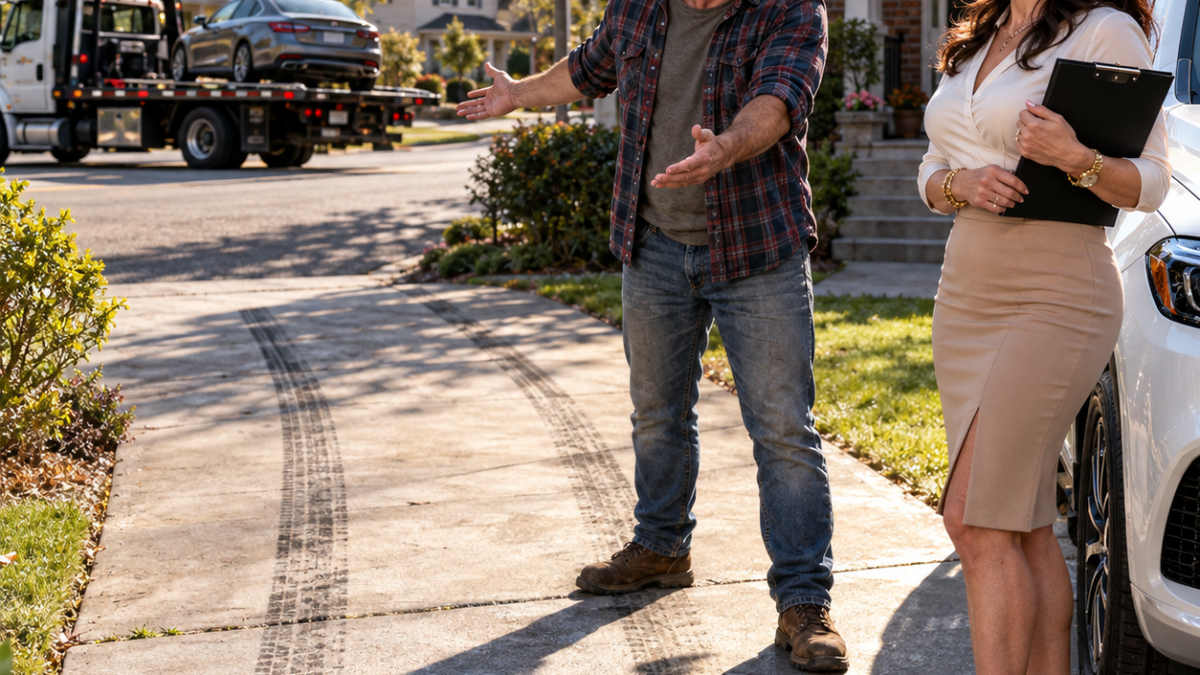
I was already running late, carrying coffee in one hand and my laptop bag in the other. I stepped out my front door, locked it behind me, turned toward the driveway, and stopped.
Empty.
My driveway was empty.
For one stupid second, my brain tried to fill the space with the shape of my car. A 2019 Toyota sedan. Nothing fancy, but reliable. Paid on time. Parked exactly where I had left it the night before.
The car was not there.
My first thought was theft.
Real theft.
The kind where some stranger breaks into your life while you sleep and drives off with a piece of your stability. My stomach dropped so hard I felt lightheaded.
I walked down the driveway as if maybe the angle was wrong. As if the car might reappear if I got closer.
Nothing.
No broken glass. No obvious skid marks. Just tire lines and morning silence.
I called 911.
The dispatcher was calm, which made me less calm.
I gave my name, address, vehicle description, plate number. She typed for a while, then said, “Sir, let me check the non-emergency tow logs.”
The words tow logs made no sense.
My car was in my driveway.
Private driveway.
Private property.
Then she came back on the line.
“It looks like your vehicle was towed at approximately 4:20 this morning by Neighborhood Management Towing.”
“Towed?” I said. “From where?”
“Your address.”
“By who?”
There was a pause.
“The order was placed by Karen Horror Homeowner Association for violation of community standards and improper parking on HOA property.”
I laughed once.
Not because it was funny.
Because my brain refused to accept the sentence.
“I’m not in the HOA.”
“I understand.”
“No, I don’t think you do. They towed my car out of my own driveway.”
“Sir, if the HOA has a contract with the tow company and they claim authority, you may need to resolve that with them. It may be a civil matter.”
I felt something hot and sharp rise through my chest.
“This is not a civil matter. They stole my car.”
“I understand you’re upset.”
That phrase has never helped anyone in human history.
I hung up before I said something that would make me sound like the unreasonable one.
I knew exactly who had done it.
Karen’s house was easy to find because, of course, she had a ridiculous plaque by the front door that said HOA PRESIDENT in decorative script, as if elected volunteer tyrant was a noble title. I marched there in work shoes, still holding my laptop bag because I had not yet fully processed that work was not happening.
I hammered on the door.
A tiny dog began screaming inside.
Karen opened the door wearing a silk robe, holding the dog against her chest. Her hair was loose around her shoulders, and even at that hour, she somehow looked styled. Not ready, exactly, but intentionally unready. Rich-person casual.
Her smile appeared before she spoke.
“Can I help you, Mr. Lawson?”
That was my last name.
Hearing it in her voice made my skin crawl.
“You had my car towed from my driveway.”
Her smile widened.
Not a lot.
Just enough.
“I’m afraid I can’t discuss enforcement matters on your doorstep.”
“You’re going to discuss this one.”
The dog yapped against her arm.
She stroked its head slowly.
“Your vehicle was in clear violation. It had not moved in forty-eight hours, which constitutes storage of an inoperable vehicle under our community rules. It was also parked on HOA common property.”
I stared at her.
“It’s my driveway.”
“Your driveway connects to our private street.”
“It’s a city street.”
“That is your interpretation.”
“No. That is the city’s interpretation.”
Her eyes cooled.
“Your property line ends at your garage.”
For a moment, I genuinely could not respond.
The lie was too large.
My survey showed my property extending all the way to the street. The driveway was mine. The apron was subject to an easement over a narrow strip near the curb, but that did not make my entire driveway HOA property. I knew this because I had checked before buying.
“You’re lying,” I said.
Her expression hardened, but the smile stayed.
“You need to be very careful with accusations.”
“You towed my car from my property.”
“We removed an inoperable vehicle from HOA common area after repeated warnings.”
“My car is not inoperable. I drove it yesterday.”
“You have been delinquent on your dues since you moved in.”
That sentence hit me harder than the missing car.
“What dues?”
She tilted her head, performing pity.
“Everyone who lives in this neighborhood is part of the HOA. You cannot simply opt out because you prefer not to comply.”
“I am not in your HOA.”
“We’ve sent notices.”
“You’ve taped complaints to my door about trash cans and lawn height. None of those said I owed dues.”
“In total,” she continued, ignoring me, “you owe forty-eight hundred dollars in back dues, late fees, and penalties.”
The number felt unreal.
“Forty-eight hundred?”
“And because you refused to respond, we attached a lien to your property last month.”
I felt the blood drain from my face.
“A lien?”
Her smile returned in full.
“Yes. The tow was lawful under our enforcement authority. You can retrieve your vehicle from the impound lot after paying the towing and storage charges. I strongly recommend visiting the management office to arrange a payment plan on your delinquency.”
She leaned slightly closer.
“If you don’t, foreclosure is the next step.”
Foreclosure.
On my house.
My house that had never belonged to her association.
My house I had saved for, inspected, insured, and legally purchased outside her HOA.
For half a second, I could not breathe.
Karen watched me absorb it, and I swear she enjoyed every flicker of panic.
Then she closed the door in my face.
I stood on her porch with the dog still yapping behind the wood, my hands shaking.
Not from fear anymore.
From rage.
The tow company wanted six hundred dollars cash to release my car, plus seventy-five dollars per day in storage. They said they had a valid tow authorization from the HOA. I asked if they verified the property was in the HOA before taking a car from a private driveway.
The man on the phone said, “We tow based on client authorization.”
That was a very professional way of saying no.
I checked the county clerk’s website next.
There it was.
A $4,800 lien against my property filed by the Karen Horror HOA.
Seeing it on an official website made my stomach twist.
A lie in Karen’s mouth was one thing. A lie recorded against my title was something else entirely. It sat there in black and white, making itself real through bureaucracy.
For a few minutes, I panicked.
Real panic. The kind that makes your thoughts sprint in circles.
Could they actually foreclose?
Would this affect my credit?
Could I sell or refinance?
Was my title clouded?
Could I get my car without validating the debt?
Was this criminal?
Civil?
Both?
Then I opened the kitchen drawer and pulled out every note Karen had ever sent me.
The stack looked pathetic at first. Petty complaints. Aesthetic whining. Passive-aggressive nonsense. But now it had a pattern. Harassment. Escalation. A record that she knew exactly who she was targeting.
I called a real estate litigation attorney that morning.
His name was Daniel Lowe, but he told me to call him Dan. He had fought HOAs before, which became obvious when I said “fraudulent lien” and heard his chair creak like he had just sat up straighter.
“Bring everything,” he said. “Closing documents, title policy, survey, the lien, tow paperwork, all notes from the HOA. Everything.”
I paid the tow company first because Dan told me to stop the storage fees from bleeding me. He instructed me to write paid under protest on the receipt and get copies of everything.
Handing over six hundred dollars to retrieve my own car from thieves with paperwork made me physically sick.
The impound lot was dusty, hot, and staffed by a man who seemed offended that I wanted receipts.
My car had been towed in the middle of the night like it was abandoned junk.
There was a scuff near the rear bumper that had not been there before.
I took photos.
Then I drove straight to Dan’s office.
He spent five minutes reviewing my documents.
Just five.
Then he placed the papers down, looked over his glasses, and said, “Your property is explicitly excluded from the HOA. The lien is fraudulent. This is not just wrong. This is illegal.”
I sat there, stunned by the relief of hearing an expert say what I already knew.
“They can’t do this?”
“No.”
“Can they claim it was a mistake?”
“They can claim the moon is made of soup. The documents are clear.”
He tapped my title policy.
“Also, call your title insurance company. A fraudulent lien clouding title is exactly the kind of thing that gets their attention.”
“What about the car?”
“Wrongful conversion. Possibly more, but we’ll focus on what we can prove quickly.”
“What do I do about Karen?”
“Nothing.”
I blinked.
“Nothing?”
“You do not speak to her again. You do not email. You do not text. If she shows up, you record if legal and tell her all communication goes through counsel. People like this survive by getting you angry enough to say something they can twist.”
That was good advice.
Difficult advice.
But good.
Dan moved fast.
The next day, he filed an emergency motion to have the lien declared fraudulent and removed. He filed suit against the HOA, the management company, and Karen personally for slander of title, fraud, and wrongful conversion. He included the towing fee, storage risk, missed work, attorney fees, and punitive damages.
My title insurance company was even angrier than I expected.
A fraudulent lien was not just an inconvenience to me. It was an attack on their insured title. They opened their own case and put their legal team in contact with Dan.
Suddenly, I had two sets of lawyers aiming at Karen’s paperwork.
It was the first good feeling I had since seeing the empty driveway.
Karen was served about a week later.
That same afternoon, Dan got a call from the HOA’s attorney, a polished big-firm type who apparently opened with the phrase, “terrible misunderstanding.”
Dan told me later he almost laughed.
The attorney said the HOA was prepared to release the lien immediately and reimburse my $600 towing cost as a gesture of good faith.
Dan responded, “Your client personally confronted my client and told him foreclosure was next. That is not an administrative error. That is malice. My fees are already eight thousand dollars. We will see you in court.”
The tone changed quickly after that.
The HOA did not want discovery. They did not want depositions. They did not want a judge reading Karen’s lien paperwork next to my deed. They definitely did not want Karen personally on the hook, because once she realized she might not be shielded by the HOA, her confidence reportedly began cracking.
But she did not crack enough.
We went to mediation.
I saw her there for the first time since the porch confrontation.
Karen walked into the conference room wearing a cream suit, heels, gold jewelry, and an expression of wounded superiority. She looked immaculate, of course. People like her dress for war in fabric that says lunch meeting. Her attorney walked beside her carrying a folder and the weary look of a man who had realized too late that his client was the problem.
Dan sat on my left.
The management company representative sat across from us, pale and quiet.
The mediator was a retired judge with silver hair, reading glasses, and the ability to make silence feel like a weapon.
Karen brought photos.
That still amazes me.
Not documents proving I was in the HOA. Not evidence of authority. Photos. My lawn. My trash cans. My driveway stains. My house from the street. She spread them across the table like a prosecutor revealing murder evidence.
“He’s a nuisance,” she said. “His property doesn’t match. He leaves trash cans out. His lawn is unkempt. The driveway is stained. It affects our values.”
Her own lawyer closed his eyes.
The retired judge looked at Karen over his glasses.
“Ma’am,” he said, “your personal aesthetic preferences are not legally binding.”
Her mouth tightened.
He lifted my deed and survey.
“This document is what matters. His property is not and has never been part of your association. You had no authority to tow his car. You had no authority to file a lien. Filing a lien under these circumstances may constitute fraud.”
When he said fraud, Karen went white.
Her attorney jumped in.
“My client misspoke earlier. She was acting on old information.”
Dan leaned forward.
“Old information? She confronted my client after the tow and tried to extort forty-eight hundred dollars while threatening foreclosure. We also have the documents she filed with the county. We are happy to present all of this to a jury.”
The management company representative finally spoke.
“We were acting on the orders of the board president.”
Dan turned to him with a smile that made me very grateful he was on my side.
“As a professional management company, you had no duty to verify that the property was actually part of the association before filing a lien? You simply accepted the command of a volunteer board member and clouded a homeowner’s title?”
The representative stopped speaking.
They caucused.
Thirty minutes later, they came back ready to pay.
The settlement was better than I expected.
They paid Dan’s fees in full, which had climbed to twelve thousand dollars. They reimbursed the towing cost. They paid my lost wages. They paid ten thousand dollars in damages. The lien was removed. And most importantly, I received a legally binding judgment making clear that my property was permanently and forever excluded from the HOA.
I walked out of mediation feeling lighter than I had in months.
Not happy exactly.
Being wronged and compensated does not erase the violation. But the law had said, clearly and formally, that Karen’s reach ended before my front door.
I thought it was over.
That was my mistake.
Karen was still HOA president.
Not for lack of outrage. From what one of my actual neighbors told me, the HOA board was furious about the settlement. Residents were furious about the money. The management company was under pressure. But apparently their bylaws required procedure for removal, and the next formal meeting was still weeks away.
So Karen still had power.
And humiliation.
That combination is combustible.
About a month after I deposited the settlement check, another letter arrived.
HOA letterhead.
Signed by Karen.
My blood pressure spiked before I finished the first paragraph.
This time, she did not claim my property was inside the HOA. The court had permanently destroyed that fantasy. Instead, she found another angle.
During Dan’s research, we had learned there was a narrow five-foot strip of grass between the sidewalk and the city street running in front of my house. The developer had given that useless strip to the HOA as common area years ago. My driveway crossed it to reach the road, so a permanent ingress and egress easement had been recorded when my house was built. That easement allowed my property to pass and repass across the strip.
In normal language: I had the legal right to cross it.
Karen’s new letter acknowledged, through gritted teeth, that while my property was not part of the HOA, my driveway crossed HOA common land. She attached the easement and claimed I had a duty to maintain the crossing in good repair. Then she stated that a recent inspection found the asphalt cracked and stained, violating community standards.
She could not fine my house.
So she went after the five feet my car needed to reach the street.
Then came the demand.
It did not say repair.
It did not say repave.
It said I had ten days to remove all non-compliant personal property and improvements from the HOA common strip easement. Failure to comply would result in the HOA performing removal at my expense and taking further legal action.
I read that sentence again.
Remove all non-compliant personal property and improvements.
I read the easement.
Then I read her sentence a third time.
Karen thought she was cleverly demanding I replace the old asphalt apron with a new HOA-approved one at my expense.
But that was not what she wrote.
I called Dan.
He answered with the sigh of a man who had begun recognizing my number as a symptom.
“What now?”
“I got another letter from Karen.”
A pause.
“You’re kidding.”
“She says I have to remove all personal property and improvements from the five-foot easement strip.”
“Read that to me.”
I did.
He went silent.
Then he let out a low whistle.
“Oh, that is very specific. And very poorly worded.”
“She means repair it.”
“She wrote remove it.”
“So I should just do what she says?”
“Not yet.”
His voice sharpened into lawyer mode.
“This is a trap, but we are going to set it properly. Do nothing until I send their attorney a letter.”
“What letter?”
“I’m going to ask them to confirm the demand. In writing. Specifically, whether they are ordering you to remove all improvements from the easement strip. We’ll give them forty-eight hours.”
“And if they say it was a mistake?”
“Then we have another record of harassment, and they look stupid.”
“And if they confirm?”
“Then,” Dan said, and I could hear the smile in his voice, “you get to comply.”
Two days later, Dan called me.
“We are golden.”
“What happened?”
“Their attorney responded with one sentence: The board’s letter is clear. Please be advised that your client is to comply as directed.”
I closed my eyes.
“You’re serious.”
“Completely.”
“Karen pushed him?”
“I assume she screamed until he sent something lazy. Either way, they confirmed. Have fun.”
So I did.
I hired a concrete cutting and demolition company. Not some guy with a sledgehammer. A real crew with saws, jackhammers, chalk lines, and insurance. I showed them the survey, the easement strip, and the exact five-foot area. I gave them instructions in writing.
Remove the asphalt improvements from the HOA common strip only.
Not an inch beyond.
They arrived on a beautiful Saturday morning.
The kind of day neighbors notice noise.
Perfect.
Karen happened to be walking her tiny dog when the truck pulled up. I do not know whether that was luck or divine scheduling, but I waved.
She stopped at the end of the sidewalk, suspicious immediately.
The crew snapped two straight chalk lines.
Line one at the edge of the street where the HOA strip began.
Line two exactly five feet up my driveway where the strip ended and my actual property began.
The saw started.
If you have never heard a concrete saw cut through asphalt on a quiet Saturday morning, imagine a mechanical banshee with legal documentation. The sound tore through the block. Garage doors opened. Curtains moved. A man two houses down stepped outside holding coffee and wearing the expression of someone who knew entertainment had arrived.
Karen came sprinting.
Her dog bounced in her arms, barking like an alarm system with hair.
“What are you doing?” she screamed.
I had been waiting for that line.
I pulled three papers from my back pocket: Karen’s letter, Dan’s certified clarification request, and the HOA attorney’s confirmation.
“I’m complying with your written demand,” I shouted over the saw.
“What?”
“You ordered me to remove all personal property and improvements from the easement strip. My lawyer asked your lawyer to confirm. He did. So I’m removing my asphalt.”
The saw stopped for a moment.
That allowed my words to carry beautifully.
Neighbors had gathered now.
Karen’s eyes darted from the papers to the crew.
“I meant repair it!”
“That is not what you wrote.”
“You know what I meant.”
“I know what you confirmed.”
The jackhammer started next.
Chunks of asphalt broke loose under the hammer. The crew shoveled them into a dump truck. Piece by piece, the five-foot apron connecting my driveway to the road disappeared, leaving a trench of dirt and gravel between my property and the street.
Karen’s face went through colors I had not known existed in human skin.
Red. White. Pink. Purple. Back to red.
“You’re destroying HOA property!” she shouted.
“No,” I said. “I’m removing my non-compliant improvements from HOA property, exactly as ordered.”
“You idiot,” she snapped. “You ruined your own driveway.”
I let the crew work for a few more seconds before answering.
Then I lowered my voice.
Not because I wanted only her to hear.
Because calm travels farther than yelling when everyone is listening.
“I didn’t ruin it, Karen. I complied. You, however, now have a problem.”
She froze.
“What are you talking about?”
“My easement gives me the right to pass and repass over this strip. Your HOA owns the strip. You ordered me to remove the improvements. Now the strip is an impassable trench, and I cannot access my property from the street.”
Her mouth opened.
No sound came out.
“That means the HOA is obstructing my recorded easement.”
She stared at the trench.
I continued, almost gently.
“I’ve been meaning to redo that apron for a while. Thank you for making sure the HOA pays for it.”
One of the neighbors actually laughed.
Karen heard it.
That may have hurt her more than the legal explanation.
She clutched her dog closer and stormed back toward her house.
Dan sent the email within an hour.
Subject: Obstruction of Easement.
It stated that the HOA, through its president Karen, had created a hazardous condition and rendered my recorded easement impassable. It noted that I had simply complied with the board’s written demand, confirmed by HOA counsel, to remove my property and improvements from the strip. It gave them twenty-four hours to restore access by filling, compacting, and paving the five-foot easement at the HOA’s sole expense. Failure would result in an emergency injunction and daily damages.
The HOA attorney called Dan within ten minutes.
Dan later told me the conversation included the words unbelievable, idiot, and removed from the board.
The next morning, a paving crew arrived.
Not my crew.
Theirs.
Paid for by the HOA.
They filled, compacted, and paved a beautiful new five-foot apron connecting my driveway to the city street. Smooth, clean, better than what had been there before. It cost the HOA thirty-five hundred dollars.
I stood on my porch drinking coffee while they worked.
Karen did not come outside.
A neighbor from the actual HOA, an older man named Pete, walked over and stood beside my driveway with his hands in his pockets.
“She really did that to herself?” he asked.
“Entirely.”
He looked at the fresh asphalt.
“She’s going to get us all sued again.”
“Not by me if they remove her fast enough.”
He nodded grimly.
“They’re meeting tonight.”
That emergency meeting ended Karen’s presidency.
I did not attend because I was not part of the HOA, a fact everyone finally seemed to understand. But Pete filled me in afterward. The homeowners were furious. The first settlement had cost them legal fees, damages, and embarrassment. The driveway stunt had cost another thirty-five hundred dollars and proved Karen was not merely mistaken, but actively dangerous.
She tried to defend herself, naturally.
She claimed I had tricked her.
She said Dan had manipulated the language.
She said I maliciously destroyed the driveway to embarrass her.
Apparently, someone read her letter aloud. Then someone read the attorney’s confirmation. Then someone asked why the HOA was still letting one person’s vendetta drain everyone’s dues.
The vote was decisive.
Karen was removed as president.
The management company was placed under review.
For the first time since I bought my house, the HOA went quiet.
No notes. No photos. No slow drive-bys. No letters. No claims about community standards. No threats. Just silence.
Beautiful, expensive silence.
Karen became, according to Pete, the most hated person in the association. Her vendetta had cost her neighbors tens of thousands of dollars, damaged the HOA’s credibility, forced a court judgment confirming my exclusion, and bought me a brand-new driveway apron.
The irony was not subtle.
She had started by accusing my property of hurting their values.
Then she became the neighborhood liability.
A few months later, her house went up for sale.
I saw the sign while driving home one evening. It stood in her perfect little yard, framed by approved landscaping and the beige walls of the house she had once ruled from like a tiny palace. I slowed just enough to confirm it.
For Sale.
I smiled all the way home.
My life returned to normal after that, but not exactly the same normal.
The settlement money helped. I would be lying if I said otherwise. Ten thousand dollars did not make me rich, but it replaced the money I had lost, paid for stress in a way money never truly can, and gave me breathing room. Dan’s fees were covered. The lien was gone. My title was clean. My car was back. My driveway apron was new.
But the bigger relief was knowing the line had been drawn in court.
Not just verbally. Not just in my closing documents. Officially.
My property was not in the HOA.
Permanently and forever.
Those words became a kind of mental shield.
For months, I had felt like Karen could invent trouble faster than I could respond to it. A note here. A tow there. A lien. A fake debt. A foreclosure threat. An easement demand. Each time, she had tried to turn paper into power.
In the end, better paper beat her.
That is what I tell people now when they ask about it.
Keep your documents.
Keep the annoying letters. Keep the envelopes. Keep the receipts. Keep the screenshots. Keep the surveys you think you will never need. Keep the boring title paperwork in a place you can find it quickly when someone beautiful and furious stands on her porch and tells you your driveway ends at your garage.
Because sometimes the truth does not win because it is obvious.
Sometimes it wins because it is organized.
I also learned that HOAs are only as reasonable as the people willing to say no to their worst instincts. The regular homeowners were not all villains. Most of them had no idea Karen was harassing me. Some were embarrassed when they learned. Some apologized. Some avoided eye contact, which was apology enough from people who had spent years letting her do whatever she wanted because it was easier than fighting.
I understood that, too.
Karen thrived because most people preferred peace.
So did I.
Until peace became surrender.
There is a difference.
The day the new asphalt fully cured, I parked my Toyota in the driveway and stood at the curb looking back at the house. The brick exterior still needed work. The porch still needed paint. The lawn was not perfect. My trash cans were visible if you stood at the right angle and cared enough to be miserable about it.
But it was mine.
Not Karen’s.
Not the HOA’s.
Not a beige kingdom’s loose end.
Mine.
Pete walked by with his dog and stopped.
“Looks good,” he said, nodding toward the apron.
“HOA does quality work when properly motivated.”
He chuckled. “You know, some people inside are saying you’re petty.”
“I am.”
“At least you’re honest.”
“That’s my community standard.”
He laughed harder than the joke deserved and kept walking.
I watched him go, then looked down the street toward Karen’s house. The For Sale sign stood in the distance like punctuation at the end of a very expensive sentence.
I never spoke to her again.
Not directly.
Once, a few weeks before she moved, I saw her SUV pass my house slowly. I was in the yard pulling weeds near the driveway. She looked straight ahead, both hands on the wheel, face tight. No sunglasses that day. No smile.
For the first time, she looked small.
Not physically. She was still polished. Still beautiful. Still Karen.
But the authority was gone.
That smug glow she had carried on her porch the morning she told me foreclosure was next had disappeared. She had wanted me scared and compliant. Instead, she had created a paper trail that cost her title, reputation, and maybe eventually her house.
As she passed, I raised one hand in a friendly wave.
She did not wave back.
I did not expect her to.
The moving truck came on a Thursday.
I watched from my porch as boxes left her house. Not because I was obsessed. Because after everything she had done, I felt entitled to witness the credits roll. She stood near the driveway in a cream blouse and dark slacks, directing movers with sharp little gestures. Even defeated, she had the posture of someone correcting the world.
At one point, she looked toward my house.
This time, I did not wave.
I just stood there beside the driveway she had paid to improve.
That was enough.
People like Karen rarely learn the lesson you want them to learn. I doubt she left thinking, I abused power and got what I deserved. More likely, she told herself she had been betrayed by weak board members, tricked by technicalities, and targeted by an unreasonable man who refused to maintain standards.
Fine.
Let her have that story.
I have the judgment.
I have the check.
I have the court order.
I have the fresh asphalt.
And I have my car in my driveway, exactly where it belongs.
That is the thing about property. For most people, it is not abstract. It is not just lines and legal descriptions. It is where your mornings begin. Where you carry groceries. Where you park after long days. Where you stand in slippers taking out trash. Where you plant things, fix things, curse at plumbing, and slowly turn a structure into a life.
Karen looked at my house and saw a flaw in her aesthetic.
I looked at it and saw home.
That difference was everything.
She thought a fake lien could make her lie official.
She thought a tow truck could make my driveway hers.
She thought foreclosure was a word she could toss onto a porch and watch me fold.
Then she thought one more letter, one more petty demand, one more clever little trap about a five-foot strip of asphalt would put me back in my place.
Instead, I followed her instructions.
Exactly.
I removed the improvements.
I exposed the obstruction.
I let her own rules, her own letter, and her own lawyer’s confirmation do what all my arguing never could.
I let Karen beat Karen.
And in the end, the house stayed mine, the HOA paid, and the woman who once laughed in my face while threatening foreclosure had to drive past my brand-new driveway on her way out of the neighborhood she no longer ruled.
𝗧𝗛𝗘 𝗘𝗡𝗗
She Towed My Car From My Own Driveway, Then Ordered Me to Remove the Road She Needed Me to Use
Karen stole my car from my own driveway and filed a fake lien against a house her HOA had never controlled.
She smiled while telling me foreclosure was next, as if my home was just another beige box in her kingdom.
Then she made one more demand in writing, and I followed it so perfectly that her own HOA had to pay to fix the damage.
I knew my house was not in the HOA before I ever signed the closing papers.
That was not an assumption. It was not a rumor from a neighbor. It was not one of those hopeful little lies homeowners tell themselves because they do not want to read sixty pages of documents. I checked. Then I checked again. Then I paid my lawyer to check, because I had lived long enough to know that a nice house can become a nightmare if the wrong people think they have power over it.
My house was an older brick place from the seventies on a decent-sized lot, the kind of home that did not look fashionable but felt solid the moment you walked inside. The floors creaked in predictable spots. The kitchen cabinets were outdated. The front porch needed paint. But the bones were good, the yard was mine, and the price was something I could afford without lying awake every night wondering which bill would eat me first.
It sat on a strange little block of four normal houses surrounded by a massive master-planned community that had grown around us over the last twenty years.
The development looked expensive in the blandest possible way. Beige houses. Beige stone. Beige fences. Beige signs with names like they had been generated by a committee trying to make farmland sound aristocratic. There were pools, tennis courts, walking trails, decorative ponds, and a clubhouse that always looked empty except when people gathered to complain about things no one outside that neighborhood could imagine caring about.
My little block was different.
We were not part of them.
We had our own lots, our own deeds, our own city-maintained street access, and absolutely no obligation to their homeowner association. I had no right to use their pools, and they had no right to tell me what color my shutters should be. Fair trade, as far as I was concerned.
Before closing, I asked my real estate attorney point blank.
“Am I part of this HOA in any way?”
He looked over the title work, survey, covenants, exclusions, and insurance documents.
“No,” he said. “Your property is explicitly excluded.”
“Explicitly?”
“Yes.”
“As in, they cannot come after me later?”
He tapped the folder. “Your title is clear. You are not a member.”
That sentence was worth every dollar I paid him.
For the first few months, I thought that would be enough.
Then Karen noticed me.
Karen was the HOA president. I learned that before I met her because everyone who lived near that development learned her name eventually, the way people learn storm warnings. She lived in one of the large beige houses behind my block and had to drive past my place to reach the main exit. That meant my house, my driveway, my lawn, my trash cans, and my general refusal to resemble her neighborhood aesthetic entered her field of vision daily.
Apparently, that was an injury she could not survive quietly.
Karen was in her early forties, maybe mid-forties, and looked like she spent more money maintaining the illusion of effortless beauty than I spent maintaining my entire house. Glossy dark hair, sharp cheekbones, perfect nails, fitted dresses, gold jewelry, and a white luxury SUV that always looked freshly detailed. She wore sunglasses large enough to hide most human emotion and smiled like someone who had weaponized politeness years ago and never missed.
At first, she left notes.
Passive-aggressive little papers taped to my door.
Your trash cans are visible from the street.
Your lawn does not meet community standards.
Your porch light is not consistent with approved exterior fixtures.
Your driveway has oil staining visible from common areas.
None of the notes mentioned dues. None claimed I was a member. They were just little bites, testing whether I would bleed.
I ignored them.
Maybe that was my mistake. Maybe I should have had a lawyer send a formal letter the first time she taped nonsense to my door. But life is busy, and most people do not want to turn every petty annoyance into a legal event. I had work. Bills. Repairs. A life.
So I made a drawer in my kitchen and dropped every note into it.
The Karen drawer.
It would eventually become very useful.
For a while, she stayed at note level. I would see her SUV slow down as it passed my house. Sometimes she stared. Sometimes she took pictures. Once, I was mowing, and she stopped long enough to lower her window and say, “You know, consistency benefits everyone.”
I shut off the mower.
“Does it?”
Her smile tightened. “Neighborhood appearance affects property values.”
“Good thing I’m not in your neighborhood.”
She laughed softly, like I had said something childish.
“Everyone says that until the paperwork catches up.”
Then she drove away.
I should have heard the threat.
Instead, I thought she was just another bored HOA tyrant trying to extend her kingdom by attitude.
Then one morning, my car was gone.
PART 2
It was 7:30 on a Tuesday.
I was already running late, carrying coffee in one hand and my laptop bag in the other. I stepped out my front door, locked it behind me, turned toward the driveway, and stopped.
Empty.
My driveway was empty.
For one stupid second, my brain tried to fill the space with the shape of my car. A 2019 Toyota sedan. Nothing fancy, but reliable. Paid on time. Parked exactly where I had left it the night before.
The car was not there.
My first thought was theft.
Real theft.
The kind where some stranger breaks into your life while you sleep and drives off with a piece of your stability. My stomach dropped so hard I felt lightheaded.
I walked down the driveway as if maybe the angle was wrong. As if the car might reappear if I got closer.
Nothing.
No broken glass. No obvious skid marks. Just tire lines and morning silence.
I called 911.
The dispatcher was calm, which made me less calm.
I gave my name, address, vehicle description, plate number. She typed for a while, then said, “Sir, let me check the non-emergency tow logs.”
The words tow logs made no sense.
My car was in my driveway.
Private driveway.
Private property.
Then she came back on the line.
“It looks like your vehicle was towed at approximately 4:20 this morning by Neighborhood Management Towing.”
“Towed?” I said. “From where?”
“Your address.”
“By who?”
There was a pause.
“The order was placed by Karen Horror Homeowner Association for violation of community standards and improper parking on HOA property.”
I laughed once.
Not because it was funny.
Because my brain refused to accept the sentence.
“I’m not in the HOA.”
“I understand.”
“No, I don’t think you do. They towed my car out of my own driveway.”
“Sir, if the HOA has a contract with the tow company and they claim authority, you may need to resolve that with them. It may be a civil matter.”
I felt something hot and sharp rise through my chest.
“This is not a civil matter. They stole my car.”
“I understand you’re upset.”
That phrase has never helped anyone in human history.
I hung up before I said something that would make me sound like the unreasonable one.
I knew exactly who had done it.
Karen’s house was easy to find because, of course, she had a ridiculous plaque by the front door that said HOA PRESIDENT in decorative script, as if elected volunteer tyrant was a noble title. I marched there in work shoes, still holding my laptop bag because I had not yet fully processed that work was not happening.
I hammered on the door.
A tiny dog began screaming inside.
Karen opened the door wearing a silk robe, holding the dog against her chest. Her hair was loose around her shoulders, and even at that hour, she somehow looked styled. Not ready, exactly, but intentionally unready. Rich-person casual.
Her smile appeared before she spoke.
“Can I help you, Mr. Lawson?”
That was my last name.
Hearing it in her voice made my skin crawl.
“You had my car towed from my driveway.”
Her smile widened.
Not a lot.
Just enough.
“I’m afraid I can’t discuss enforcement matters on your doorstep.”
“You’re going to discuss this one.”
The dog yapped against her arm.
She stroked its head slowly.
“Your vehicle was in clear violation. It had not moved in forty-eight hours, which constitutes storage of an inoperable vehicle under our community rules. It was also parked on HOA common property.”
I stared at her.
“It’s my driveway.”
“Your driveway connects to our private street.”
“It’s a city street.”
“That is your interpretation.”
“No. That is the city’s interpretation.”
Her eyes cooled.
“Your property line ends at your garage.”
For a moment, I genuinely could not respond.
The lie was too large.
My survey showed my property extending all the way to the street. The driveway was mine. The apron was subject to an easement over a narrow strip near the curb, but that did not make my entire driveway HOA property. I knew this because I had checked before buying.
“You’re lying,” I said.
Her expression hardened, but the smile stayed.
“You need to be very careful with accusations.”
“You towed my car from my property.”
“We removed an inoperable vehicle from HOA common area after repeated warnings.”
“My car is not inoperable. I drove it yesterday.”
“You have been delinquent on your dues since you moved in.”
That sentence hit me harder than the missing car.
“What dues?”
She tilted her head, performing pity.
“Everyone who lives in this neighborhood is part of the HOA. You cannot simply opt out because you prefer not to comply.”
“I am not in your HOA.”
“We’ve sent notices.”
“You’ve taped complaints to my door about trash cans and lawn height. None of those said I owed dues.”
“In total,” she continued, ignoring me, “you owe forty-eight hundred dollars in back dues, late fees, and penalties.”
The number felt unreal.
“Forty-eight hundred?”
“And because you refused to respond, we attached a lien to your property last month.”
I felt the blood drain from my face.
“A lien?”
Her smile returned in full.
“Yes. The tow was lawful under our enforcement authority. You can retrieve your vehicle from the impound lot after paying the towing and storage charges. I strongly recommend visiting the management office to arrange a payment plan on your delinquency.”
She leaned slightly closer.
“If you don’t, foreclosure is the next step.”
Foreclosure.
On my house.
My house that had never belonged to her association.
My house I had saved for, inspected, insured, and legally purchased outside her HOA.
For half a second, I could not breathe.
Karen watched me absorb it, and I swear she enjoyed every flicker of panic.
Then she closed the door in my face.
I stood on her porch with the dog still yapping behind the wood, my hands shaking.
Not from fear anymore.
From rage.
The tow company wanted six hundred dollars cash to release my car, plus seventy-five dollars per day in storage. They said they had a valid tow authorization from the HOA. I asked if they verified the property was in the HOA before taking a car from a private driveway.
The man on the phone said, “We tow based on client authorization.”
That was a very professional way of saying no.
I checked the county clerk’s website next.
There it was.
A $4,800 lien against my property filed by the Karen Horror HOA.
Seeing it on an official website made my stomach twist.
A lie in Karen’s mouth was one thing. A lie recorded against my title was something else entirely. It sat there in black and white, making itself real through bureaucracy.
For a few minutes, I panicked.
Real panic. The kind that makes your thoughts sprint in circles.
Could they actually foreclose?
Would this affect my credit?
Could I sell or refinance?
Was my title clouded?
Could I get my car without validating the debt?
Was this criminal?
Civil?
Both?
Then I opened the kitchen drawer and pulled out every note Karen had ever sent me.
The stack looked pathetic at first. Petty complaints. Aesthetic whining. Passive-aggressive nonsense. But now it had a pattern. Harassment. Escalation. A record that she knew exactly who she was targeting.
I called a real estate litigation attorney that morning.
His name was Daniel Lowe, but he told me to call him Dan. He had fought HOAs before, which became obvious when I said “fraudulent lien” and heard his chair creak like he had just sat up straighter.
“Bring everything,” he said. “Closing documents, title policy, survey, the lien, tow paperwork, all notes from the HOA. Everything.”
I paid the tow company first because Dan told me to stop the storage fees from bleeding me. He instructed me to write paid under protest on the receipt and get copies of everything.
Handing over six hundred dollars to retrieve my own car from thieves with paperwork made me physically sick.
The impound lot was dusty, hot, and staffed by a man who seemed offended that I wanted receipts.
My car had been towed in the middle of the night like it was abandoned junk.
There was a scuff near the rear bumper that had not been there before.
I took photos.
Then I drove straight to Dan’s office.
He spent five minutes reviewing my documents.
Just five.
Then he placed the papers down, looked over his glasses, and said, “Your property is explicitly excluded from the HOA. The lien is fraudulent. This is not just wrong. This is illegal.”
I sat there, stunned by the relief of hearing an expert say what I already knew.
“They can’t do this?”
“No.”
“Can they claim it was a mistake?”
“They can claim the moon is made of soup. The documents are clear.”
He tapped my title policy.
“Also, call your title insurance company. A fraudulent lien clouding title is exactly the kind of thing that gets their attention.”
“What about the car?”
“Wrongful conversion. Possibly more, but we’ll focus on what we can prove quickly.”
“What do I do about Karen?”
“Nothing.”
I blinked.
“Nothing?”
“You do not speak to her again. You do not email. You do not text. If she shows up, you record if legal and tell her all communication goes through counsel. People like this survive by getting you angry enough to say something they can twist.”
That was good advice.
Difficult advice.
But good.
Dan moved fast.
The next day, he filed an emergency motion to have the lien declared fraudulent and removed. He filed suit against the HOA, the management company, and Karen personally for slander of title, fraud, and wrongful conversion. He included the towing fee, storage risk, missed work, attorney fees, and punitive damages.
My title insurance company was even angrier than I expected.
A fraudulent lien was not just an inconvenience to me. It was an attack on their insured title. They opened their own case and put their legal team in contact with Dan.
Suddenly, I had two sets of lawyers aiming at Karen’s paperwork.
It was the first good feeling I had since seeing the empty driveway.
Karen was served about a week later.
That same afternoon, Dan got a call from the HOA’s attorney, a polished big-firm type who apparently opened with the phrase, “terrible misunderstanding.”
Dan told me later he almost laughed.
The attorney said the HOA was prepared to release the lien immediately and reimburse my $600 towing cost as a gesture of good faith.
Dan responded, “Your client personally confronted my client and told him foreclosure was next. That is not an administrative error. That is malice. My fees are already eight thousand dollars. We will see you in court.”
The tone changed quickly after that.
The HOA did not want discovery. They did not want depositions. They did not want a judge reading Karen’s lien paperwork next to my deed. They definitely did not want Karen personally on the hook, because once she realized she might not be shielded by the HOA, her confidence reportedly began cracking.
But she did not crack enough.
We went to mediation.
I saw her there for the first time since the porch confrontation.
Karen walked into the conference room wearing a cream suit, heels, gold jewelry, and an expression of wounded superiority. She looked immaculate, of course. People like her dress for war in fabric that says lunch meeting. Her attorney walked beside her carrying a folder and the weary look of a man who had realized too late that his client was the problem.
Dan sat on my left.
The management company representative sat across from us, pale and quiet.
The mediator was a retired judge with silver hair, reading glasses, and the ability to make silence feel like a weapon.
Karen brought photos.
That still amazes me.
Not documents proving I was in the HOA. Not evidence of authority. Photos. My lawn. My trash cans. My driveway stains. My house from the street. She spread them across the table like a prosecutor revealing murder evidence.
“He’s a nuisance,” she said. “His property doesn’t match. He leaves trash cans out. His lawn is unkempt. The driveway is stained. It affects our values.”
Her own lawyer closed his eyes.
The retired judge looked at Karen over his glasses.
“Ma’am,” he said, “your personal aesthetic preferences are not legally binding.”
Her mouth tightened.
He lifted my deed and survey.
“This document is what matters. His property is not and has never been part of your association. You had no authority to tow his car. You had no authority to file a lien. Filing a lien under these circumstances may constitute fraud.”
When he said fraud, Karen went white.
Her attorney jumped in.
“My client misspoke earlier. She was acting on old information.”
Dan leaned forward.
“Old information? She confronted my client after the tow and tried to extort forty-eight hundred dollars while threatening foreclosure. We also have the documents she filed with the county. We are happy to present all of this to a jury.”
The management company representative finally spoke.
“We were acting on the orders of the board president.”
Dan turned to him with a smile that made me very grateful he was on my side.
“As a professional management company, you had no duty to verify that the property was actually part of the association before filing a lien? You simply accepted the command of a volunteer board member and clouded a homeowner’s title?”
The representative stopped speaking.
They caucused.
Thirty minutes later, they came back ready to pay.
The settlement was better than I expected.
They paid Dan’s fees in full, which had climbed to twelve thousand dollars. They reimbursed the towing cost. They paid my lost wages. They paid ten thousand dollars in damages. The lien was removed. And most importantly, I received a legally binding judgment making clear that my property was permanently and forever excluded from the HOA.
I walked out of mediation feeling lighter than I had in months.
Not happy exactly.
Being wronged and compensated does not erase the violation. But the law had said, clearly and formally, that Karen’s reach ended before my front door.
I thought it was over.
That was my mistake.
Karen was still HOA president.
Not for lack of outrage. From what one of my actual neighbors told me, the HOA board was furious about the settlement. Residents were furious about the money. The management company was under pressure. But apparently their bylaws required procedure for removal, and the next formal meeting was still weeks away.
So Karen still had power.
And humiliation.
That combination is combustible.
About a month after I deposited the settlement check, another letter arrived.
HOA letterhead.
Signed by Karen.
My blood pressure spiked before I finished the first paragraph.
This time, she did not claim my property was inside the HOA. The court had permanently destroyed that fantasy. Instead, she found another angle.
During Dan’s research, we had learned there was a narrow five-foot strip of grass between the sidewalk and the city street running in front of my house. The developer had given that useless strip to the HOA as common area years ago. My driveway crossed it to reach the road, so a permanent ingress and egress easement had been recorded when my house was built. That easement allowed my property to pass and repass across the strip.
In normal language: I had the legal right to cross it.
Karen’s new letter acknowledged, through gritted teeth, that while my property was not part of the HOA, my driveway crossed HOA common land. She attached the easement and claimed I had a duty to maintain the crossing in good repair. Then she stated that a recent inspection found the asphalt cracked and stained, violating community standards.
She could not fine my house.
So she went after the five feet my car needed to reach the street.
Then came the demand.
It did not say repair.
It did not say repave.
It said I had ten days to remove all non-compliant personal property and improvements from the HOA common strip easement. Failure to comply would result in the HOA performing removal at my expense and taking further legal action.
I read that sentence again.
Remove all non-compliant personal property and improvements.
I read the easement.
Then I read her sentence a third time.
Karen thought she was cleverly demanding I replace the old asphalt apron with a new HOA-approved one at my expense.
But that was not what she wrote.
I called Dan.
He answered with the sigh of a man who had begun recognizing my number as a symptom.
“What now?”
“I got another letter from Karen.”
A pause.
“You’re kidding.”
“She says I have to remove all personal property and improvements from the five-foot easement strip.”
“Read that to me.”
I did.
He went silent.
Then he let out a low whistle.
“Oh, that is very specific. And very poorly worded.”
“She means repair it.”
“She wrote remove it.”
“So I should just do what she says?”
“Not yet.”
His voice sharpened into lawyer mode.
“This is a trap, but we are going to set it properly. Do nothing until I send their attorney a letter.”
“What letter?”
“I’m going to ask them to confirm the demand. In writing. Specifically, whether they are ordering you to remove all improvements from the easement strip. We’ll give them forty-eight hours.”
“And if they say it was a mistake?”
“Then we have another record of harassment, and they look stupid.”
“And if they confirm?”
“Then,” Dan said, and I could hear the smile in his voice, “you get to comply.”
Two days later, Dan called me.
“We are golden.”
“What happened?”
“Their attorney responded with one sentence: The board’s letter is clear. Please be advised that your client is to comply as directed.”
I closed my eyes.
“You’re serious.”
“Completely.”
“Karen pushed him?”
“I assume she screamed until he sent something lazy. Either way, they confirmed. Have fun.”
So I did.
I hired a concrete cutting and demolition company. Not some guy with a sledgehammer. A real crew with saws, jackhammers, chalk lines, and insurance. I showed them the survey, the easement strip, and the exact five-foot area. I gave them instructions in writing.
Remove the asphalt improvements from the HOA common strip only.
Not an inch beyond.
They arrived on a beautiful Saturday morning.
The kind of day neighbors notice noise.
Perfect.
Karen happened to be walking her tiny dog when the truck pulled up. I do not know whether that was luck or divine scheduling, but I waved.
She stopped at the end of the sidewalk, suspicious immediately.
The crew snapped two straight chalk lines.
Line one at the edge of the street where the HOA strip began.
Line two exactly five feet up my driveway where the strip ended and my actual property began.
The saw started.
If you have never heard a concrete saw cut through asphalt on a quiet Saturday morning, imagine a mechanical banshee with legal documentation. The sound tore through the block. Garage doors opened. Curtains moved. A man two houses down stepped outside holding coffee and wearing the expression of someone who knew entertainment had arrived.
Karen came sprinting.
Her dog bounced in her arms, barking like an alarm system with hair.
“What are you doing?” she screamed.
I had been waiting for that line.
I pulled three papers from my back pocket: Karen’s letter, Dan’s certified clarification request, and the HOA attorney’s confirmation.
“I’m complying with your written demand,” I shouted over the saw.
“What?”
“You ordered me to remove all personal property and improvements from the easement strip. My lawyer asked your lawyer to confirm. He did. So I’m removing my asphalt.”
The saw stopped for a moment.
That allowed my words to carry beautifully.
Neighbors had gathered now.
Karen’s eyes darted from the papers to the crew.
“I meant repair it!”
“That is not what you wrote.”
“You know what I meant.”
“I know what you confirmed.”
The jackhammer started next.
Chunks of asphalt broke loose under the hammer. The crew shoveled them into a dump truck. Piece by piece, the five-foot apron connecting my driveway to the road disappeared, leaving a trench of dirt and gravel between my property and the street.
Karen’s face went through colors I had not known existed in human skin.
Red. White. Pink. Purple. Back to red.
“You’re destroying HOA property!” she shouted.
“No,” I said. “I’m removing my non-compliant improvements from HOA property, exactly as ordered.”
“You idiot,” she snapped. “You ruined your own driveway.”
I let the crew work for a few more seconds before answering.
Then I lowered my voice.
Not because I wanted only her to hear.
Because calm travels farther than yelling when everyone is listening.
“I didn’t ruin it, Karen. I complied. You, however, now have a problem.”
She froze.
“What are you talking about?”
“My easement gives me the right to pass and repass over this strip. Your HOA owns the strip. You ordered me to remove the improvements. Now the strip is an impassable trench, and I cannot access my property from the street.”
Her mouth opened.
No sound came out.
“That means the HOA is obstructing my recorded easement.”
She stared at the trench.
I continued, almost gently.
“I’ve been meaning to redo that apron for a while. Thank you for making sure the HOA pays for it.”
One of the neighbors actually laughed.
Karen heard it.
That may have hurt her more than the legal explanation.
She clutched her dog closer and stormed back toward her house.
Dan sent the email within an hour.
Subject: Obstruction of Easement.
It stated that the HOA, through its president Karen, had created a hazardous condition and rendered my recorded easement impassable. It noted that I had simply complied with the board’s written demand, confirmed by HOA counsel, to remove my property and improvements from the strip. It gave them twenty-four hours to restore access by filling, compacting, and paving the five-foot easement at the HOA’s sole expense. Failure would result in an emergency injunction and daily damages.
The HOA attorney called Dan within ten minutes.
Dan later told me the conversation included the words unbelievable, idiot, and removed from the board.
The next morning, a paving crew arrived.
Not my crew.
Theirs.
Paid for by the HOA.
They filled, compacted, and paved a beautiful new five-foot apron connecting my driveway to the city street. Smooth, clean, better than what had been there before. It cost the HOA thirty-five hundred dollars.
I stood on my porch drinking coffee while they worked.
Karen did not come outside.
A neighbor from the actual HOA, an older man named Pete, walked over and stood beside my driveway with his hands in his pockets.
“She really did that to herself?” he asked.
“Entirely.”
He looked at the fresh asphalt.
“She’s going to get us all sued again.”
“Not by me if they remove her fast enough.”
He nodded grimly.
“They’re meeting tonight.”
That emergency meeting ended Karen’s presidency.
I did not attend because I was not part of the HOA, a fact everyone finally seemed to understand. But Pete filled me in afterward. The homeowners were furious. The first settlement had cost them legal fees, damages, and embarrassment. The driveway stunt had cost another thirty-five hundred dollars and proved Karen was not merely mistaken, but actively dangerous.
She tried to defend herself, naturally.
She claimed I had tricked her.
She said Dan had manipulated the language.
She said I maliciously destroyed the driveway to embarrass her.
Apparently, someone read her letter aloud. Then someone read the attorney’s confirmation. Then someone asked why the HOA was still letting one person’s vendetta drain everyone’s dues.
The vote was decisive.
Karen was removed as president.
The management company was placed under review.
For the first time since I bought my house, the HOA went quiet.
No notes. No photos. No slow drive-bys. No letters. No claims about community standards. No threats. Just silence.
Beautiful, expensive silence.
Karen became, according to Pete, the most hated person in the association. Her vendetta had cost her neighbors tens of thousands of dollars, damaged the HOA’s credibility, forced a court judgment confirming my exclusion, and bought me a brand-new driveway apron.
The irony was not subtle.
She had started by accusing my property of hurting their values.
Then she became the neighborhood liability.
A few months later, her house went up for sale.
I saw the sign while driving home one evening. It stood in her perfect little yard, framed by approved landscaping and the beige walls of the house she had once ruled from like a tiny palace. I slowed just enough to confirm it.
For Sale.
I smiled all the way home.
My life returned to normal after that, but not exactly the same normal.
The settlement money helped. I would be lying if I said otherwise. Ten thousand dollars did not make me rich, but it replaced the money I had lost, paid for stress in a way money never truly can, and gave me breathing room. Dan’s fees were covered. The lien was gone. My title was clean. My car was back. My driveway apron was new.
But the bigger relief was knowing the line had been drawn in court.
Not just verbally. Not just in my closing documents. Officially.
My property was not in the HOA.
Permanently and forever.
Those words became a kind of mental shield.
For months, I had felt like Karen could invent trouble faster than I could respond to it. A note here. A tow there. A lien. A fake debt. A foreclosure threat. An easement demand. Each time, she had tried to turn paper into power.
In the end, better paper beat her.
That is what I tell people now when they ask about it.
Keep your documents.
Keep the annoying letters. Keep the envelopes. Keep the receipts. Keep the screenshots. Keep the surveys you think you will never need. Keep the boring title paperwork in a place you can find it quickly when someone beautiful and furious stands on her porch and tells you your driveway ends at your garage.
Because sometimes the truth does not win because it is obvious.
Sometimes it wins because it is organized.
I also learned that HOAs are only as reasonable as the people willing to say no to their worst instincts. The regular homeowners were not all villains. Most of them had no idea Karen was harassing me. Some were embarrassed when they learned. Some apologized. Some avoided eye contact, which was apology enough from people who had spent years letting her do whatever she wanted because it was easier than fighting.
I understood that, too.
Karen thrived because most people preferred peace.
So did I.
Until peace became surrender.
There is a difference.
The day the new asphalt fully cured, I parked my Toyota in the driveway and stood at the curb looking back at the house. The brick exterior still needed work. The porch still needed paint. The lawn was not perfect. My trash cans were visible if you stood at the right angle and cared enough to be miserable about it.
But it was mine.
Not Karen’s.
Not the HOA’s.
Not a beige kingdom’s loose end.
Mine.
Pete walked by with his dog and stopped.
“Looks good,” he said, nodding toward the apron.
“HOA does quality work when properly motivated.”
He chuckled. “You know, some people inside are saying you’re petty.”
“I am.”
“At least you’re honest.”
“That’s my community standard.”
He laughed harder than the joke deserved and kept walking.
I watched him go, then looked down the street toward Karen’s house. The For Sale sign stood in the distance like punctuation at the end of a very expensive sentence.
I never spoke to her again.
Not directly.
Once, a few weeks before she moved, I saw her SUV pass my house slowly. I was in the yard pulling weeds near the driveway. She looked straight ahead, both hands on the wheel, face tight. No sunglasses that day. No smile.
For the first time, she looked small.
Not physically. She was still polished. Still beautiful. Still Karen.
But the authority was gone.
That smug glow she had carried on her porch the morning she told me foreclosure was next had disappeared. She had wanted me scared and compliant. Instead, she had created a paper trail that cost her title, reputation, and maybe eventually her house.
As she passed, I raised one hand in a friendly wave.
She did not wave back.
I did not expect her to.
The moving truck came on a Thursday.
I watched from my porch as boxes left her house. Not because I was obsessed. Because after everything she had done, I felt entitled to witness the credits roll. She stood near the driveway in a cream blouse and dark slacks, directing movers with sharp little gestures. Even defeated, she had the posture of someone correcting the world.
At one point, she looked toward my house.
This time, I did not wave.
I just stood there beside the driveway she had paid to improve.
That was enough.
People like Karen rarely learn the lesson you want them to learn. I doubt she left thinking, I abused power and got what I deserved. More likely, she told herself she had been betrayed by weak board members, tricked by technicalities, and targeted by an unreasonable man who refused to maintain standards.
Fine.
Let her have that story.
I have the judgment.
I have the check.
I have the court order.
I have the fresh asphalt.
And I have my car in my driveway, exactly where it belongs.
That is the thing about property. For most people, it is not abstract. It is not just lines and legal descriptions. It is where your mornings begin. Where you carry groceries. Where you park after long days. Where you stand in slippers taking out trash. Where you plant things, fix things, curse at plumbing, and slowly turn a structure into a life.
Karen looked at my house and saw a flaw in her aesthetic.
I looked at it and saw home.
That difference was everything.
She thought a fake lien could make her lie official.
She thought a tow truck could make my driveway hers.
She thought foreclosure was a word she could toss onto a porch and watch me fold.
Then she thought one more letter, one more petty demand, one more clever little trap about a five-foot strip of asphalt would put me back in my place.
Instead, I followed her instructions.
Exactly.
I removed the improvements.
I exposed the obstruction.
I let her own rules, her own letter, and her own lawyer’s confirmation do what all my arguing never could.
I let Karen beat Karen.
And in the end, the house stayed mine, the HOA paid, and the woman who once laughed in my face while threatening foreclosure had to drive past my brand-new driveway on her way out of the neighborhood she no longer ruled.