𝗙𝗨𝗟𝗟 𝗦𝗧𝗢𝗥𝗬 She Took My Yard While I Was Fighting for My Life, Then Smiled Like I Should Thank Her
𝗙𝗨𝗟𝗟 𝗦𝗧𝗢𝗥𝗬
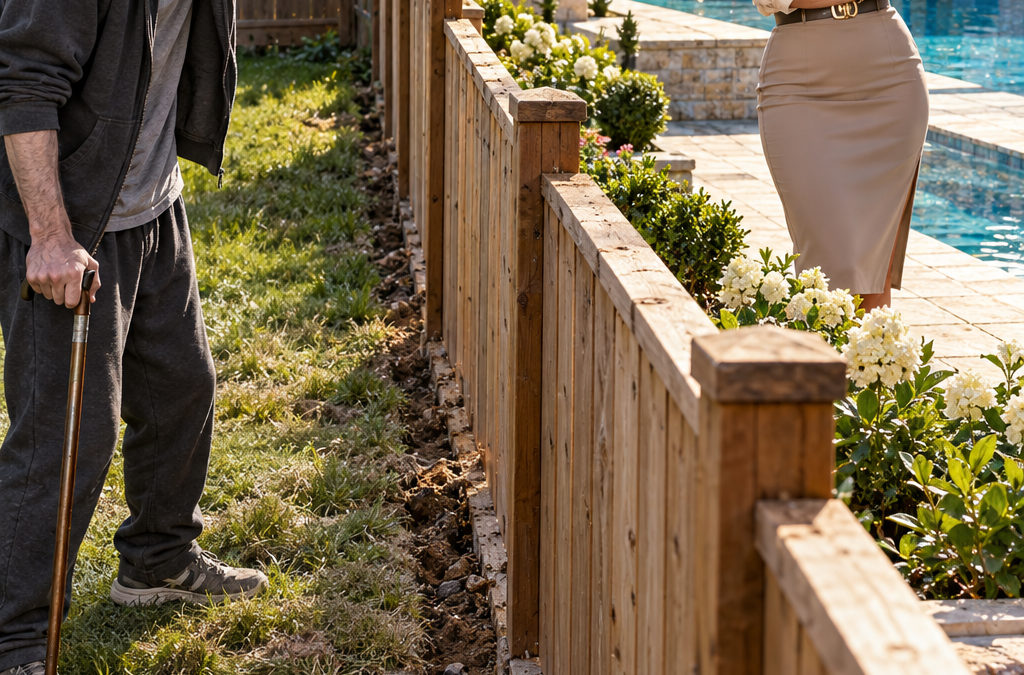
I took pictures from every angle. The ground still showed scars where posts had been dug out and reset. The grass didn’t match. On my side, there were rough patches where the old line had been disturbed. On the other side, just visible through the gaps, I could see pale stone pavers and the glimmer of water.
My first instinct was to call the police. My second was to call a lawyer. My third was to sit down right there in the grass and scream until my voice gave out.
Instead, I called my next-door neighbor, Marlene.
Marlene was in her late sixties, sharp-eyed, and knew everything that happened on our street three minutes after it happened. She had brought soup to my friend twice while I was hospitalized and had sent me awkward but sweet text messages filled with too many heart emojis.
She answered on the second ring.
“You’re home,” she said warmly.
“I am,” I said. My voice came out thinner than I liked. “Can I ask you something?”
There was a pause.
“What happened?”
That told me she already knew something.
I looked at the fence. “Do you know why my backyard is smaller?”
The silence on the line changed. It became guilty.
“Oh, honey,” she said.
My grip tightened around the phone. “Marlene.”
“I heard construction back there while you were gone. A lot of it. Trucks, digging, men shouting. It went on for weeks.”
“From Karen’s yard?”
“Yes.”
Karen.
Even before Marlene said the name, some part of me had known.
Karen lived directly behind me. We shared that rear fence, or at least we had before she apparently decided sharing meant helping herself. She was also the president of our HOA.
I knew what people say about HOAs. I had heard the horror stories. Petty rules, power-drunk board members, fines over paint shades and mailbox shapes. But when I bought my house, this neighborhood’s association had seemed reasonable. The fees weren’t outrageous. The common areas were maintained. Nobody bothered me about my flowerpots or the color of my curtains.
Then Karen became president.
She was around forty, maybe a little older, though she worked hard to make sure no one could tell. She had glossy dark hair that fell in soft waves around her shoulders, expensive-looking skin, and the kind of body that made men lose track of their sentences at board meetings. She dressed like every room was a stage. Tight pencil skirts, silk blouses, gold jewelry that flashed when she moved her hands. Her smile was bright, practiced, and never warm.
I had seen her flirt her way through disagreements and slice people apart with the same mouth five minutes later. She touched arms when she wanted compliance. She tilted her head and widened her eyes when she wanted sympathy. She laughed softly at men she considered useful and looked through women she considered beneath her.
With me, she had always been polite in the way a queen might be polite to a gardener.
I was sick. I was quiet. I didn’t attend many HOA events. To Karen, I probably looked like someone easy to ignore.
Marlene sighed. “I thought maybe you approved it.”
“I was in the hospital.”
“I know. But she said she had permission.”
My chest tightened. “She said that?”
“She told a few people you two had discussed it before you left. Said it was a small adjustment and that you didn’t care because you barely used the yard.”
For a second, the world narrowed to the blood beating in my ears.
I barely used the yard.
Because I was sick.
Because walking from the bedroom to the kitchen had become an accomplishment some days. Because my body had betrayed me. Because my life had shrunk around treatment schedules and lab results.
Karen had taken my weakness and turned it into justification.
“Did she ever come to my front door?” I asked.
“I didn’t see her. But I wasn’t watching every minute.”
“My friend was staying here. Working from home.”
“Then Karen would have known someone was there if she tried.”
Exactly.
After I hung up, I called my friend. She confirmed what I already suspected. Karen had never knocked. Never called. Never left a note. Never contacted her. Nobody had come asking for permission.
“She did what?” my friend snapped when I explained.
“Moved the fence.”
“And built a pool?”
“Looks like it.”
There was a long pause, then my friend said, very softly, “You need a lawyer.”
“I know.”
But before I called one, I wanted to hear Karen say it herself.
Maybe part of me needed to know there was some misunderstanding, some impossible explanation that would make the situation less ugly. Maybe the hospital had left me desperate to believe people were better than they were. Or maybe I just wanted to look her in the face before everything became legal letters and court dates.
I rested for an hour first because rage could not change the fact that my body was still recovering. Then I changed into clean clothes, brushed my hair until I looked less like someone who had just been released from medical custody, and walked around the block to Karen’s front door.
Her house was immaculate.
Of course it was.
A white colonial with black shutters, symmetrical flower beds, and seasonal wreaths so tasteful they looked professionally chosen. The lawn was shaved to HOA perfection. Her porch had two rocking chairs nobody ever sat in and a welcome mat that said blessed in looping script.
Behind the house, somewhere beyond that polished exterior, my stolen yard had become part of her private resort.
I rang the bell.
Karen opened the door wearing a fitted white sundress and wedge sandals, her hair pinned loosely enough to look effortless though I was sure nothing about her was accidental. Gold bracelets slid down her wrist as she leaned against the doorframe.
For half a second, surprise flashed across her face.
Then she smiled.
“Well,” she said, drawing the word out. “You’re home.”
The way she said it made my skin crawl.
“Yes,” I said. “I got back yesterday.”
“How wonderful.” Her eyes moved over me, assessing. “You look… better.”
The pause before better was small, but not small enough.
“I need to talk to you about the fence.”
Her smile didn’t move, but something behind it hardened.
“The fence?”
“The fence between our properties. It’s been moved several feet into my backyard.”
She gave a light laugh, as if I had said something adorably confused. “Oh. That.”
My hand tightened around my phone. “Yes. That.”
She stepped out onto the porch and closed the door behind her, turning the movement into a performance. “I was wondering when you’d come by. I did try to reach you, but you were unavailable.”
“I was in the hospital.”
“I heard. Terrible timing.”
Terrible timing.
My yard had been stolen, and she spoke as if my chemotherapy had inconvenienced her construction schedule.
“You didn’t try to reach me,” I said. “My friend was staying at my house the whole time. She works from home. You never came by.”
Karen’s eyes flickered.
Only for a second.
Then she lifted one shoulder. “I stopped by a few times. No one answered.”
“That’s not true.”
Her smile thinned. “Are you calling me a liar?”
“I’m saying you moved a fence onto my property and built a pool without my permission.”
The softness vanished from her face.
She was still beautiful. That was almost part of the problem. People expected ugliness to announce itself honestly. Karen didn’t. She stood there glowing in morning light, smooth and elegant and poisonous.
“I expanded slightly,” she said. “Barely a few feet.”
“Several feet.”
“It was necessary for the pool layout.”
“It’s my land.”
She sighed, as if I were a child refusing to share. “You have a large yard. You don’t even use that back portion.”
There it was.
She said it right to my face.
For a moment, I couldn’t speak. Not because I had no words, but because too many came at once, all sharp enough to cut.
Finally, I said, “I was in the hospital, Karen.”
“I understand that.”
“No, you don’t. You waited until I was gone, moved a fence, and took part of my yard.”
“I did not take anything.” Her voice rose. “I improved the property line aesthetics for both lots.”
I stared at her. “You built your pool on my property.”
“My contractor assured me it was a minor boundary adjustment.”
“Your contractor doesn’t own my land.”
“And neither do you in the way you seem to think,” she snapped.
That stopped me.
She crossed her arms, bracelets chiming lightly. “This neighborhood has standards. As HOA president, I have responsibilities. Sometimes individual homeowners don’t understand how their properties affect the community as a whole.”
“My property affects the community because you wanted a bigger pool deck?”
Her eyes narrowed.
I saw the real Karen then. Not the polished HOA president. Not the charming woman who smiled through meetings and called everyone sweetheart. The real Karen was all hunger. Control dressed as concern. Greed with lip gloss.
“You should be grateful,” she said. “Your yard was neglected.”
“I was getting cancer treatment.”
“And I’m sorry for that,” she said quickly, but there was no sorrow in it. “Truly. But the world doesn’t stop because one person has personal issues.”
Personal issues.
I felt something inside me go still.
There are moments when anger burns so hot it becomes calm. I had spent months being poked, scanned, weakened, and pitied. I had listened to doctors discuss percentages. I had woken in hospital darkness wondering if I would ever stand in my own backyard again.
Now this woman was telling me my illness had made my property available.
“You’re going to move the fence back,” I said. “And you’re going to remove anything built over my property line.”
Karen laughed.
Not loudly. Not naturally.
A short, polished little laugh meant to humiliate.
“No, I’m not.”
I looked at her.
She tilted her head, softening her expression like she was about to be generous. “But I am willing to make this easy for you.”
“Easy?”
“Yes. Since the work is already done, and undoing it would be expensive and frankly ridiculous, I’ll purchase that strip from you.”
“It’s not for sale.”
“Everything is for sale.”
“Not this.”
Her smile sharpened. “Four thousand dollars.”
I actually thought I had misheard her. “What?”
“I’ll give you four thousand dollars for the section. That’s more than fair.”
“You stole part of my yard and now you want to buy it for four thousand dollars?”
“I didn’t steal anything.” Her voice cracked like a whip. “And you should watch your accusations.”
“You moved my fence.”
“I corrected an inefficient boundary.”
“You built on my land.”
“I enhanced a shared visual space.”
“You waited until I was too sick to stop you.”
Her face flushed.
There it was. The truth had landed.
For the first time, Karen looked less polished. Not guilty. Just exposed.
“You are being dramatic,” she said.
“No,” I replied. “I’m being very clear.”
She stepped closer. The scent of her perfume drifted toward me, sweet and expensive and suffocating. “Listen to me. You’ve been through a lot. I understand emotions are high. But you are not in a position to start a fight with the HOA.”
“This isn’t the HOA. This is you.”
“I am the HOA.”
She said it with complete sincerity.
Not as a metaphor.
Not as arrogance disguised as humor.
She meant it.
That was the moment I knew reasoning with her would be useless.
“You’ll hear from my attorney,” I said.
Her expression changed again. The smile returned, but it had teeth now.
“Be careful,” she said softly. “Legal fights are exhausting. Expensive too. And from what I understand, you already have quite a few bills.”
My body went cold.
She knew.
Of course she knew. People talked. Neighbors whispered. Karen collected information the way some people collected jewelry.
She had looked at my illness, my absence, my medical debt, and calculated that I would be too tired and too broke to resist.
I wanted to slap her.
Instead, I smiled.
It surprised both of us.
“You’re right,” I said. “I am tired. So I’m not going to waste any more energy talking to you.”
I turned and walked away while she called after me.
“You will regret this.”
Maybe she expected me to stop.
I didn’t.
Every step back to my house hurt. By the time I reached my porch, my legs were trembling and my chest burned from the effort of keeping myself upright. I barely made it inside before I sank onto the couch.
Then I cried.
Not loud, dramatic sobs. Just quiet tears that slipped out before I could stop them. I cried because I was angry. Because I was weak. Because I hated that she had seen the hospital bracelet marks on my wrist and thought they meant I could be pushed around. I cried because part of me was scared she was right about the money.
Medical bills had already eaten through my savings like fire through paper.
A lawsuit would cost money I did not have. Energy I did not have. Time I did not know if I could spare.
But the alternative was worse.
If I let Karen keep what she had taken, I would see it every day. I would look out my kitchen window and know exactly when I had decided my own home was no longer worth defending.
Cancer had taken enough from me.
Karen was not getting the yard too.
That afternoon, I began collecting evidence.
I took more photographs. Wide shots from the patio. Close-ups of the disturbed ground. Pictures showing the angle of the new fence posts. I found an old barbecue photo from the previous summer, one of those candid shots where everyone was laughing too hard and nobody looked good. In the background, clear as day, was the original fence line.
I almost laughed when I found it.
There we were, paper plates in hand, standing in front of the proof Karen probably thought I wouldn’t have.
I dug through my closing documents until I found the survey paperwork showing my property lines. I called the county records office. I requested copies of anything associated with permits for Karen’s address. Then I called Marlene and asked if she would be willing to give a statement about the construction.
“Absolutely,” she said. “I should have said something sooner.”
“You thought I approved it.”
“I should have known better. Karen doesn’t ask. She announces.”
My friend also agreed to write a statement confirming she had been living in my house and that Karen had never come by. More than that, she reminded me we had a front door camera.
I had forgotten.
Three months of medical fog will do that.
We pulled the footage together. It didn’t cover the backyard, unfortunately, but it showed the front door clearly. We checked the weeks before construction started. No Karen. No contractor asking for me. No note taped to the door. Nothing.
The more evidence I gathered, the less crazy I felt.
That mattered.
People like Karen count on making you doubt yourself. They speak with so much confidence that reality starts to feel negotiable. For a day, maybe two, I had wondered if I was overreacting. Maybe the land wasn’t worth the fight. Maybe I should take the money and focus on healing.
Then I looked at the documents.
My land.
My fence.
My choice.
I contacted a local attorney named Daniel Mercer. He was in his fifties, with silver hair, tired eyes, and the calm manner of a man who had spent decades watching people behave badly over property lines.
I brought him everything.
Photos. Survey documents. The old barbecue picture. Statements from Marlene and my friend. Notes from my conversation with Karen, written down as soon as I got home so I wouldn’t forget.
Daniel listened without interrupting.
That alone nearly made me cry again.
When I finished, he leaned back in his chair and removed his glasses.
“She moved the fence while you were hospitalized?”
“Yes.”
“And built part of a pool area over the line?”
“Yes.”
“She offered you four thousand dollars after the fact?”
“Yes.”
“And she’s the HOA president?”
“Yes.”
He rubbed the bridge of his nose. “I’ve seen arrogant. This is ambitious.”
“Can we win?”
He looked at me then, really looked at me.
“Yes.”
The word landed in my chest like oxygen.
He didn’t promise it would be easy. Good lawyers don’t do that. He explained the cost, the process, the possibility that Karen would try to drag things out. He said we would likely seek restoration of the property line, damages, attorney’s fees if available, and any other remedies the court found appropriate. He also said the permit issue could become very serious for Karen if she had built without proper approval.
“What if she claims I agreed verbally?” I asked.
“Then she’ll need evidence.”
“She doesn’t have any.”
His mouth twitched. “Then she has a problem.”
For the first time since coming home, I felt something like hope.
Not happiness.
Not yet.
But a thin, stubborn line of light.
Karen was served three days later.
I know because she came to my house twenty-seven minutes after it happened.
I was in the kitchen trying to eat toast I didn’t want when pounding rattled the front door so hard my mug shook on the counter.
I checked the camera.
Karen stood on my porch in a red blouse and white slacks, looking furious enough to crack glass. Her hair was perfect. Her lipstick was perfect. Her expression was not.
I considered not answering.
Then she pounded again.
“Open the door,” she shouted. “I know you’re in there.”
I grabbed my phone, started recording, and opened the door with the chain still latched.
Karen’s eyes dropped to the chain. She smiled with pure contempt.
“Really?”
“What do you want?”
She held up the papers. “What is this?”
“That looks like a lawsuit.”
“Don’t play cute with me.”
“I’m not playing anything.”
“You had me served?” she hissed.
“Yes.”
“After I offered you money?”
“You offered to buy land you had already taken.”
“I offered you a generous settlement.”
“No. You offered me hush money with a discount.”
Her eyes flashed. “You ungrateful little—”
She stopped herself, glancing toward the street. Even angry, Karen remembered audiences.
Then she leaned closer to the gap in the door and lowered her voice.
“You have no idea what you’re doing.”
“I think I do.”
“No, you don’t. I know everyone in this neighborhood. I know the board. I know the contractors. I know the county inspectors. You think because some small-town lawyer took pity on you, this is going to go your way?”
“He didn’t take pity on me.”
Karen’s gaze swept over my face, my thin arms, the scarf I wore because I was self-conscious about my hair.
“Oh, sweetheart,” she said. “Everyone takes pity on you.”
The cruelty of it was so casual that for a second I forgot to breathe.
She saw it. I knew she did. Her eyes brightened.
That was Karen’s real addiction.
Not pools. Not HOA authority. Not admiration.
Power.
She liked finding the tender place and pressing until people folded.
I held the phone higher so she could see I was recording.
Her face changed instantly.
“You’re recording me?”
“Yes.”
“You do not have my consent.”
“You’re on my porch.”
Her mouth tightened.
I watched her calculate. She wanted to scream. She wanted to threaten. She wanted to say something unforgivable. But the camera held her like a leash.
So she smiled instead.
A bright, fake, pageant-ready smile.
“Fine,” she said. “Let’s be civil. I’ll raise the offer.”
“The land isn’t for sale.”
“Ten thousand.”
“No.”
“Don’t be stupid.”
“No.”
“Fifteen.”
“Karen.”
“Twenty,” she snapped. “That is more than that ugly strip of yard is worth.”
“It’s worth more than that to me.”
“Because you’re emotional.”
“Because it’s mine.”
Something ugly moved across her face.
“You know what I think?” she said. “I think you came back from the hospital angry at the world, and now you’re using me as something to fight because you feel helpless.”
The words hit harder than I wanted them to because they were close enough to something true to hurt.
I was angry at the world.
I did feel helpless.
But she had mistaken pain for weakness.
“No,” I said quietly. “I’m fighting you because you stole from me.”
Her nostrils flared.
“You’ll lose.”
“Then I’ll lose trying.”
For a moment, neither of us moved.
Then she stepped back from the door, her expression going cold.
“You should have taken the money.”
I closed the door.
My hands were shaking so hard I nearly dropped the phone.
That night, I sent the recording to Daniel.
His response came ten minutes later.
Good. Save everything.
Karen did not stop at threats.
Over the next few weeks, she tried every tactic she could without making herself look obviously guilty.
The first HOA notice arrived four days after she was served.
My grass was too tall.
I stared at the letter in disbelief. My lawn had been maintained by a service while I was gone. Not perfectly, but well within neighborhood rules. The violation photo attached showed a corner near the stolen fence line, where construction had torn up the ground.
Karen was fining me for the damage her project caused.
The second notice accused me of improper exterior storage because I had stacked old fence pieces near my shed. Fence pieces from the original line she had removed.
The third claimed my back patio concrete was “visually inconsistent with community standards,” which would have been funny if I had not been so tired.
Daniel sent a letter to the HOA board directly, informing them that continued retaliatory enforcement connected to active litigation could expose the association to additional liability.
That got their attention.
Two board members came to my house the following week. Karen was not with them.
One was an older man named Bill who looked like he would rather be anywhere else. The other was a woman named Denise, polite but stiff, holding a folder against her chest like a shield.
“We just want to understand the situation,” Denise said.
I invited them in because I wanted witnesses to see I was not the unstable villain Karen had probably described. I laid out the documents on my dining table. The survey. The photographs. The old barbecue picture. The camera footage logs. Copies of Karen’s violation notices.
Bill grew redder with each page.
Denise stopped taking notes halfway through and simply stared.
“She told the board you gave permission,” Bill said finally.
“I didn’t.”
“She said you two reached an informal agreement before your hospitalization.”
“I had no idea she was building anything.”
Denise looked genuinely disturbed. “She told us you were difficult to contact.”
“My friend was living here. Karen never came by.”
I showed them the statement.
Bill muttered something under his breath.
“What did she tell you about permits?” I asked.
Denise and Bill exchanged a glance.
“She said everything was handled,” Denise replied.
“By who?”
“She didn’t specify.”
That silence told me enough.
Before they left, Denise apologized carefully, in the cautious language of someone terrified of admitting liability.
“We’re sorry you’re dealing with this.”
I nodded. “I’m sorry too.”
That wasn’t sarcasm.
I was sorry any of it was happening.
I wanted my yard back, but more than that, I wanted the version of my life where I could focus on healing instead of property law. Some mornings I woke up with pain deep in my bones and wondered how much of my limited strength Karen was going to steal before this ended.
But then I would look out the window and see that fence.
And I would remember.
Court moved slowly.
Illness moved strangely.
Some days, I felt almost normal. I would make breakfast, answer emails, walk carefully around the yard, and convince myself I was becoming a person again. Other days, I could barely stand long enough to shower. My cough returned whenever I pushed too hard. I went to follow-up appointments and sat under fluorescent lights while doctors discussed blood counts.
Karen, meanwhile, lived like she had already won.
She hosted pool gatherings.
That was the part that nearly broke me.
The first time I heard music from her backyard, I was sitting on my patio trying to enjoy the evening air. I had wrapped myself in a blanket even though it was warm because chemo had done strange things to my sense of temperature. Then laughter drifted over the fence.
Loud. Careless. Triumphant.
I heard water splashing. Glasses clinking. Karen’s voice rising above everyone else, bright and performative.
I stood slowly and walked toward the fence.
Through the gaps, I saw people moving around the pool deck. Women in summer dresses. Men holding beers. Karen stood near the water in a black swimsuit and sheer cover-up, one hand on her hip, her body angled like she knew exactly how the light loved her.
She laughed at something a man said, then touched his chest with her fingertips.
Flirtatious. Effortless. In command.
Behind her, beneath her guests’ feet, was my land.
I took a picture.
My hand was steady this time.
The next day, Daniel filed additional documentation showing ongoing use of the disputed area despite notice of litigation.
Karen responded through her lawyer with a claim that I had “abandoned practical use” of the land and that her improvements had increased neighborhood value. She also claimed removing the pool area would create hardship.
Hardship.
I read that word three times.
Apparently Karen’s hardship was not being allowed to keep stolen property because demolition would be inconvenient.
Mine was supposed to be irrelevant.
The first court date arrived on a rainy morning.
I wore a navy dress my friend helped me choose because it made me look less like a patient and more like someone who belonged in her own life. Still, when I looked in the mirror, I saw the fatigue around my eyes.
“You okay?” my friend asked.
“No.”
“Good answer.”
I laughed despite myself.
At the courthouse, Karen arrived like she was attending a charity gala. Cream blazer, fitted skirt, nude heels, hair in glossy waves. Her lawyer walked beside her carrying a leather briefcase. Karen saw me near the hallway benches and smiled.
Not kindly.
Possessively.
Like she still believed this entire situation was hers to choreograph.
She approached before her lawyer could stop her.
“You look tired,” she said.
“You look expensive.”
Her smile flickered.
“I hope your attorney explained how stressful these things can become.”
“He did.”
“And you still want to continue?”
“Yes.”
She leaned closer, lowering her voice. “You know, people are already saying this is obsessive. That you’re fixating because you need a distraction from your health problems.”
My friend took a step forward.
I touched her arm gently, stopping her.
Karen’s eyes glinted.
She wanted a reaction. She needed me emotional, unstable, messy. She wanted the hallway story to become poor sick woman loses control.
So I gave her nothing.
“Then they can say it under oath,” I replied.
Her jaw tightened.
Daniel appeared beside me then, calm as ever.
“Ms. Karen,” he said. “I’d advise you not to speak directly with my client.”
Karen’s lawyer looked embarrassed, which I enjoyed more than I should have.
Inside the courtroom, everything felt both terrifying and strangely ordinary. Wooden benches. Fluorescent lights. Stacks of paper. People whispering. The judge was a woman with silver-blond hair, sharp eyes, and the kind of patience that seemed limited by design.
Daniel presented our side clearly.
I owned the property. The surveyed line was established. The fence had been moved while I was hospitalized. No written agreement existed. No payment had been made. No easement had been granted. Construction extended beyond Karen’s property.
Karen’s lawyer tried to make it sound like confusion.
Boundary confusion. Miscommunication. A neighborly misunderstanding escalated unnecessarily by emotion.
Emotion.
That word again.
As if emotion made facts less factual.
Marlene testified first. She described hearing construction begin about two weeks after I left for the hospital. She said Karen had told neighbors I knew about the project.
“Did you personally hear the plaintiff give permission?” Daniel asked.
“No,” Marlene said.
“Did you see Karen visit the plaintiff’s front door before construction began?”
“No.”
Karen’s lawyer tried to imply Marlene had poor visibility from her house.
Marlene gave him a look that could have peeled paint.
“I see three backyards from my kitchen window,” she said. “I know when the mailman gets a haircut.”
A few people chuckled.
Even the judge’s mouth twitched.
My friend testified next.
She explained that she had stayed in my home for three months while I was hospitalized. She worked remotely. She was present most weekdays. Karen never came by. No contractor came by. No note appeared. No permission was discussed.
Karen’s lawyer stood.
“Is it possible you were out when Ms. Karen came to the door?”
“Once? Sure,” my friend said. “Repeatedly? No.”
“But possible?”
My friend smiled tightly. “Lots of things are possible. That doesn’t make them true.”
Then Daniel introduced the front door camera records.
Not one appearance from Karen during the period she claimed she had tried to contact me.
Not one.
Karen sat very still.
For the first time all day, she looked less like a queen and more like someone hearing footsteps behind her.
Still, her lawyer pushed on.
He argued that Karen had relied on contractor measurements. He said she believed the fence line was incorrect. He said any encroachment had been accidental and minimal. He emphasized that she had offered compensation.
Then the judge asked a simple question.
“Where is the permit?”
Karen’s lawyer paused.
“For the pool construction?” he asked.
“For the pool construction and any associated fence relocation affecting the neighboring parcel,” the judge said.
Karen shifted beside him.
Her lawyer glanced down at his papers. “Your Honor, my client has indicated all relevant approvals were obtained.”
“I would like to see them.”
“We don’t have them physically present today.”
The judge looked at Karen. “Ms. Karen, do you have permits for this construction?”
Karen smiled.
It was impressive, really. Even cornered, she tried charm first.
“Your Honor, everything was handled through my contractor. I don’t personally carry those documents around.”
“I’m not asking whether you carry them around. I’m asking whether they exist.”
Her smile tightened.
“Yes,” she said. “Of course.”
The judge held her gaze for a long moment.
“Produce them at the next hearing.”
Karen nodded.
“Yes, Your Honor.”
I watched her profile.
For the first time since I had come home, I saw fear.
It was small. Quickly hidden. But it was there.
Outside the courtroom, Karen did not approach me.
That scared me more than her threats had.
Because quiet people plan.
Over the next two weeks, strange things happened.
A landscaping company showed up at my house claiming Karen had requested access to “restore shared boundary features.” I sent them away and notified Daniel.
A man I didn’t know knocked on my door and offered to buy my house “as is” for a low cash price, saying he heard I was overwhelmed and might want to move on. I asked who sent him. He denied anyone had.
My HOA account suddenly showed pending fines for violations that had never been mailed. Daniel sent another letter. The fines disappeared.
Every move had Karen’s fingerprints, but never openly enough to pin down easily.
She was learning caution.
That made her more dangerous.
At night, I lay awake listening to the house settle. My body hurt. My mind circled. Some part of me wondered if the fight was poisoning my recovery. Stress is not abstract when you are sick. It has weight. It sits on your chest. It steals appetite. It sharpens pain.
One evening, after a rough appointment, I stood in my bathroom staring at the medications lined up beside the sink.
I thought about calling Daniel and telling him to settle.
Not because Karen deserved to keep anything.
Because I was tired.
So tired.
Then my phone buzzed.
It was a message from Marlene.
I saw Karen showing someone the fence today. Looked like she was measuring. Be careful.
I sat on the edge of the tub and read the message twice.
Something inside me clicked back into place.
Karen wasn’t tired.
Karen wasn’t reflecting.
Karen wasn’t sorry.
She was still trying to win.
So I would keep going.
The second hearing was crowded enough to surprise me. Word had spread through the neighborhood. People wanted to see what would happen. Some were there out of concern. Some out of curiosity. Some, I suspected, because they had endured Karen’s rule and wanted to watch her sweat.
Karen arrived in pale blue this time, soft and feminine, like she had dressed to appear harmless. Her hair was pulled back neatly. Minimal jewelry. A tasteful cross necklace I had never seen her wear before.
She looked like a woman ready to be misunderstood.
I almost admired the strategy.
Almost.
The judge called the case.
Karen’s lawyer presented a document.
“This is the permit approval associated with the pool construction,” he said.
Daniel received a copy. He studied it for less than thirty seconds before his posture changed.
Not dramatically.
Just enough.
He passed it to me.
I looked down.
Even I could tell something was wrong.
The formatting looked off. The county seal was blurry, as if copied from another document. The address line seemed misaligned. The date fell during a week when, according to county records Daniel had already obtained, the permitting office had been closed for a system transition.
Daniel stood.
“Your Honor, we have serious concerns regarding the authenticity of this document.”
Karen’s head snapped toward him.
Her lawyer frowned. “That’s a significant accusation.”
“Yes,” Daniel said. “It is.”
The judge took the document.
The courtroom quieted.
She studied it for a long time. Then she asked for the county permit records Daniel had subpoenaed. He provided them. She compared dates, numbers, stamps.
Karen’s face began to change.
Color crept up her neck.
Her lawyer leaned toward her, whispering urgently. She whispered back, sharp and fast.
The judge looked up.
“Ms. Karen.”
Karen straightened.
“Yes, Your Honor?”
“Where did you obtain this document?”
“My contractor provided it.”
“What is the contractor’s name?”
She hesitated.
Just long enough.
The judge noticed.
So did everyone else.
Karen gave a name. Daniel immediately asked to approach and provided information showing the licensed contractor Karen named had no record of working on her property. In fact, the company had already responded to a subpoena stating they had never been hired for that job.
The judge’s expression hardened.
“Ms. Karen,” she said carefully, “I am going to ask you again. Who performed the construction?”
Karen’s lawyer stood. “Your Honor, may I have a moment with my client?”
“You may have two minutes.”
They stepped aside.
I watched Karen whisper fiercely, her polished mask cracking under pressure. Her lawyer’s face grew darker with every word. At one point, he closed his eyes as if praying for patience.
When they returned, he looked like a man forced to carry a bomb.
“Your Honor,” he said, “my client wishes to clarify.”
The judge waited.
Karen stood slowly.
For once, she did not look at me.
She looked at the judge.
“The document may not have come from the county directly,” she said.
The room went still.
The judge’s voice was quiet. “What does that mean?”
Karen swallowed.
“It was prepared based on what we believed would have been approved.”
A murmur moved through the courtroom.
The judge struck her gavel once.
“Silence.”
My heart was pounding so hard I felt it in my throat.
Daniel leaned slightly toward me and whispered, “Don’t react.”
I didn’t.
But inside, everything in me was standing.
The judge’s eyes were ice.
“Are you telling this court that you submitted a forged permit document?”
Karen’s mouth opened.
Closed.
Her lawyer put a hand on her arm, but she shook him off.
Pride did what truth alone might not have.
“I was trying to resolve an unreasonable situation,” she said, suddenly angry. “The pool is already built. The land is unused. She was gone for months. Nobody was being harmed until she decided to make this into some crusade.”
The judge stared at her.
Karen pointed toward me.
“She doesn’t even care about that piece of yard. She cares about punishing me. She’s bitter. She’s sick, and she’s angry, and everyone is treating her like some helpless victim when she is using that to manipulate this entire process.”
A sound moved through the room, half gasp, half outrage.
My friend reached for my hand under the table.
Karen kept going, voice rising.
“I have done more for this neighborhood than she ever has. I maintain standards. I protect property values. I make this community beautiful. And I’m supposed to tear up my yard, destroy an expensive pool, and be humiliated because she suddenly wants to act like a martyr over a strip of grass?”
The word martyr landed like a slap.
Daniel started to stand, but the judge lifted one hand.
“No,” she said. “I want to hear this.”
Karen seemed to think that meant she was winning.
She turned fully toward the judge, her charm returning in frantic fragments.
“Your Honor, you have to understand. She wasn’t home. Her property was neglected. The fence line was ugly. The project improved both lots. I offered to compensate her. Generously. She refused because this was never about land. It was about control.”
I almost laughed.
Control.
Karen accusing me of control while standing there defending a forged permit and a stolen fence line.
The judge let the silence stretch after Karen finished.
Then she said, “Are you done?”
Karen blinked.
“Yes.”
“Good.”
The judge looked down at the papers before her, then back at Karen.
“This court is not persuaded by your belief that another person’s illness, absence, landscaping choices, or perceived lack of use entitled you to appropriate their property.”
Karen’s face drained.
The judge continued.
“You moved a boundary fence without consent. You constructed improvements that encroached on land you did not own. You claimed permission you have not substantiated. You submitted, or caused to be submitted, a document this court has substantial reason to believe is fraudulent. And when questioned, you attempted to justify your conduct by attacking the plaintiff’s health and character.”
Each sentence struck like a hammer.
Karen stood frozen.
For the first time since I had known her, she had no performance left.
The judge ruled in my favor.
She ordered Karen to cease use of the disputed area immediately. The pool and surrounding structures encroaching on my land were to be demolished or modified at Karen’s expense. The original property line had to be reinstated under proper survey supervision. Damages were awarded. Additional legal consequences connected to the forged document were referred for investigation.
I heard the words.
I understood them.
But my body reacted before my mind did.
My hands started shaking under the table. My eyes burned. My friend squeezed my hand so tightly it almost hurt.
Karen made a small sound.
Not a sob.
Not exactly.
More like disbelief trying to become rage.
“This is insane,” she whispered.
The judge looked at her. “Ms. Karen, I strongly advise you to stop speaking.”
Karen sat down.
Her lawyer looked like he wished the floor would open.
I walked out of the courtroom with Daniel on one side and my friend on the other. Reporters were not waiting. There was no cinematic crowd cheering. Real life is rarely that neat.
But Marlene stood in the hallway.
When she saw my face, she knew.
She covered her mouth, then hugged me gently.
“You got it back,” she whispered.
I nodded.
For some reason, that was when I cried.
Not when Karen insulted me. Not when the judge ruled. Not even when I first saw the stolen yard.
I cried when Marlene said I got it back.
Because it had never really been about a strip of land.
It was about whether the life I came home to still belonged to me.
Karen’s consequences unfolded faster than I expected.
The forged permit triggered a separate investigation. It turned out she had hired a friend of a friend to do the pool work off the books to save money and avoid the complications of proper permitting. That friend had no business moving fences, altering drainage, or touching a property line. The more officials looked, the worse it got.
Karen had not just stolen from me.
She had exposed neighboring properties to drainage issues. She had bypassed inspection requirements. She had lied to the HOA board. She had used her position to pressure people into looking away.
Once the board realized how much liability she had created, loyalty evaporated.
Power attracts people when it looks safe.
When it starts costing money, it becomes contagious disease.
Denise came to my house two weeks after the ruling. This time, she brought an official letter and an expression that looked halfway between embarrassment and relief.
“Karen has been removed as HOA president,” she said.
I took the letter but didn’t open it immediately.
“Removed?”
“Unanimously.”
I leaned against the doorframe, surprised by how much I needed to hear that.
Denise looked down. “I want to apologize personally. We should have asked more questions.”
“Yes,” I said. “You should have.”
She accepted that with a small nod.
“The association is cooperating fully. We’ll also be reviewing all enforcement actions taken during her presidency.”
That caught my attention.
“Were there others?”
Denise’s mouth tightened. “Enough to concern us.”
Of course there were.
People like Karen rarely start with the biggest theft. They practice on smaller boundaries first. A fine here. A threat there. A neighbor embarrassed into compliance. A board member charmed into silence. By the time she reached my fence, she had probably been rewarded for years of pushing and pushing until people gave way.
I wondered how many had.
I wondered how many had decided peace was cheaper than resistance.
I understood them more than I wanted to.
The demolition began the following month.
I watched from my kitchen window as workers arrived with equipment Karen had not chosen for pleasure. No glossy contractors this time. No laughter. No music. Just official trucks, marked boundaries, and men doing careful, expensive destruction.
Karen stood in her backyard during part of it.
She wore dark sunglasses and a white blouse, arms crossed tightly beneath her chest. Even then, she looked put together. Even then, she tried to seem above it all.
But when the first section of her pool deck came up, her mouth twisted.
The sound was brutal.
Tile cracking. Stone breaking. Metal scraping. The reverse music of arrogance.
I thought I would feel joy.
I didn’t, exactly.
What I felt was release.
Each piece removed from my land loosened something in my chest. The fence came down. Surveyors marked the proper line. Posts went back where they should have been. The stolen strip reappeared, ugly and scarred, but mine.
Karen did not look at me.
Not once.
I was glad.
There was nothing left to say.
After the pool was shut down and the encroaching section demolished, restoration crews repaired my side. The area Karen had covered with pavers and tile looked strange at first, like a wound with clean edges. I could have kept some of the tile, but I hated the sight of it. It reminded me of her parties, her laughter, her confidence that I would never be strong enough to object.
So I had it removed.
The ground was leveled. The damaged section was filled and restored. A plain concrete area near the patio was repaired to match what had been there before. It was not glamorous. It would not impress anyone at a neighborhood gathering.
That made me love it more.
It looked like mine again.
The money came later.
After attorney fees, medical bills, restoration issues, and settlements involving Karen and the responsible parties, I received enough to make a real dent in the financial hole cancer had dug beneath me. Not enough to erase everything. Life is not that generous. But enough that I could breathe when bills arrived. Enough that I could stop choosing which fear deserved attention first.
Karen faced criminal consequences for the forged document and related actions. I won’t pretend I followed every hearing obsessively. By then, I wanted distance. But I know she spent time behind bars, and I know the image she had built of herself as untouchable did not survive contact with actual law.
Her house went quiet.
No pool parties.
No music.
No bright laughter spilling over a stolen fence.
For a while, I expected retaliation. I checked cameras too often. I startled at noises. When a car slowed near my driveway, my heart jumped. Trauma does not care whether you won. It lingers anyway, asking what might happen next.
But nothing did.
The new HOA board kept its distance except when necessary. Denise checked in once to confirm the restoration had been completed properly. Bill stopped by with a folder of updated procedures and the awkward energy of a man trying to apologize without saying anything legally dangerous.
“We’re making changes,” he said.
“Good.”
“We don’t want anything like this happening again.”
“I hope it doesn’t.”
He looked toward the backyard. “She fooled a lot of people.”
I thought about that.
Then I said, “She didn’t fool everyone. Some people just didn’t want to be her next target.”
Bill had no answer for that.
Months passed.
My health improved slowly, unevenly, but truly. The cough faded. My strength returned in small victories. Walking to the mailbox without resting. Carrying groceries inside by myself. Standing in the backyard long enough to feel bored instead of exhausted.
Boredom, I discovered, could be beautiful.
Spring came soft that year. The grass thickened over the damaged strip, hesitant at first, then bold. I planted lavender along the restored fence line because I wanted something living there. Something that belonged because I chose it.
The first afternoon the lavender bloomed, I sat on the patio with a cup of coffee and watched bees move from flower to flower.
My yard was not perfect.
The fence was a little too new in places. The grass still showed faint differences if you knew where to look. The concrete patch would probably always remind me of what happened.
But perfection was never the point.
Survival leaves marks.
So does standing up for yourself.
I used to think healing meant returning to who you were before. Before sickness. Before fear. Before someone looked at your vulnerability and decided it made you easy prey.
I don’t think that anymore.
Healing is not going backward.
It is coming home changed and still knowing what is yours.
Karen thought she could take a few feet because I had lost months. She thought beauty, charm, authority, and cruelty would be enough to make me doubt my own boundaries. She thought my hospital stay had made me weak.
She was wrong.
The truth is, I had already faced something far more frightening than her.
I had faced my own body turning against me. I had faced sterile rooms and bad news and nights when I was not sure what my future would look like. I had faced the kind of fear that strips life down to what matters.
And because of that, when Karen tried to steal a piece of the life I had fought to return to, I recognized exactly what was at stake.
Not grass.
Not concrete.
Not a fence.
My dignity.
My home.
My right to come back from the edge of something terrible and find that the world had not been allowed to carve me up in my absence.
The lavender still grows along that fence.
Some evenings, when the air is warm and my body feels almost like mine again, I walk the property line slowly. I let my fingers brush the tops of the flowers. I listen to the quiet. I look at the place where Karen’s pool used to glitter behind stolen boards.
There is only a fence now.
A lawful one.
A simple one.
Mine.
And every time I see it, I remember the day I came home from the hospital and found part of my yard missing.
Then I remember that I got it back.