𝙍𝙚𝙖𝙙𝙈𝙤𝙧𝙚👉 She Told Me to Kick Her Out or Shoot Her, Then Smiled Like the Law Couldn’t Touch Her
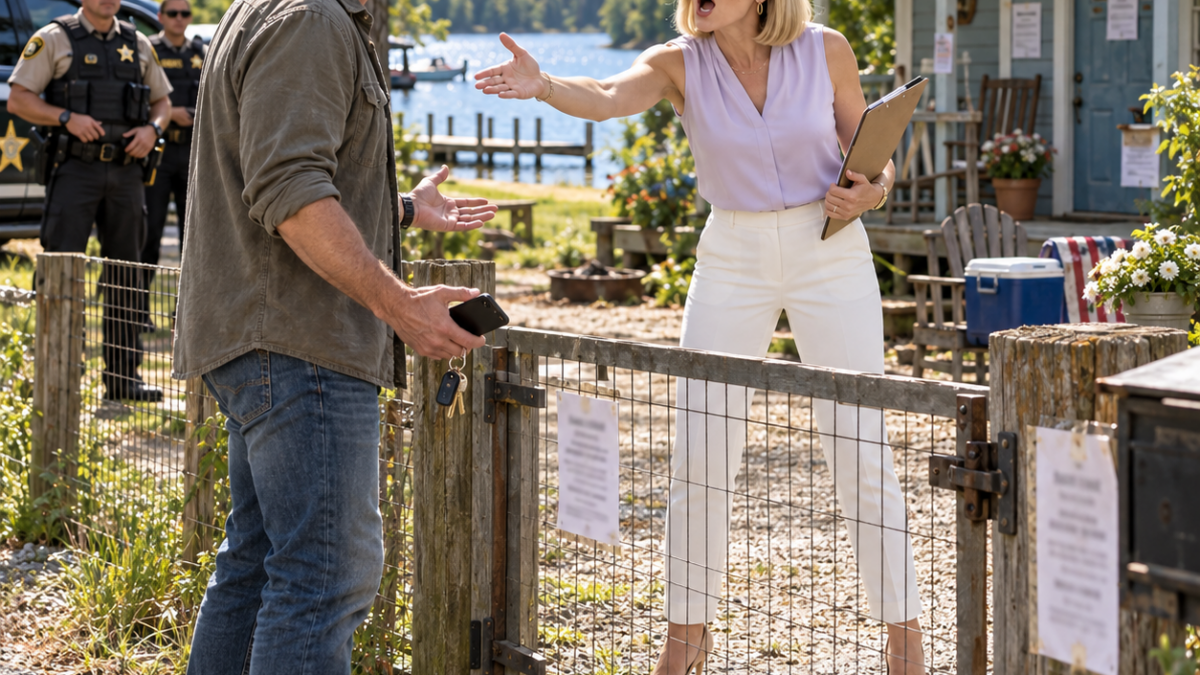
𝗙𝗨𝗟𝗟 𝗦𝗧𝗢𝗥𝗬
She looked to be somewhere in her late fifties, maybe early sixties, with sun-browned skin, sharp cheekbones, and gray-blond hair pulled into a severe braid that hung over one shoulder. She wore a camo jacket despite the mild weather, heavy boots, and cargo pants tucked into them. A fixed expression sat on her face like she had practiced it in a mirror: contempt mixed with triumph.
She carried herself like someone who had spent years telling other people they were wrong and mistaking exhaustion for victory.
“Turn around,” she called.
I opened my truck door slowly.
She walked down the porch steps and stopped halfway across the yard.
“You’re on my land.”
Her voice was flat and certain, which somehow made it more unsettling.
I held up my keys.
“This is my house.”
She smiled, but not with her eyes.
“City boy.”
The words landed with familiar weight. She did not know me, but she already had a category ready.
I stepped out and kept the truck door open.
“My name is Mark Caldwell. I own this property.”
“No,” she said. “You hold corporate paper issued under color of law. That is not ownership.”
I stared at her.
“I signed the deed. I pay the taxes. I have the title. I have keys to the front door.”
She pointed to the plastic sleeve on the gate.
“This land has been perfected under common law. I have posted notice. You failed to rebut. Your claim is abandoned.”
I looked from her to my house.
My faded blue door.
My windows.
My dock behind it, just visible through the trees.
My chair was still on the porch, but someone had moved it. Someone had sat there. Someone had watched my lake from my place and decided I was the intruder.
A heat rose in my chest, sudden and violent.
“What’s your name?” I asked.
She lifted her chin.
“Karen Vale. Sovereign living woman on the land.”
Of course her name was Karen.
Of course.
“Karen,” I said, forcing my voice to stay even, “you need to leave my property.”
Her mouth twitched.
“Your property?”
“Yes.”
“You people always say that like paper makes reality.”
“Paper backed by county records, taxes, insurance, and the law usually does.”
She stepped closer to the gate.
“You abandoned this place.”
“I did not.”
“You were gone.”
“My parents were dying.”
For one brief instant, something flickered in her face.
Not compassion.
Calculation.
Then it vanished.
“Not my concern,” she said. “Vacancy is consent. Absence is abandonment. I have occupied, improved, and perfected my claim.”
“You broke into my house.”
“I took possession of abandoned land.”
“It was locked.”
“Locks are corporate symbols.”
I almost laughed because the alternative was yelling.
“My front door lock was not a symbol. It was a lock.”
She leaned forward, eyes bright.
“You want me out? Kick me out.”
I said nothing.
She spread her arms.
“Go on. You think your fake deed gives you power? Step through that gate and remove me like a man.”
“I’m not touching you.”
“Coward.”
I reached for my phone.
Her smile widened.
“Call your government masters. See what they can do. Or better yet—” She tapped her chest. “Shoot me if you dare.”
The words hit the air like a dropped plate.
I froze.
She noticed and smiled harder.
“That’s what I thought,” she said. “Corporate slave.”
For a second, I saw every bad outcome at once. Me stepping forward. Her screaming. Me grabbing her arm. Her falling. Her producing some edited video. Me becoming the violent city outsider who assaulted a woman on “disputed” land.
I backed up instead.
All the way to the public road shoulder.
Then I called the non-emergency line.
It took two deputies forty minutes to arrive.
During those forty minutes, Karen stood inside my gate like a queen guarding a castle made of trespass notices and delusion. She did not pace. She did not look nervous. Once, she went inside my house and came back out with a mug.
My mug.
That did something ugly to me.
I had bought that chipped blue mug from a gas station on my first weekend there. It meant nothing and everything. Seeing her drink from it made the invasion feel intimate in a way the signs had not.
When the deputies arrived, I expected relief.
I should have known better.
The first deputy, Harris, was tall and tired-looking, with a face that suggested he had already seen too much foolishness before lunch. The second, Deputy Nolan, was younger and quieter, eyes moving constantly between Karen, the signs, the house, and me.
I showed them my driver’s license, deed copy on my phone, tax receipts, utility bills, insurance policy.
Karen handed them her plastic-sleeved packet.
Deputy Harris read the first page.
His expression went blank in a way I can only describe as professional spiritual exhaustion.
Deputy Nolan flipped through three pages and looked at Harris.
Karen began speaking before either deputy could ask a question.
“I am a sovereign living woman. This land was abandoned by corporate fiction claimant Mark Caldwell, who failed to rebut my affidavit of truth. I have perfected allodial title under common law, natural law, and original jurisdiction. Your statutory codes do not apply unless I consent to contract.”
Deputy Harris inhaled slowly.
“Ma’am, do you have a deed recorded with the county?”
“I have a land patent.”
“Is it recorded with the county?”
“The county is a corporate subdivision.”
“That’s not what I asked.”
“I do not answer questions designed to entrap a living woman into maritime jurisdiction.”
I looked at Deputy Nolan.
He gave me the tiniest shake of the head, not dismissal, more like a warning: Don’t engage.
Karen turned her attention to me.
“This man is trespassing on sovereign land and owes me fifty thousand dollars in gold for unlawful entry.”
Deputy Harris rubbed one hand over his mouth.
“Ma’am, he appears to have documentation showing ownership.”
“Paper magic.”
“He says you broke into the house.”
“I entered an abandoned structure on land I lawfully claimed.”
“It wasn’t abandoned,” I snapped. “I was caring for dying parents.”
Karen shrugged.
Deputy Nolan’s eyes sharpened at that, but the situation did not magically improve.
They walked the property line. They looked at the gate. They looked at the flagpole, the signs, the porch, the lock that had been replaced. They spoke to Karen. They spoke to me. They called someone. Then someone else.
By the time Harris came back to me, I already knew from his face that I was about to hear something unbearable.
“Mr. Caldwell,” he said carefully, “we believe your paperwork is legitimate.”
“Good. Then remove her.”
His jaw tightened.
“I can’t physically remove her today.”
I stared at him.
“What?”
“Because she has established occupancy, because this is a remote property, and because she’s making a possession claim—nonsense or not—we have to treat this as a civil property dispute until a judge sorts it.”
“She broke into my house.”
“I understand.”
“No,” I said, and my voice cracked in a way I hated. “You don’t. That’s my house. Those are my things.”
“I understand you’re frustrated.”
“Frustrated?”
Karen stood behind him, smiling.
That smile was the worst part.
Not wild. Not panicked. Not guilty.
Victorious.
Deputy Harris lowered his voice.
“File for emergency possession. Get an attorney. Document everything. Do not confront her physically. Do not cut utilities yourself. Do not try to force entry. If she threatens you, call us. If she damages property, document it. But today, I can’t drag her out.”
I looked past him at my house.
My little blue door felt a mile away.
Karen lifted my mug in a mock toast.
“Guess you’ll have to leave my ancestral lake now,” she called. “Corporate slave.”
Something in my stomach dropped so hard I thought I might be sick.
I sat in my truck after the deputies left and stared at the gate.
I thought about my mother forgetting my name.
My father asking for a wife who was already buried.
Two years of hospitals, bills, grief, and exhaustion.
I had survived all of that believing the lake house was waiting for me. Quiet. Patient. Mine.
Now a stranger with a flag and a stack of fake documents was drinking coffee from my mug on my porch, and the law had just told me to start filing paperwork.
I wanted to break something.
Instead, I opened the notes app on my phone.
When I am overwhelmed, I make lists.
It is not heroic. It is not cinematic. It is what my brain does when emotion gets too large to hold.
Document.
Attorney.
Survey.
Photos.
Certified notices.
Utilities.
Environmental complaint.
Court filing.
Police reports.
Witnesses.
Karen had given me specific instructions.
Kick me out, she had said.
Or shoot me.
Fine.
If she wanted everything reduced to orders and procedures, I would become the most procedural man alive.
I would not give her the fight she wanted.
I would bury her in the real rules.
The first thing I did was hire a local attorney named Claire Whitman.
Claire was in her sixties, short, silver-haired, and so calm on the phone that I trusted her before our first meeting ended.
After I explained everything, she said, “Sovereign citizen?”
“Yes.”
“Living woman?”
“She used that phrase.”
“Allodial title?”
“Several times.”
Claire sighed.
“I hate these.”
“Can we get her out?”
“Yes. But it may not be instant.”
I hated that answer, but I trusted the honesty.
She told me to order a fresh survey, post proper notices, preserve every interaction, and stay away from physical confrontation.
“People like this want a moment,” she said. “They want you angry. They want you reckless. Do not give her the gift of your worst five seconds.”
I wrote that down.
Do not give her the gift.
The surveyor I hired had the patience of a saint and the knees of a mountain goat. He hiked the property pins, confirmed the boundaries, and gave me a clean hard-copy map with fresh markings. He placed bright stakes and flags along the driveway, shoreline, and path to the boathouse.
Karen watched from my porch the entire time.
She had added more signs by then.
LAW OF THE LAND, NOT LAW OF THE SEA.
NO CORPORATE AGENTS.
NATURAL JURISDICTION ENFORCED.
She had also built a lean-to beside my boathouse with a stovepipe sticking out of the top like some kind of survivalist chimney. An orange extension cord ran from it back toward my house.
My power.
My meter.
My bill.
I stood at the property line with the surveyor and took photos.
Karen came down the yard, boots crunching over gravel.
“The paper tyrant returns,” she said.
I did not answer.
The surveyor muttered, “That’s new.”
I kept taking pictures.
“You got my notice?” I asked.
She smiled.
“I used it to start a fire.”
“You need to leave.”
“I perfected a claim. Adverse possession. Two years of care and improvement. Your absence is abandonment.”
“Adverse possession requires far more than two years in this state,” I said.
Her eyes narrowed.
“So you admit you know I have a claim.”
“No. I know enough to know you don’t.”
“Kick me out then.”
I lifted my phone and started recording.
“Karen, are you instructing me to physically remove you from my property?”
“Damn right I am.”
“And you understand that if I put hands on you, you’ll call that assault?”
“I’m giving you permission. Drag me out or stop whining.”
“Or?”
Her smile widened.
“Or shoot me, city boy.”
The surveyor went very still beside me.
I kept my voice even.
“I am declining to assault you. I am asking you to leave voluntarily.”
“Coward.”
That video went into my folder.
The folder became a binder.
Then the binder became two binders.
I posted official no-trespassing signs with my name, parcel number, and the county-recommended language. I had Claire draft a notice to quit. I mailed it certified to “Occupant” at my own address, because absurdity had become my life. I mailed another copy to the strange mailing location Karen had scribbled on one of her fake documents. I kept receipts. Tracking numbers. Photos. Dates. Times.
I took pictures of the extension cord stealing power.
Pictures of trash bags piled behind the boathouse.
Pictures of fish heads dumped near the shoreline.
Pictures of burn marks where she had been setting fires.
I called the utility company about tampering and theft. They documented it but said the occupant issue complicated immediate action.
I called environmental health about the trash and fish waste.
I called wildlife enforcement.
I called the fire marshal when she started burning treated lumber and plastic in a rusted barrel near the trees during dry weather.
Every call became a note.
Every note went into the binder.
Every visit, I recorded.
And every visit, Karen gave me more.
The second time I went back with the survey map, she stood at the gate and told me boundary pins were “corporate nails in God’s earth.”
The third time, I brought my cousin David as a witness. David lived an hour closer and had the kind of phone storage that made him useful in emergencies and family vacations. He stood on the public road and recorded while I called from the property line.
“Karen,” I said, “you have repeatedly instructed me to kick you out or shoot you. I am asking you to leave voluntarily so I do not have to address your instructions through lawful channels.”
She laughed.
“You think your little movie helps you? This is common law land.”
“Are you refusing to leave?”
“I am ordering you off my property.”
“This is my property.”
“Then act like it.”
“By that, do you mean physically remove you?”
“I mean stop hiding behind papers.”
“And if I don’t?”
“Then shoot me like you keep pretending you might.”
“I have never threatened to shoot you.”
“You’re a coward with soft hands.”
David lowered the phone just enough to whisper, “Man, she’s writing the whole case for you.”
He was right.
She kept escalating.
At first, she stayed near the porch or the gate. Then she began coming to the property line whenever I arrived, standing inches from the flags, chin lifted, eyes bright with challenge. She called me a paper tyrant, a corporate coward, a government pet, a city parasite. She told me men settle things face to face. She said the lake had accepted her. She said my absence was spiritual surrender.
Once, she claimed she had annexed my paddleboat.
I looked past her at the old sun-faded pedal boat tied near the dock, the one with a cracked seat and spider nests under the pedals.
“Enjoy it,” I said. “If it sinks, I’ll call the deputies while you bob.”
She called me cruel.
The next day, the paddleboat had been shoved back across the line like either a peace offering or a warning.
I replaced the chain and lock.
Then she started having packages shipped to my address.
The first was a large box left by the gate. I did not open it. I dragged it back to the public road shoulder and called the shipping company to retrieve a package delivered without my consent.
Karen came out screaming.
“That is federal interference!”
“It’s not addressed to me.”
“It’s delivered to my land.”
“It’s my address.”
“You touch my property again, and I will take everything.”
“You’ve already taken enough.”
Her face twisted.
“You want to play rules? I’ll show you natural law.”
By then, I had stopped sleeping well.
I would lie awake in the city, staring at the ceiling, replaying conversations with a woman who had broken into my house and somehow made me feel trapped outside my own life.
People think anger gives you energy. Sometimes it does.
But long anger drains you.
It becomes a second job. A constant hum under every ordinary moment. I would be answering an email at work and suddenly picture Karen sitting at my kitchen table. I would grocery shop and wonder whether she had burned the boathouse down. I would brush my teeth and hear her voice: Kick me out. Shoot me. Coward.
Claire filed for emergency possession and began pushing the court process.
Nothing moved as fast as I wanted.
That was the hardest lesson: being right does not make the system quick.
Meanwhile, Karen got bolder.
She posted a new sign on the boathouse.
PROTECTED BY NATURAL LAW. TRESPASSERS WILL BE DEALT WITH.
The word trespassers was misspelled, which would have been funny if the sign had not been nailed to my property by someone stealing my power.
The next time I arrived, she had a knife on her belt.
Not hidden.
Displayed.
A fixed blade in a leather sheath, handle worn smooth, positioned where she knew I would see it.
I photographed it from the road.
She noticed immediately.
“Don’t photograph me.”
“I’m on public property.”
“I do not consent.”
“You posted terms of entry and public notices all over my gate. I’m documenting your escalating behavior.”
Her hand drifted near the knife.
“You’re weak.”
“Maybe.”
That answer seemed to bother her more than arguing.
She stepped close to the wire at the property line and gripped it with both hands.
“Kick me out then,” she whispered. “Or shoot me. You won’t.”
I walked away that day.
Not because I was calm.
Because I was not.
I sat in my truck with the doors locked and shook until the worst of it passed. My hands trembled so badly I dropped my keys between the seat and console and had to sit there laughing in a way that did not sound like me.
I called Claire from the shoulder.
“She has a knife now,” I said.
Claire’s voice changed.
“Did she threaten you with it?”
“Not directly. But she made sure I saw it.”
“Send me the photos. Also send them to the deputies. Do not go alone again if you can avoid it.”
“I can’t just stop checking on the property.”
“No,” she said. “But you can stop giving her private stages.”
That night, Deputy Harris called me back after reviewing the latest report.
“She’s looking for a fight,” he said.
“I know.”
“I’m not telling you what to do. But you’re going out there remote, and she’s escalating. If you are legally allowed to carry, and if you choose to, make sure you understand the responsibility.”
“I don’t want this to become that.”
“Nobody sane does.”
I had grown up around guns without making them part of my personality. People hunted where I grew up. Friends’ fathers had gun safes. I knew the basics, but I had never been the guy who talked about calibers at cookouts or used self-defense fantasies as entertainment.
After that call, I took a refresher course.
I practiced.
I reviewed the law.
I hated every minute of it.
But I hated the idea of being unprepared more.
The final visit came on a gray morning when the lake looked like dull metal.
I did not know it was final.
I thought it would be another entry in the binder. Another recording. Another refusal. Another day of Karen performing sovereignty from behind my gate.
Before I drove out, I texted David.
Heading there now. Bad feeling. Can you be nearby?
He replied within a minute.
Already leaving.
I parked on the public shoulder like always. I did not block the gate. I did not step across the property line. I took out my phone, started recording, and placed the binder on the hood of my truck.
The air was still.
No smoke for once.
No shouting.
For one irrational second, I thought maybe she was gone.
Then the front door opened hard enough to slam against the wall inside.
Karen came out fast.
Faster than I had ever seen her move.
She was already wearing boots, jacket, knife. Like she had slept dressed. Like she had been waiting.
“There he is,” she shouted, though no one else was visible. “The corporate coward returns.”
I lifted my phone higher.
“Karen, I am standing on public property. I am giving you one final opportunity to leave before the court hearing proceeds and before I comply with your repeated demands through lawful means.”
She strode across the yard.
“What demands?”
That stopped me for half a breath.
I looked at her, genuinely stunned.
“Your demands that I kick you out or shoot you. You’ve said it repeatedly. On video.”
Her face darkened.
“You don’t have the spine.”
“I am not entering the property. I’m asking you to leave voluntarily.”
“No.”
“You are trespassing.”
“You are trespassing against me.”
“You have no legal claim.”
“I am law.”
That was when I saw David’s truck slow near the mile marker farther down the road.
Relief moved through me, but it did not last.
Karen kept coming.
She reached the gate. Opened it.
My pulse kicked.
“Do not come closer,” I said.
She stepped through.
For two months, she had always stopped at the line. Leaned over it. Grabbed the wire. Dared me from her side.
This time, she crossed.
One boot landed on the public shoulder side of the boundary, then the other.
She looked down at her own feet, then back up at me.
“What now?” she asked.
I picked up my phone with my left hand and dialed 911.
“I’m calling emergency services. You are now approaching me after crossing the property line with a weapon.”
Her hand moved.
She drew the knife.
Not high. Not yet.
Low at her side.
But out.
Everything inside me narrowed.
The trees. The lake. The gate. The signs. The flag. The binder. The truck. All of it pulled back until there was only Karen, the knife, and the distance between us.
“911, what is your emergency?”
My voice sounded strangely far away.
“My name is Mark Caldwell. I’m on County Road 15 near mile marker seven. I am being threatened by an armed trespasser. She has repeatedly demanded I shoot her. She has now crossed toward me with a knife.”
Karen smiled.
“There it is,” she said. “Calling your government masters.”
The dispatcher asked something.
I barely heard it.
Karen took another step.
“Stop,” I said loudly. “Do not come closer.”
She kept walking.
The knife remained low, but her grip changed.
“Kick me out like a man,” she said. “Or shoot me like you keep threatening.”
“I have not threatened you. Stop advancing.”
“You don’t belong here.”
“Stop.”
“You never did.”
I backed up.
Gravel shifted under my shoes.
My right hand hovered near the holster I had prayed I would never need.
“Karen,” I said, louder now, for her, for the dispatcher, for David’s camera, for God if He happened to be listening, “do not come closer.”
Her face changed.
Not suddenly. Not dramatically. But something dropped away.
The performance vanished.
What remained was fury.
“You weak little paper man,” she said.
Then she rushed.
People who have never lived a moment like that think decisions happen in words.
They do not.
There was no speech inside me. No moral debate. No cinematic slow motion where I weighed every option and chose. There was only survival instinct, training, terror, and the fact that a woman with a knife was closing distance faster than my mind could hold.
I drew.
I fired twice.
Then I stopped.
Karen fell hard onto the gravel shoulder, the knife skittering away from her hand.
For a second, the world disappeared into ringing.
I remember shouting, but I did not hear my own voice clearly.
“Shots fired. She’s down. The knife is away. I’m backing up. I’m putting the gun on my hood.”
The dispatcher’s voice came through like it was underwater.
I placed the gun on the hood of my truck and backed away with both hands up, phone still clutched in one of them.
Karen was alive.
She was swearing, gasping, clutching her side and shoulder, trying to roll.
I kept saying, “Don’t move. Help is coming. Don’t touch the knife.”
I do not know whether I said it for her or for myself.
David was out of his truck now, far enough away to be safe, phone in hand, shouting that he had seen everything.
A man from a neighboring property appeared down the road.
“She came at him!” he yelled. “I saw it! She had the knife!”
Another voice from somewhere near the trees shouted, “She’s been daring him for weeks!”
Sirens came fast and too slow at the same time.
When the deputies arrived, weapons drawn, commands sharp and overlapping, I followed every instruction like obedience was the only thing keeping the world from splitting apart.
Hands visible.
Step back.
Kneel.
Do not reach.
I did all of it.
They secured the gun. Secured the knife. Cuffed Karen even as she screamed that she did not consent. Paramedics moved in. Deputy Harris recognized me and looked older than he had two months earlier.
“Mark,” he said, voice firm but not unkind, “don’t talk right now beyond immediate safety. Breathe.”
I tried.
My whole body shook.
David gave his footage to the deputies. His dash cam had caught the approach. His phone had caught the crossing, the knife, the rush. My 911 call had recorded the warnings. My phone video had captured everything before the sprint. Neighbors gave statements. The binder was taken as evidence.
The famous binder.
Two months of Karen telling me to kick her out or shoot her.
Two months of me refusing.
Two months of notices, warnings, reports, photographs, theft, threats, signs, and escalation.
Detectives arrived later. They measured distances. Photographed the scene. Took statements. Logged my firearm. Took the knife. Took the signs. Took copies of the documents taped to my gate.
One detective flipped through Karen’s packet and muttered something I could not hear.
Another asked me questions in a careful, neutral voice after my attorney arrived.
I answered what Claire told me to answer.
Yes, I owned the property.
Yes, Karen had occupied it without permission.
Yes, I had filed through the courts.
Yes, I had repeatedly asked her to leave.
Yes, she had repeatedly demanded physical violence.
Yes, I had retreated.
Yes, I told her to stop.
Yes, she rushed me with the knife.
No, I did not want to shoot her.
That last answer broke something loose in me.
My voice failed.
Claire put a hand on my shoulder and asked for a break.
I sat on the bumper of my truck with a bottle of water I could not drink and looked at the house beyond the gate.
The sovereign flag still hung in my yard.
The fake signs still moved slightly in the wind.
The faded blue door stood open.
I did not feel victorious.
I felt hollow.
People like Karen imagine conflict as proof. They think if they can force the world into a battlefield, then whatever happens next validates the war they invented. She had wanted a dramatic ending. She had wanted me to become the villain in the story she had been telling herself.
But real violence is not dramatic when you are inside it.
It is loud and fast and ugly.
Then it is paperwork, shock, ringing ears, blood on gravel, and the knowledge that whatever happens legally, your mind now has a scene it can replay whenever it wants.
Karen lived.
I held on to that.
She had surgery for injuries to her side and shoulder. She survived, which mattered to me in ways I could not explain without sounding like I was defending her. I was not. I simply did not want a death attached to my name, my lake house, my one quiet place.
The investigation took time.
Of course it did.
Any shooting involving injury should be scrutinized. I understood that in the abstract. Living through it was different.
For weeks, I woke at three in the morning hearing her voice.
Kick me out.
Shoot me.
Coward.
Sometimes, in the replay, I moved faster. Sometimes slower. Sometimes I tripped. Sometimes the gun jammed. Sometimes she did not fall. Sometimes she did, and the scene kept going anyway.
Claire told me not to read comments on local news posts.
I read them anyway once.
That was enough.
Some people said I had defended myself.
Some said I should have let police handle it, as if I had not spent two months trying exactly that.
Some said no property was worth a life.
I agreed.
No property was worth a life.
But my life was not property.
That was the part people liked to skip.
Karen was charged with aggravated assault with a deadly weapon, criminal trespass, theft of utilities, environmental violations, illegal burning, and a mess of related offenses that came from two months of documented behavior. The prosecutor’s office reviewed everything. The grand jury declined to indict me.
The statement was brief and formal.
Clear pattern of self-defense.
Documented threats.
Repeated demands for violence by the perpetrator.
Knife.
Advance.
Recorded warnings.
Legally justified response.
I read the words at my kitchen table and felt no joy.
Relief, yes.
Joy, no.
Karen’s defense attorney tried to paint me as the aggressor later, but the evidence made that nearly impossible. It is difficult to argue your client was an innocent occupant when she is on video demanding to be kicked out or shot, then crossing toward the property owner with a knife after months of recorded threats.
Her sovereign claim collapsed the moment real scrutiny touched it.
She had never owned the land.
She had no family connection to it.
No ancestral claim.
No perfected title.
No common law victory.
She had simply found a remote house whose owner was absent and decided delusion plus confidence could become ownership if she performed it hard enough.
The court gave me possession.
The deputies removed what remained of her belongings after the legal order came through. Not much of it was valuable. Totes of survival gear. Stacks of printed documents. Canned food. Cheap tools. Burned pots. A cot. A radio. More signs than any sane person needs. A notebook full of rambling legal phrases copied from somewhere and rearranged like spells.
I stood in the yard while the crew took down her flagpole.
When the banner hit the ground, I expected satisfaction.
Instead, I felt tired.
The house was worse inside than I had imagined.
Not destroyed exactly, but violated in a thousand small ways.
My furniture had been moved. Cabinets rearranged. Food wrappers stuffed behind the couch. Smoke stains near a window where she had apparently tried to vent something. My good chair had a knife mark across one arm. My blue mug was cracked in the sink.
That stupid mug almost broke me.
I stood there holding it while David carried trash bags through the kitchen.
“You okay?” he asked.
“No.”
He set the bags down.
I laughed once, sharp and empty.
“I survived the legal part. Why is the mug what gets me?”
David looked at it.
“Because it’s yours.”
That was the whole answer.
Because it was mine.
Not expensive. Not important. Mine.
I replaced the locks again. Then the doors. Then the gate. I repaired the boathouse. Had an electrician inspect everything. Had the utility company confirm the meter. Paid for cleanup near the shoreline. Removed the lean-to. Scrubbed smoke stains until my arms hurt.
For a while, I thought I would sell.
Everyone expected me to.
My coworkers said no peaceful place could stay peaceful after that. Claire gently suggested there would be no shame in letting it go. David offered to help me list it whenever I was ready.
I even called a realtor.
She walked through the house, took notes, complimented the view, and told me the market was strong.
Then she stood on the dock and said, “People would kill for this quiet.”
I almost laughed.
Instead, I looked across the water.
The lake was still the lake.
Karen had turned the place into a battlefield for a while, but she had not created the water, the trees, the evening light, the dock’s old creak, or the way my chest loosened when the sun dropped behind the far ridge.
She had stolen time.
She had stolen safety.
She had stolen my illusion that quiet places stay quiet just because you need them to.
But she had not earned the right to be the final memory attached to that house.
So I did not sell.
I stayed away for a month after the cleanup.
Then one Friday, I packed a bag, drove out before dawn, and arrived as fog lifted off the road.
The new gate looked too clean. The fresh lock clicked open smoothly. The yard was bare where her flagpole had been, just a patched circle of dirt waiting for grass.
I carried my bag inside.
The house smelled like lemon cleaner, new wood, and faint smoke that might have been real or might have lived only in me.
I made coffee.
Not in the cracked mug. That one was gone.
In a new mug. Plain white. Bought from a grocery store on the way.
Then I walked down to the dock.
For a long time, I just stood there.
No phone.
No binder.
No camera.
No recording.
The dock creaked under my feet.
The lake moved softly against the pilings.
A bird called somewhere in the trees.
I waited for fear to take over.
It came, but smaller than before.
Then grief came too. Not just for what happened with Karen, but for the two years before it. My mother. My father. The life I had been trying to return to when I found a stranger wearing my absence like a crown.
I sat in the old chair.
The one I repaired instead of replacing.
The lake did not fix me.
Places do not do that.
But for the first time in a long time, I took a full breath.
Later, I opened the new binder I keep at the house now.
Deed.
Survey.
Court order.
Police reports.
No-trespassing notices.
Emergency contacts.
Photos of property boundaries.
Everything organized so neatly it would make a bureaucrat weep.
On the inside cover, I wrote one sentence.
Do not give them the gift of your worst five seconds.
Claire said it first, but now it belongs to me.
Karen got exactly what she kept demanding, but not in the way she imagined. She wanted me reckless. She wanted me emotional. She wanted a fight she could twist into proof that I was the villain and she was the sovereign defender of stolen land.
Instead, she got records.
Dates.
Video.
Witnesses.
Warnings.
Law.
And finally, when she crossed the last line with a knife in her hand, she got the consequence she had spent two months daring into existence.
I still do not call that winning.
Winning would have been unlocking my blue door that first day and finding dust, stale air, and maybe a mouse problem.
Winning would have been grieving my parents beside the lake without learning how quickly absence attracts predators.
Winning would have been never knowing what I sound like on a 911 call.
But survival is not always clean enough to feel like victory.
Sometimes survival is a binder on a kitchen table.
A repaired dock.
A new lock.
A quiet morning you had to fight too hard to reach.
People ask me sometimes what happened to Karen.
The short version is that she went to prison for a while, though not as long as some people thought she deserved and longer than others thought she would get. She lost every claim she made to the property. The utility theft and environmental violations added weight. The assault charge carried the most. Her courtroom speeches about sovereignty did not impress the judge, who had apparently heard enough “living woman” arguments to last three lifetimes.
I was called to testify.
She looked smaller in court.
No camo jacket. No boots in my yard. No knife on her belt. Just a woman in a plain blouse, hair pulled back, jaw tight, eyes still burning with the same resentment.
When my attorney asked about the videos, she claimed they were taken out of context.
When the prosecutor asked what context made “kick me out or shoot me” reasonable, she said she did not consent to his jurisdiction.
The judge told her to answer the question.
She stared at the table.
For the first time since I met her, Karen had no sign, no gate, no stolen porch, no performance strong enough to bend the room around her.
Just facts.
And facts, unlike fear, do not get tired.
After sentencing, I walked outside and sat on a bench near the courthouse.
Claire sat beside me.
“You did well,” she said.
“I don’t feel well.”
“No,” she said. “I don’t imagine you do.”
I looked at my hands.
They were steady now. That almost bothered me more than when they shook.
“Does that part ever go away?”
She did not pretend not to understand.
“I don’t know,” she said. “But it can become one part of the story instead of the whole story.”
That was the best anyone had offered me.
So that is what I have tried to do.
The lake house is not what it was before. It cannot be. I do not arrive with the same innocent relief I used to feel. I check the gate. I check the locks. I walk the boundary sometimes. I notice strange tire marks. I keep cameras now, and motion lights, and a relationship with neighbors I should have built earlier.
But I also fish off the dock, badly.
I drink coffee in the mornings.
I replaced the flagpole scar with a young maple tree.
David helped me plant it. We stood there afterward, both of us muddy, staring at the little tree like it had agreed to some responsibility neither of us had spoken aloud.
“Think it’ll make it?” he asked.
“It better,” I said. “I’ve had enough failed claims on this yard.”
He laughed so hard he had to sit on the porch steps.
That laugh helped.
The tree is still there.
Small, stubborn, alive.
Some evenings, I sit on the dock and think about my parents. Mom asking about sunsets she would never see again. Dad nodding along to stories he half remembered. I think about how I bought the place to escape pressure, then nearly lost it during the worst pressure of my life.
I think about ownership too.
Not the fake kind Karen performed with Latin phrases and laminated nonsense.
Real ownership.
The kind that is boring most days. Taxes. Repairs. Insurance. Maintenance. Showing up. Keeping records. Asking for help. Letting law work even when it moves slower than your anger wants it to.
Karen thought ownership meant taking space loudly enough that other people retreated.
I learned ownership sometimes means standing outside your own gate and choosing, again and again, not to become the chaos someone else is trying to summon.
The lake is quiet tonight as I write this.
The dock still creaks.
The road is still rough.
The internet is still terrible.
And when I unlock that faded blue door now, I do not feel like I cheated the world anymore.
I feel like I came back from something.
The house is mine.
The lake is not mine, not really. Water belongs to itself.
But the little piece of shore, the blue door, the dock, the chair, the maple tree growing where her flag once stood—those are mine.
Not because I yelled louder.
Not because I wanted them more.
Because the truth held.
Because I kept the receipts.
Because when a woman built an entire kingdom out of delusion and dared me to destroy myself trying to tear it down, I refused until the very last second.
And by then, every word she had thrown at me had already become the proof that saved me.
𝗧𝗛𝗘 𝗘𝗡𝗗
She Told Me to Kick Her Out or Shoot Her, Then Smiled Like the Law Couldn’t Touch Her
The woman standing on my porch had turned my lake house into her sovereign kingdom.
She dared me to drag her out with my own hands, then dared me to use the gun she swore I was too weak to carry.
By the time the deputies arrived for the last time, she finally understood that some orders become evidence.
I bought the lake house because it was the only place where my mind ever went quiet.
That was the simplest way to explain it, though it never felt simple when I tried to say it out loud. People heard “lake house” and imagined money, leisure, some polished weekend fantasy with wine glasses on a deck and clean towels stacked in wicker baskets. Mine was not that kind of place. Mine was a faded blue door, a gravel driveway that punished every low-clearance vehicle, a roof that needed attention every third storm, and a dock that creaked so loudly at night it sounded like an old man clearing his throat in the dark.
I loved every inch of it.
The internet was terrible. Cell service faded in and out depending on weather, mood, and whatever invisible gods controlled rural signal strength. The nearest grocery store was thirty minutes away if you drove like you had already made peace with potholes. In the winter, the road iced over in ways that made me question my life choices. In the summer, mosquitoes treated me like a seasonal buffet.
But when I stood on that dock at sunset and watched the lake take the sky apart piece by piece, I could breathe.
I was not born there. I did not inherit it from some rugged grandfather with calloused hands and stories about building the cabin himself. I was a city guy with a corporate job, too many screens, too many emails, too many meetings where people said “circle back” as if the human soul had not suffered enough already. My doctor kept giving my blood pressure the kind of look people give a suspicious noise in the basement.
So I saved.
For years, I saved.
When the place came up for sale, it was nothing fancy, which meant it was barely within reach. I signed the papers with hands that shook a little. I paid the taxes. I replaced the locks. I bought a secondhand canoe, a coffee maker, and one good chair for the dock.
And every time I unlocked that faded blue door, I felt like I had cheated the world.
Then life started throwing rocks.
My mother’s dementia came first.
Not all at once. That would have been merciful in a terrible way. It came in pieces. She would forget where she put her purse, then forget she had a purse, then cry because she remembered forgetting. She would call me by my father’s name, then catch herself and apologize like she had spilled coffee on my shirt instead of showing me the first crack in the foundation of our family.
The doctors used clean words.
Progressive.
Degenerative.
Cognitive decline.
None of them sounded like watching your mother disappear while her body kept sitting across from you.
My father’s Alzheimer’s diagnosis came eight months after her first major episode. They had been married forty-three years and lived by routines so precise they felt carved into the floorboards. Coffee at six. News at seven. Dinner before five-thirty. Bed by nine-thirty. When Dad started forgetting how to make coffee, Mom would try to help him, then forget why they were standing in the kitchen. I would find them both there, holding mugs like objects from a life they could no longer enter.
I moved them closer to me. Sold their house. Found a facility that did not smell like defeat. Visited every day after work until my own apartment became just a place where I slept between grief shifts.
Some days were almost normal.
Mom would ask about the lake house, and I would describe the sunset as if I had just seen it, even though months had passed since my last visit. Dad would nod along and sometimes remember the time we tried to fish there and caught nothing but a waterlogged boot.
Other days were not days at all.
They were endurance tests.
Mom stopped recognizing me first.
Dad followed six months later.
They sat together in the common room, two strangers who had built an entire life together, still holding hands because muscle memory outlasted names.
Mom went first. Pneumonia, in the end. Dad lasted four more months. The staff told me he kept asking for his wife without remembering she had died.
When he finally let go, it felt like watching someone release a rope he had been gripping long after his hands went numb.
After the funerals, after the paperwork, after dividing fifty years of shared objects into donation bins and trash bags, I sat alone in my apartment and realized I had not taken a full breath in nearly two years.
I needed somewhere that did not hurt to look at.
I needed the lake house.
part2
I had not been back except once to winterize the place. I shut off the water, checked the roof, locked the door, and promised myself I would return soon. Then soon turned into next month, next season, next year.
Two years went by like that.
It was not smart from a property-owner perspective. I knew that. Empty houses attract problems. Remote empty houses practically send out invitations. But grief does not care about best practices. When someone you love is vanishing in front of you, you do not think about gravel driveways and dock boards and utility meters. You run on fumes and hope nothing catches fire behind you.
When I finally drove back, I knew something was wrong before I even put the truck in park.
There was a flagpole in my front yard.
Not near the road. Not by the mailbox. Right in front of my house, planted like a conquest marker.
The flag was not an American flag. It was not a state flag. It was a homemade-looking mashup banner with a coiled snake, strange Latin phrases, and symbols I had only ever seen in the darker corners of the internet where people believed punctuation could defeat the government.
My stomach tightened.
On the gate hung a plywood sign painted in thick black letters.
PRIVATE SOVEREIGN PROPERTY.
Below it, someone had stapled a stack of papers inside a plastic sleeve. They were full of phrases like allodial title, land patent, common law jurisdiction, fee simple absolute, natural rights, living woman, and consent fee.
Another sign read:
NO TRESPASS. ENTRY CONSTITUTES CONTRACT. FEE: $50,000 IN GOLD.
I sat there with both hands on the steering wheel.
For a few seconds, my brain refused to understand what my eyes were seeing.
Then the front door opened.
A woman stepped onto my porch.
She looked to be somewhere in her late fifties, maybe early sixties, with sun-browned skin, sharp cheekbones, and gray-blond hair pulled into a severe braid that hung over one shoulder. She wore a camo jacket despite the mild weather, heavy boots, and cargo pants tucked into them. A fixed expression sat on her face like she had practiced it in a mirror: contempt mixed with triumph.
She carried herself like someone who had spent years telling other people they were wrong and mistaking exhaustion for victory.
“Turn around,” she called.
I opened my truck door slowly.
She walked down the porch steps and stopped halfway across the yard.
“You’re on my land.”
Her voice was flat and certain, which somehow made it more unsettling.
I held up my keys.
“This is my house.”
She smiled, but not with her eyes.
“City boy.”
The words landed with familiar weight. She did not know me, but she already had a category ready.
I stepped out and kept the truck door open.
“My name is Mark Caldwell. I own this property.”
“No,” she said. “You hold corporate paper issued under color of law. That is not ownership.”
I stared at her.
“I signed the deed. I pay the taxes. I have the title. I have keys to the front door.”
She pointed to the plastic sleeve on the gate.
“This land has been perfected under common law. I have posted notice. You failed to rebut. Your claim is abandoned.”
I looked from her to my house.
My faded blue door.
My windows.
My dock behind it, just visible through the trees.
My chair was still on the porch, but someone had moved it. Someone had sat there. Someone had watched my lake from my place and decided I was the intruder.
A heat rose in my chest, sudden and violent.
“What’s your name?” I asked.
She lifted her chin.
“Karen Vale. Sovereign living woman on the land.”
Of course her name was Karen.
Of course.
“Karen,” I said, forcing my voice to stay even, “you need to leave my property.”
Her mouth twitched.
“Your property?”
“Yes.”
“You people always say that like paper makes reality.”
“Paper backed by county records, taxes, insurance, and the law usually does.”
She stepped closer to the gate.
“You abandoned this place.”
“I did not.”
“You were gone.”
“My parents were dying.”
For one brief instant, something flickered in her face.
Not compassion.
Calculation.
Then it vanished.
“Not my concern,” she said. “Vacancy is consent. Absence is abandonment. I have occupied, improved, and perfected my claim.”
“You broke into my house.”
“I took possession of abandoned land.”
“It was locked.”
“Locks are corporate symbols.”
I almost laughed because the alternative was yelling.
“My front door lock was not a symbol. It was a lock.”
She leaned forward, eyes bright.
“You want me out? Kick me out.”
I said nothing.
She spread her arms.
“Go on. You think your fake deed gives you power? Step through that gate and remove me like a man.”
“I’m not touching you.”
“Coward.”
I reached for my phone.
Her smile widened.
“Call your government masters. See what they can do. Or better yet—” She tapped her chest. “Shoot me if you dare.”
The words hit the air like a dropped plate.
I froze.
She noticed and smiled harder.
“That’s what I thought,” she said. “Corporate slave.”
For a second, I saw every bad outcome at once. Me stepping forward. Her screaming. Me grabbing her arm. Her falling. Her producing some edited video. Me becoming the violent city outsider who assaulted a woman on “disputed” land.
I backed up instead.
All the way to the public road shoulder.
Then I called the non-emergency line.
It took two deputies forty minutes to arrive.
During those forty minutes, Karen stood inside my gate like a queen guarding a castle made of trespass notices and delusion. She did not pace. She did not look nervous. Once, she went inside my house and came back out with a mug.
My mug.
That did something ugly to me.
I had bought that chipped blue mug from a gas station on my first weekend there. It meant nothing and everything. Seeing her drink from it made the invasion feel intimate in a way the signs had not.
When the deputies arrived, I expected relief.
I should have known better.
The first deputy, Harris, was tall and tired-looking, with a face that suggested he had already seen too much foolishness before lunch. The second, Deputy Nolan, was younger and quieter, eyes moving constantly between Karen, the signs, the house, and me.
I showed them my driver’s license, deed copy on my phone, tax receipts, utility bills, insurance policy.
Karen handed them her plastic-sleeved packet.
Deputy Harris read the first page.
His expression went blank in a way I can only describe as professional spiritual exhaustion.
Deputy Nolan flipped through three pages and looked at Harris.
Karen began speaking before either deputy could ask a question.
“I am a sovereign living woman. This land was abandoned by corporate fiction claimant Mark Caldwell, who failed to rebut my affidavit of truth. I have perfected allodial title under common law, natural law, and original jurisdiction. Your statutory codes do not apply unless I consent to contract.”
Deputy Harris inhaled slowly.
“Ma’am, do you have a deed recorded with the county?”
“I have a land patent.”
“Is it recorded with the county?”
“The county is a corporate subdivision.”
“That’s not what I asked.”
“I do not answer questions designed to entrap a living woman into maritime jurisdiction.”
I looked at Deputy Nolan.
He gave me the tiniest shake of the head, not dismissal, more like a warning: Don’t engage.
Karen turned her attention to me.
“This man is trespassing on sovereign land and owes me fifty thousand dollars in gold for unlawful entry.”
Deputy Harris rubbed one hand over his mouth.
“Ma’am, he appears to have documentation showing ownership.”
“Paper magic.”
“He says you broke into the house.”
“I entered an abandoned structure on land I lawfully claimed.”
“It wasn’t abandoned,” I snapped. “I was caring for dying parents.”
Karen shrugged.
Deputy Nolan’s eyes sharpened at that, but the situation did not magically improve.
They walked the property line. They looked at the gate. They looked at the flagpole, the signs, the porch, the lock that had been replaced. They spoke to Karen. They spoke to me. They called someone. Then someone else.
By the time Harris came back to me, I already knew from his face that I was about to hear something unbearable.
“Mr. Caldwell,” he said carefully, “we believe your paperwork is legitimate.”
“Good. Then remove her.”
His jaw tightened.
“I can’t physically remove her today.”
I stared at him.
“What?”
“Because she has established occupancy, because this is a remote property, and because she’s making a possession claim—nonsense or not—we have to treat this as a civil property dispute until a judge sorts it.”
“She broke into my house.”
“I understand.”
“No,” I said, and my voice cracked in a way I hated. “You don’t. That’s my house. Those are my things.”
“I understand you’re frustrated.”
“Frustrated?”
Karen stood behind him, smiling.
That smile was the worst part.
Not wild. Not panicked. Not guilty.
Victorious.
Deputy Harris lowered his voice.
“File for emergency possession. Get an attorney. Document everything. Do not confront her physically. Do not cut utilities yourself. Do not try to force entry. If she threatens you, call us. If she damages property, document it. But today, I can’t drag her out.”
I looked past him at my house.
My little blue door felt a mile away.
Karen lifted my mug in a mock toast.
“Guess you’ll have to leave my ancestral lake now,” she called. “Corporate slave.”
Something in my stomach dropped so hard I thought I might be sick.
I sat in my truck after the deputies left and stared at the gate.
I thought about my mother forgetting my name.
My father asking for a wife who was already buried.
Two years of hospitals, bills, grief, and exhaustion.
I had survived all of that believing the lake house was waiting for me. Quiet. Patient. Mine.
Now a stranger with a flag and a stack of fake documents was drinking coffee from my mug on my porch, and the law had just told me to start filing paperwork.
I wanted to break something.
Instead, I opened the notes app on my phone.
When I am overwhelmed, I make lists.
It is not heroic. It is not cinematic. It is what my brain does when emotion gets too large to hold.
Document.
Attorney.
Survey.
Photos.
Certified notices.
Utilities.
Environmental complaint.
Court filing.
Police reports.
Witnesses.
Karen had given me specific instructions.
Kick me out, she had said.
Or shoot me.
Fine.
If she wanted everything reduced to orders and procedures, I would become the most procedural man alive.
I would not give her the fight she wanted.
I would bury her in the real rules.
The first thing I did was hire a local attorney named Claire Whitman.
Claire was in her sixties, short, silver-haired, and so calm on the phone that I trusted her before our first meeting ended.
After I explained everything, she said, “Sovereign citizen?”
“Yes.”
“Living woman?”
“She used that phrase.”
“Allodial title?”
“Several times.”
Claire sighed.
“I hate these.”
“Can we get her out?”
“Yes. But it may not be instant.”
I hated that answer, but I trusted the honesty.
She told me to order a fresh survey, post proper notices, preserve every interaction, and stay away from physical confrontation.
“People like this want a moment,” she said. “They want you angry. They want you reckless. Do not give her the gift of your worst five seconds.”
I wrote that down.
Do not give her the gift.
The surveyor I hired had the patience of a saint and the knees of a mountain goat. He hiked the property pins, confirmed the boundaries, and gave me a clean hard-copy map with fresh markings. He placed bright stakes and flags along the driveway, shoreline, and path to the boathouse.
Karen watched from my porch the entire time.
She had added more signs by then.
LAW OF THE LAND, NOT LAW OF THE SEA.
NO CORPORATE AGENTS.
NATURAL JURISDICTION ENFORCED.
She had also built a lean-to beside my boathouse with a stovepipe sticking out of the top like some kind of survivalist chimney. An orange extension cord ran from it back toward my house.
My power.
My meter.
My bill.
I stood at the property line with the surveyor and took photos.
Karen came down the yard, boots crunching over gravel.
“The paper tyrant returns,” she said.
I did not answer.
The surveyor muttered, “That’s new.”
I kept taking pictures.
“You got my notice?” I asked.
She smiled.
“I used it to start a fire.”
“You need to leave.”
“I perfected a claim. Adverse possession. Two years of care and improvement. Your absence is abandonment.”
“Adverse possession requires far more than two years in this state,” I said.
Her eyes narrowed.
“So you admit you know I have a claim.”
“No. I know enough to know you don’t.”
“Kick me out then.”
I lifted my phone and started recording.
“Karen, are you instructing me to physically remove you from my property?”
“Damn right I am.”
“And you understand that if I put hands on you, you’ll call that assault?”
“I’m giving you permission. Drag me out or stop whining.”
“Or?”
Her smile widened.
“Or shoot me, city boy.”
The surveyor went very still beside me.
I kept my voice even.
“I am declining to assault you. I am asking you to leave voluntarily.”
“Coward.”
That video went into my folder.
The folder became a binder.
Then the binder became two binders.
I posted official no-trespassing signs with my name, parcel number, and the county-recommended language. I had Claire draft a notice to quit. I mailed it certified to “Occupant” at my own address, because absurdity had become my life. I mailed another copy to the strange mailing location Karen had scribbled on one of her fake documents. I kept receipts. Tracking numbers. Photos. Dates. Times.
I took pictures of the extension cord stealing power.
Pictures of trash bags piled behind the boathouse.
Pictures of fish heads dumped near the shoreline.
Pictures of burn marks where she had been setting fires.
I called the utility company about tampering and theft. They documented it but said the occupant issue complicated immediate action.
I called environmental health about the trash and fish waste.
I called wildlife enforcement.
I called the fire marshal when she started burning treated lumber and plastic in a rusted barrel near the trees during dry weather.
Every call became a note.
Every note went into the binder.
Every visit, I recorded.
And every visit, Karen gave me more.
The second time I went back with the survey map, she stood at the gate and told me boundary pins were “corporate nails in God’s earth.”
The third time, I brought my cousin David as a witness. David lived an hour closer and had the kind of phone storage that made him useful in emergencies and family vacations. He stood on the public road and recorded while I called from the property line.
“Karen,” I said, “you have repeatedly instructed me to kick you out or shoot you. I am asking you to leave voluntarily so I do not have to address your instructions through lawful channels.”
She laughed.
“You think your little movie helps you? This is common law land.”
“Are you refusing to leave?”
“I am ordering you off my property.”
“This is my property.”
“Then act like it.”
“By that, do you mean physically remove you?”
“I mean stop hiding behind papers.”
“And if I don’t?”
“Then shoot me like you keep pretending you might.”
“I have never threatened to shoot you.”
“You’re a coward with soft hands.”
David lowered the phone just enough to whisper, “Man, she’s writing the whole case for you.”
He was right.
She kept escalating.
At first, she stayed near the porch or the gate. Then she began coming to the property line whenever I arrived, standing inches from the flags, chin lifted, eyes bright with challenge. She called me a paper tyrant, a corporate coward, a government pet, a city parasite. She told me men settle things face to face. She said the lake had accepted her. She said my absence was spiritual surrender.
Once, she claimed she had annexed my paddleboat.
I looked past her at the old sun-faded pedal boat tied near the dock, the one with a cracked seat and spider nests under the pedals.
“Enjoy it,” I said. “If it sinks, I’ll call the deputies while you bob.”
She called me cruel.
The next day, the paddleboat had been shoved back across the line like either a peace offering or a warning.
I replaced the chain and lock.
Then she started having packages shipped to my address.
The first was a large box left by the gate. I did not open it. I dragged it back to the public road shoulder and called the shipping company to retrieve a package delivered without my consent.
Karen came out screaming.
“That is federal interference!”
“It’s not addressed to me.”
“It’s delivered to my land.”
“It’s my address.”
“You touch my property again, and I will take everything.”
“You’ve already taken enough.”
Her face twisted.
“You want to play rules? I’ll show you natural law.”
By then, I had stopped sleeping well.
I would lie awake in the city, staring at the ceiling, replaying conversations with a woman who had broken into my house and somehow made me feel trapped outside my own life.
People think anger gives you energy. Sometimes it does.
But long anger drains you.
It becomes a second job. A constant hum under every ordinary moment. I would be answering an email at work and suddenly picture Karen sitting at my kitchen table. I would grocery shop and wonder whether she had burned the boathouse down. I would brush my teeth and hear her voice: Kick me out. Shoot me. Coward.
Claire filed for emergency possession and began pushing the court process.
Nothing moved as fast as I wanted.
That was the hardest lesson: being right does not make the system quick.
Meanwhile, Karen got bolder.
She posted a new sign on the boathouse.
PROTECTED BY NATURAL LAW. TRESPASSERS WILL BE DEALT WITH.
The word trespassers was misspelled, which would have been funny if the sign had not been nailed to my property by someone stealing my power.
The next time I arrived, she had a knife on her belt.
Not hidden.
Displayed.
A fixed blade in a leather sheath, handle worn smooth, positioned where she knew I would see it.
I photographed it from the road.
She noticed immediately.
“Don’t photograph me.”
“I’m on public property.”
“I do not consent.”
“You posted terms of entry and public notices all over my gate. I’m documenting your escalating behavior.”
Her hand drifted near the knife.
“You’re weak.”
“Maybe.”
That answer seemed to bother her more than arguing.
She stepped close to the wire at the property line and gripped it with both hands.
“Kick me out then,” she whispered. “Or shoot me. You won’t.”
I walked away that day.
Not because I was calm.
Because I was not.
I sat in my truck with the doors locked and shook until the worst of it passed. My hands trembled so badly I dropped my keys between the seat and console and had to sit there laughing in a way that did not sound like me.
I called Claire from the shoulder.
“She has a knife now,” I said.
Claire’s voice changed.
“Did she threaten you with it?”
“Not directly. But she made sure I saw it.”
“Send me the photos. Also send them to the deputies. Do not go alone again if you can avoid it.”
“I can’t just stop checking on the property.”
“No,” she said. “But you can stop giving her private stages.”
That night, Deputy Harris called me back after reviewing the latest report.
“She’s looking for a fight,” he said.
“I know.”
“I’m not telling you what to do. But you’re going out there remote, and she’s escalating. If you are legally allowed to carry, and if you choose to, make sure you understand the responsibility.”
“I don’t want this to become that.”
“Nobody sane does.”
I had grown up around guns without making them part of my personality. People hunted where I grew up. Friends’ fathers had gun safes. I knew the basics, but I had never been the guy who talked about calibers at cookouts or used self-defense fantasies as entertainment.
After that call, I took a refresher course.
I practiced.
I reviewed the law.
I hated every minute of it.
But I hated the idea of being unprepared more.
The final visit came on a gray morning when the lake looked like dull metal.
I did not know it was final.
I thought it would be another entry in the binder. Another recording. Another refusal. Another day of Karen performing sovereignty from behind my gate.
Before I drove out, I texted David.
Heading there now. Bad feeling. Can you be nearby?
He replied within a minute.
Already leaving.
I parked on the public shoulder like always. I did not block the gate. I did not step across the property line. I took out my phone, started recording, and placed the binder on the hood of my truck.
The air was still.
No smoke for once.
No shouting.
For one irrational second, I thought maybe she was gone.
Then the front door opened hard enough to slam against the wall inside.
Karen came out fast.
Faster than I had ever seen her move.
She was already wearing boots, jacket, knife. Like she had slept dressed. Like she had been waiting.
“There he is,” she shouted, though no one else was visible. “The corporate coward returns.”
I lifted my phone higher.
“Karen, I am standing on public property. I am giving you one final opportunity to leave before the court hearing proceeds and before I comply with your repeated demands through lawful means.”
She strode across the yard.
“What demands?”
That stopped me for half a breath.
I looked at her, genuinely stunned.
“Your demands that I kick you out or shoot you. You’ve said it repeatedly. On video.”
Her face darkened.
“You don’t have the spine.”
“I am not entering the property. I’m asking you to leave voluntarily.”
“No.”
“You are trespassing.”
“You are trespassing against me.”
“You have no legal claim.”
“I am law.”
That was when I saw David’s truck slow near the mile marker farther down the road.
Relief moved through me, but it did not last.
Karen kept coming.
She reached the gate. Opened it.
My pulse kicked.
“Do not come closer,” I said.
She stepped through.
For two months, she had always stopped at the line. Leaned over it. Grabbed the wire. Dared me from her side.
This time, she crossed.
One boot landed on the public shoulder side of the boundary, then the other.
She looked down at her own feet, then back up at me.
“What now?” she asked.
I picked up my phone with my left hand and dialed 911.
“I’m calling emergency services. You are now approaching me after crossing the property line with a weapon.”
Her hand moved.
She drew the knife.
Not high. Not yet.
Low at her side.
But out.
Everything inside me narrowed.
The trees. The lake. The gate. The signs. The flag. The binder. The truck. All of it pulled back until there was only Karen, the knife, and the distance between us.
“911, what is your emergency?”
My voice sounded strangely far away.
“My name is Mark Caldwell. I’m on County Road 15 near mile marker seven. I am being threatened by an armed trespasser. She has repeatedly demanded I shoot her. She has now crossed toward me with a knife.”
Karen smiled.
“There it is,” she said. “Calling your government masters.”
The dispatcher asked something.
I barely heard it.
Karen took another step.
“Stop,” I said loudly. “Do not come closer.”
She kept walking.
The knife remained low, but her grip changed.
“Kick me out like a man,” she said. “Or shoot me like you keep threatening.”
“I have not threatened you. Stop advancing.”
“You don’t belong here.”
“Stop.”
“You never did.”
I backed up.
Gravel shifted under my shoes.
My right hand hovered near the holster I had prayed I would never need.
“Karen,” I said, louder now, for her, for the dispatcher, for David’s camera, for God if He happened to be listening, “do not come closer.”
Her face changed.
Not suddenly. Not dramatically. But something dropped away.
The performance vanished.
What remained was fury.
“You weak little paper man,” she said.
Then she rushed.
People who have never lived a moment like that think decisions happen in words.
They do not.
There was no speech inside me. No moral debate. No cinematic slow motion where I weighed every option and chose. There was only survival instinct, training, terror, and the fact that a woman with a knife was closing distance faster than my mind could hold.
I drew.
I fired twice.
Then I stopped.
Karen fell hard onto the gravel shoulder, the knife skittering away from her hand.
For a second, the world disappeared into ringing.
I remember shouting, but I did not hear my own voice clearly.
“Shots fired. She’s down. The knife is away. I’m backing up. I’m putting the gun on my hood.”
The dispatcher’s voice came through like it was underwater.
I placed the gun on the hood of my truck and backed away with both hands up, phone still clutched in one of them.
Karen was alive.
She was swearing, gasping, clutching her side and shoulder, trying to roll.
I kept saying, “Don’t move. Help is coming. Don’t touch the knife.”
I do not know whether I said it for her or for myself.
David was out of his truck now, far enough away to be safe, phone in hand, shouting that he had seen everything.
A man from a neighboring property appeared down the road.
“She came at him!” he yelled. “I saw it! She had the knife!”
Another voice from somewhere near the trees shouted, “She’s been daring him for weeks!”
Sirens came fast and too slow at the same time.
When the deputies arrived, weapons drawn, commands sharp and overlapping, I followed every instruction like obedience was the only thing keeping the world from splitting apart.
Hands visible.
Step back.
Kneel.
Do not reach.
I did all of it.
They secured the gun. Secured the knife. Cuffed Karen even as she screamed that she did not consent. Paramedics moved in. Deputy Harris recognized me and looked older than he had two months earlier.
“Mark,” he said, voice firm but not unkind, “don’t talk right now beyond immediate safety. Breathe.”
I tried.
My whole body shook.
David gave his footage to the deputies. His dash cam had caught the approach. His phone had caught the crossing, the knife, the rush. My 911 call had recorded the warnings. My phone video had captured everything before the sprint. Neighbors gave statements. The binder was taken as evidence.
The famous binder.
Two months of Karen telling me to kick her out or shoot her.
Two months of me refusing.
Two months of notices, warnings, reports, photographs, theft, threats, signs, and escalation.
Detectives arrived later. They measured distances. Photographed the scene. Took statements. Logged my firearm. Took the knife. Took the signs. Took copies of the documents taped to my gate.
One detective flipped through Karen’s packet and muttered something I could not hear.
Another asked me questions in a careful, neutral voice after my attorney arrived.
I answered what Claire told me to answer.
Yes, I owned the property.
Yes, Karen had occupied it without permission.
Yes, I had filed through the courts.
Yes, I had repeatedly asked her to leave.
Yes, she had repeatedly demanded physical violence.
Yes, I had retreated.
Yes, I told her to stop.
Yes, she rushed me with the knife.
No, I did not want to shoot her.
That last answer broke something loose in me.
My voice failed.
Claire put a hand on my shoulder and asked for a break.
I sat on the bumper of my truck with a bottle of water I could not drink and looked at the house beyond the gate.
The sovereign flag still hung in my yard.
The fake signs still moved slightly in the wind.
The faded blue door stood open.
I did not feel victorious.
I felt hollow.
People like Karen imagine conflict as proof. They think if they can force the world into a battlefield, then whatever happens next validates the war they invented. She had wanted a dramatic ending. She had wanted me to become the villain in the story she had been telling herself.
But real violence is not dramatic when you are inside it.
It is loud and fast and ugly.
Then it is paperwork, shock, ringing ears, blood on gravel, and the knowledge that whatever happens legally, your mind now has a scene it can replay whenever it wants.
Karen lived.
I held on to that.
She had surgery for injuries to her side and shoulder. She survived, which mattered to me in ways I could not explain without sounding like I was defending her. I was not. I simply did not want a death attached to my name, my lake house, my one quiet place.
The investigation took time.
Of course it did.
Any shooting involving injury should be scrutinized. I understood that in the abstract. Living through it was different.
For weeks, I woke at three in the morning hearing her voice.
Kick me out.
Shoot me.
Coward.
Sometimes, in the replay, I moved faster. Sometimes slower. Sometimes I tripped. Sometimes the gun jammed. Sometimes she did not fall. Sometimes she did, and the scene kept going anyway.
Claire told me not to read comments on local news posts.
I read them anyway once.
That was enough.
Some people said I had defended myself.
Some said I should have let police handle it, as if I had not spent two months trying exactly that.
Some said no property was worth a life.
I agreed.
No property was worth a life.
But my life was not property.
That was the part people liked to skip.
Karen was charged with aggravated assault with a deadly weapon, criminal trespass, theft of utilities, environmental violations, illegal burning, and a mess of related offenses that came from two months of documented behavior. The prosecutor’s office reviewed everything. The grand jury declined to indict me.
The statement was brief and formal.
Clear pattern of self-defense.
Documented threats.
Repeated demands for violence by the perpetrator.
Knife.
Advance.
Recorded warnings.
Legally justified response.
I read the words at my kitchen table and felt no joy.
Relief, yes.
Joy, no.
Karen’s defense attorney tried to paint me as the aggressor later, but the evidence made that nearly impossible. It is difficult to argue your client was an innocent occupant when she is on video demanding to be kicked out or shot, then crossing toward the property owner with a knife after months of recorded threats.
Her sovereign claim collapsed the moment real scrutiny touched it.
She had never owned the land.
She had no family connection to it.
No ancestral claim.
No perfected title.
No common law victory.
She had simply found a remote house whose owner was absent and decided delusion plus confidence could become ownership if she performed it hard enough.
The court gave me possession.
The deputies removed what remained of her belongings after the legal order came through. Not much of it was valuable. Totes of survival gear. Stacks of printed documents. Canned food. Cheap tools. Burned pots. A cot. A radio. More signs than any sane person needs. A notebook full of rambling legal phrases copied from somewhere and rearranged like spells.
I stood in the yard while the crew took down her flagpole.
When the banner hit the ground, I expected satisfaction.
Instead, I felt tired.
The house was worse inside than I had imagined.
Not destroyed exactly, but violated in a thousand small ways.
My furniture had been moved. Cabinets rearranged. Food wrappers stuffed behind the couch. Smoke stains near a window where she had apparently tried to vent something. My good chair had a knife mark across one arm. My blue mug was cracked in the sink.
That stupid mug almost broke me.
I stood there holding it while David carried trash bags through the kitchen.
“You okay?” he asked.
“No.”
He set the bags down.
I laughed once, sharp and empty.
“I survived the legal part. Why is the mug what gets me?”
David looked at it.
“Because it’s yours.”
That was the whole answer.
Because it was mine.
Not expensive. Not important. Mine.
I replaced the locks again. Then the doors. Then the gate. I repaired the boathouse. Had an electrician inspect everything. Had the utility company confirm the meter. Paid for cleanup near the shoreline. Removed the lean-to. Scrubbed smoke stains until my arms hurt.
For a while, I thought I would sell.
Everyone expected me to.
My coworkers said no peaceful place could stay peaceful after that. Claire gently suggested there would be no shame in letting it go. David offered to help me list it whenever I was ready.
I even called a realtor.
She walked through the house, took notes, complimented the view, and told me the market was strong.
Then she stood on the dock and said, “People would kill for this quiet.”
I almost laughed.
Instead, I looked across the water.
The lake was still the lake.
Karen had turned the place into a battlefield for a while, but she had not created the water, the trees, the evening light, the dock’s old creak, or the way my chest loosened when the sun dropped behind the far ridge.
She had stolen time.
She had stolen safety.
She had stolen my illusion that quiet places stay quiet just because you need them to.
But she had not earned the right to be the final memory attached to that house.
So I did not sell.
I stayed away for a month after the cleanup.
Then one Friday, I packed a bag, drove out before dawn, and arrived as fog lifted off the road.
The new gate looked too clean. The fresh lock clicked open smoothly. The yard was bare where her flagpole had been, just a patched circle of dirt waiting for grass.
I carried my bag inside.
The house smelled like lemon cleaner, new wood, and faint smoke that might have been real or might have lived only in me.
I made coffee.
Not in the cracked mug. That one was gone.
In a new mug. Plain white. Bought from a grocery store on the way.
Then I walked down to the dock.
For a long time, I just stood there.
No phone.
No binder.
No camera.
No recording.
The dock creaked under my feet.
The lake moved softly against the pilings.
A bird called somewhere in the trees.
I waited for fear to take over.
It came, but smaller than before.
Then grief came too. Not just for what happened with Karen, but for the two years before it. My mother. My father. The life I had been trying to return to when I found a stranger wearing my absence like a crown.
I sat in the old chair.
The one I repaired instead of replacing.
The lake did not fix me.
Places do not do that.
But for the first time in a long time, I took a full breath.
Later, I opened the new binder I keep at the house now.
Deed.
Survey.
Court order.
Police reports.
No-trespassing notices.
Emergency contacts.
Photos of property boundaries.
Everything organized so neatly it would make a bureaucrat weep.
On the inside cover, I wrote one sentence.
Do not give them the gift of your worst five seconds.
Claire said it first, but now it belongs to me.
Karen got exactly what she kept demanding, but not in the way she imagined. She wanted me reckless. She wanted me emotional. She wanted a fight she could twist into proof that I was the villain and she was the sovereign defender of stolen land.
Instead, she got records.
Dates.
Video.
Witnesses.
Warnings.
Law.
And finally, when she crossed the last line with a knife in her hand, she got the consequence she had spent two months daring into existence.
I still do not call that winning.
Winning would have been unlocking my blue door that first day and finding dust, stale air, and maybe a mouse problem.
Winning would have been grieving my parents beside the lake without learning how quickly absence attracts predators.
Winning would have been never knowing what I sound like on a 911 call.
But survival is not always clean enough to feel like victory.
Sometimes survival is a binder on a kitchen table.
A repaired dock.
A new lock.
A quiet morning you had to fight too hard to reach.
People ask me sometimes what happened to Karen.
The short version is that she went to prison for a while, though not as long as some people thought she deserved and longer than others thought she would get. She lost every claim she made to the property. The utility theft and environmental violations added weight. The assault charge carried the most. Her courtroom speeches about sovereignty did not impress the judge, who had apparently heard enough “living woman” arguments to last three lifetimes.
I was called to testify.
She looked smaller in court.
No camo jacket. No boots in my yard. No knife on her belt. Just a woman in a plain blouse, hair pulled back, jaw tight, eyes still burning with the same resentment.
When my attorney asked about the videos, she claimed they were taken out of context.
When the prosecutor asked what context made “kick me out or shoot me” reasonable, she said she did not consent to his jurisdiction.
The judge told her to answer the question.
She stared at the table.
For the first time since I met her, Karen had no sign, no gate, no stolen porch, no performance strong enough to bend the room around her.
Just facts.
And facts, unlike fear, do not get tired.
After sentencing, I walked outside and sat on a bench near the courthouse.
Claire sat beside me.
“You did well,” she said.
“I don’t feel well.”
“No,” she said. “I don’t imagine you do.”
I looked at my hands.
They were steady now. That almost bothered me more than when they shook.
“Does that part ever go away?”
She did not pretend not to understand.
“I don’t know,” she said. “But it can become one part of the story instead of the whole story.”
That was the best anyone had offered me.
So that is what I have tried to do.
The lake house is not what it was before. It cannot be. I do not arrive with the same innocent relief I used to feel. I check the gate. I check the locks. I walk the boundary sometimes. I notice strange tire marks. I keep cameras now, and motion lights, and a relationship with neighbors I should have built earlier.
But I also fish off the dock, badly.
I drink coffee in the mornings.
I replaced the flagpole scar with a young maple tree.
David helped me plant it. We stood there afterward, both of us muddy, staring at the little tree like it had agreed to some responsibility neither of us had spoken aloud.
“Think it’ll make it?” he asked.
“It better,” I said. “I’ve had enough failed claims on this yard.”
He laughed so hard he had to sit on the porch steps.
That laugh helped.
The tree is still there.
Small, stubborn, alive.
Some evenings, I sit on the dock and think about my parents. Mom asking about sunsets she would never see again. Dad nodding along to stories he half remembered. I think about how I bought the place to escape pressure, then nearly lost it during the worst pressure of my life.
I think about ownership too.
Not the fake kind Karen performed with Latin phrases and laminated nonsense.
Real ownership.
The kind that is boring most days. Taxes. Repairs. Insurance. Maintenance. Showing up. Keeping records. Asking for help. Letting law work even when it moves slower than your anger wants it to.
Karen thought ownership meant taking space loudly enough that other people retreated.
I learned ownership sometimes means standing outside your own gate and choosing, again and again, not to become the chaos someone else is trying to summon.
The lake is quiet tonight as I write this.
The dock still creaks.
The road is still rough.
The internet is still terrible.
And when I unlock that faded blue door now, I do not feel like I cheated the world anymore.
I feel like I came back from something.
The house is mine.
The lake is not mine, not really. Water belongs to itself.
But the little piece of shore, the blue door, the dock, the chair, the maple tree growing where her flag once stood—those are mine.
Not because I yelled louder.
Not because I wanted them more.
Because the truth held.
Because I kept the receipts.
Because when a woman built an entire kingdom out of delusion and dared me to destroy myself trying to tear it down, I refused until the very last second.
And by then, every word she had thrown at me had already become the proof that saved me.