𝗙𝗨𝗟𝗟 𝗦𝗧𝗢𝗥𝗬 She Threatened My Family Home Over a Boat, But She Forgot My Driveway Was the One Place Her Rules Couldn’t Reach
𝗙𝗨𝗟𝗟 𝗦𝗧𝗢𝗥𝗬
“I’m not being difficult,” I replied. “I’m being accurate. You’re the one standing on a man’s porch threatening property you don’t control.”
“I represent the association.”
“You represent yourself.”
Her mouth opened, then closed. For the first time since I had met her, she did not have a ready line.
I picked my fork back up.
“My dinner’s getting cold,” I said. “Good night.”
I shut the door.
Then I stood there for a few seconds with my hand still on the knob, feeling something hot and old move through my chest.
Not fear. Not yet.
Anger.
There is a special kind of anger that comes when somebody threatens something sacred to you and does it casually, like they are discussing paint colors or fence height. Karen had no idea what that house meant. She had no idea what she had touched.
But she was going to learn.
I went back to the table. My spaghetti was cold.
I ate it anyway.
The next morning, I started making calls.
Here is the thing about people like Karen: rules are not what they love. Power is what they love. Rules are just the costume power wears when it wants to look respectable.
If the rules give them control, they worship the rules. If the rules limit them, they ignore them. If the rules do not exist, they invent them and print them on letterhead.
And if Karen was bold enough to threaten me, a man outside her little kingdom, then I knew she had been swinging that same club at people who actually were inside it.
So I started asking around.
At first, I did it casually. I saw Jerry across the street dragging his trash bins back from the curb and asked him, “That new HOA board lady been giving you trouble?”
He looked over his shoulder before answering.
That told me plenty.
“She fined me last month,” he said.
“For what?”
“My trash can was visible from the street.”
I looked toward his side yard. “You keep it behind that big holly bush.”
“Yeah,” he said. “Bush grew weird after the storm. You could see one corner of the lid if you stood in the street and leaned left.”
“And she fined you for that?”
“Seventy-five dollars.”
I laughed once, but there was no humor in it.
“She called it repeated noncompliance,” Jerry said. “I told her it was a trash can, not an escaped convict.”
Then there was the young couple two houses down, Mark and Elise. They had moved in with a baby, two dogs, and the exhausted optimism of people trying to make a first home work. Karen had fined them because their mailbox paint was faded “beyond community standards.”
“Beyond community standards,” Mark repeated, holding his baby against his shoulder while Elise folded laundry on their porch. “The mailbox came with the house. We didn’t even choose it.”
Elise’s eyes filled with a kind of tired anger I recognized. “We appealed it. She said we were responsible for maintaining visual harmony.”
“Visual harmony,” I said.
“She said it like that too,” Mark muttered. “Like she was naming a felony.”
Then I talked to Mrs. Alvarez, who lived near the entrance and baked bread for every neighbor who got sick, had a baby, lost someone, or looked sad near her mailbox.
Karen had sent her a notice about garden decorations.
“They were little ceramic birds,” Mrs. Alvarez said, wiping flour from her hands. “My granddaughter painted them for me.”
“What did the notice say?”
She reached into a kitchen drawer and pulled it out. Her hands shook a little as she passed it to me.
Unauthorized lawn ornamentation.
I stared at those words for a long time.
“You paid this?” I asked.
She looked embarrassed. “I didn’t want trouble.”
That was the sentence that told me Karen had done real damage.
I didn’t want trouble.
That is how petty tyrants grow. Not because they are strong, but because decent people get tired. Decent people have jobs, children, health problems, bills, grief, appointments, and lives. They pay the fine because fighting costs more energy than surrendering. They tell themselves it is easier to let it go.
And people like Karen count on that.
By the end of the week, I had heard enough stories to fill a notebook.
A man fined because his shutters were not the approved shade of black, though nobody could explain how black had degrees. A widow warned because her porch chair cushions were “seasonally inappropriate.” A young father written up because his kid’s bicycle sat in the front yard for two hours after school. Karen had developed a taste for control, and the HOA had given her a badge.
But the most interesting part came when the stories turned back toward her.
“Funny thing,” Jerry told me one evening, lowering his voice even though we stood in my driveway. “She’s got a shed out back.”
“So?”
“Unapproved.”
That got my attention.
Mark confirmed it. Then another neighbor showed me the HOA bylaws, which required architectural review board approval for all outbuildings. Karen’s shed had gone up without approval and without a record in the neighborhood portal.
Then came the fence.
Karen’s backyard fence was too tall. Not by much. Several inches. But several inches mattered if you were the kind of person who fined a woman over ceramic birds.
And then there was the money.
That part took more digging.
A neighbor named Denise used to volunteer with the HOA before Karen arrived and turned every meeting into a hostage negotiation. Denise still had access to old budget summaries, and she noticed something odd: printing and administrative expenses had jumped since Karen joined the enforcement committee.
“Not huge money,” Denise said, sitting at my kitchen table with papers spread between us. “But enough to notice.”
“How much?”
“Enough for a lot of notices.”
I picked up the one Karen had taped by my mailbox. “Like this?”
Denise nodded grimly. “HOA funds are supposed to be used for association business. If you aren’t a member, sending you enforcement notices is not association business. It’s personal harassment dressed up as procedure.”
I leaned back in my chair.
Minnie jumped onto the table, stepped directly on one of Karen’s copied notices, and sat down as if issuing judgment.
“Good girl,” I said.
Over the next few days, I built a folder.
County records showing my property was exempt.
A copy of my deed.
The original subdivision documents.
Photos of my driveway.
Photos of Karen’s shed from the street where it was visible above her fence line.
Measurements of her fence, taken from my side of the sidewalk with Jerry pretending to discuss fishing so nobody would think we were spies.
Copies of violation notices from neighbors.
Statements from people she had fined.
Budget summaries showing HOA funds used for her paper campaign.
I did not know exactly what I was going to do with all of it yet, but I knew this: Karen had mistaken kindness for permission.
That error needed correction.
Still, paperwork alone felt insufficient.
Karen loved appearances. She loved control. She loved driving through the neighborhood like a queen inspecting the peasants’ compliance. She especially loved my driveway, because my boat offended her in a way logic could not soothe.
So I decided to give her something worth looking at.
I bought a second boat.
It was a sad little project hull from a man about thirty miles away who said his wife wanted it gone before it became part of the landscape. Sun-bleached, dirty, motor blown, seats cracked, trailer rusty but serviceable. To me, it looked like a wounded dog waiting for somebody patient.
To Karen, I suspected it would look like a declaration of war.
I paid cash, hauled it home, and parked it right beside my good boat.
Two boats, side by side, both legal as sunrise on my property.
The next morning, Karen drove past my house at 8:17.
I know because I was sitting on the porch with coffee.
Her SUV slowed almost to a stop.
Behind the tinted windshield, I saw her face turn toward my driveway. Even through glass, I could feel the outrage bloom.
I lifted my mug.
She drove on.
That would have been satisfying enough, but I was not finished.
I talked to my neighbors.
“Listen,” I told Jerry. “You still got that little fishing boat your wife made you keep at your brother’s place?”
His eyes brightened. “Maybe.”
“My driveway is HOA-free territory,” I said. “If you want to bring it home for a while, there’s room.”
He stared at me.
Then he grinned so wide he looked twenty years younger.
By Saturday afternoon, Jerry’s johnboat sat on my gravel side strip.
Mark and Elise had a popup camper in storage because HOA rules said campers could not be visible from the street. They were paying monthly fees to keep it hidden like contraband. I told them there was space in my side yard.
Elise actually laughed when I said it. Not polite laughter. Real laughter. Relief laughter.
“You’re serious?” Mark asked.
“As a heart attack,” I said. “Only rule is you park it neat and don’t block my tomatoes.”
The camper arrived Sunday.
By the end of the month, my property looked like a marina had married a campground and invited the cousins.
My original boat sat under her cover, dignified and unbothered. The project boat leaned into its ugly charm. Jerry’s johnboat gleamed in aluminum stubbornness. The camper stood proudly near the side yard like a white flag nobody intended to surrender.
I kept everything clean. Nothing spilled into the road. Nothing violated county rules. Nothing was unsafe.
It was obnoxious only to a person who believed she owned other people’s peace.
For decoration, I made a sign and hung it on the fence facing the street.
NOT HOA PROPERTY. ASK ME ABOUT PARKING RATES.
I was kidding about the rates.
Mostly.
Karen drove past my house eight times the first day after that sign went up.
Eight.
By the fourth pass, even Minnie had abandoned the window, apparently deciding Karen was too predictable to be entertaining.
Each time the SUV slowed. Each time Karen looked. Each time her mouth tightened.
On Wednesday, she stopped completely for a few seconds. I was in the garage, pretending to sort wrenches while watching through the open door. She stared at the sign, then at the boats, then at the camper.
I raised one hand.
She sped away.
By Friday, the whole neighborhood knew something was happening. People who had barely spoken to each other before were suddenly walking dogs past my house, lingering by mailboxes, waving from porches. There was energy in the air, the strange electric lift that comes when scared people realize they might not be alone.
Karen felt it too.
That was why she broke.
Saturday morning, I was replacing a fuel line on the project boat when her SUV pulled up. Karen stepped out first, dressed in white slacks and a sleeveless blouse that looked expensive enough to have its own attorney. Big sunglasses covered half her face. Her hair was curled, her lipstick bright, her posture rigid.
Behind her came two men.
I recognized one as the HOA president, Tom Whitaker. He lived near the entrance, drove a beige sedan, and always looked like he was about to apologize even when he had not done anything. The other was a board member named Phil, a broad-shouldered fellow who avoided conflict so aggressively that conflict seemed to follow him out of curiosity.
Karen came up my driveway without greeting me.
“This is harassment,” she announced.
I looked around at my own yard. “Good morning to you too.”
“You’re doing this deliberately.”
“I do most things deliberately at my age. Accidents are harder on the knees.”
Her nostrils flared. “You are provoking the association.”
“No,” I said, wiping my hands on a rag. “I’m storing boats. And a camper. On my property.”
“You put up that sign to mock us.”
“I put up that sign to educate passersby.”
“This is not funny.”
“Wasn’t trying to make you laugh.”
Tom cleared his throat. “Maybe we should all calm down.”
I looked at him. “I’m calm.”
Karen turned on him. “Are you going to let him get away with this?”
That sentence told me everything about how she saw the world. Let him. Get away with. As if I were a child sneaking candy. As if my property rights were a loophole and her authority was the natural order of things.
Tom looked at the boats.
Then at the camper.
Then at Karen.
Then at his shoes.
I saw something pass over his face. Weariness, maybe. Or embarrassment. Or the slow dawning realization that the woman beside him had dragged the board into a fight it could not win.
“Karen,” he said softly, “we need to talk about the notices.”
She went still.
“And the shed,” he added.
Her head snapped toward him. “Excuse me?”
“And the fence.”
For a second, I witnessed something I had never seen before.
Karen had no words.
Her mouth opened slightly. Her sunglasses hid her eyes, but the rest of her face froze in perfect disbelief, like a computer screen buffering during a storm.
Phil shifted his weight. “We’ve received complaints.”
Karen’s voice came out low and dangerous. “From whom?”
“Multiple residents,” Tom said.
“This is because of him.” She pointed at me. “He is stirring people up.”
“I offered parking,” I said. “Didn’t know that was a revolutionary act.”
“You are encouraging violations.”
“On HOA property?” I asked.
She did not answer.
I stepped closer, but not too close. “That’s the thing you keep missing, Karen. This isn’t HOA property. It never was. You can dislike my boat. You can dislike my sign. You can dislike me. But you cannot fine me, threaten me, or use association money to harass me.”
Her cheeks reddened. “I did no such thing.”
I went into the garage and came back with the folder.
Karen stared at it like it was a snake.
I handed it to Tom. “You might want this.”
He accepted it with both hands.
“What is that?” Karen demanded.
“Records,” I said. “Mine, yours, and everybody else’s.”
Tom opened the folder. His eyes moved over the first few pages. Then he looked at me.
“You documented all this?”
“I’m retired,” I said. “And she interrupted my spaghetti.”
Phil made a sound that might have been a cough or a laugh.
Karen snatched at the folder, but Tom pulled it back.
“Karen,” he said, firmer now, “not here.”
Her face changed. For a moment, the polished mask slipped, and I saw the ugly panic underneath. Not guilt. Not regret. Panic at losing control.
“You have no right,” she said to me.
I met her eyes over the top of her sunglasses. “Funny. I was about to tell you the same thing.”
She stepped toward me. “You think this makes you clever? You think turning the neighborhood against me makes you some kind of hero?”
“No,” I said. “I think threatening a man’s home over a boat makes you careless. I think fining people because you enjoy watching them jump makes you cruel. And I think using HOA money for your personal little campaign makes you stupid.”
Her face hardened.
Tom said, “That’s enough.”
But it wasn’t enough. Not quite.
Karen looked past me at the boats, at the camper, at the sign, at the open garage full of tools, at the house behind me. I could almost see her trying to find something else to grab. Something to threaten. Something to control.
“You people think you can live however you want,” she said.
There it was.
You people.
Not neighbors. Not residents. Not families.
You people.
I took one step closer.
“Yes,” I said. “On land we own, within the law, without harming anyone else. That’s exactly what we think.”
She had no answer for that.
Tom closed the folder. “We’ll be calling a board meeting.”
Karen spun on him. “You cannot be serious.”
“I’m very serious.”
“You’re letting him manipulate you.”
“No,” Tom said. “I’m trying to keep the association out of a lawsuit.”
That word finally landed.
Lawsuit.
Karen’s lips parted.
Tom looked at me. “I apologize for the notices.”
Karen said, “Tom.”
He ignored her. “You should never have received them.”
“You’re right,” I said.
“And the lien threat?”
His face tightened. “Unauthorized.”
I looked at Karen. “I knew that.”
Her jaw clenched hard enough to crack walnuts.
Phil rubbed the back of his neck. “We’ll address it.”
“I hope you do,” I said. “For everybody. Not just me.”
That was when I noticed people watching.
Jerry stood at the edge of his yard. Denise was pretending to water flowers that did not need water. Mark had his baby strapped to his chest and Elise beside him. Mrs. Alvarez stood near her mailbox with her arms folded, small but steady.
Karen noticed them too.
For once, the audience she had always imagined was real.
And they were not on her side.
She backed away first.
Not dramatically. Not with some big speech. She simply turned, walked to her SUV, and got in. Tom and Phil followed after a few awkward seconds.
Before she drove away, Karen looked once more at my house.
This time, she did not look angry.
She looked afraid.
Not afraid of me hurting her. I would never do that.
Afraid of consequences.
That is a different fear. A cleaner one.
The board meeting happened four days later.
I was not a member, so I did not attend the closed portion. But by then, the neighborhood had become a communication network more efficient than any marina gossip chain I had ever known. People texted. People called. People “just happened” to walk by afterward.
Tom came to my house the next evening with a six-pack.
“I figured I owed you at least one,” he said.
I invited him onto the porch.
We sat there as the sun dropped behind the roofs of houses that had replaced the cow pasture of my childhood. My boats sat in the fading light like patient witnesses.
Tom opened his beer and sighed from somewhere deep.
“That,” he said, “was the longest meeting of my life.”
“Productive?”
He took a drink. “Very.”
I waited.
He looked down the street toward Karen’s house. “She’s off the enforcement committee.”
I said nothing for a moment. I wanted to enjoy the shape of those words.
“She did not take it well,” he added.
“I’m shocked.”
Tom gave me a tired half-smile. “She’s been formally reprimanded. In writing. We’re refunding unauthorized fines where enforcement was improper or inconsistent. We’re reviewing the rest.”
“Good.”
“And she has to reimburse the association for printing and mailing costs related to notices sent outside HOA authority.”
I raised my eyebrows. “Outside HOA authority.”
“That’s the wording our attorney recommended.”
“Smart attorney.”
“He also used the phrase ‘substantial liability exposure’ three times.”
“I bet that got attention.”
Tom nodded. “It did.”
“What about her shed?”
He almost smiled. “Violation notice issued.”
“And the fence?”
“Violation notice issued.”
I leaned back in my chair.
Some victories do not need fireworks. Sometimes they arrive as simple facts spoken on a porch with beer between two tired men.
Tom glanced at me. “I should’ve paid closer attention.”
“Yes,” I said.
He winced, but I was not going to soften it for him.
“You let her scare people,” I continued. “Maybe you didn’t mean to. Maybe you were busy. Maybe she made it easier to look away. But she scared people.”
He nodded slowly.
“I know.”
“Mrs. Alvarez paid a fine over ceramic birds her granddaughter painted.”
“I heard.”
“Mark and Elise were paying storage for a camper they could barely afford to keep hidden.”
“I know.”
“Jerry paid seventy-five dollars because his trash can peeked out from behind a bush.”
Tom rubbed his forehead. “I know.”
I looked toward the street. “You’re the president, Tom. If the board holds a stick, somebody better make sure the right person is holding it.”
He sat with that.
To his credit, he did not argue.
“You’re right,” he said.
We listened to the evening insects for a while.
Then he said, “We’re rewriting parts of the enforcement policy.”
“For humans this time?”
He laughed. A real laugh, tired but honest. “Yes. For humans this time.”
I held up my beer. “Good.”
He tapped his bottle against mine.
The weeks after that were quieter, but not peaceful exactly. Consequences have ripples.
Refund checks went out. Small ones, mostly, but they mattered. Not because seventy-five dollars changes a life, but because being told you were wronged and seeing it corrected can straighten something in a person’s spine.
Mrs. Alvarez brought me two loaves of bread, one warm and one wrapped for freezing.
“You did not have to do all that,” she said.
“I didn’t do much.”
She gave me the kind of look only older women and cats can manage, the look that says they know nonsense when they hear it.
“My granddaughter made new birds,” she said. “I put them back in the garden.”
“Good.”
“She painted one like a boat.”
I laughed so hard Minnie fled the room.
Mark and Elise brought the baby over in a stroller one evening to say the HOA was changing the camper rule. Not removing it entirely, but creating a reasonable temporary parking allowance for loading, maintenance, and short-term storage. It meant their camper did not have to live permanently in my yard, but for a while, they left it there anyway because Elise said she enjoyed watching Karen drive past it.
Jerry came over often, usually pretending to check on his johnboat while really checking on the neighborhood gossip.
“You know she got fined?” he said one morning.
“Who?”
He stared at me. “Who do you think?”
I wiped grease off my hands and smiled. “For the shed?”
“And the fence.”
“Imagine that.”
“She appealed.”
“Of course she did.”
“Denied.”
I looked toward Karen’s house, hidden behind roofs and trees. “Imagine that too.”
There was one more piece I did not expect.
The project boat, the ugly sun-bleached one I had bought partly out of spite, started to grow on me. I told myself I would not put much work into her. Just enough to keep her from looking abandoned. Then I checked the motor. Then I cleaned the fuel system. Then I replaced a cracked line. Then I found myself ordering parts.
A man needs hobbies.
By the time the neighborhood conflict settled, that poor boat had become a real project. A young fellow named Luke saw me working on her one afternoon and stopped to ask questions. He was maybe twenty-two, skinny, polite, with oil under his fingernails and that hungry look of somebody who wanted to learn but did not know who would teach him.
“You fixing her up to sell?” he asked.
“Maybe.”
“What’s wrong with the motor?”
I looked at him. “How much time you got?”
He grinned.
He came back the next Saturday. And the Saturday after that. I showed him how to listen before touching anything, how to check compression, how to respect old machinery without being afraid of it. By spring, the motor turned over clean.
When I finally sold the boat to him, I gave him a price lower than what I could have asked.
“You sure?” he said.
“You promise to send pictures from the lake?”
His face lit up. “Yes, sir.”
“Then I’m sure.”
He sent the first picture two weeks later. The boat sat on blue water under a bright sky, looking ten years younger and much happier than when I had dragged her home.
I printed the picture and stuck it on the garage wall.
Karen’s legacy, I suppose.
Not everything stayed in my yard forever. Jerry’s johnboat eventually went home after the HOA revised the visible boat policy into something less ridiculous. Mark and Elise took their camper on their first vacation in years. They sent me a postcard from a state park with a lake so pretty it made my old mechanic hands itch for a fishing rod.
My original boat stayed exactly where she belonged.
Under her cover.
In my driveway.
Minding her own business.
As for Karen, she still lived down the street.
For a while, she stopped driving past my house entirely. Then, little by little, her SUV began appearing again. The first time, she stared straight ahead, both hands clamped on the wheel like she was steering through a hurricane. No slowing. No glaring. No inspection.
Just passing through.
That became her new habit.
If she saw me on the porch, she did not wave.
I did not wave either.
Not out of bitterness. Not exactly. There are people you forgive in your heart because carrying them is too heavy, but you do not invite them back onto your porch.
One afternoon, months later, I found a letter in my mailbox. A real one this time. Properly mailed.
It was from the HOA board, addressed to me by name.
Inside was a formal apology for the unauthorized notices and the lien threat. It stated clearly that my property was not subject to HOA covenants or enforcement. It also said the association had adopted new procedures requiring legal review before contacting non-member properties about alleged violations.
I read it twice.
Then I carried it to the kitchen, opened the drawer where I kept the first notice Karen had taped near my mailbox, and placed the apology beside it.
Minnie jumped onto the counter, sniffed both papers, and seemed unimpressed.
“You’re hard to please,” I told her.
She blinked slowly.
A week after that, Tom stopped by again.
“No beer this time?” I asked.
He held up both hands. “Just business.”
“That sounds worse.”
He smiled. “We’re having a community cookout next month. Not official HOA enforcement nonsense. Just neighbors. You’re invited.”
“I’m not in the HOA,” I said.
“I know.”
“You sure nobody will fine me for attending?”
He chuckled. “Pretty sure.”
I looked past him at the street. The neighborhood was not what it had been when I was young. The cows were gone. The pine trees had been thinned. The houses stood close together, each with its approved trim and tidy landscaping. For a long time, I had seen those homes as something that happened around me, not with me. A new world pressing up against the old one.
But then I thought of Mrs. Alvarez’s bread. Jerry’s grin. Mark’s baby waving tiny fists from a stroller. Elise laughing at a camper parked in open defiance. Luke taking that restored boat out onto the lake.
Maybe home changes shape whether you agree to it or not.
Maybe the trick is knowing which lines to defend and which gates to open.
“I might come by,” I said.
Tom nodded. “Good.”
The cookout happened on a Saturday afternoon, the kind with warm sun and a breeze light enough to move paper plates. I went because Mrs. Alvarez threatened to bring bread to my house every day until I did, and because Minnie could not provide a convincing counterargument.
It was strange at first.
People I had only waved to for years came up and shook my hand. Some thanked me quietly. Some made jokes about parking reservations. Jerry introduced me to three people as “the marina landlord,” which I told him was slander unless he paid me.
There were kids running through yards, music playing from somebody’s portable speaker, smoke rising from grills, and neighbors standing in loose circles without the stiff fear that had settled over the place during Karen’s little reign.
Karen came too.
That surprised me.
She arrived late, wearing a pale green dress and sunglasses big enough to hide behind. She looked beautiful, as always, polished from head to toe. But the sharpness had changed. Or maybe I was seeing her differently. She stood near the edge of the gathering, speaking to almost no one, holding a plastic cup she barely drank from.
For a moment, our eyes met across the lawn.
I expected anger. Or that old curled smile. Or a glare.
Instead, she looked away first.
There are people who become smaller when they lose power because power was all they had built themselves around. Without it, they do not know where to put their hands, how to hold their shoulders, what kind of face to wear.
I almost felt sorry for her.
Almost.
Then I remembered the way Mrs. Alvarez’s hands had shaken when she showed me that notice about ceramic birds. I remembered the way Elise laughed with relief because someone had finally said no. I remembered Karen standing on my porch threatening my grandfather’s house.
Pity has its limits.
I filled a plate, talked boats with a man who had just bought his first fishing rig, and let the afternoon move on.
Near sunset, Tom tapped a spoon against his cup and thanked everyone for coming. He said the board wanted the neighborhood to feel like a community, not a courtroom. He admitted mistakes had been made. He did not name Karen. He did not need to.
Then he said something that stayed with me.
“Rules are supposed to protect neighbors from harm,” he said. “Not give neighbors permission to harm each other.”
That was the whole thing, really.
I looked over at Karen. Her face had gone pale.
Maybe she heard it. Maybe she did not. Either way, the neighborhood did.
After the cookout, I walked home slowly under a sky turning purple at the edges. My house waited at the end of the road, steady as ever. The porch light glowed. My boat sat in the driveway under her cover, exactly where she had been at the start of it all.
I stood there for a while before going inside.
Some folks might say I escalated things. Maybe I did.
Maybe I could have marched over with paperwork on day one, proven my exemption, and hoped Karen accepted reality. Maybe I could have kept my head down and trusted time to cool her off. Maybe I could have been the bigger person in that tired way people love to recommend when they are not the ones being pushed.
But I have lived long enough to know there is a difference between peace and surrender.
Peace is what happens when people respect each other’s boundaries.
Surrender is what happens when one person keeps crossing them and everyone else calls their silence maturity.
Karen had crossed too many boundaries before she reached mine. Mine just happened to be guarded by a retired boat mechanic with a paid-off house, a folder full of documents, a driveway outside HOA control, and enough free time to make tyranny inconvenient.
The house still stands.
The boat still sits in the driveway.
The tomatoes still grow along the side yard every summer.
Mrs. Alvarez’s ceramic birds are back in her garden, including the one painted like a boat. Mark and Elise use their camper. Jerry’s trash can continues its dangerous life behind the holly bush. Tom, to his credit, became a better board president after learning the difference between leadership and avoidance.
And Karen?
Karen still drives past now and then.
She never slows down.
She never looks at my boat.
She keeps both hands on the wheel and her eyes on the road, like a woman who finally understands that not every driveway belongs to her kingdom.
Every time she passes, I think about that evening she stood on my porch and threatened to put a lien on my home. I think about how carefully I set down my fork. I think about how close she came to learning nothing because everyone else had been too tired to teach her.
Then I look at the boat, at the house, at the land my grandfather chose before there was an HOA to misunderstand it.
And I smile.
Not because I beat her.
Because she finally learned where my property ended.
And where her power did.
𝗧𝗛𝗘 𝗘𝗡𝗗
She Threatened My Family Home Over a Boat, But She Forgot My Driveway Was the One Place Her Rules Couldn’t Reach
The first time Karen stood at the end of my driveway, she looked at my boat like it was a crime scene.
By the time she threatened to put a lien on the house my grandfather built with his own hands, I knew this was no longer about rules.
And when I finally stopped being polite, the whole neighborhood learned exactly what happens when a petty tyrant mistakes patience for weakness.
My hands have looked like catcher’s mitts for the better part of thirty years, and my knees have sounded like a gravel road every time I stand up for almost as long. That is what forty-plus years of repairing boats will do to a man. Outboard motors, inboards, jet drives, fishing boats, ski boats, pontoon boats, old aluminum hulls patched so many times they looked like quilts—I worked on all of them. If it floated and broke, chances are somebody dragged it to my shop, scratched the back of his neck, and said, “Think you can do anything with her?”
Most of the time, I could.
Retirement did not change that part of me. I still woke up early. I still drank my coffee black. I still noticed the sound of a motor before I noticed the face of the person running it. And I still lived in the same house my grandfather built before this whole area turned into a polished little subdivision with matching mailboxes, decorative streetlights, and neighbors who measured grass height like national security depended on it.
Back when I was a boy, the land around our place was cow pasture and pine trees. The road dead-ended near our property, and in the summer, dust hung in the air behind every truck that passed. My grandfather built our house himself, board by board, nail by nail, with a patience I did not fully understand until I got old enough to realize that love is often just labor stretched over time.
That house was not fancy. It had never pretended to be. But it was solid in a way that newer houses rarely are. Every porch board had a memory in it. Every corner held some echo of my family. I inherited it fair and square, and I kept it the way a man keeps something that was never just property.
Then the developers came.
They bought the land around me, scraped it flat, and built a neighborhood so tight the houses looked like they were leaning in to gossip. They gave it a pretty name, planted young trees in identical circles of mulch, put up a stone entrance sign, and created a homeowners association for all the shiny new people who moved in afterward.
But my property was grandfathered in.
That meant their HOA had no authority over me. None. I had never signed their covenants. I had never paid dues. I had never agreed to let some committee decide what I could park in my driveway or what color my mailbox should be. Their rules applied to their houses, their lots, their members.
Not mine.
My land was my land. My driveway was my driveway. My roots were older than their bylaws.
And sitting in that driveway, under a fitted cover beside the garage full of tools, spare parts, and one judgmental old cat named Minnie, was my boat.
She was nineteen feet of rebuilt glory. Not flashy. Not new. But mine from bow to stern. I had restored her with my own hands, brought her motor back from the dead, rewired her clean, polished her up, and kept her covered when she was not on the water. She had sat there for years without bothering a soul.
Then Karen moved in.
Part 2
I noticed her before she noticed me, which is usually how trouble announces itself.
She bought a house a few doors down, one of the newer places with stone trim and flower beds that looked like they had been installed by a committee. The first week, moving trucks blocked the street. The second week, a glossy black SUV appeared in her driveway. By the third week, she was on the HOA board.
Of course she was.
Some people join neighborhood boards because they want to organize block parties, make sure common areas are maintained, or help old folks get sidewalks repaired. Karen joined hers like she was occupying enemy territory.
She was somewhere around forty, though she worked hard to make people guess lower. Tall, polished, and expensively put together, she had thick brunette hair that fell in smooth waves over her shoulders and a wardrobe that looked less like casual suburban clothing and more like armor designed by a boutique. Fitted blouses. Sharp heels. Big sunglasses. Gold jewelry. Lipstick too perfect for a Tuesday afternoon. She had the kind of practiced smile that made some men forget they were being insulted.
But I had spent too many years around boat motors to be fooled by shine. A pretty exterior does not mean the engine is any good.
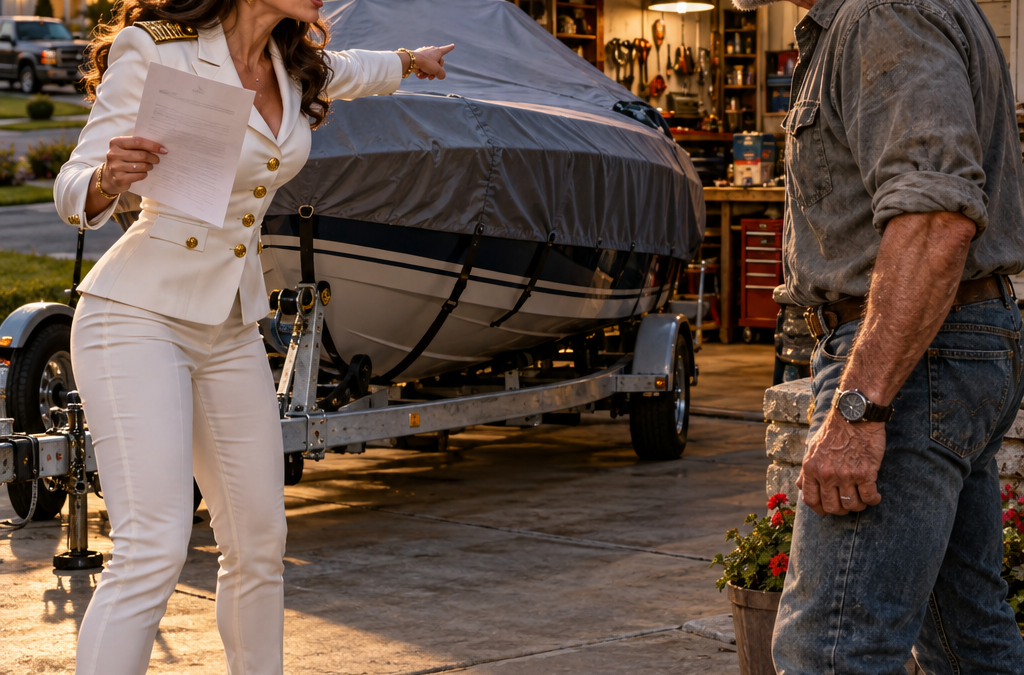
The first time I saw her up close, she was standing at the end of my driveway with one hand on her hip and the other holding her phone like she was preparing to document a felony.
I was watering my tomato plants along the side of the house. It was one of those late afternoons where the heat stuck to your shirt and the air smelled like cut grass. I looked up and gave her the neighborly nod.
She did not nod back.
Instead, she walked up my driveway like she owned the pavement. Her heels clicked against the concrete, each step sharp and irritated. Her eyes stayed fixed on my covered boat.
“Is this your boat?” she asked.
I looked at the boat. Then I looked at her. “Yes, ma’am. It is.”
“You can’t have that here.”
There was a pause. Not because I did not understand her words, but because they were so confidently wrong that my brain took a second to admire the craftsmanship.
“I’m sorry?” I said.
She lifted her chin. “HOA rules prohibit boats from being parked in driveways.”
I turned off the hose and let the last water drip from the nozzle. “Well, that may be true for folks in your HOA.”
Her eyes narrowed. “Everyone on this street is in the HOA.”
“No, ma’am,” I said, wiping my hands on my jeans. “Not everyone.”
“Yes,” she said slowly, like she was correcting a child. “Everyone.”
I gave her my best old-man smile. The one that had calmed angry boat owners, impatient fishermen, and once, a drunk man who tried to fight a propeller. “This house was here before your HOA existed. Before your house existed, for that matter. Before the bulldozers came and chased off the cows. My property is exempt.”
Her lips curved slightly, but it was not a smile. It was what a smile does when it has been raised wrong.
“That’s not how it works,” she said.
“That is exactly how it works.”
“Don’t be so sure about that.”
“I’m plenty sure.”
She looked me up and down. There was something in her face then that I did not like. It was not simple annoyance. It was calculation. She had expected me to apologize, panic, or ask what I needed to do to make her happy. When I did none of those things, she seemed personally offended, as if my refusal had embarrassed her in front of an audience only she could see.
“You’ll be hearing from the association,” she said.
“I look forward to learning what association that is,” I replied.
Her smile vanished.
Then she turned and marched back down my driveway, shoulders stiff, hair swinging behind her like a flag.
I watched her go, then turned my hose back on and gave extra water to the tomatoes.
At that point, I still thought it was a misunderstanding. A new neighbor with too much confidence and too little information. It happens. People move into neighborhoods like ours, get handed a packet full of rules, and suddenly think every square foot visible from the road belongs to them.
I figured she would check the county records, discover I was right, and find some other poor soul to bother.
That was my first mistake.
A week later, I found a printed notice tucked by my mailbox.
It was not mailed properly. It was not certified. It did not come from a lawyer. It was just taped there, fluttering in the morning breeze, printed on official-looking HOA letterhead.
I pulled it loose and read it standing in my driveway.
According to the notice, my boat was in violation of community standards. I had fourteen days to remove it or I would face fines, penalties, and escalating enforcement action.
I read it once.
Then again.
Then a third time, because sometimes nonsense gets funnier on repeat.
Escalating enforcement action from an organization I had never joined was a new one. That was like a gym I had never signed up for threatening to charge me extra because I did not use the treadmill. I folded the notice, put it on the kitchen counter, and poured myself coffee.
Minnie, my cat, sat in the window and watched me with the same expression she used whenever I did something she considered beneath her intelligence.
“I know,” I told her. “I should frame it.”
For two more weeks, I ignored it.
That is something you learn with age. Not every barking dog needs a response. Some people are just noise with shoes on. Karen could print whatever she wanted. She could stomp around board meetings and say my name with all the outrage she could gather. She still did not have authority over my property.
Then she came to my door at supper time.
That was when things changed.
I had just sat down with a plate of spaghetti. Nothing fancy. Sauce from a jar improved with garlic, onion, ground beef, and enough black pepper to make it respectable. I had one bite on my fork when the doorbell rang.
I considered ignoring it.
Then it rang again.
Minnie looked at me, offended on my behalf.
“I know,” I muttered. “Some people have no manners.”
I answered the door with the fork still in my hand.
Karen stood on my porch looking like she had dressed for a courtroom she imagined herself winning. White blouse, fitted navy skirt, high heels, expensive perfume, and that glossy hair falling over one shoulder. Behind the beauty was a hard glitter in her eyes.
“We sent you a notice,” she said.
I looked down at my fork, then back at her. “Evening to you too.”
“You received it?”
“I did.”
“You didn’t comply.”
“No, ma’am. I sure didn’t.”
“The boat has to go.”
“The boat is fine where it is.”
“The board has voted,” she said.
I leaned one shoulder against the doorframe. “The board can vote until the cows come home. And believe me, the cows used to come home right about where you’re standing. Doesn’t change the fact that I’m not part of your HOA.”
Her jaw tightened.
She was not used to being spoken to evenly. That was the thing. Some people confuse volume with strength, but Karen had another trick. She liked to lower her voice, sharpen each word, and make you feel like disobedience would cost you. It probably worked on people who had mortgages, kids, jobs, reputations, and neighbors they did not want to anger.
But I was retired, my house was paid off, my cat did not care about my social standing, and I had more free time than was healthy for a man with tools.
Karen stepped closer.
“If you don’t remove that boat,” she said, “we will place a lien on your house.”
For a moment, everything went quiet.
Not outside. Not really. A lawn mower buzzed somewhere down the street. A dog barked twice. A car passed slowly behind her.
But inside me, the room went still.
A lien on my house.
The house my grandfather built with his hands.
The house my mother had cried in when my grandmother died. The porch where my father taught me how to sharpen a pocketknife. The kitchen where I ate breakfast before my first day at the marina. The roof I had patched, the siding I had painted, the steps I had replaced plank by plank because letting that house rot would have felt like letting my family disappear.
This woman, who had lived in the zip code for about as long as milk keeps, was standing on my porch threatening my family home over a legally parked boat.
I looked at the fork in my hand.
Then I set it gently on the porch rail.
There are moments when a man should not raise his voice. Not because he is calm, but because he is past the point where noise would help.
“Ma’am,” I said, “you go right ahead and try that. And when your lawyer stops laughing at you, you come back and tell me what he said.”
Her face flushed. “This is not a joke.”
“No,” I said. “It ain’t.”
“You are creating a disturbance in this community.”
“I am eating spaghetti in my own house.”
“You’re refusing to follow standards everyone else has to follow.”
“I’m refusing to follow rules I never agreed to.”
Her eyes flicked past me into the house, as if she expected to see weakness hiding inside. Instead, Minnie appeared in the hallway behind me and stared at Karen with royal disgust.
Karen pointed one manicured finger toward my driveway. “That boat will be removed.”
“That boat,” I said, “has more right to be here than you do.”
She recoiled slightly, not because the words were loud, but because they landed exactly where I aimed them.
“You’ll regret being difficult,” she said.
“I’m not being difficult,” I replied. “I’m being accurate. You’re the one standing on a man’s porch threatening property you don’t control.”
“I represent the association.”
“You represent yourself.”
Her mouth opened, then closed. For the first time since I had met her, she did not have a ready line.
I picked my fork back up.
“My dinner’s getting cold,” I said. “Good night.”
I shut the door.
Then I stood there for a few seconds with my hand still on the knob, feeling something hot and old move through my chest.
Not fear. Not yet.
Anger.
There is a special kind of anger that comes when somebody threatens something sacred to you and does it casually, like they are discussing paint colors or fence height. Karen had no idea what that house meant. She had no idea what she had touched.
But she was going to learn.
I went back to the table. My spaghetti was cold.
I ate it anyway.
The next morning, I started making calls.
Here is the thing about people like Karen: rules are not what they love. Power is what they love. Rules are just the costume power wears when it wants to look respectable.
If the rules give them control, they worship the rules. If the rules limit them, they ignore them. If the rules do not exist, they invent them and print them on letterhead.
And if Karen was bold enough to threaten me, a man outside her little kingdom, then I knew she had been swinging that same club at people who actually were inside it.
So I started asking around.
At first, I did it casually. I saw Jerry across the street dragging his trash bins back from the curb and asked him, “That new HOA board lady been giving you trouble?”
He looked over his shoulder before answering.
That told me plenty.
“She fined me last month,” he said.
“For what?”
“My trash can was visible from the street.”
I looked toward his side yard. “You keep it behind that big holly bush.”
“Yeah,” he said. “Bush grew weird after the storm. You could see one corner of the lid if you stood in the street and leaned left.”
“And she fined you for that?”
“Seventy-five dollars.”
I laughed once, but there was no humor in it.
“She called it repeated noncompliance,” Jerry said. “I told her it was a trash can, not an escaped convict.”
Then there was the young couple two houses down, Mark and Elise. They had moved in with a baby, two dogs, and the exhausted optimism of people trying to make a first home work. Karen had fined them because their mailbox paint was faded “beyond community standards.”
“Beyond community standards,” Mark repeated, holding his baby against his shoulder while Elise folded laundry on their porch. “The mailbox came with the house. We didn’t even choose it.”
Elise’s eyes filled with a kind of tired anger I recognized. “We appealed it. She said we were responsible for maintaining visual harmony.”
“Visual harmony,” I said.
“She said it like that too,” Mark muttered. “Like she was naming a felony.”
Then I talked to Mrs. Alvarez, who lived near the entrance and baked bread for every neighbor who got sick, had a baby, lost someone, or looked sad near her mailbox.
Karen had sent her a notice about garden decorations.
“They were little ceramic birds,” Mrs. Alvarez said, wiping flour from her hands. “My granddaughter painted them for me.”
“What did the notice say?”
She reached into a kitchen drawer and pulled it out. Her hands shook a little as she passed it to me.
Unauthorized lawn ornamentation.
I stared at those words for a long time.
“You paid this?” I asked.
She looked embarrassed. “I didn’t want trouble.”
That was the sentence that told me Karen had done real damage.
I didn’t want trouble.
That is how petty tyrants grow. Not because they are strong, but because decent people get tired. Decent people have jobs, children, health problems, bills, grief, appointments, and lives. They pay the fine because fighting costs more energy than surrendering. They tell themselves it is easier to let it go.
And people like Karen count on that.
By the end of the week, I had heard enough stories to fill a notebook.
A man fined because his shutters were not the approved shade of black, though nobody could explain how black had degrees. A widow warned because her porch chair cushions were “seasonally inappropriate.” A young father written up because his kid’s bicycle sat in the front yard for two hours after school. Karen had developed a taste for control, and the HOA had given her a badge.
But the most interesting part came when the stories turned back toward her.
“Funny thing,” Jerry told me one evening, lowering his voice even though we stood in my driveway. “She’s got a shed out back.”
“So?”
“Unapproved.”
That got my attention.
Mark confirmed it. Then another neighbor showed me the HOA bylaws, which required architectural review board approval for all outbuildings. Karen’s shed had gone up without approval and without a record in the neighborhood portal.
Then came the fence.
Karen’s backyard fence was too tall. Not by much. Several inches. But several inches mattered if you were the kind of person who fined a woman over ceramic birds.
And then there was the money.
That part took more digging.
A neighbor named Denise used to volunteer with the HOA before Karen arrived and turned every meeting into a hostage negotiation. Denise still had access to old budget summaries, and she noticed something odd: printing and administrative expenses had jumped since Karen joined the enforcement committee.
“Not huge money,” Denise said, sitting at my kitchen table with papers spread between us. “But enough to notice.”
“How much?”
“Enough for a lot of notices.”
I picked up the one Karen had taped by my mailbox. “Like this?”
Denise nodded grimly. “HOA funds are supposed to be used for association business. If you aren’t a member, sending you enforcement notices is not association business. It’s personal harassment dressed up as procedure.”
I leaned back in my chair.
Minnie jumped onto the table, stepped directly on one of Karen’s copied notices, and sat down as if issuing judgment.
“Good girl,” I said.
Over the next few days, I built a folder.
County records showing my property was exempt.
A copy of my deed.
The original subdivision documents.
Photos of my driveway.
Photos of Karen’s shed from the street where it was visible above her fence line.
Measurements of her fence, taken from my side of the sidewalk with Jerry pretending to discuss fishing so nobody would think we were spies.
Copies of violation notices from neighbors.
Statements from people she had fined.
Budget summaries showing HOA funds used for her paper campaign.
I did not know exactly what I was going to do with all of it yet, but I knew this: Karen had mistaken kindness for permission.
That error needed correction.
Still, paperwork alone felt insufficient.
Karen loved appearances. She loved control. She loved driving through the neighborhood like a queen inspecting the peasants’ compliance. She especially loved my driveway, because my boat offended her in a way logic could not soothe.
So I decided to give her something worth looking at.
I bought a second boat.
It was a sad little project hull from a man about thirty miles away who said his wife wanted it gone before it became part of the landscape. Sun-bleached, dirty, motor blown, seats cracked, trailer rusty but serviceable. To me, it looked like a wounded dog waiting for somebody patient.
To Karen, I suspected it would look like a declaration of war.
I paid cash, hauled it home, and parked it right beside my good boat.
Two boats, side by side, both legal as sunrise on my property.
The next morning, Karen drove past my house at 8:17.
I know because I was sitting on the porch with coffee.
Her SUV slowed almost to a stop.
Behind the tinted windshield, I saw her face turn toward my driveway. Even through glass, I could feel the outrage bloom.
I lifted my mug.
She drove on.
That would have been satisfying enough, but I was not finished.
I talked to my neighbors.
“Listen,” I told Jerry. “You still got that little fishing boat your wife made you keep at your brother’s place?”
His eyes brightened. “Maybe.”
“My driveway is HOA-free territory,” I said. “If you want to bring it home for a while, there’s room.”
He stared at me.
Then he grinned so wide he looked twenty years younger.
By Saturday afternoon, Jerry’s johnboat sat on my gravel side strip.
Mark and Elise had a popup camper in storage because HOA rules said campers could not be visible from the street. They were paying monthly fees to keep it hidden like contraband. I told them there was space in my side yard.
Elise actually laughed when I said it. Not polite laughter. Real laughter. Relief laughter.
“You’re serious?” Mark asked.
“As a heart attack,” I said. “Only rule is you park it neat and don’t block my tomatoes.”
The camper arrived Sunday.
By the end of the month, my property looked like a marina had married a campground and invited the cousins.
My original boat sat under her cover, dignified and unbothered. The project boat leaned into its ugly charm. Jerry’s johnboat gleamed in aluminum stubbornness. The camper stood proudly near the side yard like a white flag nobody intended to surrender.
I kept everything clean. Nothing spilled into the road. Nothing violated county rules. Nothing was unsafe.
It was obnoxious only to a person who believed she owned other people’s peace.
For decoration, I made a sign and hung it on the fence facing the street.
NOT HOA PROPERTY. ASK ME ABOUT PARKING RATES.
I was kidding about the rates.
Mostly.
Karen drove past my house eight times the first day after that sign went up.
Eight.
By the fourth pass, even Minnie had abandoned the window, apparently deciding Karen was too predictable to be entertaining.
Each time the SUV slowed. Each time Karen looked. Each time her mouth tightened.
On Wednesday, she stopped completely for a few seconds. I was in the garage, pretending to sort wrenches while watching through the open door. She stared at the sign, then at the boats, then at the camper.
I raised one hand.
She sped away.
By Friday, the whole neighborhood knew something was happening. People who had barely spoken to each other before were suddenly walking dogs past my house, lingering by mailboxes, waving from porches. There was energy in the air, the strange electric lift that comes when scared people realize they might not be alone.
Karen felt it too.
That was why she broke.
Saturday morning, I was replacing a fuel line on the project boat when her SUV pulled up. Karen stepped out first, dressed in white slacks and a sleeveless blouse that looked expensive enough to have its own attorney. Big sunglasses covered half her face. Her hair was curled, her lipstick bright, her posture rigid.
Behind her came two men.
I recognized one as the HOA president, Tom Whitaker. He lived near the entrance, drove a beige sedan, and always looked like he was about to apologize even when he had not done anything. The other was a board member named Phil, a broad-shouldered fellow who avoided conflict so aggressively that conflict seemed to follow him out of curiosity.
Karen came up my driveway without greeting me.
“This is harassment,” she announced.
I looked around at my own yard. “Good morning to you too.”
“You’re doing this deliberately.”
“I do most things deliberately at my age. Accidents are harder on the knees.”
Her nostrils flared. “You are provoking the association.”
“No,” I said, wiping my hands on a rag. “I’m storing boats. And a camper. On my property.”
“You put up that sign to mock us.”
“I put up that sign to educate passersby.”
“This is not funny.”
“Wasn’t trying to make you laugh.”
Tom cleared his throat. “Maybe we should all calm down.”
I looked at him. “I’m calm.”
Karen turned on him. “Are you going to let him get away with this?”
That sentence told me everything about how she saw the world. Let him. Get away with. As if I were a child sneaking candy. As if my property rights were a loophole and her authority was the natural order of things.
Tom looked at the boats.
Then at the camper.
Then at Karen.
Then at his shoes.
I saw something pass over his face. Weariness, maybe. Or embarrassment. Or the slow dawning realization that the woman beside him had dragged the board into a fight it could not win.
“Karen,” he said softly, “we need to talk about the notices.”
She went still.
“And the shed,” he added.
Her head snapped toward him. “Excuse me?”
“And the fence.”
For a second, I witnessed something I had never seen before.
Karen had no words.
Her mouth opened slightly. Her sunglasses hid her eyes, but the rest of her face froze in perfect disbelief, like a computer screen buffering during a storm.
Phil shifted his weight. “We’ve received complaints.”
Karen’s voice came out low and dangerous. “From whom?”
“Multiple residents,” Tom said.
“This is because of him.” She pointed at me. “He is stirring people up.”
“I offered parking,” I said. “Didn’t know that was a revolutionary act.”
“You are encouraging violations.”
“On HOA property?” I asked.
She did not answer.
I stepped closer, but not too close. “That’s the thing you keep missing, Karen. This isn’t HOA property. It never was. You can dislike my boat. You can dislike my sign. You can dislike me. But you cannot fine me, threaten me, or use association money to harass me.”
Her cheeks reddened. “I did no such thing.”
I went into the garage and came back with the folder.
Karen stared at it like it was a snake.
I handed it to Tom. “You might want this.”
He accepted it with both hands.
“What is that?” Karen demanded.
“Records,” I said. “Mine, yours, and everybody else’s.”
Tom opened the folder. His eyes moved over the first few pages. Then he looked at me.
“You documented all this?”
“I’m retired,” I said. “And she interrupted my spaghetti.”
Phil made a sound that might have been a cough or a laugh.
Karen snatched at the folder, but Tom pulled it back.
“Karen,” he said, firmer now, “not here.”
Her face changed. For a moment, the polished mask slipped, and I saw the ugly panic underneath. Not guilt. Not regret. Panic at losing control.
“You have no right,” she said to me.
I met her eyes over the top of her sunglasses. “Funny. I was about to tell you the same thing.”
She stepped toward me. “You think this makes you clever? You think turning the neighborhood against me makes you some kind of hero?”
“No,” I said. “I think threatening a man’s home over a boat makes you careless. I think fining people because you enjoy watching them jump makes you cruel. And I think using HOA money for your personal little campaign makes you stupid.”
Her face hardened.
Tom said, “That’s enough.”
But it wasn’t enough. Not quite.
Karen looked past me at the boats, at the camper, at the sign, at the open garage full of tools, at the house behind me. I could almost see her trying to find something else to grab. Something to threaten. Something to control.
“You people think you can live however you want,” she said.
There it was.
You people.
Not neighbors. Not residents. Not families.
You people.
I took one step closer.
“Yes,” I said. “On land we own, within the law, without harming anyone else. That’s exactly what we think.”
She had no answer for that.
Tom closed the folder. “We’ll be calling a board meeting.”
Karen spun on him. “You cannot be serious.”
“I’m very serious.”
“You’re letting him manipulate you.”
“No,” Tom said. “I’m trying to keep the association out of a lawsuit.”
That word finally landed.
Lawsuit.
Karen’s lips parted.
Tom looked at me. “I apologize for the notices.”
Karen said, “Tom.”
He ignored her. “You should never have received them.”
“You’re right,” I said.
“And the lien threat?”
His face tightened. “Unauthorized.”
I looked at Karen. “I knew that.”
Her jaw clenched hard enough to crack walnuts.
Phil rubbed the back of his neck. “We’ll address it.”
“I hope you do,” I said. “For everybody. Not just me.”
That was when I noticed people watching.
Jerry stood at the edge of his yard. Denise was pretending to water flowers that did not need water. Mark had his baby strapped to his chest and Elise beside him. Mrs. Alvarez stood near her mailbox with her arms folded, small but steady.
Karen noticed them too.
For once, the audience she had always imagined was real.
And they were not on her side.
She backed away first.
Not dramatically. Not with some big speech. She simply turned, walked to her SUV, and got in. Tom and Phil followed after a few awkward seconds.
Before she drove away, Karen looked once more at my house.
This time, she did not look angry.
She looked afraid.
Not afraid of me hurting her. I would never do that.
Afraid of consequences.
That is a different fear. A cleaner one.
The board meeting happened four days later.
I was not a member, so I did not attend the closed portion. But by then, the neighborhood had become a communication network more efficient than any marina gossip chain I had ever known. People texted. People called. People “just happened” to walk by afterward.
Tom came to my house the next evening with a six-pack.
“I figured I owed you at least one,” he said.
I invited him onto the porch.
We sat there as the sun dropped behind the roofs of houses that had replaced the cow pasture of my childhood. My boats sat in the fading light like patient witnesses.
Tom opened his beer and sighed from somewhere deep.
“That,” he said, “was the longest meeting of my life.”
“Productive?”
He took a drink. “Very.”
I waited.
He looked down the street toward Karen’s house. “She’s off the enforcement committee.”
I said nothing for a moment. I wanted to enjoy the shape of those words.
“She did not take it well,” he added.
“I’m shocked.”
Tom gave me a tired half-smile. “She’s been formally reprimanded. In writing. We’re refunding unauthorized fines where enforcement was improper or inconsistent. We’re reviewing the rest.”
“Good.”
“And she has to reimburse the association for printing and mailing costs related to notices sent outside HOA authority.”
I raised my eyebrows. “Outside HOA authority.”
“That’s the wording our attorney recommended.”
“Smart attorney.”
“He also used the phrase ‘substantial liability exposure’ three times.”
“I bet that got attention.”
Tom nodded. “It did.”
“What about her shed?”
He almost smiled. “Violation notice issued.”
“And the fence?”
“Violation notice issued.”
I leaned back in my chair.
Some victories do not need fireworks. Sometimes they arrive as simple facts spoken on a porch with beer between two tired men.
Tom glanced at me. “I should’ve paid closer attention.”
“Yes,” I said.
He winced, but I was not going to soften it for him.
“You let her scare people,” I continued. “Maybe you didn’t mean to. Maybe you were busy. Maybe she made it easier to look away. But she scared people.”
He nodded slowly.
“I know.”
“Mrs. Alvarez paid a fine over ceramic birds her granddaughter painted.”
“I heard.”
“Mark and Elise were paying storage for a camper they could barely afford to keep hidden.”
“I know.”
“Jerry paid seventy-five dollars because his trash can peeked out from behind a bush.”
Tom rubbed his forehead. “I know.”
I looked toward the street. “You’re the president, Tom. If the board holds a stick, somebody better make sure the right person is holding it.”
He sat with that.
To his credit, he did not argue.
“You’re right,” he said.
We listened to the evening insects for a while.
Then he said, “We’re rewriting parts of the enforcement policy.”
“For humans this time?”
He laughed. A real laugh, tired but honest. “Yes. For humans this time.”
I held up my beer. “Good.”
He tapped his bottle against mine.
The weeks after that were quieter, but not peaceful exactly. Consequences have ripples.
Refund checks went out. Small ones, mostly, but they mattered. Not because seventy-five dollars changes a life, but because being told you were wronged and seeing it corrected can straighten something in a person’s spine.
Mrs. Alvarez brought me two loaves of bread, one warm and one wrapped for freezing.
“You did not have to do all that,” she said.
“I didn’t do much.”
She gave me the kind of look only older women and cats can manage, the look that says they know nonsense when they hear it.
“My granddaughter made new birds,” she said. “I put them back in the garden.”
“Good.”
“She painted one like a boat.”
I laughed so hard Minnie fled the room.
Mark and Elise brought the baby over in a stroller one evening to say the HOA was changing the camper rule. Not removing it entirely, but creating a reasonable temporary parking allowance for loading, maintenance, and short-term storage. It meant their camper did not have to live permanently in my yard, but for a while, they left it there anyway because Elise said she enjoyed watching Karen drive past it.
Jerry came over often, usually pretending to check on his johnboat while really checking on the neighborhood gossip.
“You know she got fined?” he said one morning.
“Who?”
He stared at me. “Who do you think?”
I wiped grease off my hands and smiled. “For the shed?”
“And the fence.”
“Imagine that.”
“She appealed.”
“Of course she did.”
“Denied.”
I looked toward Karen’s house, hidden behind roofs and trees. “Imagine that too.”
There was one more piece I did not expect.
The project boat, the ugly sun-bleached one I had bought partly out of spite, started to grow on me. I told myself I would not put much work into her. Just enough to keep her from looking abandoned. Then I checked the motor. Then I cleaned the fuel system. Then I replaced a cracked line. Then I found myself ordering parts.
A man needs hobbies.
By the time the neighborhood conflict settled, that poor boat had become a real project. A young fellow named Luke saw me working on her one afternoon and stopped to ask questions. He was maybe twenty-two, skinny, polite, with oil under his fingernails and that hungry look of somebody who wanted to learn but did not know who would teach him.
“You fixing her up to sell?” he asked.
“Maybe.”
“What’s wrong with the motor?”
I looked at him. “How much time you got?”
He grinned.
He came back the next Saturday. And the Saturday after that. I showed him how to listen before touching anything, how to check compression, how to respect old machinery without being afraid of it. By spring, the motor turned over clean.
When I finally sold the boat to him, I gave him a price lower than what I could have asked.
“You sure?” he said.
“You promise to send pictures from the lake?”
His face lit up. “Yes, sir.”
“Then I’m sure.”
He sent the first picture two weeks later. The boat sat on blue water under a bright sky, looking ten years younger and much happier than when I had dragged her home.
I printed the picture and stuck it on the garage wall.
Karen’s legacy, I suppose.
Not everything stayed in my yard forever. Jerry’s johnboat eventually went home after the HOA revised the visible boat policy into something less ridiculous. Mark and Elise took their camper on their first vacation in years. They sent me a postcard from a state park with a lake so pretty it made my old mechanic hands itch for a fishing rod.
My original boat stayed exactly where she belonged.
Under her cover.
In my driveway.
Minding her own business.
As for Karen, she still lived down the street.
For a while, she stopped driving past my house entirely. Then, little by little, her SUV began appearing again. The first time, she stared straight ahead, both hands clamped on the wheel like she was steering through a hurricane. No slowing. No glaring. No inspection.
Just passing through.
That became her new habit.
If she saw me on the porch, she did not wave.
I did not wave either.
Not out of bitterness. Not exactly. There are people you forgive in your heart because carrying them is too heavy, but you do not invite them back onto your porch.
One afternoon, months later, I found a letter in my mailbox. A real one this time. Properly mailed.
It was from the HOA board, addressed to me by name.
Inside was a formal apology for the unauthorized notices and the lien threat. It stated clearly that my property was not subject to HOA covenants or enforcement. It also said the association had adopted new procedures requiring legal review before contacting non-member properties about alleged violations.
I read it twice.
Then I carried it to the kitchen, opened the drawer where I kept the first notice Karen had taped near my mailbox, and placed the apology beside it.
Minnie jumped onto the counter, sniffed both papers, and seemed unimpressed.
“You’re hard to please,” I told her.
She blinked slowly.
A week after that, Tom stopped by again.
“No beer this time?” I asked.
He held up both hands. “Just business.”
“That sounds worse.”
He smiled. “We’re having a community cookout next month. Not official HOA enforcement nonsense. Just neighbors. You’re invited.”
“I’m not in the HOA,” I said.
“I know.”
“You sure nobody will fine me for attending?”
He chuckled. “Pretty sure.”
I looked past him at the street. The neighborhood was not what it had been when I was young. The cows were gone. The pine trees had been thinned. The houses stood close together, each with its approved trim and tidy landscaping. For a long time, I had seen those homes as something that happened around me, not with me. A new world pressing up against the old one.
But then I thought of Mrs. Alvarez’s bread. Jerry’s grin. Mark’s baby waving tiny fists from a stroller. Elise laughing at a camper parked in open defiance. Luke taking that restored boat out onto the lake.
Maybe home changes shape whether you agree to it or not.
Maybe the trick is knowing which lines to defend and which gates to open.
“I might come by,” I said.
Tom nodded. “Good.”
The cookout happened on a Saturday afternoon, the kind with warm sun and a breeze light enough to move paper plates. I went because Mrs. Alvarez threatened to bring bread to my house every day until I did, and because Minnie could not provide a convincing counterargument.
It was strange at first.
People I had only waved to for years came up and shook my hand. Some thanked me quietly. Some made jokes about parking reservations. Jerry introduced me to three people as “the marina landlord,” which I told him was slander unless he paid me.
There were kids running through yards, music playing from somebody’s portable speaker, smoke rising from grills, and neighbors standing in loose circles without the stiff fear that had settled over the place during Karen’s little reign.
Karen came too.
That surprised me.
She arrived late, wearing a pale green dress and sunglasses big enough to hide behind. She looked beautiful, as always, polished from head to toe. But the sharpness had changed. Or maybe I was seeing her differently. She stood near the edge of the gathering, speaking to almost no one, holding a plastic cup she barely drank from.
For a moment, our eyes met across the lawn.
I expected anger. Or that old curled smile. Or a glare.
Instead, she looked away first.
There are people who become smaller when they lose power because power was all they had built themselves around. Without it, they do not know where to put their hands, how to hold their shoulders, what kind of face to wear.
I almost felt sorry for her.
Almost.
Then I remembered the way Mrs. Alvarez’s hands had shaken when she showed me that notice about ceramic birds. I remembered the way Elise laughed with relief because someone had finally said no. I remembered Karen standing on my porch threatening my grandfather’s house.
Pity has its limits.
I filled a plate, talked boats with a man who had just bought his first fishing rig, and let the afternoon move on.
Near sunset, Tom tapped a spoon against his cup and thanked everyone for coming. He said the board wanted the neighborhood to feel like a community, not a courtroom. He admitted mistakes had been made. He did not name Karen. He did not need to.
Then he said something that stayed with me.
“Rules are supposed to protect neighbors from harm,” he said. “Not give neighbors permission to harm each other.”
That was the whole thing, really.
I looked over at Karen. Her face had gone pale.
Maybe she heard it. Maybe she did not. Either way, the neighborhood did.
After the cookout, I walked home slowly under a sky turning purple at the edges. My house waited at the end of the road, steady as ever. The porch light glowed. My boat sat in the driveway under her cover, exactly where she had been at the start of it all.
I stood there for a while before going inside.
Some folks might say I escalated things. Maybe I did.
Maybe I could have marched over with paperwork on day one, proven my exemption, and hoped Karen accepted reality. Maybe I could have kept my head down and trusted time to cool her off. Maybe I could have been the bigger person in that tired way people love to recommend when they are not the ones being pushed.
But I have lived long enough to know there is a difference between peace and surrender.
Peace is what happens when people respect each other’s boundaries.
Surrender is what happens when one person keeps crossing them and everyone else calls their silence maturity.
Karen had crossed too many boundaries before she reached mine. Mine just happened to be guarded by a retired boat mechanic with a paid-off house, a folder full of documents, a driveway outside HOA control, and enough free time to make tyranny inconvenient.
The house still stands.
The boat still sits in the driveway.
The tomatoes still grow along the side yard every summer.
Mrs. Alvarez’s ceramic birds are back in her garden, including the one painted like a boat. Mark and Elise use their camper. Jerry’s trash can continues its dangerous life behind the holly bush. Tom, to his credit, became a better board president after learning the difference between leadership and avoidance.
And Karen?
Karen still drives past now and then.
She never slows down.
She never looks at my boat.
She keeps both hands on the wheel and her eyes on the road, like a woman who finally understands that not every driveway belongs to her kingdom.
Every time she passes, I think about that evening she stood on my porch and threatened to put a lien on my home. I think about how carefully I set down my fork. I think about how close she came to learning nothing because everyone else had been too tired to teach her.
Then I look at the boat, at the house, at the land my grandfather chose before there was an HOA to misunderstand it.
And I smile.
Not because I beat her.
Because she finally learned where my property ended.
And where her power did.