She Smiled at My No Trespassing Signs Like They Were Suggestions
𝗙𝗨𝗟𝗟 𝗦𝗧𝗢𝗥𝗬
Her face flushed. “You are being incredibly selfish.”
“And you are standing on my land after being told not to.”
For once, she did not have a quick answer. She snapped her fingers for her dog, splashed out of the water, and stormed off through the grass, muttering loud enough for me to hear words like ridiculous and greedy.
That evening, I sat at my kitchen table and pulled up the county assessor’s maps.
I knew what they would show. I had seen the survey when I bought the place. But Karen had planted a seed of irritation in me, and I wanted the satisfaction of seeing the truth in black and white again.
There it was.
Every inch.
The lake. The shoreline. The dock. The fence line. The reeds. The little sloped patch where the grass turned to mud after rain.
All mine.
Not partially mine.
Not historically shared.
Not “basically” anything.
Mine.
I dug out the original survey from my records and spread it on the table. My wife came in while I was staring at it.
“She’s getting under your skin,” she said.
I looked up. “She thinks she can just say the boundaries are wrong until reality changes.”
My wife leaned over the survey. “Can she cause trouble?”
“Anyone can cause trouble.”
That was the answer I hated most because it was true.
The next morning, I started documenting everything.
I took pictures of the boundary markers, the fence, the signs, the dock, the shoreline, and every visible point showing the lake inside my parcel. I installed trail cameras along the property perimeter and near the lake. I checked the timestamps and made sure they were working. Then I called my neighbor Mike, who lived about half a mile down the road.
Mike had been there longer than I had. He knew everybody. More importantly, he knew exactly what kind of trouble people could create when they confused stubbornness with righteousness.
I told him what was happening.
He let out a low whistle. “That new woman across the road?”
“Yeah.”
“She already yelled at the mail carrier because her packages got dust on them.”
“Sounds right.”
“You want me to keep an eye out?”
“I’d appreciate it.”
“You got it.”
I also sent Karen a certified letter. I kept the language simple and formal. She had entered my private property without permission. The lake was located entirely within my parcel. Any further entry would be considered trespassing and could result in legal action.
When the delivery confirmation came back, I felt a strange mix of relief and dread.
Relief because I had created a paper trail.
Dread because people like Karen do not read warnings as boundaries.
They read them as challenges.
The following week, I found her sitting by the lake on a picnic blanket.
Her dog was tied to one of my dock posts.
She had a book open in her lap, though I doubted she had read a word. A stainless-steel tumbler sat in the grass beside her. She looked perfectly comfortable, like a woman enjoying a private resort.
My private resort.
I stood there for a moment, almost unable to believe what I was seeing.
Then I walked toward her.
“Karen.”
She looked up and smiled.
Not guilty.
Not startled.
Smiled.
“Oh,” she said. “Hi.”
“You need to leave. Now.”
Her smile faded into theatrical disappointment. “I was hoping we could be adults about this.”
“We are being adults. I sent you a certified letter.”
“Yes, I got your little letter.”
“Then you know you’re trespassing.”
She lifted her phone. “Actually, I’ve been doing some research.”
Those words should have chilled me.
She tapped at the screen and continued. “I found some original land grants for this area, and from what I can tell, water features like this were intended for community use. My deed also mentions water rights, so technically I may have just as much claim to this lake as you do.”
I stared at her.
She looked proud. Not uncertain. Not curious. Proud.
“Karen,” I said slowly, “your deed mentioning water rights does not mean you can come onto my land and use my lake.”
“That’s your interpretation.”
“That’s the law.”
“You’re not a lawyer.”
“Neither are you.”
Her eyes flashed.
I knew then that this had moved beyond neighborly annoyance. She had built an entire fantasy around the idea that she was entitled to my property, and every fact I gave her simply became another thing for her to argue around.
“Leave,” I said.
She stood, gathering her blanket with sharp little movements.
“You know,” she said, “people around here are starting to talk.”
“About what?”
“About how you think you can hoard community resources.”
I laughed once, not because it was funny, but because I could not help it. “Community resources?”
“Yes.”
“It’s a private lake on private property.”
“That’s what you keep saying.”
“Because it’s true.”
Karen clipped the leash onto her dog and pulled him away from the dock post.
“This is not over,” she said.
I watched her leave, and for the first time since buying that land, the lake did not feel peaceful.
It felt exposed.
For the next few weeks, I checked the cameras every morning. Sometimes there was nothing but deer, raccoons, and wind moving through the weeds. Sometimes Karen appeared near the fence line, looking in. Once, she stood outside one of the no trespassing signs for almost a full minute, arms crossed, staring like the sign had personally betrayed her.
I considered calling the sheriff right then, but she had not crossed the line that day.
Not technically.
That became the exhausting part. Karen knew how to dance near the edge of consequences. She would walk close enough to make me angry but not always far enough to justify an official response. She would smile when she saw me watching. She would wave. She would act innocent.
My wife told me not to let her steal my peace.
But that is exactly what people like Karen do.
They do not always take everything at once.
They take your ease first.
They make you check locks twice. They make you scan your own property before relaxing. They make you wonder what fresh absurdity will be waiting when you come home.
And then, one weekend, she stopped dancing near the line and charged straight over it.
My wife and I had gone out of town to visit her family. It was supposed to be a quiet weekend away. We locked the house, checked the cameras, and left early Saturday morning. The weather was warm, the sky clear, and I remember thinking the lake would look beautiful that afternoon.
Around three o’clock, my phone rang.
It was Mike.
I answered casually. “Hey, what’s up?”
His voice came through flat and serious.
“Did you rent out your lake?”
I sat up straighter. “What?”
“Your lake,” he said. “Did you rent it out for some kind of party?”
My stomach dropped.
“No.”
There was a pause.
“Well,” Mike said, “then you’re going to want to see this.”
A moment later, a photo came through.
I stared at my phone, and for a few seconds, my mind refused to understand what my eyes were seeing.
There were people all over my lake.
Not one or two.
Dozens.
Coolers sat in the grass. Inflatable flamingos floated near the dock. Music speakers were set up under a tree. Someone had tied a bright banner to my dock railing. Cars were parked along my driveway and near the fence line. Women in sunglasses held drinks. Someone was dragging a folding table toward the water.
And there, standing in the middle of it all like the queen of a stolen kingdom, was Karen.
She was wearing a sundress, drink in hand, laughing.
Hosting.
My pulse started hammering in my ears.
Mike sent another message.
Looks like a bachelorette party.
For a second, I could not speak.
My wife saw my face and asked, “What happened?”
I handed her the phone.
She looked at the picture, and the color drained from her face.
“No,” she said softly.
I called the sheriff’s office.
When I gave the dispatcher the address and explained that a neighbor was hosting a party on my posted private property without permission, she asked for the neighbor’s name.
“Karen,” I said.
There was a pause.
Not long.
But long enough.
Then she said, “Deputies are on the way.”
That pause told me Karen was already making a name for herself.
I wanted to turn the car around and race home, but we were hours away. There was nothing I could do except sit there, gripping my phone, while strangers treated my land like a vacation rental and Karen played owner in front of an audience.
Mike stayed nearby and kept me updated.
He did not go onto the property. He was smart enough not to insert himself directly. But he could see plenty from the road and from a neighboring rise.
He texted me that the music was loud.
That someone had tried to start a bonfire.
That people were swimming.
That Karen had told several guests the lake was hers.
When the deputies arrived, Mike called me.
I answered immediately.
“They’re there,” he said.
“What’s happening?”
“Trying to get everybody’s attention. Music’s too loud.”
I closed my eyes.
In the background, through Mike’s phone, I could faintly hear shouting.
Then more shouting.
Then Mike gave a short laugh.
“Oh, this is getting interesting.”
“What?”
“One of her friends just asked if this isn’t her lake.”
I wish I had been there to see Karen’s face.
According to Mike, the deputies asked Karen whether she had written permission to be on the property. She told them I had given her permission. When that did not work, she pivoted to claiming she had legal rights based on her research into original land grants and shared water usage.
The deputies asked for documentation.
She had printouts.
Not deeds.
Not surveys.
Not easements.
Printouts from historical websites.
One deputy apparently looked at the papers, then looked at the private property sign less than twenty yards away, and asked her where in those documents it said she could ignore posted no trespassing notices on land currently owned by someone else.
Karen did not have an answer.
Her friends did, though.
Their answer was humiliation.
One by one, they started packing.
The music shut off. Coolers were dragged back toward cars. Inflatable decorations deflated in the grass. People who had arrived ready for a carefree afternoon suddenly discovered they had been invited to trespass.
Mike told me the whole mood changed in minutes.
At first, guests were confused.
Then embarrassed.
Then angry.
Not at me.
At Karen.
Because nobody likes being made into an accomplice in someone else’s delusion.
The deputies ordered everyone to leave immediately. They warned Karen that if she stepped onto my property again, she could be charged with criminal trespassing. They also documented the damage.
And there was damage.
Beer bottles in the grass.
Cigarette butts near the reeds.
A broken board on my dock.
Scorch marks where someone had tried to build a fire pit.
Trash floating near the bank.
When Mike texted me pictures afterward, I sat in the passenger seat of our car and felt something inside me go still.
My wife touched my arm.
“We’ll handle it,” she said.
I nodded, but I was too angry to answer.
Anger is strange when it becomes quiet. Loud anger burns out quickly. Quiet anger settles into your bones and starts making plans.
By the time we got home the next day, the party was gone, but its ugliness remained.
Glitter in the grass.
Bottle caps near the dock.
A wet towel abandoned by the fence.
A blackened scar on the ground.
The broken dock board bent upward like a snapped bone.
I walked the shoreline with a trash bag in one hand, picking up evidence of other people’s carelessness. Every few feet, I found something else. A plastic cup. A hair tie. A cigarette filter. A crushed can. The lake that had once felt like a refuge now felt violated.
I know that may sound dramatic to someone who has never loved a place.
But land holds memory.
When you have sat somewhere through grief, through exhaustion, through small quiet joys nobody else would understand, it becomes more than dirt and water. It becomes part of the rhythm of your life.
Karen had not just thrown a party.
She had walked into the place where I went to breathe and treated it like a prop.
By Sunday morning, everyone knew.
In a rural community, news moves faster than weather. The story hit local Facebook groups almost immediately. Some people had driven by while deputies were there. Others knew someone who had attended the party. Someone had apparently posted a photo of the bachelorette banner on my dock before the truth came out.
By Monday, the event had a nickname.
The Bachelorette Lake Invasion.
Mike texted me that I had made twenty enemies and fifty fans.
I did not feel like a hero.
I felt tired.
I thought the humiliation might finally make Karen stop. After all, she had been caught. Publicly. Officially. In front of her own guests. The sheriff’s office had warned her. Her friends knew she had lied. The neighborhood knew she had lied.
A reasonable person would have disappeared behind closed curtains for a month and prayed everyone forgot.
Karen was not reasonable.
Two weeks later, I came home and found a certified letter taped to my door.
At first, I thought it might be something from the sheriff’s office or an insurance notice related to the damage.
Then I opened it.
Karen was suing me.
I stood in my entryway reading the packet, and despite everything, I laughed.
Not because it was harmless.
A lawsuit is never harmless.
I laughed because the claims were so absurd that my brain needed somewhere to put the shock.
Emotional distress.
Defamation.
Unlawful exclusion from community resources.
Interference with property rights.
According to Karen, I had publicly humiliated her by falsely accusing her of trespassing on land where she had legitimate claims. She argued that the lake was a historically communal water resource and that her deed’s mention of water rights supported her belief that she was entitled to access. She claimed my “aggressive defense” of disputed property boundaries had damaged her reputation and caused significant emotional suffering.
Translation: Karen lied to her friends, got caught, and wanted me to pay for how embarrassed she felt.
I hired a lawyer.
He was an older man with tired eyes and the kind of calm that only comes from years of watching adults behave like spoiled children in expensive rooms.
He sat behind his desk, reading Karen’s complaint.
For several minutes, he said nothing.
Then he reached the section about “pre-settlement usage patterns” and made a noise I can only describe as a snort trying to disguise itself as a cough.
I raised an eyebrow. “That bad?”
He looked up. “I have seen nonsense before. This is dressed-up nonsense.”
“That’s good, right?”
“It’s good for us. Potentially expensive for her.”
He pulled the county plats, tax records, my survey, and both deeds. Everything confirmed what I already knew. The lake sat entirely inside my boundaries. There was no easement granting Karen access. No shared ownership. No community right. No ambiguous sliver of shoreline crossing into her land.
The facts were clean.
The problem was that court does not run on common sense alone. It runs on documentation, procedure, timing, and money. Even when you are right, you still have to show up and prove you are right in the language the system understands.
That was the part that made me angriest.
Karen had invaded my land, damaged my property, lied to her friends, ignored warnings, and now she was forcing me to spend money defending the obvious.
The preliminary hearing arrived faster than I expected.
I remember walking into the courthouse with my lawyer beside me and feeling that strange coldness that comes with being pulled into someone else’s fantasy. Karen was already there. She wore a bright pink blazer and carried a binder so full of papers it looked like she was preparing to defend the Constitution.
She glanced at me, then looked away dramatically.
Her attorney looked less enthusiastic.
When the case was called, Karen sat forward like she had been waiting for her moment.
The judge listened while her side explained that she believed the lake had historical community significance, that original land grant intentions suggested shared access, and that I had wrongfully excluded her from what she considered a communal resource.
My lawyer sat still.
I sat still.
The judge’s face gave away almost nothing.
Then the judge asked the question that mattered.
“Do you have a deed, survey, easement, agreement, or any current legal document showing ownership interest or access rights to this property?”
Karen opened her binder.
She pulled out printouts.
She talked about historical maps.
She referenced old community patterns.
She said the spirit of shared resources should matter.
The judge asked again, more plainly this time.
“Do you have any current legal documentation?”
Karen’s mouth tightened.
“No, Your Honor, but—”
The judge did not need much more.
He reviewed the documents my lawyer provided: the plats, the survey, the deeds, the tax records, the police report, the certified trespass warning.
Then he dismissed her case.
Just like that.
No grand speech.
No dramatic music.
No moment where everyone gasped.
Just the blunt sound of reality landing on the table.
Case dismissed.
Karen stood there for a second as if she had not understood the words. Then her face flushed dark red. She gathered her binder with shaking hands and stormed out, muttering about appeals and historical property rights.
My lawyer leaned toward me and said quietly, “I hope she’s paying her attorney by the hour.”
I should have felt only relief.
I did feel relief.
But under it was something else.
Exhaustion.
Karen had taken something simple and peaceful and dragged it into a courthouse. She had forced me to defend my right to keep strangers out of my own backyard. She had turned a lake into a battleground because she could not tolerate being told no.
A few days later, the story made the regional section of the local paper.
It was not front page, but it was enough.
A short article about a frivolous property dispute involving private lake access. No dramatic language. No insults. Just enough detail for everyone in the area to know exactly who it was about.
I thought that might finally end it.
I thought public embarrassment, a sheriff’s warning, and a dismissed lawsuit would be enough.
Then my lawyer called.
“Do you want to let it go,” he asked, “or do you want to recover your damages?”
I looked out my kitchen window toward the lake.
The broken dock board had been temporarily patched, but I could still see where it had splintered. The scorch mark near the shore had faded but not disappeared. I had receipts for cleanup and repairs. I had camera footage. I had the police report.
“What would that involve?” I asked.
“A civil claim. Trespassing and property damage. Nothing excessive. Actual costs, court fees, documentation.”
I thought about Karen standing in front of a judge, pretending she was the victim.
I thought about her friends leaving trash on my land.
I thought about the certified letter she had ignored.
“Do it,” I said.
When Karen was served, I did not see her reaction.
I wish I had.
The second court date felt different.
The first time, Karen had come in playing martyr, ready to argue that history and feelings should overwrite property law.
This time, she walked in stiff-backed and sharp-faced, but there was something brittle under her confidence.
Maybe she had expected me to fold after her lawsuit failed.
Maybe she thought I would be satisfied with winning once.
Maybe she had forgotten that cameras do not care about confidence.
My lawyer presented the evidence piece by piece.
Photos of the posted signs.
The certified letter.
The police report.
Pictures of the broken dock board.
Images of the scorch mark.
Receipts for repairs.
Then the trail camera footage.
The courtroom screen showed my lake in the afternoon sun. At first, the image was almost peaceful. Then people entered the frame carrying coolers, bags, and decorations. Karen appeared, pointing toward the dock, directing people where to set things up. She moved with the casual authority of someone who believed performance could become ownership if enough people witnessed it.
The footage showed guests walking past posted signs.
It showed people on the dock.
It showed someone stumbling with an inflatable raft and cracking the board.
It showed the attempted fire setup.
It showed Karen standing nearby.
Not confused.
Not lost.
Not accidentally present.
Directing.
The judge watched silently.
Karen’s defense was exactly what I expected.
“It was a misunderstanding,” she said. “I genuinely believed I had rights to the property based on my research.”
The judge looked at her for a long moment.
It was the kind of look adults give children who have told a lie so flimsy it insults everyone in the room.
“Misunderstanding or not,” he said, “you entered clearly posted private property. You had received written warning. You hosted an event there without permission. Damage occurred. Your personal belief about historical claims does not override current legal ownership.”
Karen started to speak.
The judge raised one hand.
She stopped.
Judgment was entered in my favor.
Three thousand two hundred dollars for damages and court costs.
It was not life-changing money. It did not erase the frustration or restore the peace exactly as it had been before. But it mattered.
Not because I wanted to ruin Karen.
Because the record now said what she had spent months trying to deny.
She was not a co-owner.
She was not a defender of shared resources.
She was not a victim of unlawful exclusion.
She was a trespasser who had damaged someone else’s property and been ordered to pay for it.
That mattered more than I expected.
Afterward, outside the courthouse, Karen walked past me without speaking. Her face was pale with fury. For a second, I thought she might say something. I almost wanted her to. But she kept walking, heels clicking hard against the pavement, her shoulders rigid.
My lawyer watched her go.
“Some people would rather lose twice than admit they were wrong once,” he said.
I used the money exactly how he suggested.
I built a taller fence around the lake.
Not an ugly one, but a serious one. Strong posts, better gates, no gaps someone could pretend not to notice. I installed a professional security system with cameras placed where they could not easily be missed and signs that made the message impossible to misunderstand.
Then I added one more sign.
My wife called it petty.
Mike called it art.
It read:
PRIVATE LAKE. OWNER HAS WON TWO LAWSUITS DEFENDING THIS PROPERTY.
The first time Karen saw it, I happened to be near the driveway.
She slowed down.
Her eyes moved across the words.
Her face turned bright red.
For one glorious second, she looked like she might explode right there on the gravel road.
Then she muttered something under her breath and speed-walked back toward her house.
I am not proud of how satisfying that felt.
Actually, that is not true.
I am a little proud.
After that, the world slowly settled back into place.
Karen stopped coming near the fence. She stopped bringing up water rights. She stopped smiling at my signs like they were invitations to negotiate. When she walked her dog, she kept to the road and avoided looking toward my property.
The neighbors, however, did not avoid talking.
Every rural area has its own unofficial court of public opinion, and Karen had lost there harder than she had lost in the real one. People stopped me at the feed store, at the gas station, even once outside the hardware store, just to ask if the sign was real.
Some told me stories.
Apparently, before the bachelorette disaster, Karen had been bragging to anyone who would listen that she had found proof of partial ownership. She had told people she was “researching historic access.” She had hinted that I was trying to steal something from the community. One neighbor said Karen had described my lake as “a shared natural amenity being hoarded by one difficult man.”
A shared natural amenity.
That phrase became a joke for months.
Mike once texted me a picture of his birdbath and wrote, Thinking of filing for shared natural amenity status.
Even my wife laughed at that one.
But underneath the humor, I learned something I did not particularly want to learn.
Entitlement does not always look like greed at first.
Sometimes it looks like fairness.
Sometimes it wraps itself in language about community, access, history, kindness, and what people “should” share. Sometimes it smiles while stepping over your boundary and then acts wounded when you point to the line it crossed.
Karen never wanted fairness.
Fairness would have meant accepting that I owned something she wanted.
Fairness would have meant asking once, hearing no, and respecting it.
What she wanted was control.
And when she could not get it through charm, she tried guilt. When guilt failed, she tried trespassing. When trespassing got exposed, she tried the courts. When the courts refused to bend reality around her feelings, she became the thing she had been all along: angry that someone else’s no had power.
A few months later, the for-sale sign appeared in her yard.
I saw it on a Tuesday morning.
At first, I just stood there with my coffee, looking across the road.
The sign was white and blue and perfectly ordinary.
But to me, it looked like the end of a storm.
Rumor moved quickly, as it always did. Some people said the legal fees had hit her harder than she expected. Others said she could not stand being known as the woman who tried to steal a lake. Mike said she had complained to someone that the area was “hostile to newcomers.”
I laughed when he told me.
The area had not been hostile.
The boundaries had been.
There is a difference.
Karen moved out before the end of the season.
I did not say goodbye.
I did not wave.
I did not walk across the road for one final conversation. Some people bring closure. Others are best allowed to disappear without ceremony.
The new family moved in a few weeks later.
A couple with two kids and an old golden retriever who moved like his joints hurt but his heart was still young. The husband came over one afternoon while I was repairing a loose fence latch.
He introduced himself politely.
“We noticed the lake back there,” he said.
I braced myself.
Then he continued, “I’m assuming it’s private?”
I looked at him for a moment, almost suspicious of how normal the question sounded.
“Yes,” I said. “It is.”
He nodded. “Got it. Just wanted to make sure the kids knew not to wander that way.”
That was it.
No argument.
No lecture.
No realtor.
No historical land grants.
No speeches about community resources.
Just a neighbor asking a simple question and accepting a simple answer.
I cannot describe the relief of that moment. It was almost embarrassing. Something in my chest loosened that I had not realized was still tight.
“Appreciate you checking,” I said.
He smiled. “Of course.”
What a concept.
That evening, I walked down to the lake alone.
The sun was low, and the water caught the light in long gold strips. The new fence stood clean and strong along the property line. The cameras were tucked where they needed to be. The sign near the gate was still there, bold as ever.
For the first time in months, I did not feel angry when I looked at it.
I sat on the dock with a beer in my hand and listened to the frogs start up in the reeds.
The repaired board beneath my feet was solid.
The scorch mark near the shore had finally faded into the grass.
The lake was quiet again.
Not untouched. Not exactly the same as before.
But peaceful.
And maybe that was enough.
Because peace is not always something you get to keep without defending it. Sometimes people see your quiet life and mistake it for weakness. Sometimes they see your boundaries and treat them like the opening offer in a negotiation you never agreed to have.
Karen taught me that.
She taught me that a fence is not rude.
A sign is not selfish.
A clear no does not become cruel just because someone else wanted a yes.
I still let my kids fish from the dock when they visit. My wife and I still drink coffee by the water on cool mornings. Some evenings, when the sky turns orange and the trees reflect perfectly across the lake, I still sit there and remember why I bought that place in the beginning.
Not to win lawsuits.
Not to make a point.
Not to become a local story people laughed about at the gas station.
I bought it because I wanted one small corner of the world where life could be quiet.
And in the end, after all the noise Karen dragged across it, that was exactly what I kept.
My lake.
My land.
My peace.
This time, with a taller fence.
𝗧𝗛𝗘 𝗘𝗡𝗗
She Smiled at My No Trespassing Signs Like They Were Suggestions
The first time Karen looked at my lake, I saw something shift behind her eyes.
It was not admiration.
It was calculation.
Owning a few quiet acres in the country was the best decision I had ever made.
That was what I used to tell people, anyway.
My property was not some grand estate with stone gates, imported fountains, and a driveway long enough to make visitors feel underdressed. It was simple. A modest country house with weathered siding, a gravel driveway, a few acres of open land, and a small lake tucked low in the back of the property where the trees leaned over the water like they were guarding it.
Technically, it was probably closer to a large pond.
But nobody who saw it called it that.
It was deep enough to fish, wide enough to swim, clean enough that sunlight could reach down through the shallows, and beautiful enough that people sometimes slowed their cars on the road just to stare. On summer evenings, when the heat finally loosened its grip and the whole world seemed to exhale, I would sit at the end of my dock with a cold beer in my hand and watch the sky melt across the surface of the water.
That lake had been my retreat.
My children fished there when they visited. My wife and I drank coffee there on cool mornings. Sometimes, after a hard week, I would walk down alone, sit on the dock, and listen to the frogs and insects start their nightly chorus as the last color drained from the sky.
It was the kind of place where a man could feel his shoulders drop without realizing he had been carrying the weight of the world all day.
And it was mine.
Not in a greedy way.
Not in a “no one else deserves beauty” kind of way.
It was mine because I had paid for it, maintained it, protected it, and built a peaceful life around it. Every inch of the lake sat inside my property line. The shoreline, the dock, the cattails near the far bend, even the little muddy patch where deer sometimes came down to drink—all of it was included in my parcel.
There were fences.
There were boundary markers.
There were bright red signs posted every few yards that said PRIVATE LAKE — NO TRESPASSING.
I did not put those signs up because I hated people. I put them up because water can be dangerous, strangers can be careless, and once you let the world treat your private land like a public park, it is almost impossible to take it back.
For years, that was enough.
People around us understood boundaries. Country people may be friendly, but they usually know where their land ends and someone else’s begins. My neighbors waved from their trucks, helped each other after storms, borrowed tools, returned them, and minded their own business.
Then Karen moved in.
She bought the large house across the road, the one with the white porch and the useless decorative fence that looked expensive but would not stop a determined rabbit. From the first day I met her, something about her made me uneasy. She had that polished, suburban confidence some people wear like armor—the kind that says every room should rearrange itself around her comfort.
The first conversation we had was about the gravel road.
Not hello.
Not nice to meet you.
Not beautiful weather we’re having.
She stood near the end of my driveway in oversized sunglasses, staring at her SUV like the road had personally insulted her.
“Is this road always like this?” she asked.
I looked down at the gravel. “Like what?”
“Messy,” she said, as if the word tasted bad. “It’s terrible for my tires.”
“It’s a country road,” I said.
She sighed. “That’s what everyone keeps saying.”
That should have told me everything.
But at the time, I gave her the benefit of the doubt. Moving is stressful. Country life is different from the suburbs. Maybe she just needed time to adjust.
Then she saw the lake.
I remember the exact moment. She was standing at the edge of the road, looking past my fence toward the shimmer of water beyond the trees. Her sunglasses were pushed up on her head now, and her expression had changed. The irritation was gone.
In its place was hunger.
“So,” she said slowly, “that lake back there.”
I already knew where this was going. “What about it?”
“Do neighbors use it?”
“No,” I said. “It’s private.”
She blinked like I had given the wrong answer.
“Private?” she repeated.
“Part of my property.”
She laughed lightly, not because anything was funny, but because she wanted the word no to sound unreasonable. “Oh, come on. It’s huge. You don’t need all of it.”
I smiled because I thought she was joking.
I really did.
“Well,” I said, “need doesn’t have much to do with it. It’s on my land.”
She tilted her head, still smiling. “I’m just saying, it seems like something everyone should be able to enjoy.”
“That may be,” I said, keeping my voice even, “but it isn’t public.”
Her smile tightened.
For a second, neither of us said anything. She looked past me toward the trees again, and I could almost hear her mind working. I had met people like her before. They did not always demand things directly at first. They tested. They nudged. They made little comments designed to make you feel selfish for keeping what belonged to you.
Finally, she gave a bright, false laugh.
“Well, I’m sure we’ll figure something out.”
That was the first warning.
I just did not understand yet how far she was willing to go.
For a few weeks, Karen brought it up every time she saw me.
Sometimes she made it sound casual.
“Beautiful day for the lake.”
Sometimes she made it sound practical.
“You know, it would be safer if more people had access. That way someone would always be around.”
Sometimes she made it sound moral.
“It just feels wrong for one family to keep something like that locked away.”
Each time, I gave the same answer.
“No, Karen. It’s private.”
And each time, she smiled as if I had not spoken.
Then came the realtor story.
According to Karen, her realtor had told her the lake was “basically shared.” She said it with that particular tone people use when they think the word basically can replace contracts, deeds, laws, and common sense.
“My realtor definitely made it sound like the water was for the neighborhood,” she said one afternoon.
We were standing near the road. I had been bringing in the trash cans. She had appeared almost out of nowhere, holding a travel mug and wearing workout clothes that looked brand-new.
“I can’t speak for your realtor,” I said, “but the lake is not shared.”
“But she mentioned water rights.”
“Water rights are not the same as permission to walk onto my land and swim.”
Karen narrowed her eyes. “You can’t actually own water, you know.”
I almost laughed. “In this case, the land under it and around it is mine. The spring that feeds it starts up by the ridge on my property. The whole thing is within my boundaries.”
“That doesn’t make sense.”
“It doesn’t have to make sense to you.”
Her face hardened then. Just for a moment. The polite mask slipped, and I saw what was underneath: not confusion, not disappointment, but offense.
She was offended that I had not folded.
After that, things started small.
At least, they seemed small at the time.
One afternoon, I saw her walking along the edge of the lake with her phone out, taking pictures. She was inside my fence line, stepping carefully through the grass like she was touring a property she planned to buy.
I called out to her from the yard.
“Karen.”
She turned and waved, cheerful as could be.
“You can’t be back here,” I said.
“Oh, I’m just taking pictures,” she replied. “For landscaping ideas.”
“Still private property.”
“I’m not hurting anything.”
“That’s not the point.”
She gave me that fake little laugh again. “You really are serious about this, aren’t you?”
“Yes,” I said. “I am.”
She left, but slowly. Too slowly. Like she wanted me to notice that she was complying only because she had chosen to, not because I had the right to make her.
A few days later, she was back.
This time, she was wearing sandals, standing ankle-deep in the shallows, while her dog splashed around beside her.
That was the moment annoyance became something heavier.
I walked down to the lake with my jaw tight.
“Karen,” I called.
She looked up as if I had interrupted her in her own backyard.
“What?”
“You need to leave.”
Her dog shook water everywhere. Karen planted one hand on her hip.
“I’m just letting him cool off.”
“This is not a public lake.”
She rolled her eyes. “Here we go again.”
“No,” I said. “Not ‘here we go again.’ You are trespassing.”
“You cannot trespass on water.”
“You can trespass on the land around it.”
“I told you, I think the property lines are wrong.”
That was new.
I stopped walking.
“What?”
She lifted her chin. “I looked at the layout. It doesn’t seem possible that all of this belongs to one property. My realtor said there were shared water rights. I’m pretty sure part of this is supposed to be accessible from my side.”
“Pretty sure is not a survey.”
She shrugged. “Surveys can be wrong.”
“Mine isn’t.”
“You don’t know that.”
“Yes,” I said, feeling my patience begin to burn away, “I do.”
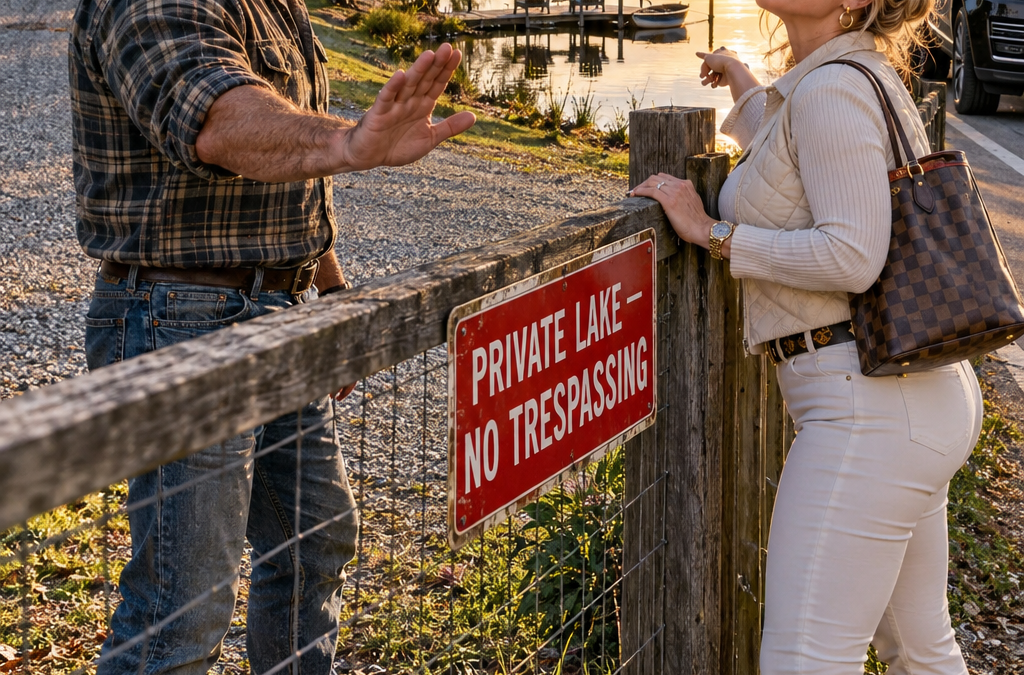
Her face flushed. “You are being incredibly selfish.”
“And you are standing on my land after being told not to.”
For once, she did not have a quick answer. She snapped her fingers for her dog, splashed out of the water, and stormed off through the grass, muttering loud enough for me to hear words like ridiculous and greedy.
That evening, I sat at my kitchen table and pulled up the county assessor’s maps.
I knew what they would show. I had seen the survey when I bought the place. But Karen had planted a seed of irritation in me, and I wanted the satisfaction of seeing the truth in black and white again.
There it was.
Every inch.
The lake. The shoreline. The dock. The fence line. The reeds. The little sloped patch where the grass turned to mud after rain.
All mine.
Not partially mine.
Not historically shared.
Not “basically” anything.
Mine.
I dug out the original survey from my records and spread it on the table. My wife came in while I was staring at it.
“She’s getting under your skin,” she said.
I looked up. “She thinks she can just say the boundaries are wrong until reality changes.”
My wife leaned over the survey. “Can she cause trouble?”
“Anyone can cause trouble.”
That was the answer I hated most because it was true.
The next morning, I started documenting everything.
I took pictures of the boundary markers, the fence, the signs, the dock, the shoreline, and every visible point showing the lake inside my parcel. I installed trail cameras along the property perimeter and near the lake. I checked the timestamps and made sure they were working. Then I called my neighbor Mike, who lived about half a mile down the road.
Mike had been there longer than I had. He knew everybody. More importantly, he knew exactly what kind of trouble people could create when they confused stubbornness with righteousness.
I told him what was happening.
He let out a low whistle. “That new woman across the road?”
“Yeah.”
“She already yelled at the mail carrier because her packages got dust on them.”
“Sounds right.”
“You want me to keep an eye out?”
“I’d appreciate it.”
“You got it.”
I also sent Karen a certified letter. I kept the language simple and formal. She had entered my private property without permission. The lake was located entirely within my parcel. Any further entry would be considered trespassing and could result in legal action.
When the delivery confirmation came back, I felt a strange mix of relief and dread.
Relief because I had created a paper trail.
Dread because people like Karen do not read warnings as boundaries.
They read them as challenges.
The following week, I found her sitting by the lake on a picnic blanket.
Her dog was tied to one of my dock posts.
She had a book open in her lap, though I doubted she had read a word. A stainless-steel tumbler sat in the grass beside her. She looked perfectly comfortable, like a woman enjoying a private resort.
My private resort.
I stood there for a moment, almost unable to believe what I was seeing.
Then I walked toward her.
“Karen.”
She looked up and smiled.
Not guilty.
Not startled.
Smiled.
“Oh,” she said. “Hi.”
“You need to leave. Now.”
Her smile faded into theatrical disappointment. “I was hoping we could be adults about this.”
“We are being adults. I sent you a certified letter.”
“Yes, I got your little letter.”
“Then you know you’re trespassing.”
She lifted her phone. “Actually, I’ve been doing some research.”
Those words should have chilled me.
She tapped at the screen and continued. “I found some original land grants for this area, and from what I can tell, water features like this were intended for community use. My deed also mentions water rights, so technically I may have just as much claim to this lake as you do.”
I stared at her.
She looked proud. Not uncertain. Not curious. Proud.
“Karen,” I said slowly, “your deed mentioning water rights does not mean you can come onto my land and use my lake.”
“That’s your interpretation.”
“That’s the law.”
“You’re not a lawyer.”
“Neither are you.”
Her eyes flashed.
I knew then that this had moved beyond neighborly annoyance. She had built an entire fantasy around the idea that she was entitled to my property, and every fact I gave her simply became another thing for her to argue around.
“Leave,” I said.
She stood, gathering her blanket with sharp little movements.
“You know,” she said, “people around here are starting to talk.”
“About what?”
“About how you think you can hoard community resources.”
I laughed once, not because it was funny, but because I could not help it. “Community resources?”
“Yes.”
“It’s a private lake on private property.”
“That’s what you keep saying.”
“Because it’s true.”
Karen clipped the leash onto her dog and pulled him away from the dock post.
“This is not over,” she said.
I watched her leave, and for the first time since buying that land, the lake did not feel peaceful.
It felt exposed.
For the next few weeks, I checked the cameras every morning. Sometimes there was nothing but deer, raccoons, and wind moving through the weeds. Sometimes Karen appeared near the fence line, looking in. Once, she stood outside one of the no trespassing signs for almost a full minute, arms crossed, staring like the sign had personally betrayed her.
I considered calling the sheriff right then, but she had not crossed the line that day.
Not technically.
That became the exhausting part. Karen knew how to dance near the edge of consequences. She would walk close enough to make me angry but not always far enough to justify an official response. She would smile when she saw me watching. She would wave. She would act innocent.
My wife told me not to let her steal my peace.
But that is exactly what people like Karen do.
They do not always take everything at once.
They take your ease first.
They make you check locks twice. They make you scan your own property before relaxing. They make you wonder what fresh absurdity will be waiting when you come home.
And then, one weekend, she stopped dancing near the line and charged straight over it.
My wife and I had gone out of town to visit her family. It was supposed to be a quiet weekend away. We locked the house, checked the cameras, and left early Saturday morning. The weather was warm, the sky clear, and I remember thinking the lake would look beautiful that afternoon.
Around three o’clock, my phone rang.
It was Mike.
I answered casually. “Hey, what’s up?”
His voice came through flat and serious.
“Did you rent out your lake?”
I sat up straighter. “What?”
“Your lake,” he said. “Did you rent it out for some kind of party?”
My stomach dropped.
“No.”
There was a pause.
“Well,” Mike said, “then you’re going to want to see this.”
A moment later, a photo came through.
I stared at my phone, and for a few seconds, my mind refused to understand what my eyes were seeing.
There were people all over my lake.
Not one or two.
Dozens.
Coolers sat in the grass. Inflatable flamingos floated near the dock. Music speakers were set up under a tree. Someone had tied a bright banner to my dock railing. Cars were parked along my driveway and near the fence line. Women in sunglasses held drinks. Someone was dragging a folding table toward the water.
And there, standing in the middle of it all like the queen of a stolen kingdom, was Karen.
She was wearing a sundress, drink in hand, laughing.
Hosting.
My pulse started hammering in my ears.
Mike sent another message.
Looks like a bachelorette party.
For a second, I could not speak.
My wife saw my face and asked, “What happened?”
I handed her the phone.
She looked at the picture, and the color drained from her face.
“No,” she said softly.
I called the sheriff’s office.
When I gave the dispatcher the address and explained that a neighbor was hosting a party on my posted private property without permission, she asked for the neighbor’s name.
“Karen,” I said.
There was a pause.
Not long.
But long enough.
Then she said, “Deputies are on the way.”
That pause told me Karen was already making a name for herself.
I wanted to turn the car around and race home, but we were hours away. There was nothing I could do except sit there, gripping my phone, while strangers treated my land like a vacation rental and Karen played owner in front of an audience.
Mike stayed nearby and kept me updated.
He did not go onto the property. He was smart enough not to insert himself directly. But he could see plenty from the road and from a neighboring rise.
He texted me that the music was loud.
That someone had tried to start a bonfire.
That people were swimming.
That Karen had told several guests the lake was hers.
When the deputies arrived, Mike called me.
I answered immediately.
“They’re there,” he said.
“What’s happening?”
“Trying to get everybody’s attention. Music’s too loud.”
I closed my eyes.
In the background, through Mike’s phone, I could faintly hear shouting.
Then more shouting.
Then Mike gave a short laugh.
“Oh, this is getting interesting.”
“What?”
“One of her friends just asked if this isn’t her lake.”
I wish I had been there to see Karen’s face.
According to Mike, the deputies asked Karen whether she had written permission to be on the property. She told them I had given her permission. When that did not work, she pivoted to claiming she had legal rights based on her research into original land grants and shared water usage.
The deputies asked for documentation.
She had printouts.
Not deeds.
Not surveys.
Not easements.
Printouts from historical websites.
One deputy apparently looked at the papers, then looked at the private property sign less than twenty yards away, and asked her where in those documents it said she could ignore posted no trespassing notices on land currently owned by someone else.
Karen did not have an answer.
Her friends did, though.
Their answer was humiliation.
One by one, they started packing.
The music shut off. Coolers were dragged back toward cars. Inflatable decorations deflated in the grass. People who had arrived ready for a carefree afternoon suddenly discovered they had been invited to trespass.
Mike told me the whole mood changed in minutes.
At first, guests were confused.
Then embarrassed.
Then angry.
Not at me.
At Karen.
Because nobody likes being made into an accomplice in someone else’s delusion.
The deputies ordered everyone to leave immediately. They warned Karen that if she stepped onto my property again, she could be charged with criminal trespassing. They also documented the damage.
And there was damage.
Beer bottles in the grass.
Cigarette butts near the reeds.
A broken board on my dock.
Scorch marks where someone had tried to build a fire pit.
Trash floating near the bank.
When Mike texted me pictures afterward, I sat in the passenger seat of our car and felt something inside me go still.
My wife touched my arm.
“We’ll handle it,” she said.
I nodded, but I was too angry to answer.
Anger is strange when it becomes quiet. Loud anger burns out quickly. Quiet anger settles into your bones and starts making plans.
By the time we got home the next day, the party was gone, but its ugliness remained.
Glitter in the grass.
Bottle caps near the dock.
A wet towel abandoned by the fence.
A blackened scar on the ground.
The broken dock board bent upward like a snapped bone.
I walked the shoreline with a trash bag in one hand, picking up evidence of other people’s carelessness. Every few feet, I found something else. A plastic cup. A hair tie. A cigarette filter. A crushed can. The lake that had once felt like a refuge now felt violated.
I know that may sound dramatic to someone who has never loved a place.
But land holds memory.
When you have sat somewhere through grief, through exhaustion, through small quiet joys nobody else would understand, it becomes more than dirt and water. It becomes part of the rhythm of your life.
Karen had not just thrown a party.
She had walked into the place where I went to breathe and treated it like a prop.
By Sunday morning, everyone knew.
In a rural community, news moves faster than weather. The story hit local Facebook groups almost immediately. Some people had driven by while deputies were there. Others knew someone who had attended the party. Someone had apparently posted a photo of the bachelorette banner on my dock before the truth came out.
By Monday, the event had a nickname.
The Bachelorette Lake Invasion.
Mike texted me that I had made twenty enemies and fifty fans.
I did not feel like a hero.
I felt tired.
I thought the humiliation might finally make Karen stop. After all, she had been caught. Publicly. Officially. In front of her own guests. The sheriff’s office had warned her. Her friends knew she had lied. The neighborhood knew she had lied.
A reasonable person would have disappeared behind closed curtains for a month and prayed everyone forgot.
Karen was not reasonable.
Two weeks later, I came home and found a certified letter taped to my door.
At first, I thought it might be something from the sheriff’s office or an insurance notice related to the damage.
Then I opened it.
Karen was suing me.
I stood in my entryway reading the packet, and despite everything, I laughed.
Not because it was harmless.
A lawsuit is never harmless.
I laughed because the claims were so absurd that my brain needed somewhere to put the shock.
Emotional distress.
Defamation.
Unlawful exclusion from community resources.
Interference with property rights.
According to Karen, I had publicly humiliated her by falsely accusing her of trespassing on land where she had legitimate claims. She argued that the lake was a historically communal water resource and that her deed’s mention of water rights supported her belief that she was entitled to access. She claimed my “aggressive defense” of disputed property boundaries had damaged her reputation and caused significant emotional suffering.
Translation: Karen lied to her friends, got caught, and wanted me to pay for how embarrassed she felt.
I hired a lawyer.
He was an older man with tired eyes and the kind of calm that only comes from years of watching adults behave like spoiled children in expensive rooms.
He sat behind his desk, reading Karen’s complaint.
For several minutes, he said nothing.
Then he reached the section about “pre-settlement usage patterns” and made a noise I can only describe as a snort trying to disguise itself as a cough.
I raised an eyebrow. “That bad?”
He looked up. “I have seen nonsense before. This is dressed-up nonsense.”
“That’s good, right?”
“It’s good for us. Potentially expensive for her.”
He pulled the county plats, tax records, my survey, and both deeds. Everything confirmed what I already knew. The lake sat entirely inside my boundaries. There was no easement granting Karen access. No shared ownership. No community right. No ambiguous sliver of shoreline crossing into her land.
The facts were clean.
The problem was that court does not run on common sense alone. It runs on documentation, procedure, timing, and money. Even when you are right, you still have to show up and prove you are right in the language the system understands.
That was the part that made me angriest.
Karen had invaded my land, damaged my property, lied to her friends, ignored warnings, and now she was forcing me to spend money defending the obvious.
The preliminary hearing arrived faster than I expected.
I remember walking into the courthouse with my lawyer beside me and feeling that strange coldness that comes with being pulled into someone else’s fantasy. Karen was already there. She wore a bright pink blazer and carried a binder so full of papers it looked like she was preparing to defend the Constitution.
She glanced at me, then looked away dramatically.
Her attorney looked less enthusiastic.
When the case was called, Karen sat forward like she had been waiting for her moment.
The judge listened while her side explained that she believed the lake had historical community significance, that original land grant intentions suggested shared access, and that I had wrongfully excluded her from what she considered a communal resource.
My lawyer sat still.
I sat still.
The judge’s face gave away almost nothing.
Then the judge asked the question that mattered.
“Do you have a deed, survey, easement, agreement, or any current legal document showing ownership interest or access rights to this property?”
Karen opened her binder.
She pulled out printouts.
She talked about historical maps.
She referenced old community patterns.
She said the spirit of shared resources should matter.
The judge asked again, more plainly this time.
“Do you have any current legal documentation?”
Karen’s mouth tightened.
“No, Your Honor, but—”
The judge did not need much more.
He reviewed the documents my lawyer provided: the plats, the survey, the deeds, the tax records, the police report, the certified trespass warning.
Then he dismissed her case.
Just like that.
No grand speech.
No dramatic music.
No moment where everyone gasped.
Just the blunt sound of reality landing on the table.
Case dismissed.
Karen stood there for a second as if she had not understood the words. Then her face flushed dark red. She gathered her binder with shaking hands and stormed out, muttering about appeals and historical property rights.
My lawyer leaned toward me and said quietly, “I hope she’s paying her attorney by the hour.”
I should have felt only relief.
I did feel relief.
But under it was something else.
Exhaustion.
Karen had taken something simple and peaceful and dragged it into a courthouse. She had forced me to defend my right to keep strangers out of my own backyard. She had turned a lake into a battleground because she could not tolerate being told no.
A few days later, the story made the regional section of the local paper.
It was not front page, but it was enough.
A short article about a frivolous property dispute involving private lake access. No dramatic language. No insults. Just enough detail for everyone in the area to know exactly who it was about.
I thought that might finally end it.
I thought public embarrassment, a sheriff’s warning, and a dismissed lawsuit would be enough.
Then my lawyer called.
“Do you want to let it go,” he asked, “or do you want to recover your damages?”
I looked out my kitchen window toward the lake.
The broken dock board had been temporarily patched, but I could still see where it had splintered. The scorch mark near the shore had faded but not disappeared. I had receipts for cleanup and repairs. I had camera footage. I had the police report.
“What would that involve?” I asked.
“A civil claim. Trespassing and property damage. Nothing excessive. Actual costs, court fees, documentation.”
I thought about Karen standing in front of a judge, pretending she was the victim.
I thought about her friends leaving trash on my land.
I thought about the certified letter she had ignored.
“Do it,” I said.
When Karen was served, I did not see her reaction.
I wish I had.
The second court date felt different.
The first time, Karen had come in playing martyr, ready to argue that history and feelings should overwrite property law.
This time, she walked in stiff-backed and sharp-faced, but there was something brittle under her confidence.
Maybe she had expected me to fold after her lawsuit failed.
Maybe she thought I would be satisfied with winning once.
Maybe she had forgotten that cameras do not care about confidence.
My lawyer presented the evidence piece by piece.
Photos of the posted signs.
The certified letter.
The police report.
Pictures of the broken dock board.
Images of the scorch mark.
Receipts for repairs.
Then the trail camera footage.
The courtroom screen showed my lake in the afternoon sun. At first, the image was almost peaceful. Then people entered the frame carrying coolers, bags, and decorations. Karen appeared, pointing toward the dock, directing people where to set things up. She moved with the casual authority of someone who believed performance could become ownership if enough people witnessed it.
The footage showed guests walking past posted signs.
It showed people on the dock.
It showed someone stumbling with an inflatable raft and cracking the board.
It showed the attempted fire setup.
It showed Karen standing nearby.
Not confused.
Not lost.
Not accidentally present.
Directing.
The judge watched silently.
Karen’s defense was exactly what I expected.
“It was a misunderstanding,” she said. “I genuinely believed I had rights to the property based on my research.”
The judge looked at her for a long moment.
It was the kind of look adults give children who have told a lie so flimsy it insults everyone in the room.
“Misunderstanding or not,” he said, “you entered clearly posted private property. You had received written warning. You hosted an event there without permission. Damage occurred. Your personal belief about historical claims does not override current legal ownership.”
Karen started to speak.
The judge raised one hand.
She stopped.
Judgment was entered in my favor.
Three thousand two hundred dollars for damages and court costs.
It was not life-changing money. It did not erase the frustration or restore the peace exactly as it had been before. But it mattered.
Not because I wanted to ruin Karen.
Because the record now said what she had spent months trying to deny.
She was not a co-owner.
She was not a defender of shared resources.
She was not a victim of unlawful exclusion.
She was a trespasser who had damaged someone else’s property and been ordered to pay for it.
That mattered more than I expected.
Afterward, outside the courthouse, Karen walked past me without speaking. Her face was pale with fury. For a second, I thought she might say something. I almost wanted her to. But she kept walking, heels clicking hard against the pavement, her shoulders rigid.
My lawyer watched her go.
“Some people would rather lose twice than admit they were wrong once,” he said.
I used the money exactly how he suggested.
I built a taller fence around the lake.
Not an ugly one, but a serious one. Strong posts, better gates, no gaps someone could pretend not to notice. I installed a professional security system with cameras placed where they could not easily be missed and signs that made the message impossible to misunderstand.
Then I added one more sign.
My wife called it petty.
Mike called it art.
It read:
PRIVATE LAKE. OWNER HAS WON TWO LAWSUITS DEFENDING THIS PROPERTY.
The first time Karen saw it, I happened to be near the driveway.
She slowed down.
Her eyes moved across the words.
Her face turned bright red.
For one glorious second, she looked like she might explode right there on the gravel road.
Then she muttered something under her breath and speed-walked back toward her house.
I am not proud of how satisfying that felt.
Actually, that is not true.
I am a little proud.
After that, the world slowly settled back into place.
Karen stopped coming near the fence. She stopped bringing up water rights. She stopped smiling at my signs like they were invitations to negotiate. When she walked her dog, she kept to the road and avoided looking toward my property.
The neighbors, however, did not avoid talking.
Every rural area has its own unofficial court of public opinion, and Karen had lost there harder than she had lost in the real one. People stopped me at the feed store, at the gas station, even once outside the hardware store, just to ask if the sign was real.
Some told me stories.
Apparently, before the bachelorette disaster, Karen had been bragging to anyone who would listen that she had found proof of partial ownership. She had told people she was “researching historic access.” She had hinted that I was trying to steal something from the community. One neighbor said Karen had described my lake as “a shared natural amenity being hoarded by one difficult man.”
A shared natural amenity.
That phrase became a joke for months.
Mike once texted me a picture of his birdbath and wrote, Thinking of filing for shared natural amenity status.
Even my wife laughed at that one.
But underneath the humor, I learned something I did not particularly want to learn.
Entitlement does not always look like greed at first.
Sometimes it looks like fairness.
Sometimes it wraps itself in language about community, access, history, kindness, and what people “should” share. Sometimes it smiles while stepping over your boundary and then acts wounded when you point to the line it crossed.
Karen never wanted fairness.
Fairness would have meant accepting that I owned something she wanted.
Fairness would have meant asking once, hearing no, and respecting it.
What she wanted was control.
And when she could not get it through charm, she tried guilt. When guilt failed, she tried trespassing. When trespassing got exposed, she tried the courts. When the courts refused to bend reality around her feelings, she became the thing she had been all along: angry that someone else’s no had power.
A few months later, the for-sale sign appeared in her yard.
I saw it on a Tuesday morning.
At first, I just stood there with my coffee, looking across the road.
The sign was white and blue and perfectly ordinary.
But to me, it looked like the end of a storm.
Rumor moved quickly, as it always did. Some people said the legal fees had hit her harder than she expected. Others said she could not stand being known as the woman who tried to steal a lake. Mike said she had complained to someone that the area was “hostile to newcomers.”
I laughed when he told me.
The area had not been hostile.
The boundaries had been.
There is a difference.
Karen moved out before the end of the season.
I did not say goodbye.
I did not wave.
I did not walk across the road for one final conversation. Some people bring closure. Others are best allowed to disappear without ceremony.
The new family moved in a few weeks later.
A couple with two kids and an old golden retriever who moved like his joints hurt but his heart was still young. The husband came over one afternoon while I was repairing a loose fence latch.
He introduced himself politely.
“We noticed the lake back there,” he said.
I braced myself.
Then he continued, “I’m assuming it’s private?”
I looked at him for a moment, almost suspicious of how normal the question sounded.
“Yes,” I said. “It is.”
He nodded. “Got it. Just wanted to make sure the kids knew not to wander that way.”
That was it.
No argument.
No lecture.
No realtor.
No historical land grants.
No speeches about community resources.
Just a neighbor asking a simple question and accepting a simple answer.
I cannot describe the relief of that moment. It was almost embarrassing. Something in my chest loosened that I had not realized was still tight.
“Appreciate you checking,” I said.
He smiled. “Of course.”
What a concept.
That evening, I walked down to the lake alone.
The sun was low, and the water caught the light in long gold strips. The new fence stood clean and strong along the property line. The cameras were tucked where they needed to be. The sign near the gate was still there, bold as ever.
For the first time in months, I did not feel angry when I looked at it.
I sat on the dock with a beer in my hand and listened to the frogs start up in the reeds.
The repaired board beneath my feet was solid.
The scorch mark near the shore had finally faded into the grass.
The lake was quiet again.
Not untouched. Not exactly the same as before.
But peaceful.
And maybe that was enough.
Because peace is not always something you get to keep without defending it. Sometimes people see your quiet life and mistake it for weakness. Sometimes they see your boundaries and treat them like the opening offer in a negotiation you never agreed to have.
Karen taught me that.
She taught me that a fence is not rude.
A sign is not selfish.
A clear no does not become cruel just because someone else wanted a yes.
I still let my kids fish from the dock when they visit. My wife and I still drink coffee by the water on cool mornings. Some evenings, when the sky turns orange and the trees reflect perfectly across the lake, I still sit there and remember why I bought that place in the beginning.
Not to win lawsuits.
Not to make a point.
Not to become a local story people laughed about at the gas station.
I bought it because I wanted one small corner of the world where life could be quiet.
And in the end, after all the noise Karen dragged across it, that was exactly what I kept.
My lake.
My land.
My peace.
This time, with a taller fence.