FULL ENDING She Sent a Semi to Destroy My Kids’ Mailbox, Then Learned the HOA Didn’t Own the Law
𝗙𝗨𝗟𝗟 𝗦𝗧𝗢𝗥𝗬
She gave a soft little laugh, the kind people use when they want to make you feel childish.
“Sir, you can’t just opt out of maintaining standards.”
“I didn’t opt out. I was never in.”
“The mailbox is visible from the road.”
“So is the sky. Are you approving cloud shapes too?”
Her face flushed.
I regretted the joke immediately, not because it was wrong, but because Karen was not the kind of person who forgot being embarrassed.
“That mailbox lowers property values,” she snapped.
“My kids painted that mailbox.”
“That does not exempt it from rules.”
“No,” I said. “My deed does.”
For the first time, she paused.
Then she smiled again, but the warmth had gone completely.
“I’m going to give you an opportunity to correct this before fines begin.”
“You can’t fine me.”
“We’ll see.”
“No,” I said, setting the hand trowel down and standing fully. “We won’t. You don’t have authority here.”
Karen’s gaze flicked over my old work jeans, my muddy gloves, the weeds at my feet, then back to my face. I knew that look. It was the look of someone deciding I was not worth taking seriously.
“You people always say that,” she said.
That changed the air between us.
“You people?”
“People who think rules are for everyone else.”
I almost smiled. “That’s rich.”
Her eyes narrowed. “Paint it black or gold. I’ll give you seven days.”
“You can give me seven years. It’s staying green.”
The mask dropped for half a second.
There was the real Karen beneath the beauty and perfume: angry, entitled, offended not by my mailbox but by the existence of a boundary she could not cross.
Then she put her sunglasses back on.
“This is not over.”
She got into her SUV and drove away.
I watched dust rise behind her tires and told myself she would cool down. Surely nobody would start a serious fight over a green mailbox on property they did not control.
That was my first mistake.
Karen did not cool down.
Karen escalated.
Three days later, I found a flyer taped to the side of the mailbox.
Not inside it. I will give her this: she was smart enough not to put anything in the mailbox itself. The flyer was printed on HOA letterhead and read like a parking ticket written by someone with a thesaurus and too much free time.
Unauthorized mailbox color.
Noncompliant material.
Failure to preserve visual harmony.
Potential negative impact on community values.
Corrective action required.
I read it twice, laughed once, and tossed it into a drawer in my kitchen.
That drawer became the Karen drawer.
Over the next few weeks, more flyers appeared. Then letters came in the mail. Then certified letters. She threatened fines. Then late fees. Then liens. One letter claimed that continued refusal to comply could result in “additional enforcement measures.”
I started keeping everything.
My wife, Jenna, told me that was smart.
“She’s unhinged,” she said one evening, holding one of the letters like it might stain her fingers.
“She’s annoying.”
“No. Annoying is the guy at work who microwaves fish. This woman is threatening liens over a mailbox she has no authority over.”
“She can’t do anything.”
Jenna looked at me over the paper. “That doesn’t mean she won’t try.”
She was right.
Karen began driving slowly past our house.
At first, I thought it was coincidence. Then I noticed the pattern. Her white SUV would roll by just after lunch or late afternoon, slow enough that I could see her phone raised near the window. Taking pictures. Of the mailbox, the driveway, the front yard, sometimes the house.
Once, my daughter was outside drawing chalk flowers on the walkway when Karen slowed down.
That was when annoyance became anger.
I stepped onto the porch and stared until Karen drove off.
That night, I installed another camera facing the driveway.
I also called the county clerk’s office and confirmed what I already knew: my property was outside the HOA boundary and not subject to their covenants. Then I called a local attorney just to ask whether I should respond formally. He told me to send a short certified letter stating that I was not an HOA member, that their rules did not apply, and that further harassment should stop.
So I did.
Karen ignored it.
Instead, she tried the mailman.
I happened to be outside one afternoon when our mail carrier, Eddie, pulled up. Eddie was a calm guy in his fifties who had seen every kind of nonsense rural homeowners could produce. As he put mail in my green box, he shook his head and chuckled.
“You know someone called the post office about this thing?”
I already knew before asking. “Karen?”
“She said your mailbox was illegal and we should suspend delivery.”
I stared at him.
He shrugged. “I told my supervisor it meets delivery requirements. Color’s not our problem.”
“She really tried to stop my mail?”
“People try weird things.”
“What did your supervisor say?”
“That unless the mailbox bites me, deliver the mail.”
I laughed, but it came out tight.
That evening, I found another flyer.
This one said final warning.
The next morning, two neighbors from inside the HOA stopped by while walking their dog. Their names were Paul and Elise, and I knew them casually from school events. Paul looked embarrassed before he even spoke.
“Karen’s been talking about your mailbox at meetings,” he said.
“I’m honored.”
Elise grimaced. “She’s telling everyone you’re deliberately trying to undermine the HOA.”
“With paint?”
“She says if you get away with ignoring standards, members will stop complying too.”
I looked toward the subdivision roofs beyond the trees.
“So she’s worried freedom might be contagious.”
Paul gave a short laugh, then quickly looked guilty for laughing.
Elise lowered her voice. “Some people agree with her.”
“I’m not surprised.”
“But a lot of us think she’s lost it,” she added. “Just be careful.”
That was the second time someone had said that to me.
Be careful.
About a mailbox.
I wish I had listened more seriously.
The day Karen destroyed it was warm and bright, the kind of afternoon when the world feels too normal for anything truly stupid to happen.
I was weeding near the front again because apparently that is what I do right before Karen appears like a curse. My kids were inside finishing homework at the kitchen table. Jenna was still at work.
At first, I heard a low rumble.
Not a pickup.
Not a delivery van.
Something bigger.
I looked down the road and saw a semi coming slowly toward my driveway.
A full-size tractor-trailer.
On my road.
That was unusual enough that I stood, wiping my hands on my jeans.
The truck slowed near my mailbox.
Then Karen’s white SUV pulled in behind it.
My stomach dropped.
Karen got out first.
She was wearing a fitted red blazer, black pants, and high heels completely unsuited to gravel. Her hair moved in glossy waves around her shoulders. She looked almost radiant with satisfaction, like a woman arriving to cut a ribbon.
The driver climbed down from the cab. He was a heavyset man with a beard, maybe mid-forties, wearing a work shirt with a hauling company logo. Later, I learned he was Karen’s brother-in-law, which explained a lot and excused nothing.
I started walking fast toward the end of the driveway.
“What are you doing?” I shouted.
Karen turned, smiling.
That smile still bothers me when I think about it.
Not because it was angry.
Because it was pleased.
“Correcting a violation,” she said.
“You are on my property.”
The driver looked uncomfortable. He glanced between Karen and me.
“Karen,” he muttered, “maybe we should—”
“Do it,” she snapped.
I broke into a run.
But a semi moves faster than a man sprinting from thirty yards away when the driver already has it in reverse.
The truck backed up.
The trailer swung slightly.
For one horrible second, everything seemed slow and silent.
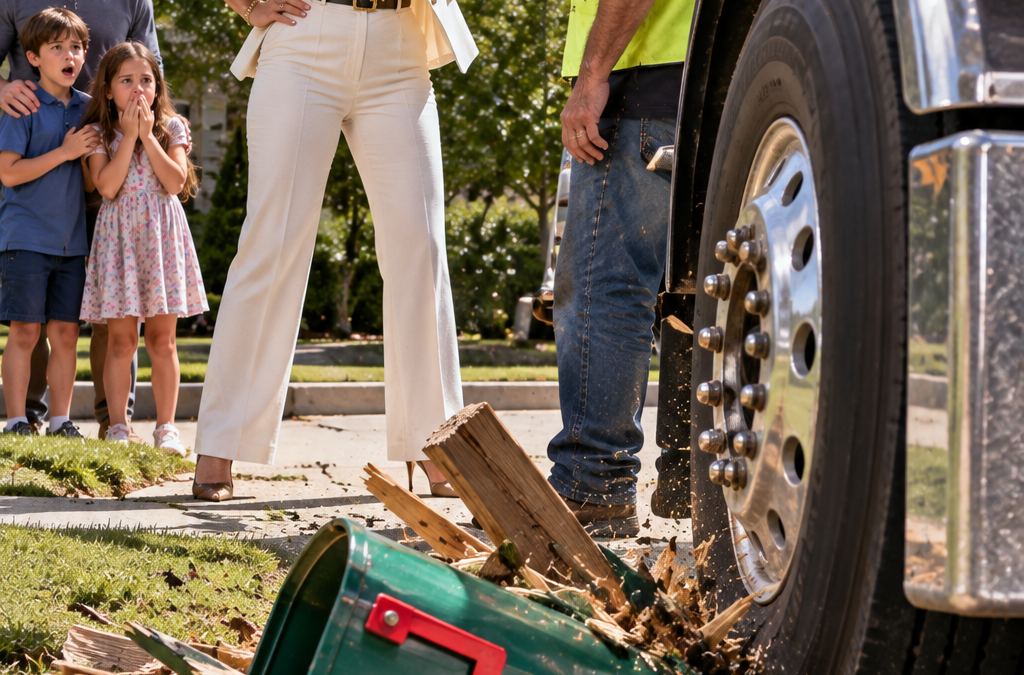
Then the trailer clipped the mailbox.
Not a tap.
Not an accident.
It hit with a violent crack that echoed across the yard. The wooden post splintered near the base. The green box snapped loose and flew sideways, flipping once before slamming into the grass. Pieces of painted wood scattered across the driveway. The red flag spun into the ditch.
I stopped dead.
For a moment, I could not process the image.
The mailbox my kids had painted was broken into pieces at my feet.
Green splinters.
Fingerprints.
A crooked patch my daughter had proudly called “extra bright.”
Gone.
Karen folded her arms.
“There,” she said. “Now you can replace it properly.”
I looked at her.
I had been angry at people before. Real anger. Adult anger. The kind that comes from bills, betrayal, fear, exhaustion. But this was different. This was cold and bright and so sharp I did not trust myself to speak immediately.
The driver climbed down again, pale now.
“Lady,” he said to Karen, “you said this was authorized.”
“It is,” she snapped.
“No,” I said quietly. “It isn’t.”
Karen turned toward me, still smiling, though a little uncertainty had finally entered her eyes.
“You were warned repeatedly.”
I pulled out my phone.
Her smile faded.
“What are you doing?”
“Calling the sheriff.”
“Oh, don’t be dramatic.”
I dialed.
The driver took a step back from the truck.
Karen moved toward me. “There is no need to involve law enforcement. This is an HOA compliance matter.”
I looked at the wreckage on the ground, then back at her.
“You destroyed my mailbox.”
“You refused to comply.”
“I am not in your HOA.”
She raised her chin. “Your property affects our community.”
The dispatcher answered.
I reported property damage. I reported that a semi had deliberately backed over my mailbox. I reported that the person responsible was still on scene.
When I gave Karen’s name, her face changed.
Not fear yet.
Outrage.
“How dare you,” she hissed.
I stepped away from her and kept talking.
The sheriff’s deputy arrived about fifteen minutes later.
By then, Paul and Elise had appeared at the edge of the road. So had two other neighbors. Karen had been loudly explaining to anyone within earshot that I had forced her hand, that repeated violations required enforcement, that she had exhausted all reasonable remedies.
The driver stood by the semi looking like a man who had begun seeing his future unemployment in vivid detail.
The deputy was named Harris. He was broad, calm, and had the tired eyes of someone who had spent years watching adults behave worse than children.
He took one look at the smashed mailbox, the semi, Karen’s posture, and me standing beside a pile of HOA letters.
Then he sighed.
“What happened?”
Karen began first, of course.
“Officer, I am the president of the homeowners association, and this property owner has been in ongoing violation of community standards regarding—”
Deputy Harris held up one hand.
“Ma’am, I asked what happened.”
Karen blinked.
“This noncompliant mailbox was removed after repeated notices.”
“Removed by who?”
She hesitated.
The driver closed his eyes.
I said, “By that semi trailer. On her instruction.”
Karen snapped, “That is not accurate.”
I pointed to the camera mounted on the front of my house.
“It’s on video.”
That shut her up for almost three whole seconds.
I handed Deputy Harris the stack from the Karen drawer: flyers, letters, threats, photographs I had taken of notices taped to the mailbox, a copy of my certified letter stating I was not part of the HOA.
He flipped through them slowly.
His expression did not improve.
“You’re not in the HOA?” he asked me.
“No.”
He looked at Karen. “Is that true?”
Karen pressed her lips together. “His property is adjacent.”
“That wasn’t my question.”
Her nostrils flared. “Technically, he is outside the boundary.”
“Technically,” Deputy Harris repeated.
The word sounded heavy in his mouth.
Then he looked at the smashed mailbox and said something I did not know at the time would travel through the subdivision by dinner.
“Destroying a mailbox isn’t just property damage. It can be a federal offense.”
Karen laughed.
Actually laughed.
It was quick and disbelieving.
“Oh, please.”
Deputy Harris turned his head slowly toward her.
That was when her laughter died.
He said, “Mail receptacles are protected. You don’t get to destroy one because you don’t like the color.”
Karen’s face flushed. “I was enforcing HOA regulations.”
“That doesn’t give you the right to commit a crime.”
The silence after that was beautiful.
Paul, who had been standing near the road, looked like he was fighting for his life not to smile.
Elise had stopped pretending not to listen.
The driver said, under his breath, “Jesus Christ.”
Deputy Harris took statements. Mine. Karen’s. The driver’s. A couple of neighbors who had seen at least part of what happened. He also asked me to preserve the camera footage and told me someone from the postal inspection side might contact me.
Karen kept trying to steer the conversation back to HOA rules.
Deputy Harris kept bringing it back to the destroyed mailbox.
Every time he did, Karen looked more confused, as if reality itself was being rude.
Before leaving, the deputy told the driver not to move the semi until photos were taken. He told Karen she would be contacted further. He told me to make a list of damages and keep receipts for replacement.
Karen glared at me.
“This could have been avoided,” she said.
I looked down at the broken green wood.
“You’re right.”
For a moment, I think she thought I was agreeing with her.
Then I said, “You could have stayed off my property.”
Her face hardened.
“You’ll regret humiliating me.”
I almost laughed.
She had just destroyed a mailbox with a semi in front of witnesses and a camera, and somehow she believed humiliation was something I had done to her.
That was Karen’s gift.
She could commit the act and still feel like the victim of being seen.
The next day, a postal inspector came to my house.
I had not known postal inspectors were a thing beyond jokes in movies. This one was serious, polite, and very interested in the camera footage. I gave him everything. The video clearly showed Karen arriving, speaking with the driver, gesturing toward the mailbox, and the semi backing directly into it.
It also captured the sound.
That crack.
I hated hearing it again.
My son heard it from the kitchen and came running before I could stop the video.
He stood in the doorway, staring at the screen.
“Dad,” he said, “that’s our mailbox.”
“I know, buddy.”
His face changed in the way children’s faces do when sadness becomes anger for the first time.
“Why would she do that?”
I had no answer that would make sense to a child.
Because she wanted control.
Because she thought rules were more important than people.
Because she knew it would hurt.
Instead, I said, “Because she made a bad choice. And now grown-ups are handling it.”
He looked unconvinced.
Honestly, so was I.
Grown-ups had created the problem.
But for once, the right grown-ups seemed to be paying attention.
News spread fast.
By the end of the week, everyone inside the HOA knew some version of what happened. At first, Karen tried to control the story. She claimed the mailbox had been an unsafe structure. She claimed the semi had accidentally clipped it while turning around. She claimed I had exaggerated because I hated the HOA.
Then people saw the video.
Small towns and strict neighborhoods have one thing in common: gossip moves faster than official communication. Someone heard from someone who heard from someone that the deputy had said mailbox destruction could be federal. Someone else repeated the line about HOA rules not giving her the right to commit a crime. By Saturday, I heard a teenager at the convenience store say, “That’s the lady who brought a semi to a mailbox fight.”
I admit, I enjoyed that one.
The HOA board enjoyed it less.
They called an emergency meeting.
I did not attend, since I was not a member, but Paul told me what happened afterward. The room was packed. People who had feared Karen for years suddenly had questions. Why was their president involving the HOA in possible federal crimes? Why was she harassing a nonmember? Had HOA funds been used? Had letters been sent on official letterhead without board approval? Could the association be sued?
That last question did what morality had not.
It scared them.
Karen apparently stood at the front in a white blazer, looking beautiful, furious, and completely incapable of understanding that the room had turned. She insisted she had acted to protect property values. She said the board had been weak for too long. She said my “deliberate provocation” had required decisive action.
Then someone asked whether she had authorized the use of a commercial semi to destroy private property.
Karen said, “I authorized enforcement.”
Wrong answer.
By the end of the meeting, the board removed her from her position pending investigation. According to Paul, she screamed that they were cowards. According to Elise, she called three different women jealous and accused one man of having “always been intimidated by strong women.”
Karen confused strength with permission.
She always had.
The legal process moved slower than gossip but faster than Karen expected.
Charges were filed. Property destruction. Destruction of a mail receptacle. Related issues tied to the deliberate nature of the act. There were fines. Restitution. Statements. Paperwork. Meetings with people whose job titles sounded boring until they started explaining penalties.
The driver, Karen’s brother-in-law, tried to say he thought the HOA had authority.
That did not help him much.
His hauling company fired him almost immediately. From what I heard, the company also faced serious questions about how one of its commercial vehicles ended up being used for a personal HOA vendetta. Department of Transportation scrutiny is not something any small hauling company wants, especially not because an employee owed his sister-in-law a favor.
I almost felt bad for him.
Almost.
Then I remembered the mailbox flying apart.
He had hesitated. He knew something was wrong. He did it anyway.
There is a point where “she told me to” stops being an explanation and becomes proof you should have known better.
Karen’s consequences took longer but cut deeper.
She had built her identity on status. HOA president. Rule enforcer. Guardian of standards. Woman whose approval mattered. The investigation stripped that away piece by piece.
The board did not reinstate her.
Her neighbors stopped smiling politely when she passed.
People who had once nodded through her speeches now crossed their arms and asked for documentation. The same gossip machine she had used to intimidate others turned on her with the efficiency of a wood chipper.
And me?
I rebuilt the mailbox.
But not right away.
For a week, we used a temporary metal mailbox from the hardware store. Plain black. Cheap. Functional. Every time I saw it, I felt like Karen had won a little.
My kids felt it too.
My daughter asked if the new permanent mailbox had to be black now.
That question broke my heart more than the splintered wood had.
“No,” I said. “It can be whatever we want.”
“Even rainbow?”
“Especially rainbow.”
So we went bigger.
I found reclaimed timber from a guy outside town. Thick, rough boards with nail marks and history in them. I built the post too sturdy for any normal accident to break, though not so dangerous it would create road issues. The box itself became less of a mailbox and more of a folk-art monument to spite.
The kids painted it over two weekends.
Green came back, but this time it had company. Blue swirls. Yellow stars. Purple handprints. Red stripes. Orange dots. My son painted a dragon on one side. My daughter painted flowers on the other. Jenna added tiny white clouds along the top. I sealed the whole ridiculous thing under enough weatherproof coating to survive the next century.
It looked like a preschool art project had exploded.
It looked completely insane beside the road.
It was perfect.
The first morning after we installed it, I stood at the end of the driveway with my coffee and admired it like a man viewing a national monument.
Eddie the mailman pulled up, leaned out, and grinned.
“Well,” he said, “that’s subtle.”
“It meets delivery requirements?”
He opened the door and put the mail inside. “Long as it doesn’t bite me.”
A car slowed from the HOA side.
Then another.
By afternoon, three people had stopped to take pictures. One woman from the subdivision told me quietly that her kids loved it. Another man said he wished he could paint his mailbox like that.
“Do it,” I said.
He laughed. “I still live under the regime.”
But the regime was weaker now.
Without Karen, the HOA became quieter. Not perfect. HOAs rarely become perfect. But the new board had learned something important: there was a line, and crossing it could cost more than pride.
They left me alone.
More importantly, they left my mailbox alone.
Karen did not.
Not mentally, anyway.
She drove by once after the new one went up.
I was on the porch and saw her slow almost to a stop.
Her face through the windshield was something I will never forget.
Anger, yes.
Humiliation, definitely.
But beneath that, confusion.
She had destroyed something to make me comply, and somehow the replacement was louder, brighter, and more offensive to her standards than the original had ever been. She had used force and produced the opposite of obedience.
That is the part bullies never understand.
Sometimes pressure does not bend people.
Sometimes it teaches them exactly where to reinforce.
I lifted my coffee cup in a cheerful little toast.
Karen drove away.
A few months later, her house went up for sale.
By then, the fines and restitution had hit. The legal embarrassment had spread. Her name had become attached permanently to the phrase mailbox incident, which sounds cute until you remember it involved a semi and federal attention. People still whispered, and Karen could not stand being the subject instead of the speaker.
She moved out of town before the end of the year.
No dramatic goodbye.
No apology.
No final confrontation in the street.
Just a moving truck, a quiet house, and one less white SUV patrolling for violations.
The day after she left, Paul walked over with his dog and stood by the mailbox.
“Feels like the end of an era,” he said.
“A stupid era.”
He laughed. “Fair.”
His dog sniffed the post, approved it in the way dogs approve things, and moved on.
Paul looked back toward the subdivision.
“You know, I used to think it was easier to just comply with people like her.”
“I get that.”
“No, I mean it. Paint the mailbox. Move the trash can. Take down the lights. Whatever shuts them up.”
“That’s how they grow.”
He nodded slowly. “Yeah. I see that now.”
I did not judge him for it.
People with families and jobs and bills often choose peace because fighting every little battle can drain the life out of you. I understood the temptation. I had felt it myself, standing in my kitchen with Karen’s letters stacked in a drawer. Paint it black. Paint it gold. Make her go away.
But the problem with feeding control is that it develops an appetite.
If I had painted that mailbox, Karen would have found something else. My fence. My grass. My kids’ bikes in the yard. The color of my shed. The fact that my truck was visible from the road. It would never have ended, because the mailbox was never the real issue.
The real issue was that I had a boundary she could not own.
So she tried to crush the symbol of it.
And instead, she made the boundary famous.
The mailbox still stands there.
Bright, ridiculous, weathered now around the edges. The paint has faded in places despite all the sealant. The dragon my son painted looks more like a lizard after a few winters. My daughter’s flowers have blurred slightly from sun and rain. The handprints are still visible if you know where to look.
My kids are older now.
They roll their eyes when I tell the story, but they still smile when friends ask about the mailbox. To them, it has become family folklore. The time some HOA lady got so mad about green paint that she brought a semi and accidentally turned our mailbox into a neighborhood landmark.
Sometimes people stop and ask if we are the mailbox house.
I always say yes.
Proudly.
Because to me, that mailbox is not just a petty decoration. It is proof.
Proof that rules without authority are just demands.
Proof that beauty can hide cruelty.
Proof that a person can look powerful right up until actual law enters the room.
Proof that my children’s joy mattered more than Karen’s standards.
I think about her occasionally, usually when I see someone online complaining about HOAs or when Eddie leaves mail inside that rainbow disaster at the end of my drive. I wonder whether Karen ever tells the story honestly. I doubt it. In her version, I am probably an unreasonable man who refused a simple request, escalated everything, ruined her reputation, and somehow forced her to involve a semi.
People like Karen rarely remember the moment they chose cruelty.
They only remember the moment consequences began.
That is fine.
I remember enough for both of us.
I remember her standing there with folded arms as the trailer backed up.
I remember the crack of wood.
I remember my son’s face when he watched the video and realized adults could destroy something children made just because they could.
I remember the deputy looking at Karen and telling her that HOA rules did not give her the right to commit a crime.
Most of all, I remember rebuilding.
That mattered more than the destruction.
Anyone with a truck and a grudge can smash something.
It takes love to build it again brighter.
Karen wanted me to replace my children’s mailbox with something approved, something obedient, something black or gold and forgettable enough to disappear into her idea of order.
Instead, we built a mailbox no one could ignore.
It is green and blue and yellow and red. It is crooked in places. It is too colorful, too personal, too weird, too alive for any HOA handbook ever written.
It lowers no property values that matter to me.
It raises something better.
Every time I pull into the driveway and see it standing there, I feel the same quiet satisfaction.
Karen came after a mailbox because she thought it was the easiest thing to break.
She never understood that it was not holding mail.
It was holding a line.
And when she crossed that line with a semi, the whole neighborhood finally saw exactly who she was.
𝗧𝗛𝗘 𝗘𝗡𝗗
She Sent a Semi to Destroy My Kids’ Mailbox, Then Learned the HOA Didn’t Own the Law
Karen thought crushing my children’s green mailbox would teach me who controlled the neighborhood.
She brought a full-size semi to my driveway like a queen arriving for an execution, smiling while splinters flew across my grass.
What she forgot was simple: HOA rules may scare homeowners, but they do not outrank federal law.
I never wanted a war with the HOA.
That is the part people always seem to miss when they hear the story later. They picture me as some guy who woke up one morning itching for a fight, standing on my porch with coffee in one hand and a grudge in the other, just waiting for a power-hungry board president to step onto my property so I could teach her a lesson.
It was not like that.
I bought my house because I wanted quiet.
Three acres, a long gravel driveway, enough trees to block most of the road, and enough space for my kids to run until they wore themselves out before dinner. The house itself was not fancy. It was an older place with a porch that sagged slightly at one corner, a basement that smelled like damp concrete after heavy rain, and windows that rattled when the wind came hard from the west.
But it was ours.
That mattered to me.
I had grown up in rentals, moving every time rent went up or my parents found something slightly cheaper. I knew what it felt like to live in places where you could not paint a wall, plant a tree, or fix a fence without asking someone else’s permission. When I finally bought land of my own, I promised myself my children would know what it felt like to belong somewhere.
Our place sat just outside the boundary of a strict HOA subdivision.
Technically, we were neighbors.
Legally, we were not part of them.
That little distinction turned out to be the line between annoying gossip and a federal investigation.
The subdivision wrapped around one side of my property like someone had drawn a neat little kingdom on a map and then stopped just short of my land. Their houses were newer, bigger, and more uniform. Same rooflines. Same trimmed lawns. Same approved paint colors. Same black mailboxes standing like obedient little soldiers along the road.
At first, I barely paid attention to them.
I heard things, of course. Everyone did. People complained at the gas station, at the school pickup line, in the hardware store. The HOA denied somebody’s request for a basketball hoop. The HOA fined a family for leaving holiday lights up too long. The HOA sent a violation notice because a trash can was visible from the road for half an afternoon.
Nothing dramatic.
No one was dumping animals in yards or tearing off roofs in the middle of the night.
They were just strict enough to make everyone miserable.
And the person behind most of that misery was Karen.
Karen was around forty, maybe a year or two older, though she fought time so aggressively I doubt even time wanted the argument. She was beautiful in the polished, expensive way that made people forgive her for about five minutes longer than they should have. Long dark hair, bright eyes, smooth skin, manicured nails, fitted blazers, tight dresses, and perfume that arrived before she did. She moved like every sidewalk was a runway and spoke like every conversation was a board meeting she had already won.
Men tended to smile too quickly around her.
Women tended to go quiet.
Karen knew both things and used them.
She was the HOA president, and from what I heard, she ran that subdivision like a private empire. Her favorite weapon was the phrase community standards. If she wanted something changed, it violated community standards. If someone pushed back, they were threatening property values. If a rule sounded absurd, she said it was necessary for visual harmony.
I only knew her from a distance at first.
Sometimes I saw her white SUV crawling through the subdivision while she stared at people’s lawns. Sometimes I passed her at the grocery store, where she looked through me like I was an item she had decided not to buy. Once, at a neighborhood school event, she spoke over three parents in a row and somehow still left with people thanking her.
She was the kind of woman who did not ask for control.
She assumed control was waiting for her to claim it.
Luckily for me, I was outside the HOA.
At least, I thought that made me lucky.
The first thing Karen noticed about my property was the mailbox.
That mailbox was not impressive in any normal sense. It was wooden, handmade, uneven, and painted a loud green that did not match anything except maybe spring grass after too much rain. My kids helped paint it one Saturday afternoon. They were nine and six at the time, and they attacked that poor mailbox with the reckless joy only children can bring to a project that adults would ruin by trying to make it look good.
There were darker streaks where my son went over the same spot four times. There were lighter patches where my daughter got distracted halfway through. A few fingerprints were sealed forever beneath the clear coat. If you looked closely, you could see where someone had dripped paint down the side and decided that was “part of the design.”
I loved it.
Every time I pulled into the driveway and saw that ridiculous green mailbox, I remembered my kids standing barefoot in the grass, arguing over who got to paint the flag.
To Karen, apparently, it was a threat to civilization.
The first time she confronted me, I was in the front yard pulling weeds from the edge of the drive. I heard tires on gravel and looked up to see her white SUV stopped near the mailbox. Karen stepped out wearing white slacks, a fitted navy blouse, sunglasses, and the expression of someone who had discovered a crime scene.
She did not introduce herself.
She pointed at the mailbox.
“That,” she said, “is a serious violation.”
I looked behind me, half expecting to see a sinkhole or a dead body.
Then I realized she meant the mailbox.
“Excuse me?”
She removed her sunglasses slowly, like she was preparing for an important line in a courtroom drama.
“The mailbox. Green is not an approved color.”
For a second, I honestly thought she was joking.
She was not.
PART 2
I stood there with dirt on my gloves, trying to decide whether laughing would make things better or worse.
Probably worse.
“Approved by who?” I asked.
Karen’s eyebrows rose. She had clearly expected apology, not confusion.
“The HOA,” she said. “Mailboxes must comply with our community standards. Black or gold only. Metal preferred, though certain approved composite materials may be acceptable if submitted for review.”
She said this like she was reciting federal statute.
I looked at my green wooden mailbox, then back at her.
“Well,” I said, “that sounds like a problem for people in the HOA.”
Her smile tightened. “All homes visible from the subdivision impact property values.”
“I’m not in the subdivision.”
“That’s irrelevant.”
“It’s extremely relevant.”
Her eyes sharpened. Up close, she was even more polished than I had realized. Not a hair out of place. Not a wrinkle in her blouse. Gold bracelets at her wrist. Lips painted a deep red that made her smile look more dangerous than friendly.
“You are adjacent to the community,” she said.
“I own private property outside your HOA boundary.”
She gave a soft little laugh, the kind people use when they want to make you feel childish.
“Sir, you can’t just opt out of maintaining standards.”
“I didn’t opt out. I was never in.”
“The mailbox is visible from the road.”
“So is the sky. Are you approving cloud shapes too?”
Her face flushed.
I regretted the joke immediately, not because it was wrong, but because Karen was not the kind of person who forgot being embarrassed.
“That mailbox lowers property values,” she snapped.
“My kids painted that mailbox.”
“That does not exempt it from rules.”
“No,” I said. “My deed does.”
For the first time, she paused.
Then she smiled again, but the warmth had gone completely.
“I’m going to give you an opportunity to correct this before fines begin.”
“You can’t fine me.”
“We’ll see.”
“No,” I said, setting the hand trowel down and standing fully. “We won’t. You don’t have authority here.”
Karen’s gaze flicked over my old work jeans, my muddy gloves, the weeds at my feet, then back to my face. I knew that look. It was the look of someone deciding I was not worth taking seriously.
“You people always say that,” she said.
That changed the air between us.
“You people?”
“People who think rules are for everyone else.”
I almost smiled. “That’s rich.”
Her eyes narrowed. “Paint it black or gold. I’ll give you seven days.”
“You can give me seven years. It’s staying green.”
The mask dropped for half a second.
There was the real Karen beneath the beauty and perfume: angry, entitled, offended not by my mailbox but by the existence of a boundary she could not cross.
Then she put her sunglasses back on.
“This is not over.”
She got into her SUV and drove away.
I watched dust rise behind her tires and told myself she would cool down. Surely nobody would start a serious fight over a green mailbox on property they did not control.
That was my first mistake.
Karen did not cool down.
Karen escalated.
Three days later, I found a flyer taped to the side of the mailbox.
Not inside it. I will give her this: she was smart enough not to put anything in the mailbox itself. The flyer was printed on HOA letterhead and read like a parking ticket written by someone with a thesaurus and too much free time.
Unauthorized mailbox color.
Noncompliant material.
Failure to preserve visual harmony.
Potential negative impact on community values.
Corrective action required.
I read it twice, laughed once, and tossed it into a drawer in my kitchen.
That drawer became the Karen drawer.
Over the next few weeks, more flyers appeared. Then letters came in the mail. Then certified letters. She threatened fines. Then late fees. Then liens. One letter claimed that continued refusal to comply could result in “additional enforcement measures.”
I started keeping everything.
My wife, Jenna, told me that was smart.
“She’s unhinged,” she said one evening, holding one of the letters like it might stain her fingers.
“She’s annoying.”
“No. Annoying is the guy at work who microwaves fish. This woman is threatening liens over a mailbox she has no authority over.”
“She can’t do anything.”
Jenna looked at me over the paper. “That doesn’t mean she won’t try.”
She was right.
Karen began driving slowly past our house.
At first, I thought it was coincidence. Then I noticed the pattern. Her white SUV would roll by just after lunch or late afternoon, slow enough that I could see her phone raised near the window. Taking pictures. Of the mailbox, the driveway, the front yard, sometimes the house.
Once, my daughter was outside drawing chalk flowers on the walkway when Karen slowed down.
That was when annoyance became anger.
I stepped onto the porch and stared until Karen drove off.
That night, I installed another camera facing the driveway.
I also called the county clerk’s office and confirmed what I already knew: my property was outside the HOA boundary and not subject to their covenants. Then I called a local attorney just to ask whether I should respond formally. He told me to send a short certified letter stating that I was not an HOA member, that their rules did not apply, and that further harassment should stop.
So I did.
Karen ignored it.
Instead, she tried the mailman.
I happened to be outside one afternoon when our mail carrier, Eddie, pulled up. Eddie was a calm guy in his fifties who had seen every kind of nonsense rural homeowners could produce. As he put mail in my green box, he shook his head and chuckled.
“You know someone called the post office about this thing?”
I already knew before asking. “Karen?”
“She said your mailbox was illegal and we should suspend delivery.”
I stared at him.
He shrugged. “I told my supervisor it meets delivery requirements. Color’s not our problem.”
“She really tried to stop my mail?”
“People try weird things.”
“What did your supervisor say?”
“That unless the mailbox bites me, deliver the mail.”
I laughed, but it came out tight.
That evening, I found another flyer.
This one said final warning.
The next morning, two neighbors from inside the HOA stopped by while walking their dog. Their names were Paul and Elise, and I knew them casually from school events. Paul looked embarrassed before he even spoke.
“Karen’s been talking about your mailbox at meetings,” he said.
“I’m honored.”
Elise grimaced. “She’s telling everyone you’re deliberately trying to undermine the HOA.”
“With paint?”
“She says if you get away with ignoring standards, members will stop complying too.”
I looked toward the subdivision roofs beyond the trees.
“So she’s worried freedom might be contagious.”
Paul gave a short laugh, then quickly looked guilty for laughing.
Elise lowered her voice. “Some people agree with her.”
“I’m not surprised.”
“But a lot of us think she’s lost it,” she added. “Just be careful.”
That was the second time someone had said that to me.
Be careful.
About a mailbox.
I wish I had listened more seriously.
The day Karen destroyed it was warm and bright, the kind of afternoon when the world feels too normal for anything truly stupid to happen.
I was weeding near the front again because apparently that is what I do right before Karen appears like a curse. My kids were inside finishing homework at the kitchen table. Jenna was still at work.
At first, I heard a low rumble.
Not a pickup.
Not a delivery van.
Something bigger.
I looked down the road and saw a semi coming slowly toward my driveway.
A full-size tractor-trailer.
On my road.
That was unusual enough that I stood, wiping my hands on my jeans.
The truck slowed near my mailbox.
Then Karen’s white SUV pulled in behind it.
My stomach dropped.
Karen got out first.
She was wearing a fitted red blazer, black pants, and high heels completely unsuited to gravel. Her hair moved in glossy waves around her shoulders. She looked almost radiant with satisfaction, like a woman arriving to cut a ribbon.
The driver climbed down from the cab. He was a heavyset man with a beard, maybe mid-forties, wearing a work shirt with a hauling company logo. Later, I learned he was Karen’s brother-in-law, which explained a lot and excused nothing.
I started walking fast toward the end of the driveway.
“What are you doing?” I shouted.
Karen turned, smiling.
That smile still bothers me when I think about it.
Not because it was angry.
Because it was pleased.
“Correcting a violation,” she said.
“You are on my property.”
The driver looked uncomfortable. He glanced between Karen and me.
“Karen,” he muttered, “maybe we should—”
“Do it,” she snapped.
I broke into a run.
But a semi moves faster than a man sprinting from thirty yards away when the driver already has it in reverse.
The truck backed up.
The trailer swung slightly.
For one horrible second, everything seemed slow and silent.
Then the trailer clipped the mailbox.
Not a tap.
Not an accident.
It hit with a violent crack that echoed across the yard. The wooden post splintered near the base. The green box snapped loose and flew sideways, flipping once before slamming into the grass. Pieces of painted wood scattered across the driveway. The red flag spun into the ditch.
I stopped dead.
For a moment, I could not process the image.
The mailbox my kids had painted was broken into pieces at my feet.
Green splinters.
Fingerprints.
A crooked patch my daughter had proudly called “extra bright.”
Gone.
Karen folded her arms.
“There,” she said. “Now you can replace it properly.”
I looked at her.
I had been angry at people before. Real anger. Adult anger. The kind that comes from bills, betrayal, fear, exhaustion. But this was different. This was cold and bright and so sharp I did not trust myself to speak immediately.
The driver climbed down again, pale now.
“Lady,” he said to Karen, “you said this was authorized.”
“It is,” she snapped.
“No,” I said quietly. “It isn’t.”
Karen turned toward me, still smiling, though a little uncertainty had finally entered her eyes.
“You were warned repeatedly.”
I pulled out my phone.
Her smile faded.
“What are you doing?”
“Calling the sheriff.”
“Oh, don’t be dramatic.”
I dialed.
The driver took a step back from the truck.
Karen moved toward me. “There is no need to involve law enforcement. This is an HOA compliance matter.”
I looked at the wreckage on the ground, then back at her.
“You destroyed my mailbox.”
“You refused to comply.”
“I am not in your HOA.”
She raised her chin. “Your property affects our community.”
The dispatcher answered.
I reported property damage. I reported that a semi had deliberately backed over my mailbox. I reported that the person responsible was still on scene.
When I gave Karen’s name, her face changed.
Not fear yet.
Outrage.
“How dare you,” she hissed.
I stepped away from her and kept talking.
The sheriff’s deputy arrived about fifteen minutes later.
By then, Paul and Elise had appeared at the edge of the road. So had two other neighbors. Karen had been loudly explaining to anyone within earshot that I had forced her hand, that repeated violations required enforcement, that she had exhausted all reasonable remedies.
The driver stood by the semi looking like a man who had begun seeing his future unemployment in vivid detail.
The deputy was named Harris. He was broad, calm, and had the tired eyes of someone who had spent years watching adults behave worse than children.
He took one look at the smashed mailbox, the semi, Karen’s posture, and me standing beside a pile of HOA letters.
Then he sighed.
“What happened?”
Karen began first, of course.
“Officer, I am the president of the homeowners association, and this property owner has been in ongoing violation of community standards regarding—”
Deputy Harris held up one hand.
“Ma’am, I asked what happened.”
Karen blinked.
“This noncompliant mailbox was removed after repeated notices.”
“Removed by who?”
She hesitated.
The driver closed his eyes.
I said, “By that semi trailer. On her instruction.”
Karen snapped, “That is not accurate.”
I pointed to the camera mounted on the front of my house.
“It’s on video.”
That shut her up for almost three whole seconds.
I handed Deputy Harris the stack from the Karen drawer: flyers, letters, threats, photographs I had taken of notices taped to the mailbox, a copy of my certified letter stating I was not part of the HOA.
He flipped through them slowly.
His expression did not improve.
“You’re not in the HOA?” he asked me.
“No.”
He looked at Karen. “Is that true?”
Karen pressed her lips together. “His property is adjacent.”
“That wasn’t my question.”
Her nostrils flared. “Technically, he is outside the boundary.”
“Technically,” Deputy Harris repeated.
The word sounded heavy in his mouth.
Then he looked at the smashed mailbox and said something I did not know at the time would travel through the subdivision by dinner.
“Destroying a mailbox isn’t just property damage. It can be a federal offense.”
Karen laughed.
Actually laughed.
It was quick and disbelieving.
“Oh, please.”
Deputy Harris turned his head slowly toward her.
That was when her laughter died.
He said, “Mail receptacles are protected. You don’t get to destroy one because you don’t like the color.”
Karen’s face flushed. “I was enforcing HOA regulations.”
“That doesn’t give you the right to commit a crime.”
The silence after that was beautiful.
Paul, who had been standing near the road, looked like he was fighting for his life not to smile.
Elise had stopped pretending not to listen.
The driver said, under his breath, “Jesus Christ.”
Deputy Harris took statements. Mine. Karen’s. The driver’s. A couple of neighbors who had seen at least part of what happened. He also asked me to preserve the camera footage and told me someone from the postal inspection side might contact me.
Karen kept trying to steer the conversation back to HOA rules.
Deputy Harris kept bringing it back to the destroyed mailbox.
Every time he did, Karen looked more confused, as if reality itself was being rude.
Before leaving, the deputy told the driver not to move the semi until photos were taken. He told Karen she would be contacted further. He told me to make a list of damages and keep receipts for replacement.
Karen glared at me.
“This could have been avoided,” she said.
I looked down at the broken green wood.
“You’re right.”
For a moment, I think she thought I was agreeing with her.
Then I said, “You could have stayed off my property.”
Her face hardened.
“You’ll regret humiliating me.”
I almost laughed.
She had just destroyed a mailbox with a semi in front of witnesses and a camera, and somehow she believed humiliation was something I had done to her.
That was Karen’s gift.
She could commit the act and still feel like the victim of being seen.
The next day, a postal inspector came to my house.
I had not known postal inspectors were a thing beyond jokes in movies. This one was serious, polite, and very interested in the camera footage. I gave him everything. The video clearly showed Karen arriving, speaking with the driver, gesturing toward the mailbox, and the semi backing directly into it.
It also captured the sound.
That crack.
I hated hearing it again.
My son heard it from the kitchen and came running before I could stop the video.
He stood in the doorway, staring at the screen.
“Dad,” he said, “that’s our mailbox.”
“I know, buddy.”
His face changed in the way children’s faces do when sadness becomes anger for the first time.
“Why would she do that?”
I had no answer that would make sense to a child.
Because she wanted control.
Because she thought rules were more important than people.
Because she knew it would hurt.
Instead, I said, “Because she made a bad choice. And now grown-ups are handling it.”
He looked unconvinced.
Honestly, so was I.
Grown-ups had created the problem.
But for once, the right grown-ups seemed to be paying attention.
News spread fast.
By the end of the week, everyone inside the HOA knew some version of what happened. At first, Karen tried to control the story. She claimed the mailbox had been an unsafe structure. She claimed the semi had accidentally clipped it while turning around. She claimed I had exaggerated because I hated the HOA.
Then people saw the video.
Small towns and strict neighborhoods have one thing in common: gossip moves faster than official communication. Someone heard from someone who heard from someone that the deputy had said mailbox destruction could be federal. Someone else repeated the line about HOA rules not giving her the right to commit a crime. By Saturday, I heard a teenager at the convenience store say, “That’s the lady who brought a semi to a mailbox fight.”
I admit, I enjoyed that one.
The HOA board enjoyed it less.
They called an emergency meeting.
I did not attend, since I was not a member, but Paul told me what happened afterward. The room was packed. People who had feared Karen for years suddenly had questions. Why was their president involving the HOA in possible federal crimes? Why was she harassing a nonmember? Had HOA funds been used? Had letters been sent on official letterhead without board approval? Could the association be sued?
That last question did what morality had not.
It scared them.
Karen apparently stood at the front in a white blazer, looking beautiful, furious, and completely incapable of understanding that the room had turned. She insisted she had acted to protect property values. She said the board had been weak for too long. She said my “deliberate provocation” had required decisive action.
Then someone asked whether she had authorized the use of a commercial semi to destroy private property.
Karen said, “I authorized enforcement.”
Wrong answer.
By the end of the meeting, the board removed her from her position pending investigation. According to Paul, she screamed that they were cowards. According to Elise, she called three different women jealous and accused one man of having “always been intimidated by strong women.”
Karen confused strength with permission.
She always had.
The legal process moved slower than gossip but faster than Karen expected.
Charges were filed. Property destruction. Destruction of a mail receptacle. Related issues tied to the deliberate nature of the act. There were fines. Restitution. Statements. Paperwork. Meetings with people whose job titles sounded boring until they started explaining penalties.
The driver, Karen’s brother-in-law, tried to say he thought the HOA had authority.
That did not help him much.
His hauling company fired him almost immediately. From what I heard, the company also faced serious questions about how one of its commercial vehicles ended up being used for a personal HOA vendetta. Department of Transportation scrutiny is not something any small hauling company wants, especially not because an employee owed his sister-in-law a favor.
I almost felt bad for him.
Almost.
Then I remembered the mailbox flying apart.
He had hesitated. He knew something was wrong. He did it anyway.
There is a point where “she told me to” stops being an explanation and becomes proof you should have known better.
Karen’s consequences took longer but cut deeper.
She had built her identity on status. HOA president. Rule enforcer. Guardian of standards. Woman whose approval mattered. The investigation stripped that away piece by piece.
The board did not reinstate her.
Her neighbors stopped smiling politely when she passed.
People who had once nodded through her speeches now crossed their arms and asked for documentation. The same gossip machine she had used to intimidate others turned on her with the efficiency of a wood chipper.
And me?
I rebuilt the mailbox.
But not right away.
For a week, we used a temporary metal mailbox from the hardware store. Plain black. Cheap. Functional. Every time I saw it, I felt like Karen had won a little.
My kids felt it too.
My daughter asked if the new permanent mailbox had to be black now.
That question broke my heart more than the splintered wood had.
“No,” I said. “It can be whatever we want.”
“Even rainbow?”
“Especially rainbow.”
So we went bigger.
I found reclaimed timber from a guy outside town. Thick, rough boards with nail marks and history in them. I built the post too sturdy for any normal accident to break, though not so dangerous it would create road issues. The box itself became less of a mailbox and more of a folk-art monument to spite.
The kids painted it over two weekends.
Green came back, but this time it had company. Blue swirls. Yellow stars. Purple handprints. Red stripes. Orange dots. My son painted a dragon on one side. My daughter painted flowers on the other. Jenna added tiny white clouds along the top. I sealed the whole ridiculous thing under enough weatherproof coating to survive the next century.
It looked like a preschool art project had exploded.
It looked completely insane beside the road.
It was perfect.
The first morning after we installed it, I stood at the end of the driveway with my coffee and admired it like a man viewing a national monument.
Eddie the mailman pulled up, leaned out, and grinned.
“Well,” he said, “that’s subtle.”
“It meets delivery requirements?”
He opened the door and put the mail inside. “Long as it doesn’t bite me.”
A car slowed from the HOA side.
Then another.
By afternoon, three people had stopped to take pictures. One woman from the subdivision told me quietly that her kids loved it. Another man said he wished he could paint his mailbox like that.
“Do it,” I said.
He laughed. “I still live under the regime.”
But the regime was weaker now.
Without Karen, the HOA became quieter. Not perfect. HOAs rarely become perfect. But the new board had learned something important: there was a line, and crossing it could cost more than pride.
They left me alone.
More importantly, they left my mailbox alone.
Karen did not.
Not mentally, anyway.
She drove by once after the new one went up.
I was on the porch and saw her slow almost to a stop.
Her face through the windshield was something I will never forget.
Anger, yes.
Humiliation, definitely.
But beneath that, confusion.
She had destroyed something to make me comply, and somehow the replacement was louder, brighter, and more offensive to her standards than the original had ever been. She had used force and produced the opposite of obedience.
That is the part bullies never understand.
Sometimes pressure does not bend people.
Sometimes it teaches them exactly where to reinforce.
I lifted my coffee cup in a cheerful little toast.
Karen drove away.
A few months later, her house went up for sale.
By then, the fines and restitution had hit. The legal embarrassment had spread. Her name had become attached permanently to the phrase mailbox incident, which sounds cute until you remember it involved a semi and federal attention. People still whispered, and Karen could not stand being the subject instead of the speaker.
She moved out of town before the end of the year.
No dramatic goodbye.
No apology.
No final confrontation in the street.
Just a moving truck, a quiet house, and one less white SUV patrolling for violations.
The day after she left, Paul walked over with his dog and stood by the mailbox.
“Feels like the end of an era,” he said.
“A stupid era.”
He laughed. “Fair.”
His dog sniffed the post, approved it in the way dogs approve things, and moved on.
Paul looked back toward the subdivision.
“You know, I used to think it was easier to just comply with people like her.”
“I get that.”
“No, I mean it. Paint the mailbox. Move the trash can. Take down the lights. Whatever shuts them up.”
“That’s how they grow.”
He nodded slowly. “Yeah. I see that now.”
I did not judge him for it.
People with families and jobs and bills often choose peace because fighting every little battle can drain the life out of you. I understood the temptation. I had felt it myself, standing in my kitchen with Karen’s letters stacked in a drawer. Paint it black. Paint it gold. Make her go away.
But the problem with feeding control is that it develops an appetite.
If I had painted that mailbox, Karen would have found something else. My fence. My grass. My kids’ bikes in the yard. The color of my shed. The fact that my truck was visible from the road. It would never have ended, because the mailbox was never the real issue.
The real issue was that I had a boundary she could not own.
So she tried to crush the symbol of it.
And instead, she made the boundary famous.
The mailbox still stands there.
Bright, ridiculous, weathered now around the edges. The paint has faded in places despite all the sealant. The dragon my son painted looks more like a lizard after a few winters. My daughter’s flowers have blurred slightly from sun and rain. The handprints are still visible if you know where to look.
My kids are older now.
They roll their eyes when I tell the story, but they still smile when friends ask about the mailbox. To them, it has become family folklore. The time some HOA lady got so mad about green paint that she brought a semi and accidentally turned our mailbox into a neighborhood landmark.
Sometimes people stop and ask if we are the mailbox house.
I always say yes.
Proudly.
Because to me, that mailbox is not just a petty decoration. It is proof.
Proof that rules without authority are just demands.
Proof that beauty can hide cruelty.
Proof that a person can look powerful right up until actual law enters the room.
Proof that my children’s joy mattered more than Karen’s standards.
I think about her occasionally, usually when I see someone online complaining about HOAs or when Eddie leaves mail inside that rainbow disaster at the end of my drive. I wonder whether Karen ever tells the story honestly. I doubt it. In her version, I am probably an unreasonable man who refused a simple request, escalated everything, ruined her reputation, and somehow forced her to involve a semi.
People like Karen rarely remember the moment they chose cruelty.
They only remember the moment consequences began.
That is fine.
I remember enough for both of us.
I remember her standing there with folded arms as the trailer backed up.
I remember the crack of wood.
I remember my son’s face when he watched the video and realized adults could destroy something children made just because they could.
I remember the deputy looking at Karen and telling her that HOA rules did not give her the right to commit a crime.
Most of all, I remember rebuilding.
That mattered more than the destruction.
Anyone with a truck and a grudge can smash something.
It takes love to build it again brighter.
Karen wanted me to replace my children’s mailbox with something approved, something obedient, something black or gold and forgettable enough to disappear into her idea of order.
Instead, we built a mailbox no one could ignore.
It is green and blue and yellow and red. It is crooked in places. It is too colorful, too personal, too weird, too alive for any HOA handbook ever written.
It lowers no property values that matter to me.
It raises something better.
Every time I pull into the driveway and see it standing there, I feel the same quiet satisfaction.
Karen came after a mailbox because she thought it was the easiest thing to break.
She never understood that it was not holding mail.
It was holding a line.
And when she crossed that line with a semi, the whole neighborhood finally saw exactly who she was.