𝗙𝗨𝗟𝗟 𝗦𝗧𝗢𝗥𝗬 She Said My Airplane Had to Be Gone by Sunset, and Then She Stepped Onto the Runway Like She Owned the Sky
𝗣𝗔𝗥𝗧 𝟮
I took the paper.
The notice accused me of violating Silver Oaks regulations regarding commercial equipment, visual obstruction, excessive noise, nuisance activity, and unauthorized vehicle storage.
Vehicle storage.
I almost laughed.
“You classified my airplane as an unauthorized vehicle?”
“It is a vehicle.”
“Not under your covenants.”
“It negatively affects property values.”
“You’re standing on city-owned airport property.”
“Which borders our community.”
“That doesn’t make it yours.”
Victoria folded her arms.
The movement pulled the white jacket even tighter across her chest.
“You have until sunset to relocate it.”
I thought I’d misheard her.
“Relocate what?”
“The airplane.”
“To where?”
“I don’t care.”
“Victoria, it lives here.”
“Then find somewhere else.”
I looked toward Hangar Four, twenty yards behind me.
“My lease with the airport says otherwise.”
“Your lease doesn’t supersede community standards.”
“It absolutely supersedes your standards because your standards don’t apply here.”
Her smile appeared.
It was the smile she used when she wanted someone to know punishment was coming.
“You should be careful about sounding so confident, Daniel.”
“And you should be careful about issuing orders outside your authority.”
For several seconds, neither of us moved.
Then she stepped closer.
Her perfume cut through the smell of fuel and warm pavement.
“I tried to handle this politely.”
“No. You tried to hand me a threat and call it a rule.”
“Residents have complained.”
“Which residents?”
“I don’t disclose confidential complaints.”
“Of course you don’t.”
“They’re tired of seeing your plane.”
“Then they can close their curtains.”
Her jaw tightened.
“They’re tired of the noise.”
“My airplane operates under the same airport noise procedures as every other aircraft here.”
“You start the engines early.”
“The airport opens at six.”
“People are sleeping at six.”
“Then complain to the airport authority.”
“I have.”
“And what did they tell you?”
That landed.
Her expression shifted for less than a second.
Enough.
I nodded.
“They told you the airport was here first.”
“They were dismissive.”
“They told you the truth.”
Victoria snatched the violation notice from my hand.
“You have until six tonight.”
“No.”
“You might want to reconsider.”
“I already considered it.”
“Daniel—”
“No.”
Her face changed.
The polished social smile disappeared.
What remained was colder.
“You’ve made your position very clear.”
“Good.”
She turned.
Then stopped.
Without looking back, she said, “Don’t say I didn’t give you an opportunity to cooperate.”
Her heels struck the pavement all the way back toward the access gate.
I watched her leave.
And I made the mistake of thinking that was the end of it.
At ten-thirty, airport manager Tom Bradley walked into my hangar carrying coffee and looking annoyed.
Tom had managed Mercer Regional for twelve years.
He was sixty, broad-shouldered, permanently sunburned, and allergic to unnecessary drama.
He held up his phone.
“Why is the Silver Oaks HOA president telling the mayor you’re operating an illegal commercial business out of Hangar Four?”
I closed my toolbox.
“Because I told her she can’t order me to move my airplane.”
Tom stared at me.
“That sentence gave me a headache.”
“Welcome to my morning.”
He showed me the email.
Victoria had copied the mayor, two city council members, the airport advisory board, the city attorney, and something called the Silver Oaks Community Safety Committee.
She claimed my aircraft was creating an “ongoing public nuisance,” lowering residential property values, violating municipal noise expectations, and possibly being used for “unlicensed commercial operations.”
Tom scrolled.
“She also says you became hostile and threatening.”
I looked at him.
“Did she mention she marched onto the apron in heels and handed me an HOA violation?”
“No.”
“Interesting omission.”
Tom sighed.
“Do you have cameras?”
I pointed toward the hangar roof.
“Three.”
“Good.”
“You think I need the footage?”
“I think anyone who writes an email like this before lunch is planning something after lunch.”
That sentence stayed with me.
At noon, I received the first call from an airport board member.
At twelve-fifteen, another.
At twelve-thirty, a city employee asked whether I was operating unauthorized charter flights.
At one, my hangar neighbor, Frank Delgado, called me from the fuel pumps.
“You got company.”
I stepped outside.
A white SUV sat beyond the security fence.
Victoria was behind the wheel.
Two women stood beside her taking photographs.
“Who are they?”
“No idea.”
Frank adjusted his baseball cap.
“They’ve been photographing your hangar for ten minutes.”
I walked toward the fence.
Victoria rolled down the window before I reached it.
“Daniel.”
“Victoria.”
One of the women lifted her phone.
I stopped.
“You recording me?”
Victoria smiled.
“This is a public-interest matter.”
“No. This is harassment.”
“We’re documenting ongoing violations.”
“From outside airport property this time?”
Her smile slipped.
“You’re becoming very confrontational.”
“I’m standing twenty feet from my own hangar asking why you’re photographing me.”
Victoria looked toward the aircraft.
“It’s still here.”
“Yes.”
“I gave you a deadline.”
“You don’t have the authority to give me one.”
“We’ll see.”
She rolled the window up.
Then drove away.
That afternoon I did something I should have done that morning.
I called an attorney.
Her name was Rachel Kim.
Rachel handled aviation and commercial property issues and had a talent for stripping emotional arguments down to the few facts that mattered.
I explained the situation.
There was silence.
Then she said, “She issued you an HOA violation for an airplane parked on municipal airport property?”
“Yes.”
“Do you own property in Silver Oaks?”
“No.”
“Is your hangar lease connected to Silver Oaks?”
“No.”
“Does the HOA possess any recorded easement, covenant, leasehold, or enforcement authority over airport property?”
“No.”
Another pause.
“Daniel?”
“Yeah?”
“Do not argue with this woman anymore.”
“Believe me, I’d love that.”
“Document everything. Communicate in writing. Save video. Save emails. And if she enters secured airport property without authorization, call airport security.”
“That serious?”
“Someone who knows she has no authority but continues pretending she does can become more dangerous than someone who is simply confused.”
At five-forty that evening, Victoria returned.
This time she wasn’t alone.
Three vehicles pulled up near the airport administration building.
Victoria’s white SUV.
A pickup truck belonging to Silver Oaks security.
And a tow truck.
That was the moment the situation stopped being ridiculous.
I had been standing beside my airplane with Frank when the vehicles came through the service entrance.
Frank lowered the rag he’d been using to wipe grease from his hands.
“Tell me that’s not for you.”
“It better not be.”
The tow truck stopped twenty yards from my aircraft.
Victoria climbed out.
Same white military-style outfit.
Same sunglasses.
Same clipboard.
But now she had two Silver Oaks security guards with her.
Neither was a police officer.
Neither had authority at the airport.
One was a heavyset man named Rick who I’d seen patrolling Silver Oaks in a black SUV.
The other looked young enough to still be embarrassed by what he was doing.
Victoria checked her watch.
“Five-forty-three.”
I walked toward her.
“What is this?”
“Enforcement.”
“Get the tow truck off the apron.”
“You ignored a lawful directive.”
“No, I ignored you.”
The tow-truck driver leaned out his window.
“Ma’am, you told me this was a vehicle impound.”
“It is.”
He looked at my turboprop.
Then at me.
Then back at Victoria.
“That’s an airplane.”
“I’m aware.”
He killed the engine.
“I’m not towing an airplane.”
Victoria turned sharply.
“You accepted the job.”
“Lady, you said disabled vehicle.”
“It is a vehicle.”
“It has wings.”
Frank coughed to hide a laugh.
Victoria glared at him.
Then at the driver.
“I am authorizing you to remove it.”
The driver pointed at me.
“He own it?”
“Yes.”
“Did he call for a tow?”
“No.”
“Airport call?”
“No.”
“Police?”
“No.”
He started his engine.
Victoria stepped toward the truck.
“Where do you think you’re going?”
“Away from whatever this is.”
He backed out.
I almost felt sorry for her.
Almost.
Then she turned on me.
“This isn’t funny.”
“I didn’t laugh.”
“You humiliated me.”
“I didn’t hire the tow truck.”
“You deliberately created a scene.”
“You brought a tow truck to an airport to confiscate an airplane.”
One of the security guards looked at the ground.
Victoria saw it.
“Rick.”
The older guard straightened.
“Yes, ma’am.”
“Secure the aircraft.”
My stomach dropped.
I stepped between them and the plane.
“No.”
Victoria pointed past me.
“Place a notice on it and prevent removal.”
“Do not touch my aircraft.”
“Daniel, step aside.”
“Rick, if you walk past me, you’re entering a federally regulated operational area without airport authorization.”
Rick hesitated.
Victoria snapped, “You work for me.”
That told me everything I needed to know.
Not the board.
Not the neighborhood.
Me.
That was how Victoria understood authority.
Personal possession.
Rick took one step.
A voice boomed behind us.
“That’s far enough.”
Tom Bradley was walking across the apron with an airport security officer beside him.
Tom looked angrier than I’d ever seen him.
“Who authorized these vehicles onto my apron?”
Victoria raised her chin.
“I did.”
Tom stopped.
“You?”
“As HOA president.”
“This is an airport.”
“I’m well aware of where I am.”
“Then you should understand that you do not authorize access.”
Victoria opened her clipboard.
“Silver Oaks has documented—”
Tom cut her off.
“I don’t care what Silver Oaks documented. Get your security personnel and vehicles off airport property.”
Her cheeks reddened.
“You don’t speak to me that way.”
“I just did.”
“I’ll call the mayor.”
“Call the governor if you want. Do it outside the gate.”
For one glorious moment, Victoria had no response.
Then she looked at me.
Not Tom.
Me.
And I saw something in her expression that should have worried me more than it did.
Humiliation.
Pure, concentrated humiliation.
She walked back to her SUV.
Before getting inside, she said quietly, “This isn’t over.”
Tom waited until she left.
Then he looked at me.
“You need to take this seriously.”
“I am now.”
“No. I mean seriously.”
He pointed toward the cameras above the administration building.
“I’ve been running airports long enough to know the difference between somebody complaining and somebody escalating.”
Frank nodded toward the gate.
“She’s escalating.”
Tom looked at the airplane.
“If you’re not flying tonight, put it inside.”
I did.
For the next week, Victoria attacked everywhere she thought pressure might work.
Silver Oaks residents received an email claiming I had verbally abused HOA representatives.
A community newsletter accused “certain airport users” of endangering neighborhood safety.
A petition began circulating demanding restrictions on early-morning flights.
Someone filed a complaint alleging fuel contamination near my hangar.
Another complaint claimed I stored hazardous chemicals illegally.
Inspectors came.
They found nothing.
Then the city received photographs suggesting I’d damaged landscaping near the airport boundary.
I hadn’t.
Rachel responded to every complaint.
Short.
Factual.
Documented.
Victoria hated facts.
Facts couldn’t be intimidated.
Three days after the tow-truck incident, Rachel sent her a formal cease-and-desist letter.
Victoria responded with six pages.
Rachel called me afterward.
“I haven’t seen this much confidence combined with this little legal understanding in years.”
“What did she say?”
“She claims the HOA has an implied authority to regulate any activity that materially affects residents.”
“That’s not a thing, is it?”
“Not the way she thinks.”
“Anything else?”
“She accused you of intimidation.”
“Of course.”
“And she threatened to pursue emergency injunctive relief.”
“Can she?”
“Anyone can file something.”
“Can she win?”
“Not based on what I’ve seen.”
I leaned back in my chair.
“Then we’re okay.”
Rachel didn’t answer immediately.
“What?”
“Legal weakness doesn’t mean behavioral predictability.”
That was the second warning I failed to appreciate enough.
The next escalation came at my house.
I didn’t live in Silver Oaks.
I lived four miles away in a small brick ranch on an ordinary street where nobody measured mailbox height.
At seven-twenty one evening, my doorbell camera alerted me.
Victoria stood on my porch.
White fitted jacket.
Deep neckline.
Gold buttons.
Clipboard.
She had brought two Silver Oaks board members with her.
I opened the door but kept the storm door locked.
“Why are you here?”
“To resolve this.”
“You have my attorney’s contact information.”
“I’m not speaking to your attorney. I’m speaking to you.”
“No, you’re leaving.”
One of the board members, a gray-haired man named Harold, shifted uncomfortably.
“Daniel, maybe we can all just talk.”
“About what?”
Victoria answered.
“About your refusal to cooperate.”
“My airplane is at an airport.”
“We’ve established that.”
“Then we’re done.”
“You live near our community. You use roads adjacent to our community. Your aircraft impacts our community.”
“None of that gives you control over me.”
Her eyes narrowed.
“You really enjoy saying that.”
“Because you keep pretending otherwise.”
She placed one hand against the storm door.
“You’ve embarrassed me repeatedly.”
There it was.
Not noise.
Not property values.
Not safety.
Her.
I lowered my voice.
“That is not my problem.”
“It became your problem the moment you decided to challenge me publicly.”
Harold turned toward her.
“Victoria.”
She ignored him.
“You think because Tom Bradley shouted at me in front of employees that you’ve won something?”
“I think you need to leave my property.”
“You think because your little lawyer writes threatening letters—”
“Leave.”
“You have no idea how many people I can make miserable.”
Harold spoke again.
“Victoria, that’s enough.”
She looked at him.
It was astonishing how quickly her expression changed.
“What did you say?”
“I said that’s enough.”
Something passed between them.
Fear on his face.
Rage on hers.
Then she smiled.
“Of course.”
She stepped away from my door.
“Have a good evening, Daniel.”
The smile remained until she reached her SUV.
The next morning, Harold called me.
“I owe you an apology.”
“You don’t owe me anything.”
“I should’ve stopped this earlier.”
“You’re on the board?”
“Treasurer.”
“Then maybe you can.”
He sighed.
“It’s not that simple.”
“Why?”
“Because Victoria keeps records on everybody.”
“What kind of records?”
“Violations. Complaints. Personal disagreements. Who voted against what. Who asked for exceptions. Who owes fees. Who has landscaping disputes. She uses information.”
“That’s called intimidation.”
“I know.”
“Then vote her out.”
“People are afraid of her.”
“She’s an HOA president, Harold. Not a warlord.”
“You don’t live there.”
There was more exhaustion than humor in his voice.
Then he said something that changed how I saw the entire conflict.
“This isn’t about your airplane anymore.”
“I figured that out.”
“No. You don’t understand. People saw someone tell her no.”
I said nothing.
“That’s what she’s fighting.”
The following Friday, I arrived at the airport just after six-thirty in the morning.
I was flying to Knoxville for a business meeting.
The sky was clear.
Wind calm.
Visibility nearly unlimited.
I pulled the aircraft from the hangar, completed the walk-around, checked fuel, inspected the control surfaces, and loaded my overnight bag.
At seven-ten, a white SUV appeared beyond the perimeter fence.
My stomach tightened.
Victoria.
She parked near the access gate.
I called Tom.
“She’s here.”
He sounded tired.
“Inside or outside?”
“Outside.”
“Then ignore her.”
I tried.
At seven-twenty, she began filming.
At seven-thirty, another Silver Oaks vehicle arrived.
At seven-forty, three residents gathered with signs about aircraft noise.
Victoria stood in front of them like a commander addressing troops.
Her white jacket gleamed in the morning sun.
Her phone stayed pointed at me.
I completed my checklist.
Engine start was scheduled for seven-fifty.
At seven-forty-eight, Tom’s voice came over my headset.
“Daniel, hold position.”
I looked toward the administration building.
“What’s going on?”
“Possible gate breach.”
My pulse changed immediately.
Airport operations weren’t like neighborhood streets.
You didn’t casually wander onto a movement area.
Propellers, taxiing aircraft, fuel trucks, jet blast—small mistakes became catastrophic quickly.
Then I saw the gate opening.
Victoria’s SUV came through.
“Tom.”
“I see it.”
The SUV accelerated onto the apron.
I shut down the startup sequence.
Victoria drove directly toward my airplane and stopped approximately thirty feet in front of the nose.
I climbed out.
“What the hell are you doing?”
She got out holding a thick folder.
Behind her, one of the protesters filmed through the fence.
Victoria smiled.
“You can’t depart.”
“Move your car.”
“You’ve been served.”
She held up the folder.
“What is that?”
“Emergency community enforcement order.”
“From what court?”
“The Silver Oaks board.”
I stared at her.
“Move your car.”
“Not until you acknowledge receipt.”
“Victoria, you are obstructing an active airport apron.”
“This will take thirty seconds.”
“Move it now.”
She walked closer.
“You don’t give me orders.”
“Apparently nobody does.”
That struck hard.
Her face flushed.
Sirens sounded near the administration building.
Airport security.
Victoria looked toward them.
Then back at me.
And suddenly she laughed.
“You really called security again?”
“I didn’t have to.”
“You enjoy this, don’t you?”
“Enjoy what?”
“Making me look powerless.”
I took one step toward her.
“You are powerless here.”
The moment the words left my mouth, I regretted them.
Not because they were wrong.
Because of what they did to her.
Her expression became completely still.
I had seen angry people before.
I’d seen passengers scream, pilots panic, businessmen threaten lawsuits, drunk men become violent.
What I saw in Victoria wasn’t ordinary anger.
It was a person whose identity depended on control realizing control was gone.
She walked back toward the SUV.
For one second I thought she’d finally leave.
Instead, she opened the driver’s door and turned.
“You want powerless?”
I didn’t understand.
“What?”
“I’ll show you powerless.”
She got in.
The engine started.
Airport security was less than a hundred yards away.
I raised both hands.
“Victoria, back out slowly.”
She stared through the windshield.
The SUV reversed.
Twenty feet.
Thirty.
Forty.
For one hopeful second, I thought she was turning around.
Then the brake lights disappeared.
The engine roared.
The SUV surged forward.
Straight toward me.
I froze.
Not because I didn’t understand what was happening.
Because I understood it too late.
Frank shouted from near Hangar Five.
“DANIEL!”
I jumped sideways.
The SUV passed close enough that I felt air move against my clothes.
Then came the sound.
Metal hit aluminum with a deep, violent crunch that didn’t sound anything like car accidents on television.
The SUV slammed into the left forward section of my aircraft.
The impact threw fragments across the apron.
A headlight exploded.
The hood folded upward.
The airplane rocked violently on its landing gear.
For half a second, everything became silent in my head.
Then alarms.
Shouting.
A horn stuck continuously.
Fluid dripping.
Someone screaming behind the fence.
I ran toward the plane.
“Kill the engine!”
Victoria’s SUV engine was still running.
Steam rose from the crushed hood.
The front bumper had wedged beneath part of the fuselage.
The airplane’s skin was torn and deeply buckled near the impact area.
My first thought wasn’t money.
It wasn’t insurance.
It wasn’t even the aircraft.
Fuel.
I smelled something sharp.
“Everybody back!”
Frank was already running toward me.
“Leak?”
“I don’t know.”
Airport security vehicles skidded to a stop.
Tom jumped out before his truck had fully settled.
“Clear the apron! Now!”
The SUV driver’s door opened.
Victoria stepped out.
There was blood at the corner of her mouth.
One heel was missing.
Her white jacket had opened at the collar, one gold button hanging loose.
Her hands shook.
But what I remember most was her expression.
She looked confused.
Almost offended.
As though the airplane had somehow violated the rules by not moving out of her way.
Then she pointed at me.
“He stepped in front of me.”
Nobody spoke.
Victoria looked around.
“He blocked me.”
Frank’s mouth fell open.
“You drove into his airplane!”
“He provoked me!”
Tom shouted, “Nobody move!”
A city police cruiser came through the gate.
Then another.
Victoria turned toward the officers.
“I’m the HOA president for Silver Oaks. This man has been threatening me for weeks.”
I couldn’t believe what I was hearing.
One officer approached her.
“Ma’am, step away from the vehicle.”
“You need to speak to him.”
“Step away from the vehicle.”
“He caused this.”
The officer’s tone hardened.
“Ma’am.”
Victoria finally obeyed.
Another officer came to me.
“Are you injured?”
“I don’t think so.”
“Did the vehicle strike you?”
“No.”
“How close?”
“Maybe three feet.”
Frank interrupted.
“Closer.”
The officer looked at him.
“You witnessed it?”
“All of it.”
Then Tom said, “So did approximately twelve cameras.”
Victoria heard him.
I watched the color drain from her face.
Within minutes, firefighters arrived.
The airport temporarily suspended operations around the apron.
Police separated witnesses.
Photographs were taken.
The SUV was shut down.
No major fuel leak developed, but the aircraft was damaged badly enough that there was no question it was going nowhere.
I stood behind a security vehicle watching firefighters inspect the fuselage.
My hands wouldn’t stop shaking.
Rachel called after Tom contacted her.
“Daniel.”
“I’m here.”
“Are you hurt?”
“No.”
“Are you sure?”
“I don’t know.”
“Sit down.”
“I’m fine.”
“Sit down anyway.”
I sat on a concrete barrier.
She asked me what happened.
I told her.
When I finished, she was silent.
Then she said, “Do not speak to Victoria.”
“She’s telling police I caused it.”
“Let her.”
“Rachel—”
“Daniel. Listen to me. Let her talk.”
Across the apron, Victoria was doing exactly that.
Talking.
Pointing.
Gesturing.
Explaining.
The more the officers listened, the more frantic she became.
One asked her to place her hands behind her back.
She recoiled.
“What?”
“Ma’am, turn around.”
“Excuse me?”
“Turn around and place your hands behind your back.”
“You don’t understand who I am.”
The officer didn’t blink.
“Turn around.”
“I am the president of Silver Oaks.”
“Ma’am.”
“You cannot handcuff me in front of these people.”
And there it was again.
Not that she hadn’t done anything wrong.
Not that an arrest would be unjust.
In front of these people.
That was what mattered.
The audience.
The humiliation.
Victoria looked toward me as the officer cuffed her.
The hatred in her face was so intense it almost made me step backward.
“You did this!” she screamed.
The officer guided her toward the cruiser.
“You ruined everything!”
I said nothing.
“You think this is over?”
Another officer closed the rear door.
For the first time in weeks, Victoria stopped talking.
The silence lasted maybe five seconds.
Then she began shouting through the glass.
The police obtained surveillance footage immediately.
There were multiple angles.
One from the administration building.
One from my hangar.
One from the fuel station.
Another from a maintenance shop across the apron.
The video was unambiguous.
Victoria reversed.
Paused.
Accelerated forward.
I moved out of the path.
The SUV struck the aircraft.
There was no accidental roll.
No blocked exit.
No mechanical confusion visible in the footage.
No one forced her vehicle anywhere.
She had made a decision.
Maybe it lasted two seconds.
Maybe less.
But decisions don’t need much time to change your life.
The airplane was grounded indefinitely.
Initial repair estimates were brutal.
Fuselage damage.
Structural inspection.
Possible engine and mount concerns from the force transmitted through the airframe.
Landing gear alignment checks.
Propeller clearance review.
Avionics inspection.
Insurance adjusters.
Engineers.
Photographs.
Reports.
More reports.
An aircraft that had been worth hundreds of thousands of dollars the previous morning was suddenly a question mark.
I walked into the hangar that afternoon and stared at the empty space where she normally sat.
That hurt more than I’d expected.
I’d worked for that airplane.
Not inherited it.
Not bought it on impulse.
Worked.
Overtime.
Night freight.
Missed holidays.
Years of saving.
Years of telling myself, Someday.
And one person’s rage had reduced all of that to bent metal behind caution tape.
I kicked a plastic bucket across the floor.
It slammed against the wall.
Then I sat on my workbench and put my face in my hands.
For the first time since the crash, I let myself be angry.
Not irritated.
Not frustrated.
Angry.
The kind that makes your chest hurt.
Frank found me twenty minutes later.
He leaned against the hangar doorway.
“You okay?”
“No.”
“Good.”
I looked up.
He shrugged.
“Anybody who says they’re okay after that is lying.”
I laughed once.
It sounded terrible.
“They might total her.”
“The plane?”
“Yeah.”
Frank looked toward the apron.
“I’m sorry.”
“I should’ve moved it.”
He frowned.
“Don’t do that.”
“If I’d flown earlier—”
“Don’t.”
“If I’d put it inside—”
“Daniel.”
I looked at him.
“You don’t rearrange your life because somebody else refuses to behave like a human being.”
I knew he was right.
It didn’t make the hangar feel less empty.
By evening, the story had spread.
Not just through Silver Oaks.
Through the entire county.
Someone had filmed Victoria’s arrest from outside the fence.
Another resident had captured the sound of the impact.
The local news showed up before sunset.
By the next morning, video from one of the airport cameras had been obtained through the city and was everywhere locally.
Victoria Hale, HOA president, driving her luxury SUV into a private airplane after a dispute.
There was no elegant way to spin that.
She tried anyway.
Through an attorney, she released a statement claiming she’d suffered emotional distress after weeks of intimidation and that the collision was an accident occurring during a “highly charged confrontation.”
Then additional footage surfaced.
The tow truck.
Her unauthorized entry.
Her standing on my porch.
Her words from my doorbell camera:
“You have no idea how many people I can make miserable.”
Rachel watched the footage twice.
“That sentence is going to follow her for a long time.”
It did.
The Silver Oaks board scheduled an emergency meeting forty-eight hours after Victoria’s arrest.
Harold called me before it happened.
“Residents are furious.”
“At me?”
“Some. Mostly her.”
“What happens now?”
“There’s a vote to remove her as president.”
I sat quietly.
Harold continued.
“People are talking.”
“About what?”
“Everything.”
The violations.
Selective enforcement.
Threats.
Retaliation.
Fines.
Board decisions made without proper votes.
Association money spent on lawyers for personal disputes.
Security staff being instructed to follow residents.
Records kept on homeowners who challenged her.
Once the fear cracked, people started comparing notes.
That was Victoria’s real disaster.
Not the SUV.
Not the airplane.
The loss of isolation.
Bullies survive by convincing everyone they’re suffering alone.
One person thinks the mysterious fine is only happening to them.
Another thinks the delayed approval is coincidence.
Another decides staying quiet is easier.
But once people start talking, patterns appear.
And patterns create courage.
Victoria was removed from the presidency by an overwhelming vote.
Then removed from the board entirely.
The HOA’s attorney resigned from representing her personally after making clear the association would not pay for her criminal defense.
Rick, the security supervisor, gave investigators copies of messages showing Victoria had ordered him to “immobilize the aircraft by any means short of damage” during the tow-truck incident.
The younger guard confirmed she’d repeatedly told employees the airport had “no choice but to comply” once she created enough political pressure.
The tow-truck driver provided his dispatch records.
Tom supplied gate-access logs.
I supplied emails, video, violation notices, and doorbell footage.
Rachel built a timeline.
It was nearly forty pages long.
Reading it made me realize something frightening.
Each incident, by itself, looked almost silly.
An email.
A threat.
A fake notice.
A tow truck.
A visit to my house.
A protest.
A gate violation.
But lined up together, they formed something else.
Escalation.
A person testing boundaries.
Then responding to each boundary by pushing harder.
The criminal case took months.
Victoria was charged with offenses related to property damage, reckless conduct, unauthorized airport access, and the danger created by using her SUV the way she had.
Her attorney argued she had panicked.
Prosecutors argued the video showed deliberate acceleration.
I attended only when required.
I didn’t want to build my life around watching hers collapse.
That surprised people.
Some expected me to enjoy it.
I didn’t.
I wanted accountability.
I wanted restitution.
I wanted her nowhere near me.
But sitting in a courtroom celebrating another person’s destruction didn’t feel like victory.
The day I testified, Victoria arrived wearing navy blue instead of white.
No military-style jacket.
No gold buttons.
No theatrical authority.
Just a conservative suit.
For the first time since I’d met her, she looked smaller than the room she occupied.
Her attorney asked whether I’d deliberately antagonized her.
“No.”
“Did you tell Ms. Hale she was powerless?”
“At the airport, yes.”
“Could that be interpreted as provocative?”
“It could be interpreted as accurate.”
The prosecutor tried not to smile.
Her attorney didn’t.
“You knew she was upset?”
“Yes.”
“And you continued challenging her authority?”
“What authority?”
“Her role as president of the Silver Oaks Homeowners Association.”
“I wasn’t a member.”
“That’s not what I asked.”
“It matters.”
“Mr. Mercer—”
“My aircraft was parked on municipal airport property. She had no jurisdiction over me, the airplane, my hangar lease, airport operations, or the apron. So when you ask whether I challenged her authority, my answer is that I refused to pretend she had authority she did not have.”
The courtroom stayed quiet.
Her attorney shifted.
“Could you have simply moved the aircraft temporarily?”
“Yes.”
“Yet you refused.”
“Yes.”
“So this entire conflict might have been avoided had you cooperated.”
I looked toward Victoria.
Then back at him.
“No.”
He raised an eyebrow.
“No?”
“If I had moved it that day, we wouldn’t have avoided the conflict. I would have taught her that threats worked.”
Her attorney objected.
The judge allowed me to finish narrowly.
I said, “I was legally entitled to keep my aircraft in the hangar and operational areas covered by my lease. I did not believe I should surrender that right because someone threatened me.”
That was all.
Outside court, Victoria approached me before her attorney could stop her.
“Daniel.”
Rachel immediately stepped between us.
“Do not speak to my client.”
Victoria looked past her.
Her face had changed over the months.
Still beautiful.
Still carefully made up.
But the absolute certainty was gone.
“Do you have any idea what you’ve done to my life?”
Rachel said, “Victoria.”
But I answered.
“I didn’t drive your SUV.”
Her mouth tightened.
“You pushed me.”
“No.”
“You embarrassed me over and over.”
“You embarrassed yourself.”
“I spent six years building that community.”
“You spent six years making people afraid of you.”
Her eyes filled with anger.
For a moment, I saw the old Victoria return.
Then something stopped her.
Maybe the courthouse.
Maybe the charges.
Maybe months of consequences.
She lowered her voice.
“I lost everything.”
I looked at her.
“No. You lost control.”
That hurt more.
I could see it.
She turned and walked away.
I never had another private conversation with her.
The civil case lasted longer.
My insurance company paid part of the aircraft claim and then pursued recovery.
Structural specialists eventually concluded the repairs were possible, but economically difficult to justify.
The final decision was one I had dreaded from the moment I saw the crushed fuselage.
The aircraft was declared a total loss.
I stood beside her one final time before the insurer took possession.
The left side had been partially opened for inspection.
Panels removed.
Interior exposed.
The blue stripe I’d spent hours polishing was broken by damage marks and inspection tape.
I put my hand against the fuselage.
Ridiculous, maybe.
Machines aren’t people.
I knew that.
But sometimes objects contain years of a person’s life.
A truck your father taught you to drive.
A watch your wife gave you.
A house where your children grew up.
An airplane you spent half your career believing you’d never be able to afford.
Losing the metal wasn’t the hardest part.
Losing what it represented was.
Frank stood several feet away giving me space.
I whispered, “You deserved better.”
Then I laughed softly at myself.
“Listen to me talking to an airplane.”
Frank said, “I’ve heard pilots say stranger things.”
I looked at him.
“Thanks.”
“For what?”
“Being there.”
He shrugged.
“You’d have done the same.”
He was right.
Eventually, restitution became part of Victoria’s legal consequences, though insurance and civil settlements made the financial details complicated.
She entered a negotiated resolution rather than forcing every charge through a full trial.
There were penalties.
Probation.
Court-ordered restitution obligations.
Restrictions connected to the airport.
And a permanent public record of the day she turned a neighborhood dispute into a criminal case.
Silver Oaks changed too.
Harold became interim president.
His first message to homeowners was four paragraphs long.
No threats.
No red letters.
No fake urgency.
The new board commissioned an independent review of previous enforcement actions.
Dozens of fines were reversed.
Several homeowners received refunds.
Architectural requests were reconsidered.
Security procedures changed.
Board meetings began being recorded.
Major enforcement decisions required multiple signatures instead of one president’s approval.
Residents could request records without going through the person whose conduct they were challenging.
Months later, Harold invited me to a Silver Oaks meeting.
I almost said no.
Then he explained why.
“There are people who want to apologize.”
“They don’t owe me one.”
“Some feel like they do.”
I went.
Not because I needed an apology.
Because I was curious.
The clubhouse was packed.
I’d expected hostility.
Instead, an elderly man walked up before the meeting and shook my hand.
“My wife and I almost moved because of her.”
A woman in her thirties said Victoria had fined her repeatedly after she objected to an HOA landscaping contract.
Another resident told me he’d stopped attending meetings because Victoria mocked him publicly every time he spoke.
One by one, people told stories.
Different details.
Same pattern.
Control.
Retaliation.
Humiliation.
Fear.
At the meeting, Harold stood behind the podium.
“Two months ago,” he said, “we thought our biggest problem was an airplane.”
A few people laughed.
He looked at me.
“It wasn’t.”
The room grew quiet.
“Our biggest problem was that we allowed one person’s authority to become more important than the rules that authority was supposed to serve.”
That sentence stayed with me.
Because authority isn’t automatically bad.
Rules aren’t automatically oppression.
HOAs, city governments, airport managers, police officers, judges—all of them need authority to function.
But authority without limits becomes something else.
And people like Victoria are very good at exploiting the moment others stop asking where those limits are.
After the meeting, I walked toward the parking lot.
Harold followed.
“Buying another plane?”
I smiled.
“Maybe.”
“That’s not an answer.”
“It’s the answer my bank account prefers.”
He laughed.
Then became serious.
“For what it’s worth, I’m sorry.”
“You already said that.”
“I know.”
I looked back at the clubhouse.
“You know what bothered me most?”
“The airplane?”
“No.”
“The threats?”
“Not even those.”
He waited.
“The number of people who told me they knew she was like this.”
Harold looked down.
I continued.
“Everybody knew. But everyone thought someone else would eventually stop her.”
He nodded slowly.
“Fear makes people quiet.”
“So does convenience.”
“Fair.”
I shook his hand.
“Don’t let the next president become her.”
“We won’t.”
“Good.”
About eight months after the crash, I bought another airplane.
Not new.
Not extravagant.
A used turboprop with more hours than my old one and an interior that smelled faintly of leather cleaner and somebody else’s coffee.
The first morning I rolled it onto the apron, I stopped for a long moment.
Same hangar.
Same concrete.
Same sunlight.
Frank walked over carrying two coffees.
“Well?”
I circled the airplane slowly.
“Left tire looks slightly low.”
He stared at me.
“You bought an airplane three days ago and that’s what you have to say?”
“I’m pacing myself emotionally.”
He handed me coffee.
Tom arrived five minutes later.
He inspected the aircraft like a suspicious father meeting his daughter’s boyfriend.
“She’s clean.”
“She is.”
“Records?”
“Complete.”
“Engines?”
“Good.”
“Insurance?”
“Painful.”
Tom nodded.
“Then welcome back.”
That meant more to me than he probably realized.
I loaded my bag.
Completed the walk-around.
Climbed into the cockpit.
For a second, my hand rested over the starter.
I remembered the SUV accelerating.
Metal folding.
Victoria screaming through the police-cruiser glass.
The empty hangar afterward.
All of it came back so clearly that I could almost hear the impact again.
Then I looked through the windshield.
The runway stretched ahead beneath a cloudless sky.
I started the engine.
The turbine began to turn.
A low whine rose into a smooth mechanical roar.
Frank stood beside the hangar and lifted his coffee in salute.
Tom watched from the administration building.
I taxied toward the runway.
At the hold-short line, I completed my final checks.
Then tower traffic cleared.
I advanced the power.
The airplane accelerated.
Faster.
Faster.
The runway markings rushed beneath me.
I eased back.
The wheels left the ground.
And just like that, all the noise below became small.
Roads.
Houses.
Fences.
Property lines.
Gates.
Signs.
The Silver Oaks development appeared off my right wing.
From altitude, the neighborhood didn’t look powerful.
It didn’t look threatening.
It looked like what it had always been.
A collection of houses beside an airport.
Nothing more.
I climbed through three thousand feet and turned south.
For months, people had asked whether I regretted refusing Victoria’s first demand.
The answer was complicated.
I regretted the damage.
I regretted the money.
I regretted the stress.
I regretted seeing something I’d worked decades to own destroyed in seconds.
I regretted the fear my family felt when the police called.
I regretted every hour spent with lawyers, adjusters, investigators, mechanics, and inspectors.
But I never regretted saying no.
Because that first morning, Victoria hadn’t really been asking me to move an airplane.
She was asking me to accept a lie.
The lie that confidence equals authority.
That intimidation creates jurisdiction.
That enough threats can transform an unreasonable demand into an obligation.
That if someone is loud enough, connected enough, attractive enough, wealthy enough, or feared enough, everyone else eventually has to move.
Sometimes they do.
Sometimes moving is easier.
Sometimes surrender costs less in the short term.
But every bully eventually meets a boundary.
A person.
A rule.
A locked gate.
A camera.
A courtroom.
Something that doesn’t care how important they believe themselves to be.
Victoria found hers on an airport apron.
She had arrived wearing white, carrying a clipboard, convinced that everyone around her existed inside the world she controlled.
She left in the back of a police cruiser.
Not because I defeated her.
Not because Tom did.
Not because Harold did.
And not even because the police did.
Victoria defeated herself the moment she decided being told no was an injury that justified anything she did next.
From the cockpit, Silver Oaks disappeared behind my right wing.
I looked ahead.
The sky was clear for miles.
And for the first time in a long time, nothing stood in my way.
𝗧𝗛𝗘 𝗘𝗡𝗗
She Said My Airplane Had to Be Gone by Sunset, and Then She Stepped Onto the Runway Like She Owned the Sky
The first time Victoria Hale threatened my airplane, I thought she was bluffing.
The second time, she brought people with her.
By the third, I understood she wasn’t trying to win an argument anymore—she was trying to make an example out of me.
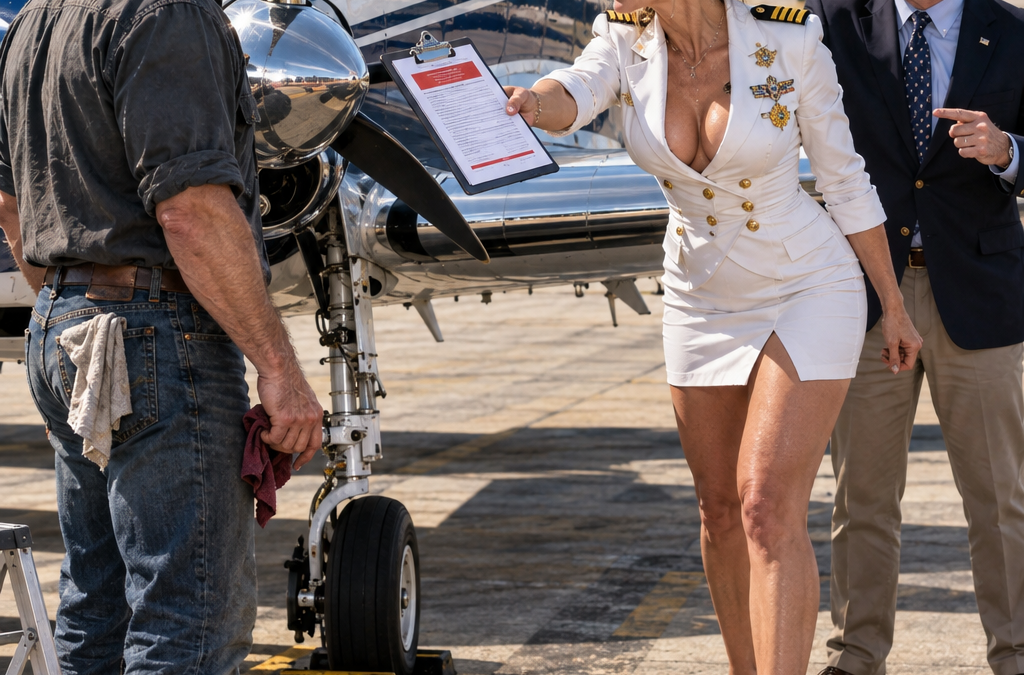
I had just finished my morning inspection when I saw her marching across the airport apron toward me like the concrete belonged to her.
Even from fifty yards away, I knew there was going to be trouble.
Victoria never walked anywhere casually.
She advanced.
A clipboard was clamped beneath one arm. Her phone was in her right hand. Oversized sunglasses rested on top of her blonde hair, which she’d pinned up in a loose, deliberately elegant twist.
And she was dressed like she’d confused a neighborhood association meeting with the bridge of a luxury yacht.
Her white military-style jacket fit her so tightly it looked tailored around every curve of her body. Gold buttons ran down the front, decorative epaulets sat on her shoulders, and the neckline plunged far lower than anything resembling an actual uniform ever would. The fitted skirt matched the jacket. White heels clicked against the concrete.
At forty, Victoria knew she was attractive.
More importantly, she knew other people knew it.
She had spent years turning charm into leverage and attention into authority.
Men who challenged her often found themselves smiling before they realized she’d insulted them. Women who opposed her discovered that Victoria could switch from sugary friendliness to cold humiliation in half a sentence.
She was president of the Silver Oaks Homeowners Association, a gated development built along the eastern boundary of Mercer Regional Airport.
For six years, she’d run Silver Oaks less like a neighborhood and more like occupied territory.
People didn’t simply disagree with Victoria.
They learned what disagreement cost.
Sudden violation notices.
Parking complaints.
Architectural reviews that somehow took four months.
Fines that appeared before residents could appeal the previous fines.
Anonymous reports about fences, trash cans, garden sheds, holiday decorations, basketball hoops, work vehicles, lawn height.
One retired couple had received three warning letters because their grandchildren left bicycles in the driveway for two afternoons.
Another homeowner had spent nearly seven thousand dollars fighting an order to remove a flagpole that had been on his property before the HOA even existed.
I knew all of that.
Which was why I’d spent almost two years avoiding her.
Unfortunately, Victoria had decided avoidance was no longer acceptable.
My name is Daniel Mercer.
I was fifty-two years old then, and I’d been flying for nearly thirty years.
Commercial work.
Cargo.
Charter.
Flight instruction.
Eventually, after saving for longer than I care to admit, I bought a used six-seat turboprop that became the closest thing I’d ever owned to a childhood dream.
She wasn’t huge.
She wasn’t flashy by private aviation standards.
But she was mine.
White fuselage.
Dark blue stripe.
Meticulously maintained engines.
A cabin I’d spent weekends restoring myself.
I kept her in Hangar Four at Mercer Regional, a small municipal airport that had existed long before Silver Oaks had manicured lawns, stone entrance gates, and homeowners paying obscene association fees for permission to paint their own front doors.
That morning, I’d pulled the airplane onto the apron because I was scheduled to fly to Tennessee later in the day.
I was checking the left landing gear when Victoria stopped beside the wing.
“Daniel.”
I kept looking at the tire.
“Victoria.”
“I’ve been calling you.”
“I know.”
“And emailing.”
“I know.”
“And apparently you’ve decided you’re too important to respond.”
That made me look at her.
“No. I’ve decided an HOA president has no reason to contact me about an airplane parked at a public airport.”
Her mouth tightened.
“There it is.”
“There what is?”
“The attitude.”
I straightened.
Victoria held out the clipboard.
A sheet of paper was clipped to it.
Across the top, in bold red letters, were the words:
VIOLATION NOTICE.
I stared at it.
Then at her.
Then back at it.
“You cannot be serious.”
“I’m very serious.”
“Victoria, my aircraft isn’t in Silver Oaks.”
“It is visible from Silver Oaks.”
“So are clouds.”
“Don’t be childish.”
“I’m not the one carrying a fake violation notice onto airport property.”
Her eyes hardened.
“It isn’t fake.”
I took the paper.
The notice accused me of violating Silver Oaks regulations regarding commercial equipment, visual obstruction, excessive noise, nuisance activity, and unauthorized vehicle storage.
Vehicle storage.
I almost laughed.
“You classified my airplane as an unauthorized vehicle?”
“It is a vehicle.”
“Not under your covenants.”
“It negatively affects property values.”
“You’re standing on city-owned airport property.”
“Which borders our community.”
“That doesn’t make it yours.”
Victoria folded her arms.
The movement pulled the white jacket even tighter across her chest.
“You have until sunset to relocate it.”
I thought I’d misheard her.
“Relocate what?”
“The airplane.”
“To where?”
“I don’t care.”
“Victoria, it lives here.”
“Then find somewhere else.”
I looked toward Hangar Four, twenty yards behind me.
“My lease with the airport says otherwise.”
“Your lease doesn’t supersede community standards.”
“It absolutely supersedes your standards because your standards don’t apply here.”
Her smile appeared.
It was the smile she used when she wanted someone to know punishment was coming.
“You should be careful about sounding so confident, Daniel.”
“And you should be careful about issuing orders outside your authority.”
For several seconds, neither of us moved.
Then she stepped closer.
Her perfume cut through the smell of fuel and warm pavement.
“I tried to handle this politely.”
“No. You tried to hand me a threat and call it a rule.”
“Residents have complained.”
“Which residents?”
“I don’t disclose confidential complaints.”
“Of course you don’t.”
“They’re tired of seeing your plane.”
“Then they can close their curtains.”
Her jaw tightened.
“They’re tired of the noise.”
“My airplane operates under the same airport noise procedures as every other aircraft here.”
“You start the engines early.”
“The airport opens at six.”
“People are sleeping at six.”
“Then complain to the airport authority.”
“I have.”
“And what did they tell you?”
That landed.
Her expression shifted for less than a second.
Enough.
I nodded.
“They told you the airport was here first.”
“They were dismissive.”
“They told you the truth.”
Victoria snatched the violation notice from my hand.
“You have until six tonight.”
“No.”
“You might want to reconsider.”
“I already considered it.”
“Daniel—”
“No.”
Her face changed.
The polished social smile disappeared.
What remained was colder.
“You’ve made your position very clear.”
“Good.”
She turned.
Then stopped.
Without looking back, she said, “Don’t say I didn’t give you an opportunity to cooperate.”
Her heels struck the pavement all the way back toward the access gate.
I watched her leave.
And I made the mistake of thinking that was the end of it.
At ten-thirty, airport manager Tom Bradley walked into my hangar carrying coffee and looking annoyed.
Tom had managed Mercer Regional for twelve years.
He was sixty, broad-shouldered, permanently sunburned, and allergic to unnecessary drama.
He held up his phone.
“Why is the Silver Oaks HOA president telling the mayor you’re operating an illegal commercial business out of Hangar Four?”
I closed my toolbox.
“Because I told her she can’t order me to move my airplane.”
Tom stared at me.
“That sentence gave me a headache.”
“Welcome to my morning.”
He showed me the email.
Victoria had copied the mayor, two city council members, the airport advisory board, the city attorney, and something called the Silver Oaks Community Safety Committee.
She claimed my aircraft was creating an “ongoing public nuisance,” lowering residential property values, violating municipal noise expectations, and possibly being used for “unlicensed commercial operations.”
Tom scrolled.
“She also says you became hostile and threatening.”
I looked at him.
“Did she mention she marched onto the apron in heels and handed me an HOA violation?”
“No.”
“Interesting omission.”
Tom sighed.
“Do you have cameras?”
I pointed toward the hangar roof.
“Three.”
“Good.”
“You think I need the footage?”
“I think anyone who writes an email like this before lunch is planning something after lunch.”
That sentence stayed with me.
At noon, I received the first call from an airport board member.
At twelve-fifteen, another.
At twelve-thirty, a city employee asked whether I was operating unauthorized charter flights.
At one, my hangar neighbor, Frank Delgado, called me from the fuel pumps.
“You got company.”
I stepped outside.
A white SUV sat beyond the security fence.
Victoria was behind the wheel.
Two women stood beside her taking photographs.
“Who are they?”
“No idea.”
Frank adjusted his baseball cap.
“They’ve been photographing your hangar for ten minutes.”
I walked toward the fence.
Victoria rolled down the window before I reached it.
“Daniel.”
“Victoria.”
One of the women lifted her phone.
I stopped.
“You recording me?”
Victoria smiled.
“This is a public-interest matter.”
“No. This is harassment.”
“We’re documenting ongoing violations.”
“From outside airport property this time?”
Her smile slipped.
“You’re becoming very confrontational.”
“I’m standing twenty feet from my own hangar asking why you’re photographing me.”
Victoria looked toward the aircraft.
“It’s still here.”
“Yes.”
“I gave you a deadline.”
“You don’t have the authority to give me one.”
“We’ll see.”
She rolled the window up.
Then drove away.
That afternoon I did something I should have done that morning.
I called an attorney.
Her name was Rachel Kim.
Rachel handled aviation and commercial property issues and had a talent for stripping emotional arguments down to the few facts that mattered.
I explained the situation.
There was silence.
Then she said, “She issued you an HOA violation for an airplane parked on municipal airport property?”
“Yes.”
“Do you own property in Silver Oaks?”
“No.”
“Is your hangar lease connected to Silver Oaks?”
“No.”
“Does the HOA possess any recorded easement, covenant, leasehold, or enforcement authority over airport property?”
“No.”
Another pause.
“Daniel?”
“Yeah?”
“Do not argue with this woman anymore.”
“Believe me, I’d love that.”
“Document everything. Communicate in writing. Save video. Save emails. And if she enters secured airport property without authorization, call airport security.”
“That serious?”
“Someone who knows she has no authority but continues pretending she does can become more dangerous than someone who is simply confused.”
At five-forty that evening, Victoria returned.
This time she wasn’t alone.
Three vehicles pulled up near the airport administration building.
Victoria’s white SUV.
A pickup truck belonging to Silver Oaks security.
And a tow truck.
That was the moment the situation stopped being ridiculous.
I had been standing beside my airplane with Frank when the vehicles came through the service entrance.
Frank lowered the rag he’d been using to wipe grease from his hands.
“Tell me that’s not for you.”
“It better not be.”
The tow truck stopped twenty yards from my aircraft.
Victoria climbed out.
Same white military-style outfit.
Same sunglasses.
Same clipboard.
But now she had two Silver Oaks security guards with her.
Neither was a police officer.
Neither had authority at the airport.
One was a heavyset man named Rick who I’d seen patrolling Silver Oaks in a black SUV.
The other looked young enough to still be embarrassed by what he was doing.
Victoria checked her watch.
“Five-forty-three.”
I walked toward her.
“What is this?”
“Enforcement.”
“Get the tow truck off the apron.”
“You ignored a lawful directive.”
“No, I ignored you.”
The tow-truck driver leaned out his window.
“Ma’am, you told me this was a vehicle impound.”
“It is.”
He looked at my turboprop.
Then at me.
Then back at Victoria.
“That’s an airplane.”
“I’m aware.”
He killed the engine.
“I’m not towing an airplane.”
Victoria turned sharply.
“You accepted the job.”
“Lady, you said disabled vehicle.”
“It is a vehicle.”
“It has wings.”
Frank coughed to hide a laugh.
Victoria glared at him.
Then at the driver.
“I am authorizing you to remove it.”
The driver pointed at me.
“He own it?”
“Yes.”
“Did he call for a tow?”
“No.”
“Airport call?”
“No.”
“Police?”
“No.”
He started his engine.
Victoria stepped toward the truck.
“Where do you think you’re going?”
“Away from whatever this is.”
He backed out.
I almost felt sorry for her.
Almost.
Then she turned on me.
“This isn’t funny.”
“I didn’t laugh.”
“You humiliated me.”
“I didn’t hire the tow truck.”
“You deliberately created a scene.”
“You brought a tow truck to an airport to confiscate an airplane.”
One of the security guards looked at the ground.
Victoria saw it.
“Rick.”
The older guard straightened.
“Yes, ma’am.”
“Secure the aircraft.”
My stomach dropped.
I stepped between them and the plane.
“No.”
Victoria pointed past me.
“Place a notice on it and prevent removal.”
“Do not touch my aircraft.”
“Daniel, step aside.”
“Rick, if you walk past me, you’re entering a federally regulated operational area without airport authorization.”
Rick hesitated.
Victoria snapped, “You work for me.”
That told me everything I needed to know.
Not the board.
Not the neighborhood.
Me.
That was how Victoria understood authority.
Personal possession.
Rick took one step.
A voice boomed behind us.
“That’s far enough.”
Tom Bradley was walking across the apron with an airport security officer beside him.
Tom looked angrier than I’d ever seen him.
“Who authorized these vehicles onto my apron?”
Victoria raised her chin.
“I did.”
Tom stopped.
“You?”
“As HOA president.”
“This is an airport.”
“I’m well aware of where I am.”
“Then you should understand that you do not authorize access.”
Victoria opened her clipboard.
“Silver Oaks has documented—”
Tom cut her off.
“I don’t care what Silver Oaks documented. Get your security personnel and vehicles off airport property.”
Her cheeks reddened.
“You don’t speak to me that way.”
“I just did.”
“I’ll call the mayor.”
“Call the governor if you want. Do it outside the gate.”
For one glorious moment, Victoria had no response.
Then she looked at me.
Not Tom.
Me.
And I saw something in her expression that should have worried me more than it did.
Humiliation.
Pure, concentrated humiliation.
She walked back to her SUV.
Before getting inside, she said quietly, “This isn’t over.”
Tom waited until she left.
Then he looked at me.
“You need to take this seriously.”
“I am now.”
“No. I mean seriously.”
He pointed toward the cameras above the administration building.
“I’ve been running airports long enough to know the difference between somebody complaining and somebody escalating.”
Frank nodded toward the gate.
“She’s escalating.”
Tom looked at the airplane.
“If you’re not flying tonight, put it inside.”
I did.
For the next week, Victoria attacked everywhere she thought pressure might work.
Silver Oaks residents received an email claiming I had verbally abused HOA representatives.
A community newsletter accused “certain airport users” of endangering neighborhood safety.
A petition began circulating demanding restrictions on early-morning flights.
Someone filed a complaint alleging fuel contamination near my hangar.
Another complaint claimed I stored hazardous chemicals illegally.
Inspectors came.
They found nothing.
Then the city received photographs suggesting I’d damaged landscaping near the airport boundary.
I hadn’t.
Rachel responded to every complaint.
Short.
Factual.
Documented.
Victoria hated facts.
Facts couldn’t be intimidated.
Three days after the tow-truck incident, Rachel sent her a formal cease-and-desist letter.
Victoria responded with six pages.
Rachel called me afterward.
“I haven’t seen this much confidence combined with this little legal understanding in years.”
“What did she say?”
“She claims the HOA has an implied authority to regulate any activity that materially affects residents.”
“That’s not a thing, is it?”
“Not the way she thinks.”
“Anything else?”
“She accused you of intimidation.”
“Of course.”
“And she threatened to pursue emergency injunctive relief.”
“Can she?”
“Anyone can file something.”
“Can she win?”
“Not based on what I’ve seen.”
I leaned back in my chair.
“Then we’re okay.”
Rachel didn’t answer immediately.
“What?”
“Legal weakness doesn’t mean behavioral predictability.”
That was the second warning I failed to appreciate enough.
The next escalation came at my house.
I didn’t live in Silver Oaks.
I lived four miles away in a small brick ranch on an ordinary street where nobody measured mailbox height.
At seven-twenty one evening, my doorbell camera alerted me.
Victoria stood on my porch.
White fitted jacket.
Deep neckline.
Gold buttons.
Clipboard.
She had brought two Silver Oaks board members with her.
I opened the door but kept the storm door locked.
“Why are you here?”
“To resolve this.”
“You have my attorney’s contact information.”
“I’m not speaking to your attorney. I’m speaking to you.”
“No, you’re leaving.”
One of the board members, a gray-haired man named Harold, shifted uncomfortably.
“Daniel, maybe we can all just talk.”
“About what?”
Victoria answered.
“About your refusal to cooperate.”
“My airplane is at an airport.”
“We’ve established that.”
“Then we’re done.”
“You live near our community. You use roads adjacent to our community. Your aircraft impacts our community.”
“None of that gives you control over me.”
Her eyes narrowed.
“You really enjoy saying that.”
“Because you keep pretending otherwise.”
She placed one hand against the storm door.
“You’ve embarrassed me repeatedly.”
There it was.
Not noise.
Not property values.
Not safety.
Her.
I lowered my voice.
“That is not my problem.”
“It became your problem the moment you decided to challenge me publicly.”
Harold turned toward her.
“Victoria.”
She ignored him.
“You think because Tom Bradley shouted at me in front of employees that you’ve won something?”
“I think you need to leave my property.”
“You think because your little lawyer writes threatening letters—”
“Leave.”
“You have no idea how many people I can make miserable.”
Harold spoke again.
“Victoria, that’s enough.”
She looked at him.
It was astonishing how quickly her expression changed.
“What did you say?”
“I said that’s enough.”
Something passed between them.
Fear on his face.
Rage on hers.
Then she smiled.
“Of course.”
She stepped away from my door.
“Have a good evening, Daniel.”
The smile remained until she reached her SUV.
The next morning, Harold called me.
“I owe you an apology.”
“You don’t owe me anything.”
“I should’ve stopped this earlier.”
“You’re on the board?”
“Treasurer.”
“Then maybe you can.”
He sighed.
“It’s not that simple.”
“Why?”
“Because Victoria keeps records on everybody.”
“What kind of records?”
“Violations. Complaints. Personal disagreements. Who voted against what. Who asked for exceptions. Who owes fees. Who has landscaping disputes. She uses information.”
“That’s called intimidation.”
“I know.”
“Then vote her out.”
“People are afraid of her.”
“She’s an HOA president, Harold. Not a warlord.”
“You don’t live there.”
There was more exhaustion than humor in his voice.
Then he said something that changed how I saw the entire conflict.
“This isn’t about your airplane anymore.”
“I figured that out.”
“No. You don’t understand. People saw someone tell her no.”
I said nothing.
“That’s what she’s fighting.”
The following Friday, I arrived at the airport just after six-thirty in the morning.
I was flying to Knoxville for a business meeting.
The sky was clear.
Wind calm.
Visibility nearly unlimited.
I pulled the aircraft from the hangar, completed the walk-around, checked fuel, inspected the control surfaces, and loaded my overnight bag.
At seven-ten, a white SUV appeared beyond the perimeter fence.
My stomach tightened.
Victoria.
She parked near the access gate.
I called Tom.
“She’s here.”
He sounded tired.
“Inside or outside?”
“Outside.”
“Then ignore her.”
I tried.
At seven-twenty, she began filming.
At seven-thirty, another Silver Oaks vehicle arrived.
At seven-forty, three residents gathered with signs about aircraft noise.
Victoria stood in front of them like a commander addressing troops.
Her white jacket gleamed in the morning sun.
Her phone stayed pointed at me.
I completed my checklist.
Engine start was scheduled for seven-fifty.
At seven-forty-eight, Tom’s voice came over my headset.
“Daniel, hold position.”
I looked toward the administration building.
“What’s going on?”
“Possible gate breach.”
My pulse changed immediately.
Airport operations weren’t like neighborhood streets.
You didn’t casually wander onto a movement area.
Propellers, taxiing aircraft, fuel trucks, jet blast—small mistakes became catastrophic quickly.
Then I saw the gate opening.
Victoria’s SUV came through.
“Tom.”
“I see it.”
The SUV accelerated onto the apron.
I shut down the startup sequence.
Victoria drove directly toward my airplane and stopped approximately thirty feet in front of the nose.
I climbed out.
“What the hell are you doing?”
She got out holding a thick folder.
Behind her, one of the protesters filmed through the fence.
Victoria smiled.
“You can’t depart.”
“Move your car.”
“You’ve been served.”
She held up the folder.
“What is that?”
“Emergency community enforcement order.”
“From what court?”
“The Silver Oaks board.”
I stared at her.
“Move your car.”
“Not until you acknowledge receipt.”
“Victoria, you are obstructing an active airport apron.”
“This will take thirty seconds.”
“Move it now.”
She walked closer.
“You don’t give me orders.”
“Apparently nobody does.”
That struck hard.
Her face flushed.
Sirens sounded near the administration building.
Airport security.
Victoria looked toward them.
Then back at me.
And suddenly she laughed.
“You really called security again?”
“I didn’t have to.”
“You enjoy this, don’t you?”
“Enjoy what?”
“Making me look powerless.”
I took one step toward her.
“You are powerless here.”
The moment the words left my mouth, I regretted them.
Not because they were wrong.
Because of what they did to her.
Her expression became completely still.
I had seen angry people before.
I’d seen passengers scream, pilots panic, businessmen threaten lawsuits, drunk men become violent.
What I saw in Victoria wasn’t ordinary anger.
It was a person whose identity depended on control realizing control was gone.
She walked back toward the SUV.
For one second I thought she’d finally leave.
Instead, she opened the driver’s door and turned.
“You want powerless?”
I didn’t understand.
“What?”
“I’ll show you powerless.”
She got in.
The engine started.
Airport security was less than a hundred yards away.
I raised both hands.
“Victoria, back out slowly.”
She stared through the windshield.
The SUV reversed.
Twenty feet.
Thirty.
Forty.
For one hopeful second, I thought she was turning around.
Then the brake lights disappeared.
The engine roared.
The SUV surged forward.
Straight toward me.
I froze.
Not because I didn’t understand what was happening.
Because I understood it too late.
Frank shouted from near Hangar Five.
“DANIEL!”
I jumped sideways.
The SUV passed close enough that I felt air move against my clothes.
Then came the sound.
Metal hit aluminum with a deep, violent crunch that didn’t sound anything like car accidents on television.
The SUV slammed into the left forward section of my aircraft.
The impact threw fragments across the apron.
A headlight exploded.
The hood folded upward.
The airplane rocked violently on its landing gear.
For half a second, everything became silent in my head.
Then alarms.
Shouting.
A horn stuck continuously.
Fluid dripping.
Someone screaming behind the fence.
I ran toward the plane.
“Kill the engine!”
Victoria’s SUV engine was still running.
Steam rose from the crushed hood.
The front bumper had wedged beneath part of the fuselage.
The airplane’s skin was torn and deeply buckled near the impact area.
My first thought wasn’t money.
It wasn’t insurance.
It wasn’t even the aircraft.
Fuel.
I smelled something sharp.
“Everybody back!”
Frank was already running toward me.
“Leak?”
“I don’t know.”
Airport security vehicles skidded to a stop.
Tom jumped out before his truck had fully settled.
“Clear the apron! Now!”
The SUV driver’s door opened.
Victoria stepped out.
There was blood at the corner of her mouth.
One heel was missing.
Her white jacket had opened at the collar, one gold button hanging loose.
Her hands shook.
But what I remember most was her expression.
She looked confused.
Almost offended.
As though the airplane had somehow violated the rules by not moving out of her way.
Then she pointed at me.
“He stepped in front of me.”
Nobody spoke.
Victoria looked around.
“He blocked me.”
Frank’s mouth fell open.
“You drove into his airplane!”
“He provoked me!”
Tom shouted, “Nobody move!”
A city police cruiser came through the gate.
Then another.
Victoria turned toward the officers.
“I’m the HOA president for Silver Oaks. This man has been threatening me for weeks.”
I couldn’t believe what I was hearing.
One officer approached her.
“Ma’am, step away from the vehicle.”
“You need to speak to him.”
“Step away from the vehicle.”
“He caused this.”
The officer’s tone hardened.
“Ma’am.”
Victoria finally obeyed.
Another officer came to me.
“Are you injured?”
“I don’t think so.”
“Did the vehicle strike you?”
“No.”
“How close?”
“Maybe three feet.”
Frank interrupted.
“Closer.”
The officer looked at him.
“You witnessed it?”
“All of it.”
Then Tom said, “So did approximately twelve cameras.”
Victoria heard him.
I watched the color drain from her face.
Within minutes, firefighters arrived.
The airport temporarily suspended operations around the apron.
Police separated witnesses.
Photographs were taken.
The SUV was shut down.
No major fuel leak developed, but the aircraft was damaged badly enough that there was no question it was going nowhere.
I stood behind a security vehicle watching firefighters inspect the fuselage.
My hands wouldn’t stop shaking.
Rachel called after Tom contacted her.
“Daniel.”
“I’m here.”
“Are you hurt?”
“No.”
“Are you sure?”
“I don’t know.”
“Sit down.”
“I’m fine.”
“Sit down anyway.”
I sat on a concrete barrier.
She asked me what happened.
I told her.
When I finished, she was silent.
Then she said, “Do not speak to Victoria.”
“She’s telling police I caused it.”
“Let her.”
“Rachel—”
“Daniel. Listen to me. Let her talk.”
Across the apron, Victoria was doing exactly that.
Talking.
Pointing.
Gesturing.
Explaining.
The more the officers listened, the more frantic she became.
One asked her to place her hands behind her back.
She recoiled.
“What?”
“Ma’am, turn around.”
“Excuse me?”
“Turn around and place your hands behind your back.”
“You don’t understand who I am.”
The officer didn’t blink.
“Turn around.”
“I am the president of Silver Oaks.”
“Ma’am.”
“You cannot handcuff me in front of these people.”
And there it was again.
Not that she hadn’t done anything wrong.
Not that an arrest would be unjust.
In front of these people.
That was what mattered.
The audience.
The humiliation.
Victoria looked toward me as the officer cuffed her.
The hatred in her face was so intense it almost made me step backward.
“You did this!” she screamed.
The officer guided her toward the cruiser.
“You ruined everything!”
I said nothing.
“You think this is over?”
Another officer closed the rear door.
For the first time in weeks, Victoria stopped talking.
The silence lasted maybe five seconds.
Then she began shouting through the glass.
The police obtained surveillance footage immediately.
There were multiple angles.
One from the administration building.
One from my hangar.
One from the fuel station.
Another from a maintenance shop across the apron.
The video was unambiguous.
Victoria reversed.
Paused.
Accelerated forward.
I moved out of the path.
The SUV struck the aircraft.
There was no accidental roll.
No blocked exit.
No mechanical confusion visible in the footage.
No one forced her vehicle anywhere.
She had made a decision.
Maybe it lasted two seconds.
Maybe less.
But decisions don’t need much time to change your life.
The airplane was grounded indefinitely.
Initial repair estimates were brutal.
Fuselage damage.
Structural inspection.
Possible engine and mount concerns from the force transmitted through the airframe.
Landing gear alignment checks.
Propeller clearance review.
Avionics inspection.
Insurance adjusters.
Engineers.
Photographs.
Reports.
More reports.
An aircraft that had been worth hundreds of thousands of dollars the previous morning was suddenly a question mark.
I walked into the hangar that afternoon and stared at the empty space where she normally sat.
That hurt more than I’d expected.
I’d worked for that airplane.
Not inherited it.
Not bought it on impulse.
Worked.
Overtime.
Night freight.
Missed holidays.
Years of saving.
Years of telling myself, Someday.
And one person’s rage had reduced all of that to bent metal behind caution tape.
I kicked a plastic bucket across the floor.
It slammed against the wall.
Then I sat on my workbench and put my face in my hands.
For the first time since the crash, I let myself be angry.
Not irritated.
Not frustrated.
Angry.
The kind that makes your chest hurt.
Frank found me twenty minutes later.
He leaned against the hangar doorway.
“You okay?”
“No.”
“Good.”
I looked up.
He shrugged.
“Anybody who says they’re okay after that is lying.”
I laughed once.
It sounded terrible.
“They might total her.”
“The plane?”
“Yeah.”
Frank looked toward the apron.
“I’m sorry.”
“I should’ve moved it.”
He frowned.
“Don’t do that.”
“If I’d flown earlier—”
“Don’t.”
“If I’d put it inside—”
“Daniel.”
I looked at him.
“You don’t rearrange your life because somebody else refuses to behave like a human being.”
I knew he was right.
It didn’t make the hangar feel less empty.
By evening, the story had spread.
Not just through Silver Oaks.
Through the entire county.
Someone had filmed Victoria’s arrest from outside the fence.
Another resident had captured the sound of the impact.
The local news showed up before sunset.
By the next morning, video from one of the airport cameras had been obtained through the city and was everywhere locally.
Victoria Hale, HOA president, driving her luxury SUV into a private airplane after a dispute.
There was no elegant way to spin that.
She tried anyway.
Through an attorney, she released a statement claiming she’d suffered emotional distress after weeks of intimidation and that the collision was an accident occurring during a “highly charged confrontation.”
Then additional footage surfaced.
The tow truck.
Her unauthorized entry.
Her standing on my porch.
Her words from my doorbell camera:
“You have no idea how many people I can make miserable.”
Rachel watched the footage twice.
“That sentence is going to follow her for a long time.”
It did.
The Silver Oaks board scheduled an emergency meeting forty-eight hours after Victoria’s arrest.
Harold called me before it happened.
“Residents are furious.”
“At me?”
“Some. Mostly her.”
“What happens now?”
“There’s a vote to remove her as president.”
I sat quietly.
Harold continued.
“People are talking.”
“About what?”
“Everything.”
The violations.
Selective enforcement.
Threats.
Retaliation.
Fines.
Board decisions made without proper votes.
Association money spent on lawyers for personal disputes.
Security staff being instructed to follow residents.
Records kept on homeowners who challenged her.
Once the fear cracked, people started comparing notes.
That was Victoria’s real disaster.
Not the SUV.
Not the airplane.
The loss of isolation.
Bullies survive by convincing everyone they’re suffering alone.
One person thinks the mysterious fine is only happening to them.
Another thinks the delayed approval is coincidence.
Another decides staying quiet is easier.
But once people start talking, patterns appear.
And patterns create courage.
Victoria was removed from the presidency by an overwhelming vote.
Then removed from the board entirely.
The HOA’s attorney resigned from representing her personally after making clear the association would not pay for her criminal defense.
Rick, the security supervisor, gave investigators copies of messages showing Victoria had ordered him to “immobilize the aircraft by any means short of damage” during the tow-truck incident.
The younger guard confirmed she’d repeatedly told employees the airport had “no choice but to comply” once she created enough political pressure.
The tow-truck driver provided his dispatch records.
Tom supplied gate-access logs.
I supplied emails, video, violation notices, and doorbell footage.
Rachel built a timeline.
It was nearly forty pages long.
Reading it made me realize something frightening.
Each incident, by itself, looked almost silly.
An email.
A threat.
A fake notice.
A tow truck.
A visit to my house.
A protest.
A gate violation.
But lined up together, they formed something else.
Escalation.
A person testing boundaries.
Then responding to each boundary by pushing harder.
The criminal case took months.
Victoria was charged with offenses related to property damage, reckless conduct, unauthorized airport access, and the danger created by using her SUV the way she had.
Her attorney argued she had panicked.
Prosecutors argued the video showed deliberate acceleration.
I attended only when required.
I didn’t want to build my life around watching hers collapse.
That surprised people.
Some expected me to enjoy it.
I didn’t.
I wanted accountability.
I wanted restitution.
I wanted her nowhere near me.
But sitting in a courtroom celebrating another person’s destruction didn’t feel like victory.
The day I testified, Victoria arrived wearing navy blue instead of white.
No military-style jacket.
No gold buttons.
No theatrical authority.
Just a conservative suit.
For the first time since I’d met her, she looked smaller than the room she occupied.
Her attorney asked whether I’d deliberately antagonized her.
“No.”
“Did you tell Ms. Hale she was powerless?”
“At the airport, yes.”
“Could that be interpreted as provocative?”
“It could be interpreted as accurate.”
The prosecutor tried not to smile.
Her attorney didn’t.
“You knew she was upset?”
“Yes.”
“And you continued challenging her authority?”
“What authority?”
“Her role as president of the Silver Oaks Homeowners Association.”
“I wasn’t a member.”
“That’s not what I asked.”
“It matters.”
“Mr. Mercer—”
“My aircraft was parked on municipal airport property. She had no jurisdiction over me, the airplane, my hangar lease, airport operations, or the apron. So when you ask whether I challenged her authority, my answer is that I refused to pretend she had authority she did not have.”
The courtroom stayed quiet.
Her attorney shifted.
“Could you have simply moved the aircraft temporarily?”
“Yes.”
“Yet you refused.”
“Yes.”
“So this entire conflict might have been avoided had you cooperated.”
I looked toward Victoria.
Then back at him.
“No.”
He raised an eyebrow.
“No?”
“If I had moved it that day, we wouldn’t have avoided the conflict. I would have taught her that threats worked.”
Her attorney objected.
The judge allowed me to finish narrowly.
I said, “I was legally entitled to keep my aircraft in the hangar and operational areas covered by my lease. I did not believe I should surrender that right because someone threatened me.”
That was all.
Outside court, Victoria approached me before her attorney could stop her.
“Daniel.”
Rachel immediately stepped between us.
“Do not speak to my client.”
Victoria looked past her.
Her face had changed over the months.
Still beautiful.
Still carefully made up.
But the absolute certainty was gone.
“Do you have any idea what you’ve done to my life?”
Rachel said, “Victoria.”
But I answered.
“I didn’t drive your SUV.”
Her mouth tightened.
“You pushed me.”
“No.”
“You embarrassed me over and over.”
“You embarrassed yourself.”
“I spent six years building that community.”
“You spent six years making people afraid of you.”
Her eyes filled with anger.
For a moment, I saw the old Victoria return.
Then something stopped her.
Maybe the courthouse.
Maybe the charges.
Maybe months of consequences.
She lowered her voice.
“I lost everything.”
I looked at her.
“No. You lost control.”
That hurt more.
I could see it.
She turned and walked away.
I never had another private conversation with her.
The civil case lasted longer.
My insurance company paid part of the aircraft claim and then pursued recovery.
Structural specialists eventually concluded the repairs were possible, but economically difficult to justify.
The final decision was one I had dreaded from the moment I saw the crushed fuselage.
The aircraft was declared a total loss.
I stood beside her one final time before the insurer took possession.
The left side had been partially opened for inspection.
Panels removed.
Interior exposed.
The blue stripe I’d spent hours polishing was broken by damage marks and inspection tape.
I put my hand against the fuselage.
Ridiculous, maybe.
Machines aren’t people.
I knew that.
But sometimes objects contain years of a person’s life.
A truck your father taught you to drive.
A watch your wife gave you.
A house where your children grew up.
An airplane you spent half your career believing you’d never be able to afford.
Losing the metal wasn’t the hardest part.
Losing what it represented was.
Frank stood several feet away giving me space.
I whispered, “You deserved better.”
Then I laughed softly at myself.
“Listen to me talking to an airplane.”
Frank said, “I’ve heard pilots say stranger things.”
I looked at him.
“Thanks.”
“For what?”
“Being there.”
He shrugged.
“You’d have done the same.”
He was right.
Eventually, restitution became part of Victoria’s legal consequences, though insurance and civil settlements made the financial details complicated.
She entered a negotiated resolution rather than forcing every charge through a full trial.
There were penalties.
Probation.
Court-ordered restitution obligations.
Restrictions connected to the airport.
And a permanent public record of the day she turned a neighborhood dispute into a criminal case.
Silver Oaks changed too.
Harold became interim president.
His first message to homeowners was four paragraphs long.
No threats.
No red letters.
No fake urgency.
The new board commissioned an independent review of previous enforcement actions.
Dozens of fines were reversed.
Several homeowners received refunds.
Architectural requests were reconsidered.
Security procedures changed.
Board meetings began being recorded.
Major enforcement decisions required multiple signatures instead of one president’s approval.
Residents could request records without going through the person whose conduct they were challenging.
Months later, Harold invited me to a Silver Oaks meeting.
I almost said no.
Then he explained why.
“There are people who want to apologize.”
“They don’t owe me one.”
“Some feel like they do.”
I went.
Not because I needed an apology.
Because I was curious.
The clubhouse was packed.
I’d expected hostility.
Instead, an elderly man walked up before the meeting and shook my hand.
“My wife and I almost moved because of her.”
A woman in her thirties said Victoria had fined her repeatedly after she objected to an HOA landscaping contract.
Another resident told me he’d stopped attending meetings because Victoria mocked him publicly every time he spoke.
One by one, people told stories.
Different details.
Same pattern.
Control.
Retaliation.
Humiliation.
Fear.
At the meeting, Harold stood behind the podium.
“Two months ago,” he said, “we thought our biggest problem was an airplane.”
A few people laughed.
He looked at me.
“It wasn’t.”
The room grew quiet.
“Our biggest problem was that we allowed one person’s authority to become more important than the rules that authority was supposed to serve.”
That sentence stayed with me.
Because authority isn’t automatically bad.
Rules aren’t automatically oppression.
HOAs, city governments, airport managers, police officers, judges—all of them need authority to function.
But authority without limits becomes something else.
And people like Victoria are very good at exploiting the moment others stop asking where those limits are.
After the meeting, I walked toward the parking lot.
Harold followed.
“Buying another plane?”
I smiled.
“Maybe.”
“That’s not an answer.”
“It’s the answer my bank account prefers.”
He laughed.
Then became serious.
“For what it’s worth, I’m sorry.”
“You already said that.”
“I know.”
I looked back at the clubhouse.
“You know what bothered me most?”
“The airplane?”
“No.”
“The threats?”
“Not even those.”
He waited.
“The number of people who told me they knew she was like this.”
Harold looked down.
I continued.
“Everybody knew. But everyone thought someone else would eventually stop her.”
He nodded slowly.
“Fear makes people quiet.”
“So does convenience.”
“Fair.”
I shook his hand.
“Don’t let the next president become her.”
“We won’t.”
“Good.”
About eight months after the crash, I bought another airplane.
Not new.
Not extravagant.
A used turboprop with more hours than my old one and an interior that smelled faintly of leather cleaner and somebody else’s coffee.
The first morning I rolled it onto the apron, I stopped for a long moment.
Same hangar.
Same concrete.
Same sunlight.
Frank walked over carrying two coffees.
“Well?”
I circled the airplane slowly.
“Left tire looks slightly low.”
He stared at me.
“You bought an airplane three days ago and that’s what you have to say?”
“I’m pacing myself emotionally.”
He handed me coffee.
Tom arrived five minutes later.
He inspected the aircraft like a suspicious father meeting his daughter’s boyfriend.
“She’s clean.”
“She is.”
“Records?”
“Complete.”
“Engines?”
“Good.”
“Insurance?”
“Painful.”
Tom nodded.
“Then welcome back.”
That meant more to me than he probably realized.
I loaded my bag.
Completed the walk-around.
Climbed into the cockpit.
For a second, my hand rested over the starter.
I remembered the SUV accelerating.
Metal folding.
Victoria screaming through the police-cruiser glass.
The empty hangar afterward.
All of it came back so clearly that I could almost hear the impact again.
Then I looked through the windshield.
The runway stretched ahead beneath a cloudless sky.
I started the engine.
The turbine began to turn.
A low whine rose into a smooth mechanical roar.
Frank stood beside the hangar and lifted his coffee in salute.
Tom watched from the administration building.
I taxied toward the runway.
At the hold-short line, I completed my final checks.
Then tower traffic cleared.
I advanced the power.
The airplane accelerated.
Faster.
Faster.
The runway markings rushed beneath me.
I eased back.
The wheels left the ground.
And just like that, all the noise below became small.
Roads.
Houses.
Fences.
Property lines.
Gates.
Signs.
The Silver Oaks development appeared off my right wing.
From altitude, the neighborhood didn’t look powerful.
It didn’t look threatening.
It looked like what it had always been.
A collection of houses beside an airport.
Nothing more.
I climbed through three thousand feet and turned south.
For months, people had asked whether I regretted refusing Victoria’s first demand.
The answer was complicated.
I regretted the damage.
I regretted the money.
I regretted the stress.
I regretted seeing something I’d worked decades to own destroyed in seconds.
I regretted the fear my family felt when the police called.
I regretted every hour spent with lawyers, adjusters, investigators, mechanics, and inspectors.
But I never regretted saying no.
Because that first morning, Victoria hadn’t really been asking me to move an airplane.
She was asking me to accept a lie.
The lie that confidence equals authority.
That intimidation creates jurisdiction.
That enough threats can transform an unreasonable demand into an obligation.
That if someone is loud enough, connected enough, attractive enough, wealthy enough, or feared enough, everyone else eventually has to move.
Sometimes they do.
Sometimes moving is easier.
Sometimes surrender costs less in the short term.
But every bully eventually meets a boundary.
A person.
A rule.
A locked gate.
A camera.
A courtroom.
Something that doesn’t care how important they believe themselves to be.
Victoria found hers on an airport apron.
She had arrived wearing white, carrying a clipboard, convinced that everyone around her existed inside the world she controlled.
She left in the back of a police cruiser.
Not because I defeated her.
Not because Tom did.
Not because Harold did.
And not even because the police did.
Victoria defeated herself the moment she decided being told no was an injury that justified anything she did next.
From the cockpit, Silver Oaks disappeared behind my right wing.
I looked ahead.
The sky was clear for miles.
And for the first time in a long time, nothing stood in my way.