𝗙𝗨𝗟𝗟 𝗦𝗧𝗢𝗥𝗬 She Put a Lien on My Grandpa’s Ranch, Then Learned He Had Measured That Land Before She Was Born
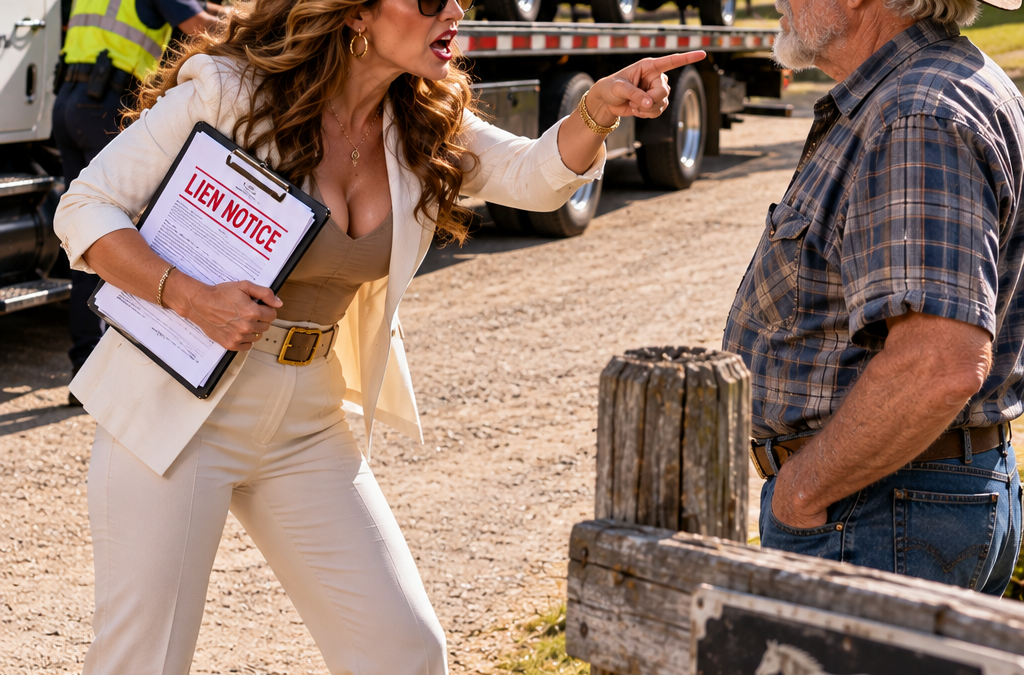
𝗙𝗨𝗟𝗟 𝗦𝗧𝗢𝗥𝗬
I read that amount three times.
Forty-five thousand dollars.
For an HOA he did not belong to.
For land his family owned before most of those houses were a developer’s daydream.
I looked at Gramps. “This is insane.”
He took a slow sip of coffee. “That’s what I said.”
“You’re not in their HOA.”
“No.”
“You never signed anything.”
“No.”
“Your land predates the subdivision by, what, a century?”
“Near enough.”
I looked back at the letter. “Then what the hell is this?”
“That,” he said, voice flat, “is a woman who thinks fancy paper makes a lie official.”
That was how it started.
Or at least that was the first time I saw it.
Karen had apparently been bothering him for weeks by then. She had shown up at the property line with a clipboard, taking pictures of his trucks through the fence. She had brought some kind of measuring device she clearly did not know how to use, making a show of pointing it around while one of her board members scribbled notes. Twice, she had tried to speak to him while he was working near the barn.
The first time, she told him his trucks were visible from HOA common areas and therefore subject to community standards.
Gramps told her, “So close your eyes.”
The second time, she claimed several homeowners had complained that his cattle operation was lowering property values.
Gramps told her, “The cows were here first.”
Karen did not appreciate that.
According to Gramps, she had smiled anyway.
That was what bothered me most.
Not the letters. Not the threats. The smile.
He described it as pretty, cold, and patient.
“She looked at me like I was a stain she already knew how to remove,” he said.
That made my stomach tighten.
I was thirty-four then, two hours away, busy with work and my own life. Since Grandma died, I tried to visit at least once a month, sometimes more. But Gramps was proud, and proud old men do not always tell you when trouble starts. They wait until trouble becomes a fire and then hand you the ashes like you should have smelled smoke earlier.
“Why didn’t you call me?” I asked.
He shrugged. “Didn’t think clipboard Barbie was worth bothering you over.”
That almost made me laugh.
Almost.
“Gramps, she’s demanding forty-five grand.”
“She can demand a pony too.”
“This isn’t just annoying. They’re threatening legal action.”
He looked out over the ranch toward the subdivision roofs beyond the fence.
“She doesn’t know where the line is.”
“You mean legally?”
He smiled slightly.
“I mean in every way.”
At the time, I thought we were dealing with a power trip. Ugly, yes. Stressful, definitely. But still a bluff.
Karen would send letters. Gramps would ignore them. Maybe we would have an attorney send a response. Eventually, the HOA would realize it could not bully a nonmember and back down.
That was my mistake.
Karen did not want compliance.
She wanted conquest.
For the next few weeks, things escalated.
More letters arrived. The language grew more threatening. The HOA claimed it had reviewed historical subdivision documents and determined that a “portion” of Gramps’s land fell under association control. They insisted the ranch had benefited from proximity to HOA amenities and therefore owed dues. They claimed the trucks violated restrictions on “visible derelict vehicles,” even though the vehicles were restored classics worth more than Karen’s white luxury SUV.
Then she started coming by in person.
I saw her once during a visit.
She arrived just before noon in that white SUV, stepping out in cream slacks, a fitted black blouse, and sunglasses large enough to hide most of her expression. Her hair fell in polished waves around her shoulders. She looked like she belonged in a real estate magazine, standing there beside the old fence like she was evaluating a property she had already bought.
Gramps was in the barn, so I walked down to meet her.
“Can I help you?” I asked.
She lowered her sunglasses just enough to look me over.
“And you are?”
“His grandson.”
“Oh.” Her smile appeared instantly. “Wonderful. Maybe you can help him understand the seriousness of the situation.”
That was my first real taste of Karen.
She did not speak to people. She arranged them.
“I understand he’s not in your HOA,” I said.
Her smile tightened. “That’s disputed.”
“No, it isn’t.”
“It is when boundaries are unclear.”
“The ranch has been here since 1905.”
“Age doesn’t exempt property from legal obligations.”
I almost admired the confidence.
Almost.
“You mean obligations he never agreed to?”
Karen stepped closer to the fence. Her perfume drifted over it, sweet and expensive and completely out of place among hay dust and engine oil.
“Your grandfather seems like a charming man,” she said, in a tone that meant the opposite. “But he is elderly, and sometimes elderly property owners misunderstand modern community structures.”
I felt my jaw tighten.
“Careful.”
Her eyebrows lifted.
“Excuse me?”
“He worked for the county surveyor’s office for forty years. If you’re going to accuse him of misunderstanding property lines, you should be careful.”
For the first time, her smile faltered.
Only for a second.
Then she recovered.
“Well, if he understands boundaries so well, I’m sure he’ll have no issue cooperating with a review.”
“What review?”
“The HOA board has authority to protect the community.”
“Not over his land.”
She slid her sunglasses back into place.
“We’ll let the attorneys sort that out.”
Then she got back in her SUV and drove away.
Gramps came out of the barn afterward wiping grease from his hands.
“Met Karen, huh?”
“Unfortunately.”
“She do the thing?”
“What thing?”
“Smile like she’s picking where to bury you?”
I looked at him.
He nodded once. “Yep. That’s the thing.”
I told him we needed to call a lawyer.
He said we would.
Soon.
Then, because he was still Gramps, he went back to rebuilding a carburetor like an HOA president had not just threatened a ranch his father had been born on.
Six months before everything ended, Karen stopped bluffing.
I got the call on a Thursday afternoon.
I was at work when my phone buzzed. Gramps rarely called during the day. Usually, he texted one-word updates like “alive” or “rain” or “bring filters.”
When I answered, he did not say hello.
“They took my trucks.”
I stood up so fast my chair rolled into the wall.
“What?”
“They took the Chevy, the Ford, and the C10.”
“Who took them?”
“The HOA.”
For a few seconds, I could not make the words fit together.
The HOA had taken his trucks.
From his ranch.
“How?”
“Towing company. I was at the doctor. Came back, they were gone.”
His voice was quiet.
Too quiet.
“What did they leave?”
“A notice.”
I was already grabbing my keys. “I’m coming.”
The two-hour drive felt longer than any drive of my life.
By the time I pulled into the ranch, the sun was dropping, and the space near the barn looked wrong. Empty. Violated. The spots where the three trucks usually sat were marked by tire tracks and scraped gravel.
Gramps was inside, pacing the living room.
He had the notice in his hand.
I had never seen him pace.
The paper stated that the vehicles had been removed due to violation of HOA community standards and were being held at an impound lot pending payment of outstanding association dues, penalties, and towing fees. It listed the back dues again: forty-five thousand dollars. Towing and storage fees: eighty-five hundred.
Total demanded: over fifty-three thousand dollars.
I felt heat rush up the back of my neck.
“They came onto your property.”
“Yes.”
“They towed legally registered, valuable vehicles.”
“Yes.”
“They’re holding them hostage for dues you don’t owe.”
“Yes.”
“And they filed a lien?”
He pointed to another paper on the table.
I picked it up.
The HOA had filed a lien with the county, claiming unpaid dues and assessments against the ranch.
I almost lost my mind.
A lien on property that had been in our family for 120 years.
A lien filed by a subdivision that did not exist when my great-great-grandparents built the first fence.
“This is criminal,” I said.
“Some of it might be.”
“We need a lawyer now.”
Gramps stopped pacing.
Then he smiled.
It was not a happy smile.
It was slow, calm, and almost gentle.
That scared me more than the pacing.
“We’ll get a lawyer,” he said. “But first, I need to do some homework.”
That was when Karen’s mistake became clear.
She thought Gramps was an old rancher with sentimental trucks.
She did not know he had retired from the county surveyor’s office after forty years of measuring, mapping, documenting, and correcting land boundaries all over the county. She did not know he had personally worked on records tied to that entire area decades earlier. She did not know he kept archives the way some men kept fishing lures.
And she definitely did not know he remembered boundary lines like other people remembered birthdays.
The next morning, Gramps took me to the back room.
I had always thought of it as the map room, though Grandma used to call it “that paper cave.” Filing cabinets lined two walls. Metal drawers held rolled surveys. Shelves sagged under binders labeled by township, range, road name, and year. There were deed copies, county maps, old aerial photographs, land grant records, survey notes, and notebooks filled with Gramps’s precise handwriting.
Everything legal.
Everything organized.
Everything dangerous to someone who had built a lie on sloppy boundaries.
He pulled a long tube from one drawer and unrolled a map across the worktable.
“This,” he said, smoothing the edge with one weathered hand, “is the original 1905 land grant.”
He pulled another.
“This is the 1978 county update survey.”
Another.
“This one I did myself.”
I looked at him. “You surveyed this area?”
“I surveyed half the damn county.”
For the next week, Gramps became a machine.
He dug out his old equipment, still maintained with obsessive care. He walked the ranch boundaries from sunrise until his knees forced him back inside. He checked markers, distances, angles, old notes, modern county records, and historical maps. I helped where I could, mostly by carrying things, driving stakes, and trying not to ask stupid questions.
He was seventy-eight years old, but when he worked a line, something in him became younger.
Sharper.
He knew how to read land. Not just papers, but the ground itself. Fence remnants. Tree lines. Drainage slopes. Old rock piles. The slight rise where a boundary marker had settled over decades. Watching him work was like watching someone read a language I had never learned.
On the third day, he stood near the back boundary between his ranch and the HOA common area and stared toward the clubhouse.
The clubhouse was a tasteful beige building with stone accents, a community pool behind it, and beyond that, a playground installed only a couple years earlier. It was the pride of the HOA, the place Karen photographed for newsletters and real estate listings. From certain homes, you could see it all: pool, clubhouse, playground, and beyond them, Gramps’s land.
Gramps stood with his old field notebook in one hand.
Then he started laughing.
Not loud.
Not joyful.
More like the land itself had told him a joke.
“What?” I asked.
He looked at me.
“They’re on my property.”
I followed his gaze.
“The fence?”
“No.”
“The landscaping?”
“No.”
He pointed.
“The clubhouse. The pool. Part of that playground.”
I stared at him.
“That can’t be right.”
“It is.”
“Gramps.”
He tapped the notebook. “Fifteen to twenty feet off in places. Maybe more depending on which monument their surveyor used.”
I looked toward the HOA facilities.
Their crown jewels.
Their pool. Their clubhouse. Their expensive playground.
All partly sitting on land they did not own.
I felt something shift inside me.
The fear did not disappear, but it changed shape.
Karen had towed his trucks and filed a lien because she believed the HOA had power over him. But if Gramps was right, the HOA had spent fifteen years using his land without permission.
“Who did their survey?” I asked.
Gramps’s mouth twitched.
“Funny thing.”
“What?”
“Man named Carl Whitaker.”
“Do you know him?”
“Not personally. But I know of him.”
He flipped through papers and pulled out a copy of the subdivision survey. “He’s Karen’s brother-in-law.”
For a moment, neither of us said anything.
Then I said, “You’re kidding.”
“Nope.”
“Could it be an honest mistake?”
“Could be.”
“Do you think it was?”
Gramps looked toward the clubhouse again.
“I think mistakes that profitable deserve daylight.”
We hired a lawyer two days later.
His name was Robert Harlan, a real estate attorney in the county seat who had been practicing property law long enough to know Gramps by reputation. When we walked into his office carrying maps, binders, deed copies, survey notes, and photographs, he looked curious.
When Gramps began laying everything out, curiosity turned into attention.
When he finished, Robert took off his glasses.
“I’ve been doing this twenty-two years,” he said. “I don’t think I’ve ever had a client walk in with a cleaner file.”
Gramps shrugged. “Paper beats yelling.”
Robert smiled. “It does.”
He recommended an independent licensed surveyor immediately. Not Gramps, not anyone connected to the HOA, not anyone who could be accused of bias. It cost thirty-five hundred dollars, which hurt, but Gramps paid without blinking.
“Truth costs less than confusion,” he said.
The independent survey took several days.
When the report came back, it confirmed everything Gramps had found.
The original subdivision survey was wrong.
Massively wrong.
Roughly 2,300 square feet of HOA common area sat on Gramps’s property. Portions of the clubhouse structure, the pool deck, and part of the playground encroached onto land legally owned by my grandfather.
The HOA had not just overreached.
They had built their showcase amenities across the line.
Robert’s next move was a quiet title action to have the court officially establish the true boundary. Then came the letter.
It was beautiful in the way legal letters can be beautiful when they are loaded and aimed correctly.
The letter went to the HOA and Karen personally. It laid out the boundary discrepancy, the improper lien, the unauthorized towing of Gramps’s vehicles, and the HOA’s fifteen-year use of land it did not own. It demanded immediate removal of the lien, immediate return of the trucks with all fees paid by the HOA, reimbursement for damages and emotional distress, and compensation for years of unauthorized use.
Robert calculated reasonable back rent for the land based on comparable local rates and commercial/common-area usage.
The number was approximately two hundred seventy-five thousand dollars.
I read the letter three times.
Then I looked at Gramps.
“You sure you don’t want to soften it?”
He sipped coffee in Robert’s conference room.
“She didn’t soften the tow truck.”
The letter gave them fourteen days.
Karen’s attorney called Robert within two hours.
Robert put the call on speaker after asking permission.
I will never forget the voice on the other end: loud, indignant, full of threats. Countersuits. Defamation. Abuse of process. Elderly confusion. Fraudulent surveys. Malicious interference with community property.
Robert let him talk.
Then he said, calmly, “I suggest you review the attached documentation before making further statements.”
The attorney kept sputtering.
Robert continued, “You have the original 1905 land grant, certified county records, a 1978 county survey, the independent surveyor’s report, and a side-by-side comparison showing the error in the subdivision survey. You also have documentation of the lien your client filed and the towing action conducted based on a legally unsupported claim. Call me back when you’re ready to discuss resolution.”
Then he hung up.
Gramps smiled.
The call came the next day.
The tone was different.
Much different.
This time, the HOA attorney wanted to “open a productive dialogue.”
Karen, however, did not.
According to people in the subdivision, she told residents my grandfather was attempting to extort the community. She claimed he had manufactured a boundary dispute because he was angry about vehicle enforcement. She said the old man was confused, manipulated by family, and trying to punish innocent homeowners.
She was good.
I will give her that.
Karen understood emotion better than law. She framed herself as protector of the community, a beautiful, determined president standing up to a greedy rancher and his opportunistic grandson. At first, some homeowners believed her.
Then documents started circulating.
Not from us directly.
From board members scared enough to leak them.
The independent survey. The land grant. The photographs of the trucks before towing. The lien paperwork. The fact that Carl, the original surveyor, was Karen’s brother-in-law.
That one changed the mood fast.
The emergency HOA meeting happened two weeks later.
I did not attend because I was not a member, and Gramps refused because, in his words, “I’ve got better things to do than watch frightened people discover arithmetic.”
But we heard about it.
Everyone heard about it.
The clubhouse was packed, which must have been painfully ironic given that part of it was on Gramps’s land. Karen stood at the front in a fitted navy dress, pearls at her throat, hair perfect, voice steady. She tried to control the room the way she always did.
She said the dispute was exaggerated.
She said legal counsel was handling it.
She said she had acted in the best interest of the community.
Then a homeowner named David stood up holding printed copies of the survey.
“Did you know Carl Whitaker was wrong when you filed the lien?”
Karen smiled. “We don’t know that he was wrong.”
“The independent survey says he was.”
“That survey was commissioned by an adverse party.”
“It matches county records.”
Her smile tightened.
Another homeowner asked, “Why did you tow vehicles from property we don’t own?”
Karen said, “The board acted based on available information.”
Someone shouted, “You acted based on your brother-in-law’s survey.”
Then someone else asked about the legal bills.
Someone asked whether HOA insurance would cover intentional misconduct.
Someone asked whether their dues would go up because Karen had started a fight with a man whose land the HOA had built on.
That was when control left the room.
People who had tolerated her letters and fines and little abuses suddenly realized her arrogance might cost them real money. Not annoyance money. Not mailbox-fine money. Big money. Pool-and-clubhouse money.
Morality had not moved them all.
Liability did.
Karen tried to speak over the shouting.
Then Margaret Bell, a retired school principal who had lived in the subdivision since the first homes were built, stood up and asked one question.
“Did you ever verify his deed before you filed that lien?”
The room went quiet.
Karen said nothing for too long.
Margaret nodded.
“That answers it.”
By the end of the meeting, Karen was removed as HOA president in a vote that was not even close.
But losing the title was only the beginning.
Once homeowners started digging, they found patterns. Contracts awarded to friends. Landscaping bids that did not make sense. Administrative fees to people close to Karen. Legal consultation expenses connected to her personal vendettas. The HOA board had been operating under her charm and fear for years, and now everyone wanted receipts.
A group of homeowners sued Karen personally for breach of fiduciary duty.
The quiet title action moved forward too.
It was not dramatic in the way movies make court dramatic. No one gasped. No one shouted confession from the witness stand. It was mostly documents, testimony, survey reports, and experts explaining boundaries in careful language.
But to me, every minute mattered.
The HOA’s entire argument depended on a bad survey and a president too proud to admit she had built a war on it. Their attorney tried to suggest the issue was complicated, that historical boundaries could be interpreted, that the community had relied on the original subdivision plans in good faith.
Robert stood and said, “Reliance does not create ownership.”
That line stuck with me.
Because it was the whole case.
They had relied on a mistake. Built on a mistake. Governed from a mistake. Then punished my grandfather based on that same mistake.
But none of that made the mistake true.
The court confirmed the boundary exactly where Gramps said it was.
Approximately 2,300 square feet of HOA common area belonged to him.
The lien was invalid.
The towing was improper.
The HOA had a very expensive problem.
After that, settlement talks became serious.
The HOA had three options.
They could move the facilities off Gramps’s land, which would mean tearing into the clubhouse, pool area, and playground at enormous cost. They could buy the land outright at whatever price Gramps set. Or they could negotiate an easement allowing continued use in exchange for payment.
Gramps chose the third path.
Not because he was soft.
Because he was fair.
“The homeowners didn’t tow my trucks,” he told me. “Most of them just bought houses from people who drew lines wrong.”
“But Karen did.”
His expression hardened.
“Karen will get hers.”
The final settlement paid Gramps $185,000 for past use of the land, plus an annual easement fee of $12,000 going forward. The lien was removed immediately. The trucks were returned with all impound and towing fees paid. The HOA also paid an additional $15,000 for inconvenience, damages, and emotional distress connected to the towing.
Total payout: just over $200,000, plus yearly easement payments.
The settlement required a formal written apology acknowledging that Gramps had never been an HOA member, that the lien and towing were improper, and that the HOA had no authority over his ranch.
I watched him read that apology at the kitchen table.
He did not smile.
Not at first.
He read it slowly, then folded it and set it beside his coffee.
“You okay?” I asked.
He looked toward the window, where the barn sat in late afternoon light.
“They should’ve asked,” he said.
That was what hurt him most.
Not the money.
Not even the trucks.
The disrespect.
He had lived on that land since birth. His father built on it. His mother died there. His wife was buried in the family plot on the far hill beneath two cedar trees. He had measured land for the county longer than Karen had been alive, and she had looked at him and seen an obstacle.
No curiosity.
No respect.
Just a target.
The trucks came back two days later.
I was there for it.
The transport pulled up midmorning. Gramps stood in the yard with his arms crossed, face unreadable. One by one, they unloaded the 1952 Chevy, the 1967 Ford, and the 1971 C10.
He inspected them like a surgeon.
The Chevy was fine.
The Ford had a small scratch on the front bumper that had not been there before.
The C10 was missing a mirror.
Minor damage, in the grand scheme of everything. But I saw his jaw tighten.
“Could be worse,” I said.
He gave me a look.
“Don’t comfort me with stupidity.”
Fair.
He had the trucks professionally detailed and repaired using settlement money. Then, because Gramps believed in making points that could be seen from a distance, he bought two more vintage pickups.
A 1954 Ford F100.
A 1969 Chevy C10 Stepside.
Both beautiful.
Both restored.
Both visible from the HOA side.
But he did not stop there.
He built a display area near the boundary closest to the HOA common area. A clean gravel pad, decorative fencing, proper drainage, fully compliant with county zoning and setback rules because of course he checked every regulation twice. Then he parked the trucks in a neat row like a museum exhibit facing the subdivision.
From the clubhouse windows, residents could see them.
From the pool deck, they could see them.
From the playground, parents could look over and see sunlight bouncing off chrome that Karen had tried to erase.
The first time I saw the finished display, I laughed so hard I had to sit down on the tailgate.
Gramps stood beside me, hands in his pockets.
“What?” he asked, though I could tell he knew.
“You built a spite museum.”
He frowned thoughtfully.
“Educational exhibit.”
“Of course.”
He pointed at the trucks. “Teaches boundaries.”
I laughed again.
He almost smiled.
Almost.
Karen did not disappear quietly.
People like Karen rarely do.
After being removed as president, she tried to position herself as a victim of mob politics. She sent long emails accusing the board of cowardice and betrayal. She claimed Gramps and Robert had manipulated documents. She insisted Carl’s survey errors were minor and blown out of proportion by “outside agitators,” which I took personally since I was probably one of the agitators.
Then Carl’s problems got worse.
Once the boundary error became public, other nearby property owners started reviewing their own surveys. At least two significant mistakes were discovered in work Carl had done. Complaints were filed with the state licensing board. His reputation collapsed almost overnight.
Maybe he was incompetent.
Maybe he had cut corners.
Maybe he had done favors.
Whatever the truth, nobody in that county wanted to hire a surveyor publicly connected to an HOA disaster that cost six figures.
Karen’s personal lawsuit from homeowners continued. I do not know all the details because Gramps stopped caring once his trucks were home and the settlement was signed, but the accusations included self-dealing, improper contracts, and breach of fiduciary duty.
Her husband, according to subdivision gossip, was furious.
Carl was her brother-in-law, tied to her side of the family, and the whole mess had dragged everyone into embarrassment. The last time I drove by Karen’s house, there was a For Sale sign out front.
Couldn’t have happened to a more deserving woman.
The subdivision changed after that.
Not magically. Places like that do not become humble overnight. But the tone shifted. The new HOA board became careful. Painfully careful. They required multiple bids for contracts. They created transparency rules. They reviewed old records. They stopped sending threatening letters like party invitations.
More importantly, they left Gramps alone.
Sometimes, when I visited, I would see residents walking near the common area and looking over at the truck display. Some looked annoyed. Some amused. Some embarrassed. A few waved at Gramps if he was outside.
He usually waved back.
He was not cruel to regular homeowners.
That was something I admired about him.
He could have pushed harder. Robert believed the back-rent claim could have gone higher. There were arguments for more damages, more pressure, maybe even forcing an outright land purchase at a brutal price. Gramps had leverage.
But leverage, to him, was a tool, not an appetite.
“I don’t need to ruin people who didn’t know better,” he said.
“What about the ones who did?”
He looked toward Karen’s distant house.
“They’re working on ruining themselves.”
That was the kind of justice he preferred.
Clean.
Patient.
I asked him once if he had been scared.
We were sitting on the porch after dinner, watching sunset turn the truck windshields gold. The cattle were grazing near the lower fence. The subdivision pool lights had just clicked on in the distance, glowing over land the HOA now paid him to use.
“When they filed the lien,” I said. “When they took the trucks. Were you scared?”
He rocked slowly in his chair.
“No.”
“Not at all?”
He thought about it.
“Angry.”
“Sure.”
“Insulted.”
“I got that.”
“Sad some.”
That surprised me.
“Sad?”
He nodded.
“Your grandma loved that red Ford.”
I looked toward the display. The 1967 F100 sat polished under evening light.
“She did?”
“She said it looked like a cherry soda.”
I smiled.
He smiled too, but it faded quickly.
“When I came home and it was gone, I thought about her seeing that empty spot.”
We sat quietly for a while.
Then he said, “That was the part Karen didn’t know. She thought she was taking old trucks. She didn’t know she was touching memories.”
That stayed with me.
People like Karen reduce the world to appearances. Trucks become eyesores. Cattle become nuisance complaints. Old men become obstacles. Land becomes leverage. Rules become weapons. If something does not serve their vision, they call it noncompliant and try to remove it.
But Gramps’s ranch was not an aesthetic problem.
It was a life.
Every fence post had been set by someone. Every truck had a story. Every acre held work, grief, love, weather, and time. Karen looked at all that and saw only a view she wanted improved.
That was why she lost.
Not because she was stupid.
She was not stupid.
She was arrogant, which is worse because arrogant people can be smart enough to cause damage and too proud to stop before it becomes disaster.
The following spring, Gramps held a small barbecue.
He did not call it a celebration. He said he had “too much brisket” and invited family, a few old friends, and a couple of subdivision residents who had apologized sincerely. Margaret Bell came. So did David, the homeowner who had challenged Karen in the meeting. Even one former board member showed up carrying potato salad and looking like he expected to be shot on sight.
Gramps shook his hand.
That was all.
No speech. No lecture.
Just a handshake.
Later, as the sun dipped low, kids wandered over to look at the trucks. Gramps opened the hood of the 1952 Chevy and started explaining the engine to a boy from the subdivision who could not have cared less about HOA politics but loved anything with wheels.
I watched him from the porch.
For the first time since Grandma died, the ranch felt full again.
Not crowded.
Full.
There is a difference.
I thought about Karen then, alone in her expensive house, probably furious that people were eating barbecue on the land she had tried to control. I wondered if she understood yet. I doubted it.
People like Karen do not learn humility from losing.
They learn new explanations for why they should have won.
But the rest of us learned plenty.
I learned that documentation is not boring when someone tries to erase the truth.
I learned that old men who seem quiet may be quiet because they are measuring where to place the knife.
I learned that property lines are more than survey marks. Sometimes they are moral lines too.
And I learned never to underestimate a man who spent forty years drawing maps.
A few months after everything settled, Karen moved.
I did not see it happen, but Gramps did. He called me that afternoon.
“She’s gone,” he said.
“Karen?”
“Moving truck left an hour ago.”
“How do you feel?”
He took a long time to answer.
“Hungry.”
I laughed. “That’s it?”
“Come Saturday. Bring ribs.”
That was Gramps.
No victory dance. No dramatic declaration.
Just ribs.
When I visited that weekend, we sat on the porch and watched the subdivision from a distance. Karen’s old house looked strangely harmless without her white SUV in the driveway. The truck display gleamed near the boundary.
“You ever think about selling?” I asked.
The question came out before I meant it to.
He looked at me sideways.
“The ranch?”
“Yeah.”
“No.”
No hesitation.
I nodded.
He looked out over the land.
“My parents built here. Your grandma planted those lilacs. Your dad learned to ride a horse in that lower field. You and your cousins used to chase fireflies by the barn. I’ll leave someday, but the land won’t.”
I swallowed.
“You want me to keep it?”
His eyes stayed on the hills.
“I want you to understand it before you decide.”
That was heavier than an instruction.
An instruction can be obeyed or rejected.
Understanding requires becoming responsible.
I looked at the trucks, the barn, the pastures, the distant pool now legally paying for the privilege of existing partly on his land.
“I’m starting to,” I said.
He nodded.
That was enough for him.
The annual easement checks still come.
Gramps treats them with dry amusement. The first one arrived in a crisp envelope from the HOA’s new management company. He opened it at the kitchen table, glanced at the amount, and slid it across to me.
“Twelve thousand dollars,” I said.
“Rent.”
“For the pool Karen wanted protected from your ugly trucks.”
He snorted. “Ugly trucks pay better than pretty lies.”
He used some of the money to maintain the ranch. Some went into savings. Some, naturally, went into the trucks. He bought better security cameras too, not because he was afraid, but because he believed in evidence.
“Trust is nice,” he said while installing one near the barn. “Video is nicer.”
He also framed the HOA apology.
Not in the living room.
That would have been too emotional.
He hung it in the shop bathroom.
Right above the toilet.
When I noticed, I laughed for a full minute.
He acted like he had no idea what was funny.
“Needed wall art,” he said.
That framed apology may be my favorite object on the ranch.
Not because it is petty, though it absolutely is.
Because it represents something rare: powerful people admitting in writing that they were wrong.
Even if their lawyer drafted it. Even if they hated every word. Even if Karen would rather have swallowed broken glass than sign off on it.
It exists.
Paper beats yelling.
Gramps was right.
The ranch is peaceful again now.
The trucks sit in their display area, shining like a row of defiant memories. The cattle still graze. The barn still smells like hay, oil, and dust. The subdivision is still there beyond the line, but it feels smaller now. Less like a threat. More like a cautionary tale with vinyl siding.
Sometimes I visit and find Gramps sitting near the display, not working, just looking.
He says he is checking for dust.
I know better.
He is remembering.
The 1952 Chevy reminds him of his father. The Ford reminds him of Grandma. The C10 reminds him of the years after retirement when he rebuilt pieces of himself by rebuilding machines. Those trucks were never clutter. They were chapters.
Karen saw them as violations because she could not read anything that was not written in her own authority.
That was her failure.
One evening, I asked Gramps what he would say if Karen ever apologized.
He thought about it for a long time.
Then he said, “I’d ask if she brought cash.”
I laughed.
He smiled.
Then, quieter, he added, “No. I’d tell her she should’ve knocked before she kicked.”
That was as close to forgiveness as Karen was likely to get.
I do not know where she went. Another HOA, maybe. Another board. Another place with rules she can twist around her own need for control. I feel sorry for whoever gets her next, but only a little. Some lessons have to arrive wearing high heels and carrying violation notices before people learn to question them.
As for Carl, his license review dragged on. His reputation never recovered. In a county where land matters and everyone knows someone who knows someone, a bad survey can follow a man longer than a criminal charge. Maybe he made honest mistakes. Maybe he did favors for family. Either way, his lines failed when tested.
That is the thing about boundaries.
They either hold or they do not.
Gramps’s held.
They held through a developer’s bad map, through fifteen years of mistaken use, through Karen’s threats, through the towing, through the lien, through the lawsuit, through every attempt to make fiction louder than fact.
They held because he knew them.
And because he could prove them.
I think about that whenever life feels messy. Whenever someone loud tries to define reality for everyone else. Whenever confidence tries to pass itself off as truth.
Know your lines.
Keep your records.
Do not mistake silence for weakness.
And never, ever assume an old man on a porch does not know exactly where he stands.
Karen made that mistake.
She looked at my grandfather and saw age. She saw a widower. She saw a ranch surrounded by a subdivision. She saw trucks she did not like and land she thought she could pressure into submission. She saw someone alone.
She did not see the forty years of maps in his back room.
She did not see the original land grant.
She did not see the certified survey with his own name attached to it from decades earlier.
She did not see the independent survey coming.
She did not see the $275,000 demand letter.
She did not see the homeowners turning on her when they realized her arrogance had put their pool, clubhouse, and playground on someone else’s land.
Most of all, she did not see Gramps.
Not really.
That was why she lost.
The last time I was there, Gramps and I walked the boundary line together. He moved slower now, leaning on a cane he pretended not to need. The evening was warm, and the subdivision pool echoed faintly with kids laughing. Somewhere beyond the clubhouse, sprinklers ticked over HOA grass.
He stopped near one of the markers and tapped it lightly with his cane.
“Here,” he said.
I looked down.
A small metal cap set into the ground. Easy to miss. Impossible to argue with.
“This is where their land ends?” I asked.
“This is where mine begins.”
I smiled. “That sounds like the same thing.”
“No,” he said.
His voice was gentle, but firm.
“Never think of your land from somebody else’s side.”
I looked at him then, really looked.
At the weathered face. The steady eyes. The man Karen had underestimated because she thought beauty, position, and legal threats could outweigh history.
“Okay,” I said.
He nodded once.
Then we turned back toward the ranch.
The trucks caught the sunset as we walked, chrome flashing gold across the field. Beyond them, the clubhouse stood partly on land the HOA now paid for every year, a permanent reminder that Karen’s biggest weapon had become my grandfather’s income stream.
He did not gloat.
He did not need to.
Every truck in that neat row did it for him.
Every easement check did it for him.
Every resident who looked from the pool toward those vintage pickups and remembered why they were there did it for him.
Karen tried to erase them.
Instead, she turned them into landmarks.
And my grandfather, patient and methodical as ever, let the whole neighborhood learn the lesson at its own expense.
This land was his land.
It had been long before Karen arrived with her letters, her liens, her fake authority, and her pretty smile.
And thanks to the one man she thought would be easy to intimidate, everyone knows it now.
𝗧𝗛𝗘 𝗘𝗡𝗗
She Put a Lien on My Grandpa’s Ranch, Then Learned He Had Measured That Land Before She Was Born
Karen thought my seventy-eight-year-old grandfather was just a lonely old man with a few rusty trucks and no fight left in him.
She took his pickups, filed a lien against land his family had owned for more than a century, and demanded forty-five thousand dollars he did not owe.
What she never bothered to ask was what my grandfather had done for forty years before he retired.
The first time I saw my grandfather truly angry, he was sitting on his front porch with a stack of HOA letters in his lap and a shotgun look in his eyes.
Not a shotgun in his hands.
Just the look.
That mattered, because Gramps was not a loud man. He was not one of those old ranchers who yelled at clouds, cursed at every passing car, or treated every change in the world like a personal insult. He had lived long enough to know most things were not worth wasting breath on. If a fence post leaned, he fixed it. If a calf got sick, he called the vet. If somebody said something stupid, he usually let the silence answer for him.
But that afternoon, when I pulled up for my monthly visit and saw him sitting so still on the porch, I knew something had crossed a line.
His ranch sat on forty-five acres of rolling land at the edge of a subdivision that had no business being there, at least not if you asked anyone who remembered what the place used to be. The original house had been built in 1905 by Gramps’s parents, back when the road was dirt, the nights were black, and the nearest neighbors measured distance in fields instead of feet. The house had been repaired, expanded, patched, repainted, and rewired over the generations, but it still held the shape of the people who built it.
A wide porch. A red barn. Two outbuildings. Pasture rolling down toward a creek line. A gravel drive that curved past the barn before reaching the house.
And the trucks.
You could not talk about Gramps without talking about the trucks.
They were his pride, his obsession, and probably the closest thing he had to church after Grandma died. He collected vintage pickups from the 1950s through the 1970s, but calling them “old trucks” was like calling a grand piano “furniture.” These were restored classics. Polished chrome. Fresh paint. Engines clean enough to eat off. Interiors stitched and detailed with more care than most people gave their living rooms.
His 1952 Chevy 3100 was deep green and worth around sixty-five thousand dollars. The 1967 Ford F100 was red and white, mint condition, worth maybe forty-five. His 1971 Chevy C10 had been restored by his own hands over five years of weekends and stubborn patience. That one was worth less on paper, maybe thirty-five thousand, but worth more to him than all the others because every bolt had a memory.
Then there were the project trucks.
A few sat under covers near the back outbuilding, waiting for parts, time, and whatever conversation Gramps felt like having with them. He did not leave junk scattered around. He did not run a scrapyard. He did not have weeds growing through broken frames. Everything had a place. Everything was maintained.
But from the subdivision next door, apparently, all Karen saw was an eyesore.
The subdivision had been built about fifteen years earlier after a developer bought the land bordering my grandfather’s ranch. Fifty homes, a clubhouse, a community pool, a playground, and one of those stone entrance signs with fake elegance carved into it. They called it something bland and expensive-sounding, but Gramps called it “the fishbowl” because the houses were packed together so tightly that everyone could see everyone else pretending to have privacy.
For a while, there had been no real trouble.
Gramps kept to himself. The subdivision kept to itself. People waved. Kids rode bikes. Occasionally, someone from the HOA complained quietly that seeing cattle made the neighborhood feel “less upscale,” but nobody did much about it.
Then Karen became HOA president.
Karen was in her early forties, beautiful in a sharp, expensive, dangerous way, and she carried herself like the world had been waiting for her instructions. Glossy brunette hair. Perfect makeup. Diamond studs. Tight blazers. High heels that clicked on pavement like a countdown. She had the kind of smile that made men lean forward and women check their backs for knives.
She had moved into the subdivision with her husband, but within months, people talked about Karen, not him. She joined committees, chaired meetings, corrected landscaping decisions, flirted with contractors, and made older board members feel important while quietly taking their power.
By the end of her first year, she was HOA president.
By the end of her second, people were afraid of her.
And by the end of her fifth, she had decided my grandfather’s ranch belonged under her authority.
PART 2
I found him on the porch that day with papers spread across the small metal table beside his coffee cup.
He did not look up when my tires crunched onto the gravel. Usually, he would raise one hand without turning, as if he recognized my truck by sound alone. That day, nothing.
I parked, stepped out, and felt the stillness immediately.
The ranch was never silent. There was always wind moving grass, cattle shifting beyond the fence, a barn door tapping somewhere, birds cutting through the oak trees. But that afternoon, even the normal sounds felt cautious.
“Gramps?” I called.
He lifted his eyes.
I had seen my grandfather tired. I had seen him grieving after Grandma passed three years earlier, sitting at the kitchen table with her empty chair across from him. I had seen him frustrated, amused, stubborn, and occasionally disappointed.
I had never seen him look insulted down to the bone.
“What happened?” I asked.
He picked up the top sheet from the stack and handed it to me.
I expected a medical bill. A tax notice. Maybe something from the county about road work.
It was an HOA violation letter.
At first, I thought someone had mailed it to him by mistake.
Then I read it.
The letter stated that Gramps’s property line “appeared to extend into association-governed territory,” making him subject to HOA covenants and community standards. It demanded that he remove all “inoperable or visually nonconforming vehicles” within thirty days, repaint his fence white to match neighborhood aesthetics, cease agricultural activity causing “nuisance odors and negative visual impact,” and pay forty-five thousand dollars in back dues for fifteen years of alleged HOA membership.
I read that amount three times.
Forty-five thousand dollars.
For an HOA he did not belong to.
For land his family owned before most of those houses were a developer’s daydream.
I looked at Gramps. “This is insane.”
He took a slow sip of coffee. “That’s what I said.”
“You’re not in their HOA.”
“No.”
“You never signed anything.”
“No.”
“Your land predates the subdivision by, what, a century?”
“Near enough.”
I looked back at the letter. “Then what the hell is this?”
“That,” he said, voice flat, “is a woman who thinks fancy paper makes a lie official.”
That was how it started.
Or at least that was the first time I saw it.
Karen had apparently been bothering him for weeks by then. She had shown up at the property line with a clipboard, taking pictures of his trucks through the fence. She had brought some kind of measuring device she clearly did not know how to use, making a show of pointing it around while one of her board members scribbled notes. Twice, she had tried to speak to him while he was working near the barn.
The first time, she told him his trucks were visible from HOA common areas and therefore subject to community standards.
Gramps told her, “So close your eyes.”
The second time, she claimed several homeowners had complained that his cattle operation was lowering property values.
Gramps told her, “The cows were here first.”
Karen did not appreciate that.
According to Gramps, she had smiled anyway.
That was what bothered me most.
Not the letters. Not the threats. The smile.
He described it as pretty, cold, and patient.
“She looked at me like I was a stain she already knew how to remove,” he said.
That made my stomach tighten.
I was thirty-four then, two hours away, busy with work and my own life. Since Grandma died, I tried to visit at least once a month, sometimes more. But Gramps was proud, and proud old men do not always tell you when trouble starts. They wait until trouble becomes a fire and then hand you the ashes like you should have smelled smoke earlier.
“Why didn’t you call me?” I asked.
He shrugged. “Didn’t think clipboard Barbie was worth bothering you over.”
That almost made me laugh.
Almost.
“Gramps, she’s demanding forty-five grand.”
“She can demand a pony too.”
“This isn’t just annoying. They’re threatening legal action.”
He looked out over the ranch toward the subdivision roofs beyond the fence.
“She doesn’t know where the line is.”
“You mean legally?”
He smiled slightly.
“I mean in every way.”
At the time, I thought we were dealing with a power trip. Ugly, yes. Stressful, definitely. But still a bluff.
Karen would send letters. Gramps would ignore them. Maybe we would have an attorney send a response. Eventually, the HOA would realize it could not bully a nonmember and back down.
That was my mistake.
Karen did not want compliance.
She wanted conquest.
For the next few weeks, things escalated.
More letters arrived. The language grew more threatening. The HOA claimed it had reviewed historical subdivision documents and determined that a “portion” of Gramps’s land fell under association control. They insisted the ranch had benefited from proximity to HOA amenities and therefore owed dues. They claimed the trucks violated restrictions on “visible derelict vehicles,” even though the vehicles were restored classics worth more than Karen’s white luxury SUV.
Then she started coming by in person.
I saw her once during a visit.
She arrived just before noon in that white SUV, stepping out in cream slacks, a fitted black blouse, and sunglasses large enough to hide most of her expression. Her hair fell in polished waves around her shoulders. She looked like she belonged in a real estate magazine, standing there beside the old fence like she was evaluating a property she had already bought.
Gramps was in the barn, so I walked down to meet her.
“Can I help you?” I asked.
She lowered her sunglasses just enough to look me over.
“And you are?”
“His grandson.”
“Oh.” Her smile appeared instantly. “Wonderful. Maybe you can help him understand the seriousness of the situation.”
That was my first real taste of Karen.
She did not speak to people. She arranged them.
“I understand he’s not in your HOA,” I said.
Her smile tightened. “That’s disputed.”
“No, it isn’t.”
“It is when boundaries are unclear.”
“The ranch has been here since 1905.”
“Age doesn’t exempt property from legal obligations.”
I almost admired the confidence.
Almost.
“You mean obligations he never agreed to?”
Karen stepped closer to the fence. Her perfume drifted over it, sweet and expensive and completely out of place among hay dust and engine oil.
“Your grandfather seems like a charming man,” she said, in a tone that meant the opposite. “But he is elderly, and sometimes elderly property owners misunderstand modern community structures.”
I felt my jaw tighten.
“Careful.”
Her eyebrows lifted.
“Excuse me?”
“He worked for the county surveyor’s office for forty years. If you’re going to accuse him of misunderstanding property lines, you should be careful.”
For the first time, her smile faltered.
Only for a second.
Then she recovered.
“Well, if he understands boundaries so well, I’m sure he’ll have no issue cooperating with a review.”
“What review?”
“The HOA board has authority to protect the community.”
“Not over his land.”
She slid her sunglasses back into place.
“We’ll let the attorneys sort that out.”
Then she got back in her SUV and drove away.
Gramps came out of the barn afterward wiping grease from his hands.
“Met Karen, huh?”
“Unfortunately.”
“She do the thing?”
“What thing?”
“Smile like she’s picking where to bury you?”
I looked at him.
He nodded once. “Yep. That’s the thing.”
I told him we needed to call a lawyer.
He said we would.
Soon.
Then, because he was still Gramps, he went back to rebuilding a carburetor like an HOA president had not just threatened a ranch his father had been born on.
Six months before everything ended, Karen stopped bluffing.
I got the call on a Thursday afternoon.
I was at work when my phone buzzed. Gramps rarely called during the day. Usually, he texted one-word updates like “alive” or “rain” or “bring filters.”
When I answered, he did not say hello.
“They took my trucks.”
I stood up so fast my chair rolled into the wall.
“What?”
“They took the Chevy, the Ford, and the C10.”
“Who took them?”
“The HOA.”
For a few seconds, I could not make the words fit together.
The HOA had taken his trucks.
From his ranch.
“How?”
“Towing company. I was at the doctor. Came back, they were gone.”
His voice was quiet.
Too quiet.
“What did they leave?”
“A notice.”
I was already grabbing my keys. “I’m coming.”
The two-hour drive felt longer than any drive of my life.
By the time I pulled into the ranch, the sun was dropping, and the space near the barn looked wrong. Empty. Violated. The spots where the three trucks usually sat were marked by tire tracks and scraped gravel.
Gramps was inside, pacing the living room.
He had the notice in his hand.
I had never seen him pace.
The paper stated that the vehicles had been removed due to violation of HOA community standards and were being held at an impound lot pending payment of outstanding association dues, penalties, and towing fees. It listed the back dues again: forty-five thousand dollars. Towing and storage fees: eighty-five hundred.
Total demanded: over fifty-three thousand dollars.
I felt heat rush up the back of my neck.
“They came onto your property.”
“Yes.”
“They towed legally registered, valuable vehicles.”
“Yes.”
“They’re holding them hostage for dues you don’t owe.”
“Yes.”
“And they filed a lien?”
He pointed to another paper on the table.
I picked it up.
The HOA had filed a lien with the county, claiming unpaid dues and assessments against the ranch.
I almost lost my mind.
A lien on property that had been in our family for 120 years.
A lien filed by a subdivision that did not exist when my great-great-grandparents built the first fence.
“This is criminal,” I said.
“Some of it might be.”
“We need a lawyer now.”
Gramps stopped pacing.
Then he smiled.
It was not a happy smile.
It was slow, calm, and almost gentle.
That scared me more than the pacing.
“We’ll get a lawyer,” he said. “But first, I need to do some homework.”
That was when Karen’s mistake became clear.
She thought Gramps was an old rancher with sentimental trucks.
She did not know he had retired from the county surveyor’s office after forty years of measuring, mapping, documenting, and correcting land boundaries all over the county. She did not know he had personally worked on records tied to that entire area decades earlier. She did not know he kept archives the way some men kept fishing lures.
And she definitely did not know he remembered boundary lines like other people remembered birthdays.
The next morning, Gramps took me to the back room.
I had always thought of it as the map room, though Grandma used to call it “that paper cave.” Filing cabinets lined two walls. Metal drawers held rolled surveys. Shelves sagged under binders labeled by township, range, road name, and year. There were deed copies, county maps, old aerial photographs, land grant records, survey notes, and notebooks filled with Gramps’s precise handwriting.
Everything legal.
Everything organized.
Everything dangerous to someone who had built a lie on sloppy boundaries.
He pulled a long tube from one drawer and unrolled a map across the worktable.
“This,” he said, smoothing the edge with one weathered hand, “is the original 1905 land grant.”
He pulled another.
“This is the 1978 county update survey.”
Another.
“This one I did myself.”
I looked at him. “You surveyed this area?”
“I surveyed half the damn county.”
For the next week, Gramps became a machine.
He dug out his old equipment, still maintained with obsessive care. He walked the ranch boundaries from sunrise until his knees forced him back inside. He checked markers, distances, angles, old notes, modern county records, and historical maps. I helped where I could, mostly by carrying things, driving stakes, and trying not to ask stupid questions.
He was seventy-eight years old, but when he worked a line, something in him became younger.
Sharper.
He knew how to read land. Not just papers, but the ground itself. Fence remnants. Tree lines. Drainage slopes. Old rock piles. The slight rise where a boundary marker had settled over decades. Watching him work was like watching someone read a language I had never learned.
On the third day, he stood near the back boundary between his ranch and the HOA common area and stared toward the clubhouse.
The clubhouse was a tasteful beige building with stone accents, a community pool behind it, and beyond that, a playground installed only a couple years earlier. It was the pride of the HOA, the place Karen photographed for newsletters and real estate listings. From certain homes, you could see it all: pool, clubhouse, playground, and beyond them, Gramps’s land.
Gramps stood with his old field notebook in one hand.
Then he started laughing.
Not loud.
Not joyful.
More like the land itself had told him a joke.
“What?” I asked.
He looked at me.
“They’re on my property.”
I followed his gaze.
“The fence?”
“No.”
“The landscaping?”
“No.”
He pointed.
“The clubhouse. The pool. Part of that playground.”
I stared at him.
“That can’t be right.”
“It is.”
“Gramps.”
He tapped the notebook. “Fifteen to twenty feet off in places. Maybe more depending on which monument their surveyor used.”
I looked toward the HOA facilities.
Their crown jewels.
Their pool. Their clubhouse. Their expensive playground.
All partly sitting on land they did not own.
I felt something shift inside me.
The fear did not disappear, but it changed shape.
Karen had towed his trucks and filed a lien because she believed the HOA had power over him. But if Gramps was right, the HOA had spent fifteen years using his land without permission.
“Who did their survey?” I asked.
Gramps’s mouth twitched.
“Funny thing.”
“What?”
“Man named Carl Whitaker.”
“Do you know him?”
“Not personally. But I know of him.”
He flipped through papers and pulled out a copy of the subdivision survey. “He’s Karen’s brother-in-law.”
For a moment, neither of us said anything.
Then I said, “You’re kidding.”
“Nope.”
“Could it be an honest mistake?”
“Could be.”
“Do you think it was?”
Gramps looked toward the clubhouse again.
“I think mistakes that profitable deserve daylight.”
We hired a lawyer two days later.
His name was Robert Harlan, a real estate attorney in the county seat who had been practicing property law long enough to know Gramps by reputation. When we walked into his office carrying maps, binders, deed copies, survey notes, and photographs, he looked curious.
When Gramps began laying everything out, curiosity turned into attention.
When he finished, Robert took off his glasses.
“I’ve been doing this twenty-two years,” he said. “I don’t think I’ve ever had a client walk in with a cleaner file.”
Gramps shrugged. “Paper beats yelling.”
Robert smiled. “It does.”
He recommended an independent licensed surveyor immediately. Not Gramps, not anyone connected to the HOA, not anyone who could be accused of bias. It cost thirty-five hundred dollars, which hurt, but Gramps paid without blinking.
“Truth costs less than confusion,” he said.
The independent survey took several days.
When the report came back, it confirmed everything Gramps had found.
The original subdivision survey was wrong.
Massively wrong.
Roughly 2,300 square feet of HOA common area sat on Gramps’s property. Portions of the clubhouse structure, the pool deck, and part of the playground encroached onto land legally owned by my grandfather.
The HOA had not just overreached.
They had built their showcase amenities across the line.
Robert’s next move was a quiet title action to have the court officially establish the true boundary. Then came the letter.
It was beautiful in the way legal letters can be beautiful when they are loaded and aimed correctly.
The letter went to the HOA and Karen personally. It laid out the boundary discrepancy, the improper lien, the unauthorized towing of Gramps’s vehicles, and the HOA’s fifteen-year use of land it did not own. It demanded immediate removal of the lien, immediate return of the trucks with all fees paid by the HOA, reimbursement for damages and emotional distress, and compensation for years of unauthorized use.
Robert calculated reasonable back rent for the land based on comparable local rates and commercial/common-area usage.
The number was approximately two hundred seventy-five thousand dollars.
I read the letter three times.
Then I looked at Gramps.
“You sure you don’t want to soften it?”
He sipped coffee in Robert’s conference room.
“She didn’t soften the tow truck.”
The letter gave them fourteen days.
Karen’s attorney called Robert within two hours.
Robert put the call on speaker after asking permission.
I will never forget the voice on the other end: loud, indignant, full of threats. Countersuits. Defamation. Abuse of process. Elderly confusion. Fraudulent surveys. Malicious interference with community property.
Robert let him talk.
Then he said, calmly, “I suggest you review the attached documentation before making further statements.”
The attorney kept sputtering.
Robert continued, “You have the original 1905 land grant, certified county records, a 1978 county survey, the independent surveyor’s report, and a side-by-side comparison showing the error in the subdivision survey. You also have documentation of the lien your client filed and the towing action conducted based on a legally unsupported claim. Call me back when you’re ready to discuss resolution.”
Then he hung up.
Gramps smiled.
The call came the next day.
The tone was different.
Much different.
This time, the HOA attorney wanted to “open a productive dialogue.”
Karen, however, did not.
According to people in the subdivision, she told residents my grandfather was attempting to extort the community. She claimed he had manufactured a boundary dispute because he was angry about vehicle enforcement. She said the old man was confused, manipulated by family, and trying to punish innocent homeowners.
She was good.
I will give her that.
Karen understood emotion better than law. She framed herself as protector of the community, a beautiful, determined president standing up to a greedy rancher and his opportunistic grandson. At first, some homeowners believed her.
Then documents started circulating.
Not from us directly.
From board members scared enough to leak them.
The independent survey. The land grant. The photographs of the trucks before towing. The lien paperwork. The fact that Carl, the original surveyor, was Karen’s brother-in-law.
That one changed the mood fast.
The emergency HOA meeting happened two weeks later.
I did not attend because I was not a member, and Gramps refused because, in his words, “I’ve got better things to do than watch frightened people discover arithmetic.”
But we heard about it.
Everyone heard about it.
The clubhouse was packed, which must have been painfully ironic given that part of it was on Gramps’s land. Karen stood at the front in a fitted navy dress, pearls at her throat, hair perfect, voice steady. She tried to control the room the way she always did.
She said the dispute was exaggerated.
She said legal counsel was handling it.
She said she had acted in the best interest of the community.
Then a homeowner named David stood up holding printed copies of the survey.
“Did you know Carl Whitaker was wrong when you filed the lien?”
Karen smiled. “We don’t know that he was wrong.”
“The independent survey says he was.”
“That survey was commissioned by an adverse party.”
“It matches county records.”
Her smile tightened.
Another homeowner asked, “Why did you tow vehicles from property we don’t own?”
Karen said, “The board acted based on available information.”
Someone shouted, “You acted based on your brother-in-law’s survey.”
Then someone else asked about the legal bills.
Someone asked whether HOA insurance would cover intentional misconduct.
Someone asked whether their dues would go up because Karen had started a fight with a man whose land the HOA had built on.
That was when control left the room.
People who had tolerated her letters and fines and little abuses suddenly realized her arrogance might cost them real money. Not annoyance money. Not mailbox-fine money. Big money. Pool-and-clubhouse money.
Morality had not moved them all.
Liability did.
Karen tried to speak over the shouting.
Then Margaret Bell, a retired school principal who had lived in the subdivision since the first homes were built, stood up and asked one question.
“Did you ever verify his deed before you filed that lien?”
The room went quiet.
Karen said nothing for too long.
Margaret nodded.
“That answers it.”
By the end of the meeting, Karen was removed as HOA president in a vote that was not even close.
But losing the title was only the beginning.
Once homeowners started digging, they found patterns. Contracts awarded to friends. Landscaping bids that did not make sense. Administrative fees to people close to Karen. Legal consultation expenses connected to her personal vendettas. The HOA board had been operating under her charm and fear for years, and now everyone wanted receipts.
A group of homeowners sued Karen personally for breach of fiduciary duty.
The quiet title action moved forward too.
It was not dramatic in the way movies make court dramatic. No one gasped. No one shouted confession from the witness stand. It was mostly documents, testimony, survey reports, and experts explaining boundaries in careful language.
But to me, every minute mattered.
The HOA’s entire argument depended on a bad survey and a president too proud to admit she had built a war on it. Their attorney tried to suggest the issue was complicated, that historical boundaries could be interpreted, that the community had relied on the original subdivision plans in good faith.
Robert stood and said, “Reliance does not create ownership.”
That line stuck with me.
Because it was the whole case.
They had relied on a mistake. Built on a mistake. Governed from a mistake. Then punished my grandfather based on that same mistake.
But none of that made the mistake true.
The court confirmed the boundary exactly where Gramps said it was.
Approximately 2,300 square feet of HOA common area belonged to him.
The lien was invalid.
The towing was improper.
The HOA had a very expensive problem.
After that, settlement talks became serious.
The HOA had three options.
They could move the facilities off Gramps’s land, which would mean tearing into the clubhouse, pool area, and playground at enormous cost. They could buy the land outright at whatever price Gramps set. Or they could negotiate an easement allowing continued use in exchange for payment.
Gramps chose the third path.
Not because he was soft.
Because he was fair.
“The homeowners didn’t tow my trucks,” he told me. “Most of them just bought houses from people who drew lines wrong.”
“But Karen did.”
His expression hardened.
“Karen will get hers.”
The final settlement paid Gramps $185,000 for past use of the land, plus an annual easement fee of $12,000 going forward. The lien was removed immediately. The trucks were returned with all impound and towing fees paid. The HOA also paid an additional $15,000 for inconvenience, damages, and emotional distress connected to the towing.
Total payout: just over $200,000, plus yearly easement payments.
The settlement required a formal written apology acknowledging that Gramps had never been an HOA member, that the lien and towing were improper, and that the HOA had no authority over his ranch.
I watched him read that apology at the kitchen table.
He did not smile.
Not at first.
He read it slowly, then folded it and set it beside his coffee.
“You okay?” I asked.
He looked toward the window, where the barn sat in late afternoon light.
“They should’ve asked,” he said.
That was what hurt him most.
Not the money.
Not even the trucks.
The disrespect.
He had lived on that land since birth. His father built on it. His mother died there. His wife was buried in the family plot on the far hill beneath two cedar trees. He had measured land for the county longer than Karen had been alive, and she had looked at him and seen an obstacle.
No curiosity.
No respect.
Just a target.
The trucks came back two days later.
I was there for it.
The transport pulled up midmorning. Gramps stood in the yard with his arms crossed, face unreadable. One by one, they unloaded the 1952 Chevy, the 1967 Ford, and the 1971 C10.
He inspected them like a surgeon.
The Chevy was fine.
The Ford had a small scratch on the front bumper that had not been there before.
The C10 was missing a mirror.
Minor damage, in the grand scheme of everything. But I saw his jaw tighten.
“Could be worse,” I said.
He gave me a look.
“Don’t comfort me with stupidity.”
Fair.
He had the trucks professionally detailed and repaired using settlement money. Then, because Gramps believed in making points that could be seen from a distance, he bought two more vintage pickups.
A 1954 Ford F100.
A 1969 Chevy C10 Stepside.
Both beautiful.
Both restored.
Both visible from the HOA side.
But he did not stop there.
He built a display area near the boundary closest to the HOA common area. A clean gravel pad, decorative fencing, proper drainage, fully compliant with county zoning and setback rules because of course he checked every regulation twice. Then he parked the trucks in a neat row like a museum exhibit facing the subdivision.
From the clubhouse windows, residents could see them.
From the pool deck, they could see them.
From the playground, parents could look over and see sunlight bouncing off chrome that Karen had tried to erase.
The first time I saw the finished display, I laughed so hard I had to sit down on the tailgate.
Gramps stood beside me, hands in his pockets.
“What?” he asked, though I could tell he knew.
“You built a spite museum.”
He frowned thoughtfully.
“Educational exhibit.”
“Of course.”
He pointed at the trucks. “Teaches boundaries.”
I laughed again.
He almost smiled.
Almost.
Karen did not disappear quietly.
People like Karen rarely do.
After being removed as president, she tried to position herself as a victim of mob politics. She sent long emails accusing the board of cowardice and betrayal. She claimed Gramps and Robert had manipulated documents. She insisted Carl’s survey errors were minor and blown out of proportion by “outside agitators,” which I took personally since I was probably one of the agitators.
Then Carl’s problems got worse.
Once the boundary error became public, other nearby property owners started reviewing their own surveys. At least two significant mistakes were discovered in work Carl had done. Complaints were filed with the state licensing board. His reputation collapsed almost overnight.
Maybe he was incompetent.
Maybe he had cut corners.
Maybe he had done favors.
Whatever the truth, nobody in that county wanted to hire a surveyor publicly connected to an HOA disaster that cost six figures.
Karen’s personal lawsuit from homeowners continued. I do not know all the details because Gramps stopped caring once his trucks were home and the settlement was signed, but the accusations included self-dealing, improper contracts, and breach of fiduciary duty.
Her husband, according to subdivision gossip, was furious.
Carl was her brother-in-law, tied to her side of the family, and the whole mess had dragged everyone into embarrassment. The last time I drove by Karen’s house, there was a For Sale sign out front.
Couldn’t have happened to a more deserving woman.
The subdivision changed after that.
Not magically. Places like that do not become humble overnight. But the tone shifted. The new HOA board became careful. Painfully careful. They required multiple bids for contracts. They created transparency rules. They reviewed old records. They stopped sending threatening letters like party invitations.
More importantly, they left Gramps alone.
Sometimes, when I visited, I would see residents walking near the common area and looking over at the truck display. Some looked annoyed. Some amused. Some embarrassed. A few waved at Gramps if he was outside.
He usually waved back.
He was not cruel to regular homeowners.
That was something I admired about him.
He could have pushed harder. Robert believed the back-rent claim could have gone higher. There were arguments for more damages, more pressure, maybe even forcing an outright land purchase at a brutal price. Gramps had leverage.
But leverage, to him, was a tool, not an appetite.
“I don’t need to ruin people who didn’t know better,” he said.
“What about the ones who did?”
He looked toward Karen’s distant house.
“They’re working on ruining themselves.”
That was the kind of justice he preferred.
Clean.
Patient.
I asked him once if he had been scared.
We were sitting on the porch after dinner, watching sunset turn the truck windshields gold. The cattle were grazing near the lower fence. The subdivision pool lights had just clicked on in the distance, glowing over land the HOA now paid him to use.
“When they filed the lien,” I said. “When they took the trucks. Were you scared?”
He rocked slowly in his chair.
“No.”
“Not at all?”
He thought about it.
“Angry.”
“Sure.”
“Insulted.”
“I got that.”
“Sad some.”
That surprised me.
“Sad?”
He nodded.
“Your grandma loved that red Ford.”
I looked toward the display. The 1967 F100 sat polished under evening light.
“She did?”
“She said it looked like a cherry soda.”
I smiled.
He smiled too, but it faded quickly.
“When I came home and it was gone, I thought about her seeing that empty spot.”
We sat quietly for a while.
Then he said, “That was the part Karen didn’t know. She thought she was taking old trucks. She didn’t know she was touching memories.”
That stayed with me.
People like Karen reduce the world to appearances. Trucks become eyesores. Cattle become nuisance complaints. Old men become obstacles. Land becomes leverage. Rules become weapons. If something does not serve their vision, they call it noncompliant and try to remove it.
But Gramps’s ranch was not an aesthetic problem.
It was a life.
Every fence post had been set by someone. Every truck had a story. Every acre held work, grief, love, weather, and time. Karen looked at all that and saw only a view she wanted improved.
That was why she lost.
Not because she was stupid.
She was not stupid.
She was arrogant, which is worse because arrogant people can be smart enough to cause damage and too proud to stop before it becomes disaster.
The following spring, Gramps held a small barbecue.
He did not call it a celebration. He said he had “too much brisket” and invited family, a few old friends, and a couple of subdivision residents who had apologized sincerely. Margaret Bell came. So did David, the homeowner who had challenged Karen in the meeting. Even one former board member showed up carrying potato salad and looking like he expected to be shot on sight.
Gramps shook his hand.
That was all.
No speech. No lecture.
Just a handshake.
Later, as the sun dipped low, kids wandered over to look at the trucks. Gramps opened the hood of the 1952 Chevy and started explaining the engine to a boy from the subdivision who could not have cared less about HOA politics but loved anything with wheels.
I watched him from the porch.
For the first time since Grandma died, the ranch felt full again.
Not crowded.
Full.
There is a difference.
I thought about Karen then, alone in her expensive house, probably furious that people were eating barbecue on the land she had tried to control. I wondered if she understood yet. I doubted it.
People like Karen do not learn humility from losing.
They learn new explanations for why they should have won.
But the rest of us learned plenty.
I learned that documentation is not boring when someone tries to erase the truth.
I learned that old men who seem quiet may be quiet because they are measuring where to place the knife.
I learned that property lines are more than survey marks. Sometimes they are moral lines too.
And I learned never to underestimate a man who spent forty years drawing maps.
A few months after everything settled, Karen moved.
I did not see it happen, but Gramps did. He called me that afternoon.
“She’s gone,” he said.
“Karen?”
“Moving truck left an hour ago.”
“How do you feel?”
He took a long time to answer.
“Hungry.”
I laughed. “That’s it?”
“Come Saturday. Bring ribs.”
That was Gramps.
No victory dance. No dramatic declaration.
Just ribs.
When I visited that weekend, we sat on the porch and watched the subdivision from a distance. Karen’s old house looked strangely harmless without her white SUV in the driveway. The truck display gleamed near the boundary.
“You ever think about selling?” I asked.
The question came out before I meant it to.
He looked at me sideways.
“The ranch?”
“Yeah.”
“No.”
No hesitation.
I nodded.
He looked out over the land.
“My parents built here. Your grandma planted those lilacs. Your dad learned to ride a horse in that lower field. You and your cousins used to chase fireflies by the barn. I’ll leave someday, but the land won’t.”
I swallowed.
“You want me to keep it?”
His eyes stayed on the hills.
“I want you to understand it before you decide.”
That was heavier than an instruction.
An instruction can be obeyed or rejected.
Understanding requires becoming responsible.
I looked at the trucks, the barn, the pastures, the distant pool now legally paying for the privilege of existing partly on his land.
“I’m starting to,” I said.
He nodded.
That was enough for him.
The annual easement checks still come.
Gramps treats them with dry amusement. The first one arrived in a crisp envelope from the HOA’s new management company. He opened it at the kitchen table, glanced at the amount, and slid it across to me.
“Twelve thousand dollars,” I said.
“Rent.”
“For the pool Karen wanted protected from your ugly trucks.”
He snorted. “Ugly trucks pay better than pretty lies.”
He used some of the money to maintain the ranch. Some went into savings. Some, naturally, went into the trucks. He bought better security cameras too, not because he was afraid, but because he believed in evidence.
“Trust is nice,” he said while installing one near the barn. “Video is nicer.”
He also framed the HOA apology.
Not in the living room.
That would have been too emotional.
He hung it in the shop bathroom.
Right above the toilet.
When I noticed, I laughed for a full minute.
He acted like he had no idea what was funny.
“Needed wall art,” he said.
That framed apology may be my favorite object on the ranch.
Not because it is petty, though it absolutely is.
Because it represents something rare: powerful people admitting in writing that they were wrong.
Even if their lawyer drafted it. Even if they hated every word. Even if Karen would rather have swallowed broken glass than sign off on it.
It exists.
Paper beats yelling.
Gramps was right.
The ranch is peaceful again now.
The trucks sit in their display area, shining like a row of defiant memories. The cattle still graze. The barn still smells like hay, oil, and dust. The subdivision is still there beyond the line, but it feels smaller now. Less like a threat. More like a cautionary tale with vinyl siding.
Sometimes I visit and find Gramps sitting near the display, not working, just looking.
He says he is checking for dust.
I know better.
He is remembering.
The 1952 Chevy reminds him of his father. The Ford reminds him of Grandma. The C10 reminds him of the years after retirement when he rebuilt pieces of himself by rebuilding machines. Those trucks were never clutter. They were chapters.
Karen saw them as violations because she could not read anything that was not written in her own authority.
That was her failure.
One evening, I asked Gramps what he would say if Karen ever apologized.
He thought about it for a long time.
Then he said, “I’d ask if she brought cash.”
I laughed.
He smiled.
Then, quieter, he added, “No. I’d tell her she should’ve knocked before she kicked.”
That was as close to forgiveness as Karen was likely to get.
I do not know where she went. Another HOA, maybe. Another board. Another place with rules she can twist around her own need for control. I feel sorry for whoever gets her next, but only a little. Some lessons have to arrive wearing high heels and carrying violation notices before people learn to question them.
As for Carl, his license review dragged on. His reputation never recovered. In a county where land matters and everyone knows someone who knows someone, a bad survey can follow a man longer than a criminal charge. Maybe he made honest mistakes. Maybe he did favors for family. Either way, his lines failed when tested.
That is the thing about boundaries.
They either hold or they do not.
Gramps’s held.
They held through a developer’s bad map, through fifteen years of mistaken use, through Karen’s threats, through the towing, through the lien, through the lawsuit, through every attempt to make fiction louder than fact.
They held because he knew them.
And because he could prove them.
I think about that whenever life feels messy. Whenever someone loud tries to define reality for everyone else. Whenever confidence tries to pass itself off as truth.
Know your lines.
Keep your records.
Do not mistake silence for weakness.
And never, ever assume an old man on a porch does not know exactly where he stands.
Karen made that mistake.
She looked at my grandfather and saw age. She saw a widower. She saw a ranch surrounded by a subdivision. She saw trucks she did not like and land she thought she could pressure into submission. She saw someone alone.
She did not see the forty years of maps in his back room.
She did not see the original land grant.
She did not see the certified survey with his own name attached to it from decades earlier.
She did not see the independent survey coming.
She did not see the $275,000 demand letter.
She did not see the homeowners turning on her when they realized her arrogance had put their pool, clubhouse, and playground on someone else’s land.
Most of all, she did not see Gramps.
Not really.
That was why she lost.
The last time I was there, Gramps and I walked the boundary line together. He moved slower now, leaning on a cane he pretended not to need. The evening was warm, and the subdivision pool echoed faintly with kids laughing. Somewhere beyond the clubhouse, sprinklers ticked over HOA grass.
He stopped near one of the markers and tapped it lightly with his cane.
“Here,” he said.
I looked down.
A small metal cap set into the ground. Easy to miss. Impossible to argue with.
“This is where their land ends?” I asked.
“This is where mine begins.”
I smiled. “That sounds like the same thing.”
“No,” he said.
His voice was gentle, but firm.
“Never think of your land from somebody else’s side.”
I looked at him then, really looked.
At the weathered face. The steady eyes. The man Karen had underestimated because she thought beauty, position, and legal threats could outweigh history.
“Okay,” I said.
He nodded once.
Then we turned back toward the ranch.
The trucks caught the sunset as we walked, chrome flashing gold across the field. Beyond them, the clubhouse stood partly on land the HOA now paid for every year, a permanent reminder that Karen’s biggest weapon had become my grandfather’s income stream.
He did not gloat.
He did not need to.
Every truck in that neat row did it for him.
Every easement check did it for him.
Every resident who looked from the pool toward those vintage pickups and remembered why they were there did it for him.
Karen tried to erase them.
Instead, she turned them into landmarks.
And my grandfather, patient and methodical as ever, let the whole neighborhood learn the lesson at its own expense.
This land was his land.
It had been long before Karen arrived with her letters, her liens, her fake authority, and her pretty smile.
And thanks to the one man she thought would be easy to intimidate, everyone knows it now.