𝗙𝗨𝗟𝗟 𝗦𝗧𝗢𝗥𝗬 She Ordered Me to Move My Plane by Sunset—Then She Turned the Airport Into Her Private Battlefield
𝗣𝗔𝗥𝗧 𝟮
I laughed once.
I couldn’t help it.
Her expression changed immediately.
“You think this is funny?”
“I think you’re standing on property your HOA doesn’t own, ordering someone who isn’t a member of your HOA to remove an airplane from an airport your HOA doesn’t control.”
She stepped closer.
“You need to be very careful with that tone.”
“And you need to be very careful pretending you have authority you don’t.”
For several seconds, neither of us spoke.
I could see anger building behind her smile.
“I tried to handle this politely,” she said.
“No. You tried to hand me a threat and call it a rule.”
“Residents have complained.”
“Which residents?”
“Complaints are confidential.”
“Convenient.”
“They’re tired of looking at your aircraft.”
“Then they can close their curtains.”
Her jaw tightened.
“They’re tired of hearing it.”
“My airplane follows the same airport noise procedures as every other aircraft.”
“You start your engines early.”
“The airport opens at six.”
“People are sleeping at six.”
“Then complain to airport management.”
“I have.”
That answer came too quickly.
I watched her face.
“And what did they tell you?”
For the first time that morning, she hesitated.
Only for a fraction of a second.
But it was enough.
I smiled.
“They told you the airport was here first.”
“They were dismissive.”
“They told you something you didn’t want to hear.”
Victoria snatched the notice from my hand.
“You have until six tonight.”
“No.”
“You should reconsider.”
“I already did.”
“Daniel.”
“No.”
That was the moment the pleasant mask disappeared.
Her face became very still.
Cold.
“You’ve made your position clear.”
“Good.”
She turned away.
Then stopped.
Without looking back, she said, “Don’t say I didn’t give you a chance to cooperate.”
Her heels clicked all the way toward the access gate.
I watched her go.
And I made the first mistake of the whole situation.
I assumed she’d eventually realize how ridiculous she was being.
At ten-thirty that morning, airport manager Tom Bradley walked into my hangar carrying coffee and looking like someone had already ruined his day.
Tom was sixty, broad-shouldered, permanently sunburned, and one of the least dramatic men I knew.
He held up his phone.
“Why is the Silver Oaks HOA president telling the mayor you’re running an illegal charter operation out of Hangar Four?”
I slowly closed my toolbox.
“Because I told her she can’t make me move my plane.”
Tom stared at me for a long second.
“That sentence just gave me a headache.”
“Imagine living it.”
He handed me the phone.
Victoria had copied the mayor, two city council members, the airport advisory board, the city attorney, and something called the Silver Oaks Community Safety Committee.
According to her email, my aircraft created an ongoing public nuisance, reduced property values, violated noise expectations, and was possibly being used for unlicensed commercial activity.
Tom scrolled farther.
“Oh, this is good.”
“What?”
“She says you became hostile and threatening when approached.”
I looked at him.
“Did she mention she walked onto the apron in heels and tried to give me an HOA violation?”
Tom scanned the message.
“No.”
“Interesting.”
“Do you have cameras?”
I pointed toward the hangar roof.
“Three.”
“Save everything.”
“You think it’ll matter?”
Tom took a long drink of coffee.
“I think anyone who sends an email like this before lunch is planning something worse after lunch.”
I wish I’d understood how right he was.
By noon, an airport board member called me.
Fifteen minutes later, another one did.
At twelve-thirty, a city employee asked whether I had been conducting unauthorized charter flights.
At one, my friend Frank Delgado called from near the fuel pumps.
“You got company.”
I walked outside.
Victoria’s white SUV was parked beyond the airport fence.
She was behind the wheel.
Two women stood beside the vehicle taking pictures of my hangar.
“Who are they?” I asked.
Frank shrugged.
“No idea. They’ve been photographing your place for ten minutes.”
I walked toward the fence.
Victoria lowered her window before I reached it.
“Daniel.”
“Victoria.”
One of the women immediately raised her phone toward me.
I stopped.
“Are you recording me?”
Victoria smiled sweetly.
“This is a public-interest matter.”
“No. This is harassment.”
“We’re documenting violations.”
“From outside airport property this time?”
The smile weakened.
“You’re becoming unnecessarily confrontational.”
“I’m asking why strangers are photographing my hangar.”
Her gaze shifted toward my aircraft.
“It’s still here.”
“Yes.”
“I gave you a deadline.”
“You gave me nothing.”
“I gave you an opportunity to resolve this peacefully.”
“You don’t have the authority to give me anything.”
Her expression hardened.
“We’ll see.”
She raised the window and drove away.
That afternoon, I called an attorney.
Her name was Rachel Kim.
Rachel specialized in aviation and property disputes and possessed the rare ability to remove emotion from a problem without becoming emotionally numb to the person dealing with it.
I explained what had happened.
When I finished, she was silent.
“Rachel?”
“Let me make sure I understand this correctly. An HOA president issued you a violation notice for an airplane sitting on municipal airport property.”
“Yes.”
“Do you own a home in Silver Oaks?”
“No.”
“Does your hangar lease involve Silver Oaks?”
“No.”
“Does the HOA own airport land?”
“No.”
“Do they hold any easement, covenant, or recorded enforcement authority over the property?”
“No.”
She sighed.
“Daniel, stop arguing with her.”
“I’d love to.”
“I’m serious. From now on, document everything. Save emails. Save video. Communicate in writing. And if she enters secured airport property without authorization, call security.”
“That serious?”
“Someone who is merely confused can usually be corrected. Someone who knows she has no authority and continues acting as if she does is different.”
I leaned against my desk.
“Different how?”
“Less predictable.”
At five-forty that evening, I learned exactly what she meant.
Three vehicles came through the airport service entrance.
Victoria’s SUV.
A Silver Oaks security pickup.
And a tow truck.
Frank was beside me when they rolled onto the apron.
He lowered the greasy rag in his hand.
“Tell me that tow truck isn’t coming here.”
“It better not be.”
It was.
The driver stopped about twenty yards from my plane.
Victoria stepped out.
Same tight white military-style jacket.
Same plunging neckline.
Same gold trim.
Same sunglasses.
Same clipboard.
Now she had two private security guards with her.
One was a heavyset man named Rick.
I’d seen him patrolling Silver Oaks.
The other was younger and already looked like he regretted being there.
Victoria checked her watch.
“Five-forty-three.”
I walked toward her.
“What exactly do you think you’re doing?”
“Enforcement.”
“Get that truck off the apron.”
“You ignored a lawful directive.”
“No. I ignored you.”
The tow-truck driver leaned out his window.
“Ma’am?”
Victoria turned.
“You said this was a vehicle impound.”
“It is.”
He looked at the airplane.
Then at me.
Then back at her.
“That’s an airplane.”
“I’m aware.”
“I’m not towing an airplane.”
“You accepted the job.”
“You told dispatch it was a disabled vehicle.”
“It is a vehicle.”
The driver pointed toward the wings.
“Lady, it flies.”
Frank coughed into his hand, unsuccessfully hiding a laugh.
Victoria shot him a look.
Then she faced the driver again.
“I am authorizing removal.”
He pointed toward me.
“That his plane?”
“Yes.”
“He call me?”
“No.”
“Airport call me?”
“No.”
“Police?”
“No.”
The driver stared at her.
Then started his engine.
Victoria stepped toward the truck.
“Where do you think you’re going?”
He put it in reverse.
“Away from whatever this is.”
He backed off the apron.
I almost felt sorry for Victoria.
Almost.
Then she turned toward me.
“This isn’t funny.”
“I didn’t say anything.”
“You humiliated me.”
“I didn’t hire the tow truck.”
“You deliberately created a spectacle.”
“You brought a tow truck to an airport to steal an airplane.”
One of the guards looked down.
Victoria noticed.
“Rick.”
The older guard straightened immediately.
“Yes, ma’am.”
“Secure the aircraft.”
My stomach tightened.
I moved between them and the plane.
“No.”
Victoria pointed around me.
“Place a notice on the aircraft. Prevent it from being removed.”
“Do not touch my plane.”
“Daniel, move.”
I ignored her and looked directly at Rick.
“If you step past me, you’re entering a controlled operational area without airport authorization.”
Rick hesitated.
Victoria snapped, “You work for me.”
That sentence explained Victoria better than anything else she had said.
You work for me.
Not the association.
Not the residents.
Not the board.
Me.
Rick took one uncertain step.
Then a voice thundered across the apron.
“That’s far enough.”
Tom Bradley was coming toward us with an airport security officer.
I’d never seen Tom that angry.
“Who authorized these vehicles onto my apron?”
Victoria raised her chin.
“I did.”
Tom actually stopped walking.
“You?”
“As president of Silver Oaks.”
“This is an airport.”
“I’m aware.”
“Then you should understand that you don’t authorize anything here.”
Victoria lifted the clipboard.
“Silver Oaks has documented multiple—”
Tom cut her off.
“I don’t care what Silver Oaks documented. Get your people and your vehicles off airport property.”
Her cheeks flushed.
“You do not speak to me that way.”
“I just did.”
“I’ll call the mayor.”
“Call the governor. Call the president. Do it from outside my gate.”
For one perfect moment, Victoria had nothing to say.
Then she looked at me.
Not Tom.
Me.
And I saw something in her face that should have frightened me.
Humiliation.
Deep, personal humiliation.
She had come with guards and a tow truck because she expected a public victory.
Instead, everyone had watched her fail.
She walked back toward her SUV.
Before getting in, she looked at me.
“This isn’t over.”
Tom waited until she was gone.
Then he turned toward me.
“You need to take this seriously.”
“I am.”
“No. I mean seriously.”
He pointed toward the cameras mounted above the administration building.
“I’ve managed airports long enough to know the difference between a complaint and escalation.”
Frank looked toward the gate.
“She’s escalating.”
Tom nodded.
“If you’re not flying tonight, put the plane inside.”
I did.
For the next week, Victoria attacked everywhere she thought she could create pressure.
Silver Oaks residents received emails claiming I had verbally abused HOA representatives.
The neighborhood newsletter referred to “certain airport users” who allegedly endangered residential safety.
A petition began demanding stricter restrictions on morning departures.
Then came anonymous complaints.
Fuel contamination.
Hazardous chemical storage.
Improper commercial activity.
Damage to landscaping near the airport boundary.
Every complaint required somebody to investigate.
Every investigation wasted time.
Inspectors came.
They found nothing.
Rachel answered everything.
Briefly.
Professionally.
With documentation.
Victoria hated documentation.
A threat could frighten people.
A rumor could spread.
A confident lie could dominate a meeting.
But a date, a lease, a video, a signed inspection report—those things didn’t care how forcefully she spoke.
Three days after the tow-truck incident, Rachel sent a cease-and-desist letter.
Victoria responded with six pages.
Rachel called me afterward.
“I haven’t seen this much confidence combined with this little legal understanding in years.”
“What did she say?”
“She claims Silver Oaks has implied authority over any activity that affects the community.”
“Does it?”
“Not the way she thinks it does.”
“Anything else?”
“She says you’re intimidating her.”
I laughed without humor.
“Of course.”
“And she’s threatening to seek emergency injunctive relief.”
“Can she?”
“She can file things.”
“Can she win?”
“Not based on the facts you’ve given me.”
I leaned back.
“Then we’re okay.”
Rachel was quiet.
“What?”
“Legal weakness doesn’t mean behavioral predictability.”
That was the second warning I didn’t respect enough.
The next escalation came to my house.
I lived four miles from Silver Oaks in a small brick ranch on a street where nobody cared what color your mailbox was.
At seven-twenty one evening, my doorbell camera alerted me.
Victoria was standing on my porch.
White jacket.
Gold buttons.
Deep neckline.
Clipboard.
Two Silver Oaks board members stood behind her.
I opened the main door but kept the storm door locked.
“Why are you here?”
“To resolve this.”
“You have Rachel’s number.”
“I’m not speaking to your attorney. I’m speaking to you.”
“No. You’re leaving.”
The older man behind her shifted awkwardly.
I recognized him as Harold, the HOA treasurer.
“Daniel,” he said, “maybe we can all just talk.”
“Talk about what?”
Victoria answered.
“Your refusal to cooperate.”
“My airplane is at an airport.”
“We’ve established that.”
“Then there’s nothing else to discuss.”
“You live near our community.”
“So?”
“You travel on roads adjacent to our community.”
“So?”
“Your aircraft affects our residents.”
“Still doesn’t give you authority over me.”
Victoria’s eyes narrowed.
“You really enjoy saying that.”
“Because you keep pretending otherwise.”
She pressed one hand against the storm door.
“You’ve embarrassed me repeatedly.”
There it was.
The truth.
Not aircraft noise.
Not landscaping.
Not property values.
Not safety.
Her pride.
“That isn’t my problem.”
“It became your problem when you challenged me publicly.”
Harold turned toward her.
“Victoria.”
She ignored him.
“You think because Tom Bradley shouted at me in front of airport employees, you’ve won something?”
“I think you’re trespassing on my porch after receiving a legal letter telling you to stop contacting me directly.”
“You think because your little lawyer writes threats—”
“Leave.”
Her eyes flashed.
“You have no idea how many people I can make miserable.”
The porch went completely quiet.
Harold stared at her.
“Victoria, that’s enough.”
She slowly turned her head toward him.
“What did you say?”
“I said that’s enough.”
For a second, I saw fear in Harold’s face.
Real fear.
Victoria smiled.
“Of course.”
She stepped away from the door.
“Have a good evening, Daniel.”
The smile stayed on her face until she reached the SUV.
The next morning, Harold called me.
“I owe you an apology.”
“You don’t owe me anything.”
“I should’ve stopped this earlier.”
“You’re on the board. Maybe you still can.”
He exhaled heavily.
“It’s complicated.”
“Why?”
“Victoria keeps records.”
“Records of what?”
“Everything.”
He began listing them.
Complaints.
Violations.
Requests for exceptions.
Voting history.
Late fees.
Personal disagreements.
Landscaping disputes.
Who opposed her.
Who questioned her.
Who needed approval for something.
I leaned back in my chair.
“That’s intimidation.”
“I know.”
“Then vote her out.”
“People are afraid of her.”
“She’s an HOA president, Harold. She’s not a warlord.”
“You don’t live there.”
There was no humor in his voice.
Then he said something that changed how I understood the whole conflict.
“This isn’t about the airplane anymore.”
“I figured that out.”
“No. You don’t understand.”
He paused.
“People saw someone tell her no.”
I said nothing.
“That’s what she’s fighting.”
The following Friday, I arrived at Mercer Regional just after six-thirty in the morning.
I had a business meeting in Knoxville.
The weather was nearly perfect.
Clear sky.
Light wind.
Excellent visibility.
I pulled the turboprop from Hangar Four, completed the walk-around, checked the fuel, inspected the control surfaces, loaded my bag, and began preparing for departure.
At seven-ten, a white SUV appeared outside the perimeter fence.
My stomach tightened instantly.
Victoria.
I called Tom.
“She’s here.”
“Inside or outside?”
“Outside.”
“Ignore her.”
I tried.
At seven-twenty, she began filming me.
At seven-thirty, another Silver Oaks vehicle arrived.
At seven-forty, three residents gathered outside the fence carrying signs about aircraft noise.
Victoria stood in front of them like some kind of general.
The morning sun reflected off her white jacket.
Her phone remained pointed toward me.
I kept working.
Checklist.
Fuel selector.
Controls.
Systems.
Engine start was scheduled for seven-fifty.
At seven-forty-eight, Tom’s voice came through my headset.
“Daniel, hold position.”
I looked toward the administration building.
“What’s happening?”
“Possible gate breach.”
My entire body tightened.
An airport apron wasn’t a neighborhood street.
People didn’t just drive wherever they wanted.
There were moving aircraft.
Fuel vehicles.
Propellers.
Engines.
Jet blast.
One careless decision could kill somebody.
Then the service gate opened.
Victoria’s SUV came through.
“Tom.”
“I see it.”
The SUV accelerated onto the apron.
I stopped the startup sequence.
Victoria drove straight toward my aircraft and stopped around thirty feet in front of the nose.
I climbed out.
“What the hell are you doing?”
She stepped from the SUV carrying a thick folder.
One of the protesters filmed from behind the fence.
Victoria smiled.
“You can’t leave.”
“Move your vehicle.”
“You’ve been served.”
She held up the folder.
“Served with what?”
“An emergency community enforcement order.”
“From what court?”
“The Silver Oaks board.”
I stared at her.
“Move your car.”
“Not until you acknowledge receipt.”
“You’re obstructing an active airport apron.”
“This will take thirty seconds.”
“Move it now.”
She stepped closer.
“You do not give me orders.”
I was tired.
Tired of calls.
Tired of inspections.
Tired of her standing at my house.
Tired of having every normal day twisted into another confrontation.
“Apparently nobody does.”
Her cheeks flushed.
Sirens sounded near the administration building.
Airport security.
Victoria looked toward them.
Then back at me.
She laughed.
“You called security again?”
“I didn’t have to.”
“You enjoy this.”
“Enjoy what?”
“Making me look powerless.”
That word hung between us.
Powerless.
I should have let it go.
Instead, I said the truth.
“You are powerless here.”
The moment I said it, I saw what it did to her.
Her face went completely still.
I’d seen angry people before.
Drunk passengers.
Panicked clients.
Pilots under stress.
Men threatening lawsuits.
People who lost their tempers and recovered ten seconds later.
Victoria wasn’t simply angry.
She looked like someone had struck at the center of who she believed she was.
She turned and walked back toward the SUV.
For one hopeful second, I thought it was finally over.
Then she opened the driver’s door.
She looked back at me.
“You want powerless?”
I frowned.
“What?”
“I’ll show you powerless.”
She got in.
The engine started.
Airport security was less than a hundred yards away.
I raised both hands.
“Victoria, back out slowly.”
She stared at me through the windshield.
The SUV reversed.
Twenty feet.
Thirty.
Forty.
For one second, I thought she was making room to turn around.
Then the brake lights disappeared.
The engine roared.
The SUV came forward.
Fast.
Straight toward me.
My mind refused to process it at first.
A car shouldn’t be accelerating toward a person standing beside an airplane.
It was so irrational that my brain lost precious time trying to make sense of what my eyes were seeing.
Then Frank screamed from Hangar Five.
“DANIEL!”
I moved.
Not gracefully.
Not bravely.
I threw myself sideways.
The SUV passed close enough that I felt displaced air against my shirt.
Then came the impact.
Metal hit aluminum with a violent, ugly crunch.
The SUV slammed into the left forward section of my aircraft.
A headlight exploded.
The hood buckled upward.
Plastic and metal fragments scattered across the apron.
The airplane rocked violently on its landing gear.
For half a second, every sound disappeared from my mind.
Then everything came back at once.
A horn.
Shouting.
Alarms.
Someone screaming behind the fence.
The hiss of damaged metal and escaping fluid.
I ran toward the wreck.
“Kill the engine!”
Victoria’s SUV was still running.
Steam curled from the crushed hood.
The front end had wedged beneath part of the fuselage.
The aircraft skin was ripped and deeply buckled.
I smelled something sharp.
Fuel.
My first thought wasn’t money.
It wasn’t insurance.
It wasn’t even the airplane.
It was fire.
“Everybody back!”
Frank ran toward me.
“Fuel leak?”
“I don’t know!”
Airport security vehicles skidded to a stop.
Tom jumped from his truck before it had fully stopped moving.
“Clear the apron! Everybody back!”
The SUV door opened.
Victoria stepped out.
There was blood at the corner of her mouth.
One heel was gone.
Her white jacket had pulled open at the collar, and one gold button hung loose.
Her hands were shaking.
But the thing I remember most was her face.
She looked offended.
Not horrified.
Not ashamed.
Offended.
As if the airplane had somehow failed to get out of her way.
Then she pointed at me.
“He stepped in front of me.”
Nobody answered.
Victoria looked around desperately.
“He blocked me!”
Frank stared at her.
“You drove into his airplane!”
“He provoked me!”
Tom shouted, “Nobody move!”
A city police cruiser came through the gate.
Then another.
Victoria turned toward the officers.
“I’m the president of the Silver Oaks HOA. This man has been threatening me for weeks.”
I couldn’t believe it.
One officer walked toward her.
“Ma’am, step away from the vehicle.”
“You need to speak with him.”
“Step away from the vehicle.”
“He caused this.”
The officer’s voice became harder.
“Ma’am.”
Victoria finally moved.
Another officer approached me.
“Are you injured?”
“I don’t think so.”
“Did the vehicle strike you?”
“No.”
“How close?”
“Three feet, maybe.”
Frank spoke from behind him.
“Closer.”
The officer turned.
“You saw the incident?”
“Every second.”
Tom pointed toward the buildings around us.
“So did about twelve cameras.”
Victoria heard him.
I watched the color drain from her face.
That was the first moment she seemed to understand she might not be able to talk her way out of what she’d done. The surveillance later showed her reversing, pausing, and then accelerating toward Daniel and the aircraft before striking it.
Fire crews arrived within minutes.
The apron was partially closed.
Police separated witnesses.
The SUV was shut down.
Emergency crews checked for leaking fuel and electrical hazards.
Fortunately, there was no major fuel spill.
But one look at the airplane told me something inside my life had just changed.
She wasn’t flying anywhere.
Maybe for a long time.
Maybe ever.
I stood behind a security vehicle watching firefighters inspect the damaged fuselage.
My hands started shaking.
I shoved them into my pockets.
They kept shaking.
Rachel called after Tom contacted her.
“Daniel.”
“I’m here.”
“Are you hurt?”
“No.”
“Are you sure?”
I looked at my hands.
“I don’t know.”
“Sit down.”
“I’m fine.”
“Sit down anyway.”
I sat on a concrete barrier.
She made me explain everything from the moment Victoria entered the gate.
When I finished, Rachel was silent.
Then she said, “Do not speak to Victoria.”
“She’s telling police I caused it.”
“Let her.”
“Rachel—”
“Daniel. Listen carefully. Let her talk.”
Across the apron, Victoria was doing exactly that.
Talking.
Pointing.
Explaining.
Interrupting.
Every time one officer asked a question, she gave five answers.
The more she talked, the more frantic she became.
Finally, an officer said, “Ma’am, turn around and place your hands behind your back.”
Victoria recoiled.
“What?”
“Turn around.”
“Excuse me?”
“Hands behind your back.”
“You don’t understand who I am.”
The officer didn’t react.
“Turn around.”
“I am the president of Silver Oaks.”
“Ma’am.”
“You cannot handcuff me in front of these people.”
There it was.
Even then.
Even after using a vehicle like a weapon.
Even while standing beside a wrecked airplane.
Her objection wasn’t that she was innocent.
It was that people were watching.
The audience mattered.
The humiliation mattered.
She looked directly at me as the officer cuffed her.
The hatred on her face was so intense it made something cold move through my chest.
“You did this!” she screamed.
The officer guided her toward the cruiser.
“You ruined everything!”
I said nothing.
“You think this is over?”
The cruiser door closed.
For about five seconds, Victoria Hale finally stopped talking.
Then she started shouting through the window.
The police collected surveillance footage almost immediately.
There were multiple camera angles.
Administration building.
My hangar.
Fuel station.
Maintenance shop.
The video left very little room for interpretation.
Victoria reversed.
Stopped.
Then accelerated forward.
I jumped aside.
Her SUV hit the plane.
No accidental roll.
No blocked route.
No mechanical confusion visible on camera.
No one forced her to accelerate.
She made a decision.
Maybe the decision lasted two seconds.
Maybe less.
But two seconds are enough to destroy years of work.
My airplane was grounded.
The first inspection was bad.
The second was worse.
Fuselage damage.
Structural concerns.
Possible engine-mount issues from the impact.
Landing gear alignment.
Propeller clearance.
Avionics.
Internal inspection.
Every answer produced another question.
Insurance adjusters appeared.
Engineers appeared.
Mechanics took measurements and photographs.
Reports became more reports.
The aircraft that had represented thirty years of work became a damaged object behind caution tape.
That afternoon, I walked into Hangar Four.
The space where the plane normally sat was empty.
I stopped in the middle of the floor.
I had expected to be angry.
Instead, I felt hollow.
I’d worked for that aircraft.
Nobody gave it to me.
I hadn’t inherited money.
I hadn’t woken up one morning and decided to buy a toy.
I’d worked overtime.
Flown nights.
Missed holidays.
Taken jobs I didn’t enjoy.
Saved money when friends bought new trucks and bigger houses.
For years, I’d told myself the same thing.
Someday.
Someday I’ll have my own aircraft.
And eventually, someday had happened.
Now one person’s rage had turned it into twisted aluminum.
I kicked a plastic bucket.
It flew across the hangar and slammed into the wall.
The sound echoed.
Then I sat on my workbench and lowered my face into my hands.
For the first time since the crash, I let myself feel everything.
Fear.
Rage.
Helplessness.
Grief.
I hated Victoria.
I hated myself for engaging with her.
I hated that I had known she was escalating and still hadn’t imagined she could do something so reckless.
And beneath all of it was one thought I couldn’t stop.
I should have moved the plane.
Frank found me about twenty minutes later.
He leaned against the hangar entrance.
“You okay?”
“No.”
“Good.”
I looked up.
“What?”
“Anybody who says they’re okay after today is lying.”
I laughed once.
It came out broken.
“They might total her.”
“The aircraft?”
“Yeah.”
Frank looked toward the apron.
“I’m sorry.”
I rubbed my face.
“I should’ve moved it.”
His expression changed.
“Don’t.”
“If I’d taken off earlier—”
“Stop.”
“If I’d put it back inside when she showed up—”
“Daniel.”
I looked at him.
“You don’t rearrange your entire life because another adult refuses to behave like one.”
“Doesn’t change what happened.”
“No.”
He paused.
“But don’t make her decision your responsibility.”
By that evening, the story had spread through the county.
Someone outside the fence had recorded Victoria’s arrest.
Another person captured the impact sound.
Local television crews arrived before sunset.
By the next morning, footage from the airport had begun circulating.
The story was irresistible.
HOA president drives luxury SUV into private aircraft after dispute.
There was no good version of that headline.
Victoria tried anyway.
Through an attorney, she released a statement claiming she had been under tremendous emotional pressure and that the collision occurred during a highly charged confrontation.
She suggested I had intimidated her.
Then more footage surfaced.
The tow truck.
Her unauthorized attempt to secure the aircraft.
The confrontation at my home.
And the doorbell recording of her saying:
“You have no idea how many people I can make miserable.”
Rachel watched that clip twice.
“That’s going to follow her.”
It did.
Forty-eight hours after Victoria’s arrest, the Silver Oaks board scheduled an emergency meeting.
Harold called me beforehand.
“Residents are furious.”
“At me?”
“Some. Mostly her.”
“What happens now?”
“We vote on removing her as president.”
I sat silently.
Harold lowered his voice.
“People are talking.”
“About what?”
“Everything.”
Once one person started, others followed.
Selective enforcement.
Retaliatory fines.
Threats.
Special treatment for friends.
Deliberately delayed approvals.
Association money used for personal disputes.
Security employees ordered to watch residents.
Private records maintained on people who challenged her.
That was Victoria’s real collapse.
Not the SUV.
Not the arrest.
Not even the criminal charges.
It was people comparing stories.
Bullies depend on isolation.
They survive when every victim believes his experience is unique.
One family thinks their violation is personal bad luck.
Another thinks a delayed application is incompetence.
Another decides silence is easier than confrontation.
But once they speak to each other, coincidence becomes pattern.
And pattern destroys fear.
Victoria was removed as president by an overwhelming vote.
Then she was removed from the board.
The association’s attorney made it clear the HOA would not fund her personal criminal defense.
Rick, the security supervisor, gave investigators text messages from Victoria.
One instructed him to immobilize my aircraft during the tow-truck incident “by any means short of damage.”
The younger guard confirmed that she repeatedly told employees airport officials would eventually surrender if she applied enough political pressure.
The tow driver provided dispatch records.
Tom gave investigators gate logs.
I supplied emails.
Video.
Violation notices.
Doorbell footage.
Rachel organized everything into a timeline.
It was almost forty pages.
Reading it was disturbing.
Each event by itself had seemed almost stupid.
A complaint.
A photograph.
An email.
A fake notice.
A tow truck.
A threat.
A visit to my house.
A protest.
A gate breach.
But together they formed something much darker.
Escalation.
A person testing a boundary.
Then punishing the boundary for existing.
The criminal case took months.
Victoria faced charges connected to property damage, reckless conduct, unauthorized airport access, and the danger created by her actions.
Her lawyer argued that she had panicked.
Prosecutors pointed to the surveillance footage.
I attended court only when necessary.
That surprised some people.
They assumed I would enjoy watching her collapse.
I didn’t.
I wanted accountability.
I wanted restitution.
I wanted her kept away from me and the airport.
But revenge wasn’t restoring my airplane.
Watching someone else lose everything wasn’t going to give me back what I’d lost.
The day I testified, Victoria arrived wearing a dark navy suit.
No white military-style jacket.
No plunging neckline.
No gold buttons.
No theatrical authority.
For the first time since I’d met her, she looked smaller than the room around her.
Her attorney approached me carefully.
“Mr. Mercer, did you deliberately antagonize Ms. Hale?”
“No.”
“Did you tell her she was powerless?”
“At the airport, yes.”
“Could that statement be considered provocative?”
“It could be considered accurate.”
The prosecutor looked down, probably hiding a reaction.
Victoria’s attorney didn’t smile.
“You knew she was upset.”
“Yes.”
“And despite knowing that, you continued to challenge her authority.”
“What authority?”
“Her authority as president of the Silver Oaks Homeowners Association.”
“I didn’t live in Silver Oaks.”
“That isn’t my question.”
“It matters.”
“Mr. Mercer—”
“My aircraft was on municipal airport property. My lease was with the airport. Silver Oaks had no authority over my aircraft, the hangar, airport operations, or me. So if you’re asking whether I challenged her authority, my answer is no. I refused to pretend she possessed authority she didn’t have.”
The courtroom remained silent.
The attorney changed direction.
“You could have moved your aircraft temporarily, correct?”
“Yes.”
“But you refused.”
“Yes.”
“So this entire conflict might have been avoided if you had simply cooperated.”
I looked at Victoria.
Then at him.
“No.”
He raised his eyebrows.
“No?”
“If I had moved the aircraft, I wouldn’t have ended the conflict. I would have taught her that threatening me worked.”
He objected when I continued.
The judge allowed a narrow answer.
“I had the legal right to keep the airplane where it was. I didn’t believe I should surrender that right because someone decided to intimidate me.”
After court, Victoria approached me before her attorney could stop her.
“Daniel.”
Rachel stepped between us.
“Do not speak to my client.”
Victoria looked around her.
Her face was still beautiful.
Her makeup was still perfect.
But the certainty was gone.
“Do you have any idea what you’ve done to my life?”
Rachel warned her.
“Victoria.”
But I answered.
“I didn’t drive your SUV.”
Her mouth tightened.
“You pushed me.”
“No.”
“You embarrassed me over and over.”
“You embarrassed yourself.”
“I spent six years building that community.”
“You spent six years making people afraid of you.”
For a second, the old rage appeared in her eyes.
Then it faded.
Maybe it was the courthouse.
Maybe the charges.
Maybe the months of consequences.
Her voice dropped.
“I lost everything.”
I studied her.
“No.”
She looked at me.
“You lost control.”
That landed harder than anything else I’d ever said to her.
She turned away.
I never spoke privately with her again.
The civil case continued longer than the criminal one.
My insurer covered part of the loss and pursued recovery.
Engineers eventually determined that repairing the airplane was technically possible.
Technically.
Economically was another question.
The damage was extensive enough that repair made little financial sense.
The aircraft was declared a total loss.
I knew it was coming.
Still, hearing the words felt like losing her twice.
Before the insurer took possession, I went to see her one final time.
Part of the left side had been opened for inspection.
Panels were removed.
Interior sections were exposed.
The blue stripe I’d polished so many times was broken by tape, scratches, and structural damage.
I rested one hand against the fuselage.
It felt stupid.
Machines aren’t people.
I knew that.
But objects can still hold years of your life.
A truck your father taught you to drive.
A watch your wife gave you on an anniversary.
A house where your children grew up.
An airplane you spent half your career believing you’d never own.
Losing the aluminum wasn’t what hurt.
Losing what the airplane represented did.
Frank stood several feet away.
I whispered, “You deserved better.”
Then I shook my head.
“Great. Now I’m talking to airplanes.”
Frank smiled faintly.
“I’ve heard pilots talk to worse.”
I looked at him.
“Thanks.”
“For what?”
“For being here through all of this.”
He shrugged.
“You’d do the same.”
He was right.
Eventually, Victoria accepted a negotiated resolution rather than forcing every criminal charge through a full trial.
There were penalties.
Probation.
Restitution obligations.
Restrictions involving the airport.
And something she probably hated more than all of those combined.
A permanent public record.
The story of the day Victoria Hale turned an HOA dispute into a criminal case.
Silver Oaks changed too.
Harold became interim president.
His first message to the neighborhood was four paragraphs.
No threats.
No red letters.
No artificial deadlines.
The new board ordered an independent review of past enforcement.
Dozens of fines were reversed.
Some homeowners received refunds.
Old architectural applications were reconsidered.
Security procedures changed.
Board meetings began being recorded.
Major enforcement actions required more than one signature.
Residents were allowed to request records without first going through the same person whose conduct they were questioning.
Months later, Harold called me.
“We’re having a community meeting.”
“Congratulations.”
“I want you to come.”
“No.”
“There are people who want to apologize.”
“They don’t owe me an apology.”
“Some of them think they do.”
I almost refused again.
Then curiosity got me.
I went.
The Silver Oaks clubhouse was packed.
I expected awkwardness.
Maybe hostility.
Instead, an elderly man approached me before the meeting and shook my hand.
“My wife and I almost sold our house because of her.”
A woman in her thirties told me Victoria had targeted her after she questioned an HOA landscaping contract.
Another man said he’d stopped attending meetings because Victoria publicly mocked him whenever he disagreed.
One by one, people spoke.
Different stories.
Same pattern.
Control.
Retaliation.
Humiliation.
Fear.
Harold eventually stood behind the podium.
“Two months ago,” he said, “we believed our biggest problem was an airplane.”
A few people laughed.
He looked toward me.
“It wasn’t.”
The room became quiet.
“Our biggest problem was that we allowed one person’s authority to become more important than the rules that authority was supposed to serve.”
I never forgot that.
Because authority isn’t inherently wrong.
Rules aren’t automatically oppression.
Airports need rules.
Cities need rules.
Police need authority.
Courts need authority.
Even homeowners associations need some authority if people voluntarily live under shared covenants.
But authority without limits becomes something else.
And people like Victoria thrive whenever everyone around them becomes too tired, intimidated, or comfortable to ask where those limits are.
After the meeting, I walked toward the parking lot.
Harold followed.
“You buying another airplane?”
I smiled.
“Maybe.”
“That’s not an answer.”
“It’s the answer my bank account currently prefers.”
He laughed.
Then his expression became serious.
“For what it’s worth, I’m sorry.”
“You’ve already told me.”
“I know.”
I looked back toward the clubhouse.
“You know what bothered me most?”
“The plane?”
“No.”
“The threats?”
“Not even those.”
He waited.
“The number of people tonight who told me they already knew what she was like.”
Harold looked down.
“Everybody knew,” I said. “But everybody thought somebody else would eventually stop her.”
He nodded.
“Fear makes people quiet.”
“So does convenience.”
He looked at me.
“That’s fair.”
I shook his hand.
“Don’t let the next president become another Victoria.”
“We won’t.”
“Good.”
About eight months after the crash, I bought another airplane.
Not new.
Not extravagant.
A used turboprop with more hours than the old one and an interior that smelled faintly like leather conditioner and somebody else’s coffee.
The first morning I rolled her onto the apron, I stopped.
Same hangar.
Same pavement.
Same morning light.
For a moment, I could almost see the old aircraft sitting there.
Frank walked over carrying two cups of coffee.
“Well?”
I walked around the new plane.
“Left tire looks a little low.”
He stared at me.
“You bought an airplane three days ago, and that’s the emotional reaction you’re giving me?”
“I’m pacing myself.”
He handed me a coffee.
Tom came over a few minutes later.
He inspected the airplane with the suspicion of a father meeting the man who wanted to marry his daughter.
“She’s clean.”
“She is.”
“Records?”
“Complete.”
“Engines?”
“Good.”
“Insurance?”
“Painful.”
He nodded.
“Then welcome back.”
Those three words hit me harder than I expected.
Welcome back.
I loaded my bag.
Completed the walk-around.
Climbed into the cockpit.
My hand rested over the starter.
For a second, the memories came back.
The SUV accelerating.
Frank screaming my name.
The crash.
Metal folding.
Victoria shouting through the police-cruiser glass.
The empty hangar.
The insurance reports.
The final goodbye.
I closed my eyes.
Then opened them.
The runway stretched ahead beneath a clear sky.
I started the engine.
The turbine began turning.
A low mechanical whine rose into the familiar smooth roar I’d missed more than I had realized.
Frank stood near the hangar.
He raised his coffee in salute.
Tom watched from the administration building.
I taxied toward the runway.
At the hold-short line, I completed the last checks.
Everything looked right.
I advanced the power.
The airplane accelerated.
Faster.
The runway markings rushed beneath me.
I eased back on the controls.
The wheels left the ground.
The airport began to shrink.
Then the roads.
The houses.
The fences.
The gates.
Silver Oaks appeared off my right wing.
From three thousand feet, the neighborhood didn’t look powerful.
It didn’t look threatening.
It didn’t look like a kingdom.
It looked like exactly what it had always been.
A group of houses beside an airport.
Nothing more.
For months, people had asked whether I regretted refusing Victoria’s original demand.
The answer was complicated.
I regretted the damage.
I regretted the money.
I regretted the fear.
I regretted the nights I couldn’t sleep.
I regretted every meeting with attorneys, inspectors, investigators, adjusters, and mechanics.
I regretted losing an airplane I’d worked decades to own.
But I never regretted saying no.
Because that first morning, Victoria hadn’t really been asking me to move an airplane.
She was asking me to accept a lie.
The lie that confidence creates authority.
That intimidation creates jurisdiction.
That enough threats can turn an unreasonable demand into an obligation.
That if someone is loud enough, attractive enough, connected enough, wealthy enough, feared enough, then eventually everybody else has to move.
Sometimes people do move.
Sometimes surrender is easier.
Sometimes silence is cheaper in the short term.
But sooner or later, every bully reaches a boundary.
A person.
A rule.
A locked gate.
A camera.
A courtroom.
Something that doesn’t care how important they believe themselves to be.
Victoria found her boundary on an airport apron.
She arrived wearing white, carrying a clipboard, convinced everyone around her existed inside the world she controlled.
She left in the back of a police cruiser. Later, Silver Oaks removed her from the presidency and board, reviewed her enforcement practices, and eventually changed its procedures so one person could no longer exercise the same unchecked control.
Not because I defeated her.
Not because Tom defeated her.
Not because Harold defeated her.
Not even because the police defeated her.
Victoria destroyed herself the moment she decided that hearing the word no was an injury so unforgivable that anything she did afterward could be justified.
I banked south.
Silver Oaks slid behind my right wing.
The airport grew smaller beneath me.
Ahead, the sky was clear for miles.
And for the first time in a long time, there was nothing in front of me but open air.
𝗧𝗛𝗘 𝗘𝗡𝗗
She Ordered Me to Move My Plane by Sunset—Then She Turned the Airport Into Her Private Battlefield
The first time Victoria Hale threatened my airplane, I thought she was bluffing.
The second time, she brought backup.
By the third, I understood she wasn’t trying to win an argument anymore—she was trying to prove that nobody could tell her no.
I had just finished checking the left landing gear when I saw her crossing the airport apron toward me.
Even from fifty yards away, I knew exactly who it was.
Nobody else walked like Victoria.
Most people walked across an airport ramp carefully. They watched for service vehicles, fuel lines, spinning equipment, uneven pavement.
Victoria Hale marched across it as if someone had rolled the concrete out for her personally.
Her heels clicked sharply against the apron.
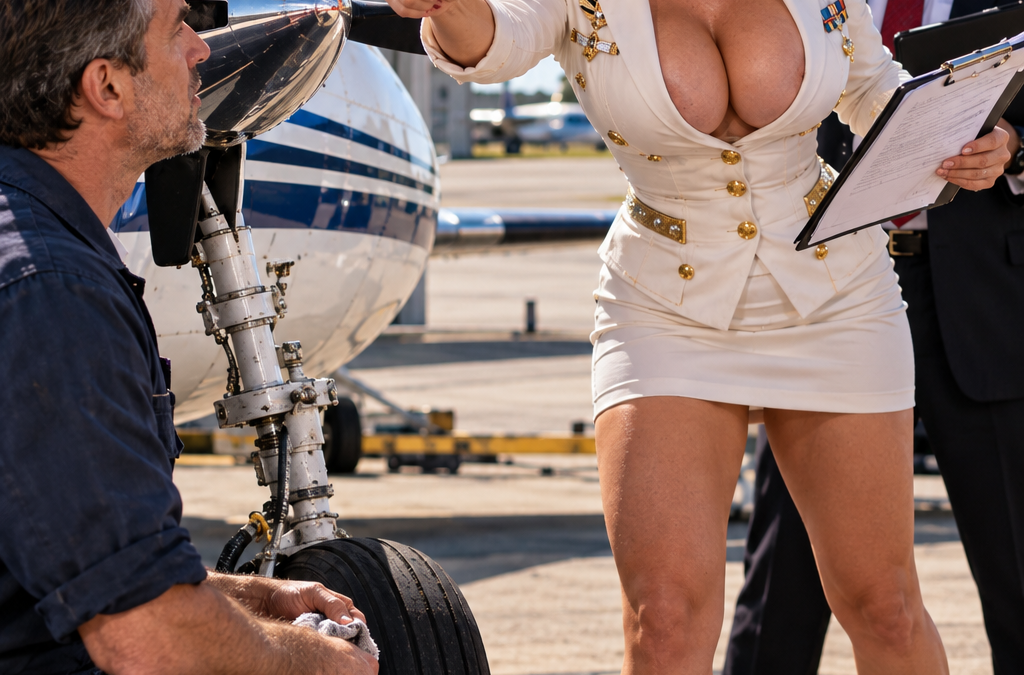
A clipboard was tucked beneath one arm. Her phone rested in her other hand. Oversized sunglasses sat above carefully styled blonde hair, and the bright morning sun caught the gold trim on the white military-style outfit she seemed determined to make into her personal uniform.
It was the kind of outfit no actual military organization would have approved.
The fitted white jacket clung tightly to her body, emphasizing a voluptuous figure she never seemed interested in hiding. Decorative gold buttons ran down the front, epaulets sat on her shoulders, and the neckline plunged low enough to show generous cleavage. The matching skirt was equally fitted, and everything about the outfit seemed designed to communicate the same message Victoria herself always communicated.
Look at me.
Notice me.
And understand that I’m important.
She was around forty, undeniably beautiful, and completely aware of the effect she had on people.
Victoria could flirt while insulting you.
She could smile while threatening you.
She could touch a man’s arm, lower her voice, and make a demand sound almost intimate—until you realized she had never been asking.
And if charm failed, something colder appeared immediately behind it.
She had been president of the Silver Oaks Homeowners Association for six years.
Silver Oaks sat along the eastern side of Mercer Regional Airport, a gated development of expensive homes, decorative stone walls, perfectly trimmed landscaping, and enough regulations to make a prison handbook feel casual.
I didn’t live there.
That point should have ended everything.
It didn’t.
Victoria had turned the HOA into a private kingdom.
Residents learned that disagreeing with her had consequences.
A trash can left visible too long could become a formal violation.
A fence request could disappear into committee review for months.
A parking complaint could arrive the morning after someone challenged her during a meeting.
One elderly couple had received repeated warnings because their grandchildren left bicycles in the driveway during a weekend visit.
Another homeowner had spent nearly seven thousand dollars fighting an order to remove a flagpole that predated the HOA itself.
Victoria called that enforcement.
Most people called it retaliation when she wasn’t around.
I had spent almost two years doing my best to stay outside her orbit.
That morning, she decided I no longer had the option.
My name is Daniel Mercer.
I was fifty-two years old, and by then I’d spent almost three decades around airplanes.
I’d flown commercial routes, cargo runs, charter flights, and instructional hours.
I’d slept in crew lounges.
I’d eaten vending-machine dinners at midnight.
I’d flown through rain so heavy it erased the horizon and summer turbulence that made passengers pray to religions they hadn’t practiced in years.
Flying wasn’t a hobby I’d picked up after making money somewhere else.
It was my life.
And after years of saving, I had finally bought an aircraft of my own.
She was a used six-seat turboprop.
Nothing outrageous.
Nothing a billionaire would have noticed.
But to me, she was the physical form of thirty years of sacrifice.
White fuselage.
Dark blue stripe.
Clean engines.
A cabin I’d spent weekends restoring with my own hands.
I kept her in Hangar Four at Mercer Regional, a municipal airport that had existed decades before Silver Oaks was anything more than open land.
That morning, I’d pulled her onto the apron because I was supposed to fly to Tennessee later that day.
I was crouched beside the left main tire when Victoria stopped near the wing.
“Daniel.”
I kept inspecting the tread.
“Victoria.”
“I’ve been calling you.”
“I know.”
“And emailing you.”
“I know.”
“And apparently you’ve decided you’re too important to answer me.”
That made me stand.
She was close enough now that I could smell her perfume beneath the familiar scent of warm pavement and aviation fuel.
“No,” I said. “I’ve decided the president of a homeowners association has no reason to contact me about an airplane parked at a public airport.”
Her lips pressed together.
“There it is.”
“There what is?”
“That attitude.”
I wiped my hands on a cloth.
Victoria extended the clipboard toward me.
A sheet of paper sat beneath the metal clip.
Across the top, printed in bold red letters, were two words.
VIOLATION NOTICE.
For a few seconds, I honestly thought it was a joke.
I looked at the paper.
Then at her.
Then back at the paper.
“You cannot be serious.”
“I’m completely serious.”
“Victoria, my airplane isn’t inside Silver Oaks.”
“It is visible from Silver Oaks.”
“So are clouds.”
Her eyes narrowed.
“Don’t be childish.”
“I’m not the one standing on airport property with a fake HOA violation.”
“It isn’t fake.”
I took the paper.
The notice accused me of violating Silver Oaks regulations involving commercial equipment, visual obstruction, excessive noise, nuisance activity, and unauthorized vehicle storage.
That last one almost made me laugh.
“Unauthorized vehicle storage?”
“The aircraft is a vehicle.”
“Not under your covenants.”
“It affects our property values.”
“You’re standing on municipal airport property.”
“Which borders our community.”
“That doesn’t make the airport part of your community.”
Victoria folded her arms.
Her white jacket pulled even tighter across her chest.
“You have until sunset to relocate the aircraft.”
I stared at her.
“I’m sorry?”
“You heard me.”
“Relocate it where?”
“Somewhere else.”
“It lives here.”
“Then find another place for it to live.”
I glanced toward Hangar Four.
“My airport lease says it stays exactly where it is.”
“Your lease does not supersede community standards.”
I laughed once.
I couldn’t help it.
Her expression changed immediately.
“You think this is funny?”
“I think you’re standing on property your HOA doesn’t own, ordering someone who isn’t a member of your HOA to remove an airplane from an airport your HOA doesn’t control.”
She stepped closer.
“You need to be very careful with that tone.”
“And you need to be very careful pretending you have authority you don’t.”
For several seconds, neither of us spoke.
I could see anger building behind her smile.
“I tried to handle this politely,” she said.
“No. You tried to hand me a threat and call it a rule.”
“Residents have complained.”
“Which residents?”
“Complaints are confidential.”
“Convenient.”
“They’re tired of looking at your aircraft.”
“Then they can close their curtains.”
Her jaw tightened.
“They’re tired of hearing it.”
“My airplane follows the same airport noise procedures as every other aircraft.”
“You start your engines early.”
“The airport opens at six.”
“People are sleeping at six.”
“Then complain to airport management.”
“I have.”
That answer came too quickly.
I watched her face.
“And what did they tell you?”
For the first time that morning, she hesitated.
Only for a fraction of a second.
But it was enough.
I smiled.
“They told you the airport was here first.”
“They were dismissive.”
“They told you something you didn’t want to hear.”
Victoria snatched the notice from my hand.
“You have until six tonight.”
“No.”
“You should reconsider.”
“I already did.”
“Daniel.”
“No.”
That was the moment the pleasant mask disappeared.
Her face became very still.
Cold.
“You’ve made your position clear.”
“Good.”
She turned away.
Then stopped.
Without looking back, she said, “Don’t say I didn’t give you a chance to cooperate.”
Her heels clicked all the way toward the access gate.
I watched her go.
And I made the first mistake of the whole situation.
I assumed she’d eventually realize how ridiculous she was being.
At ten-thirty that morning, airport manager Tom Bradley walked into my hangar carrying coffee and looking like someone had already ruined his day.
Tom was sixty, broad-shouldered, permanently sunburned, and one of the least dramatic men I knew.
He held up his phone.
“Why is the Silver Oaks HOA president telling the mayor you’re running an illegal charter operation out of Hangar Four?”
I slowly closed my toolbox.
“Because I told her she can’t make me move my plane.”
Tom stared at me for a long second.
“That sentence just gave me a headache.”
“Imagine living it.”
He handed me the phone.
Victoria had copied the mayor, two city council members, the airport advisory board, the city attorney, and something called the Silver Oaks Community Safety Committee.
According to her email, my aircraft created an ongoing public nuisance, reduced property values, violated noise expectations, and was possibly being used for unlicensed commercial activity.
Tom scrolled farther.
“Oh, this is good.”
“What?”
“She says you became hostile and threatening when approached.”
I looked at him.
“Did she mention she walked onto the apron in heels and tried to give me an HOA violation?”
Tom scanned the message.
“No.”
“Interesting.”
“Do you have cameras?”
I pointed toward the hangar roof.
“Three.”
“Save everything.”
“You think it’ll matter?”
Tom took a long drink of coffee.
“I think anyone who sends an email like this before lunch is planning something worse after lunch.”
I wish I’d understood how right he was.
By noon, an airport board member called me.
Fifteen minutes later, another one did.
At twelve-thirty, a city employee asked whether I had been conducting unauthorized charter flights.
At one, my friend Frank Delgado called from near the fuel pumps.
“You got company.”
I walked outside.
Victoria’s white SUV was parked beyond the airport fence.
She was behind the wheel.
Two women stood beside the vehicle taking pictures of my hangar.
“Who are they?” I asked.
Frank shrugged.
“No idea. They’ve been photographing your place for ten minutes.”
I walked toward the fence.
Victoria lowered her window before I reached it.
“Daniel.”
“Victoria.”
One of the women immediately raised her phone toward me.
I stopped.
“Are you recording me?”
Victoria smiled sweetly.
“This is a public-interest matter.”
“No. This is harassment.”
“We’re documenting violations.”
“From outside airport property this time?”
The smile weakened.
“You’re becoming unnecessarily confrontational.”
“I’m asking why strangers are photographing my hangar.”
Her gaze shifted toward my aircraft.
“It’s still here.”
“Yes.”
“I gave you a deadline.”
“You gave me nothing.”
“I gave you an opportunity to resolve this peacefully.”
“You don’t have the authority to give me anything.”
Her expression hardened.
“We’ll see.”
She raised the window and drove away.
That afternoon, I called an attorney.
Her name was Rachel Kim.
Rachel specialized in aviation and property disputes and possessed the rare ability to remove emotion from a problem without becoming emotionally numb to the person dealing with it.
I explained what had happened.
When I finished, she was silent.
“Rachel?”
“Let me make sure I understand this correctly. An HOA president issued you a violation notice for an airplane sitting on municipal airport property.”
“Yes.”
“Do you own a home in Silver Oaks?”
“No.”
“Does your hangar lease involve Silver Oaks?”
“No.”
“Does the HOA own airport land?”
“No.”
“Do they hold any easement, covenant, or recorded enforcement authority over the property?”
“No.”
She sighed.
“Daniel, stop arguing with her.”
“I’d love to.”
“I’m serious. From now on, document everything. Save emails. Save video. Communicate in writing. And if she enters secured airport property without authorization, call security.”
“That serious?”
“Someone who is merely confused can usually be corrected. Someone who knows she has no authority and continues acting as if she does is different.”
I leaned against my desk.
“Different how?”
“Less predictable.”
At five-forty that evening, I learned exactly what she meant.
Three vehicles came through the airport service entrance.
Victoria’s SUV.
A Silver Oaks security pickup.
And a tow truck.
Frank was beside me when they rolled onto the apron.
He lowered the greasy rag in his hand.
“Tell me that tow truck isn’t coming here.”
“It better not be.”
It was.
The driver stopped about twenty yards from my plane.
Victoria stepped out.
Same tight white military-style jacket.
Same plunging neckline.
Same gold trim.
Same sunglasses.
Same clipboard.
Now she had two private security guards with her.
One was a heavyset man named Rick.
I’d seen him patrolling Silver Oaks.
The other was younger and already looked like he regretted being there.
Victoria checked her watch.
“Five-forty-three.”
I walked toward her.
“What exactly do you think you’re doing?”
“Enforcement.”
“Get that truck off the apron.”
“You ignored a lawful directive.”
“No. I ignored you.”
The tow-truck driver leaned out his window.
“Ma’am?”
Victoria turned.
“You said this was a vehicle impound.”
“It is.”
He looked at the airplane.
Then at me.
Then back at her.
“That’s an airplane.”
“I’m aware.”
“I’m not towing an airplane.”
“You accepted the job.”
“You told dispatch it was a disabled vehicle.”
“It is a vehicle.”
The driver pointed toward the wings.
“Lady, it flies.”
Frank coughed into his hand, unsuccessfully hiding a laugh.
Victoria shot him a look.
Then she faced the driver again.
“I am authorizing removal.”
He pointed toward me.
“That his plane?”
“Yes.”
“He call me?”
“No.”
“Airport call me?”
“No.”
“Police?”
“No.”
The driver stared at her.
Then started his engine.
Victoria stepped toward the truck.
“Where do you think you’re going?”
He put it in reverse.
“Away from whatever this is.”
He backed off the apron.
I almost felt sorry for Victoria.
Almost.
Then she turned toward me.
“This isn’t funny.”
“I didn’t say anything.”
“You humiliated me.”
“I didn’t hire the tow truck.”
“You deliberately created a spectacle.”
“You brought a tow truck to an airport to steal an airplane.”
One of the guards looked down.
Victoria noticed.
“Rick.”
The older guard straightened immediately.
“Yes, ma’am.”
“Secure the aircraft.”
My stomach tightened.
I moved between them and the plane.
“No.”
Victoria pointed around me.
“Place a notice on the aircraft. Prevent it from being removed.”
“Do not touch my plane.”
“Daniel, move.”
I ignored her and looked directly at Rick.
“If you step past me, you’re entering a controlled operational area without airport authorization.”
Rick hesitated.
Victoria snapped, “You work for me.”
That sentence explained Victoria better than anything else she had said.
You work for me.
Not the association.
Not the residents.
Not the board.
Me.
Rick took one uncertain step.
Then a voice thundered across the apron.
“That’s far enough.”
Tom Bradley was coming toward us with an airport security officer.
I’d never seen Tom that angry.
“Who authorized these vehicles onto my apron?”
Victoria raised her chin.
“I did.”
Tom actually stopped walking.
“You?”
“As president of Silver Oaks.”
“This is an airport.”
“I’m aware.”
“Then you should understand that you don’t authorize anything here.”
Victoria lifted the clipboard.
“Silver Oaks has documented multiple—”
Tom cut her off.
“I don’t care what Silver Oaks documented. Get your people and your vehicles off airport property.”
Her cheeks flushed.
“You do not speak to me that way.”
“I just did.”
“I’ll call the mayor.”
“Call the governor. Call the president. Do it from outside my gate.”
For one perfect moment, Victoria had nothing to say.
Then she looked at me.
Not Tom.
Me.
And I saw something in her face that should have frightened me.
Humiliation.
Deep, personal humiliation.
She had come with guards and a tow truck because she expected a public victory.
Instead, everyone had watched her fail.
She walked back toward her SUV.
Before getting in, she looked at me.
“This isn’t over.”
Tom waited until she was gone.
Then he turned toward me.
“You need to take this seriously.”
“I am.”
“No. I mean seriously.”
He pointed toward the cameras mounted above the administration building.
“I’ve managed airports long enough to know the difference between a complaint and escalation.”
Frank looked toward the gate.
“She’s escalating.”
Tom nodded.
“If you’re not flying tonight, put the plane inside.”
I did.
For the next week, Victoria attacked everywhere she thought she could create pressure.
Silver Oaks residents received emails claiming I had verbally abused HOA representatives.
The neighborhood newsletter referred to “certain airport users” who allegedly endangered residential safety.
A petition began demanding stricter restrictions on morning departures.
Then came anonymous complaints.
Fuel contamination.
Hazardous chemical storage.
Improper commercial activity.
Damage to landscaping near the airport boundary.
Every complaint required somebody to investigate.
Every investigation wasted time.
Inspectors came.
They found nothing.
Rachel answered everything.
Briefly.
Professionally.
With documentation.
Victoria hated documentation.
A threat could frighten people.
A rumor could spread.
A confident lie could dominate a meeting.
But a date, a lease, a video, a signed inspection report—those things didn’t care how forcefully she spoke.
Three days after the tow-truck incident, Rachel sent a cease-and-desist letter.
Victoria responded with six pages.
Rachel called me afterward.
“I haven’t seen this much confidence combined with this little legal understanding in years.”
“What did she say?”
“She claims Silver Oaks has implied authority over any activity that affects the community.”
“Does it?”
“Not the way she thinks it does.”
“Anything else?”
“She says you’re intimidating her.”
I laughed without humor.
“Of course.”
“And she’s threatening to seek emergency injunctive relief.”
“Can she?”
“She can file things.”
“Can she win?”
“Not based on the facts you’ve given me.”
I leaned back.
“Then we’re okay.”
Rachel was quiet.
“What?”
“Legal weakness doesn’t mean behavioral predictability.”
That was the second warning I didn’t respect enough.
The next escalation came to my house.
I lived four miles from Silver Oaks in a small brick ranch on a street where nobody cared what color your mailbox was.
At seven-twenty one evening, my doorbell camera alerted me.
Victoria was standing on my porch.
White jacket.
Gold buttons.
Deep neckline.
Clipboard.
Two Silver Oaks board members stood behind her.
I opened the main door but kept the storm door locked.
“Why are you here?”
“To resolve this.”
“You have Rachel’s number.”
“I’m not speaking to your attorney. I’m speaking to you.”
“No. You’re leaving.”
The older man behind her shifted awkwardly.
I recognized him as Harold, the HOA treasurer.
“Daniel,” he said, “maybe we can all just talk.”
“Talk about what?”
Victoria answered.
“Your refusal to cooperate.”
“My airplane is at an airport.”
“We’ve established that.”
“Then there’s nothing else to discuss.”
“You live near our community.”
“So?”
“You travel on roads adjacent to our community.”
“So?”
“Your aircraft affects our residents.”
“Still doesn’t give you authority over me.”
Victoria’s eyes narrowed.
“You really enjoy saying that.”
“Because you keep pretending otherwise.”
She pressed one hand against the storm door.
“You’ve embarrassed me repeatedly.”
There it was.
The truth.
Not aircraft noise.
Not landscaping.
Not property values.
Not safety.
Her pride.
“That isn’t my problem.”
“It became your problem when you challenged me publicly.”
Harold turned toward her.
“Victoria.”
She ignored him.
“You think because Tom Bradley shouted at me in front of airport employees, you’ve won something?”
“I think you’re trespassing on my porch after receiving a legal letter telling you to stop contacting me directly.”
“You think because your little lawyer writes threats—”
“Leave.”
Her eyes flashed.
“You have no idea how many people I can make miserable.”
The porch went completely quiet.
Harold stared at her.
“Victoria, that’s enough.”
She slowly turned her head toward him.
“What did you say?”
“I said that’s enough.”
For a second, I saw fear in Harold’s face.
Real fear.
Victoria smiled.
“Of course.”
She stepped away from the door.
“Have a good evening, Daniel.”
The smile stayed on her face until she reached the SUV.
The next morning, Harold called me.
“I owe you an apology.”
“You don’t owe me anything.”
“I should’ve stopped this earlier.”
“You’re on the board. Maybe you still can.”
He exhaled heavily.
“It’s complicated.”
“Why?”
“Victoria keeps records.”
“Records of what?”
“Everything.”
He began listing them.
Complaints.
Violations.
Requests for exceptions.
Voting history.
Late fees.
Personal disagreements.
Landscaping disputes.
Who opposed her.
Who questioned her.
Who needed approval for something.
I leaned back in my chair.
“That’s intimidation.”
“I know.”
“Then vote her out.”
“People are afraid of her.”
“She’s an HOA president, Harold. She’s not a warlord.”
“You don’t live there.”
There was no humor in his voice.
Then he said something that changed how I understood the whole conflict.
“This isn’t about the airplane anymore.”
“I figured that out.”
“No. You don’t understand.”
He paused.
“People saw someone tell her no.”
I said nothing.
“That’s what she’s fighting.”
The following Friday, I arrived at Mercer Regional just after six-thirty in the morning.
I had a business meeting in Knoxville.
The weather was nearly perfect.
Clear sky.
Light wind.
Excellent visibility.
I pulled the turboprop from Hangar Four, completed the walk-around, checked the fuel, inspected the control surfaces, loaded my bag, and began preparing for departure.
At seven-ten, a white SUV appeared outside the perimeter fence.
My stomach tightened instantly.
Victoria.
I called Tom.
“She’s here.”
“Inside or outside?”
“Outside.”
“Ignore her.”
I tried.
At seven-twenty, she began filming me.
At seven-thirty, another Silver Oaks vehicle arrived.
At seven-forty, three residents gathered outside the fence carrying signs about aircraft noise.
Victoria stood in front of them like some kind of general.
The morning sun reflected off her white jacket.
Her phone remained pointed toward me.
I kept working.
Checklist.
Fuel selector.
Controls.
Systems.
Engine start was scheduled for seven-fifty.
At seven-forty-eight, Tom’s voice came through my headset.
“Daniel, hold position.”
I looked toward the administration building.
“What’s happening?”
“Possible gate breach.”
My entire body tightened.
An airport apron wasn’t a neighborhood street.
People didn’t just drive wherever they wanted.
There were moving aircraft.
Fuel vehicles.
Propellers.
Engines.
Jet blast.
One careless decision could kill somebody.
Then the service gate opened.
Victoria’s SUV came through.
“Tom.”
“I see it.”
The SUV accelerated onto the apron.
I stopped the startup sequence.
Victoria drove straight toward my aircraft and stopped around thirty feet in front of the nose.
I climbed out.
“What the hell are you doing?”
She stepped from the SUV carrying a thick folder.
One of the protesters filmed from behind the fence.
Victoria smiled.
“You can’t leave.”
“Move your vehicle.”
“You’ve been served.”
She held up the folder.
“Served with what?”
“An emergency community enforcement order.”
“From what court?”
“The Silver Oaks board.”
I stared at her.
“Move your car.”
“Not until you acknowledge receipt.”
“You’re obstructing an active airport apron.”
“This will take thirty seconds.”
“Move it now.”
She stepped closer.
“You do not give me orders.”
I was tired.
Tired of calls.
Tired of inspections.
Tired of her standing at my house.
Tired of having every normal day twisted into another confrontation.
“Apparently nobody does.”
Her cheeks flushed.
Sirens sounded near the administration building.
Airport security.
Victoria looked toward them.
Then back at me.
She laughed.
“You called security again?”
“I didn’t have to.”
“You enjoy this.”
“Enjoy what?”
“Making me look powerless.”
That word hung between us.
Powerless.
I should have let it go.
Instead, I said the truth.
“You are powerless here.”
The moment I said it, I saw what it did to her.
Her face went completely still.
I’d seen angry people before.
Drunk passengers.
Panicked clients.
Pilots under stress.
Men threatening lawsuits.
People who lost their tempers and recovered ten seconds later.
Victoria wasn’t simply angry.
She looked like someone had struck at the center of who she believed she was.
She turned and walked back toward the SUV.
For one hopeful second, I thought it was finally over.
Then she opened the driver’s door.
She looked back at me.
“You want powerless?”
I frowned.
“What?”
“I’ll show you powerless.”
She got in.
The engine started.
Airport security was less than a hundred yards away.
I raised both hands.
“Victoria, back out slowly.”
She stared at me through the windshield.
The SUV reversed.
Twenty feet.
Thirty.
Forty.
For one second, I thought she was making room to turn around.
Then the brake lights disappeared.
The engine roared.
The SUV came forward.
Fast.
Straight toward me.
My mind refused to process it at first.
A car shouldn’t be accelerating toward a person standing beside an airplane.
It was so irrational that my brain lost precious time trying to make sense of what my eyes were seeing.
Then Frank screamed from Hangar Five.
“DANIEL!”
I moved.
Not gracefully.
Not bravely.
I threw myself sideways.
The SUV passed close enough that I felt displaced air against my shirt.
Then came the impact.
Metal hit aluminum with a violent, ugly crunch.
The SUV slammed into the left forward section of my aircraft.
A headlight exploded.
The hood buckled upward.
Plastic and metal fragments scattered across the apron.
The airplane rocked violently on its landing gear.
For half a second, every sound disappeared from my mind.
Then everything came back at once.
A horn.
Shouting.
Alarms.
Someone screaming behind the fence.
The hiss of damaged metal and escaping fluid.
I ran toward the wreck.
“Kill the engine!”
Victoria’s SUV was still running.
Steam curled from the crushed hood.
The front end had wedged beneath part of the fuselage.
The aircraft skin was ripped and deeply buckled.
I smelled something sharp.
Fuel.
My first thought wasn’t money.
It wasn’t insurance.
It wasn’t even the airplane.
It was fire.
“Everybody back!”
Frank ran toward me.
“Fuel leak?”
“I don’t know!”
Airport security vehicles skidded to a stop.
Tom jumped from his truck before it had fully stopped moving.
“Clear the apron! Everybody back!”
The SUV door opened.
Victoria stepped out.
There was blood at the corner of her mouth.
One heel was gone.
Her white jacket had pulled open at the collar, and one gold button hung loose.
Her hands were shaking.
But the thing I remember most was her face.
She looked offended.
Not horrified.
Not ashamed.
Offended.
As if the airplane had somehow failed to get out of her way.
Then she pointed at me.
“He stepped in front of me.”
Nobody answered.
Victoria looked around desperately.
“He blocked me!”
Frank stared at her.
“You drove into his airplane!”
“He provoked me!”
Tom shouted, “Nobody move!”
A city police cruiser came through the gate.
Then another.
Victoria turned toward the officers.
“I’m the president of the Silver Oaks HOA. This man has been threatening me for weeks.”
I couldn’t believe it.
One officer walked toward her.
“Ma’am, step away from the vehicle.”
“You need to speak with him.”
“Step away from the vehicle.”
“He caused this.”
The officer’s voice became harder.
“Ma’am.”
Victoria finally moved.
Another officer approached me.
“Are you injured?”
“I don’t think so.”
“Did the vehicle strike you?”
“No.”
“How close?”
“Three feet, maybe.”
Frank spoke from behind him.
“Closer.”
The officer turned.
“You saw the incident?”
“Every second.”
Tom pointed toward the buildings around us.
“So did about twelve cameras.”
Victoria heard him.
I watched the color drain from her face.
That was the first moment she seemed to understand she might not be able to talk her way out of what she’d done. The surveillance later showed her reversing, pausing, and then accelerating toward Daniel and the aircraft before striking it.
Fire crews arrived within minutes.
The apron was partially closed.
Police separated witnesses.
The SUV was shut down.
Emergency crews checked for leaking fuel and electrical hazards.
Fortunately, there was no major fuel spill.
But one look at the airplane told me something inside my life had just changed.
She wasn’t flying anywhere.
Maybe for a long time.
Maybe ever.
I stood behind a security vehicle watching firefighters inspect the damaged fuselage.
My hands started shaking.
I shoved them into my pockets.
They kept shaking.
Rachel called after Tom contacted her.
“Daniel.”
“I’m here.”
“Are you hurt?”
“No.”
“Are you sure?”
I looked at my hands.
“I don’t know.”
“Sit down.”
“I’m fine.”
“Sit down anyway.”
I sat on a concrete barrier.
She made me explain everything from the moment Victoria entered the gate.
When I finished, Rachel was silent.
Then she said, “Do not speak to Victoria.”
“She’s telling police I caused it.”
“Let her.”
“Rachel—”
“Daniel. Listen carefully. Let her talk.”
Across the apron, Victoria was doing exactly that.
Talking.
Pointing.
Explaining.
Interrupting.
Every time one officer asked a question, she gave five answers.
The more she talked, the more frantic she became.
Finally, an officer said, “Ma’am, turn around and place your hands behind your back.”
Victoria recoiled.
“What?”
“Turn around.”
“Excuse me?”
“Hands behind your back.”
“You don’t understand who I am.”
The officer didn’t react.
“Turn around.”
“I am the president of Silver Oaks.”
“Ma’am.”
“You cannot handcuff me in front of these people.”
There it was.
Even then.
Even after using a vehicle like a weapon.
Even while standing beside a wrecked airplane.
Her objection wasn’t that she was innocent.
It was that people were watching.
The audience mattered.
The humiliation mattered.
She looked directly at me as the officer cuffed her.
The hatred on her face was so intense it made something cold move through my chest.
“You did this!” she screamed.
The officer guided her toward the cruiser.
“You ruined everything!”
I said nothing.
“You think this is over?”
The cruiser door closed.
For about five seconds, Victoria Hale finally stopped talking.
Then she started shouting through the window.
The police collected surveillance footage almost immediately.
There were multiple camera angles.
Administration building.
My hangar.
Fuel station.
Maintenance shop.
The video left very little room for interpretation.
Victoria reversed.
Stopped.
Then accelerated forward.
I jumped aside.
Her SUV hit the plane.
No accidental roll.
No blocked route.
No mechanical confusion visible on camera.
No one forced her to accelerate.
She made a decision.
Maybe the decision lasted two seconds.
Maybe less.
But two seconds are enough to destroy years of work.
My airplane was grounded.
The first inspection was bad.
The second was worse.
Fuselage damage.
Structural concerns.
Possible engine-mount issues from the impact.
Landing gear alignment.
Propeller clearance.
Avionics.
Internal inspection.
Every answer produced another question.
Insurance adjusters appeared.
Engineers appeared.
Mechanics took measurements and photographs.
Reports became more reports.
The aircraft that had represented thirty years of work became a damaged object behind caution tape.
That afternoon, I walked into Hangar Four.
The space where the plane normally sat was empty.
I stopped in the middle of the floor.
I had expected to be angry.
Instead, I felt hollow.
I’d worked for that aircraft.
Nobody gave it to me.
I hadn’t inherited money.
I hadn’t woken up one morning and decided to buy a toy.
I’d worked overtime.
Flown nights.
Missed holidays.
Taken jobs I didn’t enjoy.
Saved money when friends bought new trucks and bigger houses.
For years, I’d told myself the same thing.
Someday.
Someday I’ll have my own aircraft.
And eventually, someday had happened.
Now one person’s rage had turned it into twisted aluminum.
I kicked a plastic bucket.
It flew across the hangar and slammed into the wall.
The sound echoed.
Then I sat on my workbench and lowered my face into my hands.
For the first time since the crash, I let myself feel everything.
Fear.
Rage.
Helplessness.
Grief.
I hated Victoria.
I hated myself for engaging with her.
I hated that I had known she was escalating and still hadn’t imagined she could do something so reckless.
And beneath all of it was one thought I couldn’t stop.
I should have moved the plane.
Frank found me about twenty minutes later.
He leaned against the hangar entrance.
“You okay?”
“No.”
“Good.”
I looked up.
“What?”
“Anybody who says they’re okay after today is lying.”
I laughed once.
It came out broken.
“They might total her.”
“The aircraft?”
“Yeah.”
Frank looked toward the apron.
“I’m sorry.”
I rubbed my face.
“I should’ve moved it.”
His expression changed.
“Don’t.”
“If I’d taken off earlier—”
“Stop.”
“If I’d put it back inside when she showed up—”
“Daniel.”
I looked at him.
“You don’t rearrange your entire life because another adult refuses to behave like one.”
“Doesn’t change what happened.”
“No.”
He paused.
“But don’t make her decision your responsibility.”
By that evening, the story had spread through the county.
Someone outside the fence had recorded Victoria’s arrest.
Another person captured the impact sound.
Local television crews arrived before sunset.
By the next morning, footage from the airport had begun circulating.
The story was irresistible.
HOA president drives luxury SUV into private aircraft after dispute.
There was no good version of that headline.
Victoria tried anyway.
Through an attorney, she released a statement claiming she had been under tremendous emotional pressure and that the collision occurred during a highly charged confrontation.
She suggested I had intimidated her.
Then more footage surfaced.
The tow truck.
Her unauthorized attempt to secure the aircraft.
The confrontation at my home.
And the doorbell recording of her saying:
“You have no idea how many people I can make miserable.”
Rachel watched that clip twice.
“That’s going to follow her.”
It did.
Forty-eight hours after Victoria’s arrest, the Silver Oaks board scheduled an emergency meeting.
Harold called me beforehand.
“Residents are furious.”
“At me?”
“Some. Mostly her.”
“What happens now?”
“We vote on removing her as president.”
I sat silently.
Harold lowered his voice.
“People are talking.”
“About what?”
“Everything.”
Once one person started, others followed.
Selective enforcement.
Retaliatory fines.
Threats.
Special treatment for friends.
Deliberately delayed approvals.
Association money used for personal disputes.
Security employees ordered to watch residents.
Private records maintained on people who challenged her.
That was Victoria’s real collapse.
Not the SUV.
Not the arrest.
Not even the criminal charges.
It was people comparing stories.
Bullies depend on isolation.
They survive when every victim believes his experience is unique.
One family thinks their violation is personal bad luck.
Another thinks a delayed application is incompetence.
Another decides silence is easier than confrontation.
But once they speak to each other, coincidence becomes pattern.
And pattern destroys fear.
Victoria was removed as president by an overwhelming vote.
Then she was removed from the board.
The association’s attorney made it clear the HOA would not fund her personal criminal defense.
Rick, the security supervisor, gave investigators text messages from Victoria.
One instructed him to immobilize my aircraft during the tow-truck incident “by any means short of damage.”
The younger guard confirmed that she repeatedly told employees airport officials would eventually surrender if she applied enough political pressure.
The tow driver provided dispatch records.
Tom gave investigators gate logs.
I supplied emails.
Video.
Violation notices.
Doorbell footage.
Rachel organized everything into a timeline.
It was almost forty pages.
Reading it was disturbing.
Each event by itself had seemed almost stupid.
A complaint.
A photograph.
An email.
A fake notice.
A tow truck.
A threat.
A visit to my house.
A protest.
A gate breach.
But together they formed something much darker.
Escalation.
A person testing a boundary.
Then punishing the boundary for existing.
The criminal case took months.
Victoria faced charges connected to property damage, reckless conduct, unauthorized airport access, and the danger created by her actions.
Her lawyer argued that she had panicked.
Prosecutors pointed to the surveillance footage.
I attended court only when necessary.
That surprised some people.
They assumed I would enjoy watching her collapse.
I didn’t.
I wanted accountability.
I wanted restitution.
I wanted her kept away from me and the airport.
But revenge wasn’t restoring my airplane.
Watching someone else lose everything wasn’t going to give me back what I’d lost.
The day I testified, Victoria arrived wearing a dark navy suit.
No white military-style jacket.
No plunging neckline.
No gold buttons.
No theatrical authority.
For the first time since I’d met her, she looked smaller than the room around her.
Her attorney approached me carefully.
“Mr. Mercer, did you deliberately antagonize Ms. Hale?”
“No.”
“Did you tell her she was powerless?”
“At the airport, yes.”
“Could that statement be considered provocative?”
“It could be considered accurate.”
The prosecutor looked down, probably hiding a reaction.
Victoria’s attorney didn’t smile.
“You knew she was upset.”
“Yes.”
“And despite knowing that, you continued to challenge her authority.”
“What authority?”
“Her authority as president of the Silver Oaks Homeowners Association.”
“I didn’t live in Silver Oaks.”
“That isn’t my question.”
“It matters.”
“Mr. Mercer—”
“My aircraft was on municipal airport property. My lease was with the airport. Silver Oaks had no authority over my aircraft, the hangar, airport operations, or me. So if you’re asking whether I challenged her authority, my answer is no. I refused to pretend she possessed authority she didn’t have.”
The courtroom remained silent.
The attorney changed direction.
“You could have moved your aircraft temporarily, correct?”
“Yes.”
“But you refused.”
“Yes.”
“So this entire conflict might have been avoided if you had simply cooperated.”
I looked at Victoria.
Then at him.
“No.”
He raised his eyebrows.
“No?”
“If I had moved the aircraft, I wouldn’t have ended the conflict. I would have taught her that threatening me worked.”
He objected when I continued.
The judge allowed a narrow answer.
“I had the legal right to keep the airplane where it was. I didn’t believe I should surrender that right because someone decided to intimidate me.”
After court, Victoria approached me before her attorney could stop her.
“Daniel.”
Rachel stepped between us.
“Do not speak to my client.”
Victoria looked around her.
Her face was still beautiful.
Her makeup was still perfect.
But the certainty was gone.
“Do you have any idea what you’ve done to my life?”
Rachel warned her.
“Victoria.”
But I answered.
“I didn’t drive your SUV.”
Her mouth tightened.
“You pushed me.”
“No.”
“You embarrassed me over and over.”
“You embarrassed yourself.”
“I spent six years building that community.”
“You spent six years making people afraid of you.”
For a second, the old rage appeared in her eyes.
Then it faded.
Maybe it was the courthouse.
Maybe the charges.
Maybe the months of consequences.
Her voice dropped.
“I lost everything.”
I studied her.
“No.”
She looked at me.
“You lost control.”
That landed harder than anything else I’d ever said to her.
She turned away.
I never spoke privately with her again.
The civil case continued longer than the criminal one.
My insurer covered part of the loss and pursued recovery.
Engineers eventually determined that repairing the airplane was technically possible.
Technically.
Economically was another question.
The damage was extensive enough that repair made little financial sense.
The aircraft was declared a total loss.
I knew it was coming.
Still, hearing the words felt like losing her twice.
Before the insurer took possession, I went to see her one final time.
Part of the left side had been opened for inspection.
Panels were removed.
Interior sections were exposed.
The blue stripe I’d polished so many times was broken by tape, scratches, and structural damage.
I rested one hand against the fuselage.
It felt stupid.
Machines aren’t people.
I knew that.
But objects can still hold years of your life.
A truck your father taught you to drive.
A watch your wife gave you on an anniversary.
A house where your children grew up.
An airplane you spent half your career believing you’d never own.
Losing the aluminum wasn’t what hurt.
Losing what the airplane represented did.
Frank stood several feet away.
I whispered, “You deserved better.”
Then I shook my head.
“Great. Now I’m talking to airplanes.”
Frank smiled faintly.
“I’ve heard pilots talk to worse.”
I looked at him.
“Thanks.”
“For what?”
“For being here through all of this.”
He shrugged.
“You’d do the same.”
He was right.
Eventually, Victoria accepted a negotiated resolution rather than forcing every criminal charge through a full trial.
There were penalties.
Probation.
Restitution obligations.
Restrictions involving the airport.
And something she probably hated more than all of those combined.
A permanent public record.
The story of the day Victoria Hale turned an HOA dispute into a criminal case.
Silver Oaks changed too.
Harold became interim president.
His first message to the neighborhood was four paragraphs.
No threats.
No red letters.
No artificial deadlines.
The new board ordered an independent review of past enforcement.
Dozens of fines were reversed.
Some homeowners received refunds.
Old architectural applications were reconsidered.
Security procedures changed.
Board meetings began being recorded.
Major enforcement actions required more than one signature.
Residents were allowed to request records without first going through the same person whose conduct they were questioning.
Months later, Harold called me.
“We’re having a community meeting.”
“Congratulations.”
“I want you to come.”
“No.”
“There are people who want to apologize.”
“They don’t owe me an apology.”
“Some of them think they do.”
I almost refused again.
Then curiosity got me.
I went.
The Silver Oaks clubhouse was packed.
I expected awkwardness.
Maybe hostility.
Instead, an elderly man approached me before the meeting and shook my hand.
“My wife and I almost sold our house because of her.”
A woman in her thirties told me Victoria had targeted her after she questioned an HOA landscaping contract.
Another man said he’d stopped attending meetings because Victoria publicly mocked him whenever he disagreed.
One by one, people spoke.
Different stories.
Same pattern.
Control.
Retaliation.
Humiliation.
Fear.
Harold eventually stood behind the podium.
“Two months ago,” he said, “we believed our biggest problem was an airplane.”
A few people laughed.
He looked toward me.
“It wasn’t.”
The room became quiet.
“Our biggest problem was that we allowed one person’s authority to become more important than the rules that authority was supposed to serve.”
I never forgot that.
Because authority isn’t inherently wrong.
Rules aren’t automatically oppression.
Airports need rules.
Cities need rules.
Police need authority.
Courts need authority.
Even homeowners associations need some authority if people voluntarily live under shared covenants.
But authority without limits becomes something else.
And people like Victoria thrive whenever everyone around them becomes too tired, intimidated, or comfortable to ask where those limits are.
After the meeting, I walked toward the parking lot.
Harold followed.
“You buying another airplane?”
I smiled.
“Maybe.”
“That’s not an answer.”
“It’s the answer my bank account currently prefers.”
He laughed.
Then his expression became serious.
“For what it’s worth, I’m sorry.”
“You’ve already told me.”
“I know.”
I looked back toward the clubhouse.
“You know what bothered me most?”
“The plane?”
“No.”
“The threats?”
“Not even those.”
He waited.
“The number of people tonight who told me they already knew what she was like.”
Harold looked down.
“Everybody knew,” I said. “But everybody thought somebody else would eventually stop her.”
He nodded.
“Fear makes people quiet.”
“So does convenience.”
He looked at me.
“That’s fair.”
I shook his hand.
“Don’t let the next president become another Victoria.”
“We won’t.”
“Good.”
About eight months after the crash, I bought another airplane.
Not new.
Not extravagant.
A used turboprop with more hours than the old one and an interior that smelled faintly like leather conditioner and somebody else’s coffee.
The first morning I rolled her onto the apron, I stopped.
Same hangar.
Same pavement.
Same morning light.
For a moment, I could almost see the old aircraft sitting there.
Frank walked over carrying two cups of coffee.
“Well?”
I walked around the new plane.
“Left tire looks a little low.”
He stared at me.
“You bought an airplane three days ago, and that’s the emotional reaction you’re giving me?”
“I’m pacing myself.”
He handed me a coffee.
Tom came over a few minutes later.
He inspected the airplane with the suspicion of a father meeting the man who wanted to marry his daughter.
“She’s clean.”
“She is.”
“Records?”
“Complete.”
“Engines?”
“Good.”
“Insurance?”
“Painful.”
He nodded.
“Then welcome back.”
Those three words hit me harder than I expected.
Welcome back.
I loaded my bag.
Completed the walk-around.
Climbed into the cockpit.
My hand rested over the starter.
For a second, the memories came back.
The SUV accelerating.
Frank screaming my name.
The crash.
Metal folding.
Victoria shouting through the police-cruiser glass.
The empty hangar.
The insurance reports.
The final goodbye.
I closed my eyes.
Then opened them.
The runway stretched ahead beneath a clear sky.
I started the engine.
The turbine began turning.
A low mechanical whine rose into the familiar smooth roar I’d missed more than I had realized.
Frank stood near the hangar.
He raised his coffee in salute.
Tom watched from the administration building.
I taxied toward the runway.
At the hold-short line, I completed the last checks.
Everything looked right.
I advanced the power.
The airplane accelerated.
Faster.
The runway markings rushed beneath me.
I eased back on the controls.
The wheels left the ground.
The airport began to shrink.
Then the roads.
The houses.
The fences.
The gates.
Silver Oaks appeared off my right wing.
From three thousand feet, the neighborhood didn’t look powerful.
It didn’t look threatening.
It didn’t look like a kingdom.
It looked like exactly what it had always been.
A group of houses beside an airport.
Nothing more.
For months, people had asked whether I regretted refusing Victoria’s original demand.
The answer was complicated.
I regretted the damage.
I regretted the money.
I regretted the fear.
I regretted the nights I couldn’t sleep.
I regretted every meeting with attorneys, inspectors, investigators, adjusters, and mechanics.
I regretted losing an airplane I’d worked decades to own.
But I never regretted saying no.
Because that first morning, Victoria hadn’t really been asking me to move an airplane.
She was asking me to accept a lie.
The lie that confidence creates authority.
That intimidation creates jurisdiction.
That enough threats can turn an unreasonable demand into an obligation.
That if someone is loud enough, attractive enough, connected enough, wealthy enough, feared enough, then eventually everybody else has to move.
Sometimes people do move.
Sometimes surrender is easier.
Sometimes silence is cheaper in the short term.
But sooner or later, every bully reaches a boundary.
A person.
A rule.
A locked gate.
A camera.
A courtroom.
Something that doesn’t care how important they believe themselves to be.
Victoria found her boundary on an airport apron.
She arrived wearing white, carrying a clipboard, convinced everyone around her existed inside the world she controlled.
She left in the back of a police cruiser. Later, Silver Oaks removed her from the presidency and board, reviewed her enforcement practices, and eventually changed its procedures so one person could no longer exercise the same unchecked control.
Not because I defeated her.
Not because Tom defeated her.
Not because Harold defeated her.
Not even because the police defeated her.
Victoria destroyed herself the moment she decided that hearing the word no was an injury so unforgivable that anything she did afterward could be justified.
I banked south.
Silver Oaks slid behind my right wing.
The airport grew smaller beneath me.
Ahead, the sky was clear for miles.
And for the first time in a long time, there was nothing in front of me but open air.