𝗙𝗨𝗟𝗟 𝗦𝗧𝗢𝗥𝗬 She Kept Parking on My Land and Dared Me to Touch Her Car—So I Finally Took Her Seriously
𝗙𝗨𝗟𝗟 𝗦𝗧𝗢𝗥𝗬
She began timing the parking.
I would come home from work and find her car positioned diagonally across the narrowest part of the driveway.
If I tried to squeeze past, there would be maybe fifteen centimeters between our vehicles.
Too close.
I’d stop.
Back out.
Find her.
Ask her to move.
She’d act surprised.
“Oh, you’re home already?”
Same time every day.
Another morning, I needed to leave early.
The Lada was parked directly outside the garage.
I knocked on her door.
No answer.
Knocked again.
Nothing.
I waited.
Then saw movement behind her curtain.
She was home.
“Karen!”
Nothing.
I knocked again.
Finally the door opened.
She was wearing a robe.
“What?”
“I need to go to work.”
“So?”
“Your car is blocking mine.”
She yawned.
“I’ll move it later.”
“I have to leave now.”
“You should plan better.”
I couldn’t believe it.
“Plan better?”
“Yes.”
“It’s six-thirty in the morning.”
“And you’re waking me up.”
“Because your car is in my driveway.”
She stared at me as if I were unreasonable.
After several minutes of arguing, she moved it.
I was late.
That was when the pattern became impossible to ignore.
Karen wasn’t looking for parking.
She was looking for control.
She watched my routine.
She knew when I worked.
When I came home.
When I went shopping.
When I usually needed the garage.
She learned which parking angle inconvenienced me most.
Sometimes she left just enough space for me to think I could get through.
I would begin maneuvering.
Halfway past her car, I’d realize my mirror was about to scrape the stone fence.
Then I’d reverse.
Go next door.
Knock.
And see that same little smile.
One afternoon I asked:
“Why are you doing this?”
“Doing what?”
“You know exactly what.”
“I park my car.”
“On my property.”
“I don’t know why you’re obsessed with property.”
“Because it’s mine.”
She laughed.
“Men.”
“What does that mean?”
“Always territorial.”
“It’s a driveway.”
“Exactly.”
“My driveway.”
“There you go again.”
She somehow managed to make ownership sound like a personality defect.
Eventually I decided politeness wasn’t enough.
I called the local police.
An officer came out.
He looked tired before he even left his vehicle.
This wasn’t a serious crime by the standards of that period.
There were thefts.
Fights.
Drunk drivers.
Organized crime.
Economic chaos.
Two neighbors arguing about an old Lada was not going to become anyone’s top priority.
Still, he came.
He looked at Karen’s car.
Looked at my driveway.
Looked at the stone boundary.
Then spoke with both of us.
Karen transformed instantly.
Her voice became soft.
Reasonable.
Almost hurt.
“I don’t understand why he’s making such a problem.”
The officer looked at me.
I said:
“She parks here repeatedly without permission.”
Karen shook her head.
“We’re neighbors.”
“I’ve told her not to.”
“Sometimes he lets me.”
“No.”
She turned to the officer.
“You see?”
“See what?”
“He gets angry.”
“I’m not angry.”
“He’s always angry with me.”
The officer rubbed his forehead.
“Do you have permission to park here?”
Karen smiled sweetly.
“We have an understanding.”
“No, we don’t.”
She looked shocked.
“You said I could park temporarily.”
“When?”
“Before.”
“When?”
She shrugged.
“Many times.”
The officer turned toward me.
“Did you?”
“I asked her to move every single time.”
Karen said:
“That’s not how I remember it.”
There it was.
Her word against mine.
The officer pulled me aside.
“Listen.”
“Yes?”
“This is private property, but proving what arrangement existed between neighbors is difficult.”
“There is no arrangement.”
“I understand what you’re telling me.”
“Then make her move.”
“I can tell her to move today.”
“Good.”
“But tomorrow, if she claims you allowed her again?”
I sighed.
“Then what?”
“Document it.”
“How?”
“Written notice. Witnesses. Photographs if you can.”
This was decades before everyone carried a high-resolution camera in a pocket.
Documentation was not as easy as it is now.
He continued:
“Right now she says she believes she has permission.”
“She’s lying.”
“Probably.”
That surprised me.
He looked toward Karen.
“But ‘probably’ isn’t enough for me to turn a stupid neighbor argument into something bigger.”
I understood.
Didn’t like it.
Understood.
He told Karen to move the car.
She did.
For three days.
Then it was back.
From that point on, “Prove it” became Karen’s favorite phrase.
I would confront her.
“You know you don’t have permission.”
“Prove it.”
“You blocked me yesterday.”
“Prove it.”
“You parked here while I was at work.”
“Prove it.”
The smugness intensified.
Because now she believed the police had confirmed her invincibility.
The parking wasn’t the only problem anymore.
Trash began appearing.
Cigarette butts near the driveway.
Food wrappers.
A bottle.
Once an empty vodka bottle appeared beside the garage.
I went next door.
“Is this yours?”
Karen looked at it.
“No.”
“It was beside your car.”
“So?”
“It wasn’t there before.”
She smiled.
“Maybe the wind.”
“The wind carried a vodka bottle?”
“Strong wind.”
“Karen.”
“What?”
“You know this is yours.”
“Prove it.”
I hated those two words.
Prove it.
She had discovered the perfect weapon for a situation where authorities didn’t want to referee every petty dispute.
No witnesses?
Prove it.
No camera?
Prove it.
No written confession?
Prove it.
The car was rusting holes into my patience.
Then came spring planting.
My grandfather had always maintained a large vegetable garden.
After inheriting the property, I kept the tradition.
Partly because I enjoyed it.
Partly because letting the garden disappear felt like losing another piece of him.
That year I spent weeks preparing the beds.
Turned the soil.
Added compost.
Planted tomatoes.
Peppers.
Onions.
Cucumbers.
Several rows had only recently sprouted.
Anyone looking could see they were planted.
One afternoon I came home and stopped outside the gate.
Karen’s Lada wasn’t in the driveway.
For one brief second, I felt relieved.
Then I saw it.
She had driven onto the grass.
One side of the car was sitting on the edge of the garden.
The tires had crushed several newly planted rows.
I got out of my car.
Walked closer.
Seedlings were flattened into the soil.
One tire had created a deep rut.
I don’t remember deciding to walk next door.
I simply remember pounding on Karen’s door.
She opened.
“What?”
“What the hell are you doing?”
She stepped back slightly.
“What are you talking about?”
“Your car.”
She looked past me.
“Oh.”
“Oh?”
“What?”
“You drove into my garden.”
“I needed somewhere to park.”
“Your driveway is empty!”
She rolled her eyes.
“Here we go again.”
“You crushed my plants.”
“They’re plants.”
“They’re mine.”
“I didn’t think a few seedlings were such a big deal.”
I stared at her.
Something in her expression changed.
The fake innocence disappeared.
And for the first time, she said openly what she’d been implying for months.
“Actually, I can park wherever I want.”
I laughed once.
Not because it was funny.
Because the alternative was shouting.
“No, you cannot.”
“My son is in the military.”
I stared.
“What?”
“You heard me.”
“What does your son have to do with my garden?”
She stepped closer.
“He knows people.”
I almost couldn’t follow the logic.
“Your son being in the military doesn’t give you rights over my property.”
She smiled.
“Doesn’t it?”
“No.”
“He has important connections.”
“Good for him.”
“You should be very careful about making enemies.”
“Are you threatening me?”
“I’m giving you advice.”
“Move the car.”
She crossed her arms.
“No.”
My jaw tightened.
“Move it.”
Karen came closer until we were nearly face-to-face.
“What are you going to do?”
I said nothing.
“Call the police again?”
Her smile widened.
“How did that work last time?”
“Move your car.”
“Or what?”
I stared at her.
She lifted her chin.
“You want to take action against my car?”
“Get it off my property.”
“Go ahead.”
She spread her arms slightly.
“Touch it.”
I said nothing.
“I dare you.”
Her voice dropped.
“Touch my car.”
She pointed toward my house.
“Do anything to it.”
Then she smiled.
“But I’m warning you.”
I waited.
“I’m protected.”
“By your son.”
“Yes.”
“You seriously believe that.”
“I know it.”
“You think nobody can touch your property while you can drive over mine.”
“Now you’re understanding.”
“You are unbelievable.”
“No.”
She leaned closer.
“You are weak.”
That landed harder than it should have.
Not because I believed her.
Because I realized this entire thing had become entertainment to her.
Months of inconvenience.
Being late to work.
Trash.
Crushed seedlings.
Police visits.
Every time I tried to act reasonably, she interpreted restraint as fear.
Karen continued.
“You complain.”
Nothing.
“You knock on my door.”
Nothing.
“You ask.”
Nothing.
“But you never do anything.”
She smiled.
“What are you going to do about it?”
I looked at her.
Then at the Lada sitting partly on my garden.
Then back.
“Fine.”
Her smile faded slightly.
“Fine what?”
“Nothing.”
I nodded.
“Remember you said that.”
“Said what?”
“That I should do something.”
Her eyes narrowed.
“I dare you.”
“Good.”
I turned.
Walked away.
Behind me she called:
“That’s what I thought.”
That night I couldn’t sleep.
Her words kept repeating.
I dare you.
I’m protected.
There’s nothing you can do.
The rational part of my mind knew this was becoming ridiculous.
The emotional part was tired of being treated like I didn’t own my own property.
The next morning I started asking questions.
Remember, this was rural Ukraine during a chaotic period.
Property procedures weren’t something you could simply look up online.
There was no easy municipal towing website.
No smartphone search.
You asked police.
Neighbors.
Local officials.
Old men who somehow knew everything.
I spoke to several people.
The answers were inconsistent.
Call police.
Don’t call police.
Push the car into the road.
Don’t touch the car.
Charge storage.
Tow it.
Wait.
Ignore it.
One conversation stayed with me.
My neighbor Mikhail was older than I was by decades.
He had lived in the village his entire life.
I explained the problem.
He listened.
Then said:
“She keeps leaving it on your land?”
“Yes.”
“You tell her to move?”
“Every time.”
“And she refuses?”
“Yes.”
Mikhail scratched his chin.
“In the old days, we would call that abandoned.”
“It’s not abandoned. She comes back.”
He shrugged.
“Then why leave it where she’s been told not to?”
“To annoy me.”
“So she wants you responsible for it?”
“No.”
“Then remove it.”
“Police said—”
“Police said what?”
“Hard to prove I didn’t give permission.”
He laughed.
“Then stop giving permission.”
“I never gave permission.”
“Exactly.”
I knew what he meant.
Then he said something more interesting.
“If someone abandons junk on your property after you tell them to remove it, eventually you treat it as junk.”
“Legally?”
Mikhail shrugged.
“Legal.”
The way he said the word captured the period perfectly.
“You want a university professor or you want that car gone?”
“Car gone.”
“Find Victor.”
“Who?”
“Flatbed truck.”
That was the beginning of the plan.
I asked around.
There wasn’t a modern towing company nearby.
But there were people who moved broken vehicles.
Farm equipment.
Scrap cars.
Machinery.
Victor was one of them.
He owned a flatbed truck and did hauling jobs.
I found him working near a repair yard.
“You Victor?”
“Depends.”
“On?”
“Who asks?”
I told him my name.
Explained the situation.
Months of parking.
Repeated demands.
Police.
Garden.
Karen’s refusal.
The dare.
Victor listened.
Then said:
“Whose land?”
“Mine.”
“Car parked there now?”
“Not today.”
“You want me to tow it when it comes back?”
“Yes.”
He scratched his beard.
“You have permission from owner?”
“No.”
“Then this can become trouble.”
“Owner has been told repeatedly not to leave it.”
“How repeatedly?”
“Months.”
“And refuses?”
“Yes.”
He thought.
Then asked:
“That rusted Lada next door?”
“You know it?”
“Everyone knows it.”
“Why?”
“Because I don’t understand how it’s still alive.”
I laughed despite myself.
He continued.
“If you call when it’s on your property, I can remove it.”
“Where?”
“Petro’s scrap yard.”
“Will he hold it?”
“Yes.”
“How long?”
“About a week.”
“What happens if owner claims it?”
“They pay towing.”
“Okay.”
“Storage.”
“Okay.”
“And whatever Petro decides he’s owed.”
“How much?”
Victor smiled.
“More than the Lada is worth.”
“And if nobody claims it?”
He made a crushing motion with both hands.
“Scrap.”
That should have made me reconsider.
I won’t pretend it did.
Maybe I was too angry.
Maybe Karen had finally pushed me into thinking the way she did.
She had dared me.
Repeatedly.
The next week, she parked in my driveway three more times.
Each time I told her to move it.
Each time she delayed.
I didn’t mention Victor.
Tuesday morning came.
Karen parked directly in front of the garage.
Perfect.
She got out.
Locked the Lada.
Then walked toward the village market.
I watched from the kitchen.
Karen usually spent at least two hours there.
Shopping took thirty minutes.
Gossip took the rest.
I picked up the telephone.
Called Victor.
“You busy?”
“Where’s the car?”
“Garage.”
“I’ll be there.”
Twenty minutes later I heard the flatbed coming.
Victor drove into the property with another man.
He stopped.
Climbed out.
Looked at the Lada.
Then looked at me.
“This?”
“Yes.”
He walked around it.
Kicked one tire lightly.
A flake of rust fell from somewhere.
“You sure somebody wants this?”
“Very sure.”
Victor laughed.
They positioned the truck.
Attached chains.
Winched the Lada onto the flatbed.
The old suspension groaned.
One door shifted slightly because it never latched right.
Watching it rise felt strange.
Satisfaction mixed with nervousness.
This was the first time in months the car was moving from my driveway without Karen controlling when.
Victor secured it.
“Last chance.”
I looked at him.
“What?”
“I can put it back.”
I looked toward Karen’s house.
Then the crushed garden.
Then my garage.
“No.”
Victor nodded.
“Petro’s yard.”
“Fifteen kilometers east?”
“About.”
“How long does he hold it?”
“One week.”
“Make sure he does.”
“He will.”
“And if she asks?”
Victor smiled.
“I transport junk.”
“Victor.”
“What?”
“Seriously.”
“If she finds it and pays, she gets it.”
“Good.”
He climbed into the truck.
I watched Karen’s Lada disappear down the road.
Then I opened the garage.
Pulled my own car out.
Parked it exactly where hers had been.
Went inside.
And waited.
Karen came back around an hour later.
I heard her before seeing her.
Not words.
A scream.
A raw, furious shriek from outside.
Then:
“WHERE IS IT?”
Footsteps.
My front door shook under pounding.
I opened it.
Karen stood there.
Her face was red.
“What did you do?”
“Hello.”
“WHERE IS MY CAR?”
“What car?”
That was petty.
I admit it.
She pointed behind herself.
“My car!”
“Oh.”
I looked toward the empty driveway.
“That one.”
“Where is it?”
“The vehicle you abandoned?”
“I DID NOT ABANDON IT!”
I leaned against the doorframe.
“You left it on my property.”
“I PARK THERE.”
“I know.”
“You know?”
“Yes.”
“Then where is it?”
“I had unwanted property removed.”
She stared.
“You what?”
“You’ve been told repeatedly not to park here.”
“You stole my car.”
“No.”
“You stole it!”
“I had a vehicle removed from my property.”
“WHERE DID YOU TAKE IT?”
“I didn’t take it anywhere.”
Her face was becoming purple.
“Who did?”
“Someone who removes junk.”
“JUNK?”
Her voice cracked.
“That is my car!”
“You said you weren’t going to move it.”
“I didn’t say I was abandoning it.”
“You dared me to touch it.”
“I didn’t mean steal it!”
“I didn’t steal it.”
“Where is it?”
I shrugged.
“I don’t know.”
That was not entirely true.
I knew the general destination.
But Victor was the one handling removal.
Karen stepped closer.
“You tell me right now.”
“Or?”
She froze.
I couldn’t resist.
“You’ll call your military son?”
Her eyes widened.
“The important connections?”
“Don’t you mock my family.”
“The people who make you untouchable?”
“You will regret this.”
“Maybe.”
“I will have you arrested.”
“Okay.”
“I will sue you.”
“Okay.”
“I will destroy you.”
“Okay.”
That infuriated her more than arguing.
She pointed at me.
“This is not over.”
I nodded.
“I think it is.”
“You have no idea what you’ve done.”
“I removed a car from my garage entrance.”
“My car.”
“Yes.”
“You had no right.”
I smiled.
“Interesting.”
“What?”
“Now you care about property rights.”
She had no answer for that.
I continued:
“You told me you could put your property on mine because there was nothing I could do.”
She stared.
“You told me I was weak.”
Nothing.
“You dared me.”
Nothing.
“So I finally believed you.”
Karen stormed away.
She spent the rest of the afternoon making phone calls.
I know because I could hear her through the open windows.
Police.
Relatives.
People whose names I didn’t know.
The next morning, a different police officer came.
Younger.
More serious.
I expected him.
He knocked.
“Are you the property owner?”
“Yes.”
“We received a complaint regarding a stolen vehicle.”
I nodded.
“The Lada?”
“Yes.”
“Owner says you arranged to have it removed.”
“Correct.”
He wrote something.
“Why?”
“Because it was abandoned in front of my garage.”
“Abandoned?”
“She has parked on my property for months.”
I explained everything.
Repeated requests.
Prior officer.
Claims of permission.
Garden damage.
Her refusal.
Her dare.
The new officer listened.
Then asked:
“Did you damage the vehicle?”
“No.”
“Sell it?”
“No.”
“Keep it?”
“No.”
“What did you do?”
“Hired someone to remove an unwanted vehicle from my private property.”
“Where did it go?”
“I don’t know precisely.”
He looked up.
“You hired someone but don’t know where?”
“I hired someone who handles junk vehicles.”
He studied me.
I continued.
“The last officer told me the problem was there was no proof whether she had permission.”
He nodded slightly.
“There isn’t.”
“I am now telling you, as the property owner, she did not have permission.”
He wrote again.
“Any witnesses?”
“Neighbors know I’ve asked her to stop.”
“Anything written?”
“No.”
“Has she got proof you gave permission?”
“No.”
He sighed.
The same problem had reversed.
Before, Karen benefited because it was her word against mine.
Now that same ambiguity hurt her.
The officer went next door.
Talked to Karen.
Came back.
“You understand she says you stole her car.”
“I understand.”
“She says it was only parked temporarily.”
“It had been a repeated problem for months.”
“She says you gave permission.”
“I didn’t.”
He looked toward the stone fence.
Then the garage.
Then the tire marks where Karen had regularly stopped.
Finally he said:
“Don’t do anything else.”
“I’m not planning to.”
“If the car turns up, this may become a different matter.”
“Understood.”
Then he left.
No arrest.
No handcuffs.
No military intervention.
Karen must have expected more.
She came to my door later.
“Where is it?”
“I already told you.”
“Tell me who took it.”
“No.”
“You know.”
“I hired a removal.”
“What company?”
“Not a company.”
“Name.”
“No.”
She stared.
“My son is coming.”
“Good.”
“He’ll deal with you.”
“I’m looking forward to meeting this general.”
She slammed her hand against the doorframe.
“Don’t joke.”
“I’m not.”
Two days later, the military son arrived.
Except he wasn’t exactly what Karen had implied.
A man in his thirties came with her.
He wore ordinary clothes.
Karen marched beside him with the confidence of someone bringing artillery.
“This is my son.”
He looked uncomfortable.
“Hello.”
I said:
“Hello.”
Karen told him:
“This is the man who stole the car.”
He looked at me.
“Did you?”
“I had it removed from my driveway.”
He looked toward the garage.
Then at Karen.
“You parked here?”
She snapped:
“That doesn’t matter.”
His face changed.
It mattered to him.
He asked me:
“How often?”
“Months.”
Karen interrupted.
“I had permission.”
“No, you didn’t.”
Her relative looked at her.
“Did he tell you not to?”
“He’s unreasonable.”
“That’s not what I asked.”
I almost liked him.
She glared.
He turned toward me.
“Where was it taken?”
“I don’t know where it is now.”
“Who moved it?”
“A local hauler.”
Karen said:
“See? He admits it.”
The man rubbed his forehead.
Then he said something to Karen quietly.
She became furious.
I couldn’t hear every word.
But I heard:
“You told me…”
And:
“This is not military business.”
That was when I realized something.
He wasn’t a high-ranking officer.
From what neighbors later told me, he wasn’t even her son.
He was a nephew doing clerical work at a regional military office.
Important connections indeed.
He left without threatening me.
Karen remained.
“You embarrassed me.”
I stared at her.
“You did that yourself.”
“This isn’t finished.”
“You keep saying that.”
“I’ll find the car.”
“Then find it.”
And she tried.
For days.
Then weeks.
Karen traveled around nearby villages asking whether anyone had seen her Lada.
She contacted repair shops.
Scrap yards she knew.
Neighbors.
People at the market.
Drivers.
Every rumor sent her somewhere else.
Meanwhile, the clock at Petro’s yard kept running.
Ten days after the tow, Victor visited.
I was outside working near the garden.
He leaned against the gate.
“Thought you’d want to know.”
“Know what?”
He smiled.
“Nobody came.”
My stomach tightened slightly.
“For the Lada?”
“Yes.”
“What happened?”
“Petro waited.”
“How long?”
“A week.”
“And?”
Victor made the crushing gesture again.
I stared.
“He crushed it?”
“Yesterday.”
For several seconds, I didn’t speak.
All those months.
The rusty car angled across my driveway.
The late mornings.
Arguments.
Trash.
Oil stains.
Crushed seedlings.
Karen’s smug smile.
Prove it.
I dare you.
Untouchable.
Now the Lada was compressed scrap.
“How much was it worth?”
Victor laughed.
“Maybe fifty rubles.”
“That’s all?”
“I’m being generous.”
He scratched his beard.
“Half the thing was rust.”
I felt satisfaction.
I’m not going to rewrite my younger self as morally perfect.
I felt a lot of satisfaction.
But there was something else too.
A strange finality.
I’d wanted the harassment to stop.
The vehicle no longer existed.
That was certainly one way to accomplish it.
Karen never learned exactly where it went.
At least not from me.
Victor didn’t tell her.
Petro didn’t tell her.
For weeks, she kept asking.
She became convinced someone had hidden it.
One afternoon she stopped me near the road.
“You know where it is.”
“No.”
“Liar.”
“You’ve checked everywhere?”
“Why do you care?”
“I don’t.”
“You think this is funny?”
“I think parking somewhere else would’ve been easier.”
Her face tightened.
“You destroyed it.”
“I had it removed.”
“You destroyed it.”
“Can you prove that?”
The words left my mouth before I consciously decided to say them.
Karen froze.
I smiled.
“Prove it.”
She looked like she wanted to hit me.
Instead she turned around and walked away.
That was the last serious confrontation we had over the car.
Afterward, something remarkable happened.
Karen stopped parking on my property.
Obviously, part of that was because she no longer had the vehicle.
But even after she eventually arranged other transportation, she didn’t park in my driveway.
Not once.
No trash beside the garage.
No cigarette butts.
No bottles.
No crushed garden.
The property became quiet.
I could leave for work without checking whether a rusted obstacle had appeared overnight.
I could come home and drive directly to my garage.
Normal things suddenly felt luxurious.
The seedlings Karen had crushed didn’t all survive.
I replanted some.
Others were too late for the season.
The garden looked uneven that year.
Whenever I passed the damaged section, I remembered the argument.
Her saying:
A few plants aren’t a big deal.
Maybe they weren’t.
Not financially.
The car was probably worth more than the seedlings.
Even an old Lada meant something in Ukraine at that time.
Vehicles weren’t disposable.
People kept cars alive for decades because replacing them wasn’t easy.
Looking back now, I understand why some people hearing the story think I went too far.
They’re not necessarily wrong.
If someone asks whether crushing another person’s car over a parking dispute is proportionate, the answer sounds obvious.
But that’s not how it felt while living through months of it.
The car wasn’t just a car anymore.
It had become a tool.
Karen used it deliberately.
To block me.
Delay me.
Force interactions.
Destroy plants.
Test boundaries.
Then she hid behind uncertainty.
Prove permission.
Prove intent.
Prove trash.
Prove damage.
She created a situation where every reasonable response required more effort from me than the original offense required from her.
Move your car.
No.
Call police.
Can’t prove it.
Take photographs.
Not easy.
Find witnesses.
Maybe.
Ask again.
No.
Every time I chose restraint, she interpreted it as confirmation that nothing would happen.
And eventually she said the one thing she should never have said.
I dare you.
People say things like that because they assume the other person will remain the person they have already trained him to be.
Polite.
Cautious.
Reasonable.
Afraid of consequences.
Karen was certain she knew my limits.
Then I changed them.
Would I do exactly the same thing today?
Probably not.
Today, I would install cameras.
Send certified notices.
Document each trespass.
Call a licensed towing service.
Get written records.
Follow whatever abandoned-vehicle procedure applied.
I would build a case so clean that nobody could argue about permission.
Back then, those systems either didn’t exist in the same way or weren’t accessible to a person in a village dealing with a ridiculous neighborhood conflict.
So I used what existed.
Neighbors.
A truck.
A scrap yard.
And a woman whose arrogance convinced her she was untouchable.
Years later, Mikhail asked me about the Lada.
We were sitting outside his house drinking tea.
He said:
“Whatever happened to Karen’s car?”
I looked at him.
“You don’t know?”
“I heard stories.”
“What stories?”
“Some say Russians stole it.”
I laughed.
“Why would Russians want that?”
“Exactly.”
“What else?”
“Karen says you sold it.”
“I didn’t.”
“Someone said it fell into a river.”
“Definitely not.”
Mikhail smiled.
“So?”
I told him.
Everything.
Victor.
Petro.
Storage period.
Scrap.
Fifty rubles.
Mikhail listened.
Then laughed so hard he had to put down his cup.
When he recovered, he said:
“Fifty?”
“Approximately.”
“Too much.”
“Victor said the same.”
Mikhail wiped his eyes.
“Karen treated that car like gold.”
“Apparently Petro disagreed.”
The story spread eventually.
Village stories always do.
But by then enough details had mutated that I never knew which version people believed.
Maybe that was better.
Karen stayed next door for several more years.
Our relationship never became friendly.
But it became respectful in the only way she seemed to understand.
Distance.
She stayed on her side of the stone fence.
I stayed on mine.
When we passed each other, we nodded occasionally.
No conversations.
No military threats.
No property lectures.
The old stone fence did what it had always done.
It showed where one person’s rights stopped and another person’s began.
Nothing complicated.
One line.
My grandfather had understood that.
Every farmer and homeowner around us understood it.
Karen had looked at that line and decided it was optional.
Then spent months discovering how expensive that assumption could become.
Eventually she moved away.
I don’t remember exactly why.
Family, I think.
Another city.
By then enough time had passed that the anger was gone.
I watched a truck take furniture from her house.
A strange memory returned.
Victor’s flatbed carrying the Lada away.
For a second I wondered whether Karen remembered too.
Probably.
Before she left, she came to the stone fence.
I was repairing part of the gate.
She stood quietly.
That itself was unusual.
I looked up.
“Hello.”
“Hello.”
She glanced toward my driveway.
Then toward the garage.
“You still tell people about my car?”
I smiled.
“Sometimes.”
Her lips tightened.
“I knew it.”
“You asked.”
“You made me look like a fool.”
I set down the wrench.
“Karen.”
“What?”
“You parked in my garden.”
“It was years ago.”
“You blocked my garage for months.”
“I know.”
“You threatened me with your military connections.”
She looked away.
“People say things.”
“You dared me.”
“I didn’t think you’d actually—”
She stopped.
For the first time, I heard the truth.
“You didn’t think I’d actually do anything.”
She said nothing.
“That was the whole problem.”
Karen looked at me.
“You could have just told me where the car went.”
“I told you to move it before it went anywhere.”
Her expression hardened slightly.
Then softened again.
Maybe age.
Maybe distance.
Maybe because she was leaving.
“I shouldn’t have parked there.”
It wasn’t exactly an apology.
But it was the closest I’d ever get.
“No.”
I nodded.
“You shouldn’t have.”
She looked at the garden.
My tomato plants were healthy that year.
She gave a tiny smile.
“Your plants look good.”
I almost laughed.
“Thank you.”
Then she walked back to her house.
The moving truck left the following day.
I never saw Karen again.
The property changed owners.
The new neighbor came over almost immediately.
His name was Pavel.
He was probably thirty.
Young family.
Two children.
He stood at the gate.
“Hello.”
“Hello.”
“We’re next door.”
“I noticed.”
He laughed.
“I wanted to ask about parking when relatives visit.”
I looked at him.
“What about it?”
“Sometimes they may have two or three cars.”
“Okay.”
“Is there somewhere along the road that’s best?”
He pointed.
“We don’t want to block your driveway.”
I stared for half a second.
Then laughed.
Pavel looked confused.
“Did I say something?”
“No.”
“Is parking a problem?”
“No.”
I pointed toward a wide shoulder farther from my gate.
“They can park there.”
“Great.”
“If you ever need space temporarily, just ask.”
“Of course.”
That was it.
Ten seconds.
Problem solved.
That’s what made Karen’s behavior seem even more absurd in hindsight.
Most property disputes don’t require laws.
They require one word.
Ask.
Can I park here?
Yes.
No.
For how long?
Until five.
Thank you.
Done.
Karen skipped the question because asking meant acknowledging I had the right to say no.
And that was what she couldn’t tolerate.
She didn’t really need my driveway.
Her own was usually empty.
She needed the victory.
After the first time I objected, parking became symbolic.
Every time the Lada appeared, she was saying:
You don’t control this.
Every time I asked her to move it and waited, she believed she’d proven something.
The garden changed that for me.
It stopped being inconvenience.
She had driven a vehicle onto something I’d spent weeks planting and then told me it didn’t matter.
When I protested, she didn’t apologize.
She didn’t move quickly.
She escalated.
Military son.
Connections.
Untouchable.
Dare.
At that point, the conflict wasn’t about a car.
It was about whether she believed my property existed at all when it conflicted with what she wanted.
I still think about the first police officer sometimes.
People occasionally blame him when I tell the story.
I don’t.
He was working within what he could prove.
Two neighbors.
One claimed permission.
One denied it.
No camera.
No written record.
He told me to document.
He wasn’t wrong.
The problem was that Karen heard his inability to act decisively and interpreted it as legal permission.
People do that constantly.
An officer says:
“I can’t arrest someone based on this.”
They hear:
“What I’m doing is legal.”
Those are not the same statement.
Karen built months of arrogance on that misunderstanding.
The second officer didn’t arrest me either.
Maybe that reinforced my own arrogance.
I recognize that possibility too.
As I’ve grown older, I’m less interested in pretending revenge made me unquestionably right.
It solved the problem.
That doesn’t make every step perfect.
The Lada being crushed was irreversible.
Had Karen found Petro’s yard during the storage period, she could have paid and recovered it.
She didn’t.
Was I secretly hoping she wouldn’t?
Of course.
I’m not going to lie.
When Victor told me it had become scrap, I didn’t feel regret.
I felt relief.
That may not be noble.
It’s honest.
There is something important about telling these stories without rewriting yourself as a saint.
Karen was wrong.
Repeatedly.
Deliberately.
I eventually responded in a way that was aggressive, risky, and shaped by the legal chaos of the time.
Both things can be true.
But one thing has never changed in my mind.
I warned her.
Again.
And again.
And again.
Months.
Move your car.
Stay off my land.
Don’t block the garage.
Don’t drive into the garden.
She had more opportunities to stop than I can count.
The final opportunity was the easiest.
When I told her to move the car after she crushed the seedlings, she could have said:
Fine.
She could have driven ten meters next door.
Instead she stepped into my face.
Boasted about protection.
Told me I was powerless.
And dared me.
That was the choice that turned a stupid parking dispute into a story I can still tell three decades later.
Years after leaving the house, I drove through the village again.
The old stone fence was still there.
Some sections repaired.
Others leaning.
My grandfather’s house had been repainted.
The garden was smaller.
The detached garage had a newer door.
The gravel driveway was still visible.
For a moment I pictured the Lada sitting across it.
Rust.
Oil leak.
Crooked door.
Karen watching from next door.
Then the memory disappeared.
Just an empty driveway.
Exactly the way I’d wanted it.
I stopped nearby and looked for a minute.
Property can hold strange memories.
A driveway is just gravel.
Until someone spends months using it to tell you your boundaries don’t matter.
A garden is just soil.
Until someone drives across your seedlings and smiles.
An old car is just scrap metal.
Until it becomes the center of a neighborhood war.
Karen once believed her Lada made her powerful because she could put it wherever she wanted and force me to react.
In the end, it was worth about fifty rubles.
Maybe that was the most appropriate ending possible.
All that arrogance.
All those threats.
All the blocking.
All the “prove it.”
All the claims that important people protected her.
Compressed into a block of rusty metal barely worth paying someone to haul away.
Whenever someone asks me what finally happened to the woman who kept parking on my property, I don’t start with the scrap yard.
I start with the first conversation.
“It’s my driveway.”
“I don’t see the problem.”
Because everything was already there.
Karen believed something only became a problem when it affected her.
My garage blocked?
Not a problem.
My work delayed?
Not a problem.
My property crossed?
Not a problem.
Trash left?
Not a problem.
Seedlings crushed?
Not a problem.
Her car moved?
Suddenly property rights were sacred.
Suddenly police mattered.
Suddenly ownership mattered.
Suddenly consent mattered.
That hypocrisy taught me something I’ve carried ever since.
Some people understand boundaries only when they need one.
You can explain yours for months and they will treat it like a suggestion.
The moment their own boundary is crossed, they become experts.
With Karen, words didn’t work.
Requests didn’t work.
Police warnings didn’t work.
Neighborly patience definitely didn’t work.
What finally worked was consequence.
Not the most elegant consequence.
Not the one I’d recommend today.
But one she understood immediately.
After that Lada disappeared, Karen never again seemed confused about where my property began.
And she never parked on my driveway again.
Not once.
For all the arguments we had, all the threats, all the claims that her family connections put her above ordinary rules, the ending was almost absurdly simple.
She dared me to do something.
I did.
And for the first time since I’d moved into my grandfather’s house, the driveway stayed empty.
𝗧𝗛𝗘 𝗘𝗡𝗗
She Kept Parking on My Land and Dared Me to Touch Her Car—So I Finally Took Her Seriously
Karen spent months blocking my garage, crushing my garden, and laughing every time I told her to keep her car off my property.
Then she stepped into my face, told me her military connections made her untouchable, and dared me to do something about it.
This happened roughly thirty years ago in rural Ukraine, during those chaotic years after the Soviet Union collapsed.
Everything felt temporary back then.
Rules existed, but enforcement depended heavily on who you knew, who happened to be working that day, and whether anyone in authority considered your problem important enough to deal with.
Private businesses were appearing.
Old state systems were disappearing.
People were improvising careers, repairs, property arrangements, and sometimes entire legal interpretations.
It was not exactly a period known for administrative clarity.
That matters.
Because if the same thing happened to me today, I would handle parts of it differently.
But this didn’t happen today.
At the time, I was living in the house that had belonged to my grandfather.
He had died several years earlier, and eventually the property came to me.
It was a good place.
Not wealthy.
Not modern.
But solid.
The house sat back from the village road behind an old stone fence that had existed since before I was born.
The driveway was long and covered in gravel.
It ran from the front gate to a detached garage behind the house.
On one side was a garden where my grandfather had once grown potatoes, tomatoes, onions, cucumbers, and enough dill to supply half the village.
Behind the garage was more land.
Nothing enormous, but enough that the property felt private.
The boundaries were obvious.
Especially the stone fence.
Nobody could look at that property and honestly believe the driveway belonged to the public.
Which is why I still don’t know what Karen’s original excuse was.
She lived next door.
She was probably in her late forties then.
She lived alone most of the time, although an adult son—or, as I later discovered, a relative she liked presenting as her son—occasionally visited.
Karen was attractive in a severe, carefully maintained way.
Blonde hair always styled.
Makeup even when she was doing nothing more important than taking garbage outside.
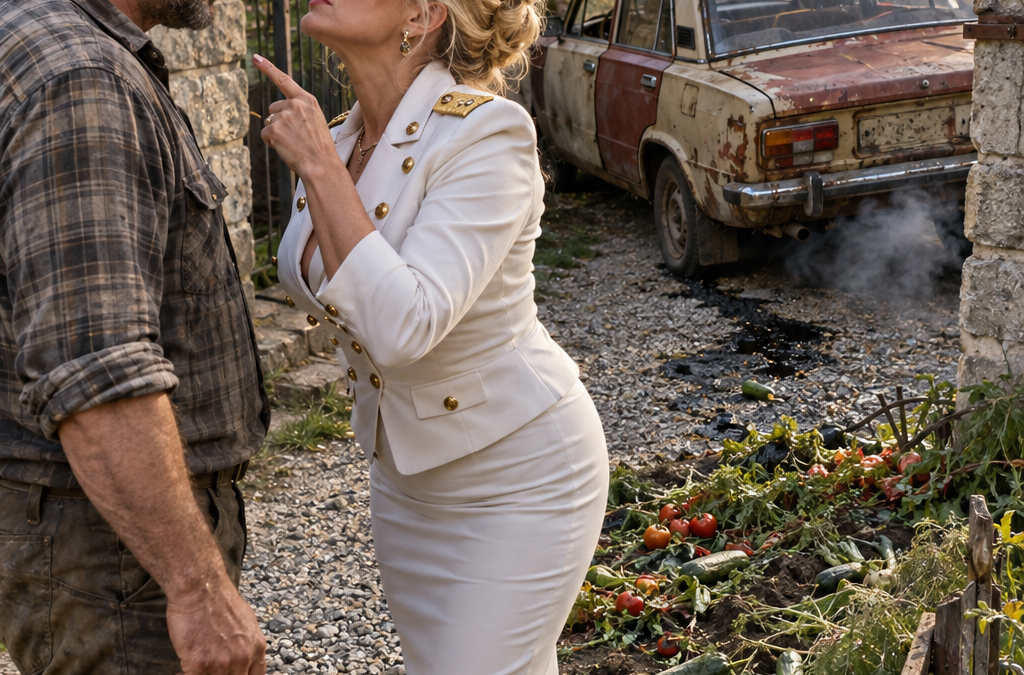
She liked fitted clothes and had a very theatrical sense of authority. One of her favorite outfits was a tight white military-inspired jacket with gold buttons and decorative shoulders over a fitted skirt, which made her look like she’d appointed herself commander of a military unit nobody else knew existed.
She had a large personality to match.
Karen spoke as if she were correcting people even when she was asking what time it was.
Her car was another matter.
It was an old Lada that appeared to be held together mostly by rust, wire, and stubbornness.
One door didn’t close correctly.
The exhaust sounded unhealthy.
The body had several different shades of faded paint.
Oil seemed to leak from somewhere underneath no matter where she parked it.
When the engine started cold, it produced a cloud large enough to make you question whether the vehicle had caught fire.
Karen drove that thing with the pride of someone behind the wheel of a government limousine.
The first problem happened not long after I moved into my grandfather’s house permanently.
I came home from work one evening and found the Lada parked in my driveway.
Not near the driveway.
Not half over the property line.
Not positioned in some way that could reasonably be called a mistake.
It was directly in the middle.
My garage door was behind it.
I stopped outside the gate and stared.
At first, I assumed someone had broken down.
The car looked capable of breaking down simply from being looked at too aggressively.
Then I recognized it as Karen’s.
I parked along the road.
Walked next door.
Knocked.
Karen opened almost immediately.
She already had her arms crossed.
“What?”
That should have warned me.
“Hello.”
“What do you want?”
“I’m from next door.”
“I know.”
“Your car is in my driveway.”
She looked past me as if checking.
Then returned her eyes to mine.
“I know.”
That confused me more.
“I thought maybe you parked there by mistake.”
“No.”
“Okay.”
She waited.
“So could you move it?”
Her eyebrows rose.
“Why?”
I remember actually looking behind myself, wondering whether I was missing something obvious.
“Because it’s blocking my garage.”
She shrugged.
“I don’t see the problem.”
“I need to get into the garage.”
“Later.”
I stared.
“It’s my driveway.”
Another shrug.
“It’s just a driveway.”
That was the exact moment I realized this conversation wasn’t going to follow ordinary logic.
I stayed polite.
“Yes. My driveway. On my property.”
She sighed dramatically.
“Fine.”
“Thank you.”
“Whatever.”
Then she slammed the door.
Twenty minutes passed before she finally came outside.
She walked past me without speaking.
Started the Lada.
The engine coughed twice.
A gray cloud came out of the exhaust.
Then she drove it back to her own property.
I thought it was over.
Why wouldn’t I?
Maybe she’d been distracted.
Maybe she was difficult but not malicious.
Maybe she genuinely didn’t understand that I needed access.
The following week I came home and found the Lada in my driveway again.
This time it was angled sideways.
It blocked the garage more efficiently than before.
I parked outside.
Walked next door.
Karen opened the door wearing a smug little smile.
“Oh.”
She leaned against the frame.
“It’s you again.”
“The car.”
“What car?”
I stared at her.
“Yours.”
“What about it?”
“It’s in my driveway again.”
She gave me the same innocent expression.
“I needed somewhere to park.”
“Your driveway is empty.”
She glanced toward her own property.
“Now it is.”
“What does that mean?”
“It was blocked earlier.”
“By what?”
“Things.”
“What things?”
She looked annoyed.
“Why does it matter?”
“Because you’re parked on my property.”
“It’s temporary.”
“Then move it.”
Her smile returned.
“I’ll get to it.”
“No.”
That surprised her.
“I need you to move it now.”
She studied me for a few seconds.
Then said:
“You are very unfriendly.”
“I am asking you not to block my garage.”
“We are neighbors.”
“Exactly.”
“Neighbors help each other.”
“If you had asked to park here for an hour, maybe I would’ve helped.”
“I shouldn’t have to ask every time.”
That sentence was so ridiculous I didn’t even know how to answer it.
She finally moved the car.
And then she did it again.
And again.
And again.
For months, Karen’s old Lada appeared in different places around my property. Sometimes it blocked the garage; sometimes it sat in the center of the driveway; once she even put it on the grass beside my garden.
At first I kept assuming there had to be some reason.
Then I understood.
She was doing it because I had objected.
My request itself had become the motivation.
Some people interpret a boundary as information.
Karen interpreted it as a challenge.
She began timing the parking.
I would come home from work and find her car positioned diagonally across the narrowest part of the driveway.
If I tried to squeeze past, there would be maybe fifteen centimeters between our vehicles.
Too close.
I’d stop.
Back out.
Find her.
Ask her to move.
She’d act surprised.
“Oh, you’re home already?”
Same time every day.
Another morning, I needed to leave early.
The Lada was parked directly outside the garage.
I knocked on her door.
No answer.
Knocked again.
Nothing.
I waited.
Then saw movement behind her curtain.
She was home.
“Karen!”
Nothing.
I knocked again.
Finally the door opened.
She was wearing a robe.
“What?”
“I need to go to work.”
“So?”
“Your car is blocking mine.”
She yawned.
“I’ll move it later.”
“I have to leave now.”
“You should plan better.”
I couldn’t believe it.
“Plan better?”
“Yes.”
“It’s six-thirty in the morning.”
“And you’re waking me up.”
“Because your car is in my driveway.”
She stared at me as if I were unreasonable.
After several minutes of arguing, she moved it.
I was late.
That was when the pattern became impossible to ignore.
Karen wasn’t looking for parking.
She was looking for control.
She watched my routine.
She knew when I worked.
When I came home.
When I went shopping.
When I usually needed the garage.
She learned which parking angle inconvenienced me most.
Sometimes she left just enough space for me to think I could get through.
I would begin maneuvering.
Halfway past her car, I’d realize my mirror was about to scrape the stone fence.
Then I’d reverse.
Go next door.
Knock.
And see that same little smile.
One afternoon I asked:
“Why are you doing this?”
“Doing what?”
“You know exactly what.”
“I park my car.”
“On my property.”
“I don’t know why you’re obsessed with property.”
“Because it’s mine.”
She laughed.
“Men.”
“What does that mean?”
“Always territorial.”
“It’s a driveway.”
“Exactly.”
“My driveway.”
“There you go again.”
She somehow managed to make ownership sound like a personality defect.
Eventually I decided politeness wasn’t enough.
I called the local police.
An officer came out.
He looked tired before he even left his vehicle.
This wasn’t a serious crime by the standards of that period.
There were thefts.
Fights.
Drunk drivers.
Organized crime.
Economic chaos.
Two neighbors arguing about an old Lada was not going to become anyone’s top priority.
Still, he came.
He looked at Karen’s car.
Looked at my driveway.
Looked at the stone boundary.
Then spoke with both of us.
Karen transformed instantly.
Her voice became soft.
Reasonable.
Almost hurt.
“I don’t understand why he’s making such a problem.”
The officer looked at me.
I said:
“She parks here repeatedly without permission.”
Karen shook her head.
“We’re neighbors.”
“I’ve told her not to.”
“Sometimes he lets me.”
“No.”
She turned to the officer.
“You see?”
“See what?”
“He gets angry.”
“I’m not angry.”
“He’s always angry with me.”
The officer rubbed his forehead.
“Do you have permission to park here?”
Karen smiled sweetly.
“We have an understanding.”
“No, we don’t.”
She looked shocked.
“You said I could park temporarily.”
“When?”
“Before.”
“When?”
She shrugged.
“Many times.”
The officer turned toward me.
“Did you?”
“I asked her to move every single time.”
Karen said:
“That’s not how I remember it.”
There it was.
Her word against mine.
The officer pulled me aside.
“Listen.”
“Yes?”
“This is private property, but proving what arrangement existed between neighbors is difficult.”
“There is no arrangement.”
“I understand what you’re telling me.”
“Then make her move.”
“I can tell her to move today.”
“Good.”
“But tomorrow, if she claims you allowed her again?”
I sighed.
“Then what?”
“Document it.”
“How?”
“Written notice. Witnesses. Photographs if you can.”
This was decades before everyone carried a high-resolution camera in a pocket.
Documentation was not as easy as it is now.
He continued:
“Right now she says she believes she has permission.”
“She’s lying.”
“Probably.”
That surprised me.
He looked toward Karen.
“But ‘probably’ isn’t enough for me to turn a stupid neighbor argument into something bigger.”
I understood.
Didn’t like it.
Understood.
He told Karen to move the car.
She did.
For three days.
Then it was back.
From that point on, “Prove it” became Karen’s favorite phrase.
I would confront her.
“You know you don’t have permission.”
“Prove it.”
“You blocked me yesterday.”
“Prove it.”
“You parked here while I was at work.”
“Prove it.”
The smugness intensified.
Because now she believed the police had confirmed her invincibility.
The parking wasn’t the only problem anymore.
Trash began appearing.
Cigarette butts near the driveway.
Food wrappers.
A bottle.
Once an empty vodka bottle appeared beside the garage.
I went next door.
“Is this yours?”
Karen looked at it.
“No.”
“It was beside your car.”
“So?”
“It wasn’t there before.”
She smiled.
“Maybe the wind.”
“The wind carried a vodka bottle?”
“Strong wind.”
“Karen.”
“What?”
“You know this is yours.”
“Prove it.”
I hated those two words.
Prove it.
She had discovered the perfect weapon for a situation where authorities didn’t want to referee every petty dispute.
No witnesses?
Prove it.
No camera?
Prove it.
No written confession?
Prove it.
The car was rusting holes into my patience.
Then came spring planting.
My grandfather had always maintained a large vegetable garden.
After inheriting the property, I kept the tradition.
Partly because I enjoyed it.
Partly because letting the garden disappear felt like losing another piece of him.
That year I spent weeks preparing the beds.
Turned the soil.
Added compost.
Planted tomatoes.
Peppers.
Onions.
Cucumbers.
Several rows had only recently sprouted.
Anyone looking could see they were planted.
One afternoon I came home and stopped outside the gate.
Karen’s Lada wasn’t in the driveway.
For one brief second, I felt relieved.
Then I saw it.
She had driven onto the grass.
One side of the car was sitting on the edge of the garden.
The tires had crushed several newly planted rows.
I got out of my car.
Walked closer.
Seedlings were flattened into the soil.
One tire had created a deep rut.
I don’t remember deciding to walk next door.
I simply remember pounding on Karen’s door.
She opened.
“What?”
“What the hell are you doing?”
She stepped back slightly.
“What are you talking about?”
“Your car.”
She looked past me.
“Oh.”
“Oh?”
“What?”
“You drove into my garden.”
“I needed somewhere to park.”
“Your driveway is empty!”
She rolled her eyes.
“Here we go again.”
“You crushed my plants.”
“They’re plants.”
“They’re mine.”
“I didn’t think a few seedlings were such a big deal.”
I stared at her.
Something in her expression changed.
The fake innocence disappeared.
And for the first time, she said openly what she’d been implying for months.
“Actually, I can park wherever I want.”
I laughed once.
Not because it was funny.
Because the alternative was shouting.
“No, you cannot.”
“My son is in the military.”
I stared.
“What?”
“You heard me.”
“What does your son have to do with my garden?”
She stepped closer.
“He knows people.”
I almost couldn’t follow the logic.
“Your son being in the military doesn’t give you rights over my property.”
She smiled.
“Doesn’t it?”
“No.”
“He has important connections.”
“Good for him.”
“You should be very careful about making enemies.”
“Are you threatening me?”
“I’m giving you advice.”
“Move the car.”
She crossed her arms.
“No.”
My jaw tightened.
“Move it.”
Karen came closer until we were nearly face-to-face.
“What are you going to do?”
I said nothing.
“Call the police again?”
Her smile widened.
“How did that work last time?”
“Move your car.”
“Or what?”
I stared at her.
She lifted her chin.
“You want to take action against my car?”
“Get it off my property.”
“Go ahead.”
She spread her arms slightly.
“Touch it.”
I said nothing.
“I dare you.”
Her voice dropped.
“Touch my car.”
She pointed toward my house.
“Do anything to it.”
Then she smiled.
“But I’m warning you.”
I waited.
“I’m protected.”
“By your son.”
“Yes.”
“You seriously believe that.”
“I know it.”
“You think nobody can touch your property while you can drive over mine.”
“Now you’re understanding.”
“You are unbelievable.”
“No.”
She leaned closer.
“You are weak.”
That landed harder than it should have.
Not because I believed her.
Because I realized this entire thing had become entertainment to her.
Months of inconvenience.
Being late to work.
Trash.
Crushed seedlings.
Police visits.
Every time I tried to act reasonably, she interpreted restraint as fear.
Karen continued.
“You complain.”
Nothing.
“You knock on my door.”
Nothing.
“You ask.”
Nothing.
“But you never do anything.”
She smiled.
“What are you going to do about it?”
I looked at her.
Then at the Lada sitting partly on my garden.
Then back.
“Fine.”
Her smile faded slightly.
“Fine what?”
“Nothing.”
I nodded.
“Remember you said that.”
“Said what?”
“That I should do something.”
Her eyes narrowed.
“I dare you.”
“Good.”
I turned.
Walked away.
Behind me she called:
“That’s what I thought.”
That night I couldn’t sleep.
Her words kept repeating.
I dare you.
I’m protected.
There’s nothing you can do.
The rational part of my mind knew this was becoming ridiculous.
The emotional part was tired of being treated like I didn’t own my own property.
The next morning I started asking questions.
Remember, this was rural Ukraine during a chaotic period.
Property procedures weren’t something you could simply look up online.
There was no easy municipal towing website.
No smartphone search.
You asked police.
Neighbors.
Local officials.
Old men who somehow knew everything.
I spoke to several people.
The answers were inconsistent.
Call police.
Don’t call police.
Push the car into the road.
Don’t touch the car.
Charge storage.
Tow it.
Wait.
Ignore it.
One conversation stayed with me.
My neighbor Mikhail was older than I was by decades.
He had lived in the village his entire life.
I explained the problem.
He listened.
Then said:
“She keeps leaving it on your land?”
“Yes.”
“You tell her to move?”
“Every time.”
“And she refuses?”
“Yes.”
Mikhail scratched his chin.
“In the old days, we would call that abandoned.”
“It’s not abandoned. She comes back.”
He shrugged.
“Then why leave it where she’s been told not to?”
“To annoy me.”
“So she wants you responsible for it?”
“No.”
“Then remove it.”
“Police said—”
“Police said what?”
“Hard to prove I didn’t give permission.”
He laughed.
“Then stop giving permission.”
“I never gave permission.”
“Exactly.”
I knew what he meant.
Then he said something more interesting.
“If someone abandons junk on your property after you tell them to remove it, eventually you treat it as junk.”
“Legally?”
Mikhail shrugged.
“Legal.”
The way he said the word captured the period perfectly.
“You want a university professor or you want that car gone?”
“Car gone.”
“Find Victor.”
“Who?”
“Flatbed truck.”
That was the beginning of the plan.
I asked around.
There wasn’t a modern towing company nearby.
But there were people who moved broken vehicles.
Farm equipment.
Scrap cars.
Machinery.
Victor was one of them.
He owned a flatbed truck and did hauling jobs.
I found him working near a repair yard.
“You Victor?”
“Depends.”
“On?”
“Who asks?”
I told him my name.
Explained the situation.
Months of parking.
Repeated demands.
Police.
Garden.
Karen’s refusal.
The dare.
Victor listened.
Then said:
“Whose land?”
“Mine.”
“Car parked there now?”
“Not today.”
“You want me to tow it when it comes back?”
“Yes.”
He scratched his beard.
“You have permission from owner?”
“No.”
“Then this can become trouble.”
“Owner has been told repeatedly not to leave it.”
“How repeatedly?”
“Months.”
“And refuses?”
“Yes.”
He thought.
Then asked:
“That rusted Lada next door?”
“You know it?”
“Everyone knows it.”
“Why?”
“Because I don’t understand how it’s still alive.”
I laughed despite myself.
He continued.
“If you call when it’s on your property, I can remove it.”
“Where?”
“Petro’s scrap yard.”
“Will he hold it?”
“Yes.”
“How long?”
“About a week.”
“What happens if owner claims it?”
“They pay towing.”
“Okay.”
“Storage.”
“Okay.”
“And whatever Petro decides he’s owed.”
“How much?”
Victor smiled.
“More than the Lada is worth.”
“And if nobody claims it?”
He made a crushing motion with both hands.
“Scrap.”
That should have made me reconsider.
I won’t pretend it did.
Maybe I was too angry.
Maybe Karen had finally pushed me into thinking the way she did.
She had dared me.
Repeatedly.
The next week, she parked in my driveway three more times.
Each time I told her to move it.
Each time she delayed.
I didn’t mention Victor.
Tuesday morning came.
Karen parked directly in front of the garage.
Perfect.
She got out.
Locked the Lada.
Then walked toward the village market.
I watched from the kitchen.
Karen usually spent at least two hours there.
Shopping took thirty minutes.
Gossip took the rest.
I picked up the telephone.
Called Victor.
“You busy?”
“Where’s the car?”
“Garage.”
“I’ll be there.”
Twenty minutes later I heard the flatbed coming.
Victor drove into the property with another man.
He stopped.
Climbed out.
Looked at the Lada.
Then looked at me.
“This?”
“Yes.”
He walked around it.
Kicked one tire lightly.
A flake of rust fell from somewhere.
“You sure somebody wants this?”
“Very sure.”
Victor laughed.
They positioned the truck.
Attached chains.
Winched the Lada onto the flatbed.
The old suspension groaned.
One door shifted slightly because it never latched right.
Watching it rise felt strange.
Satisfaction mixed with nervousness.
This was the first time in months the car was moving from my driveway without Karen controlling when.
Victor secured it.
“Last chance.”
I looked at him.
“What?”
“I can put it back.”
I looked toward Karen’s house.
Then the crushed garden.
Then my garage.
“No.”
Victor nodded.
“Petro’s yard.”
“Fifteen kilometers east?”
“About.”
“How long does he hold it?”
“One week.”
“Make sure he does.”
“He will.”
“And if she asks?”
Victor smiled.
“I transport junk.”
“Victor.”
“What?”
“Seriously.”
“If she finds it and pays, she gets it.”
“Good.”
He climbed into the truck.
I watched Karen’s Lada disappear down the road.
Then I opened the garage.
Pulled my own car out.
Parked it exactly where hers had been.
Went inside.
And waited.
Karen came back around an hour later.
I heard her before seeing her.
Not words.
A scream.
A raw, furious shriek from outside.
Then:
“WHERE IS IT?”
Footsteps.
My front door shook under pounding.
I opened it.
Karen stood there.
Her face was red.
“What did you do?”
“Hello.”
“WHERE IS MY CAR?”
“What car?”
That was petty.
I admit it.
She pointed behind herself.
“My car!”
“Oh.”
I looked toward the empty driveway.
“That one.”
“Where is it?”
“The vehicle you abandoned?”
“I DID NOT ABANDON IT!”
I leaned against the doorframe.
“You left it on my property.”
“I PARK THERE.”
“I know.”
“You know?”
“Yes.”
“Then where is it?”
“I had unwanted property removed.”
She stared.
“You what?”
“You’ve been told repeatedly not to park here.”
“You stole my car.”
“No.”
“You stole it!”
“I had a vehicle removed from my property.”
“WHERE DID YOU TAKE IT?”
“I didn’t take it anywhere.”
Her face was becoming purple.
“Who did?”
“Someone who removes junk.”
“JUNK?”
Her voice cracked.
“That is my car!”
“You said you weren’t going to move it.”
“I didn’t say I was abandoning it.”
“You dared me to touch it.”
“I didn’t mean steal it!”
“I didn’t steal it.”
“Where is it?”
I shrugged.
“I don’t know.”
That was not entirely true.
I knew the general destination.
But Victor was the one handling removal.
Karen stepped closer.
“You tell me right now.”
“Or?”
She froze.
I couldn’t resist.
“You’ll call your military son?”
Her eyes widened.
“The important connections?”
“Don’t you mock my family.”
“The people who make you untouchable?”
“You will regret this.”
“Maybe.”
“I will have you arrested.”
“Okay.”
“I will sue you.”
“Okay.”
“I will destroy you.”
“Okay.”
That infuriated her more than arguing.
She pointed at me.
“This is not over.”
I nodded.
“I think it is.”
“You have no idea what you’ve done.”
“I removed a car from my garage entrance.”
“My car.”
“Yes.”
“You had no right.”
I smiled.
“Interesting.”
“What?”
“Now you care about property rights.”
She had no answer for that.
I continued:
“You told me you could put your property on mine because there was nothing I could do.”
She stared.
“You told me I was weak.”
Nothing.
“You dared me.”
Nothing.
“So I finally believed you.”
Karen stormed away.
She spent the rest of the afternoon making phone calls.
I know because I could hear her through the open windows.
Police.
Relatives.
People whose names I didn’t know.
The next morning, a different police officer came.
Younger.
More serious.
I expected him.
He knocked.
“Are you the property owner?”
“Yes.”
“We received a complaint regarding a stolen vehicle.”
I nodded.
“The Lada?”
“Yes.”
“Owner says you arranged to have it removed.”
“Correct.”
He wrote something.
“Why?”
“Because it was abandoned in front of my garage.”
“Abandoned?”
“She has parked on my property for months.”
I explained everything.
Repeated requests.
Prior officer.
Claims of permission.
Garden damage.
Her refusal.
Her dare.
The new officer listened.
Then asked:
“Did you damage the vehicle?”
“No.”
“Sell it?”
“No.”
“Keep it?”
“No.”
“What did you do?”
“Hired someone to remove an unwanted vehicle from my private property.”
“Where did it go?”
“I don’t know precisely.”
He looked up.
“You hired someone but don’t know where?”
“I hired someone who handles junk vehicles.”
He studied me.
I continued.
“The last officer told me the problem was there was no proof whether she had permission.”
He nodded slightly.
“There isn’t.”
“I am now telling you, as the property owner, she did not have permission.”
He wrote again.
“Any witnesses?”
“Neighbors know I’ve asked her to stop.”
“Anything written?”
“No.”
“Has she got proof you gave permission?”
“No.”
He sighed.
The same problem had reversed.
Before, Karen benefited because it was her word against mine.
Now that same ambiguity hurt her.
The officer went next door.
Talked to Karen.
Came back.
“You understand she says you stole her car.”
“I understand.”
“She says it was only parked temporarily.”
“It had been a repeated problem for months.”
“She says you gave permission.”
“I didn’t.”
He looked toward the stone fence.
Then the garage.
Then the tire marks where Karen had regularly stopped.
Finally he said:
“Don’t do anything else.”
“I’m not planning to.”
“If the car turns up, this may become a different matter.”
“Understood.”
Then he left.
No arrest.
No handcuffs.
No military intervention.
Karen must have expected more.
She came to my door later.
“Where is it?”
“I already told you.”
“Tell me who took it.”
“No.”
“You know.”
“I hired a removal.”
“What company?”
“Not a company.”
“Name.”
“No.”
She stared.
“My son is coming.”
“Good.”
“He’ll deal with you.”
“I’m looking forward to meeting this general.”
She slammed her hand against the doorframe.
“Don’t joke.”
“I’m not.”
Two days later, the military son arrived.
Except he wasn’t exactly what Karen had implied.
A man in his thirties came with her.
He wore ordinary clothes.
Karen marched beside him with the confidence of someone bringing artillery.
“This is my son.”
He looked uncomfortable.
“Hello.”
I said:
“Hello.”
Karen told him:
“This is the man who stole the car.”
He looked at me.
“Did you?”
“I had it removed from my driveway.”
He looked toward the garage.
Then at Karen.
“You parked here?”
She snapped:
“That doesn’t matter.”
His face changed.
It mattered to him.
He asked me:
“How often?”
“Months.”
Karen interrupted.
“I had permission.”
“No, you didn’t.”
Her relative looked at her.
“Did he tell you not to?”
“He’s unreasonable.”
“That’s not what I asked.”
I almost liked him.
She glared.
He turned toward me.
“Where was it taken?”
“I don’t know where it is now.”
“Who moved it?”
“A local hauler.”
Karen said:
“See? He admits it.”
The man rubbed his forehead.
Then he said something to Karen quietly.
She became furious.
I couldn’t hear every word.
But I heard:
“You told me…”
And:
“This is not military business.”
That was when I realized something.
He wasn’t a high-ranking officer.
From what neighbors later told me, he wasn’t even her son.
He was a nephew doing clerical work at a regional military office.
Important connections indeed.
He left without threatening me.
Karen remained.
“You embarrassed me.”
I stared at her.
“You did that yourself.”
“This isn’t finished.”
“You keep saying that.”
“I’ll find the car.”
“Then find it.”
And she tried.
For days.
Then weeks.
Karen traveled around nearby villages asking whether anyone had seen her Lada.
She contacted repair shops.
Scrap yards she knew.
Neighbors.
People at the market.
Drivers.
Every rumor sent her somewhere else.
Meanwhile, the clock at Petro’s yard kept running.
Ten days after the tow, Victor visited.
I was outside working near the garden.
He leaned against the gate.
“Thought you’d want to know.”
“Know what?”
He smiled.
“Nobody came.”
My stomach tightened slightly.
“For the Lada?”
“Yes.”
“What happened?”
“Petro waited.”
“How long?”
“A week.”
“And?”
Victor made the crushing gesture again.
I stared.
“He crushed it?”
“Yesterday.”
For several seconds, I didn’t speak.
All those months.
The rusty car angled across my driveway.
The late mornings.
Arguments.
Trash.
Oil stains.
Crushed seedlings.
Karen’s smug smile.
Prove it.
I dare you.
Untouchable.
Now the Lada was compressed scrap.
“How much was it worth?”
Victor laughed.
“Maybe fifty rubles.”
“That’s all?”
“I’m being generous.”
He scratched his beard.
“Half the thing was rust.”
I felt satisfaction.
I’m not going to rewrite my younger self as morally perfect.
I felt a lot of satisfaction.
But there was something else too.
A strange finality.
I’d wanted the harassment to stop.
The vehicle no longer existed.
That was certainly one way to accomplish it.
Karen never learned exactly where it went.
At least not from me.
Victor didn’t tell her.
Petro didn’t tell her.
For weeks, she kept asking.
She became convinced someone had hidden it.
One afternoon she stopped me near the road.
“You know where it is.”
“No.”
“Liar.”
“You’ve checked everywhere?”
“Why do you care?”
“I don’t.”
“You think this is funny?”
“I think parking somewhere else would’ve been easier.”
Her face tightened.
“You destroyed it.”
“I had it removed.”
“You destroyed it.”
“Can you prove that?”
The words left my mouth before I consciously decided to say them.
Karen froze.
I smiled.
“Prove it.”
She looked like she wanted to hit me.
Instead she turned around and walked away.
That was the last serious confrontation we had over the car.
Afterward, something remarkable happened.
Karen stopped parking on my property.
Obviously, part of that was because she no longer had the vehicle.
But even after she eventually arranged other transportation, she didn’t park in my driveway.
Not once.
No trash beside the garage.
No cigarette butts.
No bottles.
No crushed garden.
The property became quiet.
I could leave for work without checking whether a rusted obstacle had appeared overnight.
I could come home and drive directly to my garage.
Normal things suddenly felt luxurious.
The seedlings Karen had crushed didn’t all survive.
I replanted some.
Others were too late for the season.
The garden looked uneven that year.
Whenever I passed the damaged section, I remembered the argument.
Her saying:
A few plants aren’t a big deal.
Maybe they weren’t.
Not financially.
The car was probably worth more than the seedlings.
Even an old Lada meant something in Ukraine at that time.
Vehicles weren’t disposable.
People kept cars alive for decades because replacing them wasn’t easy.
Looking back now, I understand why some people hearing the story think I went too far.
They’re not necessarily wrong.
If someone asks whether crushing another person’s car over a parking dispute is proportionate, the answer sounds obvious.
But that’s not how it felt while living through months of it.
The car wasn’t just a car anymore.
It had become a tool.
Karen used it deliberately.
To block me.
Delay me.
Force interactions.
Destroy plants.
Test boundaries.
Then she hid behind uncertainty.
Prove permission.
Prove intent.
Prove trash.
Prove damage.
She created a situation where every reasonable response required more effort from me than the original offense required from her.
Move your car.
No.
Call police.
Can’t prove it.
Take photographs.
Not easy.
Find witnesses.
Maybe.
Ask again.
No.
Every time I chose restraint, she interpreted it as confirmation that nothing would happen.
And eventually she said the one thing she should never have said.
I dare you.
People say things like that because they assume the other person will remain the person they have already trained him to be.
Polite.
Cautious.
Reasonable.
Afraid of consequences.
Karen was certain she knew my limits.
Then I changed them.
Would I do exactly the same thing today?
Probably not.
Today, I would install cameras.
Send certified notices.
Document each trespass.
Call a licensed towing service.
Get written records.
Follow whatever abandoned-vehicle procedure applied.
I would build a case so clean that nobody could argue about permission.
Back then, those systems either didn’t exist in the same way or weren’t accessible to a person in a village dealing with a ridiculous neighborhood conflict.
So I used what existed.
Neighbors.
A truck.
A scrap yard.
And a woman whose arrogance convinced her she was untouchable.
Years later, Mikhail asked me about the Lada.
We were sitting outside his house drinking tea.
He said:
“Whatever happened to Karen’s car?”
I looked at him.
“You don’t know?”
“I heard stories.”
“What stories?”
“Some say Russians stole it.”
I laughed.
“Why would Russians want that?”
“Exactly.”
“What else?”
“Karen says you sold it.”
“I didn’t.”
“Someone said it fell into a river.”
“Definitely not.”
Mikhail smiled.
“So?”
I told him.
Everything.
Victor.
Petro.
Storage period.
Scrap.
Fifty rubles.
Mikhail listened.
Then laughed so hard he had to put down his cup.
When he recovered, he said:
“Fifty?”
“Approximately.”
“Too much.”
“Victor said the same.”
Mikhail wiped his eyes.
“Karen treated that car like gold.”
“Apparently Petro disagreed.”
The story spread eventually.
Village stories always do.
But by then enough details had mutated that I never knew which version people believed.
Maybe that was better.
Karen stayed next door for several more years.
Our relationship never became friendly.
But it became respectful in the only way she seemed to understand.
Distance.
She stayed on her side of the stone fence.
I stayed on mine.
When we passed each other, we nodded occasionally.
No conversations.
No military threats.
No property lectures.
The old stone fence did what it had always done.
It showed where one person’s rights stopped and another person’s began.
Nothing complicated.
One line.
My grandfather had understood that.
Every farmer and homeowner around us understood it.
Karen had looked at that line and decided it was optional.
Then spent months discovering how expensive that assumption could become.
Eventually she moved away.
I don’t remember exactly why.
Family, I think.
Another city.
By then enough time had passed that the anger was gone.
I watched a truck take furniture from her house.
A strange memory returned.
Victor’s flatbed carrying the Lada away.
For a second I wondered whether Karen remembered too.
Probably.
Before she left, she came to the stone fence.
I was repairing part of the gate.
She stood quietly.
That itself was unusual.
I looked up.
“Hello.”
“Hello.”
She glanced toward my driveway.
Then toward the garage.
“You still tell people about my car?”
I smiled.
“Sometimes.”
Her lips tightened.
“I knew it.”
“You asked.”
“You made me look like a fool.”
I set down the wrench.
“Karen.”
“What?”
“You parked in my garden.”
“It was years ago.”
“You blocked my garage for months.”
“I know.”
“You threatened me with your military connections.”
She looked away.
“People say things.”
“You dared me.”
“I didn’t think you’d actually—”
She stopped.
For the first time, I heard the truth.
“You didn’t think I’d actually do anything.”
She said nothing.
“That was the whole problem.”
Karen looked at me.
“You could have just told me where the car went.”
“I told you to move it before it went anywhere.”
Her expression hardened slightly.
Then softened again.
Maybe age.
Maybe distance.
Maybe because she was leaving.
“I shouldn’t have parked there.”
It wasn’t exactly an apology.
But it was the closest I’d ever get.
“No.”
I nodded.
“You shouldn’t have.”
She looked at the garden.
My tomato plants were healthy that year.
She gave a tiny smile.
“Your plants look good.”
I almost laughed.
“Thank you.”
Then she walked back to her house.
The moving truck left the following day.
I never saw Karen again.
The property changed owners.
The new neighbor came over almost immediately.
His name was Pavel.
He was probably thirty.
Young family.
Two children.
He stood at the gate.
“Hello.”
“Hello.”
“We’re next door.”
“I noticed.”
He laughed.
“I wanted to ask about parking when relatives visit.”
I looked at him.
“What about it?”
“Sometimes they may have two or three cars.”
“Okay.”
“Is there somewhere along the road that’s best?”
He pointed.
“We don’t want to block your driveway.”
I stared for half a second.
Then laughed.
Pavel looked confused.
“Did I say something?”
“No.”
“Is parking a problem?”
“No.”
I pointed toward a wide shoulder farther from my gate.
“They can park there.”
“Great.”
“If you ever need space temporarily, just ask.”
“Of course.”
That was it.
Ten seconds.
Problem solved.
That’s what made Karen’s behavior seem even more absurd in hindsight.
Most property disputes don’t require laws.
They require one word.
Ask.
Can I park here?
Yes.
No.
For how long?
Until five.
Thank you.
Done.
Karen skipped the question because asking meant acknowledging I had the right to say no.
And that was what she couldn’t tolerate.
She didn’t really need my driveway.
Her own was usually empty.
She needed the victory.
After the first time I objected, parking became symbolic.
Every time the Lada appeared, she was saying:
You don’t control this.
Every time I asked her to move it and waited, she believed she’d proven something.
The garden changed that for me.
It stopped being inconvenience.
She had driven a vehicle onto something I’d spent weeks planting and then told me it didn’t matter.
When I protested, she didn’t apologize.
She didn’t move quickly.
She escalated.
Military son.
Connections.
Untouchable.
Dare.
At that point, the conflict wasn’t about a car.
It was about whether she believed my property existed at all when it conflicted with what she wanted.
I still think about the first police officer sometimes.
People occasionally blame him when I tell the story.
I don’t.
He was working within what he could prove.
Two neighbors.
One claimed permission.
One denied it.
No camera.
No written record.
He told me to document.
He wasn’t wrong.
The problem was that Karen heard his inability to act decisively and interpreted it as legal permission.
People do that constantly.
An officer says:
“I can’t arrest someone based on this.”
They hear:
“What I’m doing is legal.”
Those are not the same statement.
Karen built months of arrogance on that misunderstanding.
The second officer didn’t arrest me either.
Maybe that reinforced my own arrogance.
I recognize that possibility too.
As I’ve grown older, I’m less interested in pretending revenge made me unquestionably right.
It solved the problem.
That doesn’t make every step perfect.
The Lada being crushed was irreversible.
Had Karen found Petro’s yard during the storage period, she could have paid and recovered it.
She didn’t.
Was I secretly hoping she wouldn’t?
Of course.
I’m not going to lie.
When Victor told me it had become scrap, I didn’t feel regret.
I felt relief.
That may not be noble.
It’s honest.
There is something important about telling these stories without rewriting yourself as a saint.
Karen was wrong.
Repeatedly.
Deliberately.
I eventually responded in a way that was aggressive, risky, and shaped by the legal chaos of the time.
Both things can be true.
But one thing has never changed in my mind.
I warned her.
Again.
And again.
And again.
Months.
Move your car.
Stay off my land.
Don’t block the garage.
Don’t drive into the garden.
She had more opportunities to stop than I can count.
The final opportunity was the easiest.
When I told her to move the car after she crushed the seedlings, she could have said:
Fine.
She could have driven ten meters next door.
Instead she stepped into my face.
Boasted about protection.
Told me I was powerless.
And dared me.
That was the choice that turned a stupid parking dispute into a story I can still tell three decades later.
Years after leaving the house, I drove through the village again.
The old stone fence was still there.
Some sections repaired.
Others leaning.
My grandfather’s house had been repainted.
The garden was smaller.
The detached garage had a newer door.
The gravel driveway was still visible.
For a moment I pictured the Lada sitting across it.
Rust.
Oil leak.
Crooked door.
Karen watching from next door.
Then the memory disappeared.
Just an empty driveway.
Exactly the way I’d wanted it.
I stopped nearby and looked for a minute.
Property can hold strange memories.
A driveway is just gravel.
Until someone spends months using it to tell you your boundaries don’t matter.
A garden is just soil.
Until someone drives across your seedlings and smiles.
An old car is just scrap metal.
Until it becomes the center of a neighborhood war.
Karen once believed her Lada made her powerful because she could put it wherever she wanted and force me to react.
In the end, it was worth about fifty rubles.
Maybe that was the most appropriate ending possible.
All that arrogance.
All those threats.
All the blocking.
All the “prove it.”
All the claims that important people protected her.
Compressed into a block of rusty metal barely worth paying someone to haul away.
Whenever someone asks me what finally happened to the woman who kept parking on my property, I don’t start with the scrap yard.
I start with the first conversation.
“It’s my driveway.”
“I don’t see the problem.”
Because everything was already there.
Karen believed something only became a problem when it affected her.
My garage blocked?
Not a problem.
My work delayed?
Not a problem.
My property crossed?
Not a problem.
Trash left?
Not a problem.
Seedlings crushed?
Not a problem.
Her car moved?
Suddenly property rights were sacred.
Suddenly police mattered.
Suddenly ownership mattered.
Suddenly consent mattered.
That hypocrisy taught me something I’ve carried ever since.
Some people understand boundaries only when they need one.
You can explain yours for months and they will treat it like a suggestion.
The moment their own boundary is crossed, they become experts.
With Karen, words didn’t work.
Requests didn’t work.
Police warnings didn’t work.
Neighborly patience definitely didn’t work.
What finally worked was consequence.
Not the most elegant consequence.
Not the one I’d recommend today.
But one she understood immediately.
After that Lada disappeared, Karen never again seemed confused about where my property began.
And she never parked on my driveway again.
Not once.
For all the arguments we had, all the threats, all the claims that her family connections put her above ordinary rules, the ending was almost absurdly simple.
She dared me to do something.
I did.
And for the first time since I’d moved into my grandfather’s house, the driveway stayed empty.