𝗙𝗨𝗟𝗟 𝗦𝗧𝗢𝗥𝗬 She Had My Tesla Towed From My Own Driveway—Then Gave Me 30 Days to Sell It
𝗙𝗨𝗟𝗟 𝗦𝗧𝗢𝗥𝗬
I almost laughed.
Not because anything was funny.
Because the statement was so absurd that my brain didn’t know what else to do with it.
“There has never been a rule against electric cars.”
“There is now.”
“Show it to me.”
Karen’s lips tightened.
“I don’t carry the bylaws around in my purse.”
“Then pull them up on your phone.”
Her eyes hardened.
“I don’t appreciate your tone.”
“And I don’t appreciate waking up to find my car being stolen.”
“It isn’t being stolen.”
“It’s being removed under a rule you can’t show me.”
She stepped toward me.
Up close, she smelled faintly of expensive perfume.
Her smile returned, softer this time.
“Why don’t you make this easier on yourself?”
The sudden change in her voice irritated me even more than her arrogance had.
“How?”
“Accept that the neighborhood has standards.”
“Standards against what? Batteries?”
Her jaw tightened again.
“Some residents don’t want those vehicles here.”
“Which residents?”
“That isn’t your concern.”
“I’m a resident.”
“And I’m the president.”
There it was.
Not an explanation.
A title.
As though the words HOA president ended every argument automatically.
I pointed toward the tow truck.
“Tell him to put my car down.”
Karen slowly slid her sunglasses back onto her face.
“No.”
I looked at the tow operator again.
“Don’t take it.”
He looked miserable now.
“I’ve already been dispatched, man.”
“By who?”
“The association.”
Karen smiled.
I wanted to argue more, but I glanced at my phone and realized how late I was getting.
I had work.
And because my transportation was currently being hauled away under a rule that apparently existed only inside Karen’s head, I now had to figure out how to get there.
“How am I supposed to get to work?”
Karen shrugged.
“That really isn’t my problem.”
Something about how casually she said it stayed with me.
Not my problem.
She had deliberately created the problem.
She had stood there supervising it.
But the consequences belonged entirely to me.
I stepped away before I said something I would regret.
I texted my boss.
My car was unexpectedly towed. I’m trying to get transportation. I may be late.
His response came almost immediately.
That might be the strangest excuse you’ve ever given me. Get here when you can.
Fortunately, he was reasonable.
Unfortunately, reasonable bosses don’t make Uber fares cheaper.
My office wasn’t close.
By the time I got into the rideshare and watched my own neighborhood disappear behind me, I was already calculating how much Karen’s little morning performance was going to cost.
The ride.
The tow fee.
Whatever storage fee the company invented.
And all because I owned a perfectly legal car parked on my own property.
I spent most of the day distracted.
At lunch, I searched my email.
Nothing.
I searched the HOA website.
No announcement banning electric vehicles.
I checked the rules I already had saved.
Nothing.
The vehicle-related provisions were exactly what I remembered.
No excessive engine noise.
No intentionally blasting music.
No reckless driving.
Vehicles had to be legally registered where required.
Basic, boring, common-sense rules.
Not a single sentence banning electric vehicles.
After work, I took another rideshare to the towing company’s office.
The employee behind the counter pulled up my information.
“Tesla?”
“Yeah.”
He looked at the screen.
“HOA tow.”
“That’s what I was told.”
I leaned against the counter.
“Can you tell me exactly why?”
He read the note.
“‘Electric vehicle violation.'”
“That’s it?”
“Pretty much.”
“Did they send you a copy of the rule?”
He frowned and clicked around.
“No.”
“So you towed my car because one person called and told you electric vehicles weren’t allowed?”
He raised both hands slightly.
“Look, man, I’m not trying to fight with you. We have a service agreement with the association. They authorize a tow, we respond.”
“Even from a private driveway?”
His expression suggested he realized how questionable the situation sounded.
“I wasn’t the driver.”
“Can I have my car back?”
“Yeah.”
He told me the amount.
I stared at him.
“You’ve got to be kidding.”
“I’m sorry.”
I paid.
I hated doing it, but I needed the car.
To the company’s credit, nobody there acted smug about it. If anything, they seemed confused by the entire situation.
The Tesla was returned to me.
I drove home.
And for about twelve hours, I allowed myself to believe maybe Karen had made her point and would stop.
The next morning, there was an email.
Not from the HOA’s official address.
From Karen’s personal account.
The subject line read:
IMPORTANT COMMUNITY VEHICLE POLICY.
She had sent it to what appeared to be the entire neighborhood.
Electric vehicles, it announced, were prohibited.
No board vote was mentioned.
No section of the bylaws was cited.
No explanation was provided beyond vague language about “community standards,” “safety,” and “neighborhood character.”
I read it three times.
Then I laughed.
She had actually done it.
Karen had taken whatever private problem she had with my Tesla and converted it into what looked like an official policy.
Except there was one obvious problem.
As far as I could tell, I was the only person in the neighborhood who owned an electric vehicle.
That made the email feel less like a rule and more like a message addressed specifically to me while hundreds of people watched.
For several days, nothing else happened.
Then the first letter arrived.
It came in a clean white envelope with my name typed neatly across the front.
Inside was a single-page notice.
I had thirty days to remove the electric vehicle from the community.
That meant selling it, storing it somewhere else, or finding another permanent form of transportation.
At the end of the thirty days, daily fines would begin.
I stood in my kitchen holding the letter.
“You have got to be kidding me.”
I read it again.
Same words.
Same deadline.
I had worked hard for that car.
It wasn’t some toy I’d bought impulsively.
I’d saved.
I’d planned.
I’d made financial decisions around it.
Karen apparently expected me to lose thousands of dollars selling a vehicle I wanted because she had suddenly decided she didn’t like seeing it.
The more I thought about it, the angrier I became.
Still, part of me hesitated.
Karen was the HOA president.
That title did carry real authority within certain limits.
If the rule somehow had been properly adopted and I’d missed the notice, ignoring it could make things worse.
HOA fines can accumulate quickly.
Disputes can become legal problems.
Legal problems become expensive.
Maybe I was wrong.
So I waited.
I watched my email.
I checked the website.
I looked for meeting minutes.
There was still nothing.
Another letter arrived.
Twenty-three days remaining.
Then another.
Fourteen days.
Karen was counting down.
Once, while I was washing the Tesla in my driveway, I saw her walking along the sidewalk.
She slowed.
I kept working.
Karen removed her sunglasses and smiled.
“Enjoying it while you can?”
I straightened.
“Excuse me?”
“The car.”
She nodded toward it.
“You don’t have much time left.”
I put the hose down.
“You really have a problem with this thing, don’t you?”
“I have a problem with residents who believe rules don’t apply to them.”
“Show me the rule.”
Her smile vanished.
“We’ve already discussed this.”
“No. You’ve announced things. We haven’t discussed anything.”
“I sent the community notice.”
“From your private email.”
“I’m the president.”
“That doesn’t make your inbox the legislature.”
Her cheeks flushed.
“You think you’re clever.”
“No. I think you haven’t shown me a single piece of official documentation.”
“You will comply.”
“What happens if I don’t?”
Karen stepped closer.
For a moment, that flirtatious softness returned to her voice.
“You don’t want to find out.”
I stared at her.
“Was that supposed to intimidate me?”
She tilted her head.
“I’m trying to help you.”
“By making me sell my car?”
“By giving you an opportunity to avoid unnecessary penalties.”
“No, Karen. You’re giving me an ultimatum.”
Her eyes narrowed.
“You have thirty days.”
Then she walked away.
I watched her go.
Something had changed in that conversation.
Until then, I’d still entertained the possibility that there was a bureaucratic explanation somewhere.
Maybe Karen misunderstood something.
Maybe she had interpreted a guideline incorrectly.
But that interaction felt personal.
She enjoyed the deadline.
She enjoyed reminding me she controlled it.
And she enjoyed the possibility that I might have to give up something expensive because she told me to.
On day thirty-one, the fine arrived.
Then another the next day.
And another.
Each was marked as a daily violation.
I started keeping them in a folder.
At first, I had ignored Karen’s threats because they were so ridiculous.
Now I was frightened.
Not frightened of her physically.
Frightened of what bureaucracy can do once enough paperwork exists.
It doesn’t matter how absurd a claim seems when bills begin appearing with your name on them.
I imagined months passing.
Thousands of dollars accumulating.
Collection notices.
Legal fees.
Liens.
All over a car.
I considered selling the Tesla.
For about ten minutes.
Then I became angry at myself for even thinking it.
Why should I lose money because one woman decided she disliked electric vehicles?
Still, anger wasn’t a legal argument.
I needed to know exactly what I was dealing with.
So I went to the HOA website.
I hadn’t visited it for months because, before Karen, I had almost no reason to.
The site had been redesigned.
I clicked through announcements, documents, meeting information, and board profiles.
No electric-vehicle ban.
I checked the current bylaws.
Nothing.
Then I found something interesting on the “About Our Community” page.
There was a whole section devoted to sustainability.
The HOA claimed it supported eco-friendly choices.
Green initiatives.
Waste reduction.
Energy conservation.
Reduced environmental impact.
I read the paragraph twice.
Then I sat back in my chair.
“So electric cars are banned by the environmentally friendly HOA.”
That didn’t make sense.
Unless this wasn’t an HOA policy at all.
Unless it was Karen.
That thought had been sitting in the back of my mind for weeks.
Now I wanted to know why.
I searched her name online.
Her social media profile wasn’t difficult to find.
Karen posted constantly.
Vacations.
Restaurants.
Expensive clothes.
Photos of herself beside pools.
Pictures from charity events.
Quotes about leadership that became unintentionally hilarious once you knew how she actually behaved.
Then I found the political posts.
And suddenly the Tesla situation made perfect sense.
Karen didn’t believe climate change was real.
She shared posts mocking environmental regulations.
She complained about government incentives for electric vehicles.
There were memes about batteries.
Posts calling electric cars ugly.
One rant claimed they made “annoying artificial noises” and were ruining the character of American roads.
I stared at my screen.
That was it.
Not safety.
Not parking.
Not HOA law.
Karen just hated electric cars.
She personally disliked them, and because she had become president, she apparently believed she could convert her preferences into neighborhood law.
I started saving screenshots.
Every relevant post.
Every email she had sent.
Every fine.
The towing receipt.
The rideshare receipt.
I downloaded a fresh copy of the HOA rules.
Then I checked the calendar.
The next general meeting was coming up.
That was when I stopped thinking about selling my Tesla.
Karen wanted this to be a private fight between me and her.
I was going to make sure the entire board heard about it.
The day of the meeting, I arrived early.
Karen was already there.
She stood near the front of the room talking to two residents.
She wore a fitted dark dress and heels, her hair falling perfectly over one shoulder. She was smiling, laughing, touching one man’s arm lightly while she spoke.
For a moment, watching her, I understood why she had probably gotten elected.
She was charismatic when she wanted to be.
Confident.
Attractive.
Good at making people feel as though she were sharing something with them personally.
Then she noticed me.
The smile froze.
Only for a fraction of a second.
Then it returned.
“Well,” she said when I passed her. “Nice of you to finally attend.”
I stopped.
“I wouldn’t miss this one.”
Her eyes flicked toward the folder under my arm.
“What’s that?”
“Something for later.”
“You know, if this is about your violations, the meeting isn’t the place.”
“Funny. I thought HOA policies were exactly what HOA meetings were for.”
Her expression tightened.
“Individual enforcement disputes should be handled privately.”
“That’s convenient.”
She leaned closer.
Her voice dropped.
“I’m giving you some advice. Don’t embarrass yourself in front of your neighbors.”
I looked at her.
“Are you worried I’m going to embarrass myself?”
For once, Karen didn’t have an immediate answer.
I walked away.
The meeting began.
For the first twenty minutes, everything was painfully ordinary.
Landscaping.
Pool maintenance.
A minor budget update.
Someone complained about a streetlight.
Another board member discussed upcoming repairs.
I watched Karen while people spoke.
She looked completely comfortable.
Professional.
In control.
Anyone walking in without context would have thought she was an excellent president.
Then the board reached the usual public-comment section.
“Any comments, concerns, or suggestions from homeowners?”
My hand went up.
Karen saw it.
Her shoulders stiffened.
Another board member nodded toward me.
“Go ahead.”
I stood.
My heart was pounding harder than I expected.
Public confrontation had sounded easier while I was sitting alone at home.
Now dozens of neighbors were watching.
Karen was watching.
I opened the folder.
“I want to start by saying I’ve lived here for five years, and until recently, I’ve been very happy with how this HOA has been run.”
Karen relaxed slightly.
Maybe she thought I had lost my nerve.
“I especially appreciate the association’s stated commitment to environmental responsibility and green initiatives.”
One board member smiled.
“Thank you.”
I nodded.
“That’s actually why I’m confused.”
Karen’s eyes narrowed.
I continued.
“Because I don’t understand how an HOA that publicly supports sustainability can simultaneously ban electric vehicles.”
The room went quiet.
Karen immediately interrupted.
“That isn’t what this meeting is about.”
One of the board members turned toward her.
“What is he talking about?”
“Nothing. He’s upset about an enforcement matter.”
I looked at the board.
“Was a policy passed banning electric vehicles?”
Several board members looked at one another.
That was the moment I knew.
They had no idea.
A gray-haired man near the end of the table leaned toward his microphone.
“No.”
Karen turned toward him.
“We discussed vehicle standards.”
He frowned.
“We discussed noise complaints and parking.”
“Exactly.”
“That isn’t an electric-vehicle ban.”
Karen’s face changed.
Only slightly.
But the confidence slipped.
I pulled out the printed email.
“Then I’d like to know why this was sent to the entire neighborhood announcing that electric vehicles were prohibited.”
I handed a copy forward.
The board member nearest me took it.
He read.
Then passed it down.
Karen’s cheeks reddened.
“I sent that because the policy needed clarification.”
“From your private email,” I said.
The gray-haired board member looked up.
“Karen, did the board approve this?”
She sat straighter.
“As president, I have authority to interpret community guidelines.”
“Interpret what guideline?”
Her voice sharpened.
“Vehicle standards.”
“Where does it say electric cars are prohibited?”
“It doesn’t need to use those exact words.”
Another board member joined in.
“What exactly is the violation?”
Karen looked irritated now.
“They’re disruptive.”
“How?”
“They make artificial sounds. They’re aesthetically inconsistent with the neighborhood. There are concerns about batteries, charging, and—”
“I charge mine on my own property,” I said.
Karen pointed toward me.
“Please stop interrupting.”
A few people in the audience laughed.
Her eyes flashed.
I continued before she could regain control.
“My car was towed out of my own driveway without warning.”
That caused murmuring.
I held up the receipt.
“I had to pay to get it back. I had to pay for transportation to work. Then I was given thirty days to sell the car.”
Someone behind me said, “What?”
I held up the letters.
“And when I refused, daily fines started.”
The gray-haired board member stared at Karen.
“Daily fines?”
She folded her arms.
“He knowingly continued violating the policy.”
“What policy?” I asked.
“Sit down.”
The room went silent.
Karen’s voice had come out louder than she intended.
I stayed standing.
“No.”
Her face hardened.
“I am chairing this meeting.”
“And the board asked what happened.”
“I said sit down.”
One of the other board members intervened.
“Karen, let him finish.”
She turned toward him.
“This is becoming a circus.”
“No,” I said. “It’s becoming public.”
That landed.
I could see it.
Karen’s polished expression cracked.
“You’re trying to create drama because you’re angry that rules apply to you.”
“No. I’m asking whether you created a rule because you personally hate electric cars.”
Her eyes widened.
I took out another set of pages.
“I was curious why you were so obsessed with my Tesla, so I looked at the public posts on your Facebook page.”
The room became even quieter.
Karen stood.
“That is completely inappropriate.”
“They’re public posts.”
“My personal political opinions have nothing to do with HOA business.”
“I agree.”
I let that sentence sit for a second.
“Which is exactly why they shouldn’t become HOA policy.”
Someone in the back actually said, “Damn.”
Karen’s face turned red.
I continued.
“You’ve publicly said climate change is a hoax.”
“I am entitled to my opinion.”
“Yes.”
“You’ve said electric vehicles are ugly.”
“That is irrelevant.”
“You’ve complained about the sounds they make.”
“I said that’s irrelevant.”
“And shortly after becoming HOA president, you had the only electric vehicle I know of in this neighborhood towed.”
Karen slapped one hand against the table.
“Enough.”
The sound cracked through the room.
For the first time since I’d met her, she didn’t look polished or charming.
She looked furious.
Not because she had been misunderstood.
Because she was losing control.
The gray-haired board member took the screenshots from me.
Another member leaned over to read them.
I pointed toward the HOA’s mission statement I’d printed.
“Your own website says this association supports green initiatives.”
One board member nodded.
“It does.”
“So I’m asking everyone here a simple question.”
I looked at Karen.
“Did the board vote to ban electric vehicles?”
Silence.
Then the gray-haired member said, “No.”
“Was there ever an approved rule saying my Tesla was prohibited?”
“No.”
“Did the board authorize it to be towed?”
His expression changed.
“No.”
Karen turned toward him.
“You don’t have all the context.”
“Then give it to us.”
She opened her mouth.
Nothing came out.
The other board member asked, “Did you authorize the tow yourself?”
Karen sat slowly.
“As president.”
“That’s not what I asked.”
She stared at him.
“I acted in what I believed were the best interests of the community.”
“And the fines?”
“Also authorized under presidential discretion.”
The board member shook his head.
“We don’t have presidential discretion for creating violations.”
Karen’s voice sharpened.
“I was elected to lead.”
“You were elected to chair the board.”
“I am the president.”
“You’re one vote.”
That sentence changed the entire room.
Karen stared at him as though he’d betrayed her.
Maybe, in her mind, he had.
For months, she had acted as if HOA president meant neighborhood ruler.
Now another board member had publicly reminded everyone that she was simply one member of a governing body.
Karen tried to recover.
She turned toward the residents.
“Everyone needs to understand that this is being deliberately misrepresented. My responsibility is to maintain property values and community character.”
A woman near the front raised her hand.
“How does his car lower my property value?”
Karen hesitated.
“That’s not the point.”
A man across the aisle spoke without waiting to be recognized.
“Is the car legal?”
“That’s also not the point.”
Someone else said, “Sounds like that’s exactly the point.”
The room started filling with overlapping voices.
Karen banged the small gavel on the table.
“Order!”
Nobody stopped immediately.
She struck it again.
“Order!”
Eventually the room quieted.
Karen’s breathing had become visible.
The board members spoke quietly among themselves.
Finally, the gray-haired member leaned toward the microphone.
“We’re ending the public portion of tonight’s meeting early.”
Karen turned.
“What?”
“We need to discuss this privately.”
“There is nothing to discuss.”
He looked at her.
“There is quite a bit to discuss.”
Her face went pale.
The meeting adjourned.
The board disappeared into another room.
I stood near the back while neighbors gathered around me.
Everyone wanted to know what had happened.
“She really had your car towed?”
“From your driveway?”
“She told you to sell it?”
“You’re getting fined every day?”
I showed people the letters.
One older neighbor shook his head.
“I don’t even like Teslas, and that’s insane.”
That summed it up perfectly.
Nobody needed to love electric cars.
Nobody needed to agree with me about climate change.
The issue was power.
Karen had taken a personal preference and tried to enforce it using HOA authority.
As I was leaving, Karen came out of the back room.
She saw me near the door.
For a second, neither of us spoke.
Then she walked toward me.
Most people had already left.
Her heels clicked sharply against the floor.
“You think you’ve won something?”
Her voice was low.
I looked at her.
“I think the board knows what you’ve been doing.”
“You humiliated me.”
“No. I showed them your emails.”
Her jaw tightened.
“You went through my personal Facebook.”
“Your public Facebook.”
“You had no right.”
“You had my car towed.”
“Because it violated standards.”
“You still can’t name one.”
She moved closer.
“I could make your life very uncomfortable here.”
That stopped me.
Not because I was afraid.
Because of how openly she said it.
I took out my phone.
Karen noticed.
“What are you doing?”
“Making sure I remember exactly what you just said.”
Her eyes flicked to the screen.
“Are you recording me?”
“I wasn’t.”
I smiled.
“But that’s a good idea.”
She stepped back.
Her expression changed immediately.
That same polished mask returned.
“I think you’re misunderstanding the conversation.”
“I’m sure I am.”
She turned and walked away.
I drove home in my Tesla.
For the first time in weeks, I actually enjoyed the drive.
But I wasn’t celebrating yet.
Karen was still president.
The fines still existed.
And I had no idea what the board was going to do.
Two days passed.
Nothing.
Then I received an email announcing an emergency board meeting.
It was closed to general residents.
I wasn’t invited.
That made me nervous.
Maybe Karen had convinced them she’d acted within some obscure authority.
Maybe they’d decide to protect the president to avoid embarrassment.
Maybe they’d quietly create the rule after the fact.
My imagination produced every possible bad outcome.
On the fourth day, another daily fine arrived.
I added it to the folder.
On the fifth day, nothing came.
On the sixth, still nothing.
Then an official HOA email appeared in my inbox.
I opened it immediately.
The message was addressed to all residents.
The board had completed an internal review regarding recent vehicle enforcement actions.
I read that first sentence twice.
Then I continued.
The board stated that no rule prohibiting electric vehicles had ever been properly proposed, voted upon, or adopted.
Any notice claiming otherwise had been unauthorized.
All fines connected to electric-vehicle ownership were void.
Any enforcement action taken under the supposed prohibition was invalid.
I stopped reading.
I actually leaned back in my chair and laughed.
Then I saw the next paragraph.
Karen had been removed from the board following an emergency vote.
I read it again.
Removed.
Not warned.
Not censured.
Removed.
The statement said her unauthorized actions were inconsistent with established board procedures and with the association’s stated values.
A temporary president would serve until a special election could be held.
I sat in silence for several seconds.
Then I kept reading.
The HOA formally apologized to me.
It would reimburse the towing fee.
It would reimburse my Uber expense from the morning my car had been removed.
All daily fines were canceled.
The board also clarified that legally registered electric vehicles were fully permitted in the neighborhood.
In fact, the association encouraged residents to consider environmentally responsible transportation when appropriate.
I laughed harder at that part.
Karen had tried to ban electric cars.
Her actions resulted in the HOA publicly encouraging them.
There was something almost poetic about it.
The reimbursement arrived without a fight.
The towing fee came back.
The transportation expense came back.
Every fine disappeared from my account.
I checked several times because I almost didn’t trust it.
Balance: $0.
A week later, there was a neighborhood meeting to explain what had happened.
Karen wasn’t there.
The temporary president apologized again.
He explained that Karen had acted independently and had used her position to make certain decisions without board authorization.
The HOA’s towing relationship would also be reviewed so one board member couldn’t order a similar tow without proper documentation.
That mattered to me almost as much as the apology.
Removing Karen solved my problem.
Changing the process might stop the next Karen.
After the meeting, several neighbors approached me.
Some admitted they had believed the electric-car ban was legitimate because Karen sounded so confident.
That bothered me.
One man said, “When the president sends an email saying there’s a new rule, you assume there was a vote.”
Exactly.
Karen had relied on that assumption.
Authority often works because people assume the person claiming it must have earned it.
Karen wore the title.
She sent formal-looking letters.
She imposed fines.
She ordered a tow.
Every action made the next one appear more legitimate.
But underneath all of it, there had never been a rule.
Just Karen.
A few weeks later, I saw her for the first time since she’d been removed.
I was unloading groceries from the Tesla.
A luxury SUV slowed near my driveway.
The window lowered.
Karen was driving.
She looked exactly as polished as ever.
Perfect makeup.
Perfect hair.
Sunglasses pushed onto the top of her head.
For a moment, I considered ignoring her.
Then she stopped.
“You seem pleased with yourself.”
I closed the trunk.
“I’m pleased to have my car.”
Her mouth tightened.
“You caused a lot of unnecessary drama.”
I laughed.
“I caused it?”
“You could have handled this privately.”
“I tried.”
“You publicly attacked me.”
“I asked the board whether they approved your rule.”
“You went after my personal beliefs.”
“Only after your personal beliefs became my towing bill.”
Karen stared at me.
“You think those people care about you?”
“What?”
“The board.”
Her voice took on that soft, almost seductive tone she used whenever she wanted to manipulate rather than command.
“They threw me away because they were afraid of bad publicity. Don’t mistake that for loyalty to you.”
“I don’t need their loyalty.”
She frowned.
“I just need them to follow their own rules.”
Her expression hardened again.
“You were lucky.”
“No.”
I shook my head.
“I kept records.”
She scoffed.
“Same thing.”
“No, Karen. Luck would have been you deciding not to abuse your position in the first place.”
Her cheeks colored.
“You know, that electric car still looks ridiculous.”
I smiled.
“Good thing you don’t get to vote on it anymore.”
Her face went completely still.
For one second, I thought she’d explode.
Instead, she put her sunglasses on.
Then she drove away.
I stood there watching the SUV disappear around the corner.
That was the last direct argument we ever had.
The special election took place not long afterward.
A longtime board member became the new president.
He wasn’t particularly charismatic.
He wasn’t glamorous.
He didn’t arrive at meetings dressed like he was hosting a fundraiser.
But he understood something Karen never had.
The HOA wasn’t his kingdom.
Rules required votes.
Fines required actual violations.
Leadership meant following the same procedures everybody else had to follow.
The entire atmosphere changed.
Meetings became boring again.
I loved it.
There are few things more beautiful than boring government after you’ve experienced someone who enjoys abusing power.
The Tesla remained in my driveway.
Nobody towed it.
Nobody fined me.
Nobody gave me thirty days to replace it with something Karen found prettier.
Eventually another resident bought an electric vehicle.
Then another.
The HOA even discussed adding charging stations near the clubhouse someday if enough residents wanted them.
I wish I could have seen Karen’s face when she heard that.
Sometimes people ask why I didn’t hire a lawyer or sue Karen.
Maybe I could have.
I had documentation.
Financial damages.
An unauthorized tow.
Threatening letters.
But once the HOA reversed everything, reimbursed me, removed her, and fixed the process, I didn’t feel the need.
I hadn’t wanted revenge.
I wanted my life back.
I wanted to wake up and go to work without wondering whether my car would still be where I’d left it.
I wanted HOA emails to go back to being messages about pool hours and landscaping schedules.
And, eventually, that’s exactly what happened.
Still, the experience changed the way I think about rules.
Before Karen, whenever I received something official-looking, I assumed someone had checked it.
A fine meant a rule existed.
A policy announcement meant a vote happened.
A person with a title meant they knew the limits of their authority.
Now I verify.
Not obsessively.
Just enough.
Because Karen taught me that sometimes the most dangerous abuse of power isn’t complicated.
Sometimes it’s just one person discovering that nobody has asked them to prove they can do what they’re doing.
Her first move had been towing my car.
If I had accepted that quietly, I probably would have sold it.
That’s uncomfortable to admit.
There were moments when I came close.
The financial pressure worked.
The daily fines frightened me.
The uncertainty frightened me even more.
Karen understood that most people don’t have unlimited money for legal disputes.
She didn’t need to prove she was right immediately.
She only needed to make resisting expensive enough.
That’s why the thirty-day deadline had been so effective psychologically.
Every day felt like the clock was moving against me.
Keep the car and risk escalating fines.
Sell the car and lose thousands.
Challenge the president and risk becoming the neighborhood troublemaker.
Those weren’t accidental pressures.
Karen wanted me to believe surrender was cheaper.
What she failed to understand was that once I discovered the rule didn’t exist, the entire situation changed.
I wasn’t refusing an HOA policy.
I was refusing Karen.
And Karen wasn’t the HOA.
That distinction ended her presidency.
Months later, one of the board members mentioned the incident while we were talking after a meeting.
He told me something I hadn’t known.
Apparently, during the emergency session after my presentation, Karen had fought desperately to keep her position.
She insisted that presidents needed broad discretion.
She argued that the board was undermining her authority.
She claimed removing her would make the association look weak.
At one point, she apparently suggested that because most residents didn’t own electric vehicles, the policy affected so few people that it shouldn’t matter.
That argument did not help her.
One board member reportedly asked:
“If we let the president invent a rule because it only hurts one homeowner, what prevents the next president from inventing a rule that only hurts you?”
Karen didn’t have an answer.
Neither would I.
That was the real issue.
Maybe nobody else cared about Teslas.
But next time it could have been motorcycles.
Pickup trucks.
Political signs.
Garden plants.
Pets.
Anything a future president personally disliked.
Once you accept that one person can invent rules without approval, the subject of the first rule barely matters.
The board understood that.
Karen never did.
She believed being elected meant people had handed her power.
The board believed being elected meant people had handed her responsibility.
Those are very different things.
I kept the first towing receipt.
Not because I needed it anymore.
The HOA reimbursed me long ago.
I keep it in a folder with the original thirty-day letter.
Every once in a while, I find them while looking for something else.
AUTHORIZED TOW.
ELECTRIC VEHICLE VIOLATION.
Thirty days to remove vehicle.
Daily penalties thereafter.
The language still looks official.
That’s what makes it unsettling.
If you knew nothing about the story, you’d read those pages and assume I’d broken a real rule.
Karen understood presentation.
She understood that a letter on official stationery feels true.
She understood that confidence sounds like authority.
She understood that most people don’t challenge someone who acts completely certain.
She just underestimated how badly certainty collapses when someone asks for evidence.
Show me the rule.
That was the question she could never answer.
Everything else came from that.
The tow.
The threats.
The fines.
The meeting.
The investigation.
Her removal.
All because she couldn’t answer four words.
Show me the rule.
Today, my Tesla still sits in the same driveway.
It’s older now.
A few scratches.
More miles.
Nothing special.
But sometimes I look at it and remember that morning.
The tow truck.
Karen on the sidewalk.
Her sunglasses.
That smug little smile.
Electric vehicles violate HOA bylaws.
She had said it with absolute confidence.
She expected me to believe her.
For a while, part of me almost did.
That’s probably the part of the story that stays with me most.
Not that Karen lied.
People lie.
Not that she abused power.
People do that too.
It’s how easy it would have been for her lie to become my reality if I’d been too intimidated to ask questions.
I could have sold the car.
I could have paid the fines.
I could have told myself fighting wasn’t worth it.
Karen would have walked away believing her presidency allowed her to reshape the neighborhood around her personal preferences.
And the next homeowner might have had it worse.
Instead, she got exactly what her behavior deserved.
She lost the position she had abused.
The fines disappeared.
My money was returned.
The tow was acknowledged as unauthorized.
The HOA publicly welcomed the same vehicles she had tried to ban.
And the rest of us got a reminder that elected leadership doesn’t mean unquestioned control.
Sometimes I still see Karen around the neighborhood.
We don’t speak.
She usually looks away first.
I have no idea whether she regrets what she did.
Maybe she thinks she was betrayed.
Maybe she thinks I ruined her presidency.
Maybe she still believes electric cars are ugly and climate change is fake.
She’s allowed to believe all of that.
That’s the part she never understood.
She was always entitled to her opinion.
She just wasn’t entitled to turn it into my law.
And every morning when I walk outside, unplug my Tesla, get behind the wheel, and drive past her street without paying a single dollar in fines, I’m reminded of the difference.
𝗧𝗛𝗘 𝗘𝗡𝗗
She Had My Tesla Towed From My Own Driveway—Then Gave Me 30 Days to Sell It
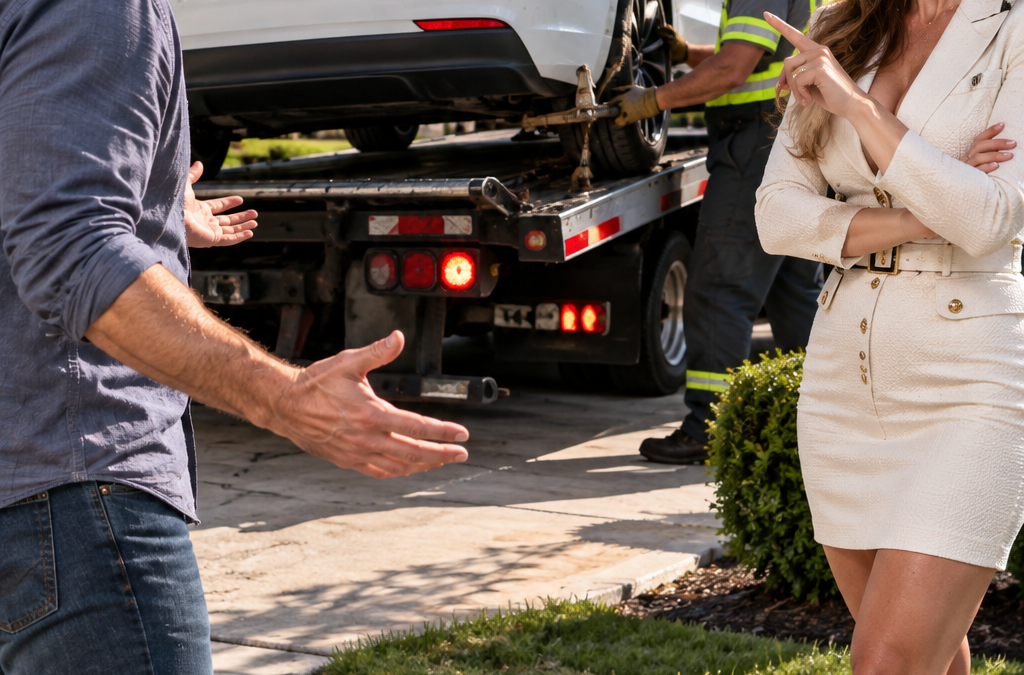
I woke up one morning expecting another ordinary workday and found a tow truck lifting my Tesla out of my own driveway while the new HOA president watched from the curb like she’d finally won something.
When I demanded to know what I had done wrong, Karen smiled and told me electric cars were no longer welcome in the neighborhood—and that if I brought mine back, she would fine me every single day until I couldn’t afford to keep it.
What frightened me wasn’t just the towing fee or the threat of thousands of dollars in penalties. It was how confidently she acted as if one election had given her the right to rewrite the rules of my life.
Until Karen became president, I had actually been one of those rare people who didn’t hate my HOA.
I know how ridiculous that sounds.
Before buying my house, I had heard every horror story imaginable about homeowners associations. People getting fined because their grass was half an inch too tall. Retired couples being threatened over flowerpots. Families being ordered to repaint perfectly good houses because somebody on a board disliked the shade of beige.
So when I found the house I eventually bought, I researched the HOA almost as carefully as I researched the property itself.
I read the governing documents.
I went through years of online reviews.
I talked to neighbors.
I even attended a meeting before closing.
To my surprise, the association had an excellent reputation.
And for the first five years I lived there, it deserved it.
The board mostly stayed out of people’s lives unless something genuinely affected the neighborhood. When streetlights failed, they got repaired. When two homeowners fought over drainage from one yard into another, the HOA helped settle it without turning the situation into a legal war.
The rules were reasonable.
Keep your property maintained.
Don’t create excessive noise.
Don’t drive like an idiot through residential streets.
If a rule changed, homeowners were notified by email and the updated document was posted online.
It wasn’t perfect, but it worked.
Then the board elections came around.
Most members served two-year terms, and several longtime board members chose not to run again.
The new president was a woman named Karen.
She was somewhere around forty, maybe forty-two, and even before I knew what kind of person she was, she was difficult not to notice.
Karen was beautiful in a polished, expensive way. Long chestnut-brown hair, immaculate makeup, a carefully maintained figure, designer sunglasses, fitted dresses or blouses, and the kind of heels that announced her arrival before she said a word.
She also seemed to know exactly what effect her appearance had on people.
When she wanted something, her voice became softer.
Her smile lingered a little longer.
She leaned closer.
Then, if charm didn’t work, the warmth disappeared so quickly it was almost impressive.
Karen had money.
Not private-jet money, but noticeably more than most people in our neighborhood. Her house was several streets away from mine, larger than average, professionally landscaped, and always looked like it had been staged for a real-estate advertisement.
I barely knew her.
Occasionally I saw her walking through the neighborhood or getting into one of her vehicles.
We might exchange a polite wave.
That was it.
Which was why I had absolutely no idea why she would eventually decide that my car was worth turning the neighborhood upside down over.
I owned a Tesla.
I wasn’t evangelical about it.
I didn’t lecture people at gas stations.
I didn’t think owning an electric vehicle made me morally superior to anyone.
I simply wanted one.
Part of the reason was environmental. I knew one person choosing an electric vehicle wasn’t going to solve climate change, but billions of individual decisions are ultimately made one person at a time.
I also liked the car.
So after saving for a long time, I bought it.
I lived alone and normally parked in my driveway. Our streets weren’t particularly narrow, but once vehicles lined both sides, things became cramped. Keeping my car off the street seemed considerate.
For five years, I’d never received a serious HOA violation.
My Tesla was properly registered.
The city required permits for vehicles parked overnight in certain circumstances, and all my paperwork was current.
There was no reason for anyone to touch it.
At least, that’s what I believed until the morning I opened my front door and saw a tow truck in my driveway.
For several seconds, I couldn’t process what I was looking at.
The rear of my Tesla was already raised.
A cable ran beneath it.
A man in a reflective vest stood beside the truck.
And on the sidewalk, wearing sunglasses despite the early hour, stood Karen.
She had one arm folded beneath the other and was watching the entire operation with a small, satisfied smile.
I hurried outside.
“What the hell is going on?”
Karen slowly turned toward me.
That smile widened.
“Good morning.”
“Why is my car being towed?”
She removed her sunglasses.
Then she looked at my Tesla as if it were something dirty somebody had abandoned on the street.
“Because electric vehicles violate HOA regulations.”
I stared at her.
For a second, I genuinely wondered whether I’d misheard.
“What?”
“Electric vehicles are no longer permitted in the community.”
I looked from her to the tow truck.
Then back to her.
“I’ve never received any notice about that.”
Karen gave a delicate little shrug.
“Then perhaps you should make more of an effort to stay informed.”
That was the moment I realized something was very wrong.
PART 2
I stepped closer to her.
“Karen, stop the tow.”
Her expression didn’t change.
“I’m afraid that’s not possible.”
“Of course it’s possible. It’s my car, in my driveway.”
“And it is violating community standards.”
“What standard?”
She sighed as if I were a child asking the same question for the tenth time.
“The association has determined that electric vehicles are not appropriate for this neighborhood.”
“The association determined that?”
“Yes.”
“When?”
“You really should attend meetings more regularly.”
I felt heat rising in my chest.
I did attend meetings when something relevant was happening.
More importantly, the HOA had always sent written notice whenever rules changed.
They were required to.
“I haven’t received an email.”
“That doesn’t mean the rule doesn’t exist.”
“I haven’t received a letter either.”
Karen crossed her arms.
Behind her, the tow operator looked uncomfortable.
I turned toward him.
“Did she give you paperwork authorizing this?”
He glanced at Karen.
Then at me.
“I’m just here on the call, sir.”
“What reason did she give?”
Karen answered before he could.
“HOA violation.”
I looked at her.
“Specifically?”
“An unauthorized electric vehicle.”
I almost laughed.
Not because anything was funny.
Because the statement was so absurd that my brain didn’t know what else to do with it.
“There has never been a rule against electric cars.”
“There is now.”
“Show it to me.”
Karen’s lips tightened.
“I don’t carry the bylaws around in my purse.”
“Then pull them up on your phone.”
Her eyes hardened.
“I don’t appreciate your tone.”
“And I don’t appreciate waking up to find my car being stolen.”
“It isn’t being stolen.”
“It’s being removed under a rule you can’t show me.”
She stepped toward me.
Up close, she smelled faintly of expensive perfume.
Her smile returned, softer this time.
“Why don’t you make this easier on yourself?”
The sudden change in her voice irritated me even more than her arrogance had.
“How?”
“Accept that the neighborhood has standards.”
“Standards against what? Batteries?”
Her jaw tightened again.
“Some residents don’t want those vehicles here.”
“Which residents?”
“That isn’t your concern.”
“I’m a resident.”
“And I’m the president.”
There it was.
Not an explanation.
A title.
As though the words HOA president ended every argument automatically.
I pointed toward the tow truck.
“Tell him to put my car down.”
Karen slowly slid her sunglasses back onto her face.
“No.”
I looked at the tow operator again.
“Don’t take it.”
He looked miserable now.
“I’ve already been dispatched, man.”
“By who?”
“The association.”
Karen smiled.
I wanted to argue more, but I glanced at my phone and realized how late I was getting.
I had work.
And because my transportation was currently being hauled away under a rule that apparently existed only inside Karen’s head, I now had to figure out how to get there.
“How am I supposed to get to work?”
Karen shrugged.
“That really isn’t my problem.”
Something about how casually she said it stayed with me.
Not my problem.
She had deliberately created the problem.
She had stood there supervising it.
But the consequences belonged entirely to me.
I stepped away before I said something I would regret.
I texted my boss.
My car was unexpectedly towed. I’m trying to get transportation. I may be late.
His response came almost immediately.
That might be the strangest excuse you’ve ever given me. Get here when you can.
Fortunately, he was reasonable.
Unfortunately, reasonable bosses don’t make Uber fares cheaper.
My office wasn’t close.
By the time I got into the rideshare and watched my own neighborhood disappear behind me, I was already calculating how much Karen’s little morning performance was going to cost.
The ride.
The tow fee.
Whatever storage fee the company invented.
And all because I owned a perfectly legal car parked on my own property.
I spent most of the day distracted.
At lunch, I searched my email.
Nothing.
I searched the HOA website.
No announcement banning electric vehicles.
I checked the rules I already had saved.
Nothing.
The vehicle-related provisions were exactly what I remembered.
No excessive engine noise.
No intentionally blasting music.
No reckless driving.
Vehicles had to be legally registered where required.
Basic, boring, common-sense rules.
Not a single sentence banning electric vehicles.
After work, I took another rideshare to the towing company’s office.
The employee behind the counter pulled up my information.
“Tesla?”
“Yeah.”
He looked at the screen.
“HOA tow.”
“That’s what I was told.”
I leaned against the counter.
“Can you tell me exactly why?”
He read the note.
“‘Electric vehicle violation.'”
“That’s it?”
“Pretty much.”
“Did they send you a copy of the rule?”
He frowned and clicked around.
“No.”
“So you towed my car because one person called and told you electric vehicles weren’t allowed?”
He raised both hands slightly.
“Look, man, I’m not trying to fight with you. We have a service agreement with the association. They authorize a tow, we respond.”
“Even from a private driveway?”
His expression suggested he realized how questionable the situation sounded.
“I wasn’t the driver.”
“Can I have my car back?”
“Yeah.”
He told me the amount.
I stared at him.
“You’ve got to be kidding.”
“I’m sorry.”
I paid.
I hated doing it, but I needed the car.
To the company’s credit, nobody there acted smug about it. If anything, they seemed confused by the entire situation.
The Tesla was returned to me.
I drove home.
And for about twelve hours, I allowed myself to believe maybe Karen had made her point and would stop.
The next morning, there was an email.
Not from the HOA’s official address.
From Karen’s personal account.
The subject line read:
IMPORTANT COMMUNITY VEHICLE POLICY.
She had sent it to what appeared to be the entire neighborhood.
Electric vehicles, it announced, were prohibited.
No board vote was mentioned.
No section of the bylaws was cited.
No explanation was provided beyond vague language about “community standards,” “safety,” and “neighborhood character.”
I read it three times.
Then I laughed.
She had actually done it.
Karen had taken whatever private problem she had with my Tesla and converted it into what looked like an official policy.
Except there was one obvious problem.
As far as I could tell, I was the only person in the neighborhood who owned an electric vehicle.
That made the email feel less like a rule and more like a message addressed specifically to me while hundreds of people watched.
For several days, nothing else happened.
Then the first letter arrived.
It came in a clean white envelope with my name typed neatly across the front.
Inside was a single-page notice.
I had thirty days to remove the electric vehicle from the community.
That meant selling it, storing it somewhere else, or finding another permanent form of transportation.
At the end of the thirty days, daily fines would begin.
I stood in my kitchen holding the letter.
“You have got to be kidding me.”
I read it again.
Same words.
Same deadline.
I had worked hard for that car.
It wasn’t some toy I’d bought impulsively.
I’d saved.
I’d planned.
I’d made financial decisions around it.
Karen apparently expected me to lose thousands of dollars selling a vehicle I wanted because she had suddenly decided she didn’t like seeing it.
The more I thought about it, the angrier I became.
Still, part of me hesitated.
Karen was the HOA president.
That title did carry real authority within certain limits.
If the rule somehow had been properly adopted and I’d missed the notice, ignoring it could make things worse.
HOA fines can accumulate quickly.
Disputes can become legal problems.
Legal problems become expensive.
Maybe I was wrong.
So I waited.
I watched my email.
I checked the website.
I looked for meeting minutes.
There was still nothing.
Another letter arrived.
Twenty-three days remaining.
Then another.
Fourteen days.
Karen was counting down.
Once, while I was washing the Tesla in my driveway, I saw her walking along the sidewalk.
She slowed.
I kept working.
Karen removed her sunglasses and smiled.
“Enjoying it while you can?”
I straightened.
“Excuse me?”
“The car.”
She nodded toward it.
“You don’t have much time left.”
I put the hose down.
“You really have a problem with this thing, don’t you?”
“I have a problem with residents who believe rules don’t apply to them.”
“Show me the rule.”
Her smile vanished.
“We’ve already discussed this.”
“No. You’ve announced things. We haven’t discussed anything.”
“I sent the community notice.”
“From your private email.”
“I’m the president.”
“That doesn’t make your inbox the legislature.”
Her cheeks flushed.
“You think you’re clever.”
“No. I think you haven’t shown me a single piece of official documentation.”
“You will comply.”
“What happens if I don’t?”
Karen stepped closer.
For a moment, that flirtatious softness returned to her voice.
“You don’t want to find out.”
I stared at her.
“Was that supposed to intimidate me?”
She tilted her head.
“I’m trying to help you.”
“By making me sell my car?”
“By giving you an opportunity to avoid unnecessary penalties.”
“No, Karen. You’re giving me an ultimatum.”
Her eyes narrowed.
“You have thirty days.”
Then she walked away.
I watched her go.
Something had changed in that conversation.
Until then, I’d still entertained the possibility that there was a bureaucratic explanation somewhere.
Maybe Karen misunderstood something.
Maybe she had interpreted a guideline incorrectly.
But that interaction felt personal.
She enjoyed the deadline.
She enjoyed reminding me she controlled it.
And she enjoyed the possibility that I might have to give up something expensive because she told me to.
On day thirty-one, the fine arrived.
Then another the next day.
And another.
Each was marked as a daily violation.
I started keeping them in a folder.
At first, I had ignored Karen’s threats because they were so ridiculous.
Now I was frightened.
Not frightened of her physically.
Frightened of what bureaucracy can do once enough paperwork exists.
It doesn’t matter how absurd a claim seems when bills begin appearing with your name on them.
I imagined months passing.
Thousands of dollars accumulating.
Collection notices.
Legal fees.
Liens.
All over a car.
I considered selling the Tesla.
For about ten minutes.
Then I became angry at myself for even thinking it.
Why should I lose money because one woman decided she disliked electric vehicles?
Still, anger wasn’t a legal argument.
I needed to know exactly what I was dealing with.
So I went to the HOA website.
I hadn’t visited it for months because, before Karen, I had almost no reason to.
The site had been redesigned.
I clicked through announcements, documents, meeting information, and board profiles.
No electric-vehicle ban.
I checked the current bylaws.
Nothing.
Then I found something interesting on the “About Our Community” page.
There was a whole section devoted to sustainability.
The HOA claimed it supported eco-friendly choices.
Green initiatives.
Waste reduction.
Energy conservation.
Reduced environmental impact.
I read the paragraph twice.
Then I sat back in my chair.
“So electric cars are banned by the environmentally friendly HOA.”
That didn’t make sense.
Unless this wasn’t an HOA policy at all.
Unless it was Karen.
That thought had been sitting in the back of my mind for weeks.
Now I wanted to know why.
I searched her name online.
Her social media profile wasn’t difficult to find.
Karen posted constantly.
Vacations.
Restaurants.
Expensive clothes.
Photos of herself beside pools.
Pictures from charity events.
Quotes about leadership that became unintentionally hilarious once you knew how she actually behaved.
Then I found the political posts.
And suddenly the Tesla situation made perfect sense.
Karen didn’t believe climate change was real.
She shared posts mocking environmental regulations.
She complained about government incentives for electric vehicles.
There were memes about batteries.
Posts calling electric cars ugly.
One rant claimed they made “annoying artificial noises” and were ruining the character of American roads.
I stared at my screen.
That was it.
Not safety.
Not parking.
Not HOA law.
Karen just hated electric cars.
She personally disliked them, and because she had become president, she apparently believed she could convert her preferences into neighborhood law.
I started saving screenshots.
Every relevant post.
Every email she had sent.
Every fine.
The towing receipt.
The rideshare receipt.
I downloaded a fresh copy of the HOA rules.
Then I checked the calendar.
The next general meeting was coming up.
That was when I stopped thinking about selling my Tesla.
Karen wanted this to be a private fight between me and her.
I was going to make sure the entire board heard about it.
The day of the meeting, I arrived early.
Karen was already there.
She stood near the front of the room talking to two residents.
She wore a fitted dark dress and heels, her hair falling perfectly over one shoulder. She was smiling, laughing, touching one man’s arm lightly while she spoke.
For a moment, watching her, I understood why she had probably gotten elected.
She was charismatic when she wanted to be.
Confident.
Attractive.
Good at making people feel as though she were sharing something with them personally.
Then she noticed me.
The smile froze.
Only for a fraction of a second.
Then it returned.
“Well,” she said when I passed her. “Nice of you to finally attend.”
I stopped.
“I wouldn’t miss this one.”
Her eyes flicked toward the folder under my arm.
“What’s that?”
“Something for later.”
“You know, if this is about your violations, the meeting isn’t the place.”
“Funny. I thought HOA policies were exactly what HOA meetings were for.”
Her expression tightened.
“Individual enforcement disputes should be handled privately.”
“That’s convenient.”
She leaned closer.
Her voice dropped.
“I’m giving you some advice. Don’t embarrass yourself in front of your neighbors.”
I looked at her.
“Are you worried I’m going to embarrass myself?”
For once, Karen didn’t have an immediate answer.
I walked away.
The meeting began.
For the first twenty minutes, everything was painfully ordinary.
Landscaping.
Pool maintenance.
A minor budget update.
Someone complained about a streetlight.
Another board member discussed upcoming repairs.
I watched Karen while people spoke.
She looked completely comfortable.
Professional.
In control.
Anyone walking in without context would have thought she was an excellent president.
Then the board reached the usual public-comment section.
“Any comments, concerns, or suggestions from homeowners?”
My hand went up.
Karen saw it.
Her shoulders stiffened.
Another board member nodded toward me.
“Go ahead.”
I stood.
My heart was pounding harder than I expected.
Public confrontation had sounded easier while I was sitting alone at home.
Now dozens of neighbors were watching.
Karen was watching.
I opened the folder.
“I want to start by saying I’ve lived here for five years, and until recently, I’ve been very happy with how this HOA has been run.”
Karen relaxed slightly.
Maybe she thought I had lost my nerve.
“I especially appreciate the association’s stated commitment to environmental responsibility and green initiatives.”
One board member smiled.
“Thank you.”
I nodded.
“That’s actually why I’m confused.”
Karen’s eyes narrowed.
I continued.
“Because I don’t understand how an HOA that publicly supports sustainability can simultaneously ban electric vehicles.”
The room went quiet.
Karen immediately interrupted.
“That isn’t what this meeting is about.”
One of the board members turned toward her.
“What is he talking about?”
“Nothing. He’s upset about an enforcement matter.”
I looked at the board.
“Was a policy passed banning electric vehicles?”
Several board members looked at one another.
That was the moment I knew.
They had no idea.
A gray-haired man near the end of the table leaned toward his microphone.
“No.”
Karen turned toward him.
“We discussed vehicle standards.”
He frowned.
“We discussed noise complaints and parking.”
“Exactly.”
“That isn’t an electric-vehicle ban.”
Karen’s face changed.
Only slightly.
But the confidence slipped.
I pulled out the printed email.
“Then I’d like to know why this was sent to the entire neighborhood announcing that electric vehicles were prohibited.”
I handed a copy forward.
The board member nearest me took it.
He read.
Then passed it down.
Karen’s cheeks reddened.
“I sent that because the policy needed clarification.”
“From your private email,” I said.
The gray-haired board member looked up.
“Karen, did the board approve this?”
She sat straighter.
“As president, I have authority to interpret community guidelines.”
“Interpret what guideline?”
Her voice sharpened.
“Vehicle standards.”
“Where does it say electric cars are prohibited?”
“It doesn’t need to use those exact words.”
Another board member joined in.
“What exactly is the violation?”
Karen looked irritated now.
“They’re disruptive.”
“How?”
“They make artificial sounds. They’re aesthetically inconsistent with the neighborhood. There are concerns about batteries, charging, and—”
“I charge mine on my own property,” I said.
Karen pointed toward me.
“Please stop interrupting.”
A few people in the audience laughed.
Her eyes flashed.
I continued before she could regain control.
“My car was towed out of my own driveway without warning.”
That caused murmuring.
I held up the receipt.
“I had to pay to get it back. I had to pay for transportation to work. Then I was given thirty days to sell the car.”
Someone behind me said, “What?”
I held up the letters.
“And when I refused, daily fines started.”
The gray-haired board member stared at Karen.
“Daily fines?”
She folded her arms.
“He knowingly continued violating the policy.”
“What policy?” I asked.
“Sit down.”
The room went silent.
Karen’s voice had come out louder than she intended.
I stayed standing.
“No.”
Her face hardened.
“I am chairing this meeting.”
“And the board asked what happened.”
“I said sit down.”
One of the other board members intervened.
“Karen, let him finish.”
She turned toward him.
“This is becoming a circus.”
“No,” I said. “It’s becoming public.”
That landed.
I could see it.
Karen’s polished expression cracked.
“You’re trying to create drama because you’re angry that rules apply to you.”
“No. I’m asking whether you created a rule because you personally hate electric cars.”
Her eyes widened.
I took out another set of pages.
“I was curious why you were so obsessed with my Tesla, so I looked at the public posts on your Facebook page.”
The room became even quieter.
Karen stood.
“That is completely inappropriate.”
“They’re public posts.”
“My personal political opinions have nothing to do with HOA business.”
“I agree.”
I let that sentence sit for a second.
“Which is exactly why they shouldn’t become HOA policy.”
Someone in the back actually said, “Damn.”
Karen’s face turned red.
I continued.
“You’ve publicly said climate change is a hoax.”
“I am entitled to my opinion.”
“Yes.”
“You’ve said electric vehicles are ugly.”
“That is irrelevant.”
“You’ve complained about the sounds they make.”
“I said that’s irrelevant.”
“And shortly after becoming HOA president, you had the only electric vehicle I know of in this neighborhood towed.”
Karen slapped one hand against the table.
“Enough.”
The sound cracked through the room.
For the first time since I’d met her, she didn’t look polished or charming.
She looked furious.
Not because she had been misunderstood.
Because she was losing control.
The gray-haired board member took the screenshots from me.
Another member leaned over to read them.
I pointed toward the HOA’s mission statement I’d printed.
“Your own website says this association supports green initiatives.”
One board member nodded.
“It does.”
“So I’m asking everyone here a simple question.”
I looked at Karen.
“Did the board vote to ban electric vehicles?”
Silence.
Then the gray-haired member said, “No.”
“Was there ever an approved rule saying my Tesla was prohibited?”
“No.”
“Did the board authorize it to be towed?”
His expression changed.
“No.”
Karen turned toward him.
“You don’t have all the context.”
“Then give it to us.”
She opened her mouth.
Nothing came out.
The other board member asked, “Did you authorize the tow yourself?”
Karen sat slowly.
“As president.”
“That’s not what I asked.”
She stared at him.
“I acted in what I believed were the best interests of the community.”
“And the fines?”
“Also authorized under presidential discretion.”
The board member shook his head.
“We don’t have presidential discretion for creating violations.”
Karen’s voice sharpened.
“I was elected to lead.”
“You were elected to chair the board.”
“I am the president.”
“You’re one vote.”
That sentence changed the entire room.
Karen stared at him as though he’d betrayed her.
Maybe, in her mind, he had.
For months, she had acted as if HOA president meant neighborhood ruler.
Now another board member had publicly reminded everyone that she was simply one member of a governing body.
Karen tried to recover.
She turned toward the residents.
“Everyone needs to understand that this is being deliberately misrepresented. My responsibility is to maintain property values and community character.”
A woman near the front raised her hand.
“How does his car lower my property value?”
Karen hesitated.
“That’s not the point.”
A man across the aisle spoke without waiting to be recognized.
“Is the car legal?”
“That’s also not the point.”
Someone else said, “Sounds like that’s exactly the point.”
The room started filling with overlapping voices.
Karen banged the small gavel on the table.
“Order!”
Nobody stopped immediately.
She struck it again.
“Order!”
Eventually the room quieted.
Karen’s breathing had become visible.
The board members spoke quietly among themselves.
Finally, the gray-haired member leaned toward the microphone.
“We’re ending the public portion of tonight’s meeting early.”
Karen turned.
“What?”
“We need to discuss this privately.”
“There is nothing to discuss.”
He looked at her.
“There is quite a bit to discuss.”
Her face went pale.
The meeting adjourned.
The board disappeared into another room.
I stood near the back while neighbors gathered around me.
Everyone wanted to know what had happened.
“She really had your car towed?”
“From your driveway?”
“She told you to sell it?”
“You’re getting fined every day?”
I showed people the letters.
One older neighbor shook his head.
“I don’t even like Teslas, and that’s insane.”
That summed it up perfectly.
Nobody needed to love electric cars.
Nobody needed to agree with me about climate change.
The issue was power.
Karen had taken a personal preference and tried to enforce it using HOA authority.
As I was leaving, Karen came out of the back room.
She saw me near the door.
For a second, neither of us spoke.
Then she walked toward me.
Most people had already left.
Her heels clicked sharply against the floor.
“You think you’ve won something?”
Her voice was low.
I looked at her.
“I think the board knows what you’ve been doing.”
“You humiliated me.”
“No. I showed them your emails.”
Her jaw tightened.
“You went through my personal Facebook.”
“Your public Facebook.”
“You had no right.”
“You had my car towed.”
“Because it violated standards.”
“You still can’t name one.”
She moved closer.
“I could make your life very uncomfortable here.”
That stopped me.
Not because I was afraid.
Because of how openly she said it.
I took out my phone.
Karen noticed.
“What are you doing?”
“Making sure I remember exactly what you just said.”
Her eyes flicked to the screen.
“Are you recording me?”
“I wasn’t.”
I smiled.
“But that’s a good idea.”
She stepped back.
Her expression changed immediately.
That same polished mask returned.
“I think you’re misunderstanding the conversation.”
“I’m sure I am.”
She turned and walked away.
I drove home in my Tesla.
For the first time in weeks, I actually enjoyed the drive.
But I wasn’t celebrating yet.
Karen was still president.
The fines still existed.
And I had no idea what the board was going to do.
Two days passed.
Nothing.
Then I received an email announcing an emergency board meeting.
It was closed to general residents.
I wasn’t invited.
That made me nervous.
Maybe Karen had convinced them she’d acted within some obscure authority.
Maybe they’d decide to protect the president to avoid embarrassment.
Maybe they’d quietly create the rule after the fact.
My imagination produced every possible bad outcome.
On the fourth day, another daily fine arrived.
I added it to the folder.
On the fifth day, nothing came.
On the sixth, still nothing.
Then an official HOA email appeared in my inbox.
I opened it immediately.
The message was addressed to all residents.
The board had completed an internal review regarding recent vehicle enforcement actions.
I read that first sentence twice.
Then I continued.
The board stated that no rule prohibiting electric vehicles had ever been properly proposed, voted upon, or adopted.
Any notice claiming otherwise had been unauthorized.
All fines connected to electric-vehicle ownership were void.
Any enforcement action taken under the supposed prohibition was invalid.
I stopped reading.
I actually leaned back in my chair and laughed.
Then I saw the next paragraph.
Karen had been removed from the board following an emergency vote.
I read it again.
Removed.
Not warned.
Not censured.
Removed.
The statement said her unauthorized actions were inconsistent with established board procedures and with the association’s stated values.
A temporary president would serve until a special election could be held.
I sat in silence for several seconds.
Then I kept reading.
The HOA formally apologized to me.
It would reimburse the towing fee.
It would reimburse my Uber expense from the morning my car had been removed.
All daily fines were canceled.
The board also clarified that legally registered electric vehicles were fully permitted in the neighborhood.
In fact, the association encouraged residents to consider environmentally responsible transportation when appropriate.
I laughed harder at that part.
Karen had tried to ban electric cars.
Her actions resulted in the HOA publicly encouraging them.
There was something almost poetic about it.
The reimbursement arrived without a fight.
The towing fee came back.
The transportation expense came back.
Every fine disappeared from my account.
I checked several times because I almost didn’t trust it.
Balance: $0.
A week later, there was a neighborhood meeting to explain what had happened.
Karen wasn’t there.
The temporary president apologized again.
He explained that Karen had acted independently and had used her position to make certain decisions without board authorization.
The HOA’s towing relationship would also be reviewed so one board member couldn’t order a similar tow without proper documentation.
That mattered to me almost as much as the apology.
Removing Karen solved my problem.
Changing the process might stop the next Karen.
After the meeting, several neighbors approached me.
Some admitted they had believed the electric-car ban was legitimate because Karen sounded so confident.
That bothered me.
One man said, “When the president sends an email saying there’s a new rule, you assume there was a vote.”
Exactly.
Karen had relied on that assumption.
Authority often works because people assume the person claiming it must have earned it.
Karen wore the title.
She sent formal-looking letters.
She imposed fines.
She ordered a tow.
Every action made the next one appear more legitimate.
But underneath all of it, there had never been a rule.
Just Karen.
A few weeks later, I saw her for the first time since she’d been removed.
I was unloading groceries from the Tesla.
A luxury SUV slowed near my driveway.
The window lowered.
Karen was driving.
She looked exactly as polished as ever.
Perfect makeup.
Perfect hair.
Sunglasses pushed onto the top of her head.
For a moment, I considered ignoring her.
Then she stopped.
“You seem pleased with yourself.”
I closed the trunk.
“I’m pleased to have my car.”
Her mouth tightened.
“You caused a lot of unnecessary drama.”
I laughed.
“I caused it?”
“You could have handled this privately.”
“I tried.”
“You publicly attacked me.”
“I asked the board whether they approved your rule.”
“You went after my personal beliefs.”
“Only after your personal beliefs became my towing bill.”
Karen stared at me.
“You think those people care about you?”
“What?”
“The board.”
Her voice took on that soft, almost seductive tone she used whenever she wanted to manipulate rather than command.
“They threw me away because they were afraid of bad publicity. Don’t mistake that for loyalty to you.”
“I don’t need their loyalty.”
She frowned.
“I just need them to follow their own rules.”
Her expression hardened again.
“You were lucky.”
“No.”
I shook my head.
“I kept records.”
She scoffed.
“Same thing.”
“No, Karen. Luck would have been you deciding not to abuse your position in the first place.”
Her cheeks colored.
“You know, that electric car still looks ridiculous.”
I smiled.
“Good thing you don’t get to vote on it anymore.”
Her face went completely still.
For one second, I thought she’d explode.
Instead, she put her sunglasses on.
Then she drove away.
I stood there watching the SUV disappear around the corner.
That was the last direct argument we ever had.
The special election took place not long afterward.
A longtime board member became the new president.
He wasn’t particularly charismatic.
He wasn’t glamorous.
He didn’t arrive at meetings dressed like he was hosting a fundraiser.
But he understood something Karen never had.
The HOA wasn’t his kingdom.
Rules required votes.
Fines required actual violations.
Leadership meant following the same procedures everybody else had to follow.
The entire atmosphere changed.
Meetings became boring again.
I loved it.
There are few things more beautiful than boring government after you’ve experienced someone who enjoys abusing power.
The Tesla remained in my driveway.
Nobody towed it.
Nobody fined me.
Nobody gave me thirty days to replace it with something Karen found prettier.
Eventually another resident bought an electric vehicle.
Then another.
The HOA even discussed adding charging stations near the clubhouse someday if enough residents wanted them.
I wish I could have seen Karen’s face when she heard that.
Sometimes people ask why I didn’t hire a lawyer or sue Karen.
Maybe I could have.
I had documentation.
Financial damages.
An unauthorized tow.
Threatening letters.
But once the HOA reversed everything, reimbursed me, removed her, and fixed the process, I didn’t feel the need.
I hadn’t wanted revenge.
I wanted my life back.
I wanted to wake up and go to work without wondering whether my car would still be where I’d left it.
I wanted HOA emails to go back to being messages about pool hours and landscaping schedules.
And, eventually, that’s exactly what happened.
Still, the experience changed the way I think about rules.
Before Karen, whenever I received something official-looking, I assumed someone had checked it.
A fine meant a rule existed.
A policy announcement meant a vote happened.
A person with a title meant they knew the limits of their authority.
Now I verify.
Not obsessively.
Just enough.
Because Karen taught me that sometimes the most dangerous abuse of power isn’t complicated.
Sometimes it’s just one person discovering that nobody has asked them to prove they can do what they’re doing.
Her first move had been towing my car.
If I had accepted that quietly, I probably would have sold it.
That’s uncomfortable to admit.
There were moments when I came close.
The financial pressure worked.
The daily fines frightened me.
The uncertainty frightened me even more.
Karen understood that most people don’t have unlimited money for legal disputes.
She didn’t need to prove she was right immediately.
She only needed to make resisting expensive enough.
That’s why the thirty-day deadline had been so effective psychologically.
Every day felt like the clock was moving against me.
Keep the car and risk escalating fines.
Sell the car and lose thousands.
Challenge the president and risk becoming the neighborhood troublemaker.
Those weren’t accidental pressures.
Karen wanted me to believe surrender was cheaper.
What she failed to understand was that once I discovered the rule didn’t exist, the entire situation changed.
I wasn’t refusing an HOA policy.
I was refusing Karen.
And Karen wasn’t the HOA.
That distinction ended her presidency.
Months later, one of the board members mentioned the incident while we were talking after a meeting.
He told me something I hadn’t known.
Apparently, during the emergency session after my presentation, Karen had fought desperately to keep her position.
She insisted that presidents needed broad discretion.
She argued that the board was undermining her authority.
She claimed removing her would make the association look weak.
At one point, she apparently suggested that because most residents didn’t own electric vehicles, the policy affected so few people that it shouldn’t matter.
That argument did not help her.
One board member reportedly asked:
“If we let the president invent a rule because it only hurts one homeowner, what prevents the next president from inventing a rule that only hurts you?”
Karen didn’t have an answer.
Neither would I.
That was the real issue.
Maybe nobody else cared about Teslas.
But next time it could have been motorcycles.
Pickup trucks.
Political signs.
Garden plants.
Pets.
Anything a future president personally disliked.
Once you accept that one person can invent rules without approval, the subject of the first rule barely matters.
The board understood that.
Karen never did.
She believed being elected meant people had handed her power.
The board believed being elected meant people had handed her responsibility.
Those are very different things.
I kept the first towing receipt.
Not because I needed it anymore.
The HOA reimbursed me long ago.
I keep it in a folder with the original thirty-day letter.
Every once in a while, I find them while looking for something else.
AUTHORIZED TOW.
ELECTRIC VEHICLE VIOLATION.
Thirty days to remove vehicle.
Daily penalties thereafter.
The language still looks official.
That’s what makes it unsettling.
If you knew nothing about the story, you’d read those pages and assume I’d broken a real rule.
Karen understood presentation.
She understood that a letter on official stationery feels true.
She understood that confidence sounds like authority.
She understood that most people don’t challenge someone who acts completely certain.
She just underestimated how badly certainty collapses when someone asks for evidence.
Show me the rule.
That was the question she could never answer.
Everything else came from that.
The tow.
The threats.
The fines.
The meeting.
The investigation.
Her removal.
All because she couldn’t answer four words.
Show me the rule.
Today, my Tesla still sits in the same driveway.
It’s older now.
A few scratches.
More miles.
Nothing special.
But sometimes I look at it and remember that morning.
The tow truck.
Karen on the sidewalk.
Her sunglasses.
That smug little smile.
Electric vehicles violate HOA bylaws.
She had said it with absolute confidence.
She expected me to believe her.
For a while, part of me almost did.
That’s probably the part of the story that stays with me most.
Not that Karen lied.
People lie.
Not that she abused power.
People do that too.
It’s how easy it would have been for her lie to become my reality if I’d been too intimidated to ask questions.
I could have sold the car.
I could have paid the fines.
I could have told myself fighting wasn’t worth it.
Karen would have walked away believing her presidency allowed her to reshape the neighborhood around her personal preferences.
And the next homeowner might have had it worse.
Instead, she got exactly what her behavior deserved.
She lost the position she had abused.
The fines disappeared.
My money was returned.
The tow was acknowledged as unauthorized.
The HOA publicly welcomed the same vehicles she had tried to ban.
And the rest of us got a reminder that elected leadership doesn’t mean unquestioned control.
Sometimes I still see Karen around the neighborhood.
We don’t speak.
She usually looks away first.
I have no idea whether she regrets what she did.
Maybe she thinks she was betrayed.
Maybe she thinks I ruined her presidency.
Maybe she still believes electric cars are ugly and climate change is fake.
She’s allowed to believe all of that.
That’s the part she never understood.
She was always entitled to her opinion.
She just wasn’t entitled to turn it into my law.
And every morning when I walk outside, unplug my Tesla, get behind the wheel, and drive past her street without paying a single dollar in fines, I’m reminded of the difference.