.She Fired the Only Man Who Knew How the Company Worked, Then Learned the System Had Been Held Together by His Hands
PART 2
Karen loved language more than results.
Everything was agile, scalable, cloud-first, optimized, rationalized, transformed. She would stand at a whiteboard drawing boxes and arrows, talking as if she had invented logistics that morning. When someone asked a practical question, she treated it like resistance.
“Which server currently handles inventory transactions?” I asked in one planning meeting.
She waved one hand. “We’ll standardize that later.”
“That server feeds the scanners in two warehouses.”
“That’s a technical detail.”
“It’s an operational detail.”
Her smile sharpened.
“Let’s not confuse complexity with importance.”
I remember the room going quiet.
Not because her answer was good.
Because people were learning what kind of leader she was.
The old company had been chaotic but human. People disagreed openly. Warehouse supervisors argued with operations. Accounting complained about bad data. Drivers complained about routes. I complained about people blocking network closets with broken pallet jacks. We got irritated, but we solved things because everyone understood the goal: keep freight moving.
Karen replaced that with fear wearing perfume.
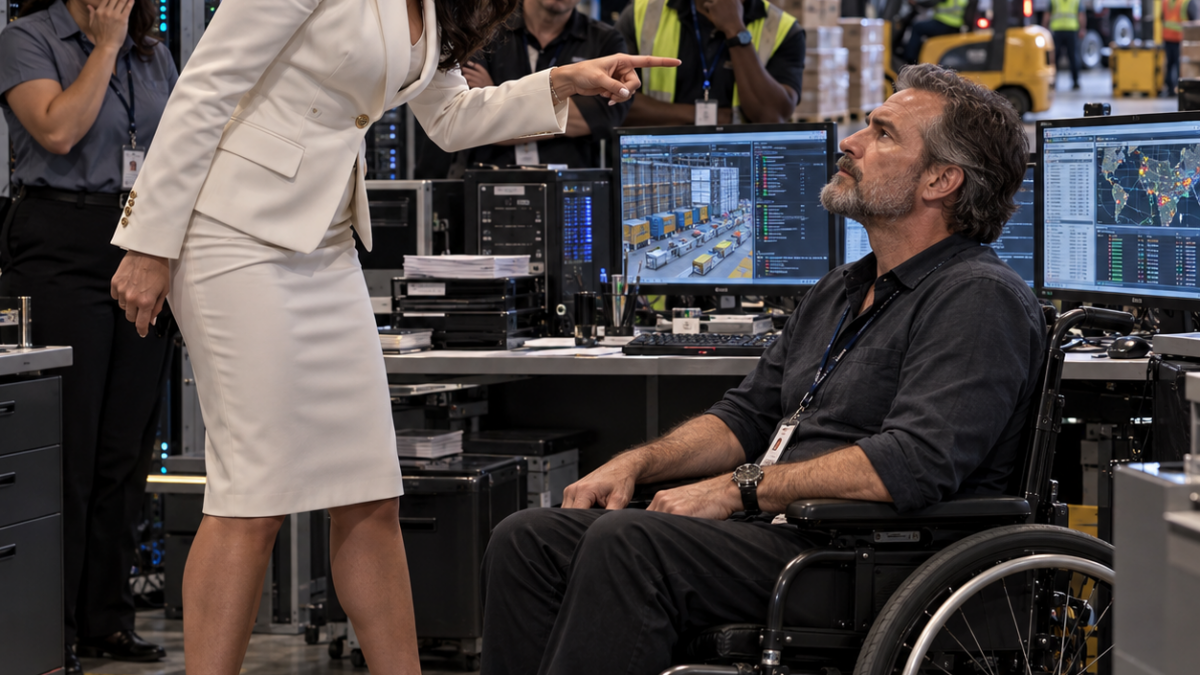
The senior warehouse manager, Don, had been there longer than me. He knew the floor like a living map. He could hear a forklift pattern and tell you whether loading was falling behind. Karen told him his “tribal knowledge” was a risk and made him run decisions past a new operations coordinator fresh out of business school.
The head accountant, Marlene, could close the books almost from muscle memory. Karen told her every expense over a tiny threshold had to be justified to a finance person at the parent company who did not know the difference between a fuel surcharge and a repair invoice.
Operations had an old report everyone used because it showed useful information quickly. Karen replaced it with a dashboard that looked impressive in meetings and missed half the reality on the floor.
Then there was me.
With me, she had a special tone.
Not always open hostility. That would have been easier. It was worse because it came wrapped in concern.
If someone left a pallet in the hallway and I had to go around it, she would say, “We really need to rethink these traffic patterns. We can’t have movement slowed down.”
If I was two minutes late to a meeting because the accessible route had been blocked by inventory carts again, she would say in front of everyone, “Punctuality matters, especially in IT. Time is money.”
Once, she pulled me aside and said, “How are you coping with the pace of change? Maybe we can find a role that doesn’t require so much movement around the building.”
I stared at her.
“My chair is not the bottleneck in the network.”
She laughed lightly, as if I had made a joke.
“I’m just thinking about fit.”
Fit.
People like Karen love that word because it sounds neutral while carrying every prejudice they do not want to say directly.
At first, I tried to educate her.
I pointed out that the issue was not me moving through the building. It was the building being badly managed. Carts blocked routes. Boxes got left near ramps. People parked equipment in front of doors. Fixing that would improve movement for everyone, not just me.
I even wrote her a simple accessibility and workflow memo. Clear paths. Enforced storage zones. Meeting rooms booked with accessible access. No equipment left in corridors. Practical, cheap, useful.
It disappeared into the void.
The comments did not.
“If we had a more mobile team, we could do walking stand-ups.”
“We need faster movement and faster thinking.”
“Some people are more comfortable in static roles.”
She never said, “Your wheelchair makes you slow.”
She did not have to.
Everyone heard it anyway.
So I documented.
Dates. Times. Exact wording. Who was present. Emails. Calendar invites. Performance notes. I forwarded important records to my personal account when appropriate. I saved copies of anything that might matter later.
Not because I planned revenge then.
Because after twenty years in IT, you learn one truth: if there is no record, it did not happen.
Karen’s grand plan was to move everything to the cloud and outsource basic support to a managed service partner.
On paper, that sounded reasonable.
In reality, it was terrifying.
Our environment was not clean. It had grown like tree roots through concrete. Some systems were old because no one wanted to fund replacements. Some were old because the vendor went out of business but the tool still worked. Some were held together by scheduled jobs, scripts, manual checks, and processes that existed because real logistics rarely fits into neat software diagrams.
I was not against modernization.
I wanted better systems.
But moving our core operations in one big cutover without parallel testing, fallback plans, clean documentation, warehouse connectivity upgrades, and people who understood the ugly edges? That was not modernization.
That was loading dynamite into a forklift and calling it innovation.
I raised concerns.
Karen called it negativity.
“The scanners already drop connections on a good day,” I said in one meeting. “If core transactions depend on stable internet to a hosted environment, we need staged testing.”
“Modern systems are resilient,” she said.
“Modern systems still need networks.”
She smiled at me like I had misunderstood the future.
“That’s legacy thinking.”
A few days later, she sent me a performance expectations document.
No clear metrics. No specific failures. Just phrases.
Demonstrate agility.
Improve pace of work.
Align with transformation goals.
Reduce resistance.
It was not a plan.
It was a paper trail.
I knew what she was doing.
That evening, I sat at the kitchen table with my wife, Claire, the document between us.
Claire read it once, then again.
“This is garbage,” she said.
“She’s building a case.”
“For what?”
“To push me out.”
“You’ve never been written up.”
“Doesn’t matter.”
“You’ve kept that place running for twenty years.”
“That may be the problem.”
Claire looked up.
I explained what I had begun to understand.
Karen did not want people who knew the system. She wanted people who would validate the transformation story she had already sold to the parent company. Knowledge was inconvenient because knowledge asked questions. Experience became resistance. Caution became negativity. Anyone who could say, “That won’t work,” had to be recast as dead weight before the failure arrived.
Claire reached across the table and covered my hand with hers.
“Then protect yourself.”
“I am.”
“More.”
So I did.
I considered going to HR with the disability comments and the vague performance setup. But HR now reported into the parent company, and the new HR head seemed attached to Karen’s hip. I had no reason to believe they would act before the situation became embarrassing for them.
So I kept working.
I kept documenting.
And I prepared for the possibility that the company I had kept alive for two decades would decide I was disposable.
It happened on Thanksgiving.
The old owner used to send a personal holiday note every year. He mentioned actual teams, actual people, actual work. The new owners sent something clearly written by marketing. Gratitude. Commitment. Transformation. Together.
Whatever.
I was at a relative’s house, sitting in a crowded living room that smelled like turkey, butter, and too many opinions. Football was on. Someone’s kid was crying in another room. I was half listening to a conversation when my phone buzzed.
Text from Karen.
No greeting.
No call.
No meeting.
Just a cold block of words.
Effective immediately, your position has been eliminated as part of our transformation efforts. Your final paycheck and a severance payment of $500 will be processed next week. Please return your badge, laptop, and all company property by Monday. We appreciate your contributions and wish you the best in your future endeavors.
I read it once.
Then again.
Then I handed the phone to Claire.
She read it, and her face changed.
“You’ve got to be kidding me.”
A few minutes later, the email version arrived from HR with the same wording and a generic severance agreement attached.
Five hundred dollars.
After twenty years.
Fired by text on Thanksgiving.
I went outside because I needed air.
The cold hit my face hard. I sat at the edge of the porch ramp, phone in my lap, and felt the first wave pass through me.
Shock.
Then embarrassment.
Then anger so hot it felt clean.
I had stayed late through outages. I had worked weekends because drivers needed route sheets Monday morning. I had answered calls from warehouse supervisors at 2 a.m. I had skipped vacations because upgrades went sideways. I had built checklists, trained people, patched systems, prevented failures no one ever knew almost happened.
And Karen reduced all of that to five hundred dollars and a canned paragraph.
I opened the email again.
Effective immediately.
That phrase caught my eye.
I knew our offboarding process because I had built it. HR initiated a termination ticket. IT disabled accounts, revoked VPN, removed admin rights, collected hardware, reviewed shared credentials, changed service passwords where needed, documented all of it.
Except IT was me.
And nobody had looped me in.
For one reflexive second, my thumb hovered over the VPN app.
Then I stopped.
Claire opened the door behind me.
“You okay?”
“No.”
She came outside and sat near me.
“They probably didn’t cut my access,” I said.
She understood immediately. She had been married to me long enough.
“Don’t.”
“I know.”
“I mean it.”
“I know.”
Her voice softened. “They are not worth jail. Or guilt. Or becoming the story they want to tell about you.”
That landed.
Because she was right.
There were things I could have done. Anyone who knows systems knows there are always things. But the truth is, I did not need to sabotage anything.
Karen had already done that.
She had fired the person who knew the system, ignored the people who understood operations, rushed a risky migration, insulted the warehouse team, alienated accounting, and chosen a cheap partner for a complicated environment. The building was already full of smoke. I did not need to light a match.
So I took screenshots proving my access had not been revoked.
Then I closed the app without logging in.
The next morning, I called a lawyer.
Not a corporate lawyer. An employment lawyer.
I brought everything. Emails. Notes. The performance document. The text. The HR message. My list of Karen’s comments. Names of witnesses. Dates. Context. The accessibility memo she had ignored. The pattern of her tying my “pace” and “mobility” to performance.
The lawyer was careful.
Good lawyers usually are.
“Discrimination cases are never automatic,” she said. “But written comments and documented patterns matter. You were a long-term employee with no meaningful disciplinary history, visibly disabled, suddenly pushed out by a new supervisor who made comments about your mobility and pace. That is something.”
Something.
After twenty years, I would take something.
While the lawyer prepared a letter, I called people.
Not to start a rebellion. Not at first.
I called Don from the warehouse.
He already knew I had been fired.
“Text?” he asked.
“Text.”
“On Thanksgiving?”
“Yep.”
He was quiet for a long moment.
Then he said, “That’s low.”
“How are things there?”
He laughed without humor.
“How much time you got?”
He told me Karen had warned him his role might not exist in the new structure. He was being asked to document processes for a coordinator who still did not know how freight actually moved through the building. He had an offer from a competitor but had been waiting to see if things improved.
“Don’t wait too long,” I said.
I called Marlene in accounting.
She sounded tired in a way I had never heard from her. The parent company wanted to centralize finance. Karen had told her to train someone remotely on systems Marlene had managed for years, but no one had clarified whether she would still have a job afterward.
“I’ve never worked anywhere else as an adult,” she admitted.
“You know more than you think,” I said. “And if you need a reference, I’ll give one.”
I called operations.
Same story.
Bad dashboard. Unrealistic targets. Middle managers overriding decisions and blaming the floor. Pressure to support the cutover even though no one had addressed the actual process gaps.
I did not tell anyone what to do.
I simply told the truth.
“They fired me by text on Thanksgiving after twenty years,” I said. “If they’re asking you to train your replacement, pay attention.”
People did.
Over the next month, five experienced employees left or gave notice.
Don took the competitor offer.
Marlene accepted a job at a smaller company with better hours.
An operations lead left for a distributor across town.
Two IT staffers, both of whom knew important pieces of the environment, resigned before Karen’s migration went live.
Nobody made speeches.
Nobody flipped tables.
They simply stopped holding up a place that no longer valued their hands.
That is the part executives never understand. Institutional knowledge does not storm out like a villain. It quietly updates its resume, uses vacation time, and walks away with the map still in its head.
Karen kept moving.
She had promised the parent company results by the quarter. She had slides to defend. Transformation waits for no reality. The managed service partner came in with clean diagrams, standard templates, and a confidence that made me nervous even from the outside.
They scheduled the big cutover right before one of the busiest periods of the year.
I heard about it from former coworkers.
At first, I thought they were exaggerating.
Then I realized they were not.
No proper parallel run. Limited fallback planning. Warehouse connectivity still spotty. Backup restoration testing incomplete. Too many assumptions. Too few people who remembered why old processes existed.
If I had still been there, I would have thrown my body in front of that train.
Not literally, obviously.
But close.
I would have demanded staged migration. I would have insisted on live restore tests. I would have kept certain warehouse functions local until the network proved stable. I would have made them run a full week of parallel transactions before touching production. I would have documented every risk and forced someone to sign off on ignoring it.
But I was not there.
I was at home, unemployed, updating my resume while the company that had called me slow sprinted toward a cliff.
The cutover happened.
For a few hours, it looked okay.
That is how disasters work.
The first dashboards loaded. Users logged in. A few test orders moved. Someone probably congratulated someone. Karen probably said words like seamless and scalable.
Then the edges began to crumble.
Warehouse scanners dropped connections randomly. Orders appeared twice in one system and not at all in another. Inventory counts shifted because an old background process had not been retired correctly. A scheduling job tied to driver route printing had not been configured in the hosted environment. Reports that looked fine in the boardroom did not match what was happening on the floor.
The managed partner said their hosted systems looked fine.
Of course they did.
The problem was everything between the neat diagram and the messy world.
Drivers showed up and did not have routes.
Warehouse workers stood around waiting for pick lists.
Supervisors tried to improvise with spreadsheets.
Some shipments went out wrong.
Others did not go out at all.
Customers called.
Then larger customers called louder.
Someone suggested rolling back, only to discover that rollback planning had been treated like pessimism. The available restore points were incomplete, outdated, or too risky to use without losing recent transactions. Not because anyone needed to sabotage them. Because backup systems require care, testing, and people who understand what “successful” actually means.
Karen had thought green checkmarks were enough.
They were not.
Payroll got hit too.
Marlene was gone. The person she had trained remotely did not have full access yet because the parent company had decided to tighten controls. Combine that with broken time systems and incomplete data, and paychecks came out wrong.
Nothing destroys morale faster than messing with people’s money.
From outside, I watched vague social media posts begin appearing.
“Management has no clue.”
“Systems down again.”
“Warehouse chaos.”
“Love when they transform your paycheck into a mystery.”
One former coworker texted me: You picked the right time to get pushed out.
I stared at that message for a long time.
Because I had not picked the time.
Karen had.
Internally, from what people told me later, it was worse. Parent company executives flew in. Emergency meetings ran all day. Karen went into spin mode.
She blamed technical debt.
She blamed the old team.
She blamed the managed service partner.
At one point, someone told me, she even floated the idea of sabotage by disgruntled former staff.
An executive asked, “Do we have evidence?”
They did not.
What they had was evidence of rushed planning. Ignored warnings. Understaffed transition. Incomplete testing. Departed experts. A managed partner who had asked for more time in writing and been told to proceed. Remaining IT staff who had tickets showing concerns about timing. Warehouse and operations emails asking to delay until after the busy season.
Every thread led back to Karen.
Not because she had touched every keyboard.
Because she had owned the decision to stop listening.
Meanwhile, my lawyer sent the company a letter.
It laid out the timeline clearly.
Karen’s mobility comments.
The accessibility memo that went ignored.
The vague performance document with no measurable goals.
The Thanksgiving text.
The insulting severance.
The fact that I was the only visibly disabled member of the department and had been pushed out by someone who repeatedly tied speed, movement, and workplace value to mobility.
The letter did not scream. It did not exaggerate. It did not threaten wildly.
It simply made clear that we were prepared to file a formal complaint if they did not resolve the matter.
The timing was not something I planned perfectly.
Their systems were already on fire when the letter arrived.
That helped.
Companies become very reasonable when they are already explaining one disaster and do not want another.
Their legal department responded quickly.
They denied wrongdoing, of course. They always do. But suddenly, they were open to amicable resolution. They offered far more than five hundred dollars. Enough to cover several months of living expenses, legal fees, and the indignity of being treated like a broken piece of equipment after two decades of work. They agreed to classify the termination neutrally as part of restructuring and provide a neutral reference.
My lawyer explained the choice.
Fight longer, maybe get more, maybe get nothing, definitely spend time and stress.
Or take the settlement and move on.
Part of me wanted court.
I wanted Karen’s comments read out loud. I wanted the company forced to answer why a twenty-year employee with a clean record was fired by text on a holiday after being called slow in every coded way possible. I wanted public vindication.
But revenge does not pay bills.
Settlement does.
And Karen’s transformation was already costing them more than they would ever pay me.
So I took the deal.
I signed.
They paid.
I walked away.
Back at the company, things kept sliding.
They limped through the busy season, but at a cost. A major retail client suspended orders after too many mistakes. Smaller customers drifted away. Emergency consulting fees ballooned. The managed service partner increased rates because everything was suddenly “out of scope.” More staff left. Morale collapsed. The parent company did what parent companies always do when a plan fails.
They found the person whose name was on the plan.
Karen was asked to leave a couple months after my settlement.
No dramatic scene. No public firing. No security march through the warehouse. Just a bland announcement about pursuing other opportunities and a badge that stopped working.
A former coworker texted me two words.
Guess who.
I smiled so hard my face hurt.
I am not proud of how good that felt.
Actually, that is not true.
I am a little proud.
The company never fully recovered. One regional warehouse shut down. Some assets were sold. Eventually, the old name and logo disappeared when another logistics company absorbed what was left. Trucks I had helped keep on the road for twenty years rolled under someone else’s branding. The server closet I had cursed, patched, cooled, labeled, and protected probably got emptied by people who never knew which cable I had once replaced at midnight with a warehouse supervisor holding a flashlight.
I expected to feel more grief.
Maybe I had already spent it.
The place I loved had been gone before the logo changed. It disappeared when the old owner sold, when Karen arrived, when experience became resistance, when people became boxes on a transformation chart.
As for me, I took some time off.
Between savings, Claire’s income, and the settlement, we were okay. I updated my resume. I applied carefully. I was honest in interviews without handing over a memoir. Company was acquired. New management restructured. My role was eliminated. I was looking for a place that valued stable systems and practical experience.
Eventually, I found one.
A smaller company.
Remote-friendly.
Less glamorous.
Better.
The interview was almost strange because nobody asked whether my wheelchair would make me slower. Nobody mentioned mobility like a hidden concern. The hiring manager asked about warehouse systems, uptime, documentation, backups, and how I handled legacy environments.
Imagine that.
A person asking about my work.
I took the job.
On my first day, I made myself a promise.
I would never again let myself become the only person who knew how everything worked.
That sounds backward, maybe. Knowledge had protected me, after all. It had given me value. It had made me hard to replace. But it had also trapped me for years in a structure where leadership could ignore invisible work until the person doing it disappeared.
So at the new company, I documented everything in a way other people could understand.
Not just technical notes for someone like me. Real documentation. Plain language. Dependencies. Restore steps. Escalation paths. Offboarding procedures that did not depend on one person remembering to disable access. Backup tests scheduled and witnessed. Cross-training. Shared ownership.
I refused to be magic.
Magic gets applauded until someone decides it costs too much.
Systems need to be understood.
People do too.
Sometimes I still think about Karen’s face when she first entered my server room and called it vintage. I wonder if she ever understood that the ugly systems she mocked were ugly because they had survived reality. They had grown around budget cuts, emergency fixes, customer demands, warehouse constraints, bad vendor promises, and years of “we’ll replace that next quarter.”
They were not elegant.
But they worked.
She mistook ugliness for uselessness.
She mistook my wheelchair for slowness.
She mistook confidence for competence.
And she mistook silence for weakness.
The thing about being disabled in a workplace is that you learn to read rooms very early. You learn which smiles are genuine and which are assessments. You learn when people are thinking about access and when they are thinking about inconvenience. You learn that some people will praise resilience while resenting every ramp that makes it possible.
Karen was not unique.
She was just careless enough to write things down.
That was her real failure.
Not the bias itself, though that was ugly. Not the transformation plan, though it was reckless. Not even firing me, though she handled it with spectacular cruelty.
Her failure was believing that because she had power in the moment, the record would not matter later.
The record always matters later.
I kept mine.
She created hers.
The company paid for both.
One afternoon, months into my new job, Don called me. He was at the competitor now and sounded happier than I had heard him in years.
“You hear they took the old sign down?” he asked.
“Yeah.”
“Feels weird.”
“It does.”
“You miss it?”
I looked around my home office. My desk. My monitors. My coffee. The ramp outside my house leading to a world where nobody had to move a pallet so I could reach a meeting.
“I miss what it used to be,” I said.
“Yeah,” Don replied. “Me too.”
We sat in silence on the phone for a moment.
Then he said, “For what it’s worth, after you left, everybody realized how much you were doing.”
I laughed softly.
“Great timing.”
“I know. But they did.”
That helped more than I expected.
Not because I needed worship. I am not built that way. But invisible labor leaves a strange wound. You spend years preventing disasters, and when disasters do not happen, people assume prevention was easy. Then one day you stop preventing them, and suddenly everyone calls it bad luck.
It was not bad luck.
It was bad leadership.
Karen wanted a faster, leaner, more agile company.
She got one.
It moved so fast it ran straight into a wall.
I did not cheer when the old company got absorbed. Too many good people were hurt. Too many workers had pay messed up. Too many warehouse employees carried stress they did not create. The collapse was not clean justice. Real consequences rarely are.
But Karen?
Karen earned hers.
She had looked at me, a man in a wheelchair who had kept her company alive before she knew its name, and decided I was outdated machinery.
She tried to make my disability sound like a performance issue.
She tried to call knowledge resistance.
She tried to replace history with a dashboard.
She fired me by text on Thanksgiving and valued twenty years at five hundred dollars.
In the end, the company paid me far more to leave quietly.
Her transformation failed loudly.
And the systems she thought would be easy to replace proved what I had been trying to tell her from the beginning.
The problem was never that I moved too slowly.
The problem was that Karen moved too fast to see the cliff.
𝗧𝗛𝗘 𝗘𝗡𝗗
She Fired the Only Man Who Knew How the Company Worked, Then Learned the System Had Been Held Together by His Hands
Karen thought my wheelchair made me slow, outdated, and easy to push out.
She fired me by text on Thanksgiving after twenty years of keeping the company alive, offering five hundred dollars like I was a broken office chair.
Then the systems she called “legacy” started failing, and the people who had trusted me stopped holding her company together.
For twenty years, I was the guy people forgot about until something stopped working.
That is the strange thing about good IT in a warehouse business. If you do your job well, you become invisible. Trucks leave on time. Pick lists print correctly. Scanners connect. Drivers get routes. Invoices match shipments. Payroll runs. Nobody thanks the network when Monday starts smoothly, and nobody remembers the server closet unless the lights inside it turn red.
I was fine with that.
I had never wanted to be famous. I did not work for applause. I liked problems that had edges, systems that could be understood, cables that led somewhere, scripts that either ran or did not. People were harder. People smiled while hiding knives. Servers at least had logs.
When I started at the logistics company, it was not some sleek, modern operation with glass walls and cloud dashboards. It was a family-owned business with forklifts, warehouses, dusty offices, and a server closet that looked like someone had built it during a power outage. The IT department was basically me, an old tower PC, a label maker, and a chair that barely fit between shelves.
I also happened to be in a wheelchair.
That part mattered to other people more than it ever mattered to me.
I had a spinal cord injury from before I joined the company. I am not going to turn that into a tragic backstory. It was part of my life, not the whole of it. What mattered was simple: I could do the job.
The old owner understood that.
During my interview, he looked over my resume, asked me a few practical questions, and then said, “Can you do the work?”
“Yes,” I said.
“Then we’ll figure out the rest.”
That was it.
No dramatic speech. No inspiration-poster nonsense. No patronizing congratulations for existing in a workplace. Just a job and the assumption that competence mattered more than stairs.
I respected him for that.
And because he respected me, I gave that company everything I had.
Over the years, I built or rebuilt nearly every system that kept the business running. Inventory. Warehouse scanning. Driver scheduling. Reporting. Backup routines. User permissions. Old databases nobody wanted to admit still mattered. New tools duct-taped to old systems because the budget never quite matched ambition. Temporary fixes that became permanent because they worked well enough and everyone moved on.
I knew where everything lived.
I knew which server had to be restarted gently because one service behaved like a nervous animal. I knew which warehouse scanners hated certain access points. I knew which old report still fed a new dashboard because the shiny tool never actually replaced the ugly script behind it. I knew which jobs could fail silently for a day and which ones would ruin shipping by lunch.
Was it glamorous?
No.
It was stable.
And in logistics, stable is holy.
The company grew faster than anyone had planned. More warehouses. More trucks. More customers. More pressure. The old owner aged. The family began talking about succession. Then private equity arrived with polished shoes and phrases like “exciting new chapter.”
That phrase should be illegal.
“Exciting new chapter” usually means the people who understand the business are about to be treated like furniture.
The old owner sold. He said it was time. I did not blame him. He had earned retirement. But after he left, the air changed. We started getting glossy slide decks about transformation road maps, synergy, operational excellence, and technology leverage. People who had never walked through our warehouse began explaining warehouse optimization in conference rooms.
Then Karen arrived.
Her official title was Director of Business Transformation and IT, which was already a warning sign because no one who understood our business would have combined those words without protective equipment.
She came in like she was starring in a corporate reality show. Always on. Always sharp. Always dressed as if a camera crew might burst through the wall and ask for her leadership philosophy. She was in her early forties, tall, polished, with glossy dark hair, expensive heels, and fitted blazers that looked more engineered than sewn. She had the kind of beauty that made people forgive arrogance for the first five minutes.
Then she opened her mouth.
The first time she walked into the server room, she looked around for maybe five seconds before smiling at me.
“Wow,” she said. “This is vintage.”
I was sitting between a rack and a workbench, checking a switch configuration.
“Most of it works,” I said. “Some of it needs replacing.”
She cut me off with a bright smile that did not reach her eyes.
“Don’t worry. We’re going to drag this place into the modern era.”
I had heard variations of that sentence before. Sometimes it meant investment. Sometimes it meant layoffs. Usually, it meant someone had promised savings before understanding what they were cutting.
“You’ve been here a long time, right?” she asked.
“A while.”
“Perfect. I’ll need your help mapping all this legacy stuff so we can decide what to shut down first.”
Not improve.
Not document.
Not stabilize.
Shut down.
That was the first red flag.
There would be many.
PART 2
Karen loved language more than results.
Everything was agile, scalable, cloud-first, optimized, rationalized, transformed. She would stand at a whiteboard drawing boxes and arrows, talking as if she had invented logistics that morning. When someone asked a practical question, she treated it like resistance.
“Which server currently handles inventory transactions?” I asked in one planning meeting.
She waved one hand. “We’ll standardize that later.”
“That server feeds the scanners in two warehouses.”
“That’s a technical detail.”
“It’s an operational detail.”
Her smile sharpened.
“Let’s not confuse complexity with importance.”
I remember the room going quiet.
Not because her answer was good.
Because people were learning what kind of leader she was.
The old company had been chaotic but human. People disagreed openly. Warehouse supervisors argued with operations. Accounting complained about bad data. Drivers complained about routes. I complained about people blocking network closets with broken pallet jacks. We got irritated, but we solved things because everyone understood the goal: keep freight moving.
Karen replaced that with fear wearing perfume.
The senior warehouse manager, Don, had been there longer than me. He knew the floor like a living map. He could hear a forklift pattern and tell you whether loading was falling behind. Karen told him his “tribal knowledge” was a risk and made him run decisions past a new operations coordinator fresh out of business school.
The head accountant, Marlene, could close the books almost from muscle memory. Karen told her every expense over a tiny threshold had to be justified to a finance person at the parent company who did not know the difference between a fuel surcharge and a repair invoice.
Operations had an old report everyone used because it showed useful information quickly. Karen replaced it with a dashboard that looked impressive in meetings and missed half the reality on the floor.
Then there was me.
With me, she had a special tone.
Not always open hostility. That would have been easier. It was worse because it came wrapped in concern.
If someone left a pallet in the hallway and I had to go around it, she would say, “We really need to rethink these traffic patterns. We can’t have movement slowed down.”
If I was two minutes late to a meeting because the accessible route had been blocked by inventory carts again, she would say in front of everyone, “Punctuality matters, especially in IT. Time is money.”
Once, she pulled me aside and said, “How are you coping with the pace of change? Maybe we can find a role that doesn’t require so much movement around the building.”
I stared at her.
“My chair is not the bottleneck in the network.”
She laughed lightly, as if I had made a joke.
“I’m just thinking about fit.”
Fit.
People like Karen love that word because it sounds neutral while carrying every prejudice they do not want to say directly.
At first, I tried to educate her.
I pointed out that the issue was not me moving through the building. It was the building being badly managed. Carts blocked routes. Boxes got left near ramps. People parked equipment in front of doors. Fixing that would improve movement for everyone, not just me.
I even wrote her a simple accessibility and workflow memo. Clear paths. Enforced storage zones. Meeting rooms booked with accessible access. No equipment left in corridors. Practical, cheap, useful.
It disappeared into the void.
The comments did not.
“If we had a more mobile team, we could do walking stand-ups.”
“We need faster movement and faster thinking.”
“Some people are more comfortable in static roles.”
She never said, “Your wheelchair makes you slow.”
She did not have to.
Everyone heard it anyway.
So I documented.
Dates. Times. Exact wording. Who was present. Emails. Calendar invites. Performance notes. I forwarded important records to my personal account when appropriate. I saved copies of anything that might matter later.
Not because I planned revenge then.
Because after twenty years in IT, you learn one truth: if there is no record, it did not happen.
Karen’s grand plan was to move everything to the cloud and outsource basic support to a managed service partner.
On paper, that sounded reasonable.
In reality, it was terrifying.
Our environment was not clean. It had grown like tree roots through concrete. Some systems were old because no one wanted to fund replacements. Some were old because the vendor went out of business but the tool still worked. Some were held together by scheduled jobs, scripts, manual checks, and processes that existed because real logistics rarely fits into neat software diagrams.
I was not against modernization.
I wanted better systems.
But moving our core operations in one big cutover without parallel testing, fallback plans, clean documentation, warehouse connectivity upgrades, and people who understood the ugly edges? That was not modernization.
That was loading dynamite into a forklift and calling it innovation.
I raised concerns.
Karen called it negativity.
“The scanners already drop connections on a good day,” I said in one meeting. “If core transactions depend on stable internet to a hosted environment, we need staged testing.”
“Modern systems are resilient,” she said.
“Modern systems still need networks.”
She smiled at me like I had misunderstood the future.
“That’s legacy thinking.”
A few days later, she sent me a performance expectations document.
No clear metrics. No specific failures. Just phrases.
Demonstrate agility.
Improve pace of work.
Align with transformation goals.
Reduce resistance.
It was not a plan.
It was a paper trail.
I knew what she was doing.
That evening, I sat at the kitchen table with my wife, Claire, the document between us.
Claire read it once, then again.
“This is garbage,” she said.
“She’s building a case.”
“For what?”
“To push me out.”
“You’ve never been written up.”
“Doesn’t matter.”
“You’ve kept that place running for twenty years.”
“That may be the problem.”
Claire looked up.
I explained what I had begun to understand.
Karen did not want people who knew the system. She wanted people who would validate the transformation story she had already sold to the parent company. Knowledge was inconvenient because knowledge asked questions. Experience became resistance. Caution became negativity. Anyone who could say, “That won’t work,” had to be recast as dead weight before the failure arrived.
Claire reached across the table and covered my hand with hers.
“Then protect yourself.”
“I am.”
“More.”
So I did.
I considered going to HR with the disability comments and the vague performance setup. But HR now reported into the parent company, and the new HR head seemed attached to Karen’s hip. I had no reason to believe they would act before the situation became embarrassing for them.
So I kept working.
I kept documenting.
And I prepared for the possibility that the company I had kept alive for two decades would decide I was disposable.
It happened on Thanksgiving.
The old owner used to send a personal holiday note every year. He mentioned actual teams, actual people, actual work. The new owners sent something clearly written by marketing. Gratitude. Commitment. Transformation. Together.
Whatever.
I was at a relative’s house, sitting in a crowded living room that smelled like turkey, butter, and too many opinions. Football was on. Someone’s kid was crying in another room. I was half listening to a conversation when my phone buzzed.
Text from Karen.
No greeting.
No call.
No meeting.
Just a cold block of words.
Effective immediately, your position has been eliminated as part of our transformation efforts. Your final paycheck and a severance payment of $500 will be processed next week. Please return your badge, laptop, and all company property by Monday. We appreciate your contributions and wish you the best in your future endeavors.
I read it once.
Then again.
Then I handed the phone to Claire.
She read it, and her face changed.
“You’ve got to be kidding me.”
A few minutes later, the email version arrived from HR with the same wording and a generic severance agreement attached.
Five hundred dollars.
After twenty years.
Fired by text on Thanksgiving.
I went outside because I needed air.
The cold hit my face hard. I sat at the edge of the porch ramp, phone in my lap, and felt the first wave pass through me.
Shock.
Then embarrassment.
Then anger so hot it felt clean.
I had stayed late through outages. I had worked weekends because drivers needed route sheets Monday morning. I had answered calls from warehouse supervisors at 2 a.m. I had skipped vacations because upgrades went sideways. I had built checklists, trained people, patched systems, prevented failures no one ever knew almost happened.
And Karen reduced all of that to five hundred dollars and a canned paragraph.
I opened the email again.
Effective immediately.
That phrase caught my eye.
I knew our offboarding process because I had built it. HR initiated a termination ticket. IT disabled accounts, revoked VPN, removed admin rights, collected hardware, reviewed shared credentials, changed service passwords where needed, documented all of it.
Except IT was me.
And nobody had looped me in.
For one reflexive second, my thumb hovered over the VPN app.
Then I stopped.
Claire opened the door behind me.
“You okay?”
“No.”
She came outside and sat near me.
“They probably didn’t cut my access,” I said.
She understood immediately. She had been married to me long enough.
“Don’t.”
“I know.”
“I mean it.”
“I know.”
Her voice softened. “They are not worth jail. Or guilt. Or becoming the story they want to tell about you.”
That landed.
Because she was right.
There were things I could have done. Anyone who knows systems knows there are always things. But the truth is, I did not need to sabotage anything.
Karen had already done that.
She had fired the person who knew the system, ignored the people who understood operations, rushed a risky migration, insulted the warehouse team, alienated accounting, and chosen a cheap partner for a complicated environment. The building was already full of smoke. I did not need to light a match.
So I took screenshots proving my access had not been revoked.
Then I closed the app without logging in.
The next morning, I called a lawyer.
Not a corporate lawyer. An employment lawyer.
I brought everything. Emails. Notes. The performance document. The text. The HR message. My list of Karen’s comments. Names of witnesses. Dates. Context. The accessibility memo she had ignored. The pattern of her tying my “pace” and “mobility” to performance.
The lawyer was careful.
Good lawyers usually are.
“Discrimination cases are never automatic,” she said. “But written comments and documented patterns matter. You were a long-term employee with no meaningful disciplinary history, visibly disabled, suddenly pushed out by a new supervisor who made comments about your mobility and pace. That is something.”
Something.
After twenty years, I would take something.
While the lawyer prepared a letter, I called people.
Not to start a rebellion. Not at first.
I called Don from the warehouse.
He already knew I had been fired.
“Text?” he asked.
“Text.”
“On Thanksgiving?”
“Yep.”
He was quiet for a long moment.
Then he said, “That’s low.”
“How are things there?”
He laughed without humor.
“How much time you got?”
He told me Karen had warned him his role might not exist in the new structure. He was being asked to document processes for a coordinator who still did not know how freight actually moved through the building. He had an offer from a competitor but had been waiting to see if things improved.
“Don’t wait too long,” I said.
I called Marlene in accounting.
She sounded tired in a way I had never heard from her. The parent company wanted to centralize finance. Karen had told her to train someone remotely on systems Marlene had managed for years, but no one had clarified whether she would still have a job afterward.
“I’ve never worked anywhere else as an adult,” she admitted.
“You know more than you think,” I said. “And if you need a reference, I’ll give one.”
I called operations.
Same story.
Bad dashboard. Unrealistic targets. Middle managers overriding decisions and blaming the floor. Pressure to support the cutover even though no one had addressed the actual process gaps.
I did not tell anyone what to do.
I simply told the truth.
“They fired me by text on Thanksgiving after twenty years,” I said. “If they’re asking you to train your replacement, pay attention.”
People did.
Over the next month, five experienced employees left or gave notice.
Don took the competitor offer.
Marlene accepted a job at a smaller company with better hours.
An operations lead left for a distributor across town.
Two IT staffers, both of whom knew important pieces of the environment, resigned before Karen’s migration went live.
Nobody made speeches.
Nobody flipped tables.
They simply stopped holding up a place that no longer valued their hands.
That is the part executives never understand. Institutional knowledge does not storm out like a villain. It quietly updates its resume, uses vacation time, and walks away with the map still in its head.
Karen kept moving.
She had promised the parent company results by the quarter. She had slides to defend. Transformation waits for no reality. The managed service partner came in with clean diagrams, standard templates, and a confidence that made me nervous even from the outside.
They scheduled the big cutover right before one of the busiest periods of the year.
I heard about it from former coworkers.
At first, I thought they were exaggerating.
Then I realized they were not.
No proper parallel run. Limited fallback planning. Warehouse connectivity still spotty. Backup restoration testing incomplete. Too many assumptions. Too few people who remembered why old processes existed.
If I had still been there, I would have thrown my body in front of that train.
Not literally, obviously.
But close.
I would have demanded staged migration. I would have insisted on live restore tests. I would have kept certain warehouse functions local until the network proved stable. I would have made them run a full week of parallel transactions before touching production. I would have documented every risk and forced someone to sign off on ignoring it.
But I was not there.
I was at home, unemployed, updating my resume while the company that had called me slow sprinted toward a cliff.
The cutover happened.
For a few hours, it looked okay.
That is how disasters work.
The first dashboards loaded. Users logged in. A few test orders moved. Someone probably congratulated someone. Karen probably said words like seamless and scalable.
Then the edges began to crumble.
Warehouse scanners dropped connections randomly. Orders appeared twice in one system and not at all in another. Inventory counts shifted because an old background process had not been retired correctly. A scheduling job tied to driver route printing had not been configured in the hosted environment. Reports that looked fine in the boardroom did not match what was happening on the floor.
The managed partner said their hosted systems looked fine.
Of course they did.
The problem was everything between the neat diagram and the messy world.
Drivers showed up and did not have routes.
Warehouse workers stood around waiting for pick lists.
Supervisors tried to improvise with spreadsheets.
Some shipments went out wrong.
Others did not go out at all.
Customers called.
Then larger customers called louder.
Someone suggested rolling back, only to discover that rollback planning had been treated like pessimism. The available restore points were incomplete, outdated, or too risky to use without losing recent transactions. Not because anyone needed to sabotage them. Because backup systems require care, testing, and people who understand what “successful” actually means.
Karen had thought green checkmarks were enough.
They were not.
Payroll got hit too.
Marlene was gone. The person she had trained remotely did not have full access yet because the parent company had decided to tighten controls. Combine that with broken time systems and incomplete data, and paychecks came out wrong.
Nothing destroys morale faster than messing with people’s money.
From outside, I watched vague social media posts begin appearing.
“Management has no clue.”
“Systems down again.”
“Warehouse chaos.”
“Love when they transform your paycheck into a mystery.”
One former coworker texted me: You picked the right time to get pushed out.
I stared at that message for a long time.
Because I had not picked the time.
Karen had.
Internally, from what people told me later, it was worse. Parent company executives flew in. Emergency meetings ran all day. Karen went into spin mode.
She blamed technical debt.
She blamed the old team.
She blamed the managed service partner.
At one point, someone told me, she even floated the idea of sabotage by disgruntled former staff.
An executive asked, “Do we have evidence?”
They did not.
What they had was evidence of rushed planning. Ignored warnings. Understaffed transition. Incomplete testing. Departed experts. A managed partner who had asked for more time in writing and been told to proceed. Remaining IT staff who had tickets showing concerns about timing. Warehouse and operations emails asking to delay until after the busy season.
Every thread led back to Karen.
Not because she had touched every keyboard.
Because she had owned the decision to stop listening.
Meanwhile, my lawyer sent the company a letter.
It laid out the timeline clearly.
Karen’s mobility comments.
The accessibility memo that went ignored.
The vague performance document with no measurable goals.
The Thanksgiving text.
The insulting severance.
The fact that I was the only visibly disabled member of the department and had been pushed out by someone who repeatedly tied speed, movement, and workplace value to mobility.
The letter did not scream. It did not exaggerate. It did not threaten wildly.
It simply made clear that we were prepared to file a formal complaint if they did not resolve the matter.
The timing was not something I planned perfectly.
Their systems were already on fire when the letter arrived.
That helped.
Companies become very reasonable when they are already explaining one disaster and do not want another.
Their legal department responded quickly.
They denied wrongdoing, of course. They always do. But suddenly, they were open to amicable resolution. They offered far more than five hundred dollars. Enough to cover several months of living expenses, legal fees, and the indignity of being treated like a broken piece of equipment after two decades of work. They agreed to classify the termination neutrally as part of restructuring and provide a neutral reference.
My lawyer explained the choice.
Fight longer, maybe get more, maybe get nothing, definitely spend time and stress.
Or take the settlement and move on.
Part of me wanted court.
I wanted Karen’s comments read out loud. I wanted the company forced to answer why a twenty-year employee with a clean record was fired by text on a holiday after being called slow in every coded way possible. I wanted public vindication.
But revenge does not pay bills.
Settlement does.
And Karen’s transformation was already costing them more than they would ever pay me.
So I took the deal.
I signed.
They paid.
I walked away.
Back at the company, things kept sliding.
They limped through the busy season, but at a cost. A major retail client suspended orders after too many mistakes. Smaller customers drifted away. Emergency consulting fees ballooned. The managed service partner increased rates because everything was suddenly “out of scope.” More staff left. Morale collapsed. The parent company did what parent companies always do when a plan fails.
They found the person whose name was on the plan.
Karen was asked to leave a couple months after my settlement.
No dramatic scene. No public firing. No security march through the warehouse. Just a bland announcement about pursuing other opportunities and a badge that stopped working.
A former coworker texted me two words.
Guess who.
I smiled so hard my face hurt.
I am not proud of how good that felt.
Actually, that is not true.
I am a little proud.
The company never fully recovered. One regional warehouse shut down. Some assets were sold. Eventually, the old name and logo disappeared when another logistics company absorbed what was left. Trucks I had helped keep on the road for twenty years rolled under someone else’s branding. The server closet I had cursed, patched, cooled, labeled, and protected probably got emptied by people who never knew which cable I had once replaced at midnight with a warehouse supervisor holding a flashlight.
I expected to feel more grief.
Maybe I had already spent it.
The place I loved had been gone before the logo changed. It disappeared when the old owner sold, when Karen arrived, when experience became resistance, when people became boxes on a transformation chart.
As for me, I took some time off.
Between savings, Claire’s income, and the settlement, we were okay. I updated my resume. I applied carefully. I was honest in interviews without handing over a memoir. Company was acquired. New management restructured. My role was eliminated. I was looking for a place that valued stable systems and practical experience.
Eventually, I found one.
A smaller company.
Remote-friendly.
Less glamorous.
Better.
The interview was almost strange because nobody asked whether my wheelchair would make me slower. Nobody mentioned mobility like a hidden concern. The hiring manager asked about warehouse systems, uptime, documentation, backups, and how I handled legacy environments.
Imagine that.
A person asking about my work.
I took the job.
On my first day, I made myself a promise.
I would never again let myself become the only person who knew how everything worked.
That sounds backward, maybe. Knowledge had protected me, after all. It had given me value. It had made me hard to replace. But it had also trapped me for years in a structure where leadership could ignore invisible work until the person doing it disappeared.
So at the new company, I documented everything in a way other people could understand.
Not just technical notes for someone like me. Real documentation. Plain language. Dependencies. Restore steps. Escalation paths. Offboarding procedures that did not depend on one person remembering to disable access. Backup tests scheduled and witnessed. Cross-training. Shared ownership.
I refused to be magic.
Magic gets applauded until someone decides it costs too much.
Systems need to be understood.
People do too.
Sometimes I still think about Karen’s face when she first entered my server room and called it vintage. I wonder if she ever understood that the ugly systems she mocked were ugly because they had survived reality. They had grown around budget cuts, emergency fixes, customer demands, warehouse constraints, bad vendor promises, and years of “we’ll replace that next quarter.”
They were not elegant.
But they worked.
She mistook ugliness for uselessness.
She mistook my wheelchair for slowness.
She mistook confidence for competence.
And she mistook silence for weakness.
The thing about being disabled in a workplace is that you learn to read rooms very early. You learn which smiles are genuine and which are assessments. You learn when people are thinking about access and when they are thinking about inconvenience. You learn that some people will praise resilience while resenting every ramp that makes it possible.
Karen was not unique.
She was just careless enough to write things down.
That was her real failure.
Not the bias itself, though that was ugly. Not the transformation plan, though it was reckless. Not even firing me, though she handled it with spectacular cruelty.
Her failure was believing that because she had power in the moment, the record would not matter later.
The record always matters later.
I kept mine.
She created hers.
The company paid for both.
One afternoon, months into my new job, Don called me. He was at the competitor now and sounded happier than I had heard him in years.
“You hear they took the old sign down?” he asked.
“Yeah.”
“Feels weird.”
“It does.”
“You miss it?”
I looked around my home office. My desk. My monitors. My coffee. The ramp outside my house leading to a world where nobody had to move a pallet so I could reach a meeting.
“I miss what it used to be,” I said.
“Yeah,” Don replied. “Me too.”
We sat in silence on the phone for a moment.
Then he said, “For what it’s worth, after you left, everybody realized how much you were doing.”
I laughed softly.
“Great timing.”
“I know. But they did.”
That helped more than I expected.
Not because I needed worship. I am not built that way. But invisible labor leaves a strange wound. You spend years preventing disasters, and when disasters do not happen, people assume prevention was easy. Then one day you stop preventing them, and suddenly everyone calls it bad luck.
It was not bad luck.
It was bad leadership.
Karen wanted a faster, leaner, more agile company.
She got one.
It moved so fast it ran straight into a wall.
I did not cheer when the old company got absorbed. Too many good people were hurt. Too many workers had pay messed up. Too many warehouse employees carried stress they did not create. The collapse was not clean justice. Real consequences rarely are.
But Karen?
Karen earned hers.
She had looked at me, a man in a wheelchair who had kept her company alive before she knew its name, and decided I was outdated machinery.
She tried to make my disability sound like a performance issue.
She tried to call knowledge resistance.
She tried to replace history with a dashboard.
She fired me by text on Thanksgiving and valued twenty years at five hundred dollars.
In the end, the company paid me far more to leave quietly.
Her transformation failed loudly.
And the systems she thought would be easy to replace proved what I had been trying to tell her from the beginning.
The problem was never that I moved too slowly.
The problem was that Karen moved too fast to see the cliff.