𝗙𝗨𝗟𝗟 𝗦𝗧𝗢𝗥𝗬 She Came With a Clipboard, but She Wanted the Keys to My Life
𝗙𝗨𝗟𝗟 𝗦𝗧𝗢𝗥𝗬
I let myself believe my attorney’s letter had worked.
Maybe her own HOA lawyer had pulled her aside and explained that bullying a non-member property owner was not a great legal strategy. Maybe the rest of the board had told her to focus on actual association business. Maybe she had moved on to terrorizing someone whose mailbox was one shade too rebellious.
Then one Saturday morning, I saw her standing at the edge of my property with two other residents.
I was inside by the front window, holding a mug of coffee, when movement caught my eye.
There she was, pointing at my house.
Not casually.
Not like someone saying, “That’s the old place I told you about.”
She was giving a presentation.
One of the residents had a notebook. The other stood with his arms folded, looking at my porch like it had personally reduced his home value.
I opened the front door and stepped outside.
“Morning,” I called.
The two residents looked uncomfortable.
She did not wave.
She just turned and began walking away, taking them with her.
Over the next few weeks, the street changed.
People who had once been friendly became distant. A woman who used to wave from her porch suddenly looked away when I passed. Dennis, the ladder guy, saw me near the mailboxes one afternoon and turned around like he had forgotten something urgent inside his own house.
I did not know what she was telling them.
But whatever it was, it was working.
Then came the petition.
She delivered it personally.
I opened my door to find her standing on my porch with a folder tucked under one arm and a smile that made me want to check my locks.
“This is from the residents of Coastal Estates,” she said.
I did not take the folder right away.
“What is it?”
“A petition.”
“For what?”
“For you to either join the association voluntarily or bring your property into compliance with community standards.”
I stared at her.
She looked thrilled with herself.
“Twenty residents signed,” she said. “They agree that your property is dragging down community values.”
“My property is not in your community.”
She sighed, performing patience. “You share the street. You affect all of us.”
“I share the street with the seafood shack too. I’m not asking them to approve my doormat.”
Her smile vanished.
“This is your last chance to cooperate before we take further action.”
“What further action?”
“We have options.”
“Legal options?”
Her chin lifted. “Yes.”
“My attorney already sent your association a cease and desist letter. I’m guessing your legal options are pretty limited.”
Her face tightened.
“You think you’re above this community, don’t you?”
“No,” I said. “I’m not in this community. That’s the whole point.”
“We’ll see.”
She shoved the petition into my hands and walked away.
I stood there for a long moment, feeling the ocean wind move through the paper.
Twenty signatures.
Twenty people who either believed her lies or were too intimidated to say no.
I scanned the whole thing and emailed it to my attorney.
His reply came less than ten minutes later.
Keep documenting. Do not engage beyond written communication if possible.
Good advice.
Hard advice.
A few days later, I ran into an older woman from the subdivision at the gas station. Her name was Marjorie. I knew her only in that loose neighborly way where you recognize a face, know the general location of their house, and have discussed the weather enough times to feel faintly obligated to smile.
She approached me while I was pumping gas.
“I didn’t sign it,” she said quietly.
I looked at her. “The petition?”
She nodded, glancing around like the HOA president might pop out from behind the windshield washer station.
“I just wanted you to know that. I don’t like what she’s doing.”
“What exactly is she telling people?”
Marjorie hesitated.
“That you’re sabotaging the community. That you refuse to follow state law. That because your house is on the same street, you’re a de facto member of the association.”
I actually laughed.
Not because it was funny.
Because the alternative was yelling.
“There’s no such thing as de facto HOA membership,” I said.
“I figured,” Marjorie said. “But a lot of people don’t know how this works. She makes it sound very official at the meetings.”
“What else?”
“She says you’re hostile. That you think rules don’t apply to you. That your property is lowering values because buyers don’t want to live beside someone who refuses to cooperate.”
I looked toward the road, jaw tight.
“She’s poisoning the neighborhood against me because she can’t control my house.”
Marjorie’s face softened. “That’s what it feels like.”
I thanked her for telling me.
On the drive back to the beach house, I felt a kind of anger I had not felt in years.
Not hot anger.
Cold anger.
The kind that sharpens everything.
This was not about paint. It was not about my fence, my lights, my kayak rack, or my doormat.
It was about control.
She could not stand that one property sat inside her imagined kingdom but outside her authority. My house was a hole in her map. A place where her title meant nothing. And instead of accepting that, she had decided to make me the villain.
Soon after that, the anonymous notes started.
The first one was tucked inside my mailbox.
Good neighbors follow the rules.
I turned it over, looking for anything else.
Nothing.
No signature.
I threw it away.
The second came four days later.
Your property is everyone’s problem.
The third said, Stop being selfish.
That was when I installed my first security camera.
I mounted it high enough to cover the mailbox, front porch, and driveway. Then I added a camera at the front door.
At first, the cameras felt excessive.
They would not for long.
Little things started happening around the property.
My garden hose was moved from the side of the house to the middle of the walkway. A potted plant on the porch was knocked over. My recycling bin ended up in the middle of the driveway one morning even though I knew I had left it tucked beside the garage.
Could I prove it was her?
No.
But timing has a language of its own.
Then one afternoon, while I was at work two hours away, my phone buzzed with a camera alert.
I opened the app.
There she was.
Standing on my porch.
She was alone, wearing sunglasses and holding her phone in one hand. She looked around once, then reached for my front door handle.
My entire body went still.
She tried the knob.
It did not open.
She tried it again.
Then she stepped back, glanced toward the street, and walked around the side of my house, disappearing from the camera’s view.
I called my neighbor across the street, a man named Paul who, thankfully, was not part of the HOA either.
“Can you look at my place?” I asked. “The HOA woman just tried my front door and went around the side.”
His tone changed immediately. “I’m going now.”
Ten minutes later, he called back.
“She’s gone,” he said. “But your back gate is open.”
My hand tightened around the phone.
“I always keep it closed.”
“I figured. Want me to walk around?”
“No, don’t touch anything. I’m driving down tonight.”
That evening, I arrived after dark with a flashlight and a sick feeling in my stomach.
At first, nothing looked missing. The garage was closed. The windows were intact. The front door was locked. But when I checked the back door, I saw scratches around the keyhole.
Fresh scratches.
I had older renovation photos showing that door up close because I had refinished it myself. The marks had not been there before.
Somebody had worked at that lock with a tool.
The deadbolt still held.
That was probably the only reason she had not gotten inside.
I took close-up photos from several angles. I saved the security footage of her trying the front door. Then I called the local police non-emergency line and filed a report.
The officer who came out was polite. He looked at the scratches, watched the video, wrote everything down, and told me what I already expected.
Since she had not entered the house and there was no obvious damage beyond minor scratches, there was not much they could do at that stage.
“But it’s documented,” he said.
“That’s what I need.”
He nodded. “Keep the footage. Add more cameras if you can.”
So I did.
I added one camera covering the back door and another watching the side gate. I adjusted the front camera to catch more of the driveway. I set the app to send alerts for any motion near the house.
It felt paranoid.
But paranoia is when you imagine danger.
I had video.
For a couple of weeks, nothing happened.
The quiet returned, but it did not feel peaceful anymore. Every alert made my heart kick. Every car slowing near the house made me look through the blinds. I found myself checking the locks even when I knew I had already checked them.
That is what harassment does.
It turns your own home into a place you have to monitor.
Then came the weekend that changed everything.
I took a Friday off work and drove down to the beach house Thursday night. I arrived around ten, unloaded my bag, had one beer on the porch, and listened to the waves in the dark. For the first time in weeks, the air felt almost normal. No envelope taped to the door. No strange note in the mailbox. No camera alert.
I went to bed thinking maybe the police report had finally scared her.
Friday morning, I woke early.
The light was soft and gray-blue, the kind of coastal morning where the world looks half-awake. I made coffee, drank it on the porch, and decided to walk on the beach before it got too hot.
I locked the house.
I closed the back gate.
I know I did because by then it had become a ritual.
Lock door. Check knob. Close gate. Check latch.
Then I walked down the sandy path to the beach.
For forty-five minutes, I let myself breathe.
The tide was low. The sand was cool under my feet. A few gulls moved along the shoreline, stabbing their beaks into the wet sand. I walked farther than I meant to, following the curve of the beach until my house was hidden behind dunes and sea grass.
For those forty-five minutes, I almost forgot about her.
Then I came back up the path.
The back gate was open.
I stopped.
Not slowed.
Stopped.
The latch hung loose.
The gate moved slightly in the wind.
Every sound around me seemed to sharpen at once—the distant surf, the creak of the gate, the faint rustle of dune grass.
I knew I had closed it.
My mouth went dry.
I moved closer, slowly, and then I heard it.
A thump from inside the house.
Then another.
Drawers opening.
Something sliding across a counter.
Someone was inside.
For a moment, I just stood there, phone in hand, feeling my heartbeat climb into my throat.
Then I opened the security app.
The back door camera had recorded motion thirty minutes earlier.
I pressed play.
There she was.
She walked through my open gate with a folder under one arm and a clipboard in her hand. She approached the back door, pulled something from her pocket, and inserted it into the lock.
Not a key.
At least, not one of mine.
She worked it into the lock, struck or twisted it with a sharp motion, and after less than a minute, the door opened.
She stepped inside my house.
I watched the clip twice because part of me could not believe what I had seen.
Then I called 911.
“My name is—” I began, and my voice sounded strangely calm to my own ears. “Someone broke into my house. She is inside right now.”
The dispatcher asked if I was safe.
“I’m outside.”
“Do not enter the home.”
“I’m not going in.”
I walked around to the front sidewalk and waited.
I could see my own front door from the street. It was closed. Behind it, inside my house, was a woman who had spent months pretending her imaginary authority gave her power over my life. Now she had crossed a line so clear that even she would not be able to talk her way around it.
Or so I thought.
A minute later, the front door opened.
She stepped out carrying her clipboard and a folder full of papers.
When she saw me standing on the sidewalk, she froze for half a second.
Just half a second.
Then she smiled.
“Oh, good,” she said, as if we had bumped into each other at the grocery store. “You’re here.”
I stared at her.
She adjusted the folder against her chest. “I was just conducting an interior inspection of your property.”
Something inside me went cold and clear.
“You broke into my house.”
Her smile twitched.
“I have the authority to inspect properties within community boundaries when there are resident concerns about possible violations.”
“This property is not within your community.”
She took a breath, steadying herself. “Several residents have expressed concerns.”
“You broke into my house,” I said again. “And the police are on their way.”
That finally reached her.
Not the crime.
Not the violation.
The consequence.
Her eyes flicked toward the street. “There’s no need for that.”
“There is every need for that.”
“I was conducting official association business.”
“You forced open my back door and entered my home without permission.”
Her face hardened. “If you had cooperated with the inspection process, this would not have been necessary.”
I almost laughed because the sentence was so perfectly insane.
“You’re blaming me for you breaking into my house?”
She rolled her eyes. “Don’t be dramatic.”
“Breaking and entering is dramatic.”
“I’ll leave,” she said sharply. “We can discuss this at the next association meeting.”
“You’re not going anywhere.”
That was when the mask fell.
Her posture changed. Her shoulders squared. The polished HOA president disappeared, and what stepped forward was pure fury.
“You listen to me,” she snapped. “I have been patient with you for months. I have tried to handle this through proper channels. You ignored every notice. You refused to comply. You left me no choice but to take matters into my own hands.”
“You always had a choice.”
“This is my community.”
“This is my house.”
“These properties are my responsibility.”
“No,” I said. “They’re not.”
She stepped closer, voice rising. “I will not let one stubborn holdout drag down property values for everyone else.”
“Cool speech,” I said. “You’re still getting arrested.”
Her mouth opened slightly.
“You wouldn’t dare.”
“I already called.”
“I am the president of this HOA.”
“You keep saying that like it matters.”
“Do you know how many people support me?”
“Right now,” I said, “I know you’re someone who broke into my house and got caught on camera. Everything else seems pretty irrelevant.”
Her face went white.
“Camera?”
“Multiple cameras.”
The transformation was instant.
The anger drained from her expression so quickly it was almost frightening. Her eyes darted to the corner of the house where one camera was mounted. Then to the porch. Then back to me.
“You recorded me?”
“You recorded yourself.”
“I need those recordings deleted.”
“No.”
“This is a private community. You can’t record association activity.”
“This is my private property.”
“You don’t have permission to record me.”
“You didn’t have permission to enter my house.”
She looked down the street, then at her car, then back at me.
“I’m leaving.”
“No, you’re waiting for the police.”
“This was a misunderstanding.”
“You can explain that to them.”
Her fingers tightened around the clipboard so hard I thought it might snap.
For a minute, she paced across my front lawn like an animal searching for a weak spot in a fence. Twice, she looked like she might walk away. Twice, she stopped herself.
I think her ego trapped her there.
Running would have meant admitting she had done something wrong. And in her mind, she had built an entire identity around never being wrong.
Then her voice changed.
It became soft. Reasonable. Almost kind.
“Look,” she said, “we got off on the wrong foot.”
I said nothing.
“I’m willing to forget about this whole thing if you agree to have a simple conversation about bringing your property into alignment with the community. No fines. No penalties. Just a conversation.”
I stared at her.
“You broke into my house.”
“I did not break in.”
“I have footage of you forcing the lock.”
“The door opened.”
“Because you forced it open.”
She had no answer.
The police arrived five minutes later.
Two officers in one patrol car.
I walked to the curb and met them before she could start performing. I explained everything as clearly as I could: the fake violation notices, the lien threat, the cease and desist letter, the petition, the anonymous notes, the previous attempt at the front door, the scratches on the back lock, the police report, and the footage from that morning.
She tried to interrupt constantly.
“I’m the HOA president.”
“This is a community matter.”
“He refuses to comply.”
“This has been an ongoing association issue.”
One officer finally turned to her.
“Ma’am, stop talking and let him finish.”
The look she gave him could have stripped paint.
I pulled up the footage on my phone.
The officers watched.
There it was.
Clear as day.
Karen walking through my back gate.
Karen approaching my back door.
Karen using something on the lock.
Karen entering my home.
There was no ambiguity. No misunderstanding. No community interpretation. No approved color palette in the world could explain that video away.
The lead officer looked from the phone to Karen.
“Did you have permission to enter this home?”
She drew herself up.
“I am the association president.”
“That wasn’t my question.”
“I have authority to inspect properties within—”
“Ma’am,” he interrupted, “did you have the homeowner’s permission to enter this home? Yes or no?”
Silence.
For once, silence.
Then she said, “He should have given me permission.”
The officer’s expression did not change.
“That’s not how this works.”
“This is a community issue.”
“Being an HOA president does not give you the right to enter someone’s home without permission.”
“He has been violating—”
“I’m going to ask you one more time. Did you have permission to enter the home?”
Her lips pressed together.
“No,” she said finally. “But—”
“Turn around and place your hands behind your back.”
Her mouth fell open.
It was not an expression I had ever seen on her before.
Shock, yes.
Outrage, yes.
But under both of those was something almost childlike. A stunned disbelief that rules had suddenly become real.
“You cannot be serious,” she whispered.
The officer was very serious.
He cuffed her on my front lawn while she sputtered about lawsuits, association authority, resident complaints, and how everyone in the neighborhood would hear about this.
They already had.
As the officers put her in the back of the patrol car, doors began opening along the street. Neighbors stepped onto porches. Curtains moved. A few people came out onto their lawns.
Some looked shocked.
Some looked uncomfortable.
A few did not look surprised at all.
One older man across the street caught my eye and gave me a slow nod, as if he had been waiting for that patrol car longer than I had.
Another woman I barely knew walked over after the police car pulled away.
Her voice was quiet.
“Thank you,” she said.
I looked at her, still running on adrenaline. “For what?”
“She’s been making everyone miserable. Nobody knew how to stop her.”
I did not know what to say.
So I just nodded.
After the arrest, I went inside my house.
That was the hardest part.
Not talking to the police.
Not watching her get cuffed.
Walking back into my own home after knowing she had been in there.
She had opened drawers. Moved papers. Walked through rooms where she had no right to stand. The clipboard and folder made it worse somehow. They showed intention. Preparation. She had not wandered in impulsively. She had come ready with a costume and a cover story.
Official inspection.
Community concern.
Association authority.
Words meant to make trespassing sound administrative.
I changed the locks that day.
All of them.
Then I sat at my kitchen table and saved every camera clip to three different places.
In the days that followed, everything came out.
Once Karen was arrested, the fear around the neighborhood cracked open.
People started talking.
I learned I was not the only one she had been harassing. Residents inside the actual HOA had been dealing with her power trips for months. She had fined people for absurd things: flowerpots, porch decorations, slightly faded shutters, trash bins visible too early, flags she personally disliked, garden hoses not hidden from view.
She had threatened liens over paint colors.
She had sent warning letters for things that were not even in the covenants.
She had apparently used HOA funds for questionable personal expenses, though I never got the full details. People had complained to the board, but she controlled the meetings through intimidation. She talked over people. She embarrassed them publicly. She implied legal consequences she did not have the power to impose.
My house had become her obsession because it was the one place her authority completely failed.
And instead of accepting that, she had escalated until her own arrogance put her in handcuffs.
My attorney contacted the HOA’s legal counsel immediately after the arrest. He made it clear that my property was not part of Coastal Estates, had never been part of Coastal Estates, and would never be treated as part of Coastal Estates.
Their lawyer responded quickly.
Too quickly, honestly.
He confirmed everything my attorney had been saying from the beginning. My property was exempt. The HOA had no enforcement authority over it. No dues. No fines. No inspections. No liens. Nothing.
Then came the detail that made my blood run hot all over again.
According to their lawyer, Karen had been told this multiple times.
Multiple times.
She had known.
Maybe not at the very first driveway conversation. Maybe then she had been ignorant. But after the attorney letters, after the records were reviewed, after the HOA’s own counsel explained it, she knew my house was outside her authority.
She kept going anyway.
That changed how I understood the whole thing.
It was not confusion.
It was entitlement with paperwork.
Shortly after, the HOA held an emergency meeting.
I did not attend. I was not a member, and by then I had no interest in sitting in a room full of people debating a woman who had broken into my house. But Marjorie called me afterward.
“They removed her,” she said.
“From president?”
“From everything. Board position too. Unanimous vote.”
I leaned back in my chair and closed my eyes.
For a moment, I did not say anything.
“You still there?” she asked.
“Yeah,” I said. “Just enjoying the word unanimous.”
Marjorie gave a tired laugh.
“You’re not the only one.”
The criminal case dragged on for a few months. Eventually, Karen pleaded to a reduced charge. I could give you all the legal details, but honestly, the details are not what stayed with me.
What stayed with me was the sound of the handcuffs.
What stayed with me was her face when she realized the cameras existed.
What stayed with me was the officer saying, “That’s not how this works.”
Because that was the entire story in one sentence.
That was what she never understood.
That authority has limits.
That titles do not magically expand because you want them to.
That a clipboard is not a search warrant.
That calling something an inspection does not make it legal.
That a community does not own every person who lives near it.
Last I heard, Karen stopped appearing around the neighborhood. Some people said she sold her place. Others said she was staying with family somewhere inland. I did not care enough to verify.
Her absence was enough.
The street changed again after she was gone.
Slowly, awkwardly, people started waving. Dennis apologized one afternoon near the mailboxes. He told me he should have asked questions instead of believing her. Marjorie brought over a pie, which felt old-fashioned and unnecessary but kind. A couple from the HOA stopped me near the seafood shack and said they were sorry for signing the petition.
One of them looked genuinely ashamed.
“She made it sound like you were trying to hurt all of us,” he said.
“I was trying to be left alone.”
“I know that now.”
I nodded.
I appreciated the apology, but it did not erase everything.
That is another thing people do not always understand.
When a group turns on you because one loud person gave them permission, the apology may be real, but the memory remains. You remember who looked away. You remember who signed. You remember who decided your side of the story was not worth hearing.
Still, peace returned.
Not the same peace as before.
A guarded peace.
A peace with better locks, more cameras, and a folder of legal documents stored in three places.
But peace.
One evening, months after it was all over, I sat on the porch with a beer and watched the sky turn violet over the dunes. My new locks shone faintly in the porch light. The camera above the door blinked with its small red eye. My kayak rested in its supposedly non-compliant rack beside the house. The doormat still said WIPE YOUR PAWS.
I had considered replacing it with something tasteful out of spite.
Then I decided spite deserved better.
So I kept it.
The porch boards creaked under my feet as I stood and walked to the edge of the steps. Down the street, the Coastal Estates homes sat in a neat row, their approved lights glowing, their approved shutters framing approved windows, their approved lawns trimmed to approved lengths.
And there was my house.
Older.
Different.
Unapproved.
Mine.
The wind moved through the sea grass. Somewhere beyond the dunes, the waves rolled in and broke against the shore, one after another, steady and indifferent to every human argument about property values and paint colors.
I thought about the first day Karen came up my driveway.
How small it had seemed then.
A woman complaining about paint.
A misunderstanding.
A little power trip.
I had not known that some people treat small boundaries as practice for larger violations. I had not known that if you give the wrong person an inch of politeness, they will try to turn it into a deed, a key, and a right to walk through your door.
But I know that now.
And I know something else too.
Being peaceful does not mean being passive.
Being neighborly does not mean surrendering your rights.
And refusing to be controlled does not make you difficult.
Sometimes the most important sentence you can say is the simplest one.
No.
No, you may not fine me.
No, you may not threaten me.
No, you may not turn my neighbors against me because I will not obey rules that do not apply.
No, you may not open my gate.
No, you may not force my lock.
No, you may not stand inside my home and call it an inspection.
No.
That little beach house is still my favorite place on earth.
Not because nothing bad happened there.
Because something bad happened there, and I kept it.
I kept the porch.
I kept the path to the beach.
I kept the kayak rack, the wrong-colored garage door, the unapproved lights, the twelve-dollar doormat, and the right to sit in my own home without asking permission from a woman who confused power with ownership.
The house is quiet again now.
When I arrive after dark, I still unlock the door and feel my shoulders drop. In the mornings, I still drink coffee on the porch while gulls scream overhead. In the evenings, I still walk barefoot down the sandy path and let the ocean remind me that the world is bigger than bullies with clipboards.
And every time I pass the front door, I glance at the lock.
Not with fear anymore.
With gratitude.
It held long enough for the truth to catch up.
𝗧𝗛𝗘 𝗘𝗡𝗗
She Came With a Clipboard, but She Wanted the Keys to My Life
The first time she stepped onto my driveway, I thought she wanted to talk about paint.
By the time she stood inside my locked house with a clipboard in her hands, I understood she had never cared about paint at all.
She wanted control, and she was willing to break more than rules to get it.
I bought the beach house five years before everything fell apart.
At the time, calling it a beach house felt almost too generous. It was a small two-bedroom place on the coast in a quiet town where the air always smelled faintly of salt, sunscreen, and old wood warmed by the sun. The house had a covered porch, a detached garage, and a narrow sandy path out back that led straight to the beach. If you stood on the porch early in the morning, before the retirees came out to water their flowers and before the summer people started dragging umbrellas toward the shore, you could hear the waves breathing in the distance.
That sound was the reason I bought it.
Not because the house was impressive. It was not.
The roof needed replacing. The plumbing groaned in the walls. The paint was faded from years of salt air. The porch boards creaked in a way that made visitors step carefully, and one of the windows stuck so badly that opening it felt like arm wrestling the house itself.
But structurally, it was solid.
More importantly, it was mine.
The previous owner was an elderly man whose family needed to move him into assisted living. They wanted a quick sale, and I was looking for a place that still had soul. I got it for a good price, and for eight months after closing, I spent nearly every free weekend fixing it.
I replaced the roof first because every storm made me nervous. Then I updated the plumbing, repaired the porch, repainted the siding, redid the shutters, cleared overgrown brush from the back path, and turned the detached garage into a place where I could store tools, beach gear, and a battered old kayak I loved more than it probably deserved.
By the time I finished, the house did not look fancy.
It looked cared for.
That mattered to me.
I had spent most of my adult life living under fluorescent lights, answering emails, dealing with deadlines, and measuring my weeks by how tired I felt on Friday afternoons. That little house became the opposite of all that. It was where I went when I needed to remember that life was allowed to be quiet.
I would drive down after work, arrive after dark, unlock the door, and immediately feel something inside me loosen. In the mornings, I drank coffee on the porch while gulls screamed overhead. In the evenings, I walked barefoot down the sandy path to the beach and watched the water swallow the last orange light of the day.
It was not a resort.
It was not a status symbol.
It was peace.
And from the beginning, I made sure of one thing before I bought it.
The house was not part of any homeowners association.
Not loosely.
Not accidentally.
Not “technically, maybe.”
Not now, not ever.
That was important because the house sat next to a coastal subdivision called Coastal Estates. From the outside, I understood how someone could get confused. My house shared the same street with the subdivision homes. The road curved past all of us in one long line, and the neighboring houses had that matching coastal look developers love—pale siding, identical rooflines, approved landscaping, decorative lanterns by the doors.
But my house was older.
Decades older.
It had been built long before Coastal Estates existed, long before the developer came in and carved the land into matching lots, long before anyone decided that every porch light, fence height, and mailbox color needed approval from a committee.
My property had a separate deed, a separate tax parcel, no recorded covenants, no restrictions, and no membership in the HOA.
I did not guess that.
I confirmed it before closing with a real estate attorney. I asked him to check everything because I had heard enough horror stories about HOAs to know that the wrong paperwork could turn a dream home into a permanent headache.
My attorney was clear.
“You are not part of the association,” he told me. “They have no authority over this property.”
Those words gave me comfort.
For the first couple of years, everyone seemed to understand it.
The subdivision residents were mostly summer people, retirees, and quiet families who came down on weekends. They waved when I drove by. I made small talk with them at the seafood shack down the road. I helped one older couple carry storm shutters into their garage before a hurricane watch. A guy named Dennis borrowed my ladder once and returned it with a six-pack.
Normal neighbor stuff.
Nobody asked me to join anything.
Nobody mentioned community standards.
Nobody cared about my kayak rack, my doormat, or the fact that my garage door was painted a darker blue than the houses next door.
Then she showed up.
I still do not know whether her official title was HOA president, board chair, or self-appointed queen of the cul-de-sac. What I do know is that from the moment she took over running Coastal Estates, the whole street changed.
She was in her mid-fifties, always dressed like she was on her way to a country club brunch even when she was just walking past mailboxes. She had perfectly styled hair, bright lipstick, crisp white pants, and a collection of cardigans that looked expensive enough to come with their own insurance policies.
But what I remember most was the way she looked at things.
Not people.
Things.
Your shutters. Your grass. Your driveway. Your fence. Your porch furniture. Your trash bins. Your shoes if they had the audacity to be visible.
She scanned everything like she was mentally issuing citations.
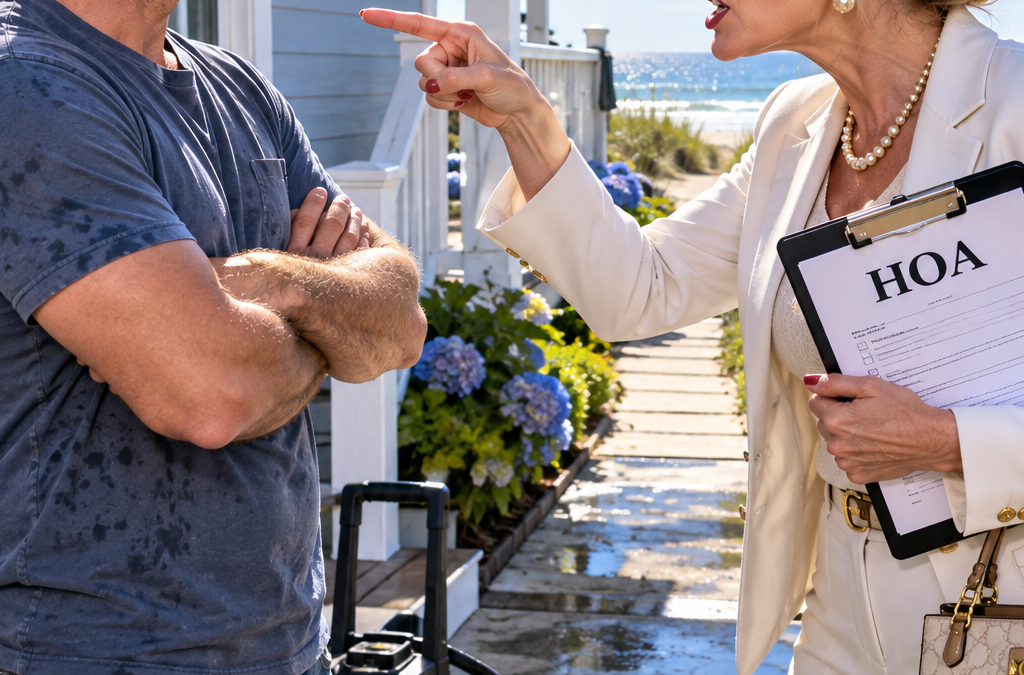
The first time I met her, I was pressure washing my porch. It was a Saturday morning, warm enough that sweat had already soaked through the back of my shirt. I had music playing from a small speaker near the steps, and I was halfway through blasting years of salt grime off the railings when I saw her walking up my driveway.
She did not wave.
She did not call out.
She just marched up, stopped near the porch, crossed her arms, and waited for me to turn off the pressure washer.
I did.
Water dripped from the nozzle onto the boards between us.
“Can I help you?” I asked.
She lifted her chin. “I’m the new community association president.”
I wiped sweat off my forehead with the back of my wrist. “Okay.”
“I’ve been reviewing the properties in our community,” she said, “and I noticed your exterior paint does not match the approved color palette.”
For a second, I genuinely thought I had misheard her.
“My what?”
“Your exterior paint,” she repeated. “It’s not within the approved range.”
I looked at my house, then back at her. “Approved by who?”
“The Coastal Estates Community Association.”
I let out a small laugh because the whole thing seemed so obviously mistaken that I assumed a simple correction would end it.
“Oh,” I said. “I’m not part of that.”
She blinked.
“My house isn’t in the HOA.”
Her head tilted slightly, as if I had just said the ocean was made of soup.
“Every property on this street is part of our association.”
“No,” I said. “Mine isn’t. This house predates the subdivision. Different deed, separate parcel, no covenants. My attorney confirmed all of that before I bought it.”
She stared at me for what felt like ten full seconds.
Then she pulled out her phone and started tapping at the screen.
“I’ll need to look into that,” she said.
“You can.”
“In the meantime, I would appreciate it if you reviewed our community guidelines. I’ll have someone drop off a copy.”
“You can drop off whatever you want,” I said, trying to keep my voice polite. “But I’m not bound by it.”
Her smile was tight enough to crack glass.
“We’ll see.”
Then she turned and walked down my driveway like she had just finished inspecting a defective product.
I watched her go, shook my head, and turned the pressure washer back on.
I thought that would be the end of it.
She would check the records. She would learn I was telling the truth. Maybe she would be embarrassed. Maybe she would avoid eye contact for a while. Eventually, life would go back to normal.
I was wrong.
About a week later, I found an envelope taped to my front door.
No stamp.
No mailing address.
Just my name written across the front in sharp black marker.
Inside was a printed list titled NOTICE OF VIOLATIONS.
I stood on my porch reading it while the ocean wind snapped the paper against my hand.
According to the HOA, my fence was the wrong height. My garage door was the wrong color. My landscaping failed to meet the approved coastal aesthetic standard, whatever that meant. My outdoor grill was stored in an improper location. My kayak rack was visible from the street. My porch furniture was not in harmony with the community appearance guidelines.
And then, near the bottom, there was a note about my doormat.
My doormat.
A twelve-dollar mat from a hardware store that said WIPE YOUR PAWS because my sister had bought it for me as a joke.
Apparently, it was non-compliant.
I laughed so hard I had to sit down.
Then I threw the whole notice into the recycling bin and went on with my life.
The second notice came the following week.
This one complained about my porch lights, the material of my shutters, and the fact that my trash bins had been visible from the street for several hours after pickup.
There were fine amounts listed beside each violation.
Fifty dollars.
Seventy-five dollars.
One hundred dollars for the kayak rack.
The total came to a little over four hundred dollars.
I tossed that one too.
The third notice was different.
It came with a cover letter.
The tone had changed from irritated to threatening.
It stated that my unpaid fines had been escalated and that if I did not bring my account current within thirty days, the association reserved the right to place a lien on my property.
That was the first time I stopped laughing.
Not because I believed she could do it.
She could not.
An HOA cannot place a lien on a property that is not legally part of the HOA. That would be like me fining my neighbor because I disliked the color of his socks. But the fact that she had written it down told me she was not simply confused anymore.
She was escalating.
And people who escalate against facts are dangerous in a special kind of way.
They are not trying to understand reality.
They are trying to exhaust it.
I called my attorney that afternoon.
He listened while I explained the visits, the fake violation notices, the fines, and the threat of a lien.
There was a long pause after I finished.
Then he sighed.
“She’s either profoundly ignorant,” he said, “or she’s hoping you are.”
“Can she actually file something?”
“She can try,” he said. “People can try all kinds of stupid things. But if she files a fraudulent lien, that creates serious legal exposure for her and potentially for the association.”
“What do we do?”
“We send a cease and desist letter.”
He drafted it that day.
The letter was firm, clear, and beautifully free of emotion. It explained that my property was not part of Coastal Estates, that I was not subject to HOA rules, fines, dues, inspections, or enforcement procedures, and that any attempt to record a lien or otherwise interfere with my ownership would be considered fraudulent and met with legal action.
I sent it certified mail.
I also photographed every notice she had sent, scanned the envelope, saved copies of the letters, and started a folder on my computer titled HOA Nonsense.
At the time, I thought the folder name was funny.
Later, it became evidence.
For about three weeks after the cease and desist letter arrived, things were quiet.
Beautifully quiet.
I went down to the house two weekends in a row and did not find anything taped to my door. No notices. No fines. No smug woman in white pants pacing my driveway with a clipboard. The neighbors waved again. The mornings felt normal.
I let myself believe my attorney’s letter had worked.
Maybe her own HOA lawyer had pulled her aside and explained that bullying a non-member property owner was not a great legal strategy. Maybe the rest of the board had told her to focus on actual association business. Maybe she had moved on to terrorizing someone whose mailbox was one shade too rebellious.
Then one Saturday morning, I saw her standing at the edge of my property with two other residents.
I was inside by the front window, holding a mug of coffee, when movement caught my eye.
There she was, pointing at my house.
Not casually.
Not like someone saying, “That’s the old place I told you about.”
She was giving a presentation.
One of the residents had a notebook. The other stood with his arms folded, looking at my porch like it had personally reduced his home value.
I opened the front door and stepped outside.
“Morning,” I called.
The two residents looked uncomfortable.
She did not wave.
She just turned and began walking away, taking them with her.
Over the next few weeks, the street changed.
People who had once been friendly became distant. A woman who used to wave from her porch suddenly looked away when I passed. Dennis, the ladder guy, saw me near the mailboxes one afternoon and turned around like he had forgotten something urgent inside his own house.
I did not know what she was telling them.
But whatever it was, it was working.
Then came the petition.
She delivered it personally.
I opened my door to find her standing on my porch with a folder tucked under one arm and a smile that made me want to check my locks.
“This is from the residents of Coastal Estates,” she said.
I did not take the folder right away.
“What is it?”
“A petition.”
“For what?”
“For you to either join the association voluntarily or bring your property into compliance with community standards.”
I stared at her.
She looked thrilled with herself.
“Twenty residents signed,” she said. “They agree that your property is dragging down community values.”
“My property is not in your community.”
She sighed, performing patience. “You share the street. You affect all of us.”
“I share the street with the seafood shack too. I’m not asking them to approve my doormat.”
Her smile vanished.
“This is your last chance to cooperate before we take further action.”
“What further action?”
“We have options.”
“Legal options?”
Her chin lifted. “Yes.”
“My attorney already sent your association a cease and desist letter. I’m guessing your legal options are pretty limited.”
Her face tightened.
“You think you’re above this community, don’t you?”
“No,” I said. “I’m not in this community. That’s the whole point.”
“We’ll see.”
She shoved the petition into my hands and walked away.
I stood there for a long moment, feeling the ocean wind move through the paper.
Twenty signatures.
Twenty people who either believed her lies or were too intimidated to say no.
I scanned the whole thing and emailed it to my attorney.
His reply came less than ten minutes later.
Keep documenting. Do not engage beyond written communication if possible.
Good advice.
Hard advice.
A few days later, I ran into an older woman from the subdivision at the gas station. Her name was Marjorie. I knew her only in that loose neighborly way where you recognize a face, know the general location of their house, and have discussed the weather enough times to feel faintly obligated to smile.
She approached me while I was pumping gas.
“I didn’t sign it,” she said quietly.
I looked at her. “The petition?”
She nodded, glancing around like the HOA president might pop out from behind the windshield washer station.
“I just wanted you to know that. I don’t like what she’s doing.”
“What exactly is she telling people?”
Marjorie hesitated.
“That you’re sabotaging the community. That you refuse to follow state law. That because your house is on the same street, you’re a de facto member of the association.”
I actually laughed.
Not because it was funny.
Because the alternative was yelling.
“There’s no such thing as de facto HOA membership,” I said.
“I figured,” Marjorie said. “But a lot of people don’t know how this works. She makes it sound very official at the meetings.”
“What else?”
“She says you’re hostile. That you think rules don’t apply to you. That your property is lowering values because buyers don’t want to live beside someone who refuses to cooperate.”
I looked toward the road, jaw tight.
“She’s poisoning the neighborhood against me because she can’t control my house.”
Marjorie’s face softened. “That’s what it feels like.”
I thanked her for telling me.
On the drive back to the beach house, I felt a kind of anger I had not felt in years.
Not hot anger.
Cold anger.
The kind that sharpens everything.
This was not about paint. It was not about my fence, my lights, my kayak rack, or my doormat.
It was about control.
She could not stand that one property sat inside her imagined kingdom but outside her authority. My house was a hole in her map. A place where her title meant nothing. And instead of accepting that, she had decided to make me the villain.
Soon after that, the anonymous notes started.
The first one was tucked inside my mailbox.
Good neighbors follow the rules.
I turned it over, looking for anything else.
Nothing.
No signature.
I threw it away.
The second came four days later.
Your property is everyone’s problem.
The third said, Stop being selfish.
That was when I installed my first security camera.
I mounted it high enough to cover the mailbox, front porch, and driveway. Then I added a camera at the front door.
At first, the cameras felt excessive.
They would not for long.
Little things started happening around the property.
My garden hose was moved from the side of the house to the middle of the walkway. A potted plant on the porch was knocked over. My recycling bin ended up in the middle of the driveway one morning even though I knew I had left it tucked beside the garage.
Could I prove it was her?
No.
But timing has a language of its own.
Then one afternoon, while I was at work two hours away, my phone buzzed with a camera alert.
I opened the app.
There she was.
Standing on my porch.
She was alone, wearing sunglasses and holding her phone in one hand. She looked around once, then reached for my front door handle.
My entire body went still.
She tried the knob.
It did not open.
She tried it again.
Then she stepped back, glanced toward the street, and walked around the side of my house, disappearing from the camera’s view.
I called my neighbor across the street, a man named Paul who, thankfully, was not part of the HOA either.
“Can you look at my place?” I asked. “The HOA woman just tried my front door and went around the side.”
His tone changed immediately. “I’m going now.”
Ten minutes later, he called back.
“She’s gone,” he said. “But your back gate is open.”
My hand tightened around the phone.
“I always keep it closed.”
“I figured. Want me to walk around?”
“No, don’t touch anything. I’m driving down tonight.”
That evening, I arrived after dark with a flashlight and a sick feeling in my stomach.
At first, nothing looked missing. The garage was closed. The windows were intact. The front door was locked. But when I checked the back door, I saw scratches around the keyhole.
Fresh scratches.
I had older renovation photos showing that door up close because I had refinished it myself. The marks had not been there before.
Somebody had worked at that lock with a tool.
The deadbolt still held.
That was probably the only reason she had not gotten inside.
I took close-up photos from several angles. I saved the security footage of her trying the front door. Then I called the local police non-emergency line and filed a report.
The officer who came out was polite. He looked at the scratches, watched the video, wrote everything down, and told me what I already expected.
Since she had not entered the house and there was no obvious damage beyond minor scratches, there was not much they could do at that stage.
“But it’s documented,” he said.
“That’s what I need.”
He nodded. “Keep the footage. Add more cameras if you can.”
So I did.
I added one camera covering the back door and another watching the side gate. I adjusted the front camera to catch more of the driveway. I set the app to send alerts for any motion near the house.
It felt paranoid.
But paranoia is when you imagine danger.
I had video.
For a couple of weeks, nothing happened.
The quiet returned, but it did not feel peaceful anymore. Every alert made my heart kick. Every car slowing near the house made me look through the blinds. I found myself checking the locks even when I knew I had already checked them.
That is what harassment does.
It turns your own home into a place you have to monitor.
Then came the weekend that changed everything.
I took a Friday off work and drove down to the beach house Thursday night. I arrived around ten, unloaded my bag, had one beer on the porch, and listened to the waves in the dark. For the first time in weeks, the air felt almost normal. No envelope taped to the door. No strange note in the mailbox. No camera alert.
I went to bed thinking maybe the police report had finally scared her.
Friday morning, I woke early.
The light was soft and gray-blue, the kind of coastal morning where the world looks half-awake. I made coffee, drank it on the porch, and decided to walk on the beach before it got too hot.
I locked the house.
I closed the back gate.
I know I did because by then it had become a ritual.
Lock door. Check knob. Close gate. Check latch.
Then I walked down the sandy path to the beach.
For forty-five minutes, I let myself breathe.
The tide was low. The sand was cool under my feet. A few gulls moved along the shoreline, stabbing their beaks into the wet sand. I walked farther than I meant to, following the curve of the beach until my house was hidden behind dunes and sea grass.
For those forty-five minutes, I almost forgot about her.
Then I came back up the path.
The back gate was open.
I stopped.
Not slowed.
Stopped.
The latch hung loose.
The gate moved slightly in the wind.
Every sound around me seemed to sharpen at once—the distant surf, the creak of the gate, the faint rustle of dune grass.
I knew I had closed it.
My mouth went dry.
I moved closer, slowly, and then I heard it.
A thump from inside the house.
Then another.
Drawers opening.
Something sliding across a counter.
Someone was inside.
For a moment, I just stood there, phone in hand, feeling my heartbeat climb into my throat.
Then I opened the security app.
The back door camera had recorded motion thirty minutes earlier.
I pressed play.
There she was.
She walked through my open gate with a folder under one arm and a clipboard in her hand. She approached the back door, pulled something from her pocket, and inserted it into the lock.
Not a key.
At least, not one of mine.
She worked it into the lock, struck or twisted it with a sharp motion, and after less than a minute, the door opened.
She stepped inside my house.
I watched the clip twice because part of me could not believe what I had seen.
Then I called 911.
“My name is—” I began, and my voice sounded strangely calm to my own ears. “Someone broke into my house. She is inside right now.”
The dispatcher asked if I was safe.
“I’m outside.”
“Do not enter the home.”
“I’m not going in.”
I walked around to the front sidewalk and waited.
I could see my own front door from the street. It was closed. Behind it, inside my house, was a woman who had spent months pretending her imaginary authority gave her power over my life. Now she had crossed a line so clear that even she would not be able to talk her way around it.
Or so I thought.
A minute later, the front door opened.
She stepped out carrying her clipboard and a folder full of papers.
When she saw me standing on the sidewalk, she froze for half a second.
Just half a second.
Then she smiled.
“Oh, good,” she said, as if we had bumped into each other at the grocery store. “You’re here.”
I stared at her.
She adjusted the folder against her chest. “I was just conducting an interior inspection of your property.”
Something inside me went cold and clear.
“You broke into my house.”
Her smile twitched.
“I have the authority to inspect properties within community boundaries when there are resident concerns about possible violations.”
“This property is not within your community.”
She took a breath, steadying herself. “Several residents have expressed concerns.”
“You broke into my house,” I said again. “And the police are on their way.”
That finally reached her.
Not the crime.
Not the violation.
The consequence.
Her eyes flicked toward the street. “There’s no need for that.”
“There is every need for that.”
“I was conducting official association business.”
“You forced open my back door and entered my home without permission.”
Her face hardened. “If you had cooperated with the inspection process, this would not have been necessary.”
I almost laughed because the sentence was so perfectly insane.
“You’re blaming me for you breaking into my house?”
She rolled her eyes. “Don’t be dramatic.”
“Breaking and entering is dramatic.”
“I’ll leave,” she said sharply. “We can discuss this at the next association meeting.”
“You’re not going anywhere.”
That was when the mask fell.
Her posture changed. Her shoulders squared. The polished HOA president disappeared, and what stepped forward was pure fury.
“You listen to me,” she snapped. “I have been patient with you for months. I have tried to handle this through proper channels. You ignored every notice. You refused to comply. You left me no choice but to take matters into my own hands.”
“You always had a choice.”
“This is my community.”
“This is my house.”
“These properties are my responsibility.”
“No,” I said. “They’re not.”
She stepped closer, voice rising. “I will not let one stubborn holdout drag down property values for everyone else.”
“Cool speech,” I said. “You’re still getting arrested.”
Her mouth opened slightly.
“You wouldn’t dare.”
“I already called.”
“I am the president of this HOA.”
“You keep saying that like it matters.”
“Do you know how many people support me?”
“Right now,” I said, “I know you’re someone who broke into my house and got caught on camera. Everything else seems pretty irrelevant.”
Her face went white.
“Camera?”
“Multiple cameras.”
The transformation was instant.
The anger drained from her expression so quickly it was almost frightening. Her eyes darted to the corner of the house where one camera was mounted. Then to the porch. Then back to me.
“You recorded me?”
“You recorded yourself.”
“I need those recordings deleted.”
“No.”
“This is a private community. You can’t record association activity.”
“This is my private property.”
“You don’t have permission to record me.”
“You didn’t have permission to enter my house.”
She looked down the street, then at her car, then back at me.
“I’m leaving.”
“No, you’re waiting for the police.”
“This was a misunderstanding.”
“You can explain that to them.”
Her fingers tightened around the clipboard so hard I thought it might snap.
For a minute, she paced across my front lawn like an animal searching for a weak spot in a fence. Twice, she looked like she might walk away. Twice, she stopped herself.
I think her ego trapped her there.
Running would have meant admitting she had done something wrong. And in her mind, she had built an entire identity around never being wrong.
Then her voice changed.
It became soft. Reasonable. Almost kind.
“Look,” she said, “we got off on the wrong foot.”
I said nothing.
“I’m willing to forget about this whole thing if you agree to have a simple conversation about bringing your property into alignment with the community. No fines. No penalties. Just a conversation.”
I stared at her.
“You broke into my house.”
“I did not break in.”
“I have footage of you forcing the lock.”
“The door opened.”
“Because you forced it open.”
She had no answer.
The police arrived five minutes later.
Two officers in one patrol car.
I walked to the curb and met them before she could start performing. I explained everything as clearly as I could: the fake violation notices, the lien threat, the cease and desist letter, the petition, the anonymous notes, the previous attempt at the front door, the scratches on the back lock, the police report, and the footage from that morning.
She tried to interrupt constantly.
“I’m the HOA president.”
“This is a community matter.”
“He refuses to comply.”
“This has been an ongoing association issue.”
One officer finally turned to her.
“Ma’am, stop talking and let him finish.”
The look she gave him could have stripped paint.
I pulled up the footage on my phone.
The officers watched.
There it was.
Clear as day.
Karen walking through my back gate.
Karen approaching my back door.
Karen using something on the lock.
Karen entering my home.
There was no ambiguity. No misunderstanding. No community interpretation. No approved color palette in the world could explain that video away.
The lead officer looked from the phone to Karen.
“Did you have permission to enter this home?”
She drew herself up.
“I am the association president.”
“That wasn’t my question.”
“I have authority to inspect properties within—”
“Ma’am,” he interrupted, “did you have the homeowner’s permission to enter this home? Yes or no?”
Silence.
For once, silence.
Then she said, “He should have given me permission.”
The officer’s expression did not change.
“That’s not how this works.”
“This is a community issue.”
“Being an HOA president does not give you the right to enter someone’s home without permission.”
“He has been violating—”
“I’m going to ask you one more time. Did you have permission to enter the home?”
Her lips pressed together.
“No,” she said finally. “But—”
“Turn around and place your hands behind your back.”
Her mouth fell open.
It was not an expression I had ever seen on her before.
Shock, yes.
Outrage, yes.
But under both of those was something almost childlike. A stunned disbelief that rules had suddenly become real.
“You cannot be serious,” she whispered.
The officer was very serious.
He cuffed her on my front lawn while she sputtered about lawsuits, association authority, resident complaints, and how everyone in the neighborhood would hear about this.
They already had.
As the officers put her in the back of the patrol car, doors began opening along the street. Neighbors stepped onto porches. Curtains moved. A few people came out onto their lawns.
Some looked shocked.
Some looked uncomfortable.
A few did not look surprised at all.
One older man across the street caught my eye and gave me a slow nod, as if he had been waiting for that patrol car longer than I had.
Another woman I barely knew walked over after the police car pulled away.
Her voice was quiet.
“Thank you,” she said.
I looked at her, still running on adrenaline. “For what?”
“She’s been making everyone miserable. Nobody knew how to stop her.”
I did not know what to say.
So I just nodded.
After the arrest, I went inside my house.
That was the hardest part.
Not talking to the police.
Not watching her get cuffed.
Walking back into my own home after knowing she had been in there.
She had opened drawers. Moved papers. Walked through rooms where she had no right to stand. The clipboard and folder made it worse somehow. They showed intention. Preparation. She had not wandered in impulsively. She had come ready with a costume and a cover story.
Official inspection.
Community concern.
Association authority.
Words meant to make trespassing sound administrative.
I changed the locks that day.
All of them.
Then I sat at my kitchen table and saved every camera clip to three different places.
In the days that followed, everything came out.
Once Karen was arrested, the fear around the neighborhood cracked open.
People started talking.
I learned I was not the only one she had been harassing. Residents inside the actual HOA had been dealing with her power trips for months. She had fined people for absurd things: flowerpots, porch decorations, slightly faded shutters, trash bins visible too early, flags she personally disliked, garden hoses not hidden from view.
She had threatened liens over paint colors.
She had sent warning letters for things that were not even in the covenants.
She had apparently used HOA funds for questionable personal expenses, though I never got the full details. People had complained to the board, but she controlled the meetings through intimidation. She talked over people. She embarrassed them publicly. She implied legal consequences she did not have the power to impose.
My house had become her obsession because it was the one place her authority completely failed.
And instead of accepting that, she had escalated until her own arrogance put her in handcuffs.
My attorney contacted the HOA’s legal counsel immediately after the arrest. He made it clear that my property was not part of Coastal Estates, had never been part of Coastal Estates, and would never be treated as part of Coastal Estates.
Their lawyer responded quickly.
Too quickly, honestly.
He confirmed everything my attorney had been saying from the beginning. My property was exempt. The HOA had no enforcement authority over it. No dues. No fines. No inspections. No liens. Nothing.
Then came the detail that made my blood run hot all over again.
According to their lawyer, Karen had been told this multiple times.
Multiple times.
She had known.
Maybe not at the very first driveway conversation. Maybe then she had been ignorant. But after the attorney letters, after the records were reviewed, after the HOA’s own counsel explained it, she knew my house was outside her authority.
She kept going anyway.
That changed how I understood the whole thing.
It was not confusion.
It was entitlement with paperwork.
Shortly after, the HOA held an emergency meeting.
I did not attend. I was not a member, and by then I had no interest in sitting in a room full of people debating a woman who had broken into my house. But Marjorie called me afterward.
“They removed her,” she said.
“From president?”
“From everything. Board position too. Unanimous vote.”
I leaned back in my chair and closed my eyes.
For a moment, I did not say anything.
“You still there?” she asked.
“Yeah,” I said. “Just enjoying the word unanimous.”
Marjorie gave a tired laugh.
“You’re not the only one.”
The criminal case dragged on for a few months. Eventually, Karen pleaded to a reduced charge. I could give you all the legal details, but honestly, the details are not what stayed with me.
What stayed with me was the sound of the handcuffs.
What stayed with me was her face when she realized the cameras existed.
What stayed with me was the officer saying, “That’s not how this works.”
Because that was the entire story in one sentence.
That was what she never understood.
That authority has limits.
That titles do not magically expand because you want them to.
That a clipboard is not a search warrant.
That calling something an inspection does not make it legal.
That a community does not own every person who lives near it.
Last I heard, Karen stopped appearing around the neighborhood. Some people said she sold her place. Others said she was staying with family somewhere inland. I did not care enough to verify.
Her absence was enough.
The street changed again after she was gone.
Slowly, awkwardly, people started waving. Dennis apologized one afternoon near the mailboxes. He told me he should have asked questions instead of believing her. Marjorie brought over a pie, which felt old-fashioned and unnecessary but kind. A couple from the HOA stopped me near the seafood shack and said they were sorry for signing the petition.
One of them looked genuinely ashamed.
“She made it sound like you were trying to hurt all of us,” he said.
“I was trying to be left alone.”
“I know that now.”
I nodded.
I appreciated the apology, but it did not erase everything.
That is another thing people do not always understand.
When a group turns on you because one loud person gave them permission, the apology may be real, but the memory remains. You remember who looked away. You remember who signed. You remember who decided your side of the story was not worth hearing.
Still, peace returned.
Not the same peace as before.
A guarded peace.
A peace with better locks, more cameras, and a folder of legal documents stored in three places.
But peace.
One evening, months after it was all over, I sat on the porch with a beer and watched the sky turn violet over the dunes. My new locks shone faintly in the porch light. The camera above the door blinked with its small red eye. My kayak rested in its supposedly non-compliant rack beside the house. The doormat still said WIPE YOUR PAWS.
I had considered replacing it with something tasteful out of spite.
Then I decided spite deserved better.
So I kept it.
The porch boards creaked under my feet as I stood and walked to the edge of the steps. Down the street, the Coastal Estates homes sat in a neat row, their approved lights glowing, their approved shutters framing approved windows, their approved lawns trimmed to approved lengths.
And there was my house.
Older.
Different.
Unapproved.
Mine.
The wind moved through the sea grass. Somewhere beyond the dunes, the waves rolled in and broke against the shore, one after another, steady and indifferent to every human argument about property values and paint colors.
I thought about the first day Karen came up my driveway.
How small it had seemed then.
A woman complaining about paint.
A misunderstanding.
A little power trip.
I had not known that some people treat small boundaries as practice for larger violations. I had not known that if you give the wrong person an inch of politeness, they will try to turn it into a deed, a key, and a right to walk through your door.
But I know that now.
And I know something else too.
Being peaceful does not mean being passive.
Being neighborly does not mean surrendering your rights.
And refusing to be controlled does not make you difficult.
Sometimes the most important sentence you can say is the simplest one.
No.
No, you may not fine me.
No, you may not threaten me.
No, you may not turn my neighbors against me because I will not obey rules that do not apply.
No, you may not open my gate.
No, you may not force my lock.
No, you may not stand inside my home and call it an inspection.
No.
That little beach house is still my favorite place on earth.
Not because nothing bad happened there.
Because something bad happened there, and I kept it.
I kept the porch.
I kept the path to the beach.
I kept the kayak rack, the wrong-colored garage door, the unapproved lights, the twelve-dollar doormat, and the right to sit in my own home without asking permission from a woman who confused power with ownership.
The house is quiet again now.
When I arrive after dark, I still unlock the door and feel my shoulders drop. In the mornings, I still drink coffee on the porch while gulls scream overhead. In the evenings, I still walk barefoot down the sandy path and let the ocean remind me that the world is bigger than bullies with clipboards.
And every time I pass the front door, I glance at the lock.
Not with fear anymore.
With gratitude.
It held long enough for the truth to catch up.