FULL ENDING She Came to My Clinic Demanding the Owner Fire Me, Never Realizing I Owned the Building She Was Standing In
𝗙𝗨𝗟𝗟 𝗦𝗧𝗢𝗥𝗬
I dropped the bag, wiped my hands on my shorts, and jogged toward the front. By the time I reached the waiting room, the buzzer was still going. The blinds were half-open, letting in pale spring light. Through the glass, I could see a woman standing on the sidewalk outside the locked front door.
At first glance, she looked expensive.
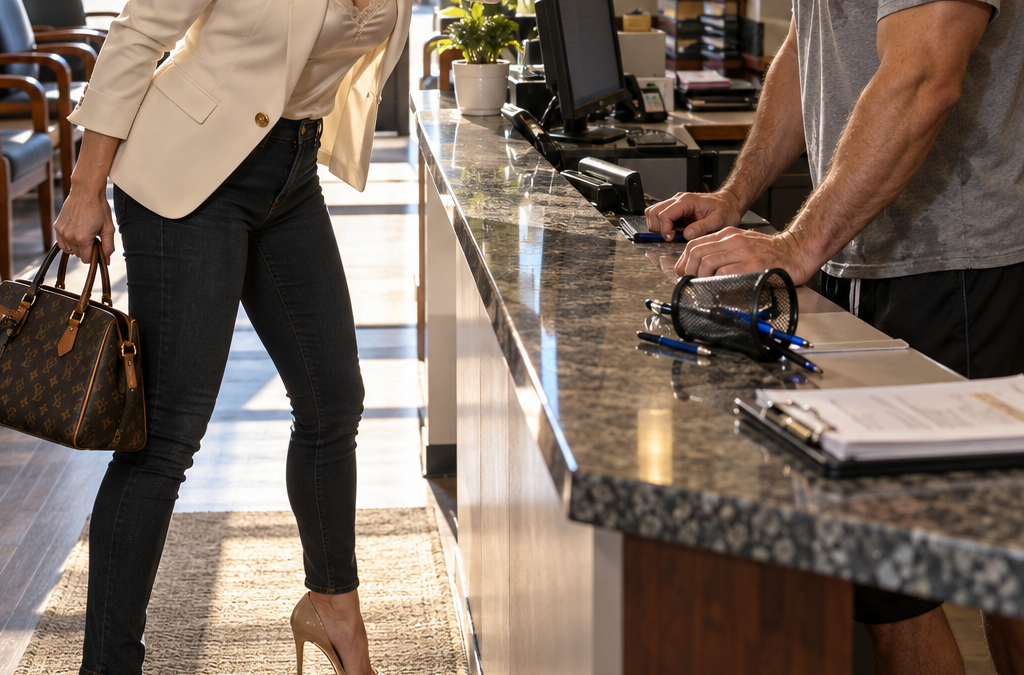
She was around forty, maybe early forties, with glossy chestnut-brown hair curled over one shoulder, oversized sunglasses pushed into it like a headband, and makeup applied with the kind of precision that suggested she considered mirrors a public service. She wore a fitted cream blazer over a low-cut silk top, tight dark jeans, and heels that had no business being worn on a clinic sidewalk before nine in the morning. She had a curvy, polished, deliberately attention-grabbing beauty, the kind she clearly knew how to use. One manicured hand was on the buzzer. The other held a designer purse in the crook of her elbow like a weapon.
When I unlocked the door and pulled it open, she did not say hello.
“It’s about damn time,” she snapped. “I’ve been standing here for five minutes.”
Her voice hit me before her perfume did. Both were sharp.
I glanced behind her at the sign on the door. It clearly said we opened at 10:00 a.m. on Tuesdays.
“Good morning,” I said, forcing my professional voice into place. “Can I help you?”
Her eyes dropped to my shirt, then my shorts, then my sneakers. Her expression changed from anger to contempt so quickly it was almost impressive.
“I have an appointment,” she said. “Obviously. Why is the door locked?”
“We don’t open until ten on Tuesdays,” I said. “It’s not even nine yet.”
“I know what time it is.” She leaned closer, her mouth tightening. “I said I have an appointment. Let me in. It’s freezing out here.”
It was a mild spring morning, maybe sixty degrees, with a little breeze. She was not freezing. But I could already feel this turning into a sidewalk scene, and the last thing I wanted was some dramatic stranger yelling outside the front door before the clinic opened.
So I stepped aside.
“Come in and have a seat,” I said. “I’ll check the schedule.”
She swept past me without a thank-you, bringing with her a cloud of floral perfume and entitlement. Her heels clicked across the waiting room floor. She did not sit. She stood in the middle of the lobby, scanning the place like a health inspector who had already decided to fail us.
I shut the door behind her.
“Who are you here to see?” I asked.
“The chiropractor,” she said, rolling her eyes. “Who else would I be here to see? The janitor?”
Her gaze flicked pointedly to the trash dust on my shorts.
I felt my jaw tighten, but I kept my tone even. “We have three doctors on staff. Which doctor?”
“The owner,” she said, smug satisfaction curling around the word. “I only see the owner.”
That was my first warning sign.
Because I was the owner.
And I had absolutely not booked her.
Maybe she meant my dad. Maybe she was one of his old patients who had not realized he was retired. Maybe there had been a software glitch. Maybe one of my associates had made some strange early appointment and forgotten to tell me. I did not want to assume the worst, even though she was making that difficult.
“Let me check,” I said. “Please have a seat.”
She did not sit. She followed me to the reception desk and watched me like she expected me to steal something from my own computer.
The reception counter was high enough that once I got behind it, she could not see my shorts anymore. I woke the computer, logged into the scheduling system, and pulled up the day.
Nothing.
My first patient was at ten. Dr. Evans had someone at 10:15. Dr. Lee was off. There were no appointments at 8:45. No appointments at nine. No blocked emergency slot. No note. Nothing.
“Ma’am,” I said, “I’m not seeing anything scheduled this morning. Are you sure you have the right day?”
Her palm hit the granite counter hard enough to make the pen cup jump.
“I’m positive.”
I looked up.
Her sunglasses were now in her hair, and I could see her eyes clearly. They were light blue, cold, and furious in a way that felt too practiced to be spontaneous. This was not confusion. This was performance.
“I’m not an idiot,” she said. “Are you implying I’m an idiot?”
“No,” I said. “I’m saying I don’t see an appointment in the system, and I need more information to—”
“I don’t care what your little computer says.” She pointed one glossy nail at me. “What is your name?”
I paused.
“My name isn’t the issue. I’m trying to find your appointment.”
“Your name,” she repeated slowly, as if speaking to a child.
I gave her my first name only.
She smiled, but it was not a pleasant smile. It was the kind of smile someone gives when they think they have found a weak spot.
“Well, you’re incredibly incompetent,” she said. “I’ll be making sure the owner hears about this.”
“I still need your name to look up the appointment.”
“Karen,” she snapped. “Karen Whitmore.”
The name suited her so perfectly that under different circumstances, I might have laughed.
I typed it in.
No result.
I checked alternate spellings. Nothing. I searched by phone number after she reluctantly gave it to me. Nothing. I searched active patients, inactive patients, imported legacy files. Nothing.
She did not exist in our database.
“Karen,” I said carefully, “I’m not finding a patient file for you. Have you been here before?”
Her face flushed red under the foundation. “Are you serious?”
“I just need to know if this is a first visit or—”
“I have been coming here for five years,” she said, each word louder than the last. “Five. Years. I have never been treated so badly in my life.”
Five years.
If she had been coming to my father for five years, she would have had a chart. During the transition, we scanned every active file from the last seven years, and my dad had been meticulous. The man kept notes on paper like a monk illuminating manuscripts. He wrote down everything.
“I’ll check the physical archives,” I said.
She folded her arms. “You do that.”
Then she leaned forward over the counter, lowering her voice into something almost intimate, almost mocking.
“And just so you know,” she said, “I know the owner personally. We’re close friends. Very close. So I would be careful how you speak to me.”
I looked at her.
Her smile returned.
“I could have you fired,” she said. “Especially if this is how you treat patients. What are you, anyway? The cleaning boy?”
For one second, the room went silent around me.
I could have ended it right there. I could have told her who I was, shown her the ownership paperwork on the wall, watched her expression crack, and moved on with my morning.
But something stopped me.
Maybe it was the way she said she knew the owner personally. Maybe it was the confidence. Maybe it was the insult delivered with that pretty, poisonous smile. She had decided I was beneath her because of my clothes, and she was building a lie on top of that assumption.
I wanted to see how high she would stack it.
“I’ll check the paper files,” I said.
I went into the back office, leaving her huffing in the lobby. The old filing cabinets stood against the wall like metal monuments to my father’s stubbornness. Most had been emptied, scanned, and archived, but we still kept physical records for old inactive patients and a handful of legacy cases. I searched Whitmore. I searched possible misspellings. I searched by first name. I checked the inactive drawer.
Nothing.
No Karen Whitmore. No Karen W. No file remotely matching her.
By the time I walked back out, the rear door had opened, and Ingrid had arrived.
Ingrid was our new receptionist, though calling her a receptionist did not do her justice. She ran the front desk with the calm authority of an air traffic controller. She was in her fifties, sharp-eyed, kind when kindness was deserved, and terrifyingly organized. She had been with us only eight months, but I already trusted her more than most people I had worked with for years.
She stopped short when she saw Karen standing in the lobby with her arms crossed like she was waiting for a servant to be punished.
Karen saw Ingrid and immediately pointed at me.
“Finally,” she said. “Tell this employee of yours that I have an appointment and he’s refusing to help me.”
Ingrid blinked once, looked at me in my gym clothes, then looked back at Karen.
“He’s actually—”
I gave Ingrid the smallest shake of my head.
She caught it immediately.
Karen did not.
“Are you going to adjust me or not?” Karen barked at me. “I have places to be.”
“I’m going to get this sorted out,” I said. “Please have a seat.”
This time, she sat, but she did it aggressively, dropping into the chair with one leg crossed over the other, her heel bouncing. She pulled out her phone and began tapping at the screen with dramatic force.
“I’m texting the owner right now,” she announced. “He needs to know what kind of trash he has working here.”
Ingrid’s eyes widened almost imperceptibly.
I motioned for her to follow me into the back office.
The second the door closed, she whispered, “What is happening?”
“She says she has an appointment,” I said. “No record in the schedule. No patient file. No paper file. Says she’s been coming here five years and knows the owner personally.”
Ingrid stared at me.
“She doesn’t know you’re the owner?”
“No.”
“She thinks you’re…”
“The cleaning boy, apparently.”
Ingrid pressed her lips together. I could see laughter fighting for its life behind her eyes.
“Don’t,” I said.
“I’m not.”
“You absolutely are.”
She inhaled, held it, and managed to look professional again. “What do you want me to do?”
“I’m going to shower and change. Go out there and try to get a straight answer about when she supposedly booked. Don’t tell her who I am yet.”
Ingrid’s expression shifted from amusement to interest. “You want to let her keep digging?”
“I want to know what her game is.”
Ingrid nodded slowly. “Understood.”
I went downstairs to the staff locker room and took the fastest shower of my life. As hot water ran over my shoulders, I replayed the interaction in my head. Five years. Close friends with the owner. Appointment before opening. Threats before facts. It did not add up, but entitled people rarely feel obligated to make mathematical sense.
When I came back upstairs, I looked like a different man.
Dress slacks. Clean button-down. White coat. Name embroidered on the chest. Hair damp but combed. No trash dust. No gym smell. No visible reason for Karen to dismiss me as help.
And through the office door, I could hear her voice.
“I made this appointment over a month ago,” she snapped.
Ingrid’s tone stayed impressively calm. “I’ve checked our call logs and online requests, Mrs. Whitmore, and I don’t see anything under your name.”
“Then your system is wrong.”
“That’s possible,” Ingrid said, though we both knew it was not likely. “Who did you speak with when you scheduled?”
“The man,” Karen said. “The old man.”
I stopped just inside the hallway.
Ingrid said, “Dr. Whitaker?”
My father.
“Yes,” Karen said. “Him. He told me to come.”
“He retired more than a year ago,” Ingrid said.
“I know who I spoke to.”
“I’m only saying he doesn’t take booking calls.”
Karen’s voice rose. “Are you calling me a liar?”
“No. I’m trying to understand.”
“Well, understand this,” Karen said. “I’m calling him right now.”
I stepped into the reception area just as Karen stormed out the front door with her phone in hand. Through the window, I watched her pace on the sidewalk, one hand on her hip, the other pressing her phone to her ear. She looked like the heroine of a courtroom drama no one else had agreed to film.
Ingrid leaned toward me.
“She’s nuts,” she whispered.
“She said she booked a month ago?”
“And that your dad personally made the appointment.”
“He hasn’t taken a booking call in two years.”
“I know.”
“And if she knew him, she’d know he retired.”
“I know that too.”
I stood behind the desk and looked out the window. Karen was now gesturing with her free hand, though I doubted anyone had answered. My father had a habit of leaving his phone in random places and discovering it hours later like it had betrayed him.
At exactly ten minutes before opening, Mr. Riverton came in.
He was my first real patient of the day, a retired hardware store manager with a bad lower back and a dry sense of humor. He pushed open the front door carefully, because he had learned the hard way that twisting too fast was a mistake.
“Morning, Doctor,” he said, smiling when he saw me. “You’re looking sharp today.”
“Morning, Mr. Riverton,” I said, shaking his hand. “Trying something new. Professionalism.”
He chuckled. “Careful. People might expect it.”
Ingrid began checking him in.
That was when Karen came back inside.
She entered like a thunderstorm in heels. The door swung open hard, and she marched across the waiting room with triumph written all over her face. She saw me standing behind the counter in my white coat and hesitated for less than a second. Her eyes narrowed, taking in the change, the embroidered name, the posture.
For one flicker of time, I thought recognition might save her.
It did not.
She was too committed to rage.
“You people are in serious trouble,” she announced to the room.
Mr. Riverton turned slowly.
Karen pointed at Ingrid, then at me. “I just spoke to the owner. He’s on his way down here right now to fire all of you.”
Ingrid looked down at her keyboard.
I knew her well enough by then to know she was fighting laughter again.
“The owner is on his way?” I asked calmly.
“Don’t play stupid.” Karen jabbed her finger toward me. “You’re done. Both of you. I told him everything.”
“Everything?”
“Yes. About the locked door. About the missing appointment. About this disgusting treatment.” She looked me up and down again, but this time with confusion folded into contempt. “And about you.”
Mr. Riverton shifted uncomfortably. “Is everything all right?”
“Just a misunderstanding,” I said.
Karen spun toward him. “It is not a misunderstanding. It is malpractice.”
He blinked. “I haven’t even sat down yet.”
Before I could respond, the front door opened again.
My father walked in holding a pink donut box.
He wore a windbreaker, jeans, and the ridiculous fishing hat he had adopted in retirement even though he had gone fishing exactly twice and hated both experiences. He looked cheerful, relaxed, and completely unprepared to walk into a lobby that felt like it had been wired with explosives.
Karen saw him and lit up.
It was almost frightening how quickly her face transformed. The fury became satisfaction. The tight mouth became a victorious smile. She turned toward me and Ingrid with pure venomous delight.
“There he is,” she said. “Now you’re finished.”
My father stopped halfway through the door.
He looked at Karen. Then at me. Then at Ingrid. Then at Mr. Riverton, who gave him a small helpless shrug.
Dad held up the donut box slightly. “Did I come at a bad time?”
Karen rushed toward him.
“Doctor Whitaker,” she said, her voice suddenly warm, breathy, and sweetened at the edges. She placed one hand lightly against her chest as if personally wounded. “Thank God you’re here. Your staff has been absolutely horrible to me.”
My father’s eyebrows rose.
Karen stepped closer to him than was necessary. She tilted her head, letting her curled hair fall over one shoulder, and gave him the sort of smile that had probably worked on salesmen, waiters, and men with weaker boundaries.
“I told them you were expecting me,” she said. “But they locked me out. They lost my appointment. They were rude, disrespectful, and incompetent. I honestly cannot believe this is what your beautiful practice has become.”
My dad looked at her for a long second.
Then he said, “Do I know you?”
The silence that followed was one of the most satisfying sounds I have ever heard.
Karen’s smile faltered.
“Of course you do,” she said quickly. “It’s me. Karen.”
My father blinked.
“Karen,” she repeated, a little sharper now. “I’m friends with your wife. We met last week.”
Recognition moved slowly across my father’s face, but it was not the recognition Karen wanted.
“Oh,” he said. “You.”
Karen’s smile returned too soon. She mistook the word for rescue.
“Yes,” she said, turning toward us. “See? I told you. I know the owner.”
My father glanced at me.
I said nothing.
Karen continued, emboldened. “These people refused to honor the appointment you made for me. They treated me like some random walk-in. They made me stand outside. This one”—she pointed at me—“was especially rude. I want him fired.”
Mr. Riverton made a small choking sound.
Ingrid looked at the ceiling.
My father stared at Karen.
“You want him fired,” he repeated.
“Yes,” Karen said. “Immediately. He has no business working in a clinic. First he came to the door looking like some sweaty janitor, then he disappeared and came back pretending to be important.”
I stepped out from behind the reception desk.
Karen’s gaze snapped to me.
“Before we go any further,” I said, “I want to clarify something.”
She rolled her eyes. “I don’t care what you want.”
“You said you met my father last week.”
That landed.
Her eyes flicked to my dad, then back to me. “What?”
“You told Ingrid you made this appointment a month ago. Before that, you told me you had been coming here for five years.”
Karen’s face tightened.
I took one step closer.
“So which is it? Have you been a patient here for five years? Did you book a month ago? Or did you meet him last week?”
Her mouth opened.
No words came out.
I continued, keeping my voice calm because calm made her angrier. “And if you met him last week, socially, why would you tell us you were a longtime patient? Why would you claim he personally scheduled you before business hours?”
Karen laughed once, too high and brittle. “You misunderstood.”
“I heard you clearly.”
Ingrid raised a hand from behind the desk. “So did I. You said a month ago.”
“And five years,” Mr. Riverton added, then immediately looked like he regretted joining in.
Karen turned on him. “Stay out of this.”
My father set the donut box down on the waiting room table.
That small action changed the room. My dad was gentle by nature. He had spent forty years listening to people describe pain. He was patient, sometimes to a fault. But there were two things he could not tolerate: dishonesty and cruelty toward family.
He stepped beside me.
“Karen,” he said, his voice firmer now, “we met last week at the bistro.”
She swallowed.
“You were sitting with a loud group at the table next to ours,” he continued. “You overheard someone mention I was a chiropractor. You came over during our dinner and told me your neck hurt.”
“I was being friendly,” she said.
“You interrupted my wife while she was speaking.”
Karen flushed.
“I told you I was retired,” Dad said. “I told you my son owned the practice now. I gave you his card and said you could call the office to see if they could fit you in.”
He turned his head toward me.
“I did not book an appointment for you. I did not promise you treatment. I definitely did not tell you to show up before opening and abuse the staff.”
Karen stared at him.
Then at me.
Something in her expression collapsed.
“Your son?” she said.
My father put a hand on my shoulder.
“Yes,” he said. “This is my son. Dr. Whitaker. The owner of this practice. The man you just demanded I fire.”
I smiled.
Not because it was funny exactly, though part of it was. I smiled because for nearly an hour, Karen had treated me like I was invisible, disposable, beneath her. She had built an entire fantasy on the assumption that I could not possibly matter because I had opened the door in gym shorts.
And now she had to stand inside the building I owned and look me in the eye.
“So,” I said, “let me make sure I understand.”
Karen took a step back.
“You came here before we opened,” I said. “You ignored the posted hours. You rang the buzzer until I had to answer. You lied about having an appointment. You lied about being a patient for five years. You lied about booking a month ago. You insulted me, harassed my receptionist, claimed you were close friends with the owner, and then tried to get me fired from my own clinic.”
“I didn’t lie,” she said weakly. “I misunderstood.”
“No,” I said. “You lied.”
Her eyes sharpened again.
People like Karen do not surrender easily. Embarrassment does not humble them. It just changes the direction of the attack.
“I am in pain,” she said, pressing one manicured hand to her neck. “And you are refusing to treat a patient.”
“You are not my patient.”
“I could have been.”
“Not anymore.”
Her mouth hardened. “You can’t refuse me care.”
“I can refuse service to someone who abuses my staff,” I said. “And I will.”
She looked at my father, expecting him to overrule me. That was the part that angered me most. Even after the truth was clear, she still searched for a higher man to appeal to, as if I were a child wearing a costume instead of the person responsible for the practice.
My father did not rescue her.
He folded his arms and stood beside me.
Karen’s voice dropped into something colder.
“You’re making a mistake.”
“I’m not.”
“This town loves your father,” she said. “Not you.”
That hit harder than I wanted it to.
Not because she knew me. She did not. But because every person who takes over a family legacy knows that fear. My father’s name was on decades of trust. Mine was newer. I had spent the past year trying to prove modernization did not mean disrespect, that change did not mean loss, that I was not some arrogant city-trained son coming home to erase what my father built.
Karen saw the crack and pressed her nail into it.
“People come here because of him,” she said, nodding toward my father. “You think they care about your little software and your fancy coat? You’re nothing without his reputation.”
The room went very still.
My father’s face changed.
I felt his hand leave my shoulder.
He stepped forward.
“You do not speak to my son like that,” he said.
Karen blinked.
His voice was not loud, but it had a weight I rarely heard. It was the voice he used when pain crossed into danger, when a patient ignored symptoms too serious to shrug off.
“You came into his clinic,” Dad said, “lied to his face, insulted his staff, and tried to use my name to bully him. You do not get to stand here now and tell him what he is worth.”
For the first time that morning, Karen looked genuinely unsure.
Only for a second.
Then she recovered.
“I’m not leaving until I get adjusted,” she said.
“You are leaving now,” I said.
“No.”
“Ingrid,” I said, without taking my eyes off Karen, “please call the police and tell them we have a trespasser refusing to leave.”
Ingrid picked up the phone with visible satisfaction.
Karen’s eyes widened. “You wouldn’t.”
“I absolutely would.”
“This is insane,” she snapped. “I came here for medical help.”
“You came here to bully your way into something you never scheduled.”
“I know your mother,” she said to my father.
My father’s mouth tightened. “My wife met you once and hoped never to repeat the experience.”
Mr. Riverton coughed into his fist.
Karen swung toward him. “Are you laughing at me?”
“No, ma’am,” he said. “I have allergies.”
Ingrid began speaking into the phone. “Hi, this is Whitaker Chiropractic on Maple Road. We have an individual refusing to leave the premises after being asked…”
Karen grabbed her purse.
“You have not heard the last of me,” she hissed.
“I’m sure,” I said.
“I will sue you.”
“Okay.”
“I will write reviews.”
“Okay.”
“I will tell everyone in this town what you did.”
“Please be accurate when you do.”
Her face twisted.
For one second, I thought she might throw something. Instead, she pointed at me with a shaking finger.
“You are going to regret humiliating me.”
I looked at her, and the anger I had been holding down all morning finally sharpened into something clean.
“No, Karen,” I said. “You humiliated yourself. I just stopped pretending not to notice.”
She stormed out so hard the glass door rattled behind her.
The lobby remained silent for three full seconds.
Then Mr. Riverton let out a low whistle.
“Well,” he said, “that was better than morning television.”
My father exhaled, opened the donut box, and looked at me.
“I leave you in charge for one year,” he said, “and this is what happens?”
I laughed then, because if I did not laugh, I might have shaken from the adrenaline.
Ingrid hung up after telling the police the person had left but asking whether we could file a trespass notice if she returned. Then she came around the desk, looked at the donuts, and said, “I want hazard pay in the form of Boston cream.”
“Approved,” I said.
Mr. Riverton took a maple glazed and sat down like he had earned it.
For a few minutes, it felt over.
It was not over.
Karen had promised scorched earth, and Karen, for all her lies, seemed very committed to revenge.
The first review appeared that afternoon.
One star.
Rude staff. Dirty office. Doctor came to the door wearing filthy gym clothes and smelled disgusting. Elderly owner is senile and lies to patients. New management is arrogant and unprofessional. Do not go here.
I read it twice while sitting alone in my office after lunch.
The first time, I laughed.
The second time, my stomach turned.
Not because the claims were true. They were ridiculous. We kept the office clean enough that Ingrid could spot a single crooked magazine from across the lobby. My father was not senile. I had been in gym clothes because we were closed and I was doing maintenance work before patients arrived. None of it mattered. Online, a confident lie could travel faster than any careful explanation.
I took screenshots. Ingrid had already documented the morning in our incident log. We saved the schedule showing no appointment. We saved the call logs. We saved the empty patient search. Owning a healthcare practice had taught me that documentation was not paranoia. It was armor.
Then Karen escalated.
That evening, while I was finishing insurance paperwork, Ingrid texted me a screenshot from the local community Facebook group.
You know the kind of group. Every town has one. Lost dogs. Loud fireworks. Suspicious vans. Arguments about whether the new traffic light is destroying civilization. People announcing yard sales with more drama than necessary.
Karen had written a novel.
According to her, my father had personally promised her free treatment because they were “family friends.” According to her, she had arrived at her appointment only to be locked out by a “sweaty, aggressive employee” who refused to give his full name. According to her, the receptionist mocked her, the new doctor acted arrogant, and my father was being manipulated by his “spoiled son” who had taken over the practice and ruined it.
She made herself sound fragile. Betrayed. Injured.
She made me sound like a tyrant.
For about thirty seconds, fear moved through me in a cold wave.
Because this was my nightmare in public form.
When I bought the clinic, I understood spreadsheets, treatment protocols, payroll, marketing, equipment leases, and compliance. What I had not fully understood was the emotional weight of taking over a beloved local institution. People did not just come to that building for adjustments. They came because my father had been steady for them. They came because the walls felt familiar. They came because trust had accumulated there slowly, year by year, until it became almost invisible.
Karen was not attacking one appointment.
She was attacking the transition.
And she was smart enough to aim where I was most vulnerable.
I stared at the post, reading the comments as they started to gather.
The first one was from a woman named Marsha Greene, whose husband my father had treated after a work injury.
Karen, I’ve gone to that clinic for twenty-two years. This doesn’t sound right.
Then another.
Dr. Whitaker retired. His son owns it now. He’s excellent. My daughter sees him.
Then another.
Did you actually have an appointment?
Karen replied almost immediately.
Yes, I had an appointment. The old doctor promised me personally.
A man named Paul Henderson responded.
That’s strange because I saw Dr. Whitaker senior at breakfast last week telling someone he was retired and didn’t schedule patients anymore.
Then came the comment that changed the entire temperature of the thread.
Wait, are you the same Karen who screamed at the grocery store cashier last month because your coupon expired?
I leaned back in my chair.
Another comment appeared.
She is. I was there.
Then another.
She also got kicked out of Bella’s Boutique for trying to return worn shoes.
Then another.
My niece works at the bistro. This lady interrupted Dr. Whitaker’s dinner and wouldn’t leave him alone.
The thread turned.
Not slowly. Not gently.
It turned like weather.
People I had treated began telling stories. Not about Karen, at first, but about my father. About the time he opened early for an injured teacher before a field trip. About the time he stayed late for a firefighter with a locked-up shoulder. About how he had treated three generations of the same family. Then they talked about me. Newer patients. Younger ones. The people who liked the evening hours, the online booking, the fact that we took cards now without acting like technology was witchcraft.
My hands were still cold, but something in my chest loosened.
Karen kept arguing for a while.
Each response made her look worse.
She said my father was “confused.” Half the town took that personally. She said I was arrogant. Three patients replied that I had sat with them for extra time when they were scared. She said the office was dirty. Ingrid posted a picture of the lobby from that morning, spotless except for the chair Karen had shoved sideways when she stormed out.
I called my father around seven.
He answered on the fifth ring, breathless.
“You found your phone?” I asked.
“It was in the refrigerator.”
“Why?”
“I don’t want to talk about it.”
I rubbed my forehead. “Did Mom see the Facebook post?”
There was a pause.
“Yes.”
“And?”
“She said Karen spelled ‘chiropractic’ wrong three different ways.”
Despite everything, I laughed.
Dad grew quiet.
“You okay?” he asked.
I looked around my office. My office now. The framed license on the wall. The old photo of my father standing outside the building in the eighties, hair thick, smile wide, sign freshly painted. The new computer on my desk. The stack of insurance claims. The donut box still half-full in the break room.
“I think so,” I said.
“You handled yourself well.”
I swallowed.
“Did I?”
“Yes.”
“I banned someone from the practice in front of a waiting patient.”
“You banned someone who abused you and your staff.”
“She’s telling people I ruined your clinic.”
My father was silent for a moment.
Then he said, “Son, anyone who believes that was already looking for a reason to.”
I closed my eyes.
He continued, “You are not me. You were never supposed to be me. That clinic didn’t survive forty years because I never changed anything. It survived because people trusted me to do what was right for them. Now they need to learn they can trust you. Days like this help more than they hurt.”
“That sounds optimistic.”
“I’m retired,” he said. “Optimism is all I have left besides fishing hats and cholesterol.”
I laughed again, softer this time.
After we hung up, I read through the thread one more time.
Karen had stopped replying.
By the next morning, her Facebook post had been deleted.
The Google review stayed up, but it did not do what she wanted. In fact, it had the opposite effect. Over the next week, patients began leaving reviews of their own. Real ones. Detailed ones. People mentioned the staff by name. They mentioned the transition. They mentioned my father’s retirement and how grateful they were that the practice had stayed in the family.
One review from Mr. Riverton nearly made me spit coffee.
Came in for lower back pain. Got donuts and live theater. Five stars.
Ingrid printed that one and taped it inside the staff room cabinet.
Karen did not return, but she did send one final email through the website contact form. It was full of threats. Legal action. Medical board complaints. Defamation. Emotional distress. Public exposure. Every sentence sounded like it had been written by someone who had Googled “how to sound legally terrifying” and then added perfume.
I forwarded it to our attorney, who responded with a short, beautiful message: Do not engage. Maintain documentation. You are within your rights.
So we did.
We kept the incident report. We flagged her name in the system in case she ever tried to book online. We added a clear conduct policy to our website and front desk paperwork. Zero tolerance for abuse toward staff. Refusal of non-emergency service at the discretion of management. Trespass notice if necessary.
Some people might think that was an overreaction.
They have probably never watched a person try to weaponize charm, lies, and social pressure in real time.
Karen was not the first difficult person I had dealt with, and she would not be the last. Pain makes people impatient. Fear makes people rude. Confusion makes people defensive. I can forgive a lot when someone is hurting.
But there is a difference between pain and entitlement.
There is a difference between frustration and cruelty.
There is a difference between needing help and demanding obedience.
Karen walked into my clinic before opening and saw a man in gym clothes carrying trash. In her mind, that meant I was beneath her. It meant she could talk over me, insult me, threaten me, and use the name of a man she barely knew as a hammer. She thought power belonged to whoever looked polished enough to claim it.
She was wrong.
That morning taught me something I did not realize I still needed to learn.
For months after taking over, I had carried my father’s legacy like a fragile object. I worried constantly about dropping it. I worried that every mistake would prove I was not ready, every unhappy patient would become evidence that the son could never match the father, every change would be seen as disrespect instead of growth.
But legacy is not a glass vase.
It is a foundation.
You do not honor it by standing still forever. You honor it by building carefully on top of it, by protecting the people inside it, by knowing when kindness becomes weakness and when patience becomes permission.
My father had spent forty years creating a place where people felt cared for.
That meant I had a responsibility to protect my staff from people who mistook care for submission.
A week after the incident, I arrived early again on a Tuesday.
Same routine. Back lot. Rear door. Quiet hallway. Trash bags. Inventory clipboard. The maple tree outside dropping leaves into the cracked pavement like nothing had happened.
This time, I paused in the lobby before turning on all the lights.
The waiting room looked calm. Chairs aligned. Magazines straight. Children’s corner organized. My father’s old framed photo still hung near the hallway, but beside it now was a newer photo of the whole staff from our reopening anniversary. Ingrid stood in the middle with her arms crossed like she owned us all. Dr. Evans was laughing. Dr. Lee had somehow blinked. My father stood on one end, retired but proud. I stood on the other, not replacing him, not pretending to be him, just there.
The front door was locked.
The hours were posted clearly.
For a moment, I thought about Karen standing outside with her finger on the buzzer, convinced that volume could turn a lie into reality.
Then I thought about my father setting down the donut box.
Do I know you?
I smiled to myself.
At nine-thirty, Ingrid arrived with coffee.
“No Karens today?” she asked, glancing around theatrically.
“Don’t say that,” I said. “You’ll summon one.”
She handed me a cup. “If another one shows up, I’m charging admission.”
At ten, we opened.
Mr. Riverton was not on the schedule that day, but he stopped by anyway with a small paper bag from the bakery.
“For the staff,” he said.
Inside were donuts.
I stared at them, then at him.
He shrugged. “Figured you people need fuel. Never know when the next performance starts.”
The morning filled the way mornings do. A teacher with neck tension. A mechanic with a stubborn shoulder. A mother bringing in her teenage son after soccer practice. Real patients. Real pain. Real trust.
No drama.
No threats.
No perfume cloud of entitlement.
Just the work.
Near noon, my father came by.
He wore the fishing hat again.
I looked at him and said, “You know you don’t fish.”
He touched the brim proudly. “Not with that attitude.”
He brought donuts too, which meant we now had more sugar than medical judgment would recommend. Ingrid accused him of trying to create future patients through inflammation. He told her retirement had freed him from responsibility.
Before he left, he lingered near the hallway, looking at the clinic the way people look at homes they used to live in. Not with regret exactly. More like tenderness.
“You’ve made it better,” he said suddenly.
I looked up from the chart I was reviewing.
“What?”
“The clinic,” he said. “You’ve made it better.”
I did not know what to say.
He smiled, a little embarrassed by his own sincerity.
“I made it mine,” he said. “Now you’re making it yours. That’s how it should be.”
Then he left before I could get too emotional, because men in our family have historically preferred to express love through baked goods and avoid prolonged eye contact.
I stood there for a while after he walked out.
The clinic hummed around me. Phones ringing. Keyboard taps. Low patient voices. Ingrid laughing at something near the front desk. The faint scent of coffee and disinfectant. Sunlight across the lobby floor.
A year earlier, I had thought ownership meant paperwork, payroll, software, billing, scheduling, staffing, and enough stress to permanently tighten my traps.
I had been wrong.
Ownership meant opening the door when the buzzer would not stop and deciding what kind of place people were walking into.
It meant knowing that kindness did not require surrender.
It meant understanding that the name on the building carried history, but the boundaries inside it carried the future.
Karen had come in that morning certain she could make me small.
She thought she could shame me because I was sweaty, dismiss me because I was young, overpower Ingrid because she was staff, manipulate my father because he was polite, and frighten the town because she knew how to write a dramatic post online.
Instead, she exposed herself.
She showed everyone exactly who she was.
And without meaning to, she gave me something I had been struggling to claim.
Not the practice. I already owned that on paper.
She gave me the moment I finally felt like I owned it in my bones.
So now, whenever someone asks about the first real crisis I faced after taking over my father’s legendary forty-year-old clinic, I do not start with the billing system crash or the insurance audit or the time the new online booking platform accidentally allowed three people to schedule the same slot.
I tell them about Karen.
I tell them about the woman who came before opening, lied about an appointment, claimed she knew the owner, and demanded that my father fire me from my own building.
And then I tell them the best part.
My father did not defend his legacy by taking the clinic back.
He defended it by standing beside me.
And Karen never stepped through our door again.
𝗧𝗛𝗘 𝗘𝗡𝗗
She Came to My Clinic Demanding the Owner Fire Me, Never Realizing I Owned the Building She Was Standing In
The worst kind of liar is the one who smiles like the truth already belongs to her.
She walked into my father’s old clinic before we were even open and decided I looked too ordinary to matter.
By the time she demanded that the owner fire me, she had no idea she was standing three feet away from the only person who could ban her forever.
My father’s chiropractic office had been part of our hometown for longer than I had been alive.
It sat on the edge of town in a small standalone building with faded brick, a green awning, and a parking lot that still had one crooked maple tree my dad refused to cut down no matter how many times its roots cracked the pavement. People in town knew that building the way they knew the post office or the old diner on Main Street. If someone threw out their back moving a couch, they went to my dad. If a teenager jammed his neck in football practice, they went to my dad. If a grandmother woke up unable to turn her head, her daughter drove her straight to that brick building before she even called anyone else.
For forty years, my father had built his life there. He knew patients by name, by pain pattern, by birthday, by which grandkid had just gotten braces. He treated people like neighbors because most of them were. That was why, when he finally decided to retire, selling the practice to some corporate chain felt like betrayal. He did not want the place turned into a fast-moving patient mill with scripted greetings and rushed adjustments. He wanted the clinic to stay human.
So I came home.
I had followed him into chiropractic care, but I had taken a different road. I went to school in the city, worked in a high-volume sports clinic, and got used to digital records, online scheduling, fast treatment plans, and patients who expected efficiency. My dad, meanwhile, had kept paper appointment books and filing cabinets until the world practically dragged him forward. Taking over meant more than buying a business from my parents. It meant sorting through forty years of habits, memories, trust, and dust.
For six months, I lived between two lives. I worked part-time in the city, part-time at my dad’s office, and spent every spare hour modernizing the practice. We digitized records. We replaced the billing system. We installed online booking. We accepted credit cards without using ancient carbon-copy slips. I hired new staff after my dad’s receptionist retired with him, brought on two associate doctors, and expanded the hours so working people could come in evenings or weekends.
By the time the incident happened, I was officially the owner. The building was mine. The practice was mine. My father still stopped by sometimes with donuts, bad jokes, or both, but he no longer treated patients. He had earned his retirement.
Most people adjusted to the change.
Some grumbled about the new software. Some missed my dad’s handwriting in the appointment book. Some walked in already irritated because pain can turn good people sharp around the edges. I understood that. In healthcare, especially when people hurt, you learn not to take every tone personally.
But Karen was not in pain when she first pressed our buzzer.
She was looking for someone to control.
part2
It was a Tuesday morning, and Tuesdays were my heavy admin days. The clinic did not open to patients until ten because we used those early hours for staff meetings, payroll, insurance claims, supply orders, and training. I usually got there before everyone else, partly because I liked the quiet and partly because owning a practice means there is always something waiting for you before coffee.
That morning, I had come straight from the gym.
I lifted early to clear my head, so when I pulled into the back lot around eight-thirty, I was wearing black gym shorts, an old sweat-stained T-shirt, beat-up sneakers, and the kind of expression a man has when he is mentally sorting payroll and trash bags at the same time. My plan was simple: unlock the back door, take out trash from the treatment rooms, check inventory, shower downstairs in the staff locker room, then change into slacks and a white coat before the team arrived.
Nothing about that morning felt dramatic.
I unlocked the rear entrance, switched on the hallway lights, and started my routine. The building smelled faintly of disinfectant, paper files, and the coffee someone had forgotten to clean out of the machine the day before. I moved through the treatment rooms, tying up trash bags, checking table paper, making notes about low supplies. Outside, the town was still easing awake. A few cars passed on the road. Somewhere nearby, a delivery truck backed up with its dull, steady beep.
Then the front buzzer screamed through the building.
It was not a pleasant doorbell. It was an industrial old-school buzzer my father had installed decades earlier so he could hear it from the treatment rooms. When it rang, it did not politely announce a visitor. It attacked the nervous system.
I froze with one hand around the neck of a trash bag and checked my watch.
8:45.
We opened at ten.
I ignored it.
That happened sometimes. A delivery driver. A patient who misread the schedule. Someone who would see the sign on the door and leave. I bent back over the trash bag.
The buzzer rang again.
Then again.
Then it became one long, furious, continuous blast, like somebody had planted their thumb on the button and decided the building owed them immediate surrender.
I closed my eyes and inhaled through my nose.
“Okay,” I muttered to nobody. “That’s enough.”
I dropped the bag, wiped my hands on my shorts, and jogged toward the front. By the time I reached the waiting room, the buzzer was still going. The blinds were half-open, letting in pale spring light. Through the glass, I could see a woman standing on the sidewalk outside the locked front door.
At first glance, she looked expensive.
She was around forty, maybe early forties, with glossy chestnut-brown hair curled over one shoulder, oversized sunglasses pushed into it like a headband, and makeup applied with the kind of precision that suggested she considered mirrors a public service. She wore a fitted cream blazer over a low-cut silk top, tight dark jeans, and heels that had no business being worn on a clinic sidewalk before nine in the morning. She had a curvy, polished, deliberately attention-grabbing beauty, the kind she clearly knew how to use. One manicured hand was on the buzzer. The other held a designer purse in the crook of her elbow like a weapon.
When I unlocked the door and pulled it open, she did not say hello.
“It’s about damn time,” she snapped. “I’ve been standing here for five minutes.”
Her voice hit me before her perfume did. Both were sharp.
I glanced behind her at the sign on the door. It clearly said we opened at 10:00 a.m. on Tuesdays.
“Good morning,” I said, forcing my professional voice into place. “Can I help you?”
Her eyes dropped to my shirt, then my shorts, then my sneakers. Her expression changed from anger to contempt so quickly it was almost impressive.
“I have an appointment,” she said. “Obviously. Why is the door locked?”
“We don’t open until ten on Tuesdays,” I said. “It’s not even nine yet.”
“I know what time it is.” She leaned closer, her mouth tightening. “I said I have an appointment. Let me in. It’s freezing out here.”
It was a mild spring morning, maybe sixty degrees, with a little breeze. She was not freezing. But I could already feel this turning into a sidewalk scene, and the last thing I wanted was some dramatic stranger yelling outside the front door before the clinic opened.
So I stepped aside.
“Come in and have a seat,” I said. “I’ll check the schedule.”
She swept past me without a thank-you, bringing with her a cloud of floral perfume and entitlement. Her heels clicked across the waiting room floor. She did not sit. She stood in the middle of the lobby, scanning the place like a health inspector who had already decided to fail us.
I shut the door behind her.
“Who are you here to see?” I asked.
“The chiropractor,” she said, rolling her eyes. “Who else would I be here to see? The janitor?”
Her gaze flicked pointedly to the trash dust on my shorts.
I felt my jaw tighten, but I kept my tone even. “We have three doctors on staff. Which doctor?”
“The owner,” she said, smug satisfaction curling around the word. “I only see the owner.”
That was my first warning sign.
Because I was the owner.
And I had absolutely not booked her.
Maybe she meant my dad. Maybe she was one of his old patients who had not realized he was retired. Maybe there had been a software glitch. Maybe one of my associates had made some strange early appointment and forgotten to tell me. I did not want to assume the worst, even though she was making that difficult.
“Let me check,” I said. “Please have a seat.”
She did not sit. She followed me to the reception desk and watched me like she expected me to steal something from my own computer.
The reception counter was high enough that once I got behind it, she could not see my shorts anymore. I woke the computer, logged into the scheduling system, and pulled up the day.
Nothing.
My first patient was at ten. Dr. Evans had someone at 10:15. Dr. Lee was off. There were no appointments at 8:45. No appointments at nine. No blocked emergency slot. No note. Nothing.
“Ma’am,” I said, “I’m not seeing anything scheduled this morning. Are you sure you have the right day?”
Her palm hit the granite counter hard enough to make the pen cup jump.
“I’m positive.”
I looked up.
Her sunglasses were now in her hair, and I could see her eyes clearly. They were light blue, cold, and furious in a way that felt too practiced to be spontaneous. This was not confusion. This was performance.
“I’m not an idiot,” she said. “Are you implying I’m an idiot?”
“No,” I said. “I’m saying I don’t see an appointment in the system, and I need more information to—”
“I don’t care what your little computer says.” She pointed one glossy nail at me. “What is your name?”
I paused.
“My name isn’t the issue. I’m trying to find your appointment.”
“Your name,” she repeated slowly, as if speaking to a child.
I gave her my first name only.
She smiled, but it was not a pleasant smile. It was the kind of smile someone gives when they think they have found a weak spot.
“Well, you’re incredibly incompetent,” she said. “I’ll be making sure the owner hears about this.”
“I still need your name to look up the appointment.”
“Karen,” she snapped. “Karen Whitmore.”
The name suited her so perfectly that under different circumstances, I might have laughed.
I typed it in.
No result.
I checked alternate spellings. Nothing. I searched by phone number after she reluctantly gave it to me. Nothing. I searched active patients, inactive patients, imported legacy files. Nothing.
She did not exist in our database.
“Karen,” I said carefully, “I’m not finding a patient file for you. Have you been here before?”
Her face flushed red under the foundation. “Are you serious?”
“I just need to know if this is a first visit or—”
“I have been coming here for five years,” she said, each word louder than the last. “Five. Years. I have never been treated so badly in my life.”
Five years.
If she had been coming to my father for five years, she would have had a chart. During the transition, we scanned every active file from the last seven years, and my dad had been meticulous. The man kept notes on paper like a monk illuminating manuscripts. He wrote down everything.
“I’ll check the physical archives,” I said.
She folded her arms. “You do that.”
Then she leaned forward over the counter, lowering her voice into something almost intimate, almost mocking.
“And just so you know,” she said, “I know the owner personally. We’re close friends. Very close. So I would be careful how you speak to me.”
I looked at her.
Her smile returned.
“I could have you fired,” she said. “Especially if this is how you treat patients. What are you, anyway? The cleaning boy?”
For one second, the room went silent around me.
I could have ended it right there. I could have told her who I was, shown her the ownership paperwork on the wall, watched her expression crack, and moved on with my morning.
But something stopped me.
Maybe it was the way she said she knew the owner personally. Maybe it was the confidence. Maybe it was the insult delivered with that pretty, poisonous smile. She had decided I was beneath her because of my clothes, and she was building a lie on top of that assumption.
I wanted to see how high she would stack it.
“I’ll check the paper files,” I said.
I went into the back office, leaving her huffing in the lobby. The old filing cabinets stood against the wall like metal monuments to my father’s stubbornness. Most had been emptied, scanned, and archived, but we still kept physical records for old inactive patients and a handful of legacy cases. I searched Whitmore. I searched possible misspellings. I searched by first name. I checked the inactive drawer.
Nothing.
No Karen Whitmore. No Karen W. No file remotely matching her.
By the time I walked back out, the rear door had opened, and Ingrid had arrived.
Ingrid was our new receptionist, though calling her a receptionist did not do her justice. She ran the front desk with the calm authority of an air traffic controller. She was in her fifties, sharp-eyed, kind when kindness was deserved, and terrifyingly organized. She had been with us only eight months, but I already trusted her more than most people I had worked with for years.
She stopped short when she saw Karen standing in the lobby with her arms crossed like she was waiting for a servant to be punished.
Karen saw Ingrid and immediately pointed at me.
“Finally,” she said. “Tell this employee of yours that I have an appointment and he’s refusing to help me.”
Ingrid blinked once, looked at me in my gym clothes, then looked back at Karen.
“He’s actually—”
I gave Ingrid the smallest shake of my head.
She caught it immediately.
Karen did not.
“Are you going to adjust me or not?” Karen barked at me. “I have places to be.”
“I’m going to get this sorted out,” I said. “Please have a seat.”
This time, she sat, but she did it aggressively, dropping into the chair with one leg crossed over the other, her heel bouncing. She pulled out her phone and began tapping at the screen with dramatic force.
“I’m texting the owner right now,” she announced. “He needs to know what kind of trash he has working here.”
Ingrid’s eyes widened almost imperceptibly.
I motioned for her to follow me into the back office.
The second the door closed, she whispered, “What is happening?”
“She says she has an appointment,” I said. “No record in the schedule. No patient file. No paper file. Says she’s been coming here five years and knows the owner personally.”
Ingrid stared at me.
“She doesn’t know you’re the owner?”
“No.”
“She thinks you’re…”
“The cleaning boy, apparently.”
Ingrid pressed her lips together. I could see laughter fighting for its life behind her eyes.
“Don’t,” I said.
“I’m not.”
“You absolutely are.”
She inhaled, held it, and managed to look professional again. “What do you want me to do?”
“I’m going to shower and change. Go out there and try to get a straight answer about when she supposedly booked. Don’t tell her who I am yet.”
Ingrid’s expression shifted from amusement to interest. “You want to let her keep digging?”
“I want to know what her game is.”
Ingrid nodded slowly. “Understood.”
I went downstairs to the staff locker room and took the fastest shower of my life. As hot water ran over my shoulders, I replayed the interaction in my head. Five years. Close friends with the owner. Appointment before opening. Threats before facts. It did not add up, but entitled people rarely feel obligated to make mathematical sense.
When I came back upstairs, I looked like a different man.
Dress slacks. Clean button-down. White coat. Name embroidered on the chest. Hair damp but combed. No trash dust. No gym smell. No visible reason for Karen to dismiss me as help.
And through the office door, I could hear her voice.
“I made this appointment over a month ago,” she snapped.
Ingrid’s tone stayed impressively calm. “I’ve checked our call logs and online requests, Mrs. Whitmore, and I don’t see anything under your name.”
“Then your system is wrong.”
“That’s possible,” Ingrid said, though we both knew it was not likely. “Who did you speak with when you scheduled?”
“The man,” Karen said. “The old man.”
I stopped just inside the hallway.
Ingrid said, “Dr. Whitaker?”
My father.
“Yes,” Karen said. “Him. He told me to come.”
“He retired more than a year ago,” Ingrid said.
“I know who I spoke to.”
“I’m only saying he doesn’t take booking calls.”
Karen’s voice rose. “Are you calling me a liar?”
“No. I’m trying to understand.”
“Well, understand this,” Karen said. “I’m calling him right now.”
I stepped into the reception area just as Karen stormed out the front door with her phone in hand. Through the window, I watched her pace on the sidewalk, one hand on her hip, the other pressing her phone to her ear. She looked like the heroine of a courtroom drama no one else had agreed to film.
Ingrid leaned toward me.
“She’s nuts,” she whispered.
“She said she booked a month ago?”
“And that your dad personally made the appointment.”
“He hasn’t taken a booking call in two years.”
“I know.”
“And if she knew him, she’d know he retired.”
“I know that too.”
I stood behind the desk and looked out the window. Karen was now gesturing with her free hand, though I doubted anyone had answered. My father had a habit of leaving his phone in random places and discovering it hours later like it had betrayed him.
At exactly ten minutes before opening, Mr. Riverton came in.
He was my first real patient of the day, a retired hardware store manager with a bad lower back and a dry sense of humor. He pushed open the front door carefully, because he had learned the hard way that twisting too fast was a mistake.
“Morning, Doctor,” he said, smiling when he saw me. “You’re looking sharp today.”
“Morning, Mr. Riverton,” I said, shaking his hand. “Trying something new. Professionalism.”
He chuckled. “Careful. People might expect it.”
Ingrid began checking him in.
That was when Karen came back inside.
She entered like a thunderstorm in heels. The door swung open hard, and she marched across the waiting room with triumph written all over her face. She saw me standing behind the counter in my white coat and hesitated for less than a second. Her eyes narrowed, taking in the change, the embroidered name, the posture.
For one flicker of time, I thought recognition might save her.
It did not.
She was too committed to rage.
“You people are in serious trouble,” she announced to the room.
Mr. Riverton turned slowly.
Karen pointed at Ingrid, then at me. “I just spoke to the owner. He’s on his way down here right now to fire all of you.”
Ingrid looked down at her keyboard.
I knew her well enough by then to know she was fighting laughter again.
“The owner is on his way?” I asked calmly.
“Don’t play stupid.” Karen jabbed her finger toward me. “You’re done. Both of you. I told him everything.”
“Everything?”
“Yes. About the locked door. About the missing appointment. About this disgusting treatment.” She looked me up and down again, but this time with confusion folded into contempt. “And about you.”
Mr. Riverton shifted uncomfortably. “Is everything all right?”
“Just a misunderstanding,” I said.
Karen spun toward him. “It is not a misunderstanding. It is malpractice.”
He blinked. “I haven’t even sat down yet.”
Before I could respond, the front door opened again.
My father walked in holding a pink donut box.
He wore a windbreaker, jeans, and the ridiculous fishing hat he had adopted in retirement even though he had gone fishing exactly twice and hated both experiences. He looked cheerful, relaxed, and completely unprepared to walk into a lobby that felt like it had been wired with explosives.
Karen saw him and lit up.
It was almost frightening how quickly her face transformed. The fury became satisfaction. The tight mouth became a victorious smile. She turned toward me and Ingrid with pure venomous delight.
“There he is,” she said. “Now you’re finished.”
My father stopped halfway through the door.
He looked at Karen. Then at me. Then at Ingrid. Then at Mr. Riverton, who gave him a small helpless shrug.
Dad held up the donut box slightly. “Did I come at a bad time?”
Karen rushed toward him.
“Doctor Whitaker,” she said, her voice suddenly warm, breathy, and sweetened at the edges. She placed one hand lightly against her chest as if personally wounded. “Thank God you’re here. Your staff has been absolutely horrible to me.”
My father’s eyebrows rose.
Karen stepped closer to him than was necessary. She tilted her head, letting her curled hair fall over one shoulder, and gave him the sort of smile that had probably worked on salesmen, waiters, and men with weaker boundaries.
“I told them you were expecting me,” she said. “But they locked me out. They lost my appointment. They were rude, disrespectful, and incompetent. I honestly cannot believe this is what your beautiful practice has become.”
My dad looked at her for a long second.
Then he said, “Do I know you?”
The silence that followed was one of the most satisfying sounds I have ever heard.
Karen’s smile faltered.
“Of course you do,” she said quickly. “It’s me. Karen.”
My father blinked.
“Karen,” she repeated, a little sharper now. “I’m friends with your wife. We met last week.”
Recognition moved slowly across my father’s face, but it was not the recognition Karen wanted.
“Oh,” he said. “You.”
Karen’s smile returned too soon. She mistook the word for rescue.
“Yes,” she said, turning toward us. “See? I told you. I know the owner.”
My father glanced at me.
I said nothing.
Karen continued, emboldened. “These people refused to honor the appointment you made for me. They treated me like some random walk-in. They made me stand outside. This one”—she pointed at me—“was especially rude. I want him fired.”
Mr. Riverton made a small choking sound.
Ingrid looked at the ceiling.
My father stared at Karen.
“You want him fired,” he repeated.
“Yes,” Karen said. “Immediately. He has no business working in a clinic. First he came to the door looking like some sweaty janitor, then he disappeared and came back pretending to be important.”
I stepped out from behind the reception desk.
Karen’s gaze snapped to me.
“Before we go any further,” I said, “I want to clarify something.”
She rolled her eyes. “I don’t care what you want.”
“You said you met my father last week.”
That landed.
Her eyes flicked to my dad, then back to me. “What?”
“You told Ingrid you made this appointment a month ago. Before that, you told me you had been coming here for five years.”
Karen’s face tightened.
I took one step closer.
“So which is it? Have you been a patient here for five years? Did you book a month ago? Or did you meet him last week?”
Her mouth opened.
No words came out.
I continued, keeping my voice calm because calm made her angrier. “And if you met him last week, socially, why would you tell us you were a longtime patient? Why would you claim he personally scheduled you before business hours?”
Karen laughed once, too high and brittle. “You misunderstood.”
“I heard you clearly.”
Ingrid raised a hand from behind the desk. “So did I. You said a month ago.”
“And five years,” Mr. Riverton added, then immediately looked like he regretted joining in.
Karen turned on him. “Stay out of this.”
My father set the donut box down on the waiting room table.
That small action changed the room. My dad was gentle by nature. He had spent forty years listening to people describe pain. He was patient, sometimes to a fault. But there were two things he could not tolerate: dishonesty and cruelty toward family.
He stepped beside me.
“Karen,” he said, his voice firmer now, “we met last week at the bistro.”
She swallowed.
“You were sitting with a loud group at the table next to ours,” he continued. “You overheard someone mention I was a chiropractor. You came over during our dinner and told me your neck hurt.”
“I was being friendly,” she said.
“You interrupted my wife while she was speaking.”
Karen flushed.
“I told you I was retired,” Dad said. “I told you my son owned the practice now. I gave you his card and said you could call the office to see if they could fit you in.”
He turned his head toward me.
“I did not book an appointment for you. I did not promise you treatment. I definitely did not tell you to show up before opening and abuse the staff.”
Karen stared at him.
Then at me.
Something in her expression collapsed.
“Your son?” she said.
My father put a hand on my shoulder.
“Yes,” he said. “This is my son. Dr. Whitaker. The owner of this practice. The man you just demanded I fire.”
I smiled.
Not because it was funny exactly, though part of it was. I smiled because for nearly an hour, Karen had treated me like I was invisible, disposable, beneath her. She had built an entire fantasy on the assumption that I could not possibly matter because I had opened the door in gym shorts.
And now she had to stand inside the building I owned and look me in the eye.
“So,” I said, “let me make sure I understand.”
Karen took a step back.
“You came here before we opened,” I said. “You ignored the posted hours. You rang the buzzer until I had to answer. You lied about having an appointment. You lied about being a patient for five years. You lied about booking a month ago. You insulted me, harassed my receptionist, claimed you were close friends with the owner, and then tried to get me fired from my own clinic.”
“I didn’t lie,” she said weakly. “I misunderstood.”
“No,” I said. “You lied.”
Her eyes sharpened again.
People like Karen do not surrender easily. Embarrassment does not humble them. It just changes the direction of the attack.
“I am in pain,” she said, pressing one manicured hand to her neck. “And you are refusing to treat a patient.”
“You are not my patient.”
“I could have been.”
“Not anymore.”
Her mouth hardened. “You can’t refuse me care.”
“I can refuse service to someone who abuses my staff,” I said. “And I will.”
She looked at my father, expecting him to overrule me. That was the part that angered me most. Even after the truth was clear, she still searched for a higher man to appeal to, as if I were a child wearing a costume instead of the person responsible for the practice.
My father did not rescue her.
He folded his arms and stood beside me.
Karen’s voice dropped into something colder.
“You’re making a mistake.”
“I’m not.”
“This town loves your father,” she said. “Not you.”
That hit harder than I wanted it to.
Not because she knew me. She did not. But because every person who takes over a family legacy knows that fear. My father’s name was on decades of trust. Mine was newer. I had spent the past year trying to prove modernization did not mean disrespect, that change did not mean loss, that I was not some arrogant city-trained son coming home to erase what my father built.
Karen saw the crack and pressed her nail into it.
“People come here because of him,” she said, nodding toward my father. “You think they care about your little software and your fancy coat? You’re nothing without his reputation.”
The room went very still.
My father’s face changed.
I felt his hand leave my shoulder.
He stepped forward.
“You do not speak to my son like that,” he said.
Karen blinked.
His voice was not loud, but it had a weight I rarely heard. It was the voice he used when pain crossed into danger, when a patient ignored symptoms too serious to shrug off.
“You came into his clinic,” Dad said, “lied to his face, insulted his staff, and tried to use my name to bully him. You do not get to stand here now and tell him what he is worth.”
For the first time that morning, Karen looked genuinely unsure.
Only for a second.
Then she recovered.
“I’m not leaving until I get adjusted,” she said.
“You are leaving now,” I said.
“No.”
“Ingrid,” I said, without taking my eyes off Karen, “please call the police and tell them we have a trespasser refusing to leave.”
Ingrid picked up the phone with visible satisfaction.
Karen’s eyes widened. “You wouldn’t.”
“I absolutely would.”
“This is insane,” she snapped. “I came here for medical help.”
“You came here to bully your way into something you never scheduled.”
“I know your mother,” she said to my father.
My father’s mouth tightened. “My wife met you once and hoped never to repeat the experience.”
Mr. Riverton coughed into his fist.
Karen swung toward him. “Are you laughing at me?”
“No, ma’am,” he said. “I have allergies.”
Ingrid began speaking into the phone. “Hi, this is Whitaker Chiropractic on Maple Road. We have an individual refusing to leave the premises after being asked…”
Karen grabbed her purse.
“You have not heard the last of me,” she hissed.
“I’m sure,” I said.
“I will sue you.”
“Okay.”
“I will write reviews.”
“Okay.”
“I will tell everyone in this town what you did.”
“Please be accurate when you do.”
Her face twisted.
For one second, I thought she might throw something. Instead, she pointed at me with a shaking finger.
“You are going to regret humiliating me.”
I looked at her, and the anger I had been holding down all morning finally sharpened into something clean.
“No, Karen,” I said. “You humiliated yourself. I just stopped pretending not to notice.”
She stormed out so hard the glass door rattled behind her.
The lobby remained silent for three full seconds.
Then Mr. Riverton let out a low whistle.
“Well,” he said, “that was better than morning television.”
My father exhaled, opened the donut box, and looked at me.
“I leave you in charge for one year,” he said, “and this is what happens?”
I laughed then, because if I did not laugh, I might have shaken from the adrenaline.
Ingrid hung up after telling the police the person had left but asking whether we could file a trespass notice if she returned. Then she came around the desk, looked at the donuts, and said, “I want hazard pay in the form of Boston cream.”
“Approved,” I said.
Mr. Riverton took a maple glazed and sat down like he had earned it.
For a few minutes, it felt over.
It was not over.
Karen had promised scorched earth, and Karen, for all her lies, seemed very committed to revenge.
The first review appeared that afternoon.
One star.
Rude staff. Dirty office. Doctor came to the door wearing filthy gym clothes and smelled disgusting. Elderly owner is senile and lies to patients. New management is arrogant and unprofessional. Do not go here.
I read it twice while sitting alone in my office after lunch.
The first time, I laughed.
The second time, my stomach turned.
Not because the claims were true. They were ridiculous. We kept the office clean enough that Ingrid could spot a single crooked magazine from across the lobby. My father was not senile. I had been in gym clothes because we were closed and I was doing maintenance work before patients arrived. None of it mattered. Online, a confident lie could travel faster than any careful explanation.
I took screenshots. Ingrid had already documented the morning in our incident log. We saved the schedule showing no appointment. We saved the call logs. We saved the empty patient search. Owning a healthcare practice had taught me that documentation was not paranoia. It was armor.
Then Karen escalated.
That evening, while I was finishing insurance paperwork, Ingrid texted me a screenshot from the local community Facebook group.
You know the kind of group. Every town has one. Lost dogs. Loud fireworks. Suspicious vans. Arguments about whether the new traffic light is destroying civilization. People announcing yard sales with more drama than necessary.
Karen had written a novel.
According to her, my father had personally promised her free treatment because they were “family friends.” According to her, she had arrived at her appointment only to be locked out by a “sweaty, aggressive employee” who refused to give his full name. According to her, the receptionist mocked her, the new doctor acted arrogant, and my father was being manipulated by his “spoiled son” who had taken over the practice and ruined it.
She made herself sound fragile. Betrayed. Injured.
She made me sound like a tyrant.
For about thirty seconds, fear moved through me in a cold wave.
Because this was my nightmare in public form.
When I bought the clinic, I understood spreadsheets, treatment protocols, payroll, marketing, equipment leases, and compliance. What I had not fully understood was the emotional weight of taking over a beloved local institution. People did not just come to that building for adjustments. They came because my father had been steady for them. They came because the walls felt familiar. They came because trust had accumulated there slowly, year by year, until it became almost invisible.
Karen was not attacking one appointment.
She was attacking the transition.
And she was smart enough to aim where I was most vulnerable.
I stared at the post, reading the comments as they started to gather.
The first one was from a woman named Marsha Greene, whose husband my father had treated after a work injury.
Karen, I’ve gone to that clinic for twenty-two years. This doesn’t sound right.
Then another.
Dr. Whitaker retired. His son owns it now. He’s excellent. My daughter sees him.
Then another.
Did you actually have an appointment?
Karen replied almost immediately.
Yes, I had an appointment. The old doctor promised me personally.
A man named Paul Henderson responded.
That’s strange because I saw Dr. Whitaker senior at breakfast last week telling someone he was retired and didn’t schedule patients anymore.
Then came the comment that changed the entire temperature of the thread.
Wait, are you the same Karen who screamed at the grocery store cashier last month because your coupon expired?
I leaned back in my chair.
Another comment appeared.
She is. I was there.
Then another.
She also got kicked out of Bella’s Boutique for trying to return worn shoes.
Then another.
My niece works at the bistro. This lady interrupted Dr. Whitaker’s dinner and wouldn’t leave him alone.
The thread turned.
Not slowly. Not gently.
It turned like weather.
People I had treated began telling stories. Not about Karen, at first, but about my father. About the time he opened early for an injured teacher before a field trip. About the time he stayed late for a firefighter with a locked-up shoulder. About how he had treated three generations of the same family. Then they talked about me. Newer patients. Younger ones. The people who liked the evening hours, the online booking, the fact that we took cards now without acting like technology was witchcraft.
My hands were still cold, but something in my chest loosened.
Karen kept arguing for a while.
Each response made her look worse.
She said my father was “confused.” Half the town took that personally. She said I was arrogant. Three patients replied that I had sat with them for extra time when they were scared. She said the office was dirty. Ingrid posted a picture of the lobby from that morning, spotless except for the chair Karen had shoved sideways when she stormed out.
I called my father around seven.
He answered on the fifth ring, breathless.
“You found your phone?” I asked.
“It was in the refrigerator.”
“Why?”
“I don’t want to talk about it.”
I rubbed my forehead. “Did Mom see the Facebook post?”
There was a pause.
“Yes.”
“And?”
“She said Karen spelled ‘chiropractic’ wrong three different ways.”
Despite everything, I laughed.
Dad grew quiet.
“You okay?” he asked.
I looked around my office. My office now. The framed license on the wall. The old photo of my father standing outside the building in the eighties, hair thick, smile wide, sign freshly painted. The new computer on my desk. The stack of insurance claims. The donut box still half-full in the break room.
“I think so,” I said.
“You handled yourself well.”
I swallowed.
“Did I?”
“Yes.”
“I banned someone from the practice in front of a waiting patient.”
“You banned someone who abused you and your staff.”
“She’s telling people I ruined your clinic.”
My father was silent for a moment.
Then he said, “Son, anyone who believes that was already looking for a reason to.”
I closed my eyes.
He continued, “You are not me. You were never supposed to be me. That clinic didn’t survive forty years because I never changed anything. It survived because people trusted me to do what was right for them. Now they need to learn they can trust you. Days like this help more than they hurt.”
“That sounds optimistic.”
“I’m retired,” he said. “Optimism is all I have left besides fishing hats and cholesterol.”
I laughed again, softer this time.
After we hung up, I read through the thread one more time.
Karen had stopped replying.
By the next morning, her Facebook post had been deleted.
The Google review stayed up, but it did not do what she wanted. In fact, it had the opposite effect. Over the next week, patients began leaving reviews of their own. Real ones. Detailed ones. People mentioned the staff by name. They mentioned the transition. They mentioned my father’s retirement and how grateful they were that the practice had stayed in the family.
One review from Mr. Riverton nearly made me spit coffee.
Came in for lower back pain. Got donuts and live theater. Five stars.
Ingrid printed that one and taped it inside the staff room cabinet.
Karen did not return, but she did send one final email through the website contact form. It was full of threats. Legal action. Medical board complaints. Defamation. Emotional distress. Public exposure. Every sentence sounded like it had been written by someone who had Googled “how to sound legally terrifying” and then added perfume.
I forwarded it to our attorney, who responded with a short, beautiful message: Do not engage. Maintain documentation. You are within your rights.
So we did.
We kept the incident report. We flagged her name in the system in case she ever tried to book online. We added a clear conduct policy to our website and front desk paperwork. Zero tolerance for abuse toward staff. Refusal of non-emergency service at the discretion of management. Trespass notice if necessary.
Some people might think that was an overreaction.
They have probably never watched a person try to weaponize charm, lies, and social pressure in real time.
Karen was not the first difficult person I had dealt with, and she would not be the last. Pain makes people impatient. Fear makes people rude. Confusion makes people defensive. I can forgive a lot when someone is hurting.
But there is a difference between pain and entitlement.
There is a difference between frustration and cruelty.
There is a difference between needing help and demanding obedience.
Karen walked into my clinic before opening and saw a man in gym clothes carrying trash. In her mind, that meant I was beneath her. It meant she could talk over me, insult me, threaten me, and use the name of a man she barely knew as a hammer. She thought power belonged to whoever looked polished enough to claim it.
She was wrong.
That morning taught me something I did not realize I still needed to learn.
For months after taking over, I had carried my father’s legacy like a fragile object. I worried constantly about dropping it. I worried that every mistake would prove I was not ready, every unhappy patient would become evidence that the son could never match the father, every change would be seen as disrespect instead of growth.
But legacy is not a glass vase.
It is a foundation.
You do not honor it by standing still forever. You honor it by building carefully on top of it, by protecting the people inside it, by knowing when kindness becomes weakness and when patience becomes permission.
My father had spent forty years creating a place where people felt cared for.
That meant I had a responsibility to protect my staff from people who mistook care for submission.
A week after the incident, I arrived early again on a Tuesday.
Same routine. Back lot. Rear door. Quiet hallway. Trash bags. Inventory clipboard. The maple tree outside dropping leaves into the cracked pavement like nothing had happened.
This time, I paused in the lobby before turning on all the lights.
The waiting room looked calm. Chairs aligned. Magazines straight. Children’s corner organized. My father’s old framed photo still hung near the hallway, but beside it now was a newer photo of the whole staff from our reopening anniversary. Ingrid stood in the middle with her arms crossed like she owned us all. Dr. Evans was laughing. Dr. Lee had somehow blinked. My father stood on one end, retired but proud. I stood on the other, not replacing him, not pretending to be him, just there.
The front door was locked.
The hours were posted clearly.
For a moment, I thought about Karen standing outside with her finger on the buzzer, convinced that volume could turn a lie into reality.
Then I thought about my father setting down the donut box.
Do I know you?
I smiled to myself.
At nine-thirty, Ingrid arrived with coffee.
“No Karens today?” she asked, glancing around theatrically.
“Don’t say that,” I said. “You’ll summon one.”
She handed me a cup. “If another one shows up, I’m charging admission.”
At ten, we opened.
Mr. Riverton was not on the schedule that day, but he stopped by anyway with a small paper bag from the bakery.
“For the staff,” he said.
Inside were donuts.
I stared at them, then at him.
He shrugged. “Figured you people need fuel. Never know when the next performance starts.”
The morning filled the way mornings do. A teacher with neck tension. A mechanic with a stubborn shoulder. A mother bringing in her teenage son after soccer practice. Real patients. Real pain. Real trust.
No drama.
No threats.
No perfume cloud of entitlement.
Just the work.
Near noon, my father came by.
He wore the fishing hat again.
I looked at him and said, “You know you don’t fish.”
He touched the brim proudly. “Not with that attitude.”
He brought donuts too, which meant we now had more sugar than medical judgment would recommend. Ingrid accused him of trying to create future patients through inflammation. He told her retirement had freed him from responsibility.
Before he left, he lingered near the hallway, looking at the clinic the way people look at homes they used to live in. Not with regret exactly. More like tenderness.
“You’ve made it better,” he said suddenly.
I looked up from the chart I was reviewing.
“What?”
“The clinic,” he said. “You’ve made it better.”
I did not know what to say.
He smiled, a little embarrassed by his own sincerity.
“I made it mine,” he said. “Now you’re making it yours. That’s how it should be.”
Then he left before I could get too emotional, because men in our family have historically preferred to express love through baked goods and avoid prolonged eye contact.
I stood there for a while after he walked out.
The clinic hummed around me. Phones ringing. Keyboard taps. Low patient voices. Ingrid laughing at something near the front desk. The faint scent of coffee and disinfectant. Sunlight across the lobby floor.
A year earlier, I had thought ownership meant paperwork, payroll, software, billing, scheduling, staffing, and enough stress to permanently tighten my traps.
I had been wrong.
Ownership meant opening the door when the buzzer would not stop and deciding what kind of place people were walking into.
It meant knowing that kindness did not require surrender.
It meant understanding that the name on the building carried history, but the boundaries inside it carried the future.
Karen had come in that morning certain she could make me small.
She thought she could shame me because I was sweaty, dismiss me because I was young, overpower Ingrid because she was staff, manipulate my father because he was polite, and frighten the town because she knew how to write a dramatic post online.
Instead, she exposed herself.
She showed everyone exactly who she was.
And without meaning to, she gave me something I had been struggling to claim.
Not the practice. I already owned that on paper.
She gave me the moment I finally felt like I owned it in my bones.
So now, whenever someone asks about the first real crisis I faced after taking over my father’s legendary forty-year-old clinic, I do not start with the billing system crash or the insurance audit or the time the new online booking platform accidentally allowed three people to schedule the same slot.
I tell them about Karen.
I tell them about the woman who came before opening, lied about an appointment, claimed she knew the owner, and demanded that my father fire me from my own building.
And then I tell them the best part.
My father did not defend his legacy by taking the clinic back.
He defended it by standing beside me.
And Karen never stepped through our door again.