𝗙𝗨𝗟𝗟 𝗦𝗧𝗢𝗥𝗬 She Called the Sheriff and Claimed I Was Squatting on My Own Land—Then Her Fake HOA Paperwork Started Falling Apart
𝗙𝗨𝗟𝗟 𝗦𝗧𝗢𝗥𝗬
Survey.
Septic documents.
Well paperwork.
Utility approvals.
Eventually, the county issued my certificate of occupancy.
I remember holding it in my hand and laughing.
Not because it was funny.
Because it meant I had finished.
I put every important document into a folder.
Then I put that folder into a fireproof box.
I had learned one lesson during construction that became more important than I ever expected.
Paperwork is protection.
Once I moved in, my monthly expenses collapsed.
No rent.
No mortgage.
Solar kept electricity cheap.
My garden used collected rainwater.
When something broke, I fixed it because I’d built most of it.
For the first time in my adult life, I didn’t feel like somebody else could increase the cost of simply existing whenever they wanted.
That freedom mattered to me.
My house wasn’t impressive compared to the giant homes nearby.
It was maybe a fraction of their size.
Simple exterior.
Metal roof.
Solar panels.
Rainwater barrels and storage tanks tucked beside the garden.
A porch I’d built myself.
Inside, everything was efficient.
Warm.
Quiet.
Mine.
That should have been the end of the story.
Unfortunately, one property line connected me to people who believed my freedom was lowering their property values.
Next to my parcel sat a subdivision called Silver Ridge Estates.
Silver Ridge was the kind of development where every lawn looked professionally groomed and every house seemed like a slightly altered version of the same architectural drawing.
Big garages.
Stone facades.
Decorative entrance gates.
Perfect sidewalks.
Expensive landscaping.
And, naturally, an HOA.
My parcel wasn’t part of it.
It had existed before the subdivision.
When developers assembled the land for Silver Ridge, my odd little two-acre parcel had simply remained separate.
Different plat.
Different deed.
My driveway went directly to a county road.
I didn’t use Silver Ridge roads.
Didn’t use their entrance.
Didn’t use their clubhouse.
Didn’t use their drainage ponds.
Didn’t use anything.
My deed didn’t reference their covenants.
My title contained nothing connecting me to them.
We were neighbors.
That was all.
For several months, nobody bothered me.
Then Tanya appeared.
Tanya was the Silver Ridge HOA president.
I later learned she was also a real-estate agent who handled a lot of listings inside the subdivision.
That second job turned out to matter.
She was around forty, blonde, beautiful, and so carefully put together that she looked more like someone arriving for a television interview than someone inspecting drainage complaints.
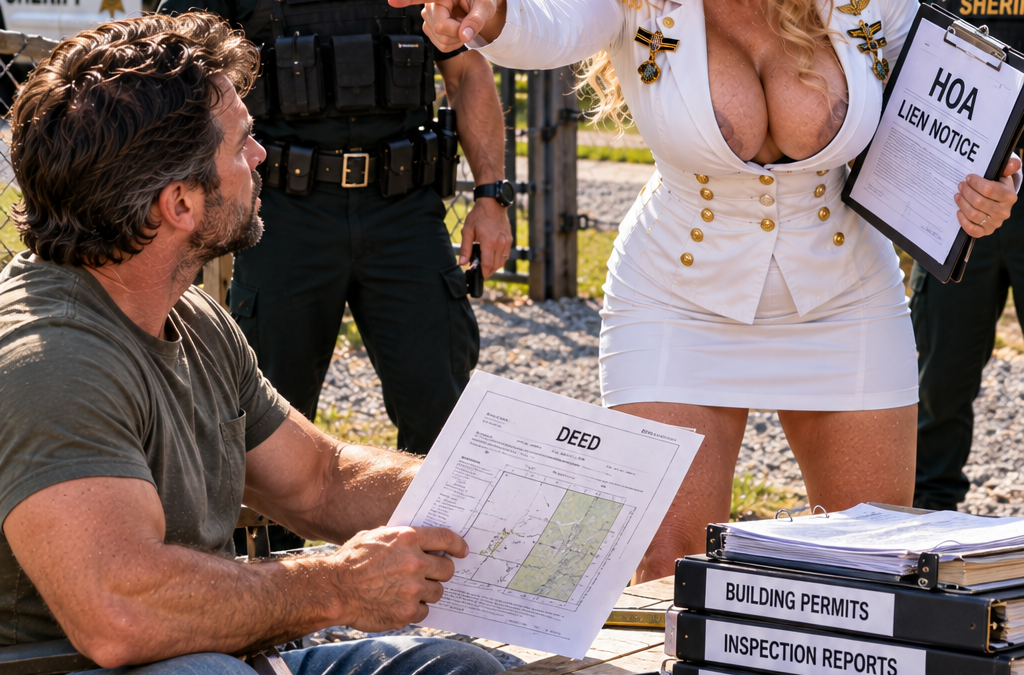
The first day she came to my property, she wore a tight white military-inspired outfit that I would eventually realize was almost a personal uniform.
The jacket had gold buttons, ornamental epaulets, and a deep plunging neckline that emphasized a very large chest. A fitted white skirt ended above the knee, and white heels made no sense whatsoever on my gravel driveway.
But Tanya walked in them like she expected the gravel to accommodate her.
She had expensive sunglasses.
Perfect makeup.
Clipboard.
And the smile of someone who believed being attractive and authoritative were the same thing.
She stopped at the end of my driveway rather than walking all the way up.
I was working near the garden.
She called out.
“Excuse me.”
I walked over.
“Can I help you?”
She smiled.
“Are you the owner?”
“Yes.”
“Tanya Whitmore.”
She offered her hand.
“President of Silver Ridge Homeowners Association.”
I shook it.
“Okay.”
She looked past me toward my home.
Her expression changed.
“I wanted to speak with you about the property.”
“What about it?”
She tilted her head.
“Your structure.”
“My house?”
“If that’s what you’re calling it.”
That should have warned me.
She continued.
“We have architectural standards in this area.”
“You do.”
She smiled.
“We do.”
“I’m not part of Silver Ridge.”
Her smile barely moved.
“Your property still affects Silver Ridge.”
“That doesn’t make it part of your association.”
She glanced toward the rainwater collection system.
“Those tanks are visible from several homes.”
“So?”
“They create a junkyard appearance.”
I stared at her.
“They’re rain barrels.”
“The distinction isn’t particularly important visually.”
“It is to me.”
She looked at the solar array.
“And the panels.”
“What about them?”
“They don’t match the neighborhood aesthetic.”
“Good thing I’m not in the neighborhood.”
That irritated her.
Only slightly.
The smile stayed.
“Property values don’t stop at subdivision lines.”
“Neither do county permits.”
She looked back at me.
“What does that mean?”
“Everything you see has been approved.”
“I’m sure you believe that.”
I laughed once.
“I don’t believe it. I have the inspections.”
Her expression cooled.
“I’m not here to argue.”
“You came onto my property to tell me my legal house is hurting a subdivision I don’t belong to.”
“I’m asking for cooperation.”
“With what?”
“Visual improvements.”
“No.”
Her eyebrows rose.
“No?”
“No.”
The word clearly surprised her.
Most people probably gave Tanya explanations.
Apologies.
Negotiations.
I didn’t need her permission.
That made the conversation very short.
She recovered.
“I think you’ll find the association has more authority here than you realize.”
“I checked before I bought.”
“We’ll see.”
She walked back toward her luxury SUV.
At the road, she turned.
“You should think about maintaining a good relationship with your neighbors.”
I called back.
“I am.”
That was visit number one.
Visit number two came about two weeks later.
No friendly introduction this time.
She drove farther up the driveway.
Stepped out.
Same white fitted outfit.
Same gold buttons.
Same deep neckline.
Different clipboard.
“The board has reviewed your parcel.”
“Congratulations.”
Her expression hardened.
“We have determined that it falls within association jurisdiction because of the zoning designation covering this area.”
I stared at her.
“That’s not how zoning works.”
“You aren’t an attorney.”
“Neither are you.”
Her mouth tightened.
“We’ve consulted our records.”
“Show me.”
“I don’t carry every document with me.”
“Then send it.”
“We will.”
“Great.”
She looked toward the house again.
“You also need to discontinue further exterior modifications.”
“No.”
“Until the architectural committee reviews them.”
“No.”
Her voice sharpened.
“You don’t get to simply refuse association enforcement.”
“I’m not in your association.”
“You keep saying that.”
“Because it’s true.”
“You may believe it’s true.”
“Deed says it’s true.”
The smile disappeared completely.
“We’ll be in touch.”
She left.
My gut told me to take her more seriously.
But I had enough documents to know she was wrong.
So I didn’t worry much.
That was a mistake.
Third visit.
Late afternoon.
She arrived carrying a thick stack of papers.
This time she didn’t stand politely at the driveway.
She walked directly to my porch.
Heels clicking against wood.
White jacket stretched tightly across her chest as she tucked the documents beneath one arm.
I opened the door before she knocked.
“Now what?”
Her eyes narrowed.
“Official notice.”
She handed me the stack.
I looked at the first page.
Silver Ridge Homeowners Association.
Demand for Payment and Compliance.
Amount due:
$14,386.
I stared.
“What is this?”
“Back assessments.”
“I’m not a member.”
“Late fees.”
“I’m not a member.”
“Compliance penalties.”
“I’m not—”
“You are.”
I looked at her.
“No.”
“You’ve been under the association for years.”
“I bought this land directly from the previous owner.”
“Association obligations run with the property.”
“Not this property.”
She tapped the papers.
“The board has records showing annexation.”
My stomach tightened slightly.
“What annexation?”
“You should read before arguing.”
That condescending tone almost worked.
I looked at the number again.
Fourteen thousand dollars.
“I don’t owe you anything.”
She leaned closer.
Perfume.
White jacket.
Gold details.
All designed to project control.
“You can either resolve this voluntarily or the association will pursue enforcement.”
“What kind?”
“Collections.”
“Try.”
“Property lien.”
My expression changed.
She noticed.
“And if necessary, legal action relating to unauthorized occupancy and noncompliant structures.”
I laughed in disbelief.
“Unauthorized occupancy?”
“Your building doesn’t meet our standards.”
“It meets county code.”
“Association standards supersede minimum county requirements for covered parcels.”
“Covered parcels.”
“Yes.”
“Which mine isn’t.”
She smiled.
“We disagree.”
I handed the stack back.
She didn’t take it.
“Keep it.”
“I don’t want it.”
“You’ll need it.”
“Have an attorney contact me.”
Her eyes flashed.
“You’ll regret being difficult.”
I looked directly at her.
“Get off my property.”
She turned slowly.
Walked down the porch steps.
Then stopped.
“Fourteen thousand becomes more every day you refuse.”
“Goodbye, Tanya.”
That night I read everything.
Page after page.
Assessments.
Fines.
Architectural violations.
Accusations that my rainwater system was an exterior nuisance.
Solar placement violation.
Home-size requirement violation.
Landscaping violation.
Improper accessory structures.
Then I reached the document that made my stomach drop.
ANNEXATION AMENDMENT.
According to the page, my parcel had been formally added to the Silver Ridge HOA years earlier.
There were signatures.
Multiple board members.
A date.
Language claiming the property was voluntarily annexed under association procedures.
The problem was obvious.
I had never heard of it.
No document like that appeared in my title work.
Nobody had disclosed membership when I bought the land.
I had never signed anything.
The previous owner had never mentioned anything.
No dues notices had ever arrived before Tanya decided she hated my house.
I stared at the page for a long time.
Part of me wanted to call a lawyer immediately.
Another part thought the whole thing had to be bluff.
A fake internal HOA paper designed to scare me.
Surely nobody would actually try using it legally.
That assumption nearly cost me.
About a week later, I received formal notice from the county recorder.
A lien had been recorded against my property.
An actual lien.
Silver Ridge Homeowners Association claimed I owed money.
The same land I’d bought with cash.
The land I’d specifically chosen because no landlord or bank could threaten the roof over my head.
Now the public record showed another private organization claiming a debt secured against it.
I sat at my kitchen table holding the notice.
My hands shook.
Not anger at first.
Fear.
That surprised me.
I had always imagined that owning property outright meant safety.
Then one fraudulent page entered a government record and suddenly my title was clouded.
If I wanted to sell?
Problem.
Borrow against the property?
Problem.
Transfer ownership?
Problem.
And until I removed it, Tanya could point at that lien and say:
See?
He owes us.
That wasn’t the worst part.
Three days later, a sheriff’s cruiser came up my driveway.
I saw it from the kitchen.
My stomach dropped.
A deputy stepped out.
I walked onto the porch.
“Morning.”
“Morning.”
He looked apologetic already.
“Are you the resident?”
“Owner.”
“Okay.”
He glanced at a tablet.
“We received a complaint regarding possible unlawful occupancy.”
I stared at him.
“What?”
He continued carefully.
“A report stated that someone may be living in an unpermitted structure on land they don’t legally own.”
For half a second, I couldn’t speak.
Then I understood.
“Tanya.”
He didn’t confirm.
Didn’t need to.
I said, “Give me one minute.”
I went inside.
Opened the fireproof box.
Pulled the folder.
Returned.
Deed.
Recorded survey.
Permits.
Septic approval.
Well documents.
Electrical inspection.
Framing inspection.
Certificate of occupancy.
The deputy stood against the hood of his cruiser reviewing everything.
Eventually he looked up.
“This all appears in order.”
“It is.”
“You own the land.”
“Yes.”
“House is permitted.”
“Yes.”
“Certificate of occupancy is valid.”
“Yes.”
He exhaled.
“I’m sorry we bothered you.”
“You weren’t bothering me.”
I looked toward the neighboring subdivision.
“Someone else is.”
He followed my gaze.
Then said something I remembered later.
“This isn’t the first call we’ve had from people associated with that neighborhood.”
“About me?”
“Not necessarily.”
He handed the documents back.
“Some complaints haven’t held up.”
I put everything into the folder.
“Is there anything I should do?”
“Document everything.”
That advice would become the theme of my life.
I thanked him.
He left.
The next afternoon Tanya drove past slowly.
I was outside.
She looked directly at me.
Smiled.
Kept driving.
That smile told me the sheriff visit wasn’t an accident.
She wanted me frightened.
Two weeks later, she did it again.
Another deputy.
Different complaint language.
Same accusation.
Illegal resident.
Possible unpermitted structure.
I showed the documents.
He left.
Then a third call.
By then the deputies knew the situation.
The third officer barely needed to see everything.
He said, “You’ve already been verified.”
“Twice.”
He looked annoyed.
“Keep copies of the prior contacts.”
“I am.”
Tanya escalated again.
One Saturday I saw her walking along my side property line with a man carrying a measuring wheel and camera.
She had no permission to be there.
I walked toward them.
“Tanya.”
She turned.
The white outfit looked especially absurd in tall grass.
“What are you doing?”
“Documenting.”
“On my property.”
“We are conducting an enforcement assessment.”
“No, you’re trespassing.”
The man beside her looked uncomfortable.
She introduced him as a contractor.
“What kind of contractor?”
“That’s irrelevant.”
“He should know he’s on private land.”
Tanya lifted the clipboard.
“We have legal authority to inspect association property.”
“This isn’t association property.”
“We’ve discussed this.”
“Get out.”
She smiled.
“You’re becoming hostile.”
I pointed toward the driveway.
“Leave.”
The contractor looked at her.
“I think we should go.”
She ignored him.
Then raised her phone and photographed the rainwater tanks.
I heard the camera shutter.
“One more picture and I’m calling the sheriff myself.”
That worked.
She turned.
Walked away.
My exterior camera captured all of it.
I saved the footage.
Then the rumors started.
One Silver Ridge resident slowed near my driveway.
Then another.
People stared.
A man walking a dog stopped near the county road and looked toward my house for an uncomfortable amount of time.
Finally one of the nicer subdivision residents approached me while I was checking the mailbox.
“Can I ask something?”
“Sure.”
“Are you actually allowed to live here?”
I almost laughed.
“Why?”
He looked embarrassed.
“The HOA president says you’re squatting.”
There it was.
“On my own property?”
“She says the structure’s illegal.”
“It’s permitted.”
“Okay.”
“Want to see the certificate?”
He raised both hands.
“No. I’m not accusing you.”
He hesitated.
“She told people the board is working on getting the illegal structure removed.”
That made something inside me go cold.
This wasn’t an argument anymore.
Tanya was building a narrative.
Squatter.
Illegal shack.
Unpermitted structure.
Eyesore.
Threat to values.
And the fact she sold homes in Silver Ridge suddenly mattered.
She wasn’t only HOA president.
She was a real-estate agent whose listings were easier to sell when every neighboring property looked expensive and conforming.
My small debt-free house sat outside the fence reminding buyers that not everyone had to spend half a million dollars to live nearby.
My rain barrels were ugly to her.
My solar panels were ugly.
My modest square footage was ugly.
Not because they were unsafe.
Because they affected the image she sold.
That was when fear turned into anger.
I sat at my kitchen table looking at everything.
Fourteen-thousand-dollar demand.
Annexation amendment.
Recorded lien.
Three sheriff visits.
Trespassing video.
Rumors.
And finally admitted something.
I couldn’t handle this alone.
I hired a property attorney.
His name was David Rosen.
He was in his late fifties and had the calm expression of a man who had seen every possible version of neighbors behaving badly.
I laid everything across his conference table.
He began with the deed.
Then survey.
Title.
Tanya’s demand.
Annexation amendment.
Lien notice.
Police contact records.
He spent maybe ten minutes reading.
Then looked at me.
“Your property isn’t in the HOA.”
“I know.”
“No.”
He tapped the deed.
“I mean it isn’t even close.”
A little tension left my shoulders.
“Then how did she record the lien?”
“People can file things.”
“That easily?”
“Filing something and having a legitimate claim are different questions.”
He picked up the annexation amendment.
“Where did this come from?”
“Tanya gave it to me.”
“Original?”
“That’s the exact copy.”
“Keep it.”
“I was planning to.”
“Don’t write on it.”
I stared.
His tone had changed.
“Why?”
He looked at the signatures.
“Have you verified any of these?”
“No.”
“Do you know whether this annexation was ever recorded?”
“My title doesn’t show it.”
“Exactly.”
He leaned back.
“Your title is one of the cleanest I’ve seen in a while.”
“Good.”
“This isn’t.”
He lifted Tanya’s document.
“Potentially very much not.”
“What does that mean?”
“It means we’re going to stop speaking directly to Tanya.”
“Okay.”
“Everything through my office.”
“Fine.”
“And we’re going to comply with her demand.”
That surprised me.
“What?”
David smiled slightly.
“She demanded proof establishing your right to occupy the property and your association standing, correct?”
“Yes.”
“Let’s give it to her.”
I stared.
“All of it?”
“Everything relevant.”
He tapped the demand letter.
“Exactly what she asked for.”
That was when the strategy became clear.
We assembled a complete package.
Certified deed.
Title documentation.
Survey.
County permits.
Inspection approvals.
Certificate of occupancy.
Documentation showing the parcel had existed separately before Silver Ridge.
Evidence that I used my own county-road access and no HOA infrastructure.
Every page contradicted Tanya’s story.
Then David drafted the cover letter.
It was polite.
Almost painfully polite.
Per your request, enclosed please find documentation establishing our client’s ownership, lawful occupancy, permitted improvements, and property status.
Then came the important part.
Because Tanya’s demand relied on the alleged annexation amendment, we requested proof.
The association was asked to produce:
The legally recorded annexation instrument.
Board-meeting minutes showing the vote approving annexation.
Evidence that the then-owner consented if required.
Proof of proper recording.
Accounting records establishing when assessments supposedly began.
We gave them thirty days.
The exact deadline Tanya had given me.
Then David did something Tanya apparently had never expected.
He didn’t send the package only to her.
He sent certified copies separately to every identifiable HOA board member.
The management company.
Association counsel.
Anyone whose name appeared on official records.
Everyone received the same evidence.
Everyone received the same question.
Prove the annexation.
For the first time, Tanya could no longer control who knew what.
Then we waited.
It didn’t take thirty days.
The first board member called David within a week.
She sounded confused.
She had never heard of my parcel being annexed.
Another board member responded in writing.
No recollection of any vote.
A third asked for a copy of the amendment because the signature above his printed name didn’t look right.
Then everything accelerated.
The actual board searched its records.
No annexation instrument.
No recorded vote.
No minutes.
No authorization.
Nothing.
One board member compared the signature on Tanya’s amendment with her genuine signature.
Not hers.
Another looked at the date.
There hadn’t even been a board meeting during that period.
The document Tanya had handed me was not an HOA record.
She had created it.
And used board members’ names.
Then used that fabricated document to support a lien against my property and demand more than fourteen thousand dollars.
The entire board panicked.
I don’t blame them.
Imagine receiving a certified letter from an attorney telling you your association claims to have annexed property you have never heard discussed.
Then discovering an official-looking document containing a signature that is supposed to be yours.
Not approximately yours.
Purportedly yours.
Used to claim someone else’s land.
Used to demand money.
Used to record a lien.
They hired separate counsel almost immediately.
Then they turned over association records voluntarily.
Not to Tanya.
To David.
And eventually to the sheriff’s office.
Tanya called me the evening she realized what was happening.
I didn’t answer.
She left a voicemail.
Her voice was furious.
“Daniel, this has gone far enough.”
I listened once.
Saved it.
She continued.
“You had no right to contact board members individually. You are interfering with internal association governance and creating confusion about a legitimate enforcement matter.”
Then her tone softened.
The seductive version of authority.
“Call me. We can still resolve this privately.”
I almost laughed.
Weeks earlier, she had sent the sheriff to question whether I had a right to sleep in my own bed.
Now privacy was important.
I forwarded the voicemail to David.
His reply:
Do not call her.
I didn’t.
Then the sheriff’s office contacted me.
This time, they weren’t coming to investigate whether I was a squatter.
They wanted a statement.
I drove there with David.
We brought everything.
The original demand package.
Annexation amendment.
Lien filing.
Property documents.
Deputy contact records from the previous complaints.
Security video of Tanya entering my property.
Emails.
Voicemail.
Timeline.
An investigator sat across from us.
He asked me to explain from the beginning.
I did.
First visit.
Second visit.
Fourteen-thousand-dollar demand.
Fake annexation.
Lien.
Squatter reports.
Trespass.
Rumors.
When I finished, he looked at David.
Then back at me.
“Do you know of any legitimate HOA document tying your parcel to Silver Ridge?”
“No.”
“Ever paid dues?”
“No.”
“Ever attended meetings?”
“No.”
“Signed anything?”
“No.”
“Prior owner?”
“Not according to title records.”
He nodded.
“This may go beyond a neighbor dispute.”
David said, “That’s why we’re here.”
The association cooperated fully.
That mattered.
Once real board records sat beside Tanya’s amendment, the discrepancy was obvious.
No vote.
No authorization.
False signatures.
Then investigators looked at the lien.
A public filing.
Based on a debt that depended on the nonexistent annexation.
Then the money demand.
Then repeated law-enforcement complaints made after deputies had already verified I lawfully owned and occupied the property.
The story Tanya had built began collapsing because each piece depended on the previous lie.
My illegal membership justified dues.
The dues justified the lien.
The lien made her claim of authority look stronger.
The fake authority supported enforcement threats.
The enforcement threats justified sheriff calls.
Once the annexation disappeared, everything above it lost its foundation.
I thought that would be the entire case.
It wasn’t.
Because when investigators started looking into Silver Ridge records, they found something nobody expected.
Tanya had controlled a great deal of the HOA’s administrative work.
She had been president for years.
She was involved with dues.
Payments.
Vendor decisions.
Collections.
She knew where records lived.
She knew how much attention other board members paid.
Apparently, not enough.
Investigators began comparing payments from actual homeowners with the association’s bank records.
Things didn’t match.
Some dues were recorded one way internally and appeared differently in the bank.
Money moved without clear authorization.
Certain payments lacked corresponding board approval.
Transactions led to questions.
Questions led to more records.
More records led to more questions.
The forged annexation involving my land suddenly stopped looking like one bizarre act of spite.
It looked like part of a pattern.
Tanya had grown accustomed to treating the HOA’s authority as personal authority.
Its money as something she could manipulate.
Its name as something she could put on documents and expect people to obey.
My parcel had simply become her most reckless move.
David asked me once, “Why do you think she picked you?”
I looked toward the subdivision from my porch.
“Real estate.”
“Explain.”
“She sells houses there.”
“Yes.”
“My place is visible from some lots.”
“Okay.”
“She told me on day one that it hurt values.”
David nodded.
“And?”
“I think she wanted me to conform, pay, or leave.”
“Which helps listings.”
“Exactly.”
He leaned back.
“Possible motive.”
I thought about Tanya standing at my driveway.
White fitted uniform.
Gold buttons.
Deep neckline.
Perfect smile.
Rain barrels are ugly.
House too small.
Your property affects us.
At the time it had sounded like ordinary HOA arrogance.
Now it looked different.
If she could force my parcel into the HOA, she gained multiple advantages.
Money.
Control.
Architectural authority.
Perhaps enough pressure to make me sell.
Maybe then somebody could buy the land and replace my small house with something that matched Silver Ridge.
I can’t prove every thought in her head.
But investigators clearly believed financial motive mattered.
Then the charges came.
They were serious.
Not neighborhood-dispute serious.
Criminal serious.
A fraudulent lien or false instrument involving real property.
Forgery connected to the annexation document.
Theft or extortion-related charges tied to the fourteen-thousand-dollar demand.
False reports connected to repeated sheriff complaints.
And then additional financial offenses involving the association itself.
When I heard the list, I sat quietly.
I expected to feel triumphant.
Mostly I felt sick.
This woman had created months of fear because she didn’t like looking at my tiny home.
And apparently she’d harmed her own neighbors too.
Tanya fought at first.
Of course she did.
Her first defense was that everything had been a misunderstanding.
She claimed she believed my parcel had been annexed.
Then prosecutors produced the document.
She said she had relied on association records.
There was no association record.
She said signatures might have been collected informally.
Board members denied signing.
The date didn’t correspond to a meeting.
She said the lien was standard enforcement.
There was no valid debt.
She said sheriff reports were legitimate safety concerns.
Deputies had repeatedly verified my ownership and occupancy.
She said entering my property with the contractor was part of HOA enforcement.
My property had never belonged to the HOA.
Every answer created another question.
The white uniform disappeared during court appearances.
The first time I saw her at a hearing, she wore a conservative dark suit.
Hair pulled back.
Minimal jewelry.
She looked smaller somehow.
Not physically.
The performance had changed.
No clipboard.
No gold buttons.
No exaggerated authority.
Just a defendant sitting beside an attorney.
We didn’t speak.
Then one day, outside a courtroom hallway, she approached before her lawyer could stop her.
“Daniel.”
I turned.
She looked exhausted.
“You destroyed my life.”
That sentence surprised me.
I didn’t answer immediately.
She continued.
“You could have talked to me.”
I almost laughed.
“We talked.”
“You know what I mean.”
“You put a lien on my home.”
“I was acting for the association.”
“No.”
Her face hardened.
“You sent documents to people who didn’t understand what was happening.”
“I sent your documents to the board members whose signatures were on them.”
She looked away.
“You wanted to humiliate me.”
“I wanted the lien off my property.”
“You got that.”
“After lawyers.”
“You could have come to me privately.”
I stared.
“Tanya, you called the sheriff and told them I was a squatter.”
Her eyes flashed.
“Your home didn’t comply.”
“With rules that didn’t apply.”
“It affected values.”
“There’s the truth.”
She stopped.
I continued.
“This was never about me being a member.”
Nothing.
“You wanted control over the property because you didn’t like what I built.”
Her mouth tightened.
“You think you’re better than everyone because you live in some shack with solar panels.”
I almost smiled.
There she was.
“You forged an annexation document.”
“Watch what you accuse me of.”
“It’s evidence now.”
That silenced her.
Her attorney appeared.
“Tanya.”
She ignored him.
“You’ll regret pushing this.”
I looked at her.
“That’s how this started.”
She stared.
“What?”
“You told me I’d regret being difficult.”
Her attorney touched her elbow.
“Come on.”
She pulled away.
Then followed him.
That was the last private conversation I had with her.
The evidence eventually became too heavy.
Forged document.
Recorded lien.
Money demand.
False reports.
HOA records.
Financial discrepancies.
Board-member testimony.
She stopped fighting everything.
The final criminal resolution included convictions tied to the property scheme and the association’s finances.
Tanya went to prison.
Not for being annoying.
Not for being an aggressive HOA president.
For crimes.
Real ones.
The forged paperwork.
The fraudulent claim against my land.
The money scheme.
The financial misconduct that had been uncovered after investigators opened the association’s books.
She was also ordered to pay restitution.
Some to me.
Some to the HOA.
Then came one consequence I found especially appropriate.
She lost her real-estate license.
The career she’d apparently been trying to protect by controlling neighborhood appearances disappeared because she had abused property records.
There was something painfully symmetrical about it.
The woman who repeatedly called law enforcement claiming I was living illegally on my own land eventually lost her own freedom because of what she had done trying to remove me.
The lien was formally cleared from my title.
That moment mattered almost as much as the day I received the deed.
David called me.
“It’s clean.”
I was standing in my garden.
“What?”
“Title.”
I stopped moving.
“The lien release and corrective documents are complete.”
I didn’t answer.
“Daniel?”
“I’m here.”
“You’re good.”
I sat down on the porch step.
For months, there had been this invisible stain attached to my property.
Nobody driving past could see it.
But I knew it was there.
Now it wasn’t.
Clean deed.
Again.
The association’s insurer became involved.
There was a civil settlement.
My legal fees were covered.
All of them.
That alone felt enormous.
There were additional damages tied to what had happened.
I won’t pretend the money erased the stress.
It didn’t.
But it prevented Tanya’s actions from costing me years of savings just to prove I already owned what I owned.
Silver Ridge’s board changed drastically afterward.
Several members resigned.
Not because they’d participated in Tanya’s crimes.
Because they felt humiliated that they had allowed one person so much unchecked control.
The association hired professional management.
Financial procedures changed.
Two signatures were required for certain transactions.
Board records became easier for members to inspect.
Lien filings required attorney review.
Complaints involving neighboring nonmembers had to be verified before anyone contacted law enforcement.
The new president eventually came to my house.
He stood at the end of the driveway.
Didn’t step onto the property.
That detail mattered.
I walked down.
“I’m Robert Hayes.”
“I know.”
“New board president.”
“I heard.”
He looked toward my home.
“I wanted to apologize.”
“You didn’t do it.”
“No.”
He paused.
“But the association’s name was used.”
I appreciated that.
“We should have had controls in place.”
“Yes.”
He nodded.
“Several residents also want you to know they’re sorry about the rumors.”
“I don’t need apologies from people who believed their president.”
“Some of them repeated them.”
“That’s their issue.”
He looked toward the rainwater tanks.
“They don’t look like a junkyard.”
I laughed.
“No.”
“Actually considering something similar.”
“Rainwater?”
“Garden.”
“Works well.”
For several minutes, we talked like normal neighbors.
That was all I’d ever wanted.
Before leaving, Robert said, “For the record, the association acknowledges your parcel is completely outside Silver Ridge.”
“I’d like that in writing.”
He laughed.
“Already drafted.”
He handed me an envelope.
I liked him immediately.
Months passed.
My life got quiet again.
That was stranger than I expected.
For so long, every unfamiliar car slowing near my driveway had triggered anxiety.
Every knock made me wonder whether it was another deputy.
Every piece of certified mail tightened my chest.
Then suddenly there were no threats.
No white SUV.
No Tanya in that fitted white pseudo-military outfit.
No clipboard.
No demand letters.
I could walk into my garden and hear birds instead of wondering whether someone was photographing my septic field.
It took time before the property felt entirely mine again.
One evening I sat on the porch while the sun went down behind the trees.
Solar system humming quietly.
Garden wet from rainwater irrigation.
Lights on inside the tiny house I’d built.
I thought about the first apartment.
The rent.
That feeling of working only to keep permission to sleep under somebody else’s roof.
Then about Tanya.
She had attacked exactly the thing I’d built to escape that feeling.
Debt-free land.
No landlord.
No HOA.
No bank.
Mine.
She tried to recreate the same vulnerability.
Pay us.
Obey us.
Conform.
Or risk losing the property.
That was why it had frightened me so much.
It wasn’t only fourteen thousand dollars.
It was the possibility that freedom had been an illusion.
That no matter how carefully I planned, some powerful group could simply print paperwork and force its way into my life.
What saved me wasn’t bravado.
It wasn’t confronting Tanya at the fence.
It wasn’t yelling louder.
It was documentation.
The deed.
Survey.
Permits.
Certificate of occupancy.
Recorded history.
Board minutes.
Bank records.
Sheriff reports.
Camera footage.
Certified letters.
Every time Tanya relied on confidence, the documents answered.
And documents don’t care how confident you sound.
That lesson stayed with me.
So did another.
I should have hired David earlier.
The moment Tanya handed me that annexation amendment, I should have treated it like the danger it was.
Instead, I thought:
This is ridiculous.
I know I’m right.
I’ll ignore it.
Being right doesn’t automatically protect you.
That is one of the most expensive adult lessons there is.
A false claim can still hurt you.
A fraudulent filing can still cloud title.
A bogus accusation can still bring law enforcement to your door.
A forged document can still create problems until somebody formally proves it’s forged.
If I had hired counsel the day Tanya handed me those papers, maybe the lien would never have been recorded.
Maybe the sheriff visits never would have happened.
Maybe the rumors wouldn’t have spread.
I know that now.
After the criminal case ended, I reorganized my fireproof box.
The folder got thicker.
Original deed.
Construction permits.
Certificate of occupancy.
Lien release.
Civil settlement documents.
Letter from Silver Ridge acknowledging no jurisdiction.
I added digital backups too.
Cloud storage.
External drive.
Overkill?
Maybe.
But I sleep well.
The neighborhood itself changed.
Not mine.
I still don’t consider Silver Ridge my neighborhood.
But the people there became actual neighbors instead of distant strangers.
A few waved when driving by.
One family bought eggs from me occasionally after I added chickens.
Robert asked questions about solar.
Another man hired me to help him build a garden shed outside HOA common areas.
Ironically, some Silver Ridge residents began envying the freedom they’d once been told was hurting their values.
One man looked at my rainwater system and said, “Our board would never approve that.”
I laughed.
“Exactly.”
He laughed too.
“Rub it in.”
I didn’t.
Not much.
Property values didn’t collapse.
The subdivision remained expensive.
Homes still sold.
Maybe a buyer occasionally looked at my smaller house and wondered why it didn’t match.
Then Tanya’s predicted catastrophe failed to happen.
Turns out one modest legal home sitting on its own two acres did not destroy civilization.
I learned later that Tanya’s real-estate business had been more entangled with the HOA than many residents realized.
She used board connections to position herself as the person who knew everything happening inside Silver Ridge.
Upcoming listings.
Disputes.
Potential sellers.
Compliance issues.
She presented herself to clients as someone who could protect the character and value of the development.
That reputation fed the arrogance.
If she could point to my home and say she’d forced it into compliance—or forced me out—she reinforced that image.
Instead, she attacked the one parcel where her authority did not exist.
Then manufactured authority.
That was her fatal mistake.
Not disliking my house.
People can dislike anything.
Not asking questions.
She could have approached.
Not even complaining.
Complaints are normal.
The fatal step was deciding that because she wanted jurisdiction, she could create it on paper.
People asked me later whether I felt sorry for her.
That’s a difficult question.
Prison is serious.
Losing a career is serious.
Restitution.
Public humiliation.
None of that is light.
But Tanya had exits.
Many.
First visit.
She could have accepted my answer.
Second visit.
She could have checked the deed.
Before the fourteen-thousand-dollar demand.
Check records.
Before making the amendment.
Stop.
Before filing the lien.
Stop.
Before calling the sheriff.
Stop.
After the first deputy confirmed my ownership.
Stop.
After the second.
Stop.
At every stage, she made another deliberate choice.
Then investigators discovered she’d been making similar choices with other people’s money.
Eventually consequences stopped being something another person was doing to her.
They were simply the accumulated weight of her own decisions.
The last time I saw Tanya was years later.
Not in person.
A former Silver Ridge resident sent me a link to an article about her release and restitution status.
I opened it.
There was an older photograph from when she was still an agent.
Blonde hair.
Professional smile.
White jacket.
Not the deepest-necked version she liked wearing around the neighborhood, but recognizable.
For a moment, anger returned.
Then disappeared.
I closed the article.
Went outside.
My house was still there.
That was enough.
The roof I’d framed.
The porch I’d built.
The well I’d paid for.
Solar panels.
Garden.
Rain barrels.
A house small enough that Tanya considered it embarrassing and strong enough to outlast everything she threw at it.
Sometimes I stand at the end of my driveway and look toward Silver Ridge.
Perfect lawns.
Large homes.
Identical mailboxes.
Stone entrance.
It isn’t ugly.
I understand why people like it.
Some people want uniformity.
Shared amenities.
Rules protecting certain expectations.
Nothing inherently wrong with that.
They voluntarily bought into it.
I didn’t.
That distinction is everything.
Freedom isn’t pretending rules don’t exist.
I followed more rules building my house than Tanya probably imagined.
Permits.
Inspections.
Setbacks.
Septic requirements.
Electrical code.
Well requirements.
Occupancy approval.
I followed all of them.
What I refused was a private organization inventing power over me after the fact.
There is a difference between law and control.
Tanya blurred them because control benefited her.
When the real law finally became involved, she learned the distinction in the hardest possible way.
Years after the case, Robert stopped by again.
He had retired from the board by then.
We sat on my porch drinking coffee.
He looked across the garden.
“You know what still bothers me?”
“What?”
“We trusted her.”
“You had reasons.”
“Not enough.”
He shook his head.
“People assume fraud looks suspicious.”
I waited.
“It doesn’t.”
He continued.
“Sometimes it looks organized.”
That was one of the smartest things anyone said about the whole affair.
Tanya had not looked like a criminal when she walked onto my land.
She looked official.
Clipboard.
Documents.
Title.
Confidence.
Beautiful clothes.
Expensive vehicle.
Association letterhead.
She didn’t whisper shady proposals in dark parking lots.
She mailed notices.
Filed forms.
Called law enforcement.
Used procedures.
That’s why it worked for as long as it did.
People trust things that look administrative.
A signature.
A seal.
A recorded filing.
A woman saying, “The board has reviewed this.”
That language creates weight.
Even when the foundation underneath it is empty.
I looked at Robert.
“Maybe that’s why paperwork saved me too.”
He nodded.
“Real paperwork beat fake paperwork.”
Basically.
After he left, I went back inside and opened the fireproof box.
Not because I was worried.
Just curious.
There was Tanya’s original demand.
Fourteen thousand dollars.
I hadn’t looked at it in years.
The language was still aggressive.
PAYMENT REQUIRED.
COMPLIANCE DEADLINE.
ENFORCEMENT.
REMOVAL.
Thirty days.
That piece of paper had once made me feel physically sick.
Now it looked strangely small.
I set it beside my certificate of occupancy.
Then beside the lien release.
Three pieces of paper.
Threat.
Truth.
Resolution.
I put everything back.
Locked the box.
Then walked outside.
My garden needed watering.
The rain barrels were full.
The same rainwater system Tanya once called a junkyard.
I opened the valve.
Water ran through the hose.
Simple.
Free.
Exactly the kind of life I’d wanted.
Sometimes justice is dramatic.
Police.
Courtrooms.
Charges.
Prison.
The Tanya story had all of that eventually.
But the moment that mattered most to me wasn’t her conviction.
It was when David called and said:
Your title is clean.
That was the victory.
The land still belonged to me.
The house still belonged to me.
Nobody had attached a fake debt to it anymore.
Nobody could point at a fraudulent lien and pretend I owed them permission to live there.
I had stepped off the rent treadmill years earlier because I wanted one thing.
Security.
Not wealth.
Not status.
Security.
A roof no landlord could price away from me.
A home no bank could foreclose because I lost a job.
Land I could understand.
Own.
Maintain.
Tanya almost convinced me that none of that mattered if somebody powerful enough simply decided otherwise.
She was wrong.
Not because I was stronger than her.
Not because I was smarter.
Because ownership has records.
Authority has limits.
And eventually, lies have to survive contact with documents that were created before anyone needed to lie.
Mine did.
Hers didn’t.
Tanya came to my property believing she could force a tiny independent parcel into her association because she didn’t like what she saw from the houses she was trying to sell.
She demanded dues I never owed.
Created an annexation that never happened.
Placed a lien on land she had no claim to.
Called deputies and told them I was trespassing on property with my own name on the deed.
Then walked across that property photographing the home I had built legally with my own hands.
She wanted me scared enough to pay.
Or conform.
Or leave.
For a while, she succeeded at the first part.
I was scared.
I won’t pretend otherwise.
But fear eventually made me open the fireproof box.
Then hire a lawyer.
Then answer every demand with evidence.
That was when everything changed.
Because Tanya had built her entire attack on one assumption:
Nobody would make her prove it.
Once the real board did, there was nothing there.
No annexation.
No vote.
No valid signatures.
No dues obligation.
No HOA membership.
No authority.
Just one woman using an organization as if it belonged to her.
In the end, she lost the presidency.
Her career.
Her freedom.
And the reputation she had been trying so desperately to protect.
I kept my land.
Kept my house.
Kept my garden.
Kept my rainwater system.
Kept my solar panels.
Never paid Silver Ridge a dollar in dues.
Never joined their association.
Never changed my home to match their standards.
The subdivision still sits beside me.
My property still sits outside it.
Exactly where it always was.
Some mornings, when sunlight hits the solar panels and the garden is wet with collected rain, I stand on the porch with coffee and think about the first thing Tanya ever told me.
Your place doesn’t meet our standards.
She had been right.
It didn’t.
That was the entire point.
I hadn’t spent years escaping rent, buying land, hauling lumber, pulling permits, passing inspections, and building a home with my own hands just to let a stranger walk up my driveway and recreate the same kind of control I’d worked so hard to escape.
I built that place so I could finally say something I’d almost forgotten how to say.
Mine.
My land.
My home.
My rules, within the actual law.
And when Tanya tried to erase that with forged paperwork, the truth didn’t need to scream louder than she did.
It only needed to be recorded properly.
𝗧𝗛𝗘 𝗘𝗡𝗗
She Called the Sheriff and Claimed I Was Squatting on My Own Land—Then Her Fake HOA Paperwork Started Falling Apart
I had spent years building a debt-free home with my own hands when an HOA president showed up and told me I owed her more than fourteen thousand dollars.
A week later, she put a lien on my property and sent the sheriff to remove the “squatter” living there.
What she didn’t understand was that every permit, every inspection, every line on my deed was real—and eventually someone was going to ask whether her paperwork was.
For years, I had felt like I was running on a treadmill that someone else controlled.
Work.
Payday.
Rent.
Utilities.
Food.
Repeat.
I wasn’t poor.
That almost made it more frustrating.
I had a full-time job, worked hard, rarely missed a shift, and made enough money that people assumed I must be doing fine.
But every month, the same thing happened.
The rent left my bank account before I had time to feel like the money had ever belonged to me.
I lived in a small apartment in town.
Nothing luxurious.
Nothing special.
A bedroom.
Tiny kitchen.
Parking space.
Thin walls.
A landlord who raised the rent whenever the market gave him an excuse.
After several years, I looked at how much I’d paid and realized I had bought somebody else a considerable piece of property while owning nothing myself.
That was when I decided to get off the treadmill.
I started searching for raw land.
Not a subdivision lot.
Not a new development.
Land.
Something cheap enough that I could pay cash.
Something outside the city where regulations were manageable.
Something I could build on gradually instead of signing another thirty-year loan and spending my life working for a bank instead of a landlord.
It took months.
Then I found slightly more than two acres on the outskirts of town.
The parcel was oddly shaped.
That was probably why nobody wanted it.
Long on one side.
Narrow toward the county road.
A patch of woods near the back.
Slight slope.
No house.
No utilities.
No fancy entrance.
To me, it looked perfect.
I checked zoning before making an offer.
Then checked again.
Residential use was allowed.
A small dwelling was allowed if it met county building code.
The land had legal road access.
No private covenants appeared on the deed.
No association membership.
No subdivision restrictions.
I bought it with cash.
That moment mattered to me more than I can explain.
No mortgage.
No bank.
No landlord.
The deed had my name on it.
Mine.
Then I started building.
Calling what I built a tiny home sometimes makes people imagine one of those little houses sitting on a trailer.
Mine wasn’t that.
It was small, but permanent.
Proper foundation.
Real plumbing.
Real electrical.
Real septic.
Real permits.
I did most of the framing myself.
I watched more instructional videos than I’d like to admit.
A friend who had built his own place years earlier helped me avoid several expensive mistakes.
I learned how exhausting construction becomes when the person paying for the materials is also the one lifting them.
Weeknights.
Weekends.
Vacation days.
Heat.
Cold.
Mud.
Sometimes I would arrive after work, turn on temporary lights, and keep going until ten at night.
Then I’d sit inside the unfinished structure eating a sandwich while staring through window openings that didn’t have windows yet.
It took forever.
But every board meant something.
Every screw meant something.
Every dollar I spent stayed in something I owned.
I had a well drilled.
That bill hurt.
I installed a rainwater collection system from the roof for irrigation.
The county didn’t require it.
I wanted it.
I built garden beds because I liked the idea of producing at least some of my own food.
I installed solar panels, but I also connected to the grid for backup.
I hired licensed people where required.
Septic was installed and inspected.
Electrical was inspected.
Framing inspected.
Final inspection.
Every step went through the county.
I kept everything.
Permits.
Receipts.
Inspection reports.
Survey.
Septic documents.
Well paperwork.
Utility approvals.
Eventually, the county issued my certificate of occupancy.
I remember holding it in my hand and laughing.
Not because it was funny.
Because it meant I had finished.
I put every important document into a folder.
Then I put that folder into a fireproof box.
I had learned one lesson during construction that became more important than I ever expected.
Paperwork is protection.
Once I moved in, my monthly expenses collapsed.
No rent.
No mortgage.
Solar kept electricity cheap.
My garden used collected rainwater.
When something broke, I fixed it because I’d built most of it.
For the first time in my adult life, I didn’t feel like somebody else could increase the cost of simply existing whenever they wanted.
That freedom mattered to me.
My house wasn’t impressive compared to the giant homes nearby.
It was maybe a fraction of their size.
Simple exterior.
Metal roof.
Solar panels.
Rainwater barrels and storage tanks tucked beside the garden.
A porch I’d built myself.
Inside, everything was efficient.
Warm.
Quiet.
Mine.
That should have been the end of the story.
Unfortunately, one property line connected me to people who believed my freedom was lowering their property values.
Next to my parcel sat a subdivision called Silver Ridge Estates.
Silver Ridge was the kind of development where every lawn looked professionally groomed and every house seemed like a slightly altered version of the same architectural drawing.
Big garages.
Stone facades.
Decorative entrance gates.
Perfect sidewalks.
Expensive landscaping.
And, naturally, an HOA.
My parcel wasn’t part of it.
It had existed before the subdivision.
When developers assembled the land for Silver Ridge, my odd little two-acre parcel had simply remained separate.
Different plat.
Different deed.
My driveway went directly to a county road.
I didn’t use Silver Ridge roads.
Didn’t use their entrance.
Didn’t use their clubhouse.
Didn’t use their drainage ponds.
Didn’t use anything.
My deed didn’t reference their covenants.
My title contained nothing connecting me to them.
We were neighbors.
That was all.
For several months, nobody bothered me.
Then Tanya appeared.
Tanya was the Silver Ridge HOA president.
I later learned she was also a real-estate agent who handled a lot of listings inside the subdivision.
That second job turned out to matter.
She was around forty, blonde, beautiful, and so carefully put together that she looked more like someone arriving for a television interview than someone inspecting drainage complaints.
The first day she came to my property, she wore a tight white military-inspired outfit that I would eventually realize was almost a personal uniform.
The jacket had gold buttons, ornamental epaulets, and a deep plunging neckline that emphasized a very large chest. A fitted white skirt ended above the knee, and white heels made no sense whatsoever on my gravel driveway.
But Tanya walked in them like she expected the gravel to accommodate her.
She had expensive sunglasses.
Perfect makeup.
Clipboard.
And the smile of someone who believed being attractive and authoritative were the same thing.
She stopped at the end of my driveway rather than walking all the way up.
I was working near the garden.
She called out.
“Excuse me.”
I walked over.
“Can I help you?”
She smiled.
“Are you the owner?”
“Yes.”
“Tanya Whitmore.”
She offered her hand.
“President of Silver Ridge Homeowners Association.”
I shook it.
“Okay.”
She looked past me toward my home.
Her expression changed.
“I wanted to speak with you about the property.”
“What about it?”
She tilted her head.
“Your structure.”
“My house?”
“If that’s what you’re calling it.”
That should have warned me.
She continued.
“We have architectural standards in this area.”
“You do.”
She smiled.
“We do.”
“I’m not part of Silver Ridge.”
Her smile barely moved.
“Your property still affects Silver Ridge.”
“That doesn’t make it part of your association.”
She glanced toward the rainwater collection system.
“Those tanks are visible from several homes.”
“So?”
“They create a junkyard appearance.”
I stared at her.
“They’re rain barrels.”
“The distinction isn’t particularly important visually.”
“It is to me.”
She looked at the solar array.
“And the panels.”
“What about them?”
“They don’t match the neighborhood aesthetic.”
“Good thing I’m not in the neighborhood.”
That irritated her.
Only slightly.
The smile stayed.
“Property values don’t stop at subdivision lines.”
“Neither do county permits.”
She looked back at me.
“What does that mean?”
“Everything you see has been approved.”
“I’m sure you believe that.”
I laughed once.
“I don’t believe it. I have the inspections.”
Her expression cooled.
“I’m not here to argue.”
“You came onto my property to tell me my legal house is hurting a subdivision I don’t belong to.”
“I’m asking for cooperation.”
“With what?”
“Visual improvements.”
“No.”
Her eyebrows rose.
“No?”
“No.”
The word clearly surprised her.
Most people probably gave Tanya explanations.
Apologies.
Negotiations.
I didn’t need her permission.
That made the conversation very short.
She recovered.
“I think you’ll find the association has more authority here than you realize.”
“I checked before I bought.”
“We’ll see.”
She walked back toward her luxury SUV.
At the road, she turned.
“You should think about maintaining a good relationship with your neighbors.”
I called back.
“I am.”
That was visit number one.
Visit number two came about two weeks later.
No friendly introduction this time.
She drove farther up the driveway.
Stepped out.
Same white fitted outfit.
Same gold buttons.
Same deep neckline.
Different clipboard.
“The board has reviewed your parcel.”
“Congratulations.”
Her expression hardened.
“We have determined that it falls within association jurisdiction because of the zoning designation covering this area.”
I stared at her.
“That’s not how zoning works.”
“You aren’t an attorney.”
“Neither are you.”
Her mouth tightened.
“We’ve consulted our records.”
“Show me.”
“I don’t carry every document with me.”
“Then send it.”
“We will.”
“Great.”
She looked toward the house again.
“You also need to discontinue further exterior modifications.”
“No.”
“Until the architectural committee reviews them.”
“No.”
Her voice sharpened.
“You don’t get to simply refuse association enforcement.”
“I’m not in your association.”
“You keep saying that.”
“Because it’s true.”
“You may believe it’s true.”
“Deed says it’s true.”
The smile disappeared completely.
“We’ll be in touch.”
She left.
My gut told me to take her more seriously.
But I had enough documents to know she was wrong.
So I didn’t worry much.
That was a mistake.
Third visit.
Late afternoon.
She arrived carrying a thick stack of papers.
This time she didn’t stand politely at the driveway.
She walked directly to my porch.
Heels clicking against wood.
White jacket stretched tightly across her chest as she tucked the documents beneath one arm.
I opened the door before she knocked.
“Now what?”
Her eyes narrowed.
“Official notice.”
She handed me the stack.
I looked at the first page.
Silver Ridge Homeowners Association.
Demand for Payment and Compliance.
Amount due:
$14,386.
I stared.
“What is this?”
“Back assessments.”
“I’m not a member.”
“Late fees.”
“I’m not a member.”
“Compliance penalties.”
“I’m not—”
“You are.”
I looked at her.
“No.”
“You’ve been under the association for years.”
“I bought this land directly from the previous owner.”
“Association obligations run with the property.”
“Not this property.”
She tapped the papers.
“The board has records showing annexation.”
My stomach tightened slightly.
“What annexation?”
“You should read before arguing.”
That condescending tone almost worked.
I looked at the number again.
Fourteen thousand dollars.
“I don’t owe you anything.”
She leaned closer.
Perfume.
White jacket.
Gold details.
All designed to project control.
“You can either resolve this voluntarily or the association will pursue enforcement.”
“What kind?”
“Collections.”
“Try.”
“Property lien.”
My expression changed.
She noticed.
“And if necessary, legal action relating to unauthorized occupancy and noncompliant structures.”
I laughed in disbelief.
“Unauthorized occupancy?”
“Your building doesn’t meet our standards.”
“It meets county code.”
“Association standards supersede minimum county requirements for covered parcels.”
“Covered parcels.”
“Yes.”
“Which mine isn’t.”
She smiled.
“We disagree.”
I handed the stack back.
She didn’t take it.
“Keep it.”
“I don’t want it.”
“You’ll need it.”
“Have an attorney contact me.”
Her eyes flashed.
“You’ll regret being difficult.”
I looked directly at her.
“Get off my property.”
She turned slowly.
Walked down the porch steps.
Then stopped.
“Fourteen thousand becomes more every day you refuse.”
“Goodbye, Tanya.”
That night I read everything.
Page after page.
Assessments.
Fines.
Architectural violations.
Accusations that my rainwater system was an exterior nuisance.
Solar placement violation.
Home-size requirement violation.
Landscaping violation.
Improper accessory structures.
Then I reached the document that made my stomach drop.
ANNEXATION AMENDMENT.
According to the page, my parcel had been formally added to the Silver Ridge HOA years earlier.
There were signatures.
Multiple board members.
A date.
Language claiming the property was voluntarily annexed under association procedures.
The problem was obvious.
I had never heard of it.
No document like that appeared in my title work.
Nobody had disclosed membership when I bought the land.
I had never signed anything.
The previous owner had never mentioned anything.
No dues notices had ever arrived before Tanya decided she hated my house.
I stared at the page for a long time.
Part of me wanted to call a lawyer immediately.
Another part thought the whole thing had to be bluff.
A fake internal HOA paper designed to scare me.
Surely nobody would actually try using it legally.
That assumption nearly cost me.
About a week later, I received formal notice from the county recorder.
A lien had been recorded against my property.
An actual lien.
Silver Ridge Homeowners Association claimed I owed money.
The same land I’d bought with cash.
The land I’d specifically chosen because no landlord or bank could threaten the roof over my head.
Now the public record showed another private organization claiming a debt secured against it.
I sat at my kitchen table holding the notice.
My hands shook.
Not anger at first.
Fear.
That surprised me.
I had always imagined that owning property outright meant safety.
Then one fraudulent page entered a government record and suddenly my title was clouded.
If I wanted to sell?
Problem.
Borrow against the property?
Problem.
Transfer ownership?
Problem.
And until I removed it, Tanya could point at that lien and say:
See?
He owes us.
That wasn’t the worst part.
Three days later, a sheriff’s cruiser came up my driveway.
I saw it from the kitchen.
My stomach dropped.
A deputy stepped out.
I walked onto the porch.
“Morning.”
“Morning.”
He looked apologetic already.
“Are you the resident?”
“Owner.”
“Okay.”
He glanced at a tablet.
“We received a complaint regarding possible unlawful occupancy.”
I stared at him.
“What?”
He continued carefully.
“A report stated that someone may be living in an unpermitted structure on land they don’t legally own.”
For half a second, I couldn’t speak.
Then I understood.
“Tanya.”
He didn’t confirm.
Didn’t need to.
I said, “Give me one minute.”
I went inside.
Opened the fireproof box.
Pulled the folder.
Returned.
Deed.
Recorded survey.
Permits.
Septic approval.
Well documents.
Electrical inspection.
Framing inspection.
Certificate of occupancy.
The deputy stood against the hood of his cruiser reviewing everything.
Eventually he looked up.
“This all appears in order.”
“It is.”
“You own the land.”
“Yes.”
“House is permitted.”
“Yes.”
“Certificate of occupancy is valid.”
“Yes.”
He exhaled.
“I’m sorry we bothered you.”
“You weren’t bothering me.”
I looked toward the neighboring subdivision.
“Someone else is.”
He followed my gaze.
Then said something I remembered later.
“This isn’t the first call we’ve had from people associated with that neighborhood.”
“About me?”
“Not necessarily.”
He handed the documents back.
“Some complaints haven’t held up.”
I put everything into the folder.
“Is there anything I should do?”
“Document everything.”
That advice would become the theme of my life.
I thanked him.
He left.
The next afternoon Tanya drove past slowly.
I was outside.
She looked directly at me.
Smiled.
Kept driving.
That smile told me the sheriff visit wasn’t an accident.
She wanted me frightened.
Two weeks later, she did it again.
Another deputy.
Different complaint language.
Same accusation.
Illegal resident.
Possible unpermitted structure.
I showed the documents.
He left.
Then a third call.
By then the deputies knew the situation.
The third officer barely needed to see everything.
He said, “You’ve already been verified.”
“Twice.”
He looked annoyed.
“Keep copies of the prior contacts.”
“I am.”
Tanya escalated again.
One Saturday I saw her walking along my side property line with a man carrying a measuring wheel and camera.
She had no permission to be there.
I walked toward them.
“Tanya.”
She turned.
The white outfit looked especially absurd in tall grass.
“What are you doing?”
“Documenting.”
“On my property.”
“We are conducting an enforcement assessment.”
“No, you’re trespassing.”
The man beside her looked uncomfortable.
She introduced him as a contractor.
“What kind of contractor?”
“That’s irrelevant.”
“He should know he’s on private land.”
Tanya lifted the clipboard.
“We have legal authority to inspect association property.”
“This isn’t association property.”
“We’ve discussed this.”
“Get out.”
She smiled.
“You’re becoming hostile.”
I pointed toward the driveway.
“Leave.”
The contractor looked at her.
“I think we should go.”
She ignored him.
Then raised her phone and photographed the rainwater tanks.
I heard the camera shutter.
“One more picture and I’m calling the sheriff myself.”
That worked.
She turned.
Walked away.
My exterior camera captured all of it.
I saved the footage.
Then the rumors started.
One Silver Ridge resident slowed near my driveway.
Then another.
People stared.
A man walking a dog stopped near the county road and looked toward my house for an uncomfortable amount of time.
Finally one of the nicer subdivision residents approached me while I was checking the mailbox.
“Can I ask something?”
“Sure.”
“Are you actually allowed to live here?”
I almost laughed.
“Why?”
He looked embarrassed.
“The HOA president says you’re squatting.”
There it was.
“On my own property?”
“She says the structure’s illegal.”
“It’s permitted.”
“Okay.”
“Want to see the certificate?”
He raised both hands.
“No. I’m not accusing you.”
He hesitated.
“She told people the board is working on getting the illegal structure removed.”
That made something inside me go cold.
This wasn’t an argument anymore.
Tanya was building a narrative.
Squatter.
Illegal shack.
Unpermitted structure.
Eyesore.
Threat to values.
And the fact she sold homes in Silver Ridge suddenly mattered.
She wasn’t only HOA president.
She was a real-estate agent whose listings were easier to sell when every neighboring property looked expensive and conforming.
My small debt-free house sat outside the fence reminding buyers that not everyone had to spend half a million dollars to live nearby.
My rain barrels were ugly to her.
My solar panels were ugly.
My modest square footage was ugly.
Not because they were unsafe.
Because they affected the image she sold.
That was when fear turned into anger.
I sat at my kitchen table looking at everything.
Fourteen-thousand-dollar demand.
Annexation amendment.
Recorded lien.
Three sheriff visits.
Trespassing video.
Rumors.
And finally admitted something.
I couldn’t handle this alone.
I hired a property attorney.
His name was David Rosen.
He was in his late fifties and had the calm expression of a man who had seen every possible version of neighbors behaving badly.
I laid everything across his conference table.
He began with the deed.
Then survey.
Title.
Tanya’s demand.
Annexation amendment.
Lien notice.
Police contact records.
He spent maybe ten minutes reading.
Then looked at me.
“Your property isn’t in the HOA.”
“I know.”
“No.”
He tapped the deed.
“I mean it isn’t even close.”
A little tension left my shoulders.
“Then how did she record the lien?”
“People can file things.”
“That easily?”
“Filing something and having a legitimate claim are different questions.”
He picked up the annexation amendment.
“Where did this come from?”
“Tanya gave it to me.”
“Original?”
“That’s the exact copy.”
“Keep it.”
“I was planning to.”
“Don’t write on it.”
I stared.
His tone had changed.
“Why?”
He looked at the signatures.
“Have you verified any of these?”
“No.”
“Do you know whether this annexation was ever recorded?”
“My title doesn’t show it.”
“Exactly.”
He leaned back.
“Your title is one of the cleanest I’ve seen in a while.”
“Good.”
“This isn’t.”
He lifted Tanya’s document.
“Potentially very much not.”
“What does that mean?”
“It means we’re going to stop speaking directly to Tanya.”
“Okay.”
“Everything through my office.”
“Fine.”
“And we’re going to comply with her demand.”
That surprised me.
“What?”
David smiled slightly.
“She demanded proof establishing your right to occupy the property and your association standing, correct?”
“Yes.”
“Let’s give it to her.”
I stared.
“All of it?”
“Everything relevant.”
He tapped the demand letter.
“Exactly what she asked for.”
That was when the strategy became clear.
We assembled a complete package.
Certified deed.
Title documentation.
Survey.
County permits.
Inspection approvals.
Certificate of occupancy.
Documentation showing the parcel had existed separately before Silver Ridge.
Evidence that I used my own county-road access and no HOA infrastructure.
Every page contradicted Tanya’s story.
Then David drafted the cover letter.
It was polite.
Almost painfully polite.
Per your request, enclosed please find documentation establishing our client’s ownership, lawful occupancy, permitted improvements, and property status.
Then came the important part.
Because Tanya’s demand relied on the alleged annexation amendment, we requested proof.
The association was asked to produce:
The legally recorded annexation instrument.
Board-meeting minutes showing the vote approving annexation.
Evidence that the then-owner consented if required.
Proof of proper recording.
Accounting records establishing when assessments supposedly began.
We gave them thirty days.
The exact deadline Tanya had given me.
Then David did something Tanya apparently had never expected.
He didn’t send the package only to her.
He sent certified copies separately to every identifiable HOA board member.
The management company.
Association counsel.
Anyone whose name appeared on official records.
Everyone received the same evidence.
Everyone received the same question.
Prove the annexation.
For the first time, Tanya could no longer control who knew what.
Then we waited.
It didn’t take thirty days.
The first board member called David within a week.
She sounded confused.
She had never heard of my parcel being annexed.
Another board member responded in writing.
No recollection of any vote.
A third asked for a copy of the amendment because the signature above his printed name didn’t look right.
Then everything accelerated.
The actual board searched its records.
No annexation instrument.
No recorded vote.
No minutes.
No authorization.
Nothing.
One board member compared the signature on Tanya’s amendment with her genuine signature.
Not hers.
Another looked at the date.
There hadn’t even been a board meeting during that period.
The document Tanya had handed me was not an HOA record.
She had created it.
And used board members’ names.
Then used that fabricated document to support a lien against my property and demand more than fourteen thousand dollars.
The entire board panicked.
I don’t blame them.
Imagine receiving a certified letter from an attorney telling you your association claims to have annexed property you have never heard discussed.
Then discovering an official-looking document containing a signature that is supposed to be yours.
Not approximately yours.
Purportedly yours.
Used to claim someone else’s land.
Used to demand money.
Used to record a lien.
They hired separate counsel almost immediately.
Then they turned over association records voluntarily.
Not to Tanya.
To David.
And eventually to the sheriff’s office.
Tanya called me the evening she realized what was happening.
I didn’t answer.
She left a voicemail.
Her voice was furious.
“Daniel, this has gone far enough.”
I listened once.
Saved it.
She continued.
“You had no right to contact board members individually. You are interfering with internal association governance and creating confusion about a legitimate enforcement matter.”
Then her tone softened.
The seductive version of authority.
“Call me. We can still resolve this privately.”
I almost laughed.
Weeks earlier, she had sent the sheriff to question whether I had a right to sleep in my own bed.
Now privacy was important.
I forwarded the voicemail to David.
His reply:
Do not call her.
I didn’t.
Then the sheriff’s office contacted me.
This time, they weren’t coming to investigate whether I was a squatter.
They wanted a statement.
I drove there with David.
We brought everything.
The original demand package.
Annexation amendment.
Lien filing.
Property documents.
Deputy contact records from the previous complaints.
Security video of Tanya entering my property.
Emails.
Voicemail.
Timeline.
An investigator sat across from us.
He asked me to explain from the beginning.
I did.
First visit.
Second visit.
Fourteen-thousand-dollar demand.
Fake annexation.
Lien.
Squatter reports.
Trespass.
Rumors.
When I finished, he looked at David.
Then back at me.
“Do you know of any legitimate HOA document tying your parcel to Silver Ridge?”
“No.”
“Ever paid dues?”
“No.”
“Ever attended meetings?”
“No.”
“Signed anything?”
“No.”
“Prior owner?”
“Not according to title records.”
He nodded.
“This may go beyond a neighbor dispute.”
David said, “That’s why we’re here.”
The association cooperated fully.
That mattered.
Once real board records sat beside Tanya’s amendment, the discrepancy was obvious.
No vote.
No authorization.
False signatures.
Then investigators looked at the lien.
A public filing.
Based on a debt that depended on the nonexistent annexation.
Then the money demand.
Then repeated law-enforcement complaints made after deputies had already verified I lawfully owned and occupied the property.
The story Tanya had built began collapsing because each piece depended on the previous lie.
My illegal membership justified dues.
The dues justified the lien.
The lien made her claim of authority look stronger.
The fake authority supported enforcement threats.
The enforcement threats justified sheriff calls.
Once the annexation disappeared, everything above it lost its foundation.
I thought that would be the entire case.
It wasn’t.
Because when investigators started looking into Silver Ridge records, they found something nobody expected.
Tanya had controlled a great deal of the HOA’s administrative work.
She had been president for years.
She was involved with dues.
Payments.
Vendor decisions.
Collections.
She knew where records lived.
She knew how much attention other board members paid.
Apparently, not enough.
Investigators began comparing payments from actual homeowners with the association’s bank records.
Things didn’t match.
Some dues were recorded one way internally and appeared differently in the bank.
Money moved without clear authorization.
Certain payments lacked corresponding board approval.
Transactions led to questions.
Questions led to more records.
More records led to more questions.
The forged annexation involving my land suddenly stopped looking like one bizarre act of spite.
It looked like part of a pattern.
Tanya had grown accustomed to treating the HOA’s authority as personal authority.
Its money as something she could manipulate.
Its name as something she could put on documents and expect people to obey.
My parcel had simply become her most reckless move.
David asked me once, “Why do you think she picked you?”
I looked toward the subdivision from my porch.
“Real estate.”
“Explain.”
“She sells houses there.”
“Yes.”
“My place is visible from some lots.”
“Okay.”
“She told me on day one that it hurt values.”
David nodded.
“And?”
“I think she wanted me to conform, pay, or leave.”
“Which helps listings.”
“Exactly.”
He leaned back.
“Possible motive.”
I thought about Tanya standing at my driveway.
White fitted uniform.
Gold buttons.
Deep neckline.
Perfect smile.
Rain barrels are ugly.
House too small.
Your property affects us.
At the time it had sounded like ordinary HOA arrogance.
Now it looked different.
If she could force my parcel into the HOA, she gained multiple advantages.
Money.
Control.
Architectural authority.
Perhaps enough pressure to make me sell.
Maybe then somebody could buy the land and replace my small house with something that matched Silver Ridge.
I can’t prove every thought in her head.
But investigators clearly believed financial motive mattered.
Then the charges came.
They were serious.
Not neighborhood-dispute serious.
Criminal serious.
A fraudulent lien or false instrument involving real property.
Forgery connected to the annexation document.
Theft or extortion-related charges tied to the fourteen-thousand-dollar demand.
False reports connected to repeated sheriff complaints.
And then additional financial offenses involving the association itself.
When I heard the list, I sat quietly.
I expected to feel triumphant.
Mostly I felt sick.
This woman had created months of fear because she didn’t like looking at my tiny home.
And apparently she’d harmed her own neighbors too.
Tanya fought at first.
Of course she did.
Her first defense was that everything had been a misunderstanding.
She claimed she believed my parcel had been annexed.
Then prosecutors produced the document.
She said she had relied on association records.
There was no association record.
She said signatures might have been collected informally.
Board members denied signing.
The date didn’t correspond to a meeting.
She said the lien was standard enforcement.
There was no valid debt.
She said sheriff reports were legitimate safety concerns.
Deputies had repeatedly verified my ownership and occupancy.
She said entering my property with the contractor was part of HOA enforcement.
My property had never belonged to the HOA.
Every answer created another question.
The white uniform disappeared during court appearances.
The first time I saw her at a hearing, she wore a conservative dark suit.
Hair pulled back.
Minimal jewelry.
She looked smaller somehow.
Not physically.
The performance had changed.
No clipboard.
No gold buttons.
No exaggerated authority.
Just a defendant sitting beside an attorney.
We didn’t speak.
Then one day, outside a courtroom hallway, she approached before her lawyer could stop her.
“Daniel.”
I turned.
She looked exhausted.
“You destroyed my life.”
That sentence surprised me.
I didn’t answer immediately.
She continued.
“You could have talked to me.”
I almost laughed.
“We talked.”
“You know what I mean.”
“You put a lien on my home.”
“I was acting for the association.”
“No.”
Her face hardened.
“You sent documents to people who didn’t understand what was happening.”
“I sent your documents to the board members whose signatures were on them.”
She looked away.
“You wanted to humiliate me.”
“I wanted the lien off my property.”
“You got that.”
“After lawyers.”
“You could have come to me privately.”
I stared.
“Tanya, you called the sheriff and told them I was a squatter.”
Her eyes flashed.
“Your home didn’t comply.”
“With rules that didn’t apply.”
“It affected values.”
“There’s the truth.”
She stopped.
I continued.
“This was never about me being a member.”
Nothing.
“You wanted control over the property because you didn’t like what I built.”
Her mouth tightened.
“You think you’re better than everyone because you live in some shack with solar panels.”
I almost smiled.
There she was.
“You forged an annexation document.”
“Watch what you accuse me of.”
“It’s evidence now.”
That silenced her.
Her attorney appeared.
“Tanya.”
She ignored him.
“You’ll regret pushing this.”
I looked at her.
“That’s how this started.”
She stared.
“What?”
“You told me I’d regret being difficult.”
Her attorney touched her elbow.
“Come on.”
She pulled away.
Then followed him.
That was the last private conversation I had with her.
The evidence eventually became too heavy.
Forged document.
Recorded lien.
Money demand.
False reports.
HOA records.
Financial discrepancies.
Board-member testimony.
She stopped fighting everything.
The final criminal resolution included convictions tied to the property scheme and the association’s finances.
Tanya went to prison.
Not for being annoying.
Not for being an aggressive HOA president.
For crimes.
Real ones.
The forged paperwork.
The fraudulent claim against my land.
The money scheme.
The financial misconduct that had been uncovered after investigators opened the association’s books.
She was also ordered to pay restitution.
Some to me.
Some to the HOA.
Then came one consequence I found especially appropriate.
She lost her real-estate license.
The career she’d apparently been trying to protect by controlling neighborhood appearances disappeared because she had abused property records.
There was something painfully symmetrical about it.
The woman who repeatedly called law enforcement claiming I was living illegally on my own land eventually lost her own freedom because of what she had done trying to remove me.
The lien was formally cleared from my title.
That moment mattered almost as much as the day I received the deed.
David called me.
“It’s clean.”
I was standing in my garden.
“What?”
“Title.”
I stopped moving.
“The lien release and corrective documents are complete.”
I didn’t answer.
“Daniel?”
“I’m here.”
“You’re good.”
I sat down on the porch step.
For months, there had been this invisible stain attached to my property.
Nobody driving past could see it.
But I knew it was there.
Now it wasn’t.
Clean deed.
Again.
The association’s insurer became involved.
There was a civil settlement.
My legal fees were covered.
All of them.
That alone felt enormous.
There were additional damages tied to what had happened.
I won’t pretend the money erased the stress.
It didn’t.
But it prevented Tanya’s actions from costing me years of savings just to prove I already owned what I owned.
Silver Ridge’s board changed drastically afterward.
Several members resigned.
Not because they’d participated in Tanya’s crimes.
Because they felt humiliated that they had allowed one person so much unchecked control.
The association hired professional management.
Financial procedures changed.
Two signatures were required for certain transactions.
Board records became easier for members to inspect.
Lien filings required attorney review.
Complaints involving neighboring nonmembers had to be verified before anyone contacted law enforcement.
The new president eventually came to my house.
He stood at the end of the driveway.
Didn’t step onto the property.
That detail mattered.
I walked down.
“I’m Robert Hayes.”
“I know.”
“New board president.”
“I heard.”
He looked toward my home.
“I wanted to apologize.”
“You didn’t do it.”
“No.”
He paused.
“But the association’s name was used.”
I appreciated that.
“We should have had controls in place.”
“Yes.”
He nodded.
“Several residents also want you to know they’re sorry about the rumors.”
“I don’t need apologies from people who believed their president.”
“Some of them repeated them.”
“That’s their issue.”
He looked toward the rainwater tanks.
“They don’t look like a junkyard.”
I laughed.
“No.”
“Actually considering something similar.”
“Rainwater?”
“Garden.”
“Works well.”
For several minutes, we talked like normal neighbors.
That was all I’d ever wanted.
Before leaving, Robert said, “For the record, the association acknowledges your parcel is completely outside Silver Ridge.”
“I’d like that in writing.”
He laughed.
“Already drafted.”
He handed me an envelope.
I liked him immediately.
Months passed.
My life got quiet again.
That was stranger than I expected.
For so long, every unfamiliar car slowing near my driveway had triggered anxiety.
Every knock made me wonder whether it was another deputy.
Every piece of certified mail tightened my chest.
Then suddenly there were no threats.
No white SUV.
No Tanya in that fitted white pseudo-military outfit.
No clipboard.
No demand letters.
I could walk into my garden and hear birds instead of wondering whether someone was photographing my septic field.
It took time before the property felt entirely mine again.
One evening I sat on the porch while the sun went down behind the trees.
Solar system humming quietly.
Garden wet from rainwater irrigation.
Lights on inside the tiny house I’d built.
I thought about the first apartment.
The rent.
That feeling of working only to keep permission to sleep under somebody else’s roof.
Then about Tanya.
She had attacked exactly the thing I’d built to escape that feeling.
Debt-free land.
No landlord.
No HOA.
No bank.
Mine.
She tried to recreate the same vulnerability.
Pay us.
Obey us.
Conform.
Or risk losing the property.
That was why it had frightened me so much.
It wasn’t only fourteen thousand dollars.
It was the possibility that freedom had been an illusion.
That no matter how carefully I planned, some powerful group could simply print paperwork and force its way into my life.
What saved me wasn’t bravado.
It wasn’t confronting Tanya at the fence.
It wasn’t yelling louder.
It was documentation.
The deed.
Survey.
Permits.
Certificate of occupancy.
Recorded history.
Board minutes.
Bank records.
Sheriff reports.
Camera footage.
Certified letters.
Every time Tanya relied on confidence, the documents answered.
And documents don’t care how confident you sound.
That lesson stayed with me.
So did another.
I should have hired David earlier.
The moment Tanya handed me that annexation amendment, I should have treated it like the danger it was.
Instead, I thought:
This is ridiculous.
I know I’m right.
I’ll ignore it.
Being right doesn’t automatically protect you.
That is one of the most expensive adult lessons there is.
A false claim can still hurt you.
A fraudulent filing can still cloud title.
A bogus accusation can still bring law enforcement to your door.
A forged document can still create problems until somebody formally proves it’s forged.
If I had hired counsel the day Tanya handed me those papers, maybe the lien would never have been recorded.
Maybe the sheriff visits never would have happened.
Maybe the rumors wouldn’t have spread.
I know that now.
After the criminal case ended, I reorganized my fireproof box.
The folder got thicker.
Original deed.
Construction permits.
Certificate of occupancy.
Lien release.
Civil settlement documents.
Letter from Silver Ridge acknowledging no jurisdiction.
I added digital backups too.
Cloud storage.
External drive.
Overkill?
Maybe.
But I sleep well.
The neighborhood itself changed.
Not mine.
I still don’t consider Silver Ridge my neighborhood.
But the people there became actual neighbors instead of distant strangers.
A few waved when driving by.
One family bought eggs from me occasionally after I added chickens.
Robert asked questions about solar.
Another man hired me to help him build a garden shed outside HOA common areas.
Ironically, some Silver Ridge residents began envying the freedom they’d once been told was hurting their values.
One man looked at my rainwater system and said, “Our board would never approve that.”
I laughed.
“Exactly.”
He laughed too.
“Rub it in.”
I didn’t.
Not much.
Property values didn’t collapse.
The subdivision remained expensive.
Homes still sold.
Maybe a buyer occasionally looked at my smaller house and wondered why it didn’t match.
Then Tanya’s predicted catastrophe failed to happen.
Turns out one modest legal home sitting on its own two acres did not destroy civilization.
I learned later that Tanya’s real-estate business had been more entangled with the HOA than many residents realized.
She used board connections to position herself as the person who knew everything happening inside Silver Ridge.
Upcoming listings.
Disputes.
Potential sellers.
Compliance issues.
She presented herself to clients as someone who could protect the character and value of the development.
That reputation fed the arrogance.
If she could point to my home and say she’d forced it into compliance—or forced me out—she reinforced that image.
Instead, she attacked the one parcel where her authority did not exist.
Then manufactured authority.
That was her fatal mistake.
Not disliking my house.
People can dislike anything.
Not asking questions.
She could have approached.
Not even complaining.
Complaints are normal.
The fatal step was deciding that because she wanted jurisdiction, she could create it on paper.
People asked me later whether I felt sorry for her.
That’s a difficult question.
Prison is serious.
Losing a career is serious.
Restitution.
Public humiliation.
None of that is light.
But Tanya had exits.
Many.
First visit.
She could have accepted my answer.
Second visit.
She could have checked the deed.
Before the fourteen-thousand-dollar demand.
Check records.
Before making the amendment.
Stop.
Before filing the lien.
Stop.
Before calling the sheriff.
Stop.
After the first deputy confirmed my ownership.
Stop.
After the second.
Stop.
At every stage, she made another deliberate choice.
Then investigators discovered she’d been making similar choices with other people’s money.
Eventually consequences stopped being something another person was doing to her.
They were simply the accumulated weight of her own decisions.
The last time I saw Tanya was years later.
Not in person.
A former Silver Ridge resident sent me a link to an article about her release and restitution status.
I opened it.
There was an older photograph from when she was still an agent.
Blonde hair.
Professional smile.
White jacket.
Not the deepest-necked version she liked wearing around the neighborhood, but recognizable.
For a moment, anger returned.
Then disappeared.
I closed the article.
Went outside.
My house was still there.
That was enough.
The roof I’d framed.
The porch I’d built.
The well I’d paid for.
Solar panels.
Garden.
Rain barrels.
A house small enough that Tanya considered it embarrassing and strong enough to outlast everything she threw at it.
Sometimes I stand at the end of my driveway and look toward Silver Ridge.
Perfect lawns.
Large homes.
Identical mailboxes.
Stone entrance.
It isn’t ugly.
I understand why people like it.
Some people want uniformity.
Shared amenities.
Rules protecting certain expectations.
Nothing inherently wrong with that.
They voluntarily bought into it.
I didn’t.
That distinction is everything.
Freedom isn’t pretending rules don’t exist.
I followed more rules building my house than Tanya probably imagined.
Permits.
Inspections.
Setbacks.
Septic requirements.
Electrical code.
Well requirements.
Occupancy approval.
I followed all of them.
What I refused was a private organization inventing power over me after the fact.
There is a difference between law and control.
Tanya blurred them because control benefited her.
When the real law finally became involved, she learned the distinction in the hardest possible way.
Years after the case, Robert stopped by again.
He had retired from the board by then.
We sat on my porch drinking coffee.
He looked across the garden.
“You know what still bothers me?”
“What?”
“We trusted her.”
“You had reasons.”
“Not enough.”
He shook his head.
“People assume fraud looks suspicious.”
I waited.
“It doesn’t.”
He continued.
“Sometimes it looks organized.”
That was one of the smartest things anyone said about the whole affair.
Tanya had not looked like a criminal when she walked onto my land.
She looked official.
Clipboard.
Documents.
Title.
Confidence.
Beautiful clothes.
Expensive vehicle.
Association letterhead.
She didn’t whisper shady proposals in dark parking lots.
She mailed notices.
Filed forms.
Called law enforcement.
Used procedures.
That’s why it worked for as long as it did.
People trust things that look administrative.
A signature.
A seal.
A recorded filing.
A woman saying, “The board has reviewed this.”
That language creates weight.
Even when the foundation underneath it is empty.
I looked at Robert.
“Maybe that’s why paperwork saved me too.”
He nodded.
“Real paperwork beat fake paperwork.”
Basically.
After he left, I went back inside and opened the fireproof box.
Not because I was worried.
Just curious.
There was Tanya’s original demand.
Fourteen thousand dollars.
I hadn’t looked at it in years.
The language was still aggressive.
PAYMENT REQUIRED.
COMPLIANCE DEADLINE.
ENFORCEMENT.
REMOVAL.
Thirty days.
That piece of paper had once made me feel physically sick.
Now it looked strangely small.
I set it beside my certificate of occupancy.
Then beside the lien release.
Three pieces of paper.
Threat.
Truth.
Resolution.
I put everything back.
Locked the box.
Then walked outside.
My garden needed watering.
The rain barrels were full.
The same rainwater system Tanya once called a junkyard.
I opened the valve.
Water ran through the hose.
Simple.
Free.
Exactly the kind of life I’d wanted.
Sometimes justice is dramatic.
Police.
Courtrooms.
Charges.
Prison.
The Tanya story had all of that eventually.
But the moment that mattered most to me wasn’t her conviction.
It was when David called and said:
Your title is clean.
That was the victory.
The land still belonged to me.
The house still belonged to me.
Nobody had attached a fake debt to it anymore.
Nobody could point at a fraudulent lien and pretend I owed them permission to live there.
I had stepped off the rent treadmill years earlier because I wanted one thing.
Security.
Not wealth.
Not status.
Security.
A roof no landlord could price away from me.
A home no bank could foreclose because I lost a job.
Land I could understand.
Own.
Maintain.
Tanya almost convinced me that none of that mattered if somebody powerful enough simply decided otherwise.
She was wrong.
Not because I was stronger than her.
Not because I was smarter.
Because ownership has records.
Authority has limits.
And eventually, lies have to survive contact with documents that were created before anyone needed to lie.
Mine did.
Hers didn’t.
Tanya came to my property believing she could force a tiny independent parcel into her association because she didn’t like what she saw from the houses she was trying to sell.
She demanded dues I never owed.
Created an annexation that never happened.
Placed a lien on land she had no claim to.
Called deputies and told them I was trespassing on property with my own name on the deed.
Then walked across that property photographing the home I had built legally with my own hands.
She wanted me scared enough to pay.
Or conform.
Or leave.
For a while, she succeeded at the first part.
I was scared.
I won’t pretend otherwise.
But fear eventually made me open the fireproof box.
Then hire a lawyer.
Then answer every demand with evidence.
That was when everything changed.
Because Tanya had built her entire attack on one assumption:
Nobody would make her prove it.
Once the real board did, there was nothing there.
No annexation.
No vote.
No valid signatures.
No dues obligation.
No HOA membership.
No authority.
Just one woman using an organization as if it belonged to her.
In the end, she lost the presidency.
Her career.
Her freedom.
And the reputation she had been trying so desperately to protect.
I kept my land.
Kept my house.
Kept my garden.
Kept my rainwater system.
Kept my solar panels.
Never paid Silver Ridge a dollar in dues.
Never joined their association.
Never changed my home to match their standards.
The subdivision still sits beside me.
My property still sits outside it.
Exactly where it always was.
Some mornings, when sunlight hits the solar panels and the garden is wet with collected rain, I stand on the porch with coffee and think about the first thing Tanya ever told me.
Your place doesn’t meet our standards.
She had been right.
It didn’t.
That was the entire point.
I hadn’t spent years escaping rent, buying land, hauling lumber, pulling permits, passing inspections, and building a home with my own hands just to let a stranger walk up my driveway and recreate the same kind of control I’d worked so hard to escape.
I built that place so I could finally say something I’d almost forgotten how to say.
Mine.
My land.
My home.
My rules, within the actual law.
And when Tanya tried to erase that with forged paperwork, the truth didn’t need to scream louder than she did.
It only needed to be recorded properly.