𝗙𝗨𝗟𝗟 𝗦𝗧𝗢𝗥𝗬 She Called the Police on Me for Walking Past Her House, Then Learned I Owned the House She Was Renting
𝗙𝗨𝗟𝗟 𝗦𝗧𝗢𝗥𝗬
I looked around because surely she was not talking to me like that.
She was.
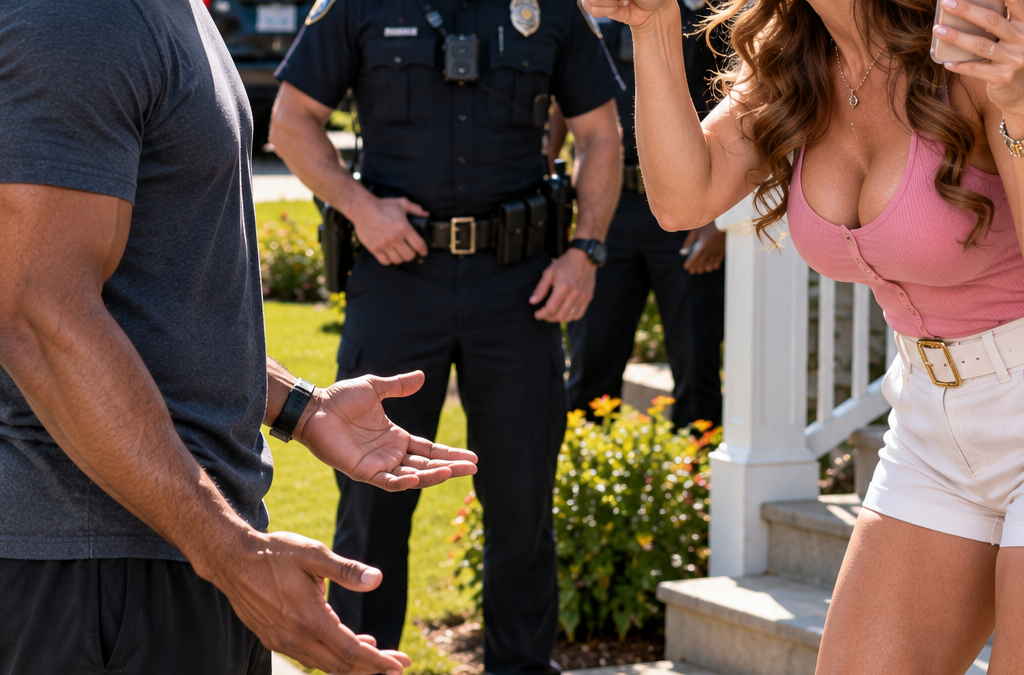
Karen stood on the porch of the house I owned, phone in one hand, the other hand planted on her hip like she had been waiting all day for a confrontation. She wore white shorts, a sleeveless pink top, oversized sunglasses pushed into her hair, and sandals that clicked against the porch boards as she came forward. Her makeup was perfect. Her expression was not.
“You stop right there,” she shouted. “I’m already recording you.”
I pulled one earbud out.
“Excuse me?”
“You heard me.”
“I’m walking.”
“No,” she said, stepping down one stair. “You’re casing my house.”
I actually glanced at the house, then back at her.
“Your house?”
Her eyes narrowed.
“My home.”
That was clever. Not legally meaningful, but clever.
“I’m just taking a walk,” I said. “I live in the neighborhood.”
She laughed.
Not a real laugh. A sharp, performative little sound meant to cut.
“You do not live here.”
I looked down at myself. Ratty gray T-shirt. Black basketball shorts. Running shoes that had seen better years. Sweat at my temples because walking for blood pressure apparently makes blood pressure worse when interrupted by racism.
“And you know that how?” I asked.
Karen lifted her phone higher.
“I know what belongs in this neighborhood.”
There it was.
The sentence behind every other sentence.
“What belongs,” I repeated.
“You’re making people uncomfortable.”
“There’s nobody else out here.”
“I’m uncomfortable.”
“I can see that.”
“I’m on the phone with the police.”
My body went still.
Not because I was guilty of anything.
Because I knew exactly how fast innocence becomes irrelevant when a Black man is reported as suspicious in a nice neighborhood.
“You called the police?”
“I certainly did.”
“For walking?”
“For suspicious behavior.”
“I walked past a house.”
“You were looking at it.”
“It’s on a public street.”
“You were looking too long.”
I took a slow breath.
There are moments when anger rises so fast it feels physical, like heat filling your arms and chest. But anger, for men who look like me, is expensive. It can cost you your safety, your freedom, your reputation, your life. So you learn to speak calmly while your stomach burns.
“Ma’am,” I said, “I’m not doing anything wrong.”
She smiled, and it was ugly despite her beauty.
“That’s what people like you always say.”
I stared at her.
“People like me.”
She tilted her head, enjoying herself now.
“You can play innocent all you want. I know exactly what you’re doing. I’m on the HOA board.”
“No, you’re not.”
Her face twitched.
That surprised her.
“I beg your pardon?”
“You’re not on the board.”
“You don’t know who I am.”
“I know more than you think.”
She stepped down onto the walkway, still keeping distance, phone angled toward me.
“You’re going to be in big trouble. We have had break-ins around here.”
“No, we haven’t.”
“You don’t live here.”
“I do.”
“You cannot afford to live in a place like this.”
There it was again, only less disguised.
She looked me up and down, from my worn shirt to my shoes, and her mouth curled.
“You look like a bum.”
I laughed once.
I did not mean to. It just escaped.
That made her furious.
“You think this is funny?”
“No,” I said. “I think it’s familiar.”
She did not understand that.
Of course she did not.
People like Karen think each moment of cruelty is original because they have never had to be on the receiving end of the pattern.
“I should have worn a three-piece suit for my walk,” I said. “My mistake.”
“You’re being smart with me?”
“I’m trying very hard not to be.”
Her lips tightened.
“I saw you looking at my windows.”
“I looked at the house.”
“Why?”
“Because I own it.”
For the first time, Karen went quiet.
Not humbled.
Not convinced.
Just momentarily interrupted.
Then she laughed.
Loudly.
“You?”
“Yes.”
“You own this house?”
“Yes.”
Her smile widened with pure contempt.
“You are insane.”
I reached for my phone slowly, making sure my hands stayed visible even though the police had not arrived yet. I knew how this worked. No sudden movements. No reaching fast. No giving the story she had invented any help.
“I can show you documentation.”
“I don’t want to see your fake documents.”
“They’re not fake.”
“You do not own this house.”
“I do.”
“You don’t own anything here.”
I looked at the porch beneath her feet, the windows my maintenance crew had replaced two years earlier, the front walk I had paid to repair, the roof I had negotiated on after inspection.
“I own several properties here,” I said.
Her face twisted.
That was the moment she stopped pretending this was about safety.
“You people always lie,” she snapped.
My jaw tightened.
“Be careful.”
“Or what? You’ll break my windows? Rob me? Is that what you were planning?”
“I would be the one paying for the windows,” I said. “So that would be a terrible investment.”
Her eyes flashed. She did not like that I was calm. She wanted fear. Or rage. Something she could feed into her phone camera and the police report.
Instead, I stood on the sidewalk with my hands visible and waited.
The police took their time.
I did not leave.
People later asked me why I stayed. Why not just walk away? Why not go home and let the situation cool down?
Because I knew better.
If I walked away after she had called in a “suspicious Black man” allegedly casing houses, that would become fleeing the scene. If officers rolled up and Karen pointed down the street saying I had run, everything would escalate. Maybe they would find me. Maybe they would not. Maybe I would be safe. Maybe I would end up face-down on pavement because I matched the description she gave.
So I stayed.
I pulled up documents on my phone while we waited: property record, lease summary, management company contact, proof of ownership. I also took out my ID before officers arrived and held it loosely in my hand.
Karen kept recording.
She paced between the porch and the walkway, performing outrage for an audience that did not exist yet.
“This neighborhood has standards,” she said.
“So I’ve heard.”
“We watch out for each other.”
“You called police on your landlord.”
“You are not my landlord.”
“My property manager is your landlord’s agent. I own the house.”
“Stop saying that.”
“It remains true.”
“You probably stole someone’s phone. Or hacked something.”
I looked at her.
“Listen to yourself.”
“You don’t get to tell me what to do.”
“No, apparently only the imaginary HOA board gets that privilege.”
Her cheeks flushed.
“I do work with the HOA.”
“You attend meetings and bother people.”
“You have no idea how much influence I have here.”
“Less than you think.”
That was when the first police cruiser turned onto the street.
Then the second.
Of course they sent two.
Karen ran toward them before the first officer was fully out of his car.
“That’s him!” she shouted. “That’s the man. He’s been watching my house.”
I stayed still.
The officers approached carefully. One was older, maybe late forties, with tired eyes and a hand resting near his belt. The other was younger, alert, scanning me like he had been trained to do.
“Sir,” the older officer said, “can you tell me what you’re doing here?”
“Yes, officer. My name is Marcus Bell. I live in this neighborhood. I was taking a walk. I also own this property.”
Karen scoffed loudly.
“He does not.”
The younger officer glanced at her, then back at me.
“Do you have ID?”
“Yes. It’s already in my hand.”
I held it out slowly.
He took it.
“I also have property documentation on my phone,” I said. “May I show you?”
The older officer nodded.
“Slowly.”
I unlocked my phone and pulled up the files. My hands were steady, but I could feel my pulse in my throat.
Karen stood behind the officers, arms crossed, looking impatient.
“He’s lying,” she said. “He told me that ridiculous story after I caught him.”
The older officer looked at the documents.
His expression changed slightly.
Not much.
Enough.
“This shows you as owner of record?”
“Yes.”
“And this is the lease?”
“Yes. Managed through Henderson Property Group. Tenant is Karen Whitmore.”
The younger officer looked toward Karen.
She went red.
“That’s not real,” she said quickly.
The older officer asked, “Ma’am, are you Karen Whitmore?”
She lifted her chin.
“Yes, but—”
“And you rent this residence?”
“I live here.”
“Do you rent it?”
Her mouth tightened.
“Yes.”
The officer looked back at my phone.
“This appears consistent.”
Karen stepped closer.
“No. No, it isn’t. He must have stolen that. People like him do not own homes like this.”
The younger officer’s face hardened.
“Ma’am.”
She ignored the warning.
“He’s probably part of some scam. Arrest him. He’s pretending to own my house. That has to be illegal.”
I kept my mouth shut.
Sometimes silence lets people reveal themselves better than any argument could.
The older officer handed my ID back.
“Mr. Bell, you’re free to continue your walk.”
Karen’s mouth dropped open.
“What?”
The officer turned to her.
“We don’t have evidence of a crime. He has ID. He has documentation. Walking on a public sidewalk is not illegal, and neither is looking at a property he owns.”
“He was casing it!”
“It’s his property.”
“I told you he stole that paperwork.”
“Do you have evidence of that?”
She stared at him like the question itself was offensive.
“He cannot afford this.”
The street went very quiet.
The younger officer said, carefully, “Ma’am, that is not evidence.”
Karen’s face twisted, and then she said a word I will not repeat.
A word people like her keep loaded behind their teeth and pretend is ancient history until anger gives it permission.
Both officers heard it.
I heard it.
The neighbor watering plants across the street heard it.
For a second, nobody moved.
Then the older officer’s expression became flat.
“Ma’am,” he said, “you need to go inside.”
“But—”
“Now.”
“This is my—”
“Now.”
Karen looked at me with hatred so pure it almost felt unreal. Then she turned, stormed back up the walkway, and slammed the door of the house I owned.
The officers apologized in that careful way police do when they know something ugly happened but also know an apology does not erase it.
I accepted it because I was tired.
The older officer gave me an incident number and said the report would be available through records.
“Make sure the report includes her language,” I said.
His eyes met mine.
“It will.”
I finished my walk because pride is a stubborn thing.
But my blood pressure did not benefit.
For the next few weeks, I tried to let the property manager handle it.
I forwarded the incident number. I sent a summary. I asked them to review the lease. The lease had clauses about harassment, unlawful conduct, creating a hostile environment, and behavior that interfered with peaceful enjoyment or exposed the property owner to legal risk. Calling the police on the owner because he was Black and walking past his own property did not fall under acceptable tenant conduct.
Still, I waited.
Partly because eviction is not something you do casually. It is serious. Housing matters. People need shelter. I knew that.
But so did my dignity.
A few weeks later, a repair request came through for that same property.
Back gate latch broken. Minor issue.
Normally, I would send my usual maintenance guy. Instead, I decided to go myself with proper notice. The property manager informed Karen that the owner or owner’s representative would inspect the gate on Friday at 10 a.m.
She agreed.
I arrived at 9:58 with copies of the lease, the repair notice, my ID, and the police report in a folder. I parked in front, walked to the side gate, and used my key to unlock it.
Karen came flying out the back door like a hornet in heels.
“What are you doing?”
“Good morning.”
“You cannot just walk onto my property.”
“It’s not your property.”
“You again?”
“Yes. Me again.”
Her eyes flicked to the key in my hand.
For the first time, real fear crossed her face.
Not fear of danger.
Fear of being wrong in a way she could not escape.
“You have a key,” she said.
“I own the lock.”
“You’re trespassing.”
“No. You received notice of owner entry for inspection and repair.”
“I thought they meant the real owner.”
I opened the folder and held out the lease.
“Here is your lease agreement. Your signature is on page seven. My name is on the ownership addendum. Henderson Property Group acts as my agent. You have been renting my house for eleven months.”
She did not take it.
So I laid it on the patio table.
Her eyes scanned the page.
Her lips parted slightly.
Watching someone’s reality collapse is not always satisfying.
This time, it was.
“You lied to the police,” I said.
She looked up sharply.
“I was scared.”
“No. You were racist.”
Her face hardened.
“I will not be spoken to that way.”
“You called police on me for walking past my own property. You said I could not afford to live here. You used a racial slur in front of officers. You accused me of stealing ownership documents because you could not accept that a Black man owned the house you rent.”
Her mouth worked silently.
Then the tears came.
Fast.
Convenient.
“Marcus,” she said, suddenly using my first name as if we had ever been friendly, “I think we got off on the wrong foot.”
“No.”
“I was frightened. You have to understand, women have to be careful.”
“Do not hide behind women’s safety to excuse racism.”
She flinched.
“I am not racist.”
“You are not my tenant anymore either.”
Her tears stopped.
“What?”
“You violated the lease. The police report is documented. The property manager is starting termination proceedings.”
“You can’t evict me.”
“I can begin the legal process to remove a tenant who harassed the property owner, made a false police report, created a hostile environment, and violated lease conduct clauses.”
Her face went pale beneath her makeup.
“This is retaliation.”
“This is consequence.”
“I will fight it.”
“That is your right.”
“I’ll go to the HOA.”
“I’m not part of the HOA.”
“I’ll tell everyone what you’re doing.”
“Please do. Start with the part where you called police on your landlord for walking.”
Her lips trembled, but the hatred was still there beneath the fear.
“You people always think you can bully—”
I held up one hand.
“Finish that sentence very carefully.”
She stopped.
For once.
I inspected the gate latch, took pictures, wrote notes, and left.
The eviction process was not instant, because nothing involving tenants ever is. Karen tried to contest everything. She claimed she felt unsafe. She claimed I had intimidated her. She claimed she had not known who I was and had only contacted police out of concern for neighborhood safety. She tried to rewrite the story with herself as the cautious woman and me as the aggressive landlord punishing her for speaking up.
Then the police report landed.
Then the body camera footage became part of the file.
Then the property manager’s attorney sent formal notice referencing the lease clauses she had violated.
Karen’s confidence began to crumble.
She tried apologizing once.
Not in person.
Through email.
Dear Mr. Bell,
I regret that our first interaction became so heated. I was under stress and misread the situation. I hope we can resolve this without further escalation. I have always taken pride in being a responsible tenant and community member.
Karen
I read it twice.
Misread the situation.
That was one way to describe calling police on a Black man, telling them he could not own property, and using a slur when documents proved otherwise.
I forwarded it to the property manager and replied with one sentence.
Please direct all future communication through Henderson Property Group.
She did not like that.
Over the next month, Karen cycled through every version of herself.
Angry Karen sent messages about suing me for discrimination.
Victim Karen told neighbors I was a cruel landlord trying to throw a single woman out for “one misunderstanding.”
Charming Karen tried to flatter the property manager and ask for a second chance.
HOA Karen reportedly complained at meetings that “outside investors” were destroying community trust, which was rich coming from a woman renting from one.
Desperate Karen finally called the property manager crying and offering to apologize to me directly.
I declined.
I did not need her apology.
I needed her out.
The day she moved, I went to the neighborhood.
Not to harass her. Not to gloat openly. But because the property manager had scheduled a move-out inspection, and after everything that happened, I wanted eyes on my investment.
Karen stood near the driveway supervising movers with the expression of a woman attending her own humiliation.
She looked different without the porch as her stage. Still beautiful, still put together, but strained. Her hair was pulled back too tightly. Her lipstick was darker than usual. She wore sunglasses even though the sky was cloudy.
When she saw me, she froze.
I parked across the street and waited with the property manager.
She did not approach.
Good.
The inspection later found minor damage, nothing catastrophic. A few wall marks. A cracked cabinet hinge. Some trash left behind. Normal enough that I could not even accuse her of revenge. Maybe by then she understood she had already lost too much.
I had the house cleaned, repainted in two rooms, and listed again.
Applications came in fast.
The neighborhood had improved, and the house was nice. Three bedrooms, good yard, updated kitchen, decent schools nearby. People wanted it.
The applicants I chose were an interracial couple named David and Alana with a little girl and a baby on the way. Their references were solid. Income stable. Credit good. They were polite, prepared, and clearly loved the house from the moment they walked in.
This time, I showed it myself.
I do not usually do that. But sometimes life gives you a scene so perfectly balanced that refusing to appear would be rude.
Karen had not fully moved her last few boxes yet. She was still next door at a neighbor’s house, talking loudly enough to be noticed, when I arrived with David and Alana.
She saw us.
She saw me unlock the front door.
She saw Alana, who was Black, smile at the kitchen window.
She saw David, who was white, measuring the nursery wall with his hands while their daughter spun in the empty living room.
She saw the future of the house she had lost.
And there was nothing she could do.
I did not look at her for long.
I did not need to.
The satisfaction was not in hurting her.
It was in replacing her with people who would live there without poisoning the air around them.
David and Alana signed the lease the next week.
They were excellent tenants.
They planted flowers in the front beds. They paid on time. They reported maintenance issues early instead of letting small problems grow teeth. Their daughter drew chalk rainbows on the driveway. They sent the property manager a photo when their baby was born, standing on the porch Karen had once used as a platform for hate.
That picture stayed with me.
Months later, Karen sent one final email.
I do not know why. Maybe she was angry. Maybe embarrassed. Maybe she had convinced herself she deserved the last word.
You are the worst person I have ever dealt with in real estate, she wrote. You abuse power and treat good tenants like trash. You will never succeed treating people the way you treated me.
I almost deleted it.
Then I decided she deserved a response.
Karen,
You are right about one thing. I leased to the wrong kind of person.
That person was you.
Marcus Bell
I never heard from her again.
People sometimes ask if I enjoyed evicting her.
The answer is complicated.
I did not enjoy the process. Eviction is expensive, time-consuming, and stressful. It is not a magic button you press because someone hurts your feelings. It involves documents, deadlines, legal standards, and human consequences.
But did I enjoy knowing Karen could no longer stand on the porch of my property and treat me like a threat?
Yes.
Absolutely.
Did I enjoy watching her learn that the man she tried to criminalize had legal authority over the house she felt entitled to control?
Yes.
I am not ashamed of that.
Because some lessons only land when they cost something.
Karen had spent years, I suspect, moving through life confident that her appearance, her tears, her whiteness, her HOA language, and her ability to sound alarmed could bend reality around her. She believed police would arrive and see what she wanted them to see. She believed neighbors would accept her version. She believed property belonged, morally if not legally, to the kind of people she thought should live in it.
People like her often talk about community.
What they mean is ownership of comfort.
They want the comfort of never being challenged. Never seeing someone they have been taught to look down on doing better than they expected. Never having to question why a Black man in basketball shorts walking down a sidewalk makes them reach for a phone.
I think about that day sometimes when I walk.
I still walk for my blood pressure. Better shoes now. Slightly less ratty shirts. Same neighborhood. Same sidewalks. I pass houses I own and houses I do not. I wave at neighbors. Some wave back. Some do not. I keep moving.
The body remembers, though.
A police car rolling by still makes something in me measure my posture.
A woman watching from a porch still makes me aware of my hands.
A stranger’s stare can still turn a peaceful walk into a calculation.
That is the part Karen never had to understand.
For her, calling police was a weapon she could pick up casually and set down when finished.
For me, it was a risk I had to survive.
That is why I do not accept “misunderstanding” as the story.
She understood enough.
She understood that saying suspicious Black man would bring urgency.
She understood that claiming fear would give her power.
She understood that my calmness frustrated her because it denied her the performance she wanted.
She understood that if the officers had been less careful, less patient, less willing to look at my documents, that day could have ended very differently for me.
She just did not care.
Until the paperwork pointed back at her.
There is a moment I return to often.
Not the slur. Not the police lights. Not the eviction notice.
The moment after I told her I owned the house.
That tiny pause before she laughed.
In that pause, reality offered her a doorway. She could have asked a question. She could have stepped back. She could have said, “Wait, what do you mean?” She could have chosen caution, humility, basic human decency.
Instead, she chose disbelief.
Not because my claim was impossible.
Because in her world, it was unacceptable.
That was the whole story right there.
The rest was paperwork.
Today, my real estate business is stronger than ever. I still use property managers. I still keep an eye on my investments. I still believe in buying neglected places and making them better. The neighborhood kept improving, not because of the HOA people like Karen worshiped, but because owners, tenants, families, workers, and regular people invested care into where they lived.
David and Alana eventually bought a house of their own.
When they moved out, they left the rental spotless and sent me a note thanking me for being fair with repairs. I kept that note in my office for a while, tucked into a drawer with old closing documents and inspection reports.
Not because it was dramatic.
Because fairness matters.
Respect matters.
The right tenant can make a house feel lived in without making ownership feel like a fight.
The wrong tenant can stand on your porch, call you a criminal, and then act shocked when the lease has consequences.
Karen was the wrong tenant.
The wrong kind of person.
And for once, she did not get to hide behind a locked door after causing harm.
She had to pack her boxes, leave the keys, and drive away from a house she never owned while the man she tried to have arrested stood on the sidewalk, still free, still breathing, still building the life she thought someone like me could not afford.
That was enough for me.
Not revenge in the loud sense.
No shouting. No public scene. No cruel speech.
Just documents.
A lease.
A police report.
An eviction process.
A new family moving in.
And a quiet truth Karen had no power to change.
I was never the suspicious man outside her home.
She was the racist tenant inside mine.
𝗧𝗛𝗘 𝗘𝗡𝗗
She Called the Police on Me for Walking Past Her House, Then Learned I Owned the House She Was Renting
She told the police a suspicious Black man was casing her home.
She never imagined the “suspicious man” was the one who signed the deed beneath her feet.
I learned a long time ago that some people decide who you are before you ever open your mouth.
They look at your skin, your clothes, the car you drive that day, the neighborhood you happen to be standing in, and they build a whole story around you before you get a chance to speak. Sometimes the story is harmlessly stupid. A contractor once assumed I was there to carry drywall at a property I owned. A neighbor once asked me which landscaping company I worked for while I was unlocking my own front door. A real estate agent once complimented me for being “so articulate” after I asked about zoning setbacks.
Those moments sting, but they pass. People get embarrassed. They apologize badly. You move on because life is too short to stop at every insult and build a courtroom around it.
But Karen was different.
Karen was not confused.
Karen was not awkward.
Karen was not one of those people who says something ignorant and then realizes too late that the ugliness in their head has escaped through their mouth.
Karen knew exactly what she was doing.
I was forty-two when this happened, and by then I had done well for myself. Not flashy well. Not private-jet, champagne, magazine-cover well. But well enough. I had made smart real estate investments when other people were laughing at the neighborhoods I was buying in. I bought properties that needed work, cleaned them up, rented them carefully, and held onto them. I was patient. I watched markets shift. I reinvested. I learned early that real estate rewards people who can see what a place might become before everyone else sees it too.
One of those neighborhoods was a suburban area that had been rough around the edges when I started buying there. Not dangerous in the dramatic way people imagine, just neglected. Tired lawns, empty houses, old fences, cracked sidewalks, rental turnover, people passing through instead of settling in. But the bones were good. Schools were improving. Access to the city was easy. A few young families had moved in. I saw potential.
So I bought several homes there over the years.
I did not buy them to flip fast and disappear. I repaired them properly. New roofs where needed. Plumbing. Paint. Floors. Landscaping. I wanted stable tenants, not chaos. Eventually the area began to change. Houses sold quicker. Lawns got cleaner. People started walking dogs in the evening. The local coffee shop stopped looking surprised when it had customers.
That was when the HOA started acting like it had invented the neighborhood.
To be clear, I was not part of that HOA.
Some of the nearby homes belonged to it. Mine did not. I had checked documents carefully when I bought. My properties sat outside its authority, even if a few of them were close enough that the board liked to pretend otherwise. I paid taxes. I followed city code. I maintained my properties. I did not answer to a group of people arguing over mailbox colors and acceptable mulch shades.
Karen rented one of my houses through my property management company.
I had never met her in person before the day everything happened. That was intentional. Years earlier, I managed all my rentals myself and nearly lost my sanity doing it. Tenants calling at midnight because a light bulb flickered. People wanting to argue over late fees. Maintenance requests buried in text chains. Applications, inspections, repairs, renewals—it became a second full-time job.
So I hired a property manager.
They screened tenants, handled paperwork, collected rent, coordinated repairs, and acted as a buffer. Worth every penny. My name was still on leases and ownership documents, of course, but tenants usually dealt with the company unless something unusual happened.
Karen, from what I later learned, loved unusual.
She was about forty, attractive in a sharp and expensive way, with glossy auburn hair, a curvy figure she clearly knew how to dress, and the kind of bright smile that looked warm until you noticed it never reached her eyes. She wore fitted blouses, tight skirts, perfume strong enough to arrive before she did, and a confidence that came from years of people mistaking beauty for credibility. She liked attention. She liked control. She liked the small thrill of making people nervous.
She also loved the HOA.
Not because she owned the house. She did not.
Not because she had any actual authority. She did not.
But because the HOA gave her a stage. She attended meetings, volunteered for committees, quoted rules at people, and apparently introduced herself to neighbors as if she were part of the board. Some residents later told me she liked to say things like “we’ll be reviewing that” and “we have standards here,” even though she was just a renter in a house owned by a man she had never bothered to learn about.
That man was me.
Part 2
At the time, I was living in one of my other houses in the same neighborhood.
It made sense. I worked remotely most days, kept an eye on my investments, and liked knowing what was happening where my money actually lived. I did not spy on tenants. I did not peer through windows or show up unannounced. But I drove the streets, noticed peeling paint, checked whether gutters were sagging, watched for neglected yards, and made sure my properties were not slowly turning into problems.
My doctor had also been on me about my blood pressure.
“You sit too much,” he told me.
“I work,” I said.
“You sit and work.”
“That still counts as work.”
“Your arteries disagree.”
The gym sounded like punishment invented by people who enjoyed mirrors too much, so I started walking around the neighborhood in the mornings and evenings. Nothing intense. Headphones in, podcast playing, old T-shirt, basketball shorts, sneakers. I was not trying to impress anyone. I was trying to keep my heart from staging a protest.
That was how I ended up walking past Karen’s rental on a warm afternoon.
I had no reason to stop. The house looked fine from the sidewalk. Lawn decent. Gutters intact. No broken windows. No obvious maintenance issue. I slowed slightly, the way any property owner might when passing an investment, then kept moving.
That was when I heard shouting over my headphones.
“Hey! You!”
I looked around because surely she was not talking to me like that.
She was.
Karen stood on the porch of the house I owned, phone in one hand, the other hand planted on her hip like she had been waiting all day for a confrontation. She wore white shorts, a sleeveless pink top, oversized sunglasses pushed into her hair, and sandals that clicked against the porch boards as she came forward. Her makeup was perfect. Her expression was not.
“You stop right there,” she shouted. “I’m already recording you.”
I pulled one earbud out.
“Excuse me?”
“You heard me.”
“I’m walking.”
“No,” she said, stepping down one stair. “You’re casing my house.”
I actually glanced at the house, then back at her.
“Your house?”
Her eyes narrowed.
“My home.”
That was clever. Not legally meaningful, but clever.
“I’m just taking a walk,” I said. “I live in the neighborhood.”
She laughed.
Not a real laugh. A sharp, performative little sound meant to cut.
“You do not live here.”
I looked down at myself. Ratty gray T-shirt. Black basketball shorts. Running shoes that had seen better years. Sweat at my temples because walking for blood pressure apparently makes blood pressure worse when interrupted by racism.
“And you know that how?” I asked.
Karen lifted her phone higher.
“I know what belongs in this neighborhood.”
There it was.
The sentence behind every other sentence.
“What belongs,” I repeated.
“You’re making people uncomfortable.”
“There’s nobody else out here.”
“I’m uncomfortable.”
“I can see that.”
“I’m on the phone with the police.”
My body went still.
Not because I was guilty of anything.
Because I knew exactly how fast innocence becomes irrelevant when a Black man is reported as suspicious in a nice neighborhood.
“You called the police?”
“I certainly did.”
“For walking?”
“For suspicious behavior.”
“I walked past a house.”
“You were looking at it.”
“It’s on a public street.”
“You were looking too long.”
I took a slow breath.
There are moments when anger rises so fast it feels physical, like heat filling your arms and chest. But anger, for men who look like me, is expensive. It can cost you your safety, your freedom, your reputation, your life. So you learn to speak calmly while your stomach burns.
“Ma’am,” I said, “I’m not doing anything wrong.”
She smiled, and it was ugly despite her beauty.
“That’s what people like you always say.”
I stared at her.
“People like me.”
She tilted her head, enjoying herself now.
“You can play innocent all you want. I know exactly what you’re doing. I’m on the HOA board.”
“No, you’re not.”
Her face twitched.
That surprised her.
“I beg your pardon?”
“You’re not on the board.”
“You don’t know who I am.”
“I know more than you think.”
She stepped down onto the walkway, still keeping distance, phone angled toward me.
“You’re going to be in big trouble. We have had break-ins around here.”
“No, we haven’t.”
“You don’t live here.”
“I do.”
“You cannot afford to live in a place like this.”
There it was again, only less disguised.
She looked me up and down, from my worn shirt to my shoes, and her mouth curled.
“You look like a bum.”
I laughed once.
I did not mean to. It just escaped.
That made her furious.
“You think this is funny?”
“No,” I said. “I think it’s familiar.”
She did not understand that.
Of course she did not.
People like Karen think each moment of cruelty is original because they have never had to be on the receiving end of the pattern.
“I should have worn a three-piece suit for my walk,” I said. “My mistake.”
“You’re being smart with me?”
“I’m trying very hard not to be.”
Her lips tightened.
“I saw you looking at my windows.”
“I looked at the house.”
“Why?”
“Because I own it.”
For the first time, Karen went quiet.
Not humbled.
Not convinced.
Just momentarily interrupted.
Then she laughed.
Loudly.
“You?”
“Yes.”
“You own this house?”
“Yes.”
Her smile widened with pure contempt.
“You are insane.”
I reached for my phone slowly, making sure my hands stayed visible even though the police had not arrived yet. I knew how this worked. No sudden movements. No reaching fast. No giving the story she had invented any help.
“I can show you documentation.”
“I don’t want to see your fake documents.”
“They’re not fake.”
“You do not own this house.”
“I do.”
“You don’t own anything here.”
I looked at the porch beneath her feet, the windows my maintenance crew had replaced two years earlier, the front walk I had paid to repair, the roof I had negotiated on after inspection.
“I own several properties here,” I said.
Her face twisted.
That was the moment she stopped pretending this was about safety.
“You people always lie,” she snapped.
My jaw tightened.
“Be careful.”
“Or what? You’ll break my windows? Rob me? Is that what you were planning?”
“I would be the one paying for the windows,” I said. “So that would be a terrible investment.”
Her eyes flashed. She did not like that I was calm. She wanted fear. Or rage. Something she could feed into her phone camera and the police report.
Instead, I stood on the sidewalk with my hands visible and waited.
The police took their time.
I did not leave.
People later asked me why I stayed. Why not just walk away? Why not go home and let the situation cool down?
Because I knew better.
If I walked away after she had called in a “suspicious Black man” allegedly casing houses, that would become fleeing the scene. If officers rolled up and Karen pointed down the street saying I had run, everything would escalate. Maybe they would find me. Maybe they would not. Maybe I would be safe. Maybe I would end up face-down on pavement because I matched the description she gave.
So I stayed.
I pulled up documents on my phone while we waited: property record, lease summary, management company contact, proof of ownership. I also took out my ID before officers arrived and held it loosely in my hand.
Karen kept recording.
She paced between the porch and the walkway, performing outrage for an audience that did not exist yet.
“This neighborhood has standards,” she said.
“So I’ve heard.”
“We watch out for each other.”
“You called police on your landlord.”
“You are not my landlord.”
“My property manager is your landlord’s agent. I own the house.”
“Stop saying that.”
“It remains true.”
“You probably stole someone’s phone. Or hacked something.”
I looked at her.
“Listen to yourself.”
“You don’t get to tell me what to do.”
“No, apparently only the imaginary HOA board gets that privilege.”
Her cheeks flushed.
“I do work with the HOA.”
“You attend meetings and bother people.”
“You have no idea how much influence I have here.”
“Less than you think.”
That was when the first police cruiser turned onto the street.
Then the second.
Of course they sent two.
Karen ran toward them before the first officer was fully out of his car.
“That’s him!” she shouted. “That’s the man. He’s been watching my house.”
I stayed still.
The officers approached carefully. One was older, maybe late forties, with tired eyes and a hand resting near his belt. The other was younger, alert, scanning me like he had been trained to do.
“Sir,” the older officer said, “can you tell me what you’re doing here?”
“Yes, officer. My name is Marcus Bell. I live in this neighborhood. I was taking a walk. I also own this property.”
Karen scoffed loudly.
“He does not.”
The younger officer glanced at her, then back at me.
“Do you have ID?”
“Yes. It’s already in my hand.”
I held it out slowly.
He took it.
“I also have property documentation on my phone,” I said. “May I show you?”
The older officer nodded.
“Slowly.”
I unlocked my phone and pulled up the files. My hands were steady, but I could feel my pulse in my throat.
Karen stood behind the officers, arms crossed, looking impatient.
“He’s lying,” she said. “He told me that ridiculous story after I caught him.”
The older officer looked at the documents.
His expression changed slightly.
Not much.
Enough.
“This shows you as owner of record?”
“Yes.”
“And this is the lease?”
“Yes. Managed through Henderson Property Group. Tenant is Karen Whitmore.”
The younger officer looked toward Karen.
She went red.
“That’s not real,” she said quickly.
The older officer asked, “Ma’am, are you Karen Whitmore?”
She lifted her chin.
“Yes, but—”
“And you rent this residence?”
“I live here.”
“Do you rent it?”
Her mouth tightened.
“Yes.”
The officer looked back at my phone.
“This appears consistent.”
Karen stepped closer.
“No. No, it isn’t. He must have stolen that. People like him do not own homes like this.”
The younger officer’s face hardened.
“Ma’am.”
She ignored the warning.
“He’s probably part of some scam. Arrest him. He’s pretending to own my house. That has to be illegal.”
I kept my mouth shut.
Sometimes silence lets people reveal themselves better than any argument could.
The older officer handed my ID back.
“Mr. Bell, you’re free to continue your walk.”
Karen’s mouth dropped open.
“What?”
The officer turned to her.
“We don’t have evidence of a crime. He has ID. He has documentation. Walking on a public sidewalk is not illegal, and neither is looking at a property he owns.”
“He was casing it!”
“It’s his property.”
“I told you he stole that paperwork.”
“Do you have evidence of that?”
She stared at him like the question itself was offensive.
“He cannot afford this.”
The street went very quiet.
The younger officer said, carefully, “Ma’am, that is not evidence.”
Karen’s face twisted, and then she said a word I will not repeat.
A word people like her keep loaded behind their teeth and pretend is ancient history until anger gives it permission.
Both officers heard it.
I heard it.
The neighbor watering plants across the street heard it.
For a second, nobody moved.
Then the older officer’s expression became flat.
“Ma’am,” he said, “you need to go inside.”
“But—”
“Now.”
“This is my—”
“Now.”
Karen looked at me with hatred so pure it almost felt unreal. Then she turned, stormed back up the walkway, and slammed the door of the house I owned.
The officers apologized in that careful way police do when they know something ugly happened but also know an apology does not erase it.
I accepted it because I was tired.
The older officer gave me an incident number and said the report would be available through records.
“Make sure the report includes her language,” I said.
His eyes met mine.
“It will.”
I finished my walk because pride is a stubborn thing.
But my blood pressure did not benefit.
For the next few weeks, I tried to let the property manager handle it.
I forwarded the incident number. I sent a summary. I asked them to review the lease. The lease had clauses about harassment, unlawful conduct, creating a hostile environment, and behavior that interfered with peaceful enjoyment or exposed the property owner to legal risk. Calling the police on the owner because he was Black and walking past his own property did not fall under acceptable tenant conduct.
Still, I waited.
Partly because eviction is not something you do casually. It is serious. Housing matters. People need shelter. I knew that.
But so did my dignity.
A few weeks later, a repair request came through for that same property.
Back gate latch broken. Minor issue.
Normally, I would send my usual maintenance guy. Instead, I decided to go myself with proper notice. The property manager informed Karen that the owner or owner’s representative would inspect the gate on Friday at 10 a.m.
She agreed.
I arrived at 9:58 with copies of the lease, the repair notice, my ID, and the police report in a folder. I parked in front, walked to the side gate, and used my key to unlock it.
Karen came flying out the back door like a hornet in heels.
“What are you doing?”
“Good morning.”
“You cannot just walk onto my property.”
“It’s not your property.”
“You again?”
“Yes. Me again.”
Her eyes flicked to the key in my hand.
For the first time, real fear crossed her face.
Not fear of danger.
Fear of being wrong in a way she could not escape.
“You have a key,” she said.
“I own the lock.”
“You’re trespassing.”
“No. You received notice of owner entry for inspection and repair.”
“I thought they meant the real owner.”
I opened the folder and held out the lease.
“Here is your lease agreement. Your signature is on page seven. My name is on the ownership addendum. Henderson Property Group acts as my agent. You have been renting my house for eleven months.”
She did not take it.
So I laid it on the patio table.
Her eyes scanned the page.
Her lips parted slightly.
Watching someone’s reality collapse is not always satisfying.
This time, it was.
“You lied to the police,” I said.
She looked up sharply.
“I was scared.”
“No. You were racist.”
Her face hardened.
“I will not be spoken to that way.”
“You called police on me for walking past my own property. You said I could not afford to live here. You used a racial slur in front of officers. You accused me of stealing ownership documents because you could not accept that a Black man owned the house you rent.”
Her mouth worked silently.
Then the tears came.
Fast.
Convenient.
“Marcus,” she said, suddenly using my first name as if we had ever been friendly, “I think we got off on the wrong foot.”
“No.”
“I was frightened. You have to understand, women have to be careful.”
“Do not hide behind women’s safety to excuse racism.”
She flinched.
“I am not racist.”
“You are not my tenant anymore either.”
Her tears stopped.
“What?”
“You violated the lease. The police report is documented. The property manager is starting termination proceedings.”
“You can’t evict me.”
“I can begin the legal process to remove a tenant who harassed the property owner, made a false police report, created a hostile environment, and violated lease conduct clauses.”
Her face went pale beneath her makeup.
“This is retaliation.”
“This is consequence.”
“I will fight it.”
“That is your right.”
“I’ll go to the HOA.”
“I’m not part of the HOA.”
“I’ll tell everyone what you’re doing.”
“Please do. Start with the part where you called police on your landlord for walking.”
Her lips trembled, but the hatred was still there beneath the fear.
“You people always think you can bully—”
I held up one hand.
“Finish that sentence very carefully.”
She stopped.
For once.
I inspected the gate latch, took pictures, wrote notes, and left.
The eviction process was not instant, because nothing involving tenants ever is. Karen tried to contest everything. She claimed she felt unsafe. She claimed I had intimidated her. She claimed she had not known who I was and had only contacted police out of concern for neighborhood safety. She tried to rewrite the story with herself as the cautious woman and me as the aggressive landlord punishing her for speaking up.
Then the police report landed.
Then the body camera footage became part of the file.
Then the property manager’s attorney sent formal notice referencing the lease clauses she had violated.
Karen’s confidence began to crumble.
She tried apologizing once.
Not in person.
Through email.
Dear Mr. Bell,
I regret that our first interaction became so heated. I was under stress and misread the situation. I hope we can resolve this without further escalation. I have always taken pride in being a responsible tenant and community member.
Karen
I read it twice.
Misread the situation.
That was one way to describe calling police on a Black man, telling them he could not own property, and using a slur when documents proved otherwise.
I forwarded it to the property manager and replied with one sentence.
Please direct all future communication through Henderson Property Group.
She did not like that.
Over the next month, Karen cycled through every version of herself.
Angry Karen sent messages about suing me for discrimination.
Victim Karen told neighbors I was a cruel landlord trying to throw a single woman out for “one misunderstanding.”
Charming Karen tried to flatter the property manager and ask for a second chance.
HOA Karen reportedly complained at meetings that “outside investors” were destroying community trust, which was rich coming from a woman renting from one.
Desperate Karen finally called the property manager crying and offering to apologize to me directly.
I declined.
I did not need her apology.
I needed her out.
The day she moved, I went to the neighborhood.
Not to harass her. Not to gloat openly. But because the property manager had scheduled a move-out inspection, and after everything that happened, I wanted eyes on my investment.
Karen stood near the driveway supervising movers with the expression of a woman attending her own humiliation.
She looked different without the porch as her stage. Still beautiful, still put together, but strained. Her hair was pulled back too tightly. Her lipstick was darker than usual. She wore sunglasses even though the sky was cloudy.
When she saw me, she froze.
I parked across the street and waited with the property manager.
She did not approach.
Good.
The inspection later found minor damage, nothing catastrophic. A few wall marks. A cracked cabinet hinge. Some trash left behind. Normal enough that I could not even accuse her of revenge. Maybe by then she understood she had already lost too much.
I had the house cleaned, repainted in two rooms, and listed again.
Applications came in fast.
The neighborhood had improved, and the house was nice. Three bedrooms, good yard, updated kitchen, decent schools nearby. People wanted it.
The applicants I chose were an interracial couple named David and Alana with a little girl and a baby on the way. Their references were solid. Income stable. Credit good. They were polite, prepared, and clearly loved the house from the moment they walked in.
This time, I showed it myself.
I do not usually do that. But sometimes life gives you a scene so perfectly balanced that refusing to appear would be rude.
Karen had not fully moved her last few boxes yet. She was still next door at a neighbor’s house, talking loudly enough to be noticed, when I arrived with David and Alana.
She saw us.
She saw me unlock the front door.
She saw Alana, who was Black, smile at the kitchen window.
She saw David, who was white, measuring the nursery wall with his hands while their daughter spun in the empty living room.
She saw the future of the house she had lost.
And there was nothing she could do.
I did not look at her for long.
I did not need to.
The satisfaction was not in hurting her.
It was in replacing her with people who would live there without poisoning the air around them.
David and Alana signed the lease the next week.
They were excellent tenants.
They planted flowers in the front beds. They paid on time. They reported maintenance issues early instead of letting small problems grow teeth. Their daughter drew chalk rainbows on the driveway. They sent the property manager a photo when their baby was born, standing on the porch Karen had once used as a platform for hate.
That picture stayed with me.
Months later, Karen sent one final email.
I do not know why. Maybe she was angry. Maybe embarrassed. Maybe she had convinced herself she deserved the last word.
You are the worst person I have ever dealt with in real estate, she wrote. You abuse power and treat good tenants like trash. You will never succeed treating people the way you treated me.
I almost deleted it.
Then I decided she deserved a response.
Karen,
You are right about one thing. I leased to the wrong kind of person.
That person was you.
Marcus Bell
I never heard from her again.
People sometimes ask if I enjoyed evicting her.
The answer is complicated.
I did not enjoy the process. Eviction is expensive, time-consuming, and stressful. It is not a magic button you press because someone hurts your feelings. It involves documents, deadlines, legal standards, and human consequences.
But did I enjoy knowing Karen could no longer stand on the porch of my property and treat me like a threat?
Yes.
Absolutely.
Did I enjoy watching her learn that the man she tried to criminalize had legal authority over the house she felt entitled to control?
Yes.
I am not ashamed of that.
Because some lessons only land when they cost something.
Karen had spent years, I suspect, moving through life confident that her appearance, her tears, her whiteness, her HOA language, and her ability to sound alarmed could bend reality around her. She believed police would arrive and see what she wanted them to see. She believed neighbors would accept her version. She believed property belonged, morally if not legally, to the kind of people she thought should live in it.
People like her often talk about community.
What they mean is ownership of comfort.
They want the comfort of never being challenged. Never seeing someone they have been taught to look down on doing better than they expected. Never having to question why a Black man in basketball shorts walking down a sidewalk makes them reach for a phone.
I think about that day sometimes when I walk.
I still walk for my blood pressure. Better shoes now. Slightly less ratty shirts. Same neighborhood. Same sidewalks. I pass houses I own and houses I do not. I wave at neighbors. Some wave back. Some do not. I keep moving.
The body remembers, though.
A police car rolling by still makes something in me measure my posture.
A woman watching from a porch still makes me aware of my hands.
A stranger’s stare can still turn a peaceful walk into a calculation.
That is the part Karen never had to understand.
For her, calling police was a weapon she could pick up casually and set down when finished.
For me, it was a risk I had to survive.
That is why I do not accept “misunderstanding” as the story.
She understood enough.
She understood that saying suspicious Black man would bring urgency.
She understood that claiming fear would give her power.
She understood that my calmness frustrated her because it denied her the performance she wanted.
She understood that if the officers had been less careful, less patient, less willing to look at my documents, that day could have ended very differently for me.
She just did not care.
Until the paperwork pointed back at her.
There is a moment I return to often.
Not the slur. Not the police lights. Not the eviction notice.
The moment after I told her I owned the house.
That tiny pause before she laughed.
In that pause, reality offered her a doorway. She could have asked a question. She could have stepped back. She could have said, “Wait, what do you mean?” She could have chosen caution, humility, basic human decency.
Instead, she chose disbelief.
Not because my claim was impossible.
Because in her world, it was unacceptable.
That was the whole story right there.
The rest was paperwork.
Today, my real estate business is stronger than ever. I still use property managers. I still keep an eye on my investments. I still believe in buying neglected places and making them better. The neighborhood kept improving, not because of the HOA people like Karen worshiped, but because owners, tenants, families, workers, and regular people invested care into where they lived.
David and Alana eventually bought a house of their own.
When they moved out, they left the rental spotless and sent me a note thanking me for being fair with repairs. I kept that note in my office for a while, tucked into a drawer with old closing documents and inspection reports.
Not because it was dramatic.
Because fairness matters.
Respect matters.
The right tenant can make a house feel lived in without making ownership feel like a fight.
The wrong tenant can stand on your porch, call you a criminal, and then act shocked when the lease has consequences.
Karen was the wrong tenant.
The wrong kind of person.
And for once, she did not get to hide behind a locked door after causing harm.
She had to pack her boxes, leave the keys, and drive away from a house she never owned while the man she tried to have arrested stood on the sidewalk, still free, still breathing, still building the life she thought someone like me could not afford.
That was enough for me.
Not revenge in the loud sense.
No shouting. No public scene. No cruel speech.
Just documents.
A lease.
A police report.
An eviction process.
A new family moving in.
And a quiet truth Karen had no power to change.
I was never the suspicious man outside her home.
She was the racist tenant inside mine.