𝗙𝗨𝗟𝗟 𝗦𝗧𝗢𝗥𝗬 She Called 911 to Have Me Arrested for Washing My Car—Then Refused to Leave My Driveway
𝗣𝗔𝗥𝗧 𝟮
She glanced toward the gutter.
A thin stream of water was moving along the curb.
“The runoff is entering the storm drain.”
“Yes.”
“You’re contaminating the environment.”
I stared at her.
“With car soap?”
“Harsh chemicals.”
I reached toward my supplies.
“It’s biodegradable.”
Karen rolled her eyes.
“Of course that’s what you’d say.”
“No, that’s what the manufacturer says.”
I picked up the bottle.
“Want to read it?”
“I don’t need to read your bottle.”
“Then how do you know what’s in it?”
Her lips tightened.
She changed targets.
“The radio is too loud.”
I actually turned to make sure it was still on.
The radio sat several feet inside the garage.
You could hear guitar.
Barely.
From where Karen stood, the noise of a lawn mower three houses away was louder.
“It’s pretty quiet.”
“It’s Sunday.”
“Yes.”
“People are resting.”
“I can turn it down a little more.”
I was trying to be polite.
Thirty years responding to emergencies had taught me something useful.
You don’t escalate unless escalation solves something.
Most angry people become less difficult when they realize you’re not going to fight for sport.
Karen interpreted calmness differently.
To her, compromise was confirmation that she had authority.
She lifted her chin.
“This neighborhood has standards.”
“Okay.”
“As vice president of the board, I am responsible for enforcing them.”
“Okay.”
“You should become familiar with the rules.”
“I read them before we bought.”
Her eyes narrowed.
The little dog tried to sniff the edge of my lawn.
Karen jerked the leash.
“Come on.”
She stomped away.
I watched the dog hurry to keep up.
Then I went back to my car.
When I told my wife, she laughed.
“That bad?”
“She thinks I’m poisoning the ecosystem.”
“With the biodegradable soap?”
“Apparently.”
“What about the radio?”
“Threat to public tranquility.”
My wife shook her head.
“Every neighborhood has one.”
“That’s what I’m afraid of.”
“Just ignore her.”
That sounded reasonable.
For the next few Sundays, I tried.
Karen made it difficult.
She began timing her walks to coincide with my car washing.
Maybe coincidence.
The first time.
Not the fifth.
I would be outside rinsing a wheel and see the white uniform coming slowly down the sidewalk.
She stopped near my property.
Pulled out her phone.
Took pictures.
Not secretly.
Deliberately.
A photograph of my car.
A photograph of the water.
A photograph of my driveway.
A photograph of the radio.
Once she crouched slightly to photograph soap bubbles moving toward the gutter.
I waved.
She glared.
Then continued walking.
My wife watched from the front window one morning.
“She took six pictures.”
“I know.”
“Why?”
“Evidence for The Hague, apparently.”
“You should stop joking.”
I looked at her.
“She bothers you?”
“She bothers me because she’s trying to bother you.”
“That’s her problem.”
“For now.”
My wife’s words turned out to be prophetic.
A few days later, I found an envelope in our mailbox.
No postage.
No official HOA letterhead.
Just our address typed across the front.
Inside was a single sheet of paper.
NOTICE OF COMMUNITY GUIDELINE VIOLATION.
It accused us of excessive water use.
Noise pollution.
Environmental contamination.
The language sounded legal if you had never actually seen a legal document.
It warned that “continued noncompliance” could result in “substantial financial penalties.”
No specific bylaw section.
No board vote.
No management company contact.
Just Karen’s name typed at the bottom.
VICE PRESIDENT.
My wife read it at the kitchen counter.
“This isn’t official.”
“No.”
“Can she fine us?”
“Not for rules that don’t exist.”
We had read the bylaws.
I opened the digital copy again to make sure.
There were rules regarding junk vehicles.
Cars couldn’t sit disassembled on blocks.
Oil couldn’t be dumped into the street.
Residents couldn’t run noisy commercial operations from driveways.
Nothing prohibited washing a functional car.
Nothing prohibited reasonable radio volume during daytime hours.
Nothing about Sunday.
I dropped Karen’s notice into the trash.
Two days later, another appeared.
This time taped to the garage door.
It claimed the HOA would hold a “special compliance hearing” regarding my “blatant environmental misconduct.”
Blatant.
I actually admired that word.
My wife did not.
“She came onto the property to tape this up.”
“Yes.”
“I don’t like that.”
“Neither do I.”
“You need to say something.”
“I will.”
Firefighters learn patience.
We deal with drunk people yelling during medical calls.
Drivers screaming beside crashes.
Families panicking.
People having the worst day of their lives and taking that fear out on whoever happens to be nearby.
I could absorb anger without reacting.
But being harassed at home felt different.
Home was where the uniform came off.
Home was where the alarm bells weren’t supposed to follow.
Karen was bringing conflict to the one place I had worked thirty years to protect from it.
I decided the next interaction would be clearer.
Sunday arrived.
I pulled the car out.
Washed it.
Dried it.
Then started applying wax.
The weather was perfect.
Blue sky.
Mild temperature.
Classic rock barely audible from the garage.
Then I heard the heels.
Click.
Click.
Click.
Karen appeared.
Little dog trailing behind her.
This time she didn’t remain on the sidewalk.
She stepped onto my driveway.
Then another step.
“I see you’re ignoring the notices.”
I set down the wax applicator.
“Karen.”
She smiled slightly.
“You did receive them.”
“Yes.”
“And?”
“I threw them away.”
Her face changed.
“What?”
“They’re not valid HOA notices.”
“They came from me.”
“Exactly.”
She stepped closer.
“I am the vice president.”
“And I’m the homeowner.”
“You are required to follow community standards.”
“I do.”
“Clearly not.”
I walked toward her but stopped several feet away.
“I’ve read the bylaws.”
“So have I.”
“There is no rule against washing a car.”
“Environmental nuisance.”
“Not a rule.”
“Water conservation.”
“Not applicable to this.”
“Noise disturbance.”
“My radio isn’t violating anything.”
Her face reddened.
“You do not determine what is a nuisance.”
“Neither do you personally.”
“I absolutely do.”
“No.”
Her eyebrows lifted.
“Excuse me?”
“You don’t get to invent restrictions because something annoys you.”
She pointed toward the car.
“You are splashing toxic water into the street.”
“The soap is biodegradable.”
“I don’t care.”
“That seems to be the problem.”
Her jaw tightened.
“And you keep photographing me.”
“I’m documenting violations.”
“I want it to stop.”
“You don’t get to dictate board investigations.”
“You’re standing on my driveway.”
Her eyes flashed.
“Yes.”
“I want you to step back to the sidewalk.”
“No.”
I almost laughed.
“Karen.”
“This entire community is within HOA jurisdiction.”
“The HOA doesn’t own my driveway.”
“I am authorized to inspect properties.”
“From wherever you’re legally permitted to stand.”
“I can stand here.”
“I am asking you to leave.”
She laughed.
Not nervous laughter.
Mocking laughter.
“Trespassing?”
“Yes.”
“You think you can throw me out of my own neighborhood?”
“This isn’t your property.”
“I can fine you so much you’ll have to sell this house.”
That wiped the last hint of humor from me.
She continued.
“I’ll make your life miserable.”
My wife opened the front door.
“What is going on?”
Karen turned.
“Your husband is a menace.”
My wife stared at her.
“He’s waxing a car.”
“He is violating environmental and noise rules.”
“No, he’s not.”
“You’re both going to be penalized.”
My wife is one of the calmest people I have ever known.
She survived thirty years married to a firefighter, which probably qualifies her for sainthood.
She rarely insults anyone.
That morning, she looked Karen up and down.
The tight white uniform.
The gold buttons.
The dog pulling toward the grass.
The furious expression.
Then she said very calmly, “You’re a deeply unhappy person, aren’t you?”
Karen gasped.
It was magnificent.
My wife pointed toward the sidewalk.
“Please get off our property.”
For a moment, Karen looked genuinely speechless.
Then her face went red.
“You will regret this.”
She grabbed the dog’s leash.
“You have no idea who you’re dealing with.”
She stormed away.
My wife looked at me.
“Too much?”
“Marry me again.”
She smiled.
We went back to our Sunday.
But that night, we made a decision.
If Karen continued, we would report everything directly to the HOA president and management company.
No more unofficial notes.
No more letting her turn board status into a personal license to harass us.
Unfortunately, Karen escalated before we did.
The next Sunday started normally.
I’d purchased a new tire dressing during the week.
Yes, retirement had made me the kind of man who became excited about tire dressing.
I accept that.
My wife teased me over breakfast.
“Big plans today?”
“Very.”
“Saving lives?”
“Restoring sidewall shine.”
“A hero.”
“Somebody has to do it.”
I pulled the car into the driveway around nine.
Filled the buckets.
Put on music.
Started washing.
Twenty minutes later, I heard quick footsteps.
No dog this time.
Karen was coming alone.
White uniform.
Phone in one hand.
Expression set like she was approaching an active crime scene.
She crossed the sidewalk.
Walked straight up my driveway.
Stopped beside the car.
“Turn the hose off.”
I looked at her.
The hose wasn’t even running.
It was lying on the driveway.
“Excuse me?”
“Stop washing the car.”
“No.”
“This is your final warning.”
“Get off my property.”
“I’m not leaving.”
“You are trespassing.”
“I’m performing an HOA inspection.”
“I have withdrawn permission for you to be here.”
“You can’t.”
“I just did.”
Her lips curled into a smile.
“You think you’re very clever.”
“No.”
“You think because you’re retired you can sit around all day creating problems.”
“I wash my car once a week.”
“On Sunday.”
“Yes.”
“A day of rest.”
I stared at her.
“Is the HOA enforcing religious observance now?”
Her face tightened.
“You know exactly what I mean.”
“I genuinely don’t.”
“You are disturbing the peace.”
“No.”
“You’re contaminating the water system.”
“No.”
“You are defying the board.”
“No, Karen. I’m defying you.”
That landed.
She lifted her phone.
“Fine.”
“What?”
“I’m calling the police.”
I actually smiled.
“You’re calling police because I’m washing my car.”
“I’m going to have you arrested.”
“For?”
“Environmental sabotage.”
I thought she was bluffing.
Then she dialed.
I watched.
Phone to ear.
Her entire voice changed when someone answered.
Suddenly frantic.
Breathless.
Victimized.
“Hello? Yes, I need police immediately.”
I shook my head.
“There is an aggressive man causing a major disturbance in my neighborhood.”
Aggressive man.
I stood beside a bucket holding a sponge.
“He is dumping toxic chemicals into the public drainage system.”
I looked at the biodegradable-soap bottle.
“He’s blasting loud music.”
I turned toward the garage.
The radio was playing low enough that I could barely identify the song.
“And he is refusing to comply with community law.”
Community law.
That was new.
“I feel extremely unsafe.”
She gave my address.
Then hung up.
Karen lowered the phone and smiled.
“They’re coming.”
“I know.”
“They’ll arrest you.”
I placed the sponge in the bucket.
“I doubt that.”
My wife had come onto the porch.
“Did she actually call 911?”
“Yep.”
“For washing the car?”
“Environmental sabotage.”
My wife looked at Karen.
Then at me.
Then back at Karen.
“You realize police are going to be angry that you called emergency services for this.”
Karen placed both hands on her hips.
“They’re going to take your husband away in handcuffs.”
The smugness in her voice was extraordinary.
“That is what happens when you disrespect the board.”
I told my wife, “Stay on the porch.”
She frowned.
“You sure?”
“Yes.”
I wasn’t worried about the officers.
I’d worked alongside law enforcement for decades.
Car crashes.
Structure fires.
Medical emergencies.
Hazmat calls.
Fatal scenes.
I knew how police assessed situations.
I also knew how they felt about unnecessary 911 calls.
And there I stood.
No shouting.
No weapons.
No disturbance.
No toxic spill.
Just a wet car.
Karen, meanwhile, refused to leave.
I asked her again.
“Step off my driveway.”
“No.”
“You have already called police.”
“And I’m staying until they arrive.”
“You are trespassing.”
“I am an HOA officer.”
“You are a homeowner with a board title.”
She stared at me.
“Same thing.”
“No.”
I asked her again five minutes later.
Then again.
Each time, she crossed her arms.
Refused.
For nearly fifteen minutes, she stood in the middle of my driveway like a victorious general waiting for reinforcements.
Then two police cruisers turned onto our street.
Lights flashing.
No sirens.
Three officers stepped out.
The first thing they did was look around.
I watched their faces.
Street quiet.
No crowd.
No yelling.
No smoke.
No damaged property.
No poisoned river.
Just me beside my car.
My wife on the porch.
Karen on my driveway.
One officer looked toward his partner.
Even from thirty feet away, I recognized the expression.
This is the emergency?
Karen hurried toward them.
“Officers!”
She waved both arms.
“This man is out of control.”
One officer held up a hand.
Karen kept talking.
“He is dumping toxic chemicals directly into the water supply.”
The officers looked toward my bucket.
“He’s blasting loud music.”
One turned his head toward the garage.
“And he’s been harassing me all morning.”
My wife crossed her arms.
Karen pointed at me.
“You need to arrest him.”
The oldest officer stepped toward me.
“Morning, sir.”
“Morning.”
“Can you tell me what’s happening?”
“I’m washing my car.”
He looked at the car.
“Okay.”
“I do it every Sunday.”
He nodded.
“This woman is vice president of the HOA. She decided she doesn’t like it.”
Karen yelled from behind him.
“That is not what happened!”
The officer glanced back.
“Ma’am, give us a moment.”
I continued.
“She has been photographing me for weeks, leaving unofficial warning notices on our house, and claiming I’m violating environmental and noise rules that don’t exist.”
The officer looked toward the bucket.
“What soap?”
I picked up the bottle.
“Biodegradable automotive soap.”
He read part of the label.
Nodded.
“The radio?”
I pointed toward the garage.
“Back there.”
The officer listened.
Classic rock.
Barely audible.
He released a breath that was half sigh.
“Are you retired?”
“Fire department.”
He looked back at me.
“Where?”
I told him.
His expression softened.
“My uncle was with them years ago.”
“Small world.”
Karen’s voice rose.
“Why are you talking about his career? He’s committing crimes!”
The officer turned.
He walked back toward her.
“Ma’am.”
“Yes?”
“Washing a vehicle is not a crime.”
Her face froze.
“What?”
“He isn’t violating any noise ordinance.”
“He is.”
“He isn’t.”
“The chemicals—”
“The soap is legal.”
“He’s poisoning the environment!”
“No evidence of that.”
Karen stared at him like he had betrayed her personally.
“What do you mean it’s not a crime?”
The officer remained calm.
“Exactly that.”
“I am the HOA vice president.”
“I understand.”
“I declared this activity a violation.”
“HOA rules aren’t criminal law.”
She blinked.
“They are community law.”
“No.”
“I have authority here.”
“Not over us.”
Her mouth opened.
Closed.
Then opened again.
“You have to arrest him.”
“No.”
“He is defying me.”
“That isn’t an offense.”
Karen’s breathing became louder.
The officer continued.
“At most, if you believe there is some HOA-rule disagreement, that’s a private civil matter.”
“It isn’t civil.”
“It is.”
“He’s dangerous.”
I looked down at the sponge in my hand.
The officer glanced at me too.
Then back at her.
“Ma’am, you need to leave this man alone and return to your own property.”
Karen’s face turned bright red.
“No.”
The officer paused.
“What?”
“No.”
She actually stomped one white heel against my driveway.
“I’m not leaving until you do your jobs.”
The second officer looked at her.
“We are doing our jobs.”
“I pay taxes.”
“So does he.”
“I pay your salaries.”
The older officer’s expression hardened.
“This conversation needs to calm down.”
Karen pointed toward my house.
“This is my neighborhood.”
I decided that was enough.
“Officer.”
He turned toward me.
“Yes, sir?”
“I have repeatedly asked this woman to leave my property.”
Karen’s head snapped toward me.
“She has refused.”
The officer looked at the driveway beneath her feet.
“How long has she been here?”
“About twenty minutes.”
“Have you asked her clearly to leave?”
“Multiple times.”
My wife called from the porch.
“At least five.”
Karen pointed at her.
“Stay out of this.”
The officer looked back at Karen.
The whole situation shifted.
Until that moment, she had believed police were there to enforce her complaint.
Now they were looking at her as the problem.
The officer spoke slowly.
“You are on private property.”
Karen lifted her chin.
“I am performing an inspection.”
“The homeowner has told you to leave.”
“He can’t interfere with HOA enforcement.”
The officer ignored that.
“You need to step off this driveway and return to the sidewalk.”
“No.”
“Ma’am.”
“No.”
His voice became firmer.
“I’m giving you a lawful instruction to leave private property after the owner withdrew permission for you to remain.”
Karen crossed her arms.
Her fitted white jacket pulled tightly across her chest as she planted both feet apart.
“I have every right to stand here.”
“No, you don’t.”
“I am vice president of the HOA.”
“That does not give you a right to trespass.”
“I’m inspecting.”
“You’re leaving.”
“No.”
The second officer shifted closer.
Neighbors had begun appearing outside.
A man across the street stood on his porch.
Someone else opened a garage.
Karen noticed.
And I think the audience made her worse.
She had spent months performing authority.
Backing down in front of witnesses would have shattered the image she had built.
So instead, she doubled down.
“You people clearly don’t understand HOA law.”
One officer almost smiled.
“Ma’am, final warning.”
She pointed toward me.
“Arrest him.”
“Step off the driveway.”
“No!”
The officer moved.
No hesitation.
He reached for her arm.
Karen’s expression went from fury to shock.
“What are you doing?”
He turned her gently but firmly.
“You are under arrest for trespassing.”
Her mouth dropped open.
“What?”
He pulled one wrist behind her.
“No!”
The first handcuff clicked.
Karen screamed.
“Let me go!”
Her other arm came back.
The second cuff clicked.
“You cannot arrest me!”
“Stop resisting.”
“I am the HOA vice president!”
The officers began walking her toward the cruiser.
Karen twisted.
Her white heels slipped slightly against the concrete.
Her hair fell across her face.
“What are you doing?”
The neighbors were fully watching now.
Curtains moving.
People standing in driveways.
Karen’s voice got louder.
“I’m the victim!”
The officer said, “Watch your step.”
“They’re kidnapping me!”
My wife covered her mouth.
I couldn’t tell whether she was horrified or trying not to laugh.
Karen looked toward us.
“You did this!”
I shook my head.
“You called them.”
“I’ll sue you!”
The officer opened the back door.
Karen planted both feet.
“I am not getting in there.”
“Ma’am.”
“You cannot put me in a police car.”
“You’re under arrest.”
“This is illegal.”
She tried bracing herself against the doorframe.
A second officer went around the other side.
Together they got her into the back seat.
Karen screamed through the open door.
“I will sue this entire department!”
Then at me.
“I will take your house!”
The officer shut the door.
Her mouth continued moving behind the glass.
I could still hear muffled shouting.
Then the older officer walked back up the driveway.
For a moment, we both looked toward the cruiser.
Karen was gesturing wildly inside.
He sighed.
“Sorry about that.”
“Not your fault.”
“We’ll be taking her to the station.”
He pulled out a notepad.
“Trespassing, and we’ll also review the 911 call for possible misuse.”
I nodded.
“I’ll need your information.”
I gave it to him.
When I mentioned the fire department again, we talked briefly.
Turns out he knew several firefighters I’d worked with.
He shook my hand.
“Enjoy retirement.”
I looked toward the cruiser.
“Working on it.”
He laughed.
Then his expression became serious.
“You’ve got those warning notices?”
“Yes.”
“Keep them.”
“Already did.”
“Good.”
After the police left, the neighborhood went quiet.
Strangely quiet.
Like everyone was pretending they hadn’t just watched the HOA vice president being put into a patrol car while screaming that police worked for her.
My wife walked down from the porch.
She looked at the empty stretch of driveway where Karen had been standing.
Then at me.
Then at the sponge sitting in the bucket.
“You going to finish?”
“The car?”
“Yes.”
I looked down the street where the police cruisers had disappeared.
Then I laughed.
“Absolutely.”
I dipped the sponge back into the soapy water.
My wife went inside and came back with coffee.
The radio resumed.
I washed the rest of the car.
Waxed it.
Applied the tire shine.
The sun stayed warm.
The water ran quietly toward the gutter.
Nothing caught fire.
No ecosystem collapsed.
Civilization survived.
It was one of the best Sundays I’d had since retiring.
The HOA fallout came quickly.
News travels faster than official email in a suburban neighborhood.
By that evening, half the street knew what had happened.
By Monday, probably the whole subdivision did.
Some residents already had stories about Karen.
Unnecessary warnings.
Aggressive complaints.
Photography.
Arguments over decorations.
Threats of fines.
Apparently we weren’t the only family she’d targeted.
We were simply the first people she’d harassed badly enough to end up in handcuffs.
A few days later, the HOA announced a board meeting.
My wife and I attended.
Karen did not.
For the first time since moving there, the meeting felt almost relaxed.
The HOA president—not Karen, the actual president—stood at the front and addressed the room.
“I want to discuss an incident involving one of our board officers.”
Everyone knew which incident.
He looked directly at my wife and me.
“First, I want to apologize.”
My wife glanced at me.
The president continued.
“The board has reviewed the governing documents and confirmed that residents are permitted to wash personal vehicles on their property.”
A few people laughed quietly.
He almost smiled.
“There is also no special restriction prohibiting this activity on Sundays.”
More laughter.
“And normal use of environmentally safe cleaning products is not an HOA violation.”
I leaned toward my wife.
“Glad we got constitutional clarity on shampoo.”
She elbowed me lightly.
The president continued.
“The board has also determined that the notices issued to these homeowners were not properly authorized.”
That mattered.
Karen had been acting on her own.
Using her title to create threats that looked official.
He took a breath.
“Effective immediately, Karen has been removed as vice president and stripped of all board responsibilities.”
No one objected.
Not one person.
Then something happened I hadn’t expected.
Applause.
Not huge.
But real.
A few residents started it.
Then more joined.
I didn’t clap.
I wasn’t there to celebrate someone’s humiliation.
But I understood why they did.
For them, this wasn’t about my car.
It was about months or years of having someone turn neighborhood administration into personal domination.
The HOA president looked uncomfortable.
“We will also review how board notices are generated to make sure something like this cannot happen again.”
Good.
That was what I wanted.
Systems mattered more than revenge.
After the meeting, several neighbors approached us.
One older man said, “You did the whole street a favor.”
“I washed a car.”
He laughed.
“No. You didn’t let her scare you.”
A woman who lived around the corner told us Karen had once threatened to fine her because wind blew recycling from someone else’s bin into her yard.
Another resident said she had photographed his teenage son carrying a skateboard and claimed he was damaging sidewalks.
None of it surprised me anymore.
The legal consequences of Karen’s arrest were less clear.
We never followed the case closely.
I knew she spent at least part of that Sunday in custody.
There may have been consequences related to trespassing and the emergency call.
I didn’t care enough to keep digging.
I didn’t want my retirement becoming a hobby of monitoring Karen.
That was exactly the kind of obsession I had accused her of having.
What mattered was what happened afterward.
She disappeared.
Not literally.
She still lived in the neighborhood.
But the patrols stopped.
The little dog no longer got dragged past our house every Sunday.
No more pictures.
No more letters.
No more dramatic white uniform standing at the property line.
When we drove past her house, the blinds were often closed.
If she was outside and saw us, she looked away.
The woman who had once declared that the entire neighborhood was under her jurisdiction suddenly behaved as though she wanted the neighborhood to forget she existed.
People laughed about the arrest for months.
I heard she became known as “the Sunday sheriff.”
Another neighbor called her “Captain Car Wash.”
I tried not to encourage that one.
My wife did.
One morning, several months later, I was washing the car when a neighbor walking his dog stopped near the driveway.
I looked up.
“Everything okay?”
He smiled.
“Just making sure the environment survives.”
I sprayed a tiny amount of water toward the curb.
“Tell my wife I loved her.”
He laughed and kept walking.
That was the kind of neighborhood I had hoped to retire into.
People teasing each other.
Talking.
Leaving one another alone when nothing actually needed fixing.
The irony was that I never changed my Sunday routine.
I still used two buckets.
Still biodegradable soap.
Still low-volume classic rock.
Still washed the car around the same time.
All the things Karen claimed were destroying community life continued.
And nothing happened.
No toxic disaster.
No water crisis.
No noise complaints.
No police.
The only disturbance had always been her reaction to it.
Retirement teaches you strange things about time.
When I was working, Sundays weren’t really Sundays.
Sometimes I was on shift.
Sometimes I had worked all night Saturday.
Sometimes holidays landed on duty days and you ate dinner at the station between calls.
After retiring, rituals became more important.
Sunday car washing sounds trivial.
It is trivial.
That’s exactly why it mattered.
I had spent decades around actual emergencies.
When you’ve seen people lose houses to fire, you’ve got limited patience for someone calling a clean car an existential threat.
When you’ve stood at collision scenes where seconds mattered, it’s hard to take “radio too quiet to hear from the sidewalk” seriously.
When you’ve worked beside cops trying to manage real danger, watching someone call 911 because an HOA disagreement hurt her ego is almost offensive.
Karen had never understood the difference between discomfort and danger.
She disliked something.
Therefore it was unsafe.
She couldn’t control something.
Therefore it violated standards.
Someone told her no.
Therefore they were aggressive.
That mindset explained everything.
The soap wasn’t the real problem.
Neither was the radio.
The problem was that I continued washing the car after she told me to stop.
Her identity depended on obedience.
Vice president wasn’t merely a volunteer position to her.
It was proof that she mattered.
Proof that people should listen.
Proof that she could enter someone else’s driveway, demand changes, create unofficial notices, photograph residents, and expect compliance.
When I stayed calm and kept doing what I was legally allowed to do, she interpreted it as disrespect.
That’s why every reasonable compromise failed.
I offered to show her the soap label.
She refused.
I offered to lower music that was already quiet.
It wasn’t enough.
I explained the bylaws.
She didn’t care.
I asked her to stay off my property.
She claimed my property fell under her jurisdiction.
Every time reality gave Karen an exit, pride closed it.
Even when police arrived, she had multiple chances.
They told her washing the car wasn’t illegal.
She could have gone home.
She refused.
They told her HOA rules were not criminal law.
She could have gone home.
She refused.
The homeowner told her to leave private property.
She could have taken three steps backward.
Three steps.
That was all.
She refused.
A police officer warned her.
Again.
She crossed her arms.
Final warning.
Still no.
Then the handcuffs came out.
People later told the story like the arrest was some elaborate revenge.
It wasn’t.
Nobody tricked her.
Nobody baited her.
Nobody exaggerated evidence.
She called the police herself.
She stood on property where she had been told she was unwelcome.
She explained her own reasoning.
She ignored multiple lawful instructions.
Then she was shocked that consequences applied.
If she had simply stepped back onto the sidewalk, the story would have ended completely differently.
She couldn’t.
Because stepping back would have meant accepting that my driveway wasn’t hers.
And that was the one thing her ego couldn’t tolerate.
My wife and I ended up loving the neighborhood.
The community garden was great.
The pool was useful when our grandchildren visited.
Most of the neighbors were genuinely kind.
The HOA became quieter once Karen was gone from the board.
Not perfect.
No organization run by humans ever is.
But normal.
Emails instead of threats.
Meetings instead of confrontations.
Actual references to bylaws instead of “because I said so.”
I even volunteered once to help clean up the community garden after a storm.
My wife laughed when I told her.
“You?”
“What?”
“Volunteering with the HOA?”
“Community project.”
“Slippery slope.”
“Next thing you know, I’ll own a clipboard.”
“If you buy a white military jacket, I’m leaving.”
“Fair.”
We still laugh about that.
But there was one thing I stopped laughing about.
The way harassment changes the feeling of home.
For several weeks before the arrest, I had started anticipating Karen every Sunday.
I would hear footsteps and look up.
See someone with a dog and tense slightly.
Notice an envelope and wonder whether it was another warning.
That’s not how home should feel.
A home is supposed to be the place where your nervous system can lower its guard.
I spent decades entering other people’s homes at their most chaotic moments.
Fire alarms.
Smoke.
Panic.
Sirens reflecting against bedroom walls.
When I retired, I wanted a place defined by the absence of emergency.
Karen managed to drag a kind of emergency into it anyway.
A pointless one.
Manufactured entirely from ego.
That was why the Sunday after her removal felt different.
I woke up.
Made coffee.
Pulled the car out.
Set up the buckets.
Classic rock started playing.
For the first twenty minutes, I kept expecting her.
Clicking heels.
Phone camera.
White jacket.
Nothing.
Thirty minutes.
Nothing.
An hour.
Still nothing.
My wife came outside with another cup of coffee.
“No inspection today?”
“Apparently not.”
“You disappointed?”
“Devastated.”
She sat on a chair near the garage.
I rinsed the hood.
Water reflected sunlight across the driveway.
A neighbor waved while jogging past.
I waved back.
That was it.
Normal.
I hadn’t appreciated normal enough before.
Maybe nobody does until someone interferes with it.
I finished the wash.
Dried the car.
Applied wax.
Then sat beside my wife.
She looked at the car.
“Worth all that trouble?”
“The arrest?”
“The detailing.”
“Absolutely.”
She shook her head.
“You firefighters are weird.”
“Retired firefighters.”
“Even worse.”
A breeze moved through the trees.
Somewhere down the street, a lawn mower started.
Kids were shouting near the pool.
My radio played softly in the garage.
Nothing dramatic happened.
It was exactly the life I had wanted.
Years of firefighting taught me that some emergencies are unavoidable.
Electrical failures.
Kitchen accidents.
Storms.
Mechanical failures.
People make mistakes.
Bad things happen.
But other disasters are entirely self-created.
Karen’s was.
She could have walked past my house that first Sunday.
She could have disliked the car washing privately.
She could have read the soap label.
She could have checked the actual rules.
She could have accepted that another adult’s harmless hobby wasn’t subject to her personal approval.
Instead, she photographed.
Threatened.
Trespassed.
Invented authority.
Escalated.
Called 911.
Lied about danger.
Then ignored police officers when they told her to leave.
By the time those handcuffs clicked shut, there was nobody left for Karen to blame.
Not me.
Not my wife.
Not the HOA.
Not the police.
She built the entire disaster herself.
The funniest part is that my car has never been cleaner.
I still wash it most Sundays.
Same driveway.
Same radio.
Same biodegradable soap.
Sometimes I even use the hose.
And every once in a while, as the water runs harmlessly toward the gutter, I remember Karen standing with her arms crossed and telling three police officers that she wasn’t leaving because she was inspecting my property.
Then I remember the officer saying, one last time, “Step off the driveway.”
One step would have saved her.
She chose handcuffs instead.
That’s what happens when someone mistakes authority for ownership.
My retirement is quiet now.
Boring, even.
And after everything I’ve seen in my life, boring is still one of the best things I’ve ever earned.
𝗧𝗛𝗘 𝗘𝗡𝗗
She Called 911 to Have Me Arrested for Washing My Car—Then Refused to Leave My Driveway
After thirty years of running toward burning buildings, I thought retirement would finally give me a quiet life.
Instead, an HOA vice president decided that washing my car on Sunday made me an environmental criminal.
The morning she called 911 and demanded that police drag me away in handcuffs, she had no idea she was standing on my driveway committing the only actual crime in sight.
I spent most of my adult life as a firefighter.
Three decades of alarms going off in the middle of meals.
Three decades of running into places everyone else was trying to escape.
House fires.
Vehicle crashes.
Medical calls.
Chemical spills.
Storm damage.
The occasional cat that somehow managed to get twenty feet up a tree and then forgot it had claws.
I loved the job.
I loved the people I worked with.
But eventually, the weight catches up with you.
Not just emotionally.
Physically.
Turnout gear isn’t light.
Air tanks aren’t light.
Hoses definitely aren’t light.
And people who need to be carried out of dangerous situations tend to become considerably heavier when adrenaline wears off.
By the time I reached retirement age, my knees hurt when the weather changed, my right shoulder reminded me of several bad calls, and I had developed the permanent habit of waking up instantly whenever I heard a loud noise.
I was ready to be bored.
Truly bored.
I wanted mornings where nothing was on fire.
I wanted coffee that stayed hot because nobody interrupted me halfway through the cup.
I wanted to sit outside and complain about squirrels like every other retired guy.
My wife had similar ambitions.
We sold our larger house in the city and decided to downsize.
Not dramatically.
We weren’t moving into a cabin.
We just wanted something easier.
Less traffic.
Less maintenance.
A quieter neighborhood.
My wife found a place in a suburb about forty minutes away.
She fell in love with it almost immediately.
The neighborhood had wide sidewalks, mature trees, a community garden, and a private pool.
The houses were nice without being absurd.
Families walked dogs in the evenings.
Older couples sat on porches.
The streets were quiet enough that we could hear birds in the morning.
There was only one thing I didn’t like.
The HOA.
The moment our real estate agent said homeowner association, I made a face.
My wife noticed.
“Don’t start.”
“I didn’t say anything.”
“You made the face.”
“What face?”
“The HOA face.”
“I have an HOA face?”
“You absolutely have an HOA face.”
I sighed.
“I’ve heard stories.”
“So has everyone.”
“People measuring grass with rulers.”
“That probably happens once in a thousand neighborhoods.”
“Fines because the front door is the wrong shade of blue.”
“We’ll keep our door whatever color they want.”
“Somebody deciding where I can park my car.”
“You already park normally.”
“That’s not the point.”
My wife smiled.
“You like the house.”
I looked around.
I did.
She knew it.
“We pay the dues,” she said. “We use the pool. We keep the yard nice. We mind our own business.”
“That simple?”
“That simple.”
I should have known better than to let anyone say that out loud.
Still, I agreed.
We bought the house.
For the first several months, life was exactly what I wanted.
I woke up early because thirty years of shift work had permanently destroyed my ability to sleep late.
I made coffee.
Sometimes my wife joined me on the back patio.
I did small projects around the house.
We walked in the evenings.
And I rediscovered an old hobby I hadn’t had much time for when I was working.
Detailing my car.
The car wasn’t exotic.
No Italian supercar.
No collector’s piece.
Just a vehicle I had worked hard to buy and enjoyed taking care of.
During my firefighting years, washing it usually meant driving through an automatic car wash between shifts.
Retirement changed that.
Sunday morning became my ritual.
I’d pull the car into the driveway.
Two buckets.
One for clean water.
One for rinse water.
Microfiber towels.
Wheel brushes.
A biodegradable automotive soap designed specifically to be environmentally safe.
Sometimes wax.
Sometimes tire dressing.
I put a small radio near the back of the garage and played classic rock quietly.
Not concert volume.
Not even backyard-barbecue volume.
Just enough that I could hear it while I worked.
Then I’d spend an hour or two washing the car.
Slowly.
Carefully.
It sounds silly, but it was therapeutic.
Firefighting trains your brain to expect urgency.
Everything matters now.
Move now.
Decide now.
After retirement, it took time to learn how to do something simply because I enjoyed doing it.
Washing the car gave me that.
No emergency.
No clock.
Just soap, water, music, sunlight, and a job I could finish with absolutely nobody’s life depending on the result.
Then I met Karen.
Her actual name isn’t important.
Karen describes her well enough.
She was around forty.
Beautiful in a highly polished, unmistakably deliberate way.
Long blonde hair.
Perfect makeup.
Glossy lipstick.
High heels even when she was supposedly walking her dog.
And she had a favorite style of clothing that was almost impossible to ignore.
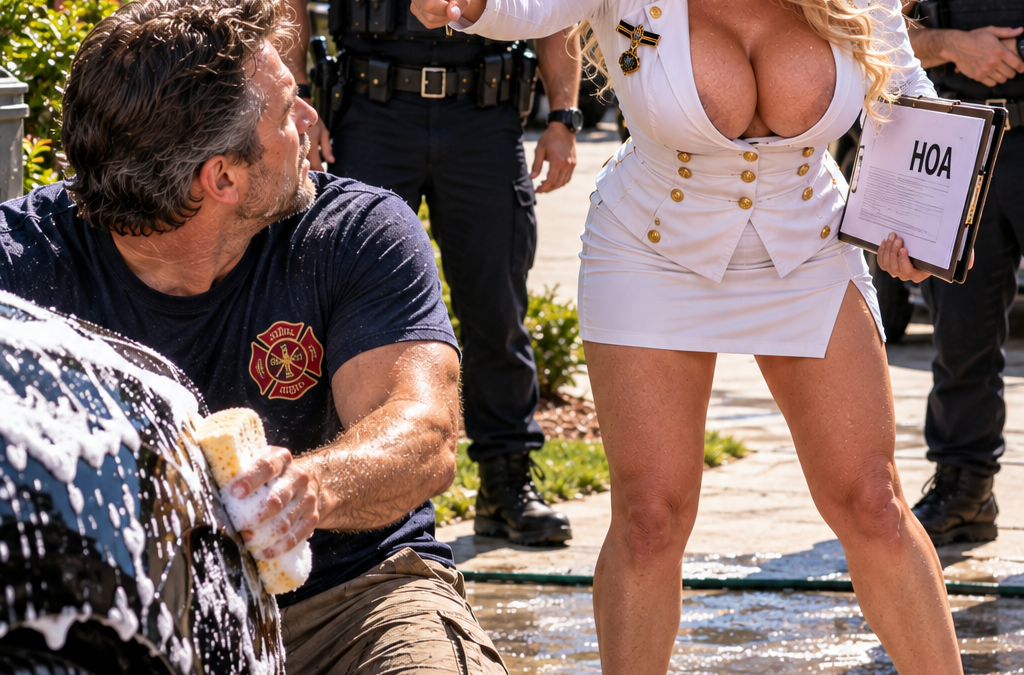
A tight white military-inspired uniform.
The jacket had decorative gold buttons, sharp shoulders, and a neckline cut so deep it emphasized her very large chest. The waist was fitted tightly, and she usually paired it with a matching white skirt and heels.
It was absurdly formal for someone patrolling suburban sidewalks.
But I eventually understood why she wore it.
Karen loved looking official.
She loved symbols of authority.
A clipboard.
A board title.
Gold buttons.
A carefully commanding walk.
Anything that made the distance between “neighbor” and “person who gets to tell you what to do” feel larger.
She was the vice president of the HOA.
To Karen, vice president apparently meant governor, sheriff, zoning inspector, environmental protection officer, and commander of the neighborhood militia.
My first encounter with her happened on a beautiful Sunday morning.
I was crouched beside my car scrubbing the front wheel.
The radio was playing softly behind me.
I heard fast footsteps on the sidewalk.
Click.
Click.
Click.
I looked up.
Karen was coming toward me with a tiny dog on a leash.
Technically, she was walking the dog.
Practically, the dog was being dragged behind her like luggage with paws.
She stopped at the edge of my property.
Didn’t say good morning.
Didn’t introduce herself.
She looked at the car.
Then the water.
Then me.
“You’re using too much water.”
I paused.
“Morning.”
Her expression said greetings were beneath the seriousness of the situation.
“We are supposed to conserve resources in this community.”
I put my wheel brush into the bucket and stood.
“I use a bucket system.”
She folded her arms.
The white jacket tightened across her chest.
“That doesn’t change the amount of water running into the street.”
“Actually it does. It uses a lot less water than leaving a hose running.”
She glanced toward the gutter.
A thin stream of water was moving along the curb.
“The runoff is entering the storm drain.”
“Yes.”
“You’re contaminating the environment.”
I stared at her.
“With car soap?”
“Harsh chemicals.”
I reached toward my supplies.
“It’s biodegradable.”
Karen rolled her eyes.
“Of course that’s what you’d say.”
“No, that’s what the manufacturer says.”
I picked up the bottle.
“Want to read it?”
“I don’t need to read your bottle.”
“Then how do you know what’s in it?”
Her lips tightened.
She changed targets.
“The radio is too loud.”
I actually turned to make sure it was still on.
The radio sat several feet inside the garage.
You could hear guitar.
Barely.
From where Karen stood, the noise of a lawn mower three houses away was louder.
“It’s pretty quiet.”
“It’s Sunday.”
“Yes.”
“People are resting.”
“I can turn it down a little more.”
I was trying to be polite.
Thirty years responding to emergencies had taught me something useful.
You don’t escalate unless escalation solves something.
Most angry people become less difficult when they realize you’re not going to fight for sport.
Karen interpreted calmness differently.
To her, compromise was confirmation that she had authority.
She lifted her chin.
“This neighborhood has standards.”
“Okay.”
“As vice president of the board, I am responsible for enforcing them.”
“Okay.”
“You should become familiar with the rules.”
“I read them before we bought.”
Her eyes narrowed.
The little dog tried to sniff the edge of my lawn.
Karen jerked the leash.
“Come on.”
She stomped away.
I watched the dog hurry to keep up.
Then I went back to my car.
When I told my wife, she laughed.
“That bad?”
“She thinks I’m poisoning the ecosystem.”
“With the biodegradable soap?”
“Apparently.”
“What about the radio?”
“Threat to public tranquility.”
My wife shook her head.
“Every neighborhood has one.”
“That’s what I’m afraid of.”
“Just ignore her.”
That sounded reasonable.
For the next few Sundays, I tried.
Karen made it difficult.
She began timing her walks to coincide with my car washing.
Maybe coincidence.
The first time.
Not the fifth.
I would be outside rinsing a wheel and see the white uniform coming slowly down the sidewalk.
She stopped near my property.
Pulled out her phone.
Took pictures.
Not secretly.
Deliberately.
A photograph of my car.
A photograph of the water.
A photograph of my driveway.
A photograph of the radio.
Once she crouched slightly to photograph soap bubbles moving toward the gutter.
I waved.
She glared.
Then continued walking.
My wife watched from the front window one morning.
“She took six pictures.”
“I know.”
“Why?”
“Evidence for The Hague, apparently.”
“You should stop joking.”
I looked at her.
“She bothers you?”
“She bothers me because she’s trying to bother you.”
“That’s her problem.”
“For now.”
My wife’s words turned out to be prophetic.
A few days later, I found an envelope in our mailbox.
No postage.
No official HOA letterhead.
Just our address typed across the front.
Inside was a single sheet of paper.
NOTICE OF COMMUNITY GUIDELINE VIOLATION.
It accused us of excessive water use.
Noise pollution.
Environmental contamination.
The language sounded legal if you had never actually seen a legal document.
It warned that “continued noncompliance” could result in “substantial financial penalties.”
No specific bylaw section.
No board vote.
No management company contact.
Just Karen’s name typed at the bottom.
VICE PRESIDENT.
My wife read it at the kitchen counter.
“This isn’t official.”
“No.”
“Can she fine us?”
“Not for rules that don’t exist.”
We had read the bylaws.
I opened the digital copy again to make sure.
There were rules regarding junk vehicles.
Cars couldn’t sit disassembled on blocks.
Oil couldn’t be dumped into the street.
Residents couldn’t run noisy commercial operations from driveways.
Nothing prohibited washing a functional car.
Nothing prohibited reasonable radio volume during daytime hours.
Nothing about Sunday.
I dropped Karen’s notice into the trash.
Two days later, another appeared.
This time taped to the garage door.
It claimed the HOA would hold a “special compliance hearing” regarding my “blatant environmental misconduct.”
Blatant.
I actually admired that word.
My wife did not.
“She came onto the property to tape this up.”
“Yes.”
“I don’t like that.”
“Neither do I.”
“You need to say something.”
“I will.”
Firefighters learn patience.
We deal with drunk people yelling during medical calls.
Drivers screaming beside crashes.
Families panicking.
People having the worst day of their lives and taking that fear out on whoever happens to be nearby.
I could absorb anger without reacting.
But being harassed at home felt different.
Home was where the uniform came off.
Home was where the alarm bells weren’t supposed to follow.
Karen was bringing conflict to the one place I had worked thirty years to protect from it.
I decided the next interaction would be clearer.
Sunday arrived.
I pulled the car out.
Washed it.
Dried it.
Then started applying wax.
The weather was perfect.
Blue sky.
Mild temperature.
Classic rock barely audible from the garage.
Then I heard the heels.
Click.
Click.
Click.
Karen appeared.
Little dog trailing behind her.
This time she didn’t remain on the sidewalk.
She stepped onto my driveway.
Then another step.
“I see you’re ignoring the notices.”
I set down the wax applicator.
“Karen.”
She smiled slightly.
“You did receive them.”
“Yes.”
“And?”
“I threw them away.”
Her face changed.
“What?”
“They’re not valid HOA notices.”
“They came from me.”
“Exactly.”
She stepped closer.
“I am the vice president.”
“And I’m the homeowner.”
“You are required to follow community standards.”
“I do.”
“Clearly not.”
I walked toward her but stopped several feet away.
“I’ve read the bylaws.”
“So have I.”
“There is no rule against washing a car.”
“Environmental nuisance.”
“Not a rule.”
“Water conservation.”
“Not applicable to this.”
“Noise disturbance.”
“My radio isn’t violating anything.”
Her face reddened.
“You do not determine what is a nuisance.”
“Neither do you personally.”
“I absolutely do.”
“No.”
Her eyebrows lifted.
“Excuse me?”
“You don’t get to invent restrictions because something annoys you.”
She pointed toward the car.
“You are splashing toxic water into the street.”
“The soap is biodegradable.”
“I don’t care.”
“That seems to be the problem.”
Her jaw tightened.
“And you keep photographing me.”
“I’m documenting violations.”
“I want it to stop.”
“You don’t get to dictate board investigations.”
“You’re standing on my driveway.”
Her eyes flashed.
“Yes.”
“I want you to step back to the sidewalk.”
“No.”
I almost laughed.
“Karen.”
“This entire community is within HOA jurisdiction.”
“The HOA doesn’t own my driveway.”
“I am authorized to inspect properties.”
“From wherever you’re legally permitted to stand.”
“I can stand here.”
“I am asking you to leave.”
She laughed.
Not nervous laughter.
Mocking laughter.
“Trespassing?”
“Yes.”
“You think you can throw me out of my own neighborhood?”
“This isn’t your property.”
“I can fine you so much you’ll have to sell this house.”
That wiped the last hint of humor from me.
She continued.
“I’ll make your life miserable.”
My wife opened the front door.
“What is going on?”
Karen turned.
“Your husband is a menace.”
My wife stared at her.
“He’s waxing a car.”
“He is violating environmental and noise rules.”
“No, he’s not.”
“You’re both going to be penalized.”
My wife is one of the calmest people I have ever known.
She survived thirty years married to a firefighter, which probably qualifies her for sainthood.
She rarely insults anyone.
That morning, she looked Karen up and down.
The tight white uniform.
The gold buttons.
The dog pulling toward the grass.
The furious expression.
Then she said very calmly, “You’re a deeply unhappy person, aren’t you?”
Karen gasped.
It was magnificent.
My wife pointed toward the sidewalk.
“Please get off our property.”
For a moment, Karen looked genuinely speechless.
Then her face went red.
“You will regret this.”
She grabbed the dog’s leash.
“You have no idea who you’re dealing with.”
She stormed away.
My wife looked at me.
“Too much?”
“Marry me again.”
She smiled.
We went back to our Sunday.
But that night, we made a decision.
If Karen continued, we would report everything directly to the HOA president and management company.
No more unofficial notes.
No more letting her turn board status into a personal license to harass us.
Unfortunately, Karen escalated before we did.
The next Sunday started normally.
I’d purchased a new tire dressing during the week.
Yes, retirement had made me the kind of man who became excited about tire dressing.
I accept that.
My wife teased me over breakfast.
“Big plans today?”
“Very.”
“Saving lives?”
“Restoring sidewall shine.”
“A hero.”
“Somebody has to do it.”
I pulled the car into the driveway around nine.
Filled the buckets.
Put on music.
Started washing.
Twenty minutes later, I heard quick footsteps.
No dog this time.
Karen was coming alone.
White uniform.
Phone in one hand.
Expression set like she was approaching an active crime scene.
She crossed the sidewalk.
Walked straight up my driveway.
Stopped beside the car.
“Turn the hose off.”
I looked at her.
The hose wasn’t even running.
It was lying on the driveway.
“Excuse me?”
“Stop washing the car.”
“No.”
“This is your final warning.”
“Get off my property.”
“I’m not leaving.”
“You are trespassing.”
“I’m performing an HOA inspection.”
“I have withdrawn permission for you to be here.”
“You can’t.”
“I just did.”
Her lips curled into a smile.
“You think you’re very clever.”
“No.”
“You think because you’re retired you can sit around all day creating problems.”
“I wash my car once a week.”
“On Sunday.”
“Yes.”
“A day of rest.”
I stared at her.
“Is the HOA enforcing religious observance now?”
Her face tightened.
“You know exactly what I mean.”
“I genuinely don’t.”
“You are disturbing the peace.”
“No.”
“You’re contaminating the water system.”
“No.”
“You are defying the board.”
“No, Karen. I’m defying you.”
That landed.
She lifted her phone.
“Fine.”
“What?”
“I’m calling the police.”
I actually smiled.
“You’re calling police because I’m washing my car.”
“I’m going to have you arrested.”
“For?”
“Environmental sabotage.”
I thought she was bluffing.
Then she dialed.
I watched.
Phone to ear.
Her entire voice changed when someone answered.
Suddenly frantic.
Breathless.
Victimized.
“Hello? Yes, I need police immediately.”
I shook my head.
“There is an aggressive man causing a major disturbance in my neighborhood.”
Aggressive man.
I stood beside a bucket holding a sponge.
“He is dumping toxic chemicals into the public drainage system.”
I looked at the biodegradable-soap bottle.
“He’s blasting loud music.”
I turned toward the garage.
The radio was playing low enough that I could barely identify the song.
“And he is refusing to comply with community law.”
Community law.
That was new.
“I feel extremely unsafe.”
She gave my address.
Then hung up.
Karen lowered the phone and smiled.
“They’re coming.”
“I know.”
“They’ll arrest you.”
I placed the sponge in the bucket.
“I doubt that.”
My wife had come onto the porch.
“Did she actually call 911?”
“Yep.”
“For washing the car?”
“Environmental sabotage.”
My wife looked at Karen.
Then at me.
Then back at Karen.
“You realize police are going to be angry that you called emergency services for this.”
Karen placed both hands on her hips.
“They’re going to take your husband away in handcuffs.”
The smugness in her voice was extraordinary.
“That is what happens when you disrespect the board.”
I told my wife, “Stay on the porch.”
She frowned.
“You sure?”
“Yes.”
I wasn’t worried about the officers.
I’d worked alongside law enforcement for decades.
Car crashes.
Structure fires.
Medical emergencies.
Hazmat calls.
Fatal scenes.
I knew how police assessed situations.
I also knew how they felt about unnecessary 911 calls.
And there I stood.
No shouting.
No weapons.
No disturbance.
No toxic spill.
Just a wet car.
Karen, meanwhile, refused to leave.
I asked her again.
“Step off my driveway.”
“No.”
“You have already called police.”
“And I’m staying until they arrive.”
“You are trespassing.”
“I am an HOA officer.”
“You are a homeowner with a board title.”
She stared at me.
“Same thing.”
“No.”
I asked her again five minutes later.
Then again.
Each time, she crossed her arms.
Refused.
For nearly fifteen minutes, she stood in the middle of my driveway like a victorious general waiting for reinforcements.
Then two police cruisers turned onto our street.
Lights flashing.
No sirens.
Three officers stepped out.
The first thing they did was look around.
I watched their faces.
Street quiet.
No crowd.
No yelling.
No smoke.
No damaged property.
No poisoned river.
Just me beside my car.
My wife on the porch.
Karen on my driveway.
One officer looked toward his partner.
Even from thirty feet away, I recognized the expression.
This is the emergency?
Karen hurried toward them.
“Officers!”
She waved both arms.
“This man is out of control.”
One officer held up a hand.
Karen kept talking.
“He is dumping toxic chemicals directly into the water supply.”
The officers looked toward my bucket.
“He’s blasting loud music.”
One turned his head toward the garage.
“And he’s been harassing me all morning.”
My wife crossed her arms.
Karen pointed at me.
“You need to arrest him.”
The oldest officer stepped toward me.
“Morning, sir.”
“Morning.”
“Can you tell me what’s happening?”
“I’m washing my car.”
He looked at the car.
“Okay.”
“I do it every Sunday.”
He nodded.
“This woman is vice president of the HOA. She decided she doesn’t like it.”
Karen yelled from behind him.
“That is not what happened!”
The officer glanced back.
“Ma’am, give us a moment.”
I continued.
“She has been photographing me for weeks, leaving unofficial warning notices on our house, and claiming I’m violating environmental and noise rules that don’t exist.”
The officer looked toward the bucket.
“What soap?”
I picked up the bottle.
“Biodegradable automotive soap.”
He read part of the label.
Nodded.
“The radio?”
I pointed toward the garage.
“Back there.”
The officer listened.
Classic rock.
Barely audible.
He released a breath that was half sigh.
“Are you retired?”
“Fire department.”
He looked back at me.
“Where?”
I told him.
His expression softened.
“My uncle was with them years ago.”
“Small world.”
Karen’s voice rose.
“Why are you talking about his career? He’s committing crimes!”
The officer turned.
He walked back toward her.
“Ma’am.”
“Yes?”
“Washing a vehicle is not a crime.”
Her face froze.
“What?”
“He isn’t violating any noise ordinance.”
“He is.”
“He isn’t.”
“The chemicals—”
“The soap is legal.”
“He’s poisoning the environment!”
“No evidence of that.”
Karen stared at him like he had betrayed her personally.
“What do you mean it’s not a crime?”
The officer remained calm.
“Exactly that.”
“I am the HOA vice president.”
“I understand.”
“I declared this activity a violation.”
“HOA rules aren’t criminal law.”
She blinked.
“They are community law.”
“No.”
“I have authority here.”
“Not over us.”
Her mouth opened.
Closed.
Then opened again.
“You have to arrest him.”
“No.”
“He is defying me.”
“That isn’t an offense.”
Karen’s breathing became louder.
The officer continued.
“At most, if you believe there is some HOA-rule disagreement, that’s a private civil matter.”
“It isn’t civil.”
“It is.”
“He’s dangerous.”
I looked down at the sponge in my hand.
The officer glanced at me too.
Then back at her.
“Ma’am, you need to leave this man alone and return to your own property.”
Karen’s face turned bright red.
“No.”
The officer paused.
“What?”
“No.”
She actually stomped one white heel against my driveway.
“I’m not leaving until you do your jobs.”
The second officer looked at her.
“We are doing our jobs.”
“I pay taxes.”
“So does he.”
“I pay your salaries.”
The older officer’s expression hardened.
“This conversation needs to calm down.”
Karen pointed toward my house.
“This is my neighborhood.”
I decided that was enough.
“Officer.”
He turned toward me.
“Yes, sir?”
“I have repeatedly asked this woman to leave my property.”
Karen’s head snapped toward me.
“She has refused.”
The officer looked at the driveway beneath her feet.
“How long has she been here?”
“About twenty minutes.”
“Have you asked her clearly to leave?”
“Multiple times.”
My wife called from the porch.
“At least five.”
Karen pointed at her.
“Stay out of this.”
The officer looked back at Karen.
The whole situation shifted.
Until that moment, she had believed police were there to enforce her complaint.
Now they were looking at her as the problem.
The officer spoke slowly.
“You are on private property.”
Karen lifted her chin.
“I am performing an inspection.”
“The homeowner has told you to leave.”
“He can’t interfere with HOA enforcement.”
The officer ignored that.
“You need to step off this driveway and return to the sidewalk.”
“No.”
“Ma’am.”
“No.”
His voice became firmer.
“I’m giving you a lawful instruction to leave private property after the owner withdrew permission for you to remain.”
Karen crossed her arms.
Her fitted white jacket pulled tightly across her chest as she planted both feet apart.
“I have every right to stand here.”
“No, you don’t.”
“I am vice president of the HOA.”
“That does not give you a right to trespass.”
“I’m inspecting.”
“You’re leaving.”
“No.”
The second officer shifted closer.
Neighbors had begun appearing outside.
A man across the street stood on his porch.
Someone else opened a garage.
Karen noticed.
And I think the audience made her worse.
She had spent months performing authority.
Backing down in front of witnesses would have shattered the image she had built.
So instead, she doubled down.
“You people clearly don’t understand HOA law.”
One officer almost smiled.
“Ma’am, final warning.”
She pointed toward me.
“Arrest him.”
“Step off the driveway.”
“No!”
The officer moved.
No hesitation.
He reached for her arm.
Karen’s expression went from fury to shock.
“What are you doing?”
He turned her gently but firmly.
“You are under arrest for trespassing.”
Her mouth dropped open.
“What?”
He pulled one wrist behind her.
“No!”
The first handcuff clicked.
Karen screamed.
“Let me go!”
Her other arm came back.
The second cuff clicked.
“You cannot arrest me!”
“Stop resisting.”
“I am the HOA vice president!”
The officers began walking her toward the cruiser.
Karen twisted.
Her white heels slipped slightly against the concrete.
Her hair fell across her face.
“What are you doing?”
The neighbors were fully watching now.
Curtains moving.
People standing in driveways.
Karen’s voice got louder.
“I’m the victim!”
The officer said, “Watch your step.”
“They’re kidnapping me!”
My wife covered her mouth.
I couldn’t tell whether she was horrified or trying not to laugh.
Karen looked toward us.
“You did this!”
I shook my head.
“You called them.”
“I’ll sue you!”
The officer opened the back door.
Karen planted both feet.
“I am not getting in there.”
“Ma’am.”
“You cannot put me in a police car.”
“You’re under arrest.”
“This is illegal.”
She tried bracing herself against the doorframe.
A second officer went around the other side.
Together they got her into the back seat.
Karen screamed through the open door.
“I will sue this entire department!”
Then at me.
“I will take your house!”
The officer shut the door.
Her mouth continued moving behind the glass.
I could still hear muffled shouting.
Then the older officer walked back up the driveway.
For a moment, we both looked toward the cruiser.
Karen was gesturing wildly inside.
He sighed.
“Sorry about that.”
“Not your fault.”
“We’ll be taking her to the station.”
He pulled out a notepad.
“Trespassing, and we’ll also review the 911 call for possible misuse.”
I nodded.
“I’ll need your information.”
I gave it to him.
When I mentioned the fire department again, we talked briefly.
Turns out he knew several firefighters I’d worked with.
He shook my hand.
“Enjoy retirement.”
I looked toward the cruiser.
“Working on it.”
He laughed.
Then his expression became serious.
“You’ve got those warning notices?”
“Yes.”
“Keep them.”
“Already did.”
“Good.”
After the police left, the neighborhood went quiet.
Strangely quiet.
Like everyone was pretending they hadn’t just watched the HOA vice president being put into a patrol car while screaming that police worked for her.
My wife walked down from the porch.
She looked at the empty stretch of driveway where Karen had been standing.
Then at me.
Then at the sponge sitting in the bucket.
“You going to finish?”
“The car?”
“Yes.”
I looked down the street where the police cruisers had disappeared.
Then I laughed.
“Absolutely.”
I dipped the sponge back into the soapy water.
My wife went inside and came back with coffee.
The radio resumed.
I washed the rest of the car.
Waxed it.
Applied the tire shine.
The sun stayed warm.
The water ran quietly toward the gutter.
Nothing caught fire.
No ecosystem collapsed.
Civilization survived.
It was one of the best Sundays I’d had since retiring.
The HOA fallout came quickly.
News travels faster than official email in a suburban neighborhood.
By that evening, half the street knew what had happened.
By Monday, probably the whole subdivision did.
Some residents already had stories about Karen.
Unnecessary warnings.
Aggressive complaints.
Photography.
Arguments over decorations.
Threats of fines.
Apparently we weren’t the only family she’d targeted.
We were simply the first people she’d harassed badly enough to end up in handcuffs.
A few days later, the HOA announced a board meeting.
My wife and I attended.
Karen did not.
For the first time since moving there, the meeting felt almost relaxed.
The HOA president—not Karen, the actual president—stood at the front and addressed the room.
“I want to discuss an incident involving one of our board officers.”
Everyone knew which incident.
He looked directly at my wife and me.
“First, I want to apologize.”
My wife glanced at me.
The president continued.
“The board has reviewed the governing documents and confirmed that residents are permitted to wash personal vehicles on their property.”
A few people laughed quietly.
He almost smiled.
“There is also no special restriction prohibiting this activity on Sundays.”
More laughter.
“And normal use of environmentally safe cleaning products is not an HOA violation.”
I leaned toward my wife.
“Glad we got constitutional clarity on shampoo.”
She elbowed me lightly.
The president continued.
“The board has also determined that the notices issued to these homeowners were not properly authorized.”
That mattered.
Karen had been acting on her own.
Using her title to create threats that looked official.
He took a breath.
“Effective immediately, Karen has been removed as vice president and stripped of all board responsibilities.”
No one objected.
Not one person.
Then something happened I hadn’t expected.
Applause.
Not huge.
But real.
A few residents started it.
Then more joined.
I didn’t clap.
I wasn’t there to celebrate someone’s humiliation.
But I understood why they did.
For them, this wasn’t about my car.
It was about months or years of having someone turn neighborhood administration into personal domination.
The HOA president looked uncomfortable.
“We will also review how board notices are generated to make sure something like this cannot happen again.”
Good.
That was what I wanted.
Systems mattered more than revenge.
After the meeting, several neighbors approached us.
One older man said, “You did the whole street a favor.”
“I washed a car.”
He laughed.
“No. You didn’t let her scare you.”
A woman who lived around the corner told us Karen had once threatened to fine her because wind blew recycling from someone else’s bin into her yard.
Another resident said she had photographed his teenage son carrying a skateboard and claimed he was damaging sidewalks.
None of it surprised me anymore.
The legal consequences of Karen’s arrest were less clear.
We never followed the case closely.
I knew she spent at least part of that Sunday in custody.
There may have been consequences related to trespassing and the emergency call.
I didn’t care enough to keep digging.
I didn’t want my retirement becoming a hobby of monitoring Karen.
That was exactly the kind of obsession I had accused her of having.
What mattered was what happened afterward.
She disappeared.
Not literally.
She still lived in the neighborhood.
But the patrols stopped.
The little dog no longer got dragged past our house every Sunday.
No more pictures.
No more letters.
No more dramatic white uniform standing at the property line.
When we drove past her house, the blinds were often closed.
If she was outside and saw us, she looked away.
The woman who had once declared that the entire neighborhood was under her jurisdiction suddenly behaved as though she wanted the neighborhood to forget she existed.
People laughed about the arrest for months.
I heard she became known as “the Sunday sheriff.”
Another neighbor called her “Captain Car Wash.”
I tried not to encourage that one.
My wife did.
One morning, several months later, I was washing the car when a neighbor walking his dog stopped near the driveway.
I looked up.
“Everything okay?”
He smiled.
“Just making sure the environment survives.”
I sprayed a tiny amount of water toward the curb.
“Tell my wife I loved her.”
He laughed and kept walking.
That was the kind of neighborhood I had hoped to retire into.
People teasing each other.
Talking.
Leaving one another alone when nothing actually needed fixing.
The irony was that I never changed my Sunday routine.
I still used two buckets.
Still biodegradable soap.
Still low-volume classic rock.
Still washed the car around the same time.
All the things Karen claimed were destroying community life continued.
And nothing happened.
No toxic disaster.
No water crisis.
No noise complaints.
No police.
The only disturbance had always been her reaction to it.
Retirement teaches you strange things about time.
When I was working, Sundays weren’t really Sundays.
Sometimes I was on shift.
Sometimes I had worked all night Saturday.
Sometimes holidays landed on duty days and you ate dinner at the station between calls.
After retiring, rituals became more important.
Sunday car washing sounds trivial.
It is trivial.
That’s exactly why it mattered.
I had spent decades around actual emergencies.
When you’ve seen people lose houses to fire, you’ve got limited patience for someone calling a clean car an existential threat.
When you’ve stood at collision scenes where seconds mattered, it’s hard to take “radio too quiet to hear from the sidewalk” seriously.
When you’ve worked beside cops trying to manage real danger, watching someone call 911 because an HOA disagreement hurt her ego is almost offensive.
Karen had never understood the difference between discomfort and danger.
She disliked something.
Therefore it was unsafe.
She couldn’t control something.
Therefore it violated standards.
Someone told her no.
Therefore they were aggressive.
That mindset explained everything.
The soap wasn’t the real problem.
Neither was the radio.
The problem was that I continued washing the car after she told me to stop.
Her identity depended on obedience.
Vice president wasn’t merely a volunteer position to her.
It was proof that she mattered.
Proof that people should listen.
Proof that she could enter someone else’s driveway, demand changes, create unofficial notices, photograph residents, and expect compliance.
When I stayed calm and kept doing what I was legally allowed to do, she interpreted it as disrespect.
That’s why every reasonable compromise failed.
I offered to show her the soap label.
She refused.
I offered to lower music that was already quiet.
It wasn’t enough.
I explained the bylaws.
She didn’t care.
I asked her to stay off my property.
She claimed my property fell under her jurisdiction.
Every time reality gave Karen an exit, pride closed it.
Even when police arrived, she had multiple chances.
They told her washing the car wasn’t illegal.
She could have gone home.
She refused.
They told her HOA rules were not criminal law.
She could have gone home.
She refused.
The homeowner told her to leave private property.
She could have taken three steps backward.
Three steps.
That was all.
She refused.
A police officer warned her.
Again.
She crossed her arms.
Final warning.
Still no.
Then the handcuffs came out.
People later told the story like the arrest was some elaborate revenge.
It wasn’t.
Nobody tricked her.
Nobody baited her.
Nobody exaggerated evidence.
She called the police herself.
She stood on property where she had been told she was unwelcome.
She explained her own reasoning.
She ignored multiple lawful instructions.
Then she was shocked that consequences applied.
If she had simply stepped back onto the sidewalk, the story would have ended completely differently.
She couldn’t.
Because stepping back would have meant accepting that my driveway wasn’t hers.
And that was the one thing her ego couldn’t tolerate.
My wife and I ended up loving the neighborhood.
The community garden was great.
The pool was useful when our grandchildren visited.
Most of the neighbors were genuinely kind.
The HOA became quieter once Karen was gone from the board.
Not perfect.
No organization run by humans ever is.
But normal.
Emails instead of threats.
Meetings instead of confrontations.
Actual references to bylaws instead of “because I said so.”
I even volunteered once to help clean up the community garden after a storm.
My wife laughed when I told her.
“You?”
“What?”
“Volunteering with the HOA?”
“Community project.”
“Slippery slope.”
“Next thing you know, I’ll own a clipboard.”
“If you buy a white military jacket, I’m leaving.”
“Fair.”
We still laugh about that.
But there was one thing I stopped laughing about.
The way harassment changes the feeling of home.
For several weeks before the arrest, I had started anticipating Karen every Sunday.
I would hear footsteps and look up.
See someone with a dog and tense slightly.
Notice an envelope and wonder whether it was another warning.
That’s not how home should feel.
A home is supposed to be the place where your nervous system can lower its guard.
I spent decades entering other people’s homes at their most chaotic moments.
Fire alarms.
Smoke.
Panic.
Sirens reflecting against bedroom walls.
When I retired, I wanted a place defined by the absence of emergency.
Karen managed to drag a kind of emergency into it anyway.
A pointless one.
Manufactured entirely from ego.
That was why the Sunday after her removal felt different.
I woke up.
Made coffee.
Pulled the car out.
Set up the buckets.
Classic rock started playing.
For the first twenty minutes, I kept expecting her.
Clicking heels.
Phone camera.
White jacket.
Nothing.
Thirty minutes.
Nothing.
An hour.
Still nothing.
My wife came outside with another cup of coffee.
“No inspection today?”
“Apparently not.”
“You disappointed?”
“Devastated.”
She sat on a chair near the garage.
I rinsed the hood.
Water reflected sunlight across the driveway.
A neighbor waved while jogging past.
I waved back.
That was it.
Normal.
I hadn’t appreciated normal enough before.
Maybe nobody does until someone interferes with it.
I finished the wash.
Dried the car.
Applied wax.
Then sat beside my wife.
She looked at the car.
“Worth all that trouble?”
“The arrest?”
“The detailing.”
“Absolutely.”
She shook her head.
“You firefighters are weird.”
“Retired firefighters.”
“Even worse.”
A breeze moved through the trees.
Somewhere down the street, a lawn mower started.
Kids were shouting near the pool.
My radio played softly in the garage.
Nothing dramatic happened.
It was exactly the life I had wanted.
Years of firefighting taught me that some emergencies are unavoidable.
Electrical failures.
Kitchen accidents.
Storms.
Mechanical failures.
People make mistakes.
Bad things happen.
But other disasters are entirely self-created.
Karen’s was.
She could have walked past my house that first Sunday.
She could have disliked the car washing privately.
She could have read the soap label.
She could have checked the actual rules.
She could have accepted that another adult’s harmless hobby wasn’t subject to her personal approval.
Instead, she photographed.
Threatened.
Trespassed.
Invented authority.
Escalated.
Called 911.
Lied about danger.
Then ignored police officers when they told her to leave.
By the time those handcuffs clicked shut, there was nobody left for Karen to blame.
Not me.
Not my wife.
Not the HOA.
Not the police.
She built the entire disaster herself.
The funniest part is that my car has never been cleaner.
I still wash it most Sundays.
Same driveway.
Same radio.
Same biodegradable soap.
Sometimes I even use the hose.
And every once in a while, as the water runs harmlessly toward the gutter, I remember Karen standing with her arms crossed and telling three police officers that she wasn’t leaving because she was inspecting my property.
Then I remember the officer saying, one last time, “Step off the driveway.”
One step would have saved her.
She chose handcuffs instead.
That’s what happens when someone mistakes authority for ownership.
My retirement is quiet now.
Boring, even.
And after everything I’ve seen in my life, boring is still one of the best things I’ve ever earned.