𝗣𝗔𝗥𝗧 𝟮 She Called 911 on the Man in the Hoodie, Not Knowing His Name Was on the Manager’s Door
𝗣𝗔𝗥𝗧 𝟮
There is a kind of silence that fills a room when everyone knows something ugly has happened, but nobody knows who is allowed to say it first.
The customer at Luna’s window turned slightly. One of the personal bankers froze halfway out of her chair. Ben, across the lobby, looked up from helping the elderly man at the ATM. Behind the teller glass, Luna’s expression shifted from confusion to anger so quickly I could almost see her choosing professionalism by force.
I set the creamer down slowly.
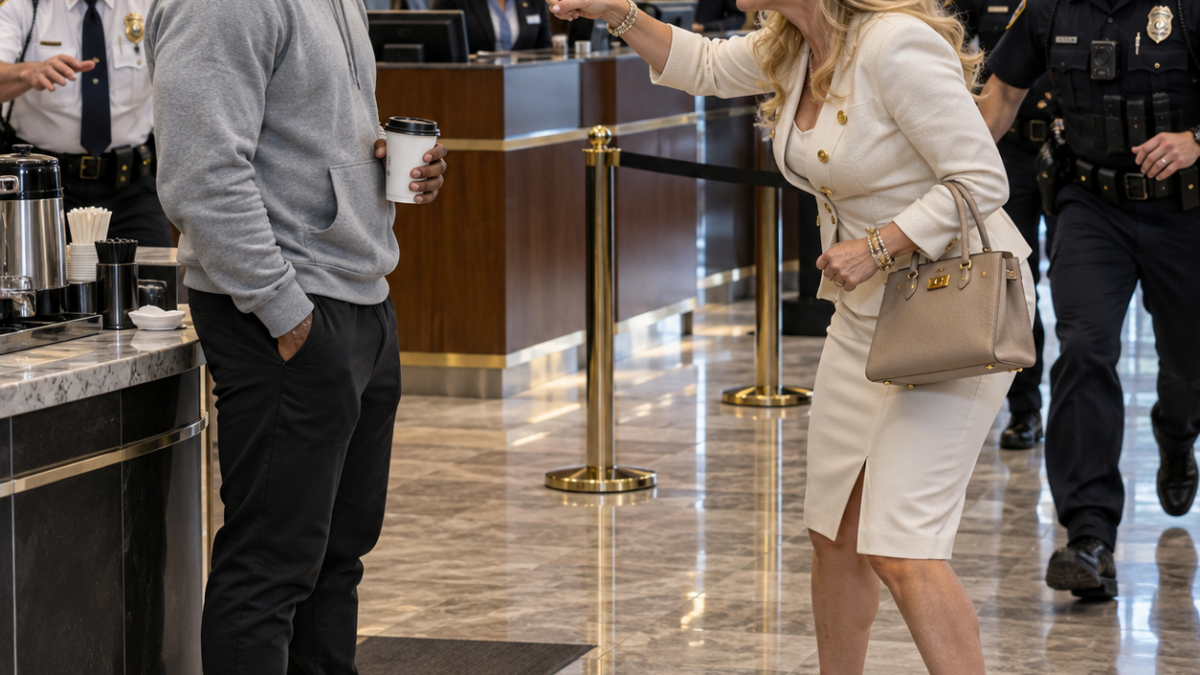
“Ma’am,” I said, keeping my voice light at first, “I assure you I’m not a vagrant.”
Dolores recoiled as if I had stepped toward her instead of spoken from five feet away.
“Do not speak to me.”
That sentence landed harder than vagrant.
Not because it was louder.
Because it was purer.
She had not mistaken me for someone needing help. She had not wondered if I belonged there. She had decided I was beneath conversation.
She looked back at Luna.
“Call security.”
Luna’s jaw tightened.
“Mrs. Harrington—”
“He’s loitering. He’s probably casing the place. Look at him.”
I felt heat move up my neck.
Every Black professional I know has a private file in their mind labeled not today. Inside it are the things we do to keep from becoming the stereotype someone else is desperate to project onto us. Keep your hands visible. Keep your voice calm. Do not crowd. Do not point. Do not let anger sharpen your face too much. Do not give anyone a still image they can use against you.
I opened that file.
“Mrs. Harrington,” I said, dropping the warmth and using the steady voice I used in difficult client meetings, “you need to lower your voice. I work here.”
She laughed.
Sharp. Incredulous. Designed for the room.
“You work here?”
“Yes.”
“Looking like that?”
“I’m not customer-facing today.”
“Oh, don’t insult my intelligence.” She waved one hand at me, the diamonds on her bracelet catching the light. “You’re probably here for free coffee. Or you’re the janitor’s assistant. Or some homeless person who wandered in because nobody stopped you.”
A customer near the waiting chairs muttered, “Jesus.”
Dolores heard him and spun.
“What? We are all thinking it.”
“No,” Luna said, voice tight. “We are not.”
That made Dolores furious.
I stepped slightly to the side, putting myself between her and the teller line without moving closer to her.
“My name is Marcus Reed,” I said clearly. “I’m the branch manager. My office is right there.”
I pointed toward the glass-walled office near the back corner, where a plaque beside the door read Marcus Reed, Branch Manager.
Dolores did not even look.
“Liar.”
The word cracked across the lobby.
“Mrs. Harrington,” Luna said, “he is the manager.”
Dolores’s face hardened.
“The manager is a gentleman in a suit. I have seen him.”
“That was me,” I said. “In a suit.”
“You expect me to believe that?”
“I expect you to stop disrupting my branch.”
She gasped as if I had slapped her.
“Your branch?”
“Yes.”
“Listen to me.” She stepped forward, perfume hitting me like a wall. “I have more money in this bank than you will make in your entire life. I will not be spoken to by some street thug in a hoodie pretending to be important.”
There it was.
Thug.
Not man.
Not employee.
Not even liar anymore.
Thug.
Ben arrived then, moving carefully, palms open.
“Mrs. Harrington,” he said, “is there a problem?”
“Yes, Ben. Finally.” Dolores swung toward him with visible relief, because in her mind Ben belonged to the category of people who should naturally protect her from me. “Remove this man.”
Ben looked at me, then back at her.
“Ma’am, that is Mr. Reed. He’s the branch manager.”
You would think that would have ended it.
A reasonable person would have stopped. Looked at the office plaque. Looked at Luna. Looked at Ben. Maybe blinked through embarrassment and said, “Oh my God, I am so sorry. I didn’t recognize you out of your suit.”
Dolores was not reasonable.
She turned on Ben.
“Are you in on this?”
Ben frowned. “Excuse me?”
“Did he pay you? Or are you just incompetent?”
Ben’s face flushed.
I stepped in before he could respond.
“Mrs. Harrington, you are causing a disturbance. I am asking you to leave the branch now. We can discuss your banking needs on Monday after you’ve calmed down.”
She stared at me.
Then she smiled.
It was small, smug, and cruel.
“You are asking me to leave?”
“Yes.”
“I am a loyal customer of this bank.”
“And right now you are trespassing.”
That word detonated something in her.
“Trespassing?” she shrieked. “I’m trespassing? No. You are trespassing. I am banning you from this bank.”
The absurdity almost made me laugh.
Almost.
But there was something in her eyes that stopped me. Rage, yes. Entitlement, yes. But also certainty. Dolores truly believed that her money, whiteness, and outrage outranked my title, my staff, and the reality of where she stood.
She pulled out her phone.
“If your security guard won’t do his job, I’ll call the police myself.”
“Mrs. Harrington,” I said sharply, “do not make a false emergency call.”
She lifted the phone to her ear and smiled at me while it rang.
When the dispatcher answered, Dolores became someone else.
Her voice trembled.
Not with fear.
With performance.
“Yes, I’m at the bank on Main Street. There’s a man here. He’s aggressive. He looks homeless, maybe on drugs, and he’s refusing to leave.” She glanced at me, eyes glittering. “The security guard is refusing to help. I think they might be robbing the bank. Please send officers immediately. I feel threatened.”
My stomach dropped.
Not because I thought I had done anything wrong.
Because I knew what she had just done.
She had not called about a rude employee. She had not called about confusion. She had used words that summon urgency: aggressive, homeless, drugs, robbing, threatened.
And whether she understood the full risk or not, she had just painted a target on me.
She hung up and lowered the phone.
“They’re coming,” she said softly. “You’re going to jail.”
For a moment, nobody moved.
Then training took over.
“Luna,” I said, keeping my voice controlled, “lock the front door. No new customers in. Secure teller drawers.”
Standard protocol.
If police are coming to a bank for a reported threat, you secure cash, limit entry, preserve the scene, and protect staff.
Dolores lunged toward the teller counter.
“Don’t you dare lock us in!”
Luna stepped back behind the glass.
I moved between Dolores and the teller line, hands open.
“Nobody is locking anyone in. The front door locks from outside entry only. Customers can still exit. We are securing the branch because you called the police.”
“He’s taking us hostage!” Dolores screamed.
That was when some customers started to panic.
An older woman grabbed her purse and stood. A man near the coffee station backed toward the wall. One of my personal bankers, Elena, quietly guided her client toward a consultation room. I could see fear spreading, not because of me, but because Dolores was narrating a nightmare loudly enough to make people wonder if they had missed something.
I had to control the room.
“Everyone, please remain calm,” I said. “You are safe. You may exit if you choose. Staff will assist you.”
Dolores pointed at me.
“Listen to him giving orders.”
“I am the branch manager.”
“You are a criminal.”
“Step away from the teller counter.”
“No.”
“Mrs. Harrington.”
“No!”
Then she swung her purse.
It happened fast.
One second she was screaming. The next, her heavy designer bag came at my face. I raised my forearm instinctively, and the metal buckle caught me hard enough to send a sharp crack of pain up to my elbow.
The lobby gasped.
“Mrs. Harrington!” Ben shouted.
Pain flashed white behind my eyes, but I stayed on my feet.
“Ben,” I said, voice harder now, “step in.”
Ben moved between us, one hand out.
“Ma’am, you need to stop.”
Dolores shoved him.
Ben was older, strong but not braced for it. He stumbled backward and hit the edge of the check-writing desk before going down on one knee.
That changed everything inside me.
She could insult me. She could humiliate me. She could call the police and perform terror for an audience. But Ben was sixty-eight years old, kind to everyone, and had done nothing but try to keep the peace.
“Enough,” I snapped.
Dolores turned back toward me and spat directly in my face.
For one second, the world narrowed to the warmth sliding down my cheek.
Her lips curled.
“You filthy animal.”
Behind the teller glass, Luna screamed, “Oh my God!”
Dolores grabbed a stapler from the check-writing desk and hurled it toward the teller line. It bounced off the security glass with a crack that made one customer cry out.
That was the moment sirens sounded outside.
Thank God.
The police arrived fast after that.
Two officers came through the door, hands near their holsters, faces alert. They entered a scene already shaped by Dolores’s call: a Black man in a hoodie standing in the lobby, a white woman crying and screaming, an elderly security guard on one knee, customers backed away, staff behind glass, tension thick enough to choke on.
“Hands!” one officer shouted.
I raised mine immediately.
Dolores switched roles so quickly it would have been impressive if it had not been disgusting.
“He attacked me!” she sobbed. Real tears now, or something close enough to pass from a distance. “He attacked me. He’s the one. He hit the guard. He tried to rob us.”
The younger officer looked at me.
I saw the calculation.
Black male. Hoodie. Aggressive suspect. Matching caller description.
“Sir,” he said, moving toward me, “turn around and place your hands behind your back.”
Luna shouted from behind the glass, “No! That’s Mr. Reed! He’s the manager!”
Ben, still trying to stand, groaned, “She’s lying. He’s the manager.”
But the officer kept moving.
I did not argue with my hands down. I did not reach for ID. I did not turn suddenly toward my office plaque. I did what every Black man in America learns to do in the space between injustice and survival.
I complied.
“Officer,” I said calmly, turning around, “I am the branch manager. My ID is in my back pocket. My business cards are on my desk. We have full video and audio surveillance. That woman assaulted me and my security guard.”
“Liar!” Dolores screamed. “He’s lying!”
The cuffs closed around my wrists.
Cold metal.
Public humiliation has a temperature.
It is cold at first, then burning.
I stood there in my own bank, handcuffed in front of my staff, my customers, and the woman who had spit on me, while Luna cried and kept saying, “That’s our boss. Please. That’s our boss.”
The officer patted me down, found my wallet, and checked my ID.
His face changed.
Then he looked toward my office.
Elena, my personal banker, had stepped out just enough to point.
“His business cards are on the desk,” she said, voice shaking. “His name is on the door.”
The second officer walked over, picked one up, looked at the plaque, then looked at me.
The cuffs came off immediately.
The young officer’s face flushed.
“Sir, I apologize.”
I rubbed my wrists.
“I understand you responded to the call you got.”
He swallowed.
“That call described—”
“I know what it described.”
Dolores had stopped crying.
Not completely, but enough.
Reality was beginning to leak into her performance.
I wiped my face with a tissue Luna handed me through the small document slot beneath the teller glass. My forearm throbbed where the purse buckle had hit. Ben was standing now, one hand on the counter, face pale with pain and anger.
“I want to press charges,” I said.
Dolores inhaled sharply.
“For what?” she snapped, forgetting to sob for half a second.
“Assault. Battery. Trespass. Disorderly conduct. False report if it applies. Anything else the facts support.”
“He assaulted me first!”
“No, ma’am,” Ben said. His voice was rough, but steady. “You hit him with your purse. You shoved me. You spit on him. You threw a stapler.”
“I did not spit.”
The entire lobby seemed to breathe in at once.
Luna said, ice-cold, “We have cameras.”
Dolores’s eyes flicked up toward the ceiling.
There were cameras everywhere.
This was a bank.
Of course there were cameras.
4K video. Audio in key areas. Multiple angles. Lobby view. Teller line. Coffee station. Front door. Check-writing desk. Security room.
Every insult.
Every movement.
Every lie.
Captured.
The second officer’s voice hardened.
“Ma’am, place your hands behind your back.”
Dolores stepped back.
“No.”
“Ma’am.”
“No. Do you know who I am?”
The older officer sighed, the way men do when they have heard that sentence too many times.
“Hands behind your back.”
“I know the mayor.”
“Hands.”
“I will have your badges.”
“Ma’am, you are under arrest.”
“This is a conspiracy!” she screamed as they turned her around. “He set me up! That man is dangerous. You’ll see. You’ll all see.”
They cuffed her.
Watching Dolores Harrington get walked through my lobby in handcuffs was not as satisfying as people might imagine.
Not at first.
I was too angry. Too shaken. My wrist hurt. My face still felt contaminated no matter how many times I wiped it. Ben was hurt. My staff were rattled. Customers had been terrified. The branch had been turned into a theater of racism, violence, and lies because one woman could not accept that the man in the hoodie outranked her assumptions.
But when Dolores passed me and whispered, “You’ll regret this,” something in me settled.
“No,” I said quietly. “You will.”
The officers took statements.
Mine. Ben’s. Luna’s. Elena’s. Two customers who had seen everything. The elderly man Ben had been helping at the ATM gave a statement too. He was furious in that dignified old-man way that feels more powerful than shouting.
“She was dreadful,” he said. “Absolutely dreadful.”
The police reviewed footage in the security room before leaving.
It was all there.
Dolores pointing. Dolores calling me a vagrant. Dolores refusing to believe I worked there. Dolores calling 911. Dolores swinging the purse. Shoving Ben. Spitting. Throwing the stapler. Crying when police arrived. Lying.
Clean. Damning. Undeniable.
After they took her away, I closed the branch for the rest of the day.
Not because we could not technically operate.
Because my staff deserved not to smile at customers ten minutes after watching their manager get handcuffed and spit on.
I called the district manager.
Then corporate security.
Then HR.
Then facilities, because somehow in the middle of all that, the HVAC technician had finished the repair and was standing awkwardly near the back hallway holding a clipboard.
“Good news,” he said carefully. “Server room temperature is stable.”
I stared at him.
Then I started laughing.
Not because anything was funny.
Because the alternative was screaming.
The next few days were corporate hell, but the useful kind.
First, I filed a formal trespass order.
Dolores Harrington was banned from my branch immediately. Then corporate security expanded it. Due to violence against staff, she was barred from entering any branch owned by our bank. Not just mine. Every branch. Statewide, then nationally after review.
Second came demarketing.
That is the polite banking word for firing a customer.
People outside the industry sometimes think banks must keep anyone with money. We do not. If you assault staff, threaten employees, create security risk, or engage in abusive conduct, we can end the relationship. Usually account closures require notice. Violence changes timelines.
On Monday morning, her accounts were frozen pending closure.
Checking.
Savings.
A certificate of deposit.
Safe deposit box access suspended under security supervision.
Her balances were substantial. I will give her that. She really did have money with us. But money does not outweigh staff safety.
Risk management reviewed the footage and police report. Legal approved immediate termination of the banking relationship. We issued cashier’s checks for balances where appropriate, handled the CD under early closure terms allowed by the conduct clause, inventoried safe deposit procedures according to policy, and mailed formal notices via certified mail.
I signed nothing with pleasure.
But I signed everything with clarity.
My forearm bruised badly.
Ben’s back was sore for days.
Luna cried twice that week when she thought nobody saw. The first time, I found her in the break room, standing by the coffee machine, staring at nothing.
“I’m sorry,” she said immediately, wiping her face.
“Don’t apologize.”
“I should have done more.”
“You did exactly what you could.”
“She called you that and I just—”
Her voice broke.
I had to look away for a second.
Managers are supposed to be steady. That is part of the job. But leadership is not pretending harm does not hurt. It is making sure the harm stops with you instead of spreading through everyone else.
“You backed me up,” I said. “You protected the branch. You gave a statement. That matters.”
“She deserved worse.”
“She may get it.”
She did.
The charges were serious.
Assault on me. Battery involving Ben, with an enhancement because of his age. Disorderly conduct. Trespass. The spitting added a layer prosecutors did not appreciate, especially after the last few years had made bodily fluid incidents more legally and socially serious. Her false statements to dispatch were reviewed too, though I stayed out of that part and let the authorities decide what fit.
Dolores hired an attorney, of course.
People like her always think a better suit can launder behavior.
Her lawyer floated the idea that she had suffered a panic attack, that she genuinely believed she was in danger, that confusion over my identity had triggered a trauma response. It might have worked if there had not been video of her calmly escalating, dialing 911 with a constructed narrative, insulting me coherently, and attacking people only after being told to leave.
The footage killed the panic defense.
So did the witnesses.
So did her words.
Small towns talk. Affluent suburbs talk louder.
Within two weeks, people knew.
Not every detail. But enough.
Dolores worked as an executive recruiter for a firm in the city. Her job depended on reputation, polish, relationships, and the ability to appear trustworthy in rooms full of executives. Getting arrested for assaulting a Black bank manager while yelling racist insults did not align with the brand.
I did not call her employer.
I did not have to.
Someone did. Or someone saw the arrest report. Or someone’s cousin’s neighbor worked in HR. I do not know, and I did not ask.
I heard through a friend of a friend that she was terminated for cause.
When I heard, I sat with it for a moment.
I did not cheer.
I did not feel sorry.
I thought about Luna crying in the break room. Ben hitting the floor. The cuffs on my wrists. Dolores smiling while telling me I was going to jail.
Then I took a sip of coffee and went back to work.
The legal process dragged on for months.
Eventually, Dolores pleaded no contest. No jail time, which did not surprise me. People like her often avoid the harshest consequences the first time they are forced to face any. But she received heavy fines, two years of probation, mandatory anger management, and a permanent restraining order covering me and the branch. The bank’s trespass order remained in place.
For most people, that would be enough humiliation for one lifetime.
Dolores was not most people.
About three months later, I got a call from another branch manager I knew at a competitor bank down the street. His name was Aaron. We were friendly in that cautious way bankers from competing institutions can be friendly—lunch occasionally, compliance jokes, mutual respect, no confidential details.
“Marcus,” he said, “hypothetically speaking.”
“Oh no.”
“Hypothetically, if a woman named Dolores Harrington came in trying to deposit a six-figure cashier’s check from your institution and spent twenty minutes ranting that your bank was run by criminals and thugs, should I be concerned?”
I leaned back in my chair.
“I cannot discuss client relationships.”
“Obviously.”
“Hypothetically, you should follow your KYC protocols very carefully.”
“Already doing that.”
“And maybe check local public records from a few months ago.”
He was quiet for a second.
“Ah.”
“Yes.”
“Hypothetically, thank you.”
“Hypothetically, you’re welcome.”
A week later, I heard she had been denied an account there too.
That is one thing people forget about banks. You may walk away from one branch, but risk has memory. Institutions track threats. Employees talk through official channels. Public records exist. If you are flagged for violence against staff, you become a problem other institutions may not want.
Dolores still had her money.
But she lost the kind of access she had taken for granted.
She lost the ability to walk into polished buildings and demand to be treated like royalty.
She lost the assumption that her wealth made her welcome everywhere.
The final incident happened about a month after that.
It was a Wednesday afternoon. I was in my suit this time, reviewing loan exception reports in my office, when I glanced at the external security monitor and saw a familiar car in the parking lot.
Dolores sat behind the wheel.
She was not parked in a customer space. She was across the lot, angled toward the front doors, just staring at the building.
My body reacted before my mind did.
Shoulders tense. Jaw tight. Pulse up.
I watched for maybe thirty seconds.
She did not get out.
She just stared.
Maybe she wanted to intimidate me. Maybe she wanted to see if she still had power to make us uncomfortable. Maybe she was spiraling and thought returning to the scene of her consequences would somehow make her feel in control.
It did not matter.
She was barred from the property. She had a restraining order. She was on probation.
I picked up the phone and called the non-emergency line.
“This is Marcus Reed, branch manager at the Main Street branch. We have a trespassed individual on the premises in violation of a restraining order.”
Police arrived in five minutes.
Dolores tried to drive away when she saw the cruiser, but the officer stopped her before she could leave the lot. I watched from my office window as they spoke to her. Then her hands came up in disbelief. Then the officer opened the door. Then she stepped out.
When they cuffed her, she looked toward the branch.
Toward my office.
She saw me standing in the window.
This time, I was in the suit.
This time, there was no confusion available for her to hide inside.
I lifted one hand and gave her a small wave.
Petty?
Maybe.
Human?
Absolutely.
She was arrested for violating the restraining order and the terms of her probation. I never saw her again after that.
The branch eventually returned to normal, or as normal as a place can be after something like that.
The HVAC system worked beautifully, by the way. Server room temperature stayed exactly where it needed to be. Security feeds stayed stable. Transaction systems ran without interruption. The technician’s report was excellent.
Corporate approved additional security training.
Ben took a week off, then came back with the same gentle smile and a slightly more assertive stance near the lobby entrance. Luna became even more protective of the teller line than before, which I did not think was possible. Elena joked that we should install a sign reading: Yes, the man in the hoodie works here.
I did not install the sign.
But I did start wearing my ID badge on a lanyard whenever I came in casually on Saturdays.
Not because Dolores had been right.
Because safety sometimes looks like preventing stupid people from becoming dangerous.
Still, I refuse to let what she did dictate who I am allowed to be.
Sometimes I come in on maintenance days wearing a hoodie.
Sometimes I grab coffee from the customer station.
Sometimes I stand in the lobby in sneakers that cost more than Dolores probably assumed my rent did, and I let myself exist in the branch I earned the right to manage.
Because that was the deepest insult beneath all her words.
Not vagrant.
Not thug.
Not homeless.
Not even the words I will not repeat.
The deepest insult was her certainty that someone like me could not belong in authority unless I dressed in a costume she recognized.
A suit made me acceptable.
A hoodie made me suspicious.
Same man.
Same degree.
Same office.
Same authority.
Different fabric.
That is how thin some people’s respect really is.
I have thought a lot about why that day affected me so deeply. I have dealt with difficult clients before. I have been talked down to, underestimated, questioned, dismissed. I have watched people address white employees standing beside me because they assumed leadership could not be mine. I have had customers ask to speak to “the real manager” while I was holding the manager override keys.
But this was different because it turned physical.
It became handcuffs.
It became spit.
It became my staff watching me treated like a criminal in the space I was responsible for protecting.
That kind of humiliation leaves a mark.
For weeks afterward, every time the front door opened too quickly, I looked up. Every time someone raised their voice, my shoulders tightened. Every time a wealthy customer looked me up and down before speaking, I had to remind myself that I was not back in that moment.
Healing from public degradation is strange.
You do not just get over it because the paperwork went your way.
Yes, Dolores was arrested.
Yes, we closed her accounts.
Yes, she lost her job.
Yes, the footage proved the truth.
Yes, she violated probation and got arrested again.
Those outcomes mattered. They gave the story an ending. They restored some balance.
But consequence does not erase the seconds when the officer cuffed me.
It does not erase Luna screaming, “He’s the boss.”
It does not erase the feeling of metal around my wrists while Dolores cried fake tears ten feet away.
What it does is remind me that systems can still correct themselves when people inside them choose truth over convenience.
The officers could have ignored my staff. They did not.
My bank could have protected a wealthy customer to avoid conflict. It did not.
Corporate could have softened the incident into “miscommunication.” It did not.
My employees could have stayed silent to protect their own comfort. They did not.
That matters.
The people who stood with me that day became part of why I stayed.
Because I did consider leaving.
Not dramatically. Not in some movie-scene resignation letter. But quietly, at night, sitting at my kitchen table, wondering if I wanted to keep managing a place where someone could look at me and decide I was a threat before knowing my name.
Then Ben called me on his day off.
He said, “You better not let that woman run you out of your own branch.”
I laughed.
“I wasn’t planning to.”
“Good,” he said. “Because Luna said if you quit, she quits. Then Elena said she quits. Then I said I’m too old to find another manager who knows how I take my coffee.”
“So this is about your coffee.”
“Mostly.”
I stayed.
Not because staying erased what happened.
Because leaving would have given Dolores more power than she deserved.
Months later, during a regional leadership meeting, my district manager asked me to speak about incident response, staff safety, and customer demarketing. I stood in front of other branch managers wearing a navy suit and a pale blue tie, and I walked them through the situation professionally.
Secure the branch.
Protect staff.
Preserve footage.
Document statements.
Involve corporate security.
Use established trespass procedures.
Escalate violent-client review immediately.
I did not describe how my wrists felt.
I did not mention the spit.
I did not tell them I still wore an ID badge on Saturdays because part of me no longer trusted common sense to protect me.
But afterward, a younger Black assistant manager from another branch caught me near the coffee table.
He said quietly, “Thank you.”
I knew what he meant.
So I nodded and said, “Document everything.”
He smiled a little.
“Always.”
That is the lesson I pass on now.
Document everything.
Know your policies.
Know your authority.
Train your staff before crisis hits.
Do not let a customer’s wealth confuse your moral compass.
And never assume racism will announce itself politely enough for policy to recognize it.
Sometimes it walks in wearing diamonds.
Sometimes it smells like expensive perfume.
Sometimes it smiles at police with tears in its eyes and calls itself threatened after doing the harm.
Dolores thought she understood power.
She thought power was money in an account, years of customer history, a designer purse heavy enough to bruise my arm, and a phone call to 911 delivered in the right trembling voice.
She was wrong.
Power was Luna telling the truth while crying behind the glass.
Power was Ben standing up even after she shoved him.
Power was the camera recording what charm could not hide.
Power was a risk department saying staff safety mattered more than deposits.
Power was watching her account relationship end not because I hated her, but because actions have consequences even when the person acting has money.
The branch is peaceful now.
Customers come and go. Tellers laugh between transactions. Ben complains about the coffee but drinks it anyway. Luna runs her line like a general. Elena still keeps peppermints in her desk for nervous clients. The server room stays cool. The plaque on my office door is polished every night by the cleaning crew.
Sometimes, on Saturdays, I come in early.
I unlock the door. Turn off the alarm. Walk through the quiet lobby before the lights are fully bright. There is something beautiful about a bank before customers arrive. The order of it. The stillness. The sense of systems waiting to move.
On those mornings, I might be in a hoodie.
I might not.
Either way, I know exactly who I am.
I am not the vagrant Dolores saw.
I am not the threat she invented.
I am not the criminal she tried to summon into existence because my clothes gave her permission to expose what was already inside her.
I am Marcus Reed.
Branch manager.
MBA.
Top numbers in the district.
Leader of a staff that stood by me when it mattered.
A man who learned long ago that some people will only respect a title when it comes wrapped in the costume they expect.
And a man who also learned something better.
The truth does not stop being true because racism refuses to recognize it.
My name was on the door before Dolores walked in.
It was still there after the police took her out.
And every morning I unlock that branch, I pass that plaque and remember the most satisfying part of the whole ugly story.
She came in convinced I did not belong.
She left banned from the building.
I stayed in charge.
𝗧𝗛𝗘 𝗘𝗡𝗗
She Called 911 on the Man in the Hoodie, Not Knowing His Name Was on the Manager’s Door
She walked into my bank, looked at my hoodie, and decided I was a threat before I ever said my name.
By the time she learned I ran the branch, the police were already putting cuffs on the wrong person.
I had spent my whole adult life learning how to look harmless to people who had already decided I was dangerous.
That is not something they teach you in business school.
They teach financial modeling, compliance frameworks, risk management, leadership strategy, and the kind of corporate language that makes simple ideas sound expensive. They teach you how to read balance sheets and how to present quarterly performance without sounding like you are begging for approval. They teach you how to manage teams, protect client relationships, identify fraud, and handle high-net-worth customers who believe a large account balance means reality should step aside when they enter a room.
But nobody teaches you how to stand in a lobby with spit on your face while a woman screams that you are a violent criminal, even though your name is engraved on the office door behind her.
That lesson comes from life.
I am an African-American man in my early thirties. I started at the bottom of banking, and I mean the bottom. Part-time teller while taking night classes. Cheap shoes polished until they looked better than they were. A tie I bought on clearance and wore until the fabric started to shine at the knot. I worked through university, then worked through my MBA, then worked my way up through every layer of customer service, operations, lending support, compliance review, and branch leadership people like to pretend happens overnight when they only see the title at the end.
Two years before everything happened, I became branch manager of a bank in one of the wealthiest suburbs in the district.
I was good at it.
Not just good in the motivational-poster sense. Good on paper. Top-tier numbers. Strong deposits. Clean audits. Low staff turnover. High customer satisfaction. Good cross-sell ratios without pressuring people into products they did not need. My branch was calm, efficient, profitable, and respected. My district manager trusted me. My staff trusted me more, which mattered to me far more than any metric.
Most days, I looked exactly like what people expected a bank manager to look like.
Tailored suit. Crisp shirt. Conservative tie. Polished shoes. Watch tasteful enough for the clients who noticed those things but not so expensive that it made the wrong kind of statement. I kept my hair neat, my beard sharp, my tone professional. I knew how to smile at a man who interrupted my teller and still make him feel like he had been handled respectfully. I knew how to tell a woman with seven figures in combined assets that no, federal regulations did still apply to her, without using those exact words.
When I looked the part, most people accepted the part.
That was the trick.
People love to say clothes do not matter, but that is usually said by people who have never been treated like a trespasser because they wore the wrong ones.
The Saturday this happened was supposed to be routine.
Our branch had been undergoing facility upgrades for weeks. New lighting in the consultation rooms. A remodel of the waiting area. Security camera adjustments. Nothing dramatic. But then we started having problems with the HVAC system that cooled the server room.
That was not cosmetic.
That was a compliance nightmare waiting to happen.
The server room housed critical systems for transaction processing, internal network functions, alarm integration, and security feeds. If that room overheated, we risked outages, failed transactions, dropped camera coverage, and a cascade of operational problems that would have made Monday morning look like a disaster drill. I had no interest in explaining to corporate why we lost functionality because I waited for a weekday appointment.
So I scheduled a specialized technician for Saturday morning.
We were open Saturdays from nine to one, but foot traffic was usually lighter and the work could happen mostly in the back. I came in early to unlock the restricted areas, supervise access, and handle some paperwork while the tech worked.
Because I did not plan to be customer-facing, I did not dress like the branch manager.
I wore a gray hoodie, black joggers, and expensive sneakers my sister had teased me for buying because, according to her, “you dress like a vice president at work and a tired college student on weekends.” The clothes were clean. The sneakers cost more than some dress shoes. But I did not look like a banker that day. I looked like someone stopping for coffee after the gym.
That difference was enough to turn my own branch into hostile territory.
I arrived at 8:30, let the technician in, walked him through security sign-in, escorted him to the server room, and made sure he understood which doors had to remain closed. By ten, the lobby was open and busy. Three tellers were on the line. Two personal bankers had appointments. Our security guard, Ben, was helping an elderly customer near the ATM. Ben was retired military, late sixties, gentle unless he had no choice. He was not the kind of guard who puffed up and intimidated people. He believed presence prevented problems. Most of the time, he was right.
Around 10:15, I stepped out of my back office to grab coffee.
The break room was out of creamer.
That should have been the most irritating part of my morning.
We kept nicer coffee supplies at the customer station in the lobby, partly because wealthy clients liked pretending they did not care about little comforts and partly because they absolutely did. I walked out, hood down, phone in one hand, empty coffee cup in the other, and checked the creamer canister near the lobby table.
That was when Dolores walked in.
Everyone at the branch knew Dolores Harrington.
She was a regular customer, the kind who believed loyalty meant ownership. She had been banking with us for years, carried multiple accounts, and enjoyed reminding staff of both facts whenever she did not get her way fast enough. Dolores was in her late forties, though she dressed like a woman fighting a personal war against fifty. She was beautiful in an expensive, aggressive way—blonde hair blown out into smooth waves, curvy figure squeezed into designer clothes just tight enough to announce she still turned heads, diamonds flashing at her wrist, perfume heavy enough to reach the teller line before she did.
She was also mean.
Not loud every time. Not always obvious. Sometimes her cruelty came wrapped in a laugh, a raised eyebrow, a soft “sweetheart” that made the person receiving it feel smaller. She flirted shamelessly with men she thought mattered, leaned too close, touched arms, laughed too brightly, then turned around and spoke to tellers like they were malfunctioning machines. She had one personal banker she preferred, a patient woman named Meredith, and if Meredith was not available, Dolores acted as if the entire bank had personally betrayed her.
Meredith was off that day.
Dolores stopped about five feet inside the lobby.
She looked straight at me.
Not at my face first.
At my hoodie.
Then my joggers.
Then my sneakers.
Then, finally, my skin.
I knew the look before her mouth opened.
It was not confusion.
It was disgust.
The kind of disgust people try to hide when they are in public but fail to erase from their eyes. The kind that says, You are out of place. The kind that says, Someone should remove you.
Customer service habit is hard to kill, so I smiled.
“Good morning.”
She did not answer.
Instead, she turned toward the teller line and raised her voice.
“Luna.”
My lead teller, Luna, was helping another customer. She looked up, startled but professional.
“Good morning, Mrs. Harrington. I’ll be with you in just a moment.”
“No,” Dolores snapped. “You need to handle this now.”
The lobby quieted.
I still had the creamer canister in my hand.
Dolores pointed one manicured finger at me like she had found a dead animal on the carpet.
“Why is there a vagrant in the lobby?”
For half a second, I looked around.
Not because I did not understand.
Because some part of my brain refused to accept that she meant me.
Then her eyes locked onto mine.
“This is unacceptable,” she said. “I don’t feel safe.”
Part 2
There is a kind of silence that fills a room when everyone knows something ugly has happened, but nobody knows who is allowed to say it first.
The customer at Luna’s window turned slightly. One of the personal bankers froze halfway out of her chair. Ben, across the lobby, looked up from helping the elderly man at the ATM. Behind the teller glass, Luna’s expression shifted from confusion to anger so quickly I could almost see her choosing professionalism by force.
I set the creamer down slowly.
“Ma’am,” I said, keeping my voice light at first, “I assure you I’m not a vagrant.”
Dolores recoiled as if I had stepped toward her instead of spoken from five feet away.
“Do not speak to me.”
That sentence landed harder than vagrant.
Not because it was louder.
Because it was purer.
She had not mistaken me for someone needing help. She had not wondered if I belonged there. She had decided I was beneath conversation.
She looked back at Luna.
“Call security.”
Luna’s jaw tightened.
“Mrs. Harrington—”
“He’s loitering. He’s probably casing the place. Look at him.”
I felt heat move up my neck.
Every Black professional I know has a private file in their mind labeled not today. Inside it are the things we do to keep from becoming the stereotype someone else is desperate to project onto us. Keep your hands visible. Keep your voice calm. Do not crowd. Do not point. Do not let anger sharpen your face too much. Do not give anyone a still image they can use against you.
I opened that file.
“Mrs. Harrington,” I said, dropping the warmth and using the steady voice I used in difficult client meetings, “you need to lower your voice. I work here.”
She laughed.
Sharp. Incredulous. Designed for the room.
“You work here?”
“Yes.”
“Looking like that?”
“I’m not customer-facing today.”
“Oh, don’t insult my intelligence.” She waved one hand at me, the diamonds on her bracelet catching the light. “You’re probably here for free coffee. Or you’re the janitor’s assistant. Or some homeless person who wandered in because nobody stopped you.”
A customer near the waiting chairs muttered, “Jesus.”
Dolores heard him and spun.
“What? We are all thinking it.”
“No,” Luna said, voice tight. “We are not.”
That made Dolores furious.
I stepped slightly to the side, putting myself between her and the teller line without moving closer to her.
“My name is Marcus Reed,” I said clearly. “I’m the branch manager. My office is right there.”
I pointed toward the glass-walled office near the back corner, where a plaque beside the door read Marcus Reed, Branch Manager.
Dolores did not even look.
“Liar.”
The word cracked across the lobby.
“Mrs. Harrington,” Luna said, “he is the manager.”
Dolores’s face hardened.
“The manager is a gentleman in a suit. I have seen him.”
“That was me,” I said. “In a suit.”
“You expect me to believe that?”
“I expect you to stop disrupting my branch.”
She gasped as if I had slapped her.
“Your branch?”
“Yes.”
“Listen to me.” She stepped forward, perfume hitting me like a wall. “I have more money in this bank than you will make in your entire life. I will not be spoken to by some street thug in a hoodie pretending to be important.”
There it was.
Thug.
Not man.
Not employee.
Not even liar anymore.
Thug.
Ben arrived then, moving carefully, palms open.
“Mrs. Harrington,” he said, “is there a problem?”
“Yes, Ben. Finally.” Dolores swung toward him with visible relief, because in her mind Ben belonged to the category of people who should naturally protect her from me. “Remove this man.”
Ben looked at me, then back at her.
“Ma’am, that is Mr. Reed. He’s the branch manager.”
You would think that would have ended it.
A reasonable person would have stopped. Looked at the office plaque. Looked at Luna. Looked at Ben. Maybe blinked through embarrassment and said, “Oh my God, I am so sorry. I didn’t recognize you out of your suit.”
Dolores was not reasonable.
She turned on Ben.
“Are you in on this?”
Ben frowned. “Excuse me?”
“Did he pay you? Or are you just incompetent?”
Ben’s face flushed.
I stepped in before he could respond.
“Mrs. Harrington, you are causing a disturbance. I am asking you to leave the branch now. We can discuss your banking needs on Monday after you’ve calmed down.”
She stared at me.
Then she smiled.
It was small, smug, and cruel.
“You are asking me to leave?”
“Yes.”
“I am a loyal customer of this bank.”
“And right now you are trespassing.”
That word detonated something in her.
“Trespassing?” she shrieked. “I’m trespassing? No. You are trespassing. I am banning you from this bank.”
The absurdity almost made me laugh.
Almost.
But there was something in her eyes that stopped me. Rage, yes. Entitlement, yes. But also certainty. Dolores truly believed that her money, whiteness, and outrage outranked my title, my staff, and the reality of where she stood.
She pulled out her phone.
“If your security guard won’t do his job, I’ll call the police myself.”
“Mrs. Harrington,” I said sharply, “do not make a false emergency call.”
She lifted the phone to her ear and smiled at me while it rang.
When the dispatcher answered, Dolores became someone else.
Her voice trembled.
Not with fear.
With performance.
“Yes, I’m at the bank on Main Street. There’s a man here. He’s aggressive. He looks homeless, maybe on drugs, and he’s refusing to leave.” She glanced at me, eyes glittering. “The security guard is refusing to help. I think they might be robbing the bank. Please send officers immediately. I feel threatened.”
My stomach dropped.
Not because I thought I had done anything wrong.
Because I knew what she had just done.
She had not called about a rude employee. She had not called about confusion. She had used words that summon urgency: aggressive, homeless, drugs, robbing, threatened.
And whether she understood the full risk or not, she had just painted a target on me.
She hung up and lowered the phone.
“They’re coming,” she said softly. “You’re going to jail.”
For a moment, nobody moved.
Then training took over.
“Luna,” I said, keeping my voice controlled, “lock the front door. No new customers in. Secure teller drawers.”
Standard protocol.
If police are coming to a bank for a reported threat, you secure cash, limit entry, preserve the scene, and protect staff.
Dolores lunged toward the teller counter.
“Don’t you dare lock us in!”
Luna stepped back behind the glass.
I moved between Dolores and the teller line, hands open.
“Nobody is locking anyone in. The front door locks from outside entry only. Customers can still exit. We are securing the branch because you called the police.”
“He’s taking us hostage!” Dolores screamed.
That was when some customers started to panic.
An older woman grabbed her purse and stood. A man near the coffee station backed toward the wall. One of my personal bankers, Elena, quietly guided her client toward a consultation room. I could see fear spreading, not because of me, but because Dolores was narrating a nightmare loudly enough to make people wonder if they had missed something.
I had to control the room.
“Everyone, please remain calm,” I said. “You are safe. You may exit if you choose. Staff will assist you.”
Dolores pointed at me.
“Listen to him giving orders.”
“I am the branch manager.”
“You are a criminal.”
“Step away from the teller counter.”
“No.”
“Mrs. Harrington.”
“No!”
Then she swung her purse.
It happened fast.
One second she was screaming. The next, her heavy designer bag came at my face. I raised my forearm instinctively, and the metal buckle caught me hard enough to send a sharp crack of pain up to my elbow.
The lobby gasped.
“Mrs. Harrington!” Ben shouted.
Pain flashed white behind my eyes, but I stayed on my feet.
“Ben,” I said, voice harder now, “step in.”
Ben moved between us, one hand out.
“Ma’am, you need to stop.”
Dolores shoved him.
Ben was older, strong but not braced for it. He stumbled backward and hit the edge of the check-writing desk before going down on one knee.
That changed everything inside me.
She could insult me. She could humiliate me. She could call the police and perform terror for an audience. But Ben was sixty-eight years old, kind to everyone, and had done nothing but try to keep the peace.
“Enough,” I snapped.
Dolores turned back toward me and spat directly in my face.
For one second, the world narrowed to the warmth sliding down my cheek.
Her lips curled.
“You filthy animal.”
Behind the teller glass, Luna screamed, “Oh my God!”
Dolores grabbed a stapler from the check-writing desk and hurled it toward the teller line. It bounced off the security glass with a crack that made one customer cry out.
That was the moment sirens sounded outside.
Thank God.
The police arrived fast after that.
Two officers came through the door, hands near their holsters, faces alert. They entered a scene already shaped by Dolores’s call: a Black man in a hoodie standing in the lobby, a white woman crying and screaming, an elderly security guard on one knee, customers backed away, staff behind glass, tension thick enough to choke on.
“Hands!” one officer shouted.
I raised mine immediately.
Dolores switched roles so quickly it would have been impressive if it had not been disgusting.
“He attacked me!” she sobbed. Real tears now, or something close enough to pass from a distance. “He attacked me. He’s the one. He hit the guard. He tried to rob us.”
The younger officer looked at me.
I saw the calculation.
Black male. Hoodie. Aggressive suspect. Matching caller description.
“Sir,” he said, moving toward me, “turn around and place your hands behind your back.”
Luna shouted from behind the glass, “No! That’s Mr. Reed! He’s the manager!”
Ben, still trying to stand, groaned, “She’s lying. He’s the manager.”
But the officer kept moving.
I did not argue with my hands down. I did not reach for ID. I did not turn suddenly toward my office plaque. I did what every Black man in America learns to do in the space between injustice and survival.
I complied.
“Officer,” I said calmly, turning around, “I am the branch manager. My ID is in my back pocket. My business cards are on my desk. We have full video and audio surveillance. That woman assaulted me and my security guard.”
“Liar!” Dolores screamed. “He’s lying!”
The cuffs closed around my wrists.
Cold metal.
Public humiliation has a temperature.
It is cold at first, then burning.
I stood there in my own bank, handcuffed in front of my staff, my customers, and the woman who had spit on me, while Luna cried and kept saying, “That’s our boss. Please. That’s our boss.”
The officer patted me down, found my wallet, and checked my ID.
His face changed.
Then he looked toward my office.
Elena, my personal banker, had stepped out just enough to point.
“His business cards are on the desk,” she said, voice shaking. “His name is on the door.”
The second officer walked over, picked one up, looked at the plaque, then looked at me.
The cuffs came off immediately.
The young officer’s face flushed.
“Sir, I apologize.”
I rubbed my wrists.
“I understand you responded to the call you got.”
He swallowed.
“That call described—”
“I know what it described.”
Dolores had stopped crying.
Not completely, but enough.
Reality was beginning to leak into her performance.
I wiped my face with a tissue Luna handed me through the small document slot beneath the teller glass. My forearm throbbed where the purse buckle had hit. Ben was standing now, one hand on the counter, face pale with pain and anger.
“I want to press charges,” I said.
Dolores inhaled sharply.
“For what?” she snapped, forgetting to sob for half a second.
“Assault. Battery. Trespass. Disorderly conduct. False report if it applies. Anything else the facts support.”
“He assaulted me first!”
“No, ma’am,” Ben said. His voice was rough, but steady. “You hit him with your purse. You shoved me. You spit on him. You threw a stapler.”
“I did not spit.”
The entire lobby seemed to breathe in at once.
Luna said, ice-cold, “We have cameras.”
Dolores’s eyes flicked up toward the ceiling.
There were cameras everywhere.
This was a bank.
Of course there were cameras.
4K video. Audio in key areas. Multiple angles. Lobby view. Teller line. Coffee station. Front door. Check-writing desk. Security room.
Every insult.
Every movement.
Every lie.
Captured.
The second officer’s voice hardened.
“Ma’am, place your hands behind your back.”
Dolores stepped back.
“No.”
“Ma’am.”
“No. Do you know who I am?”
The older officer sighed, the way men do when they have heard that sentence too many times.
“Hands behind your back.”
“I know the mayor.”
“Hands.”
“I will have your badges.”
“Ma’am, you are under arrest.”
“This is a conspiracy!” she screamed as they turned her around. “He set me up! That man is dangerous. You’ll see. You’ll all see.”
They cuffed her.
Watching Dolores Harrington get walked through my lobby in handcuffs was not as satisfying as people might imagine.
Not at first.
I was too angry. Too shaken. My wrist hurt. My face still felt contaminated no matter how many times I wiped it. Ben was hurt. My staff were rattled. Customers had been terrified. The branch had been turned into a theater of racism, violence, and lies because one woman could not accept that the man in the hoodie outranked her assumptions.
But when Dolores passed me and whispered, “You’ll regret this,” something in me settled.
“No,” I said quietly. “You will.”
The officers took statements.
Mine. Ben’s. Luna’s. Elena’s. Two customers who had seen everything. The elderly man Ben had been helping at the ATM gave a statement too. He was furious in that dignified old-man way that feels more powerful than shouting.
“She was dreadful,” he said. “Absolutely dreadful.”
The police reviewed footage in the security room before leaving.
It was all there.
Dolores pointing. Dolores calling me a vagrant. Dolores refusing to believe I worked there. Dolores calling 911. Dolores swinging the purse. Shoving Ben. Spitting. Throwing the stapler. Crying when police arrived. Lying.
Clean. Damning. Undeniable.
After they took her away, I closed the branch for the rest of the day.
Not because we could not technically operate.
Because my staff deserved not to smile at customers ten minutes after watching their manager get handcuffed and spit on.
I called the district manager.
Then corporate security.
Then HR.
Then facilities, because somehow in the middle of all that, the HVAC technician had finished the repair and was standing awkwardly near the back hallway holding a clipboard.
“Good news,” he said carefully. “Server room temperature is stable.”
I stared at him.
Then I started laughing.
Not because anything was funny.
Because the alternative was screaming.
The next few days were corporate hell, but the useful kind.
First, I filed a formal trespass order.
Dolores Harrington was banned from my branch immediately. Then corporate security expanded it. Due to violence against staff, she was barred from entering any branch owned by our bank. Not just mine. Every branch. Statewide, then nationally after review.
Second came demarketing.
That is the polite banking word for firing a customer.
People outside the industry sometimes think banks must keep anyone with money. We do not. If you assault staff, threaten employees, create security risk, or engage in abusive conduct, we can end the relationship. Usually account closures require notice. Violence changes timelines.
On Monday morning, her accounts were frozen pending closure.
Checking.
Savings.
A certificate of deposit.
Safe deposit box access suspended under security supervision.
Her balances were substantial. I will give her that. She really did have money with us. But money does not outweigh staff safety.
Risk management reviewed the footage and police report. Legal approved immediate termination of the banking relationship. We issued cashier’s checks for balances where appropriate, handled the CD under early closure terms allowed by the conduct clause, inventoried safe deposit procedures according to policy, and mailed formal notices via certified mail.
I signed nothing with pleasure.
But I signed everything with clarity.
My forearm bruised badly.
Ben’s back was sore for days.
Luna cried twice that week when she thought nobody saw. The first time, I found her in the break room, standing by the coffee machine, staring at nothing.
“I’m sorry,” she said immediately, wiping her face.
“Don’t apologize.”
“I should have done more.”
“You did exactly what you could.”
“She called you that and I just—”
Her voice broke.
I had to look away for a second.
Managers are supposed to be steady. That is part of the job. But leadership is not pretending harm does not hurt. It is making sure the harm stops with you instead of spreading through everyone else.
“You backed me up,” I said. “You protected the branch. You gave a statement. That matters.”
“She deserved worse.”
“She may get it.”
She did.
The charges were serious.
Assault on me. Battery involving Ben, with an enhancement because of his age. Disorderly conduct. Trespass. The spitting added a layer prosecutors did not appreciate, especially after the last few years had made bodily fluid incidents more legally and socially serious. Her false statements to dispatch were reviewed too, though I stayed out of that part and let the authorities decide what fit.
Dolores hired an attorney, of course.
People like her always think a better suit can launder behavior.
Her lawyer floated the idea that she had suffered a panic attack, that she genuinely believed she was in danger, that confusion over my identity had triggered a trauma response. It might have worked if there had not been video of her calmly escalating, dialing 911 with a constructed narrative, insulting me coherently, and attacking people only after being told to leave.
The footage killed the panic defense.
So did the witnesses.
So did her words.
Small towns talk. Affluent suburbs talk louder.
Within two weeks, people knew.
Not every detail. But enough.
Dolores worked as an executive recruiter for a firm in the city. Her job depended on reputation, polish, relationships, and the ability to appear trustworthy in rooms full of executives. Getting arrested for assaulting a Black bank manager while yelling racist insults did not align with the brand.
I did not call her employer.
I did not have to.
Someone did. Or someone saw the arrest report. Or someone’s cousin’s neighbor worked in HR. I do not know, and I did not ask.
I heard through a friend of a friend that she was terminated for cause.
When I heard, I sat with it for a moment.
I did not cheer.
I did not feel sorry.
I thought about Luna crying in the break room. Ben hitting the floor. The cuffs on my wrists. Dolores smiling while telling me I was going to jail.
Then I took a sip of coffee and went back to work.
The legal process dragged on for months.
Eventually, Dolores pleaded no contest. No jail time, which did not surprise me. People like her often avoid the harshest consequences the first time they are forced to face any. But she received heavy fines, two years of probation, mandatory anger management, and a permanent restraining order covering me and the branch. The bank’s trespass order remained in place.
For most people, that would be enough humiliation for one lifetime.
Dolores was not most people.
About three months later, I got a call from another branch manager I knew at a competitor bank down the street. His name was Aaron. We were friendly in that cautious way bankers from competing institutions can be friendly—lunch occasionally, compliance jokes, mutual respect, no confidential details.
“Marcus,” he said, “hypothetically speaking.”
“Oh no.”
“Hypothetically, if a woman named Dolores Harrington came in trying to deposit a six-figure cashier’s check from your institution and spent twenty minutes ranting that your bank was run by criminals and thugs, should I be concerned?”
I leaned back in my chair.
“I cannot discuss client relationships.”
“Obviously.”
“Hypothetically, you should follow your KYC protocols very carefully.”
“Already doing that.”
“And maybe check local public records from a few months ago.”
He was quiet for a second.
“Ah.”
“Yes.”
“Hypothetically, thank you.”
“Hypothetically, you’re welcome.”
A week later, I heard she had been denied an account there too.
That is one thing people forget about banks. You may walk away from one branch, but risk has memory. Institutions track threats. Employees talk through official channels. Public records exist. If you are flagged for violence against staff, you become a problem other institutions may not want.
Dolores still had her money.
But she lost the kind of access she had taken for granted.
She lost the ability to walk into polished buildings and demand to be treated like royalty.
She lost the assumption that her wealth made her welcome everywhere.
The final incident happened about a month after that.
It was a Wednesday afternoon. I was in my suit this time, reviewing loan exception reports in my office, when I glanced at the external security monitor and saw a familiar car in the parking lot.
Dolores sat behind the wheel.
She was not parked in a customer space. She was across the lot, angled toward the front doors, just staring at the building.
My body reacted before my mind did.
Shoulders tense. Jaw tight. Pulse up.
I watched for maybe thirty seconds.
She did not get out.
She just stared.
Maybe she wanted to intimidate me. Maybe she wanted to see if she still had power to make us uncomfortable. Maybe she was spiraling and thought returning to the scene of her consequences would somehow make her feel in control.
It did not matter.
She was barred from the property. She had a restraining order. She was on probation.
I picked up the phone and called the non-emergency line.
“This is Marcus Reed, branch manager at the Main Street branch. We have a trespassed individual on the premises in violation of a restraining order.”
Police arrived in five minutes.
Dolores tried to drive away when she saw the cruiser, but the officer stopped her before she could leave the lot. I watched from my office window as they spoke to her. Then her hands came up in disbelief. Then the officer opened the door. Then she stepped out.
When they cuffed her, she looked toward the branch.
Toward my office.
She saw me standing in the window.
This time, I was in the suit.
This time, there was no confusion available for her to hide inside.
I lifted one hand and gave her a small wave.
Petty?
Maybe.
Human?
Absolutely.
She was arrested for violating the restraining order and the terms of her probation. I never saw her again after that.
The branch eventually returned to normal, or as normal as a place can be after something like that.
The HVAC system worked beautifully, by the way. Server room temperature stayed exactly where it needed to be. Security feeds stayed stable. Transaction systems ran without interruption. The technician’s report was excellent.
Corporate approved additional security training.
Ben took a week off, then came back with the same gentle smile and a slightly more assertive stance near the lobby entrance. Luna became even more protective of the teller line than before, which I did not think was possible. Elena joked that we should install a sign reading: Yes, the man in the hoodie works here.
I did not install the sign.
But I did start wearing my ID badge on a lanyard whenever I came in casually on Saturdays.
Not because Dolores had been right.
Because safety sometimes looks like preventing stupid people from becoming dangerous.
Still, I refuse to let what she did dictate who I am allowed to be.
Sometimes I come in on maintenance days wearing a hoodie.
Sometimes I grab coffee from the customer station.
Sometimes I stand in the lobby in sneakers that cost more than Dolores probably assumed my rent did, and I let myself exist in the branch I earned the right to manage.
Because that was the deepest insult beneath all her words.
Not vagrant.
Not thug.
Not homeless.
Not even the words I will not repeat.
The deepest insult was her certainty that someone like me could not belong in authority unless I dressed in a costume she recognized.
A suit made me acceptable.
A hoodie made me suspicious.
Same man.
Same degree.
Same office.
Same authority.
Different fabric.
That is how thin some people’s respect really is.
I have thought a lot about why that day affected me so deeply. I have dealt with difficult clients before. I have been talked down to, underestimated, questioned, dismissed. I have watched people address white employees standing beside me because they assumed leadership could not be mine. I have had customers ask to speak to “the real manager” while I was holding the manager override keys.
But this was different because it turned physical.
It became handcuffs.
It became spit.
It became my staff watching me treated like a criminal in the space I was responsible for protecting.
That kind of humiliation leaves a mark.
For weeks afterward, every time the front door opened too quickly, I looked up. Every time someone raised their voice, my shoulders tightened. Every time a wealthy customer looked me up and down before speaking, I had to remind myself that I was not back in that moment.
Healing from public degradation is strange.
You do not just get over it because the paperwork went your way.
Yes, Dolores was arrested.
Yes, we closed her accounts.
Yes, she lost her job.
Yes, the footage proved the truth.
Yes, she violated probation and got arrested again.
Those outcomes mattered. They gave the story an ending. They restored some balance.
But consequence does not erase the seconds when the officer cuffed me.
It does not erase Luna screaming, “He’s the boss.”
It does not erase the feeling of metal around my wrists while Dolores cried fake tears ten feet away.
What it does is remind me that systems can still correct themselves when people inside them choose truth over convenience.
The officers could have ignored my staff. They did not.
My bank could have protected a wealthy customer to avoid conflict. It did not.
Corporate could have softened the incident into “miscommunication.” It did not.
My employees could have stayed silent to protect their own comfort. They did not.
That matters.
The people who stood with me that day became part of why I stayed.
Because I did consider leaving.
Not dramatically. Not in some movie-scene resignation letter. But quietly, at night, sitting at my kitchen table, wondering if I wanted to keep managing a place where someone could look at me and decide I was a threat before knowing my name.
Then Ben called me on his day off.
He said, “You better not let that woman run you out of your own branch.”
I laughed.
“I wasn’t planning to.”
“Good,” he said. “Because Luna said if you quit, she quits. Then Elena said she quits. Then I said I’m too old to find another manager who knows how I take my coffee.”
“So this is about your coffee.”
“Mostly.”
I stayed.
Not because staying erased what happened.
Because leaving would have given Dolores more power than she deserved.
Months later, during a regional leadership meeting, my district manager asked me to speak about incident response, staff safety, and customer demarketing. I stood in front of other branch managers wearing a navy suit and a pale blue tie, and I walked them through the situation professionally.
Secure the branch.
Protect staff.
Preserve footage.
Document statements.
Involve corporate security.
Use established trespass procedures.
Escalate violent-client review immediately.
I did not describe how my wrists felt.
I did not mention the spit.
I did not tell them I still wore an ID badge on Saturdays because part of me no longer trusted common sense to protect me.
But afterward, a younger Black assistant manager from another branch caught me near the coffee table.
He said quietly, “Thank you.”
I knew what he meant.
So I nodded and said, “Document everything.”
He smiled a little.
“Always.”
That is the lesson I pass on now.
Document everything.
Know your policies.
Know your authority.
Train your staff before crisis hits.
Do not let a customer’s wealth confuse your moral compass.
And never assume racism will announce itself politely enough for policy to recognize it.
Sometimes it walks in wearing diamonds.
Sometimes it smells like expensive perfume.
Sometimes it smiles at police with tears in its eyes and calls itself threatened after doing the harm.
Dolores thought she understood power.
She thought power was money in an account, years of customer history, a designer purse heavy enough to bruise my arm, and a phone call to 911 delivered in the right trembling voice.
She was wrong.
Power was Luna telling the truth while crying behind the glass.
Power was Ben standing up even after she shoved him.
Power was the camera recording what charm could not hide.
Power was a risk department saying staff safety mattered more than deposits.
Power was watching her account relationship end not because I hated her, but because actions have consequences even when the person acting has money.
The branch is peaceful now.
Customers come and go. Tellers laugh between transactions. Ben complains about the coffee but drinks it anyway. Luna runs her line like a general. Elena still keeps peppermints in her desk for nervous clients. The server room stays cool. The plaque on my office door is polished every night by the cleaning crew.
Sometimes, on Saturdays, I come in early.
I unlock the door. Turn off the alarm. Walk through the quiet lobby before the lights are fully bright. There is something beautiful about a bank before customers arrive. The order of it. The stillness. The sense of systems waiting to move.
On those mornings, I might be in a hoodie.
I might not.
Either way, I know exactly who I am.
I am not the vagrant Dolores saw.
I am not the threat she invented.
I am not the criminal she tried to summon into existence because my clothes gave her permission to expose what was already inside her.
I am Marcus Reed.
Branch manager.
MBA.
Top numbers in the district.
Leader of a staff that stood by me when it mattered.
A man who learned long ago that some people will only respect a title when it comes wrapped in the costume they expect.
And a man who also learned something better.
The truth does not stop being true because racism refuses to recognize it.
My name was on the door before Dolores walked in.
It was still there after the police took her out.
And every morning I unlock that branch, I pass that plaque and remember the most satisfying part of the whole ugly story.
She came in convinced I did not belong.
She left banned from the building.
I stayed in charge.