𝗙𝗨𝗟𝗟 𝗦𝗧𝗢𝗥𝗬 She Called 911 Because I Wouldn’t Give Her My Garage Key—So I Gave Her One and Waited
𝗣𝗔𝗥𝗧 𝟮
I started thinking maybe Karen had moved on to someone else’s recycling bin.
Then Saturday morning came.
I was in the garage working on the muscle car.
The hood was up.
Music was playing quietly.
I had one front wheel off because I was checking a suspension component.
My wife opened the interior door.
“You have a visitor.”
“Who?”
She gave me a look.
I knew.
I wiped my hands on a rag and followed her to the front door.
Karen stood on the porch.
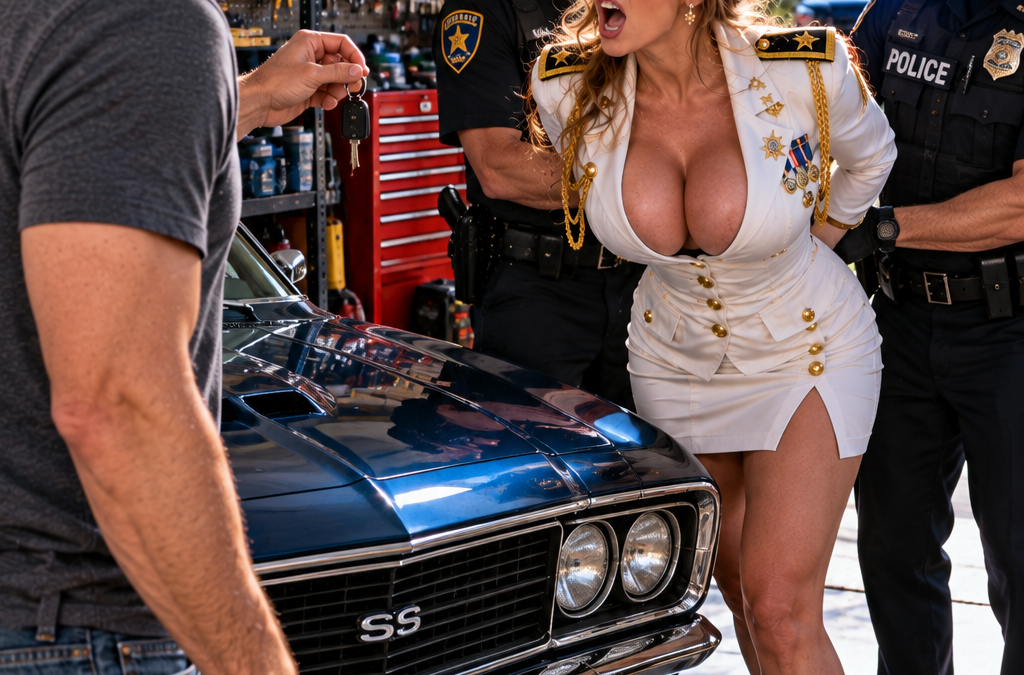
White jacket.
Gold buttons.
Tight skirt.
Plunging neckline.
Clipboard.
Sunglasses pushed into her blonde hair.
She smiled when she saw me.
Not warmly.
Victorious people smile that way before they’ve actually won.
“Good morning.”
“Karen.”
“The board discussed your situation.”
“My situation?”
“Your garage.”
I leaned against the doorframe.
“What about it?”
“We need to conduct an inspection.”
“Okay.”
She seemed surprised.
“Okay?”
“Send me the written notice required by the bylaws.”
Her smile thinned.
“This is an emergency inspection.”
“What’s the emergency?”
“We have safety concerns.”
“What safety concerns?”
“Regarding materials stored in the garage.”
“What materials?”
She stared at me.
I waited.
Finally she said, “That’s what we need to inspect.”
I glanced at her clipboard.
“Do you have anything in writing?”
“No.”
“Then it isn’t an authorized inspection.”
“The board discussed it.”
“That isn’t the same thing.”
“I am on the board.”
“I know.”
“I am telling you an inspection is required.”
“And I’m telling you the bylaws require written notice.”
She shifted closer.
The perfume arrived before the next sentence.
“Why are you being so difficult?”
“I’m not.”
“Normal homeowners don’t refuse safety inspections.”
“I’m not refusing one.”
“You literally are.”
“I’m asking you to follow the rules.”
Her jaw tightened.
“Those rules give us emergency authority.”
“Then identify the emergency.”
She didn’t.
I could almost see the gears turning.
Then she changed tactics.
“We also require a garage key.”
I laughed.
I didn’t mean to.
It escaped.
Karen’s face went blank.
“I’m sorry,” I said.
“You think that’s funny?”
“Yes.”
My wife was standing behind me now.
I could feel her trying not to react.
Karen lifted the clipboard.
“The HOA requires emergency access to all garages in case of fire, flood, gas leak, or other hazard.”
“Show me the policy.”
“I don’t need to show you anything.”
“Then I’m not giving you a key.”
“You’re obstructing an authorized inspection.”
“No.”
“You are.”
“No, Karen. You’re asking for access you aren’t entitled to.”
Her cheeks flushed.
“You need to understand something.”
Here we go.
“This community has standards.”
“So do I.”
“And homeowners who refuse reasonable cooperation create problems for everybody.”
“I’m not giving you keys to my house.”
“It’s the garage.”
“It’s attached to my house.”
“You have something in there you don’t want us seeing.”
That irritated me.
“Or I don’t want strangers entering my property whenever they feel like it.”
“Board representatives are not strangers.”
“You are not getting a key.”
Karen smiled again.
This time there was no warmth at all.
“Fine.”
“Fine.”
“You’ll regret making this difficult.”
My wife stepped closer.
“Is that a threat?”
Karen looked past me.
“I wasn’t speaking to you.”
My wife smiled.
“This is my house too.”
For once, Karen didn’t have an immediate answer.
I opened the storm door farther.
“Have a good day.”
“This isn’t over.”
“I didn’t think it was.”
I closed the door.
My wife stared at me.
“She is completely insane.”
“She’s not getting the key.”
“That’s not what worries me.”
“What does?”
“People like that don’t hear no as an answer.”
Ten minutes later, somebody knocked.
Hard.
I was still in the living room.
My wife looked toward the door.
“No way.”
I opened it.
Two police officers stood on the porch.
Karen was on the sidewalk behind them.
Arms folded.
Clipboard pressed against her body.
She looked pleased.
One officer spoke.
“Are you the homeowner?”
“Yes.”
“We received a call regarding a property-access dispute.”
I looked past him at Karen.
Of course we had.
“Come in.”
I invited the officers into the foyer.
I didn’t dramatize anything.
I pulled up the bylaws on my phone.
Showed them the inspection provision.
Showed them Karen’s fake open-garage notice.
Showed them her email.
Then I explained the conversation from ten minutes earlier.
One officer scrolled through the language.
“So the HOA can inspect?”
“With written notice and a legitimate reason.”
“And you haven’t received that?”
“No.”
“They asked for a key?”
“She did.”
“Is that in the bylaws?”
“No.”
He looked at his partner.
They went back outside.
I watched through the window.
Karen immediately started talking with both hands.
Pointing at our house.
Pointing toward the garage.
Pointing at her clipboard.
One officer said something.
Karen shook her head violently.
Then talked faster.
My wife stood beside me.
“She’s telling them we’re criminals.”
“Probably.”
“Can you imagine calling 911 because someone won’t give you their garage key?”
“I can now.”
The conversation lasted around fifteen minutes.
Eventually one officer returned.
He looked tired.
“This is a civil matter.”
“I figured.”
“Based on what you’ve shown us, the HOA needs to follow its own procedures if it wants an inspection.”
“Understood.”
“They can’t compel you to hand over keys through us.”
“Also understood.”
He lowered his voice slightly.
“If the situation keeps escalating, document every interaction.”
“I already am.”
“Good.”
“And if she keeps coming here?”
“You can make a harassment report if appropriate.”
“Thank you.”
As the officers walked back toward their cars, Karen marched up the driveway.
The officers had barely cleared the curb.
“This is not over.”
I looked at her.
“You called the police because I wouldn’t give you my garage keys.”
“They should have enforced the rules.”
“They aren’t HOA security.”
“The board will take action.”
“Then follow the bylaws.”
Her nostrils flared.
“You think you’re clever.”
“No.”
“You think embarrassing me in front of police changes anything?”
That sentence caught my attention.
Embarrassing me.
Not resolving the safety issue.
Not protecting the neighborhood.
Her.
“I didn’t call them.”
She stared.
“You made me call them.”
I almost answered.
Then decided against it.
“Have a nice evening, Karen.”
She turned sharply and walked away.
Before reaching her own property, she was already on the phone.
That night, I couldn’t relax.
My wife noticed.
“What’s wrong?”
“Something doesn’t make sense.”
“What?”
“Why my garage?”
“Because she hates happiness?”
“I’m serious.”
“So am I.”
“No. She’s not doing this because she likes inspections. She specifically wants inside.”
My wife thought about it.
“Maybe she thinks you have something illegal.”
“Like what?”
“You’re asking me to understand Karen.”
Fair point.
Two days later, I got my answer.
I was taking the trash bins back from the curb when our neighbor Michael walked over.
Michael was also on the HOA board.
He was the opposite of Karen.
Quiet.
Reasonable.
The sort of person who thought rules should solve problems instead of create opportunities for punishment.
“Got a minute?”
“Sure.”
He looked toward Karen’s house.
“Maybe inside.”
That immediately concerned me.
We went into my garage.
He stared at the car for a moment.
“That’s what all this is about?”
“What?”
“The business.”
I frowned.
“What business?”
Michael looked at me.
“You don’t know?”
“No.”
He exhaled.
“Karen has been telling the board you’re operating an unlicensed auto-repair business from your garage.”
I laughed.
Then stopped when I saw he wasn’t joking.
“What?”
“She says people come here for repairs.”
“My friend Mike comes over sometimes.”
“That’s probably what she means.”
“We work on his car together.”
“I know.”
“I don’t charge him.”
“I know.”
“I’m not running a business.”
“I know.”
“Then why is the board discussing it?”
Michael looked uncomfortable.
“Because she’s claiming she has evidence.”
“What evidence?”
“That’s the problem.”
He paused.
“When people asked her to produce it, she couldn’t.”
I felt something cold settle in my stomach.
“So why does she need inside?”
Michael nodded slowly.
“At the last meeting she said something like, ‘Once we get inside the garage, we’ll finally have the proof.'”
For a moment, neither of us spoke.
I leaned against my workbench.
“She doesn’t have evidence.”
“No.”
“She’s looking for evidence.”
“That’s how it sounded.”
“Evidence of something that isn’t happening.”
“Daniel—”
“So she decided I’m guilty first and now wants access so she can find something that supports it.”
Michael rubbed the back of his neck.
“I’m telling you because the board is discussing fines.”
That stopped everything.
“What fines?”
“If they determine you’re operating a prohibited business, the bylaws allow continuing-violation penalties.”
“How much?”
“Up to five hundred dollars per day.”
I stared at him.
He continued carefully.
“And unpaid assessments can eventually become a lien issue.”
My garage suddenly felt different.
The shelves.
Tools.
Car.
Work light.
Everything looked the same.
But the conflict wasn’t silly anymore.
Five hundred dollars a day.
Three thousand five hundred a week.
More than fifteen thousand a month.
A lien.
My house.
My wife’s house.
Our home.
The place we’d worked for.
The place where we’d built our life.
Karen wasn’t just being nosy.
She was building a case.
A false case.
“Does the board believe her?”
“Not everybody.”
“That’s not what I asked.”
Michael looked away.
“They’re taking the accusation seriously.”
“Without evidence?”
“She keeps saying the refusal to inspect is evidence you’re hiding something.”
I laughed bitterly.
“That’s convenient.”
“I agree.”
“Do you?”
He looked at me.
“That’s why I’m standing here.”
That calmed me slightly.
“Thank you.”
“Document everything.”
“The police told me the same thing.”
Michael glanced at the car.
“For what it’s worth, I’ve told them I’ve never seen customers here.”
“Because there aren’t any.”
“I know.”
After he left, I told my wife.
She sat at the kitchen table in silence.
Then she asked, “Can they take the house?”
“Not tomorrow.”
“That’s not what I asked.”
“If they fined us, and if we refused, and if it escalated far enough…”
Her face tightened.
“This is insane.”
“Yes.”
“You work on your own car.”
“I know.”
“Your friend comes over.”
“I know.”
“That’s not a business.”
“I know.”
She slapped her palm against the table.
“Then why are we even worried?”
Because I’d learned something.
Facts matter.
But so do procedures.
And if the person controlling the procedure is willing to lie, facts sometimes arrive late.
I called a lawyer the next morning.
His name was Andrew Collins.
I brought him everything.
Bylaws.
Emails.
Karen’s fake notice.
Police incident number.
Michael’s description of the board discussion.
He read quietly for almost twenty minutes.
Finally he said, “Do not let anyone into the garage without proper notice.”
“I wasn’t planning to.”
“They cannot demand a key.”
“Good.”
“They cannot conduct a surprise interior inspection under the language you’ve shown me.”
“Good.”
“And if they fine you without evidentiary basis, we challenge it.”
“How expensive?”
He gave me a look lawyers give before discussing numbers.
“Potentially less expensive if the board behaves reasonably once challenged.”
“And if they don’t?”
“More.”
I leaned back.
“Great.”
Andrew tapped Karen’s email.
“This is useful.”
“Why?”
“She’s documenting her own demands.”
He read the line about having nothing to hide.
“People love writing things they later wish they hadn’t.”
Then he paused.
“There is one option.”
“What?”
“You could voluntarily provide an emergency-access key.”
I stared.
“Absolutely not.”
He raised one hand.
“Hear me out.”
“I hired you to stop her getting a key.”
“And I’m telling you that voluntary emergency access is different from general inspection authority.”
“How?”
“You control the terms.”
He explained.
Some homeowners voluntarily gave management companies keys for genuine emergencies.
Fire.
Flood.
Gas leak.
Situations where immediate entry could prevent major damage.
The key didn’t automatically authorize inspections.
It didn’t waive privacy rights.
And the conditions could be stated explicitly in writing.
Something clicked.
Andrew saw my expression.
“What?”
“Nothing.”
“That’s not a nothing face.”
“If I voluntarily give them a key…”
“Yes?”
“And state clearly that it can only be used for an actual emergency…”
“Correct.”
“And state that use is monitored…”
Andrew stared at me.
“You’re thinking about cameras.”
“I was thinking about cameras before this conversation.”
He leaned back.
“I am advising you to protect your property, not manufacture a confrontation.”
“I’m not manufacturing anything.”
“If she follows the terms, nothing happens.”
“Exactly.”
He studied me for several seconds.
Then smiled slightly.
“Document everything.”
That afternoon I went to the hardware store.
I made one copy of the garage access key.
Then I bought cameras.
Not one.
Several.
Wide angle.
High resolution.
Motion activated.
Timestamped recording.
Cloud backup.
A door sensor that sent an alert directly to my phone.
Another camera aimed toward the tool area.
One covering the vehicle.
One showing the interior entry door.
Everything visible.
Nothing hidden in a place where anyone had a legitimate expectation of privacy.
My wife watched me on the ladder adjusting one camera.
“So you’re setting a trap.”
“No.”
She folded her arms.
“You’re installing four cameras and giving Karen the key she’s been demanding.”
“I’m protecting our property.”
“While giving Karen the rope.”
“That’s a colorful interpretation.”
She stared.
I climbed down.
“If she uses the key for a real emergency, there’s no problem.”
“And if she doesn’t?”
“Then we know.”
My wife shook her head.
“You know exactly what you’re doing.”
“Yes.”
“Okay.”
That evening, I emailed the HOA management company.
I copied Karen and the board president.
The language was deliberate.
After careful consideration, I am voluntarily providing one emergency access key for my attached garage.
This key is provided solely for immediate access during a genuine emergency, including active fire, flooding, gas leak, or other event involving imminent risk to persons or property.
The key does not constitute permission for inspections, investigations, compliance checks, or general property access.
Any use will be electronically logged and monitored.
I repeated the final sentence.
Electronically logged and monitored.
Karen responded in eleven minutes.
Thank you for finally complying with the board’s emergency access requirements.
Finally complying.
I forwarded it to Andrew.
His reply came quickly.
Save this.
I did.
For the next two weeks, Karen vanished.
No notes.
No emails.
No confrontations.
She didn’t stroll past the garage.
Didn’t mention inspections.
Nothing.
The silence made me more suspicious than the harassment had.
My wife noticed too.
“Maybe she gave up.”
“No.”
“You’re sure?”
“Completely.”
Then we had a family trip scheduled.
My wife’s parents lived a few hours away.
We planned to leave Friday afternoon and return Sunday.
On Thursday night, I tested every camera.
Opened the garage.
Closed it.
Walked through.
Checked notifications.
Checked cloud recordings.
Everything worked.
Friday before leaving, I told Michael we’d be gone for the weekend.
“Can you keep an eye on the place?”
“Sure.”
He paused.
“Karen know you’re leaving?”
“I haven’t told her.”
“Good.”
We left around three.
Nothing happened Friday night.
Saturday morning, I was sitting at my in-laws’ kitchen table.
Coffee.
Eggs.
My father-in-law complaining about property taxes.
Completely ordinary morning.
Then my phone buzzed.
GARAGE ENTRY DETECTED.
For a second I just looked at the screen.
My wife saw my face.
“What?”
I opened the camera app.
Live video appeared.
My garage.
Door open.
Then Karen walked into frame.
White fitted military-style jacket.
Gold buttons.
Plunging neckline.
Clipboard.
My key in her hand.
Behind her was an HOA maintenance employee named Steve.
I stopped breathing for a second.
My wife stood beside me.
“No.”
I didn’t answer.
Karen walked deeper into the garage.
She wasn’t rushing.
There was no water spraying.
No smoke.
No gas emergency.
No urgency whatsoever.
She held up her phone.
Started taking pictures.
My wife whispered, “Oh my God.”
I tapped record backup even though the system was already saving everything.
Karen photographed the tool chest.
Then the shelves.
Then the car.
She crouched low and angled the phone upward so my large tool cabinet filled the background.
Click.
Another angle.
Click.
She moved a container of spare parts closer to the workbench.
Click.
Then another.
She shifted two boxes.
Moved an oil container.
Pulled a tray from beneath the workbench.
My hands started shaking.
Not fear.
Rage.
My father-in-law asked from behind us, “What’s happening?”
My wife said, “Someone is inside our house.”
“Garage,” I corrected automatically.
It didn’t make it better.
Steve remained near the door.
Even through video, he looked uncomfortable.
Karen pointed toward something.
He shook his head.
She spoke.
The camera didn’t catch every word clearly, but enough.
“Just take it.”
Steve hesitated.
She handed him her phone.
Then she walked beside my tool chest.
Raised the clipboard.
Posed.
My wife looked at me.
“Is she taking a picture of herself?”
“Yes.”
“Inside our garage?”
“Yes.”
“While we’re out of town?”
“Yes.”
My father-in-law said, “Call the police.”
I almost did.
My finger hovered over the phone.
Then I stopped.
“Not yet.”
My wife stared.
“Why?”
“Because I want to know exactly what she’s doing.”
Karen moved toward the shelves.
Opened a box.
Looked through it.
Closed it.
Opened another.
She moved things again.
Took more pictures.
The original story’s emergency-access agreement explicitly restricted the key to genuine emergencies and warned that any use would be monitored; Karen later used it during the owner’s absence to enter with an HOA maintenance worker and stage photographs of the garage.
Every second felt invasive.
I’d thought seeing it on camera would feel satisfying.
Caught you.
Instead, it made me furious.
That was my garage.
My property.
My father’s old wrench set was in one drawer.
Insurance paperwork in another cabinet.
Parts I’d spent years collecting.
She was walking through it as though my home belonged to the HOA because she’d finally gotten hold of a key.
Then Karen moved my floor jack.
She repositioned a stack of parts near the car.
Photographed them.
The angle made the garage look completely different.
Tighter.
Busier.
More commercial.
I suddenly understood.
She wasn’t searching for evidence.
She was creating it.
Twenty minutes later, they left.
The door closed.
My phone displayed another notification.
GARAGE SECURED.
I stared at the screen.
My wife spoke first.
“We’re going home.”
“Yes.”
I called Michael.
He answered immediately.
“Everything okay?”
“Karen just entered my garage.”
Silence.
“What?”
“Using the emergency key.”
“Why?”
“That’s what I’d like to know.”
“Was there an emergency?”
“No.”
“You sure?”
“I watched the entire thing on camera.”
Another silence.
“She took pictures.”
“Of what?”
“Everything.”
“Jesus.”
“She moved things around first.”
Michael stopped speaking.
I could hear him breathing.
Then he said, “I had no idea.”
“I know.”
“She didn’t mention any inspection.”
“I know.”
“Send me nothing yet.”
That surprised me.
“What?”
“If you’ve got video, preserve it. Don’t circulate it. Bring it to the board properly.”
That was exactly what I intended to do.
Then I called Andrew.
He was silent for a long time after I explained.
Finally he said, “Do you have the original email establishing the terms of the key?”
“Yes.”
“Her response?”
“Yes.”
“Video showing entry?”
“Yes.”
“Timestamp?”
“Yes.”
“Video showing there was no emergency?”
“Twenty minutes of it.”
“Did she access closed containers?”
“Yes.”
“Did she move property?”
“Yes.”
“Preserve everything in multiple locations.”
“I already have cloud backup.”
“Download copies anyway.”
“Is this trespassing?”
“It may support several theories depending on local law and the precise facts. At minimum, it is plainly outside the permission you gave.”
“I don’t want to sue the HOA.”
“Then don’t decide that today.”
“I want the board to see what she did.”
“That’s reasonable.”
“I want her to explain it.”
Andrew paused.
“Be careful with wanting things emotionally.”
“What does that mean?”
“It means your strongest position is the truth. Don’t turn it into revenge.”
That calmed me.
“Understood.”
We shortened the trip.
My wife apologized to her parents.
Her mother hugged her.
Her father told me to call if we needed anything.
We drove home Sunday morning.
The first thing I did was inspect the garage.
No obvious damage.
But several items were not where I’d left them.
A box of gaskets had been moved.
The floor jack sat at a different angle.
Two parts containers had been shifted.
A stack of shop towels had been moved near the car.
Tiny things.
But once you’ve watched someone rearrange your belongings to manufacture a story about you, those small changes feel enormous.
My wife stood at the doorway.
“Can we change the lock?”
“After the meeting.”
“I don’t want her having that key.”
“Neither do I.”
That Sunday night, I built a timeline.
Original fake garage-door notice.
My response.
Karen’s email.
Her home visit.
Key demand.
Police call.
Police outcome.
Michael’s warning about the alleged illegal business.
Attorney consultation.
Emergency-key email.
Karen’s reply.
Trip dates.
Garage sensor alert.
Entry time.
Video.
Exit time.
Then I took screenshots.
Karen photographing my tool chest.
Karen moving boxes.
Karen opening containers.
Karen posing with the clipboard.
The maintenance man standing near the doorway.
I didn’t edit the underlying video beyond creating copies and clips.
The full recording remained preserved.
Monday morning, I requested a place on the agenda for the next HOA meeting.
My description was short.
Evidence concerning unauthorized use of HOA emergency access by a board member.
The management company approved it.
Karen apparently received the agenda too.
Because two hours later she emailed me.
Daniel,
I understand you have requested board time regarding emergency-access procedures.
Please be advised that any access undertaken by an HOA representative acting in a safety capacity is authorized under existing board powers.
I read it three times.
Then forwarded it to Andrew.
His reply:
Excellent.
My wife read it.
“She knows.”
“She suspects.”
“Is there a difference?”
“Enough.”
The week before the meeting was tense.
Karen did not approach us.
But I saw her several times.
Once while I was checking the mail.
She stood across the street talking to another homeowner.
White outfit.
Clipboard.
When she saw me, she smiled.
I smiled back.
Her expression changed slightly.
Another evening, her SUV drove slowly past our house.
My wife watched from the front window.
“She’s trying to scare us.”
“Maybe.”
“Is it working?”
“A little.”
She looked at me.
“Me too.”
That mattered.
I’d been treating the whole situation like a contest between me and Karen.
But my wife lived there too.
Every knock on the door affected her.
Every threat of fines.
Every mention of a lien.
Every possibility that the HOA might use fabricated evidence against our home.
One night she said, “What if the board protects her?”
I didn’t answer immediately.
She continued.
“She’s been doing this for years. What if they watch the video and somehow decide she was acting for the association?”
“Then Andrew gets involved.”
“And how much does that cost?”
“I don’t know.”
“Exactly.”
She sat on the edge of the bed.
“I’m angry too. I just want our home to feel like our home again.”
That was the moment the whole thing stopped being satisfying.
Catching Karen wasn’t enough.
I needed the system around her to respond.
If they didn’t, then she wasn’t the real problem.
The HOA was.
The meeting was Thursday night at the community center.
My wife came with me.
The parking lot was fuller than usual.
Word had gotten around that something serious was on the agenda.
We entered together.
Karen was already seated at the front with the other board members.
Same white jacket.
Same gold buttons.
Same dramatically low neckline.
Her blonde hair fell in smooth waves over one shoulder.
She looked completely composed.
There was a folder in front of her.
A stack of photographs inside it.
I knew immediately what they were.
My garage.
Her version of it.
Michael sat two seats away.
When our eyes met, he gave me the smallest nod.
The meeting began with ordinary business.
Landscaping.
Budget.
Fence request.
Pool maintenance.
I barely heard any of it.
My pulse was too loud.
Then the board chair looked toward me.
“Daniel Mercer?”
I stood.
My wife squeezed my hand before I walked forward.
I had my phone, printed documents, and a flash drive.
Karen leaned back in her chair.
I started calmly.
“I’d like to address a series of events involving access to my garage.”
Karen immediately shifted.
I continued.
“Several weeks ago, a notice was placed on my garage stating homeowners were required to leave garage doors open for random inspections.”
I displayed the notice.
Murmurs spread through the room.
“I reviewed our bylaws. That requirement does not exist.”
Karen interrupted.
“That notice was part of a proposed safety initiative.”
The chair looked at her.
“Karen, please let him finish.”
She pressed her lips together.
I continued.
“I contacted Karen and reminded her that the bylaws require reasonable written notice for interior inspection.”
I displayed her reply.
“If I had nothing to hide, she said, I should have no problem allowing access.”
More murmurs.
Karen shifted again.
“Later, she came to my house and demanded entry into my garage.”
“That’s not accurate.”
The chair raised his hand.
“Karen.”
She stopped.
“She called it an emergency inspection but could not identify the emergency.”
I looked around the room.
“She then demanded copies of my garage keys.”
One homeowner said, “What?”
Another whispered something.
I continued.
“When I refused, police officers arrived at my home shortly afterward because Karen had called about the dispute.”
Karen’s face was beginning to tighten.
“The officers reviewed the bylaws and told me this was a civil matter and the HOA couldn’t use the police to compel me to provide keys.”
I placed the police incident information on the table.
“Afterward, I learned Karen had accused me of operating an illegal auto-repair business from my home.”
Now Karen spoke.
“Because there were legitimate concerns.”
I turned toward her.
“What evidence did you have before entering my garage?”
She stared.
The chair stepped in.
“Daniel, continue your presentation.”
I nodded.
“I don’t operate a business.”
I looked at the audience.
“I work on my own vehicle. Occasionally a friend and I work on his car. Nobody pays me. I don’t have customers. There is no commercial enterprise.”
A neighbor near the back nodded.
“I’ve lived two houses away for six years. I’ve never seen customers there.”
Another voice said, “Same.”
Karen leaned forward.
“That doesn’t prove anything.”
The chair gave her a warning look.
I continued.
“After consulting an attorney, I voluntarily provided the HOA with an emergency key.”
Karen smiled faintly.
I held up the email.
“The terms were specific.”
I read them.
Fire.
Flood.
Gas leak.
Imminent risk.
Not inspections.
Not investigations.
Not compliance searches.
“And the email specifically stated that use of the key would be electronically monitored.”
Karen’s smile vanished.
I saw the first real change in her face.
The chair glanced toward her.
Then back at me.
I continued.
“Last weekend, my wife and I were out of town.”
Karen looked down.
“Saturday morning, my garage-door sensor notified me that someone had entered.”
Nobody moved.
“I opened the camera system.”
Karen’s face was beginning to redden.
“I watched Karen enter my garage using the emergency key.”
She spoke quickly.
“There were safety concerns.”
I looked directly at her.
“There was no emergency.”
“You don’t know what information we had.”
“I know what my cameras recorded.”
The room changed.
People sat straighter.
Karen went still.
I continued.
“The person who entered my garage spent approximately twenty minutes photographing my private property, opening containers, moving objects, repositioning parts, and creating photographs from selected angles.”
Karen’s mouth opened.
I kept speaking.
“Before I provided the key, I installed cameras.”
The color drained from her face.
For weeks, Karen had been demanding access to prove I was hiding something.
Now she looked like the person with something to hide.
The board chair leaned forward.
“You have footage?”
“Yes.”
“Full footage?”
“Yes.”
“With timestamps?”
“Yes.”
Karen spoke.
“This meeting is becoming a spectacle.”
The chair didn’t look at her.
“Daniel, can you display it?”
“Yes.”
I connected my phone to the projector.
The screen behind the board turned black.
Then my garage appeared.
Saturday.
10:14 a.m.
Door opening.
Karen entered.
There was an audible reaction from the room.
On the large screen, her white outfit looked almost absurd against the oil-stained practicality of my garage.
Gold buttons.
Clipboard.
Phone.
Behind her came Steve.
The maintenance employee.
Nobody spoke as the video played.
Karen walked to my tool chest.
Photographed it.
Moved a box.
Photographed again.
She went toward the shelves.
Shifted parts.
Photographed.
Someone behind me whispered, “Holy crap.”
The video continued.
Karen opened a container.
Looked inside.
Moved another item.
Steve remained near the door.
Then came the moment I knew would destroy any claim this had been an emergency.
Karen handed Steve her phone.
Walked beside my tool chest.
Raised the clipboard.
Posed.
The room erupted in murmurs.
Karen’s voice rose.
“This is being presented completely out of context.”
The chair turned.
“What context explains posing for a photograph during an emergency?”
She stopped.
I let the video continue.
Every movement.
Every angle.
Every box.
Every photograph.
Nobody laughed anymore.
Then the video ended.
The screen froze on my empty garage after they left.
Silence.
Real silence.
Not awkward.
Heavy.
I unplugged the phone.
Then I said, “I’d also like to discuss the photographs submitted against me.”
The management company representative looked up.
“What photographs?”
Karen’s head snapped toward her.
The representative began searching through the meeting materials.
Then her expression changed.
“Yes.”
She pulled out a packet.
“A complaint alleging operation of a prohibited automotive business.”
“Submitted by whom?”
She hesitated.
“Karen.”
The room reacted again.
Karen started talking.
“We have a responsibility to investigate potential covenant violations.”
I held up a screenshot from my surveillance footage.
“Can you show one of her submitted photographs?”
The management representative projected it.
There was my tool chest dominating the foreground.
Parts arranged behind it.
Car on stands.
Tightly framed.
If I hadn’t known the garage, I might have thought it belonged to a small repair business.
Then I projected the surveillance image taken at essentially the same time from a wide angle.
The difference was brutal.
One private car.
One workbench.
Storage shelves.
Normal residential garage.
Plenty of open space.
Karen had used angles and placement to manufacture density.
Then I showed the clip of her moving the parts before taking the photograph.
Someone in the audience said, “She staged it.”
Karen snapped toward them.
“I did not stage anything.”
I looked at her.
“You moved those boxes.”
“For safety.”
“You moved them together.”
“I was inspecting.”
“You posed with my tool chest.”
Her face turned red.
“Stop twisting everything.”
The board chair raised his hand.
“Karen.”
She turned toward him.
“You will have an opportunity to respond.”
“I need to respond now because this is character assassination.”
He stared at her.
“The video is not character assassination.”
She went quiet.
I returned to my seat beside my wife.
My hands were trembling.
She grabbed one.
“You okay?”
“Now I am.”
Not quite true.
Then the board chair asked Karen to respond.
She stood.
For the first time since I’d known her, the white military-style outfit no longer made her look authoritative.
It made her look like someone pretending.
She adjusted the front of the jacket.
Straightened the clipboard.
Then began.
“There have been long-standing concerns about activities at the Mercer property.”
“From whom?” Michael asked.
Karen looked at him.
“Multiple residents.”
“Names?”
“Confidential.”
Michael leaned back.
Of course.
Karen continued.
“There were concerns regarding fire safety, hazardous automotive chemicals, possible commercial inventory, and unusual vehicle-maintenance activity.”
I almost stood.
My wife squeezed my hand.
Stay seated.
Karen looked toward the audience.
“The board has a fiduciary responsibility to protect property values.”
Someone muttered, “Here we go.”
She continued.
“Based on the available information, I believed immediate access was necessary to determine whether a potentially hazardous situation existed.”
The chair asked, “What was the emergency?”
“Possible hazardous materials.”
“What indicated an immediate threat?”
“Automotive chemicals can be volatile.”
“Did you observe smoke?”
“No.”
“Did anyone report fire?”
“No.”
“Gas odor?”
“No.”
“Flooding?”
Karen hesitated.
“There had been concerns about water.”
That was when Steve raised his hand.
Everybody turned.
The maintenance employee had been sitting near the back.
He looked deeply uncomfortable.
The chair said, “Steve?”
He stood.
“Can I say something?”
“Please.”
Steve looked at Karen.
Then at the board.
“When she called me Saturday, she said there was a water leak.”
Karen’s face changed.
The chair leaned forward.
“A confirmed water leak?”
“That’s what she told me.”
Karen interrupted.
“I said there might be—”
Steve shook his head.
“No.”
“Excuse me?”
“You said there was water leaking in the garage and the homeowner was away.”
Karen glared at him.
“You may be remembering the exact wording incorrectly.”
“I’m not.”
His voice strengthened.
“You said it was an emergency and we needed to use the key before there was property damage.”
Nobody spoke.
Steve continued.
“When we got there, there was no water.”
The chair asked, “What did you do?”
“I told her I didn’t see a leak.”
“And?”
“She said since we were already inside, we should document the garage.”
Karen looked furious.
Steve kept going.
“I thought she had authorization.”
The chair asked, “Did she tell you the key was restricted to emergency access only?”
Steve looked at the floor.
“No.”
That was it.
Not dramatic.
No shouting.
No confession.
Just a maintenance worker telling the truth.
Karen had lied about an emergency to get someone to accompany her.
She had used an emergency key for a non-emergency.
She had manipulated my belongings.
She had submitted staged photographs as evidence.
And she had done it while trying to build a violation that could expose my family to hundreds of dollars in daily fines.
The chair asked Karen one final question.
“Did you tell Steve there was an active water leak?”
Karen crossed her arms.
Her white jacket tightened across her chest.
“I may have described a potential water issue.”
Steve shook his head again.
“No. You said there was a leak.”
Karen snapped, “Nobody asked you to editorialize.”
That might have been the moment she lost the room completely.
The chair’s expression hardened.
“Karen, that’s enough.”
She stared at him.
“Excuse me?”
“You’ve had several opportunities to explain.”
“I am explaining.”
“No. You’re changing the explanation every time another piece of evidence appears.”
Her mouth opened.
He continued.
“You requested access based on alleged safety concerns.”
“I did.”
“You called the police when the homeowner refused to surrender his key.”
“Because he was obstructive.”
“The police told you this was a civil matter.”
“They misunderstood the HOA’s authority.”
A few people laughed.
Karen spun toward the audience.
“This is not funny.”
Nobody answered.
The chair continued.
“Then an emergency key was provided under specific written restrictions.”
“Yes.”
“You used that key while the homeowner was away.”
“For safety.”
“After telling a maintenance employee there was a water leak.”
“A potential leak.”
“He says you told him there was an actual leak.”
Karen lifted her chin.
“I believed there was sufficient concern.”
“Then why were you moving boxes?”
“To inspect them.”
“Why did you photograph yourself with a clipboard beside his tool chest?”
She finally had nothing.
The silence lasted maybe five seconds.
It felt longer.
The board went into discussion.
Karen tried to remain.
The chair asked her to step away from the table while the other members considered an action concerning her conduct.
She stood abruptly.
“This is ridiculous.”
Nobody answered.
She moved to the side of the room.
For the first time, she was not sitting with the people who held power.
The vote came in stages.
First, the violation against me.
Cancelled.
Unanimously.
Second, any proposed fine.
Withdrawn.
Third, reimbursement for reasonable costs I had incurred specifically because of the emergency-key dispute.
The replacement key.
Security equipment.
Approved.
I wasn’t expecting that.
My wife looked at me.
“Seriously?”
I whispered, “Apparently.”
Then came policy.
No emergency key could be accessed by a single board member anymore.
Management-company authorization would be required.
The reason for entry had to be documented.
Actual evidence of an emergency had to exist whenever circumstances allowed.
Every use would be logged.
That passed too.
Then the chair took a breath.
“Final motion.”
Karen was standing against the wall.
Her face had gone pale.
“Removal of Karen Whitmore from her board position for misuse of association authority, unauthorized entry outside agreed emergency access, submission of misleading evidence, and material misrepresentation to association personnel.”
Karen stepped forward.
“You cannot be serious.”
The chair looked at her.
“I am.”
“I have served this community for seven years.”
Michael said quietly, “That’s part of the problem.”
She turned on him.
“You’ve been undermining me for months.”
“No.”
“You gave him confidential board information.”
“I warned a homeowner that you were trying to fine him without evidence.”
“You violated board confidence.”
“You lied about a water leak to enter his garage.”
Her voice rose.
“I was protecting property values!”
I stood before I meant to.
Everyone looked at me.
Karen did too.
I spoke calmly.
“No.”
She stared.
“You weren’t protecting the neighborhood.”
“You don’t get to tell me—”
“You decided I was guilty.”
She stopped.
“Then you tried to get inside so you could find something to justify it.”
Her face tightened.
“I saw what you were doing.”
“You saw what?”
“A man with tools?”
She pointed toward me.
“A garage filled with automotive equipment.”
“It’s a garage.”
“With industrial tools.”
“They sell my floor jack at Home Depot.”
Several people laughed.
Karen flushed.
I continued.
“You couldn’t find evidence of a business because I don’t run one. So you moved my property and framed photographs to make my garage look commercial.”
“That’s your interpretation.”
“It’s on video.”
“You set me up.”
There it was.
The sentence I’d been waiting for without realizing it.
“You gave me that key knowing—”
“Knowing what?”
She stopped.
I stepped closer to the front.
“Knowing you’d use an emergency key when there wasn’t an emergency?”
Her mouth opened.
Nothing came out.
“If you had followed the agreement, my cameras would have recorded nothing except an unopened door.”
The room went completely still.
“I didn’t force you into my garage.”
She glared at me.
“I didn’t tell you to lie to Steve.”
Her eyes flicked toward him.
“I didn’t make you move my belongings.”
She lowered her voice.
“You wanted this.”
“I wanted you to leave me alone.”
That was the truth.
More than victory.
More than embarrassment.
More than removing her.
I wanted our house back.
I wanted my garage to become a garage again instead of a battlefield.
The chair called for the vote.
Karen was removed.
Not by me.
By the board.
The same board position she’d used as a weapon disappeared in less than a minute.
She stood there through the result.
For once, she didn’t interrupt.
Then she gathered her clipboard, purse, and folder.
Her hands weren’t quite steady.
At the door, she turned toward me.
I expected another threat.
Maybe the police.
Maybe lawyers.
Maybe the board.
Instead she said, “I hope you’re proud of yourself.”
I thought about my wife lying awake worrying about our house.
The police on my porch.
Five-hundred-dollar daily fines.
A possible lien.
Karen walking through my garage while I watched from another city.
I answered honestly.
“I’m relieved.”
That seemed to hurt her more than pride would have.
She left.
The door closed.
And the room exhaled.
For the next twenty minutes, people started talking.
Really talking.
A neighbor said Karen had measured his fence three times after he disagreed with her over landscaping.
Another woman said she’d stopped putting decorations outside because Karen always found something wrong with them.
Someone else had received warning letters that seemed to appear whenever he questioned board spending.
Michael listened.
So did the chair.
The pattern became obvious.
Karen hadn’t just been enforcing rules aggressively.
She had been using enforcement personally.
A complaint became punishment.
Disagreement became scrutiny.
Privacy became suspicious.
And because most of the individual incidents looked small, nobody had connected them.
Trash cans.
Fence measurements.
Lawn height.
Garage doors.
One at a time, they looked petty.
Together, they looked like control.
My cameras had not created that problem.
They had simply made it visible.
When my wife and I got home, I went directly to the garage.
I unlocked the side door.
Walked inside.
Turned on the lights.
The muscle car sat exactly where it always had.
Blue paint reflecting the overhead fixtures.
Tools lined against the wall.
Shelves full of parts.
I stood there for several minutes.
My wife came in behind me.
“You okay?”
“Yeah.”
“Really?”
I looked around.
“For the first time in a while.”
She leaned against the workbench.
“Change the lock tomorrow.”
“Tonight.”
She smiled.
“Good.”
I changed it that night.
The emergency key Karen had demanded became useless before midnight.
In the following weeks, the neighborhood changed in ways I hadn’t expected.
The HOA didn’t disappear.
Rules didn’t disappear.
People still got notices.
Inspections still happened.
But they happened differently.
Written notice.
Actual reasons.
Records.
No surprise visits.
No single board member deciding she had emergency authority because she wanted access.
The new board members were boring.
And I mean that as the highest compliment possible.
Nobody walked around in white heels measuring fences.
Nobody placed homemade notices on garage doors.
Nobody called police because a resident quoted the bylaws.
Michael once joked that HOA meetings had become painfully dull.
I told him, “That’s what good HOA meetings are supposed to be.”
People seemed more relaxed.
Garage doors opened because homeowners wanted them open.
Kids played in driveways.
Neighbors worked on projects without looking over their shoulders.
My friend came over one Saturday to work on his car.
We had the hood up.
Tools everywhere.
Music playing.
At one point he looked toward the street.
“No Karen?”
“No Karen.”
“Can we legally use sockets now?”
“Only metric.”
He laughed.
It felt good.
A few months later, I finished the suspension work I’d been doing before Karen first appeared at my door.
I backed the muscle car out.
Washed it.
Took it for a long drive.
No destination.
Just road.
Engine noise.
Sunlight.
The kind of drive that reminded me why I had spent years keeping the thing alive.
When I returned, I parked in the driveway for a while instead of immediately putting it away.
Michael walked past.
He stopped.
“That’s the illegal business?”
I nodded.
“Very profitable.”
“How much have you made?”
“Negative several thousand dollars.”
“Excellent business model.”
“Thank you.”
He laughed.
Then became more serious.
“You know, that could’ve gone badly.”
“I know.”
“If you hadn’t installed cameras…”
“I know.”
“She submitted those photos before the meeting.”
I looked at him.
“I figured.”
“The board was going to discuss the violation.”
“Would they have fined me?”
Michael hesitated.
That was answer enough.
“Some people wanted more evidence.”
“Some?”
“Karen was pushing hard.”
“Five hundred a day?”
“That was being discussed.”
I looked toward my house.
My wife was visible through the front window.
Our home.
That was the part of the story that never became funny.
Without video, Karen would have had photographs.
Official-looking photographs.
Tool chest.
Car on jack stands.
Parts arranged like inventory.
A complaint from a board member.
A maintenance employee who might only have remembered being told there was an emergency.
I would have had my word.
Maybe we’d have won eventually.
Maybe.
After attorneys.
Appeals.
Meetings.
Thousands of dollars.
Stress.
That was what frightened me.
Karen almost didn’t need to prove I was guilty.
She only needed to create enough paperwork that defending myself became expensive.
I looked at Michael.
“Why didn’t anybody stop her before?”
He sighed.
“Because she always operated right at the edge.”
“What does that mean?”
“She was annoying, not obviously corrupt.”
“Until my garage.”
“Exactly.”
He looked toward her old house.
She still lived there at the time, though she no longer participated in anything.
“People also didn’t want to become her next project.”
That made sense.
Fear doesn’t always look dramatic.
Sometimes fear is leaving your trash can inside ten minutes early because you know which neighbor is watching.
Sometimes it’s not speaking at a meeting.
Sometimes it’s paying a fine you think is wrong because fighting it costs more.
Karen had built influence out of thousands of those tiny calculations.
Is this worth arguing about?
Usually the answer was no.
Until suddenly the argument involved my house.
I couldn’t afford for the answer to be no anymore.
About six months after the meeting, the board sent homeowners a revised emergency-access policy.
It was one page.
Clear.
Boring.
Emergency keys were voluntary.
Use required management approval except in an immediate life-safety situation.
Entries had to be documented.
Homeowners had to be notified.
No key could be used for routine compliance inspection.
I printed it.
Then I put it in the same folder where I’d kept Karen’s original fake notice.
My wife saw me.
“Souvenir?”
“Evidence.”
“Of what?”
“That sometimes reading the rules works.”
She laughed.
“Sometimes cameras work better.”
“Also true.”
Karen eventually stopped walking the neighborhood with her clipboard.
For a while, she’d still drive slowly past houses.
Then even that stopped.
Without the board title, people treated her differently.
Not cruelly.
Just normally.
That’s a strange thing about people addicted to authority.
Normal treatment feels like disrespect once they’ve grown accustomed to deference.
No special access.
No instant answers.
No ability to say “the board requires” when what she really meant was “I want.”
The white military-style outfits disappeared too.
I don’t know whether that was coincidence.
Maybe not.
The last time I saw her up close was at the mailbox cluster almost a year later.
I was getting my mail.
She walked up.
Regular jeans.
Sweater.
No clipboard.
For a moment neither of us spoke.
Then she said, “Your car still loud?”
I looked at her.
“It’s within the rules.”
Her mouth tightened.
“I wasn’t complaining.”
“Okay.”
Another silence.
Then she said, “The neighborhood has gotten sloppy.”
I looked around.
Lawns looked fine.
Houses maintained.
Kids’ bicycles in one driveway.
Someone had left a basketball near the curb.
Nothing catastrophic.
“Looks normal to me.”
She shook her head.
“People need standards.”
“I agree.”
That surprised her.
I continued.
“Standards should apply to the board too.”
Her expression hardened.
For a second, I saw the old Karen.
The one on my porch.
The one pointing at police.
The one inside my garage arranging my property to fit a story she’d already written.
Then it disappeared.
She took her mail.
Walked away.
That was the last real conversation we ever had.
Looking back, I don’t think Karen’s biggest mistake was entering the garage.
That was the mistake that got her caught.
The real mistake happened much earlier.
She convinced herself that suspicion gave her authority.
She believed my refusal to open my garage proved something.
Then my refusal to surrender a key proved something else.
Every boundary became evidence of guilt.
That’s dangerous.
Because once someone thinks resistance proves guilt, there is no way to prove innocence except surrendering every boundary they demand.
Open the garage.
Give me the key.
Let me inspect.
Let me search.
Let me photograph.
If you say no, you’re hiding something.
And if I search and find nothing?
Then I simply haven’t looked hard enough.
Karen wasn’t investigating a violation.
She had already decided one existed.
Everything after that was a hunt for justification.
That’s why the camera footage mattered.
Not because it caught her inside.
Because it revealed the process.
Move the boxes.
Change the angle.
Frame the photograph.
Create the appearance.
Then submit the appearance as evidence.
She didn’t enter to discover the truth.
She entered to manufacture the truth she needed.
And that is why I never felt guilty about giving her the emergency key.
People occasionally heard the story and said, “You trapped her.”
No.
A trap makes someone do something.
I gave Karen exactly what she claimed to need.
Emergency access.
With explicit restrictions.
If there had been a fire, she could have entered.
If there had been a flood, she could have entered.
If there had been a gas leak threatening the house, she could have entered.
If she’d never used the key, nothing would have happened.
If she’d requested a lawful inspection in writing, I would have let the HOA inspect.
The only path that caused her trouble was the path she chose herself.
Wait until we’re out of town.
Invent a leak.
Take the emergency key.
Enter without permission.
Move our property.
Stage photographs.
Submit them as evidence.
The cameras didn’t make her do any of that.
They simply refused to let her rewrite it afterward.
Years later, I still have cameras in the garage.
Different system now.
Better resolution.
Mostly I use them to check whether I remembered to close the door.
The muscle car is still there too.
Still costing me money.
Still worth every dollar.
My wife still occasionally reminds me that she was right about Karen from the beginning.
I pretend not to hear that part.
But she was.
One night not long ago, I was working under the hood and found the old folder in a cabinet.
Inside was Karen’s original notice.
ALL GARAGE DOORS MUST REMAIN OPEN DURING DAYTIME HOURS FOR RANDOM HOA INSPECTIONS.
I read it.
Then laughed.
That single sheet of paper had started everything.
Karen wanted an open garage.
Then an inspection.
Then my keys.
Then police.
Then fines.
Then evidence.
Every time I refused something she had no right to demand, she escalated.
Every escalation made the next one easier for her to justify.
Until finally she crossed the boundary so completely that even the people who had tolerated her for years couldn’t pretend anymore.
And the irony has never stopped being funny to me.
Karen spent months insisting she needed access because I was hiding something.
I wasn’t.
But she was.
She was hiding the fact that she had no evidence.
Hiding the fact that the open-garage rule was invented.
Hiding the fact that her “emergency inspection” had no emergency.
Hiding the fact that she intended to search first and justify it later.
Hiding the fact that she was willing to manipulate what she found.
All I did was give her the one thing she kept demanding.
Access.
On clear terms.
Then I waited.
She thought the key meant I’d finally surrendered.
She probably felt victorious when she opened my garage that Saturday morning.
She probably imagined the photographs spreading across the HOA table.
Five-hundred-dollar daily fines.
Maybe a forced stop to my hobby.
Maybe even the satisfaction of saying she’d known I was guilty all along.
Instead, every photograph she took became evidence against her.
Every object she moved was recorded.
Every false claim collapsed.
The maintenance employee told the truth.
The board saw exactly what happened.
The fake violation disappeared.
The fines disappeared.
The emergency policy changed.
Karen lost the position she’d been using to intimidate the neighborhood.
And my garage?
It remained exactly what it had always been.
One man’s private space.
One old muscle car.
Too many tools.
Too many parts.
No customers.
No illegal repair shop.
No secret operation.
Just a garage.
Karen had called 911 because I wouldn’t give her the key.
In the end, giving her that key was the decision that finally locked her out for good.