𝗙𝗨𝗟𝗟 𝗦𝗧𝗢𝗥𝗬 She Banned Me From Clearing Their Snow, Then Begged Me When Her Whole Neighborhood Was Buried
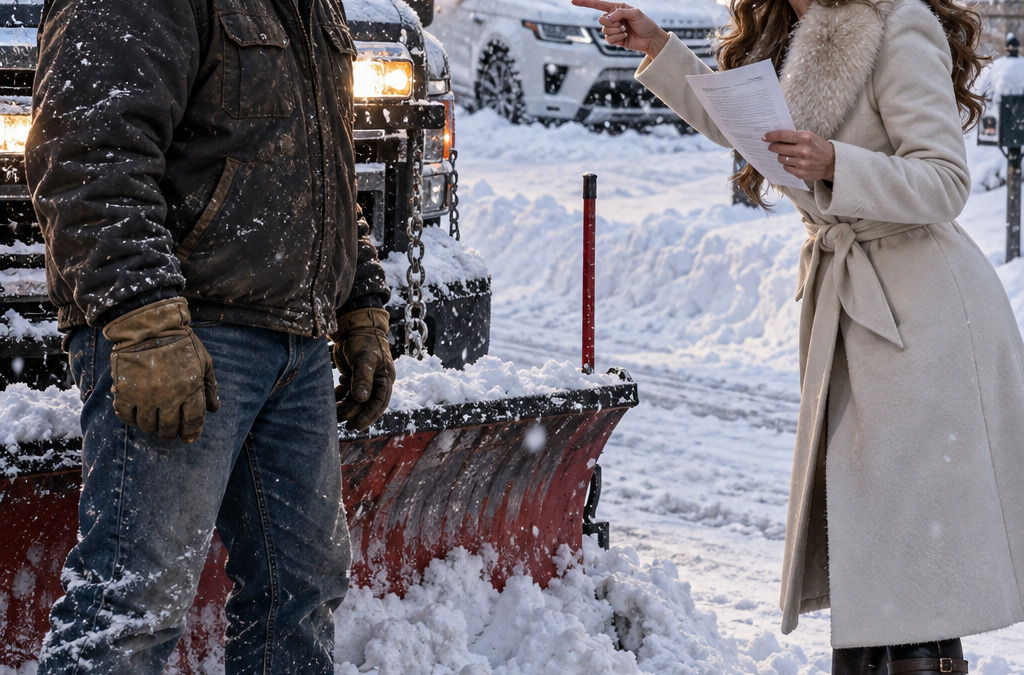
𝗙𝗨𝗟𝗟 𝗦𝗧𝗢𝗥𝗬 .
These were fancy, overpriced, smooth gray stones arranged like the entrance to a boutique hotel.
Karen stepped into the road as I approached, one hand lifted.
I stopped because hitting the HOA president with a landscaping truck felt like bad public relations, even for someone outside the HOA.
She walked to my driver’s window with slow, deliberate confidence, sunglasses perched on her head, lips painted a glossy pink. She smiled like we were friends.
“You’re the snow guy,” she said.
“I’m Mark,” I replied.
Her smile did not change. “Right. The snow guy.”
That told me everything I needed to know about how she categorized people.
“What can I do for you?” I asked.
She glanced at my truck, then toward the road behind me. “I’ve noticed your commercial vehicles come through here frequently.”
“I live back there.”
“I know.” She said it like my existence was an administrative inconvenience. “I’m reviewing neighborhood traffic and road impact.”
“The roads are public.”
Her smile tightened. “That’s a common misconception.”
“It’s not.”
Her eyes flickered. She was not used to being corrected quickly.
“Well,” she said, recovering, “we’ll be sending out updated information soon. I just wanted to introduce myself.”
“You did.”
For a second, the pretty mask slipped. Her mouth hardened.
Then she laughed softly, leaning a little closer to the open window. “You seem like a very direct man, Mark.”
“I run on coffee and diesel. Not much room for poetry.”
She looked me over in a way that might have been flirtatious if it had not felt like an inspection.
“I’m sure we’ll be speaking again.”
“I’m sure.”
She stepped back.
I drove on.
That would have been forgettable if it had not become the opening scene of a very stupid disaster.
Two weeks later, I found a letter stuffed into my mailbox.
Not mailed.
Stuffed.
That was already illegal, but I was too annoyed by the content to appreciate the full stupidity of the delivery method.
The letter was on HOA stationery. It stated that the board had reviewed its financial obligations and determined that all “residents utilizing HOA-maintained streets” were required to pay a new annual street maintenance fee of five hundred dollars. Payment was due by November 1st. Failure to pay could result in restricted access to HOA amenities and services.
I read it once.
Then again.
Then a third time while standing beside my mailbox in work boots, wondering whether I had lost my mind.
HOA-maintained streets?
The township maintained those roads. Township plows cleared them when they had time. Township crews patched potholes. Township taxes paid for it. The HOA maintained the entrance sign, some flowers, and now apparently a pile of decorative rocks that probably cost more than my first truck.
As for amenities, there were none.
No pool.
No clubhouse.
No tennis courts.
Unless Karen considered her personality a shared facility, I had no idea what she thought I was using.
I called the number on the letter.
Karen answered on the second ring.
“HOA office,” she said, crisp and pleased with herself.
“Karen, this is Mark. I got your street maintenance letter.”
“Oh, good. Then you’re aware of the new fee.”
“I’m aware you put something in my mailbox.”
A pause.
“I beg your pardon?”
“You can’t stuff unstamped letters in mailboxes. That’s not what I called about, but you should know.”
Her voice cooled. “The board is communicating important community information.”
“I’m not part of the community association.”
“You use the roads.”
“The roads are public.”
“The roads run through our community.”
“They run through the township.”
Her breathing changed. I could practically hear her deciding whether to charm or attack.
She chose attack wrapped in silk.
“Mark, I understand you may not be familiar with how community governance works, but residents who benefit from shared infrastructure need to contribute.”
“I’m not a resident of the HOA.”
“You live behind us.”
“Behind you is not inside you.”
Silence.
Then, sharply, “That was unnecessary.”
“So is the fee.”
She lowered her voice, the way people do when they think sounding calm makes them sound powerful. “The board has voted. The decision is final.”
“No board can vote me into an HOA I don’t belong to.”
“You use our snow removal services every winter.”
That made me laugh.
I couldn’t help it.
“Your what?”
“Our snow removal services.”
“Karen, I am the snow removal.”
“You operate equipment on HOA streets.”
“I plow those streets for free.”
“Exactly. You perform a commercial service.”
“For free.”
“With commercial equipment.”
“With my equipment.”
“In our neighborhood.”
“On public roads.”
“You’re twisting words.”
“No, I’m defining them correctly.”
Her voice turned flat. “The fee is due November 1st.”
“I’m not paying it.”
“We’ll see about that,” she said.
Then she hung up.
I stared at my phone for a while, then laughed again, but there was less humor in it that time.
I had dealt with difficult customers. I had dealt with property managers who thought snow should disappear for the price of a pizza. I had dealt with guys in suits who called during blizzards asking if I could “just swing by real quick” as if my truck teleported.
But Karen was different.
Customers wanted service.
Karen wanted authority.
And authority, once invented, needs victims to prove it exists.
Two weeks later, the second letter came.
This one was more formal, probably because Karen had discovered fonts with serifs.
It stated that because I had refused to contribute to street maintenance despite “regular use of HOA snow removal services,” the HOA was formally prohibiting me and my commercial vehicles from operating on HOA streets. It further stated that I was banned from performing snow removal operations on HOA property and would be fined one hundred dollars per occurrence if found plowing HOA streets.
I stood in my shop reading it while one of my employees, Luis, changed a cutting edge on the plow blade.
He looked up. “Bad news?”
“Karen banned me from plowing the neighborhood.”
He blinked. “The neighborhood you plow for free?”
“Apparently, yes.”
“Can she do that?”
“No.”
“Are you gonna do it anyway?”
I looked at the letter again.
That was the question.
Technically, Karen had no authority over me. The roads were public, and I had access rights. But snow plowing was trickier. If she wanted to make a fight out of it, she could waste my time, threaten fines, harass me, complain to the township, maybe even interfere with my business. I had paying contracts to handle. I did not need a power-drunk HOA president turning my goodwill into a legal headache.
So I called her again.
This time, I recorded the notes afterward because experience had taught me that people like Karen made paper trails necessary.
She answered with a tone that suggested she had expected my call and already won.
“Karen,” I said, “I got your second letter.”
“Then I trust the matter is clear.”
“No. It’s actually more confused than before.”
“I don’t see how.”
“I have never charged anyone in your HOA for plowing. I have never been paid by the HOA. I’ve been clearing those streets for six winters as a courtesy.”
She laughed.
It was a pretty laugh, light and mean.
“Nice try.”
I closed my eyes for a second. “What does that mean?”
“It means I’m not naïve. You run a commercial operation. You drive around with your logo on your truck. You clear the streets and build goodwill so residents will hire you privately. It’s a client pipeline.”
“A client pipeline?”
“Unauthorized commercial activity.”
“I am literally doing unpaid labor.”
“Then you won’t mind stopping.”
That sentence sat between us.
I leaned back against my workbench.
“Just so I understand,” I said slowly. “You are ordering me not to plow the neighborhood streets anymore.”
“That’s correct.”
“Even though residents have relied on me doing that for years.”
“They will rely on the HOA now.”
“You have a plow contract?”
“That is HOA business.”
“It becomes my business if you’re telling me to stop doing something people count on.”
“Do not flatter yourself,” she snapped. “You are not some hero. You’re a man with a truck who has been using our neighborhood as advertising space.”
I felt my temper stir.
I pictured Margaret’s pie. The kids’ thank-you cards. The tired dads waving in the dark.
Then I pictured Karen in her white SUV, deciding all of it was a scam because she could not imagine doing something without leverage attached.
“What happens when it snows?” I asked.
“The HOA will contract with a professional service.”
“Have you done that?”
“That is not your concern.”
“It will be when the road is buried.”
“Your arrogance is incredible.”
“My blade is useful.”
“You are prohibited from operating your snow plow on HOA streets,” she said, each word sharp and formal. “If you need to access your property, you may drive through in a personal vehicle only. No commercial trucks, no plows, no equipment. This is your final warning.”
I let the silence stretch.
Then I said, “Okay.”
She seemed thrown. “Okay?”
“Okay. I’ll comply.”
Another pause.
She had wanted a fight. She had dressed herself emotionally for one. I could hear it in the way her breath caught when I did not give her resistance.
“Yes,” she said finally. “Good.”
“Send me anything else in writing.”
“I already did.”
“Great.”
I hung up.
Then I sat down at my desk and wrote an email.
Per our phone conversation today, I acknowledge your directive that I cease all snow removal operations on HOA streets effective immediately. I will comply with this request and restrict plowing to my private property boundaries only.
I copied Karen, the HOA email, and my attorney.
My attorney replied twenty minutes later.
Document everything. Take photos. Do not plow their roads unless they rescind in writing.
That was exactly what I planned to do.
I also texted a handful of neighbors I was friendly with, including Tim, a guy four houses down from the entrance, and Margaret’s daughter, who checked on her often.
Just a heads-up: HOA president has formally banned me from plowing HOA streets. I’ll only be clearing my property unless they reverse it in writing.
The responses came fast.
What?
Why?
That’s insane.
Karen did what?
I sent screenshots of the letter and email.
People were confused, but November stayed weirdly warm, and confusion has a short shelf life when no snow is falling. Karen sent out a neighborhood email a week later claiming the HOA had secured professional snow removal for the season. She did not name the company. She did not provide a schedule. She simply declared it handled.
Most people moved on.
I did too.
I had commercial contracts to finalize, blades to inspect, salt deliveries to schedule, and trucks to keep running. If Karen wanted to save me thirty minutes of unpaid work every snow event, fine. I could use the time.
That was what I told myself.
Still, every time I drove through those streets, I felt a little sad.
Not guilty.
Sad.
Because the neighborhood had been one of those rare places where a small kindness became a habit. It made winter less lonely. When you plow at three in the morning, you exist in a world most people never see. Empty roads. Dark houses. Snow falling through orange streetlights. You clear paths for people who are asleep, and by the time they wake up, the work looks almost inevitable, as if the road decided on its own to reappear.
I liked being part of that.
Karen had turned it into a threat.
The first storm came on December 3rd.
I woke at 2:30 a.m. before my alarm, because my body knew. The wind was pushing snow against the windows in thick, white sheets. My phone showed fourteen inches overnight and more bands forming to the west. The radar looked ugly.
Good money weather.
Bad human weather.
I dressed in layers, filled my travel mug, and headed to the shop.
The truck started hard, grumbling in the cold. I let it warm while I inspected the blade under the yard light. Snow glittered in the beam like static. The world was silent except for diesel rumble and wind.
I cleared my driveway first.
Then the private road.
The blade bit into the snow with that deep, satisfying scrape that every plow driver knows. Snow rolled off to the side in heavy waves. The truck pushed, groaned, corrected, pushed again. By the time I reached the boundary where my property ended and the HOA neighborhood began, I stopped.
Ahead of me, the main loop was buried.
Untouched.
White from curb to curb.
For six winters, this was the moment when I would drop the blade and keep going. I knew the route in muscle memory. Angle left past the entrance. Push wide near Tim’s driveway because the road crowned there. Back-drag the turn by Margaret’s street if the township hadn’t been through. Watch the mailbox near number 17 because the post leaned in winter.
My hand hovered near the plow control.
Then I remembered Karen’s voice.
You are prohibited.
Final warning.
One hundred dollars per occurrence.
I lifted the blade higher.
Then I drove forward slowly, leaving the snow exactly where it was.
It felt wrong.
Not illegal. Not immoral. Wrong in the body, like walking past someone who dropped groceries and not helping because their lawyer sent you a letter saying hands off the apples.
A few houses had lights on already. People were beginning to wake, look outside, and realize the old magic had failed. I saw a man in a robe standing in his garage, shovel in hand, staring at the street as if it had betrayed him. Someone else waved at me, confused.
I kept driving.
My truck rocked through the deep snow. Even with four-wheel drive, it was rough going without the blade clearing the path. I could feel the packed weight grabbing at my tires.
At the entrance, I turned onto the main road and headed to my commercial route.
For the next eight hours, I worked.
Office park. Medical building. Pharmacy lot. Dentist’s office. Strip mall. Salt. Scrape. Stack. Repeat.
By noon, my back hurt, my gloves were soaked, and I had seven missed calls.
Fifteen texts.
Most were from neighborhood residents.
Hey Mark, did your truck break?
Are you plowing today?
Street is still buried. Do you know when HOA plow comes?
Did Karen tell you something?
Tim called twice.
I called him back while sitting in a gas station lot eating a protein bar that had frozen around the edges.
He answered immediately.
“Please tell me you’re sick or your plow exploded or something.”
“Nope.”
“Then what the hell is going on?”
“I’m complying with Karen’s ban.”
A long silence.
Then, very quietly, “Her what?”
I sent him the letter while we were on the phone.
He opened it.
I heard him exhale.
“You have got to be kidding me.”
“I wish I was.”
“She told people you were still doing it until the contractor took over.”
“She told me I was forbidden.”
“That woman told me this morning the plow service was delayed but on its way.”
“She has a plow service?”
“You’re asking me?”
“I asked her weeks ago. She said it was HOA business.”
Tim swore.
Tim was a patient guy most days. Two kids, practical job, friendly enough to wave even when running late. But I could hear anger climbing up his voice.
“My wife couldn’t get out this morning,” he said. “I had to park near the entrance and hike back to the house. Half the street is stuck.”
“I’m sorry.”
“I know this isn’t on you.”
“It feels like it is.”
“It’s not.” His voice hardened. “Send me everything.”
I did.
By evening, the neighborhood Facebook group was burning.
I was not in the group, but Tim sent screenshots. Residents were demanding answers. Someone posted a picture of my perfectly cleared driveway beyond the boundary, next to the buried HOA street, with the caption: Why is Mark’s road perfect and ours looks like Antarctica?
Karen responded after hours of silence.
The contracted snow removal provider has experienced weather-related delays due to regional demand. Service is expected first thing tomorrow. Please remain patient and avoid spreading misinformation.
Misinformation.
That word did a lot of work for a woman whose entire snow plan appeared to be vibes and arrogance.
Tomorrow came.
No plow.
The first storm settled, compressed, and hardened. Then Wednesday night brought another six inches. By Thursday morning, the neighborhood had close to twenty inches of snow and ice packed into the roads.
I cleared my property again and stopped at the boundary again.
This time, I took photos.
My driveway looked like a runway. The HOA street looked like a warning.
Driving through without plowing was miserable. I had switched to my personal truck because Karen’s letter had specifically threatened commercial vehicles and equipment. Even then, the tires fought for traction. Snow dragged under the frame. At one point near the side street, I had to rock forward and back to keep from getting stuck.
People were outside shoveling paths not just through driveways, but into the road itself, trying to create tire tracks by hand.
I saw Tim helping an older couple push a Subaru.
I saw a teenager fall waist-deep into a drift near a mailbox.
I saw Margaret standing at her front window, small and worried behind the glass.
That one hurt.
I almost stopped.
My hands tightened on the steering wheel.
Then I pictured Karen waving another letter, another fine, another accusation that I was operating commercially against orders. I pictured legal fees, business reputation, insurance problems. I pictured my attorney’s email.
Do not plow unless they rescind in writing.
So I drove on.
Sometimes doing the right legal thing feels morally disgusting.
By Thursday afternoon, Margaret called me.
I did not recognize the number, but I answered because in snow removal, unknown numbers often mean someone is trapped.
Her voice trembled.
“Mark? This is Margaret from Birch Lane.”
“Hi, Margaret.”
“I’m sorry to bother you.”
“You’re not bothering me.”
“I have a doctor’s appointment today. Well, I had one. My daughter tried to come get me, but her car got stuck turning onto our street.”
I closed my eyes.
“I’m sorry.”
“Could you maybe clear just my street?” she asked. “Just enough for us to get out? I wouldn’t ask, but it’s important.”
I leaned against my kitchen counter, looking out toward my clean driveway and the white disaster beyond.
“Margaret, I want to. I really do.”
“I know Karen said something, but surely she can’t—”
“She formally banned me in writing. My attorney told me not to plow unless the HOA rescinds it in writing.”
There was a silence.
Then she said, softly, “She did this?”
“Yes.”
“She told us you refused to help because you wanted to force the HOA to pay you.”
My jaw tightened.
Of course she did.
“She lied.”
“I thought so,” Margaret whispered. “You never asked for anything.”
“No, ma’am.”
She took a shaky breath. “I’m sorry, dear.”
“You don’t need to apologize.”
“Yes,” she said. “Someone should.”
After we hung up, I sat there for a long time.
Then I forwarded Margaret’s number to Tim and told him what had happened.
His reply came back almost instantly.
I’m handling this.
By Friday morning, another eight inches had fallen.
The neighborhood was no longer inconvenient.
It was dangerous.
Cars sat abandoned at odd angles. Residents with sedans had given up. People with trucks and SUVs were packing down narrow, icy ruts that would freeze into ridges. Kids were climbing snowbanks taller than they were. Delivery drivers refused to enter. One home health aide parked outside the neighborhood and walked in carrying supplies.
The township got involved after multiple complaints.
A code enforcement officer came out and took photos. I watched from my property as he trudged through the main loop, boots sinking deep. He spoke with several residents. I later heard he told them the roads had to be cleared within forty-eight hours or the township would do it and bill the HOA.
Estimated cost: three thousand dollars.
That number spread through the neighborhood like sparks on dry grass.
By Saturday morning, people were done.
I came back from an early salt run to find nearly thirty residents gathered near the entrance with handmade signs.
Where’s Our Plow?
Karen Buried Us.
Free Mark’s Blade.
One sign had Karen’s face badly photoshopped onto the Snow Queen from Frozen. It was not high art, but it was emotionally accurate.
I slowed as I passed.
People waved.
Someone cheered.
I gave a small wave back, uncomfortable and touched and worried all at once.
Then Karen arrived.
Her white SUV came gliding toward the entrance, tires struggling slightly in the rutted snow. She stopped beside the protest and rolled down her window. Even from a distance, I could see she was dressed like she was arriving at a boardroom instead of a neighborhood revolt: cream coat, oversized sunglasses, red lipstick, hair falling perfectly over one shoulder.
She looked furious.
Someone started recording.
I could not hear every word live, but Tim sent me the video later.
Karen’s voice was sharp enough to cut through the wind.
“This is harassment,” she shouted from her SUV. “I am doing everything possible to resolve an unprecedented weather event.”
A man yelled, “Where’s the plow company?”
“They’re delayed due to equipment issues.”
“What’s the company name?”
“That is confidential vendor information.”
People booed.
Karen’s face flushed bright red.
“You are all being incredibly ungrateful,” she snapped. “I volunteered my time to lead this association, and this is how you treat me?”
Margaret, standing bundled near Tim, called back, “You stopped the man who used to clear the roads.”
Karen’s head whipped toward her.
“He was operating illegally.”
Someone else yelled, “He was helping us.”
“He was exploiting you,” Karen shouted.
That was when Tim stepped forward.
“You lied to us,” he said.
Karen pointed one manicured finger at him. “Be very careful.”
“No,” Tim replied. “You be careful.”
For a moment, even on the video, you could feel the shift.
Karen had spent months making people afraid of her letters, her fines, her polished authority. But snow had humbled the entire neighborhood. People were cold, trapped, embarrassed, and angry. Fear had lost its usefulness.
Karen saw it too.
She rolled up her window and drove away.
That afternoon, the township issued formal pressure. That evening, one of the HOA board members who was not Karen sent out an email calling an emergency meeting for Sunday at 6 p.m. at the community center.
I was not invited because I was not an HOA member.
I did not want to go anyway.
Still, I spent most of Sunday restless.
The meeting started at six. At 6:08, Tim texted: Packed room. Standing room only.
At 6:21: Karen has a speech.
At 6:30: She keeps saying “vendor reliability issues.”
At 6:37: Someone asked vendor name. She said confidential. People laughed.
Then nothing for almost an hour.
I sat at my kitchen table, boots still on, phone beside my coffee mug, feeling strangely nervous for people I was not legally connected to and a fight I had not chosen.
Finally, at 7:42, Tim called.
His voice sounded like he had just run a mile.
“You’re not going to believe this.”
“Try me.”
“It was a massacre.”
He told me everything.
Karen had opened with a prepared statement about unprecedented snowfall, contractor delays, safety priorities, and patience. She stood at the front of the room in a fitted black turtleneck and gray slacks, looking sleek and authoritative and completely unprepared for a room that no longer wanted performance.
Someone asked for the name of the snow removal company.
Karen refused.
Someone asked for proof a contract existed.
Karen said vendor negotiations were confidential.
Then Tim stood up.
He had done research.
That was the thing Karen had not counted on. Snow trapped people at home with time, anger, and internet access.
Tim had reviewed HOA bylaws and meeting minutes. The supposed vote banning my plowing had occurred at a meeting where only Karen, her friend Linda the secretary, and one remote board member had been present. No quorum. No valid binding vote.
The ban was not just stupid.
It was procedurally invalid.
Karen tried to interrupt.
Tim kept going.
He had called three local snow removal companies and gotten seasonal quotes. All were between thirty-five hundred and five thousand dollars for the neighborhood. Emergency service after multiple storms would cost far more. None of the companies he contacted had any record of being approached by Karen or the HOA.
Someone shouted, “So there is no contractor?”
Karen insisted there was.
“Name them,” someone yelled.
She refused.
Then the money questions started.
A resident who had been reviewing financial records stood up and revealed that Karen had approved over four thousand dollars in landscaping upgrades around the entrance sign, including nine hundred dollars in decorative rocks. She had also authorized three hundred dollars a month to Linda for “administrative services” that nobody remembered voting on.
The room erupted.
Karen tried to shout over them, saying the president had executive discretion. A retired attorney in the room stood and read the bylaw stating expenditures over five hundred dollars required a full board vote.
Then Margaret stood.
According to Tim, that was when the room went quiet.
Margaret was small, elderly, and respected by everyone. She had lived there longer than most of them. She did not shout. She did not insult Karen. She simply said that for six years, I had plowed the streets for free. I had never asked for money. I had never advertised. I had never used kindness as a business scheme. Karen had created a conflict where none existed, and her decision had directly put residents at risk, including Margaret herself.
That did what anger could not.
It gave the room a moral center.
Someone moved for an immediate vote of no confidence in the board.
Karen objected, claiming improper notice. But the bylaws allowed emergency votes if more than fifty percent of residents were present, and they had just over sixty percent in the room.
They voted.
Karen was removed.
Linda was removed.
The inactive remote board member was removed too, though apparently he barely cared because he owned his house as an investment property and had no idea what was happening most of the time.
Tim was elected interim president along with three other residents.
Their first official action was to rescind the ban on my plowing and issue an apology.
I sat silently while Tim finished.
Then I said, “Well.”
He laughed, exhausted. “Yeah.”
“Congratulations, President Tim.”
“Don’t you dare.”
I smiled for the first time all week.
Then he got serious.
“Mark, I know this is a lot, and I know you got burned. But people are stuck. The streets are bad. The budget is a mess, and we can’t pay you properly right now. Would you be willing to plow us out one time? As a favor?”
I looked toward the window.
Outside, the snowbanks glowed under the yard light. My truck sat ready in the shop lot. The blade was attached.
“I need it in writing,” I said.
“Absolutely.”
“I want the new board to acknowledge that I’m authorized to plow voluntarily, without compensation, and that the HOA won’t fine me, penalize me, or make claims against me for doing it.”
“I’ll send it tonight.”
“I’m not touching those streets until I have that email.”
“I understand.”
Twenty minutes later, the email arrived.
It was signed by Tim and the interim board members. Clear authorization. No compensation. No liability claim from the HOA. Formal rescission of Karen’s directive. Apology included.
I forwarded it to my attorney.
His reply: Good enough. Be careful.
At 10 p.m., I started the truck.
The diesel engine turned over with a deep growl that felt almost alive. I let it warm while I checked the hydraulic lines and lights. The air was bitter cold, the kind that bites the inside of your nose. The neighborhood beyond my property was dark except for porch lights and the occasional glow of someone watching from a window.
I drove to the boundary.
For the first time in nearly a week, I dropped the blade.
The sound of steel hitting packed snow echoed through the road.
Then I pushed.
It was ugly work.
Fresh powder is easy compared to snow that has been driven over, partially melted, refrozen, and buried again. The blade scraped, bucked, and caught. I had to take smaller bites, angle carefully, make multiple passes. The truck strained. Snow rolled off in heavy chunks, gray and icy beneath the white top layer.
I cleared the main loop first.
Then the side streets.
Driveway mouths were plugged with frozen ridges from the few vehicles that had managed to push through. I opened them as best I could without entering private property. People came outside despite the hour, bundled in coats and hats, waving from porches. Someone clapped. Someone shouted thank you. At Margaret’s street, her porch light flickered twice.
I worked for four hours.
By the time I finished, the streets were clear curb to curb. Not perfect, but passable. Safe. Back to what they should have been days earlier.
I parked at my shop around 2:30 a.m., the same hour I usually started work.
For a moment, I sat in the truck and listened to the engine tick.
I was exhausted.
I was also relieved.
Not because Karen had lost, though I would be lying if I said that did not satisfy some petty corner of my soul. I was relieved because the neighborhood had a way out again. Because Margaret could get to appointments. Because parents could drive to work. Because kids would not be climbing through dangerous ruts near stuck cars.
Because the road was a road again.
The next morning, my porch was covered.
Thank-you cards. Cookies. Gift cards. A case of beer. A fifty-dollar Home Depot card tucked under a snow globe paperweight so it would not blow away. Someone left a handwritten note that simply said, Sorry we let her speak for us.
That one stayed with me.
Margaret came by around noon with another pie.
I saw her coming slowly up the cleared path, bundled in a navy coat, carrying the pie like an offering. I hurried out to meet her because I did not want her climbing my porch steps in the ice.
“You didn’t have to do that,” I said.
She smiled. “Neither did you.”
That shut me up.
She handed me the pie.
“I hope you won’t hold this against the neighborhood,” she said.
“I don’t.”
“She fooled some people.”
“She bullied others.”
Margaret nodded, eyes sad. “Yes. That too.”
We stood there for a moment in the cold.
Then she said, “You know, dear, some people mistake a kind man for an easy one.”
I looked toward the HOA streets, clean and shining under winter sun.
“Karen did.”
Margaret’s smile sharpened.
“And look where it got her.”
Karen tried to fight the vote.
Of course she did.
She sent emails claiming the emergency meeting had been improper. She accused Tim of staging a coup. She said residents had been manipulated by misinformation. She threatened legal action against the HOA, against Tim, and, somehow, against me.
My attorney told me not to respond.
So I didn’t.
That silence seemed to drive her insane.
People like Karen need engagement. They need arguments to twist, reactions to weaponize, emotional scenes to reframe later. When you give them nothing but documentation, they start swinging at air.
The bylaws were clear. The vote stood.
The interim board hired an independent bookkeeper to review HOA finances. More came out. Not criminal, from what I heard, but ugly. Unauthorized payments. Inflated landscaping expenses. Linda’s monthly administrative fee with no proper approval. Petty reimbursements for things Karen had decided counted as board expenses, including meeting refreshments from a boutique bakery that cost more than some families spent on groceries.
Residents were furious all over again.
Karen stopped attending meetings.
Then she stopped posting in the Facebook group.
By February, a For Sale sign appeared in front of her house.
The day I drove past and saw it, I felt something I can only describe as peaceful amusement.
Karen had arrived like a queen.
She left because snow exposed her.
She and her husband moved out by April. I never spoke to her again directly, though I saw her once during the move. She stood in the driveway wearing oversized sunglasses while movers carried boxes into a truck. Even then, she looked glamorous, expensive, and deeply offended by reality.
As I passed, she turned her head toward my truck.
For a second, our eyes met.
I gave her a polite little wave.
She did not wave back.
Some traditions remain.
The new board turned out to be solid.
Tim served as interim president for about six months until they held proper elections. During that time, the HOA passed rules requiring financial transparency, multiple quotes for major services, and full resident input on big decisions. They formally documented that my property had legal access through the streets and that I was not subject to HOA rules or fees. They also added a note in the minutes thanking me for years of voluntary snow removal.
That mattered more than I expected.
Not because I needed applause.
Because the record was finally honest.
For six years, I had done a good thing quietly. Karen had looked at it and seen a scam because that was the only language she understood. The new board wrote down the truth: voluntary, neighborly, appreciated.
The next winter, I kept plowing the streets.
Still free.
Still unofficial in the sense that I did not invoice them or sign a seasonal contract. But now, after each season, the HOA board voted to give me a small gift card or something similar as a thank-you. Nothing huge. Nothing that turned kindness into business. Just a gesture.
And everyone knew the arrangement.
No mystery.
No power games.
No Karen.
Sometimes people ask why I kept doing it after all that. They assume I would have been bitter enough to let the neighborhood deal with its own snow forever. I understand that. A part of me considered it.
But the neighborhood was never the enemy.
The residents were not the ones who wrote the letter. Margaret did not ban me. Tim did not accuse me of running a scam. The kids who left thank-you cards did not invent fines. Most people had simply trusted the person elected to handle things and then learned, the hard way, that trust without oversight is just an invitation.
So I kept plowing.
But I also kept every email.
Every authorization.
Every thank-you note.
Every board minute.
Kindness is still kindness when documented.
Maybe that sounds cynical.
Maybe it is.
But winter teaches you to prepare for what can go wrong while still doing the work that needs doing.
Years later, I can still picture that first morning after Karen’s ban. My truck at the boundary. Blade lifted. Buried street ahead. My hand hovering over the control. That awful feeling of driving past people I wanted to help because one arrogant woman had turned help into liability.
I hated that moment.
I also needed it.
Because it taught everyone else what invisible labor looks like when it disappears.
For six winters, those residents woke up to cleared roads and thought, That’s nice.
After Karen, they woke up to twenty inches of snow and understood, That mattered.
Karen wanted control.
She wanted fees from people she had no right to charge. She wanted authority over roads she did not own. She wanted credit for services she had not arranged and obedience from a man who did not belong to her HOA.
What she got instead was a neighborhood full of trapped, angry residents reading bylaws by flashlight while snow piled against their garage doors.
I do not think winter punished Karen.
Winter just revealed her.
That is what hard weather does. It strips away speeches. It does not care about glossy hair, luxury SUVs, pretty smiles, or titles printed under names in HOA newsletters. When snow falls hard enough, people need competence. They need honesty. They need the person with the blade to be allowed to drop it.
Karen forgot that.
Everyone else remembered.
Now, when the forecast calls for heavy snow, my phone still buzzes. Not with panic. Not with threats. Usually just Tim sending a message like, Big one coming. Stay safe out there.
Margaret passed away a couple years after the whole mess, and her daughter brought me one of her handwritten recipe cards for the pie she used to make. I keep it pinned on the wall in my shop, tucked between a parts schedule and a salt supplier invoice.
It reminds me why I still clear the roads.
Not for the HOA.
Not for authority.
Not for applause.
For people.
For the old woman with the doctor’s appointment. For the parent trying to get to work. For the kid waiting at the window to see whether school might actually happen. For the tired neighbor scraping ice in the dark who looks up when my headlights come around the bend.
And yes, maybe a little for the satisfaction of knowing that somewhere out there, Karen probably still tells the story differently.
I’m sure in her version, she was a dedicated president undermined by ungrateful residents and a rude snowplow man with a grudge.
That is fine.
The roads know the truth.
So do the people who stood in front of their buried houses and finally realized what she had taken from them.
The last real conversation I ever had about Karen happened with Tim after a February storm the following year. I had just finished clearing the loop, and he came out with coffee in a travel mug for me.
“Still can’t believe she banned you,” he said, watching snow steam off my hood.
I took the coffee. “I can.”
He laughed. “Yeah, I guess you saw it sooner than we did.”
“People like Karen are easy to spot when they’re aiming at you.”
He nodded toward the clean street. “Well, for what it’s worth, we’re not letting another one happen.”
“That’s worth a lot.”
He looked embarrassed for a second.
Then he said, “I’m sorry we didn’t pay attention until it affected us.”
That was honest.
I appreciated it more than a perfect apology.
“Most people don’t,” I said.
He nodded.
Then I climbed back into my truck and headed toward the next side street, blade low, lights cutting through the falling snow.
The work was still hard.
It was still cold.
It still started before dawn and left my shoulders aching by noon.
But the road opened behind me, black pavement appearing where there had been only weight and silence.
That has always been the best part.
Not beating Karen.
Not watching the HOA revolt.
Not seeing the For Sale sign.
The best part is still the moment the blade drops, the truck leans into the storm, and the path comes back one push at a time.
Karen banned me from clearing her neighborhood because she thought kindness was a hustle.
Then the snow came.
And for five long days, everyone learned exactly what my free work had been worth.
By the end, Karen lost her title, her audience, her control, and eventually her place in the neighborhood.
I kept my business.
I kept my property rights.
And when winter came again, I kept doing what I had always done.
Only this time, every person on those streets knew the difference between someone who wants power and someone who shows up with a plow when the world is buried.
𝗧𝗛𝗘 𝗘𝗡𝗗
She Banned Me From Clearing Their Snow, Then Begged Me When Her Whole Neighborhood Was Buried
Karen told me I was forbidden from plowing her neighborhood streets, so when the storm came, I lifted my blade and drove past every buried driveway.
For six winters, I had cleared those roads for free before sunrise, asking for nothing but the right to be left alone.
Then one power-hungry HOA president decided kindness looked too much like weakness, and twenty inches of snow proved her wrong.
I have learned that winter does not care who thinks they are in charge.
Snow does not stop at an HOA boundary. Ice does not read bylaws. A blizzard does not pause because some woman in a tailored coat and high-heeled boots has decided she runs the neighborhood like a private kingdom.
Winter comes down on everyone equally.
That was the part Karen never understood.
By the time she moved into our neighborhood, I had already spent six years waking up before most people had finished dreaming. I owned a small landscaping and snow removal business in upstate New York, the kind of operation that sounds simple until you are out in the dark at three in the morning, fighting lake-effect snow with numb fingers, burning coffee in your stomach, and watching the sky reload while your truck’s heater struggles to keep the windshield clear.
It was brutal work.
It was also honest work.
I had two plow trucks, a small shop, a few commercial contracts, and a body that could predict snow better than half the apps on my phone. My customers were office parks, strip malls, medical buildings, little industrial lots where employees needed pavement before sunrise. If I missed a storm, people lost business. If I showed up late, someone slipped. So I did not show up late.
My house sat at the very back of a development that most people called “the HOA neighborhood,” even though the roads running through it were technically public streets maintained by the township. My property was different from the others. It was about three acres, sold separately back in the nineties when the developer carved up the land. It was zoned for a home business, which meant I could keep my trucks and equipment there legally.
That was why I bought it.
I had looked my deed over with a lawyer before signing anything. I had a legal easement and right-of-way access through the neighborhood streets to reach my land. I was not part of the HOA. I did not pay dues. I did not follow their paint rules, mailbox rules, trash-can rules, or whatever other little rules people invented when they had too much free time and not enough actual problems.
Still, I tried to be a good neighbor.
For six winters, after clearing my long driveway and the private road leading to my shop, I would drop my blade and plow the HOA streets on my way out to work. It took me maybe thirty extra minutes. The layout was simple: one main loop and three side streets. I was already in the truck. The plow was already mounted. The diesel was already warm.
So I cleared it.
No invoice. No contract. No handshake agreement. Just a neighbor doing something decent because snow can make life hard, and I had the equipment to make it a little easier.
People appreciated it.
I got waves from tired dads scraping windshields in the dark. Kids left crooked thank-you cards in my mailbox. Around Christmas, cookies appeared on my porch. One elderly woman named Margaret once brought me a homemade pie and told me I had saved her from missing a cardiology appointment.
That meant more to me than money.
I liked knowing the neighborhood could count on me.
Then Karen moved in.
She bought one of the bigger houses near the entrance with her husband, though nobody ever talked about him much because Karen occupied enough space for both of them. She was around forty, maybe a little older, but she had the kind of polished beauty that made age feel like something she had negotiated down. Long chestnut-brown hair, glossy and expensive. Bright red nails. A white luxury SUV that always looked freshly washed, even in mud season. She wore fitted coats, tight sweaters, designer boots, and perfume strong enough to survive a snowstorm.
She was beautiful.
That was part of her weapon.
Karen had a way of smiling at men like she was letting them in on a secret and looking at women like she had already found three things wrong with them. She flirted when it helped her, pouted when challenged, and turned cold the second charm stopped working. Within two months, she had inserted herself into every neighborhood conversation like she had been appointed by God to correct everyone’s lives.
Within four months, she became HOA president.
That was when the neighborhood changed.
PART 2
Before Karen, the HOA had been mostly harmless.
The previous president was an older guy named Walt who seemed to believe the best government was the one that sent the fewest emails. He made sure the entrance flowers got watered, collected dues without drama, and occasionally reminded people not to leave trash cans at the curb for three days. Under Walt, the HOA was boring.
Boring is underrated.
Karen turned it into theater.
Her first month as president, she sent violation letters for things nobody had cared about in twenty years. One family’s mailbox was “an inconsistent shade of black.” Another had a bird feeder that, according to Karen, “encouraged wildlife congregation.” A retired couple got written up because their pumpkins remained on the porch two days after Halloween. She created a nine-page holiday decoration policy with specific language about bulb temperature, inflatable lawn displays, and “visual harmony.”
I watched all of it from a distance.
Again, I was not in the HOA.
My property sat beyond their little kingdom, and my equipment was parked behind my shop where nobody could see it from the road unless they trespassed. I drove through the neighborhood because I had a legal right to do so. I waved when people waved. I kept to myself.
Karen never waved back.
The first time we actually spoke was at the neighborhood entrance in late September. I was coming back from a mulch delivery, driving my older Chevy 2500 with the company logo on the door. She was standing near the entrance sign, supervising two landscapers who were placing decorative rocks around the flower bed.
Not normal rocks.
These were fancy, overpriced, smooth gray stones arranged like the entrance to a boutique hotel.
Karen stepped into the road as I approached, one hand lifted.
I stopped because hitting the HOA president with a landscaping truck felt like bad public relations, even for someone outside the HOA.
She walked to my driver’s window with slow, deliberate confidence, sunglasses perched on her head, lips painted a glossy pink. She smiled like we were friends.
“You’re the snow guy,” she said.
“I’m Mark,” I replied.
Her smile did not change. “Right. The snow guy.”
That told me everything I needed to know about how she categorized people.
“What can I do for you?” I asked.
She glanced at my truck, then toward the road behind me. “I’ve noticed your commercial vehicles come through here frequently.”
“I live back there.”
“I know.” She said it like my existence was an administrative inconvenience. “I’m reviewing neighborhood traffic and road impact.”
“The roads are public.”
Her smile tightened. “That’s a common misconception.”
“It’s not.”
Her eyes flickered. She was not used to being corrected quickly.
“Well,” she said, recovering, “we’ll be sending out updated information soon. I just wanted to introduce myself.”
“You did.”
For a second, the pretty mask slipped. Her mouth hardened.
Then she laughed softly, leaning a little closer to the open window. “You seem like a very direct man, Mark.”
“I run on coffee and diesel. Not much room for poetry.”
She looked me over in a way that might have been flirtatious if it had not felt like an inspection.
“I’m sure we’ll be speaking again.”
“I’m sure.”
She stepped back.
I drove on.
That would have been forgettable if it had not become the opening scene of a very stupid disaster.
Two weeks later, I found a letter stuffed into my mailbox.
Not mailed.
Stuffed.
That was already illegal, but I was too annoyed by the content to appreciate the full stupidity of the delivery method.
The letter was on HOA stationery. It stated that the board had reviewed its financial obligations and determined that all “residents utilizing HOA-maintained streets” were required to pay a new annual street maintenance fee of five hundred dollars. Payment was due by November 1st. Failure to pay could result in restricted access to HOA amenities and services.
I read it once.
Then again.
Then a third time while standing beside my mailbox in work boots, wondering whether I had lost my mind.
HOA-maintained streets?
The township maintained those roads. Township plows cleared them when they had time. Township crews patched potholes. Township taxes paid for it. The HOA maintained the entrance sign, some flowers, and now apparently a pile of decorative rocks that probably cost more than my first truck.
As for amenities, there were none.
No pool.
No clubhouse.
No tennis courts.
Unless Karen considered her personality a shared facility, I had no idea what she thought I was using.
I called the number on the letter.
Karen answered on the second ring.
“HOA office,” she said, crisp and pleased with herself.
“Karen, this is Mark. I got your street maintenance letter.”
“Oh, good. Then you’re aware of the new fee.”
“I’m aware you put something in my mailbox.”
A pause.
“I beg your pardon?”
“You can’t stuff unstamped letters in mailboxes. That’s not what I called about, but you should know.”
Her voice cooled. “The board is communicating important community information.”
“I’m not part of the community association.”
“You use the roads.”
“The roads are public.”
“The roads run through our community.”
“They run through the township.”
Her breathing changed. I could practically hear her deciding whether to charm or attack.
She chose attack wrapped in silk.
“Mark, I understand you may not be familiar with how community governance works, but residents who benefit from shared infrastructure need to contribute.”
“I’m not a resident of the HOA.”
“You live behind us.”
“Behind you is not inside you.”
Silence.
Then, sharply, “That was unnecessary.”
“So is the fee.”
She lowered her voice, the way people do when they think sounding calm makes them sound powerful. “The board has voted. The decision is final.”
“No board can vote me into an HOA I don’t belong to.”
“You use our snow removal services every winter.”
That made me laugh.
I couldn’t help it.
“Your what?”
“Our snow removal services.”
“Karen, I am the snow removal.”
“You operate equipment on HOA streets.”
“I plow those streets for free.”
“Exactly. You perform a commercial service.”
“For free.”
“With commercial equipment.”
“With my equipment.”
“In our neighborhood.”
“On public roads.”
“You’re twisting words.”
“No, I’m defining them correctly.”
Her voice turned flat. “The fee is due November 1st.”
“I’m not paying it.”
“We’ll see about that,” she said.
Then she hung up.
I stared at my phone for a while, then laughed again, but there was less humor in it that time.
I had dealt with difficult customers. I had dealt with property managers who thought snow should disappear for the price of a pizza. I had dealt with guys in suits who called during blizzards asking if I could “just swing by real quick” as if my truck teleported.
But Karen was different.
Customers wanted service.
Karen wanted authority.
And authority, once invented, needs victims to prove it exists.
Two weeks later, the second letter came.
This one was more formal, probably because Karen had discovered fonts with serifs.
It stated that because I had refused to contribute to street maintenance despite “regular use of HOA snow removal services,” the HOA was formally prohibiting me and my commercial vehicles from operating on HOA streets. It further stated that I was banned from performing snow removal operations on HOA property and would be fined one hundred dollars per occurrence if found plowing HOA streets.
I stood in my shop reading it while one of my employees, Luis, changed a cutting edge on the plow blade.
He looked up. “Bad news?”
“Karen banned me from plowing the neighborhood.”
He blinked. “The neighborhood you plow for free?”
“Apparently, yes.”
“Can she do that?”
“No.”
“Are you gonna do it anyway?”
I looked at the letter again.
That was the question.
Technically, Karen had no authority over me. The roads were public, and I had access rights. But snow plowing was trickier. If she wanted to make a fight out of it, she could waste my time, threaten fines, harass me, complain to the township, maybe even interfere with my business. I had paying contracts to handle. I did not need a power-drunk HOA president turning my goodwill into a legal headache.
So I called her again.
This time, I recorded the notes afterward because experience had taught me that people like Karen made paper trails necessary.
She answered with a tone that suggested she had expected my call and already won.
“Karen,” I said, “I got your second letter.”
“Then I trust the matter is clear.”
“No. It’s actually more confused than before.”
“I don’t see how.”
“I have never charged anyone in your HOA for plowing. I have never been paid by the HOA. I’ve been clearing those streets for six winters as a courtesy.”
She laughed.
It was a pretty laugh, light and mean.
“Nice try.”
I closed my eyes for a second. “What does that mean?”
“It means I’m not naïve. You run a commercial operation. You drive around with your logo on your truck. You clear the streets and build goodwill so residents will hire you privately. It’s a client pipeline.”
“A client pipeline?”
“Unauthorized commercial activity.”
“I am literally doing unpaid labor.”
“Then you won’t mind stopping.”
That sentence sat between us.
I leaned back against my workbench.
“Just so I understand,” I said slowly. “You are ordering me not to plow the neighborhood streets anymore.”
“That’s correct.”
“Even though residents have relied on me doing that for years.”
“They will rely on the HOA now.”
“You have a plow contract?”
“That is HOA business.”
“It becomes my business if you’re telling me to stop doing something people count on.”
“Do not flatter yourself,” she snapped. “You are not some hero. You’re a man with a truck who has been using our neighborhood as advertising space.”
I felt my temper stir.
I pictured Margaret’s pie. The kids’ thank-you cards. The tired dads waving in the dark.
Then I pictured Karen in her white SUV, deciding all of it was a scam because she could not imagine doing something without leverage attached.
“What happens when it snows?” I asked.
“The HOA will contract with a professional service.”
“Have you done that?”
“That is not your concern.”
“It will be when the road is buried.”
“Your arrogance is incredible.”
“My blade is useful.”
“You are prohibited from operating your snow plow on HOA streets,” she said, each word sharp and formal. “If you need to access your property, you may drive through in a personal vehicle only. No commercial trucks, no plows, no equipment. This is your final warning.”
I let the silence stretch.
Then I said, “Okay.”
She seemed thrown. “Okay?”
“Okay. I’ll comply.”
Another pause.
She had wanted a fight. She had dressed herself emotionally for one. I could hear it in the way her breath caught when I did not give her resistance.
“Yes,” she said finally. “Good.”
“Send me anything else in writing.”
“I already did.”
“Great.”
I hung up.
Then I sat down at my desk and wrote an email.
Per our phone conversation today, I acknowledge your directive that I cease all snow removal operations on HOA streets effective immediately. I will comply with this request and restrict plowing to my private property boundaries only.
I copied Karen, the HOA email, and my attorney.
My attorney replied twenty minutes later.
Document everything. Take photos. Do not plow their roads unless they rescind in writing.
That was exactly what I planned to do.
I also texted a handful of neighbors I was friendly with, including Tim, a guy four houses down from the entrance, and Margaret’s daughter, who checked on her often.
Just a heads-up: HOA president has formally banned me from plowing HOA streets. I’ll only be clearing my property unless they reverse it in writing.
The responses came fast.
What?
Why?
That’s insane.
Karen did what?
I sent screenshots of the letter and email.
People were confused, but November stayed weirdly warm, and confusion has a short shelf life when no snow is falling. Karen sent out a neighborhood email a week later claiming the HOA had secured professional snow removal for the season. She did not name the company. She did not provide a schedule. She simply declared it handled.
Most people moved on.
I did too.
I had commercial contracts to finalize, blades to inspect, salt deliveries to schedule, and trucks to keep running. If Karen wanted to save me thirty minutes of unpaid work every snow event, fine. I could use the time.
That was what I told myself.
Still, every time I drove through those streets, I felt a little sad.
Not guilty.
Sad.
Because the neighborhood had been one of those rare places where a small kindness became a habit. It made winter less lonely. When you plow at three in the morning, you exist in a world most people never see. Empty roads. Dark houses. Snow falling through orange streetlights. You clear paths for people who are asleep, and by the time they wake up, the work looks almost inevitable, as if the road decided on its own to reappear.
I liked being part of that.
Karen had turned it into a threat.
The first storm came on December 3rd.
I woke at 2:30 a.m. before my alarm, because my body knew. The wind was pushing snow against the windows in thick, white sheets. My phone showed fourteen inches overnight and more bands forming to the west. The radar looked ugly.
Good money weather.
Bad human weather.
I dressed in layers, filled my travel mug, and headed to the shop.
The truck started hard, grumbling in the cold. I let it warm while I inspected the blade under the yard light. Snow glittered in the beam like static. The world was silent except for diesel rumble and wind.
I cleared my driveway first.
Then the private road.
The blade bit into the snow with that deep, satisfying scrape that every plow driver knows. Snow rolled off to the side in heavy waves. The truck pushed, groaned, corrected, pushed again. By the time I reached the boundary where my property ended and the HOA neighborhood began, I stopped.
Ahead of me, the main loop was buried.
Untouched.
White from curb to curb.
For six winters, this was the moment when I would drop the blade and keep going. I knew the route in muscle memory. Angle left past the entrance. Push wide near Tim’s driveway because the road crowned there. Back-drag the turn by Margaret’s street if the township hadn’t been through. Watch the mailbox near number 17 because the post leaned in winter.
My hand hovered near the plow control.
Then I remembered Karen’s voice.
You are prohibited.
Final warning.
One hundred dollars per occurrence.
I lifted the blade higher.
Then I drove forward slowly, leaving the snow exactly where it was.
It felt wrong.
Not illegal. Not immoral. Wrong in the body, like walking past someone who dropped groceries and not helping because their lawyer sent you a letter saying hands off the apples.
A few houses had lights on already. People were beginning to wake, look outside, and realize the old magic had failed. I saw a man in a robe standing in his garage, shovel in hand, staring at the street as if it had betrayed him. Someone else waved at me, confused.
I kept driving.
My truck rocked through the deep snow. Even with four-wheel drive, it was rough going without the blade clearing the path. I could feel the packed weight grabbing at my tires.
At the entrance, I turned onto the main road and headed to my commercial route.
For the next eight hours, I worked.
Office park. Medical building. Pharmacy lot. Dentist’s office. Strip mall. Salt. Scrape. Stack. Repeat.
By noon, my back hurt, my gloves were soaked, and I had seven missed calls.
Fifteen texts.
Most were from neighborhood residents.
Hey Mark, did your truck break?
Are you plowing today?
Street is still buried. Do you know when HOA plow comes?
Did Karen tell you something?
Tim called twice.
I called him back while sitting in a gas station lot eating a protein bar that had frozen around the edges.
He answered immediately.
“Please tell me you’re sick or your plow exploded or something.”
“Nope.”
“Then what the hell is going on?”
“I’m complying with Karen’s ban.”
A long silence.
Then, very quietly, “Her what?”
I sent him the letter while we were on the phone.
He opened it.
I heard him exhale.
“You have got to be kidding me.”
“I wish I was.”
“She told people you were still doing it until the contractor took over.”
“She told me I was forbidden.”
“That woman told me this morning the plow service was delayed but on its way.”
“She has a plow service?”
“You’re asking me?”
“I asked her weeks ago. She said it was HOA business.”
Tim swore.
Tim was a patient guy most days. Two kids, practical job, friendly enough to wave even when running late. But I could hear anger climbing up his voice.
“My wife couldn’t get out this morning,” he said. “I had to park near the entrance and hike back to the house. Half the street is stuck.”
“I’m sorry.”
“I know this isn’t on you.”
“It feels like it is.”
“It’s not.” His voice hardened. “Send me everything.”
I did.
By evening, the neighborhood Facebook group was burning.
I was not in the group, but Tim sent screenshots. Residents were demanding answers. Someone posted a picture of my perfectly cleared driveway beyond the boundary, next to the buried HOA street, with the caption: Why is Mark’s road perfect and ours looks like Antarctica?
Karen responded after hours of silence.
The contracted snow removal provider has experienced weather-related delays due to regional demand. Service is expected first thing tomorrow. Please remain patient and avoid spreading misinformation.
Misinformation.
That word did a lot of work for a woman whose entire snow plan appeared to be vibes and arrogance.
Tomorrow came.
No plow.
The first storm settled, compressed, and hardened. Then Wednesday night brought another six inches. By Thursday morning, the neighborhood had close to twenty inches of snow and ice packed into the roads.
I cleared my property again and stopped at the boundary again.
This time, I took photos.
My driveway looked like a runway. The HOA street looked like a warning.
Driving through without plowing was miserable. I had switched to my personal truck because Karen’s letter had specifically threatened commercial vehicles and equipment. Even then, the tires fought for traction. Snow dragged under the frame. At one point near the side street, I had to rock forward and back to keep from getting stuck.
People were outside shoveling paths not just through driveways, but into the road itself, trying to create tire tracks by hand.
I saw Tim helping an older couple push a Subaru.
I saw a teenager fall waist-deep into a drift near a mailbox.
I saw Margaret standing at her front window, small and worried behind the glass.
That one hurt.
I almost stopped.
My hands tightened on the steering wheel.
Then I pictured Karen waving another letter, another fine, another accusation that I was operating commercially against orders. I pictured legal fees, business reputation, insurance problems. I pictured my attorney’s email.
Do not plow unless they rescind in writing.
So I drove on.
Sometimes doing the right legal thing feels morally disgusting.
By Thursday afternoon, Margaret called me.
I did not recognize the number, but I answered because in snow removal, unknown numbers often mean someone is trapped.
Her voice trembled.
“Mark? This is Margaret from Birch Lane.”
“Hi, Margaret.”
“I’m sorry to bother you.”
“You’re not bothering me.”
“I have a doctor’s appointment today. Well, I had one. My daughter tried to come get me, but her car got stuck turning onto our street.”
I closed my eyes.
“I’m sorry.”
“Could you maybe clear just my street?” she asked. “Just enough for us to get out? I wouldn’t ask, but it’s important.”
I leaned against my kitchen counter, looking out toward my clean driveway and the white disaster beyond.
“Margaret, I want to. I really do.”
“I know Karen said something, but surely she can’t—”
“She formally banned me in writing. My attorney told me not to plow unless the HOA rescinds it in writing.”
There was a silence.
Then she said, softly, “She did this?”
“Yes.”
“She told us you refused to help because you wanted to force the HOA to pay you.”
My jaw tightened.
Of course she did.
“She lied.”
“I thought so,” Margaret whispered. “You never asked for anything.”
“No, ma’am.”
She took a shaky breath. “I’m sorry, dear.”
“You don’t need to apologize.”
“Yes,” she said. “Someone should.”
After we hung up, I sat there for a long time.
Then I forwarded Margaret’s number to Tim and told him what had happened.
His reply came back almost instantly.
I’m handling this.
By Friday morning, another eight inches had fallen.
The neighborhood was no longer inconvenient.
It was dangerous.
Cars sat abandoned at odd angles. Residents with sedans had given up. People with trucks and SUVs were packing down narrow, icy ruts that would freeze into ridges. Kids were climbing snowbanks taller than they were. Delivery drivers refused to enter. One home health aide parked outside the neighborhood and walked in carrying supplies.
The township got involved after multiple complaints.
A code enforcement officer came out and took photos. I watched from my property as he trudged through the main loop, boots sinking deep. He spoke with several residents. I later heard he told them the roads had to be cleared within forty-eight hours or the township would do it and bill the HOA.
Estimated cost: three thousand dollars.
That number spread through the neighborhood like sparks on dry grass.
By Saturday morning, people were done.
I came back from an early salt run to find nearly thirty residents gathered near the entrance with handmade signs.
Where’s Our Plow?
Karen Buried Us.
Free Mark’s Blade.
One sign had Karen’s face badly photoshopped onto the Snow Queen from Frozen. It was not high art, but it was emotionally accurate.
I slowed as I passed.
People waved.
Someone cheered.
I gave a small wave back, uncomfortable and touched and worried all at once.
Then Karen arrived.
Her white SUV came gliding toward the entrance, tires struggling slightly in the rutted snow. She stopped beside the protest and rolled down her window. Even from a distance, I could see she was dressed like she was arriving at a boardroom instead of a neighborhood revolt: cream coat, oversized sunglasses, red lipstick, hair falling perfectly over one shoulder.
She looked furious.
Someone started recording.
I could not hear every word live, but Tim sent me the video later.
Karen’s voice was sharp enough to cut through the wind.
“This is harassment,” she shouted from her SUV. “I am doing everything possible to resolve an unprecedented weather event.”
A man yelled, “Where’s the plow company?”
“They’re delayed due to equipment issues.”
“What’s the company name?”
“That is confidential vendor information.”
People booed.
Karen’s face flushed bright red.
“You are all being incredibly ungrateful,” she snapped. “I volunteered my time to lead this association, and this is how you treat me?”
Margaret, standing bundled near Tim, called back, “You stopped the man who used to clear the roads.”
Karen’s head whipped toward her.
“He was operating illegally.”
Someone else yelled, “He was helping us.”
“He was exploiting you,” Karen shouted.
That was when Tim stepped forward.
“You lied to us,” he said.
Karen pointed one manicured finger at him. “Be very careful.”
“No,” Tim replied. “You be careful.”
For a moment, even on the video, you could feel the shift.
Karen had spent months making people afraid of her letters, her fines, her polished authority. But snow had humbled the entire neighborhood. People were cold, trapped, embarrassed, and angry. Fear had lost its usefulness.
Karen saw it too.
She rolled up her window and drove away.
That afternoon, the township issued formal pressure. That evening, one of the HOA board members who was not Karen sent out an email calling an emergency meeting for Sunday at 6 p.m. at the community center.
I was not invited because I was not an HOA member.
I did not want to go anyway.
Still, I spent most of Sunday restless.
The meeting started at six. At 6:08, Tim texted: Packed room. Standing room only.
At 6:21: Karen has a speech.
At 6:30: She keeps saying “vendor reliability issues.”
At 6:37: Someone asked vendor name. She said confidential. People laughed.
Then nothing for almost an hour.
I sat at my kitchen table, boots still on, phone beside my coffee mug, feeling strangely nervous for people I was not legally connected to and a fight I had not chosen.
Finally, at 7:42, Tim called.
His voice sounded like he had just run a mile.
“You’re not going to believe this.”
“Try me.”
“It was a massacre.”
He told me everything.
Karen had opened with a prepared statement about unprecedented snowfall, contractor delays, safety priorities, and patience. She stood at the front of the room in a fitted black turtleneck and gray slacks, looking sleek and authoritative and completely unprepared for a room that no longer wanted performance.
Someone asked for the name of the snow removal company.
Karen refused.
Someone asked for proof a contract existed.
Karen said vendor negotiations were confidential.
Then Tim stood up.
He had done research.
That was the thing Karen had not counted on. Snow trapped people at home with time, anger, and internet access.
Tim had reviewed HOA bylaws and meeting minutes. The supposed vote banning my plowing had occurred at a meeting where only Karen, her friend Linda the secretary, and one remote board member had been present. No quorum. No valid binding vote.
The ban was not just stupid.
It was procedurally invalid.
Karen tried to interrupt.
Tim kept going.
He had called three local snow removal companies and gotten seasonal quotes. All were between thirty-five hundred and five thousand dollars for the neighborhood. Emergency service after multiple storms would cost far more. None of the companies he contacted had any record of being approached by Karen or the HOA.
Someone shouted, “So there is no contractor?”
Karen insisted there was.
“Name them,” someone yelled.
She refused.
Then the money questions started.
A resident who had been reviewing financial records stood up and revealed that Karen had approved over four thousand dollars in landscaping upgrades around the entrance sign, including nine hundred dollars in decorative rocks. She had also authorized three hundred dollars a month to Linda for “administrative services” that nobody remembered voting on.
The room erupted.
Karen tried to shout over them, saying the president had executive discretion. A retired attorney in the room stood and read the bylaw stating expenditures over five hundred dollars required a full board vote.
Then Margaret stood.
According to Tim, that was when the room went quiet.
Margaret was small, elderly, and respected by everyone. She had lived there longer than most of them. She did not shout. She did not insult Karen. She simply said that for six years, I had plowed the streets for free. I had never asked for money. I had never advertised. I had never used kindness as a business scheme. Karen had created a conflict where none existed, and her decision had directly put residents at risk, including Margaret herself.
That did what anger could not.
It gave the room a moral center.
Someone moved for an immediate vote of no confidence in the board.
Karen objected, claiming improper notice. But the bylaws allowed emergency votes if more than fifty percent of residents were present, and they had just over sixty percent in the room.
They voted.
Karen was removed.
Linda was removed.
The inactive remote board member was removed too, though apparently he barely cared because he owned his house as an investment property and had no idea what was happening most of the time.
Tim was elected interim president along with three other residents.
Their first official action was to rescind the ban on my plowing and issue an apology.
I sat silently while Tim finished.
Then I said, “Well.”
He laughed, exhausted. “Yeah.”
“Congratulations, President Tim.”
“Don’t you dare.”
I smiled for the first time all week.
Then he got serious.
“Mark, I know this is a lot, and I know you got burned. But people are stuck. The streets are bad. The budget is a mess, and we can’t pay you properly right now. Would you be willing to plow us out one time? As a favor?”
I looked toward the window.
Outside, the snowbanks glowed under the yard light. My truck sat ready in the shop lot. The blade was attached.
“I need it in writing,” I said.
“Absolutely.”
“I want the new board to acknowledge that I’m authorized to plow voluntarily, without compensation, and that the HOA won’t fine me, penalize me, or make claims against me for doing it.”
“I’ll send it tonight.”
“I’m not touching those streets until I have that email.”
“I understand.”
Twenty minutes later, the email arrived.
It was signed by Tim and the interim board members. Clear authorization. No compensation. No liability claim from the HOA. Formal rescission of Karen’s directive. Apology included.
I forwarded it to my attorney.
His reply: Good enough. Be careful.
At 10 p.m., I started the truck.
The diesel engine turned over with a deep growl that felt almost alive. I let it warm while I checked the hydraulic lines and lights. The air was bitter cold, the kind that bites the inside of your nose. The neighborhood beyond my property was dark except for porch lights and the occasional glow of someone watching from a window.
I drove to the boundary.
For the first time in nearly a week, I dropped the blade.
The sound of steel hitting packed snow echoed through the road.
Then I pushed.
It was ugly work.
Fresh powder is easy compared to snow that has been driven over, partially melted, refrozen, and buried again. The blade scraped, bucked, and caught. I had to take smaller bites, angle carefully, make multiple passes. The truck strained. Snow rolled off in heavy chunks, gray and icy beneath the white top layer.
I cleared the main loop first.
Then the side streets.
Driveway mouths were plugged with frozen ridges from the few vehicles that had managed to push through. I opened them as best I could without entering private property. People came outside despite the hour, bundled in coats and hats, waving from porches. Someone clapped. Someone shouted thank you. At Margaret’s street, her porch light flickered twice.
I worked for four hours.
By the time I finished, the streets were clear curb to curb. Not perfect, but passable. Safe. Back to what they should have been days earlier.
I parked at my shop around 2:30 a.m., the same hour I usually started work.
For a moment, I sat in the truck and listened to the engine tick.
I was exhausted.
I was also relieved.
Not because Karen had lost, though I would be lying if I said that did not satisfy some petty corner of my soul. I was relieved because the neighborhood had a way out again. Because Margaret could get to appointments. Because parents could drive to work. Because kids would not be climbing through dangerous ruts near stuck cars.
Because the road was a road again.
The next morning, my porch was covered.
Thank-you cards. Cookies. Gift cards. A case of beer. A fifty-dollar Home Depot card tucked under a snow globe paperweight so it would not blow away. Someone left a handwritten note that simply said, Sorry we let her speak for us.
That one stayed with me.
Margaret came by around noon with another pie.
I saw her coming slowly up the cleared path, bundled in a navy coat, carrying the pie like an offering. I hurried out to meet her because I did not want her climbing my porch steps in the ice.
“You didn’t have to do that,” I said.
She smiled. “Neither did you.”
That shut me up.
She handed me the pie.
“I hope you won’t hold this against the neighborhood,” she said.
“I don’t.”
“She fooled some people.”
“She bullied others.”
Margaret nodded, eyes sad. “Yes. That too.”
We stood there for a moment in the cold.
Then she said, “You know, dear, some people mistake a kind man for an easy one.”
I looked toward the HOA streets, clean and shining under winter sun.
“Karen did.”
Margaret’s smile sharpened.
“And look where it got her.”
Karen tried to fight the vote.
Of course she did.
She sent emails claiming the emergency meeting had been improper. She accused Tim of staging a coup. She said residents had been manipulated by misinformation. She threatened legal action against the HOA, against Tim, and, somehow, against me.
My attorney told me not to respond.
So I didn’t.
That silence seemed to drive her insane.
People like Karen need engagement. They need arguments to twist, reactions to weaponize, emotional scenes to reframe later. When you give them nothing but documentation, they start swinging at air.
The bylaws were clear. The vote stood.
The interim board hired an independent bookkeeper to review HOA finances. More came out. Not criminal, from what I heard, but ugly. Unauthorized payments. Inflated landscaping expenses. Linda’s monthly administrative fee with no proper approval. Petty reimbursements for things Karen had decided counted as board expenses, including meeting refreshments from a boutique bakery that cost more than some families spent on groceries.
Residents were furious all over again.
Karen stopped attending meetings.
Then she stopped posting in the Facebook group.
By February, a For Sale sign appeared in front of her house.
The day I drove past and saw it, I felt something I can only describe as peaceful amusement.
Karen had arrived like a queen.
She left because snow exposed her.
She and her husband moved out by April. I never spoke to her again directly, though I saw her once during the move. She stood in the driveway wearing oversized sunglasses while movers carried boxes into a truck. Even then, she looked glamorous, expensive, and deeply offended by reality.
As I passed, she turned her head toward my truck.
For a second, our eyes met.
I gave her a polite little wave.
She did not wave back.
Some traditions remain.
The new board turned out to be solid.
Tim served as interim president for about six months until they held proper elections. During that time, the HOA passed rules requiring financial transparency, multiple quotes for major services, and full resident input on big decisions. They formally documented that my property had legal access through the streets and that I was not subject to HOA rules or fees. They also added a note in the minutes thanking me for years of voluntary snow removal.
That mattered more than I expected.
Not because I needed applause.
Because the record was finally honest.
For six years, I had done a good thing quietly. Karen had looked at it and seen a scam because that was the only language she understood. The new board wrote down the truth: voluntary, neighborly, appreciated.
The next winter, I kept plowing the streets.
Still free.
Still unofficial in the sense that I did not invoice them or sign a seasonal contract. But now, after each season, the HOA board voted to give me a small gift card or something similar as a thank-you. Nothing huge. Nothing that turned kindness into business. Just a gesture.
And everyone knew the arrangement.
No mystery.
No power games.
No Karen.
Sometimes people ask why I kept doing it after all that. They assume I would have been bitter enough to let the neighborhood deal with its own snow forever. I understand that. A part of me considered it.
But the neighborhood was never the enemy.
The residents were not the ones who wrote the letter. Margaret did not ban me. Tim did not accuse me of running a scam. The kids who left thank-you cards did not invent fines. Most people had simply trusted the person elected to handle things and then learned, the hard way, that trust without oversight is just an invitation.
So I kept plowing.
But I also kept every email.
Every authorization.
Every thank-you note.
Every board minute.
Kindness is still kindness when documented.
Maybe that sounds cynical.
Maybe it is.
But winter teaches you to prepare for what can go wrong while still doing the work that needs doing.
Years later, I can still picture that first morning after Karen’s ban. My truck at the boundary. Blade lifted. Buried street ahead. My hand hovering over the control. That awful feeling of driving past people I wanted to help because one arrogant woman had turned help into liability.
I hated that moment.
I also needed it.
Because it taught everyone else what invisible labor looks like when it disappears.
For six winters, those residents woke up to cleared roads and thought, That’s nice.
After Karen, they woke up to twenty inches of snow and understood, That mattered.
Karen wanted control.
She wanted fees from people she had no right to charge. She wanted authority over roads she did not own. She wanted credit for services she had not arranged and obedience from a man who did not belong to her HOA.
What she got instead was a neighborhood full of trapped, angry residents reading bylaws by flashlight while snow piled against their garage doors.
I do not think winter punished Karen.
Winter just revealed her.
That is what hard weather does. It strips away speeches. It does not care about glossy hair, luxury SUVs, pretty smiles, or titles printed under names in HOA newsletters. When snow falls hard enough, people need competence. They need honesty. They need the person with the blade to be allowed to drop it.
Karen forgot that.
Everyone else remembered.
Now, when the forecast calls for heavy snow, my phone still buzzes. Not with panic. Not with threats. Usually just Tim sending a message like, Big one coming. Stay safe out there.
Margaret passed away a couple years after the whole mess, and her daughter brought me one of her handwritten recipe cards for the pie she used to make. I keep it pinned on the wall in my shop, tucked between a parts schedule and a salt supplier invoice.
It reminds me why I still clear the roads.
Not for the HOA.
Not for authority.
Not for applause.
For people.
For the old woman with the doctor’s appointment. For the parent trying to get to work. For the kid waiting at the window to see whether school might actually happen. For the tired neighbor scraping ice in the dark who looks up when my headlights come around the bend.
And yes, maybe a little for the satisfaction of knowing that somewhere out there, Karen probably still tells the story differently.
I’m sure in her version, she was a dedicated president undermined by ungrateful residents and a rude snowplow man with a grudge.
That is fine.
The roads know the truth.
So do the people who stood in front of their buried houses and finally realized what she had taken from them.
The last real conversation I ever had about Karen happened with Tim after a February storm the following year. I had just finished clearing the loop, and he came out with coffee in a travel mug for me.
“Still can’t believe she banned you,” he said, watching snow steam off my hood.
I took the coffee. “I can.”
He laughed. “Yeah, I guess you saw it sooner than we did.”
“People like Karen are easy to spot when they’re aiming at you.”
He nodded toward the clean street. “Well, for what it’s worth, we’re not letting another one happen.”
“That’s worth a lot.”
He looked embarrassed for a second.
Then he said, “I’m sorry we didn’t pay attention until it affected us.”
That was honest.
I appreciated it more than a perfect apology.
“Most people don’t,” I said.
He nodded.
Then I climbed back into my truck and headed toward the next side street, blade low, lights cutting through the falling snow.
The work was still hard.
It was still cold.
It still started before dawn and left my shoulders aching by noon.
But the road opened behind me, black pavement appearing where there had been only weight and silence.
That has always been the best part.
Not beating Karen.
Not watching the HOA revolt.
Not seeing the For Sale sign.
The best part is still the moment the blade drops, the truck leans into the storm, and the path comes back one push at a time.
Karen banned me from clearing her neighborhood because she thought kindness was a hustle.
Then the snow came.
And for five long days, everyone learned exactly what my free work had been worth.
By the end, Karen lost her title, her audience, her control, and eventually her place in the neighborhood.
I kept my business.
I kept my property rights.
And when winter came again, I kept doing what I had always done.
Only this time, every person on those streets knew the difference between someone who wants power and someone who shows up with a plow when the world is buried.