𝗙𝗨𝗟𝗟 𝗦𝗧𝗢𝗥𝗬 Our New Neighbor Invented Her Own HOA and Sent Us $540 Fines—Then We Found Out Her House Was the Biggest Violation on the Street
𝗙𝗨𝗟𝗟 𝗦𝗧𝗢𝗥𝗬
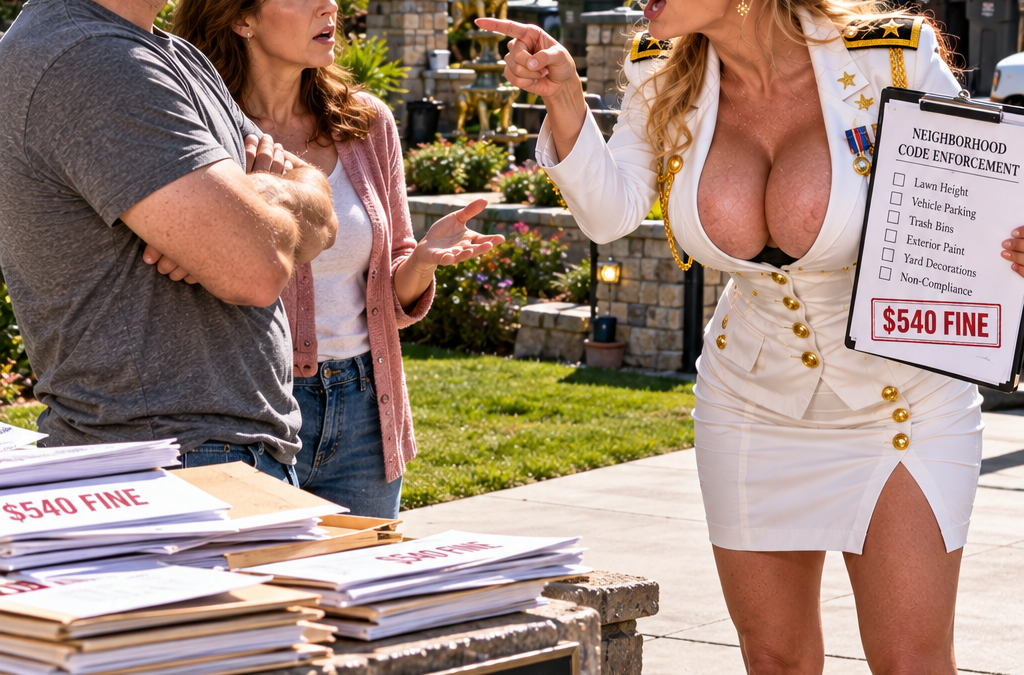
Then she reached Frank’s house.
He was outside washing his pickup.
Karen stopped at the end of his driveway.
Hands on hips.
White fitted military-style jacket gleaming in the sun.
Frank kept scrubbing one of his wheels.
Karen waited.
He ignored her.
She cleared her throat loudly.
Frank looked up.
“Morning.”
Karen didn’t answer the greeting.
“Do you know where that runoff goes?”
Frank looked down at the water.
“Downhill?”
My wife nearly choked on her drink.
Karen’s face tightened.
“It enters storm drainage.”
“Okay.”
“Your soap and contaminants are entering the ecosystem.”
Frank looked at the bottle in his hand.
“Car soap.”
“It is pollution.”
“I’ve washed this truck here for fifteen years.”
“That doesn’t make it appropriate.”
Frank stared at her.
Karen continued.
“You should take vehicles to a commercial car wash.”
“No.”
“The wet pavement also creates inconsistent visual presentation.”
Frank blinked.
“What?”
“Your driveway.”
She gestured dramatically.
“It looks different from neighboring driveways while wet.”
I stared at my wife.
She whispered, “No way.”
Karen continued.
“We’re trying to maintain uniform presentation on this block.”
Frank laughed.
Not sarcastically.
Genuinely.
He thought she was joking.
“Ma’am, I’m almost done.”
He turned the hose back on.
Karen’s expression hardened.
She wrote something on the clipboard.
Then she stared at him for several seconds.
Frank kept washing the truck.
Finally Karen turned.
And came directly toward our house.
My wife whispered, “Oh boy.”
Karen walked up the front path.
Then, without asking, stepped onto our porch.
Up close, the uniform looked even more theatrical.
Bright white fabric.
Gold trim.
Deep neckline.
Perfect makeup.
Perfume strong enough to compete with my wife’s flowers.
Karen looked at me.
Then my wife.
“Good morning.”
“Morning,” I said.
She held the clipboard against her chest.
“I’m establishing a street monitoring committee.”
I waited.
She clearly expected me to react more enthusiastically.
“A what?”
“Street monitoring committee.”
My wife looked at me.
Then back at Karen.
“Did the city establish something?”
“No.”
Karen smiled proudly.
“I did.”
I thought maybe I hadn’t heard correctly.
“You did.”
“Yes.”
“Why?”
She looked toward the street with obvious disappointment.
“This neighborhood has no formal oversight.”
“We know.”
“Standards have slipped.”
I followed her gaze.
Frank was still washing his truck.
Someone farther down was mowing grass.
A child rode past on a bicycle.
Nothing seemed particularly collapsed.
Karen continued.
“As a homeowner, I have a financial interest in maintaining safety and aesthetic consistency.”
“Sure.”
“So I will be conducting property evaluations every two weeks.”
I laughed once.
Karen didn’t.
“Evaluations?”
“Lawns. Exterior presentation. Vehicle compliance. Waste storage. Noise. Safety hazards.”
My wife said gently, “We don’t have an HOA.”
“That is precisely the problem.”
Karen’s voice sharpened.
“Lack of structure creates disorder.”
“No,” I said. “It creates houses without an HOA.”
Her eyes narrowed slightly.
“I’ll distribute standards by Friday.”
I stared at her.
“Standards written by who?”
“Me.”
“And approved by?”
“The street requires leadership.”
“That didn’t answer my question.”
Karen adjusted her clipboard.
“Compliance is expected.”
Then she turned.
Walked down our steps.
And marched toward the next house.
My wife watched her go.
“What just happened?”
“I think we got annexed.”
“Can she actually do anything?”
“No.”
“Good.”
We laughed.
That was mistake number one.
We treated her like a joke.
By Wednesday, every house received a four-page packet.
The title was printed in bold capital letters:
NEIGHBORHOOD STANDARDS AND COMMUNITY CODE OF CONDUCT.
I sat at our kitchen table and read the entire thing.
The rules were insane.
Lawns had a maximum height.
Mowing was assigned to certain weekdays.
Garbage bins had precise storage requirements.
Cars parked on the street were discouraged and subject to “review.”
Front windows were supposed to maintain “uniform visual presentation.”
Driveways were not to be washed during certain periods.
Music outside required “neighbor awareness.”
Decorations needed to reflect “community taste.”
There was even language regarding acceptable porch furniture.
Then I reached the last page.
“Administrative participation fee: $50 monthly per household.”
I called my wife over.
“She wants money.”
“How much?”
“Fifty dollars a month.”
“For what?”
I held up the packet.
“Apparently printing this.”
My wife took it.
“This can’t be real.”
“It isn’t.”
Our neighbor next door threw his packet directly into recycling.
Frank used his to protect his garage floor while painting something.
Nobody paid.
Nobody followed Karen’s lawn schedule.
We assumed reality would eventually reach her.
Instead, rejection seemed to make her more determined.
The following Tuesday, I was working from home.
My desk faced the front window.
Around 10:30, I heard a strange electronic beeping outside.
I looked up.
Karen was kneeling in my yard.
Not near it.
In it.
She wore a bright white military-style jacket under a neon safety vest, along with a wide-brimmed hat.
In one hand was a yellow digital measuring tool.
In the other was her notebook.
She pressed the device against my grass.
I watched for about five seconds.
Then opened the door.
“Can I help you?”
She didn’t look up.
She measured another section.
Pressed a button.
Wrote the number down.
Then stood.
“Three-point-one inches.”
“What?”
“Your lawn.”
I stared at her.
“Congratulations.”
Her mouth tightened.
“Maximum allowable height is two and a half.”
“Allowable by who?”
“The standards.”
“Your standards?”
“The community standards.”
“There is no community organization.”
Karen ignored that.
“Today is Tuesday.”
“I know.”
“Tuesday is designated lawn maintenance day.”
“I mow Saturday.”
She looked genuinely offended.
“Saturday mowing disrupts weekend tranquility.”
“That’s when I’m not working.”
“You should adjust your schedule.”
I stepped toward the edge of the porch.
“You’re also standing on my property.”
Karen tapped her notebook.
“If the lawn is not corrected by two this afternoon, I will log a noncompliance penalty.”
I couldn’t help myself.
“Log it where?”
Her chin lifted.
“The neighborhood oversight record.”
“What oversight record?”
“The committee file.”
“The committee that consists of you?”
Her cheeks reddened.
“The fine is ten dollars per day.”
“Fine payable to who?”
“The committee.”
“You mean you.”
“Administrative penalties support enforcement.”
I walked down the steps.
“Listen carefully.”
Her expression stiffened.
“You don’t own this street.”
She opened her mouth.
“You aren’t a city inspector.”
She closed it.
“You aren’t HOA president because there is no HOA.”
Her face reddened further.
“You’re a woman who bought a house two doors down.”
I pointed toward the sidewalk.
“Get off my lawn.”
Karen clutched the notebook against her chest.
“Property owners are legally required to maintain standards.”
“City codes, yes.”
“Community standards.”
“No.”
“Poorly maintained lawns lower my property value.”
“My lawn is healthy.”
“It’s too tall.”
“It’s three-point-one inches.”
“Exactly.”
“Get off my property.”
Her lips trembled with anger.
“You’re being hostile.”
“I am asking you to leave.”
“I am trying to build community cohesion.”
“If you don’t leave, I’ll call the police non-emergency line and report trespassing.”
That worked.
Barely.
Karen backed toward the sidewalk.
“You will regret being uncooperative.”
“Have a good Tuesday.”
She stormed away.
Then marched to my neighbor’s house.
He opened the door.
Karen started talking.
Five seconds later, he laughed in her face and closed the door while she was still speaking.
I thought that might finally break through.
It didn’t.
The next month became exhausting.
Karen’s fake committee expanded its imaginary powers because nobody recognized them.
She placed orange traffic cones along public curbs.
Each cone carried a sign:
RESERVED FOR STREET PASSING AND EMERGENCY ACCESS.
NO RESIDENTIAL PARKING.
BY ORDER OF BLOCK MANAGEMENT.
There was no block management.
Frank saw the cones outside his house, loaded them into his pickup, and parked his daughter’s sedan exactly where it was legally allowed.
Two hours later, Karen appeared screaming.
“You stole my traffic-control equipment!”
Frank leaned out an upstairs window.
“You put plastic cones on a public street.”
“They are community infrastructure!”
“They’re in my truck.”
“I’ll have you arrested.”
“Great. Send them over.”
“You need to move that car.”
“No.”
“I’ll have it impounded.”
Frank laughed.
“If you put cones here again, I’m throwing them away. And get out of the road before somebody hits you.”
Karen’s face went purple.
But she moved.
After the cones failed, she discovered city hotlines.
That was when our street stopped feeling peaceful.
Code enforcement started appearing.
The first time an inspector knocked on my door, he looked exhausted.
“Afternoon.”
“Hi.”
“We received a complaint about an illegal commercial operation being run from your garage.”
I stared at him.
“A what?”
“Also an unpermitted structural hazard.”
“Come in.”
I showed him the garage.
Car.
Bicycles.
Tools.
No business.
Then he asked about the backyard shed.
I walked him outside.
The “hazard” was a small plastic storage shed that had been there five years.
Legal size.
Legal location.
No foundation.
Nothing remotely unusual.
The inspector sighed.
“I figured.”
“Who complained?”
He couldn’t formally identify complainants, but his expression told me.
“This is the fourth call from your street today.”
“Same person?”
He hesitated.
“Someone has been very active.”
“Can you do something about false reports?”
“If a complaint is specific enough, we’re required to investigate.”
“So she can keep wasting your time?”
“For a while.”
He looked toward Karen’s house.
“But we’re learning.”
Code enforcement wasn’t enough.
She called the fire marshal on a family with a legal backyard fire pit.
She called animal control because a golden retriever barked at a squirrel.
She reported delivery drivers as suspicious if they sat in vans for more than two minutes.
Officers came.
Inspectors came.
Everyone investigated.
Everyone left.
No violations.
Still, the damage was real.
People were tense.
Every city vehicle entering the street made someone wonder whose house Karen had targeted that day.
Then she installed cameras.
Lots of them.
Security cameras around your own home are normal.
Karen went much further.
Tall metal poles appeared near her roofline.
Cameras were mounted high enough to look over fences.
Two aimed directly toward our porch and living-room windows.
Another pointed into Frank’s backyard, where his teenage kids used the pool.
When he complained, Karen said she was conducting “community monitoring.”
Then came the floodlights.
Massive LED fixtures mounted on the house.
So bright that when they activated at night, the street looked like a prison yard during an escape.
Their sensitivity was ridiculous.
Cat walks past.
Light.
Wind moves a branch.
Light.
Car turns the corner.
Light.
At two in the morning, our bedroom would suddenly turn white.
My wife sat up one night after the third activation.
“I hate her.”
My wife almost never said she hated anyone.
That frightened me more than the lights.
“We need to do something.”
“I know.”
“This isn’t just annoying anymore.”
“I know.”
Then Karen made the mistake that united everyone.
Friday afternoon.
Official-looking envelopes appeared inside nearly every mailbox.
No stamps.
No postal markings.
Hand-delivered into federal mailboxes.
I opened ours.
NOTICE OF OUTSTANDING VIOLATIONS AND ACCUMULATED PENALTIES.
Lawn schedule violations: $140.
Nonconforming exterior window presentation: $50.
Hostile verbal conduct toward block management: $200.
Unpaid administrative fees: $150.
Total:
$540.
At the bottom:
Failure to remit payment within seven days may result in a property lien and referral to legal counsel.
I read the word lien twice.
My wife looked over my shoulder.
“She can’t do that.”
“No.”
“But she’s telling old people on this street she can.”
That mattered.
Karen knew most homeowners would understand the letter was nonsense.
But intimidation doesn’t need everyone to believe it.
It only needs a few.
That evening, four of us met in my driveway.
Frank.
Our neighbor with the pool.
The guy with the fire pit.
Me.
Each held the same fake fine notice.
The pool owner was furious.
“She has a camera pointed into my backyard.”
“I know.”
“My daughters swim there.”
Frank held up his envelope.
“She put this inside my mailbox.”
I nodded.
“That’s another problem.”
He frowned.
“You can’t just put unstamped material into postal boxes, right?”
“No.”
“And these liens?”
“Fake.”
The fire-pit owner shook his head.
“She keeps calling authorities. What do we do? Keep explaining ourselves every week?”
For months we’d been playing defense.
Karen complains.
We respond.
Karen invents a rule.
We laugh.
Karen trespasses.
We tell her to leave.
Karen calls the city.
We prove innocence.
Every interaction gave her what she wanted.
Attention.
Power.
Control over our time.
I looked at the men standing in my driveway.
“We stop reacting to her.”
Frank frowned.
“And?”
“We start documenting.”
That night, we created a group chat.
Eight households joined.
Every house on the street except Karen’s.
The name was a joke:
BLOCK DEFENSE COMMITTEE.
The irony wasn’t subtle.
Our plan was simple.
No threats.
No harassment.
No illegal retaliation.
We would document everything and research actual law.
If Karen wanted rules, she was going to meet real ones.
For two weeks, we became painfully methodical.
Floodlight shines into bedroom?
Video.
Camera pole aimed over a fence?
Photograph.
Karen steps into someone else’s yard?
Doorbell footage saved.
Fake notice inside mailbox?
Photograph it in place before removal.
Orange cones on public street?
Document.
Municipal complaint?
Save the inspector’s report.
Then we got lucky.
One man at the end of the street was a civil engineer.
He worked with planning departments regularly.
He spent a weekend reviewing property maps and city regulations.
Sunday evening, a message appeared in our group chat.
You guys need to see this.
He had pulled the survey for Karen’s lot.
Then permits.
Or, more accurately, the absence of permits.
The discoveries kept coming.
Her oversized backyard shed sat partly over a municipal drainage easement.
So did a significant section of the expensive multi-level deck she had built.
Neither appeared properly permitted.
Her driveway extension was worse.
Karen had poured a wide concrete pad over the drainage swale at the front of her property.
That swale existed for stormwater.
Paving over it had changed runoff flow and contributed to water collecting in the road during heavy rain.
Then came the trees.
Two large mature trees near her curb had disappeared shortly after she moved in.
We had all noticed.
None of us knew those trees were inside protected public right-of-way.
Removing them without permits carried substantial fines.
Then the camera poles.
Too high under residential structural rules without required approvals.
Then the floodlights.
Directly violating nuisance-lighting ordinances because they projected into neighboring living areas.
We sat staring at the engineer’s report.
My wife finally said, “You’re kidding.”
“No.”
“She calls inspectors on everyone.”
“Yes.”
“And her house is illegal?”
“Large parts of it seem to be.”
She laughed.
Not happily.
More like disbelief finally needed somewhere to go.
“Of course.”
We assembled a complete packet.
Photos.
Survey maps.
Videos.
Dates.
Municipal code references.
No exaggeration.
No fake rules.
Only actual documented violations.
Then we acted.
The mailbox issue went to the appropriate postal authorities.
Frank took photographs and original notices.
The engineer submitted formal complaints to city building inspection.
Environmental drainage.
Forestry.
The lighting nuisance was documented.
The camera structures were documented.
Everything was filed properly.
Then we decided to have a little fun.
Legal fun.
City law allowed street parking.
Vehicles had to face traffic.
Stay within twelve inches of the curb.
Move periodically.
Avoid hydrants and driveways.
So five neighbors moved legally registered vehicles onto the public street around Karen’s house.
Every one compliant.
Straight.
Proper direction.
Correct distance from the curb.
No driveway blocked.
Her house suddenly had cars everywhere.
Then the fire-pit neighbor exercised his legal right to use his fire pit.
Every evening after five.
Fire extinguisher nearby.
Seasoned wood.
Within allowed hours.
Another neighbor installed a legal amateur-radio antenna.
Tall.
Silver.
Permitted.
Perfectly visible from Karen’s kitchen.
Nothing illegal.
Nothing Karen could legitimately stop.
Tuesday morning came.
Karen’s favorite inspection day.
At ten, her front door opened.
White military-style uniform.
Deep neckline.
Gold buttons.
Heels.
Clipboard.
She stepped outside.
Then froze.
Cars lined the street.
Her face changed.
She marched toward my truck.
I happened to be outside.
She slapped one palm against the driver’s window.
“Move this.”
I opened the door.
Stepped out.
“Morning.”
“You’re blocking visibility.”
“No.”
“You are obstructing my street view.”
“Not a legal issue.”
“I established no street parking.”
“You established nothing.”
Her face reddened.
“I gave clear guidelines.”
“I checked city law this morning.”
I pointed toward the curb.
“Correct direction. Less than twelve inches from curb. No hydrant. No driveway obstruction.”
Karen’s chest rose sharply.
“Move it.”
“No.”
“This is intentional harassment.”
“It’s public parking.”
She pulled out her phone.
“Fine.”
She dialed non-emergency police on speaker.
“I need an officer immediately.”
The dispatcher sounded tired before Karen finished introducing herself.
“There is an organized vehicle blockade around my residence.”
“Are the vehicles on a public street?”
“Yes, but—”
“Are they blocking your driveway?”
“No, but—”
“Hydrant?”
“No.”
“Intersection?”
“No.”
“Then what is the violation?”
“They’re violating block regulations.”
“Ma’am, public roadway parking is governed by municipal law.”
Karen’s face twitched.
“I am block management.”
“There is no municipal offense being described.”
“I need an officer.”
“We will not dispatch an officer to legally parked vehicles.”
The call ended.
Karen stared at the phone.
I almost felt sorry for her.
Almost.
Then two white city utility vehicles turned onto the street.
A police cruiser followed.
Karen’s face brightened.
She smiled at me.
“There.”
I said nothing.
“Now we’ll see.”
She practically hurried toward the vehicles.
Three officials got out.
Senior building inspector.
Environmental compliance officer.
City forester.
The police officer remained close.
Karen approached them with the confidence of someone welcoming her personal enforcement team.
“Finally.”
She threw both hands outward.
“I have twenty-three documented violations requiring immediate attention.”
The senior inspector held a thick packet.
“Ma’am.”
“Start with the grass at that house.”
He looked at her property.
“Are you the owner here?”
“Yes.”
“And organizer of the block oversight committee.”
The inspector’s expression didn’t change.
“We’re not here for your neighbors.”
Karen’s smile faded.
“What?”
“We’re here regarding your property.”
Silence.
“My property is the standard for this street.”
The city forester stepped forward.
He pointed toward two tree stumps near the curb.
“Did you remove the trees previously located here?”
Karen blinked.
“Yes.”
“Personally?”
“I hired someone.”
“Permit?”
“They were on my lawn.”
“That isn’t what I asked.”
“They dropped leaves.”
The forester looked at her.
“They were inside the municipal right-of-way.”
Karen stiffened.
“No.”
“Yes.”
He checked his paperwork.
“Two protected mature trees removed without authorization.”
Karen’s mouth opened.
“That’s ridiculous.”
“Two thousand dollars per tree.”
The color vanished from her face.
“What?”
“Four thousand dollars total.”
He handed her the citation.
Her fingers shook.
The environmental officer moved toward the driveway extension.
He pointed down.
“This was recently poured?”
“Yes.”
“Permit?”
“I don’t need a permit to improve my driveway.”
“You paved over the municipal drainage swale.”
“No, I didn’t.”
He unfolded a map.
“The swale runs here.”
Karen stared.
“This modification interferes with stormwater flow.”
“It looks better.”
“That isn’t relevant.”
Her voice rose.
“I spent thousands on that concrete.”
“You’ll need to remove it.”
She actually laughed.
“You cannot make me tear up my driveway.”
“If it is not removed within thirty days, the municipality may perform the work and assess costs, plus applicable daily penalties.”
Another official document entered her shaking hands.
Then the building inspector spoke.
“We also need access to the rear yard.”
Karen stepped backward.
“No.”
“Ma’am.”
“You are not entering my backyard.”
He produced a paper.
“We have administrative authority to inspect the documented encroachment.”
The police officer stepped closer.
Karen looked at him.
Then at us.
We were watching from our yards.
She knew.
For the first time, she understood exactly what was happening.
Everything she had done to us had produced this moment.
“Fine.”
She marched toward the side gate.
The officials followed.
We couldn’t see what happened behind the house.
We could hear it.
“That deck cost fifteen thousand dollars!”
Then:
“Do not step on those flowers!”
Then:
“The shed is new!”
Then louder:
“This is harassment!”
Ten minutes later, everyone returned.
The inspector had several pages of notes.
Karen’s face was flushed.
Hair slightly disordered.
Perfect authority cracking.
“Ma’am.”
She glared.
“Your shed encroaches onto municipal drainage property.”
“No.”
“Approximately forty percent of the rear deck also extends into the easement.”
“You’re wrong.”
“Neither structure has required permitting on file.”
“My contractor handled everything.”
“Then you may address reimbursement with your contractor.”
Karen stared.
“What are you saying?”
“Both structures are subject to removal.”
Her clipboard slipped from her hand.
It landed in the grass.
“Removal?”
“Yes.”
“Demolition?”
“Yes.”
She made a small choking sound.
The inspector continued.
“You have forty-five days.”
“That deck cost me over fifteen thousand dollars.”
“I understand.”
“No, you don’t.”
“There are also three over-height camera mounting poles without structural approval.”
Her eyes widened.
“And your exterior lighting violates nuisance-light provisions.”
One of our neighbors smiled.
The inspector went on.
“You have forty-eight hours to correct the lighting orientation or remove the fixtures.”
Karen looked like she might explode.
Then a postal vehicle pulled up.
The carrier stepped out.
Walked toward her.
Held out an envelope.
Karen accepted it automatically.
She looked at the sender.
United States Postal Inspection Service.
Her head lifted slowly.
She looked around.
At us.
At the legally parked cars.
At the inspectors.
At the citations.
At the city vehicle.
At the police officer.
At the letter.
And she understood.
The neighborhood she had spent months inspecting had finally inspected her.
Except we hadn’t invented a single rule.
Within forty-eight hours, the floodlights went dark.
The high camera poles came down.
The effect at night was immediate.
Our bedroom stayed dark.
Our street looked residential again instead of a prison perimeter.
A week later, contractors arrived at Karen’s house.
Not to add anything.
To undo it.
Jackhammers attacked the expensive driveway extension.
Concrete broke apart.
The drainage swale reappeared.
In the backyard, crews dismantled the shed.
Then the deck.
Board after board.
Thousands of dollars of unauthorized construction reduced to piles of lumber.
Certified landscapers arrived near the curb.
The two protected trees Karen removed had to be replaced according to city requirements.
None of us stood in front of her house cheering.
We didn’t need to.
We watched quietly through windows.
The costs added up.
City fines.
Tree penalties.
Demolition.
Concrete removal.
Restoration work.
Lighting corrections.
Camera modifications.
Postal consequences.
By our rough calculation, Karen lost upward of thirty-five thousand dollars.
Possibly more.
The transformation in her personality was immediate.
No clipboard.
No measuring tape.
No inspection walks.
No white military uniform parading down our street.
For weeks, we barely saw her.
When she collected mail, she moved quickly.
Ordinary clothes.
Sunglasses.
Head down.
If somebody walked past, she looked away.
She kept curtains closed.
The woman who once believed every driveway belonged under her authority now seemed afraid to make eye contact beyond her own property line.
Our fake fines disappeared.
Obviously.
There was no committee.
No authority.
No lien.
No $540 debt.
Nobody paid her.
Nobody ever had.
And once she stopped pushing, the entire imaginary system vanished instantly.
That was probably the greatest proof of how fake her power had always been.
Real authority survives when one individual becomes embarrassed.
City law still existed.
Postal law still existed.
Property boundaries still existed.
Karen’s “community code” disappeared the moment everyone stopped participating in her fantasy.
About six weeks after the inspection, a sign appeared in her front yard.
FOR SALE.
Frank called me.
“You see it?”
“Yep.”
“She finally found one community standard we all support.”
I laughed.
Two months later, a moving truck arrived.
I watched through our front window as workers carried boxes from Karen’s house.
She supervised quietly.
No yelling.
No clipboard.
No white uniform.
No declarations about property values.
She looked tired.
Smaller somehow.
Defeated.
At one point she stood near the curb and looked down the street.
Our street.
Frank’s truck was parked outside.
The pool family’s kids were laughing behind their fence.
Somebody was mowing grass on a Saturday.
The fire-pit owner had stacked wood near his backyard.
My lawn was probably over three inches.
Nothing was uniform.
Nothing was collapsing.
People were simply living.
Karen saw me watching from my porch.
Our eyes met.
For a second, I wondered whether she would come over.
One final confrontation.
One final accusation.
She didn’t.
She looked away.
Then climbed into her SUV.
The moving truck pulled out first.
Karen followed.
She reached the intersection.
Turned.
And disappeared.
Nobody organized a celebration.
But that evening, half the street ended up outside anyway.
Frank brought drinks.
Someone ordered pizza.
Kids rode bikes.
The engineer who had discovered Karen’s violations stood talking near my driveway.
My wife looked around.
“Funny.”
“What?”
“She said we needed her to build community.”
I looked at everyone.
“Technically, she did.”
My wife laughed.
The neighborhood group chat stayed active after Karen left.
We changed the name.
BLOCK DEFENSE COMMITTEE sounded too dramatic once there was nobody to defend ourselves against.
Frank suggested NO HOA EVER.
That got unanimous approval.
For months afterward, the story became neighborhood legend.
People loved the dramatic parts.
The $540 fake fines.
The traffic cones.
The inspection.
The four-thousand-dollar tree citation.
The deck demolition.
But when I thought back on it, the part that bothered me most was much quieter.
It was how easily one determined person disrupted an entire street simply because the rest of us were decent enough to assume she would eventually behave rationally.
At every stage, we gave Karen a normal explanation.
Maybe she was enthusiastic.
Maybe she didn’t understand the neighborhood.
Maybe ignoring her would work.
Maybe she’d get bored.
Maybe city inspectors would discourage her.
Maybe telling her to stay off private property would be enough.
We kept trying to interpret her behavior through the expectations we had for reasonable adults.
She interpreted our patience as weakness.
That was the mistake.
Karen didn’t want community cooperation.
Cooperation requires compromise.
She wanted obedience.
That was why our peaceful street offended her.
There was no central authority.
No hierarchy.
No one needed her permission.
Frank could wash his truck.
I could mow Saturday.
Families could park legally on the public road.
People solved problems directly.
Karen looked at that freedom and saw disorder because disorder gave her no important role.
So she invented one.
Street monitoring committee.
Block management.
Community standards.
Administrative fees.
Penalties.
Oversight records.
Every title sounded official because she needed other people to forget one simple fact.
She had no authority.
The white military-style uniform worked the same way.
So did the clipboard.
So did the high-visibility vest.
She surrounded herself with symbols of power.
When those weren’t enough, she borrowed real institutions.
Code enforcement.
Police.
Fire marshal.
Animal control.
She weaponized legitimate public services to give her private preferences force.
And for a while, that worked better than the fake fines.
Nobody enjoys explaining themselves to an inspector.
Nobody wants a police cruiser stopping outside because a neighbor invented suspicious activity.
The complaints were false.
But responding to them cost time.
Time was what she took from us most.
Hours explaining.
Hours documenting.
Hours wondering.
Minutes waking up under floodlights.
Minutes checking cameras.
Conversations about what she might do next.
People like Karen often count on that.
They don’t have to be legally correct.
They just have to make resistance more exhausting than surrender.
It almost worked.
Several neighbors asked privately whether paying fifty dollars a month might simply make her stop.
My wife once asked whether we should ignore the lawn issue and let her feel like she had won something.
I understood the impulse.
But there was one problem.
Nothing would ever be enough.
A person who demands money without authority doesn’t become satisfied when you pay.
She learns you can be made to pay.
A person who orders you to mow Tuesday and sees you obey doesn’t suddenly respect your Saturday.
She adds Wednesday rules.
Parking.
Windows.
Porches.
Lights.
Cars.
Dogs.
Whatever comes next.
The turning point wasn’t when we became more aggressive.
It was when we became calmer.
Document everything.
Research.
Respond in writing.
Use real procedures.
No screaming.
No fake threats.
No vandalism.
No revenge that required breaking rules ourselves.
Karen wanted chaos because chaos allowed her to claim leadership.
We gave her paperwork.
Survey maps.
Municipal codes.
Photographs.
Dates.
Measurements taken by people who actually had legal authority.
She hated that.
Her strongest weapon had always been certainty.
When she said something loudly enough, she expected people to accept that there must be a rule somewhere supporting it.
Once we started asking for actual law, her power evaporated.
The irony was almost perfect.
Karen spent months lecturing us about standards.
In the end, standards removed her deck.
Rules tore up her driveway.
Enforcement cost her thousands.
Compliance took down her cameras.
Real community action drove her out.
Not literally.
Nobody forced Karen to sell.
Nobody threatened her home.
Nobody forged a lien.
Nobody invented fees.
The consequences she faced came from choices she had made on her own property while she was too busy policing everyone else’s.
That was probably the lesson she never wanted to learn.
If you’re going to spend your life inspecting your neighbors, you had better make very sure your own house can survive inspection.
A year later, our street looked almost exactly as it had before she moved in.
Different cars.
A couple new trees.
One renovated kitchen.
Otherwise, the same.
People still waved.
Storms still brought neighbors outside with tools.
Frank still washed his truck in his driveway.
He sometimes did it on Tuesday just to make me laugh.
I still mowed Saturday mornings.
Nobody filed a complaint.
The family with the pool eventually installed a better privacy screen.
Not because they had to.
Because after months of cameras pointing toward their yard, they liked knowing nobody could see in.
The fire-pit guy kept using his fire pit.
He stopped making it intentionally smoky after Karen left.
The radio antenna remained for a while.
Eventually the neighbor took it down because he didn’t actually need it that tall.
That always made me smile.
So many things we did had never been about wanting ugly cars on streets, smoke in windows, or antennas in sight lines.
They were reminders.
You don’t get to declare private preferences public law.
That was all.
My wife and I still sit on the porch sometimes.
On quiet evenings, we talk about how bizarre those months were.
“Remember Tuesday lawn maintenance?”
she’ll ask.
“I still get nervous every Tuesday.”
“No you don’t.”
“Three-point-one inches.”
She laughs.
Once she bought me a small yellow measuring tape as a joke.
It’s in my garage.
Frank suggested framing one of the fake $540 invoices.
I kept mine in a file instead.
Not because I expect Karen to return.
Because it reminds me how official nonsense can look if someone uses the right font and enough confidence.
The paper threatened a lien.
Legal counsel.
Financial penalties.
Someone older or more vulnerable could easily have panicked.
That’s the part I never found funny.
Karen wasn’t merely eccentric.
She was testing whether fear could be turned into payment.
She failed because the street compared notes.
That’s another thing I learned.
Bullies like isolated targets.
When Karen confronted Frank, it seemed like Frank’s problem.
When she measured my lawn, it seemed like mine.
When she pointed cameras into the pool yard, that belonged to another family.
Fire-marshal complaint?
Another house.
Dog complaint?
Another.
Each incident felt separate until we stood in my driveway holding almost identical envelopes.
Then the pattern became visible.
Community wasn’t the committee Karen invented.
Community was eight households sharing information and protecting one another without demanding ownership over anyone’s property.
No dues.
No binder.
No president.
Just neighbors.
After Karen left, a new family eventually bought her house.
They were nervous when they first arrived.
Probably because people on our street kept looking toward the property with unusual interest.
The husband introduced himself to Frank.
The wife came over to meet us.
Nice couple.
Two kids.
Normal.
The first weekend, they had a contractor come look at the backyard.
My wife whispered, “Uh-oh.”
I laughed.
“We are not becoming her.”
“Right.”
“Never.”
The new owner later mentioned that the rear yard was smaller than they expected because of the drainage easement.
I said, “Yeah. The city is pretty serious about that.”
He laughed.
“Apparently the previous owner learned that.”
I smiled.
“You could say that.”
He never asked for the full story.
At least not then.
Eventually somebody told him.
Of course.
Neighborhood stories have longer lives than people.
A month later, he stopped me while I was taking in the trash cans.
“Were you really fined five hundred forty dollars for your grass?”
“Among other crimes.”
He laughed.
“She really called herself block management?”
“Yep.”
“That’s insane.”
“Yes.”
He looked at his house.
“I’m beginning to understand why the sellers were motivated.”
I didn’t say anything.
Then he grinned.
“Just so we’re clear, I don’t care when you mow.”
“Saturday.”
“Great.”
“And Frank washes his truck.”
“Also fine.”
“No committee?”
“Absolutely not.”
He offered his hand.
“Sounds perfect.”
I shook it.
It was.
That was all any of us had ever wanted.
A street where adults could live normal lives.
Where a neighbor could ask for a favor instead of issuing an order.
Where real dangers went to real authorities and petty preferences stayed personal.
Karen believed freedom was disorder.
She thought a neighborhood without someone in charge was a vacuum waiting to be filled.
She was wrong.
There had always been something holding our street together.
Respect.
It just didn’t come with a clipboard.
Karen moved in and tried to replace respect with fear.
For a few months, fear was louder.
Then the rest of us remembered we had voices too.
She measured our grass.
We measured her setbacks.
She photographed our cars.
We documented her floodlights.
She invented violations.
We found actual ordinances.
She mailed imaginary penalties.
Real agencies mailed real citations.
She threatened our homes.
And eventually, the only FOR SALE sign on the block stood in her yard.
I didn’t feel triumphant watching her leave.
Not exactly.
Mostly I felt relieved.
Peace had returned.
And the lesson was simple enough that none of us needed four pages of neighborhood standards to understand it.
If you move onto a street and treat your neighbors like subjects, eventually they’re going to stop acting like strangers and start acting like a community.
Karen spent months trying to create one.
In the end, she succeeded.
Just not the way she planned.
𝗧𝗛𝗘 𝗘𝗡𝗗
Our New Neighbor Invented Her Own HOA and Sent Us $540 Fines—Then We Found Out Her House Was the Biggest Violation on the Street
For six years, our street had no HOA, no neighborhood board, and no self-appointed ruler telling grown adults how to live.
Then a beautiful woman in a white military-style uniform moved in, invented her own “community code,” and threatened to put liens on our homes if we didn’t pay her.
She spent months hunting for violations on everyone else’s property before we discovered something almost too perfect to believe.
Her own house was breaking more real laws than the rest of the street combined.
My wife and I had chosen that neighborhood for one specific reason.
There was no HOA.
That wasn’t a minor selling point.
It was one of the first things I asked our realtor.
“Any homeowners association?”
“No.”
“Any mandatory neighborhood covenant?”
“No.”
“Any architectural committee?”
“No.”
“Anybody who can fine me because my grass is three inches instead of two and a half?”
She laughed.
“No.”
“Perfect.”
I wasn’t against neighbors having standards.
I liked clean streets.
I liked maintained houses.
I didn’t want abandoned cars on lawns or somebody opening a nightclub in the garage next door.
But I believed normal adults could solve most ordinary neighborhood problems without forming a miniature government.
And for six years, we proved it.
Our street was old by suburban standards.
Not ancient.
Just established.
Large trees shaded the sidewalks.
The houses didn’t match.
One was brick.
The next had pale blue siding.
Another had a bright red front door.
Some people kept perfect lawns.
Some lawns looked a little rough near the end of summer.
Nobody cared.
People mostly kept to themselves, but there was enough trust between us that if something went wrong, neighbors appeared.
A storm once knocked a huge branch across Frank’s driveway three houses down.
Before he could hire anyone, three men from the block showed up with chainsaws.
When my wife had surgery, our next-door neighbor brought food twice without being asked.
When someone’s teenager accidentally backed into a mailbox, his father knocked on the homeowner’s door before the homeowner even knew it happened and offered to replace it.
That was our neighborhood.
Not perfect.
Human.
Functional.
Then the Wilsons moved away.
They lived across the street and two houses down.
Quiet couple.
Retired.
Nice people.
Their grandchildren lived in another state, and eventually they decided to move closer.
Their house sat empty for almost two months.
Then Karen bought it.
Her actual name wasn’t Karen, but that was what everybody on our street eventually started calling her when she wasn’t around.
She was about forty, maybe early forties, and she stood out immediately.
Partly because she was attractive.
Very attractive.
Tall.
Blonde.
Expensive-looking.
She had a curvy figure she clearly enjoyed emphasizing, especially her very large chest, and she carried herself with the confidence of someone who expected attention whenever she appeared.
Her clothing was even more memorable.
Karen frequently wore a tight white military-style uniform with gold buttons, fitted sharply through her waist and cut low across the neckline.
Sometimes she added white heels.
Sometimes boots.
Sometimes sunglasses large enough to hide half her face.
The whole appearance was absurdly formal for suburban dog walking, but it suited her personality.
She didn’t walk.
She marched.
She didn’t ask.
She instructed.
And she didn’t seem capable of seeing another person’s property without immediately thinking about how she would manage it differently.
During her first week, we assumed she was simply enthusiastic about her new house.
She spent hours working on the landscaping.
Contractors came and went constantly.
A new deck started taking shape in the back.
The driveway expanded.
Large lights appeared around the house.
Camera mounts went up.
Trees near the curb disappeared.
At the time, none of us paid much attention.
Her property.
Her money.
Her problem.
Then one Saturday morning, my wife and I were sitting on our front porch drinking juice when Karen appeared in the street carrying a clipboard.
My wife noticed her first.
“What is she doing?”
I looked up.
Karen wasn’t walking normally.
She moved slowly from property to property, stopping in front of each house and making notes.
She paused beside a hedge.
Wrote something.
Looked at a driveway.
Wrote something.
Then she reached Frank’s house.
He was outside washing his pickup.
Karen stopped at the end of his driveway.
Hands on hips.
White fitted military-style jacket gleaming in the sun.
Frank kept scrubbing one of his wheels.
Karen waited.
He ignored her.
She cleared her throat loudly.
Frank looked up.
“Morning.”
Karen didn’t answer the greeting.
“Do you know where that runoff goes?”
Frank looked down at the water.
“Downhill?”
My wife nearly choked on her drink.
Karen’s face tightened.
“It enters storm drainage.”
“Okay.”
“Your soap and contaminants are entering the ecosystem.”
Frank looked at the bottle in his hand.
“Car soap.”
“It is pollution.”
“I’ve washed this truck here for fifteen years.”
“That doesn’t make it appropriate.”
Frank stared at her.
Karen continued.
“You should take vehicles to a commercial car wash.”
“No.”
“The wet pavement also creates inconsistent visual presentation.”
Frank blinked.
“What?”
“Your driveway.”
She gestured dramatically.
“It looks different from neighboring driveways while wet.”
I stared at my wife.
She whispered, “No way.”
Karen continued.
“We’re trying to maintain uniform presentation on this block.”
Frank laughed.
Not sarcastically.
Genuinely.
He thought she was joking.
“Ma’am, I’m almost done.”
He turned the hose back on.
Karen’s expression hardened.
She wrote something on the clipboard.
Then she stared at him for several seconds.
Frank kept washing the truck.
Finally Karen turned.
And came directly toward our house.
My wife whispered, “Oh boy.”
Karen walked up the front path.
Then, without asking, stepped onto our porch.
Up close, the uniform looked even more theatrical.
Bright white fabric.
Gold trim.
Deep neckline.
Perfect makeup.
Perfume strong enough to compete with my wife’s flowers.
Karen looked at me.
Then my wife.
“Good morning.”
“Morning,” I said.
She held the clipboard against her chest.
“I’m establishing a street monitoring committee.”
I waited.
She clearly expected me to react more enthusiastically.
“A what?”
“Street monitoring committee.”
My wife looked at me.
Then back at Karen.
“Did the city establish something?”
“No.”
Karen smiled proudly.
“I did.”
I thought maybe I hadn’t heard correctly.
“You did.”
“Yes.”
“Why?”
She looked toward the street with obvious disappointment.
“This neighborhood has no formal oversight.”
“We know.”
“Standards have slipped.”
I followed her gaze.
Frank was still washing his truck.
Someone farther down was mowing grass.
A child rode past on a bicycle.
Nothing seemed particularly collapsed.
Karen continued.
“As a homeowner, I have a financial interest in maintaining safety and aesthetic consistency.”
“Sure.”
“So I will be conducting property evaluations every two weeks.”
I laughed once.
Karen didn’t.
“Evaluations?”
“Lawns. Exterior presentation. Vehicle compliance. Waste storage. Noise. Safety hazards.”
My wife said gently, “We don’t have an HOA.”
“That is precisely the problem.”
Karen’s voice sharpened.
“Lack of structure creates disorder.”
“No,” I said. “It creates houses without an HOA.”
Her eyes narrowed slightly.
“I’ll distribute standards by Friday.”
I stared at her.
“Standards written by who?”
“Me.”
“And approved by?”
“The street requires leadership.”
“That didn’t answer my question.”
Karen adjusted her clipboard.
“Compliance is expected.”
Then she turned.
Walked down our steps.
And marched toward the next house.
My wife watched her go.
“What just happened?”
“I think we got annexed.”
“Can she actually do anything?”
“No.”
“Good.”
We laughed.
That was mistake number one.
We treated her like a joke.
By Wednesday, every house received a four-page packet.
The title was printed in bold capital letters:
NEIGHBORHOOD STANDARDS AND COMMUNITY CODE OF CONDUCT.
I sat at our kitchen table and read the entire thing.
The rules were insane.
Lawns had a maximum height.
Mowing was assigned to certain weekdays.
Garbage bins had precise storage requirements.
Cars parked on the street were discouraged and subject to “review.”
Front windows were supposed to maintain “uniform visual presentation.”
Driveways were not to be washed during certain periods.
Music outside required “neighbor awareness.”
Decorations needed to reflect “community taste.”
There was even language regarding acceptable porch furniture.
Then I reached the last page.
“Administrative participation fee: $50 monthly per household.”
I called my wife over.
“She wants money.”
“How much?”
“Fifty dollars a month.”
“For what?”
I held up the packet.
“Apparently printing this.”
My wife took it.
“This can’t be real.”
“It isn’t.”
Our neighbor next door threw his packet directly into recycling.
Frank used his to protect his garage floor while painting something.
Nobody paid.
Nobody followed Karen’s lawn schedule.
We assumed reality would eventually reach her.
Instead, rejection seemed to make her more determined.
The following Tuesday, I was working from home.
My desk faced the front window.
Around 10:30, I heard a strange electronic beeping outside.
I looked up.
Karen was kneeling in my yard.
Not near it.
In it.
She wore a bright white military-style jacket under a neon safety vest, along with a wide-brimmed hat.
In one hand was a yellow digital measuring tool.
In the other was her notebook.
She pressed the device against my grass.
I watched for about five seconds.
Then opened the door.
“Can I help you?”
She didn’t look up.
She measured another section.
Pressed a button.
Wrote the number down.
Then stood.
“Three-point-one inches.”
“What?”
“Your lawn.”
I stared at her.
“Congratulations.”
Her mouth tightened.
“Maximum allowable height is two and a half.”
“Allowable by who?”
“The standards.”
“Your standards?”
“The community standards.”
“There is no community organization.”
Karen ignored that.
“Today is Tuesday.”
“I know.”
“Tuesday is designated lawn maintenance day.”
“I mow Saturday.”
She looked genuinely offended.
“Saturday mowing disrupts weekend tranquility.”
“That’s when I’m not working.”
“You should adjust your schedule.”
I stepped toward the edge of the porch.
“You’re also standing on my property.”
Karen tapped her notebook.
“If the lawn is not corrected by two this afternoon, I will log a noncompliance penalty.”
I couldn’t help myself.
“Log it where?”
Her chin lifted.
“The neighborhood oversight record.”
“What oversight record?”
“The committee file.”
“The committee that consists of you?”
Her cheeks reddened.
“The fine is ten dollars per day.”
“Fine payable to who?”
“The committee.”
“You mean you.”
“Administrative penalties support enforcement.”
I walked down the steps.
“Listen carefully.”
Her expression stiffened.
“You don’t own this street.”
She opened her mouth.
“You aren’t a city inspector.”
She closed it.
“You aren’t HOA president because there is no HOA.”
Her face reddened further.
“You’re a woman who bought a house two doors down.”
I pointed toward the sidewalk.
“Get off my lawn.”
Karen clutched the notebook against her chest.
“Property owners are legally required to maintain standards.”
“City codes, yes.”
“Community standards.”
“No.”
“Poorly maintained lawns lower my property value.”
“My lawn is healthy.”
“It’s too tall.”
“It’s three-point-one inches.”
“Exactly.”
“Get off my property.”
Her lips trembled with anger.
“You’re being hostile.”
“I am asking you to leave.”
“I am trying to build community cohesion.”
“If you don’t leave, I’ll call the police non-emergency line and report trespassing.”
That worked.
Barely.
Karen backed toward the sidewalk.
“You will regret being uncooperative.”
“Have a good Tuesday.”
She stormed away.
Then marched to my neighbor’s house.
He opened the door.
Karen started talking.
Five seconds later, he laughed in her face and closed the door while she was still speaking.
I thought that might finally break through.
It didn’t.
The next month became exhausting.
Karen’s fake committee expanded its imaginary powers because nobody recognized them.
She placed orange traffic cones along public curbs.
Each cone carried a sign:
RESERVED FOR STREET PASSING AND EMERGENCY ACCESS.
NO RESIDENTIAL PARKING.
BY ORDER OF BLOCK MANAGEMENT.
There was no block management.
Frank saw the cones outside his house, loaded them into his pickup, and parked his daughter’s sedan exactly where it was legally allowed.
Two hours later, Karen appeared screaming.
“You stole my traffic-control equipment!”
Frank leaned out an upstairs window.
“You put plastic cones on a public street.”
“They are community infrastructure!”
“They’re in my truck.”
“I’ll have you arrested.”
“Great. Send them over.”
“You need to move that car.”
“No.”
“I’ll have it impounded.”
Frank laughed.
“If you put cones here again, I’m throwing them away. And get out of the road before somebody hits you.”
Karen’s face went purple.
But she moved.
After the cones failed, she discovered city hotlines.
That was when our street stopped feeling peaceful.
Code enforcement started appearing.
The first time an inspector knocked on my door, he looked exhausted.
“Afternoon.”
“Hi.”
“We received a complaint about an illegal commercial operation being run from your garage.”
I stared at him.
“A what?”
“Also an unpermitted structural hazard.”
“Come in.”
I showed him the garage.
Car.
Bicycles.
Tools.
No business.
Then he asked about the backyard shed.
I walked him outside.
The “hazard” was a small plastic storage shed that had been there five years.
Legal size.
Legal location.
No foundation.
Nothing remotely unusual.
The inspector sighed.
“I figured.”
“Who complained?”
He couldn’t formally identify complainants, but his expression told me.
“This is the fourth call from your street today.”
“Same person?”
He hesitated.
“Someone has been very active.”
“Can you do something about false reports?”
“If a complaint is specific enough, we’re required to investigate.”
“So she can keep wasting your time?”
“For a while.”
He looked toward Karen’s house.
“But we’re learning.”
Code enforcement wasn’t enough.
She called the fire marshal on a family with a legal backyard fire pit.
She called animal control because a golden retriever barked at a squirrel.
She reported delivery drivers as suspicious if they sat in vans for more than two minutes.
Officers came.
Inspectors came.
Everyone investigated.
Everyone left.
No violations.
Still, the damage was real.
People were tense.
Every city vehicle entering the street made someone wonder whose house Karen had targeted that day.
Then she installed cameras.
Lots of them.
Security cameras around your own home are normal.
Karen went much further.
Tall metal poles appeared near her roofline.
Cameras were mounted high enough to look over fences.
Two aimed directly toward our porch and living-room windows.
Another pointed into Frank’s backyard, where his teenage kids used the pool.
When he complained, Karen said she was conducting “community monitoring.”
Then came the floodlights.
Massive LED fixtures mounted on the house.
So bright that when they activated at night, the street looked like a prison yard during an escape.
Their sensitivity was ridiculous.
Cat walks past.
Light.
Wind moves a branch.
Light.
Car turns the corner.
Light.
At two in the morning, our bedroom would suddenly turn white.
My wife sat up one night after the third activation.
“I hate her.”
My wife almost never said she hated anyone.
That frightened me more than the lights.
“We need to do something.”
“I know.”
“This isn’t just annoying anymore.”
“I know.”
Then Karen made the mistake that united everyone.
Friday afternoon.
Official-looking envelopes appeared inside nearly every mailbox.
No stamps.
No postal markings.
Hand-delivered into federal mailboxes.
I opened ours.
NOTICE OF OUTSTANDING VIOLATIONS AND ACCUMULATED PENALTIES.
Lawn schedule violations: $140.
Nonconforming exterior window presentation: $50.
Hostile verbal conduct toward block management: $200.
Unpaid administrative fees: $150.
Total:
$540.
At the bottom:
Failure to remit payment within seven days may result in a property lien and referral to legal counsel.
I read the word lien twice.
My wife looked over my shoulder.
“She can’t do that.”
“No.”
“But she’s telling old people on this street she can.”
That mattered.
Karen knew most homeowners would understand the letter was nonsense.
But intimidation doesn’t need everyone to believe it.
It only needs a few.
That evening, four of us met in my driveway.
Frank.
Our neighbor with the pool.
The guy with the fire pit.
Me.
Each held the same fake fine notice.
The pool owner was furious.
“She has a camera pointed into my backyard.”
“I know.”
“My daughters swim there.”
Frank held up his envelope.
“She put this inside my mailbox.”
I nodded.
“That’s another problem.”
He frowned.
“You can’t just put unstamped material into postal boxes, right?”
“No.”
“And these liens?”
“Fake.”
The fire-pit owner shook his head.
“She keeps calling authorities. What do we do? Keep explaining ourselves every week?”
For months we’d been playing defense.
Karen complains.
We respond.
Karen invents a rule.
We laugh.
Karen trespasses.
We tell her to leave.
Karen calls the city.
We prove innocence.
Every interaction gave her what she wanted.
Attention.
Power.
Control over our time.
I looked at the men standing in my driveway.
“We stop reacting to her.”
Frank frowned.
“And?”
“We start documenting.”
That night, we created a group chat.
Eight households joined.
Every house on the street except Karen’s.
The name was a joke:
BLOCK DEFENSE COMMITTEE.
The irony wasn’t subtle.
Our plan was simple.
No threats.
No harassment.
No illegal retaliation.
We would document everything and research actual law.
If Karen wanted rules, she was going to meet real ones.
For two weeks, we became painfully methodical.
Floodlight shines into bedroom?
Video.
Camera pole aimed over a fence?
Photograph.
Karen steps into someone else’s yard?
Doorbell footage saved.
Fake notice inside mailbox?
Photograph it in place before removal.
Orange cones on public street?
Document.
Municipal complaint?
Save the inspector’s report.
Then we got lucky.
One man at the end of the street was a civil engineer.
He worked with planning departments regularly.
He spent a weekend reviewing property maps and city regulations.
Sunday evening, a message appeared in our group chat.
You guys need to see this.
He had pulled the survey for Karen’s lot.
Then permits.
Or, more accurately, the absence of permits.
The discoveries kept coming.
Her oversized backyard shed sat partly over a municipal drainage easement.
So did a significant section of the expensive multi-level deck she had built.
Neither appeared properly permitted.
Her driveway extension was worse.
Karen had poured a wide concrete pad over the drainage swale at the front of her property.
That swale existed for stormwater.
Paving over it had changed runoff flow and contributed to water collecting in the road during heavy rain.
Then came the trees.
Two large mature trees near her curb had disappeared shortly after she moved in.
We had all noticed.
None of us knew those trees were inside protected public right-of-way.
Removing them without permits carried substantial fines.
Then the camera poles.
Too high under residential structural rules without required approvals.
Then the floodlights.
Directly violating nuisance-lighting ordinances because they projected into neighboring living areas.
We sat staring at the engineer’s report.
My wife finally said, “You’re kidding.”
“No.”
“She calls inspectors on everyone.”
“Yes.”
“And her house is illegal?”
“Large parts of it seem to be.”
She laughed.
Not happily.
More like disbelief finally needed somewhere to go.
“Of course.”
We assembled a complete packet.
Photos.
Survey maps.
Videos.
Dates.
Municipal code references.
No exaggeration.
No fake rules.
Only actual documented violations.
Then we acted.
The mailbox issue went to the appropriate postal authorities.
Frank took photographs and original notices.
The engineer submitted formal complaints to city building inspection.
Environmental drainage.
Forestry.
The lighting nuisance was documented.
The camera structures were documented.
Everything was filed properly.
Then we decided to have a little fun.
Legal fun.
City law allowed street parking.
Vehicles had to face traffic.
Stay within twelve inches of the curb.
Move periodically.
Avoid hydrants and driveways.
So five neighbors moved legally registered vehicles onto the public street around Karen’s house.
Every one compliant.
Straight.
Proper direction.
Correct distance from the curb.
No driveway blocked.
Her house suddenly had cars everywhere.
Then the fire-pit neighbor exercised his legal right to use his fire pit.
Every evening after five.
Fire extinguisher nearby.
Seasoned wood.
Within allowed hours.
Another neighbor installed a legal amateur-radio antenna.
Tall.
Silver.
Permitted.
Perfectly visible from Karen’s kitchen.
Nothing illegal.
Nothing Karen could legitimately stop.
Tuesday morning came.
Karen’s favorite inspection day.
At ten, her front door opened.
White military-style uniform.
Deep neckline.
Gold buttons.
Heels.
Clipboard.
She stepped outside.
Then froze.
Cars lined the street.
Her face changed.
She marched toward my truck.
I happened to be outside.
She slapped one palm against the driver’s window.
“Move this.”
I opened the door.
Stepped out.
“Morning.”
“You’re blocking visibility.”
“No.”
“You are obstructing my street view.”
“Not a legal issue.”
“I established no street parking.”
“You established nothing.”
Her face reddened.
“I gave clear guidelines.”
“I checked city law this morning.”
I pointed toward the curb.
“Correct direction. Less than twelve inches from curb. No hydrant. No driveway obstruction.”
Karen’s chest rose sharply.
“Move it.”
“No.”
“This is intentional harassment.”
“It’s public parking.”
She pulled out her phone.
“Fine.”
She dialed non-emergency police on speaker.
“I need an officer immediately.”
The dispatcher sounded tired before Karen finished introducing herself.
“There is an organized vehicle blockade around my residence.”
“Are the vehicles on a public street?”
“Yes, but—”
“Are they blocking your driveway?”
“No, but—”
“Hydrant?”
“No.”
“Intersection?”
“No.”
“Then what is the violation?”
“They’re violating block regulations.”
“Ma’am, public roadway parking is governed by municipal law.”
Karen’s face twitched.
“I am block management.”
“There is no municipal offense being described.”
“I need an officer.”
“We will not dispatch an officer to legally parked vehicles.”
The call ended.
Karen stared at the phone.
I almost felt sorry for her.
Almost.
Then two white city utility vehicles turned onto the street.
A police cruiser followed.
Karen’s face brightened.
She smiled at me.
“There.”
I said nothing.
“Now we’ll see.”
She practically hurried toward the vehicles.
Three officials got out.
Senior building inspector.
Environmental compliance officer.
City forester.
The police officer remained close.
Karen approached them with the confidence of someone welcoming her personal enforcement team.
“Finally.”
She threw both hands outward.
“I have twenty-three documented violations requiring immediate attention.”
The senior inspector held a thick packet.
“Ma’am.”
“Start with the grass at that house.”
He looked at her property.
“Are you the owner here?”
“Yes.”
“And organizer of the block oversight committee.”
The inspector’s expression didn’t change.
“We’re not here for your neighbors.”
Karen’s smile faded.
“What?”
“We’re here regarding your property.”
Silence.
“My property is the standard for this street.”
The city forester stepped forward.
He pointed toward two tree stumps near the curb.
“Did you remove the trees previously located here?”
Karen blinked.
“Yes.”
“Personally?”
“I hired someone.”
“Permit?”
“They were on my lawn.”
“That isn’t what I asked.”
“They dropped leaves.”
The forester looked at her.
“They were inside the municipal right-of-way.”
Karen stiffened.
“No.”
“Yes.”
He checked his paperwork.
“Two protected mature trees removed without authorization.”
Karen’s mouth opened.
“That’s ridiculous.”
“Two thousand dollars per tree.”
The color vanished from her face.
“What?”
“Four thousand dollars total.”
He handed her the citation.
Her fingers shook.
The environmental officer moved toward the driveway extension.
He pointed down.
“This was recently poured?”
“Yes.”
“Permit?”
“I don’t need a permit to improve my driveway.”
“You paved over the municipal drainage swale.”
“No, I didn’t.”
He unfolded a map.
“The swale runs here.”
Karen stared.
“This modification interferes with stormwater flow.”
“It looks better.”
“That isn’t relevant.”
Her voice rose.
“I spent thousands on that concrete.”
“You’ll need to remove it.”
She actually laughed.
“You cannot make me tear up my driveway.”
“If it is not removed within thirty days, the municipality may perform the work and assess costs, plus applicable daily penalties.”
Another official document entered her shaking hands.
Then the building inspector spoke.
“We also need access to the rear yard.”
Karen stepped backward.
“No.”
“Ma’am.”
“You are not entering my backyard.”
He produced a paper.
“We have administrative authority to inspect the documented encroachment.”
The police officer stepped closer.
Karen looked at him.
Then at us.
We were watching from our yards.
She knew.
For the first time, she understood exactly what was happening.
Everything she had done to us had produced this moment.
“Fine.”
She marched toward the side gate.
The officials followed.
We couldn’t see what happened behind the house.
We could hear it.
“That deck cost fifteen thousand dollars!”
Then:
“Do not step on those flowers!”
Then:
“The shed is new!”
Then louder:
“This is harassment!”
Ten minutes later, everyone returned.
The inspector had several pages of notes.
Karen’s face was flushed.
Hair slightly disordered.
Perfect authority cracking.
“Ma’am.”
She glared.
“Your shed encroaches onto municipal drainage property.”
“No.”
“Approximately forty percent of the rear deck also extends into the easement.”
“You’re wrong.”
“Neither structure has required permitting on file.”
“My contractor handled everything.”
“Then you may address reimbursement with your contractor.”
Karen stared.
“What are you saying?”
“Both structures are subject to removal.”
Her clipboard slipped from her hand.
It landed in the grass.
“Removal?”
“Yes.”
“Demolition?”
“Yes.”
She made a small choking sound.
The inspector continued.
“You have forty-five days.”
“That deck cost me over fifteen thousand dollars.”
“I understand.”
“No, you don’t.”
“There are also three over-height camera mounting poles without structural approval.”
Her eyes widened.
“And your exterior lighting violates nuisance-light provisions.”
One of our neighbors smiled.
The inspector went on.
“You have forty-eight hours to correct the lighting orientation or remove the fixtures.”
Karen looked like she might explode.
Then a postal vehicle pulled up.
The carrier stepped out.
Walked toward her.
Held out an envelope.
Karen accepted it automatically.
She looked at the sender.
United States Postal Inspection Service.
Her head lifted slowly.
She looked around.
At us.
At the legally parked cars.
At the inspectors.
At the citations.
At the city vehicle.
At the police officer.
At the letter.
And she understood.
The neighborhood she had spent months inspecting had finally inspected her.
Except we hadn’t invented a single rule.
Within forty-eight hours, the floodlights went dark.
The high camera poles came down.
The effect at night was immediate.
Our bedroom stayed dark.
Our street looked residential again instead of a prison perimeter.
A week later, contractors arrived at Karen’s house.
Not to add anything.
To undo it.
Jackhammers attacked the expensive driveway extension.
Concrete broke apart.
The drainage swale reappeared.
In the backyard, crews dismantled the shed.
Then the deck.
Board after board.
Thousands of dollars of unauthorized construction reduced to piles of lumber.
Certified landscapers arrived near the curb.
The two protected trees Karen removed had to be replaced according to city requirements.
None of us stood in front of her house cheering.
We didn’t need to.
We watched quietly through windows.
The costs added up.
City fines.
Tree penalties.
Demolition.
Concrete removal.
Restoration work.
Lighting corrections.
Camera modifications.
Postal consequences.
By our rough calculation, Karen lost upward of thirty-five thousand dollars.
Possibly more.
The transformation in her personality was immediate.
No clipboard.
No measuring tape.
No inspection walks.
No white military uniform parading down our street.
For weeks, we barely saw her.
When she collected mail, she moved quickly.
Ordinary clothes.
Sunglasses.
Head down.
If somebody walked past, she looked away.
She kept curtains closed.
The woman who once believed every driveway belonged under her authority now seemed afraid to make eye contact beyond her own property line.
Our fake fines disappeared.
Obviously.
There was no committee.
No authority.
No lien.
No $540 debt.
Nobody paid her.
Nobody ever had.
And once she stopped pushing, the entire imaginary system vanished instantly.
That was probably the greatest proof of how fake her power had always been.
Real authority survives when one individual becomes embarrassed.
City law still existed.
Postal law still existed.
Property boundaries still existed.
Karen’s “community code” disappeared the moment everyone stopped participating in her fantasy.
About six weeks after the inspection, a sign appeared in her front yard.
FOR SALE.
Frank called me.
“You see it?”
“Yep.”
“She finally found one community standard we all support.”
I laughed.
Two months later, a moving truck arrived.
I watched through our front window as workers carried boxes from Karen’s house.
She supervised quietly.
No yelling.
No clipboard.
No white uniform.
No declarations about property values.
She looked tired.
Smaller somehow.
Defeated.
At one point she stood near the curb and looked down the street.
Our street.
Frank’s truck was parked outside.
The pool family’s kids were laughing behind their fence.
Somebody was mowing grass on a Saturday.
The fire-pit owner had stacked wood near his backyard.
My lawn was probably over three inches.
Nothing was uniform.
Nothing was collapsing.
People were simply living.
Karen saw me watching from my porch.
Our eyes met.
For a second, I wondered whether she would come over.
One final confrontation.
One final accusation.
She didn’t.
She looked away.
Then climbed into her SUV.
The moving truck pulled out first.
Karen followed.
She reached the intersection.
Turned.
And disappeared.
Nobody organized a celebration.
But that evening, half the street ended up outside anyway.
Frank brought drinks.
Someone ordered pizza.
Kids rode bikes.
The engineer who had discovered Karen’s violations stood talking near my driveway.
My wife looked around.
“Funny.”
“What?”
“She said we needed her to build community.”
I looked at everyone.
“Technically, she did.”
My wife laughed.
The neighborhood group chat stayed active after Karen left.
We changed the name.
BLOCK DEFENSE COMMITTEE sounded too dramatic once there was nobody to defend ourselves against.
Frank suggested NO HOA EVER.
That got unanimous approval.
For months afterward, the story became neighborhood legend.
People loved the dramatic parts.
The $540 fake fines.
The traffic cones.
The inspection.
The four-thousand-dollar tree citation.
The deck demolition.
But when I thought back on it, the part that bothered me most was much quieter.
It was how easily one determined person disrupted an entire street simply because the rest of us were decent enough to assume she would eventually behave rationally.
At every stage, we gave Karen a normal explanation.
Maybe she was enthusiastic.
Maybe she didn’t understand the neighborhood.
Maybe ignoring her would work.
Maybe she’d get bored.
Maybe city inspectors would discourage her.
Maybe telling her to stay off private property would be enough.
We kept trying to interpret her behavior through the expectations we had for reasonable adults.
She interpreted our patience as weakness.
That was the mistake.
Karen didn’t want community cooperation.
Cooperation requires compromise.
She wanted obedience.
That was why our peaceful street offended her.
There was no central authority.
No hierarchy.
No one needed her permission.
Frank could wash his truck.
I could mow Saturday.
Families could park legally on the public road.
People solved problems directly.
Karen looked at that freedom and saw disorder because disorder gave her no important role.
So she invented one.
Street monitoring committee.
Block management.
Community standards.
Administrative fees.
Penalties.
Oversight records.
Every title sounded official because she needed other people to forget one simple fact.
She had no authority.
The white military-style uniform worked the same way.
So did the clipboard.
So did the high-visibility vest.
She surrounded herself with symbols of power.
When those weren’t enough, she borrowed real institutions.
Code enforcement.
Police.
Fire marshal.
Animal control.
She weaponized legitimate public services to give her private preferences force.
And for a while, that worked better than the fake fines.
Nobody enjoys explaining themselves to an inspector.
Nobody wants a police cruiser stopping outside because a neighbor invented suspicious activity.
The complaints were false.
But responding to them cost time.
Time was what she took from us most.
Hours explaining.
Hours documenting.
Hours wondering.
Minutes waking up under floodlights.
Minutes checking cameras.
Conversations about what she might do next.
People like Karen often count on that.
They don’t have to be legally correct.
They just have to make resistance more exhausting than surrender.
It almost worked.
Several neighbors asked privately whether paying fifty dollars a month might simply make her stop.
My wife once asked whether we should ignore the lawn issue and let her feel like she had won something.
I understood the impulse.
But there was one problem.
Nothing would ever be enough.
A person who demands money without authority doesn’t become satisfied when you pay.
She learns you can be made to pay.
A person who orders you to mow Tuesday and sees you obey doesn’t suddenly respect your Saturday.
She adds Wednesday rules.
Parking.
Windows.
Porches.
Lights.
Cars.
Dogs.
Whatever comes next.
The turning point wasn’t when we became more aggressive.
It was when we became calmer.
Document everything.
Research.
Respond in writing.
Use real procedures.
No screaming.
No fake threats.
No vandalism.
No revenge that required breaking rules ourselves.
Karen wanted chaos because chaos allowed her to claim leadership.
We gave her paperwork.
Survey maps.
Municipal codes.
Photographs.
Dates.
Measurements taken by people who actually had legal authority.
She hated that.
Her strongest weapon had always been certainty.
When she said something loudly enough, she expected people to accept that there must be a rule somewhere supporting it.
Once we started asking for actual law, her power evaporated.
The irony was almost perfect.
Karen spent months lecturing us about standards.
In the end, standards removed her deck.
Rules tore up her driveway.
Enforcement cost her thousands.
Compliance took down her cameras.
Real community action drove her out.
Not literally.
Nobody forced Karen to sell.
Nobody threatened her home.
Nobody forged a lien.
Nobody invented fees.
The consequences she faced came from choices she had made on her own property while she was too busy policing everyone else’s.
That was probably the lesson she never wanted to learn.
If you’re going to spend your life inspecting your neighbors, you had better make very sure your own house can survive inspection.
A year later, our street looked almost exactly as it had before she moved in.
Different cars.
A couple new trees.
One renovated kitchen.
Otherwise, the same.
People still waved.
Storms still brought neighbors outside with tools.
Frank still washed his truck in his driveway.
He sometimes did it on Tuesday just to make me laugh.
I still mowed Saturday mornings.
Nobody filed a complaint.
The family with the pool eventually installed a better privacy screen.
Not because they had to.
Because after months of cameras pointing toward their yard, they liked knowing nobody could see in.
The fire-pit guy kept using his fire pit.
He stopped making it intentionally smoky after Karen left.
The radio antenna remained for a while.
Eventually the neighbor took it down because he didn’t actually need it that tall.
That always made me smile.
So many things we did had never been about wanting ugly cars on streets, smoke in windows, or antennas in sight lines.
They were reminders.
You don’t get to declare private preferences public law.
That was all.
My wife and I still sit on the porch sometimes.
On quiet evenings, we talk about how bizarre those months were.
“Remember Tuesday lawn maintenance?”
she’ll ask.
“I still get nervous every Tuesday.”
“No you don’t.”
“Three-point-one inches.”
She laughs.
Once she bought me a small yellow measuring tape as a joke.
It’s in my garage.
Frank suggested framing one of the fake $540 invoices.
I kept mine in a file instead.
Not because I expect Karen to return.
Because it reminds me how official nonsense can look if someone uses the right font and enough confidence.
The paper threatened a lien.
Legal counsel.
Financial penalties.
Someone older or more vulnerable could easily have panicked.
That’s the part I never found funny.
Karen wasn’t merely eccentric.
She was testing whether fear could be turned into payment.
She failed because the street compared notes.
That’s another thing I learned.
Bullies like isolated targets.
When Karen confronted Frank, it seemed like Frank’s problem.
When she measured my lawn, it seemed like mine.
When she pointed cameras into the pool yard, that belonged to another family.
Fire-marshal complaint?
Another house.
Dog complaint?
Another.
Each incident felt separate until we stood in my driveway holding almost identical envelopes.
Then the pattern became visible.
Community wasn’t the committee Karen invented.
Community was eight households sharing information and protecting one another without demanding ownership over anyone’s property.
No dues.
No binder.
No president.
Just neighbors.
After Karen left, a new family eventually bought her house.
They were nervous when they first arrived.
Probably because people on our street kept looking toward the property with unusual interest.
The husband introduced himself to Frank.
The wife came over to meet us.
Nice couple.
Two kids.
Normal.
The first weekend, they had a contractor come look at the backyard.
My wife whispered, “Uh-oh.”
I laughed.
“We are not becoming her.”
“Right.”
“Never.”
The new owner later mentioned that the rear yard was smaller than they expected because of the drainage easement.
I said, “Yeah. The city is pretty serious about that.”
He laughed.
“Apparently the previous owner learned that.”
I smiled.
“You could say that.”
He never asked for the full story.
At least not then.
Eventually somebody told him.
Of course.
Neighborhood stories have longer lives than people.
A month later, he stopped me while I was taking in the trash cans.
“Were you really fined five hundred forty dollars for your grass?”
“Among other crimes.”
He laughed.
“She really called herself block management?”
“Yep.”
“That’s insane.”
“Yes.”
He looked at his house.
“I’m beginning to understand why the sellers were motivated.”
I didn’t say anything.
Then he grinned.
“Just so we’re clear, I don’t care when you mow.”
“Saturday.”
“Great.”
“And Frank washes his truck.”
“Also fine.”
“No committee?”
“Absolutely not.”
He offered his hand.
“Sounds perfect.”
I shook it.
It was.
That was all any of us had ever wanted.
A street where adults could live normal lives.
Where a neighbor could ask for a favor instead of issuing an order.
Where real dangers went to real authorities and petty preferences stayed personal.
Karen believed freedom was disorder.
She thought a neighborhood without someone in charge was a vacuum waiting to be filled.
She was wrong.
There had always been something holding our street together.
Respect.
It just didn’t come with a clipboard.
Karen moved in and tried to replace respect with fear.
For a few months, fear was louder.
Then the rest of us remembered we had voices too.
She measured our grass.
We measured her setbacks.
She photographed our cars.
We documented her floodlights.
She invented violations.
We found actual ordinances.
She mailed imaginary penalties.
Real agencies mailed real citations.
She threatened our homes.
And eventually, the only FOR SALE sign on the block stood in her yard.
I didn’t feel triumphant watching her leave.
Not exactly.
Mostly I felt relieved.
Peace had returned.
And the lesson was simple enough that none of us needed four pages of neighborhood standards to understand it.
If you move onto a street and treat your neighbors like subjects, eventually they’re going to stop acting like strangers and start acting like a community.
Karen spent months trying to create one.
In the end, she succeeded.
Just not the way she planned.