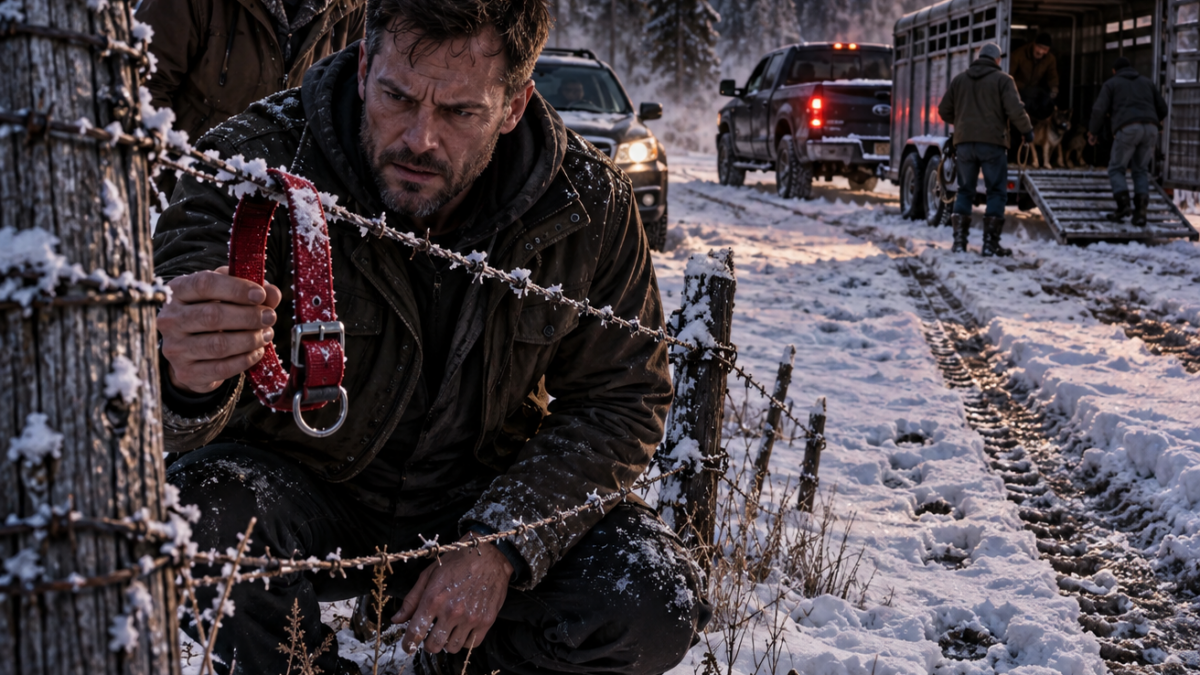
𝗙𝗨𝗟𝗟 𝗦𝗧𝗢𝗥𝗬 The red collar was hanging from the barbed wire like someone had left it there with my name on it.
𝗙𝗨𝗟𝗟 𝗦𝗧𝗢𝗥𝗬
The puppy tried to retreat, but there was nowhere to go.
I took off my glove, reached slowly beneath the branch, and let her smell my fingers. She snapped once, weakly, without conviction. Fear, not aggression.
“I know,” I said. “I know, little one.”
Travis crouched beside me.
There were tracks everywhere.
Tiny paws. Larger paws. Boots.
And deep grooves where something heavy had been dragged toward the service road.
The puppy did not get there by herself.
I looked into the dark timber, toward the place Red had disappeared every morning with food in her mouth.
For twelve days, I had thought she was leaving me.
Now I understood.
She had been going back.
Dr. Avery Sloan arrived forty minutes later.
She drove a dark SUV with a veterinary emblem on the side and stepped out carrying a medical kit like she had no interest in anyone’s panic until panic became useful. She was thirty-eight, sharp-eyed, practical, and completely unimpressed when Nora introduced me as a former Navy SEAL.
Which, frankly, made me like her immediately.
“She’s female,” Avery said after wrapping the puppy in thermal blankets inside her SUV. “Maybe five weeks. Dehydrated. Cold, but responsive.”
“Recently fed?” I asked.
Avery examined her with careful hands.
Then she looked at me.
“Recently nursed.”
My eyes went to the woods.
“How recently?”
“Recent enough that her mother was probably here after the storm.”
Red.
Alive.
Maybe.
I held onto that word harder than I wanted anyone to see.
Avery took the puppy to her clinic while Travis contacted animal control and started working land records. I stayed at the roadside long after everyone else had gone, staring at the service road and feeling a familiar old pressure settle behind my ribs.
In the Teams, there was a phrase I never liked: actionable intelligence.
It made everything sound clean.
But intelligence rarely arrives clean. It arrives as a missing collar, a sound under a branch, a boy saying he locked the gate, a dog carrying food into the woods. It arrives in fragments, and most people miss it because fragments do not look like proof until someone has already paid the price.
By afternoon, Travis called.
The service road crossed several parcels before reaching an old ranch property about two miles into the forest. Years earlier, it had operated as Bitter Creek Working Dogs.
The breeding permit had expired eighteen months before.
Owner: Warren Kessler.
Fifty-two.
No current kennel license.
“That doesn’t make him guilty,” Travis said over the phone.
“No,” I said. “But it gives you somewhere to start.”
“It gives us somewhere to ask questions.”
“Then ask them fast.”
He exhaled. “Grant.”
“She has puppies.”
“I know.”
“No,” I said, sharper than I intended. “You know it as a fact. I know it because I saw what it cost her to carry food in her mouth every morning.”
Silence held for a beat.
Then Travis said, “I’m moving as fast as the law lets me.”
That was the sentence I hated most.
Not because he was wrong.
Because he was right.
That evening, another report came in.
A golden retriever had vanished twelve miles north.
Then a cattle dog.
Both within the previous three weeks.
Nora started calling shelters, rescues, veterinarians, anyone she knew who might have heard rumors about missing dogs or suspicious sales. By nightfall, her kitchen table had become a command center of sticky notes, scribbled phone numbers, and coffee cups she kept forgetting to drink from.
I went to Avery’s clinic.
The puppy was asleep beneath warming blankets when I arrived. She looked impossibly small without the forest around her. Her ribs rose and fell quickly. One paw twitched in her sleep.
Avery stood beside me with her arms folded.
“You found her in time,” she said.
“I found one.”
Her face softened, but only slightly. “We don’t know how many there are.”
“She carried food like there were more.”
“I know.”
“What happens if Red can’t get back to them?”
Avery did not answer right away. That told me enough.
I looked through the glass at the puppy.
“What are you calling her?”
“I haven’t named her.”
“Good.”
“You don’t approve of names?”
“I don’t approve of naming dogs before you know whether you can save their mother.”
Avery looked at me. “That sounds like superstition.”
“Maybe.”
“Or self-protection.”
I said nothing.
She let the silence sit.
Then she said, “I scanned her.”
My head turned. “Chip?”
“Yes. That’s the strange part. The chip was inserted recently, but the registration is incomplete.”
“What does it trace to?”
“The manufacturer batch number matches chips purchased through a veterinary supplier connected to Bitter Creek Working Dogs.”
For a second, the room seemed to narrow.
“You’re sure?”
“I’m looking at the records.”
I called Travis from the parking lot.
He was quiet while I told him.
Then he said, “That helps.”
“It should do more than help.”
“It helps me build something that holds.”
I looked up at the mountains, black against the winter sky.
“Then build it.”
The next morning, Travis obtained permission to inspect the exterior areas of the old Bitter Creek property while pursuing broader authorization. I was allowed to go as far as the law permitted, which was Travis’s way of reminding me that he knew exactly what kind of man I had once been and exactly what kind of trouble I could make if I forgot I was a civilian.
The old kennel property looked abandoned from a distance.
Sagging fence.
Weather-beaten barn.
A low building with boarded windows.
Snow drifted against the walls, smooth in some places and churned in others. That was what I noticed first. Not the building. Not the rusted equipment. The snow.
Movement leaves signatures.
Avery joined us with animal control. Nora waited near the road because she had promised Travis she would not interfere, which meant she interfered by phone instead.
We found the first cage fifty yards behind the building.
Empty.
Then another.
Also empty.
Behind the barn, the snow had been stomped into mud by dozens of paw prints. Some old. Some fresher. Some too small.
Avery stopped suddenly.
“Grant.”
She pointed.
Tiny tracks.
Five sets, maybe six.
Mixed with adult Shepherd prints.
My chest tightened.
Red had been there.
I followed the tracks with my eyes toward a warped wooden building near the back of the property. One board near the foundation had been pushed outward, creating a narrow gap.
Not wide enough for a man.
Wide enough for a German Shepherd.
Everything clicked into place so sharply it felt almost physical.
“She was getting out,” I said.
Travis turned. “What?”
“Every morning. She wasn’t living loose in the forest.”
I pointed toward the broken board.
“She was escaping.”
Avery stared at the gap.
“She got out,” I continued, “crossed two miles of winter forest, reached the highway, found me, ate enough to keep herself standing, carried back what she could, then crawled back in.”
Travis looked at me. “Why would she return voluntarily?”
Avery answered before I could.
“Her puppies.”
Those words landed hard.
Red had not been a stray mother hiding a litter somewhere safe.
She had been trapped.
And every morning, before dawn, she had forced her way out through a broken board and run through the cold to find food, only to return to captivity because five helpless lives depended on her.
My jaw clenched so hard it hurt.
“What happened after the storm?” I asked.
Travis looked toward the trailer tracks.
“Maybe whoever was using this place realized she was escaping.”
“And moved everything.”
“Possibly.”
Possibly was another word I hated.
It was the language of people who had to prove what their instincts already knew.
Then Nora called.
A gas station fifteen miles north had exterior cameras. The footage showed a dark pickup towing a white enclosed trailer at 3:17 Friday morning, hours after the storm began.
One detail stood out.
A black mountain-shaped decal on the trailer’s rear door.
Another business captured the same trailer forty minutes later, heading north on Highway 93.
Travis began pulling traffic camera footage. Nora kept calling. Avery stayed at the clinic with the puppy and sent updates that were too brief to be comforting.
Stronger.
Drinking.
Still weak.
Then the missing husky’s owner arrived at Avery’s clinic.
His name was Wyatt Mercer. Fifteen years old. Too thin for his winter coat. His face carried the raw, sleepless look of someone who had been told by too many adults to accept an answer his heart refused.
He stood beside his mother, clutching a photograph.
The husky was white and gray with bright blue eyes.
“His name is Ghost,” Wyatt said.
I studied the picture.
“People keep saying he escaped,” Wyatt added.
“Did he?”
“No.”
His mother touched his shoulder. “Wyatt—”
“No,” he said, voice cracking. “I locked the gate. It has a combination lock. I checked it twice.”
I believed him.
Not because teenagers cannot make mistakes.
Because I recognized the expression.
He was not guessing. He was replaying the moment again and again, searching for the mistake everyone else insisted he must have made.
I had done the same thing after Red disappeared.
“Anything unusual that week?” I asked.
Wyatt hesitated.
“A truck.”
Travis, who had just stepped into the lobby, looked up. “What truck?”
“Dark-colored. It drove past our house twice.”
“Trailer?”
“The second time.”
“What did it look like?”
Travis pulled up a still from the gas station footage on his phone.
Wyatt leaned closer.
His finger stopped on the black mountain decal.
“That.”
Nobody spoke.
Travis immediately called his office.
Thirty minutes later, traffic footage placed the trailer near Hamilton. Then farther north. Then east. By late afternoon, they had it entering a rural road leading toward an isolated property outside Drummond.
Forty-eight miles from the original kennel.
Travis stared at the map.
“We’ve got a possible destination.”
I grabbed my jacket.
He stopped me with one look.
“You’re not coming in with us.”
“I’m coming as far as the law allows.”
“Grant.”
“That dog came to me twelve mornings in a row.”
He held my stare.
I did not add what both of us already knew.
That she had asked me for help in the only way she knew how.
That I had been slow to understand.
That I was not going to be slow again.
Travis sighed. “As far as the law allows.”
“That’s enough.”
But as I headed for my truck, Avery walked out holding the rescued puppy bundled against her chest.
The little Shepherd lifted her head.
For the first time, she was not trembling.
I touched two fingers lightly to her forehead.
“I’m bringing your mother back,” I whispered.
I meant it.
I just did not know that when we reached that property, Red would not be the only dog waiting for us.
The property outside Drummond looked ordinary.
That made it worse.
A gray farmhouse sat back from the road. A metal barn stood behind it. Two pickups were parked near a tractor. Snow leaned against weathered fences, and smoke rose from a chimney like nothing in the world was wrong.
If you drove by at highway speed, you would forget the place in ten seconds.
The white trailer sat behind the barn.
Black mountain decal on the rear door.
Same trailer.
Travis and the other deputies handled everything from there. There were no movie moments. No dramatic door-kicking while heroic music played. Real investigations move with caution because one mistake can poison everything that comes after.
The property was secured methodically.
Animal control arrived.
A second veterinarian joined Avery.
I stood behind the line Travis had given me, hands buried in my coat pockets, trying not to imagine what was inside that barn.
Then I heard barking.
Not one dog.
Many.
The sound rose through the cold air in waves. Fear, confusion, warning, desperation. Dogs know when strangers arrive. They also know when hope has entered a place where hope does not usually go.
Avery closed her eyes for half a second.
I did not.
I kept looking at the barn.
Several minutes later, Travis emerged.
“Grant.”
I stepped forward. “How many?”
“We don’t know yet.”
“Red?”
He hesitated.
“We found German Shepherds.”
That hesitation frightened me more than a direct answer.
“Is she alive?”
“I don’t know which one is yours.”
“She’s not mine.”
Travis gave me a look.
Neither of us believed that sentence anymore.
One by one, dogs began coming out.
A Labrador with dull eyes and a raw spot on his neck.
A beagle who shook so badly the animal control officer had to carry him.
Two mixed breeds pressed against each other in the same crate.
Then a golden retriever.
Nora, who had stayed with Wyatt and his mother, began comparing photographs over the phone.
“That’s Daisy,” she said, voice breaking. “That’s the missing retriever.”
So the connection was real.
These were not just unregistered breeding dogs.
At least some had families.
At least some had been taken.
Then someone shouted from inside.
“Microchip confirmed!”
A moment later, a white-and-gray husky appeared between two handlers.
Ghost.
Even from thirty yards away, I recognized those blue eyes.
I called Wyatt.
He answered immediately.
“Did you find him?”
I watched Ghost stand in the snow, confused but alive.
“Yeah,” I said.
Silence.
“Grant?”
“We found Ghost.”
I heard the kid break down.
Not loudly.
Just one sharp breath, like he had been holding it for a week and his body had finally betrayed him.
“Is he okay?”
“He’s standing. Vet’s checking him.”
“I knew he didn’t run away.”
“I know.”
After I hung up, Avery appeared from the barn. Her gloves were dirty. Her face was tight in a way I did not like.
“There’s another room,” she said.
My heart started pounding.
“What room?”
“Rear section. Warmer than the rest.”
“Avery.”
“Come with me.”
Travis permitted it only after the area had been cleared. I walked through the barn behind Avery and tried to keep my face still.
The smell hit first.
Fear. Damp straw. Urine. Old food. Metal cages. Bleach used too late and too little.
Rows of temporary pens lined the walls. Some were empty. Some held frightened dogs who would not look directly at anyone. Water bowls. Transport crates. Medication containers. Stacks of incomplete paperwork.
Evidence, I thought.
Then immediately hated myself for thinking like that.
Not evidence.
Lives.
We reached a narrow doorway near the back.
I stopped.
A black-and-tan German Shepherd stood on the other side.
Thinner than before.
No red collar.
But the eyes were the same.
Red.
She saw me.
Her body went rigid.
Four puppies huddled behind her.
For a second I could not breathe.
There are things combat teaches you to survive. Noise. Blood. Fear. Chaos. Loss. There are ways to lock your mind around the moment in front of you and keep moving because stopping might get someone killed.
But no training had prepared me for the sight of that dog standing between strangers and her children with nothing left in her but will.
“Hey, girl,” I said.
Her ears moved.
I lowered myself slowly to one knee.
“You remember me?”
She did not move.
Then I understood.
I was not beside my truck.
There was no snowbank.
No open roadside.
No blue bowl waiting in a familiar patch of dawn.
Everything around her smelled like cages, strangers, and terror.
So I reached inside my coat.
Avery stared at me. “You brought that?”
I pulled out the blue plastic bowl.
“Yeah.”
I set it on the floor between us.
Red’s eyes dropped to it.
Then returned to my face.
I poured a handful of kibble inside.
The sound did what my voice could not.
Her head tilted.
A laugh almost broke out of me, but it came too close to a sob.
“That’s right,” I whispered. “It’s me.”
One step.
She stopped.
Behind her, the puppies squeaked.
She turned immediately to check them.
That told me everything.
Even now, starving and exhausted and surrounded by people, they came first.
I did not reach for her.
I did not rush.
I waited.
Finally, Red crossed the distance herself.
Her nose touched my hand.
Then her entire posture changed.
The rigid shoulders loosened. Her ears lowered slightly. Her eyes closed for half a second.
And she pushed her head against my chest.
I wrapped both arms around her.
“There you are,” I said.
Avery looked away.
I did not.
I was not ashamed of the tears.
Not after that.
“There are only four,” I said after a moment, staring past Red at the puppies pressed together in the straw.
Avery smiled softly.
“No.”
I looked at her.
“What?”
“The puppy at my clinic.”
For a second, I could not make the words fit.
“She’s one of them?”
“The age, markings, and condition all fit. We’ll confirm properly, but I’d bet my clinic on it.”
Five puppies.
All alive.
Red had done it.
For almost two weeks, she had escaped through a broken foundation board before sunrise, crossed nearly two miles of winter forest, found food from a stranger on the roadside, carried what she could, and returned to captivity.
Not because she could not run.
Because her puppies could not.
Later, investigators would reconstruct what had likely happened. When the person operating the kennel discovered Red’s escape route, the dogs were moved before authorities could find them. Her collar had been removed during transport. The rescued puppy had slipped away and hidden under the fallen branches near the drainage ditch.
That tiny accident became the clue that exposed everything.
Warren Kessler was taken into custody while investigators sorted through suspected animal theft, unlawful kennel operations, falsified records, and neglect allegations. The exact charges would take time to move through the courts.
People later asked me if I felt satisfaction seeing him arrested.
I did not.
Not the kind they meant.
I cared about the dogs leaving his property.
One by one.
Alive.
That evening, Red was transported to Avery’s clinic.
Her missing puppy was waiting.
I stood outside the recovery enclosure while Avery carried the little Shepherd in. The puppy smelled her mother before she saw her and began to squeal.
Red stood.
The change in her was instant.
Not weak. Not cautious. Not beaten.
Mother.
She crossed the enclosure faster than I had seen her move all day, sniffed the puppy once, then again, then began cleaning her face with desperate tenderness. The puppy crawled beneath her, searching blindly, and the other four crowded around until all five small bodies were pressed against her belly.
Avery leaned beside me.
“Family reunion,” she said.
I sat against the wall outside the enclosure.
Five puppies.
One exhausted mother.
All together.
For the first time in twelve mornings, Red did not need to carry food anywhere.
I filled the blue bowl and placed it beside her.
She ate every bite.
Ghost went home to Wyatt two days later.
I was there because Nora insisted, and because some things deserve witnesses.
The clinic doors opened, and Ghost walked into the lobby beside Avery. Wyatt stood near the reception desk with both hands clenched at his sides, like he was afraid reaching too soon might make the moment disappear.
He whispered, “Ghost.”
The husky stopped.
His ears lifted.
Then he exploded forward.
Wyatt dropped to his knees just before sixty pounds of husky slammed into him. His mother began crying immediately. Ghost licked Wyatt’s face, climbed halfway into his lap, and made a sound somewhere between a howl and a whine.
“I told everybody,” Wyatt kept saying into his fur. “I told everybody you didn’t leave.”
I understood exactly what he meant.
Sometimes the hardest part is not losing someone.
It is being told their absence has a simple explanation when every instinct in you knows something is wrong.
Over the next several weeks, investigators identified more dogs through microchips, photographs, veterinary records, and families who had refused to stop searching. Some went home. Others entered rescue programs. Nora turned her dining room into a temporary operations center and claimed she was “helping a little,” which was Nora’s way of saying she had quietly taken command of half the valley.
Avery focused on Red.
That was when we learned her real name.
Juniper.
Her previous owner had been a retired teacher named Harold Bennett. Two years earlier, after moving into assisted living, he had surrendered her to what he believed was a reputable working-dog program.
When Avery called him, he cried.
So did I after I hung up.
I never told anyone that part.
Juniper recovered faster than I expected. The puppies recovered even faster, as puppies do, as if their small bodies had already decided joy was more useful than memory.
The smallest—the one we had found beneath the branches—was named Piper.
Avery adopted her.
I accused Avery of planning it from the first night.
She denied it while Piper slept under her desk with a pink blanket tucked around her like royalty.
The other puppies went to carefully screened families. One went to a wilderness search-and-rescue trainer. Another went home with a firefighter, his wife, and two children who promised solemnly to share the couch. The last two became spoiled suburban dogs whose greatest future danger appeared to be excessive treats and unrestricted sofa access.
Juniper watched them leave one at a time.
That worried me.
After the third puppy left, she paced her clinic room for nearly an hour.
I sat on the floor with my back against the wall.
“It’s okay,” I told her.
She looked at the door.
“They’re safe.”
She paced again.
“They don’t need you to go after them.”
She stopped then, not because she understood every word, but because she understood the tone.
Eventually she lay down beside me and rested her head across my boot.
I stayed until midnight.
Three days later, Nora cornered me at my mailbox.
“When are you taking her home?”
I pulled a stack of bills from the box. “Who?”
She stared at me.
“You spent sixteen years performing missions people write books about, and that is the best lie you can produce?”
“She’s still recovering.”
“She recovered.”
“Avery hasn’t—”
“Avery told me yesterday she would clear her for adoption.”
I narrowed my eyes. “You two discuss me?”
“Constantly.”
“Nora.”
“Grant.”
I started toward my cabin.
She called after me, “You already bought the bed!”
I stopped.
That was classified information as far as I was concerned.
Nora laughed so loudly I could hear her from my porch.
The next afternoon, I drove to Avery’s clinic.
Juniper was standing behind the glass before my truck fully stopped.
Avery met me at the counter with a clipboard and a look she was trying too hard to make professional.
“I assume you’re here for your usual visit.”
“No.”
Her eyebrows rose.
I placed a new collar on the counter.
Dark blue.
Metal identification tag.
GRANT CALLOWAY.
My phone number beneath it.
Avery looked down at the tag, then back at me.
“Interesting.”
“I want to adopt her.”
“Are you sure?”
I looked through the glass.
Juniper had one paw against the door.
“I think she decided twelve mornings before I did.”
Avery’s expression softened, but she did not let me off easy.
“She may have separation anxiety. Hypervigilance. Resource guarding. Night pacing. Door fixation. She needs structure, exercise, routine, and patience.”
“I understand.”
“Being a former SEAL does not automatically qualify you to raise a traumatized German Shepherd.”
“I know.”
“Good.”
She slid the paperwork across the counter.
“Sign.”
Twenty minutes later, Juniper walked outside with me.
When I opened the passenger door, she looked at the seat, then at me.
“Your choice,” I said.
She jumped in.
The blue bowl was already on the floorboard.
She sniffed it, circled once, and sat down.
I laughed.
“Yeah,” I said. “You’re home.”
Life changed faster than I expected.
My cabin stopped being quiet.
There was fur everywhere. On the floor. On my jacket. In my truck. Once, somehow, inside a sealed coffee mug.
Juniper barked at delivery drivers with the moral outrage of a property attorney. She hated the vacuum cleaner as if it had personally betrayed her. She refused to sleep on the expensive orthopedic dog bed I had bought and instead slept outside my bedroom door, where she could monitor the hallway, the front entrance, and apparently my breathing.
Every morning before sunrise, she woke me.
For the first week, it scared me.
At 5:30, she would stand beside the front door.
Waiting.
The same time she had once escaped the kennel.
The first morning, I opened the door and watched her step onto the porch. She did not run. She only stood there, looking into the dark as if expecting the world to demand something from her.
“Juniper,” I said.
Her ears moved.
“You don’t have to go.”
She glanced back at me.
I clipped on her leash anyway.
Not because I thought she would bolt.
Because trust goes both ways.
We drove to the old roadside.
Snow still covered the forest. The barbed-wire fence looked smaller in daylight, less menacing than it had on the morning when the red collar hung there. I placed the blue bowl where it used to sit.
Juniper stared toward the pines.
I wondered what she remembered.
The cages.
The puppies.
The broken board.
The runs through frozen darkness with hunger clawing at her from the inside.
Then she looked at me.
I unclipped her leash.
“You don’t have to go back,” I said.
She remained beside me.
“You hear me?”
Her tail moved once.
The first time I met Juniper, she had eaten just enough to survive and carried the rest away.
Now I filled the bowl completely.
She ate.
Every bite.
And when she finished, she did not turn toward the forest.
She jumped into my truck.
Spring came late to western Montana.
By April, the snow had retreated into the mountains and the valley turned green in slow, stubborn layers. Juniper gained twelve pounds. Her coat grew thick and glossy. The hollow spaces around her ribs filled in. The haunted look faded from her eyes.
Not completely.
Some things leave marks no one else can see.
I understood that better than most.
But she learned.
She learned that doors could open without someone taking her away.
She learned that a truck could mean a walk, a trail, a vet who kept treats in her pocket, or a ride into town with the window cracked just enough for smells.
She learned food would still be there tomorrow.
And I learned too.
For years after leaving the Teams, I had told myself I liked being alone. Maybe part of me did. Silence had uses. Distance had uses. Routine kept the past in manageable compartments.
But solitude can harden into habit so gradually that a man stops recognizing the difference between peace and absence.
Juniper changed that.
So did the people she dragged into my life.
Nora began visiting constantly, supposedly to see the dog. She brought casseroles I did not ask for, opinions I did not invite, and updates from every rescue within a hundred miles.
Avery and Piper came hiking with us twice a month. Piper grew into a beautiful young Shepherd with one ear that leaned sideways whenever she got excited. Juniper pretended to be dignified around her until Piper pounced, and then all dignity vanished.
Wyatt sometimes brought Ghost over.
Watching Juniper tolerate Ghost’s ridiculous husky energy became entertainment worth selling tickets for.
One Saturday morning, Avery watched Juniper follow a trail I had taken through the yard twenty minutes earlier.
“Have you considered scent work?” she asked.
“She tracks everything already.”
“I’m serious. There’s a volunteer search-and-rescue trainer outside Hamilton who works with stable adult dogs.”
“She’s seven.”
“Nobody’s promising a professional career.”
Juniper found one of my gloves behind the woodpile and brought it to me like evidence.
Avery smiled.
“She wants a job.”
So we began simply.
Hidden gloves.
Short trails.
Finding Nora behind a fallen cedar.
The first time Juniper located Nora, she looked so proud that I laughed until my ribs hurt. Nora insisted she had been perfectly hidden. Juniper disagreed by sitting in front of her and barking once, as if filing an official report.
Months later, Juniper assisted volunteers during a controlled wilderness training exercise.
Nothing dramatic.
No cameras.
No medals.
No headlines.
Just a dog using the same instincts that had once kept her puppies alive.
That was enough.
The legal case moved in the background.
Several recovered dogs were conclusively connected to families who had reported them missing. Records from both properties helped investigators establish how animals had been moved, concealed, and falsely documented. Kessler eventually entered guilty pleas to multiple state charges related to unlawful possession and mistreatment of animals. Other allegations were resolved through separate proceedings.
I attended the first hearing.
Not the rest.
Justice mattered.
But Juniper mattered more.
One year after I first saw her beside the road, I woke before sunrise.
5:36.
She was already standing beside my bed.
I opened one eye.
“Seriously?”
Her tail thumped once.
“Anniversary?”
Another thump.
I pulled on my boots.
We drove to the same road.
No storm this time. No wall of snow. Just a thin layer of frost glowing under the headlights and the faint blue edge of morning lifting behind the mountains.
I brought the blue bowl.
It was scratched now. Faded. Chewed at one edge from a phase Juniper and I had agreed never to discuss.
I set it beside the ditch.
Juniper walked to the edge of the trees.
Stopped.
Looked back.
For one terrible second, an old fear rose through me.
I remembered watching her disappear between those pines morning after morning. I remembered the untouched food, the empty road, the collar hanging from the fence.
Then Juniper turned away from the forest.
She came back to me.
I crouched, and she pressed her forehead into my chest.
“Good choice,” I whispered.
A truck approached.
Avery.
Piper jumped out before Avery had fully closed her door. She was not tiny anymore, not the shivering puppy from beneath the branches, but when she saw Juniper, something in her changed.
Mother and daughter raced toward each other.
Piper circled her twice.
Juniper chased her across the frosted field.
Avery walked over holding two coffees.
“You planned this?” I asked.
“Nora told me you’d be here.”
“Of course she did.”
Avery handed me a cup.
We watched the dogs run.
“You ever think about that first morning?” she asked.
“All the time.”
“What would have happened if you kept driving?”
I did not answer immediately.
Because I had wondered.
If I had not stopped, maybe Juniper would have found food somewhere else. Maybe another driver would have noticed her. Maybe authorities would eventually have discovered Bitter Creek and the Drummond property anyway.
Or maybe not.
People like to imagine life turns on grand heroic decisions.
It usually does not.
Sometimes it turns on tiny ones.
Slow down.
Open the truck door.
Put food in a bowl.
Come back tomorrow.
Notice when something changes.
Refuse to dismiss the small detail that does not make sense.
I had spent years in places where danger announced itself with gunfire, alarms, smoke, and shouting. Juniper taught me that sometimes an emergency looks completely different.
Sometimes it looks like a hungry mother standing silently beside a frozen road.
For twelve mornings, I believed I was feeding her.
I was not.
I was answering a message I did not yet understand.
Every mouthful she carried into the forest said the same thing.
There are others.
Every nervous glance over her shoulder said:
I can’t stay.
Every morning she returned said:
Please be here.
And when she vanished, the empty roadside said what she could not.
Follow me.
A year earlier, Juniper had been willing to leave safety every morning because her puppies needed her.
Now all five puppies were alive.
Ghost was home.
The other recovered dogs had either returned to their families or found new ones.
Piper had Avery.
Juniper had me.
And somehow, because one stubborn German Shepherd refused to abandon her family, I had found one too.
Piper sprinted past us.
Juniper chased her.
Avery laughed.
The sunrise broke above the mountains, spilling gold across the grass, the road, the fence, the trees, and the old blue bowl sitting empty near my boots.
For the first time, it was empty because no one needed what was inside it.
No one was starving.
No one was carrying food back to a cage.
No one was disappearing into the woods.
I picked up the bowl and walked toward the truck.
“Juniper!”
She stopped beside Piper.
Her ears lifted.
Then she ran straight toward me.
This time, she was not returning because she had to.
She was returning because she was home.
And for the first time in years, so was I.
𝗧𝗛𝗘 𝗘𝗡𝗗
The red collar was hanging from the barbed wire like someone had left it there with my name on it.
For twelve mornings, she had come to me before sunrise.
For twelve mornings, I had watched her carry food into the pines and told myself patience was the same thing as trust.
On the thirteenth morning, all she left behind was a collar, a trail in the snow, and a silence that felt too deliberate to ignore.
I killed the engine of my truck and sat there with both hands still wrapped around the wheel, staring through the windshield at that strip of red nylon swaying on the fence.
The heater ticked softly. My breath fogged the glass. Outside, Montana looked frozen solid, the Bitterroot Valley buried under fresh snow, the pine trees standing black and motionless beyond the road. Nothing moved. No birds. No wind. No flash of tan-and-black fur slipping between the trees.
No Red.
That was what I had started calling her because of the collar. Not imaginative, maybe, but a starving German Shepherd who appears out of the dark before sunrise does not exactly stop and offer introductions.
For nearly two weeks, she had met me beside that road at 5:40 every morning.
Not 5:35. Not 5:50.
5:40.
The kind of detail most people would shrug off.
I was not most people.
My name is Grant Calloway. I was forty-three years old then, and I had spent sixteen years in Naval Special Warfare before I finally admitted that a man can come home from war and still live like he is waiting to be deployed again. I had a cabin outside Missoula, a truck that smelled like coffee and gun oil, and a quiet life that most people thought suited me.
Maybe it did.
Maybe I had just gotten good at confusing quiet with peace.
The first time I saw Red, I was driving home after an overnight security consultation for a construction site west of town. It was still dark, the kind of hour when even the highway looked half asleep, and my headlights caught her stepping out near the shoulder.
I slammed the brakes hard enough to make the coffee in my cup holder jump.
She did not run.
That was the first thing that bothered me.
A healthy stray dog bolts from headlights. A scared dog retreats. A feral dog vanishes like smoke.
She stood there.
Thin, alert, dirty, and perfectly still.
Her ribs showed beneath her coat. Snow clung to the fur on her legs. Her ears were up, not pinned back. Her eyes were dark brown and calculating, locked on me with the kind of exhausted intelligence that made me sit still a few seconds longer than I normally would have.
Then she looked behind her.
Not once.
Twice.
I knew that look.
It was not curiosity.
It was fear measured against responsibility.
I cracked the door slowly. “Easy, girl.”
She watched me without blinking.
I had half a turkey sandwich in a paper bag on the passenger seat. I tore off a piece and tossed it gently into the snow.
She waited.
Then she stepped forward, sniffed, and ate it.
I tossed another piece.
She ate faster that time.
The third piece, she picked up in her mouth, looked at me again, and turned toward the pines.
She did not chew it.
She carried it away.
I watched her disappear between two trees.
The next morning, I brought dog food.
I told myself it was practical. If she showed up again, I would feed her properly. If she did not, I would take the bag home and feel a little foolish.
She showed up.
Same place.
Same time.
Same silent stare.
She ate three mouthfuls from the blue plastic bowl I had set on the ground, then filled her mouth with kibble and vanished into the forest.
By the fourth morning, I understood she was carrying food to something.
By the sixth, I noticed the milk along her belly.
Puppies.
That changed everything.
I tried not to react too much when I saw it. Animals read tension better than people do. Red already treated me like a risk she had chosen to tolerate because hunger had narrowed her choices. I did not want to become the kind of man who turned help into pressure.
So I kept my distance.
Ten feet.
Then eight.
Then six.
By the tenth morning, I was sitting against the front tire of my pickup while she ate from the bowl, and she no longer flinched every time I moved my hand.
I never followed her.
That mattered to me.
Trust is a fragile thing when a creature has learned that people can hurt her. It is not won by chasing. It is not won by grabbing. It is won by showing up the same way, again and again, until fear begins to recognize the shape of mercy.
Every morning, when she stepped into the trees with food in her mouth, I said the same thing.
“See you tomorrow.”
Then tomorrow stopped coming.
A storm hit Thursday night.
By Friday morning, the valley was smothered in fresh snow. I drove out anyway with the blue bowl, a thermos of coffee, and a bag of food on the passenger seat.
Red did not appear.
I waited forty-seven minutes.
Long enough to know I was not being impatient.
Long enough for the cold to creep through my boots.
Long enough for the old part of my mind, the part trained to measure absence as information, to begin assembling possibilities I did not like.
Saturday morning, I went back.
Still nothing.
The food remained untouched.
Sunday, I found the collar.
Hanging from the fence.
Three feet off the ground.
Deliberately.
I got out of the truck, and the cold hit my lungs so hard it felt like swallowing broken glass. I walked toward the fence slowly, boots crunching in the snow. My eyes moved over everything before I touched anything.
The collar had not snapped.
It had not been chewed off.
The buckle was intact.
Someone had removed it.
Then I saw the tracks beneath the fresh powder.
Tire marks.
A pickup, probably. Heavier than mine. Something behind it had cut parallel grooves through the snow where the old service road disappeared into the forest.
Trailer.
I took out my phone and photographed the collar, the fence, the tire tracks, the gate, the service road. I photographed everything before I let my hand hover near the red nylon.
“Come on, girl,” I said quietly.
The trees gave me nothing.
A truck pulled up behind me. I turned and saw Nora Bellamy climbing out of her old Subaru in a brown parka large enough to shelter a family of four.
Nora was sixty-six, widowed, and possessed the kind of stubborn compassion that made half the county pretend to be annoyed by her while calling her first when anything went wrong. She had volunteered with rescues across western Montana for years. I had told her about Red after the first week because Nora knew things about dogs that no manual could teach.
She stopped when she saw my face.
“What did you find?”
I pointed toward the fence.
She walked up beside me, took one look at the collar, and her expression changed.
“Oh,” she whispered.
“Someone put it there.”
She did not argue. That was one of the things I respected about Nora. She did not waste time dismissing what was already obvious.
“Did you touch it?”
“No.”
“Good.” Then she saw the tracks. “Grant.”
“I know.”
“Call Travis.”
“I’m about to.”
Deputy Travis Heller was not a friend exactly, but in a place like ours, categories blurred. He had been to my cabin twice for coffee and once to ask whether I could help him understand a security camera system after a burglary case. He was broad-shouldered, calm, careful, and irritatingly hard to rattle.
Before I could dial, Nora’s phone rang.
She answered with the distracted impatience of someone who expected a scheduling problem.
Then she went still.
“What?” she said.
I looked at her.
She listened for several seconds.
“When?”
Another pause.
“Tell them not to touch anything. I’m with Grant now. We’re coming.”
She ended the call and looked directly at me.
“What happened?” I asked.
“Another dog disappeared last night.”
“Where?”
“Six miles from here.”
“What kind?”
“A husky. Family dog. Backyard gate was still locked.”
The trees seemed to get darker.
One missing dog could be anything. A runaway. A predator. An accident. A family hoping for someone to blame because blame feels better than helplessness.
Two missing dogs, close together, with one collar hanging on a fence and trailer tracks in the snow, was no longer nothing.
Twenty minutes later, Deputy Travis Heller stood beside the barbed wire photographing Red’s collar.
He did not speak much at first. He moved methodically, documenting what I had already documented, studying the tracks, the service road, the fence line. Nora hovered a few steps back with her arms crossed tight against her chest.
Finally Travis said, “One missing dog doesn’t establish a pattern.”
“I know.”
“A collar doesn’t prove somebody took her.”
“I know that too.”
He glanced at me. “You don’t sound convinced.”
“I’m convinced of one thing. She had puppies somewhere.”
That shifted his expression.
“How young?”
“I don’t know. I never saw them.”
“But you’re sure she was nursing?”
“Yes.”
Nora nodded. “I saw her two days before the storm. He’s right.”
Travis looked into the pines.
If Red had puppies and she had been taken, the rest of the sentence did not need to be spoken.
They were out there.
Alone.
Cold.
Hungry.
Too young to understand why their mother had not come back.
A faint sound came from the trees.
I froze.
Nora looked at me.
Travis raised a hand, and all three of us stood perfectly still.
There it was again.
Not barking.
Crying.
High. Weak. Frantic.
I was moving before I realized it.
“Grant,” Travis warned.
“I hear it.”
“I go first.”
“Then go.”
He did. I followed close enough to irritate him and not close enough to give him a reason to turn around.
The sound led us thirty yards into the pines, down toward an old drainage ditch half buried beneath snow and deadfall. A fallen branch had created a shallow pocket near the bank, and beneath it something moved.
I dropped to one knee.
Two tiny brown eyes stared back at me.
A German Shepherd puppy was wedged under the branches, shivering so violently her entire body shook. Snow clung to her muzzle. Her paws were crusted with ice.
And around her neck was a thin strip of red nylon.
Nora made a sound behind me that was almost a sob.
“Easy,” I whispered.
The puppy tried to retreat, but there was nowhere to go.
I took off my glove, reached slowly beneath the branch, and let her smell my fingers. She snapped once, weakly, without conviction. Fear, not aggression.
“I know,” I said. “I know, little one.”
Travis crouched beside me.
There were tracks everywhere.
Tiny paws. Larger paws. Boots.
And deep grooves where something heavy had been dragged toward the service road.
The puppy did not get there by herself.
I looked into the dark timber, toward the place Red had disappeared every morning with food in her mouth.
For twelve days, I had thought she was leaving me.
Now I understood.
She had been going back.
Dr. Avery Sloan arrived forty minutes later.
She drove a dark SUV with a veterinary emblem on the side and stepped out carrying a medical kit like she had no interest in anyone’s panic until panic became useful. She was thirty-eight, sharp-eyed, practical, and completely unimpressed when Nora introduced me as a former Navy SEAL.
Which, frankly, made me like her immediately.
“She’s female,” Avery said after wrapping the puppy in thermal blankets inside her SUV. “Maybe five weeks. Dehydrated. Cold, but responsive.”
“Recently fed?” I asked.
Avery examined her with careful hands.
Then she looked at me.
“Recently nursed.”
My eyes went to the woods.
“How recently?”
“Recent enough that her mother was probably here after the storm.”
Red.
Alive.
Maybe.
I held onto that word harder than I wanted anyone to see.
Avery took the puppy to her clinic while Travis contacted animal control and started working land records. I stayed at the roadside long after everyone else had gone, staring at the service road and feeling a familiar old pressure settle behind my ribs.
In the Teams, there was a phrase I never liked: actionable intelligence.
It made everything sound clean.
But intelligence rarely arrives clean. It arrives as a missing collar, a sound under a branch, a boy saying he locked the gate, a dog carrying food into the woods. It arrives in fragments, and most people miss it because fragments do not look like proof until someone has already paid the price.
By afternoon, Travis called.
The service road crossed several parcels before reaching an old ranch property about two miles into the forest. Years earlier, it had operated as Bitter Creek Working Dogs.
The breeding permit had expired eighteen months before.
Owner: Warren Kessler.
Fifty-two.
No current kennel license.
“That doesn’t make him guilty,” Travis said over the phone.
“No,” I said. “But it gives you somewhere to start.”
“It gives us somewhere to ask questions.”
“Then ask them fast.”
He exhaled. “Grant.”
“She has puppies.”
“I know.”
“No,” I said, sharper than I intended. “You know it as a fact. I know it because I saw what it cost her to carry food in her mouth every morning.”
Silence held for a beat.
Then Travis said, “I’m moving as fast as the law lets me.”
That was the sentence I hated most.
Not because he was wrong.
Because he was right.
That evening, another report came in.
A golden retriever had vanished twelve miles north.
Then a cattle dog.
Both within the previous three weeks.
Nora started calling shelters, rescues, veterinarians, anyone she knew who might have heard rumors about missing dogs or suspicious sales. By nightfall, her kitchen table had become a command center of sticky notes, scribbled phone numbers, and coffee cups she kept forgetting to drink from.
I went to Avery’s clinic.
The puppy was asleep beneath warming blankets when I arrived. She looked impossibly small without the forest around her. Her ribs rose and fell quickly. One paw twitched in her sleep.
Avery stood beside me with her arms folded.
“You found her in time,” she said.
“I found one.”
Her face softened, but only slightly. “We don’t know how many there are.”
“She carried food like there were more.”
“I know.”
“What happens if Red can’t get back to them?”
Avery did not answer right away. That told me enough.
I looked through the glass at the puppy.
“What are you calling her?”
“I haven’t named her.”
“Good.”
“You don’t approve of names?”
“I don’t approve of naming dogs before you know whether you can save their mother.”
Avery looked at me. “That sounds like superstition.”
“Maybe.”
“Or self-protection.”
I said nothing.
She let the silence sit.
Then she said, “I scanned her.”
My head turned. “Chip?”
“Yes. That’s the strange part. The chip was inserted recently, but the registration is incomplete.”
“What does it trace to?”
“The manufacturer batch number matches chips purchased through a veterinary supplier connected to Bitter Creek Working Dogs.”
For a second, the room seemed to narrow.
“You’re sure?”
“I’m looking at the records.”
I called Travis from the parking lot.
He was quiet while I told him.
Then he said, “That helps.”
“It should do more than help.”
“It helps me build something that holds.”
I looked up at the mountains, black against the winter sky.
“Then build it.”
The next morning, Travis obtained permission to inspect the exterior areas of the old Bitter Creek property while pursuing broader authorization. I was allowed to go as far as the law permitted, which was Travis’s way of reminding me that he knew exactly what kind of man I had once been and exactly what kind of trouble I could make if I forgot I was a civilian.
The old kennel property looked abandoned from a distance.
Sagging fence.
Weather-beaten barn.
A low building with boarded windows.
Snow drifted against the walls, smooth in some places and churned in others. That was what I noticed first. Not the building. Not the rusted equipment. The snow.
Movement leaves signatures.
Avery joined us with animal control. Nora waited near the road because she had promised Travis she would not interfere, which meant she interfered by phone instead.
We found the first cage fifty yards behind the building.
Empty.
Then another.
Also empty.
Behind the barn, the snow had been stomped into mud by dozens of paw prints. Some old. Some fresher. Some too small.
Avery stopped suddenly.
“Grant.”
She pointed.
Tiny tracks.
Five sets, maybe six.
Mixed with adult Shepherd prints.
My chest tightened.
Red had been there.
I followed the tracks with my eyes toward a warped wooden building near the back of the property. One board near the foundation had been pushed outward, creating a narrow gap.
Not wide enough for a man.
Wide enough for a German Shepherd.
Everything clicked into place so sharply it felt almost physical.
“She was getting out,” I said.
Travis turned. “What?”
“Every morning. She wasn’t living loose in the forest.”
I pointed toward the broken board.
“She was escaping.”
Avery stared at the gap.
“She got out,” I continued, “crossed two miles of winter forest, reached the highway, found me, ate enough to keep herself standing, carried back what she could, then crawled back in.”
Travis looked at me. “Why would she return voluntarily?”
Avery answered before I could.
“Her puppies.”
Those words landed hard.
Red had not been a stray mother hiding a litter somewhere safe.
She had been trapped.
And every morning, before dawn, she had forced her way out through a broken board and run through the cold to find food, only to return to captivity because five helpless lives depended on her.
My jaw clenched so hard it hurt.
“What happened after the storm?” I asked.
Travis looked toward the trailer tracks.
“Maybe whoever was using this place realized she was escaping.”
“And moved everything.”
“Possibly.”
Possibly was another word I hated.
It was the language of people who had to prove what their instincts already knew.
Then Nora called.
A gas station fifteen miles north had exterior cameras. The footage showed a dark pickup towing a white enclosed trailer at 3:17 Friday morning, hours after the storm began.
One detail stood out.
A black mountain-shaped decal on the trailer’s rear door.
Another business captured the same trailer forty minutes later, heading north on Highway 93.
Travis began pulling traffic camera footage. Nora kept calling. Avery stayed at the clinic with the puppy and sent updates that were too brief to be comforting.
Stronger.
Drinking.
Still weak.
Then the missing husky’s owner arrived at Avery’s clinic.
His name was Wyatt Mercer. Fifteen years old. Too thin for his winter coat. His face carried the raw, sleepless look of someone who had been told by too many adults to accept an answer his heart refused.
He stood beside his mother, clutching a photograph.
The husky was white and gray with bright blue eyes.
“His name is Ghost,” Wyatt said.
I studied the picture.
“People keep saying he escaped,” Wyatt added.
“Did he?”
“No.”
His mother touched his shoulder. “Wyatt—”
“No,” he said, voice cracking. “I locked the gate. It has a combination lock. I checked it twice.”
I believed him.
Not because teenagers cannot make mistakes.
Because I recognized the expression.
He was not guessing. He was replaying the moment again and again, searching for the mistake everyone else insisted he must have made.
I had done the same thing after Red disappeared.
“Anything unusual that week?” I asked.
Wyatt hesitated.
“A truck.”
Travis, who had just stepped into the lobby, looked up. “What truck?”
“Dark-colored. It drove past our house twice.”
“Trailer?”
“The second time.”
“What did it look like?”
Travis pulled up a still from the gas station footage on his phone.
Wyatt leaned closer.
His finger stopped on the black mountain decal.
“That.”
Nobody spoke.
Travis immediately called his office.
Thirty minutes later, traffic footage placed the trailer near Hamilton. Then farther north. Then east. By late afternoon, they had it entering a rural road leading toward an isolated property outside Drummond.
Forty-eight miles from the original kennel.
Travis stared at the map.
“We’ve got a possible destination.”
I grabbed my jacket.
He stopped me with one look.
“You’re not coming in with us.”
“I’m coming as far as the law allows.”
“Grant.”
“That dog came to me twelve mornings in a row.”
He held my stare.
I did not add what both of us already knew.
That she had asked me for help in the only way she knew how.
That I had been slow to understand.
That I was not going to be slow again.
Travis sighed. “As far as the law allows.”
“That’s enough.”
But as I headed for my truck, Avery walked out holding the rescued puppy bundled against her chest.
The little Shepherd lifted her head.
For the first time, she was not trembling.
I touched two fingers lightly to her forehead.
“I’m bringing your mother back,” I whispered.
I meant it.
I just did not know that when we reached that property, Red would not be the only dog waiting for us.
The property outside Drummond looked ordinary.
That made it worse.
A gray farmhouse sat back from the road. A metal barn stood behind it. Two pickups were parked near a tractor. Snow leaned against weathered fences, and smoke rose from a chimney like nothing in the world was wrong.
If you drove by at highway speed, you would forget the place in ten seconds.
The white trailer sat behind the barn.
Black mountain decal on the rear door.
Same trailer.
Travis and the other deputies handled everything from there. There were no movie moments. No dramatic door-kicking while heroic music played. Real investigations move with caution because one mistake can poison everything that comes after.
The property was secured methodically.
Animal control arrived.
A second veterinarian joined Avery.
I stood behind the line Travis had given me, hands buried in my coat pockets, trying not to imagine what was inside that barn.
Then I heard barking.
Not one dog.
Many.
The sound rose through the cold air in waves. Fear, confusion, warning, desperation. Dogs know when strangers arrive. They also know when hope has entered a place where hope does not usually go.
Avery closed her eyes for half a second.
I did not.
I kept looking at the barn.
Several minutes later, Travis emerged.
“Grant.”
I stepped forward. “How many?”
“We don’t know yet.”
“Red?”
He hesitated.
“We found German Shepherds.”
That hesitation frightened me more than a direct answer.
“Is she alive?”
“I don’t know which one is yours.”
“She’s not mine.”
Travis gave me a look.
Neither of us believed that sentence anymore.
One by one, dogs began coming out.
A Labrador with dull eyes and a raw spot on his neck.
A beagle who shook so badly the animal control officer had to carry him.
Two mixed breeds pressed against each other in the same crate.
Then a golden retriever.
Nora, who had stayed with Wyatt and his mother, began comparing photographs over the phone.
“That’s Daisy,” she said, voice breaking. “That’s the missing retriever.”
So the connection was real.
These were not just unregistered breeding dogs.
At least some had families.
At least some had been taken.
Then someone shouted from inside.
“Microchip confirmed!”
A moment later, a white-and-gray husky appeared between two handlers.
Ghost.
Even from thirty yards away, I recognized those blue eyes.
I called Wyatt.
He answered immediately.
“Did you find him?”
I watched Ghost stand in the snow, confused but alive.
“Yeah,” I said.
Silence.
“Grant?”
“We found Ghost.”
I heard the kid break down.
Not loudly.
Just one sharp breath, like he had been holding it for a week and his body had finally betrayed him.
“Is he okay?”
“He’s standing. Vet’s checking him.”
“I knew he didn’t run away.”
“I know.”
After I hung up, Avery appeared from the barn. Her gloves were dirty. Her face was tight in a way I did not like.
“There’s another room,” she said.
My heart started pounding.
“What room?”
“Rear section. Warmer than the rest.”
“Avery.”
“Come with me.”
Travis permitted it only after the area had been cleared. I walked through the barn behind Avery and tried to keep my face still.
The smell hit first.
Fear. Damp straw. Urine. Old food. Metal cages. Bleach used too late and too little.
Rows of temporary pens lined the walls. Some were empty. Some held frightened dogs who would not look directly at anyone. Water bowls. Transport crates. Medication containers. Stacks of incomplete paperwork.
Evidence, I thought.
Then immediately hated myself for thinking like that.
Not evidence.
Lives.
We reached a narrow doorway near the back.
I stopped.
A black-and-tan German Shepherd stood on the other side.
Thinner than before.
No red collar.
But the eyes were the same.
Red.
She saw me.
Her body went rigid.
Four puppies huddled behind her.
For a second I could not breathe.
There are things combat teaches you to survive. Noise. Blood. Fear. Chaos. Loss. There are ways to lock your mind around the moment in front of you and keep moving because stopping might get someone killed.
But no training had prepared me for the sight of that dog standing between strangers and her children with nothing left in her but will.
“Hey, girl,” I said.
Her ears moved.
I lowered myself slowly to one knee.
“You remember me?”
She did not move.
Then I understood.
I was not beside my truck.
There was no snowbank.
No open roadside.
No blue bowl waiting in a familiar patch of dawn.
Everything around her smelled like cages, strangers, and terror.
So I reached inside my coat.
Avery stared at me. “You brought that?”
I pulled out the blue plastic bowl.
“Yeah.”
I set it on the floor between us.
Red’s eyes dropped to it.
Then returned to my face.
I poured a handful of kibble inside.
The sound did what my voice could not.
Her head tilted.
A laugh almost broke out of me, but it came too close to a sob.
“That’s right,” I whispered. “It’s me.”
One step.
She stopped.
Behind her, the puppies squeaked.
She turned immediately to check them.
That told me everything.
Even now, starving and exhausted and surrounded by people, they came first.
I did not reach for her.
I did not rush.
I waited.
Finally, Red crossed the distance herself.
Her nose touched my hand.
Then her entire posture changed.
The rigid shoulders loosened. Her ears lowered slightly. Her eyes closed for half a second.
And she pushed her head against my chest.
I wrapped both arms around her.
“There you are,” I said.
Avery looked away.
I did not.
I was not ashamed of the tears.
Not after that.
“There are only four,” I said after a moment, staring past Red at the puppies pressed together in the straw.
Avery smiled softly.
“No.”
I looked at her.
“What?”
“The puppy at my clinic.”
For a second, I could not make the words fit.
“She’s one of them?”
“The age, markings, and condition all fit. We’ll confirm properly, but I’d bet my clinic on it.”
Five puppies.
All alive.
Red had done it.
For almost two weeks, she had escaped through a broken foundation board before sunrise, crossed nearly two miles of winter forest, found food from a stranger on the roadside, carried what she could, and returned to captivity.
Not because she could not run.
Because her puppies could not.
Later, investigators would reconstruct what had likely happened. When the person operating the kennel discovered Red’s escape route, the dogs were moved before authorities could find them. Her collar had been removed during transport. The rescued puppy had slipped away and hidden under the fallen branches near the drainage ditch.
That tiny accident became the clue that exposed everything.
Warren Kessler was taken into custody while investigators sorted through suspected animal theft, unlawful kennel operations, falsified records, and neglect allegations. The exact charges would take time to move through the courts.
People later asked me if I felt satisfaction seeing him arrested.
I did not.
Not the kind they meant.
I cared about the dogs leaving his property.
One by one.
Alive.
That evening, Red was transported to Avery’s clinic.
Her missing puppy was waiting.
I stood outside the recovery enclosure while Avery carried the little Shepherd in. The puppy smelled her mother before she saw her and began to squeal.
Red stood.
The change in her was instant.
Not weak. Not cautious. Not beaten.
Mother.
She crossed the enclosure faster than I had seen her move all day, sniffed the puppy once, then again, then began cleaning her face with desperate tenderness. The puppy crawled beneath her, searching blindly, and the other four crowded around until all five small bodies were pressed against her belly.
Avery leaned beside me.
“Family reunion,” she said.
I sat against the wall outside the enclosure.
Five puppies.
One exhausted mother.
All together.
For the first time in twelve mornings, Red did not need to carry food anywhere.
I filled the blue bowl and placed it beside her.
She ate every bite.
Ghost went home to Wyatt two days later.
I was there because Nora insisted, and because some things deserve witnesses.
The clinic doors opened, and Ghost walked into the lobby beside Avery. Wyatt stood near the reception desk with both hands clenched at his sides, like he was afraid reaching too soon might make the moment disappear.
He whispered, “Ghost.”
The husky stopped.
His ears lifted.
Then he exploded forward.
Wyatt dropped to his knees just before sixty pounds of husky slammed into him. His mother began crying immediately. Ghost licked Wyatt’s face, climbed halfway into his lap, and made a sound somewhere between a howl and a whine.
“I told everybody,” Wyatt kept saying into his fur. “I told everybody you didn’t leave.”
I understood exactly what he meant.
Sometimes the hardest part is not losing someone.
It is being told their absence has a simple explanation when every instinct in you knows something is wrong.
Over the next several weeks, investigators identified more dogs through microchips, photographs, veterinary records, and families who had refused to stop searching. Some went home. Others entered rescue programs. Nora turned her dining room into a temporary operations center and claimed she was “helping a little,” which was Nora’s way of saying she had quietly taken command of half the valley.
Avery focused on Red.
That was when we learned her real name.
Juniper.
Her previous owner had been a retired teacher named Harold Bennett. Two years earlier, after moving into assisted living, he had surrendered her to what he believed was a reputable working-dog program.
When Avery called him, he cried.
So did I after I hung up.
I never told anyone that part.
Juniper recovered faster than I expected. The puppies recovered even faster, as puppies do, as if their small bodies had already decided joy was more useful than memory.
The smallest—the one we had found beneath the branches—was named Piper.
Avery adopted her.
I accused Avery of planning it from the first night.
She denied it while Piper slept under her desk with a pink blanket tucked around her like royalty.
The other puppies went to carefully screened families. One went to a wilderness search-and-rescue trainer. Another went home with a firefighter, his wife, and two children who promised solemnly to share the couch. The last two became spoiled suburban dogs whose greatest future danger appeared to be excessive treats and unrestricted sofa access.
Juniper watched them leave one at a time.
That worried me.
After the third puppy left, she paced her clinic room for nearly an hour.
I sat on the floor with my back against the wall.
“It’s okay,” I told her.
She looked at the door.
“They’re safe.”
She paced again.
“They don’t need you to go after them.”
She stopped then, not because she understood every word, but because she understood the tone.
Eventually she lay down beside me and rested her head across my boot.
I stayed until midnight.
Three days later, Nora cornered me at my mailbox.
“When are you taking her home?”
I pulled a stack of bills from the box. “Who?”
She stared at me.
“You spent sixteen years performing missions people write books about, and that is the best lie you can produce?”
“She’s still recovering.”
“She recovered.”
“Avery hasn’t—”
“Avery told me yesterday she would clear her for adoption.”
I narrowed my eyes. “You two discuss me?”
“Constantly.”
“Nora.”
“Grant.”
I started toward my cabin.
She called after me, “You already bought the bed!”
I stopped.
That was classified information as far as I was concerned.
Nora laughed so loudly I could hear her from my porch.
The next afternoon, I drove to Avery’s clinic.
Juniper was standing behind the glass before my truck fully stopped.
Avery met me at the counter with a clipboard and a look she was trying too hard to make professional.
“I assume you’re here for your usual visit.”
“No.”
Her eyebrows rose.
I placed a new collar on the counter.
Dark blue.
Metal identification tag.
GRANT CALLOWAY.
My phone number beneath it.
Avery looked down at the tag, then back at me.
“Interesting.”
“I want to adopt her.”
“Are you sure?”
I looked through the glass.
Juniper had one paw against the door.
“I think she decided twelve mornings before I did.”
Avery’s expression softened, but she did not let me off easy.
“She may have separation anxiety. Hypervigilance. Resource guarding. Night pacing. Door fixation. She needs structure, exercise, routine, and patience.”
“I understand.”
“Being a former SEAL does not automatically qualify you to raise a traumatized German Shepherd.”
“I know.”
“Good.”
She slid the paperwork across the counter.
“Sign.”
Twenty minutes later, Juniper walked outside with me.
When I opened the passenger door, she looked at the seat, then at me.
“Your choice,” I said.
She jumped in.
The blue bowl was already on the floorboard.
She sniffed it, circled once, and sat down.
I laughed.
“Yeah,” I said. “You’re home.”
Life changed faster than I expected.
My cabin stopped being quiet.
There was fur everywhere. On the floor. On my jacket. In my truck. Once, somehow, inside a sealed coffee mug.
Juniper barked at delivery drivers with the moral outrage of a property attorney. She hated the vacuum cleaner as if it had personally betrayed her. She refused to sleep on the expensive orthopedic dog bed I had bought and instead slept outside my bedroom door, where she could monitor the hallway, the front entrance, and apparently my breathing.
Every morning before sunrise, she woke me.
For the first week, it scared me.
At 5:30, she would stand beside the front door.
Waiting.
The same time she had once escaped the kennel.
The first morning, I opened the door and watched her step onto the porch. She did not run. She only stood there, looking into the dark as if expecting the world to demand something from her.
“Juniper,” I said.
Her ears moved.
“You don’t have to go.”
She glanced back at me.
I clipped on her leash anyway.
Not because I thought she would bolt.
Because trust goes both ways.
We drove to the old roadside.
Snow still covered the forest. The barbed-wire fence looked smaller in daylight, less menacing than it had on the morning when the red collar hung there. I placed the blue bowl where it used to sit.
Juniper stared toward the pines.
I wondered what she remembered.
The cages.
The puppies.
The broken board.
The runs through frozen darkness with hunger clawing at her from the inside.
Then she looked at me.
I unclipped her leash.
“You don’t have to go back,” I said.
She remained beside me.
“You hear me?”
Her tail moved once.
The first time I met Juniper, she had eaten just enough to survive and carried the rest away.
Now I filled the bowl completely.
She ate.
Every bite.
And when she finished, she did not turn toward the forest.
She jumped into my truck.
Spring came late to western Montana.
By April, the snow had retreated into the mountains and the valley turned green in slow, stubborn layers. Juniper gained twelve pounds. Her coat grew thick and glossy. The hollow spaces around her ribs filled in. The haunted look faded from her eyes.
Not completely.
Some things leave marks no one else can see.
I understood that better than most.
But she learned.
She learned that doors could open without someone taking her away.
She learned that a truck could mean a walk, a trail, a vet who kept treats in her pocket, or a ride into town with the window cracked just enough for smells.
She learned food would still be there tomorrow.
And I learned too.
For years after leaving the Teams, I had told myself I liked being alone. Maybe part of me did. Silence had uses. Distance had uses. Routine kept the past in manageable compartments.
But solitude can harden into habit so gradually that a man stops recognizing the difference between peace and absence.
Juniper changed that.
So did the people she dragged into my life.
Nora began visiting constantly, supposedly to see the dog. She brought casseroles I did not ask for, opinions I did not invite, and updates from every rescue within a hundred miles.
Avery and Piper came hiking with us twice a month. Piper grew into a beautiful young Shepherd with one ear that leaned sideways whenever she got excited. Juniper pretended to be dignified around her until Piper pounced, and then all dignity vanished.
Wyatt sometimes brought Ghost over.
Watching Juniper tolerate Ghost’s ridiculous husky energy became entertainment worth selling tickets for.
One Saturday morning, Avery watched Juniper follow a trail I had taken through the yard twenty minutes earlier.
“Have you considered scent work?” she asked.
“She tracks everything already.”
“I’m serious. There’s a volunteer search-and-rescue trainer outside Hamilton who works with stable adult dogs.”
“She’s seven.”
“Nobody’s promising a professional career.”
Juniper found one of my gloves behind the woodpile and brought it to me like evidence.
Avery smiled.
“She wants a job.”
So we began simply.
Hidden gloves.
Short trails.
Finding Nora behind a fallen cedar.
The first time Juniper located Nora, she looked so proud that I laughed until my ribs hurt. Nora insisted she had been perfectly hidden. Juniper disagreed by sitting in front of her and barking once, as if filing an official report.
Months later, Juniper assisted volunteers during a controlled wilderness training exercise.
Nothing dramatic.
No cameras.
No medals.
No headlines.
Just a dog using the same instincts that had once kept her puppies alive.
That was enough.
The legal case moved in the background.
Several recovered dogs were conclusively connected to families who had reported them missing. Records from both properties helped investigators establish how animals had been moved, concealed, and falsely documented. Kessler eventually entered guilty pleas to multiple state charges related to unlawful possession and mistreatment of animals. Other allegations were resolved through separate proceedings.
I attended the first hearing.
Not the rest.
Justice mattered.
But Juniper mattered more.
One year after I first saw her beside the road, I woke before sunrise.
5:36.
She was already standing beside my bed.
I opened one eye.
“Seriously?”
Her tail thumped once.
“Anniversary?”
Another thump.
I pulled on my boots.
We drove to the same road.
No storm this time. No wall of snow. Just a thin layer of frost glowing under the headlights and the faint blue edge of morning lifting behind the mountains.
I brought the blue bowl.
It was scratched now. Faded. Chewed at one edge from a phase Juniper and I had agreed never to discuss.
I set it beside the ditch.
Juniper walked to the edge of the trees.
Stopped.
Looked back.
For one terrible second, an old fear rose through me.
I remembered watching her disappear between those pines morning after morning. I remembered the untouched food, the empty road, the collar hanging from the fence.
Then Juniper turned away from the forest.
She came back to me.
I crouched, and she pressed her forehead into my chest.
“Good choice,” I whispered.
A truck approached.
Avery.
Piper jumped out before Avery had fully closed her door. She was not tiny anymore, not the shivering puppy from beneath the branches, but when she saw Juniper, something in her changed.
Mother and daughter raced toward each other.
Piper circled her twice.
Juniper chased her across the frosted field.
Avery walked over holding two coffees.
“You planned this?” I asked.
“Nora told me you’d be here.”
“Of course she did.”
Avery handed me a cup.
We watched the dogs run.
“You ever think about that first morning?” she asked.
“All the time.”
“What would have happened if you kept driving?”
I did not answer immediately.
Because I had wondered.
If I had not stopped, maybe Juniper would have found food somewhere else. Maybe another driver would have noticed her. Maybe authorities would eventually have discovered Bitter Creek and the Drummond property anyway.
Or maybe not.
People like to imagine life turns on grand heroic decisions.
It usually does not.
Sometimes it turns on tiny ones.
Slow down.
Open the truck door.
Put food in a bowl.
Come back tomorrow.
Notice when something changes.
Refuse to dismiss the small detail that does not make sense.
I had spent years in places where danger announced itself with gunfire, alarms, smoke, and shouting. Juniper taught me that sometimes an emergency looks completely different.
Sometimes it looks like a hungry mother standing silently beside a frozen road.
For twelve mornings, I believed I was feeding her.
I was not.
I was answering a message I did not yet understand.
Every mouthful she carried into the forest said the same thing.
There are others.
Every nervous glance over her shoulder said:
I can’t stay.
Every morning she returned said:
Please be here.
And when she vanished, the empty roadside said what she could not.
Follow me.
A year earlier, Juniper had been willing to leave safety every morning because her puppies needed her.
Now all five puppies were alive.
Ghost was home.
The other recovered dogs had either returned to their families or found new ones.
Piper had Avery.
Juniper had me.
And somehow, because one stubborn German Shepherd refused to abandon her family, I had found one too.
Piper sprinted past us.
Juniper chased her.
Avery laughed.
The sunrise broke above the mountains, spilling gold across the grass, the road, the fence, the trees, and the old blue bowl sitting empty near my boots.
For the first time, it was empty because no one needed what was inside it.
No one was starving.
No one was carrying food back to a cage.
No one was disappearing into the woods.
I picked up the bowl and walked toward the truck.
“Juniper!”
She stopped beside Piper.
Her ears lifted.
Then she ran straight toward me.
This time, she was not returning because she had to.
She was returning because she was home.
And for the first time in years, so was I.