𝗙𝗨𝗟𝗟 𝗦𝗧𝗢𝗥𝗬 My Teacher Ate Peanut Butter in Front of Me, Locked the Door, and Threatened to Fail Me If I Left
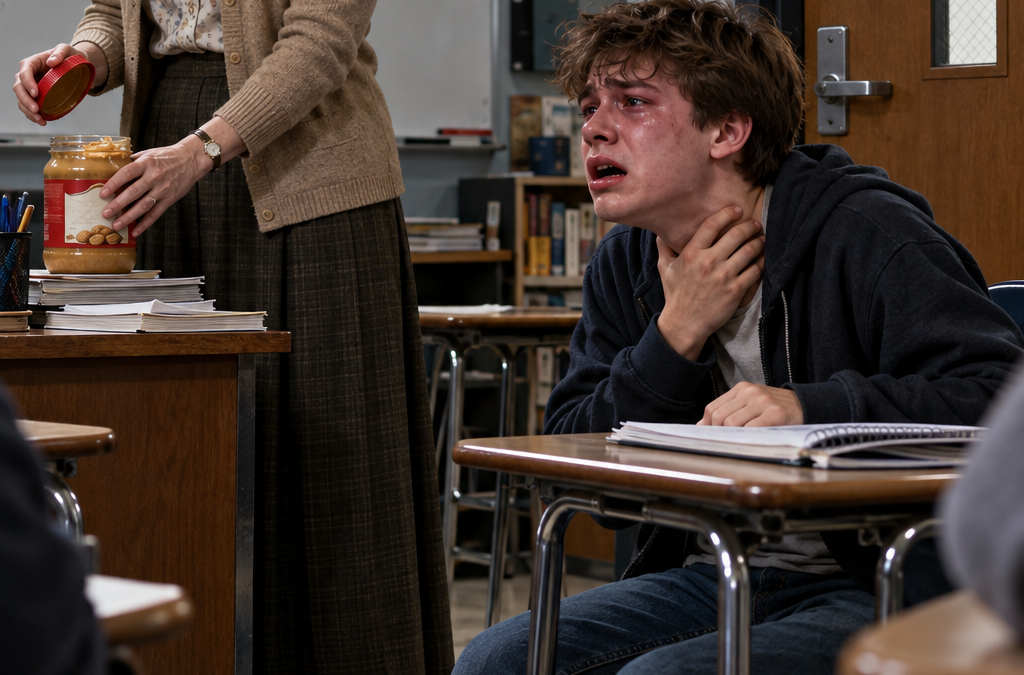
𝗣𝗔𝗥𝗧 𝟮
She leaned back.
Her expression changed.
Not concern.
Annoyance.
“I think it’s ridiculous.”
I wasn’t sure I’d heard correctly.
“Sorry?”
“When I was your age, nobody had peanut allergies.”
I stared.
She continued as if explaining basic history.
“You know what we called children who wouldn’t eat certain foods?”
I already knew I wasn’t going to like the answer.
“Picky.”
She smiled.
“Picky eaters.”
I swallowed.
“I’m not picky.”
“Of course.”
“My medical plan says—”
“I’ve read your medical plan.”
“Then you know I need to be able to leave if there’s exposure.”
Mrs. Lewis pointed toward a desk in the front row.
“You’re sitting there.”
I looked at it.
Directly in front of her desk.
Three steps from where she usually stood.
“I normally sit near the door.”
“I’ve noticed you sit in back.”
“Because—”
“I don’t like quiet students hiding in the back.”
“I’m not hiding.”
“Quiet students in the back are either sleeping or planning something.”
I thought she was joking.
Again, she wasn’t.
“I want you where I can see you.”
I glanced toward the door.
It was across the room.
“My plan specifically says—”
She raised one hand.
“Enough.”
I stopped.
“If there’s a real emergency, adults will handle it.”
“I need to be able to get away from the allergen.”
“The only emergency in this classroom is students thinking they can manipulate teachers using paperwork.”
I felt heat rise into my face.
“It’s not fake.”
“I didn’t say fake.”
“You said—”
“I said sit in the front.”
Then she gave me a choice.
“Front row or hall.”
Meaning I could comply or start the semester being thrown out.
So I sat in front.
I told myself it didn’t matter.
Peanuts weren’t supposed to be in the classroom anyway.
My allergy information was on file.
The nurse knew.
Administration knew.
Surely even Mrs. Lewis wouldn’t deliberately bring peanuts into class.
That assumption nearly killed me.
For the first few weeks, her behavior was mostly irritating.
She called on me constantly.
Especially when my hand wasn’t raised.
I’d be reading silently and suddenly:
“Daniel.”
I looked up.
“Yes?”
“Explain the symbolism.”
I would.
She seemed disappointed when I knew the answer.
Other times, she tried catching me daydreaming.
“Daniel, since you’re so quiet, perhaps you’d like to explain what I just said.”
So I repeated it.
That didn’t make her like me.
It made her more determined.
She’d make comments about “fragility.”
“Students used to develop resilience.”
Or:
“The real world will not rearrange itself around everyone’s personal issues.”
Whenever accommodations came up, she rolled her eyes.
One student had extra testing time.
Mrs. Lewis said:
“Apparently clocks are discriminatory now.”
Another student needed to step out briefly during panic attacks.
She muttered:
“Convenient timing.”
She rarely said these things loudly enough for administrators to hear.
But we heard.
Every day.
I kept my head down.
One semester.
That was my plan.
Survive one semester.
Pass English.
Move on.
Then came Thursday.
I remember the day because everything about the morning had been normal.
Toast.
Backpack.
Bus.
Chemistry quiz.
Lunch.
Then fifth-period English.
Mrs. Lewis had been in an especially foul mood that week because the principal sent teachers a reminder about accommodation procedures.
Apparently there had been complaints somewhere in the district.
Mrs. Lewis spent several minutes before class talking to another teacher in the hallway.
“They’re teaching these kids helplessness.”
The other teacher looked uncomfortable.
Mrs. Lewis continued.
“Every discomfort gets a diagnosis.”
I was already seated.
Front row.
I heard everything.
Then the bell rang.
She came inside.
Closed the door.
Flipped the latch.
Class began.
We were discussing symbolism in a novel.
I don’t remember which one.
That’s strange, considering how much of that day I remember perfectly.
Her shoes.
The scratch on my desk.
The ticking clock.
The sunlight coming through the blinds.
But not the book.
She paced while lecturing.
Twenty minutes.
Maybe twenty-five.
Then she went behind her desk.
Opened a drawer.
Pulled out a clear plastic food container.
Inside were celery sticks.
And a large scoop of peanut butter.
My entire body went alert.
I stared.
Maybe it wasn’t peanut butter.
Maybe sunflower butter.
Maybe something else.
Then she popped the lid.
The smell hit.
My heart started racing before I consciously decided I was scared.
Whether every severe peanut-allergic person would react in the same way wasn’t something I was thinking about in that moment. What mattered was that my documented medical history treated peanut exposure as dangerous, I began developing symptoms, and Mrs. Lewis knew exactly what my emergency plan required.
My arms started tingling.
Then my face.
Tiny prickling sensations.
My stomach tightened.
The inside of my throat felt wrong.
Not closed yet.
Thick.
Like swallowing suddenly required more effort.
I raised my hand.
Mrs. Lewis ignored me.
She dipped a celery stick into peanut butter.
Took a bite.
Kept lecturing.
I raised my hand higher.
Nothing.
“Mrs. Lewis.”
She stopped.
Slowly.
Looked at me.
“What?”
“That’s peanut butter?”
She looked at the container.
“Obviously.”
“I’m having a reaction.”
A few students turned.
Mrs. Lewis stared at me.
“The peanut butter.”
I tried keeping my voice steady.
“I need to step outside.”
She smiled.
Then laughed.
A small, ugly laugh.
“Here we go.”
My chest tightened.
“Mrs. Lewis—”
“The special snowflake can’t handle peanut butter across the room.”
A student behind me whispered:
“What the hell?”
Mrs. Lewis ignored it.
“Do you hear how ridiculous you sound?”
“My throat is swelling.”
She dipped another celery stick.
Slowly.
Deliberately.
“You’re sitting several feet away.”
“My medical plan—”
“Enough.”
“My face is swelling.”
“You’re working yourself up.”
I touched my cheek.
It felt hot.
My lips were beginning to puff.
I could feel it.
“Mrs. Lewis, this is a medical emergency.”
She took another bite.
Crunch.
I can still hear that sound.
“You need to stop creating drama.”
“I have EpiPens.”
“Then apparently you’re prepared.”
“I need to get away from the peanut butter and go to the nurse.”
Her expression hardened.
“You’re not leaving my classroom.”
I stared.
“What?”
“Sit down.”
“I am sitting.”
“Then stay there.”
“I need the nurse.”
“You need to learn that you don’t control the class.”
“I’m not trying to—”
She pointed at me.
“You will sit in that chair.”
Then toward the front.
“You will face forward.”
My stomach turned.
“And you will remain there until the bell rings.”
I couldn’t believe this was happening.
“If you get up from that seat, don’t bother coming back.”
“Mrs. Lewis—”
“I will fail you for the semester.”
The room went quiet.
Someone behind me said:
“He’s turning red.”
Mrs. Lewis snapped:
“Nobody asked you.”
I heard another student whisper:
“He doesn’t look good.”
My breathing became shallow.
I knew what I should do.
Get up.
Leave.
Forget the grade.
Forget Mrs. Lewis.
Forget permission.
Use medication.
Call for help.
But severe reactions don’t make you smarter.
Fear doesn’t always produce perfect decision-making.
And I was fifteen.
Sitting in front of a teacher who had spent weeks telling us that disobedience had consequences.
Part of my brain was screaming:
Leave.
Another part had become strangely calm.
Almost detached.
She wanted me to stay?
Fine.
She had spent weeks insisting students follow instructions exactly.
Fine.
I looked at her.
Then the door.
Then back.
“Okay.”
Mrs. Lewis blinked.
“Okay what?”
“I’ll stay.”
She looked satisfied.
For maybe ten seconds.
I faced forward.
Exactly like she’d ordered.
My stomach lurched.
I knew immediately what was coming.
I had enough warning to realize I should move.
Trash can was several feet away.
Door farther.
But moving would mean getting up.
And she’d just threatened to fail me if I left my chair.
So I stayed.
Mrs. Lewis came around the desk.
Maybe she thought she’d won.
Maybe she wanted one final lecture.
She stopped directly in front of me.
Leaned down.
“See how much easier things are when—”
I vomited.
There was no graceful version.
No warning.
No turning away.
My body took over.
Everything came up violently.
Directly forward.
Exactly where Mrs. Lewis had positioned herself.
It hit her blouse.
Her arms.
Her desk.
Her open grade book.
The peanut butter container.
Papers.
And yes.
Her face.
For one second, the entire room froze.
Absolute silence.
Mrs. Lewis stood there dripping.
I remember thinking:
This is going to be bad.
Then chaos.
Someone screamed.
Someone else yelled:
“Oh my God!”
A few students laughed in shock.
Mrs. Lewis made a sound halfway between a scream and a gag.
I barely noticed.
My hands were shaking.
I reached into my bag.
EpiPen.
My fingers felt clumsy and swollen.
I pulled it out.
Removed the safety cap.
Pressed it against my thigh through my jeans.
Held it.
I had practiced this.
My parents had made me practice with trainers.
But doing it while your breathing feels wrong and half the class is panicking is different.
I dropped the used device.
Someone shouted:
“Call 911!”
Phones appeared everywhere.
Mrs. Lewis was still screaming.
“He did that on purpose!”
I heard her.
Barely.
“He assaulted me!”
Someone yelled back:
“He’s having a reaction!”
A boy ran toward the door.
Pulled.
Nothing.
Then remembered the latch.
His hands fumbled.
“She locked it!”
“Open it!”
He flipped the latch.
The door swung open.
Noise spilled into the hallway.
Teachers from nearby rooms came running.
I tried breathing slowly.
It wasn’t getting easier.
My face felt enormous.
My eyes were swelling.
My throat tighter.
Someone crouched beside me.
A girl from the second row.
“Daniel?”
I looked at her.
“Can you breathe?”
I nodded automatically.
Then realized that wasn’t really true.
“Not good.”
She shouted toward the hall.
“WE NEED THE NURSE!”
Mrs. Lewis was wiping vomit from her face with tissues.
Her voice shook with rage.
“He stayed there deliberately!”
A student shouted:
“You told him to!”
Another:
“She said she’d fail him!”
Mrs. Lewis snapped:
“Be quiet!”
Nobody listened anymore.
That may have been the first moment in thirty years when her classroom completely stopped belonging to her.
The nurse arrived.
She took one look at me.
Her entire posture changed.
No questions about whether I was exaggerating.
No lecture.
Crisis mode.
“Daniel, did you use epinephrine?”
I pointed toward the floor.
“One.”
“How long ago?”
“I don’t know.”
“Few minutes,” someone said.
The nurse checked me.
My face.
Breathing.
Pulse.
Then reached for my second EpiPen.
“You’re not improving enough.”
She helped administer the second dose.
Someone called the school resource officer.
911 was already being dispatched.
Mrs. Lewis kept trying to explain.
“He vomited on me deliberately.”
The nurse didn’t even look at her.
“Move away.”
“What?”
“Move away from him.”
“I am the teacher.”
“And he’s having anaphylaxis.”
That shut her up for maybe three seconds.
Then:
“I was only eating my lunch.”
A student shouted:
“He told you!”
Another:
“You wouldn’t let him leave!”
Then everybody started talking.
Students who almost never spoke in class.
Kids who didn’t even know me well.
They told the truth.
All at once.
“She had peanut butter.”
“She knew.”
“He asked to leave.”
“She laughed.”
“She said he’d fail.”
“She made him stay.”
“She called him fake.”
Mrs. Lewis looked around as if her own class had betrayed her.
Maybe in her mind, we had.
In reality, thirty years of authority were collapsing in about five minutes because the students she expected to remain quiet were watching somebody struggle to breathe.
One boy became especially angry.
His name was Marcus.
We had barely spoken before.
He pointed toward Mrs. Lewis.
“He told you it was a medical emergency.”
She said:
“You don’t understand—”
“YOU SAID HE WAS LYING.”
A teacher from the next room stepped between them.
“Marcus.”
“No.”
His voice shook.
“She told him he’d fail if he left.”
Mrs. Lewis snapped:
“That is enough.”
Marcus laughed.
“No. It’s not.”
Paramedics arrived.
After that, my memory becomes fragmented.
Oxygen.
Questions.
Blood-pressure cuff.
People touching my arms.
Voices.
My name repeated.
“Daniel, stay with us.”
Someone gave me more medication.
I remember being moved onto a stretcher.
I remember the fluorescent hallway ceiling sliding above me.
I remember my mother somewhere.
Her voice.
Panicked.
Then nothing.
I woke in the hospital that evening.
The room was dark except for a light near the sink.
My mom sat beside the bed.
Her eyes were red.
Dad was near the window.
I tried speaking.
My throat hurt.
Mom stood immediately.
“Hey.”
I blinked.
She touched my hand.
“You’re okay.”
I looked around.
“What happened?”
“You had a severe reaction.”
I remembered.
Mrs. Lewis.
Peanut butter.
Classroom.
Vomiting.
My stomach twisted.
“Did I—”
“You’re okay.”
Dad came closer.
His face was different from Mom’s.
She looked relieved.
He looked furious.
The kind of furious where the voice gets quieter instead of louder.
“They gave you more epinephrine in the ambulance.”
I swallowed.
“And more treatment here.”
Mom continued.
“Your blood pressure dropped.”
I looked at her.
“You passed out briefly.”
That scared me more than anything else.
I didn’t remember losing consciousness.
The doctor explained they wanted me overnight.
Severe reactions can recur.
Observation.
Monitoring.
More medication.
I nodded.
Then I asked:
“What happened to Mrs. Lewis?”
Dad laughed once.
There was nothing funny in it.
“That’s becoming a very complicated question.”
Apparently chaos continued after the ambulance left.
The principal came to the classroom.
By then, Mrs. Lewis had changed clothing but was still loudly insisting I’d intentionally vomited on her.
She used the word assault.
Repeatedly.
Then students started showing videos.
That was when everything changed.
Phones weren’t supposed to be out in Mrs. Lewis’s class.
Apparently teenagers do not always follow phone rules.
For once, I was grateful.
A girl named Hannah had started recording before things got truly bad.
She knew about my allergy.
Not all the medical details.
Just enough to recognize peanut butter might become a problem.
When Mrs. Lewis pulled the container from her desk, Hannah became nervous.
She placed her phone low near her notebook.
Hit record.
The video wasn’t perfect.
Part of the frame was blocked.
The camera angle was bad.
But the audio was clear.
Mrs. Lewis:
“The special snowflake cannot handle a little peanut butter from across the room.”
Me:
“This is a medical emergency.”
Then her:
“You’re not leaving my classroom.”
Then:
“You will sit in that chair and you will face forward until the bell rings or you will fail this entire semester.”
All of it.
Recorded.
Other students had footage of the aftermath.
My swollen face.
The nurse treating me.
Mrs. Lewis yelling.
Witness statements matched.
The school also had my medical accommodation plan.
In writing.
The one Mrs. Lewis had admitted to me she’d received.
By the time I woke up, she had already been placed on administrative leave.
She never taught my class again.
Word spread fast.
Too fast.
A student posted one of the videos.
Then someone else reposted it.
Parents saw it.
Local community groups.
The story escaped the school before the district could contain it.
My parents’ phones wouldn’t stop ringing.
Other families were furious.
Not just because of me.
Because almost every parent eventually has to trust a teacher with something important.
Asthma.
Diabetes.
Seizures.
Food allergy.
Medication.
Panic disorder.
A child who may not always be able to advocate perfectly for themselves.
Watching a teacher mock a medical emergency touched something primal in people.
The district tried controlling the situation.
Statements.
Investigation.
Privacy rules.
Legal review.
They told the media they were “deeply concerned.”
I barely cared.
I was still recovering.
My face returned to normal within days.
Breathing stabilized.
Physically, I was lucky.
Very lucky.
Emotionally?
Different story.
I returned to school the following week.
Walking through the doors felt wrong.
People stared.
Students I’d never met knew who I was.
Some whispered.
Some smiled.
A few said:
“Glad you’re okay.”
I hated all of it.
Remember, I was the quiet kid.
I had spent years successfully avoiding attention.
Now I was peanut-allergy-video guy.
English had a substitute.
Mrs. Grant.
Retired teacher.
Probably in her sixties.
First thing she did was stand at the front of class and say:
“I want to make something clear.”
We all went silent.
“This classroom is nut-free.”
She pointed toward the door.
“If you feel ill, unsafe, or believe you need medical attention, you may leave immediately.”
Then she looked at all of us.
“You do not need permission to preserve your health.”
Nobody joked.
Mrs. Grant continued.
“If you need to use the restroom, ask when possible. If it’s an emergency, go.”
Then:
“We’re going to spend the rest of the semester learning English.”
That was it.
No speech about Mrs. Lewis.
No drama.
I liked her immediately.
After class, she stopped me.
“Daniel.”
I tensed.
Then she simply said:
“Door seat okay?”
She pointed to an empty desk near the exit.
“Yes.”
“Good.”
I moved there the next day.
That tiny act nearly made me cry.
Meanwhile, adults handled the bigger mess.
My parents hired an attorney.
The district had attorneys.
Meetings began.
We learned that what Mrs. Lewis had done went far beyond being rude.
The school had documented notice of my medical condition.
There was a formal accommodation and emergency plan.
She had received it.
She had disregarded it.
Then, during an apparent medical emergency, she’d prevented me from leaving and threatened academic punishment if I tried.
I wasn’t involved in every legal conversation.
My parents intentionally shielded me from most of it.
I was fifteen.
My job was supposed to be recovering and passing algebra.
But I knew enough.
The district did not want court.
The videos were bad.
The witnesses were worse.
There were twenty-something students who could describe what happened.
And the story was already public.
Eventually, the school district offered a settlement.
Medical bills.
Related expenses.
Additional compensation.
My parents accepted after long conversations with counsel.
I wasn’t involved in negotiating numbers.
I didn’t care about the money.
I cared about never seeing Mrs. Lewis standing between me and a door again.
The employment investigation took longer.
Then more people came forward.
That was the part nobody expected.
I had thought I was the one student she singled out because she didn’t believe allergies were real.
Turns out I was one piece of a much larger pattern.
A former student with diabetes told investigators Mrs. Lewis had once refused to let him check his blood sugar because “class time wasn’t medical time.”
Another student said she mocked her during a panic attack.
Another had a bladder condition and received detention for requesting the bathroom too frequently.
Parents had complained over the years.
Individually.
One complaint sounded like personality conflict.
Another like strict discipline.
Another like miscommunication.
Nobody had connected them.
My incident forced people to.
The picture became ugly.
Mrs. Lewis fundamentally did not believe many medical accommodations were legitimate.
She believed students manipulated sympathetic parents and weak administrators.
That belief had guided years of decisions.
She hadn’t merely made one mistake.
She had created a philosophy around dismissing vulnerability.
And eventually that philosophy put a student in an ambulance.
Her employment was terminated.
Then came the state licensing process.
That took much longer.
More than a year, from what I heard.
Mrs. Lewis fought it.
Of course she did.
She claimed she hadn’t known how severe my allergy was.
The district had records.
She claimed nobody told her I needed to sit near the exit.
Medical plan.
She claimed she believed I was exaggerating.
Videos.
She claimed I intentionally vomited on her.
That was almost funny.
Almost.
Dad actually laughed when our lawyer told him.
“What was he supposed to do?”
No one had a good answer.
Mrs. Lewis had ordered me to remain seated.
Ordered me to face forward.
Threatened me if I stood.
Then placed herself directly in front of me.
My body did the rest.
Eventually her teaching license was revoked.
Thirty years.
Over.
People expected me to feel victorious.
I didn’t.
That’s the strangest part.
When Dad told me the final decision, we were eating dinner.
He looked almost relieved.
“It’s official.”
I looked up.
“What?”
“Her license.”
I stopped eating.
“Revoked?”
He nodded.
Mom watched me carefully.
I said:
“Okay.”
Dad seemed surprised.
“That’s it?”
“What am I supposed to say?”
“I don’t know.”
Mom said softly:
“You don’t have to feel anything.”
I appreciated that.
Because I wasn’t happy.
I didn’t want Mrs. Lewis dead.
Didn’t want her homeless.
Didn’t fantasize about revenge.
I wanted one thing.
To breathe.
That’s what made the entire story so stupid.
She nearly destroyed thirty years of work because she was too proud to accept that a student knew something about his own body that she didn’t.
There was nothing satisfying about that.
For months afterward, I struggled around food.
Before the incident, I was careful.
Afterward, I became obsessive.
I checked labels three times.
Asked restaurants the same question twice.
Sometimes three times.
If someone nearby ate something I couldn’t identify, my heart raced.
Peanut butter smell became tied to panic.
I had nightmares.
Same basic dream.
Classroom.
Front row.
Door across the room.
Mrs. Lewis eating.
I try standing.
My legs don’t work.
Everyone watches.
Then I wake up.
That lasted months.
My parents found a therapist who worked with teenagers dealing with medical trauma.
I hated the idea initially.
“I don’t need therapy.”
Mom said:
“You’re waking up from nightmares.”
“I’m fine.”
“You haven’t eaten anything prepared outside this house in six weeks.”
I didn’t answer.
Dad said:
“Going doesn’t mean you’re weak.”
That phrase almost made me laugh.
Mrs. Lewis had spent months telling us exactly the opposite.
Weakness.
Softness.
Excuses.
I went.
It helped.
Slowly.
The therapist didn’t tell me to stop being cautious.
Caution was necessary.
She helped me separate caution from panic.
There was a difference.
I learned it.
Eventually I ate at a restaurant again.
Then at a friend’s house.
Then cafeteria food I trusted.
I stopped checking the classroom door every five minutes.
Senior year, I could walk past the English wing without thinking about what happened.
Mostly.
Hannah and I became friends.
She’s the girl who recorded the video.
One afternoon, months later, we were sitting outside during lunch.
I said:
“Why did you record?”
She shrugged.
“You looked scared.”
“Before I reacted?”
“Yeah.”
She picked at her sandwich.
“You never looked scared in class.”
That surprised me.
“I was always scared in that class.”
“You didn’t look it.”
She continued.
“When she pulled out the peanut butter, you went really still.”
“So you recorded?”
“I thought she was going to say something stupid.”
“She did.”
“Very.”
I laughed.
Then said:
“Thank you.”
Hannah shrugged again.
“You’re welcome.”
I looked at her lunch.
“What is that?”
“Turkey.”
“You sure?”
She rolled her eyes.
“Yes, Daniel.”
The whole experience changed how I viewed quiet people.
Before, I thought being quiet meant staying out of conflict.
Afterward, I understood something else.
Quiet doesn’t mean powerless.
I didn’t give speeches.
Didn’t scream at Mrs. Lewis.
Didn’t organize petitions.
Didn’t expose her career myself.
I said:
“I’m having a medical emergency.”
Then:
“I need to leave.”
She made the choices after that.
The students spoke.
My parents fought.
The nurse acted.
The paramedics acted.
The district investigated.
Other families came forward.
The licensing board reviewed evidence.
Consequences came from accumulated decisions.
Not one dramatic revenge plan.
That’s probably why the story still bothers me when people call it satisfying malicious compliance.
Yes.
There is dark humor.
Mrs. Lewis told me:
Sit.
Face forward.
Don’t leave.
So I did.
She positioned herself directly in front of me while my body was preparing to vomit.
Then suffered a very literal consequence of her own instruction.
If the story ended there, maybe it would be funny.
Teacher acts cruel.
Teacher gets covered in vomit.
Everyone cheers.
Except it didn’t end there.
I stopped breathing properly.
Needed multiple epinephrine doses.
My blood pressure crashed.
I lost consciousness.
My parents spent the evening wondering whether their son was going to be okay.
That’s not comedy.
That’s why, when people ask whether I did it deliberately, my answer is:
Not really.
Did part of me think:
Fine, you told me to stay, so I’ll stay?
Yes.
Was I calmly engineering some genius revenge while experiencing anaphylaxis?
Absolutely not.
I was scared.
Sick.
Fifteen.
Trying to obey an adult while another part of my brain knew that adult was dangerous.
The vomiting was my body reacting.
Mrs. Lewis simply chose where to stand.
I saw her once after everything.
Years later.
I was in a grocery store.
College by then.
Different haircut.
Older.
No longer the skinny sophomore sitting in the front row.
I was walking near frozen foods when I saw her.
She looked smaller.
That was my first thought.
Not physically.
Just less imposing.
Gray hair looser.
No classroom.
No desk.
No rows of students facing her.
She was simply a woman pushing a shopping cart.
She saw me.
Stopped.
For a second, neither of us moved.
I considered walking away.
Then she said my name.
“Daniel.”
I nodded.
“Mrs. Lewis.”
Her face tightened at the title.
Maybe nobody called her that anymore.
She looked at me.
“You’ve grown.”
“That’s usually what happens.”
Awkward silence.
Then she said:
“I hope you’re doing well.”
I almost laughed.
Not because it was funny.
Because there were a thousand things she could have said.
I’m sorry.
I was wrong.
I didn’t understand.
I hurt you.
Instead:
I hope you’re doing well.
“I am.”
She nodded.
“Good.”
She started to move her cart.
Then stopped.
“You know, what happened wasn’t exactly the way people portrayed it.”
There it was.
I felt something old wake up.
Not panic.
Not fear.
Just disappointment.
I looked at her.
“What part?”
She hesitated.
“Things got exaggerated.”
“My face swelled.”
“I mean afterward.”
“I went to the hospital.”
“You know what I mean.”
“No.”
I genuinely didn’t.
Mrs. Lewis gripped the cart handle.
“The media made it sound like I intentionally harmed you.”
“You intentionally ate peanut butter after receiving my medical plan.”
Her jaw tightened.
“I ate my lunch.”
“I told you I was reacting.”
“I didn’t understand the severity.”
“I told you it was a medical emergency.”
Silence.
“I asked to leave.”
Nothing.
“You told me I’d fail.”
She looked away.
“Students exaggerate.”
“And I almost died.”
Her eyes returned to mine.
For the first time, she looked old.
“I lost everything.”
I hadn’t expected that.
Not because it wasn’t true.
Because of how she said it.
As though I had taken it.
I thought about the classroom.
Her peanut butter.
Her laugh.
The latch.
Her standing in front of me.
Then all the students who came forward afterward.
The diabetic kid.
The girl with panic attacks.
The student with the bladder condition.
I said:
“No.”
She frowned.
“What?”
“You lost your job.”
I kept my voice calm.
“But I didn’t do that to you.”
Her eyes hardened.
“You were the incident.”
“I was the kid who asked to leave.”
Silence.
“You made the rest happen.”
She looked as if I had slapped her.
Then I walked away.
No grand speech.
No audience.
No revenge.
Just groceries.
I thought I’d feel shaken afterward.
I didn’t.
That conversation actually helped.
For years, part of me had remembered Mrs. Lewis as this enormous figure.
Teacher.
Authority.
The woman who controlled the door.
Seeing her in a grocery store reduced the memory to its proper size.
She had been wrong.
Dangerously wrong.
That’s all.
Adults can be wrong.
Teachers can be wrong.
People with thirty years of experience can be wrong.
Someone speaking confidently can still be wrong.
Someone insulting your fear doesn’t make the danger disappear.
That’s the thing I wish fifteen-year-old me had understood sooner.
If you’re having a medical emergency, you’re allowed to protect yourself.
Even if an authority figure rolls their eyes.
Even if leaving breaks a classroom rule.
Even if someone threatens your grade.
A grade can be appealed.
A detention can be removed.
An angry teacher can be dealt with later.
Breathing comes first.
I learned that the hard way.
My parents had always told me.
The nurse had told me.
Doctors had told me.
But teenagers are trained to obey adults.
Most of the time, that’s useful.
Until the adult is wrong.
Mrs. Lewis’s classroom rule was simple:
Nobody leaves.
Her worldview was simple too.
Young people are soft.
Accommodations encourage weakness.
Medical problems are exaggerated.
Parents coddle.
Students manipulate.
The simplicity probably made her feel powerful.
Everything had an easy explanation.
Then I sat in front of her turning red and swelling.
Reality gave her a chance to update her beliefs.
She refused.
That was the real failure.
Not ignorance.
Pride.
If she had stopped after one second and said:
“You’re reacting? Go.”
Nothing else happens.
I use medication.
Go to the nurse.
Maybe ambulance anyway.
Maybe not.
Mrs. Lewis finishes the school year.
Maybe eventually somebody corrects her attitude.
Thirty-year career continues.
Instead, she doubled down.
Then doubled down again.
Laugh.
Dismiss.
Threaten.
Block.
Accuse.
Even after I was vomiting and injecting epinephrine, she insisted I was manipulating her.
Even after paramedics arrived, she talked about her grade book.
Even after video appeared, she said I provoked her.
Even after termination, she denied knowing.
Even years later in a grocery store, she still wanted to explain that the story had been exaggerated.
Some people will sacrifice almost anything to avoid saying:
I was wrong.
That frightened me more than her anger ever did.
I eventually graduated.
Went to college.
Carried two EpiPens.
Still do.
I read labels.
Ask questions.
Leave when I need to.
If someone thinks that’s dramatic, they can think whatever they want.
I learned not to negotiate with my own airway for somebody else’s comfort.
I also became less quiet.
Not loud.
I’m still me.
I still prefer reading to big parties.
Still hate speaking in front of rooms.
Still think cafeteria noise should qualify as an environmental hazard.
But I speak sooner now.
When something feels wrong, I say it.
When I need help, I ask.
When someone says:
“It’s probably nothing.”
I don’t let that decide for me.
Mrs. Lewis used to call that weakness.
I don’t anymore.
A few years ago, my mom found the old medical folder from high school.
She was cleaning a closet.
Called me over.
“Look.”
Inside were copies of everything.
Allergy action plan.
Teacher notification.
Accommodation paperwork.
Emergency contacts.
Right on top was the form Mrs. Lewis had received.
Her initials appeared beside the distribution record.
Proof she’d been notified.
Mom stared at it.
“Still makes me angry.”
“Me too.”
“Want me to throw it away?”
I thought about it.
Then nodded.
“Yeah.”
She hesitated.
“Really?”
“Really.”
We shredded it.
Not because documentation didn’t matter.
It had mattered enormously.
It helped prove the truth when Mrs. Lewis denied knowing.
But I didn’t need to keep carrying that particular piece of evidence anymore.
The case was over.
Her career was over.
I had my life.
That’s enough.
Sometimes people ask about the vomit.
Of course they do.
That’s the memorable part.
“Did you actually hit her face?”
Yes.
“Was the grade book ruined?”
Very.
“Did peanut butter get contaminated?”
Completely.
“Did the class laugh?”
Some did.
Mostly because teenagers laugh when reality becomes too absurd for the brain to process.
Then someone usually says:
“She deserved it.”
I don’t know.
Maybe she deserved the dry-cleaning bill.
What she deserved professionally was investigation.
Accountability.
Consequences.
Those came.
The vomit was just biology.
But there is one part I admit still gives me a tiny amount of satisfaction.
Mrs. Lewis loved rules.
Her rule:
Stay seated.
Her rule:
Face forward.
Her rule:
Nobody leaves.
Her threat:
Get up and you’ll fail.
So when my body gave me about three seconds of warning, I didn’t violate a single one.
I sat.
I faced forward.
And unfortunately for Mrs. Lewis, she was standing directly in front of me.
She got exactly what she demanded.
I survived.
The class told the truth.
The videos preserved it.
My parents forced the district to take it seriously.
Other students finally got to tell their stories.
And Mrs. Lewis discovered, after thirty years of telling children that medical accommodations were weakness, that reality doesn’t care how long you’ve been teaching.
She had ordered me not to leave.
In the end, she was the one who never came back.
𝗧𝗛𝗘 𝗘𝗡𝗗
My Teacher Ate Peanut Butter in Front of Me, Locked the Door, and Threatened to Fail Me If I Left
Mrs. Lewis had spent thirty years convincing herself that students exaggerated medical problems for attention.
Then she opened a container of peanut butter three feet from me, refused to let me leave while my face started swelling, and told me I’d fail the semester if I got out of my chair.
So I stayed exactly where she ordered me to stay.
I was what people at school called the quiet kid.
Not creepy quiet.
Not the guy standing alone in the corner staring at people.
I was just introverted.
I liked books.
I liked knowing what was expected of me.
I hated presentations.
I almost never raised my hand unless I was absolutely certain I knew the answer.
At lunch, I’d rather read than spend forty minutes trying to yell over two hundred other teenagers in the cafeteria.
Being invisible felt comfortable.
Part of that was personality.
Part of it was survival.
I had a severe peanut allergy.
Not the kind where I ate one and got a rash.
The kind that had made emergency plans, medical forms, EpiPens, nurse visits, and food labels part of my life for as long as I could remember.
My parents had drilled the rules into me.
Check food.
Ask questions.
Carry epinephrine.
Know where the nearest responsible adult is.
Never assume someone understands just because you told them once.
And most importantly:
If I believed I was having a serious reaction, I was supposed to act immediately.
No embarrassment.
No waiting to see if it got worse.
No worrying about annoying anybody.
My parents had spent years making sure the school understood that too.
Every August there were forms.
Medical documentation.
Emergency action plan.
Medication authorization.
Nurse instructions.
Teacher notifications.
Usually, it worked.
Most teachers were completely reasonable.
Some pulled me aside the first day.
“Hey, I saw your allergy plan. You’re good to sit near the door.”
Others simply emailed my mom.
“I received everything. Please let me know if there’s anything else I should know.”
One teacher kept a peanut-free classroom without even announcing why.
Another moved a class party outside when somebody accidentally brought cookies that had a warning label.
Nobody made it dramatic.
That was the ideal.
Keep me safe.
Don’t turn me into a spectacle.
Then sophomore year started.
And I got Mrs. Lewis for English.
Mrs. Lewis had been at the school forever.
At least that was how it felt to students.
Thirty years, maybe slightly more.
She talked constantly about “how things used to be.”
How students used to respect teachers.
How parents used to support discipline.
How nobody needed “special accommodations” for every little discomfort.
How kids were becoming soft.
She had a phrase for it.
“Generational weakness.”
I heard her use it during the first week.
A student mentioned anxiety.
Mrs. Lewis sighed.
“When I was young, we called that being nervous and got on with our day.”
A different kid said he had ADHD and needed written directions.
She said:
“When I was young, people learned to pay attention.”
Someone sneezed three times.
Mrs. Lewis smiled.
“Allergies are just weakness leaving the body.”
She laughed at her own joke.
Nobody else did.
That should tell you everything.
She wasn’t loud all the time.
That would’ve been easier.
She had this calm, superior way of talking that made disagreement feel like proof you were immature.
She stood at the front of the room with perfect posture, arms folded, looking over the tops of her glasses like she was waiting for you to embarrass yourself.
She wore long skirts most days.
Buttoned blouses.
Cardigans.
Sensible shoes.
Her gray-streaked hair was always pinned neatly at the back.
Nothing about her looked threatening.
She looked exactly like the kind of teacher parents would describe as “old school.”
She was proud of that.
On the first day, she spent almost the entire period explaining rules.
No phones.
No gum.
No sleeping.
No talking while she was talking.
No late work without “documented catastrophe.”
And her favorite:
No leaving once the bell rang.
She actually walked over to the classroom door and demonstrated.
There was a little interior latch she flipped after class started.
Not a deadbolt that would prevent emergency evacuation, but enough of a barrier that anyone trying to leave had to deliberately stop and undo it.
She clicked it into place.
“Once the bell rings, class has begun.”
She faced us.
“Noboby leaves.”
A few students looked at one another.
Mrs. Lewis continued.
“Not for water.”
Pause.
“Not for the bathroom.”
Another pause.
“And certainly not for drama.”
Someone in the back gave a small nervous laugh.
Mrs. Lewis didn’t.
“If you cannot plan your bodily functions around fifty minutes of instructional time, you should have thought about that before arriving.”
She smiled.
“Anyone who leaves stays out.”
Then:
“And receives a zero for the day.”
No one challenged her.
That was high school.
You learned quickly which adults would respond to questions and which adults interpreted questions as rebellion.
Mrs. Lewis belonged firmly in the second group.
My parents had already submitted my allergy documentation before school started.
The nurse confirmed it.
Normally, that would have been enough.
But Mrs. Lewis didn’t mention it.
So on the second morning, I went to her desk before the bell.
She was organizing papers.
“Mrs. Lewis?”
She didn’t look up.
“Yes?”
“I just wanted to make sure you received my medical information.”
That got her attention.
“What medical information?”
“My peanut allergy.”
She stared.
“I did.”
“Okay.”
I waited.
Nothing.
I continued.
“It’s severe.”
“I read the form.”
“I usually sit near the door in case there’s exposure and I need to leave quickly.”
She leaned back.
Her expression changed.
Not concern.
Annoyance.
“I think it’s ridiculous.”
I wasn’t sure I’d heard correctly.
“Sorry?”
“When I was your age, nobody had peanut allergies.”
I stared.
She continued as if explaining basic history.
“You know what we called children who wouldn’t eat certain foods?”
I already knew I wasn’t going to like the answer.
“Picky.”
She smiled.
“Picky eaters.”
I swallowed.
“I’m not picky.”
“Of course.”
“My medical plan says—”
“I’ve read your medical plan.”
“Then you know I need to be able to leave if there’s exposure.”
Mrs. Lewis pointed toward a desk in the front row.
“You’re sitting there.”
I looked at it.
Directly in front of her desk.
Three steps from where she usually stood.
“I normally sit near the door.”
“I’ve noticed you sit in back.”
“Because—”
“I don’t like quiet students hiding in the back.”
“I’m not hiding.”
“Quiet students in the back are either sleeping or planning something.”
I thought she was joking.
Again, she wasn’t.
“I want you where I can see you.”
I glanced toward the door.
It was across the room.
“My plan specifically says—”
She raised one hand.
“Enough.”
I stopped.
“If there’s a real emergency, adults will handle it.”
“I need to be able to get away from the allergen.”
“The only emergency in this classroom is students thinking they can manipulate teachers using paperwork.”
I felt heat rise into my face.
“It’s not fake.”
“I didn’t say fake.”
“You said—”
“I said sit in the front.”
Then she gave me a choice.
“Front row or hall.”
Meaning I could comply or start the semester being thrown out.
So I sat in front.
I told myself it didn’t matter.
Peanuts weren’t supposed to be in the classroom anyway.
My allergy information was on file.
The nurse knew.
Administration knew.
Surely even Mrs. Lewis wouldn’t deliberately bring peanuts into class.
That assumption nearly killed me.
For the first few weeks, her behavior was mostly irritating.
She called on me constantly.
Especially when my hand wasn’t raised.
I’d be reading silently and suddenly:
“Daniel.”
I looked up.
“Yes?”
“Explain the symbolism.”
I would.
She seemed disappointed when I knew the answer.
Other times, she tried catching me daydreaming.
“Daniel, since you’re so quiet, perhaps you’d like to explain what I just said.”
So I repeated it.
That didn’t make her like me.
It made her more determined.
She’d make comments about “fragility.”
“Students used to develop resilience.”
Or:
“The real world will not rearrange itself around everyone’s personal issues.”
Whenever accommodations came up, she rolled her eyes.
One student had extra testing time.
Mrs. Lewis said:
“Apparently clocks are discriminatory now.”
Another student needed to step out briefly during panic attacks.
She muttered:
“Convenient timing.”
She rarely said these things loudly enough for administrators to hear.
But we heard.
Every day.
I kept my head down.
One semester.
That was my plan.
Survive one semester.
Pass English.
Move on.
Then came Thursday.
I remember the day because everything about the morning had been normal.
Toast.
Backpack.
Bus.
Chemistry quiz.
Lunch.
Then fifth-period English.
Mrs. Lewis had been in an especially foul mood that week because the principal sent teachers a reminder about accommodation procedures.
Apparently there had been complaints somewhere in the district.
Mrs. Lewis spent several minutes before class talking to another teacher in the hallway.
“They’re teaching these kids helplessness.”
The other teacher looked uncomfortable.
Mrs. Lewis continued.
“Every discomfort gets a diagnosis.”
I was already seated.
Front row.
I heard everything.
Then the bell rang.
She came inside.
Closed the door.
Flipped the latch.
Class began.
We were discussing symbolism in a novel.
I don’t remember which one.
That’s strange, considering how much of that day I remember perfectly.
Her shoes.
The scratch on my desk.
The ticking clock.
The sunlight coming through the blinds.
But not the book.
She paced while lecturing.
Twenty minutes.
Maybe twenty-five.
Then she went behind her desk.
Opened a drawer.
Pulled out a clear plastic food container.
Inside were celery sticks.
And a large scoop of peanut butter.
My entire body went alert.
I stared.
Maybe it wasn’t peanut butter.
Maybe sunflower butter.
Maybe something else.
Then she popped the lid.
The smell hit.
My heart started racing before I consciously decided I was scared.
Whether every severe peanut-allergic person would react in the same way wasn’t something I was thinking about in that moment. What mattered was that my documented medical history treated peanut exposure as dangerous, I began developing symptoms, and Mrs. Lewis knew exactly what my emergency plan required.
My arms started tingling.
Then my face.
Tiny prickling sensations.
My stomach tightened.
The inside of my throat felt wrong.
Not closed yet.
Thick.
Like swallowing suddenly required more effort.
I raised my hand.
Mrs. Lewis ignored me.
She dipped a celery stick into peanut butter.
Took a bite.
Kept lecturing.
I raised my hand higher.
Nothing.
“Mrs. Lewis.”
She stopped.
Slowly.
Looked at me.
“What?”
“That’s peanut butter?”
She looked at the container.
“Obviously.”
“I’m having a reaction.”
A few students turned.
Mrs. Lewis stared at me.
“The peanut butter.”
I tried keeping my voice steady.
“I need to step outside.”
She smiled.
Then laughed.
A small, ugly laugh.
“Here we go.”
My chest tightened.
“Mrs. Lewis—”
“The special snowflake can’t handle peanut butter across the room.”
A student behind me whispered:
“What the hell?”
Mrs. Lewis ignored it.
“Do you hear how ridiculous you sound?”
“My throat is swelling.”
She dipped another celery stick.
Slowly.
Deliberately.
“You’re sitting several feet away.”
“My medical plan—”
“Enough.”
“My face is swelling.”
“You’re working yourself up.”
I touched my cheek.
It felt hot.
My lips were beginning to puff.
I could feel it.
“Mrs. Lewis, this is a medical emergency.”
She took another bite.
Crunch.
I can still hear that sound.
“You need to stop creating drama.”
“I have EpiPens.”
“Then apparently you’re prepared.”
“I need to get away from the peanut butter and go to the nurse.”
Her expression hardened.
“You’re not leaving my classroom.”
I stared.
“What?”
“Sit down.”
“I am sitting.”
“Then stay there.”
“I need the nurse.”
“You need to learn that you don’t control the class.”
“I’m not trying to—”
She pointed at me.
“You will sit in that chair.”
Then toward the front.
“You will face forward.”
My stomach turned.
“And you will remain there until the bell rings.”
I couldn’t believe this was happening.
“If you get up from that seat, don’t bother coming back.”
“Mrs. Lewis—”
“I will fail you for the semester.”
The room went quiet.
Someone behind me said:
“He’s turning red.”
Mrs. Lewis snapped:
“Nobody asked you.”
I heard another student whisper:
“He doesn’t look good.”
My breathing became shallow.
I knew what I should do.
Get up.
Leave.
Forget the grade.
Forget Mrs. Lewis.
Forget permission.
Use medication.
Call for help.
But severe reactions don’t make you smarter.
Fear doesn’t always produce perfect decision-making.
And I was fifteen.
Sitting in front of a teacher who had spent weeks telling us that disobedience had consequences.
Part of my brain was screaming:
Leave.
Another part had become strangely calm.
Almost detached.
She wanted me to stay?
Fine.
She had spent weeks insisting students follow instructions exactly.
Fine.
I looked at her.
Then the door.
Then back.
“Okay.”
Mrs. Lewis blinked.
“Okay what?”
“I’ll stay.”
She looked satisfied.
For maybe ten seconds.
I faced forward.
Exactly like she’d ordered.
My stomach lurched.
I knew immediately what was coming.
I had enough warning to realize I should move.
Trash can was several feet away.
Door farther.
But moving would mean getting up.
And she’d just threatened to fail me if I left my chair.
So I stayed.
Mrs. Lewis came around the desk.
Maybe she thought she’d won.
Maybe she wanted one final lecture.
She stopped directly in front of me.
Leaned down.
“See how much easier things are when—”
I vomited.
There was no graceful version.
No warning.
No turning away.
My body took over.
Everything came up violently.
Directly forward.
Exactly where Mrs. Lewis had positioned herself.
It hit her blouse.
Her arms.
Her desk.
Her open grade book.
The peanut butter container.
Papers.
And yes.
Her face.
For one second, the entire room froze.
Absolute silence.
Mrs. Lewis stood there dripping.
I remember thinking:
This is going to be bad.
Then chaos.
Someone screamed.
Someone else yelled:
“Oh my God!”
A few students laughed in shock.
Mrs. Lewis made a sound halfway between a scream and a gag.
I barely noticed.
My hands were shaking.
I reached into my bag.
EpiPen.
My fingers felt clumsy and swollen.
I pulled it out.
Removed the safety cap.
Pressed it against my thigh through my jeans.
Held it.
I had practiced this.
My parents had made me practice with trainers.
But doing it while your breathing feels wrong and half the class is panicking is different.
I dropped the used device.
Someone shouted:
“Call 911!”
Phones appeared everywhere.
Mrs. Lewis was still screaming.
“He did that on purpose!”
I heard her.
Barely.
“He assaulted me!”
Someone yelled back:
“He’s having a reaction!”
A boy ran toward the door.
Pulled.
Nothing.
Then remembered the latch.
His hands fumbled.
“She locked it!”
“Open it!”
He flipped the latch.
The door swung open.
Noise spilled into the hallway.
Teachers from nearby rooms came running.
I tried breathing slowly.
It wasn’t getting easier.
My face felt enormous.
My eyes were swelling.
My throat tighter.
Someone crouched beside me.
A girl from the second row.
“Daniel?”
I looked at her.
“Can you breathe?”
I nodded automatically.
Then realized that wasn’t really true.
“Not good.”
She shouted toward the hall.
“WE NEED THE NURSE!”
Mrs. Lewis was wiping vomit from her face with tissues.
Her voice shook with rage.
“He stayed there deliberately!”
A student shouted:
“You told him to!”
Another:
“She said she’d fail him!”
Mrs. Lewis snapped:
“Be quiet!”
Nobody listened anymore.
That may have been the first moment in thirty years when her classroom completely stopped belonging to her.
The nurse arrived.
She took one look at me.
Her entire posture changed.
No questions about whether I was exaggerating.
No lecture.
Crisis mode.
“Daniel, did you use epinephrine?”
I pointed toward the floor.
“One.”
“How long ago?”
“I don’t know.”
“Few minutes,” someone said.
The nurse checked me.
My face.
Breathing.
Pulse.
Then reached for my second EpiPen.
“You’re not improving enough.”
She helped administer the second dose.
Someone called the school resource officer.
911 was already being dispatched.
Mrs. Lewis kept trying to explain.
“He vomited on me deliberately.”
The nurse didn’t even look at her.
“Move away.”
“What?”
“Move away from him.”
“I am the teacher.”
“And he’s having anaphylaxis.”
That shut her up for maybe three seconds.
Then:
“I was only eating my lunch.”
A student shouted:
“He told you!”
Another:
“You wouldn’t let him leave!”
Then everybody started talking.
Students who almost never spoke in class.
Kids who didn’t even know me well.
They told the truth.
All at once.
“She had peanut butter.”
“She knew.”
“He asked to leave.”
“She laughed.”
“She said he’d fail.”
“She made him stay.”
“She called him fake.”
Mrs. Lewis looked around as if her own class had betrayed her.
Maybe in her mind, we had.
In reality, thirty years of authority were collapsing in about five minutes because the students she expected to remain quiet were watching somebody struggle to breathe.
One boy became especially angry.
His name was Marcus.
We had barely spoken before.
He pointed toward Mrs. Lewis.
“He told you it was a medical emergency.”
She said:
“You don’t understand—”
“YOU SAID HE WAS LYING.”
A teacher from the next room stepped between them.
“Marcus.”
“No.”
His voice shook.
“She told him he’d fail if he left.”
Mrs. Lewis snapped:
“That is enough.”
Marcus laughed.
“No. It’s not.”
Paramedics arrived.
After that, my memory becomes fragmented.
Oxygen.
Questions.
Blood-pressure cuff.
People touching my arms.
Voices.
My name repeated.
“Daniel, stay with us.”
Someone gave me more medication.
I remember being moved onto a stretcher.
I remember the fluorescent hallway ceiling sliding above me.
I remember my mother somewhere.
Her voice.
Panicked.
Then nothing.
I woke in the hospital that evening.
The room was dark except for a light near the sink.
My mom sat beside the bed.
Her eyes were red.
Dad was near the window.
I tried speaking.
My throat hurt.
Mom stood immediately.
“Hey.”
I blinked.
She touched my hand.
“You’re okay.”
I looked around.
“What happened?”
“You had a severe reaction.”
I remembered.
Mrs. Lewis.
Peanut butter.
Classroom.
Vomiting.
My stomach twisted.
“Did I—”
“You’re okay.”
Dad came closer.
His face was different from Mom’s.
She looked relieved.
He looked furious.
The kind of furious where the voice gets quieter instead of louder.
“They gave you more epinephrine in the ambulance.”
I swallowed.
“And more treatment here.”
Mom continued.
“Your blood pressure dropped.”
I looked at her.
“You passed out briefly.”
That scared me more than anything else.
I didn’t remember losing consciousness.
The doctor explained they wanted me overnight.
Severe reactions can recur.
Observation.
Monitoring.
More medication.
I nodded.
Then I asked:
“What happened to Mrs. Lewis?”
Dad laughed once.
There was nothing funny in it.
“That’s becoming a very complicated question.”
Apparently chaos continued after the ambulance left.
The principal came to the classroom.
By then, Mrs. Lewis had changed clothing but was still loudly insisting I’d intentionally vomited on her.
She used the word assault.
Repeatedly.
Then students started showing videos.
That was when everything changed.
Phones weren’t supposed to be out in Mrs. Lewis’s class.
Apparently teenagers do not always follow phone rules.
For once, I was grateful.
A girl named Hannah had started recording before things got truly bad.
She knew about my allergy.
Not all the medical details.
Just enough to recognize peanut butter might become a problem.
When Mrs. Lewis pulled the container from her desk, Hannah became nervous.
She placed her phone low near her notebook.
Hit record.
The video wasn’t perfect.
Part of the frame was blocked.
The camera angle was bad.
But the audio was clear.
Mrs. Lewis:
“The special snowflake cannot handle a little peanut butter from across the room.”
Me:
“This is a medical emergency.”
Then her:
“You’re not leaving my classroom.”
Then:
“You will sit in that chair and you will face forward until the bell rings or you will fail this entire semester.”
All of it.
Recorded.
Other students had footage of the aftermath.
My swollen face.
The nurse treating me.
Mrs. Lewis yelling.
Witness statements matched.
The school also had my medical accommodation plan.
In writing.
The one Mrs. Lewis had admitted to me she’d received.
By the time I woke up, she had already been placed on administrative leave.
She never taught my class again.
Word spread fast.
Too fast.
A student posted one of the videos.
Then someone else reposted it.
Parents saw it.
Local community groups.
The story escaped the school before the district could contain it.
My parents’ phones wouldn’t stop ringing.
Other families were furious.
Not just because of me.
Because almost every parent eventually has to trust a teacher with something important.
Asthma.
Diabetes.
Seizures.
Food allergy.
Medication.
Panic disorder.
A child who may not always be able to advocate perfectly for themselves.
Watching a teacher mock a medical emergency touched something primal in people.
The district tried controlling the situation.
Statements.
Investigation.
Privacy rules.
Legal review.
They told the media they were “deeply concerned.”
I barely cared.
I was still recovering.
My face returned to normal within days.
Breathing stabilized.
Physically, I was lucky.
Very lucky.
Emotionally?
Different story.
I returned to school the following week.
Walking through the doors felt wrong.
People stared.
Students I’d never met knew who I was.
Some whispered.
Some smiled.
A few said:
“Glad you’re okay.”
I hated all of it.
Remember, I was the quiet kid.
I had spent years successfully avoiding attention.
Now I was peanut-allergy-video guy.
English had a substitute.
Mrs. Grant.
Retired teacher.
Probably in her sixties.
First thing she did was stand at the front of class and say:
“I want to make something clear.”
We all went silent.
“This classroom is nut-free.”
She pointed toward the door.
“If you feel ill, unsafe, or believe you need medical attention, you may leave immediately.”
Then she looked at all of us.
“You do not need permission to preserve your health.”
Nobody joked.
Mrs. Grant continued.
“If you need to use the restroom, ask when possible. If it’s an emergency, go.”
Then:
“We’re going to spend the rest of the semester learning English.”
That was it.
No speech about Mrs. Lewis.
No drama.
I liked her immediately.
After class, she stopped me.
“Daniel.”
I tensed.
Then she simply said:
“Door seat okay?”
She pointed to an empty desk near the exit.
“Yes.”
“Good.”
I moved there the next day.
That tiny act nearly made me cry.
Meanwhile, adults handled the bigger mess.
My parents hired an attorney.
The district had attorneys.
Meetings began.
We learned that what Mrs. Lewis had done went far beyond being rude.
The school had documented notice of my medical condition.
There was a formal accommodation and emergency plan.
She had received it.
She had disregarded it.
Then, during an apparent medical emergency, she’d prevented me from leaving and threatened academic punishment if I tried.
I wasn’t involved in every legal conversation.
My parents intentionally shielded me from most of it.
I was fifteen.
My job was supposed to be recovering and passing algebra.
But I knew enough.
The district did not want court.
The videos were bad.
The witnesses were worse.
There were twenty-something students who could describe what happened.
And the story was already public.
Eventually, the school district offered a settlement.
Medical bills.
Related expenses.
Additional compensation.
My parents accepted after long conversations with counsel.
I wasn’t involved in negotiating numbers.
I didn’t care about the money.
I cared about never seeing Mrs. Lewis standing between me and a door again.
The employment investigation took longer.
Then more people came forward.
That was the part nobody expected.
I had thought I was the one student she singled out because she didn’t believe allergies were real.
Turns out I was one piece of a much larger pattern.
A former student with diabetes told investigators Mrs. Lewis had once refused to let him check his blood sugar because “class time wasn’t medical time.”
Another student said she mocked her during a panic attack.
Another had a bladder condition and received detention for requesting the bathroom too frequently.
Parents had complained over the years.
Individually.
One complaint sounded like personality conflict.
Another like strict discipline.
Another like miscommunication.
Nobody had connected them.
My incident forced people to.
The picture became ugly.
Mrs. Lewis fundamentally did not believe many medical accommodations were legitimate.
She believed students manipulated sympathetic parents and weak administrators.
That belief had guided years of decisions.
She hadn’t merely made one mistake.
She had created a philosophy around dismissing vulnerability.
And eventually that philosophy put a student in an ambulance.
Her employment was terminated.
Then came the state licensing process.
That took much longer.
More than a year, from what I heard.
Mrs. Lewis fought it.
Of course she did.
She claimed she hadn’t known how severe my allergy was.
The district had records.
She claimed nobody told her I needed to sit near the exit.
Medical plan.
She claimed she believed I was exaggerating.
Videos.
She claimed I intentionally vomited on her.
That was almost funny.
Almost.
Dad actually laughed when our lawyer told him.
“What was he supposed to do?”
No one had a good answer.
Mrs. Lewis had ordered me to remain seated.
Ordered me to face forward.
Threatened me if I stood.
Then placed herself directly in front of me.
My body did the rest.
Eventually her teaching license was revoked.
Thirty years.
Over.
People expected me to feel victorious.
I didn’t.
That’s the strangest part.
When Dad told me the final decision, we were eating dinner.
He looked almost relieved.
“It’s official.”
I looked up.
“What?”
“Her license.”
I stopped eating.
“Revoked?”
He nodded.
Mom watched me carefully.
I said:
“Okay.”
Dad seemed surprised.
“That’s it?”
“What am I supposed to say?”
“I don’t know.”
Mom said softly:
“You don’t have to feel anything.”
I appreciated that.
Because I wasn’t happy.
I didn’t want Mrs. Lewis dead.
Didn’t want her homeless.
Didn’t fantasize about revenge.
I wanted one thing.
To breathe.
That’s what made the entire story so stupid.
She nearly destroyed thirty years of work because she was too proud to accept that a student knew something about his own body that she didn’t.
There was nothing satisfying about that.
For months afterward, I struggled around food.
Before the incident, I was careful.
Afterward, I became obsessive.
I checked labels three times.
Asked restaurants the same question twice.
Sometimes three times.
If someone nearby ate something I couldn’t identify, my heart raced.
Peanut butter smell became tied to panic.
I had nightmares.
Same basic dream.
Classroom.
Front row.
Door across the room.
Mrs. Lewis eating.
I try standing.
My legs don’t work.
Everyone watches.
Then I wake up.
That lasted months.
My parents found a therapist who worked with teenagers dealing with medical trauma.
I hated the idea initially.
“I don’t need therapy.”
Mom said:
“You’re waking up from nightmares.”
“I’m fine.”
“You haven’t eaten anything prepared outside this house in six weeks.”
I didn’t answer.
Dad said:
“Going doesn’t mean you’re weak.”
That phrase almost made me laugh.
Mrs. Lewis had spent months telling us exactly the opposite.
Weakness.
Softness.
Excuses.
I went.
It helped.
Slowly.
The therapist didn’t tell me to stop being cautious.
Caution was necessary.
She helped me separate caution from panic.
There was a difference.
I learned it.
Eventually I ate at a restaurant again.
Then at a friend’s house.
Then cafeteria food I trusted.
I stopped checking the classroom door every five minutes.
Senior year, I could walk past the English wing without thinking about what happened.
Mostly.
Hannah and I became friends.
She’s the girl who recorded the video.
One afternoon, months later, we were sitting outside during lunch.
I said:
“Why did you record?”
She shrugged.
“You looked scared.”
“Before I reacted?”
“Yeah.”
She picked at her sandwich.
“You never looked scared in class.”
That surprised me.
“I was always scared in that class.”
“You didn’t look it.”
She continued.
“When she pulled out the peanut butter, you went really still.”
“So you recorded?”
“I thought she was going to say something stupid.”
“She did.”
“Very.”
I laughed.
Then said:
“Thank you.”
Hannah shrugged again.
“You’re welcome.”
I looked at her lunch.
“What is that?”
“Turkey.”
“You sure?”
She rolled her eyes.
“Yes, Daniel.”
The whole experience changed how I viewed quiet people.
Before, I thought being quiet meant staying out of conflict.
Afterward, I understood something else.
Quiet doesn’t mean powerless.
I didn’t give speeches.
Didn’t scream at Mrs. Lewis.
Didn’t organize petitions.
Didn’t expose her career myself.
I said:
“I’m having a medical emergency.”
Then:
“I need to leave.”
She made the choices after that.
The students spoke.
My parents fought.
The nurse acted.
The paramedics acted.
The district investigated.
Other families came forward.
The licensing board reviewed evidence.
Consequences came from accumulated decisions.
Not one dramatic revenge plan.
That’s probably why the story still bothers me when people call it satisfying malicious compliance.
Yes.
There is dark humor.
Mrs. Lewis told me:
Sit.
Face forward.
Don’t leave.
So I did.
She positioned herself directly in front of me while my body was preparing to vomit.
Then suffered a very literal consequence of her own instruction.
If the story ended there, maybe it would be funny.
Teacher acts cruel.
Teacher gets covered in vomit.
Everyone cheers.
Except it didn’t end there.
I stopped breathing properly.
Needed multiple epinephrine doses.
My blood pressure crashed.
I lost consciousness.
My parents spent the evening wondering whether their son was going to be okay.
That’s not comedy.
That’s why, when people ask whether I did it deliberately, my answer is:
Not really.
Did part of me think:
Fine, you told me to stay, so I’ll stay?
Yes.
Was I calmly engineering some genius revenge while experiencing anaphylaxis?
Absolutely not.
I was scared.
Sick.
Fifteen.
Trying to obey an adult while another part of my brain knew that adult was dangerous.
The vomiting was my body reacting.
Mrs. Lewis simply chose where to stand.
I saw her once after everything.
Years later.
I was in a grocery store.
College by then.
Different haircut.
Older.
No longer the skinny sophomore sitting in the front row.
I was walking near frozen foods when I saw her.
She looked smaller.
That was my first thought.
Not physically.
Just less imposing.
Gray hair looser.
No classroom.
No desk.
No rows of students facing her.
She was simply a woman pushing a shopping cart.
She saw me.
Stopped.
For a second, neither of us moved.
I considered walking away.
Then she said my name.
“Daniel.”
I nodded.
“Mrs. Lewis.”
Her face tightened at the title.
Maybe nobody called her that anymore.
She looked at me.
“You’ve grown.”
“That’s usually what happens.”
Awkward silence.
Then she said:
“I hope you’re doing well.”
I almost laughed.
Not because it was funny.
Because there were a thousand things she could have said.
I’m sorry.
I was wrong.
I didn’t understand.
I hurt you.
Instead:
I hope you’re doing well.
“I am.”
She nodded.
“Good.”
She started to move her cart.
Then stopped.
“You know, what happened wasn’t exactly the way people portrayed it.”
There it was.
I felt something old wake up.
Not panic.
Not fear.
Just disappointment.
I looked at her.
“What part?”
She hesitated.
“Things got exaggerated.”
“My face swelled.”
“I mean afterward.”
“I went to the hospital.”
“You know what I mean.”
“No.”
I genuinely didn’t.
Mrs. Lewis gripped the cart handle.
“The media made it sound like I intentionally harmed you.”
“You intentionally ate peanut butter after receiving my medical plan.”
Her jaw tightened.
“I ate my lunch.”
“I told you I was reacting.”
“I didn’t understand the severity.”
“I told you it was a medical emergency.”
Silence.
“I asked to leave.”
Nothing.
“You told me I’d fail.”
She looked away.
“Students exaggerate.”
“And I almost died.”
Her eyes returned to mine.
For the first time, she looked old.
“I lost everything.”
I hadn’t expected that.
Not because it wasn’t true.
Because of how she said it.
As though I had taken it.
I thought about the classroom.
Her peanut butter.
Her laugh.
The latch.
Her standing in front of me.
Then all the students who came forward afterward.
The diabetic kid.
The girl with panic attacks.
The student with the bladder condition.
I said:
“No.”
She frowned.
“What?”
“You lost your job.”
I kept my voice calm.
“But I didn’t do that to you.”
Her eyes hardened.
“You were the incident.”
“I was the kid who asked to leave.”
Silence.
“You made the rest happen.”
She looked as if I had slapped her.
Then I walked away.
No grand speech.
No audience.
No revenge.
Just groceries.
I thought I’d feel shaken afterward.
I didn’t.
That conversation actually helped.
For years, part of me had remembered Mrs. Lewis as this enormous figure.
Teacher.
Authority.
The woman who controlled the door.
Seeing her in a grocery store reduced the memory to its proper size.
She had been wrong.
Dangerously wrong.
That’s all.
Adults can be wrong.
Teachers can be wrong.
People with thirty years of experience can be wrong.
Someone speaking confidently can still be wrong.
Someone insulting your fear doesn’t make the danger disappear.
That’s the thing I wish fifteen-year-old me had understood sooner.
If you’re having a medical emergency, you’re allowed to protect yourself.
Even if an authority figure rolls their eyes.
Even if leaving breaks a classroom rule.
Even if someone threatens your grade.
A grade can be appealed.
A detention can be removed.
An angry teacher can be dealt with later.
Breathing comes first.
I learned that the hard way.
My parents had always told me.
The nurse had told me.
Doctors had told me.
But teenagers are trained to obey adults.
Most of the time, that’s useful.
Until the adult is wrong.
Mrs. Lewis’s classroom rule was simple:
Nobody leaves.
Her worldview was simple too.
Young people are soft.
Accommodations encourage weakness.
Medical problems are exaggerated.
Parents coddle.
Students manipulate.
The simplicity probably made her feel powerful.
Everything had an easy explanation.
Then I sat in front of her turning red and swelling.
Reality gave her a chance to update her beliefs.
She refused.
That was the real failure.
Not ignorance.
Pride.
If she had stopped after one second and said:
“You’re reacting? Go.”
Nothing else happens.
I use medication.
Go to the nurse.
Maybe ambulance anyway.
Maybe not.
Mrs. Lewis finishes the school year.
Maybe eventually somebody corrects her attitude.
Thirty-year career continues.
Instead, she doubled down.
Then doubled down again.
Laugh.
Dismiss.
Threaten.
Block.
Accuse.
Even after I was vomiting and injecting epinephrine, she insisted I was manipulating her.
Even after paramedics arrived, she talked about her grade book.
Even after video appeared, she said I provoked her.
Even after termination, she denied knowing.
Even years later in a grocery store, she still wanted to explain that the story had been exaggerated.
Some people will sacrifice almost anything to avoid saying:
I was wrong.
That frightened me more than her anger ever did.
I eventually graduated.
Went to college.
Carried two EpiPens.
Still do.
I read labels.
Ask questions.
Leave when I need to.
If someone thinks that’s dramatic, they can think whatever they want.
I learned not to negotiate with my own airway for somebody else’s comfort.
I also became less quiet.
Not loud.
I’m still me.
I still prefer reading to big parties.
Still hate speaking in front of rooms.
Still think cafeteria noise should qualify as an environmental hazard.
But I speak sooner now.
When something feels wrong, I say it.
When I need help, I ask.
When someone says:
“It’s probably nothing.”
I don’t let that decide for me.
Mrs. Lewis used to call that weakness.
I don’t anymore.
A few years ago, my mom found the old medical folder from high school.
She was cleaning a closet.
Called me over.
“Look.”
Inside were copies of everything.
Allergy action plan.
Teacher notification.
Accommodation paperwork.
Emergency contacts.
Right on top was the form Mrs. Lewis had received.
Her initials appeared beside the distribution record.
Proof she’d been notified.
Mom stared at it.
“Still makes me angry.”
“Me too.”
“Want me to throw it away?”
I thought about it.
Then nodded.
“Yeah.”
She hesitated.
“Really?”
“Really.”
We shredded it.
Not because documentation didn’t matter.
It had mattered enormously.
It helped prove the truth when Mrs. Lewis denied knowing.
But I didn’t need to keep carrying that particular piece of evidence anymore.
The case was over.
Her career was over.
I had my life.
That’s enough.
Sometimes people ask about the vomit.
Of course they do.
That’s the memorable part.
“Did you actually hit her face?”
Yes.
“Was the grade book ruined?”
Very.
“Did peanut butter get contaminated?”
Completely.
“Did the class laugh?”
Some did.
Mostly because teenagers laugh when reality becomes too absurd for the brain to process.
Then someone usually says:
“She deserved it.”
I don’t know.
Maybe she deserved the dry-cleaning bill.
What she deserved professionally was investigation.
Accountability.
Consequences.
Those came.
The vomit was just biology.
But there is one part I admit still gives me a tiny amount of satisfaction.
Mrs. Lewis loved rules.
Her rule:
Stay seated.
Her rule:
Face forward.
Her rule:
Nobody leaves.
Her threat:
Get up and you’ll fail.
So when my body gave me about three seconds of warning, I didn’t violate a single one.
I sat.
I faced forward.
And unfortunately for Mrs. Lewis, she was standing directly in front of me.
She got exactly what she demanded.
I survived.
The class told the truth.
The videos preserved it.
My parents forced the district to take it seriously.
Other students finally got to tell their stories.
And Mrs. Lewis discovered, after thirty years of telling children that medical accommodations were weakness, that reality doesn’t care how long you’ve been teaching.
She had ordered me not to leave.
In the end, she was the one who never came back.