𝗙𝗨𝗟𝗟 𝗦𝗧𝗢𝗥𝗬 My Quiet Road Became Karen’s Shortcut Until I Made Her Pay for Every Inch of It
𝗙𝗨𝗟𝗟 𝗦𝗧𝗢𝗥𝗬
I read it once.
Then again.
Then a third time, because my brain refused to accept that anyone could be that arrogant in writing.
According to the letter, the Bellehaven Estates HOA had conducted a “historical access review” and determined that my private road functioned as a “community easement” based on its usage during the development phase. It further stated that the HOA board had voted to designate my road as Exit B for Bellehaven residents during peak traffic hours.
The letter thanked me for my “continued cooperation.”
I had not cooperated with anything.
It reminded me that “neighborly participation strengthens community values.”
I was not part of their community.
At the bottom was Karen Vale’s signature, sweeping and dramatic, with the title HOA President beneath it.
I drove to Bellehaven that evening with the letter on the passenger seat, folded and refolded until the paper was soft at the creases.
I found Karen outside a large white house near the entrance, standing on the sidewalk while a landscaping crew trimmed hedges under her supervision. She wore a fitted navy dress, gold heels, and sunglasses that made her look less like an HOA president and more like a woman about to blackmail a senator.
“Karen Vale?” I asked.
She turned, looked me up and down, and smiled.
“Can I help you?”
I held up the letter. “You can explain why your HOA thinks it owns my road.”
Her smile did not fade. If anything, it sharpened.
“Oh,” she said. “You’re the property owner.”
“The property owner,” I repeated. “Meaning the person who owns the property your residents keep driving across.”
She removed her sunglasses slowly, like we were on a stage and she wanted the audience to see her eyes.
“Bellehaven used that road during development,” she said. “It has an established access history.”
“For construction vehicles,” I said. “Under a temporary agreement with my grandfather. That agreement ended years ago.”
Karen tilted her head. “That may be your interpretation.”
“It is not an interpretation. It is a contract.”
Her lips curved. “Contracts can create patterns. Patterns can create expectations. Expectations can create rights.”
“That sounds like something you made up after two glasses of wine.”
The landscapers went silent.
Karen’s face tightened, but only for a second.
“You are being unnecessarily hostile,” she said.
“Fifty strangers a day are driving across my land, and you sent me a letter telling me to be grateful for it.”
“I sent you a courtesy notice.”
“You declared my driveway a neighborhood exit.”
“Because it benefits the community.”
“It harms me.”
Her eyes flicked over my clothes, my truck parked by the curb, the work dust still on my boots. Then she looked back at me with the faintest trace of pity.
“Listen,” she said, lowering her voice. “I understand this property probably feels very sentimental to you. But the area has changed. Bellehaven is not some random group of people cutting through your yard. We are an organized residential community. There are legal realities that come with growth.”
“What legal realities?”
“Our legal committee reviewed the matter.”
“Who is on your legal committee?”
She smiled. “People who understand these things.”
“That is not an answer.”
“It is the answer you are getting.”
I took one step closer. “Karen, stop sending cars through my road.”
Her perfume was sweet and heavy, but her voice turned cold.
“No.”
The word was soft, almost intimate.
Then she leaned in slightly.
“And if you try to block access, you may find yourself facing consequences far more expensive than a little extra traffic.”
I should have walked away right then.
Instead, I said, “You have no idea how expensive this is about to become.”
For the first time, her smile faltered.
Only a little.
But I saw it.
The next morning, traffic through my land doubled.
It was not an accident.
Karen had sent a message to the residents.
I knew because a man in a white Tesla slowed long enough to say, “Karen told us Exit B is fully approved.”
Another driver shouted, “Take it up with the HOA!”
A woman in workout clothes gave me a thumbs-down from behind her windshield.
By seven-thirty, I counted thirty-two cars.
By eight-fifteen, fifty-six.
My dog refused to go near the road. Dust coated the porch railing. A loose patch of asphalt near the bend began to crumble under the constant weight. My quiet home no longer felt like mine. It felt occupied.
That afternoon, I called my friend Daniel.
Daniel was a property attorney, and unlike most people, he became genuinely happy when handed a land dispute. Some men liked football. Daniel liked deeds, easements, zoning maps, and poorly written threats from overconfident idiots.
I invited him over and spread everything across my kitchen table.
My grandfather’s deed. The old construction access agreement. The termination notice from the developer. Karen’s letter. Photos of the removed signs. Videos of cars using the road.
Daniel read in silence.
Then he laughed.
Not a polite laugh.
A full, delighted laugh.
“Oh,” he said, tapping Karen’s letter. “She really put this in writing.”
“Is that good?”
“For you? Very.”
He explained it carefully.
There was no easement.
None.
The developer’s agreement had been temporary, paid, and limited to construction access. It had clear start and end dates. It had expired years earlier. The right-of-way language Karen appeared to be relying on referred to underground utility lines running beneath part of the property, not surface travel.
“She either did not read the documents,” Daniel said, “did not understand them, or understood them and hoped you wouldn’t.”
“Can I put up a gate?”
“Yes.”
“Can I block the road?”
“Yes.”
“Can I call the police?”
“Yes.”
He leaned back in his chair, eyes bright.
“But I assume you did not call me here because you wanted the boring answer.”
I looked at Karen’s letter again.
Designated as Exit B.
Community access.
Continued cooperation.
“No,” I said. “I want her to choke on her own paperwork.”
Daniel grinned.
“That,” he said, “is a better answer.”
We spent the next two nights planning.
Not revenge, exactly.
Compliance.
Karen had declared my road a community access point. She had encouraged residents to use it. She had put the HOA name behind that claim.
So I decided to treat it like community infrastructure.
Daniel found the local rules. If a private road was used by an organization or group for access, the landowner could collect reasonable maintenance fees to offset wear, damage, dust control, and resurfacing costs, as long as use was voluntary and the fees were clearly posted.
Voluntary was important.
I could not physically trap anyone or run a real toll booth without permits.
But I could document every vehicle, issue invoices, and charge a road maintenance fee for community usage.
Ten dollars per entry.
Reasonable, considering asphalt repair costs.
Hilarious, considering Bellehaven residents were using my land to avoid waiting in traffic.
The next morning, I went to a hardware supplier and bought two industrial speed bumps so aggressive they looked like they had been designed by someone who hated suspensions. I hired a contractor to install them thirty yards apart near the entrance.
Then I hired two university students, Marcus and Janelle, who wanted part-time work and had the calm emotional stamina of people who had already survived customer service jobs.
I gave them a canopy tent, a folding table, chairs, bottled water, clipboards, and printed invoices.
At the top of each invoice was my property address.
Below that were spaces for date, time, license plate number, vehicle description, and amount due.
At the entrance, I installed a professional sign:
PRIVATE ROAD MAINTENANCE FEE
$10 PER ENTRY
PROCEEDS USED FOR RESURFACING, DUST CONTROL, AND PROPERTY MAINTENANCE
USE OF ROAD CONSTITUTES ACCEPTANCE OF FEE
Daniel reviewed every word.
“Perfect,” he said. “Annoying, but perfect.”
Day one was glorious.
The first SUV came flying in at 7:04 a.m. and hit the first speed bump too fast.
The sound it made was not pleasant.
The driver slammed on his brakes, rolled down his window, and screamed, “What the hell is this?”
Marcus walked over with a smile and handed him an invoice.
“Good morning, sir. Private road maintenance fee. Ten dollars per entry.”
“I’m not paying that.”
“That’s your choice, sir. I’ll note the license plate.”
The man stared at him. “You can’t do that.”
Marcus looked down at the clipboard. “I just did.”
By 7:30, a line had formed.
Not because we blocked anyone. We didn’t.
The speed bumps did the work.
Cars had to slow to a crawl. Drivers who had been using my road to save time suddenly found themselves waiting behind other furious drivers being handed invoices by two polite college students under a canopy tent.
Some cursed.
Some threatened.
Some laughed nervously and paid.
A woman in a Lexus said, “Karen said this was an approved exit.”
Janelle smiled. “Then the HOA may want to reimburse you.”
A man in a Porsche refused to open his window, so Marcus tucked the invoice under his windshield wiper when he stopped at the second bump.
By nine o’clock, Bellehaven’s shortcut had become slower than their official entrance.
Which was the point.
I watched from my porch with coffee in my hand, feeling more peace than I had in weeks.
That peace lasted until the second morning.
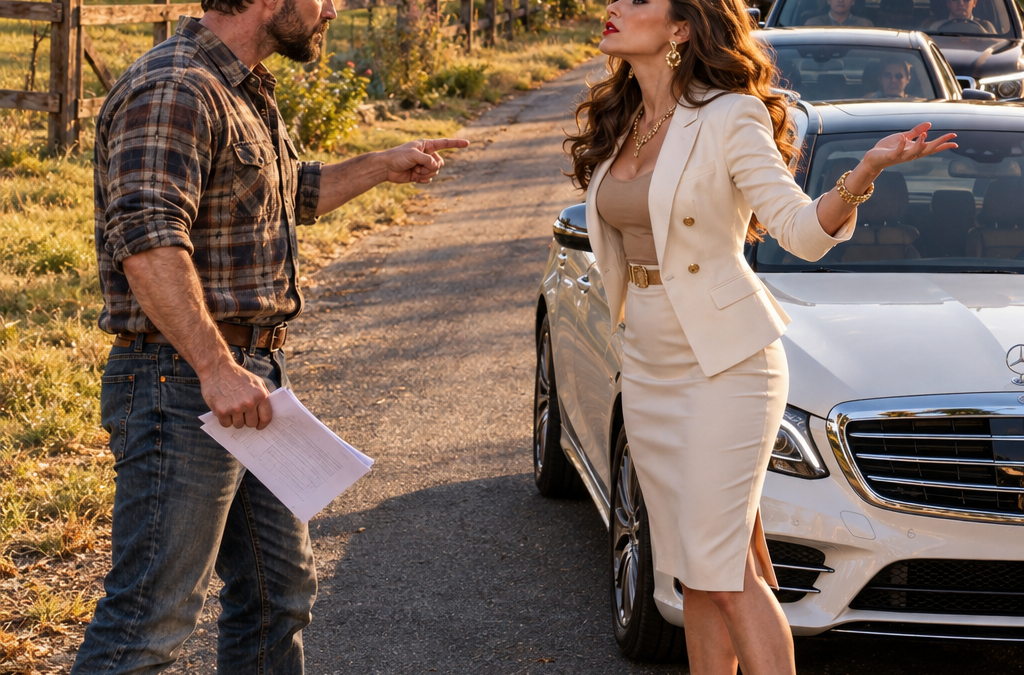
At 8:12 a.m., Karen arrived.
Of course she did not arrive quietly.
Her pearl-white Mercedes turned off the highway and swept onto my road like a royal carriage entering enemy territory. She hit the first speed bump too fast, and the front of her car dipped hard enough to make me wince.
She stopped completely before the second one.
Janelle approached with an invoice.
Karen lowered her window.
Even from the porch, I could see the red lipstick, the oversized sunglasses, the white blouse open one button too many, the gold chain at her throat, and the fury beneath the polish.
“Do you know who I am?” she asked.
Janelle pointed at the invoice. “If you give me your name, I can add it.”
Karen opened her door and stepped out.
Her heels clicked against my road.
My road.
She snatched the invoice, glanced at it, then looked toward my porch.
“You,” she called.
I walked down slowly.
Daniel stepped out of his car behind me. I had asked him to come early because I knew Karen would not be able to resist making a scene.
Karen saw him and narrowed her eyes.
“This is harassment,” she said.
“No,” I replied. “This is maintenance.”
“You are operating an illegal toll booth.”
“No one is stopping anyone from using the road.”
“You are demanding money.”
“I am issuing maintenance invoices for use of private road infrastructure.”
Her nostrils flared. “Private?”
I raised my eyebrows. “Do you want it to be private now?”
Daniel coughed into his fist to hide a laugh.
Karen pointed one manicured finger at me.
“You are interfering with Bellehaven residents’ established access rights.”
“Great,” I said. “Then Bellehaven can pay for the wear and tear caused by those access rights.”
“You have no authority.”
“You sent me a letter saying my road was a community access point. I’m treating it accordingly.”
“That letter was a notice.”
“It was an official HOA notice.”
“It was not a contract.”
“It was evidence.”
That word landed.
Evidence.
Karen’s confidence flickered.
Daniel stepped forward, calm and professional.
“Ms. Vale, I’m Daniel Mercer, counsel for the property owner. I reviewed the deed, the construction access agreement, and the documents your HOA referenced. There is no surface easement across this property.”
Karen’s mouth tightened.
“I don’t know who you think you are—”
“I just told you,” Daniel said. “Counsel. Please listen carefully.”
That was the first time I saw someone interrupt Karen and survive.
He opened a folder and removed copies of the documents.
“The construction access agreement was temporary. It allowed developer vehicles only. It expired. The right-of-way language concerns underground utilities. It does not allow Bellehaven residents to drive across this road.”
Karen crossed her arms.
“Our committee interpreted it differently.”
“Your committee interpreted it incorrectly.”
Her cheeks colored beneath her makeup.
Daniel held up her letter.
“More importantly, the HOA issued written communication designating my client’s private road as an official neighborhood exit and encouraged residents to use it. That creates a record of HOA-sanctioned use of private property without permission.”
Karen stared at him.
For once, she had no immediate answer.
I almost enjoyed the silence.
Almost.
Then she turned on me.
“You think you’re clever,” she said.
“No,” I said. “I think I own my land.”
“You live next to Bellehaven. Whether you like it or not, you benefit from our community standards.”
“I benefit from your residents driving across my property?”
“You benefit from proximity to our neighborhood. Your property value exists because of us.”
“My property existed before Bellehaven had a name.”
She stepped closer.
“You are making enemies you cannot afford.”
Daniel’s voice sharpened. “Careful.”
Karen looked at him, then at me, then back at the students.
“You will remove these speed bumps today.”
“No.”
“You will stop invoicing our residents.”
“No.”
“You will regret this.”
I smiled.
“Invoice her twice,” I said to Janelle. “She entered and she’s going to exit.”
Karen’s face went still.
For a second, I thought she might slap me.
Instead, she threw the invoice onto the ground, got into her Mercedes, and drove away so fast she hit the second speed bump hard enough to scrape something underneath her car.
Marcus picked up the invoice from the road.
“Do I still log it?” he asked.
“Absolutely,” Daniel said.
By that evening, Bellehaven was at war with itself.
I knew because the texts began arriving from numbers I did not recognize.
Some were threats.
You’re going to be sued.
You’re extorting families.
Enjoy court.
Some were strangely polite.
Hi, I used the road twice last week before realizing the dispute. Should I pay retroactively?
Some were angry at Karen.
Did she really not have permission?
Can you confirm the HOA lied?
Are we personally liable if we used Exit B?
I ignored most of them and forwarded the threats to Daniel.
The next day, traffic dropped by half.
By the fourth day, it dropped to fewer than ten cars.
The people who still came through were either stubborn, confused, or willing to pay ten dollars to avoid waiting at Bellehaven’s official gate. A retired man in a vintage Cadillac paid every time and told Marcus, “This is still cheaper than therapy.”
But the damage inside Bellehaven was spreading faster than any car had ever moved through my road.
A woman named Patricia came by one afternoon, not to use the shortcut, but to talk.
She parked at the entrance, walked up to the canopy, and asked if I was the owner.
I came down from the porch.
Patricia was in her sixties, carefully dressed, tired around the eyes.
“I owe you an apology,” she said.
I was so surprised I did not answer right away.
She continued. “I used the road three times. Karen told everyone it was officially approved. She said you had been consulted and were being difficult because you wanted the HOA to buy part of your land.”
My jaw tightened.
“She said what?”
Patricia looked embarrassed.
“She said you were trying to exploit us. That you inherited the property and saw an opportunity.”
Of course she did.
Karen had not just stolen access. She had built a story around it.
“That is not true,” I said.
“I’m beginning to understand that.”
Patricia handed me thirty dollars.
“I won’t use it again. But I did, and I should pay.”
I accepted the money, not because I needed it, but because it meant something.
“Thank you,” I said.
She hesitated before leaving.
“You should know the HOA group chat is a disaster. People are demanding answers. Karen is saying you’re unstable.”
I laughed once, without humor.
“She threatened me on my own road.”
Patricia nodded slowly.
“That sounds like her.”
After she left, I stood near the entrance and looked down the asphalt toward my house.
For the first time since all this began, the road was quiet.
But I knew the quiet would not last.
Karen was too proud to retreat.
Three days later, she escalated.
A county sheriff’s deputy pulled into my driveway just after noon.
I met him outside with Daniel on speakerphone.
The deputy was polite, middle-aged, and visibly tired in the way only law enforcement officers dealing with rich-neighborhood disputes can be tired.
“We received a complaint,” he said. “Someone claimed you’re blocking a public access road and charging unlawful passage fees.”
“I’m not blocking anyone,” I said.
He looked at the speed bumps, the sign, the canopy, the invoices.
Then he looked at the road behind him.
“This is private property?”
“Yes.”
I handed him the deed copy Daniel had told me to keep ready.
The deputy read it. Then he looked at the HOA letter.
His eyebrows went up slightly.
“She wrote this?”
“She signed it.”
“And there’s no easement?”
“No.”
Daniel’s voice came from the phone. “Deputy, I can email the supporting documents to your office. There is no public access, no recorded easement, and no court order granting HOA use.”
The deputy sighed.
“I’m not seeing a criminal issue here,” he said. “People can choose not to use the road.”
“Exactly.”
He handed back the papers.
“Just don’t physically block anyone in or make threats.”
“I haven’t.”
He glanced at the invoice log.
“You keeping records?”
“Yes.”
“Good.”
Before leaving, he paused and looked toward Bellehaven.
“Between you and me,” he said, “I’d put up a gate.”
“That’s the plan.”
Karen must have expected the deputy to scare me.
Instead, his visit gave me confidence.
It also gave Daniel the final piece he wanted: a documented complaint by the HOA president that confirmed she still claimed access after being told she was wrong.
That afternoon, Daniel drafted the letter.
It was beautiful.
Cold, precise, and devastating.
It cited Karen’s official notice. It cited the temporary construction agreement. It cited the deed. It cited the utility right-of-way language and explained why it did not apply. It referenced approximately two months of unauthorized daily use by Bellehaven residents, encouraged by HOA communication.
Then it demanded $3,500 for road degradation, dust control, and accelerated asphalt wear.
Thirty days to pay.
Failure to pay would result in legal action.
I expected Karen to explode.
She did.
But not officially.
Officially, the HOA went silent.
Unofficially, Karen came to my house at dusk.
I saw her Mercedes stop at the entrance, just outside the speed bumps. For a moment, she stayed in the car. Then she stepped out and walked up the road alone.
No clipboard.
No sunglasses.
No audience.
She wore a black dress beneath a cream coat, her hair loose around her shoulders, her heels clicking against the pavement with deliberate rhythm.
I stood on the porch as she approached.
“You sent a demand letter,” she said.
“My attorney did.”
“Because you’re too cowardly to talk to me yourself?”
“I talked to you. You threatened me.”
She stopped at the bottom of the porch steps.
In the fading light, she still looked perfect. That was the unsettling thing about Karen. Even angry, even cornered, she seemed composed enough to be photographed.
But her eyes gave her away.
She was scared.
Not of me.
Of losing control.
“You don’t understand what you’re doing,” she said.
“I understand exactly what I’m doing.”
“The board is upset.”
“They should be.”
“You’re embarrassing me.”
There it was.
Not harming the HOA. Not dividing the neighborhood. Not damaging trust.
Embarrassing me.
I looked at her for a long second.
“Karen, you sent strangers across my land for months. You lied to them. You threatened me. You destroyed my signs. You treated my home like an inconvenience.”
“I did not destroy your signs.”
“Maybe not with your own hands.”
Her mouth twisted.
“You think you’re the victim because people drove on asphalt?”
“My dog almost got hit.”
That stopped her for half a breath.
Then she looked away.
“Accidents happen.”
My hands tightened around the porch railing.
“Not on private property where those cars had no right to be.”
She climbed one step.
I did not move.
Her voice softened.
It became almost warm.
Almost intimate.
“Listen. This has gone too far. I can make this disappear. The correction notice, the payment demand, all of it. I can persuade the board to offer you something reasonable.”
“Like what?”
“A yearly access arrangement.”
“No.”
“You haven’t heard the number.”
“No.”
Her expression hardened.
“You would rather be difficult.”
“I would rather be left alone.”
“You live in a growing area. You cannot freeze the world around your grandfather’s memory.”
That hit harder than I wanted it to.
She saw it.
And she smiled.
Small. Cruel. Satisfied.
“He’s gone,” she said quietly. “This road is not sacred. It’s pavement.”
For a moment, I could not speak.
Then I came down the steps until we stood on the same level.
“You need to leave,” I said.
Her smile faded.
“I’m offering you a way out.”
“No. You’re offering me a way to surrender politely.”
“You are making a mistake.”
“No, Karen. You made the mistake. You put it in writing.”
She stared at me.
The sky behind her was darkening, and for once, without an audience, the mask slipped fully.
“You think the board will choose you over me?” she asked.
“I think the board will choose money over you.”
Her face changed.
Because she knew I was right.
Two weeks passed.
The speed bumps remained.
The invoices continued.
The road stayed mostly empty.
Bellehaven residents went back to using their official entrance, where they sat in the morning traffic they had tried to dump onto me. Every now and then, I would see a car slow near my entrance, hesitate, then drive on.
The canopy became unnecessary, but I kept Marcus and Janelle on for the full week I had promised and paid them extra. They had endured more abuse from rich commuters in five days than most people experience in a year.
Then the HOA letter arrived.
This one was not signed by Karen.
It was signed by the vice president and the treasurer.
The language was careful, polished, and cowardly.
The HOA acknowledged that prior communication “may have caused confusion” regarding the status of the access road referred to as Exit B. After review, the board had determined that the road was private property and that no community easement or surface access right existed. Residents were instructed not to use the road without my explicit permission.
Enclosed was a check for $3,500.
I stared at it for a long time.
Not because of the money.
Because of what it meant.
They had chosen.
Not morality. Not justice. Not neighborliness.
Liability.
But I would take it.
A correction notice went out to all Bellehaven residents two days later. Patricia forwarded me a copy.
It was a masterpiece of passive aggression.
The previous access communication may have been unclear.
Residents should be aware.
The board wishes to prevent further misunderstanding.
Unauthorized use may result in personal liability.
Karen’s name did not appear once.
That told me everything.
The board was not defending her anymore.
They were containing her.
I deposited the check and called a contractor.
If Karen wanted to create a permanent solution, I would help her.
By the end of the month, my old entrance was transformed.
The contractor built low stone walls on either side of the driveway, using warm gray rock that matched the old foundation of my grandfather’s barn. Between them, he installed a motorized black iron gate with a keypad, remote access, and an intercom.
It was beautiful.
Solid.
Final.
The first evening after it was finished, I stood at the entrance with the remote in my hand and watched the gate close for the first time.
The metal bars moved slowly, smoothly, until they met in the center with a soft mechanical click.
I had not realized how tense my body had been for months until that sound released something in me.
No more signs to tear down.
No more arguments at sunrise.
No more strangers honking at me on my own land.
No more Karen turning my inheritance into her convenience.
A week later, I saw her again.
I was coming back from the hardware store when I passed Bellehaven’s main entrance. There was a cluster of residents near the stone sign, and Karen stood in the middle of them.
She was dressed perfectly, as always.
White blazer. Red lipstick. Gold earrings. Hair shining under the afternoon sun.
But she looked smaller.
Not physically.
Publicly.
The group around her did not lean in the way people lean toward power. They stood apart, arms crossed, faces tight. A man I recognized from one of the shortcut cars was speaking sharply while Karen stared past him.
Then she saw my truck.
Our eyes met.
I did not wave.
Neither did she.
Two days later, Patricia told me Karen had resigned as HOA president.
The official reason was that she wanted to focus on family and personal commitments.
The unofficial reason was that half the neighborhood wanted her removed, the other half wanted the board investigated, and nobody wanted the next HOA meeting to become a public trial over Exit B.
Apparently, several residents had demanded to know why Karen had circulated false information. Others were angry that HOA funds had been used to pay me. A few threatened to sue the board for exposing them to trespass liability. Someone printed copies of Karen’s original letter and brought them to a meeting.
I would have paid good money to see her face.
Instead, I got something better.
Quiet.
Real quiet.
The kind my grandfather loved.
Mornings returned slowly.
At first, I still woke expecting engines. I would sit on the porch with coffee and listen for tires over asphalt. When none came, I did not trust it. Silence felt temporary, like a ceasefire.
But days passed.
Then weeks.
The dust settled. The dog walked calmly beside me again. Grass began growing thick along the road edges where tires had chewed it down. I repaired the cracked asphalt near the bend and used what remained of the HOA money to improve drainage along the low side.
Sometimes Bellehaven residents drove past the highway entrance and slowed when they saw the gate.
Then they kept going.
A few months later, the new HOA president sent me a letter.
I almost threw it away unopened.
But curiosity won.
It was short.
Professional.
Apologetic.
It stated that Bellehaven recognized my property boundaries and wished to maintain “respectful neighbor relations” going forward. It included a direct contact number in case any resident trespassed again.
No demands.
No false legal theories.
No community access language.
No Karen.
I pinned it to the corkboard in my kitchen beneath an old photograph of my grandfather standing beside the road when it was newly paved. In the photo, he looked younger than I ever knew him, one hand on his hip, sunlight in his eyes, proud of the work he had done with his own money on his own land.
For a while, I wondered what he would have thought of all this.
Then I realized I knew.
He would have laughed until he had to sit down.
He would have said Karen was exactly the kind of person he warned me about—the kind who borrows a corner, then a path, then a right, and acts wounded when the owner says no.
And he would have loved the gate.
Not because it was expensive.
Not because it was impressive.
Because it said one simple thing Karen never wanted to hear.
Mine.
I did not destroy the HOA.
Karen did that herself.
All I did was believe her when she said my private road was community infrastructure.
Then I charged the community for using it.
𝗧𝗛𝗘 𝗘𝗡𝗗
My Quiet Road Became Karen’s Shortcut Until I Made Her Pay for Every Inch of It
Fifty cars a day rolled across my land because one woman in a pearl-white Mercedes decided my private road belonged to her neighborhood.
She called it community access. I called it trespassing.
And by the time Karen realized I had stopped asking politely, she had already signed the paper that would ruin her.
When my grandfather died, he left me two things: a house on two acres of land and a warning I did not fully understand until years later.
“People don’t steal land all at once,” he used to tell me. “They borrow a corner, then a path, then a right, and one day they act offended when you ask for it back.”
At the time, I thought he was just being old-fashioned.
He had lived alone on that property for decades, back when the land around it was mostly fields, tree lines, and long stretches of quiet road. He bought the place before anyone with money cared about the hills behind it. Before developers carved those hills into view lots and named every street after something peaceful they had destroyed. Meadow Crest. Willow Pointe. Serenity Lane.
By the time I inherited the property, the world around my grandfather’s house had changed completely.
His old two acres sat like a stubborn little island between the highway and a luxury development called Bellehaven Estates. The people there lived behind stone signs, trimmed hedges, decorative streetlamps, and a set of HOA rules thick enough to stun an animal. Their homes were enormous. Their garages were spotless. Their lawns looked less grown than staged.
My grandfather’s place was not like that.
It was a warm, practical house with a wide porch, a sagging barn, old oaks along the western edge, and a paved private road that ran straight from the highway up to the house. He had paid for that road himself years before, back when mud was still a real problem in spring. It was not fancy, but it was solid. Three hundred yards of asphalt, bordered by grass and wildflowers, cutting cleanly across my land.
To me, it was more than a driveway.
It was the sound of my grandfather’s boots at sunrise. It was the place where he taught me to ride a bike. It was where I followed him as a kid while he carried a toolbox in one hand and a coffee mug in the other, telling me the names of trees like he was introducing me to old friends.
When I moved in after his funeral, I wanted peace.
That was all.
I had spent years in apartments where walls were thin and privacy was something you had to pretend existed. I wanted mornings on the porch. I wanted space around me. I wanted to drink coffee without hearing someone else’s argument through drywall.
For a few months, I got exactly that.
Then Karen Vale became president of the Bellehaven Estates HOA.
I noticed her before I knew her name.
She was about forty, maybe a little older, but she carried herself like aging was something she planned to sue. She was beautiful in a sharp, expensive way—glossy chestnut hair falling in perfect waves, full lips always painted red, manicured nails, high heels that had no business clicking around suburban sidewalks at eight in the morning. She wore fitted blazers, silk blouses, gold jewelry, and perfume strong enough to announce her before she arrived.
Men watched her. Women measured her. Karen knew both things and used them.
But what people mistook for confidence was something uglier.
Karen liked control.
Not responsibility. Not leadership. Control.
She walked through Bellehaven with a tablet tucked under one arm, inspecting mailbox heights, hedge lines, trash cans, flower colors, children’s bicycles, and anything else she could twist into a violation. She smiled while she did it, but it was the kind of smile that made apologies feel like receipts.
The first time I saw her near my property, she was standing at the entrance of my private road, one hand on her hip, sunglasses pushed up into her hair, staring down the asphalt like she had just discovered a useful mistake.
I should have known then.
PART 2
The problem started small enough that I almost ignored it.
One morning, while I was sitting on the porch with my coffee, a black SUV turned off the highway and came rolling up my private road.
I stood slowly, thinking maybe someone was lost.
The driver slowed when he saw the house, looked around, then kept going past my porch and continued toward the back edge of the property, where an old service lane connected near the rear fence line. Years ago, when Bellehaven was being built, the developer had temporarily used that route for construction trucks after making a paid agreement with my grandfather.
Temporary. Paid. Written down.
The agreement had ended long before I moved in.
The SUV disappeared through the back access point toward Bellehaven.
I frowned, but I let it go.
The next day, two cars came through.
By the end of the week, it was eight.
Within a month, my mornings were no longer quiet. They sounded like tires, engines, gravel spit, and impatient horns.
Bellehaven residents had discovered that my private road cut ten to fifteen minutes off their commute. Their official entrance wound around the hills in a long, narrow loop that backed up during rush hour. My road was a straight shot to the highway.
And people who spent a million dollars on a house apparently believed inconvenience was something that happened to other people.
At first, I tried to be calm.
I replaced my grandfather’s old faded sign with a new one.
PRIVATE ROAD. NO TRESPASSING.
It was large, reflective, and mounted at the highway entrance.
Someone removed it within two days.
I found it tossed into the weeds, bent at one corner.
I bought another sign and bolted it to a steel post set in concrete.
Someone spray-painted over it.
That was when my patience began to crack.
The cars kept coming. Sedans. SUVs. Sports cars. A few motorcycles. Delivery vans. People in sunglasses and business suits and tennis skirts. They drove like my land was a shortcut built for their convenience. Some waved casually at me as if trespassing became acceptable when done cheerfully. Others avoided looking at me altogether.
One morning, while I was walking my dog, a silver BMW came too fast around the curve near the barn.
I stepped off the asphalt and pulled my dog back hard by the leash.
The BMW braked just enough to avoid us, and the woman behind the wheel lowered her window.
“You need to watch where you’re walking,” she snapped.
I stared at her. “This is my road.”
She gave a short laugh. “Not anymore.”
Then she drove away.
Those two words stayed in my head all morning.
Not anymore.
That afternoon, I found an envelope in my mailbox.
It was thick, cream-colored, and printed with the Bellehaven Estates HOA logo. At the top, in elegant blue lettering, was the subject line:
NOTICE OF COMMUNITY ACCESS DESIGNATION.
I read it once.
Then again.
Then a third time, because my brain refused to accept that anyone could be that arrogant in writing.
According to the letter, the Bellehaven Estates HOA had conducted a “historical access review” and determined that my private road functioned as a “community easement” based on its usage during the development phase. It further stated that the HOA board had voted to designate my road as Exit B for Bellehaven residents during peak traffic hours.
The letter thanked me for my “continued cooperation.”
I had not cooperated with anything.
It reminded me that “neighborly participation strengthens community values.”
I was not part of their community.
At the bottom was Karen Vale’s signature, sweeping and dramatic, with the title HOA President beneath it.
I drove to Bellehaven that evening with the letter on the passenger seat, folded and refolded until the paper was soft at the creases.
I found Karen outside a large white house near the entrance, standing on the sidewalk while a landscaping crew trimmed hedges under her supervision. She wore a fitted navy dress, gold heels, and sunglasses that made her look less like an HOA president and more like a woman about to blackmail a senator.
“Karen Vale?” I asked.
She turned, looked me up and down, and smiled.
“Can I help you?”
I held up the letter. “You can explain why your HOA thinks it owns my road.”
Her smile did not fade. If anything, it sharpened.
“Oh,” she said. “You’re the property owner.”
“The property owner,” I repeated. “Meaning the person who owns the property your residents keep driving across.”
She removed her sunglasses slowly, like we were on a stage and she wanted the audience to see her eyes.
“Bellehaven used that road during development,” she said. “It has an established access history.”
“For construction vehicles,” I said. “Under a temporary agreement with my grandfather. That agreement ended years ago.”
Karen tilted her head. “That may be your interpretation.”
“It is not an interpretation. It is a contract.”
Her lips curved. “Contracts can create patterns. Patterns can create expectations. Expectations can create rights.”
“That sounds like something you made up after two glasses of wine.”
The landscapers went silent.
Karen’s face tightened, but only for a second.
“You are being unnecessarily hostile,” she said.
“Fifty strangers a day are driving across my land, and you sent me a letter telling me to be grateful for it.”
“I sent you a courtesy notice.”
“You declared my driveway a neighborhood exit.”
“Because it benefits the community.”
“It harms me.”
Her eyes flicked over my clothes, my truck parked by the curb, the work dust still on my boots. Then she looked back at me with the faintest trace of pity.
“Listen,” she said, lowering her voice. “I understand this property probably feels very sentimental to you. But the area has changed. Bellehaven is not some random group of people cutting through your yard. We are an organized residential community. There are legal realities that come with growth.”
“What legal realities?”
“Our legal committee reviewed the matter.”
“Who is on your legal committee?”
She smiled. “People who understand these things.”
“That is not an answer.”
“It is the answer you are getting.”
I took one step closer. “Karen, stop sending cars through my road.”
Her perfume was sweet and heavy, but her voice turned cold.
“No.”
The word was soft, almost intimate.
Then she leaned in slightly.
“And if you try to block access, you may find yourself facing consequences far more expensive than a little extra traffic.”
I should have walked away right then.
Instead, I said, “You have no idea how expensive this is about to become.”
For the first time, her smile faltered.
Only a little.
But I saw it.
The next morning, traffic through my land doubled.
It was not an accident.
Karen had sent a message to the residents.
I knew because a man in a white Tesla slowed long enough to say, “Karen told us Exit B is fully approved.”
Another driver shouted, “Take it up with the HOA!”
A woman in workout clothes gave me a thumbs-down from behind her windshield.
By seven-thirty, I counted thirty-two cars.
By eight-fifteen, fifty-six.
My dog refused to go near the road. Dust coated the porch railing. A loose patch of asphalt near the bend began to crumble under the constant weight. My quiet home no longer felt like mine. It felt occupied.
That afternoon, I called my friend Daniel.
Daniel was a property attorney, and unlike most people, he became genuinely happy when handed a land dispute. Some men liked football. Daniel liked deeds, easements, zoning maps, and poorly written threats from overconfident idiots.
I invited him over and spread everything across my kitchen table.
My grandfather’s deed. The old construction access agreement. The termination notice from the developer. Karen’s letter. Photos of the removed signs. Videos of cars using the road.
Daniel read in silence.
Then he laughed.
Not a polite laugh.
A full, delighted laugh.
“Oh,” he said, tapping Karen’s letter. “She really put this in writing.”
“Is that good?”
“For you? Very.”
He explained it carefully.
There was no easement.
None.
The developer’s agreement had been temporary, paid, and limited to construction access. It had clear start and end dates. It had expired years earlier. The right-of-way language Karen appeared to be relying on referred to underground utility lines running beneath part of the property, not surface travel.
“She either did not read the documents,” Daniel said, “did not understand them, or understood them and hoped you wouldn’t.”
“Can I put up a gate?”
“Yes.”
“Can I block the road?”
“Yes.”
“Can I call the police?”
“Yes.”
He leaned back in his chair, eyes bright.
“But I assume you did not call me here because you wanted the boring answer.”
I looked at Karen’s letter again.
Designated as Exit B.
Community access.
Continued cooperation.
“No,” I said. “I want her to choke on her own paperwork.”
Daniel grinned.
“That,” he said, “is a better answer.”
We spent the next two nights planning.
Not revenge, exactly.
Compliance.
Karen had declared my road a community access point. She had encouraged residents to use it. She had put the HOA name behind that claim.
So I decided to treat it like community infrastructure.
Daniel found the local rules. If a private road was used by an organization or group for access, the landowner could collect reasonable maintenance fees to offset wear, damage, dust control, and resurfacing costs, as long as use was voluntary and the fees were clearly posted.
Voluntary was important.
I could not physically trap anyone or run a real toll booth without permits.
But I could document every vehicle, issue invoices, and charge a road maintenance fee for community usage.
Ten dollars per entry.
Reasonable, considering asphalt repair costs.
Hilarious, considering Bellehaven residents were using my land to avoid waiting in traffic.
The next morning, I went to a hardware supplier and bought two industrial speed bumps so aggressive they looked like they had been designed by someone who hated suspensions. I hired a contractor to install them thirty yards apart near the entrance.
Then I hired two university students, Marcus and Janelle, who wanted part-time work and had the calm emotional stamina of people who had already survived customer service jobs.
I gave them a canopy tent, a folding table, chairs, bottled water, clipboards, and printed invoices.
At the top of each invoice was my property address.
Below that were spaces for date, time, license plate number, vehicle description, and amount due.
At the entrance, I installed a professional sign:
PRIVATE ROAD MAINTENANCE FEE
$10 PER ENTRY
PROCEEDS USED FOR RESURFACING, DUST CONTROL, AND PROPERTY MAINTENANCE
USE OF ROAD CONSTITUTES ACCEPTANCE OF FEE
Daniel reviewed every word.
“Perfect,” he said. “Annoying, but perfect.”
Day one was glorious.
The first SUV came flying in at 7:04 a.m. and hit the first speed bump too fast.
The sound it made was not pleasant.
The driver slammed on his brakes, rolled down his window, and screamed, “What the hell is this?”
Marcus walked over with a smile and handed him an invoice.
“Good morning, sir. Private road maintenance fee. Ten dollars per entry.”
“I’m not paying that.”
“That’s your choice, sir. I’ll note the license plate.”
The man stared at him. “You can’t do that.”
Marcus looked down at the clipboard. “I just did.”
By 7:30, a line had formed.
Not because we blocked anyone. We didn’t.
The speed bumps did the work.
Cars had to slow to a crawl. Drivers who had been using my road to save time suddenly found themselves waiting behind other furious drivers being handed invoices by two polite college students under a canopy tent.
Some cursed.
Some threatened.
Some laughed nervously and paid.
A woman in a Lexus said, “Karen said this was an approved exit.”
Janelle smiled. “Then the HOA may want to reimburse you.”
A man in a Porsche refused to open his window, so Marcus tucked the invoice under his windshield wiper when he stopped at the second bump.
By nine o’clock, Bellehaven’s shortcut had become slower than their official entrance.
Which was the point.
I watched from my porch with coffee in my hand, feeling more peace than I had in weeks.
That peace lasted until the second morning.
At 8:12 a.m., Karen arrived.
Of course she did not arrive quietly.
Her pearl-white Mercedes turned off the highway and swept onto my road like a royal carriage entering enemy territory. She hit the first speed bump too fast, and the front of her car dipped hard enough to make me wince.
She stopped completely before the second one.
Janelle approached with an invoice.
Karen lowered her window.
Even from the porch, I could see the red lipstick, the oversized sunglasses, the white blouse open one button too many, the gold chain at her throat, and the fury beneath the polish.
“Do you know who I am?” she asked.
Janelle pointed at the invoice. “If you give me your name, I can add it.”
Karen opened her door and stepped out.
Her heels clicked against my road.
My road.
She snatched the invoice, glanced at it, then looked toward my porch.
“You,” she called.
I walked down slowly.
Daniel stepped out of his car behind me. I had asked him to come early because I knew Karen would not be able to resist making a scene.
Karen saw him and narrowed her eyes.
“This is harassment,” she said.
“No,” I replied. “This is maintenance.”
“You are operating an illegal toll booth.”
“No one is stopping anyone from using the road.”
“You are demanding money.”
“I am issuing maintenance invoices for use of private road infrastructure.”
Her nostrils flared. “Private?”
I raised my eyebrows. “Do you want it to be private now?”
Daniel coughed into his fist to hide a laugh.
Karen pointed one manicured finger at me.
“You are interfering with Bellehaven residents’ established access rights.”
“Great,” I said. “Then Bellehaven can pay for the wear and tear caused by those access rights.”
“You have no authority.”
“You sent me a letter saying my road was a community access point. I’m treating it accordingly.”
“That letter was a notice.”
“It was an official HOA notice.”
“It was not a contract.”
“It was evidence.”
That word landed.
Evidence.
Karen’s confidence flickered.
Daniel stepped forward, calm and professional.
“Ms. Vale, I’m Daniel Mercer, counsel for the property owner. I reviewed the deed, the construction access agreement, and the documents your HOA referenced. There is no surface easement across this property.”
Karen’s mouth tightened.
“I don’t know who you think you are—”
“I just told you,” Daniel said. “Counsel. Please listen carefully.”
That was the first time I saw someone interrupt Karen and survive.
He opened a folder and removed copies of the documents.
“The construction access agreement was temporary. It allowed developer vehicles only. It expired. The right-of-way language concerns underground utilities. It does not allow Bellehaven residents to drive across this road.”
Karen crossed her arms.
“Our committee interpreted it differently.”
“Your committee interpreted it incorrectly.”
Her cheeks colored beneath her makeup.
Daniel held up her letter.
“More importantly, the HOA issued written communication designating my client’s private road as an official neighborhood exit and encouraged residents to use it. That creates a record of HOA-sanctioned use of private property without permission.”
Karen stared at him.
For once, she had no immediate answer.
I almost enjoyed the silence.
Almost.
Then she turned on me.
“You think you’re clever,” she said.
“No,” I said. “I think I own my land.”
“You live next to Bellehaven. Whether you like it or not, you benefit from our community standards.”
“I benefit from your residents driving across my property?”
“You benefit from proximity to our neighborhood. Your property value exists because of us.”
“My property existed before Bellehaven had a name.”
She stepped closer.
“You are making enemies you cannot afford.”
Daniel’s voice sharpened. “Careful.”
Karen looked at him, then at me, then back at the students.
“You will remove these speed bumps today.”
“No.”
“You will stop invoicing our residents.”
“No.”
“You will regret this.”
I smiled.
“Invoice her twice,” I said to Janelle. “She entered and she’s going to exit.”
Karen’s face went still.
For a second, I thought she might slap me.
Instead, she threw the invoice onto the ground, got into her Mercedes, and drove away so fast she hit the second speed bump hard enough to scrape something underneath her car.
Marcus picked up the invoice from the road.
“Do I still log it?” he asked.
“Absolutely,” Daniel said.
By that evening, Bellehaven was at war with itself.
I knew because the texts began arriving from numbers I did not recognize.
Some were threats.
You’re going to be sued.
You’re extorting families.
Enjoy court.
Some were strangely polite.
Hi, I used the road twice last week before realizing the dispute. Should I pay retroactively?
Some were angry at Karen.
Did she really not have permission?
Can you confirm the HOA lied?
Are we personally liable if we used Exit B?
I ignored most of them and forwarded the threats to Daniel.
The next day, traffic dropped by half.
By the fourth day, it dropped to fewer than ten cars.
The people who still came through were either stubborn, confused, or willing to pay ten dollars to avoid waiting at Bellehaven’s official gate. A retired man in a vintage Cadillac paid every time and told Marcus, “This is still cheaper than therapy.”
But the damage inside Bellehaven was spreading faster than any car had ever moved through my road.
A woman named Patricia came by one afternoon, not to use the shortcut, but to talk.
She parked at the entrance, walked up to the canopy, and asked if I was the owner.
I came down from the porch.
Patricia was in her sixties, carefully dressed, tired around the eyes.
“I owe you an apology,” she said.
I was so surprised I did not answer right away.
She continued. “I used the road three times. Karen told everyone it was officially approved. She said you had been consulted and were being difficult because you wanted the HOA to buy part of your land.”
My jaw tightened.
“She said what?”
Patricia looked embarrassed.
“She said you were trying to exploit us. That you inherited the property and saw an opportunity.”
Of course she did.
Karen had not just stolen access. She had built a story around it.
“That is not true,” I said.
“I’m beginning to understand that.”
Patricia handed me thirty dollars.
“I won’t use it again. But I did, and I should pay.”
I accepted the money, not because I needed it, but because it meant something.
“Thank you,” I said.
She hesitated before leaving.
“You should know the HOA group chat is a disaster. People are demanding answers. Karen is saying you’re unstable.”
I laughed once, without humor.
“She threatened me on my own road.”
Patricia nodded slowly.
“That sounds like her.”
After she left, I stood near the entrance and looked down the asphalt toward my house.
For the first time since all this began, the road was quiet.
But I knew the quiet would not last.
Karen was too proud to retreat.
Three days later, she escalated.
A county sheriff’s deputy pulled into my driveway just after noon.
I met him outside with Daniel on speakerphone.
The deputy was polite, middle-aged, and visibly tired in the way only law enforcement officers dealing with rich-neighborhood disputes can be tired.
“We received a complaint,” he said. “Someone claimed you’re blocking a public access road and charging unlawful passage fees.”
“I’m not blocking anyone,” I said.
He looked at the speed bumps, the sign, the canopy, the invoices.
Then he looked at the road behind him.
“This is private property?”
“Yes.”
I handed him the deed copy Daniel had told me to keep ready.
The deputy read it. Then he looked at the HOA letter.
His eyebrows went up slightly.
“She wrote this?”
“She signed it.”
“And there’s no easement?”
“No.”
Daniel’s voice came from the phone. “Deputy, I can email the supporting documents to your office. There is no public access, no recorded easement, and no court order granting HOA use.”
The deputy sighed.
“I’m not seeing a criminal issue here,” he said. “People can choose not to use the road.”
“Exactly.”
He handed back the papers.
“Just don’t physically block anyone in or make threats.”
“I haven’t.”
He glanced at the invoice log.
“You keeping records?”
“Yes.”
“Good.”
Before leaving, he paused and looked toward Bellehaven.
“Between you and me,” he said, “I’d put up a gate.”
“That’s the plan.”
Karen must have expected the deputy to scare me.
Instead, his visit gave me confidence.
It also gave Daniel the final piece he wanted: a documented complaint by the HOA president that confirmed she still claimed access after being told she was wrong.
That afternoon, Daniel drafted the letter.
It was beautiful.
Cold, precise, and devastating.
It cited Karen’s official notice. It cited the temporary construction agreement. It cited the deed. It cited the utility right-of-way language and explained why it did not apply. It referenced approximately two months of unauthorized daily use by Bellehaven residents, encouraged by HOA communication.
Then it demanded $3,500 for road degradation, dust control, and accelerated asphalt wear.
Thirty days to pay.
Failure to pay would result in legal action.
I expected Karen to explode.
She did.
But not officially.
Officially, the HOA went silent.
Unofficially, Karen came to my house at dusk.
I saw her Mercedes stop at the entrance, just outside the speed bumps. For a moment, she stayed in the car. Then she stepped out and walked up the road alone.
No clipboard.
No sunglasses.
No audience.
She wore a black dress beneath a cream coat, her hair loose around her shoulders, her heels clicking against the pavement with deliberate rhythm.
I stood on the porch as she approached.
“You sent a demand letter,” she said.
“My attorney did.”
“Because you’re too cowardly to talk to me yourself?”
“I talked to you. You threatened me.”
She stopped at the bottom of the porch steps.
In the fading light, she still looked perfect. That was the unsettling thing about Karen. Even angry, even cornered, she seemed composed enough to be photographed.
But her eyes gave her away.
She was scared.
Not of me.
Of losing control.
“You don’t understand what you’re doing,” she said.
“I understand exactly what I’m doing.”
“The board is upset.”
“They should be.”
“You’re embarrassing me.”
There it was.
Not harming the HOA. Not dividing the neighborhood. Not damaging trust.
Embarrassing me.
I looked at her for a long second.
“Karen, you sent strangers across my land for months. You lied to them. You threatened me. You destroyed my signs. You treated my home like an inconvenience.”
“I did not destroy your signs.”
“Maybe not with your own hands.”
Her mouth twisted.
“You think you’re the victim because people drove on asphalt?”
“My dog almost got hit.”
That stopped her for half a breath.
Then she looked away.
“Accidents happen.”
My hands tightened around the porch railing.
“Not on private property where those cars had no right to be.”
She climbed one step.
I did not move.
Her voice softened.
It became almost warm.
Almost intimate.
“Listen. This has gone too far. I can make this disappear. The correction notice, the payment demand, all of it. I can persuade the board to offer you something reasonable.”
“Like what?”
“A yearly access arrangement.”
“No.”
“You haven’t heard the number.”
“No.”
Her expression hardened.
“You would rather be difficult.”
“I would rather be left alone.”
“You live in a growing area. You cannot freeze the world around your grandfather’s memory.”
That hit harder than I wanted it to.
She saw it.
And she smiled.
Small. Cruel. Satisfied.
“He’s gone,” she said quietly. “This road is not sacred. It’s pavement.”
For a moment, I could not speak.
Then I came down the steps until we stood on the same level.
“You need to leave,” I said.
Her smile faded.
“I’m offering you a way out.”
“No. You’re offering me a way to surrender politely.”
“You are making a mistake.”
“No, Karen. You made the mistake. You put it in writing.”
She stared at me.
The sky behind her was darkening, and for once, without an audience, the mask slipped fully.
“You think the board will choose you over me?” she asked.
“I think the board will choose money over you.”
Her face changed.
Because she knew I was right.
Two weeks passed.
The speed bumps remained.
The invoices continued.
The road stayed mostly empty.
Bellehaven residents went back to using their official entrance, where they sat in the morning traffic they had tried to dump onto me. Every now and then, I would see a car slow near my entrance, hesitate, then drive on.
The canopy became unnecessary, but I kept Marcus and Janelle on for the full week I had promised and paid them extra. They had endured more abuse from rich commuters in five days than most people experience in a year.
Then the HOA letter arrived.
This one was not signed by Karen.
It was signed by the vice president and the treasurer.
The language was careful, polished, and cowardly.
The HOA acknowledged that prior communication “may have caused confusion” regarding the status of the access road referred to as Exit B. After review, the board had determined that the road was private property and that no community easement or surface access right existed. Residents were instructed not to use the road without my explicit permission.
Enclosed was a check for $3,500.
I stared at it for a long time.
Not because of the money.
Because of what it meant.
They had chosen.
Not morality. Not justice. Not neighborliness.
Liability.
But I would take it.
A correction notice went out to all Bellehaven residents two days later. Patricia forwarded me a copy.
It was a masterpiece of passive aggression.
The previous access communication may have been unclear.
Residents should be aware.
The board wishes to prevent further misunderstanding.
Unauthorized use may result in personal liability.
Karen’s name did not appear once.
That told me everything.
The board was not defending her anymore.
They were containing her.
I deposited the check and called a contractor.
If Karen wanted to create a permanent solution, I would help her.
By the end of the month, my old entrance was transformed.
The contractor built low stone walls on either side of the driveway, using warm gray rock that matched the old foundation of my grandfather’s barn. Between them, he installed a motorized black iron gate with a keypad, remote access, and an intercom.
It was beautiful.
Solid.
Final.
The first evening after it was finished, I stood at the entrance with the remote in my hand and watched the gate close for the first time.
The metal bars moved slowly, smoothly, until they met in the center with a soft mechanical click.
I had not realized how tense my body had been for months until that sound released something in me.
No more signs to tear down.
No more arguments at sunrise.
No more strangers honking at me on my own land.
No more Karen turning my inheritance into her convenience.
A week later, I saw her again.
I was coming back from the hardware store when I passed Bellehaven’s main entrance. There was a cluster of residents near the stone sign, and Karen stood in the middle of them.
She was dressed perfectly, as always.
White blazer. Red lipstick. Gold earrings. Hair shining under the afternoon sun.
But she looked smaller.
Not physically.
Publicly.
The group around her did not lean in the way people lean toward power. They stood apart, arms crossed, faces tight. A man I recognized from one of the shortcut cars was speaking sharply while Karen stared past him.
Then she saw my truck.
Our eyes met.
I did not wave.
Neither did she.
Two days later, Patricia told me Karen had resigned as HOA president.
The official reason was that she wanted to focus on family and personal commitments.
The unofficial reason was that half the neighborhood wanted her removed, the other half wanted the board investigated, and nobody wanted the next HOA meeting to become a public trial over Exit B.
Apparently, several residents had demanded to know why Karen had circulated false information. Others were angry that HOA funds had been used to pay me. A few threatened to sue the board for exposing them to trespass liability. Someone printed copies of Karen’s original letter and brought them to a meeting.
I would have paid good money to see her face.
Instead, I got something better.
Quiet.
Real quiet.
The kind my grandfather loved.
Mornings returned slowly.
At first, I still woke expecting engines. I would sit on the porch with coffee and listen for tires over asphalt. When none came, I did not trust it. Silence felt temporary, like a ceasefire.
But days passed.
Then weeks.
The dust settled. The dog walked calmly beside me again. Grass began growing thick along the road edges where tires had chewed it down. I repaired the cracked asphalt near the bend and used what remained of the HOA money to improve drainage along the low side.
Sometimes Bellehaven residents drove past the highway entrance and slowed when they saw the gate.
Then they kept going.
A few months later, the new HOA president sent me a letter.
I almost threw it away unopened.
But curiosity won.
It was short.
Professional.
Apologetic.
It stated that Bellehaven recognized my property boundaries and wished to maintain “respectful neighbor relations” going forward. It included a direct contact number in case any resident trespassed again.
No demands.
No false legal theories.
No community access language.
No Karen.
I pinned it to the corkboard in my kitchen beneath an old photograph of my grandfather standing beside the road when it was newly paved. In the photo, he looked younger than I ever knew him, one hand on his hip, sunlight in his eyes, proud of the work he had done with his own money on his own land.
For a while, I wondered what he would have thought of all this.
Then I realized I knew.
He would have laughed until he had to sit down.
He would have said Karen was exactly the kind of person he warned me about—the kind who borrows a corner, then a path, then a right, and acts wounded when the owner says no.
And he would have loved the gate.
Not because it was expensive.
Not because it was impressive.
Because it said one simple thing Karen never wanted to hear.
Mine.
I did not destroy the HOA.
Karen did that herself.
All I did was believe her when she said my private road was community infrastructure.
Then I charged the community for using it.