𝗙𝗨𝗟𝗟 𝗦𝗧𝗢𝗥𝗬 My New Neighbor Tried to Ban Me From My Own Driveway, So I Let the Property Line Destroy Her Perfect Life
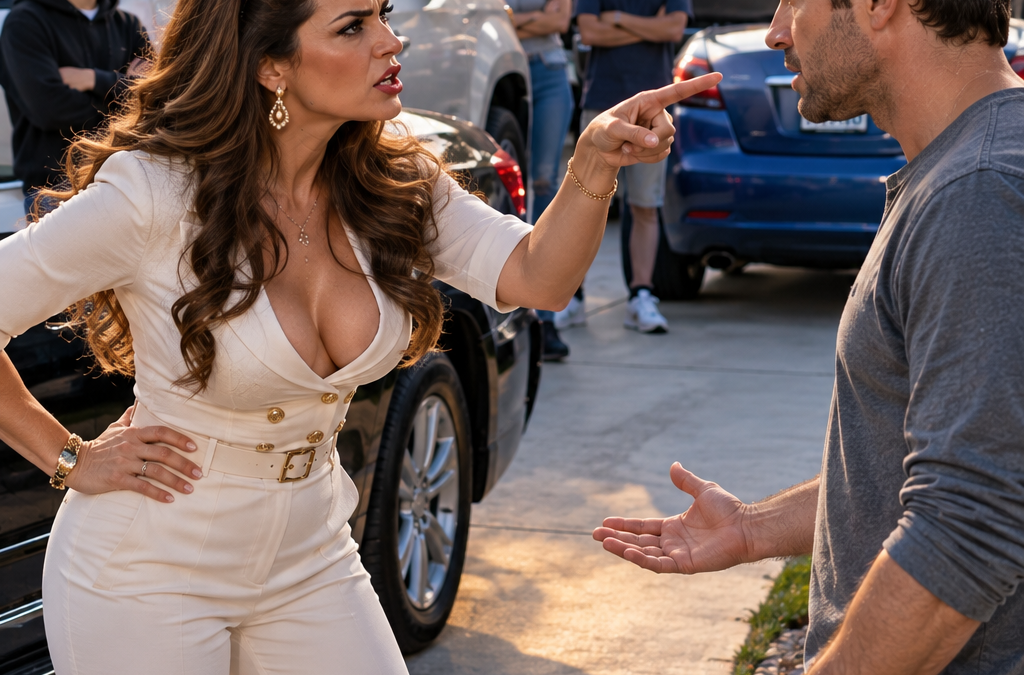
𝗙𝗨𝗟𝗟 𝗦𝗧𝗢𝗥𝗬 I waited.
She looked past me toward the driveway. “We have six drivers in this family. You’re one person. You should be more flexible.”
“I should be more flexible because your family has more cars than the driveway can handle?”
Her smile sharpened. “That would be the neighborly thing.”
Neighborly.
That word coming out of her mouth felt like perfume sprayed over smoke.
“I’ve been neighborly,” I said. “I parked on the street during your move. I’ve asked politely every time someone blocks me in. But I need access to my own car.”
“And we need access to our home.”
“You have it.”
“Not conveniently.”
“That’s not my fault.”
The smile disappeared.
For one second, I saw the real Karen beneath the pretty face and polished voice. Cold. Entitled. Offended not because I was wrong, but because I wasn’t surrendering fast enough.
She stepped back.
“I’ll talk to the kids,” she said.
She did not talk to the kids.
Or if she did, the message was apparently, “Take more.”
A week later, I woke up to find three of their cars on my side of the driveway. Not partially. Not accidentally. Fully parked where I had always parked, leaving me no room at all. My car was on the street because I had come home late the night before and there had been nowhere else to put it.
I waited until a reasonable hour and knocked.
Karen opened the door in a tight black dress and heels, looking like she had been waiting for confrontation and dressed accordingly.
“Your cars are in my spot,” I said.
She glanced toward the driveway. “First come, first served.”
“That’s not how shared driveways work.”
“It’s how this one works now.”
Then she shut the door.
That was the day I started documenting everything.
Photos. Dates. Times. Which vehicle blocked me. Which car crossed over. Which kid rolled their eyes. Which conversation happened at the door. I created a folder on my computer called Driveway, because apparently adulthood is just collecting evidence in folders you never wanted to create.
For six weeks, I tried to solve it like a normal person.
I spoke to Mark once when Karen wasn’t around. He was a tired-looking man with thinning hair, kind eyes, and the posture of someone who had spent years bracing for impact.
“I know it’s a lot of cars,” he said quietly, rubbing the back of his neck.
“It’s not just the number,” I said. “It’s the blocking. I can’t keep knocking every time I need to leave.”
“I’ll talk to them.”
“You said that last week.”
He winced.
That told me more than any answer could.
Karen ran that house.
Everyone else survived inside it.
Still, I felt a little bad for him.
Not enough to give up my driveway, but enough to understand he was not the source of the storm. He was just another object Karen had arranged where she wanted it.
Then came the letter.
I found it tucked under my front door on a Tuesday afternoon after running errands. Thick paper. Formal formatting. My name spelled correctly, which somehow made it worse.
CEASE AND DESIST NOTICE.
At first, I laughed.
Actually laughed.
The letter claimed that Karen had reviewed “historical property documents” and determined that the entire driveway legally belonged to her property. According to her, any use by me or the prior owners of my house had been by permission only. Now that she owned the neighboring property, she was “formally revoking” that permission.
She gave me seven days to make alternative parking arrangements.
Seven days.
To stop using the driveway attached to my own house.
I read the letter twice at my kitchen table while my coffee went cold.
Then the laughter faded.
Then the anger came.
It was not loud at first. It was quiet and deep, the kind that makes your hands steady instead of shaky.
Karen had moved in, taken more space than the driveway could handle, blocked me repeatedly, dismissed every reasonable conversation, and then decided the solution was not compromise but conquest.
She didn’t want a parking arrangement.
She wanted surrender.
That night, I barely slept.
The next morning, I called a lawyer.
His name was Connor Ellis, and he came recommended by a coworker who had once dealt with a property line dispute involving a fence, a tree, and a neighbor who thought yelling made measurements optional. Connor’s office was downtown in an old brick building above a coffee shop. He was younger than I expected, maybe mid-forties, with rolled-up sleeves, tired eyes, and a dry sense of humor that surfaced at exactly the right moments.
He read Karen’s letter in silence.
Then he read it again.
Finally, he looked up and said, “Well, she’s confident.”
“That’s one word.”
“Not the word I’d use in court, but yes.”
“Can she do this?”
“Not based on this letter.” He tapped the page. “But before we respond, we get facts. Title search. Survey. Both properties if possible. Old deeds. Plat maps. Easements. Everything.”
“I was told it was shared.”
“Told by whom?”
“My realtor. Previous owners. Everyone.”
“Shared by custom is not always shared by law.”
That sentence stuck with me.
I authorized the title search and survey that same day.
For the next week, Karen acted like she had already won.
Her SUV took the center of the driveway. Her kids parked wherever they wanted. One of the boys left his car behind mine overnight, and when I knocked the next morning, Karen opened the door with a smirk.
“You have five days,” she said.
“To what?”
“To figure out where you’ll park.”
I stared at her. “You’re enjoying this.”
She leaned closer, lowering her voice. “No, Nathan. I’m correcting a situation that should never have existed. My family needs this driveway. You’re one person. You can park on the street like everyone else.”
“I live here.”
“So do we.”
“You moved here knowing the driveway situation.”
“I moved here knowing people take advantage when boundaries aren’t enforced.”
The irony was so enormous I almost stepped back to admire it.
“You mean property boundaries?” I asked.
Her eyes narrowed.
I smiled for the first time in weeks.
She didn’t like that.
A few days later, the surveyor arrived.
Karen noticed immediately.
Of course she did.
The crew had barely unloaded equipment before her front door opened. She came out wearing white jeans, a fitted red blouse, oversized sunglasses, and the expression of a queen discovering peasants near the throne.
“What is this?” she demanded.
The surveyor, a calm older man named Pete, looked up from his tripod. “Survey.”
“I can see that. Who authorized it?”
“I did,” I said from my porch.
Karen turned toward me. “You’re wasting your money.”
“Probably not.”
Her smile was quick and mean. “The documents are clear.”
“Then the survey should make you happy.”
She walked closer, heels clicking on the driveway she was so sure belonged to her. “You know, some people know when to accept reality before things get expensive.”
“I was thinking the same thing.”
Her lips parted slightly.
For the first time, I saw uncertainty.
Not fear. Not yet.
Just the faintest crack in her belief that every room, every conversation, every square foot would eventually bend toward her.
The survey took most of the morning. Pete and his crew found old monuments, measured from multiple points, checked calculations, drove stakes, tied bright flags, and spray-painted temporary marks.
I watched from the porch, pretending to drink coffee while my stomach tightened.
Because here was the truth: I didn’t know what they would find.
Maybe the driveway really was shared. Maybe part of it was hers. Maybe Karen had found something real under all that arrogance. Maybe this was about to become a long, expensive fight where nobody truly won.
Then Pete walked over with his clipboard.
He looked almost amused.
“You’re going to want to hear this,” he said.
I came down the steps.
Karen was watching from her yard, arms crossed.
Pete pointed toward the row of fresh stakes. “Property line is there.”
I followed his finger.
The stakes were not in the middle of the driveway.
They were not even near the driveway.
They were about fifteen feet closer to Karen’s house.
I frowned. “What?”
“The driveway is entirely on your property,” Pete said.
I stared at him.
He nodded toward the pavement. “Every inch of it.”
I looked at the driveway. Then at Karen’s house. Then back at him.
“Say that again.”
“The driveway is entirely on your property.”
“Again.”
He smiled. “The driveway was never shared legally. It’s yours.”
Across the yard, Karen took one step forward.
“What did he say?” she called.
I didn’t answer.
Pete continued, “Looks like the neighboring property has a separate access strip on the other side. Overgrown, but it exists in the records. This driveway, though? Yours.”
The world went very quiet.
Then, somewhere deep inside me, after weeks of being blocked, mocked, and threatened, something loosened.
I looked at Karen.
She had removed her sunglasses.
For the first time since she moved in, she did not look in control.
Connor called later that afternoon after reviewing the preliminary survey and title work.
His voice held the careful delight of a lawyer trying to sound professional while holding a loaded cannon.
“It gets better,” he said.
“How much better?”
“The driveway is yours. No legal shared ownership. No recorded easement granting her use of it. Historical use appears to have been permissive.”
“Meaning?”
“Meaning prior owners of your property allowed prior owners of her property to use it as a courtesy. That courtesy was mistaken over time for a right.”
“And her letter?”
“Her letter may be the funniest mistake she’s ever made.”
I closed my eyes.
“For the record,” Connor added, “don’t say that to her.”
“I won’t.”
“I’ll say it politely.”
Connor’s response letter went out two days later.
It was beautiful.
Not emotional. Not angry. Not petty.
Worse.
It was precise.
It explained that the official survey and title records confirmed the entire driveway belonged to me. It stated that Karen’s property had no ownership interest in it and no recorded legal right to use it. It noted that any prior use had been informal, neighborly, and permissive.
Then came the part that made me read it three times.
Given Karen’s attempt to claim ownership of my property and revoke my access to my own driveway, I was now formally revoking any implied permission for her or her family to use it.
However, in the interest of avoiding unnecessary conflict, I was willing to offer a paid easement allowing limited continued use of a portion of the driveway.
Five hundred dollars per month.
Written agreement.
Defined parking limits.
No blocking my vehicle.
No claim of ownership.
Thirty days to accept.
The number was Connor’s suggestion. High, but not insane considering six vehicles were using and wearing down my property daily. I expected Karen to explode the moment she received it.
Instead, silence.
For almost a week, nothing happened.
No screaming. No door pounding. No SUV theatrics.
Her cars were still there, but they shifted slightly, as if the whole family had suddenly become aware of invisible lines.
Then Mark came to my door alone.
He looked awful.
Not physically hurt. Just exhausted in the way men get when they live in a house where peace depends on appeasing one person’s ego.
“Hey, Nathan,” he said.
“Mark.”
He glanced back toward his house. “Can we talk?”
I stepped onto the porch but didn’t invite him in.
He noticed.
“I know Karen came on strong.”
“That’s generous.”
He sighed. “She thought the documents meant something.”
“She thought wrong.”
“Yeah. I get that now.”
I waited.
He rubbed his face. “Five hundred a month is a lot.”
“So is being threatened with losing my own driveway.”
“I know. I’m not saying you weren’t wronged.”
“Good.”
“Could we maybe work something out? Lower number? Some kind of schedule? The kids need to get to school and work.”
I studied him.
A reasonable person would have come to me before sending a cease and desist letter. A reasonable person would have apologized. A reasonable person would have admitted the driveway was mine and asked what arrangement might work going forward.
Mark was trying to be reasonable now, but it felt like he was doing it from inside the wreckage Karen had built.
“The offer stands,” I said. “Five hundred a month. Written easement. Rules in writing. No blocking me in.”
He flinched. “She won’t like that.”
“I’m done caring what Karen likes.”
He nodded slowly, like he had expected that.
“I’ll talk to her.”
“Do that.”
Three days later, Connor received a letter from Karen’s attorney.
Apparently, Karen did not like that.
The letter was a masterpiece of bluffing. It mentioned historical use, implied rights, equitable access, adverse possession, emotional distress, and several phrases that sounded intimidating until Connor translated them into plain English.
“She has nothing,” he said.
“What about adverse possession?”
“Doesn’t apply.”
“Why?”
“Because her property’s use was never exclusive. You and prior owners of your property used the driveway too. Also, permissive use generally defeats adverse possession. Also, she’s been there five minutes and is acting like she conquered Rome.”
I laughed for the first time in days.
Connor sent a response reiterating our position and reminding them the paid easement offer expired in three weeks.
Karen’s family kept using the driveway during that time, though more carefully. I allowed it because Connor advised me not to create drama while the offer window remained open. But every time I watched one of those cars pull onto my property, I felt the old anger burn deeper.
Karen never apologized.
Not once.
She passed me outside twice and looked through me like I was hired help.
One afternoon, she stood at the edge of the driveway while I brought in groceries.
“You’re being ridiculous,” she said.
I kept walking.
“Five hundred dollars a month? For pavement you weren’t even using fully?”
I opened my front door.
She raised her voice. “You’re punishing my children.”
I stopped.
That one almost worked.
Not because it was true, but because using children as shields is an ugly tactic, and for a second, anger made me want to answer.
I turned.
“No, Karen. You dragged your children into this when you tried to steal my driveway instead of teaching them not to block people in.”
Her face flushed.
“I didn’t steal anything.”
“You tried.”
Her eyes flashed. “You have no idea who you’re dealing with.”
I looked at her perfect hair, perfect makeup, perfect rage.
“Yes,” I said. “I do.”
The thirty days passed.
No agreement.
Connor suggested giving them a short grace period so we looked reasonable if anything later reached a judge.
I gave them an extra week.
Still nothing.
So I called the contractor.
The fence crew arrived on a Saturday morning.
It was beautiful weather. Almost offensively beautiful. Blue sky, cool breeze, birds making cheerful little noises as if they had no idea they were about to witness suburban history. I sat on my front porch with coffee when the truck pulled up, and I will admit, I enjoyed that coffee more than usual.
The crew unloaded posts, panels, tools, and bags of concrete.
They had the permit.
They had the survey.
They had the property line marked.
They were installing a solid wood fence exactly along the boundary, cutting off Karen’s access to my driveway completely.
The first post hole wasn’t even finished before Karen came flying out of her house.
She wore a tight green top, yoga pants, and sunglasses pushed into her hair. No shoes. Red toenails flashing as she stormed across her lawn.
“What the hell do you think you’re doing?”
The crew chief barely looked up. “Installing a fence.”
“You are not putting that there.”
He pointed toward me. “Talk to the owner.”
Karen spun toward my porch. “Nathan!”
I lifted my coffee. “Morning.”
“Stop this right now.”
“No.”
Her mouth opened, shocked by the simplicity of it.
“No?” she repeated.
“No.”
“You cannot block my driveway.”
“My driveway.”
“I have rights.”
“You had an offer.”
“You are insane if you think I’m paying you five hundred dollars a month to access my own house.”
“Then don’t.”
She stepped closer, voice dropping into that dangerous, silky tone she used when she thought charm and threat could blend. “Take the fence down from the plan. We can still settle this like adults.”
“Adults don’t send fake legal threats to steal driveways.”
Her beauty changed again, the way it had when she first realized the survey mattered. Not gone, exactly. Twisted. The polish remained, but the entitlement behind it became impossible to miss.
“You petty little man,” she hissed.
I smiled. “Careful, Karen. The crew has ears.”
She turned on them. “If you put one post in the ground, I will sue every one of you.”
The crew chief sighed like a man who had heard every possible version of crazy. “Ma’am, we’re permitted and on the surveyed line.”
“You’re trespassing.”
“No, ma’am.”
“I’m calling the police.”
“Okay.”
She did.
The police arrived twenty minutes later.
By then, three post holes were dug and Karen was pacing the driveway, calling someone on her phone and using words like harassment, illegal, retaliation, and emergency. Mark stood on their porch, pale and silent. Two of the kids watched from an upstairs window.
The officer listened to Karen first because she reached him first.
Then he came to me.
I handed him the folder Connor had prepared: survey, permit, property records, contractor paperwork.
The officer reviewed everything with the expression of a man who had entered a neighbor dispute and found homework waiting.
Finally, he walked back to Karen.
“Ma’am, the fence is being installed on his property.”
Karen’s head snapped back. “No.”
“Yes.”
“He is blocking access to my home.”
“You’ll need to use whatever legal access your property has.”
“That access is unusable.”
“That’s a civil matter.”
She pointed at me. “He’s doing this to punish me.”
The officer glanced at the workers, then the permit. “He’s allowed to fence his property.”
“I will have your badge.”
The officer’s face went still.
I almost admired the speed with which Karen made things worse.
“Ma’am,” he said, voice colder, “do not interfere with the workers. If you have a legal claim, contact your attorney.”
She screamed at him.
Actually screamed.
The sound bounced off both houses and carried down the street. A few neighbors appeared in windows. Someone across the road stepped onto their porch.
The officer warned her once.
Then twice.
Mark finally came down and guided her back toward their house while she shook with rage.
The fence went up.
By late afternoon, the driveway was mine in a way it had never visibly been before.
Solid wood panels stood along the property line, clean and straight, transforming years of informal access into a hard physical truth. Karen’s SUV, trapped on the wrong side of convenience, had to be backed out awkwardly before the final section closed. Watching her maneuver that enormous vehicle with furious, jerky movements while the workers waited was one of the most satisfying moments of my life.
I am not proud of how much I enjoyed it.
But I did.
The next few weeks were chaos next door.
Without my driveway, Karen’s family had to figure out where to put six vehicles. They tried street parking, but local rules limited overnight parking. They tried squeezing cars behind the house, but their yard wasn’t designed for it. They tried using the narrow access strip on the other side, but it was overgrown with bushes and barely passable.
Then Connor called again.
“I have news,” he said.
“Good news or expensive news?”
“Yes.”
“That’s not comforting.”
He chuckled. “Remember the side access strip?”
“Karen’s legal backup?”
“Maybe not hers.”
I sat down.
Connor explained that when the surveyor had looked deeper into the old records, he found something strange. The narrow strip of land Karen thought belonged to her property was not actually part of her lot. It was an easement granted decades ago by my property to hers for driveway access from the side street.
That alone would not have mattered much.
An easement is a right to use, not ownership, and it can survive transfers for generations.
But this one had a clause.
A very old, very specific clause.
If the benefiting property owner made an adverse legal claim against the granting property owner’s land, the easement could be revoked.
Karen’s cease and desist letter might not have been enough by itself.
But her attorney’s threat letter claiming rights over my driveway?
That gave Connor an opening.
And when Karen filed an emergency motion trying to force removal of my fence and claiming a permanent right to use my driveway, the clause became a loaded weapon.
“You’re telling me,” I said slowly, “that because she claimed my driveway, she may lose the other access too?”
“I’m telling you we can file to revoke the easement under its own terms.”
I looked out the window at the new fence.
For a second, I almost felt the universe had gone too far.
Then I remembered Karen smiling as she gave me seven days to make other parking arrangements.
“Do it,” I said.
The emergency hearing happened quickly.
Karen arrived at court dressed like she was starring in a legal drama. Navy dress, heels, pearl earrings, hair swept back, makeup flawless. She walked in with her attorney beside her and Mark trailing behind like a man attending his own sentencing.
I wore a suit and sat beside Connor.
Karen did not look at me at first.
When she finally did, she smiled.
That smile said she still believed authority would recognize her as one of its own. Beautiful woman. Well-dressed. Mother of five. Homeowner. Community member. Surely the system would understand that convenience mattered more than some technical line on a survey.
Then the judge began asking questions.
Connor presented the survey. The title records. The permit. The history of permissive use. Karen’s cease and desist letter. Her attorney’s threat letter. The rejected easement offer. The fence location.
Karen’s attorney argued historical use.
Connor showed it was permissive.
Karen’s attorney argued hardship.
Connor showed her property had alternative access, however inconvenient.
Karen’s attorney argued the fence was retaliatory.
Connor said, “My client fenced his own property only after Mrs. Whitmore attempted to ban him from using it.”
The judge looked at Karen over his glasses.
“Mrs. Whitmore, did you send this letter instructing Mr. Cole to cease using the driveway?”
Karen lifted her chin. “On advice from documents I believed to be accurate.”
“That is not what I asked.”
Her lips tightened. “Yes.”
“And the driveway is now shown by licensed survey to be entirely on Mr. Cole’s property?”
Her attorney touched her arm slightly, warning her.
Karen forced the words out. “That appears to be the claim.”
The judge said, “It appears to be the evidence.”
I looked down at the table so I wouldn’t smile.
The emergency motion was denied.
The fence stayed.
Then Connor raised the easement issue.
That part took longer and continued into separate proceedings, but the early ruling was not good for Karen. The judge found the clause valid enough to proceed and warned her attorney that continued unsupported claims could expose her to fees.
Karen left that day without speaking to me.
For once.
But silence from Karen never meant surrender.
It meant regrouping.
A month later, she sued me.
The complaint claimed the survey was fraudulent, the fence was an illegal structure, I had intentionally interfered with her property rights, caused emotional distress, harmed her family, reduced her home’s value, and acted with malice. She wanted the fence removed, damages, attorney fees, and a permanent free easement over my driveway.
Connor read the complaint and sighed.
“She really does enjoy giving us things to show judges.”
“Can she win?”
“Anyone can technically win anything if a meteor hits the courthouse at the right moment.”
“Connor.”
“No. Not based on these facts.”
The lawsuit dragged on for months anyway.
That was the part people don’t understand about being legally right. It still costs money. It still costs sleep. It still puts a knot in your stomach every time an email from your lawyer appears. It still makes you second-guess yourself when you hear kids arguing next door because their cars don’t fit anymore.
Karen’s household became a war zone.
I could hear it sometimes through open windows. Doors slamming. Tires screeching. Teenagers shouting that they were late. Karen shouting louder. Mark trying to calm everyone and failing.
Two of the kids’ cars disappeared within a few months.
Sold, apparently.
I saw one of the older boys walking to the bus stop with earbuds in and a backpack slung over one shoulder. He looked miserable. For a moment, I felt bad.
Then I remembered him smirking as he moved his car from behind mine for the ninth time.
Sympathy is easier before someone teaches you how little they respect your life.
Mark came to my door again in late fall.
He looked older.
Not by years, exactly. By pressure.
“Nathan,” he said, voice low. “Please.”
That one word almost did what Karen never could.
I stepped onto the porch.
He glanced at the fence. “This has gotten out of hand.”
“Yes.”
“Karen won’t stop.”
“I noticed.”
“She’s making everyone crazy. The kids are fighting. We’ve had to sell cars. The access on the other side is a nightmare, and now with the easement thing—”
“That easement thing happened because she sued me.”
“I know.”
“Do you?”
He flinched.
I softened a little, but not much.
“Mark, I offered an agreement. She rejected it. I gave extra time. She sued. She tried to take my driveway permanently for free. What exactly are you asking me to do?”
He stared down at the porch boards.
“Let us use part of it again,” he said. “Paid, maybe. I don’t know. I’ll convince her.”
“No.”
His head lifted. “No?”
“The offer expired.”
“Nathan—”
“The fence stays. The driveway stays mine. No access.”
His face folded with exhaustion. “You’re punishing all of us for her.”
I thought about that.
Really thought about it.
Maybe I was.
Maybe I could have reopened negotiations, taken money, let them use part of it under strict terms. Maybe that would have been generous. Maybe that would have been the neighborly thing.
But the problem with people like Karen is that every inch becomes precedent. Every favor becomes weakness. Every compromise becomes proof that pressure works.
“I’m protecting myself from her,” I said.
Mark had no answer.
A decent man might have left her years earlier. A braver one might have stopped her before she sent the letter. But standing on my porch, looking ruined by a storm he helped shelter, Mark was neither villain nor victim enough to change my mind.
“I’m sorry,” I said, and meant it more than I expected.
He nodded once and walked away.
The final hearing in Karen’s lawsuit happened in early winter.
Snow had fallen the night before, thin and icy, coating the fence in white. I remember looking at it before leaving for court and thinking how peaceful it looked, as if wood and property lines had never caused anyone pain.
Karen arrived late.
That did not help her.
She wore black this time, dramatic and severe, with a camel coat over her shoulders and sunglasses she removed only when the judge entered. Her attorney looked tense. Not nervous, exactly. More like a man who had warned his client not to step on the rake and was now standing beside her in a garden full of them.
Connor was calm.
The judge reviewed everything.
The licensed survey.
The title history.
The permits.
The rejected easement offer.
The prior emergency motion.
The access records.
Karen’s claims.
The judge asked her attorney what evidence supported the allegation that the survey was fraudulent.
There was none.
He asked what evidence showed the fence was not on my property.
None.
He asked what legal basis supported a free permanent easement over my driveway.
Historical use, her attorney said weakly.
The judge’s expression suggested he was tired of those two words.
Connor stood and walked through the facts with a clarity that made the entire dispute sound as absurd as it had always been.
“Your Honor,” he said, “Mrs. Whitmore moved into a property whose prior owners had enjoyed permissive neighborly use of my client’s driveway. Rather than continue that relationship respectfully, she attempted to exclude my client from his own property. When the legal records proved the driveway was his, he offered a paid easement. She refused. He fenced his land. She sued. At no point has she produced evidence of ownership, recorded easement, exclusive adverse use, or illegality.”
Karen shifted in her seat.
Connor continued, “My client is not required to donate property rights because Mrs. Whitmore purchased a home without understanding its access limitations.”
That sentence ended it.
Not officially.
But emotionally, you could feel it.
The judge dismissed Karen’s claims.
All of them.
He upheld my right to maintain the fence. He found the survey credible, the permits valid, and Karen’s claims unsupported. He also noted that she had made little genuine effort to maintain or adapt her remaining access options while claiming catastrophic hardship.
Then came the part Connor had warned me might happen but told me not to count on.
Attorney fees.
Because the lawsuit was found frivolous in key respects, Karen was ordered to pay a substantial portion of my legal fees.
Not all of them.
Enough.
Karen sat perfectly still as the judge read the ruling.
No tears. No apology. No collapse.
Just a hard, empty stare.
When court adjourned, she walked past me in the hallway.
For one second, I thought she would keep going.
Instead, she stopped.
Her perfume was the same as it had been the first day she opened her door: expensive, sweet, sharp.
“You must feel very proud,” she said.
I looked at her.
Up close, the stress showed. Fine lines around her mouth. Tension in her jaw. A tiny chip in her manicure. Her beauty was still there, but it no longer looked effortless. It looked maintained by force.
“No,” I said. “I feel tired.”
Her eyes narrowed. “You ruined my family’s life over parking.”
I shook my head. “No, Karen. You risked your family’s stability because you couldn’t share parking.”
For once, she had no immediate answer.
So I gave her the words I had wanted to say for months.
“You moved next to me with six vehicles. You blocked me in. You took my side. You mocked me when I objected. Then you sent me a letter trying to ban me from my own driveway. Every bad thing that happened after that came from your need to win something that was never yours.”
Her face flushed.
“You think you’re better than me?” she whispered.
“No,” I said. “I think I had better documents.”
Connor coughed behind me, badly hiding a laugh.
Karen turned and walked away.
After that, life became quiet again.
Not immediately.
Karen still lived next door, and for a while, her house radiated resentment like heat off asphalt. Contractors came and went on the far side of her property. Eventually, she worked out some arrangement with the neighbor beyond her lot for access, though from what I heard, it cost her more than my original offer and gave her a narrow, inconvenient route that could barely handle two vehicles comfortably.
Her family went from six cars to three.
Sometimes I saw the older kids getting rides. Sometimes one walked to the bus stop. Mark parked carefully wherever he could. Karen’s SUV no longer gleamed in the center of my driveway like a monument to entitlement. In fact, I rarely saw it at all.
The fence changed everything.
Not just physically.
Psychologically.
Before, the driveway had been an assumption. A gray area. A place where politeness filled gaps left by history. After Karen, it became a boundary in the clearest sense.
Wood. Posts. Property line. Consequences.
I planted shrubs along my side in spring.
Nothing dramatic. Boxwoods, hydrangeas, a small Japanese maple near the front. I pressure-washed the pavement and sealed a few cracks. I repainted my garage door. For the first time since Karen moved in, I parked in my driveway without checking whether someone had blocked me.
The first morning I walked outside and saw only my car there, with the fence standing quietly beside it, I felt something close to peace.
Not victory.
Peace.
There is a difference.
Victory is loud. It wants witnesses. It wants someone to know they lost.
Peace is smaller. It is walking to your car with coffee in one hand and keys in the other, knowing you can leave whenever you want.
A year after Karen moved in, Hal and Marjorie came by to visit old friends down the street and stopped at my house.
Marjorie saw the fence and raised both eyebrows.
“Well,” she said. “That’s new.”
I laughed. “You could say that.”
Hal looked from the fence to Karen’s house, then back at me. “Trouble?”
“A little.”
He sighed. “I always wondered if that driveway arrangement would cause problems someday.”
I stared at him. “You knew it wasn’t shared?”
“Oh, sure,” he said. “My uncle told me years ago. Your lot owned it. His brother lived next door back then, so they just used it together. Family thing.”
I closed my eyes.
“Hal.”
“What?”
“That information would have been useful.”
He looked genuinely confused. “Nobody ever fought about it before.”
Marjorie patted my arm. “That’s because nobody was Karen.”
We all laughed.
And somehow that helped.
Because that was the core of it. The arrangement had survived decades not because it was legally strong, but because the people using it had been decent enough not to weaponize uncertainty. Karen did not create the flaw. She revealed it.
Sometimes I wonder what would have happened if she had knocked on my door the first week and said, “We have too many cars. Can we figure something out?”
I would have tried.
I know I would have.
I might have let them use more space temporarily. I might have helped create a schedule. I might have agreed to a small monthly payment or no payment at all if they were respectful. I might never have ordered a survey. I might never have known the driveway was entirely mine.
That is the irony I still carry.
Karen lost access because she tried to take ownership.
Her greed forced me to discover my rights.
Her arrogance made compromise impossible.
Her legal threat turned neighborly permission into a closed gate.
People like Karen believe kindness is weakness because they only offer kindness as strategy. They cannot imagine patience having a limit. They cannot imagine quiet people keeping records. They cannot imagine that the person backing away from a fight might not be afraid, only careful.
I was careful.
Then I was done.
The old driveway is boring again now.
That is the ending I wanted from the beginning.
No screaming at the door. No teenagers blocking me in. No letters under the mat. No lawyers emailing me before breakfast. No police officers standing between a fence crew and a barefoot woman shouting about rights she never had.
Just my house.
My car.
My fence.
My quiet.
Sometimes, on Saturday mornings, I sit on the porch with coffee and watch the neighborhood wake up. Dogs tug their owners down the sidewalk. Kids ride bikes. Delivery trucks stop and go. Somewhere beyond the fence, Karen’s household moves around in its reduced, inconvenient orbit.
I don’t wave at her.
She doesn’t wave at me.
That is the closest thing to mutual respect we are probably capable of now.
Once, a few months after the ruling, I saw her standing near the far side of her house, watching one of her kids maneuver carefully through the narrow access they now use. Her arms were crossed. Her face was tight. For a second, she looked over at the fence.
Then at me.
I expected anger.
I expected that familiar glare, that polished hatred.
Instead, she looked away first.
That was enough.
I don’t need an apology. I don’t expect one. People like Karen rarely apologize because an apology requires them to stand in the truth without rearranging it around themselves.
The court gave me the only apology that mattered.
The survey stakes gave me the first.
And the fence gives me one every morning.
Karen tried to steal my driveway because she thought being louder made her more rightful. She thought beauty, confidence, and a legal-looking letter could turn my property into her parking lot. She thought a single man working from home would fold under pressure from a glamorous mother with a fleet of cars and a talent for making her problems sound like everyone else’s responsibility.
She was wrong.
The driveway was never hers.
The permission was never permanent.
And the quiet neighbor she tried to bully turned out to be the one person who could take her favorite shortcut away forever.
𝗧𝗛𝗘 𝗘𝗡𝗗
My New Neighbor Tried to Ban Me From My Own Driveway, So I Let the Property Line Destroy Her Perfect Life
Karen moved in with six vehicles, one perfect smile, and the belief that my patience meant weakness.
Then she sent me a legal letter ordering me to stop using the driveway attached to my own house.
She thought she had found a quiet neighbor she could bully, but she had no idea what the survey stakes were about to prove.
For three years, my driveway had been the most boring part of my life.
That was exactly how I liked it.
My house wasn’t huge or impressive. It was a three-bedroom place in a quiet suburban neighborhood with maple trees along the street, older mailboxes leaning slightly toward the curb, and lawns that were nice without looking like anyone was trying to win a magazine contest. I bought it because I worked from home and needed an office that wasn’t also a kitchen table, a laundry room, or the corner of a bedroom where my printer screamed every time I joined a meeting.
The driveway ran between my house and the house next door. It was wide enough for four cars side by side if everyone parked like a reasonable adult, and long enough that a few more could fit behind them when necessary. When I bought the place, my realtor called it “a shared driveway situation,” which sounded annoying at first until I met the neighbors.
They were an older retired couple named Hal and Marjorie, and they were the kind of people who made you believe civilization still had a chance.
Hal parked on the side closer to his house. I parked on the side closer to mine. If one of us had guests, we talked. If a delivery truck needed space, we moved. If it snowed, Hal usually came out with his ancient snowblower before I even found my gloves, and I would bring over coffee afterward because I felt guilty.
Nothing was written down.
Nobody needed it to be.
That was the arrangement. Not because lawyers had blessed it or documents had carved it in stone, but because decent people understand that sharing space requires more than measuring it. It requires common sense, humility, and the ability to say, “Hey, do you need me to move?”
For two peaceful years, that worked.
Then Hal and Marjorie sold the house.
They told me they were downsizing and moving closer to their grandkids. Marjorie cried when she hugged me goodbye, which surprised me because we had never been especially close. We were just neighbors in the best possible way: friendly, respectful, present when needed, invisible when not.
Their house sat empty for almost two months.
I got used to the quiet.
Then Karen arrived.
I saw her first on moving day.
A massive white SUV rolled into the driveway like it was claiming conquered land. It was one of those luxury tanks with tinted windows, chrome trim, and tires that looked like they had never touched anything rougher than a mall parking lot. It pulled in diagonally across two spaces, blocking most of the driveway, then the driver’s door opened and Karen stepped out.
She was around forty, maybe forty-two, beautiful in a sharp, expensive way that seemed designed to make other people feel underdressed. Long dark hair swept over one shoulder. Oversized sunglasses. Red lipstick. Fitted beige jumpsuit. Gold bracelets flashing on her wrist as she lifted one hand and started directing movers before they had even opened the truck.
She didn’t look stressed.
She looked delighted to be in command.
I told myself not to judge. Moving day turns people into temporary monsters. Trucks need room. Families get chaotic. Furniture jams in doorways. Someone always loses the screws to the bed frame.
So I parked on the street for the day.
No big deal.
A week later, Karen’s SUV was still taking up two spaces.
Then her husband’s pickup appeared.
Then a black sedan.
Then a blue compact.
Then two more cars, both driven by teenagers who pulled in too fast, parked crooked, and slammed their doors like the driveway had personally insulted them.
Within a month, Karen’s family had six vehicles.
There was Karen’s SUV, her husband’s truck, and four cars for her kids, who ranged from about fifteen to early twenties. That meant the driveway that had comfortably handled two households for years was suddenly expected to swallow seven vehicles, including mine.
At first, I tried to be patient.
I really did.
I introduced myself a few days after they moved in. I even brought cookies from a local bakery because I had apparently been raised to believe sugar could prevent suburban warfare.
Karen opened the door wearing a silky robe, perfect makeup, and the faintly amused expression of a woman accepting tribute.
“Hi,” I said. “I’m Nathan. I live next door. Just wanted to welcome you to the neighborhood.”
Her eyes flicked to the bakery box.
“How sweet,” she said, taking it.
“I know moving can be a lot. If you need anything—”
“Thanks.”
Then she closed the door in my face.
I stood there on her porch for a second, blinking at the white-painted door.
Fine, I thought. Maybe she was busy.
part2
The parking problem got worse every day.
At first, it was little things. One of the kids would park a few inches over the invisible line everyone had always respected. Karen’s husband, Mark, would leave his truck angled too far toward my garage. The youngest boy would pull in behind me “just for a minute” and forget for two hours.
Then the blocking began.
I would walk outside to run errands and find a silver Honda parked directly behind my car. I would knock on Karen’s door, wait, and eventually one of the kids would shuffle out with a dramatic sigh, keys dangling from one finger like I had interrupted surgery.
The first few times, I stayed calm.
“Could you move the Honda?”
“Yeah, whatever.”
“Thanks.”
Then Karen started answering the door.
The first time she did, she smiled with no warmth at all and leaned against the frame like I was selling something.
“You know,” she said, “if you didn’t park so far back in the driveway, you wouldn’t get blocked in.”
“I park in the same spot I’ve always parked,” I said. “The same spot I used for two years before you moved in.”
“Well,” she said, lifting one shoulder, “things change.”
I waited.
She looked past me toward the driveway. “We have six drivers in this family. You’re one person. You should be more flexible.”
“I should be more flexible because your family has more cars than the driveway can handle?”
Her smile sharpened. “That would be the neighborly thing.”
Neighborly.
That word coming out of her mouth felt like perfume sprayed over smoke.
“I’ve been neighborly,” I said. “I parked on the street during your move. I’ve asked politely every time someone blocks me in. But I need access to my own car.”
“And we need access to our home.”
“You have it.”
“Not conveniently.”
“That’s not my fault.”
The smile disappeared.
For one second, I saw the real Karen beneath the pretty face and polished voice. Cold. Entitled. Offended not because I was wrong, but because I wasn’t surrendering fast enough.
She stepped back.
“I’ll talk to the kids,” she said.
She did not talk to the kids.
Or if she did, the message was apparently, “Take more.”
A week later, I woke up to find three of their cars on my side of the driveway. Not partially. Not accidentally. Fully parked where I had always parked, leaving me no room at all. My car was on the street because I had come home late the night before and there had been nowhere else to put it.
I waited until a reasonable hour and knocked.
Karen opened the door in a tight black dress and heels, looking like she had been waiting for confrontation and dressed accordingly.
“Your cars are in my spot,” I said.
She glanced toward the driveway. “First come, first served.”
“That’s not how shared driveways work.”
“It’s how this one works now.”
Then she shut the door.
That was the day I started documenting everything.
Photos. Dates. Times. Which vehicle blocked me. Which car crossed over. Which kid rolled their eyes. Which conversation happened at the door. I created a folder on my computer called Driveway, because apparently adulthood is just collecting evidence in folders you never wanted to create.
For six weeks, I tried to solve it like a normal person.
I spoke to Mark once when Karen wasn’t around. He was a tired-looking man with thinning hair, kind eyes, and the posture of someone who had spent years bracing for impact.
“I know it’s a lot of cars,” he said quietly, rubbing the back of his neck.
“It’s not just the number,” I said. “It’s the blocking. I can’t keep knocking every time I need to leave.”
“I’ll talk to them.”
“You said that last week.”
He winced.
That told me more than any answer could.
Karen ran that house.
Everyone else survived inside it.
Still, I felt a little bad for him.
Not enough to give up my driveway, but enough to understand he was not the source of the storm. He was just another object Karen had arranged where she wanted it.
Then came the letter.
I found it tucked under my front door on a Tuesday afternoon after running errands. Thick paper. Formal formatting. My name spelled correctly, which somehow made it worse.
CEASE AND DESIST NOTICE.
At first, I laughed.
Actually laughed.
The letter claimed that Karen had reviewed “historical property documents” and determined that the entire driveway legally belonged to her property. According to her, any use by me or the prior owners of my house had been by permission only. Now that she owned the neighboring property, she was “formally revoking” that permission.
She gave me seven days to make alternative parking arrangements.
Seven days.
To stop using the driveway attached to my own house.
I read the letter twice at my kitchen table while my coffee went cold.
Then the laughter faded.
Then the anger came.
It was not loud at first. It was quiet and deep, the kind that makes your hands steady instead of shaky.
Karen had moved in, taken more space than the driveway could handle, blocked me repeatedly, dismissed every reasonable conversation, and then decided the solution was not compromise but conquest.
She didn’t want a parking arrangement.
She wanted surrender.
That night, I barely slept.
The next morning, I called a lawyer.
His name was Connor Ellis, and he came recommended by a coworker who had once dealt with a property line dispute involving a fence, a tree, and a neighbor who thought yelling made measurements optional. Connor’s office was downtown in an old brick building above a coffee shop. He was younger than I expected, maybe mid-forties, with rolled-up sleeves, tired eyes, and a dry sense of humor that surfaced at exactly the right moments.
He read Karen’s letter in silence.
Then he read it again.
Finally, he looked up and said, “Well, she’s confident.”
“That’s one word.”
“Not the word I’d use in court, but yes.”
“Can she do this?”
“Not based on this letter.” He tapped the page. “But before we respond, we get facts. Title search. Survey. Both properties if possible. Old deeds. Plat maps. Easements. Everything.”
“I was told it was shared.”
“Told by whom?”
“My realtor. Previous owners. Everyone.”
“Shared by custom is not always shared by law.”
That sentence stuck with me.
I authorized the title search and survey that same day.
For the next week, Karen acted like she had already won.
Her SUV took the center of the driveway. Her kids parked wherever they wanted. One of the boys left his car behind mine overnight, and when I knocked the next morning, Karen opened the door with a smirk.
“You have five days,” she said.
“To what?”
“To figure out where you’ll park.”
I stared at her. “You’re enjoying this.”
She leaned closer, lowering her voice. “No, Nathan. I’m correcting a situation that should never have existed. My family needs this driveway. You’re one person. You can park on the street like everyone else.”
“I live here.”
“So do we.”
“You moved here knowing the driveway situation.”
“I moved here knowing people take advantage when boundaries aren’t enforced.”
The irony was so enormous I almost stepped back to admire it.
“You mean property boundaries?” I asked.
Her eyes narrowed.
I smiled for the first time in weeks.
She didn’t like that.
A few days later, the surveyor arrived.
Karen noticed immediately.
Of course she did.
The crew had barely unloaded equipment before her front door opened. She came out wearing white jeans, a fitted red blouse, oversized sunglasses, and the expression of a queen discovering peasants near the throne.
“What is this?” she demanded.
The surveyor, a calm older man named Pete, looked up from his tripod. “Survey.”
“I can see that. Who authorized it?”
“I did,” I said from my porch.
Karen turned toward me. “You’re wasting your money.”
“Probably not.”
Her smile was quick and mean. “The documents are clear.”
“Then the survey should make you happy.”
She walked closer, heels clicking on the driveway she was so sure belonged to her. “You know, some people know when to accept reality before things get expensive.”
“I was thinking the same thing.”
Her lips parted slightly.
For the first time, I saw uncertainty.
Not fear. Not yet.
Just the faintest crack in her belief that every room, every conversation, every square foot would eventually bend toward her.
The survey took most of the morning. Pete and his crew found old monuments, measured from multiple points, checked calculations, drove stakes, tied bright flags, and spray-painted temporary marks.
I watched from the porch, pretending to drink coffee while my stomach tightened.
Because here was the truth: I didn’t know what they would find.
Maybe the driveway really was shared. Maybe part of it was hers. Maybe Karen had found something real under all that arrogance. Maybe this was about to become a long, expensive fight where nobody truly won.
Then Pete walked over with his clipboard.
He looked almost amused.
“You’re going to want to hear this,” he said.
I came down the steps.
Karen was watching from her yard, arms crossed.
Pete pointed toward the row of fresh stakes. “Property line is there.”
I followed his finger.
The stakes were not in the middle of the driveway.
They were not even near the driveway.
They were about fifteen feet closer to Karen’s house.
I frowned. “What?”
“The driveway is entirely on your property,” Pete said.
I stared at him.
He nodded toward the pavement. “Every inch of it.”
I looked at the driveway. Then at Karen’s house. Then back at him.
“Say that again.”
“The driveway is entirely on your property.”
“Again.”
He smiled. “The driveway was never shared legally. It’s yours.”
Across the yard, Karen took one step forward.
“What did he say?” she called.
I didn’t answer.
Pete continued, “Looks like the neighboring property has a separate access strip on the other side. Overgrown, but it exists in the records. This driveway, though? Yours.”
The world went very quiet.
Then, somewhere deep inside me, after weeks of being blocked, mocked, and threatened, something loosened.
I looked at Karen.
She had removed her sunglasses.
For the first time since she moved in, she did not look in control.
Connor called later that afternoon after reviewing the preliminary survey and title work.
His voice held the careful delight of a lawyer trying to sound professional while holding a loaded cannon.
“It gets better,” he said.
“How much better?”
“The driveway is yours. No legal shared ownership. No recorded easement granting her use of it. Historical use appears to have been permissive.”
“Meaning?”
“Meaning prior owners of your property allowed prior owners of her property to use it as a courtesy. That courtesy was mistaken over time for a right.”
“And her letter?”
“Her letter may be the funniest mistake she’s ever made.”
I closed my eyes.
“For the record,” Connor added, “don’t say that to her.”
“I won’t.”
“I’ll say it politely.”
Connor’s response letter went out two days later.
It was beautiful.
Not emotional. Not angry. Not petty.
Worse.
It was precise.
It explained that the official survey and title records confirmed the entire driveway belonged to me. It stated that Karen’s property had no ownership interest in it and no recorded legal right to use it. It noted that any prior use had been informal, neighborly, and permissive.
Then came the part that made me read it three times.
Given Karen’s attempt to claim ownership of my property and revoke my access to my own driveway, I was now formally revoking any implied permission for her or her family to use it.
However, in the interest of avoiding unnecessary conflict, I was willing to offer a paid easement allowing limited continued use of a portion of the driveway.
Five hundred dollars per month.
Written agreement.
Defined parking limits.
No blocking my vehicle.
No claim of ownership.
Thirty days to accept.
The number was Connor’s suggestion. High, but not insane considering six vehicles were using and wearing down my property daily. I expected Karen to explode the moment she received it.
Instead, silence.
For almost a week, nothing happened.
No screaming. No door pounding. No SUV theatrics.
Her cars were still there, but they shifted slightly, as if the whole family had suddenly become aware of invisible lines.
Then Mark came to my door alone.
He looked awful.
Not physically hurt. Just exhausted in the way men get when they live in a house where peace depends on appeasing one person’s ego.
“Hey, Nathan,” he said.
“Mark.”
He glanced back toward his house. “Can we talk?”
I stepped onto the porch but didn’t invite him in.
He noticed.
“I know Karen came on strong.”
“That’s generous.”
He sighed. “She thought the documents meant something.”
“She thought wrong.”
“Yeah. I get that now.”
I waited.
He rubbed his face. “Five hundred a month is a lot.”
“So is being threatened with losing my own driveway.”
“I know. I’m not saying you weren’t wronged.”
“Good.”
“Could we maybe work something out? Lower number? Some kind of schedule? The kids need to get to school and work.”
I studied him.
A reasonable person would have come to me before sending a cease and desist letter. A reasonable person would have apologized. A reasonable person would have admitted the driveway was mine and asked what arrangement might work going forward.
Mark was trying to be reasonable now, but it felt like he was doing it from inside the wreckage Karen had built.
“The offer stands,” I said. “Five hundred a month. Written easement. Rules in writing. No blocking me in.”
He flinched. “She won’t like that.”
“I’m done caring what Karen likes.”
He nodded slowly, like he had expected that.
“I’ll talk to her.”
“Do that.”
Three days later, Connor received a letter from Karen’s attorney.
Apparently, Karen did not like that.
The letter was a masterpiece of bluffing. It mentioned historical use, implied rights, equitable access, adverse possession, emotional distress, and several phrases that sounded intimidating until Connor translated them into plain English.
“She has nothing,” he said.
“What about adverse possession?”
“Doesn’t apply.”
“Why?”
“Because her property’s use was never exclusive. You and prior owners of your property used the driveway too. Also, permissive use generally defeats adverse possession. Also, she’s been there five minutes and is acting like she conquered Rome.”
I laughed for the first time in days.
Connor sent a response reiterating our position and reminding them the paid easement offer expired in three weeks.
Karen’s family kept using the driveway during that time, though more carefully. I allowed it because Connor advised me not to create drama while the offer window remained open. But every time I watched one of those cars pull onto my property, I felt the old anger burn deeper.
Karen never apologized.
Not once.
She passed me outside twice and looked through me like I was hired help.
One afternoon, she stood at the edge of the driveway while I brought in groceries.
“You’re being ridiculous,” she said.
I kept walking.
“Five hundred dollars a month? For pavement you weren’t even using fully?”
I opened my front door.
She raised her voice. “You’re punishing my children.”
I stopped.
That one almost worked.
Not because it was true, but because using children as shields is an ugly tactic, and for a second, anger made me want to answer.
I turned.
“No, Karen. You dragged your children into this when you tried to steal my driveway instead of teaching them not to block people in.”
Her face flushed.
“I didn’t steal anything.”
“You tried.”
Her eyes flashed. “You have no idea who you’re dealing with.”
I looked at her perfect hair, perfect makeup, perfect rage.
“Yes,” I said. “I do.”
The thirty days passed.
No agreement.
Connor suggested giving them a short grace period so we looked reasonable if anything later reached a judge.
I gave them an extra week.
Still nothing.
So I called the contractor.
The fence crew arrived on a Saturday morning.
It was beautiful weather. Almost offensively beautiful. Blue sky, cool breeze, birds making cheerful little noises as if they had no idea they were about to witness suburban history. I sat on my front porch with coffee when the truck pulled up, and I will admit, I enjoyed that coffee more than usual.
The crew unloaded posts, panels, tools, and bags of concrete.
They had the permit.
They had the survey.
They had the property line marked.
They were installing a solid wood fence exactly along the boundary, cutting off Karen’s access to my driveway completely.
The first post hole wasn’t even finished before Karen came flying out of her house.
She wore a tight green top, yoga pants, and sunglasses pushed into her hair. No shoes. Red toenails flashing as she stormed across her lawn.
“What the hell do you think you’re doing?”
The crew chief barely looked up. “Installing a fence.”
“You are not putting that there.”
He pointed toward me. “Talk to the owner.”
Karen spun toward my porch. “Nathan!”
I lifted my coffee. “Morning.”
“Stop this right now.”
“No.”
Her mouth opened, shocked by the simplicity of it.
“No?” she repeated.
“No.”
“You cannot block my driveway.”
“My driveway.”
“I have rights.”
“You had an offer.”
“You are insane if you think I’m paying you five hundred dollars a month to access my own house.”
“Then don’t.”
She stepped closer, voice dropping into that dangerous, silky tone she used when she thought charm and threat could blend. “Take the fence down from the plan. We can still settle this like adults.”
“Adults don’t send fake legal threats to steal driveways.”
Her beauty changed again, the way it had when she first realized the survey mattered. Not gone, exactly. Twisted. The polish remained, but the entitlement behind it became impossible to miss.
“You petty little man,” she hissed.
I smiled. “Careful, Karen. The crew has ears.”
She turned on them. “If you put one post in the ground, I will sue every one of you.”
The crew chief sighed like a man who had heard every possible version of crazy. “Ma’am, we’re permitted and on the surveyed line.”
“You’re trespassing.”
“No, ma’am.”
“I’m calling the police.”
“Okay.”
She did.
The police arrived twenty minutes later.
By then, three post holes were dug and Karen was pacing the driveway, calling someone on her phone and using words like harassment, illegal, retaliation, and emergency. Mark stood on their porch, pale and silent. Two of the kids watched from an upstairs window.
The officer listened to Karen first because she reached him first.
Then he came to me.
I handed him the folder Connor had prepared: survey, permit, property records, contractor paperwork.
The officer reviewed everything with the expression of a man who had entered a neighbor dispute and found homework waiting.
Finally, he walked back to Karen.
“Ma’am, the fence is being installed on his property.”
Karen’s head snapped back. “No.”
“Yes.”
“He is blocking access to my home.”
“You’ll need to use whatever legal access your property has.”
“That access is unusable.”
“That’s a civil matter.”
She pointed at me. “He’s doing this to punish me.”
The officer glanced at the workers, then the permit. “He’s allowed to fence his property.”
“I will have your badge.”
The officer’s face went still.
I almost admired the speed with which Karen made things worse.
“Ma’am,” he said, voice colder, “do not interfere with the workers. If you have a legal claim, contact your attorney.”
She screamed at him.
Actually screamed.
The sound bounced off both houses and carried down the street. A few neighbors appeared in windows. Someone across the road stepped onto their porch.
The officer warned her once.
Then twice.
Mark finally came down and guided her back toward their house while she shook with rage.
The fence went up.
By late afternoon, the driveway was mine in a way it had never visibly been before.
Solid wood panels stood along the property line, clean and straight, transforming years of informal access into a hard physical truth. Karen’s SUV, trapped on the wrong side of convenience, had to be backed out awkwardly before the final section closed. Watching her maneuver that enormous vehicle with furious, jerky movements while the workers waited was one of the most satisfying moments of my life.
I am not proud of how much I enjoyed it.
But I did.
The next few weeks were chaos next door.
Without my driveway, Karen’s family had to figure out where to put six vehicles. They tried street parking, but local rules limited overnight parking. They tried squeezing cars behind the house, but their yard wasn’t designed for it. They tried using the narrow access strip on the other side, but it was overgrown with bushes and barely passable.
Then Connor called again.
“I have news,” he said.
“Good news or expensive news?”
“Yes.”
“That’s not comforting.”
He chuckled. “Remember the side access strip?”
“Karen’s legal backup?”
“Maybe not hers.”
I sat down.
Connor explained that when the surveyor had looked deeper into the old records, he found something strange. The narrow strip of land Karen thought belonged to her property was not actually part of her lot. It was an easement granted decades ago by my property to hers for driveway access from the side street.
That alone would not have mattered much.
An easement is a right to use, not ownership, and it can survive transfers for generations.
But this one had a clause.
A very old, very specific clause.
If the benefiting property owner made an adverse legal claim against the granting property owner’s land, the easement could be revoked.
Karen’s cease and desist letter might not have been enough by itself.
But her attorney’s threat letter claiming rights over my driveway?
That gave Connor an opening.
And when Karen filed an emergency motion trying to force removal of my fence and claiming a permanent right to use my driveway, the clause became a loaded weapon.
“You’re telling me,” I said slowly, “that because she claimed my driveway, she may lose the other access too?”
“I’m telling you we can file to revoke the easement under its own terms.”
I looked out the window at the new fence.
For a second, I almost felt the universe had gone too far.
Then I remembered Karen smiling as she gave me seven days to make other parking arrangements.
“Do it,” I said.
The emergency hearing happened quickly.
Karen arrived at court dressed like she was starring in a legal drama. Navy dress, heels, pearl earrings, hair swept back, makeup flawless. She walked in with her attorney beside her and Mark trailing behind like a man attending his own sentencing.
I wore a suit and sat beside Connor.
Karen did not look at me at first.
When she finally did, she smiled.
That smile said she still believed authority would recognize her as one of its own. Beautiful woman. Well-dressed. Mother of five. Homeowner. Community member. Surely the system would understand that convenience mattered more than some technical line on a survey.
Then the judge began asking questions.
Connor presented the survey. The title records. The permit. The history of permissive use. Karen’s cease and desist letter. Her attorney’s threat letter. The rejected easement offer. The fence location.
Karen’s attorney argued historical use.
Connor showed it was permissive.
Karen’s attorney argued hardship.
Connor showed her property had alternative access, however inconvenient.
Karen’s attorney argued the fence was retaliatory.
Connor said, “My client fenced his own property only after Mrs. Whitmore attempted to ban him from using it.”
The judge looked at Karen over his glasses.
“Mrs. Whitmore, did you send this letter instructing Mr. Cole to cease using the driveway?”
Karen lifted her chin. “On advice from documents I believed to be accurate.”
“That is not what I asked.”
Her lips tightened. “Yes.”
“And the driveway is now shown by licensed survey to be entirely on Mr. Cole’s property?”
Her attorney touched her arm slightly, warning her.
Karen forced the words out. “That appears to be the claim.”
The judge said, “It appears to be the evidence.”
I looked down at the table so I wouldn’t smile.
The emergency motion was denied.
The fence stayed.
Then Connor raised the easement issue.
That part took longer and continued into separate proceedings, but the early ruling was not good for Karen. The judge found the clause valid enough to proceed and warned her attorney that continued unsupported claims could expose her to fees.
Karen left that day without speaking to me.
For once.
But silence from Karen never meant surrender.
It meant regrouping.
A month later, she sued me.
The complaint claimed the survey was fraudulent, the fence was an illegal structure, I had intentionally interfered with her property rights, caused emotional distress, harmed her family, reduced her home’s value, and acted with malice. She wanted the fence removed, damages, attorney fees, and a permanent free easement over my driveway.
Connor read the complaint and sighed.
“She really does enjoy giving us things to show judges.”
“Can she win?”
“Anyone can technically win anything if a meteor hits the courthouse at the right moment.”
“Connor.”
“No. Not based on these facts.”
The lawsuit dragged on for months anyway.
That was the part people don’t understand about being legally right. It still costs money. It still costs sleep. It still puts a knot in your stomach every time an email from your lawyer appears. It still makes you second-guess yourself when you hear kids arguing next door because their cars don’t fit anymore.
Karen’s household became a war zone.
I could hear it sometimes through open windows. Doors slamming. Tires screeching. Teenagers shouting that they were late. Karen shouting louder. Mark trying to calm everyone and failing.
Two of the kids’ cars disappeared within a few months.
Sold, apparently.
I saw one of the older boys walking to the bus stop with earbuds in and a backpack slung over one shoulder. He looked miserable. For a moment, I felt bad.
Then I remembered him smirking as he moved his car from behind mine for the ninth time.
Sympathy is easier before someone teaches you how little they respect your life.
Mark came to my door again in late fall.
He looked older.
Not by years, exactly. By pressure.
“Nathan,” he said, voice low. “Please.”
That one word almost did what Karen never could.
I stepped onto the porch.
He glanced at the fence. “This has gotten out of hand.”
“Yes.”
“Karen won’t stop.”
“I noticed.”
“She’s making everyone crazy. The kids are fighting. We’ve had to sell cars. The access on the other side is a nightmare, and now with the easement thing—”
“That easement thing happened because she sued me.”
“I know.”
“Do you?”
He flinched.
I softened a little, but not much.
“Mark, I offered an agreement. She rejected it. I gave extra time. She sued. She tried to take my driveway permanently for free. What exactly are you asking me to do?”
He stared down at the porch boards.
“Let us use part of it again,” he said. “Paid, maybe. I don’t know. I’ll convince her.”
“No.”
His head lifted. “No?”
“The offer expired.”
“Nathan—”
“The fence stays. The driveway stays mine. No access.”
His face folded with exhaustion. “You’re punishing all of us for her.”
I thought about that.
Really thought about it.
Maybe I was.
Maybe I could have reopened negotiations, taken money, let them use part of it under strict terms. Maybe that would have been generous. Maybe that would have been the neighborly thing.
But the problem with people like Karen is that every inch becomes precedent. Every favor becomes weakness. Every compromise becomes proof that pressure works.
“I’m protecting myself from her,” I said.
Mark had no answer.
A decent man might have left her years earlier. A braver one might have stopped her before she sent the letter. But standing on my porch, looking ruined by a storm he helped shelter, Mark was neither villain nor victim enough to change my mind.
“I’m sorry,” I said, and meant it more than I expected.
He nodded once and walked away.
The final hearing in Karen’s lawsuit happened in early winter.
Snow had fallen the night before, thin and icy, coating the fence in white. I remember looking at it before leaving for court and thinking how peaceful it looked, as if wood and property lines had never caused anyone pain.
Karen arrived late.
That did not help her.
She wore black this time, dramatic and severe, with a camel coat over her shoulders and sunglasses she removed only when the judge entered. Her attorney looked tense. Not nervous, exactly. More like a man who had warned his client not to step on the rake and was now standing beside her in a garden full of them.
Connor was calm.
The judge reviewed everything.
The licensed survey.
The title history.
The permits.
The rejected easement offer.
The prior emergency motion.
The access records.
Karen’s claims.
The judge asked her attorney what evidence supported the allegation that the survey was fraudulent.
There was none.
He asked what evidence showed the fence was not on my property.
None.
He asked what legal basis supported a free permanent easement over my driveway.
Historical use, her attorney said weakly.
The judge’s expression suggested he was tired of those two words.
Connor stood and walked through the facts with a clarity that made the entire dispute sound as absurd as it had always been.
“Your Honor,” he said, “Mrs. Whitmore moved into a property whose prior owners had enjoyed permissive neighborly use of my client’s driveway. Rather than continue that relationship respectfully, she attempted to exclude my client from his own property. When the legal records proved the driveway was his, he offered a paid easement. She refused. He fenced his land. She sued. At no point has she produced evidence of ownership, recorded easement, exclusive adverse use, or illegality.”
Karen shifted in her seat.
Connor continued, “My client is not required to donate property rights because Mrs. Whitmore purchased a home without understanding its access limitations.”
That sentence ended it.
Not officially.
But emotionally, you could feel it.
The judge dismissed Karen’s claims.
All of them.
He upheld my right to maintain the fence. He found the survey credible, the permits valid, and Karen’s claims unsupported. He also noted that she had made little genuine effort to maintain or adapt her remaining access options while claiming catastrophic hardship.
Then came the part Connor had warned me might happen but told me not to count on.
Attorney fees.
Because the lawsuit was found frivolous in key respects, Karen was ordered to pay a substantial portion of my legal fees.
Not all of them.
Enough.
Karen sat perfectly still as the judge read the ruling.
No tears. No apology. No collapse.
Just a hard, empty stare.
When court adjourned, she walked past me in the hallway.
For one second, I thought she would keep going.
Instead, she stopped.
Her perfume was the same as it had been the first day she opened her door: expensive, sweet, sharp.
“You must feel very proud,” she said.
I looked at her.
Up close, the stress showed. Fine lines around her mouth. Tension in her jaw. A tiny chip in her manicure. Her beauty was still there, but it no longer looked effortless. It looked maintained by force.
“No,” I said. “I feel tired.”
Her eyes narrowed. “You ruined my family’s life over parking.”
I shook my head. “No, Karen. You risked your family’s stability because you couldn’t share parking.”
For once, she had no immediate answer.
So I gave her the words I had wanted to say for months.
“You moved next to me with six vehicles. You blocked me in. You took my side. You mocked me when I objected. Then you sent me a letter trying to ban me from my own driveway. Every bad thing that happened after that came from your need to win something that was never yours.”
Her face flushed.
“You think you’re better than me?” she whispered.
“No,” I said. “I think I had better documents.”
Connor coughed behind me, badly hiding a laugh.
Karen turned and walked away.
After that, life became quiet again.
Not immediately.
Karen still lived next door, and for a while, her house radiated resentment like heat off asphalt. Contractors came and went on the far side of her property. Eventually, she worked out some arrangement with the neighbor beyond her lot for access, though from what I heard, it cost her more than my original offer and gave her a narrow, inconvenient route that could barely handle two vehicles comfortably.
Her family went from six cars to three.
Sometimes I saw the older kids getting rides. Sometimes one walked to the bus stop. Mark parked carefully wherever he could. Karen’s SUV no longer gleamed in the center of my driveway like a monument to entitlement. In fact, I rarely saw it at all.
The fence changed everything.
Not just physically.
Psychologically.
Before, the driveway had been an assumption. A gray area. A place where politeness filled gaps left by history. After Karen, it became a boundary in the clearest sense.
Wood. Posts. Property line. Consequences.
I planted shrubs along my side in spring.
Nothing dramatic. Boxwoods, hydrangeas, a small Japanese maple near the front. I pressure-washed the pavement and sealed a few cracks. I repainted my garage door. For the first time since Karen moved in, I parked in my driveway without checking whether someone had blocked me.
The first morning I walked outside and saw only my car there, with the fence standing quietly beside it, I felt something close to peace.
Not victory.
Peace.
There is a difference.
Victory is loud. It wants witnesses. It wants someone to know they lost.
Peace is smaller. It is walking to your car with coffee in one hand and keys in the other, knowing you can leave whenever you want.
A year after Karen moved in, Hal and Marjorie came by to visit old friends down the street and stopped at my house.
Marjorie saw the fence and raised both eyebrows.
“Well,” she said. “That’s new.”
I laughed. “You could say that.”
Hal looked from the fence to Karen’s house, then back at me. “Trouble?”
“A little.”
He sighed. “I always wondered if that driveway arrangement would cause problems someday.”
I stared at him. “You knew it wasn’t shared?”
“Oh, sure,” he said. “My uncle told me years ago. Your lot owned it. His brother lived next door back then, so they just used it together. Family thing.”
I closed my eyes.
“Hal.”
“What?”
“That information would have been useful.”
He looked genuinely confused. “Nobody ever fought about it before.”
Marjorie patted my arm. “That’s because nobody was Karen.”
We all laughed.
And somehow that helped.
Because that was the core of it. The arrangement had survived decades not because it was legally strong, but because the people using it had been decent enough not to weaponize uncertainty. Karen did not create the flaw. She revealed it.
Sometimes I wonder what would have happened if she had knocked on my door the first week and said, “We have too many cars. Can we figure something out?”
I would have tried.
I know I would have.
I might have let them use more space temporarily. I might have helped create a schedule. I might have agreed to a small monthly payment or no payment at all if they were respectful. I might never have ordered a survey. I might never have known the driveway was entirely mine.
That is the irony I still carry.
Karen lost access because she tried to take ownership.
Her greed forced me to discover my rights.
Her arrogance made compromise impossible.
Her legal threat turned neighborly permission into a closed gate.
People like Karen believe kindness is weakness because they only offer kindness as strategy. They cannot imagine patience having a limit. They cannot imagine quiet people keeping records. They cannot imagine that the person backing away from a fight might not be afraid, only careful.
I was careful.
Then I was done.
The old driveway is boring again now.
That is the ending I wanted from the beginning.
No screaming at the door. No teenagers blocking me in. No letters under the mat. No lawyers emailing me before breakfast. No police officers standing between a fence crew and a barefoot woman shouting about rights she never had.
Just my house.
My car.
My fence.
My quiet.
Sometimes, on Saturday mornings, I sit on the porch with coffee and watch the neighborhood wake up. Dogs tug their owners down the sidewalk. Kids ride bikes. Delivery trucks stop and go. Somewhere beyond the fence, Karen’s household moves around in its reduced, inconvenient orbit.
I don’t wave at her.
She doesn’t wave at me.
That is the closest thing to mutual respect we are probably capable of now.
Once, a few months after the ruling, I saw her standing near the far side of her house, watching one of her kids maneuver carefully through the narrow access they now use. Her arms were crossed. Her face was tight. For a second, she looked over at the fence.
Then at me.
I expected anger.
I expected that familiar glare, that polished hatred.
Instead, she looked away first.
That was enough.
I don’t need an apology. I don’t expect one. People like Karen rarely apologize because an apology requires them to stand in the truth without rearranging it around themselves.
The court gave me the only apology that mattered.
The survey stakes gave me the first.
And the fence gives me one every morning.
Karen tried to steal my driveway because she thought being louder made her more rightful. She thought beauty, confidence, and a legal-looking letter could turn my property into her parking lot. She thought a single man working from home would fold under pressure from a glamorous mother with a fleet of cars and a talent for making her problems sound like everyone else’s responsibility.
She was wrong.
The driveway was never hers.
The permission was never permanent.
And the quiet neighbor she tried to bully turned out to be the one person who could take her favorite shortcut away forever.