𝗙𝗨𝗟𝗟 𝗦𝗧𝗢𝗥𝗬 My New Boss Said I Was Worthless Without Her Restaurant, and I Never Forgot the Look on Her Face
𝗙𝗨𝗟𝗟 𝗦𝗧𝗢𝗥𝗬
Sometimes Tony could tell I was getting stressed just by the way I set down a spoon. Hans knew when I needed five minutes of quiet. Mark would start dropping fries before I even called for them.
And Benny knew that when I said, “We’re almost there, buddy,” the rush was nearly over.
We were a team.
Not because some corporate handbook told us to be one.
Because we’d earned each other’s trust.
Then Ricardo told me he was selling the restaurant.
I remember the conversation clearly.
It was a Tuesday evening after closing, and I was finishing inventory when he came into the kitchen carrying two cups of coffee.
He handed me one and leaned against the stainless steel counter.
“I think I’m finally doing it,” he said.
“Doing what?”
“Retiring.”
I looked up.
“You’re kidding.”
“Nope. Florida. Fishing. Sunshine. Maybe I’ll buy a boat.”
I laughed.
“Ricardo, you get seasick standing in a swimming pool.”
“I’ll figure it out.”
He smiled, but I could tell he was serious.
For a moment, I didn’t know what to say.
He had owned the place for years. Somehow, I’d convinced myself he would always be there, sitting at the bar and complaining about the price of olive oil.
“Who’s buying it?” I asked.
“A woman named Karen. Business background. Seems ambitious. Has a lot of ideas.”
Something about that answer made me uneasy.
“Restaurant experience?”
He hesitated.
“Not exactly.”
I set down my coffee.
“What does that mean?”
“It means she hasn’t owned a restaurant before. But she’s smart. She understands management.”
I didn’t say what I was thinking.
Managing a restaurant isn’t like managing an office.
You can’t postpone a dinner rush until Monday because somebody missed a deadline. You can’t send a steak back to accounting because its numbers don’t match your spreadsheet.
When sixty people order dinner at the same time, somebody has to make that food.
And they have to make it properly.
Ricardo must have seen my expression.
“Look,” he said, “I told her you were essential. I made sure she understood how much you do here.”
“Did she listen?”
He smiled.
“I think so.”
That was the first time I realized how dangerous those two words could be.
I think.
Karen arrived a few weeks later.
She walked into the restaurant wearing an expensive white blazer, heels that clicked against the tile, and a perfume strong enough to overpower the garlic coming from the kitchen.
She carried a clipboard.
That should have been my first warning.
She stood just inside the kitchen entrance and looked around with an expression I’d normally associate with somebody inspecting storm damage.
Her eyes moved over the prep tables, the ovens, the sinks, and the floor.
Then she looked at me.
“You’re the head cook?”
“I’m the head chef,” I said, holding out my hand.
She shook it briefly.
“Right. Well, I’m Karen. The new owner.”
“Welcome.”
“I’ve been reviewing the business. I think there are some significant opportunities for operational improvement.”
I smiled politely.
“There’s always something we can improve.”
“Good. I like employees who are open to change.”
She said it as though I’d just passed a test.
I didn’t think much of it at the time.
For the first week, she mostly stayed in the office.
She studied receipts, asked questions about payroll, and walked around with her clipboard.
I answered whatever I could.
She asked why we ordered vegetables several times a week.
“Freshness,” I explained.
She asked why our beef supplier was more expensive than the wholesale warehouse outside town.
“Quality and consistency.”
She asked why our kitchen staff had overlapping shifts.
“Because prep and service are different jobs, and we need coverage during the rush.”
At first, I assumed she was simply learning.
A new owner should ask questions.
The problem wasn’t that Karen asked.
The problem was that she never seemed interested in the answers.
By her second week, the changes began.
The first victim was the coffee.
We had always bought our beans from a local roaster. The coffee was excellent, customers loved it, and the supplier had been working with Ricardo for years.
Karen replaced it with a generic bulk brand that tasted like somebody had filtered hot water through burned cardboard.
She saved four cents per cup.
Four cents.
Within days, customers started complaining.
One morning, I walked past the dining room and heard an older woman say, “This doesn’t taste like your regular coffee.”
The waitress looked embarrassed.
Before she could answer, Karen appeared.
“We’ve upgraded to a premium blend,” Karen announced with a bright smile.
The woman took another sip.
“Well, you should downgrade.”
I nearly laughed.
Karen didn’t.
Later that day, she gathered the servers and instructed them to describe the coffee as a premium house selection.
I asked whether we could return to the original supplier.
“We’re saving money,” she replied.
“We’re also losing customers.”
“Customers don’t make purchasing decisions based on coffee.”
I stared at her.
“Some of ours come in specifically for coffee.”
“Then they need to broaden their preferences.”
That was the first time I realized she considered customer loyalty an inconvenience rather than an achievement.
Still, coffee wasn’t going to destroy the restaurant.
At least that was what I told myself.
Then she started interfering with the food.
One Tuesday afternoon, I was trimming a beautiful beef loin.
It was an expensive cut, and I was taking my time removing the silver skin and connective tissue.
Karen appeared beside my station.
“Why are you throwing that away?”
I looked at the trimmings.
“The silver skin?”
“Yes. That’s meat.”
“It’s connective tissue. It doesn’t break down properly during cooking.”
“But we paid for it.”
“That’s part of the cost of buying a whole cut.”
She frowned.
“We shouldn’t be wasting inventory.”
“We aren’t wasting it. We’re preparing it.”
“Grind it into the burgers.”
I stopped cutting.
I put the knife down.
“Karen, we can’t do that.”
“Why not?”
“Because silver skin doesn’t grind properly. It’ll wrap around the grinder’s auger and jam the machine. Even if some gets through, customers will end up chewing pieces of gristle.”
She crossed her arms.
“That sounds like an excuse.”
“It’s not an excuse. It’s how meat works.”
“In my previous industry, we utilized our assets much more efficiently.”
I took a breath.
“This isn’t a spreadsheet. It’s somebody’s dinner.”
Her expression hardened.
“Be careful how you speak to me.”
I glanced at the expensive beef on my cutting board.
Then at her.
“I’m trying to keep us from serving an eighteen-dollar burger that nobody can chew.”
She left without answering.
For the next several weeks, she questioned practically everything we did.
Why did we need different kinds of salt?
Why did our stock simmer for eight hours?
Why couldn’t we replace fresh herbs with dried seasoning mixes?
Why were we buying fresh pasta ingredients instead of using packaged noodles?
Why did Hans need so much time for prep?
Why couldn’t Benny wash dishes faster?
Every answer I gave seemed to irritate her more.
One afternoon, she picked up a container of slowly simmering stock.
“This has been cooking since this morning?”
“Yes.”
“That’s an enormous waste of energy.”
“It’s the base for several sauces.”
“Use bouillon cubes.”
“It won’t taste the same.”
“Most customers won’t notice.”
I looked at her.
“Karen, our customers notice when we change the coffee. They’re absolutely going to notice when we change the food.”
She gave me a thin smile.
“You understand cooking. I understand business. Let’s keep those responsibilities separate.”
I wanted to tell her that the two were inseparable.
Instead, I went back to work.
I had a kitchen to run.
Over the next two months, things got worse.
Karen fired the cleaning crew to reduce operating expenses.
Then she informed the waitstaff that cleaning the bathrooms and mopping the dining room after closing would become part of their responsibilities.
Two experienced waitresses quit immediately.
Karen replaced them with teenagers who had almost no training.
I had nothing against young employees. Mark was young, and he was one of the best workers I’d ever had.
But these kids had been given practically no guidance.
They spent half their shifts confused and the other half staring at their phones.
The experienced servers who remained were exhausted.
Sarah, one of our best waitresses, came into the kitchen one evening with tears in her eyes.
“She wants me to clean the men’s bathroom after my shift.”
I looked up from the stove.
“What?”
“She says it’s part of teamwork now.”
“Did she give you cleaning supplies?”
“She gave me a bucket.”
I closed my eyes.
Sarah had worked there for years. She knew our regulars, remembered their allergies, and could handle a dining room full of impatient customers without losing her composure.
Now Karen was treating her like disposable labor.
“I’ll talk to her,” I said.
Sarah shook her head.
“Don’t bother. She’ll just make it worse.”
I hated that she was probably right.
The produce became another nightmare.
We started receiving lettuce that was already wilting, tomatoes that felt like rocks, and potatoes with sprouts growing from them.
One morning, Hans opened a delivery box and simply stood there.
I walked over.
“What’s wrong?”
He held up a head of lettuce.
The outer leaves were brown.
“Looks like it died before we ordered it,” he said.
I called the supplier.
They told me Karen had personally selected the cheaper grade.
When I confronted her, she waved away my concerns.
“You’re being too particular.”
“It’s spoiled produce.”
“Trim off the bad parts.”
“We’re already losing half of it.”
“Then improve your portion control.”
For a while, I managed to compensate.
We adjusted recipes. We cooked certain vegetables instead of serving them raw. We used seasoning carefully and tried to maintain standards with what we had.
But there’s only so much a skilled cook can do with terrible ingredients.
If a tomato has no flavor, you can’t magically put summer sunshine back inside it.
If a piece of lettuce is rotting, no amount of creativity makes it suitable for a customer’s plate.
And customers noticed.
Our online rating had once been around 4.8 stars.
Within a couple of months, it had fallen to roughly 3.5.
The reviews were painful to read.
“The food used to be incredible. What happened?”
“Service is slower and the quality has dropped.”
“Something feels different here.”
“I’ve been coming for years. I don’t think I’ll be back.”
I remember reading that last review after closing one night.
It was from a customer who had celebrated her wedding anniversary at our restaurant every year.
I knew her order.
I knew her husband’s favorite wine.
I knew they always requested the same corner table.
And now she was gone.
Not because we had forgotten how to cook.
Because somebody who didn’t understand our business had decided that quality was an unnecessary expense.
Karen blamed the staff.
She called a meeting before service one Friday.
Everyone stood in the dining room while she paced in front of us.
“Our reviews are unacceptable,” she announced.
Nobody spoke.
“I’ve reviewed our procedures, and the problem is clearly a lack of accountability.”
I could feel Tony shifting beside me.
Karen continued.
“Customers expect excellence. That means every employee needs to take pride in their work instead of making excuses.”
I raised my hand.
She looked annoyed.
“Yes?”
“We’ve changed suppliers, cut experienced staff, and reduced cleaning coverage. Those are affecting service.”
She stared at me.
“Are you challenging my management decisions?”
“I’m explaining what’s happening.”
“We are not going to blame leadership for employee performance problems.”
Something inside me tightened.
Across the room, Benny stood with his eyes lowered.
He’d been struggling with the dishwasher for weeks.
The machine had developed an electrical problem, and sometimes it shocked him when he pressed the start button.
It also stopped halfway through cycles, leaving dirty dishes stacked across the station.
I’d reported it repeatedly.
Karen kept refusing to authorize repairs.
Now she turned toward him.
“Benjamin, your station has been consistently behind schedule.”
Benny’s face turned red.
“I’m trying,” he whispered.
“Trying isn’t enough.”
I stepped forward.
“Karen, the dishwasher is broken.”
“Then he needs to work more efficiently.”
“The machine stops in the middle of cycles.”
“That’s not an excuse.”
I looked at Benny.
His hands were trembling.
Something about that nearly broke me.
He wasn’t lazy.
He wasn’t careless.
He was a man doing everything he could with equipment that didn’t work, and the person responsible for fixing it was humiliating him in front of his coworkers.
“The problem isn’t Benny,” I said firmly.
Karen turned back toward me.
“We’ll discuss your attitude later.”
“Fine.”
The meeting ended shortly afterward.
That night, I stayed three hours after closing.
I brought tools from my truck, took apart the dishwasher motor, and replaced a damaged component using a spare part I had in my garage.
I tested it until the machine completed several cycles without malfunctioning.
I didn’t record the extra hours.
I knew Karen would complain about overtime.
When I finally finished, it was almost two in the morning.
My hands were dirty. My back ached. I had a small cut across one knuckle.
Benny had stayed to help clean.
He stood beside the machine while I wiped my hands.
“Is it fixed?”
“For now.”
He looked relieved.
Then he hesitated.
“She doesn’t like me.”
I stopped.
“Who?”
“Karen.”
I leaned against the counter.
“Benny, look at me.”
He slowly raised his eyes.
“You do good work.”
He swallowed.
“She says I’m slow.”
“You’re thorough. That’s different.”
He looked toward the floor.
“I don’t want to get fired again.”
That sentence stayed with me.
Because Benny wasn’t talking about pride.
He was talking about survival.
He needed his paycheck. He needed stability. And he’d already spent too many years being made to feel as if having difficulties learning certain tasks meant he didn’t deserve either.
“You’re not the problem here,” I told him.
He nodded, but I could tell he didn’t fully believe me.
When I drove home that night, I was so exhausted I sat in my truck for several minutes before going inside.
My kitchen wasn’t the place it had been.
The staff was miserable.
The customers were leaving.
And somehow, I was spending more time repairing the damage Karen caused than actually cooking.
But I kept telling myself things might improve.
Maybe she would eventually understand.
Maybe the falling reviews would convince her.
Maybe she would realize that a restaurant wasn’t a factory where every human being could be reduced to an hourly expense.
I wanted to believe that.
Partly because I loved the place.
And partly because admitting the truth meant confronting something I didn’t want to face.
After six years, the restaurant I considered home was no longer in the hands of somebody who respected the people keeping it alive.
Then came Thursday.
I remember that afternoon with extraordinary clarity.
The lunch rush had been unusually slow.
We had plenty of prepared food, but too few customers.
Karen had spent most of the afternoon walking around the restaurant with an expression that warned everyone to stay out of her way.
Around four o’clock, she called me into her office.
It was a small room near the back of the building, barely large enough for a desk and filing cabinet.
She was sitting behind her computer when I entered.
“Close the door,” she said.
I did.
She didn’t offer me a chair.
“We need to discuss the budget.”
“Okay.”
I already knew food costs were becoming a problem.
Her cheaper ingredients were creating more waste, and our declining sales meant inventory wasn’t turning over the way it should.
“I’ve been talking to a different beef supplier,” I began. “If we commit to larger orders, I think I can reduce the cost by about five percent without sacrificing quality.”
“Labor,” she interrupted.
I stopped.
“What?”
“Labor costs are out of control.”
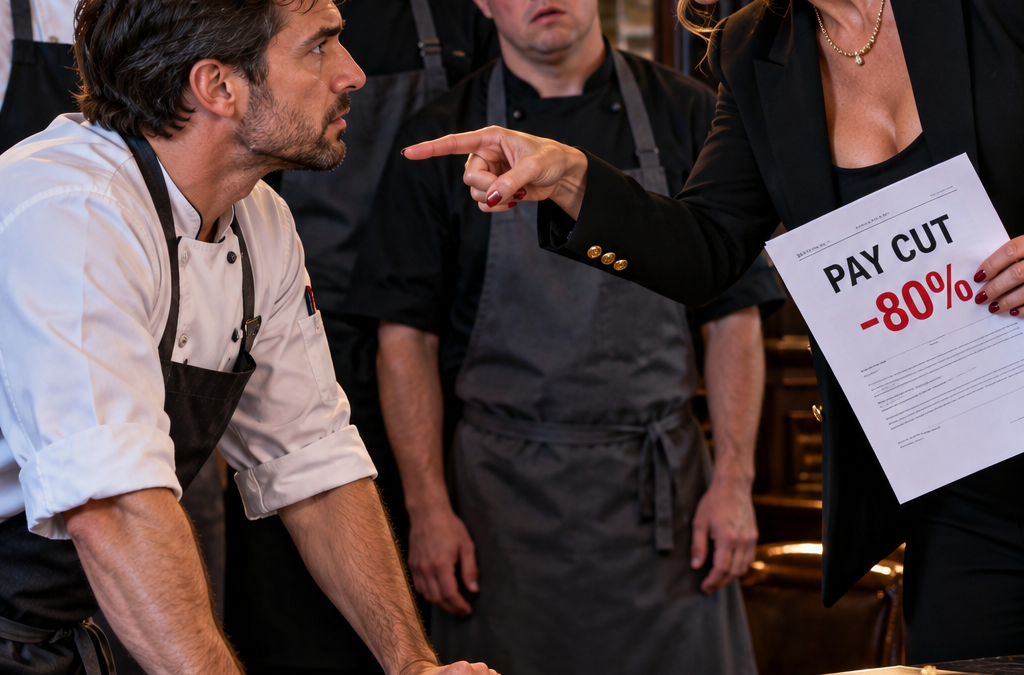
She picked up a sheet of paper and slid it across the desk.
“This is your new employment agreement.”
I took it.
At first, I thought I was misunderstanding what I was reading.
The salary was gone.
So were the bonuses.
The health benefits were gone too.
My management position had disappeared, replaced with a new title.
Line Cook One.
An hourly rate sat beside it.
A rate so low that I read it twice.
Then a third time.
I looked up.
“Karen, what is this?”
“Restructuring.”
“This is a massive pay cut.”
“Correct.”
She returned to typing.
I tried to keep my voice steady.
“I’m currently salaried. That salary reflects my experience, the hours I work, and everything I manage. When you include the lost benefits and profit-sharing bonuses, this cuts my total compensation by about eighty percent.”
She nodded without looking at me.
“That’s the new structure.”
“You’re asking me to make less than I earned when I was nineteen.”
She finally stopped typing.
“I’ve done market research.”
I stared at her.
“Market research?”
“Yes. And frankly, we’ve been dramatically overpaying for this position.”
I felt something cold settle in my stomach.
“What exactly do you think I do here?”
She leaned back.
“Cooking is unskilled labor.”
For a moment, I genuinely thought I’d misheard her.
“I’m sorry?”
“It’s repetitive manual work. You follow recipes, prepare ingredients, and operate equipment. It doesn’t require a college degree.”
I looked at her in disbelief.
She continued as if she were explaining something obvious to a child.
“Technology is advancing rapidly. In a few years, robots will probably be doing most of this anyway. Paying a management salary for someone to stand in front of a stove is poor resource allocation.”
I could hear the faint hum of the air conditioner.
Somewhere beyond the office door, a tray clattered.
I thought about my burned forearms.
The Christmas mornings I’d missed.
The endless hours I’d spent making sure nobody got sick from improperly stored food.
The equipment I’d repaired.
The employees I’d trained.
The menus I’d created.
The vendors I’d negotiated with.
The restaurant I’d helped turn into a successful local business.
And this woman was looking at me as though I had spent six years pressing buttons on a microwave.
“Karen,” I said slowly, “I run the entire back of house.”
“The menu already exists.”
“I created it.”
“The recipes are written down.”
“Because I wrote them.”
“Anyone can follow a recipe.”
“Then why are the customers complaining about food quality?”
Her expression sharpened.
“Because the kitchen isn’t performing.”
I nearly laughed.
Not because it was funny.
Because the alternative was screaming.
“I supervise four people. I handle inventory, ordering, food safety, prep schedules, equipment problems, and health inspections.”
“Ordering can be automated.”
“And food safety?”
“That should be standard procedure.”
“It is, because I enforce it.”
She waved her hand.
“These are ordinary workplace responsibilities.”
I stared at her.
She looked completely convinced.
It wasn’t an act.
She genuinely believed that because she could identify the individual tasks involved in a job, she understood the skill required to perform them well.
“You don’t need a degree to cook,” she said. “I could hire a teenager to flip burgers for minimum wage.”
“Then you’re not looking for a head chef.”
“Exactly.”
She smiled.
It was a small, satisfied smile.
The kind people wear when they think they’ve finally won an argument.
“I don’t need a manager in the kitchen anymore. I’m here now. I need someone who can follow instructions.”
I looked down at the paper again.
No benefits.
No bonuses.
No control over scheduling.
Almost eighty percent less compensation.
Six years of responsibility reduced to a single hourly figure.
“What happens if I don’t sign?”
She folded her hands.
“You’re free to explore other opportunities.”
I didn’t answer.
She leaned back further.
“I have a stack of applications. People are looking for work. You’re not irreplaceable.”
For a moment, I saw something behind her expression.
She wasn’t just trying to save money.
She wanted me to understand that she believed she held all the power.
I had a mortgage.
I had bills.
I had spent six years building my life around that job.
She assumed those things would force me to accept whatever she offered.
“You’re serious?” I asked.
“Completely.”
“You really think you can replace me with someone making minimum wage?”
“I know I can.”
She tapped the paper.
“Take it or leave it. I need an answer now so payroll can be updated tomorrow.”
I looked past her at the wall.
She had hung a cheap motivational print there.
It contained the words TEAMWORK and SUCCESS in large letters.
I almost wanted to ask whether she knew what either word meant.
Instead, I thought about Tony.
About Mark studying for exams after exhausting shifts.
About Hans quietly working through pain without ever asking for special treatment.
About Benny standing beside that broken dishwasher, terrified of being fired.
And about myself.
For six years, I had accepted long hours because I believed I was helping build something worthwhile.
But there is a difference between making sacrifices for people who value you and allowing someone to use your loyalty against you.
I looked directly at Karen.
“You’re daring me to quit.”
She tilted her head.
“I’m telling you what your labor is worth.”
A silence settled between us.
Then she added, almost casually, “If you think you’re worth more, go find it.”
Something changed inside me.
Until that moment, I’d been angry.
Now I felt strangely calm.
I realized there was nothing left to negotiate.
You can’t persuade someone to respect you when they’ve already decided your dignity is an obstacle to their profits.
“Okay,” I said.
Karen smiled.
“Good. Then sign the agreement.”
“No.”
Her smile faded.
“What?”
“I said okay. I accept your challenge.”
She frowned.
“What are you talking about?”
“I quit.”
For the first time since she’d purchased the restaurant, Karen seemed unable to find the right words.
She blinked.
Then she looked at the paper.
Then back at me.
“You’re quitting?”
“Yes.”
“Over this?”
I stared at her.
“You’re cutting my compensation by eighty percent and telling me my experience is worthless. What did you think was going to happen?”
Her face started turning red.
“I thought you would behave professionally.”
“I am. I’m declining your offer.”
“You can’t just walk away from your responsibilities.”
I glanced at the clock.
It was four in the afternoon.
Dinner service started in an hour.
We had sixty reservations that night, and Friday was already fully booked.
“Karen, if you want me to finish tonight’s service, we can discuss a professional transition.”
She straightened in her chair.
“No.”
I waited.
“If you’re quitting, you’re leaving immediately. Hand over your keys.”
I looked at her.
“Right now?”
“Yes.”
“With dinner starting in an hour?”
“I don’t need you.”
I could hardly believe what I was hearing.
“We’ve got sixty reservations tonight.”
“I know how many reservations we have.”
“Who’s running the kitchen?”
She gave an irritated laugh.
“I can cook a steak. It’s not rocket science.”
I stood there for another moment.
Part of me wanted to explain what was about to happen.
I wanted to tell her about the short ribs that needed finishing, the pasta orders that would start arriving in less than an hour, the seafood that required careful timing, and the dozens of things that had to happen simultaneously for dinner service to work.
But then I remembered her words.
Anyone can follow a recipe.
I reached into my pocket.
Removed my keys.
And placed them on her desk.
“Good luck, Karen.”
She stared at the keys.
Then at me.
“Get out.”
So I did.
Walking through that kitchen for what I believed would be the last time was harder than I expected.
The smell of garlic and rosemary hung in the air.
Tony was standing over a saucepan, reducing a glaze.
Mark was sharpening his knife.
Hans was finishing vegetables.
Benny was organizing clean plates.
Everything looked familiar.
Everything sounded familiar.
And suddenly I understood how much of my life was contained within those four walls.
I had spent more waking hours in that kitchen than in my own house.
I’d celebrated birthdays there with grocery-store cakes balanced on prep tables.
I’d argued with Tony about sauces, listened to Hans tell stories, and watched Benny grow into a man who could smile at work without waiting for someone to criticize him.
For a second, I nearly turned around.
Not to beg Karen for my job.
But because leaving felt like abandoning something I loved.
Then Tony looked up.
“Everything okay, boss?”
I took a breath.
“Guys, can you come here for a minute?”
They stopped working.
Tony turned down the burner.
Mark put his knife away.
Hans wiped his hands.
Benny stepped away from the dish station.
I looked at their faces.
“I just quit.”
Nobody moved.
Tony frowned.
“What?”
“Karen’s eliminating my position. She offered me a new job with about eighty percent less compensation, no benefits, and no bonuses.”
Mark stared at me.
“You’re kidding.”
“I wish I was.”
“Why?”
“She says cooking is unskilled labor. Apparently, anybody can do it.”
Tony’s expression changed.
Slowly, he looked down at the sauce he’d spent the last hour preparing.
Then he looked at me.
“Who’s running the pass tonight?”
“Karen says she can handle it.”
He stared.
“Karen?”
“Yep.”
“The woman who thought the sauté pans were dirty because they had seasoning on them?”
“That’s the one.”
For a moment, nobody spoke.
Then Tony untied his apron.
He took it off and dropped it onto the stainless steel counter.
“I’m done too.”
I shook my head.
“Tony, you don’t have to do that.”
“I’m not staying here without you.”
“Think about your paycheck.”
“I am thinking about it.”
He looked toward the office.
“She yelled at me yesterday because I was chopping onions and the smell made her eyes water. I’m not letting her run my kitchen.”
Mark stepped forward.
“I’m out.”
I looked at him.
“Mark, you have tuition.”
“I know.”
“Don’t make a decision just because you’re angry.”
He gave me a tired smile.
“She told me last week I wasn’t allowed to keep water near the grill because it looked unprofessional.”
I frowned.
“She said what?”
“Apparently, drinking water in front of a six-hundred-degree grill is bad for productivity.”
I felt my jaw tighten.
Mark shook his head.
“I’ve been looking for another job anyway. I’m done.”
Hans said nothing.
He simply picked up his knife, wiped it carefully, and slipped it into his leather roll.
Then he removed his apron.
I looked at him.
“Hans?”
He shrugged.
“I’ve served under bad commanders before.”
A faint smile crossed his face.
“Never saw a reason to volunteer for another one.”
Then I looked at Benny.
He was standing perfectly still.
His eyes moved from Tony to Mark, then to me.
“But I need my job,” he whispered.
My heart sank.
Of everyone in the room, Benny was the one I worried about most.
He didn’t have savings.
He didn’t have a college education or a long list of references.
He had spent years being rejected by employers, and finding another job wasn’t as simple for him as it might be for someone else.
I put a hand on his shoulder.
“Benny, listen to me. Remember my friend Rob?”
“The guy with the landscaping trucks?”
“That’s him.”
Benny nodded.
“He’s looking for help. I already reached out to him, and he said he can use you. Twenty dollars an hour. You can start tomorrow if you want.”
His mouth opened slightly.
“Really?”
“Really.”
“Doing what?”
“Helping his crew. Loading equipment, cleaning tools, landscaping work. He knows you might need extra instruction at first.”
Benny stared at me.
“He knows?”
“Yes.”
“And he’s okay with it?”
“He said he’d rather have somebody who works hard than somebody who thinks he’s too important to show up.”
Benny looked as if he might cry.
Then he glanced at the broken-looking dishwasher.
“I hate that machine,” he said.
We all laughed.
He pulled off his apron so quickly he nearly tore the strings.
“I’m quitting too.”
I looked around the kitchen.
“Guys, seriously. You don’t have to follow me out. I’m not asking you to risk your jobs.”
Tony stepped closer.
“You didn’t ask.”
“That’s not the point.”
“No,” he said. “The point is that we’ve been keeping this place alive while she treats us like garbage. And now she thinks she can throw you away.”
Mark nodded.
“We know who made this place worth working at.”
I didn’t have an answer for that.
For the first time that afternoon, my throat tightened.
I’d been so focused on the humiliation of Karen’s offer that I hadn’t considered what it would feel like to have these men stand beside me.
Not because I ordered them to.
Not because they owed me anything.
But because they wanted to.
We packed our personal belongings.
Knives.
Shoes.
A few tools.
Tony’s favorite spatula.
Hans’s knife roll.
Everything that belonged to us.
We left the restaurant’s equipment where it was.
There was no dramatic confrontation in the kitchen.
No speech.
No shouting.
Just five men who had finally decided they’d had enough.
At approximately 4:15, we walked out through the back door.
I could hear the ventilation system humming above us.
The afternoon sunlight felt almost painfully bright after hours beneath fluorescent lights.
We reached the parking lot just as Karen came running through the front entrance.
“Where are you going?”
Her voice carried across the pavement.
We stopped.
She looked from one of us to the next.
“What’s happening?”
Tony crossed his arms.
“I quit.”
Mark nodded.
“Me too.”
Benny raised his hand a little.
“I quit too.”
Hans simply continued toward his car.
Karen stared at us.
Then she looked at me.
“What did you do?”
I frowned.
“What?”
“You told them to walk out!”
“I told them I was leaving. They made their own decisions.”
“This is a strike!”
“No, Karen. It’s not.”
“You can’t abandon your shifts!”
Tony shook his head.
“Watch us.”
Karen’s face turned crimson.
“I will sue every single one of you!”
I opened the door of my truck.
“Karen, you told me anybody could do our jobs. You told me labor was just a resource you could replace whenever you wanted.”
She said nothing.
I looked at the building behind her.
“Well, that resource just decided to work somewhere else.”
“You’re sabotaging my business!”
“No. I’m leaving a job you told me wasn’t worth paying for.”
She stepped closer.
“You can’t do this!”
“We’re at-will employees,” I said. “You can end our employment, and we can resign. That’s how it works.”
Her expression twisted.
For a brief moment, I almost felt sorry for her.
Almost.
Then I remembered the look on Benny’s face when she publicly humiliated him.
I remembered her smirk when she handed me that agreement.
I climbed into my truck.
“You said it wasn’t rocket science, Karen.”
She stared at me.
“So go cook dinner.”
I started the engine.
And drove away.
We ended up at a small dive bar down the street called the Rusty Anchor.
It wasn’t fancy.
The booths had cracked vinyl seats, the floor was sticky near the pool table, and the bartender had probably been working there since before I was born.
But it had cold beer.
And large windows overlooking the street.
From our booth, we could see the Bistro.
I ordered a round of drinks.
For several minutes, nobody said much.
The adrenaline was wearing off.
Reality was beginning to settle in.
I had just walked away from a job I’d held for six years.
My mortgage wasn’t going to disappear because I had stood up for myself.
My truck still needed repairs.
And despite the satisfaction of leaving, I wasn’t certain what came next.
Tony seemed to read my thoughts.
“You okay?”
I looked at my beer.
“Ask me tomorrow.”
He nodded.
Mark leaned back against the booth.
“That was insane.”
Hans took a slow sip.
“I’ve seen worse.”
We all looked at him.
He shrugged.
“Not much worse.”
That made us laugh.
Benny was sitting beside Mark, smiling into his glass of soda.
I asked if he was nervous.
“A little,” he admitted.
“About tomorrow?”
He nodded.
“I’ve never done landscaping.”
“You’d never worked in a restaurant when we hired you either.”
He thought about that.
Then smiled.
“That’s true.”
I leaned back.
For the first time all day, I felt myself beginning to breathe normally.
Across the street, cars were pulling into the Bistro’s parking lot.
Dinner service was beginning.
At five thirty, the lot was almost full.
I knew exactly what the restaurant would look like inside.
Guests would be seated.
Servers would be taking drink orders.
The first tables would start ordering appetizers.
The ticket printer would be running.
And Karen would be standing in a kitchen she had spent months pretending to understand.
At six o’clock, we saw the first customer leave.
A man in a blue shirt walked out, shaking his head.
A woman followed him.
Then another couple.
Tony glanced at his watch.
“That didn’t take long.”
I didn’t say anything.
At six fifteen, the hostess came rushing out.
She looked upset.
She got into her car and drove away.
Mark leaned forward.
“Was that Emily?”
“Looks like it.”
“She’s leaving?”
“Apparently.”
A few minutes later, Karen appeared through the restaurant’s front windows.
She had an apron tied over her white blazer.
Even from across the street, I could see that she was moving frantically.
She disappeared toward the kitchen.
Reappeared in the dining room.
Then vanished again.
My phone started buzzing.
A message from one of our regular customers.
What happened to the Bistro tonight?
Then another.
Are you still cooking there?
I opened the restaurant’s online reviews.
New complaints were already appearing.
One customer said they’d waited nearly an hour without receiving food.
Another said the owner was shouting at employees.
Someone else complained that they’d ordered a steak and eventually left without eating.
I set the phone down.
Tony leaned over.
“Bad?”
“Very.”
Part of me felt vindicated.
Another part felt sick.
Because I knew those customers.
I knew some of them had made reservations weeks earlier.
I knew there were birthdays and anniversaries being ruined.
And although Karen had created the disaster herself, watching the restaurant fall apart still hurt.
It was like seeing someone take a house you’d spent years repairing and set fire to it because they thought they understood construction better than you.
Around seven, Sarah walked into the Rusty Anchor.
She spotted us immediately.
Then she burst out laughing.
Not a polite laugh.
The kind of exhausted, uncontrollable laughter people sometimes make when they’ve had such a terrible day that crying would be the only alternative.
She slid into our booth beside Tony.
“Oh my God.”
I looked at her.
“That bad?”
She covered her face.
“You have no idea.”
Mark leaned forward.
“Tell us.”
Sarah took a long drink of water.
“She tried to cook.”
Tony closed his eyes.
“No.”
“Oh, yes.”
“What happened?”
Sarah looked at me.
“She didn’t know how to turn on the grill.”
I stared.
“You’re kidding.”
“I wish I was.”
She started laughing again.
“She put rib eyes onto the grill while it was still cold. Then she kept complaining that the meat wasn’t cooking.”
Tony made a strangled sound.
“Please tell me you’re joking.”
“She finally got frustrated and decided to finish them in the pizza oven.”
I put my face in my hands.
Sarah continued.
“Forty-dollar steaks. She turned them into gray pieces of rubber.”
Mark laughed so hard he started coughing.
“And the pasta,” Sarah said.
I looked up slowly.
“What about the pasta?”
“She put it in cold water and then turned on the heat.”
Tony stared at her.
“She what?”
“Cold water. Pasta. Stove.”
I could practically see the disaster.
Fresh pasta wasn’t designed to sit in a pot of cold water waiting for it to boil.
“By the time she tried to drain it, the whole thing had turned into one giant sticky lump,” Sarah said.
Hans shook his head.
“That’s impressive.”
“And she burned the soup.”
Tony looked horrified.
“How do you burn soup?”
“I don’t know! But she did!”
We laughed.
We laughed so hard that people at nearby tables started turning around.
But then Sarah’s expression changed.
“Seriously, though, it was awful.”
I stopped smiling.
“What happened?”
“People were screaming. Orders were getting lost. Food was coming out wrong. She kept blaming the waitstaff.”
Sarah rubbed her forehead.
“She came into the dining room covered in flour. I don’t even know where the flour came from.”
I shook my head.
“We weren’t using flour on tonight’s menu.”
“Exactly.”
She looked down at the table.
“She told everyone the kitchen employees had betrayed her. Said you all walked out because you didn’t want to work.”
My stomach tightened.
“What?”
“She was telling customers you abandoned the restaurant.”
Tony opened his mouth, but Sarah held up a hand.
“Don’t worry. Nobody believed her.”
“How do you know?”
“Because Mr. Jenkins stood up.”
I looked at her.
“Mr. Jenkins?”
She nodded.
Mr. Jenkins was one of our oldest regulars.
He came in for liver and onions, complained affectionately about everything, and always left a generous tip.
He had been eating at the Bistro longer than I’d worked there.
Sarah smiled.
“He told her that if the kitchen staff left, it was probably because she was impossible to work for.”
Mark leaned back.
“That’s our guy.”
“Then he threw his napkin down and walked out.”
I laughed despite myself.
“Legend.”
Sarah smiled briefly.
Then sighed.
“I quit too.”
I looked at her.
“Sarah…”
“I can’t do it anymore.”
She rubbed her eyes.
“She told me I was incompetent because I refused to serve somebody a gray steak that looked like an old shoe.”
“What did you say?”
“I told her I wasn’t taking it to the table.”
“And?”
“She said I’d never work in this town again.”
I looked at Tony.
Then Mark.
Then Hans.
Finally, I looked back at Sarah.
“Welcome to the club.”
She laughed.
But I could see the exhaustion underneath it.
By eight o’clock, the restaurant’s lights went out.
The Bistro had closed early.
On a Thursday night.
With a full reservation book.
We watched the dark windows from across the street.
Nobody celebrated.
Not then.
Because every one of us understood what that meant.
A restaurant doesn’t survive on food alone.
It survives on trust.
Customers trust that their reservations will be honored. Employees trust that they’ll be treated fairly. Suppliers trust that they’ll get paid.
And once that trust begins to collapse, rebuilding it is much harder than losing it.
Karen had managed to damage all three in a single evening.
The following morning, I drove past the restaurant.
A printed sign was taped to the front door.
CLOSED FOR RENOVATIONS.
REOPENING SOON UNDER NEW MANAGEMENT.
I sat in my truck and stared at it.
Renovations.
That was what she was calling it.
As though the kitchen hadn’t fallen apart because she’d driven out everyone who knew how to operate it.
Later that day, she posted an advertisement on a local community page.
She needed experienced cooks immediately.
Competitive compensation.
Great opportunities.
Positive work environment.
I almost dropped my phone when I read that last part.
The same woman who had called cooking unskilled labor was suddenly advertising for experienced cooks.
Apparently, experience mattered when she couldn’t find anyone willing to work for her.
The restaurant community in our town was small.
Cooks talked.
Servers talked.
Suppliers talked.
Most of us had worked with each other at one point or another.
Word about the Bistro spread quickly.
I told a few people what had happened, including the pay cut and the way Karen treated staff.
I warned them to ask careful questions about compensation and working conditions before accepting a job there.
Within days, practically everyone knew.
Karen eventually found two replacement cooks from outside town.
Neither had the experience needed to run the menu we’d spent years developing.
But that was no longer my problem.
At least, that was what I kept telling myself.
By Saturday, I knew I needed to focus on finding work.
I wasn’t interested in spending the next month watching Karen destroy the restaurant from a distance.
I had bills.
More importantly, I had people I wanted to help.
Tony needed a kitchen.
Mark needed steady income around his classes.
Sarah needed a place where she wouldn’t be humiliated.
And although Benny had an opportunity with Rob, I knew he’d prefer working somewhere familiar if we could find the right situation.
There was one person I thought might be able to help.
Giovanni.
He owned a family-run Italian restaurant a short distance away.
Giovanni had grown up in Sicily, learned to cook from his family, and spent years building his business.
He was old-fashioned in some ways.
He could be stubborn.
He argued about olive oil as though it were a matter of national security.
But he respected the craft.
Whenever we ran into each other, he’d ask when I was going to leave the Bistro and come work for him.
Usually, I’d laugh and tell him to stop stealing other people’s chefs.
This time, I called him.
He answered on the third ring.
“Hello?”
“Giovanni. It’s me.”
There was a pause.
Then he laughed.
“Ah! The famous chef!”
“Famous?”
“The whole town is talking about you.”
I closed my eyes.
“Wonderful.”
“I hear you escaped the crazy woman.”
“Something like that.”
He laughed again.
“What can I do for you?”
I took a breath.
“You still looking for a head chef?”
He didn’t hesitate.
“Is the Pope Catholic?”
I smiled for the first time that morning.
“Then we should talk.”
“Come by.”
“There’s something you should know first.”
“What’s that?”
“I don’t come alone.”
There was a pause.
“How many?”
“I’ve got a sous chef, a grill cook, and a dishwasher I’d like to bring over. Maybe a waitress too.”
Giovanni whistled.
“You bring an entire army.”
“They’re good people.”
“I know.”
“I won’t leave them behind if I can help it.”
His voice grew more serious.
“Come to the restaurant. We’ll figure something out.”
I drove over that afternoon.
Giovanni was waiting at a table near the kitchen.
He poured two coffees and listened while I explained what had happened.
I told him about Karen’s cost cutting.
The declining food quality.
The broken dishwasher.
The staff meeting.
And finally, the employment agreement.
When I mentioned the eighty-percent pay cut, he put his cup down.
“Eighty percent?”
“About that, once you include everything.”
He shook his head.
“Madness.”
“She said cooking was unskilled labor.”
Giovanni stared at me.
Then he laughed.
Not because he found it amusing.
Because he couldn’t believe someone who owned a restaurant could be so ignorant.
“Unskilled?”
“Her exact words.”
He gestured toward the kitchen.
“My grandmother taught me to make pasta when I was six. I’m still learning how to cook. And this woman thinks it takes no skill?”
I shrugged.
“Apparently.”
He leaned forward.
“Listen to me. A restaurant is people. The building doesn’t cook. The ovens don’t cook. The recipes don’t cook themselves.”
I looked at him.
He continued.
“You can buy the best ingredients in the world. Without good people, all you have is expensive food waiting to rot.”
For the first time in months, I felt like I was talking to somebody who understood.
We discussed the job.
He couldn’t match every part of my old compensation immediately.
The base salary would be slightly lower than what Ricardo had paid me.
But Giovanni offered something Karen never had.
Respect.
Creative control.
A share of profits tied to the kitchen’s performance.
And a genuine willingness to listen.
“I don’t need somebody to tell me how to boil water,” he said. “I need somebody who can make this kitchen better.”
We shook hands.
Then we talked about the team.
Giovanni needed reliable cooks.
Tony and Mark could both come in at higher hourly rates than they’d previously earned.
Sarah could join the dining room staff.
And Benny could help with prep and dishes.
I called Benny that evening.
“Hey, buddy. How’s landscaping?”
“Good,” he said. “Rob’s nice.”
“Glad to hear it.”
He paused.
“Why?”
“I might have another opportunity for you.”
“Restaurant?”
“Yeah.”
“With you?”
“With me.”
There was silence.
Then he asked, “Can I come?”
I smiled.
“Of course.”
He didn’t even ask how much he’d make.
That made me more determined to ensure he was paid fairly.
Two weeks later, we started at Giovanni’s restaurant.
The first morning felt strange.
I walked into an unfamiliar kitchen carrying my knives.
Different stove.
Different prep tables.
Different smells.
For six years, I had known exactly where everything belonged at the Bistro.
Now I had to learn a new room.
But then Tony walked in.
Mark arrived a few minutes later.
Hans stopped by to wish us well, though he was enjoying a little time away from restaurant work and wasn’t ready to commit to another job.
Benny came through the back door looking nervous but excited.
And suddenly the place didn’t feel so unfamiliar.
Tony looked around.
“Well, boss?”
I smiled.
“Let’s see what we’ve got.”
We spent the first days learning the operation.
Giovanni’s restaurant already had good food and loyal customers, but his kitchen needed more structure.
We improved prep schedules, organized storage, and adjusted the flow of service.
I didn’t walk in trying to replace everything he had built.
That had been Karen’s mistake.
Instead, I asked questions.
I tasted dishes.
I listened.
Giovanni watched us work without hovering.
If I suggested changing something, he wanted to know why.
And when I explained, he actually listened.
It was such a simple difference.
But after months of fighting to justify every decision, it felt extraordinary.
Our first major special was the short ribs.
The same style I’d made at the Bistro for years.
Slow-braised beef with a rich sauce, carefully reduced until it coated the back of a spoon.
Tony handled the finishing glaze.
Mark helped coordinate service.
Benny worked prep and kept the dish station moving.
I posted a message on my personal social media account letting people know where I was cooking.
I mentioned the return of the short rib special.
Then I put my phone away.
I expected a few familiar faces.
Maybe a handful of customers from the Bistro.
What happened that night surprised even me.
By six o’clock, the dining room was nearly full.
By six thirty, people were waiting near the entrance.
By seven, there was a line outside.
I looked through the kitchen doors and recognized faces everywhere.
Couples who had celebrated anniversaries at the Bistro.
Families who had been regulars for years.
People who used to come in on Fridays.
A woman who had once brought me a handwritten thank-you note after I prepared a special meal for her father’s birthday.
They hadn’t forgotten us.
And they hadn’t forgotten what good food tasted like.
I stood behind the pass, feeling the familiar rush of service begin.
The ticket printer started.
Tony moved beside me.
Mark called out cooking times.
Benny appeared with clean trays.
For a moment, I closed my eyes.
Not because I was overwhelmed.
Because I recognized the feeling.
We were working together again.
And this time, nobody was standing over our shoulders asking why a sauce needed time to develop flavor.
“Two short ribs, one salmon, one pasta!” I called.
“Two short ribs!” Tony answered.
“Salmon working!” Mark shouted.
I looked at the tickets.
Then at the team.
And smiled.
We were back.
Later that evening, I walked into the dining room to greet a few customers.
Mr. Jenkins was sitting at a table near the window.
He stood when he saw me.
“Well, look who finally found a respectable place to work.”
I laughed and shook his hand.
“Good to see you, sir.”
He gripped my hand firmly.
“Glad you’re back where you belong.”
“How was dinner?”
He looked at his empty plate.
“Terrible.”
I raised an eyebrow.
He grinned.
“Now I have to drive farther every time I want decent food.”
I laughed.
He leaned closer.
“That other place isn’t the same without you.”
I felt something tighten in my chest.
“Thank you.”
He shook his head.
“No. Thank you. People like you make places worth coming back to.”
I returned to the kitchen with those words echoing in my mind.
Karen had told me I was just a pair of hands.
Mr. Jenkins understood something she never had.
People don’t return to a restaurant simply because it has tables, walls, and a sign above the entrance.
They return because of how the place makes them feel.
Because somebody remembers their order.
Because the food is made with care.
Because they know they’re welcome.
The Bistro had once been that kind of place.
Now, slowly, Giovanni’s was becoming one too.
Over the following weeks, business grew.
Our specials sold out.
The dining room stayed busy.
Tony began experimenting with sauces again, and his confidence improved.
Mark adjusted his schedule around college without losing shifts.
Benny settled into his new routine.
Giovanni treated him with extraordinary patience.
If Benny needed instructions repeated, Giovanni repeated them.
If he made a mistake, somebody showed him how to correct it.
Nobody called him stupid.
Nobody humiliated him in front of the staff.
One afternoon, I found Benny sitting at the prep table eating a staff meal.
He looked up.
“Hey, boss.”
“How’s it going?”
He smiled.
“Good.”
“Everything okay?”
He nodded.
Then, after a moment, he said, “I like it here.”
I sat beside him.
“Me too.”
He looked down at his plate.
“Nobody yells at me.”
I didn’t know what to say.
It was such a small thing.
Such a basic thing.
The right to go to work without being afraid of humiliation.
And yet, for Benny, it meant the world.
I thought about Karen’s lecture on efficiency.
Then I looked at the man sitting beside me, eating his lunch without fear.
I knew which workplace was actually getting the best from its employees.
Meanwhile, the Bistro continued struggling.
Karen reopened it the following Tuesday with a drastically reduced menu.
The short ribs were gone.
Fresh pasta disappeared.
Most of the seafood specials were removed.
According to people who still visited, the new menu consisted mainly of burgers, fries, and frozen food that could be dropped into a fryer.
It was a completely different restaurant.
The prices weren’t much lower.
But the quality certainly was.
The health department visited shortly after reopening.
I’d spent years keeping the restaurant inspection-ready, and I knew exactly how important that was.
The walk-in cooler had a temperamental compressor.
I had repeatedly told Karen that it needed professional repair or replacement.
Instead, I’d been maintaining it myself, monitoring temperatures and making sure food remained safely stored.
After I left, nobody seemed to be paying attention.
When the inspector arrived, the cooler was operating at approximately fifty-five degrees Fahrenheit.
Far too warm for safe storage of perishable food.
Karen had to discard thousands of dollars’ worth of inventory.
The inspector also found serious problems with food handling.
Employees weren’t washing their hands properly, and raw chicken was being handled in ways that risked contaminating salad ingredients.
The restaurant received a conditional inspection result.
The news spread quickly.
I wasn’t happy about the food safety violations.
Those weren’t funny.
People could have gotten sick.
But I couldn’t ignore the bitter irony.
The woman who had dismissed food safety as an ordinary task anyone could perform had discovered that ordinary tasks still required knowledge, attention, and accountability.
Karen’s reaction was predictable.
She blamed the new cooks.
Then the suppliers.
Then the health inspector.
Then, somehow, me.
A few weeks later, I received word that she was threatening legal action.
Apparently, she believed I’d stolen her recipes.
I almost laughed when I heard.
The recipes she was referring to were dishes I’d developed years before she purchased the restaurant.
Braised short ribs.
Sauces.
Fresh pasta.
Techniques cooks had used for generations.
I contacted my cousin Vinnie, who was an attorney.
Vinnie usually handled smaller legal matters, but he knew enough to take the threat seriously.
I showed him the messages.
He read them, leaned back, and shook his head.
“So she thinks she owns braised beef?”
“Apparently.”
“Did you take any confidential documents?”
“No.”
“Customer lists?”
“No.”
“Restaurant equipment?”
“Not a thing.”
He nodded.
“Good.”
He helped me prepare a formal response disputing her allegations and asking her to identify the specific protected information she claimed I’d taken.
Karen never pursued the matter further.
At Giovanni’s, we kept working.
At the Bistro, she kept changing strategies.
First, she tried turning it into a sports bar.
She installed inexpensive televisions around the dining room.
Unfortunately, according to customers, she hadn’t arranged the sports programming people actually expected to see.
So the screens mostly showed local news.
Then she tried introducing an upscale brunch.
That might have worked with the right planning.
But the dishwasher was still unreliable.
Instead of repairing it properly and ensuring she had enough clean glassware, she served champagne in plastic cups.
I heard about that one from Sarah.
She stared at me across the prep table.
“Plastic cups.”
I shook my head.
“You’re joking.”
“I wish.”
Tony, standing nearby, laughed.
“Fine dining at its finest.”
But beneath the absurdity, the financial situation was becoming serious.
A restaurant can’t survive indefinitely by throwing new ideas at old problems.
Karen had spent months cutting costs in ways that undermined quality.
Now she was losing customers and trying to win them back with gimmicks.
The suppliers were becoming another problem.
For years, I’d built relationships with the people who delivered our ingredients.
I knew their drivers.
I knew which farms produced the best vegetables.
I knew who could get me quality beef when supplies were tight.
Those relationships mattered.
When the price of an ingredient increased, a supplier might call me ahead of time.
When we had an unexpectedly busy weekend, somebody might squeeze in an extra delivery.
If a shipment arrived with a problem, they’d help us fix it.
Those weren’t special favors purchased with money.
They were the result of years of honest dealings.
But Karen seemed to believe the suppliers owed her the same flexibility simply because she owned the building.
According to one of the vendors, she began demanding ninety-day payment terms.
She wanted deliveries now and payment three months later.
The supplier refused.
Without a reliable relationship or sufficient credit, he wasn’t willing to take that risk.
He changed her account to cash on delivery.
Karen couldn’t consistently manage the cash flow.
Soon, she was buying meat at retail grocery-store prices.
And those prices destroyed her margins.
A restaurant can’t charge normal menu prices while buying its ingredients the same way a family shops for dinner.
The math doesn’t work.
Her food costs reportedly climbed to somewhere around sixty percent of revenue.
I remembered her obsession with saving four cents on coffee.
I remembered the argument about silver skin.
She had been willing to destroy customer satisfaction over tiny savings.
Now she was spending more than ever, getting worse ingredients, and losing money every day.
The Bistro was collapsing.
And for all her confidence, Karen had no idea how to stop it.
One afternoon, about two months after I’d left, I was preparing for dinner service at Giovanni’s.
The back door was open to let in some fresh air.
Tony was working inside, laughing with Giovanni about a soccer game.
Mark was preparing the grill.
Benny was finishing his meal before his shift.
It was an ordinary, pleasant afternoon.
Then a white BMW pulled into the service area.
I recognized it immediately.
Karen.
She parked near the back entrance and stepped out.
For a moment, I barely recognized her.
The immaculate white blazer was wrinkled.
Her hair, usually perfectly styled, looked disheveled.
There were dark circles beneath her eyes.
She stood beside the car for a few seconds before walking toward me.
“Can I talk to you?”
I wiped my hands on a towel.
“I’m working, Karen.”
“I know.”
She glanced toward the kitchen.
“Please. Just a minute.”
I looked at her.
Part of me wanted to say no immediately.
But something about her expression stopped me.
She didn’t look angry.
She looked desperate.
“All right,” I said. “A minute.”
She folded her hands in front of her.
“I made a mistake.”
I said nothing.
She continued.
“The new people aren’t working out. Food quality is terrible. Inventory keeps disappearing. Customers won’t come back.”
I leaned against the doorframe.
“I’m sorry to hear that.”
“I need you.”
I looked at her.
She swallowed.
“I want you to return to the Bistro.”
The words hung between us.
For months, I’d imagined what it might feel like to hear her admit that she’d been wrong.
I thought I would feel triumphant.
Instead, I felt tired.
“Karen…”
“I’ll restore your salary.”
She spoke quickly.
“Your old salary. The one Ricardo paid you. Same benefits. Same bonus arrangement.”
I shook my head.
“I have a job.”
“I know, but you built that kitchen.”
I stared at her.
“You remember that now?”
She looked away.
“I know we disagreed.”
“Disagreed?”
I almost laughed.
“You cut my compensation by eighty percent and told me I was worthless.”
“I didn’t say worthless.”
“You told me a teenager could replace me.”
She winced.
“Look, I was under pressure. I was trying to control expenses.”
“And how’s that working?”
She said nothing.
I could hear the sounds of the kitchen behind me.
The familiar rhythm of knives on cutting boards.
The hum of the ventilation system.
Tony laughing.
Benny moving dishes.
A place where people were working hard without being made to feel small.
Karen glanced past me.
“I’ll give you a raise,” she said.
I looked back at her.
“What?”
“Twenty percent above your old salary.”
I raised my eyebrows.
“And I want your team back. Tony. Mark. Benny. Anyone who’ll come.”
I shook my head.
“Karen, I make more here when you include the bonuses. And I work for somebody who respects me.”
“Money isn’t everything,” she said.
I stared at her.
For a moment, I genuinely wondered whether she could hear herself.
“That’s interesting coming from you.”
Her face tightened.
“Don’t make this difficult.”
I straightened.
“I’m not making anything difficult. I’m telling you no.”
She took a step closer.
“Please.”
That word surprised me.
I had never heard Karen say it sincerely before.
“I put everything into that restaurant,” she continued. “My savings. My retirement. Everything. I’m losing money every single day.”
I looked at her.
She was frightened.
I could see it.
The confidence she once wore like armor had been stripped away by unpaid invoices, empty tables, and problems she couldn’t solve.
For a brief moment, I remembered how I’d felt when Ricardo announced he was retiring.
How uncertain I’d been.
How terrified I was of losing the place I loved.
But the situations weren’t the same.
I had spent six years earning trust.
Karen had spent months destroying it.
“You said cooking was unskilled labor,” I reminded her.
She closed her eyes.
“I know.”
“You said anybody could follow a recipe.”
“Yes.”
“You said you didn’t need a manager in the kitchen.”
Her lips pressed together.
“I remember.”
“And you said I was just expensive.”
She looked at the ground.
I waited.
Finally, she whispered, “I was wrong.”
I studied her face.
Then she looked up, frustration breaking through her exhaustion.
“Okay? I was wrong. Cooking is hard. Running that kitchen is impossible. Is that what you want me to say?”
I shook my head.
“No.”
She stared.
“Then what do you want?”
“Nothing.”
She looked confused.
“I don’t understand.”
“That’s the problem, Karen. You still think this is about making me admit I was right.”
“Isn’t it?”
“No.”
I glanced behind me.
Through the doorway, I could see Tony showing Giovanni something in a saucepan.
Benny was laughing at a joke I couldn’t hear.
Mark was checking the grill.
Nobody was afraid.
Nobody was bracing for someone to storm through the door and accuse them of incompetence.
I turned back toward Karen.
“You humiliated people who were doing their best. You cut corners that hurt customers. You refused to repair dangerous equipment. You treated experienced employees like they were disposable.”
She opened her mouth.
I continued before she could interrupt.
“You made Benny feel like he didn’t deserve his job because he needed extra help sometimes. You treated Tony’s years of experience like they meant nothing. You acted as if every minute somebody spent doing quality work was money stolen from your pocket.”
Her eyes filled.
“I know I made mistakes.”
“Everybody makes mistakes.”
I paused.
“But you weren’t willing to listen when people tried to help you.”
She wiped at her eyes.
“Then help me now.”
I felt a strange sadness.
Not because I wanted to return.
But because I could see how little she had understood until losing everything forced her to confront it.
“Karen, I can’t fix what you’ve done.”
“You could.”
“No. I could run the kitchen. I could improve the menu. I could train your staff. But I can’t make people trust you again.”
She stared at me.
“I’d pay you whatever you want.”
I shook my head.
“You still don’t understand.”
“What don’t I understand?”
“Loyalty isn’t something you buy after you’ve destroyed it.”
She looked away.
I continued more quietly.
“Ricardo wasn’t perfect. He made mistakes too. But when I told him something needed fixing, he listened. When the kitchen needed equipment, he took it seriously. When someone was struggling, he didn’t immediately assume they were worthless.”
I looked at her.
“That’s why we worked hard for him.”
She said nothing.
“That’s why people stayed late. That’s why we showed up in snowstorms. That’s why we cared about a place that didn’t belong to us.”
Karen’s breathing grew uneven.
“I put my life savings into that business.”
“I believe you.”
“And you’re going to let it fail?”
The question hit me harder than I expected.
For a moment, I saw the old Bistro in my mind.
The beautiful evenings.
The busy weekends.
The familiar faces.
The kitchen I had loved.
I could almost smell the short ribs cooking.
I could hear Tony calling orders.
I could see Hans standing at the prep table, telling another story about the Navy.
Part of me wanted to save it.
Not for Karen.
For the memory of what it had been.
But memories aren’t obligations.
And love for a place doesn’t mean you have to return to someone who mistreated you.
I looked Karen in the eye.
“I’m not letting your business fail.”
She stared at me.
“You made decisions that brought it here. I warned you. So did everyone else. You chose not to listen.”
Her face crumpled.
“You don’t understand what I’m going to lose.”
I took a breath.
“Karen, you never cared what the rest of us were losing.”
She looked as though I’d struck her.
I didn’t raise my voice.
I didn’t need to.
“You saw our wages as an expense. Our experience as unnecessary. Our loyalty as weakness.”
I paused.
“And when you thought you had all the power, you told me to leave.”
Tears slid down her cheeks.
I felt no pleasure watching her cry.
Whatever satisfaction I might once have imagined from that moment had disappeared.
She was a woman who had gambled her savings on a business she didn’t understand and then pushed away the people who might have helped her succeed.
It was tragic.
But tragedy doesn’t automatically make someone else’s mistakes your responsibility.
“I’m not coming back,” I said.
Her shoulders dropped.
For several seconds, she stood there without speaking.
Then she nodded slowly.
“Fine.”
I waited.
She turned toward her car.
Halfway there, she stopped.
Without looking back, she said, “I really thought I could do it.”
I looked at her.
“I know.”
She stood still.
I added, “That’s why you should’ve listened to the people who already knew how.”
She didn’t answer.
She got into the BMW and slammed the door.
Then she drove away.
I stood at the back entrance for a long moment, watching the car disappear.
Tony eventually came outside.
“Was that Karen?”
“Yeah.”
“What did she want?”
I looked at him.
“Our jobs back.”
He stared.
“Seriously?”
“With raises.”
Tony shook his head.
“Unbelievable.”
He waited.
“What’d you say?”
“No.”
He smiled.
“Good.”
Then he looked at me more carefully.
“You okay?”
I glanced toward the kitchen.
Through the open door, I could hear Giovanni calling for somebody to taste a sauce.
Benny laughed.
A timer beeped.
Life was continuing.
“Yeah,” I said.
“I think I am.”
We went back inside.
Dinner service started fifteen minutes later.
And just like every other night, there was too much to do to spend much time thinking about the past.
A few weeks later, the Bistro closed permanently.
The building stood empty.
Its windows went dark.
The sign above the door remained for a while, weathering in the sun and rain.
Eventually, I heard that the bank had foreclosed on the property.
Karen lost the restaurant.
I never heard directly from her again.
I didn’t celebrate the foreclosure.
I didn’t drive over to take photographs of the empty building.
I didn’t send her a message reminding her of what she’d said.
By then, I had no interest in proving another point.
The lesson had already been learned, although at a terrible cost.
One afternoon, several months later, I drove past the old Bistro on my way to work.
The parking lot was empty.
There were weeds growing near the curb.
A faded notice was taped to the front door.
I pulled over for a moment.
I sat in my truck and looked at the building where I’d spent six years of my life.
I thought about Ricardo sitting at the bar with his white wine.
I thought about the first time we’d sold out of short ribs.
I remembered the night a customer proposed to his girlfriend in the dining room and the entire kitchen stopped working long enough to cheer when she said yes.
I remembered Benny’s first successful dinner rush, when he had looked at the mountain of clean plates and smiled with genuine pride.
And I remembered Karen sliding that employment agreement across her desk.
Eighty percent.
That number had felt like a judgment on my entire life.
It had made me question whether years of hard work meant anything at all.
But sitting there, looking at the empty restaurant, I finally understood something.
Karen hadn’t determined my worth.
She had only revealed how little she understood it.
My value hadn’t disappeared when she changed my job title.
My skills hadn’t vanished when she took away my benefits.
My experience didn’t become meaningless because somebody with a clipboard decided it was too expensive.
And when I walked away, I hadn’t lost the thing that made me good at my job.
I’d taken it with me.
So had Tony.
So had Mark.
So had Benny.
And Sarah.
The people who made that kitchen work were never part of the building.
We were the heart of it.
I started the truck and drove to Giovanni’s.
When I arrived, Benny was near the back door carrying a crate of vegetables.
He spotted me and smiled.
“Morning, boss.”
“Morning, buddy.”
“Big delivery today.”
“Looks like it.”
He shifted the crate in his arms.
“Want me to start washing these?”
“Please.”
He nodded and headed inside.
From the kitchen came the sound of Tony and Giovanni arguing about garlic.
Not an angry argument.
One of those ridiculous culinary debates where both men were certain they were defending the honor of civilization.
I stepped inside.
“What’s going on?”
Tony pointed at Giovanni.
“He says I use too much garlic.”
Giovanni threw up his hands.
“He uses enough garlic to frighten every vampire in Italy!”
Mark laughed from the grill.
Hans, who had stopped in to visit and was drinking coffee at the prep counter, shook his head as if he’d heard it all before.
And Benny, standing at the sink, smiled.
I looked around.
The kitchen was busy.
The orders were coming in.
There were problems to solve, ingredients to prepare, and customers waiting for meals.
It was hot.
It was loud.
My back still hurt.
Nothing about the work had suddenly become easy.
But for the first time in a long while, I felt exactly where I belonged.
Giovanni came over and tasted a spoonful of sauce.
He looked at me.
“What do you think?”
I tasted it.
A little more acidity, maybe.
A touch more salt.
I told him.
He nodded.
“Good. Fix it.”
That was all.
No argument about why salt cost money.
No lecture about efficiency.
No suggestion that anyone with a recipe could replace me.
Just trust.
I picked up a spoon and returned to work.
Later that evening, after the last plates had gone out and the kitchen was finally quiet, Giovanni came to stand beside me.
“Good service tonight.”
I nodded.
“Yeah. It was.”
He watched Tony cleaning his station.
Mark was finishing inventory.
Benny was organizing the last clean dishes.
“They’re a good team,” Giovanni said.
“The best.”
He smiled.
“You must have taken good care of them.”
I thought about that for a moment.
Then I shook my head.
“We took care of each other.”
Giovanni nodded as though that was exactly the answer he’d expected.
I went home that night exhausted.
My shoulders ached.
My hands smelled faintly of garlic.
There was a small burn on my wrist from a pan I’d grabbed too quickly.
The same old restaurant life.
But when I pulled into my driveway, I didn’t sit in my truck dreading the next morning.
I was tired because I’d spent the day doing work I cared about.
And I knew the people I worked with cared about it too.
That was the difference.
I used to believe being loyal meant staying no matter how badly things got.
I thought dedication meant sacrificing your own comfort, your time, and sometimes your dignity to keep something alive.
But Karen taught me a lesson I never expected to learn.
Loyalty is not the same as surrender.
Hard work doesn’t mean accepting humiliation.
And loving your job doesn’t mean allowing someone to convince you that you should be grateful for whatever scraps they choose to offer.
I spent six years helping build a restaurant.
Karen spent a few months tearing apart the trust that made it successful.
She believed she had purchased everything important when she bought the business.
The kitchen.
The equipment.
The recipes.
The tables.
The name above the door.
But she hadn’t purchased our respect.
She hadn’t purchased our loyalty.
And she certainly hadn’t purchased the right to decide what our years of experience were worth.
The last time I saw her, she offered me more money than she’d ever been willing to pay before.
But by then, the thing I’d wanted most was no longer for sale.
I had found a place where my work mattered.
Where my team was valued.
Where Benny could smile without fear.
Where Tony could create something beautiful without being told he was wasting ingredients.
Where Mark could finish college while earning an honest living.
And where I could walk into the kitchen knowing that the people around me respected the effort we all put into every plate.
Sometimes people ask whether I regret quitting that afternoon.
I think about the mortgage payment that was due.
The uncertainty.
The fear.
The six years I left behind.
And the way my hands trembled slightly when I placed my keys on Karen’s desk.
Then I remember the smile on her face when she told me I wasn’t worth what I was being paid.
I remember how certain she was that I had nowhere else to go.
And I remember walking into Giovanni’s kitchen that first night, hearing the ticket printer start, and looking around to see my team standing beside me.
No.
I don’t regret it.
Because the day Karen cut my pay by eighty percent was the day she tried to convince me I had no value without her restaurant.
What she never understood was that the restaurant had value because of the people she’d decided were worthless.
And when she finally discovered the difference, there was nothing left for us to save.
I didn’t need her business to prove I was a chef.
I needed a kitchen where I was allowed to be one.
And that’s exactly what I found.