𝗙𝗨𝗟𝗟 𝗦𝗧𝗢𝗥𝗬 My New Boss Fired Every Veteran on the Security Contract, Then One Marine Followed Her Rules So Perfectly It Cost Them Millions
part2
I sat up in bed, careful not to wake my wife.
“What?”
“You heard me,” Denise said. Her voice had that flat, controlled tone people use when they have practiced being furious. “You and your little boys’ club think you can just hand each other positions, but HR is going to love hearing about this.”
“I didn’t hand myself anything.”
“You’re not more qualified than me.”
“I didn’t say I was.”
“You resign from consideration, or I file a complaint.”
For a few seconds, I did not know what to say.
I had dealt with yelling before. Threats before. Fear before. But this was different. This was a person trying to put a tripwire under my career before it even changed.
“I’m going to tell my supervisor about this call,” I said.
She laughed once. “Of course you are.”
Then she hung up.
I did tell him.
He told me not to respond to her again and said management would handle it. A week later, I started as night shift supervisor.
If this were a clean story, that would be where the problem ended.
It was not.
Looking back, Denise’s call was the first tremor before the ground opened.
I thrived on nights.
Some people hate them. The quiet gets too big. The shadows stretch weird. The hours between midnight and dawn make men talk when they should not. But I liked the rhythm. Less executive traffic. More freight. More contractors trying to sneak through early. More chances to solve a problem without five managers hovering.
I rotated between gates, checked logs, made sure people got breaks, handled small fires before they became big ones, and kept the night crew moving.
One guard in particular became my project, though I would never have called him that to his face.
His name was Mason.
Marine.
Not former Marine, because he would correct you with his eyes before you finished the sentence. He was lean, intense, and wired tight enough that most people gave him space. He had a way of arguing with the air like the air had insulted him. He memorized rules the way other people remembered song lyrics. If the SOP said a badge reader failure required a yellow tag on the log sheet before the supervisor call, he would notice if you used orange ink.
Most people found him exhausting.
I understood him.
Or at least I understood enough to not treat him like a problem.
He carried a lot. You could see it in how his shoulders stayed braced, how his jaw worked when someone stood too close, how he scanned every vehicle as if each windshield might contain a ghost. I told him to go to the VA. He told me to mind my own business. I did not push every day. Just enough.
Eventually, he went.
Not because of me, not really. People save themselves when they are ready. But over time, the storm behind his eyes got a little less violent. He was still sharp. Still intense. Still more comfortable with a rule book than a conversation. But he started laughing sometimes, and that counted.
Then our old site manager vanished.
One day, he did not answer calls.
Then another.
Management held a meeting with the supervisors and gave us nothing but fog. “Personnel matter.” “Transition.” “Continuity of operations.” Words designed to say nothing at maximum volume.
Eventually, someone in HR who liked one of our supervisors let something slip.
Our boss had quit under pressure.
There had been a complaint.
From Denise.
It was not just about the promotion. There were messages. Photos. On-site behavior that should never have happened. He had crossed lines that should have been painted in fire. The company panicked, and honestly, they had reason to. The complaint was not nonsense. There was evidence. Phone records. Screenshots. Enough to make the lawyers sweat through their suits.
I did not excuse him.
I also did not celebrate.
The fallout from one man’s stupidity never lands only on him.
The company reached a deal with Denise. Reinstatement with back pay. A raise. Protection. The lawyers wanted more women on site and more women in supervision. Not because the company had suddenly discovered ethics, but because the company had discovered liability.
They put out statements about culture.
They held meetings about respect.
They dropped our old manager like a hot shell casing.
Then they hit reset.
For a couple of months, the remaining supervisors ran the site ourselves. Three of us juggling thousands of vehicles, contractor complaints, inspection logs, badge problems, shift swaps, heat injuries, theft attempts, and the ordinary stupidity of a massive construction project. We were tired, but we were good. The site held because the people at the gates still knew what they were doing.
Then Karen arrived.
Her real name was Karen Dempsey, and I have never met a person more perfectly named for the role she ended up playing in my life.
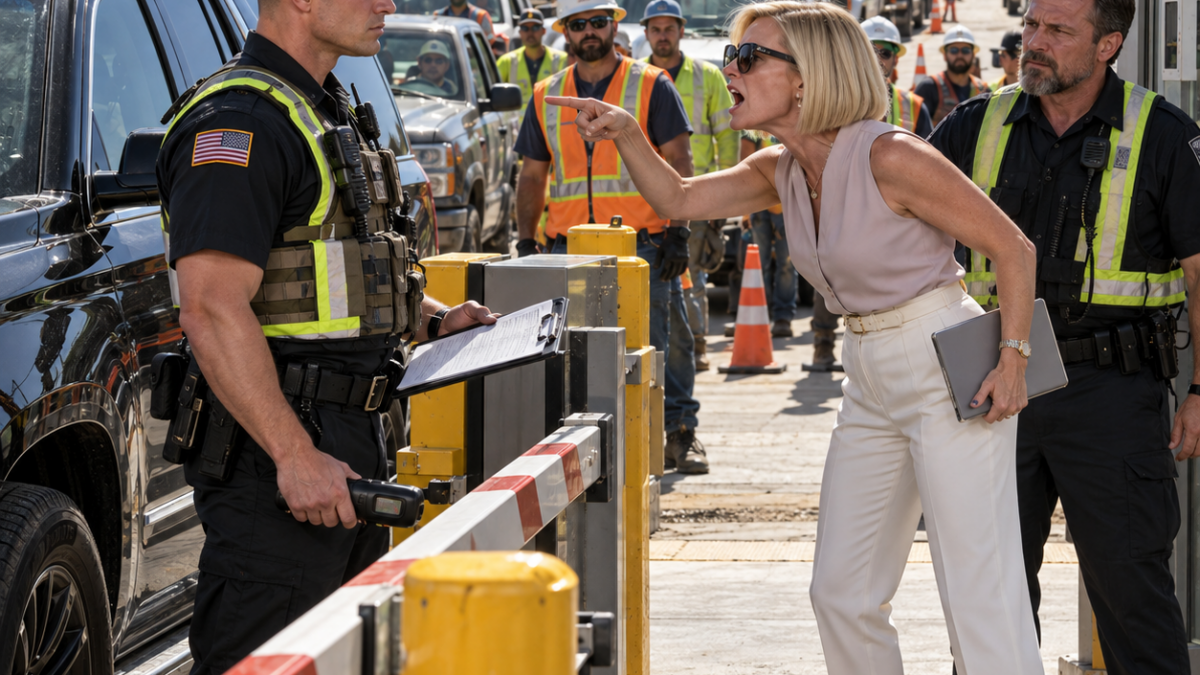
She came from another contract the company had recently lost, though we did not know that at first. All we knew was that corporate sent her in as the new site manager, and she spent the first two weeks not introducing herself to the people whose work she was now responsible for. She walked the site in heels that sank into gravel, dark slacks pressed razor-sharp, white blouse buttoned to the throat, short auburn hair sprayed into obedience, sunglasses perched on her head like a crown she never removed indoors.
When she finally gathered supervisors, she did not ask how the site worked.
She told us what was wrong with it.
“You people have gotten comfortable,” she said.
You people.
That was how she opened.
We sat around the folding table in the trailer, still damp with sweat from shift turnover, while she stood at the front with a clipboard and a tablet. She looked at us the way someone looks at an old stain on carpet.
“This contract requires professional appearance, strict compliance, and respect for management authority,” she continued. “I am not interested in excuses about weather, staffing, or what used to be acceptable.”
One of the day supervisors tried to explain the gate conditions. Badge scanner noise. Construction backup. Vehicle volume. Limited shade. The fact that our guard shacks were too far from the lanes to safely monitor scanner lights during peak traffic.
Karen held up one hand.
“I’m going to stop you there.”
The supervisor’s mouth closed.
“If the policy says guards should utilize the guard shacks, guards will utilize the guard shacks. If the uniform standard says boots will be presentable, boots will be presentable. If the report requires completion by end of shift, it will be completed by end of shift. Is that clear?”
It was clear.
Not intelligent.
But clear.
The write-ups started immediately.
Loose threads on uniforms.
Scuffed boots after twelve hours in mud.
Wet shirts during storms because we had no proper cover.
Sunglasses with smudges.
A guard written up for standing outside the guard shack during heavy traffic, even though he needed to see scanner lights and inspect windshields.
Another written up for “unprofessional posture” because he leaned against a barrier after nearly passing out in the heat.
It would have been bad enough if Karen’s nonsense landed equally.
It did not.
She targeted the veterans.
At first, I told myself I was being sensitive.
Then I saw the pattern.
A non-veteran replacement could sit inside the shack scrolling his phone for ten minutes and get a verbal reminder. A Marine with eight years on armored convoys could step into the shade to drink water and get written up for abandoning visual posture.
A new hire could misfile three incident sheets and be “still learning.” A former Army MP could miss one box on a vehicle inspection form and receive a formal counseling notice.
A veteran guard could be late because his VA appointment ran long and Karen would call it “patterned unreliability.” Her own favorite could no-call half a shift and be quietly rescheduled.
We documented.
We objected.
We tried training her without making it obvious we were training her.
We explained that the site did not run on paper compliance alone. It ran on people who knew what mattered when five things happened at once. It ran on guards who knew a contractor’s badge did not match his truck sticker because they had seen him before. It ran on old habits from people who understood access control was not a decoration.
Karen did not care.
“You’re resisting change,” she told me one night after I questioned a write-up against Mason.
“He followed the actual gate procedure.”
“He was argumentative.”
“He asked what part of the policy he violated.”
“Exactly.”
I stared at her.
She stared back, eyes cold, lips tight.
Karen was maybe mid-forties, but she had the exhausted bitterness of someone who believed every room had denied her what she deserved. She did not lead. She corrected. She did not listen. She collected leverage. Her voice stayed smooth when she was angry, which somehow made it worse. She never shouted unless witnesses benefited her. In private, she weaponized calm.
Within months, veterans were gone.
Forced out.
Written up.
Transferred.
Fired for petty accumulated violations that looked legitimate only if you never stepped onto the site and understood what those violations actually meant.
The recruiter who had always brought in veterans disappeared too.
That mattered more than we understood at first.
He had been the firewall. He knew how to interview vets without being dazzled by the word veteran alone. He asked questions only people who had lived certain realities could answer. He filtered for discipline, attention, stress tolerance, and whether a guy still thought civilian work was beneath him. He had standards.
After the old manager’s scandal, corporate needed someone to blame for the culture problem. They could not throw out Denise because she was part of the settlement. They would not blame executives who had ignored warning signs. So the recruiter got sacrificed.
His replacement had ties to Karen.
Personal ties.
Not something you put on an org chart.
The new hires came fast after that.
Too fast.
Some were fine people in the wrong job. Some were lazy. Some were scared. Some were overconfident because they had never seen what could happen when a construction site became unsafe. They did not know how contractors stole. They did not know which trucks deserved a second look. They did not understand why outbound inspections mattered or why chain of custody forms had to be treated like evidence, not scrap paper.
Karen had found a loophole.
The oil company contract required the security vendor to maintain a certain percentage of veterans on site because the site demanded experience under pressure. But there was an emergency staffing exception. If the vendor faced a shortage, they could temporarily use non-veteran guards to keep posts covered.
Karen created the shortage.
Then filled it with her people.
On paper, compliant.
In reality, sabotage with a signature line.
The site changed.
You could feel it before you could prove it.
Badge checks got sloppy. Sticker checks became glances. New guards treated contractors either like enemies to insult or friends to wave through. Random outbound inspections dropped because people did not want confrontation. Copper started disappearing. Small generators. Toolboxes. Expensive gear that should have been logged leaving the site.
We wrote memos.
We sent incident summaries.
We requested training sessions.
We asked for more scanners, shade structures, inspection support, overtime coverage, anything that would let us keep the contract safe while staffing quality fell through the floor.
Karen responded with more write-ups.
“Negative attitude.”
“Resistance to change.”
“Failure to model cultural compliance.”
I lasted longer than I should have.
Part of me believed I could still shield my people. Another part of me thought quitting meant abandoning the post. That is a dangerous belief when the post itself has been set on fire by someone above you.
Karen finally turned fully on me when I refused to remove Mason from the primary gate.
“He makes people uncomfortable,” she said.
“Who?”
She looked at me over her tablet. “Several people.”
“Did he violate policy?”
“That’s not the point.”
“It is exactly the point.”
“Your protectiveness toward certain guards is becoming a problem.”
“He’s one of the best access control guards on the site.”
“He is confrontational.”
“He is precise.”
“He is hostile to change.”
“He asks people to follow the rules.”
Karen’s smile was thin and dead. “So do I.”
“No,” I said before I could stop myself. “You use rules to punish people. He uses them to do the job.”
The silence after that had weight.
Two days later, she threatened to change my schedule in a way that would wreck my childcare arrangement. Nothing official. Nothing she would put in writing. Just enough to make the message clear.
I went home that morning and sat in my truck for ten minutes before going inside.
My wife opened the front door before I moved. She stood there in pajama pants, arms crossed, face soft with worry.
“You can’t keep doing this,” she said.
“I know.”
“You’re not sleeping.”
“I know.”
“You’re angry even when you’re quiet.”
That one hurt because it was true.
I resigned the next week.
I turned in my badge, my keys, my supervisor radio, and my last set of logs. I told the night crew I was done. Some understood. Some looked betrayed. Mason just nodded once.
“You did what you could,” he said.
It sounded like forgiveness.
I did not feel forgiven.
I got hired by another security company on a smaller, better-run contract. Funny enough, my old manager—the one whose bad choices had started the whole corporate panic—had landed there too, though I did not report to him. I reported to one of the supervisors Karen had forced out, a steady man who believed drama was a failure of planning.
The new job paid well enough.
The hours were humane.
I slept again.
But I kept in touch with people still trapped on the old site, and every update was worse.
Karen had pushed out almost every veteran.
Except Mason.
Mason stayed.
Not because he needed that job more than anyone else.
Because he was angry.
Because he believed in rules in a way Karen never understood.
Because she thought rules were tools of control, and Mason knew they were also shields.
He focused on vehicle stickers.
Most people saw sticker checks as boring. Windshield decal, quick glance, wave through. But the oil company’s rules were clear. Any vehicle entering the construction footprint needed a site-issued sticker. To get one, a driver had to pass a vehicle inspection and show a valid license and insurance. That was not bureaucracy for its own sake. Heavy equipment moved everywhere. Roads were tight. Spotters depended on drivers not being idiots. Insurance depended on compliance. If an unqualified driver hit someone with a truck, every shortcut would become evidence.
When staffing slipped, sticker inspections slipped.
Contractors hated delays. If their guys waited in line for proper stickers, they lost time. And where there is money lost, somebody eventually creates fraud to save it.
Fake stickers started appearing.
At first, they were laughable. Wrong shade. Ink bleeding in rain. Bad cuts. Numbers printed slightly crooked. A distracted guard might miss one, but any experienced gate guard would catch it.
Then they got better.
Better printer. Better vinyl. Better copies. Good enough for Karen’s new hires, who barely looked up from their phones.
Not good enough for Mason.
He noticed everything.
Serial sequence spacing.
Font weight.
Residue pattern.
The way authentic stickers curled microscopically after a week in sun.
He once told a guard he could smell a fake after two weeks of heat. I think that was nonsense, but with Mason, you never knew.
The policy for fake stickers was clear.
Pull the vehicle aside.
Call a supervisor.
Notify the site representative.
Call police if required.
Document the incident.
Remove the fake sticker.
Ban the driver from site pending review.
It did not matter why the sticker was fake. Mistake, fraud, contractor negligence, or deliberate bypass—the process was the process.
So Mason followed it.
Exactly.
He started pulling drivers by the dozen.
Trucks stacked up.
Contractors yelled.
New hires panicked.
Karen tried to stop him without saying stop.
“You’re creating unnecessary friction,” she told him.
“Has the sticker policy changed?” Mason asked.
“No.”
“Are fake stickers permitted now?”
“Of course not.”
“Then I’ll follow the policy.”
She called him overzealous.
He asked for that in writing.
She did not provide it.
So he kept going.
Here is the thing about malicious compliance when done by someone like Mason: it does not look like revenge from the outside. It looks like clean forms, straight lines, exact language, and no emotional fingerprints.
He did not invent violations.
He did not exaggerate.
He did not target people he disliked.
He did not raise his voice.
He stood at the gate, looked at windshields, and enforced the rules everyone claimed to care about.
Upper management loved it at first.
The reports looked good in meetings.
Look how seriously we take compliance.
Look how many fraudulent stickers we caught.
Look how vigilant our guards are.
Then the numbers started turning into money.
A ductwork crew lost half its workers at the gate.
A concrete pour got delayed because the pump truck driver had a fake sticker and was banned.
A crane support team could not assemble because two vehicles failed checks.
Every delay on a construction site multiplies. Steel arrives on a day for a reason. Equipment rentals bleed money by the hour. Drywall waits on rough-in. Inspections wait on installation. One missing driver at one gate can ripple across five trades before lunch.
Contractors revolted.
At first, they blamed the oil company.
The oil company pointed to the access policy every contractor had signed.
Then contractors blamed the security company for letting fake stickers become common in the first place.
That part was true.
The old veteran-heavy crew had kept the system tight.
Karen’s people had let the cracks widen until fraud found a home there.
The oil company representative started showing up at Mason’s gate.
He watched.
He asked questions.
Mason answered clearly.
No attitude. No speeches. Just facts.
“This sticker is fake because the serial number does not match the issuance log.”
“This adhesive pattern does not match current batch stock.”
“This driver has no license on file.”
“The policy requires removal and documentation.”
The rep took notes.
Then he went back to meetings and asked questions Karen could not answer.
The company tried to frame Mason as a rogue actor.
That failed because the policy belonged to the oil company.
Mason was following their book, not improvising his own.
If they wanted him to stop, they had to change the rule.
They could not.
Liability would eat them alive.
So Mason kept pulling vehicles.
The site started cracking.
Then it broke.
Hundreds of workers were turned around over a short period. Some returned properly documented. Many did not. Contractors missed headcounts. Project milestones slipped. Liquidated damages began stacking up under the construction agreement. The oil company was already under pressure because they had sold their old headquarters with a planned move date. Every day the new building stayed unfinished meant expensive temporary arrangements and rent extensions they hated paying.
Meanwhile, theft got harder to hide.
Copper.
Tools.
Generators.
Material losses that made accountants and insurers very interested.
Outbound inspections had been sloppy for months. Trucks left without random checks. Serial numbers were not logged. Chain of custody was broken. Once the oil company pulled one thread, the whole sweater began unraveling.
Karen responded the only way she knew how.
She tightened uniform rules.
She changed break policies.
She issued new posture expectations.
She tried to rotate Mason away from the primary gate.
Mason used her own paperwork against her.
The site access policy required experienced guards at the primary entry during high-volume traffic to ensure safety compliance. Mason had the seniority, cleanest inspection record, and highest detection numbers. Moving him without cause would look like retaliation.
He stayed exactly where he was.
Then came the breach notice.
The oil company sent the security company a formal notice that they were failing contract obligations. Veteran staffing percentages. Sticker issuance controls. Outbound inspections. Access enforcement. Incident documentation. There was a cure period. Fix the problems or risk termination for cause and potential damages tied to delays and failures.
Karen treated it like another document she could outlast.
Then the accident happened.
I will not describe it in detail.
No one died.
Someone got hurt.
The driver should not have been on site. Fake sticker. No proper clearance. Mason was not at that gate. He was not even on duty. A replacement guard waved the vehicle through. Cameras caught it. Clear as daylight.
That was the moment the oil company stopped pretending this was a paperwork problem.
Karen needed a scapegoat.
She suspended Mason pending investigation.
When I heard, I called him.
He answered on the fourth ring.
“You okay?” I asked.
“Yep.”
“You don’t sound okay.”
“I’m not fired yet.”
“That’s not what I asked.”
He was quiet for a long moment.
Then he said, “They think this is about me catching stickers.”
“It’s not.”
“No. It’s about everyone else pretending stickers don’t matter until somebody bleeds.”
That was Mason.
Sharp enough to cut himself.
He did not panic.
He did what he had always done.
He kept his records clean.
Dates. Times. Sticker serials. Badge numbers. Driver names. Vehicle descriptions. Policy references. Witness signatures when he had them. Photos where allowed. He did not embellish. Did not rage. Did not call Karen names in writing, though God knows she deserved several.
When the oil company audit team requested cooperation, he gave them everything.
Not around the contract.
Through it.
The agreement required guards and supervisors to cooperate with customer audits. Mason read that clause like armor. He submitted records directly when asked. He was not insubordinate. He was compliant.
The oil company brought in a third-party audit firm.
No ties to Karen.
No interest in site politics.
They pulled camera footage.
They compared sticker issuance logs to printed stock.
They found mismatches.
Missing sequences.
Repeated serial numbers.
Printer logs that had somehow been “lost.”
They reviewed the emergency staffing exception.
When was it triggered?
Who authorized it?
How long did it last?
Why were veteran staffing standards lowered?
Why did replacement hires overlap with people connected to Karen and the new recruiter?
The answers changed depending on who was speaking.
Emails buried them.
They were not smart about it.
One chain referenced “using our people until things normalize.”
Another discussed “transitioning away from legacy veteran resistance.”
Another showed Karen pushing to document minor infractions against specific veteran guards while requesting fast approval for replacements tied to her network.
Intent is hard to prove.
Patterns are not.
The oil company moved slowly until it did not.
Then it moved like a door slamming.
They terminated the security contract for cause at that site and several other properties where switching vendors was feasible. They held back payments. They initiated claims tied to breach, delay costs, inspection failures, sticker fraud, and losses connected to inadequate outbound controls. They named Karen, the recruiter, and the regional director in the narrative. They reserved the right to refer parts of the matter to law enforcement.
The number people threw around later was huge.
I never audited it myself, so I will not pretend certainty.
But between construction delays, temporary occupancy costs, security failures, theft losses, legal exposure, and contract termination, the damage ran into eight figures.
The security company’s stock dipped.
The regional director resigned for “personal reasons.”
The recruiter left.
Karen was fired.
Not transferred.
Not quietly reassigned.
Fired.
Before she went, she tried to sue.
Retaliation. Discrimination. Hostile treatment. All the words she thought would protect her because they had protected her before when there had been real misconduct by someone else.
This time, the company did not settle.
They produced the audit package.
Emails. Staffing manipulation. Conflicts of interest. Undeclared relationships. Retaliatory discipline. Contract violations. Documentation showing that the accident tied back not to Mason’s enforcement, but to the failures Karen’s staffing choices created.
She withdrew.
That was the last I ever heard of her career directly.
I would like to tell you I felt clean satisfaction.
I did not.
I felt relief first.
Relief that the consequences were measured mostly in money instead of funerals. Relief that no one died. Relief that Mason’s records protected him. Relief that the veterans Karen pushed out found other work, better work in some cases. Relief that the site finally got shade structures, real inspection lanes, better scanners, and staffing standards with teeth.
Satisfaction came later.
Quietly.
The kind you feel when someone who built a trap for others finally steps backward into her own paper trail.
Mason took time off.
For a while, he did not work gates at all. He went back to the VA, not just for therapy this time. He filed for benefits he should have filed for years earlier. He got a rating that made money less terrifying. Then he found a job at a technical college running facilities on a shift that let him see daylight and go home tired in a normal way.
He sends me photos sometimes.
A rebuilt HVAC unit.
A repaired loading dock.
A maintenance closet he reorganized with labels so perfect they look military-issued.
He does not talk about the gate much.
He does not need to.
It did what it needed to do.
As for me, I stayed with the new company. Eventually, I moved into training. Younger guards come through, some veterans, some not, and I tell them the same things until they get sick of hearing me.
Read the policy.
Not because policy is holy.
Because policy is protection when someone above you asks you to do something wrong.
Write clean reports.
Facts only.
No emotion, no insults, no drama. If someone behaved like an idiot, describe what they did so clearly that nobody needs you to call them one.
Know the difference between leadership and control.
Leadership makes hard work possible.
Control makes easy work miserable.
And never, ever let a manager convince you that safety rules are decorations.
Sometimes a rule is stupid. Sometimes it needs changing. Fine. Change it honestly. But do not ask the person at the gate to ignore it and then blame him when the thing that rule was meant to prevent happens exactly as predicted.
I still think about the old site at night sometimes.
The endless headlights.
The scanner lights blinking green and red.
The smell of diesel and wet concrete.
The jokes passed between guards at three in the morning because laughing was better than remembering how tired you were.
I think about the men Karen pushed out. Men who had flaws, yes, but who knew how to stand a post like it mattered. Men she treated like relics because they questioned shortcuts. Men she replaced with whoever would make her spreadsheet look compliant.
I think about Denise too, sometimes.
Not with anger exactly. Her complaint uncovered real misconduct. What happened with the old manager should never have happened. She had every right to report it. But the company learned the wrong lesson. Instead of building a better culture, they built a liability shield. Instead of hiring competent women and competent men under fair standards, they handed power to Karen because she looked like a solution on paper.
Paper can lie.
It can also tell the truth if the right person fills it out carefully enough.
That was what Karen never understood.
She thought paperwork existed to create her version of reality.
Mason understood paperwork records the reality you cannot spin later.
Every fake sticker he pulled.
Every driver he banned.
Every form he completed.
Every policy section he cited.
Every clean log entry became another nail in the box Karen built around herself.
She forced out veterans because she thought we were difficult.
She was right in one sense.
We were difficult.
Difficult to intimidate with a title.
Difficult to fool with vague orders.
Difficult to convince that appearance mattered more than function.
Difficult to make silent when shortcuts put people at risk.
She mistook difficulty for disobedience.
Then one Marine obeyed her world so completely it broke.
A few months after everything settled, Mason and I met for coffee.
He looked healthier. Still intense, but less haunted. He wore a plain gray T-shirt and had grease under one thumbnail from some maintenance project at the college.
“You ever miss it?” I asked.
“The gate?”
“Yeah.”
“No.”
Then after a pause, he said, “I miss knowing exactly what right looked like.”
I understood that.
Most civilian jobs are foggy. Right gets negotiated. Rules bend. People say one thing and reward another. At the gate, right had been simple once. Real sticker or fake. Badge valid or not. Vehicle clear or not. Let them through or turn them around.
Karen had tried to turn even that into fog.
Mason had refused.
He stirred his coffee and looked out the window.
“You know what pissed me off most?” he said.
“What?”
“She kept saying we were resistant to change. But she wasn’t changing anything. She was lowering standards and calling it progress.”
I sat with that.
Then I said, “That’s probably the cleanest after-action summary anyone gave.”
He almost smiled.
Almost.
My wife says I need to let the story go.
She is right in the way spouses are right when they are tired of watching you clench your jaw over things that already happened. I have let most of it go. I do not wake up angry anymore. I do not replay conversations with Karen in the shower. I do not imagine better comebacks, though I have some excellent ones now that they are useless.
But I keep the lesson.
Because someone reading this will know a Karen.
Maybe not in security.
Maybe in a hospital, warehouse, office, school, factory, restaurant, or construction crew.
Someone who arrives after others built something functional and decides control is the same as leadership. Someone who targets the people with institutional memory because memory threatens the lie that everything was broken before they came. Someone who weaponizes policy against workers but treats the actual purpose of policy as optional. Someone who calls competence resistance because competence asks inconvenient questions.
If that is where you are, document.
Cleanly.
Quietly.
Relentlessly.
Do your job right or walk away before it poisons you.
And if you stay, know the rules better than the people abusing them.
Karen fired or forced out almost every veteran on that contract.
She wanted obedience.
What she got was Mason.
One Marine at one gate, following the book exactly, refusing to ignore what everyone else wanted hidden.
In the end, he did not have to shout.
He did not have to sabotage anything.
He did not have to break a rule, threaten a soul, or make himself the hero of the story.
He just stopped helping liars pretend the system worked.
And once he did that, the system finally told the truth.
𝗧𝗛𝗘 𝗘𝗡𝗗
My New Boss Fired Every Veteran on the Security Contract, Then One Marine Followed Her Rules So Perfectly It Cost Them Millions
Karen thought veterans were the problem because we kept questioning shortcuts that looked good on paper.
She pushed us out one by one, but she forgot one thing about men trained to follow orders exactly: sometimes the rule book is sharper than revenge.
I did not go into security because it was my dream.
I went into security because I needed a paycheck, because civilian life did not come with a field manual, and because the first few years after leaving the service felt like learning to breathe through someone else’s lungs.
I was medically discharged before I was ready.
That is the clean version. The official version. The one that fits on forms.
The real version was uglier and quieter. I came home with a body that did not always cooperate, a resume full of gaps employers did not know how to read, and a habit of checking exits every time a door slammed too hard. I could follow orders. I could stay calm when people around me lost their heads. I could stand in heat, rain, cold, noise, and pressure without complaining much. What I could not do, at least not easily, was sit in an office under fluorescent lights pretending I did not hear every sudden sound.
Then I met my wife.
She already had two kids when we got together, and they moved into my life like a mission I had not known I needed. Homework at the kitchen table. Grocery lists. Soccer cleats by the door. Rent. Utilities. Car repairs. The kind of ordinary pressure that can either crush a man or give him a reason to stand up straight again.
I needed work.
That was how I ended up applying for a security job at a massive construction site for a major oil company’s new corporate headquarters. I cannot name the company, but you would know the logo. Everyone would. The building was going to be a monster—glass, steel, concrete, parking structures, access roads, delivery lanes, heavy equipment, contractors from every trade you can imagine, and more moving pieces than any one person could hold in his head.
The contract paid better than regular security because it was not regular security.
Three main entrances. Badge verification stations. Vehicle sticker checks. Random outbound inspections so tools, copper, and generators did not walk away in the back of someone’s truck. Thousands of vehicles in and out every day. Some mornings, one gate alone processed enough traffic to make your brain hum. You had to watch windshields, badges, faces, license plates, contractor decals, trailer loads, body language, and the scanner light all at once while concrete trucks lined up behind impatient electricians and some foreman screamed that your five-second check was costing him money.
It was chaos.
I liked it.
Most of us did.
That was the strange thing. Almost every guard on that site was prior service. Army, Navy, Air Force, Marines. Different branches, different wars, same dark humor. We were not all polished. Some of us were rough around the edges. Some carried scars you could see, some carried them in the way they stood too far from crowds or flinched at dropped pallets. But we understood pressure. We understood procedure. We understood that little things mattered because little things became investigations later.
Our old site manager understood us.
He was strict in the ways that mattered. Badge logs had to be clean. Incident reports had to be factual. Vehicle checks had to follow the book. But he was flexible in the ways that kept people human. No formal PTO, but if your kid got sick or your VA appointment moved or you needed two days because the world inside your head had gone loud, you could swap shifts. Somebody would cover. Nobody made a speech. Nobody called you weak.
We took care of each other because that was how the place survived.
In the summer, you handed water to the guy whose hands started shaking at the gate. In rain, you switched positions so someone could dry out long enough to stop shivering. If a guard sprinted toward the bathroom because gas station coffee and body armor had declared war, you covered his lane. You complained, sure. We were professionals, not saints. But the work got done.
I did not plan to move up.
I was happy enough to stand my post, come home exhausted, help the kids with homework, kiss my wife, and fall asleep on the couch with one boot still on.
Then a supervisor went back to school, and the slot opened.
Other guys had more time on the contract. One woman on site had made it very clear she expected the title. Her name was Denise, and she had been around long enough to know the paperwork but not long enough to understand that leadership was more than telling people what they were doing wrong. She had a sharp voice, sharp nails, and the kind of smile that showed up only when someone else was uncomfortable.
People told me to apply anyway.
So I did.
They tested each candidate by giving us a day as acting supervisor. I did not reinvent anything. I ran the checklist. Kept the lanes tight. Responded when a badge reader failed. Coordinated with the foreman when a vehicle backup started spilling toward the county road. Made sure breaks happened. Wrote clean notes. No drama.
Two nights later, my phone rang.
It was Denise.
And before I could even say hello properly, she said, “You need to decline the promotion.”
part2
I sat up in bed, careful not to wake my wife.
“What?”
“You heard me,” Denise said. Her voice had that flat, controlled tone people use when they have practiced being furious. “You and your little boys’ club think you can just hand each other positions, but HR is going to love hearing about this.”
“I didn’t hand myself anything.”
“You’re not more qualified than me.”
“I didn’t say I was.”
“You resign from consideration, or I file a complaint.”
For a few seconds, I did not know what to say.
I had dealt with yelling before. Threats before. Fear before. But this was different. This was a person trying to put a tripwire under my career before it even changed.
“I’m going to tell my supervisor about this call,” I said.
She laughed once. “Of course you are.”
Then she hung up.
I did tell him.
He told me not to respond to her again and said management would handle it. A week later, I started as night shift supervisor.
If this were a clean story, that would be where the problem ended.
It was not.
Looking back, Denise’s call was the first tremor before the ground opened.
I thrived on nights.
Some people hate them. The quiet gets too big. The shadows stretch weird. The hours between midnight and dawn make men talk when they should not. But I liked the rhythm. Less executive traffic. More freight. More contractors trying to sneak through early. More chances to solve a problem without five managers hovering.
I rotated between gates, checked logs, made sure people got breaks, handled small fires before they became big ones, and kept the night crew moving.
One guard in particular became my project, though I would never have called him that to his face.
His name was Mason.
Marine.
Not former Marine, because he would correct you with his eyes before you finished the sentence. He was lean, intense, and wired tight enough that most people gave him space. He had a way of arguing with the air like the air had insulted him. He memorized rules the way other people remembered song lyrics. If the SOP said a badge reader failure required a yellow tag on the log sheet before the supervisor call, he would notice if you used orange ink.
Most people found him exhausting.
I understood him.
Or at least I understood enough to not treat him like a problem.
He carried a lot. You could see it in how his shoulders stayed braced, how his jaw worked when someone stood too close, how he scanned every vehicle as if each windshield might contain a ghost. I told him to go to the VA. He told me to mind my own business. I did not push every day. Just enough.
Eventually, he went.
Not because of me, not really. People save themselves when they are ready. But over time, the storm behind his eyes got a little less violent. He was still sharp. Still intense. Still more comfortable with a rule book than a conversation. But he started laughing sometimes, and that counted.
Then our old site manager vanished.
One day, he did not answer calls.
Then another.
Management held a meeting with the supervisors and gave us nothing but fog. “Personnel matter.” “Transition.” “Continuity of operations.” Words designed to say nothing at maximum volume.
Eventually, someone in HR who liked one of our supervisors let something slip.
Our boss had quit under pressure.
There had been a complaint.
From Denise.
It was not just about the promotion. There were messages. Photos. On-site behavior that should never have happened. He had crossed lines that should have been painted in fire. The company panicked, and honestly, they had reason to. The complaint was not nonsense. There was evidence. Phone records. Screenshots. Enough to make the lawyers sweat through their suits.
I did not excuse him.
I also did not celebrate.
The fallout from one man’s stupidity never lands only on him.
The company reached a deal with Denise. Reinstatement with back pay. A raise. Protection. The lawyers wanted more women on site and more women in supervision. Not because the company had suddenly discovered ethics, but because the company had discovered liability.
They put out statements about culture.
They held meetings about respect.
They dropped our old manager like a hot shell casing.
Then they hit reset.
For a couple of months, the remaining supervisors ran the site ourselves. Three of us juggling thousands of vehicles, contractor complaints, inspection logs, badge problems, shift swaps, heat injuries, theft attempts, and the ordinary stupidity of a massive construction project. We were tired, but we were good. The site held because the people at the gates still knew what they were doing.
Then Karen arrived.
Her real name was Karen Dempsey, and I have never met a person more perfectly named for the role she ended up playing in my life.
She came from another contract the company had recently lost, though we did not know that at first. All we knew was that corporate sent her in as the new site manager, and she spent the first two weeks not introducing herself to the people whose work she was now responsible for. She walked the site in heels that sank into gravel, dark slacks pressed razor-sharp, white blouse buttoned to the throat, short auburn hair sprayed into obedience, sunglasses perched on her head like a crown she never removed indoors.
When she finally gathered supervisors, she did not ask how the site worked.
She told us what was wrong with it.
“You people have gotten comfortable,” she said.
You people.
That was how she opened.
We sat around the folding table in the trailer, still damp with sweat from shift turnover, while she stood at the front with a clipboard and a tablet. She looked at us the way someone looks at an old stain on carpet.
“This contract requires professional appearance, strict compliance, and respect for management authority,” she continued. “I am not interested in excuses about weather, staffing, or what used to be acceptable.”
One of the day supervisors tried to explain the gate conditions. Badge scanner noise. Construction backup. Vehicle volume. Limited shade. The fact that our guard shacks were too far from the lanes to safely monitor scanner lights during peak traffic.
Karen held up one hand.
“I’m going to stop you there.”
The supervisor’s mouth closed.
“If the policy says guards should utilize the guard shacks, guards will utilize the guard shacks. If the uniform standard says boots will be presentable, boots will be presentable. If the report requires completion by end of shift, it will be completed by end of shift. Is that clear?”
It was clear.
Not intelligent.
But clear.
The write-ups started immediately.
Loose threads on uniforms.
Scuffed boots after twelve hours in mud.
Wet shirts during storms because we had no proper cover.
Sunglasses with smudges.
A guard written up for standing outside the guard shack during heavy traffic, even though he needed to see scanner lights and inspect windshields.
Another written up for “unprofessional posture” because he leaned against a barrier after nearly passing out in the heat.
It would have been bad enough if Karen’s nonsense landed equally.
It did not.
She targeted the veterans.
At first, I told myself I was being sensitive.
Then I saw the pattern.
A non-veteran replacement could sit inside the shack scrolling his phone for ten minutes and get a verbal reminder. A Marine with eight years on armored convoys could step into the shade to drink water and get written up for abandoning visual posture.
A new hire could misfile three incident sheets and be “still learning.” A former Army MP could miss one box on a vehicle inspection form and receive a formal counseling notice.
A veteran guard could be late because his VA appointment ran long and Karen would call it “patterned unreliability.” Her own favorite could no-call half a shift and be quietly rescheduled.
We documented.
We objected.
We tried training her without making it obvious we were training her.
We explained that the site did not run on paper compliance alone. It ran on people who knew what mattered when five things happened at once. It ran on guards who knew a contractor’s badge did not match his truck sticker because they had seen him before. It ran on old habits from people who understood access control was not a decoration.
Karen did not care.
“You’re resisting change,” she told me one night after I questioned a write-up against Mason.
“He followed the actual gate procedure.”
“He was argumentative.”
“He asked what part of the policy he violated.”
“Exactly.”
I stared at her.
She stared back, eyes cold, lips tight.
Karen was maybe mid-forties, but she had the exhausted bitterness of someone who believed every room had denied her what she deserved. She did not lead. She corrected. She did not listen. She collected leverage. Her voice stayed smooth when she was angry, which somehow made it worse. She never shouted unless witnesses benefited her. In private, she weaponized calm.
Within months, veterans were gone.
Forced out.
Written up.
Transferred.
Fired for petty accumulated violations that looked legitimate only if you never stepped onto the site and understood what those violations actually meant.
The recruiter who had always brought in veterans disappeared too.
That mattered more than we understood at first.
He had been the firewall. He knew how to interview vets without being dazzled by the word veteran alone. He asked questions only people who had lived certain realities could answer. He filtered for discipline, attention, stress tolerance, and whether a guy still thought civilian work was beneath him. He had standards.
After the old manager’s scandal, corporate needed someone to blame for the culture problem. They could not throw out Denise because she was part of the settlement. They would not blame executives who had ignored warning signs. So the recruiter got sacrificed.
His replacement had ties to Karen.
Personal ties.
Not something you put on an org chart.
The new hires came fast after that.
Too fast.
Some were fine people in the wrong job. Some were lazy. Some were scared. Some were overconfident because they had never seen what could happen when a construction site became unsafe. They did not know how contractors stole. They did not know which trucks deserved a second look. They did not understand why outbound inspections mattered or why chain of custody forms had to be treated like evidence, not scrap paper.
Karen had found a loophole.
The oil company contract required the security vendor to maintain a certain percentage of veterans on site because the site demanded experience under pressure. But there was an emergency staffing exception. If the vendor faced a shortage, they could temporarily use non-veteran guards to keep posts covered.
Karen created the shortage.
Then filled it with her people.
On paper, compliant.
In reality, sabotage with a signature line.
The site changed.
You could feel it before you could prove it.
Badge checks got sloppy. Sticker checks became glances. New guards treated contractors either like enemies to insult or friends to wave through. Random outbound inspections dropped because people did not want confrontation. Copper started disappearing. Small generators. Toolboxes. Expensive gear that should have been logged leaving the site.
We wrote memos.
We sent incident summaries.
We requested training sessions.
We asked for more scanners, shade structures, inspection support, overtime coverage, anything that would let us keep the contract safe while staffing quality fell through the floor.
Karen responded with more write-ups.
“Negative attitude.”
“Resistance to change.”
“Failure to model cultural compliance.”
I lasted longer than I should have.
Part of me believed I could still shield my people. Another part of me thought quitting meant abandoning the post. That is a dangerous belief when the post itself has been set on fire by someone above you.
Karen finally turned fully on me when I refused to remove Mason from the primary gate.
“He makes people uncomfortable,” she said.
“Who?”
She looked at me over her tablet. “Several people.”
“Did he violate policy?”
“That’s not the point.”
“It is exactly the point.”
“Your protectiveness toward certain guards is becoming a problem.”
“He’s one of the best access control guards on the site.”
“He is confrontational.”
“He is precise.”
“He is hostile to change.”
“He asks people to follow the rules.”
Karen’s smile was thin and dead. “So do I.”
“No,” I said before I could stop myself. “You use rules to punish people. He uses them to do the job.”
The silence after that had weight.
Two days later, she threatened to change my schedule in a way that would wreck my childcare arrangement. Nothing official. Nothing she would put in writing. Just enough to make the message clear.
I went home that morning and sat in my truck for ten minutes before going inside.
My wife opened the front door before I moved. She stood there in pajama pants, arms crossed, face soft with worry.
“You can’t keep doing this,” she said.
“I know.”
“You’re not sleeping.”
“I know.”
“You’re angry even when you’re quiet.”
That one hurt because it was true.
I resigned the next week.
I turned in my badge, my keys, my supervisor radio, and my last set of logs. I told the night crew I was done. Some understood. Some looked betrayed. Mason just nodded once.
“You did what you could,” he said.
It sounded like forgiveness.
I did not feel forgiven.
I got hired by another security company on a smaller, better-run contract. Funny enough, my old manager—the one whose bad choices had started the whole corporate panic—had landed there too, though I did not report to him. I reported to one of the supervisors Karen had forced out, a steady man who believed drama was a failure of planning.
The new job paid well enough.
The hours were humane.
I slept again.
But I kept in touch with people still trapped on the old site, and every update was worse.
Karen had pushed out almost every veteran.
Except Mason.
Mason stayed.
Not because he needed that job more than anyone else.
Because he was angry.
Because he believed in rules in a way Karen never understood.
Because she thought rules were tools of control, and Mason knew they were also shields.
He focused on vehicle stickers.
Most people saw sticker checks as boring. Windshield decal, quick glance, wave through. But the oil company’s rules were clear. Any vehicle entering the construction footprint needed a site-issued sticker. To get one, a driver had to pass a vehicle inspection and show a valid license and insurance. That was not bureaucracy for its own sake. Heavy equipment moved everywhere. Roads were tight. Spotters depended on drivers not being idiots. Insurance depended on compliance. If an unqualified driver hit someone with a truck, every shortcut would become evidence.
When staffing slipped, sticker inspections slipped.
Contractors hated delays. If their guys waited in line for proper stickers, they lost time. And where there is money lost, somebody eventually creates fraud to save it.
Fake stickers started appearing.
At first, they were laughable. Wrong shade. Ink bleeding in rain. Bad cuts. Numbers printed slightly crooked. A distracted guard might miss one, but any experienced gate guard would catch it.
Then they got better.
Better printer. Better vinyl. Better copies. Good enough for Karen’s new hires, who barely looked up from their phones.
Not good enough for Mason.
He noticed everything.
Serial sequence spacing.
Font weight.
Residue pattern.
The way authentic stickers curled microscopically after a week in sun.
He once told a guard he could smell a fake after two weeks of heat. I think that was nonsense, but with Mason, you never knew.
The policy for fake stickers was clear.
Pull the vehicle aside.
Call a supervisor.
Notify the site representative.
Call police if required.
Document the incident.
Remove the fake sticker.
Ban the driver from site pending review.
It did not matter why the sticker was fake. Mistake, fraud, contractor negligence, or deliberate bypass—the process was the process.
So Mason followed it.
Exactly.
He started pulling drivers by the dozen.
Trucks stacked up.
Contractors yelled.
New hires panicked.
Karen tried to stop him without saying stop.
“You’re creating unnecessary friction,” she told him.
“Has the sticker policy changed?” Mason asked.
“No.”
“Are fake stickers permitted now?”
“Of course not.”
“Then I’ll follow the policy.”
She called him overzealous.
He asked for that in writing.
She did not provide it.
So he kept going.
Here is the thing about malicious compliance when done by someone like Mason: it does not look like revenge from the outside. It looks like clean forms, straight lines, exact language, and no emotional fingerprints.
He did not invent violations.
He did not exaggerate.
He did not target people he disliked.
He did not raise his voice.
He stood at the gate, looked at windshields, and enforced the rules everyone claimed to care about.
Upper management loved it at first.
The reports looked good in meetings.
Look how seriously we take compliance.
Look how many fraudulent stickers we caught.
Look how vigilant our guards are.
Then the numbers started turning into money.
A ductwork crew lost half its workers at the gate.
A concrete pour got delayed because the pump truck driver had a fake sticker and was banned.
A crane support team could not assemble because two vehicles failed checks.
Every delay on a construction site multiplies. Steel arrives on a day for a reason. Equipment rentals bleed money by the hour. Drywall waits on rough-in. Inspections wait on installation. One missing driver at one gate can ripple across five trades before lunch.
Contractors revolted.
At first, they blamed the oil company.
The oil company pointed to the access policy every contractor had signed.
Then contractors blamed the security company for letting fake stickers become common in the first place.
That part was true.
The old veteran-heavy crew had kept the system tight.
Karen’s people had let the cracks widen until fraud found a home there.
The oil company representative started showing up at Mason’s gate.
He watched.
He asked questions.
Mason answered clearly.
No attitude. No speeches. Just facts.
“This sticker is fake because the serial number does not match the issuance log.”
“This adhesive pattern does not match current batch stock.”
“This driver has no license on file.”
“The policy requires removal and documentation.”
The rep took notes.
Then he went back to meetings and asked questions Karen could not answer.
The company tried to frame Mason as a rogue actor.
That failed because the policy belonged to the oil company.
Mason was following their book, not improvising his own.
If they wanted him to stop, they had to change the rule.
They could not.
Liability would eat them alive.
So Mason kept pulling vehicles.
The site started cracking.
Then it broke.
Hundreds of workers were turned around over a short period. Some returned properly documented. Many did not. Contractors missed headcounts. Project milestones slipped. Liquidated damages began stacking up under the construction agreement. The oil company was already under pressure because they had sold their old headquarters with a planned move date. Every day the new building stayed unfinished meant expensive temporary arrangements and rent extensions they hated paying.
Meanwhile, theft got harder to hide.
Copper.
Tools.
Generators.
Material losses that made accountants and insurers very interested.
Outbound inspections had been sloppy for months. Trucks left without random checks. Serial numbers were not logged. Chain of custody was broken. Once the oil company pulled one thread, the whole sweater began unraveling.
Karen responded the only way she knew how.
She tightened uniform rules.
She changed break policies.
She issued new posture expectations.
She tried to rotate Mason away from the primary gate.
Mason used her own paperwork against her.
The site access policy required experienced guards at the primary entry during high-volume traffic to ensure safety compliance. Mason had the seniority, cleanest inspection record, and highest detection numbers. Moving him without cause would look like retaliation.
He stayed exactly where he was.
Then came the breach notice.
The oil company sent the security company a formal notice that they were failing contract obligations. Veteran staffing percentages. Sticker issuance controls. Outbound inspections. Access enforcement. Incident documentation. There was a cure period. Fix the problems or risk termination for cause and potential damages tied to delays and failures.
Karen treated it like another document she could outlast.
Then the accident happened.
I will not describe it in detail.
No one died.
Someone got hurt.
The driver should not have been on site. Fake sticker. No proper clearance. Mason was not at that gate. He was not even on duty. A replacement guard waved the vehicle through. Cameras caught it. Clear as daylight.
That was the moment the oil company stopped pretending this was a paperwork problem.
Karen needed a scapegoat.
She suspended Mason pending investigation.
When I heard, I called him.
He answered on the fourth ring.
“You okay?” I asked.
“Yep.”
“You don’t sound okay.”
“I’m not fired yet.”
“That’s not what I asked.”
He was quiet for a long moment.
Then he said, “They think this is about me catching stickers.”
“It’s not.”
“No. It’s about everyone else pretending stickers don’t matter until somebody bleeds.”
That was Mason.
Sharp enough to cut himself.
He did not panic.
He did what he had always done.
He kept his records clean.
Dates. Times. Sticker serials. Badge numbers. Driver names. Vehicle descriptions. Policy references. Witness signatures when he had them. Photos where allowed. He did not embellish. Did not rage. Did not call Karen names in writing, though God knows she deserved several.
When the oil company audit team requested cooperation, he gave them everything.
Not around the contract.
Through it.
The agreement required guards and supervisors to cooperate with customer audits. Mason read that clause like armor. He submitted records directly when asked. He was not insubordinate. He was compliant.
The oil company brought in a third-party audit firm.
No ties to Karen.
No interest in site politics.
They pulled camera footage.
They compared sticker issuance logs to printed stock.
They found mismatches.
Missing sequences.
Repeated serial numbers.
Printer logs that had somehow been “lost.”
They reviewed the emergency staffing exception.
When was it triggered?
Who authorized it?
How long did it last?
Why were veteran staffing standards lowered?
Why did replacement hires overlap with people connected to Karen and the new recruiter?
The answers changed depending on who was speaking.
Emails buried them.
They were not smart about it.
One chain referenced “using our people until things normalize.”
Another discussed “transitioning away from legacy veteran resistance.”
Another showed Karen pushing to document minor infractions against specific veteran guards while requesting fast approval for replacements tied to her network.
Intent is hard to prove.
Patterns are not.
The oil company moved slowly until it did not.
Then it moved like a door slamming.
They terminated the security contract for cause at that site and several other properties where switching vendors was feasible. They held back payments. They initiated claims tied to breach, delay costs, inspection failures, sticker fraud, and losses connected to inadequate outbound controls. They named Karen, the recruiter, and the regional director in the narrative. They reserved the right to refer parts of the matter to law enforcement.
The number people threw around later was huge.
I never audited it myself, so I will not pretend certainty.
But between construction delays, temporary occupancy costs, security failures, theft losses, legal exposure, and contract termination, the damage ran into eight figures.
The security company’s stock dipped.
The regional director resigned for “personal reasons.”
The recruiter left.
Karen was fired.
Not transferred.
Not quietly reassigned.
Fired.
Before she went, she tried to sue.
Retaliation. Discrimination. Hostile treatment. All the words she thought would protect her because they had protected her before when there had been real misconduct by someone else.
This time, the company did not settle.
They produced the audit package.
Emails. Staffing manipulation. Conflicts of interest. Undeclared relationships. Retaliatory discipline. Contract violations. Documentation showing that the accident tied back not to Mason’s enforcement, but to the failures Karen’s staffing choices created.
She withdrew.
That was the last I ever heard of her career directly.
I would like to tell you I felt clean satisfaction.
I did not.
I felt relief first.
Relief that the consequences were measured mostly in money instead of funerals. Relief that no one died. Relief that Mason’s records protected him. Relief that the veterans Karen pushed out found other work, better work in some cases. Relief that the site finally got shade structures, real inspection lanes, better scanners, and staffing standards with teeth.
Satisfaction came later.
Quietly.
The kind you feel when someone who built a trap for others finally steps backward into her own paper trail.
Mason took time off.
For a while, he did not work gates at all. He went back to the VA, not just for therapy this time. He filed for benefits he should have filed for years earlier. He got a rating that made money less terrifying. Then he found a job at a technical college running facilities on a shift that let him see daylight and go home tired in a normal way.
He sends me photos sometimes.
A rebuilt HVAC unit.
A repaired loading dock.
A maintenance closet he reorganized with labels so perfect they look military-issued.
He does not talk about the gate much.
He does not need to.
It did what it needed to do.
As for me, I stayed with the new company. Eventually, I moved into training. Younger guards come through, some veterans, some not, and I tell them the same things until they get sick of hearing me.
Read the policy.
Not because policy is holy.
Because policy is protection when someone above you asks you to do something wrong.
Write clean reports.
Facts only.
No emotion, no insults, no drama. If someone behaved like an idiot, describe what they did so clearly that nobody needs you to call them one.
Know the difference between leadership and control.
Leadership makes hard work possible.
Control makes easy work miserable.
And never, ever let a manager convince you that safety rules are decorations.
Sometimes a rule is stupid. Sometimes it needs changing. Fine. Change it honestly. But do not ask the person at the gate to ignore it and then blame him when the thing that rule was meant to prevent happens exactly as predicted.
I still think about the old site at night sometimes.
The endless headlights.
The scanner lights blinking green and red.
The smell of diesel and wet concrete.
The jokes passed between guards at three in the morning because laughing was better than remembering how tired you were.
I think about the men Karen pushed out. Men who had flaws, yes, but who knew how to stand a post like it mattered. Men she treated like relics because they questioned shortcuts. Men she replaced with whoever would make her spreadsheet look compliant.
I think about Denise too, sometimes.
Not with anger exactly. Her complaint uncovered real misconduct. What happened with the old manager should never have happened. She had every right to report it. But the company learned the wrong lesson. Instead of building a better culture, they built a liability shield. Instead of hiring competent women and competent men under fair standards, they handed power to Karen because she looked like a solution on paper.
Paper can lie.
It can also tell the truth if the right person fills it out carefully enough.
That was what Karen never understood.
She thought paperwork existed to create her version of reality.
Mason understood paperwork records the reality you cannot spin later.
Every fake sticker he pulled.
Every driver he banned.
Every form he completed.
Every policy section he cited.
Every clean log entry became another nail in the box Karen built around herself.
She forced out veterans because she thought we were difficult.
She was right in one sense.
We were difficult.
Difficult to intimidate with a title.
Difficult to fool with vague orders.
Difficult to convince that appearance mattered more than function.
Difficult to make silent when shortcuts put people at risk.
She mistook difficulty for disobedience.
Then one Marine obeyed her world so completely it broke.
A few months after everything settled, Mason and I met for coffee.
He looked healthier. Still intense, but less haunted. He wore a plain gray T-shirt and had grease under one thumbnail from some maintenance project at the college.
“You ever miss it?” I asked.
“The gate?”
“Yeah.”
“No.”
Then after a pause, he said, “I miss knowing exactly what right looked like.”
I understood that.
Most civilian jobs are foggy. Right gets negotiated. Rules bend. People say one thing and reward another. At the gate, right had been simple once. Real sticker or fake. Badge valid or not. Vehicle clear or not. Let them through or turn them around.
Karen had tried to turn even that into fog.
Mason had refused.
He stirred his coffee and looked out the window.
“You know what pissed me off most?” he said.
“What?”
“She kept saying we were resistant to change. But she wasn’t changing anything. She was lowering standards and calling it progress.”
I sat with that.
Then I said, “That’s probably the cleanest after-action summary anyone gave.”
He almost smiled.
Almost.
My wife says I need to let the story go.
She is right in the way spouses are right when they are tired of watching you clench your jaw over things that already happened. I have let most of it go. I do not wake up angry anymore. I do not replay conversations with Karen in the shower. I do not imagine better comebacks, though I have some excellent ones now that they are useless.
But I keep the lesson.
Because someone reading this will know a Karen.
Maybe not in security.
Maybe in a hospital, warehouse, office, school, factory, restaurant, or construction crew.
Someone who arrives after others built something functional and decides control is the same as leadership. Someone who targets the people with institutional memory because memory threatens the lie that everything was broken before they came. Someone who weaponizes policy against workers but treats the actual purpose of policy as optional. Someone who calls competence resistance because competence asks inconvenient questions.
If that is where you are, document.
Cleanly.
Quietly.
Relentlessly.
Do your job right or walk away before it poisons you.
And if you stay, know the rules better than the people abusing them.
Karen fired or forced out almost every veteran on that contract.
She wanted obedience.
What she got was Mason.
One Marine at one gate, following the book exactly, refusing to ignore what everyone else wanted hidden.
In the end, he did not have to shout.
He did not have to sabotage anything.
He did not have to break a rule, threaten a soul, or make himself the hero of the story.
He just stopped helping liars pretend the system worked.
And once he did that, the system finally told the truth.