𝗙𝗨𝗟𝗟 𝗦𝗧𝗢𝗥𝗬 My Neighbor Threatened to Destroy Our Lives Over Four Feet of Grass, and I Had No Idea How Far She Would Go
𝗣𝗔𝗥𝗧 𝟮
The good kind, with slightly crisp edges and soft centers.
She arranged several on one of our nicest ceramic plates and walked them next door.
I watched from the living room window.
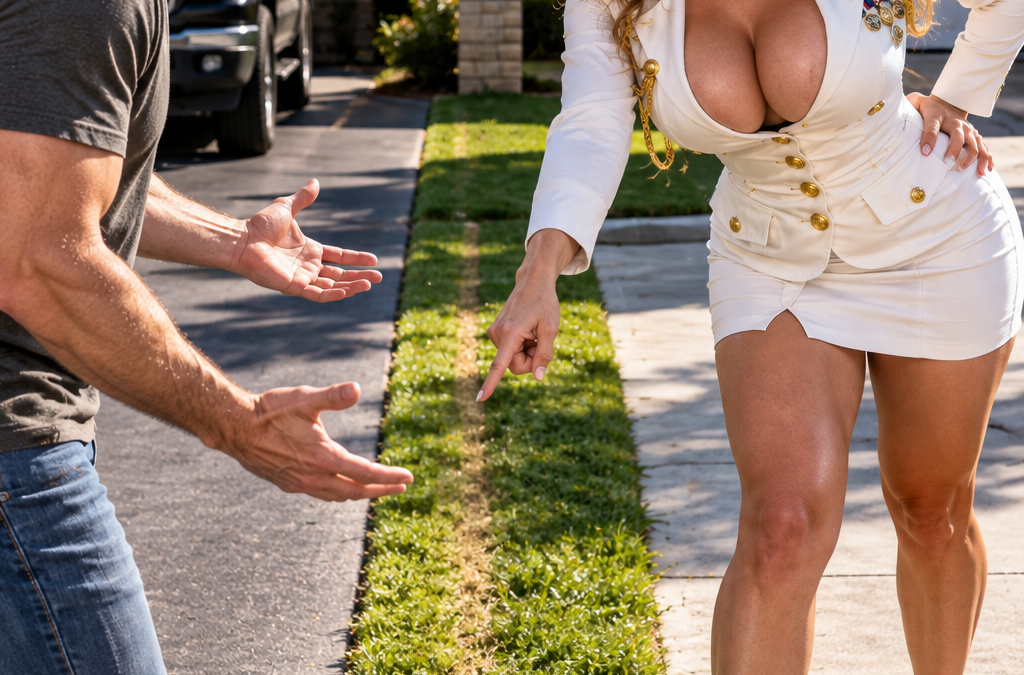
Karen answered wearing another immaculate white outfit, this one with a fitted military-style jacket over a low-cut blouse. She leaned against the doorframe, glanced at the plate, and gave my wife a thin, practiced smile.
My wife said something.
Karen took the plate.
Then she replied loudly enough that I could hear her through the open window.
“I don’t eat other people’s food.”
And closed the door.
With our plate still in her hand.
My wife stood there for a moment, staring at the door.
Then she walked home.
I met her in the hallway.
“How’d it go?”
She looked at me.
“She took the cookies.”
“That’s good.”
“Then she told me she doesn’t eat other people’s food.”
I blinked.
“Did she give them back?”
“No.”
“The cookies?”
“The plate.”
I looked toward Karen’s house.
“That was our nice plate.”
“I know.”
For a few seconds we just stared at each other.
Then my wife laughed.
It was the kind of laugh people make when a situation is too absurd to process any other way.
But her eyes looked tired.
That was the first time I realized Karen wasn’t simply irritating me.
She was hurting my wife.
And I hated that far more than anything she could have done to our trash cans.
After the cookies, Karen stopped pretending she had any interest in being civil.
She began marking the strip of grass with small wooden stakes and bright orange string.
The first morning, I found four stakes arranged in a straight line.
String stretched between them like a miniature construction barrier.
I stood at the edge of the driveway with my coffee.
Karen appeared on her porch.
“Don’t touch those,” she called.
“What are they?”
“Boundary markers.”
“Boundary markers for what?”
“My property.”
I looked at the string.
It ran straight down the middle of the grass.
“Did you have a survey done?”
“I don’t need a survey.”
“Then how do you know that’s the boundary?”
“Because I’ve lived here twenty years.”
I took a sip of coffee.
“That’s not really how property lines work.”
Her face hardened.
“Don’t lecture me about property.”
I looked at the stakes again.
“Karen, I’m just asking a question.”
“And I’m telling you to stay off my land.”
She turned away before I could answer.
The next morning, the string had moved.
It was about a foot closer to our driveway.
Two days later, it had shifted again.
Eventually, I started taking pictures because I couldn’t believe what I was seeing.
There was no pattern.
Some mornings the string nearly touched our concrete.
Other mornings it leaned toward Karen’s driveway.
It was as though she woke up each day and decided where reality ought to be.
I considered pulling the stakes out.
But I knew that would give her exactly what she wanted.
An excuse to accuse me of damaging her property.
So I left them alone.
Then she discovered the sprinkler.
I can still hear that rhythmic metallic clicking.
Tick.
Tick.
Tick.
The oscillating sprinkler would swing across the grass, spraying a thin fan of water into the morning sunlight.
It should have been an ordinary suburban sound.
Instead, it became something I dreaded.
Karen positioned the sprinkler along the edge of her driveway so that every sweep sent water across ours.
Not a little overspray.
A full arc.
The first time it happened, I was loading tools into my truck before work.
I had the passenger door open and a cardboard box balanced on one knee when icy water hit me across the back.
I jumped.
The box slipped.
Several tools spilled onto the driveway.
I turned.
Karen was standing on her porch holding a coffee cup.
“Can you adjust that thing?” I called.
She smiled.
“Adjust what?”
“Your sprinkler.”
“It’s watering my lawn.”
“It’s watering my truck.”
“Then move your truck.”
“It’s in my driveway.”
She shrugged.
“Water goes where it wants.”
Her smile widened.
I closed the truck door and moved my tools out of the spray.
I told myself it was childish.
I told myself not to give her the satisfaction of getting angry.
But when I arrived at work with wet pants and a damp shirt, I began to wonder how much patience one person was supposed to have.
A few days later, my wife got caught in the same sprinkler while unloading groceries.
I heard her yell from the kitchen.
“Really?”
I rushed outside.
She was standing beside her car with a paper grocery bag in her arms.
Water had soaked her blouse. Her hair was plastered against her cheek. The bag was beginning to sag.
Karen stood behind the low fence separating her front yard from ours.
“It’s a free country!” she announced.
“Karen, turn it off!” my wife shouted.
“Water goes where it wants!”
My wife stared at her.
Then she walked inside without another word.
She put the groceries on the counter and stood there dripping onto the kitchen floor.
I grabbed a towel.
“Are you okay?”
She nodded.
But her hands were shaking.
I noticed.
She noticed me noticing.
And that made her angrier.
“I should be able to bring groceries into my own house,” she said quietly.
“I know.”
“I shouldn’t have to check whether she’s outside first.”
“I know.”
She wiped her face with the towel.
“Why does she hate us?”
I didn’t have an answer.
That night, I stood at our bedroom window and watched the lights in Karen’s house.
I thought about confronting her.
Really confronting her.
Telling her that the games were over.
But then I imagined the police arriving, a shouting match in the front yard, or some accusation that I had threatened a woman who lived alone.
Something told me Karen knew how to make trouble.
And I didn’t want to give her another weapon.
So I waited.
Unfortunately, waiting didn’t make her stop.
It encouraged her.
Karen’s next move was more calculated.
She started calling the city.
The first visit came on a Wednesday afternoon.
I was working in the garage when a white municipal vehicle pulled into our driveway.
A man in a blue work shirt stepped out holding a clipboard.
“Afternoon,” he said. “You the homeowner?”
“Yes, sir.”
“We received a complaint about your backyard fence.”
I looked toward the fence.
“What about it?”
“Height violation.”
I walked him around the side of the house.
The fence had been there when we bought the property. It was a standard wooden privacy fence, in good condition and no taller than the surrounding fences.
The inspector took a measurement.
Then another.
He looked at his clipboard.
“You’re fine.”
“That’s good.”
He glanced toward Karen’s house.
“Your neighbor have an issue with you?”
I hesitated.
“We’ve had a few disagreements.”
He let out a quiet breath.
“Thought so.”
Before leaving, he told me there was nothing we needed to change.
I assumed that would be the end of it.
Two days later, another complaint arrived.
This time Karen claimed our grass was too long.
The city employee who inspected it looked almost embarrassed.
Our lawn had been mowed the previous afternoon.
The following week, someone reported that our trash cans were visible from the street on a day when trash collection wasn’t scheduled.
They were in our garage.
The inspector actually asked me to open the garage door so he could verify it.
I did.
He stared at the cans.
Then at me.
Then back at his paperwork.
“Looks fine.”
I was beginning to recognize that particular expression.
It was the look of a man whose job required him to respond professionally to complaints he knew were nonsense.
At first, I remained polite about everything.
Then the constant interruptions started affecting my work.
I had to leave early one afternoon to answer questions about a fence that hadn’t changed in years.
My wife missed part of a scheduled call because someone needed to inspect our yard.
Every new complaint arrived with the same unpleasant uncertainty.
What was Karen accusing us of now?
What if the next inspector believed her?
What if we missed a notice or failed to respond to some technical requirement?
We had poured our savings into that house. We couldn’t afford unnecessary fines, expensive repairs, or a prolonged legal dispute.
And Karen seemed to understand that.
One afternoon, after another city vehicle had driven away, I found her standing near the strip of grass.
She wore her familiar fitted white jacket and matching skirt, with gold trim along the cuffs and a neckline that seemed designed to attract attention. Her blonde hair was perfectly styled despite the heat.
She held her phone at chest level.
“You’re getting a reputation,” she said.
I stopped beside my truck.
“For what?”
“Not following neighborhood standards.”
I looked at her.
“What standards?”
“People notice things.”
“People?”
She smiled.
“Important people.”
I had lived there long enough to recognize the threat beneath her pleasant tone.
“Karen, every inspection has cleared us.”
“That doesn’t mean you’re doing things correctly.”
“Actually, that’s pretty much exactly what it means.”
Her smile disappeared.
“You’re very arrogant for someone who’s only been here a month.”
“And you’re very interested in a house you don’t own.”
She stepped toward me.
“Watch your mouth.”
I felt my jaw tighten.
For a second, I wanted to tell her exactly what I thought of her.
Instead, I opened my truck door.
“Have a good one, Karen.”
Her eyes narrowed.
“You think you’re funny?”
I got in and drove away.
That evening, the police came to our house.
Karen had reported that I’d threatened her.
When the officer explained the complaint, I stared at him.
“Threatened her?”
“That’s what she says.”
“What did she say I threatened to do?”
He glanced at his notes.
“She claims you approached her aggressively and made a threatening statement.”
I tried to remember our entire conversation.
Then it hit me.
“I told her to have a good one.”
The officer looked up.
“Excuse me?”
“That’s what I said. ‘Have a good one.’ Then I got in my truck and left.”
He studied my face.
I could tell he was trying not to react.
“Was there anything else?”
“She told me to watch my mouth.”
He wrote something down.
After a few more questions, he left.
No warning.
No charge.
No evidence that I’d threatened anybody.
But the damage had been done.
I had just answered my front door to a police officer investigating an accusation of threatening a neighbor.
That night, my wife asked a question I hadn’t expected.
“What if she tells them you hit her?”
I looked at her.
“What?”
“What if she starts saying you shoved her or grabbed her? How are we supposed to prove you didn’t?”
I didn’t answer immediately.
Because I had been thinking the same thing.
Karen called the police twice more over the following weeks.
The second time, she reported that our dog was aggressive.
The responding officer met him in our living room, where he was hiding behind my wife’s legs because the officer’s radio had startled him.
“That’s the dangerous animal?” the officer asked.
“Apparently.”
Our dog cautiously approached, sniffed the officer’s boot, then retreated.
The officer scratched behind his ears.
“Terrifying.”
The third complaint was even stranger.
Karen told the police she’d overheard me plotting something suspicious in the garage.
That afternoon, I had been on the phone with my brother.
We were talking about fantasy football.
Specifically, whether I should trade one of my running backs before the next game.
I explained that to the officer.
He stared at me for a moment.
Then he asked, “So the conspiracy involved football?”
“Pretty much.”
By then, I was too exhausted to appreciate the humor.
The officer lowered his notebook.
“Look,” he said, “we’re aware there’s been an ongoing issue.”
I said nothing.
He continued.
“Just keep doing what you’re doing. Don’t engage. And if you have cameras, keep them running.”
“Cameras?”
“Document everything.”
That conversation changed the way I approached Karen.
Until then, I had treated her behavior like an ugly personality conflict.
Something that might eventually resolve itself if I remained calm and reasonable.
But the officer’s advice made me see the situation differently.
Karen wasn’t merely unpleasant.
She was manufacturing accusations.
And unless we could prove what actually happened, we were relying on her word against ours.
About two months after moving in, I installed security cameras.
One covered the front entrance.
Another monitored the garage.
The third pointed down our driveway, capturing the strip of grass and the area immediately beside it.
I checked the camera angles carefully to make sure we were documenting our property and the adjacent area where the incidents were occurring.
It wasn’t a luxurious expense we had planned for.
There were plenty of other things that money could have purchased.
New kitchen fixtures.
A better lawn mower.
Furniture for the guest bedroom.
But peace of mind had become more valuable than any of those things.
The first night after installation, my wife and I sat on the couch reviewing the footage.
The picture was crisp.
The driveway was clearly visible.
The front of Karen’s house appeared at the edge of the frame.
My wife leaned against my shoulder.
“At least now we’ll know.”
“Know what?”
“What really happened when she makes another accusation.”
I kissed the top of her head.
“Exactly.”
The cameras changed Karen’s behavior almost immediately.
The first time she approached our trash cans afterward, she was halfway across the driveway before she noticed the small black camera beneath the garage roof.
She stopped.
Looked up.
And froze.
I watched the recording that evening.
It was almost comical.
Karen stood motionless, one hand hovering near the trash can.
Then she slowly lowered her arm.
She stared directly into the camera.
After several seconds, she took a cautious step backward.
Then another.
Finally, she turned around and walked home.
For the first time in weeks, I laughed without feeling guilty.
Karen did not share my amusement.
The next morning, she planted a large sign in her front yard.
It faced directly toward our house.
NO FILMING.
I stood on our porch looking at it.
My wife came outside carrying two cups of coffee.
“Can she do that?”
“She can put up a sign.”
“Do we have to take the cameras down?”
“No.”
She handed me a cup.
“Good.”
I looked at the sign again.
Karen appeared behind her living room curtain.
I could see the blinds move.
I raised my coffee cup slightly.
The blinds snapped shut.
For about a week, the trash cans stayed where I left them.
The sprinkler still occasionally crossed our driveway, but Karen was careful not to stand outside while it happened.
The orange string remained.
And that string eventually became the reason I made the most important decision of the entire ordeal.
I hired a professional surveyor.
Not because I wanted to embarrass Karen.
Not because I wanted revenge.
And certainly not because I expected anything extraordinary.
I simply wanted to know where the property line actually was.
I was tired of arguing about four feet of grass.
Tired of having somebody tell me where I could stand.
Tired of feeling like a stranger on land I had worked years to purchase.
The survey wasn’t cheap.
But uncertainty was becoming more expensive.
When I scheduled the appointment, I didn’t tell Karen.
I didn’t see any reason to.
The surveyor was licensed, qualified, and authorized to examine the boundaries of our property.
He arrived on a clear weekday morning with professional equipment and a stack of documents.
He introduced himself, explained what he would be doing, and got to work.
I watched for a while before returning to the garage.
Karen noticed him almost immediately.
Her curtains moved.
Then moved again.
At one point, she opened her front door and stood on the porch in her white military-style uniform, her hands planted firmly on her hips.
She watched the surveyor like a prison guard monitoring an escape attempt.
He continued working without acknowledging her performance.
For the next couple of hours, he checked measurements, consulted records, located reference points, and walked the boundaries of our lot.
Eventually, he began placing small markers topped with bright pink flags.
Karen’s blinds moved again.
When he finished, he told me the formal report would follow.
I thanked him and walked toward the driveway.
I wasn’t expecting much.
Maybe the boundary would fall in the center of the grass.
Maybe Karen owned a little more than I thought.
Either way, I would finally have something objective.
Then I saw the markers.
I stopped.
Looked down.
Walked a few steps.
And looked again.
Something wasn’t right.
The boundary line wasn’t in the middle of the strip of grass.
It wasn’t at the edge of our driveway.
It wasn’t even at the far edge of the grass.
The survey markers indicated that the property boundary ran approximately two feet into Karen’s concrete driveway.
I stood there trying to make sense of it.
Then I started laughing.
Not a polite chuckle.
Not an amused little breath.
I laughed so hard I had to put my hand against the side of my truck.
My wife came running outside.
“What’s wrong?”
I shook my head.
She looked alarmed.
“Are you okay?”
I pointed.
“Look.”
“At what?”
“The markers.”
She followed my finger.
Her expression changed from concern to confusion.
Then she walked toward Karen’s driveway.
She examined the flags.
She looked at the grass.
She looked back at me.
“Wait.”
I nodded.
“No.”
I nodded again.
“You’re kidding.”
“I’m not.”
She stared at the pink markers.
Then she covered her mouth.
“Oh my God.”
The entire strip of grass belonged to us.
Every inch.
All four feet.
And beyond that, approximately two feet of the concrete Karen had been using as her driveway for years also fell within our surveyed property boundary.
For two months, she’d been dragging our trash cans away from what she called her grass.
But she had actually been moving them from our property across more of our property.
She had been accusing our dog of looking at land we owned.
She had been planting stakes on our lawn.
She had been soaking us with a sprinkler while insisting she was protecting her own yard.
And the whole time, she had been parking part of her car on our land.
My wife looked at me carefully.
“Don’t.”
I blinked.
“Don’t what?”
“Don’t go over there.”
“I wasn’t—”
“Yes, you were thinking about it.”
I smiled.
She pointed at my face.
“You’ve got that look.”
“What look?”
“The look you get when you’re about to say something you’ll enjoy for five minutes and regret for six months.”
I glanced toward Karen’s house.
Then back at my wife.
She was right.
I wanted nothing more than to knock on Karen’s door, point toward the flags, and ask her whether she’d like me to explain how property lines worked.
But I didn’t.
I went back inside.
And waited for the written report.
Twenty minutes later, Karen came outside.
I was in the garage when I heard her voice.
“What the hell is this?”
I looked toward the driveway.
Karen was standing beside the survey markers.
She was wearing sunglasses and one of her tailored white outfits. Her expression was twisted with outrage.
She bent down.
Pulled out the first pink flag.
Then the second.
Then the third.
I moved toward the garage entrance.
My wife, who had been checking the camera feed in the kitchen, called out.
“Don’t go outside!”
I stopped.
Karen continued ripping the markers out of the ground.
She yanked them up one after another, gathering them in her hands.
Then she marched toward our lawn and threw them into the grass.
She turned toward our garage camera.
And raised both middle fingers.
For several seconds, she stood there glaring directly at the lens.
Then she stormed home.
I checked the recording.
Every second had been captured.
My wife stood beside me as I replayed it.
“She’s insane,” she whispered.
I shook my head.
“She’s angry.”
“That doesn’t explain this.”
“No,” I said. “It doesn’t.”
I called the surveyor.
When I explained what had happened, there was a pause on the other end of the line.
“She removed the markers?”
“Every one.”
“Do you have photographs?”
“Better. I have video.”
He told me that unlawfully disturbing survey markers could be a criminal offense under our state’s laws and that he would return to restore the markers and document the incident.
He also promised to provide the completed written survey.
That call gave me some reassurance.
But it also made something else clear.
Karen had crossed from harassment into conduct that could have legal consequences.
And she had done it with the camera recording.
A few days later, the formal survey report arrived.
It contained the property measurements, boundary information, and a clear drawing showing where our lot ended.
There was no ambiguity.
The narrow strip of grass belonged to us.
So did the roughly two-foot section extending into Karen’s driveway.
I made copies and placed the original somewhere safe.
Then I wrote a short note.
I considered several versions.
Some were satisfying.
None were wise.
Eventually, I settled on something simple and polite.
I explained that a licensed survey had confirmed the grass belonged to our property. I asked Karen to stop moving our belongings and to keep her sprinkler from spraying our driveway.
I included a copy of the survey.
I left the documents in her mailbox.
I deliberately said nothing about the two feet of concrete.
I wasn’t looking for another fight.
I wanted the ridiculous conflict to stop.
That evening, we sat down to watch a movie.
It was close to eleven.
The lights were off. Our dog was curled up against the couch, and for the first time in days, my wife looked relaxed.
Then we heard Karen screaming.
At first, I couldn’t make out the words.
I paused the movie.
Through the front window, I saw her standing on her porch.
She was facing our house.
Not our front door.
Not our windows.
The house itself.
“YOU THINK YOU CAN PAY PEOPLE OFF?”
My wife slowly turned toward me.
“Oh, here we go.”
Karen continued.
“I HAVE LIVED HERE TWENTY YEARS!”
I rubbed my forehead.
“Karen,” I muttered, although she couldn’t hear me.
“TWENTY YEARS! AND YOU THINK SOME MAN WITH A MEASURING TAPE CAN TELL ME WHAT I OWN?”
My wife stared at the window.
Karen raised both arms.
“THAT IS NOT HOW SURVEYS WORK!”
My wife looked at me.
“How does she think surveys work?”
I didn’t have an answer.
Outside, Karen continued shouting accusations about bribery, corruption, and dishonest new neighbors.
She insisted we’d paid the surveyor to fabricate the results.
She demanded that we remove the markers.
She announced that nobody was going to steal her property.
I thought about opening the front door.
Then I looked at my wife.
She shook her head.
“Don’t.”
So I didn’t.
We sat silently until Karen finally went back inside.
The moment her door slammed, our dog lifted his head and gave a nervous little bark.
My wife reached down to pet him.
I pressed play on the movie.
Neither of us paid attention to the ending.
Two days later, I came home from work and found the grass strip covered in large white landscaping rocks.
There must have been six bags’ worth.
They were scattered across the entire strip, some pressed against the edge of our driveway, others piled between the survey markers.
In the middle stood a small metal sign.
PRIVATE PROPERTY.
I sat in my truck for nearly a minute.
My hands stayed on the steering wheel.
I was too tired to feel surprised.
I called my wife.
“Come outside.”
She appeared a moment later.
She looked at the rocks.
Then the sign.
Then me.
“She’s claiming it with rocks now?”
“Apparently.”
My wife tilted her head.
“Maybe she thinks it’s like planting a flag on the moon.”
I laughed despite myself.
Then I got out of the truck.
I picked up every single rock.
One by one.
Some were heavier than they looked. A few had sharp edges that scraped against my palms.
I didn’t throw them.
I didn’t dump them into the street.
I stacked them neatly beside Karen’s driveway, within the section the survey showed belonged to our property.
Then I removed the little metal sign.
Karen’s curtains were moving the entire time.
I pretended not to notice.
When I finished, I went inside, washed my hands, and sat at the kitchen table.
My wife placed a glass of water in front of me.
“Think she’ll call the police?”
“Probably.”
“Think she’ll put them back?”
“Maybe.”
She sat across from me.
For a moment, neither of us spoke.
Then she said, “I’m tired.”
There was nothing dramatic about the words.
No tears.
No raised voice.
Just exhaustion.
I looked at the dark circles beneath her eyes.
“I know.”
“No, I mean really tired. I hate feeling nervous every time I pull into the driveway.”
I reached across the table and took her hand.
“We’ll get through it.”
She looked down.
“How long?”
I didn’t know.
That was the worst part.
I could fix a broken cabinet.
I could replace an old pipe.
I could work extra hours when money got tight.
But I couldn’t repair the feeling that our home had become a place where we were constantly being watched, judged, and threatened.
I wanted to protect my wife.
And I was beginning to realize that keeping the peace might require something more than patience.
After the rocks disappeared from our lawn, Karen went quiet.
Not just for a day.
For almost two weeks.
No new sticky notes.
No trash cans in the street.
No orange string.
No surprise city inspections.
No sprinkler soaking our driveway.
Nothing.
At first, the silence felt wonderful.
We started relaxing again.
I mowed the yard without checking the neighboring porch.
My wife began leaving the front curtains open.
Our dog returned to his favorite sunny spot near the driveway.
But I didn’t trust it.
And neither did my wife.
One evening, while we were cleaning up after dinner, she looked toward Karen’s dark windows.
“She’s planning something.”
I tried to sound reassuring.
“Maybe she finally realized it’s not worth it.”
My wife gave me a look.
“Do you actually believe that?”
I thought about the uprooted survey markers.
The false police reports.
The rocks.
The screaming.
“No,” I admitted.
She dried her hands.
“Neither do I.”
A few days later, we invited some friends and family over to celebrate her birthday.
We wanted one normal Saturday.
Just one.
A few people in the backyard, burgers on the grill, some music, and a chance to enjoy the home we’d worked so hard to buy.
I told myself Karen wouldn’t ruin it.
I had no idea how wrong I was.
The morning of my wife’s birthday party began with sunshine, warm air, and the smell of freshly cut grass.
For a few hours, everything felt normal.
I woke up early, cleaned the grill, and set up folding chairs in the backyard.
My wife made potato salad while our dog followed her around the kitchen, hoping something edible would fall from the counter.
By noon, we had music playing softly through a portable speaker and a cooler full of drinks sitting beside the patio.
About ten people were coming.
Nothing elaborate.
No loud entertainment.
No enormous gathering.
Just a handful of people we loved, celebrating another year of my wife’s life.
A couple of our friends parked along the street in front of our house. One parked in our driveway.
Everyone was legally parked, and nobody was blocking access to Karen’s property.
I checked.
By then, checking things like that had become automatic.
When our guests started arriving, my wife looked happier than I’d seen her in weeks.
Her sister came with her husband and their baby, who was wearing a ridiculous little yellow onesie decorated with ducks.
The baby became the center of attention almost immediately.
Our friends gathered around the grill, talking and laughing while I flipped burgers.
For the first time in months, I wasn’t thinking about property lines.
I wasn’t watching Karen’s windows.
I wasn’t worrying about the next accusation.
I was simply enjoying our backyard.
Then I heard the sprinkler.
Tick.
Tick.
Tick.
At first, I barely noticed it.
Karen had watered her lawn often enough that the sound had become familiar.
Then something cold struck my shoulder.
I turned.
A stream of water swept over the backyard fence.
It hit the side of the grill.
Steam rose from the hot metal.
One of my friends stepped backward.
“What the hell?”
The sprinkler swept back.
This time the water struck the table where we’d arranged the food.
Paper plates fluttered.
Napkins became soaked.
A bowl of chips tipped sideways.
My wife looked toward the fence.
“You have got to be kidding me.”
Before I could react, the water came again.
And this time, it hit her sister.
She was standing a few feet from the fence holding the baby.
Water splashed across her face, shoulders, and the child’s yellow outfit.
The baby squealed with delight.
He thought it was a game.
His mother did not.
She turned away, shielding him against her chest.
“Hey! Stop that!”
I looked over the fence.
The sprinkler was positioned at an angle I’d never seen before.
Karen hadn’t merely allowed it to overspray.
She had aimed it high enough to send water across the fence and directly into our backyard.
I could see her standing on her porch.
She wore a fitted white military-style dress with shiny gold buttons, the neckline dipping low across her chest. Her blonde hair was curled perfectly, and her makeup looked as though she were expecting to attend a formal reception rather than terrorize a backyard birthday party.
She watched us with a satisfied little smile.
Something inside me went cold.
I turned off the grill.
“Stay here,” I told my wife.
She caught my arm.
“Don’t let her get you angry.”
I looked at her sister, who was trying to dry the baby’s face with a towel.
“I’m just going to ask her to turn it off.”
I walked around the house toward the front.
Karen saw me coming.
She stepped to the edge of her porch.
“Can I help you?”
“Turn off the sprinkler.”
She lifted one eyebrow.
“Excuse me?”
“You’re spraying water into our backyard.”
“I’m watering my property.”
“You’re soaking our food.”
“Then move your food.”
I stopped at the edge of our driveway.
“Karen, you aimed it over the fence.”
She gave a little shrug.
“It’s my water. I can put it wherever I want.”
I took a slow breath.
“You’re spraying a baby.”
For just a moment, her expression changed.
I thought that might finally get through to her.
A baby.
An actual infant.
Surely even Karen had some boundary she wouldn’t cross.
Then she smiled.
“Then move the baby.”
I stared at her.
“What did you just say?”
“You heard me.”
“That child is sitting in our backyard with his mother.”
“Then his mother should learn to keep him away from my property.”
“Your sprinkler is spraying over our fence.”
She descended one step.
Her voice sharpened.
“I don’t take orders from you.”
“I’m not giving you an order. I’m asking you to show some basic decency.”
Her eyes flashed.
“Decency? After the way you’ve treated me?”
I almost laughed.
“The way we’ve treated you?”
“You moved my landscaping.”
“Off our property.”
“You hired some dishonest surveyor to steal my land.”
“The surveyor didn’t steal anything.”
“You’ve humiliated me in my own neighborhood!”
There it was.
For a moment, I saw something beneath her arrogance.
Karen wasn’t simply angry about the grass.
She was angry that she could no longer dictate the terms of every interaction.
For twenty years, she’d apparently been accustomed to doing things her way.
Then we had arrived.
We hadn’t attacked her.
We hadn’t threatened her.
We had simply refused to accept that her preferences mattered more than our rights.
And to Karen, that refusal seemed unforgivable.
“Nobody is humiliating you,” I said. “Please turn off the water.”
She leaned forward.
“Make me.”
Behind me, someone approached.
It was my buddy from the party.
He’s a big guy, broad across the shoulders, with grease permanently worked into the creases of his hands from years of working as a mechanic.
He’s also one of the quietest people I know.
He rarely raises his voice.
He doesn’t argue unless he absolutely has to.
He glanced at the sprinkler.
Then at Karen.
Then he walked toward the outdoor faucet attached to the side of her house.
I realized what he intended.
“Hey—”
Before I could finish, he reached the spigot and turned the handle.
The sprinkler stopped.
The sudden silence felt enormous.
My friend stepped away from the faucet.
Didn’t say a word.
Didn’t look at Karen.
He simply walked back toward the backyard.
For about three seconds, Karen stood completely motionless.
Then she exploded.
“YOU TRESPASSED!”
My friend kept walking.
“YOU TOUCHED MY PROPERTY!”
He disappeared around the corner.
Karen turned toward me.
“That man assaulted my house!”
I blinked.
“What?”
“HE ASSAULTED MY HOUSE!”
“Karen, he turned off a faucet.”
“He had no right!”
I couldn’t argue with the fact that he’d stepped onto her property, even though he’d done it to stop her spraying our guests.
But Karen had no interest in discussing that distinction.
She wanted a confrontation.
And now she had one.
“I’m calling the police!” she screamed.
I closed my eyes briefly.
Of course she was.
“Go ahead.”
Her expression changed.
She looked almost pleased.
“You’ll regret that.”
Then she hurried inside.
The front door slammed.
I stood there looking at the silent sprinkler.
For a moment, I considered turning around and canceling the rest of the party.
I imagined everyone packing up their things.
My wife’s sister taking the baby home.
Our friends leaving in embarrassed silence.
My wife spending the evening pretending she wasn’t hurt.
And something in me refused.
I wasn’t going to let Karen take another good day away from us.
I returned to the backyard.
My wife met me beside the grill.
“Well?”
“She’s calling the police.”
Her shoulders dropped.
“Of course she is.”
I picked up the spatula.
“Who wants a burger?”
Nobody laughed immediately.
Then my friend raised his hand.
“Make mine medium.”
The tension broke just enough for people to start talking again.
We replaced the wet napkins, moved the food farther from the fence, and tried to resume the party.
But I kept glancing toward the front of the house.
Ten minutes later, two patrol cars arrived.
My stomach tightened.
Not because we’d done anything criminal.
Because I was tired of seeing police vehicles stop outside the first home I’d ever owned.
I was tired of wondering what our neighbors thought.
Tired of explaining harmless activities to uniformed strangers.
Tired of knowing Karen could interrupt our lives with a phone call whenever she felt angry.
Two officers entered through the side gate.
The older one looked to be in his fifties. He had a weathered face, a calm manner, and the unmistakable expression of someone who had spent years dealing with people on their worst days.
The younger officer followed him.
They looked around.
A dozen adults.
A grill.
Paper plates.
Music playing quietly.
A baby in a duck onesie.
The older officer checked his notes.
“So,” he said slowly, “we received a report of a violent gathering.”
Nobody spoke for a second.
Then my wife, who was holding a plate of potato salad, looked at him.
“Would you like a burger?”
The younger officer glanced away, trying not to smile.
The older one said, “I’m on duty, ma’am.”
My wife nodded.
“Of course.”
He looked toward the grill.
After a moment, he asked, “What kind of burger?”
A few people chuckled.
I didn’t.
I stepped forward.
“Officer, I think I can explain.”
And I did.
I told him about the sprinkler.
About the water hitting our food.
About my wife’s sister holding the baby.
About my friend turning off the faucet.
I didn’t leave that part out.
I knew it could matter, and I wasn’t going to damage our credibility by pretending it hadn’t happened.
The older officer listened without interrupting.
Then he asked, “Do you have any video?”
I almost smiled.
“Yes, sir.”
I took out my phone.
And began showing him everything.
The sprinkler spraying across the fence.
The water hitting the food.
The baby being shielded by his mother.
The earlier footage of Karen moving our trash cans.
The orange string.
The survey markers being pulled from the ground.
The landscaping rocks.
The recording of Karen flipping off our driveway camera.
The sticky notes we’d photographed.
The officers watched.
The younger one leaned closer to see the screen.
The older officer’s expression grew increasingly grim.
After several minutes, he looked up.
“We’ve been here before, haven’t we?”
“Three times that I know of.”
He nodded.
“Sounds about right.”
I opened the survey document on my phone.
“This is what most of it started over.”
He examined the diagram.
Then he looked toward the neighboring driveway.
“You’re telling me the boundary runs into her concrete?”
“About two feet.”
He studied the document again.
“And she’s been claiming the grass?”
“Since the day we moved in.”
My wife stepped beside me.
“We’ve tried everything,” she said quietly. “We’ve been polite. We’ve avoided her. We’ve cooperated every time somebody comes out here. We just want to be left alone.”
The officer looked at her.
I could tell he understood something that didn’t appear in the complaint report.
This wasn’t a single argument over a sprinkler.
This was months of pressure, intimidation, and deliberate disruption.
He closed his notebook.
“All right. We’re going to speak with her.”
They walked next door.
We remained in the backyard.
I didn’t want to follow them.
I had promised myself I wouldn’t turn this into a spectacle.
But our driveway camera covered most of Karen’s front porch, and my phone still had the live feed open.
My wife stood beside me.
The others gradually returned to the party, although everyone kept listening.
The officers knocked.
Karen opened the door.
I could see her straighten her posture.
Her face brightened at the sight of the uniforms, and she smoothed the front of her own white jacket as though she were greeting colleagues.
Then she spoke.
“Did you arrest them?”
The older officer shook his head.
“No, ma’am.”
Her smile disappeared.
“Why not?”
“We’re not arresting anybody for having a birthday party.”
“They’re disturbing the peace!”
“We’ve spoken with them.”
“They have people parked on my street!”
“It’s a public street, ma’am.”
Karen pointed toward our house.
“That man came onto my property and touched my faucet!”
The officer replied calmly.
“We understand someone turned off the water after your sprinkler was directed over the fence.”
“He had no right!”
“Ma’am, you were spraying water on an infant.”
Karen recoiled as though he’d insulted her.
“That’s ridiculous!”
“We’ve seen the video.”
Her eyes widened.
Then narrowed.
“Of course you have.”
The officer continued.
“We need you to stop interfering with your neighbors.”
Karen’s face flushed.
“Interfering?”
“Yes, ma’am.”
“They’ve been interfering with me since they moved in!”
The older officer maintained his calm expression.
“That’s not what the evidence shows.”
Karen stepped forward.
“Because they’ve paid everybody off!”
I felt my wife’s hand tighten around mine.
On the phone screen, Karen was waving her arms.
“The surveyor was paid! The city inspectors were paid! And now you’re on their side, too!”
“Ma’am, lower your voice.”
“Don’t tell me how to speak!”
“We’re trying to have a conversation.”
“This is MY PROPERTY!”
The officer glanced toward his partner.
Then back at Karen.
“Ma’am, you called us. We came here because of your complaint. Now we’re asking you to stop yelling.”
Karen planted her hands on her hips.
“I will yell whenever I want! This is my porch!”
“You’re entitled to speak on your porch. You’re not entitled to harass your neighbors.”
Her eyes flashed.
“I PAY YOUR SALARY!”
The older officer didn’t hesitate.
“You and everybody else on this street.”
For a moment, Karen looked stunned.
Then she pointed at his chest.
“I want your badge number.”
He gave it to her.
“I want your supervisor.”
“We can address that.”
“I know people!”
The officer remained unmoved.
Karen stared at him.
Then she turned around, marched inside, and slammed the door.
My wife slowly lowered her head onto my shoulder.
“Please tell me it’s over.”
I looked at the camera feed.
“I don’t know.”
The officers returned to our backyard.
The older one explained that they could issue Karen a citation for the sprinkler incident and that, given the repeated complaints and documented behavior, we should seriously consider pursuing a no-contact order.
He spoke plainly.
“This situation appears to be escalating. You’re doing the right thing by documenting it, but I’d recommend taking steps to protect yourselves.”
My wife looked at me.
I could see the question in her eyes.
We had avoided formal action for months.
We’d worried that pushing back would only make Karen worse.
But she was already getting worse.
She had soaked a child.
She had called the police to interrupt a birthday party.
And when the officers confronted her with evidence, she’d accused them of corruption.
I looked back at the older officer.
“Yes.”
He waited.
“We want the citation issued.”
My wife nodded.
“Yes, please.”
The officer wrote something down.
“All right.”
He and his partner returned next door.
I remember how strange the next few minutes felt.
The afternoon sunlight was still warm.
Birds were singing in the maple trees.
Someone had turned the music back on.
My friend was standing beside the grill, quietly finishing his burger.
Everything looked normal.
But something in the air had changed.
The older officer climbed Karen’s porch steps.
His partner stood nearby.
He knocked.
Karen opened the door.
She looked furious before he even said a word.
The officer held out the citation.
“Ma’am, we’re issuing you a citation related to today’s incident.”
Karen stared at the paper.
Then at him.
“You cannot be serious.”
“I’m explaining the violation.”
She snatched the citation from his hand.
For a moment, she read it.
Then her face transformed.
The arrogance disappeared.
What replaced it was something raw and uncontrolled.
She ripped the paper in half.
My wife gasped.
Karen tore the halves again.
Then threw the pieces against the officer’s chest.
“GET OFF MY PROPERTY!”
The officer didn’t raise his voice.
“Ma’am, calm down.”
“GET OUT!”
“You’re making this worse.”
Karen stepped forward.
And shoved him.
Both hands.
Straight against his chest.
The officer stumbled backward one step on the porch.
My stomach dropped.
Beside me, my wife whispered, “Oh no.”
I stared at the screen.
Karen had just put her hands on a police officer.
On camera.
In broad daylight.
The officer steadied himself.
“Ma’am, you are now under arrest.”
Karen shook her head violently.
“No, I’m not.”
“Turn around.”
“No!”
“Ma’am—”
“I SAID NO!”
She spun toward the doorway and tried to retreat inside.
The officer reached to stop her from shutting the door and took hold of her arm.
Karen swung.
Her open hand struck the side of his face.
The sound carried faintly across the street.
My wife covered her mouth.
“Oh my God.”
The second officer hurried up the porch steps.
“Ma’am! Stop resisting!”
Karen twisted away.
Her blonde hair whipped across her face.
She kicked backward.
Her white heel struck the younger officer in the shin.
He recoiled.
For a split second, nobody moved.
Then both officers attempted to restrain her.
Karen screamed.
Not the theatrical shouting we’d heard during the previous months.
A full-throated, furious scream that sent people emerging from their houses.
“GET YOUR HANDS OFF ME!”
The older officer repeated his commands.
“Stop resisting!”
Karen pulled against his grip.
“I HAVEN’T DONE ANYTHING!”
The younger officer moved to help control her arms.
She fought them.
Kicked again.
Twisted.
Tried to pull away.
Then, suddenly, she dropped her weight toward the porch floor.
Her knees buckled.
She went limp.
The officers struggled to keep her from falling awkwardly against the steps.
And Karen began shouting something I will never forget.
“I DID NOTHING WRONG!”
Again.
And again.
“I DID NOTHING WRONG!”
My wife was trembling beside me.
I put my arm around her.
Across the street, doors opened.
People came onto porches.
Someone stepped onto the sidewalk with a phone.
The retired couple from across the street emerged carrying the folding lawn chairs they often used in their front yard.
They stood frozen, watching.
Karen continued struggling.
“YOU’RE HURTING ME!”
The older officer kept giving clear instructions, trying to get her hands secured while she thrashed and pulled away.
“Stop fighting us, ma’am.”
“I KNOW MY RIGHTS!”
“Then stop resisting.”
“CALL YOUR SUPERVISOR!”
The second officer managed to control one of her arms.
A moment later, they got the handcuffs on.
Karen let out another furious scream.
Then she started crying.
Not quiet tears.
Loud, angry sobs punctuated by accusations.
“You can’t do this to me!”
The officers helped her stand.
She twisted toward our house.
And spotted us watching from the edge of our driveway.
Her face contorted.
“YOU!”
I didn’t move.
“YOU STOLE MY GRASS!”
I stood there with my arm around my wife.
Karen strained against the officers.
“THIS IS ALL YOUR FAULT!”
I wanted to say something.
For months, she’d dragged us through endless arguments.
She’d reported us to the city.
Called the police.
Threatened us with notes.
Damaged survey markers.
Ruined our property.
And now she’d assaulted two officers because she couldn’t tolerate being held accountable.
There were a hundred things I could have said.
But in that moment, looking at her standing in handcuffs, I realized none of them mattered.
I didn’t need to win another argument.
The evidence was doing the talking.
So I stayed silent.
Karen was escorted down the porch steps.
Half the street seemed to be watching.
She shouted at the officers.
She accused them of corruption.
She shouted at my wife.
Then she turned toward the elderly couple across the street.
“YOU’RE NEXT!”
The husband blinked.
His wife looked at him.
Neither spoke.
Later, they would tell that story every time someone mentioned Karen.
At the patrol car, Karen stopped.
She planted her feet against the pavement and refused to move.
“I’m not getting in!”
The older officer waited.
“Ma’am, get into the vehicle.”
“I WILL NOT GO ANYWHERE UNTIL I SPEAK TO YOUR SUPERVISOR!”
He looked at her.
His expression barely changed.
“Ma’am, I am the supervisor.”
For several seconds, she stared at him.
Then, finally, she got into the car.
The door closed.
The officers secured her and prepared to leave.
And just like that, the woman who had spent months acting as though she controlled our entire street was sitting in the back of a police car.
I watched the vehicle pull away.
I had imagined that seeing Karen face consequences would feel triumphant.
It didn’t.
Not immediately.
My knees felt weak.
My mouth was dry.
My wife was still holding my hand so tightly that my fingers had begun to ache.
I realized that during the entire arrest, I’d barely been breathing.
She looked up at me.
“Did that really happen?”
I nodded.
“I think so.”
“She hit a police officer.”
“Two of them.”
My wife shook her head.
“Over a sprinkler.”
I looked toward the narrow strip of grass.
“No,” I said quietly. “Over not getting her way.”
The younger officer returned to speak with us before leaving.
He had a red mark near his cheek and was rubbing his jaw.
My wife noticed immediately.
“Are you okay?”
He gave a tired half-smile.
“I’ve been hit harder by my nephew.”
Then he touched his face again.
“But yeah, that’s going in the report.”
He asked whether we would be willing to provide copies of the surveillance recordings.
I almost laughed.
“Officer, I’ve never wanted to share anything more in my life.”
He smiled.
We discussed how to preserve the files and provide the recordings to investigators.
I promised to include everything relevant.
Not just what had happened that afternoon.
The earlier incidents, too.
Every time Karen had moved our belongings.
Every time she had interfered with our property.
The survey markers.
The rocks.
The sprinkler.
And now the entire confrontation on her porch.
The younger officer finished taking our statements.
Then he glanced down the street.
“For what it’s worth,” he said, “everybody we’ve spoken to has basically told us the same thing.”
“What thing?”
“That this has been going on for a while.”
I nodded.
He lowered his voice slightly.
“Nobody had a good word to say about her.”
He paused.
“Not one person.”
After he left, I stood outside for several minutes.
My wife returned to the backyard, where our friends were waiting.
Someone had taken the burgers off the grill.
The baby was asleep in his mother’s arms.
The potato salad was still on the table.
And the birthday cake was sitting unopened in its cardboard box.
I looked at the house next door.
For the first time since moving in, its windows were dark and silent.
No face behind the curtains.
No shouting from the porch.
No one standing beside the driveway waiting to accuse me of something.
The silence felt almost unreal.
My wife appeared behind me.
“Hey.”
I turned.
She held two plates.
One had a burger.
The other had a slice of birthday cake.
“You forgot to eat.”
I looked at her.
Then at the cake.
Then back at her.
And somehow, after everything that had happened, I started laughing.
She laughed, too.
Not because any of it was funny.
Because we were exhausted.
Because the afternoon had gone so far beyond anything we could have imagined.
And because, for the first time in months, neither of us felt that we had to keep watching the neighboring house.
We went back to the party.
My wife blew out her birthday candles.
Our friends tried to make the rest of the afternoon feel normal.
And when everyone finally went home, we cleaned the backyard together.
We threw away the soggy napkins.
Washed the dishes.
Folded the chairs.
Put the leftover food in the refrigerator.
Neither of us spoke much.
But when I turned off the kitchen light, my wife slipped her hand into mine.
“Maybe we can finally live here,” she whispered.
I squeezed her fingers.
“Maybe.”
The legal consequences didn’t happen overnight.
There were interviews.
Statements.
Video files to organize.
Documents to provide.
Questions about the survey markers and previous incidents.
The police reviewed our footage, and Karen’s actions that afternoon became the center of the case.
She faced two counts involving assault on police officers, one for each officer she’d struck, along with resisting arrest.
The destruction of the survey markers also became part of the criminal investigation.
Her repeated sprinkler incidents and other documented behavior were considered in connection with harassment allegations.
The citation she’d destroyed became a comparatively minor piece of the larger case.
I remember sitting at our kitchen table late one evening, organizing files into folders.
The computer screen glowed in the dark.
There were recordings from different dates.
Photographs of sticky notes.
Pictures of the orange string.
The survey report.
Footage of Karen pulling the markers out of the ground.
Footage of her shoving an officer.
The recordings played in small windows on the screen.
And as I watched them, something unexpected happened.
I became angry all over again.
Not because of the grass.
Not even because she’d tried to intimidate me.
I was angry because the files reminded me of how much of our lives she’d occupied.
Every recording represented an afternoon we’d spent arguing, worrying, or defending ourselves.
Every photograph represented another moment when our home had stopped feeling safe.
I thought about my wife’s face after the sprinkler soaked her groceries.
The way she’d asked why Karen hated us.
The dark circles under her eyes.
The way she’d started checking the front window before taking the dog outside.
I had been so focused on avoiding conflict that I hadn’t fully understood how much the conflict was already costing us.
My wife came into the kitchen.
She saw the footage on the screen.
“Still working on that?”
“Almost done.”
She pulled out the chair beside me.
For a while, she watched silently.
Then she pointed toward the video of Karen moving our trash can.
“Remember when we thought that was the worst she’d do?”
I nodded.
My wife looked down at her hands.
“I used to feel happy when I came home.”
Her voice was barely above a whisper.
I turned toward her.
She continued.
“Then I started dreading the driveway. I would sit in my car for a minute before getting out because I didn’t want to run into her.”
I closed the laptop.
“I’m sorry.”
She shook her head.
“You didn’t do anything.”
“I know. But I kept thinking if I stayed polite enough, she’d stop.”
“We both did.”
I looked toward the dark window.
“Maybe we should have taken action sooner.”
“Maybe.”
She rested her head against my shoulder.
“But we did what we thought was right.”
I put my arm around her.
For a long time, we sat together without speaking.
We consulted the lawyer we’d previously contacted about the property line dispute.
By then, the situation was so thoroughly documented that he had little trouble understanding what had happened.
He reviewed the survey, the photographs, the police reports, and the recordings.
At one point, he leaned back in his chair.
“Well,” he said, “this is unusually straightforward.”
I looked at him.
“Straightforward?”
“From an evidence perspective.”
He tapped the folder.
“Most neighbor disputes turn into arguments about who said what. You’ve got a licensed survey, contemporaneous documentation, and video of the significant incidents.”
He paused.
“And she physically attacked the officers who were responding to her own complaint.”
I rubbed my forehead.
“When you put it that way…”
He gave a small smile.
“She hasn’t done herself any favors.”
Our lawyer ultimately spent very little time on the matter compared with what we’d feared.
Perhaps an hour of actual legal work altogether.
The evidence was already there.
The police had witnessed the most serious conduct firsthand.
There was no elaborate mystery to unravel.
Karen had created her own case against herself.
Eventually, she accepted a plea agreement.
She pleaded guilty to the assault charges and resisting arrest.
She received a sentence that included several months in county jail, a substantial period of probation, and a court-ordered prohibition against contacting us.
She served most of the jail time.
When we learned the outcome, my wife and I sat at the same kitchen table where we’d once worried about Karen’s latest complaints.
The difference was almost impossible to describe.
For months, we’d been asking ourselves what she might do next.
Now there were legal restrictions on what she could do.
I didn’t feel joy at the thought of somebody sitting in jail.
I hadn’t wanted that when we moved into the neighborhood.
I hadn’t wanted revenge.
I’d wanted to park my truck.
Mow my lawn.
Walk my dog.
Celebrate my wife’s birthday.
And live in the house we’d purchased.
Karen had turned those ordinary things into battles.
The consequences were the result of her own choices.
And this time, those choices were no longer something she could explain away by blaming us.
The period after her arrest was strange.
The first few mornings, I woke up expecting to hear the sprinkler.
I’d lie in bed listening for that familiar ticking sound.
Nothing.
Sometimes, while making coffee, I’d glance through the kitchen window toward the trash cans.
They were exactly where I’d left them.
No orange string appeared in the grass.
No notes showed up on our door.
No city inspectors came to question the height of our fence.
Our dog could stare at whichever yard he pleased.
The quiet was wonderful.
But I discovered something nobody had warned me about.
Even after the source of constant tension disappears, your body doesn’t immediately understand that the danger is over.
I’d hear a car door slam and feel my shoulders tighten.
A vehicle slowing outside our house would make me look toward the window.
If somebody knocked unexpectedly, my heart would start racing before I even reached the door.
Once, my wife dropped a metal baking sheet in the kitchen.
The crash made me jump so hard I nearly knocked over my coffee.
She stared at me.
Then her expression softened.
“You’re still expecting her.”
I looked down.
“Yeah.”
She came over and hugged me.
“Me too.”
That was when I realized how deeply Karen’s behavior had affected us.
Hostile neighbors don’t just ruin a few afternoons.
They change the way you experience your own home.
They turn ordinary sounds into warnings.
They make you rehearse arguments while brushing your teeth.
They make you wonder whether every stranger at the door is arriving because someone has accused you of something.
They steal moments you never even realize you’re losing until you finally get them back.
Slowly, though, our house began to feel like ours again.
I stopped checking the cameras every hour.
My wife started gardening along the back fence.
We invited friends over without worrying that a police car might interrupt dinner.
The elderly couple across the street became friendly with us, and we learned that Karen had been difficult long before we arrived.
Apparently, everyone had a story.
A complaint about a parked vehicle.
An argument over a trash can.
A dispute about noise that nobody else could hear.
A demand that someone cut back a tree that wasn’t on her property.
The stories weren’t identical, but they had something in common.
Karen seemed to believe that living somewhere longer than other people entitled her to control their behavior.
And for years, enough people had given in that she’d come to expect obedience.
I sometimes wondered whether things would have turned out differently if we’d simply accepted her claim about the grass.
Maybe she would have left us alone.
Maybe she would have found something else.
The trash cans.
The dog.
The fence.
The driveway.
There was always another complaint waiting.
And I no longer believed we could have purchased peace by surrendering four feet of lawn.
When Karen eventually returned from jail, I found out in the most ordinary way possible.
I was making coffee.
I looked through the kitchen window.
And saw a car pull into her driveway.
She got out carrying a small bag.
For a moment, I barely recognized her.
Her blonde hair was pulled back.
She wore ordinary dark clothes instead of her elaborate white uniform.
There was no commanding posture.
No theatrical wave.
No dramatic announcement.
She glanced toward our house.
I stood still.
Our eyes met through the window.
Then she looked away.
She went inside.
And closed the door.
I waited for something to happen.
A note.
A complaint.
Some gesture of defiance.
Nothing came.
Karen was prohibited from contacting us, and for once, she followed the rule.
Over the next two weeks, I saw her occasionally.
She carried things to her car.
Walked to the mailbox.
Spoke briefly with someone on her front porch.
She never approached us.
Never shouted.
Never moved our belongings.
Never touched the survey markers.
My wife noticed the change, too.
One afternoon, while we were sitting on our back patio, she asked, “Do you think she’s learned anything?”
I considered the question.
“I don’t know.”
“Do you think she’s sorry?”
I looked toward the fence.
“I don’t know that either.”
My wife nodded.
After a moment, I added, “But she doesn’t have to like us. She just has to leave us alone.”
My wife smiled faintly.
“That’s all we ever wanted.”
Then, about two weeks after Karen returned, I came home from work and noticed something new in her yard.
A sign.
Not the old NO FILMING sign.
Not the metal marker that had declared our grass private property.
A real estate sign.
FOR SALE.
I slowed my truck.
For several seconds, I just stared.
Then I pulled into our driveway and shut off the engine.
Karen was selling her house.
After twenty years.
After months of insisting nobody could tell her what to do.
After trying to turn an ordinary strip of grass into the center of our lives.
She was leaving.
I got out of the truck.
My wife opened the front door.
She must have seen the sign, too.
Neither of us said anything at first.
Then she walked down the steps.
“Is that what I think it is?”
I nodded.
“Looks like it.”
She approached me.
We stood side by side, staring across the driveway.
I could feel a strange mixture of emotions.
Relief.
Disbelief.
A little sadness that the whole thing had gone so far.
And underneath all of it, the quiet satisfaction of knowing that we had finally reached the end of something we’d once feared might never stop.
My wife slipped her arm around my waist.
“Well,” she said.
“Yeah.”
“That’s something.”
I nodded.
Then I noticed one final detail.
I looked at the base of the sign.
At the narrow strip of concrete beside it.
At the property line confirmed by our survey.
And I started smiling.
My wife followed my gaze.
“What?”
I pointed.
“Look where she put it.”
She examined the sign.
Then the driveway.
Then she burst out laughing.
Karen had placed the FOR SALE sign on the approximately two-foot section of driveway that legally belonged to us.
The same section she’d effectively claimed for twenty years.
The same section she had defended while accusing us of stealing her grass.
The same section she’d once insisted was absolutely, unquestionably, permanently hers.
And now, even while preparing to leave, she had planted one last sign on our property.
My wife laughed so hard she had to lean against my shoulder.
“Are you going to make her move it?”
I looked at the sign.
I thought about all the times Karen had moved our trash cans.
All the times she’d accused us of trespassing.
All the effort she’d spent trying to dictate where we could put our belongings.
Then I looked at my wife.
“No.”
She raised an eyebrow.
“Really?”
“Really.”
“You’re just going to leave it?”
I smiled.
“For once, I don’t mind.”
She slipped her hand into mine.
We walked inside together.
That evening, we ate dinner with the kitchen windows open.
The air was warm.
Our dog slept beneath the table.
Somewhere down the street, children were laughing.
A lawn mower started in the distance.
There were no angry voices coming from next door.
No sprinkler sweeping across our driveway.
No footsteps approaching our front door.
Just the ordinary sounds of a neighborhood on a quiet evening.
Later, my wife and I sat on the front porch.
We watched the sky turn orange behind the maple trees.
She rested her head against my shoulder.
“Remember the day we moved in?” she asked.
I smiled.
“The mattress?”
“The mattress.”
“And Karen telling us the grass was hers.”
My wife shook her head.
“I can’t believe how much trouble four feet of grass caused.”
I thought about that.
About how small the original disagreement had been.
About how enormous Karen had made it.
About every unnecessary argument, every false complaint, every moment she’d spent trying to control people who only wanted to live beside her in peace.
Then I looked at our driveway.
The grass was neatly trimmed.
The survey markers were undisturbed.
Our trash cans were tucked safely inside the garage.
And for the first time in a long time, I wasn’t waiting for someone to tell me that I was doing something wrong.
I put my arm around my wife.
“Four feet of grass,” I said quietly. “That’s all it was supposed to be.”
She reached for my hand.
“But we still have our home.”
I looked at the porch we’d carried that mattress across.
At the windows we’d cleaned together.
At the yard where we’d celebrated birthdays, endured arguments, and finally begun to make memories that weren’t about Karen.
My wife was right.
We still had our home.
And, slowly, we were getting our peace back.
I never celebrated what happened to Karen.
I didn’t need to.
The court had handled the consequences of her actions, and I had no desire to spend another minute fighting with her.
As for the sale sign, I let it stand exactly where she’d planted it.
After all those months of being ordered to stay off land that belonged to me, I found I could afford to be generous with two feet of concrete.
Especially when the sign standing on it meant the nightmare next door was finally coming to an end.