𝗙𝗨𝗟𝗟 𝗦𝗧𝗢𝗥𝗬 My Neighbor Smiled From Above My Backyard and Dared Me to Challenge What He Claimed Was His
𝗙𝗨𝗟𝗟 𝗦𝗧𝗢𝗥𝗬
He volunteered to organize community events and handle conversations with the landscaping contractor, which meant he sometimes took on tasks nobody else wanted.
And to be fair, some of his work was useful.
But there was something about him that made ordinary conversations exhausting.
He didn’t seem capable of discussing a subject without eventually reminding everyone that he was on the board.
One Saturday, while I was trimming the bushes near my driveway, he wandered over.
“Looking good,” he said.
“Thanks.”
“You know, technically, those should probably be kept a little lower.”
I looked at the bushes.
They weren’t particularly tall.
“Really?”
“Just something to think about. We like maintaining consistent appearances throughout the neighborhood.”
I nodded.
“I’ll keep that in mind.”
He smiled.
“That’s why I’m on the board. Somebody has to look at the bigger picture.”
Then he walked away.
I stood there holding my hedge trimmers, wondering whether he’d ever had a conversation that didn’t involve reminding someone of his authority.
Still, I let it go.
I’d learned long ago that not every irritating personality deserves a confrontation.
Sometimes it’s easier to smile, wave, and continue living your life.
And for a while, that worked.
Then Ronald decided to renovate his house.
Not a modest renovation.
He practically rebuilt the back half of the property.
He expanded the kitchen, made changes to the rear exterior, and added a second-story section over the garage.
Construction crews arrived early.
Trucks parked along the street.
Power tools screamed through Saturday mornings.
Dust settled on everything.
There were days when I couldn’t enjoy my backyard because the noise was constant.
I remember standing outside one morning, coffee in hand, listening to a circular saw start up at seven o’clock.
My dog looked toward the noise, then back at me, as if asking whether this was really necessary.
I sighed.
“Believe me, buddy. I know.”
But I didn’t complain.
Construction is temporary.
People have a right to improve their homes, provided they follow the rules and respect the boundaries of other people’s property.
I didn’t want to become the kind of neighbor who made someone’s life difficult because they were adding a room.
Besides, I assumed Ronald knew what he was doing.
He had certainly spent enough time telling everyone how much he knew about construction and real estate.
Eventually, the major work appeared to finish.
The trucks disappeared.
The noise stopped.
For a brief period, the neighborhood returned to normal.
And I was relieved.
Then my father needed knee replacement surgery.
My parents lived in Arizona, and my mother was struggling to manage everything while helping him recover.
I arranged some time away from work and flew out to stay with them.
It wasn’t a vacation.
My father was in pain, frustrated by his limited mobility, and deeply unhappy about needing help with tasks he’d handled independently his entire life.
My mother was exhausted.
I spent my days helping around the house, picking up prescriptions, preparing meals, driving to appointments, and making sure my father followed his recovery instructions.
Some evenings, after everyone else had gone to bed, I’d sit in the quiet living room and think about how strange it was to watch your parents grow older.
When you’re young, your father seems indestructible.
He carries heavy things, fixes broken appliances, and somehow always knows what to do when something goes wrong.
Then one day, you’re helping him get out of a chair because his knee won’t support his weight.
I was glad I could be there.
But by the end of the visit, I was physically and emotionally drained.
All I wanted was to return home, let my dog into the backyard, and sit on my patio without anybody needing anything from me.
I returned on a Sunday afternoon.
I remember pulling into the driveway and feeling that familiar relief that comes from seeing your own house after being away.
I carried my luggage inside, dropped my bag near the entryway, and greeted my dog.
He was thrilled.
He ran in circles, wagged his tail, and headed straight for the back door.
“All right, all right,” I laughed. “I’m coming.”
I opened the door.
He bounded outside.
I followed him onto the patio.
And stopped.
At first, my brain refused to understand what I was looking at.
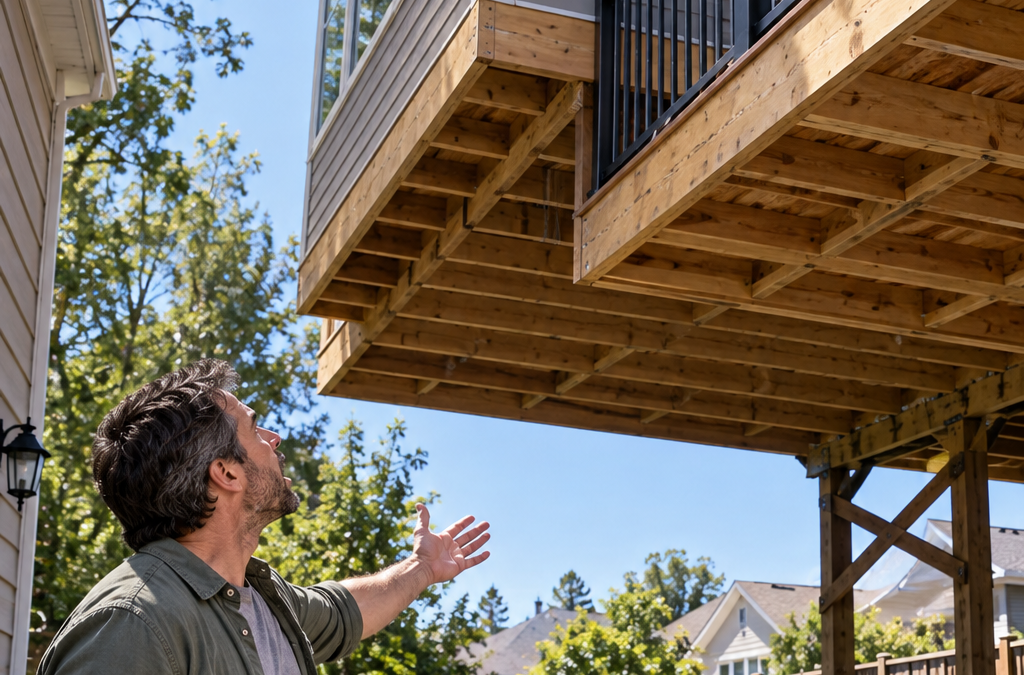
There was a massive wooden balcony extending from the second story of Ronald’s house.
It projected outward from the rear wall, high above the fence separating our properties.
And part of it was hanging directly over my backyard.
I stood perfectly still.
The balcony was enormous.
It extended roughly eight feet from Ronald’s house, with a substantial section reaching beyond the property boundary on my side.
The railing was finished.
The decking looked expensive.
Decorative string lights were already hanging along the edge.
This wasn’t an unfinished construction project.
It looked ready for parties.
Then my eyes moved downward.
And I saw the support post.
A thick wooden post had been installed on my side of the fence, anchored into a concrete footing.
Right where my raised garden bed had been.
For a moment, I genuinely wondered whether I was seeing things.
I walked closer.
The garden bed was destroyed.
The wooden frame I’d built the previous spring had been crushed and displaced.
Soil was scattered across the grass.
The plants I’d spent months caring for were gone.
A concrete footing occupied the space where they used to grow.
My dog wandered over and began sniffing the post.
I looked up at the balcony again.
Then down at the concrete.
Then toward Ronald’s house.
“No way,” I said aloud.
There was nobody outside.
I walked along the fence, trying to understand the geometry of what had happened.
The balcony wasn’t merely close to the property line.
It crossed it.
The structure overhead cast a shadow across part of my patio furniture.
The support post stood in my yard as though somebody had simply decided the boundary didn’t matter.
I felt a slow, unpleasant pressure building in my chest.
I had spent years making this backyard peaceful.
I planted flowers.
I built the raised garden bed myself, working through an entire weekend to get the boards level and the soil prepared.
I chose that spot carefully because it received good sunlight.
The garden wasn’t expensive.
Nobody would have mistaken it for something in a landscaping magazine.
But it was mine.
I remembered kneeling in the dirt with aching hands, pressing the first seedlings into place.
I remembered checking on them after storms and watering them during dry summer evenings.
Now they were buried beneath somebody else’s construction project.
And nobody had even asked me.
That was the part I couldn’t understand.
Someone had hired a crew, brought equipment onto my property, poured concrete, destroyed my garden, and installed part of a permanent structure while I was away.
There had been no phone call.
No email.
No note on my door.
Nothing.
I walked back to the patio and sat down.
I was still trying to decide whether to confront Ronald immediately when his sliding door opened.
He stepped onto the new balcony.
Beer in hand.
Big smile.
He looked down at me.
“Hey, man! Welcome back!”
I stared up at him.
“Ronald.”
“What do you think?”
I didn’t answer immediately.
He spread one arm proudly.
“Just finished it Thursday. Turned out great, right?”
I looked at the structure.
Then back at him.
“Ronald, why is your balcony over my backyard?”
He laughed lightly.
“Pretty nice, isn’t it?”
“That’s not what I asked.”
He leaned against the railing.
“Contractor did a fantastic job.”
I pointed toward the support post.
“That post is in my yard.”
He glanced down.
“Oh, yeah.”
I waited.
He took another sip of beer.
“The contractor said we needed it there for the proper support. Something about load-bearing requirements.”
I stared at him.
“And you thought that meant you could put it on my property?”
He shrugged.
“It’s just a post.”
I felt my jaw tighten.
“It’s a post installed in my yard without my permission.”
“Come on, man. It’s only a few feet.”
“A few feet of my property.”
“You won’t even notice it after a while.”
I looked down at the destroyed garden.
“I’m noticing it right now.”
He laughed again, as if I were being unreasonable.
“Relax. I’ll get someone to fix your little garden.”
My little garden.
I remember those words because they told me exactly how seriously he took what he’d done.
To Ronald, the damage was insignificant because it hadn’t happened to something he valued.
He saw a few pieces of wood and scattered soil.
I saw an entire weekend of labor, months of care, and part of the space I’d bought because I wanted it to remain private.
“Ronald,” I said, trying to keep my voice controlled, “you built part of your house over my property. This isn’t about a garden bed.”
His smile faded slightly.
“Look, I checked everything before we started.”
“Checked what?”
“The setbacks.”
“Then you know where the property line is.”
He straightened.
“Actually, airspace above a certain height is fair game.”
I stared at him.
“What?”
“The airspace,” he repeated, with the patience of someone explaining a simple concept to a child. “You own the ground. That doesn’t mean you control everything above it.”
I looked up at the massive structure projecting over my patio.
“And the post?”
He waved his hand.
“Technical necessity.”
“That’s still my land.”
“My contractor confirmed the design was fine.”
“Did your contractor see a property survey?”
His expression changed.
“Listen, buddy.”
The way he said buddy made my stomach tighten.
It wasn’t friendly.
It was a warning wrapped in a smile.
“I work in real estate. I know how this stuff works.”
“Then you should know you can’t build on someone else’s lot.”
He leaned over the railing.
“If you’ve got a problem, take it up with the HOA.”
I looked at him.
He smiled again.
“I’m on the board, remember?”
I didn’t respond.
“Or hire a lawyer and fight mine. But I’m telling you now, you’re making a mountain out of a molehill.”
I stood there, looking up at him.
He genuinely believed the conversation was over.
He believed his contractor’s opinion, his real estate experience, and his HOA position were enough to make the issue disappear.
Then he lifted his beer slightly.
“Enjoy your evening.”
He stepped inside.
The sliding door closed.
I stood in the yard for a long time.
Not shouting.
Not threatening.
Just looking at the balcony.
There are moments when somebody treats you so dismissively that your first instinct is to argue until they understand.
I wanted to march over, pound on his door, and demand that he explain how any reasonable person could think this was acceptable.
But I had just spent days caring for my father, and I was exhausted.
More importantly, I knew an argument wouldn’t accomplish anything.
Ronald had already told me how he intended to handle this.
He would rely on his connections.
He would dismiss my concerns.
And if I refused to back down, he would make the dispute expensive and unpleasant.
So instead of going to his front door, I took out my phone.
I started taking photographs.
The support post.
The concrete footing.
The damaged garden.
The fence line.
The balcony from different angles.
The shadow stretching across my patio.
I moved carefully around the yard, documenting everything I could see.
By the time I finished, I had approximately forty photographs.
The sun was beginning to set.
I looked at the support post one last time.
Then I went inside.
That night, I barely slept.
Every time I closed my eyes, I saw Ronald leaning over the railing with that smug smile.
Take it up with the HOA.
I’m on the board.
Hire a lawyer and fight mine.
I kept wondering whether he had waited until I left the state on purpose.
I couldn’t prove that.
Maybe the timing was coincidence.
But he’d had months of renovation work and plenty of opportunities to mention the balcony.
Instead, a structure had appeared over my backyard while I was gone, and his only response was to tell me it wasn’t a big deal.
The following morning, I went straight to the filing cabinet in my home office.
I kept important property documents there.
Closing paperwork.
Insurance documents.
Tax records.
And surveys.
When I’d purchased the house, I received a property survey.
Two years later, while considering extending my fence, I’d paid for another survey to verify the boundaries.
At the time, it had felt like an unnecessary expense.
Now it was one of the most valuable documents I owned.
I spread the survey across my desk.
The property line was clearly marked.
There was no confusing shared space, unusual easement, or ambiguous boundary in the area where Ronald had built.
I took the survey outside.
Then I brought out a tape measure.
I checked the fence line and the location of the support post.
The post stood approximately twenty-six inches inside my property boundary.
The outer edge of the balcony extended about forty-two inches beyond the line.
I measured again.
Then once more.
I wanted to be absolutely certain before taking another step.
But there was no uncertainty.
Ronald’s balcony wasn’t barely touching my property.
It was occupying it.
A permanent support post, with a concrete footing, had been placed more than two feet inside land that belonged to me.
And the balcony overhead extended even farther.
I stood beside the post with the tape measure in my hand.
For a moment, the absurdity of the situation almost made me laugh.
Ronald had spent months talking about his knowledge of real estate.
He walked around telling other homeowners how to maintain their properties.
And he’d apparently authorized the construction of a major addition without bothering to respect the most basic boundary in residential property ownership.
That evening, I opened the HOA’s governing documents.
Our covenants, conditions, and restrictions included an entire section devoted to exterior modifications.
Decks.
Balconies.
Fences.
Structural additions.
Anything that materially changed the outside of a home required architectural review before construction began.
A homeowner was supposed to submit plans, receive approval, and ensure the project complied with applicable rules.
The process was clear.
I searched the association’s online records.
I found no approved application for Ronald’s balcony.
Nothing.
No architectural request.
No approved drawings.
No record of permission for the structure.
I sat back in my chair.
Ronald had told me to take the matter to the HOA.
So I decided to do exactly that.
On Monday morning, I wrote an email to the HOA management company.
I kept the message factual.
I explained that my neighbor had constructed a second-story balcony extending across our shared property boundary.
I stated that a support post and concrete footing had been installed inside my yard without my permission.
I attached the photographs.
I included the survey.
I cited the architectural review requirements.
And I requested a formal investigation into the unapproved structure.
I didn’t insult Ronald.
I didn’t speculate about his intentions.
I didn’t mention his personality or his habit of lecturing people about their lawns.
I wanted the evidence to speak for itself.
Then I called the county building department.
A woman answered.
I explained the situation and provided Ronald’s address.
She pulled up the property records.
I waited while she searched.
“You’re asking about a second-story balcony?” she said.
“That’s right.”
There was a pause.
“I’m not seeing a permit for that.”
I sat upright.
“No permit at all?”
“Not for the balcony addition you’re describing.”
I looked through my office window toward Ronald’s house.
“There’s a large structure attached to his second floor, and one of the support posts is inside my property.”
She asked several questions.
I answered them carefully.
Then she said an inspector could be sent to evaluate the structure.
After hanging up, I sat quietly at my desk.
For the first time since coming home, I felt something other than anger.
Relief.
Not because the problem was solved.
It wasn’t.
But because somebody was finally treating it as a legitimate concern.
Two days later, the county called me back.
An inspector had visited Ronald’s property.
The balcony had been constructed without the required permit.
The inspector had also identified the encroachment onto my property.
Ronald was being issued a notice of violation and a stop-work order.
I asked what happened next.
The inspector explained that Ronald would need to bring the structure into compliance.
That could involve obtaining proper approval if the structure met the requirements.
But any part extending onto land he didn’t own presented an obvious obstacle.
Otherwise, removal would be necessary.
After the call, I walked outside.
The balcony was still there.
The post was still there.
My garden was still destroyed.
But now there was an official record establishing that the construction wasn’t properly authorized.
And Ronald’s claim that everything had been checked and approved was looking increasingly ridiculous.
The HOA process moved more slowly.
A few days later, the management company acknowledged my complaint.
They confirmed that no architectural review application had been submitted for the balcony.
The matter was being forwarded to the appropriate committee.
A formal violation notice would be issued.
I saved every email.
Every attachment.
Every response.
I created a folder on my computer and backed up all the photographs.
I had learned enough from Ronald’s first response to know that this dispute might not end quickly.
About a week after I’d returned home, someone knocked on my front door.
I opened it.
Ronald stood on the porch.
He was holding a piece of paper in one hand and his phone in the other.
His face was red.
“You called the county on me?”
I looked at the paper.
The violation notice.
“Yes.”
He stared at me.
“You actually reported me?”
“I also filed a complaint with the HOA, like you suggested.”
His expression darkened.
“You’re unbelievable.”
I kept my voice calm.
“You built on my property.”
“It’s a couple of feet!”
“That you don’t own.”
He stepped closer.
“Do you have any idea how much this is going to cost me?”
I looked at him.
“Did you consider that before building it?”
He shook his head.
“This is ridiculous. I’ve put thousands of dollars into that balcony.”
“And you destroyed my garden.”
“I already told you I’d fix that!”
“That’s not the issue.”
“Then what is?”
I stared at him.
“The issue is that you believe you can use my property without asking.”
He made an angry gesture toward his house.
“I’m on the HOA board. You think your little complaint is going anywhere?”
“I think the board has rules.”
“I know everyone on that board.”
“Good. Then they’ll know where to find you.”
His eyes narrowed.
For a second, I wondered whether he might actually try to push his way past me.
Instead, he leaned forward.
“You’re going to regret this.”
I felt a cold sensation move through my chest.
“What exactly is that supposed to mean?”
“It means I have a real estate attorney who handles cases like this all the time. You want to play games? Fine. We’ll play games.”
I looked at him.
“Then you should probably call your attorney.”
He stared.
I continued.
“Because I’m not withdrawing the complaint.”
His jaw tightened.
He turned abruptly and walked away.
I watched him cross the lawn and disappear into his house.
Only after closing the door did I realize my hands were shaking.
I wish I could say I was completely fearless.
I wasn’t.
There is something unsettling about being threatened by someone who lives a few feet away.
I couldn’t avoid Ronald.
His house was next to mine.
His balcony was still hanging over my backyard.
And now he was angry.
I worried about what he might do next.
I worried about legal bills.
I worried that his connections might actually give him influence over the HOA process.
For several minutes, I stood in my kitchen imagining all the ways the situation could become worse.
Then I went back to my desk.
I opened the survey again.
Twenty-six inches.
Forty-two inches.
Those measurements weren’t opinions.
They didn’t change because Ronald was angry.
They didn’t change because he claimed to know city officials.
They didn’t change because he had an attorney.
The property line existed regardless of who was standing on either side of it.
And I decided I was going to trust the documentation rather than his threats.
Over the following weeks, Ronald began telling other neighbors his version of the story.
According to him, I was being difficult.
I was wasting HOA resources.
I was creating an unnecessary dispute over a minor misunderstanding.
He described the balcony as a beautiful improvement to the neighborhood.
He made it sound as though I’d decided to attack him because I didn’t like the view.
A few people seemed willing to believe him.
Most were more skeptical.
Several neighbors had already seen the structure extending across the fence.
It’s difficult to convince people that a concrete support post isn’t on somebody else’s property when they can see it with their own eyes.
One afternoon, my good neighbor from the other side of the house came over.
He looked toward Ronald’s property.
“That guy’s been making the rounds.”
I sighed.
“I figured.”
“He came to my house yesterday.”
“What did he want?”
“He wanted me to sign something.”
I frowned.
“Sign what?”
“Some informal statement supporting his balcony. Said the neighborhood needed to stand together against unreasonable complaints.”
I stared at him.
“You’re kidding.”
“Nope.”
“What did you say?”
My neighbor smiled.
“I told him I wasn’t signing anything.”
I felt an unexpected wave of gratitude.
“Thank you.”
He shrugged.
“I saw your garden before you left. I see that post now. Doesn’t take an engineer to figure out something’s wrong.”
I looked toward Ronald’s balcony.
“Apparently, it takes a lawyer.”
He laughed.
Then his expression grew serious.
“Just be careful. He’s angry.”
“I know.”
“Keep everything documented.”
“Believe me. I am.”
That advice turned out to be important.
The HOA scheduled a formal hearing.
Because Ronald was accused of violating the architectural rules, he was entitled to present his side of the dispute.
I had no objection to that.
If the association was going to enforce its rules, the process needed to be fair.
What surprised me was Ronald’s apparent belief that being on the board meant he could participate in deciding his own case.
At the hearing, he attempted to sit with the board members.
He behaved as though he were there to judge the complaint rather than answer it.
The property manager stopped him.
“Ronald, you have a conflict of interest.”
He frowned.
“I’m a board member.”
“Yes. And this matter concerns your property.”
“I have a right to participate.”
“As the homeowner responding to the violation. Not as someone voting on it.”
He began arguing.
She remained calm.
Then she referred to the bylaws governing conflicts of interest.
Ronald insisted that he knew the rules.
The manager explained them again.
Finally, she made the choice unmistakable.
He could participate as the homeowner whose property was being discussed, or he could leave.
He could not help decide his own violation.
For several uncomfortable seconds, Ronald sat perfectly still.
Then he moved to the homeowner’s side of the room.
He looked furious.
I sat with my documents arranged in front of me.
My heart was beating faster than I wanted to admit.
I’d prepared for this meeting carefully.
I had printed the survey.
I had selected the clearest photographs.
I had written a timeline showing when I left for Arizona, when I returned, and when I discovered the construction.
I had copies of the HOA requirements and the county violation notice.
When it was my turn, I stood and explained what had happened.
I described coming home on Sunday afternoon.
I showed the committee the destroyed garden.
I pointed out the support post and the balcony overhang.
Then I presented the survey measurements.
I didn’t exaggerate.
I didn’t need to.
The evidence was already damaging enough.
One committee member leaned forward to examine the survey.
“You’re saying the support post is more than two feet inside your property?”
“Approximately twenty-six inches.”
“And the deck itself extends farther?”
“About forty-two inches beyond the boundary.”
She looked at the photographs.
Then at Ronald.
Another member asked whether Ronald had submitted an architectural review application.
Ronald cleared his throat.
“I didn’t believe one was required for this particular project.”
The room became quiet.
The committee member looked down at the governing documents.
“The rules require approval for exterior structural additions.”
Ronald shifted in his chair.
“This was part of a larger renovation.”
“That doesn’t exempt it from review.”
“My contractor handled the technical details.”
The committee asked whether he had documentation establishing that the balcony remained within his property.
He hesitated.
“My contractor assured me it was compliant.”
“Do you have measurements?”
“Not with me.”
“A survey?”
“No.”
“Any documentation showing the support post was approved on the neighboring lot?”
Ronald’s expression hardened.
“You’re making this more complicated than it needs to be.”
I stared at him.
He had installed concrete inside my yard without permission.
And he was accusing everyone else of creating complications.
The committee continued asking questions.
Ronald kept referring to his contractor.
But he couldn’t produce an approved plan.
He couldn’t produce a permit.
He couldn’t produce a survey contradicting mine.
And he couldn’t explain why he believed he had permission to occupy my property.
Eventually, the committee members deliberated.
Then they returned their decision.
The balcony was an unapproved exterior structure.
It violated the association’s architectural procedures.
And the evidence showed that it encroached onto a neighboring property.
The decision was unanimous.
Ronald was ordered to bring the structure into compliance within sixty days.
That meant obtaining valid approval and demonstrating that the structure respected the property boundary, or removing the offending construction.
Given the support post and overhang, I couldn’t imagine how he could satisfy the first option without major changes.
I should have felt relieved.
And I did.
But when I looked across the room at Ronald, I saw that the battle wasn’t over.
He was staring at the committee members with an expression of absolute disbelief.
He seemed unable to accept that the same association he’d used to lecture other homeowners had just held him accountable.
The following days proved I was right.
Ronald began sending angry emails to the board.
He accused the architectural committee of bias.
He called the decision a personal attack.
He claimed I had somehow convinced the property manager to turn against him.
He demanded that the full board overturn the committee’s ruling.
I didn’t respond to his accusations.
I had learned that arguing with Ronald only gave him more opportunities to turn the dispute into a battle of personalities.
I continued documenting everything and allowed the process to move forward.
The full board met the following month.
I wasn’t present for that meeting, but my good neighbor attended as a homeowner.
He came over afterward to tell me what happened.
The moment he approached my porch, I could tell there was a story.
He was trying not to smile.
“You’re not going to believe this.”
I looked at him.
“That bad?”
“Worse.”
We sat outside, and he described the meeting.
Ronald had stood before the board and delivered a long speech.
He said the HOA existed to protect property values.
He argued that his balcony was a high-quality improvement.
He claimed that forcing him to remove it would damage the neighborhood.
And once again, he portrayed me as the problem.
According to my neighbor, Ronald spoke as though the real issue wasn’t a structure crossing a property boundary but an unreasonable homeowner who refused to appreciate his investment.
The board president listened.
Then he explained that the architectural committee had followed the proper process.
The governing documents required approval.
Ronald hadn’t obtained it.
The structure encroached on neighboring property.
The board would not overturn the decision.
My neighbor said Ronald went quiet for a moment.
Then the president continued.
Several homeowners had complained about Ronald using his board position to influence the outcome of his own violation.
The board intended to consider whether his conduct was compatible with continued service.
That was when Ronald exploded.
He began shouting.
He demanded to know whether anyone appreciated how much work he’d done for the neighborhood.
He talked about organizing events, handling contractors, and improving property values.
He accused the board of betraying him.
He threatened to sue the association.
The president asked him to sit down.
Ronald refused.
Other members told him he was out of line.
He kept yelling.
I listened as my neighbor described the scene.
Then I asked the question that had been sitting in my mind.
“What happened?”
My neighbor smiled.
“They voted.”
“On what?”
“Removing him.”
I stared.
“From the board?”
He nodded.
“The bylaws allow it for conduct detrimental to the association. Apparently, they decided this qualified.”
I leaned back in my chair.
For a moment, I couldn’t think of anything to say.
Ronald had spent months reminding everyone that he was an HOA board member.
He’d used that title as a shield.
He had assumed it made him untouchable.
And now the other board members had taken it away.
I didn’t laugh.
Not immediately.
Mostly, I felt astonished by how completely he’d misjudged the people around him.
He’d assumed they would protect him simply because they knew him.
Instead, they had protected the rules.
For all the horror stories people tell about homeowners associations, I had found myself in the unusual position of being grateful that mine was doing its job.
But Ronald wasn’t finished.
About two weeks after losing his board position, I received a letter from an attorney.
It was written in the kind of formal language designed to make ordinary people nervous.
Ronald disputed the property line.
He disputed the association’s authority.
He claimed the balcony was legally permissible.
He also accused me of interfering with his property rights.
The letter warned that further harassment or interference could result in legal action.
I read it once.
Then again.
Then I put it down and stared at the ceiling.
For a few seconds, I actually laughed.
Not because lawsuits are funny.
They aren’t.
The thought of spending thousands of dollars on attorneys made my stomach turn.
But the argument was almost impossible to believe.
Ronald had built a support post inside my yard.
I’d reported the encroachment.
And now he was accusing me of interfering with his property.
I called the property attorney who had helped me when I purchased the house.
He returned my call the next day.
I sent him the letter, the surveys, the photographs, the county findings, and the HOA documents.
He reviewed everything.
Then he called again.
“This is a very straightforward boundary dispute,” he said.
I let out a breath.
“That’s what I thought.”
“You have a clear survey. The county has documented the permit violation. The HOA has followed its process.”
“Ronald says he owns the airspace.”
My attorney paused.
Then he asked, “What does he say about the support post?”
I looked toward the backyard.
“Apparently, that’s a technical detail.”
My attorney gave a short laugh.
“A concrete footing inside your lot isn’t a technical detail.”
I felt some of the tension leave my shoulders.
“So what do we do?”
“We respond properly. Keep your documentation. Don’t touch the structure yourself.”
“I wasn’t planning to.”
“Good. If he wants to litigate, we’ll address it through the court.”
I thanked him.
After hanging up, I sat quietly for a while.
I had hoped the HOA decision would end the dispute.
Then I’d hoped losing his board position might convince Ronald to reconsider.
Instead, he was moving toward a lawsuit.
The situation had become exhausting.
I couldn’t step into my backyard without seeing the balcony.
I couldn’t look at my ruined garden without remembering the confrontation.
Every new letter or email made me wonder what the next few months would cost.
And there were moments when I asked myself whether it would be easier to give up.
Not because Ronald was right.
But because defending something you already own can be surprisingly exhausting.
He had created the problem.
He had ignored the boundary.
He had refused to correct it.
Yet I was the one spending evenings organizing documents and worrying about legal fees.
I remember sitting on my patio one night, looking at the support post.
The yard was quiet.
The string lights on Ronald’s balcony glowed above me.
My dog lay beside my chair.
I thought about the day I first saw the property.
How peaceful the backyard had felt.
How quickly I had decided this was where I wanted to live.
And I realized that if I surrendered simply because Ronald made the dispute unpleasant, I would be giving him exactly what he’d wanted from the beginning.
He had relied on intimidation.
He had counted on the cost of resistance.
He had assumed I would eventually decide a few feet of land weren’t worth fighting for.
But the dispute had stopped being about a few feet long ago.
It was about whether someone could take what belonged to another person and then use money, connections, and threats to make the theft permanent.
I looked toward the balcony.
Then I went inside and organized my legal paperwork.
Ronald filed the lawsuit.
He sued me, alleging wrongful interference with his property rights.
He also sued the HOA, claiming the association had exceeded its authority and unfairly singled him out.
His argument centered heavily on the same theory he’d announced from his balcony with a beer in his hand.
He claimed that the airspace at the height of the second-story structure wasn’t legally part of my property in the way I argued it was.
He also insisted the association had acted out of personal bias.
My attorney responded.
We filed counterclaims addressing the trespass and damage to my property.
That included the destroyed garden bed and the tree trimming Ronald had arranged to accommodate the construction.
We also requested a court order requiring removal of the encroaching structure.
The HOA had its own attorney.
Its legal response emphasized the governing documents and the procedures the association had followed.
Ronald had never submitted the required architectural application.
He’d been given an opportunity to respond.
The committee had considered the evidence.
The board had declined to overturn the finding.
From my perspective, the process had been remarkably fair.
Ronald simply hadn’t liked the result.
The lawsuit dragged on for approximately four months.
Four months of legal documents.
Four months of uncertainty.
Four months of looking into my backyard and seeing a balcony that never should have been there.
Ronald argued that he shouldn’t have to remove the structure while the case was pending.
So it remained.
The county, however, continued enforcing its own requirements.
Fines accumulated because the unpermitted structure hadn’t been brought into compliance.
Ronald kept fighting.
At times, I wondered whether he truly believed he could win.
Maybe he did.
Maybe his attorney had convinced him there was a legal argument worth pursuing.
Or maybe Ronald had spent so much time presenting himself as the most knowledgeable person in every room that admitting a mistake had become impossible.
I couldn’t know.
What I did know was that my legal expenses were growing.
Every time my attorney contacted me, I felt a knot form in my stomach.
I wasn’t wealthy.
I had bought a modest home because it fit my budget.
I didn’t have unlimited money to spend proving where my own property line was.
Some evenings, I would look at the invoices and feel an anger deeper than anything I’d experienced during the original confrontation.
Ronald had taken something from me.
And now I was paying to force him to give it back.
But my attorney remained confident.
He reminded me that the documents were consistent.
The survey established the boundary.
The county had documented the permit problem.
The HOA had found an architectural violation.
And the physical evidence was difficult to argue with.
A concrete footing doesn’t become imaginary because someone calls it incidental.
Eventually, the case reached the hearing that would decide the dispute.
I remember arriving at the courthouse feeling strangely detached.
I’d spent so many months thinking about that day that when it finally came, everything seemed quieter than I’d expected.
There was no dramatic music.
No crowd waiting outside.
Just a courthouse hallway, attorneys carrying files, and people going about their business.
My attorney met me before the proceedings.
“How are you feeling?”
“Nervous.”
“That’s normal.”
I looked at him.
“Are we ready?”
He nodded.
“We have the evidence.”
We went inside.
Ronald was there with his attorney.
He looked polished and confident, wearing a suit that probably cost more than my monthly mortgage payment.
For a moment, seeing him that way made me uneasy.
Then I remembered what my lawyer had said.
The courtroom wasn’t a contest over who looked more important.
It was a place where evidence mattered.
The judge reviewed the documents.
The surveys.
The county records.
The HOA findings.
The photographs.
The timeline.
Ronald’s attorney argued that the second-story overhang did not constitute an unlawful encroachment because of its height above the ground.
I sat quietly, listening.
It was the same theory Ronald had explained to me from his balcony.
Only now it was being presented in a courtroom.
The judge listened.
Then asked about the support post.
The attorney paused.
The judge referred to the photographs and survey.
The post was physically anchored inside my lot.
Its concrete footing was located on my property.
How, the judge wanted to know, did that fit the argument that the structure didn’t intrude on my land?
Ronald’s attorney described the post as incidental contact.
I almost turned my head.
Incidental contact.
Those two words were so absurd that for a moment I wondered whether I’d heard correctly.
The judge appeared similarly unconvinced.
He asked for clarification.
A concrete footing.
A permanent structural support.
Installed inside a neighboring lot.
Was that what counsel meant by incidental contact?
The attorney attempted to explain.
But the phrase hung in the room.
I thought about my garden.
About the dirt scattered across my lawn.
About the plants crushed during construction.
About Ronald looking down at me and dismissing everything as no big deal.
And now the lawyer defending him was trying to describe a permanent construction intrusion as incidental.
My attorney presented our evidence methodically.
The survey showed the boundary.
The photographs showed the support post.
The county inspector’s findings established the permitting problems.
The HOA records showed that no architectural review had been approved.
The timeline demonstrated that the construction took place while I was out of state, without notice or consent.
There were photographs of the garden damage.
And evidence of the fence and landscaping damage associated with the work.
Nothing about the dispute was theoretical.
The balcony existed.
The post existed.
The damaged property existed.
And the boundary was documented.
When the judge delivered the ruling, I felt my entire body go still.
The court found in my favor.
The balcony constituted an unlawful encroachment onto my property.
The construction had caused actual property damage.
The HOA had followed proper procedures in enforcing its architectural requirements.
Ronald’s claims against me and the association were dismissed.
The judge ordered the removal of the encroaching structure within thirty days.
The court also awarded damages addressing the destroyed garden bed, damaged fence section, and my legal fees.
For a moment, I didn’t move.
I had imagined hearing that decision for months.
I thought I would feel an overwhelming rush of victory.
Instead, the strongest emotion was relief.
A deep, almost physical relief.
The kind that comes when you’ve been carrying something heavy for so long that you’ve forgotten what it feels like to put it down.
My attorney leaned toward me.
“That’s what we needed.”
I nodded.
I couldn’t immediately find the words.
Across the room, Ronald looked stunned.
His attorney spoke to him quietly.
I didn’t try to read his expression.
I didn’t need to.
The ruling was clear.
The balcony had to go.
Afterward, Ronald’s attorney explored whether some redesigned version of the balcony might be possible.
My attorney explained that the court had ordered removal of the encroaching construction.
Any future project would need to satisfy the normal requirements, including appropriate permits and HOA approval.
Ronald couldn’t simply declare a new design acceptable and begin building again.
The matter had already gone far beyond a misunderstanding between neighbors.
A court had ruled.
And there was a deadline.
Thirty days.
I went home and walked into my backyard.
The balcony was still there, of course.
Its railing cast the same shadow over my patio.
The support post still occupied the place where my garden had been.
But it looked different to me.
Not physically.
Nothing had changed.
What changed was that I finally knew the structure wouldn’t remain there forever simply because Ronald had decided it should.
The thirty-day countdown began.
For the first week, nothing happened.
No contractors.
No equipment.
No signs of preparation.
The second week passed.
Still nothing.
By the third week, I began to worry.
I didn’t want another fight.
I didn’t want another courtroom.
I didn’t want to spend more money asking someone to obey an order that had already been issued.
But Ronald seemed determined to delay until the last possible moment.
I wondered whether he was hoping for another legal maneuver.
Perhaps he believed I would offer a compromise.
Perhaps he thought enough time would make the problem disappear.
Whatever he was thinking, the balcony stayed exactly where it was.
On the twenty-fifth day, my attorney sent a reminder to Ronald’s attorney.
The court had ordered removal.
The deadline was approaching.
Failure to comply could lead to contempt proceedings.
I received a copy of the communication.
I read it carefully.
Then I placed it in the folder with everything else.
Two mornings later, I woke to the sound of trucks.
At first, I thought someone was starting another renovation nearby.
Then I looked out my window.
A construction crew had arrived at Ronald’s house.
Three workers were unloading tools and preparing equipment.
I stood at the window, watching.
For a few seconds, I didn’t let myself believe what I was seeing.
Then one of the workers climbed onto the balcony.
Another began examining the railing.
A third brought over tools.
They were taking it apart.
I felt something in my chest loosen.
After months of letters, meetings, hearings, threats, and court proceedings, the actual removal began with the ordinary sound of power tools.
No dramatic confrontation.
No screaming.
Just workers doing the job Ronald should have arranged long before.
I was working from home that day.
I tried to concentrate on my normal responsibilities, but every few minutes I found myself looking outside.
The crew began with the decking.
Boards came loose one after another.
The polished surface Ronald had proudly shown me disappeared piece by piece.
Then they removed the railing.
The string lights were taken down.
The beams were exposed.
I remembered the first time I’d seen that balcony.
How enormous it had looked.
How permanent.
How confidently Ronald had stood above me and explained that I had no right to object.
Now the structure was being dismantled by three men with tools.
I didn’t smile much.
Mostly, I watched in silence.
Because watching something come apart is a strange experience when you’ve spent months wishing it had never been built.
The next day, the crew continued.
They removed the remaining structural components.
Then they addressed the support post in my yard.
That was the part I’d been waiting for.
The post had stood beside my fence for months, a constant reminder that somebody had crossed a boundary and expected me to accept it.
Removing it wasn’t as simple as lifting it from the ground.
The concrete footing was substantial.
The workers had to use a small excavator to dig it out.
I stood near the patio, keeping a safe distance.
The machine broke through the soil.
Dirt piled up.
Then, slowly, the concrete footing emerged.
It left behind a hole approximately two feet wide and a foot and a half deep.
I stared at it.
For months, that footing had been treated as though it were a harmless technicality.
Now I could see exactly how much of my yard had been disturbed to install it.
The crew filled the hole with dirt and compacted the area.
It didn’t magically restore the garden.
It didn’t replace the plants.
It didn’t erase the damage.
But the post was gone.
For the first time since I’d returned from Arizona, the ground beneath that section of the yard was no longer occupied by Ronald’s structure.
The final beams came off his house.
Once everything was removed, an ugly rectangular patch remained where the balcony had been attached.
There were bolt holes.
Discolored siding.
Areas where flashing no longer served any purpose.
The back of Ronald’s house looked unfinished.
He would need additional repairs to restore it.
I stood on my patio and watched the workers cleaning up.
The foreman eventually came over.
“Hey,” he said. “You the homeowner here?”
“Yes.”
He gestured toward the disturbed section of my yard.
“Do you want us to do anything else with that area? Maybe put down sod?”
I looked at the dirt.
Then toward Ronald’s house.
“That’s something your client and I will need to deal with.”
The foreman nodded.
“Fair enough.”
He returned to his crew.
I watched them load their equipment.
Then the trucks pulled away.
The yard was quiet again.
And for the first time in months, nothing hung over my patio.
I walked across the grass to where the support post had been.
I stood there for a long moment.
There was no great rush of excitement.
No dramatic speech.
Just an empty space.
A patch of disturbed earth.
And the knowledge that the boundary I’d defended had finally been respected.
Later, through the court records and related filings, I learned more about what the entire ordeal had cost Ronald.
The demolition alone was approximately fourteen thousand dollars.
His own legal expenses were around eight thousand.
The HOA had also incurred significant legal fees.
There were county fines from the period when the unpermitted structure remained standing.
Then there was the original cost of constructing the balcony.
And the expense of repairing the rear of his house after its removal.
When everything was considered, the total financial damage was somewhere in the neighborhood of fifty to sixty thousand dollars.
For a balcony he’d enjoyed for only about six months.
I thought about the first conversation we’d had after I returned from Arizona.
“It’s only a few feet,” he’d said.
“You won’t even notice it.”
He had treated the boundary as insignificant.
The garden as disposable.
My concerns as foolish.
And the idea of following the rules as something beneath him.
Now those few feet had cost him more than many people spend on a vehicle.
The irony was impossible to ignore.
But I didn’t spend my evenings calculating his losses.
I had my own life to rebuild.
The legal dispute had taken months.
It had consumed time I could have spent with friends or family.
It had turned ordinary afternoons in my backyard into reminders of conflict.
It had made me nervous about answering the door.
And it had taught me how quickly someone else’s entitlement could invade a life that had previously been peaceful.
I wanted all of that behind me.
The aftermath was quieter than I’d expected.
Ronald and his wife stopped speaking to me.
There were no friendly waves.
No conversations near the mailbox.
No casual greetings across the driveway.
That didn’t bother me.
I’d never needed to be close friends with everyone on the street.
All I’d wanted from the beginning was for my property to be respected.
If silence was the price of that, I was perfectly comfortable paying it.
For a while, Ronald’s house remained noticeably scarred where the balcony had been attached.
I avoided looking at it.
I wasn’t interested in embarrassing him.
The consequences of his decisions were already visible enough.
My good neighbor occasionally asked how things were going.
I told him the legal matter was resolved.
He seemed genuinely happy for me.
One evening, we stood near the fence and talked about the whole ordeal.
“Never thought something like that would happen on this street,” he said.
“Neither did I.”
He shook his head.
“All he had to do was ask before building.”
I looked toward the area where my garden had been.
“Even asking wouldn’t have made that design okay.”
“True.”
He paused.
“But at least you’d have known what he was planning.”
I nodded.
That was the part I kept coming back to.
The entire disaster had begun with a decision to treat someone else’s property as available space.
Ronald could have built a smaller balcony.
He could have redesigned the supports.
He could have consulted a surveyor.
He could have followed the HOA process.
He could have obtained the proper permits.
There had been so many opportunities to prevent the problem.
Instead, he chose the option that required everyone else to accept his wishes without question.
And when I objected, he treated my refusal as an attack.
About two months after the balcony came down, a real estate sign appeared in Ronald’s front yard.
I noticed it one morning while taking out the trash.
For a moment, I stood on the driveway staring at it.
Then I went back inside.
The house was on the market.
I didn’t know exactly what had led Ronald and his wife to sell.
Maybe the legal expenses had created financial pressure.
Maybe the relationships in the neighborhood had become too uncomfortable.
Maybe they simply wanted to move somewhere else.
I wasn’t interested in inventing reasons.
All I knew was that after the court ruling and demolition, they had decided to leave.
The house sold relatively quickly.
It was still a nice property in a desirable neighborhood.
But I heard the final sale price was lower than they’d hoped, partly because the previous property dispute had to be disclosed.
I never found out all the details.
And frankly, I didn’t need to.
When the moving truck eventually arrived, I was working at home.
I heard the doors opening and closing.
I saw workers carrying boxes.
For a brief moment, I considered going outside.
Not to gloat.
Not to argue.
Just to acknowledge that this strange chapter of our lives was ending.
Then I decided against it.
There was nothing useful left for us to say.
The last meaningful conversation we’d had was already months behind us.
He had stood on my porch threatening legal action.
Later, he’d tried to defend his actions in court.
Both times, he had treated me as an obstacle to something he believed he deserved.
I didn’t need one final conversation to make him understand.
The survey had spoken.
The county had spoken.
The HOA had spoken.
And finally, the judge had spoken.
There was nothing more to add.
I went back to work.
By the end of the day, the moving truck was gone.
Soon afterward, Ronald and his wife were gone too.
And the street felt quiet again.
It took me longer than I expected to enjoy that quiet.
For months, every unfamiliar sound outside had made me look toward the window.
A vehicle pulling up.
A person walking near the fence.
A knock at the door.
I had become so accustomed to anticipating another problem that peaceful days almost felt suspicious.
But gradually, normal life returned.
My dog reclaimed the backyard as his personal kingdom.
The birds returned to the trees.
The evening breeze moved through the branches.
I could sit on my patio without a structure hanging over my head or a neighbor watching me from above.
And eventually, I started thinking about the garden again.
I remembered how excited I’d been when I first built it.
How proud I’d felt watching the plants grow.
For a while, looking at that section of the yard had made me angry.
Not because a garden bed was worth more than the legal bills.
But because it represented the reason I’d bought the house.
A small piece of land where I could work with my hands, enjoy the sunlight, and feel at peace.
Ronald had taken that feeling away for months.
And I didn’t want him to have the final word on what my backyard meant to me.
So I began making plans to restore the space.
Nothing elaborate.
Just another raised bed, fresh soil, and plants that would have room to grow.
The court’s decision had resolved the property dispute, but reclaiming the ordinary pleasure of living in my home was something I had to do for myself.
One evening, I stood near the cleared area and looked toward the tree line.
The late sunlight reached the grass where the balcony had once cast its shadow.
My dog wandered over and sat beside me.
I rested a hand on his head.
For a moment, I thought about how differently everything might have turned out if I’d simply ignored the post.
I could have told myself it wasn’t worth the trouble.
I could have convinced myself that a couple of feet didn’t matter.
I could have accepted Ronald’s promise to repair the garden and tried to forget that part of his house extended over my yard.
It would have been easier in the short term.
No HOA hearings.
No threats.
No lawyers.
No court appearances.
But every time I stepped outside, I would have known I’d allowed somebody to take advantage of me because confronting him was uncomfortable.
And I would have known that he had learned exactly the lesson I’d feared he would learn.
That if you act confidently enough, threaten loudly enough, and make resistance expensive enough, people will eventually surrender.
I didn’t want to live with that.
The experience changed the way I thought about boundaries.
Not just property lines.
Personal boundaries too.
Before Ronald, I had generally believed that being a good neighbor meant being accommodating.
If someone needed to borrow a tool, I helped.
If construction made noise for a few weeks, I tolerated it.
If a neighbor wanted to discuss a shared fence or landscaping issue, I listened.
I still believe those things.
Living near other people requires patience.
A neighborhood where everyone treats every inconvenience like a personal attack would be miserable.
But being reasonable doesn’t mean allowing someone else to define how much of your property, time, or peace you’re required to surrender.
Ronald confused my willingness to be patient with weakness.
He assumed that because I hadn’t complained about his renovations, I wouldn’t object when the construction crossed the property line.
He thought my desire to avoid conflict meant I would avoid it at any cost.
And when I finally said no, he acted as though I’d betrayed some unspoken agreement.
I hadn’t.
There was never an agreement.
There was just his belief that what he wanted mattered more than what belonged to me.
I’ve also thought a lot about the HOA.
Before this happened, I treated it as a background part of living in the subdivision.
I paid my dues and rarely considered what the association actually did.
Like many homeowners, I assumed the rules were mostly about exterior appearance.
Paint colors.
Landscaping.
Fence styles.
Things that seemed minor until someone decided those same rules didn’t apply to him.
But the architectural requirements existed for a reason.
A large elevated structure affects more than the homeowner who builds it.
It can affect drainage, safety, privacy, sunlight, and neighboring property.
A support post doesn’t become acceptable simply because the person who installs it thinks his design looks attractive.
The HOA’s review process was supposed to prevent exactly the kind of problem Ronald created.
And when he ignored that process, the association enforced it.
The property manager could have looked the other way because he was on the board.
She didn’t.
The architectural committee could have treated his position as a reason to soften the rules.
It didn’t.
The board could have protected him because he had volunteered his time.
Instead, it recognized that his conduct had become harmful to the association itself.
I know not every HOA handles disputes that responsibly.
I’ve heard enough stories to understand that.
But mine did.
And I’m grateful.
As for Ronald, I sometimes wonder whether he learned anything.
I hope he did.
Not because I want to imagine him sitting somewhere feeling miserable.
But because it would be a shame for someone to lose that much money, damage relationships with neighbors, and go through months of litigation without understanding why it happened.
He seemed convinced that his professional connections gave him authority over things he didn’t own.
He believed knowing the right people meant he could ignore the same rules everyone else followed.
And when the consequences arrived, he became even more determined to prove he was right.
That determination cost him dearly.
A balcony that probably could have been redesigned before construction became a lawsuit.
A damaged garden became a court-awarded claim.
A dispute that might have been resolved with an honest apology became months of hostility.
And a volunteer position on the HOA board became another casualty of his refusal to accept responsibility.
None of those consequences were inevitable.
They came from choices.
The first choice was building without properly checking the boundary.
The second was refusing to acknowledge the problem when I brought it to his attention.
The third was trying to use his position to intimidate me.
And after that, every new decision made the situation more expensive.
I’ve replayed our first confrontation more times than I can count.
I can still picture him leaning over the railing.
The beer in his hand.
The satisfied grin.
The way he said buddy as if he were generously explaining something to someone too ignorant to understand.
He told me the airspace was his.
He told me he knew the rules.
He told me to take it to the HOA.
Or hire a lawyer.
I remember standing below him, angry and exhausted after returning from Arizona, wondering whether I really had the energy for another problem.
At that moment, he probably believed he had won.
He had a finished balcony.
He had a contractor who supported his story.
He had a position on the HOA board.
He had an attorney.
And he had a neighbor who looked tired enough to give up.
What he didn’t understand was that I didn’t need to be more powerful than him.
I needed to be right about where my property ended.
I needed to document the facts.
And I needed to follow a process that didn’t depend on his opinion of me.
That’s what eventually made the difference.
Not shouting louder.
Not threatening him back.
Not trying to humiliate him in front of the neighborhood.
Just photographs, measurements, official records, and the patience to keep going when he expected me to stop.
The day the demolition crew removed the support post, I watched a machine pull the concrete from my yard.
It was an ugly, awkward process.
The soil was torn up.
The garden wasn’t restored.
The fence area still needed attention.
But when the concrete finally came free, I felt something I hadn’t experienced for months.
The sense that my home belonged to me again.
That feeling was worth defending.
And while I wouldn’t wish the legal expenses or the stress on anyone, I know I made the right decision.
One quiet evening after Ronald had moved away, I sat outside with a cup of coffee.
The air was cool.
The sky was fading into a soft orange behind the trees.
My dog was asleep near my chair.
There was no construction noise.
No shadow from a second-story balcony.
No stranger’s support post buried in my soil.
Only the familiar view that had convinced me to buy the house six years earlier.
I looked toward the empty space beside the fence.
For a moment, I remembered everything that had happened.
The anger.
The disbelief.
The sleepless nights.
The threats.
The courtroom.
The enormous relief of hearing the judge’s decision.
Then I looked away from the fence and out toward the trees.
I realized I hadn’t bought this house because I wanted to win property disputes.
I had bought it because I wanted a peaceful place to live.
And after everything Ronald had put me through, I finally had that again.
He had once stood above my backyard, smiling as though he owned more of my world than I did.
Now the balcony was gone, his house had been sold, and my yard was quiet.
I took another sip of coffee and watched the last sunlight disappear behind the trees.
For the first time in a very long while, I wasn’t thinking about Ronald at all.