𝙍𝙚𝙖𝙙𝙈𝙤𝙧𝙚👉 My Neighbor Excavated Six Feet Into My Land While I Was Away—Then Dared Me to Make Him Build the Wall That Destroyed His New Driveway
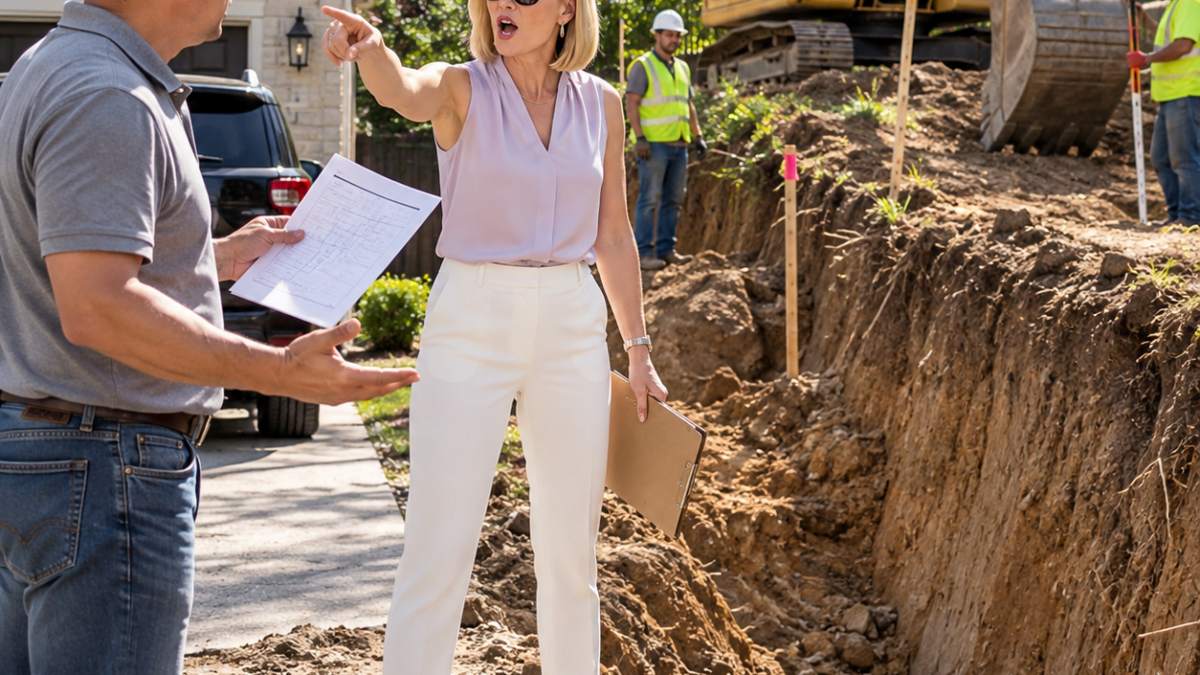
𝗙𝗨𝗟𝗟 𝗦𝗧𝗢𝗥𝗬
The gentle green incline that had run between our houses had been carved vertically downward.
Someone had removed trees.
Bushes.
Roots.
Soil.
Everything.
In their place was an exposed wall of raw earth.
Nearly eight feet high.
Straight.
Ugly.
And obviously unstable.
Thick roots stuck from the cut soil like broken cables.
Sections of loose dirt had already fallen.
The upper edge of my yard had been sliced open.
Below it was a new driveway.
Mr. Zhao’s driveway.
Fresh asphalt.
Wide.
Smooth.
And extending deeply into where my hill used to be.
For several seconds, I genuinely questioned whether I was looking at the right property.
Travel fatigue.
Jet lag.
Maybe the taxi had stopped one house too early.
Then I saw my front gate.
My windows.
My tree.
No mistake.
The driver got out.
“Everything okay?”
“No.”
I walked toward the cut.
The closer I got, the worse it looked.
The excavation wasn’t just cosmetic damage.
It was dangerous.
A sloped hill stays stable partly because gravity is distributed across that slope.
Roots reinforce the soil.
Vegetation slows water.
Mr. Zhao had simply cut the bottom away.
Now several tons of earth were standing nearly vertical.
One serious rainstorm could saturate the soil.
Then the entire face could collapse.
His new driveway would be buried.
So might his vehicles.
Worse, the collapse could pull more of my upper yard down with it.
I had seen enough construction projects through work to understand that this wasn’t something you simply “leave.”
It needed engineering.
Drainage.
Support.
Probably a retaining wall.
I paid the taxi driver.
Dragged my luggage into the house.
Dropped it just inside.
Didn’t even unpack.
Didn’t change clothes.
Didn’t call my wife yet.
I walked straight to Mr. Zhao’s front door.
And pounded on it.
He opened within a minute.
The expression on his face told me almost everything.
No surprise.
No confusion.
No fear.
He knew exactly why I was there.
And he looked pleased with himself.
“Back already?”
I stared.
“What did you do?”
He leaned against the doorframe.
“What?”
I pointed toward the hill.
“My property.”
He looked past me.
“Oh.”
“Oh?”
“I fixed the grading.”
“You destroyed my hillside.”
He shrugged.
“It was inefficient.”
For a second, I honestly couldn’t speak.
“You brought machinery onto my land.”
“My contractor graded the driveway.”
“You removed my trees.”
“They were mostly small.”
“You cut an eight-foot vertical wall into the hill.”
“Approximately.”
I stepped closer.
“That entire slope could collapse.”
“It hasn’t.”
“It will if we get enough rain.”
Mr. Zhao sighed.
“You always exaggerate.”
I stared at him.
Then noticed the driveway more carefully.
It had almost doubled in width.
Exactly what he had wanted months earlier.
“You did this because I wouldn’t sell.”
He smiled.
“Don’t be dramatic.”
“You asked for this land.”
“I asked to buy a strip.”
“I said no.”
“And I found another solution.”
That sentence burned into my memory.
“Another solution?”
He nodded.
Then disappeared inside.
For one stupid second, I wondered whether he was ending the conversation.
He returned holding a sheet of paper.
Official-looking.
Stamped.
Municipal header.
He handed it to me.
“Permit.”
I looked down.
It appeared to authorize driveway grading and modification.
There was a small site plan attached.
The drawing showed the property boundary farther uphill than I remembered.
Much farther.
My anger shifted.
From rage to suspicion.
I knew our property line.
I had reviewed the survey when we bought the house.
The line did not run where his plan showed.
“This map is wrong.”
“No.”
“Yes.”
“The city approved it.”
“The city approved the information you gave them.”
He smiled.
“So?”
“So your excavation is on my land.”
“The permit says otherwise.”
I handed the paper back.
“You need to repair this.”
“Repair what?”
“The hill.”
“Nothing is wrong with it.”
“You created a collapse hazard.”
“If you’re worried, build a retaining wall.”
I stared.
“You excavated it.”
“On my permitted work area.”
“No.”
He shrugged.
“Then prove it.”
There was the smugness.
That was what changed everything.
If he’d looked frightened, apologized, or claimed the contractor made a mistake, maybe the next weeks would have played out differently.
But Mr. Zhao believed he’d won.
He believed the finished asphalt would become reality simply because it already existed.
He believed forcing me to challenge a municipal permit would be expensive enough that I’d surrender.
He stepped closer.
“You wanted trees. Fine. Those are gone now.”
My jaw tightened.
“You really think this is over?”
“I think you should accept it.”
“No.”
He smiled.
“If you’re so worried about the dirt, make me build a wall.”
I said nothing.
“You want the wall?”
He tapped the permit against his palm.
“You pay for it.”
Then he gave a small laugh.
“Good luck fighting the city.”
That was the sentence.
Good luck fighting the city.
I looked at him for a few seconds.
Then said:
“We’ll see.”
And walked away.
Back home, I finally called my wife.
She answered cheerfully.
“You’re home?”
“Yes.”
“How was the flight?”
“Bad.”
“Did you sleep?”
“No.”
Pause.
“What happened?”
My wife knows me too well.
I told her.
Not dramatically.
Just facts.
The excavator.
The missing trees.
The new driveway.
The cliff.
The permit.
Silence.
Then:
“He did what?”
I repeated it.
She became angrier with each sentence.
By the time I quoted his “good luck fighting the city” comment, she was furious.
“I want you to destroy him.”
I laughed despite myself.
“Legally.”
“Yes.”
“I assumed.”
“Do whatever you need to do.”
“I need a survey first.”
“Do it.”
“Then a lawyer.”
“Do it.”
“Could get expensive.”
“So was our land.”
That was my wife.
She didn’t care whether the hillside had a market value of ten thousand or one hundred thousand.
It was ours.
We had said no.
He waited until we were gone and took it anyway.
The next morning, I called a licensed surveyor.
I explained the situation.
There was a pause.
Then he said:
“You’re telling me the neighbor excavated before verifying the shared boundary with you?”
“He apparently had his own map.”
“Do you have your deed and old survey?”
“Yes.”
“I’ll come out.”
Two days later, he arrived with proper equipment and municipal records.
Mr. Liang was precise, quiet, and completely uninterested in neighborhood drama.
Exactly what I wanted.
He started from established control points.
Checked coordinates.
Compared historic parcel records.
Measured.
Re-measured.
Marked locations.
For the first hour, I stayed out of his way.
Then I began seeing where his stakes were appearing.
My stomach tightened.
The true boundary wasn’t merely slightly different from Mr. Zhao’s new driveway.
It ran right through it.
Far into it.
Mr. Liang placed one pink-flagged stake directly through the edge of the fresh asphalt.
Then another several meters farther down.
Then another.
A neat line began forming.
Mr. Zhao noticed.
His front door opened.
He came out quickly.
“What are you doing?”
Mr. Liang continued checking his instrument.
“Survey.”
“Why are you on my driveway?”
Mr. Liang looked up.
“I’m locating the property boundary.”
“This is my property.”
Mr. Liang pointed toward one of the stakes.
“Not according to the official parcel record.”
Mr. Zhao’s face reddened.
“You need to remove those.”
“No.”
“Get off my land.”
Mr. Liang stared at him.
“I am currently standing on his side of the boundary.”
He pointed toward me.
Mr. Zhao looked at the stake.
Then at me.
“What did you tell him?”
I almost laughed.
“The truth.”
Mr. Zhao stepped toward the equipment.
Mr. Liang’s voice changed immediately.
“Do not interfere with survey markers or equipment.”
“This survey is wrong.”
“Then hire another licensed surveyor.”
“I have a permit.”
“I’m surveying ownership, not permits.”
Mr. Zhao held up his phone.
“I’ll call the police.”
Mr. Liang nodded.
“Please do if you plan to interfere.”
That stopped him.
He stood there.
Red-faced.
Hands on hips.
Watching.
Mr. Liang continued.
By the time he finished, the result was worse than I’d expected.
Mr. Zhao had excavated approximately six feet past the true boundary.
Not six inches.
Not a minor surveying discrepancy.
Six feet.
The entire vertical dirt face was on my property.
So was a substantial strip of the newly paved driveway.
Mr. Liang showed me the calculations.
Then the official plan Mr. Zhao had apparently submitted to obtain his permit.
He placed it beside the actual municipal survey map.
The difference was obvious.
The boundary on Mr. Zhao’s permit application had been shifted.
Deliberately or through his contractor, I couldn’t yet prove.
But it was not a normal error.
Somebody had supplied the municipality with a false site plan.
Mr. Liang looked at me.
“This document doesn’t match the registered parcel.”
“How could they approve it?”
“Authorities often rely on submitted professional materials unless something triggers verification.”
“So he gave them a false map.”
“That’s what it looks like.”
Mr. Zhao approached again.
“What did he say?”
I looked at him.
“You excavated six feet onto my property.”
“No.”
“Yes.”
“Your surveyor is biased.”
Mr. Liang didn’t even react.
I said:
“The stakes show the line.”
Mr. Zhao kicked lightly at the asphalt.
“My contractor used the approved plot.”
“The approved plot is false.”
He stared.
Then shrugged.
“Take it up with the city.”
That was the second time he gave me exactly the advice that would ruin him.
I thanked Mr. Liang.
Paid him.
Got signed copies of the report.
Photographs.
Coordinates.
Official survey documentation.
Then I started searching for a lawyer.
I wanted someone specializing in property and construction disputes.
Not someone who handled divorces, business registrations, and boundary cases occasionally.
I found Attorney Chen.
Highly rated.
Experienced with land-use disputes.
Municipal permits.
Construction damage.
The first meeting lasted nearly two hours.
I brought everything.
Our deed.
Original property survey.
Mr. Liang’s new report.
Photographs before my trip.
Photographs after.
Pictures showing exposed roots.
Pictures of the new asphalt.
A copy of Mr. Zhao’s permit.
The false plot plan.
Attorney Chen read quietly.
Asked questions.
Then read again.
Finally he leaned back.
“Your neighbor has a problem.”
I nodded.
“How large?”
He tapped the permit plan.
“If this document was knowingly altered to obtain approval, potentially very large.”
“He told me the permit made everything legal.”
“The permit only authorizes work described truthfully within the applicant’s legal rights.”
“So if the underlying property map is false?”
“Then the permit doesn’t magically transfer ownership.”
Good.
I already knew that logically.
Hearing it from a property lawyer felt better.
Chen continued.
“There are several issues.”
He counted them.
“Unauthorized excavation.”
“Destruction of vegetation.”
“Encroachment.”
“Creation of a slope-stability hazard.”
“Possible falsification of permit documents.”
“Possible misrepresentation to municipal authorities.”
“And now an illegally constructed driveway occupying your land.”
I looked at him.
“I want my property back.”
“Reasonable.”
“And I want the hill safe.”
“Also reasonable.”
“I don’t want some cheap wall pushed farther into my yard.”
He smiled slightly.
“What exactly do you want?”
I remembered Mr. Zhao’s words.
If you’re so worried, make me build a retaining wall.
I said:
“I want him to build the wall.”
Chen raised an eyebrow.
“Where?”
“Exactly on the true property line.”
Now he smiled.
I continued.
“Designed properly.”
“Engineered?”
“Yes.”
“Drainage?”
“Yes.”
“Full code?”
“Highest required specification.”
“You realize what that means for his driveway.”
“Yes.”
The smile disappeared.
Chen became serious again.
“You need to understand something. We are going to frame everything around restoration, safety, and your property rights.”
“Of course.”
“Not punishment.”
“I understand.”
“If the correct engineered solution requires removal of his encroaching asphalt, that is a consequence of his construction.”
“That’s exactly what I want.”
“Good.”
We did not send Mr. Zhao an emotional threat.
Attorney Chen was smarter than that.
First, he prepared a formal complaint package for the relevant local housing, construction, and urban-management authorities.
Attached:
The licensed survey.
The registered parcel data.
The conflicting site plan.
Photographs of the excavation.
Evidence of the unstable cut.
The permit.
The encroachment.
Then he sent Mr. Zhao a formal legal notice.
The tone was almost boring.
Which somehow made it more frightening.
It explained that the excavation extended approximately six feet onto land he did not own.
That the vertical soil cut created a safety hazard.
That the grading approval appeared to have been obtained using a plan inconsistent with recorded property boundaries.
That continued maintenance of the encroachment was unacceptable.
Then came the proposed resolution.
Mr. Zhao could immediately cooperate in restoring the legal boundary and stabilizing the hillside using a professionally designed reinforced retaining wall positioned on the true property line.
All engineering.
Permits.
Construction.
Drainage.
Demolition.
And associated expenses would be his responsibility.
If he refused, we would proceed fully through municipal enforcement and litigation, including claims relating to the permit documents and property damage.
Chen did not promise criminal prosecution.
He didn’t need to.
He simply noted that governmental authorities could independently determine whether false documentation warranted administrative or other penalties.
The implication was clear.
Mr. Zhao had wanted me to fight the city.
Now the city was being invited to look carefully at how he’d obtained permission.
The letter was formally delivered.
I happened to be home.
From my living-room window, I saw the courier approach Mr. Zhao’s house.
Mr. Zhao opened the door.
Took the envelope.
Signed.
Closed the door.
A minute later, he came back outside holding the pages.
He read while walking.
Then stopped.
Read a section again.
Even from across the property line, I could see his posture change.
No smug grin.
No relaxed shoulders.
He pulled out his phone.
Made a call.
Started pacing.
I poured tea.
Sat near the window.
And watched.
Petty?
Maybe.
But I had spent a month overseas while he used my absence to steal a piece of land.
I had earned one cup of tea.
Two days later, Mr. Zhao knocked on my door.
This time, he didn’t look confident.
“Can we talk?”
“About?”
“The letter.”
I opened the door wider but didn’t invite him in.
“What about it?”
“This is excessive.”
“Which part?”
“The wall.”
“You told me to make you build one.”
His jaw tightened.
“I didn’t mean this.”
“What did you mean?”
“A normal wall.”
“An eight-foot earth cut requires engineering.”
“We can just stabilize the dirt.”
“On whose land?”
He said nothing.
I continued.
“You excavated six feet onto mine.”
“My contractor made a mistake.”
That was new.
“Then your contractor can help pay.”
“You don’t understand how expensive this is.”
“I understand exactly how expensive it is.”
“We can leave the driveway and build against the dirt.”
“No.”
“Why?”
“Because your driveway is six feet onto my property.”
“You weren’t using that area.”
I almost laughed.
“We’ve been through this.”
“But now it’s paved.”
“Yes.”
“You want me to destroy new asphalt for no reason.”
“The reason is that it’s on my land.”
Mr. Zhao rubbed his forehead.
“Can we compromise?”
“You asked before.”
“And you refused.”
“Yes.”
“Maybe you could sell the six feet now.”
“No.”
He stared.
“Even after all this?”
“Especially after all this.”
He lowered his voice.
“I can pay more.”
“No.”
“Double.”
“No.”
“Three times what the land is worth.”
“The land isn’t for sale.”
He looked toward the hill.
Then the driveway.
“You’re doing this out of spite.”
“No.”
I pointed toward the exposed soil.
“I want my boundary restored and that slope made safe.”
“Putting the wall right there ruins everything.”
I shrugged.
“Then maybe you shouldn’t have built everything there.”
He left.
Within days, Attorney Chen informed me that Mr. Zhao had agreed in principle.
The municipal authority had also begun reviewing the permit.
That apparently motivated him.
I never learned exactly how the false plan was created.
Whether Mr. Zhao altered it personally.
Whether the contractor did it at his request.
Whether someone negligently reused an incorrect drawing.
What mattered was that his legal position was terrible.
The registered land records were clear.
The survey was clear.
The physical work was clear.
He agreed to correct the encroachment and stabilize the slope.
Then came the engineering.
Because this wasn’t just a decorative garden wall.
The soil mass behind it was substantial.
The exposed cut approached eight feet at the highest section.
Engineers assessed drainage, soil pressure, footing requirements, reinforcement, and the surrounding terrain.
The design called for a serious reinforced concrete retaining structure.
Deep foundation.
Steel reinforcement.
Drainage pipes.
Waterproofing measures.
Backfill.
Proper compaction.
Everything Mr. Zhao should have considered before digging.
The wall had to sit precisely along the legal boundary.
That was the important part.
Unfortunately for him, the legal boundary ran directly through his beautiful new driveway extension.
The construction crew arrived about a month later.
Not the questionable crew that had carved up the hill.
A legitimate licensed company.
Survey markers were checked again before any work began.
Mr. Zhao stood outside watching.
So did I.
A worker marked a line across the fresh asphalt.
Pink chalk.
Straight.
Unforgiving.
Then the concrete saw started.
The noise was incredible.
The blade cut through the driveway Mr. Zhao had been so proud of.
A long trench appeared.
Chunks of new pavement were broken out.
Excavators came.
The six-foot encroaching strip began disappearing.
I sat on my porch drinking tea.
My wife was still away for part of the early work, but I sent her pictures.
Her response:
GOOD.
Then:
TAKE VIDEO.
I did.
Mr. Zhao lasted about half a day before coming over.
The saws were running behind him.
He looked exhausted.
“Can you stop this?”
I glanced toward the workers.
“They have permits.”
He did not appreciate that answer.
“You know what I mean.”
“What?”
“Move the wall.”
“Where?”
“Against the existing dirt face.”
“That’s on my property.”
“Only a little.”
“Six feet.”
“It doesn’t matter.”
“It mattered enough for you to steal it.”
His face tightened.
“If the wall goes where they marked it, I lose the whole expansion.”
“Yes.”
“My SUV won’t fit.”
“You had a driveway before.”
“I widened it because it wasn’t enough.”
“I remember.”
He stepped closer.
“I won’t even be able to open the doors comfortably.”
I looked toward the space.
He might have been right.
With the wall along the true boundary, his remaining driveway width was awkward for the collection of oversized vehicles he owned.
“That sounds inconvenient.”
He glared.
“You’re enjoying this.”
“Some parts.”
“You’re a terrible neighbor.”
I actually laughed.
“You waited until my wife and I were gone, brought machinery onto our land, destroyed trees, dug six feet past the boundary, and then told me to fight the city.”
He looked away.
I continued.
“You also told me if I wanted a wall, I should make you build it.”
“That was anger.”
“So was cutting through six feet of my property anger?”
He didn’t answer.
I nodded toward the construction crew.
“I’m just taking your advice.”
He groaned.
Actually groaned.
Then walked away.
The wall took weeks.
There was no shortcut.
Workers excavated for footings.
Steel cages went in.
Rebar.
Formwork.
Drainage.
Gravel.
Pipes designed to relieve water pressure behind the structure.
The engineers inspected stages before concrete placement.
Then came the mixer trucks.
One after another.
Wet concrete filled the forms.
The wall rose.
Gray.
Thick.
Massive.
Not beautiful.
At least not in the traditional sense.
But after what Mr. Zhao had done, I found it gorgeous.
Eventually the forms came off.
There it stood.
Eight feet tall at the highest point.
Long enough to secure the affected section of hillside.
A reinforced barrier between our properties.
The soil behind it was properly stabilized.
Drainage installed.
The dangerous collapse risk eliminated.
And Mr. Zhao’s driveway expansion?
Destroyed.
Half of what he had gained disappeared behind concrete.
Actually, more than half of the useful advantage disappeared.
The remaining lane between the wall and his house was narrow enough that parking his larger vehicles became extremely awkward.
If he centered an SUV poorly, opening doors was difficult.
The wide luxurious parking area he had imagined was gone.
In some ways, his parking situation became worse than before.
Before, at least the wooded slope visually opened the space.
Now an eight-foot concrete wall stood beside the driveway.
A monument to his decision.
Then came the bill.
I did not know the exact number initially.
Nor did I care enough to ask.
Attorney Chen eventually mentioned the scale after receiving documentation during the resolution process.
The wall alone reportedly cost more than 400,000 RMB.
Roughly fifty-five thousand U.S. dollars at the time, give or take exchange rates.
That did not include:
The original excavation.
The shady or inaccurate permitting work.
The first contractor.
The wasted asphalt.
The demolition of that asphalt.
The survey dispute.
Engineering.
Municipal administrative expenses.
Legal consultations.
And whatever other costs Mr. Zhao absorbed because of the permit review.
It was an astonishing amount of money to spend just because parking multiple oversized vehicles had been inconvenient.
My wife returned shortly after construction ended.
I picked her up.
When we pulled onto our street, she stared.
“Oh my God.”
“You like it?”
“That’s not a wall.”
“What is it?”
“A fortress.”
We parked.
She walked toward it.
Ran a hand over the concrete.
Looked upward.
“It is huge.”
“Eight feet.”
She looked toward the hill.
“Everything is stable?”
“Yes.”
“Drainage?”
“Yes.”
“His driveway?”
I pointed.
She looked.
Then started laughing.
“He can’t fit.”
“He can technically fit.”
“He cannot open the door.”
“Depends how thin he becomes.”
She laughed harder.
For months, we’d been furious over losing the natural hillside.
And we still were, in a way.
No concrete wall could replace the trees.
The greenery.
The sense of softness.
But there was also something comforting about the final result.
Mr. Zhao was no longer gradually testing the boundary.
No tires drifting over.
No suggestions that unused land should become his.
No ambiguity.
The property line was now made of reinforced concrete.
You could see it from space.
Probably.
We began replanting on our side.
Not directly against the wall.
We followed the engineer’s recommendations.
But we planted shrubs higher up.
Small trees.
Climbing plants where appropriate.
Our goal was eventually to soften the view from our property.
Over time, greenery returned.
Different from before.
But private.
Secure.
And ours.
Mr. Zhao became quiet.
Completely.
No more complaints about leaves.
No questions about land.
No parking experiments.
No conversations unless absolutely necessary.
For several weeks, every time I saw him, he looked at the wall.
Sometimes he stood in the driveway staring at it.
One evening, shortly after the construction crew removed their final equipment, I stepped outside.
Mr. Zhao was there.
Hands in pockets.
Looking at the concrete.
He seemed older.
Tired.
I walked to my side.
He noticed me.
For a moment, I expected another argument.
Instead, he looked down.
Then at his house.
Then walked inside.
No words.
I preferred that.
Eventually, the story spread through the neighborhood.
Of course it did.
Heavy construction attracts attention.
People asked why such an enormous retaining wall had appeared between two suburban homes.
At first, I didn’t give details.
“Boundary issue.”
That was enough.
Then one neighbor apparently heard from a contractor that Mr. Zhao’s driveway had crossed the property line.
Another learned there had been a permit problem.
Soon everybody knew some version.
Most versions became increasingly dramatic.
One rumor claimed Mr. Zhao had lost half his house.
False.
Another claimed the city had nearly arrested him on-site.
Also false.
Another said the wall cost a million RMB.
Not that high.
The truth was already absurd enough.
One older neighbor stopped me while I was checking the plants.
“He really dug into your property while you were overseas?”
“Yes.”
“How much?”
“About six feet.”
The man shook his head.
“Why?”
“Parking.”
He looked at Mr. Zhao’s collection of vehicles.
Then at the wall.
Then back at me.
“That’s expensive parking.”
“Very.”
He laughed and walked away.
I often thought about what would have happened if Mr. Zhao had approached me differently.
He did ask to buy the strip initially.
That part was legitimate.
People ask neighbors to sell land all the time.
I said no.
That should have ended it.
Maybe he could have redesigned his parking area entirely within his own parcel.
Maybe sold one vehicle.
Maybe added different storage.
Maybe learned to shuffle cars like everyone else.
Instead, he treated my refusal as a problem he was entitled to solve.
That mindset was the beginning.
Not the excavation.
The moment he decided my “no” mattered less than his inconvenience, the rest followed naturally.
He watched us leave.
Probably saw my car gone.
Saw my wife’s car gone.
Noticed the dark house.
And thought:
Now.
I still wonder what conversations happened with the contractor.
Did he say the land belonged to him?
Did someone ask?
Did he show the altered site plan?
Did the contractor know?
I never found out.
But I imagine the machines arriving.
The first tree coming down.
The excavator bucket biting into the slope.
At any point, Mr. Zhao could have stopped.
He didn’t.
Because he believed completion would protect him.
This is something people misunderstand about property disputes.
They think once they build something, reality changes.
“It’s already there.”
“It would be expensive to remove.”
“Why waste it?”
“Let’s compromise.”
But if someone deliberately builds on land that is not theirs, the cost of removal is not suddenly the victim’s responsibility.
Mr. Zhao’s strongest argument after getting caught was essentially:
But I already spent money.
That didn’t move the boundary.
Concrete doesn’t rewrite a deed.
Asphalt doesn’t create ownership.
A municipal permit based on false information doesn’t grant someone else’s land.
That was the lesson.
The permit had been his shield.
He waved it at me like official stamps made him invincible.
Good luck fighting the city.
The irony was that I never needed to fight the city.
We simply showed the city accurate information.
The city hadn’t decided to give him my land.
The city had approved grading based on a map that said the work occurred on his property.
Once the real survey entered the picture, the permit stopped being protection.
If anything, it became evidence.
Mr. Zhao’s arrogance also saved me from making a bad emotional decision.
When I first returned home, I wanted to do something immediately.
Call someone.
Block the driveway.
Stand in front of his vehicles.
Maybe hire equipment and start tearing up asphalt myself.
That would have been stupid.
Instead, his smugness pushed me toward documentation.
Survey first.
Then lawyer.
Then authorities.
Every step formal.
Every fact measured.
Every boundary recorded.
Every demand connected to safety and property rights.
By the time the retaining-wall construction began, there was nothing left to argue about.
The line was the line.
I didn’t have to scream.
The survey stakes spoke for me.
I didn’t have to threaten.
The legal notice did that.
I didn’t have to damage his driveway.
The licensed construction crew removed the portion occupying my land.
And I never had to “make” him suffer.
He bought that result himself.
Piece by piece.
First the excavation.
Then the fraudulent or false plot.
Then the asphalt.
Then the refusal to fix it.
Then the dare.
Make me build a wall.
So I did.
There is one part people sometimes misunderstand when I tell the story.
They think the goal was to financially ruin him.
It wasn’t.
I wanted the hillside safe.
The exposed cut genuinely frightened me.
The first hard rain after I returned could have caused a failure.
That might have damaged his car.
His house.
My yard.
Someone walking nearby.
A retaining wall wasn’t some cartoon revenge idea.
Something had to hold the earth.
The maliciously satisfying part was simply insisting that the necessary structure go exactly where ownership said it belonged.
Not six feet inside my property to preserve his stolen driveway.
Not halfway.
Not wherever was most convenient for the person who created the hazard.
On the property line.
Exactly.
That single decision turned his entire project against him.
If I’d agreed to move the wall back, he would have succeeded.
He would have stolen six feet permanently.
He would have gotten the larger driveway he wanted.
And I would have paid for his entitlement with my land.
No.
The wall had to mark the truth.
Years have passed now.
The concrete has weathered.
It doesn’t look brand new anymore.
Plants on our side have grown enough that large sections disappear behind greenery during summer.
Vines soften parts of it.
Small trees are beginning to rebuild privacy.
Birds returned.
The hillside above it is stable.
No slides.
No dangerous erosion.
The drainage outlets work correctly after storms.
Mr. Zhao still lives next door.
He owns fewer vehicles now.
I have no idea whether that’s because of the driveway or unrelated life changes.
We rarely speak.
When we do, it’s basic.
“Morning.”
“Morning.”
Nothing more.
That’s perfect.
A good neighbor doesn’t have to become your friend.
Sometimes peaceful mutual indifference is a victory.
Once, several years after the incident, we had an unusually heavy rainstorm.
Hours of hard rain.
The kind that floods roads and fills drains faster than they can empty.
I stood near the window watching water rush across the yard.
My wife came beside me.
“You thinking about the old hill?”
“Yes.”
The retaining wall stood there.
Water moved through the drainage system exactly as designed.
No movement.
No collapse.
No soil spilling into Mr. Zhao’s driveway.
My wife folded her arms.
“Well.”
“What?”
“I guess his fifty-five-thousand-dollar wall works.”
“Very well.”
She smiled.
“Good investment.”
“For us.”
We both laughed.
That moment reminded me why we’d insisted on doing it properly.
Spite might have made the story entertaining.
Engineering made the result permanent.
Sometimes I still miss the original slope.
That’s the only part that never became satisfying.
My grandfather didn’t own the land.
There wasn’t some multigenerational emotional history.
But it was ours.
We chose the house because of that wooded barrier.
Mr. Zhao stole something that couldn’t simply be reconstructed.
Mature roots.
Years of growth.
The natural shape of the land.
You cannot put dirt back exactly the way it was and reinstall a forest like furniture.
I sometimes wonder if he understood that.
Probably not.
To him, the hill was “unused.”
That word always bothers me.
Unused.
Land doesn’t need to have a building on it to have a purpose.
A tree-covered slope can provide privacy.
Drainage.
Shade.
Habitat.
Beauty.
Distance.
Peace.
Not every square meter must become pavement.
Mr. Zhao looked at our hill and saw wasted parking space.
We saw home.
That difference mattered.
It also explains why his original offer could never work.
He evaluated the strip by area.
I evaluated it by what losing it would change.
Those are not the same value.
If someone offered you money for half the wall of your bedroom because they weren’t currently using that space, you wouldn’t calculate the value by square meter.
You’d say no.
Mr. Zhao never accepted that.
Until concrete taught him.
The strangest thing is that he probably would have saved himself tens of thousands if he had accepted my first answer.
“No.”
Free.
Short.
Simple.
Instead, he heard “no” and decided it was the beginning of a negotiation.
When negotiation failed, he decided absence meant opportunity.
Then construction became leverage.
Then the permit became intimidation.
Then the dare became a challenge.
Every step cost more.
My refusal cost him nothing.
His refusal to respect it cost everything.
Sometimes malicious compliance isn’t about doing something clever.
Sometimes it’s just taking an arrogant person’s words literally.
You want me to make you build a wall?
Fine.
Let’s build a wall.
But we are going to do it safely.
Legally.
Professionally.
According to the survey.
According to engineering.
According to the exact property line you tried to erase.
That was what destroyed his driveway.
Not revenge.
Accuracy.
The wall didn’t move into his land.
It didn’t steal from him.
It didn’t cross his boundary.
It simply stood where the boundary had always been.
The only reason it looked like it cut through his new parking space was because his new parking space had been built where it never belonged.
That distinction still matters to me.
Mr. Zhao once told me I should accept reality because the driveway was already completed.
In the end, reality was represented by a row of pink survey flags.
Everything else had to move.
The asphalt.
The cars.
His assumptions.
His ego.
All of it.
I kept one photograph from the day of the survey.
It’s nothing dramatic.
Just fresh black asphalt.
A pink-flagged wooden stake driven directly through it.
In the background, you can see Mr. Zhao standing near his house.
Arms crossed.
Watching.
That photograph captures the entire story better than the wall does.
Because that’s the exact moment his victory disappeared.
Until then, he thought the finished driveway had changed the facts.
The stake proved otherwise.
There is something beautifully indifferent about a property line.
It does not care who is richer.
Louder.
More entitled.
More confident.
It doesn’t care whose contractor works faster.
It doesn’t care who went on vacation.
It doesn’t care who has more cars.
It exists where the legal records say it exists.
Mr. Zhao spent an extraordinary amount of money learning that six feet can matter.
My wife occasionally teases me about the wall.
Whenever I complain about the cost of some repair around the house, she says:
“At least we’re not buying an eight-foot retaining wall.”
Fair.
When I mention parking?
“At least we can open our car doors.”
Also fair.
One anniversary, she bought me a small novelty sign.
I laughed for five minutes when I opened it.
It says:
GOOD LUCK FIGHTING THE CITY.
I put it in my office.
Not outside.
That would be too petty.
Probably.
Every time I look at it, I remember standing at Mr. Zhao’s door exhausted from a month of travel while he waved that permit in my face.
He thought official paper ended the argument.
Instead, it started the investigation.
He thought the city was his shield.
Instead, accurate city records confirmed my ownership.
He thought the hillside had disappeared while I was away.
Instead, the property line came back in concrete.
And he thought daring me to make him build a wall would intimidate me into surrendering six feet of land.
That was his most expensive mistake.
Because I didn’t need his permission.
I only needed a surveyor.
A lawyer.
And enough patience to make sure the wall went exactly where it should have been all along.
𝗧𝗛𝗘 𝗘𝗡𝗗
My Neighbor Excavated Six Feet Into My Land While I Was Away—Then Dared Me to Make Him Build the Wall That Destroyed His New Driveway
My neighbor waited until my wife and I were both gone, brought heavy machinery onto my property, and carved an eight-foot dirt cliff out of the wooded hillside between our homes so he could widen his driveway.
When I confronted him, he smiled, waved a city permit in my face, and told me that if I wanted a retaining wall so badly, I could try making him build one.
I took his advice.
My wife and I bought our house because of the hill.
Not despite it.
Because of it.
We live in a suburban area of China where development has been pushing outward for years. The houses aren’t packed tightly together like apartment towers closer to the city center. Out where we are, lots are larger, roads curve with the terrain, and older properties often sit at different elevations.
Our house sits higher than the property next door.
Between the two homes was a long sloping strip of land covered in bushes, small trees, wild grass, and deep root systems.
It wasn’t landscaped in the decorative sense.
No trimmed hedges.
No stone path.
No ornamental lighting.
It was just a natural wooded hillside.
And we loved it.
The slope created privacy.
From our living-room windows, we could see trees instead of our neighbor’s house.
From his property, he couldn’t look directly into ours.
Birds nested there.
In spring, everything turned bright green.
In summer, the foliage became thick enough that the neighboring home nearly disappeared.
Even during winter, the trunks and brush created separation.
That natural barrier was one of the main reasons we bought the property.
I remember standing there with my wife during our second viewing.
The real estate agent was talking about the kitchen renovation.
I wasn’t listening.
I was looking at the hill.
My wife came beside me.
“It’s quiet.”
“Very.”
“You can’t really see the neighbors.”
“Exactly.”
She smiled.
“I know that look.”
“What look?”
“You’ve already bought the house in your head.”
I had.
We signed a few weeks later.
For the first several months, life was peaceful.
Then we got to know the man next door.
His name was Mr. Zhao.
I won’t use his real name, but Zhao is close enough.
He wasn’t openly hostile at first.
Mostly annoying.
He owned several large vehicles.
Two SUVs.
A large luxury sedan.
And, for a while, a van connected to some business arrangement I never completely understood.
His property had a normal-width driveway leading from the road toward his house.
It could fit multiple vehicles if he parked carefully.
That was apparently unacceptable.
Mr. Zhao hated moving one car to reach another.
He hated turning tightly.
He hated having to coordinate parking with his wife.
Basically, he hated the reality that owning several large vehicles did not automatically increase the dimensions of his land.
The first sign of trouble was parking.
Sometimes one tire would end up across the edge near our side.
Nothing serious.
A little grass compressed.
I ignored it.
Then the entire passenger side of one vehicle started creeping farther over.
I mentioned it.
“Your SUV is over the line.”
He looked at it.
“Just a little.”
“I know.”
“There’s plenty of space.”
“On my side.”
He smiled as if I were being unnecessarily formal.
“I’ll move it later.”
He did.
But the pattern kept returning.
Then came the leaves.
One autumn afternoon, he knocked on my door.
I opened it.
Mr. Zhao looked annoyed.
“Your trees are dropping leaves onto my vehicles.”
I waited.
He apparently expected more.
Finally I said, “Yes. It’s autumn.”
He frowned.
“They’re making the cars dirty.”
“Leaves do that.”
“You should trim the trees.”
“The trees are on my property.”
“They hang near the boundary.”
“They’re still on my side.”
He folded his arms.
“You could at least cut them back.”
“Why?”
“So leaves don’t fall on my driveway.”
I looked toward the hill.
Most of the leaves he was complaining about were blowing naturally with the wind.
There was no meaningful way to guarantee none reached his driveway unless I removed half the vegetation.
“No.”
He stared.
“No?”
“I bought the property because I like the wooded slope.”
“It’s just bushes and little trees.”
“To you.”
His mouth tightened.
Then he walked away.
My wife heard the exchange from the kitchen.
When I closed the door, she laughed.
“He wants you to control the wind?”
“Apparently.”
“Good luck.”
That became our approach toward him.
Good luck.
We weren’t interested in a feud.
Neither of us enjoys confrontation.
We worked.
Came home.
Cooked dinner.
Took walks.
Spent weekends reading, gardening, or visiting family.
If Mr. Zhao complained about leaves, we ignored him.
If he parked slightly too close to the edge, I asked him to move.
No dramatic arguments.
No police.
No lawyers.
Then he asked about the land.
It happened one Saturday morning.
I was trimming some brush near the upper part of the slope.
Mr. Zhao walked over.
He pointed at a strip of hillside.
“You use that?”
I laughed.
“Use it for what?”
“Anything.”
“It’s part of my yard.”
“That’s not what I mean.”
He gestured toward his driveway.
“I want to widen this.”
I stopped trimming.
“How much?”
“Maybe two meters.”
I looked at the slope.
Then his driveway.
Then back at him.
“You’d have to cut into the hill.”
“Yes.”
“No.”
He blinked.
“I haven’t told you my offer.”
“You don’t need to.”
“I’ll pay.”
“I’m sure.”
He smiled.
“So let’s discuss it.”
“There isn’t anything to discuss.”
His smile disappeared.
“Why?”
“Because I don’t want to sell the land.”
“It’s a useless slope.”
“To you.”
“You can’t build anything there.”
“I don’t want to.”
He looked genuinely confused.
“Then what difference does it make?”
“It gives us privacy.”
“You’ll still have privacy.”
“If you cut down the trees and move the boundary toward my house?”
“Yes.”
I shook my head.
“No.”
He sighed.
“You’re being emotional.”
That annoyed me.
“No. I’m being clear.”
“I would pay a fair price.”
“I’m not selling.”
“You don’t even know the price.”
“It doesn’t matter.”
He stared toward the hill.
Then back at me.
“You’re wasting usable land.”
“It’s mine to waste.”
That ended the conversation.
Or so I thought.
For the next several months, nothing major happened.
Mr. Zhao occasionally complained about parking.
His vehicles still looked too large for the driveway.
He still stared at the hillside sometimes.
But he stopped asking me about it.
I assumed he had accepted the answer.
Then my company sent me overseas.
It was a four-week business trip.
Normally I wouldn’t be away that long, but we were working with a foreign partner on a project that required me on-site through several stages.
My wife could have stayed home.
Instead, she decided to spend much of that month visiting her parents in another province.
Her father had been having some minor health problems, nothing life-threatening, and since I wouldn’t be around anyway, it seemed like a good opportunity.
So for the first time since we’d bought the house, both of us would be gone for several weeks.
We locked everything.
Asked a friend to check the mail occasionally.
Set some lights on timers.
And left.
I thought about the house maybe twice during the trip.
Once because my wife sent me a photo of one of her plants and asked whether I’d remembered to move it away from the window.
I hadn’t.
The second time because a storm passed through our area and I wondered whether any branches had fallen.
Never once did it occur to me that someone might decide our absence meant our property was available for excavation.
The trip itself was exhausting.
Long meetings.
Hotel rooms.
Airport food.
Time-zone changes.
By the fourth week, I wanted nothing more than my own bed.
My wife was still staying with her parents when I returned.
She planned to come home a few days later.
My flight landed after a long connection.
I collected my luggage.
Took a taxi.
And spent most of the drive half asleep.
Then we entered my neighborhood.
I sat up automatically as we approached home.
Something looked wrong.
At first, I couldn’t identify it.
You know that feeling when a familiar room has been rearranged and your brain notices the difference before you consciously understand it?
It was like that.
Then the taxi turned the final corner.
I saw the hillside.
Or what used to be the hillside.
“Stop.”
The driver glanced at me.
“Here?”
“Stop here.”
He pulled over.
I opened the door before he’d fully shifted into park.
I stepped out.
Then just stood there.
My wooded slope was gone.
Not the whole hill.
But a massive section of it.
The gentle green incline that had run between our houses had been carved vertically downward.
Someone had removed trees.
Bushes.
Roots.
Soil.
Everything.
In their place was an exposed wall of raw earth.
Nearly eight feet high.
Straight.
Ugly.
And obviously unstable.
Thick roots stuck from the cut soil like broken cables.
Sections of loose dirt had already fallen.
The upper edge of my yard had been sliced open.
Below it was a new driveway.
Mr. Zhao’s driveway.
Fresh asphalt.
Wide.
Smooth.
And extending deeply into where my hill used to be.
For several seconds, I genuinely questioned whether I was looking at the right property.
Travel fatigue.
Jet lag.
Maybe the taxi had stopped one house too early.
Then I saw my front gate.
My windows.
My tree.
No mistake.
The driver got out.
“Everything okay?”
“No.”
I walked toward the cut.
The closer I got, the worse it looked.
The excavation wasn’t just cosmetic damage.
It was dangerous.
A sloped hill stays stable partly because gravity is distributed across that slope.
Roots reinforce the soil.
Vegetation slows water.
Mr. Zhao had simply cut the bottom away.
Now several tons of earth were standing nearly vertical.
One serious rainstorm could saturate the soil.
Then the entire face could collapse.
His new driveway would be buried.
So might his vehicles.
Worse, the collapse could pull more of my upper yard down with it.
I had seen enough construction projects through work to understand that this wasn’t something you simply “leave.”
It needed engineering.
Drainage.
Support.
Probably a retaining wall.
I paid the taxi driver.
Dragged my luggage into the house.
Dropped it just inside.
Didn’t even unpack.
Didn’t change clothes.
Didn’t call my wife yet.
I walked straight to Mr. Zhao’s front door.
And pounded on it.
He opened within a minute.
The expression on his face told me almost everything.
No surprise.
No confusion.
No fear.
He knew exactly why I was there.
And he looked pleased with himself.
“Back already?”
I stared.
“What did you do?”
He leaned against the doorframe.
“What?”
I pointed toward the hill.
“My property.”
He looked past me.
“Oh.”
“Oh?”
“I fixed the grading.”
“You destroyed my hillside.”
He shrugged.
“It was inefficient.”
For a second, I honestly couldn’t speak.
“You brought machinery onto my land.”
“My contractor graded the driveway.”
“You removed my trees.”
“They were mostly small.”
“You cut an eight-foot vertical wall into the hill.”
“Approximately.”
I stepped closer.
“That entire slope could collapse.”
“It hasn’t.”
“It will if we get enough rain.”
Mr. Zhao sighed.
“You always exaggerate.”
I stared at him.
Then noticed the driveway more carefully.
It had almost doubled in width.
Exactly what he had wanted months earlier.
“You did this because I wouldn’t sell.”
He smiled.
“Don’t be dramatic.”
“You asked for this land.”
“I asked to buy a strip.”
“I said no.”
“And I found another solution.”
That sentence burned into my memory.
“Another solution?”
He nodded.
Then disappeared inside.
For one stupid second, I wondered whether he was ending the conversation.
He returned holding a sheet of paper.
Official-looking.
Stamped.
Municipal header.
He handed it to me.
“Permit.”
I looked down.
It appeared to authorize driveway grading and modification.
There was a small site plan attached.
The drawing showed the property boundary farther uphill than I remembered.
Much farther.
My anger shifted.
From rage to suspicion.
I knew our property line.
I had reviewed the survey when we bought the house.
The line did not run where his plan showed.
“This map is wrong.”
“No.”
“Yes.”
“The city approved it.”
“The city approved the information you gave them.”
He smiled.
“So?”
“So your excavation is on my land.”
“The permit says otherwise.”
I handed the paper back.
“You need to repair this.”
“Repair what?”
“The hill.”
“Nothing is wrong with it.”
“You created a collapse hazard.”
“If you’re worried, build a retaining wall.”
I stared.
“You excavated it.”
“On my permitted work area.”
“No.”
He shrugged.
“Then prove it.”
There was the smugness.
That was what changed everything.
If he’d looked frightened, apologized, or claimed the contractor made a mistake, maybe the next weeks would have played out differently.
But Mr. Zhao believed he’d won.
He believed the finished asphalt would become reality simply because it already existed.
He believed forcing me to challenge a municipal permit would be expensive enough that I’d surrender.
He stepped closer.
“You wanted trees. Fine. Those are gone now.”
My jaw tightened.
“You really think this is over?”
“I think you should accept it.”
“No.”
He smiled.
“If you’re so worried about the dirt, make me build a wall.”
I said nothing.
“You want the wall?”
He tapped the permit against his palm.
“You pay for it.”
Then he gave a small laugh.
“Good luck fighting the city.”
That was the sentence.
Good luck fighting the city.
I looked at him for a few seconds.
Then said:
“We’ll see.”
And walked away.
Back home, I finally called my wife.
She answered cheerfully.
“You’re home?”
“Yes.”
“How was the flight?”
“Bad.”
“Did you sleep?”
“No.”
Pause.
“What happened?”
My wife knows me too well.
I told her.
Not dramatically.
Just facts.
The excavator.
The missing trees.
The new driveway.
The cliff.
The permit.
Silence.
Then:
“He did what?”
I repeated it.
She became angrier with each sentence.
By the time I quoted his “good luck fighting the city” comment, she was furious.
“I want you to destroy him.”
I laughed despite myself.
“Legally.”
“Yes.”
“I assumed.”
“Do whatever you need to do.”
“I need a survey first.”
“Do it.”
“Then a lawyer.”
“Do it.”
“Could get expensive.”
“So was our land.”
That was my wife.
She didn’t care whether the hillside had a market value of ten thousand or one hundred thousand.
It was ours.
We had said no.
He waited until we were gone and took it anyway.
The next morning, I called a licensed surveyor.
I explained the situation.
There was a pause.
Then he said:
“You’re telling me the neighbor excavated before verifying the shared boundary with you?”
“He apparently had his own map.”
“Do you have your deed and old survey?”
“Yes.”
“I’ll come out.”
Two days later, he arrived with proper equipment and municipal records.
Mr. Liang was precise, quiet, and completely uninterested in neighborhood drama.
Exactly what I wanted.
He started from established control points.
Checked coordinates.
Compared historic parcel records.
Measured.
Re-measured.
Marked locations.
For the first hour, I stayed out of his way.
Then I began seeing where his stakes were appearing.
My stomach tightened.
The true boundary wasn’t merely slightly different from Mr. Zhao’s new driveway.
It ran right through it.
Far into it.
Mr. Liang placed one pink-flagged stake directly through the edge of the fresh asphalt.
Then another several meters farther down.
Then another.
A neat line began forming.
Mr. Zhao noticed.
His front door opened.
He came out quickly.
“What are you doing?”
Mr. Liang continued checking his instrument.
“Survey.”
“Why are you on my driveway?”
Mr. Liang looked up.
“I’m locating the property boundary.”
“This is my property.”
Mr. Liang pointed toward one of the stakes.
“Not according to the official parcel record.”
Mr. Zhao’s face reddened.
“You need to remove those.”
“No.”
“Get off my land.”
Mr. Liang stared at him.
“I am currently standing on his side of the boundary.”
He pointed toward me.
Mr. Zhao looked at the stake.
Then at me.
“What did you tell him?”
I almost laughed.
“The truth.”
Mr. Zhao stepped toward the equipment.
Mr. Liang’s voice changed immediately.
“Do not interfere with survey markers or equipment.”
“This survey is wrong.”
“Then hire another licensed surveyor.”
“I have a permit.”
“I’m surveying ownership, not permits.”
Mr. Zhao held up his phone.
“I’ll call the police.”
Mr. Liang nodded.
“Please do if you plan to interfere.”
That stopped him.
He stood there.
Red-faced.
Hands on hips.
Watching.
Mr. Liang continued.
By the time he finished, the result was worse than I’d expected.
Mr. Zhao had excavated approximately six feet past the true boundary.
Not six inches.
Not a minor surveying discrepancy.
Six feet.
The entire vertical dirt face was on my property.
So was a substantial strip of the newly paved driveway.
Mr. Liang showed me the calculations.
Then the official plan Mr. Zhao had apparently submitted to obtain his permit.
He placed it beside the actual municipal survey map.
The difference was obvious.
The boundary on Mr. Zhao’s permit application had been shifted.
Deliberately or through his contractor, I couldn’t yet prove.
But it was not a normal error.
Somebody had supplied the municipality with a false site plan.
Mr. Liang looked at me.
“This document doesn’t match the registered parcel.”
“How could they approve it?”
“Authorities often rely on submitted professional materials unless something triggers verification.”
“So he gave them a false map.”
“That’s what it looks like.”
Mr. Zhao approached again.
“What did he say?”
I looked at him.
“You excavated six feet onto my property.”
“No.”
“Yes.”
“Your surveyor is biased.”
Mr. Liang didn’t even react.
I said:
“The stakes show the line.”
Mr. Zhao kicked lightly at the asphalt.
“My contractor used the approved plot.”
“The approved plot is false.”
He stared.
Then shrugged.
“Take it up with the city.”
That was the second time he gave me exactly the advice that would ruin him.
I thanked Mr. Liang.
Paid him.
Got signed copies of the report.
Photographs.
Coordinates.
Official survey documentation.
Then I started searching for a lawyer.
I wanted someone specializing in property and construction disputes.
Not someone who handled divorces, business registrations, and boundary cases occasionally.
I found Attorney Chen.
Highly rated.
Experienced with land-use disputes.
Municipal permits.
Construction damage.
The first meeting lasted nearly two hours.
I brought everything.
Our deed.
Original property survey.
Mr. Liang’s new report.
Photographs before my trip.
Photographs after.
Pictures showing exposed roots.
Pictures of the new asphalt.
A copy of Mr. Zhao’s permit.
The false plot plan.
Attorney Chen read quietly.
Asked questions.
Then read again.
Finally he leaned back.
“Your neighbor has a problem.”
I nodded.
“How large?”
He tapped the permit plan.
“If this document was knowingly altered to obtain approval, potentially very large.”
“He told me the permit made everything legal.”
“The permit only authorizes work described truthfully within the applicant’s legal rights.”
“So if the underlying property map is false?”
“Then the permit doesn’t magically transfer ownership.”
Good.
I already knew that logically.
Hearing it from a property lawyer felt better.
Chen continued.
“There are several issues.”
He counted them.
“Unauthorized excavation.”
“Destruction of vegetation.”
“Encroachment.”
“Creation of a slope-stability hazard.”
“Possible falsification of permit documents.”
“Possible misrepresentation to municipal authorities.”
“And now an illegally constructed driveway occupying your land.”
I looked at him.
“I want my property back.”
“Reasonable.”
“And I want the hill safe.”
“Also reasonable.”
“I don’t want some cheap wall pushed farther into my yard.”
He smiled slightly.
“What exactly do you want?”
I remembered Mr. Zhao’s words.
If you’re so worried, make me build a retaining wall.
I said:
“I want him to build the wall.”
Chen raised an eyebrow.
“Where?”
“Exactly on the true property line.”
Now he smiled.
I continued.
“Designed properly.”
“Engineered?”
“Yes.”
“Drainage?”
“Yes.”
“Full code?”
“Highest required specification.”
“You realize what that means for his driveway.”
“Yes.”
The smile disappeared.
Chen became serious again.
“You need to understand something. We are going to frame everything around restoration, safety, and your property rights.”
“Of course.”
“Not punishment.”
“I understand.”
“If the correct engineered solution requires removal of his encroaching asphalt, that is a consequence of his construction.”
“That’s exactly what I want.”
“Good.”
We did not send Mr. Zhao an emotional threat.
Attorney Chen was smarter than that.
First, he prepared a formal complaint package for the relevant local housing, construction, and urban-management authorities.
Attached:
The licensed survey.
The registered parcel data.
The conflicting site plan.
Photographs of the excavation.
Evidence of the unstable cut.
The permit.
The encroachment.
Then he sent Mr. Zhao a formal legal notice.
The tone was almost boring.
Which somehow made it more frightening.
It explained that the excavation extended approximately six feet onto land he did not own.
That the vertical soil cut created a safety hazard.
That the grading approval appeared to have been obtained using a plan inconsistent with recorded property boundaries.
That continued maintenance of the encroachment was unacceptable.
Then came the proposed resolution.
Mr. Zhao could immediately cooperate in restoring the legal boundary and stabilizing the hillside using a professionally designed reinforced retaining wall positioned on the true property line.
All engineering.
Permits.
Construction.
Drainage.
Demolition.
And associated expenses would be his responsibility.
If he refused, we would proceed fully through municipal enforcement and litigation, including claims relating to the permit documents and property damage.
Chen did not promise criminal prosecution.
He didn’t need to.
He simply noted that governmental authorities could independently determine whether false documentation warranted administrative or other penalties.
The implication was clear.
Mr. Zhao had wanted me to fight the city.
Now the city was being invited to look carefully at how he’d obtained permission.
The letter was formally delivered.
I happened to be home.
From my living-room window, I saw the courier approach Mr. Zhao’s house.
Mr. Zhao opened the door.
Took the envelope.
Signed.
Closed the door.
A minute later, he came back outside holding the pages.
He read while walking.
Then stopped.
Read a section again.
Even from across the property line, I could see his posture change.
No smug grin.
No relaxed shoulders.
He pulled out his phone.
Made a call.
Started pacing.
I poured tea.
Sat near the window.
And watched.
Petty?
Maybe.
But I had spent a month overseas while he used my absence to steal a piece of land.
I had earned one cup of tea.
Two days later, Mr. Zhao knocked on my door.
This time, he didn’t look confident.
“Can we talk?”
“About?”
“The letter.”
I opened the door wider but didn’t invite him in.
“What about it?”
“This is excessive.”
“Which part?”
“The wall.”
“You told me to make you build one.”
His jaw tightened.
“I didn’t mean this.”
“What did you mean?”
“A normal wall.”
“An eight-foot earth cut requires engineering.”
“We can just stabilize the dirt.”
“On whose land?”
He said nothing.
I continued.
“You excavated six feet onto mine.”
“My contractor made a mistake.”
That was new.
“Then your contractor can help pay.”
“You don’t understand how expensive this is.”
“I understand exactly how expensive it is.”
“We can leave the driveway and build against the dirt.”
“No.”
“Why?”
“Because your driveway is six feet onto my property.”
“You weren’t using that area.”
I almost laughed.
“We’ve been through this.”
“But now it’s paved.”
“Yes.”
“You want me to destroy new asphalt for no reason.”
“The reason is that it’s on my land.”
Mr. Zhao rubbed his forehead.
“Can we compromise?”
“You asked before.”
“And you refused.”
“Yes.”
“Maybe you could sell the six feet now.”
“No.”
He stared.
“Even after all this?”
“Especially after all this.”
He lowered his voice.
“I can pay more.”
“No.”
“Double.”
“No.”
“Three times what the land is worth.”
“The land isn’t for sale.”
He looked toward the hill.
Then the driveway.
“You’re doing this out of spite.”
“No.”
I pointed toward the exposed soil.
“I want my boundary restored and that slope made safe.”
“Putting the wall right there ruins everything.”
I shrugged.
“Then maybe you shouldn’t have built everything there.”
He left.
Within days, Attorney Chen informed me that Mr. Zhao had agreed in principle.
The municipal authority had also begun reviewing the permit.
That apparently motivated him.
I never learned exactly how the false plan was created.
Whether Mr. Zhao altered it personally.
Whether the contractor did it at his request.
Whether someone negligently reused an incorrect drawing.
What mattered was that his legal position was terrible.
The registered land records were clear.
The survey was clear.
The physical work was clear.
He agreed to correct the encroachment and stabilize the slope.
Then came the engineering.
Because this wasn’t just a decorative garden wall.
The soil mass behind it was substantial.
The exposed cut approached eight feet at the highest section.
Engineers assessed drainage, soil pressure, footing requirements, reinforcement, and the surrounding terrain.
The design called for a serious reinforced concrete retaining structure.
Deep foundation.
Steel reinforcement.
Drainage pipes.
Waterproofing measures.
Backfill.
Proper compaction.
Everything Mr. Zhao should have considered before digging.
The wall had to sit precisely along the legal boundary.
That was the important part.
Unfortunately for him, the legal boundary ran directly through his beautiful new driveway extension.
The construction crew arrived about a month later.
Not the questionable crew that had carved up the hill.
A legitimate licensed company.
Survey markers were checked again before any work began.
Mr. Zhao stood outside watching.
So did I.
A worker marked a line across the fresh asphalt.
Pink chalk.
Straight.
Unforgiving.
Then the concrete saw started.
The noise was incredible.
The blade cut through the driveway Mr. Zhao had been so proud of.
A long trench appeared.
Chunks of new pavement were broken out.
Excavators came.
The six-foot encroaching strip began disappearing.
I sat on my porch drinking tea.
My wife was still away for part of the early work, but I sent her pictures.
Her response:
GOOD.
Then:
TAKE VIDEO.
I did.
Mr. Zhao lasted about half a day before coming over.
The saws were running behind him.
He looked exhausted.
“Can you stop this?”
I glanced toward the workers.
“They have permits.”
He did not appreciate that answer.
“You know what I mean.”
“What?”
“Move the wall.”
“Where?”
“Against the existing dirt face.”
“That’s on my property.”
“Only a little.”
“Six feet.”
“It doesn’t matter.”
“It mattered enough for you to steal it.”
His face tightened.
“If the wall goes where they marked it, I lose the whole expansion.”
“Yes.”
“My SUV won’t fit.”
“You had a driveway before.”
“I widened it because it wasn’t enough.”
“I remember.”
He stepped closer.
“I won’t even be able to open the doors comfortably.”
I looked toward the space.
He might have been right.
With the wall along the true boundary, his remaining driveway width was awkward for the collection of oversized vehicles he owned.
“That sounds inconvenient.”
He glared.
“You’re enjoying this.”
“Some parts.”
“You’re a terrible neighbor.”
I actually laughed.
“You waited until my wife and I were gone, brought machinery onto our land, destroyed trees, dug six feet past the boundary, and then told me to fight the city.”
He looked away.
I continued.
“You also told me if I wanted a wall, I should make you build it.”
“That was anger.”
“So was cutting through six feet of my property anger?”
He didn’t answer.
I nodded toward the construction crew.
“I’m just taking your advice.”
He groaned.
Actually groaned.
Then walked away.
The wall took weeks.
There was no shortcut.
Workers excavated for footings.
Steel cages went in.
Rebar.
Formwork.
Drainage.
Gravel.
Pipes designed to relieve water pressure behind the structure.
The engineers inspected stages before concrete placement.
Then came the mixer trucks.
One after another.
Wet concrete filled the forms.
The wall rose.
Gray.
Thick.
Massive.
Not beautiful.
At least not in the traditional sense.
But after what Mr. Zhao had done, I found it gorgeous.
Eventually the forms came off.
There it stood.
Eight feet tall at the highest point.
Long enough to secure the affected section of hillside.
A reinforced barrier between our properties.
The soil behind it was properly stabilized.
Drainage installed.
The dangerous collapse risk eliminated.
And Mr. Zhao’s driveway expansion?
Destroyed.
Half of what he had gained disappeared behind concrete.
Actually, more than half of the useful advantage disappeared.
The remaining lane between the wall and his house was narrow enough that parking his larger vehicles became extremely awkward.
If he centered an SUV poorly, opening doors was difficult.
The wide luxurious parking area he had imagined was gone.
In some ways, his parking situation became worse than before.
Before, at least the wooded slope visually opened the space.
Now an eight-foot concrete wall stood beside the driveway.
A monument to his decision.
Then came the bill.
I did not know the exact number initially.
Nor did I care enough to ask.
Attorney Chen eventually mentioned the scale after receiving documentation during the resolution process.
The wall alone reportedly cost more than 400,000 RMB.
Roughly fifty-five thousand U.S. dollars at the time, give or take exchange rates.
That did not include:
The original excavation.
The shady or inaccurate permitting work.
The first contractor.
The wasted asphalt.
The demolition of that asphalt.
The survey dispute.
Engineering.
Municipal administrative expenses.
Legal consultations.
And whatever other costs Mr. Zhao absorbed because of the permit review.
It was an astonishing amount of money to spend just because parking multiple oversized vehicles had been inconvenient.
My wife returned shortly after construction ended.
I picked her up.
When we pulled onto our street, she stared.
“Oh my God.”
“You like it?”
“That’s not a wall.”
“What is it?”
“A fortress.”
We parked.
She walked toward it.
Ran a hand over the concrete.
Looked upward.
“It is huge.”
“Eight feet.”
She looked toward the hill.
“Everything is stable?”
“Yes.”
“Drainage?”
“Yes.”
“His driveway?”
I pointed.
She looked.
Then started laughing.
“He can’t fit.”
“He can technically fit.”
“He cannot open the door.”
“Depends how thin he becomes.”
She laughed harder.
For months, we’d been furious over losing the natural hillside.
And we still were, in a way.
No concrete wall could replace the trees.
The greenery.
The sense of softness.
But there was also something comforting about the final result.
Mr. Zhao was no longer gradually testing the boundary.
No tires drifting over.
No suggestions that unused land should become his.
No ambiguity.
The property line was now made of reinforced concrete.
You could see it from space.
Probably.
We began replanting on our side.
Not directly against the wall.
We followed the engineer’s recommendations.
But we planted shrubs higher up.
Small trees.
Climbing plants where appropriate.
Our goal was eventually to soften the view from our property.
Over time, greenery returned.
Different from before.
But private.
Secure.
And ours.
Mr. Zhao became quiet.
Completely.
No more complaints about leaves.
No questions about land.
No parking experiments.
No conversations unless absolutely necessary.
For several weeks, every time I saw him, he looked at the wall.
Sometimes he stood in the driveway staring at it.
One evening, shortly after the construction crew removed their final equipment, I stepped outside.
Mr. Zhao was there.
Hands in pockets.
Looking at the concrete.
He seemed older.
Tired.
I walked to my side.
He noticed me.
For a moment, I expected another argument.
Instead, he looked down.
Then at his house.
Then walked inside.
No words.
I preferred that.
Eventually, the story spread through the neighborhood.
Of course it did.
Heavy construction attracts attention.
People asked why such an enormous retaining wall had appeared between two suburban homes.
At first, I didn’t give details.
“Boundary issue.”
That was enough.
Then one neighbor apparently heard from a contractor that Mr. Zhao’s driveway had crossed the property line.
Another learned there had been a permit problem.
Soon everybody knew some version.
Most versions became increasingly dramatic.
One rumor claimed Mr. Zhao had lost half his house.
False.
Another claimed the city had nearly arrested him on-site.
Also false.
Another said the wall cost a million RMB.
Not that high.
The truth was already absurd enough.
One older neighbor stopped me while I was checking the plants.
“He really dug into your property while you were overseas?”
“Yes.”
“How much?”
“About six feet.”
The man shook his head.
“Why?”
“Parking.”
He looked at Mr. Zhao’s collection of vehicles.
Then at the wall.
Then back at me.
“That’s expensive parking.”
“Very.”
He laughed and walked away.
I often thought about what would have happened if Mr. Zhao had approached me differently.
He did ask to buy the strip initially.
That part was legitimate.
People ask neighbors to sell land all the time.
I said no.
That should have ended it.
Maybe he could have redesigned his parking area entirely within his own parcel.
Maybe sold one vehicle.
Maybe added different storage.
Maybe learned to shuffle cars like everyone else.
Instead, he treated my refusal as a problem he was entitled to solve.
That mindset was the beginning.
Not the excavation.
The moment he decided my “no” mattered less than his inconvenience, the rest followed naturally.
He watched us leave.
Probably saw my car gone.
Saw my wife’s car gone.
Noticed the dark house.
And thought:
Now.
I still wonder what conversations happened with the contractor.
Did he say the land belonged to him?
Did someone ask?
Did he show the altered site plan?
Did the contractor know?
I never found out.
But I imagine the machines arriving.
The first tree coming down.
The excavator bucket biting into the slope.
At any point, Mr. Zhao could have stopped.
He didn’t.
Because he believed completion would protect him.
This is something people misunderstand about property disputes.
They think once they build something, reality changes.
“It’s already there.”
“It would be expensive to remove.”
“Why waste it?”
“Let’s compromise.”
But if someone deliberately builds on land that is not theirs, the cost of removal is not suddenly the victim’s responsibility.
Mr. Zhao’s strongest argument after getting caught was essentially:
But I already spent money.
That didn’t move the boundary.
Concrete doesn’t rewrite a deed.
Asphalt doesn’t create ownership.
A municipal permit based on false information doesn’t grant someone else’s land.
That was the lesson.
The permit had been his shield.
He waved it at me like official stamps made him invincible.
Good luck fighting the city.
The irony was that I never needed to fight the city.
We simply showed the city accurate information.
The city hadn’t decided to give him my land.
The city had approved grading based on a map that said the work occurred on his property.
Once the real survey entered the picture, the permit stopped being protection.
If anything, it became evidence.
Mr. Zhao’s arrogance also saved me from making a bad emotional decision.
When I first returned home, I wanted to do something immediately.
Call someone.
Block the driveway.
Stand in front of his vehicles.
Maybe hire equipment and start tearing up asphalt myself.
That would have been stupid.
Instead, his smugness pushed me toward documentation.
Survey first.
Then lawyer.
Then authorities.
Every step formal.
Every fact measured.
Every boundary recorded.
Every demand connected to safety and property rights.
By the time the retaining-wall construction began, there was nothing left to argue about.
The line was the line.
I didn’t have to scream.
The survey stakes spoke for me.
I didn’t have to threaten.
The legal notice did that.
I didn’t have to damage his driveway.
The licensed construction crew removed the portion occupying my land.
And I never had to “make” him suffer.
He bought that result himself.
Piece by piece.
First the excavation.
Then the fraudulent or false plot.
Then the asphalt.
Then the refusal to fix it.
Then the dare.
Make me build a wall.
So I did.
There is one part people sometimes misunderstand when I tell the story.
They think the goal was to financially ruin him.
It wasn’t.
I wanted the hillside safe.
The exposed cut genuinely frightened me.
The first hard rain after I returned could have caused a failure.
That might have damaged his car.
His house.
My yard.
Someone walking nearby.
A retaining wall wasn’t some cartoon revenge idea.
Something had to hold the earth.
The maliciously satisfying part was simply insisting that the necessary structure go exactly where ownership said it belonged.
Not six feet inside my property to preserve his stolen driveway.
Not halfway.
Not wherever was most convenient for the person who created the hazard.
On the property line.
Exactly.
That single decision turned his entire project against him.
If I’d agreed to move the wall back, he would have succeeded.
He would have stolen six feet permanently.
He would have gotten the larger driveway he wanted.
And I would have paid for his entitlement with my land.
No.
The wall had to mark the truth.
Years have passed now.
The concrete has weathered.
It doesn’t look brand new anymore.
Plants on our side have grown enough that large sections disappear behind greenery during summer.
Vines soften parts of it.
Small trees are beginning to rebuild privacy.
Birds returned.
The hillside above it is stable.
No slides.
No dangerous erosion.
The drainage outlets work correctly after storms.
Mr. Zhao still lives next door.
He owns fewer vehicles now.
I have no idea whether that’s because of the driveway or unrelated life changes.
We rarely speak.
When we do, it’s basic.
“Morning.”
“Morning.”
Nothing more.
That’s perfect.
A good neighbor doesn’t have to become your friend.
Sometimes peaceful mutual indifference is a victory.
Once, several years after the incident, we had an unusually heavy rainstorm.
Hours of hard rain.
The kind that floods roads and fills drains faster than they can empty.
I stood near the window watching water rush across the yard.
My wife came beside me.
“You thinking about the old hill?”
“Yes.”
The retaining wall stood there.
Water moved through the drainage system exactly as designed.
No movement.
No collapse.
No soil spilling into Mr. Zhao’s driveway.
My wife folded her arms.
“Well.”
“What?”
“I guess his fifty-five-thousand-dollar wall works.”
“Very well.”
She smiled.
“Good investment.”
“For us.”
We both laughed.
That moment reminded me why we’d insisted on doing it properly.
Spite might have made the story entertaining.
Engineering made the result permanent.
Sometimes I still miss the original slope.
That’s the only part that never became satisfying.
My grandfather didn’t own the land.
There wasn’t some multigenerational emotional history.
But it was ours.
We chose the house because of that wooded barrier.
Mr. Zhao stole something that couldn’t simply be reconstructed.
Mature roots.
Years of growth.
The natural shape of the land.
You cannot put dirt back exactly the way it was and reinstall a forest like furniture.
I sometimes wonder if he understood that.
Probably not.
To him, the hill was “unused.”
That word always bothers me.
Unused.
Land doesn’t need to have a building on it to have a purpose.
A tree-covered slope can provide privacy.
Drainage.
Shade.
Habitat.
Beauty.
Distance.
Peace.
Not every square meter must become pavement.
Mr. Zhao looked at our hill and saw wasted parking space.
We saw home.
That difference mattered.
It also explains why his original offer could never work.
He evaluated the strip by area.
I evaluated it by what losing it would change.
Those are not the same value.
If someone offered you money for half the wall of your bedroom because they weren’t currently using that space, you wouldn’t calculate the value by square meter.
You’d say no.
Mr. Zhao never accepted that.
Until concrete taught him.
The strangest thing is that he probably would have saved himself tens of thousands if he had accepted my first answer.
“No.”
Free.
Short.
Simple.
Instead, he heard “no” and decided it was the beginning of a negotiation.
When negotiation failed, he decided absence meant opportunity.
Then construction became leverage.
Then the permit became intimidation.
Then the dare became a challenge.
Every step cost more.
My refusal cost him nothing.
His refusal to respect it cost everything.
Sometimes malicious compliance isn’t about doing something clever.
Sometimes it’s just taking an arrogant person’s words literally.
You want me to make you build a wall?
Fine.
Let’s build a wall.
But we are going to do it safely.
Legally.
Professionally.
According to the survey.
According to engineering.
According to the exact property line you tried to erase.
That was what destroyed his driveway.
Not revenge.
Accuracy.
The wall didn’t move into his land.
It didn’t steal from him.
It didn’t cross his boundary.
It simply stood where the boundary had always been.
The only reason it looked like it cut through his new parking space was because his new parking space had been built where it never belonged.
That distinction still matters to me.
Mr. Zhao once told me I should accept reality because the driveway was already completed.
In the end, reality was represented by a row of pink survey flags.
Everything else had to move.
The asphalt.
The cars.
His assumptions.
His ego.
All of it.
I kept one photograph from the day of the survey.
It’s nothing dramatic.
Just fresh black asphalt.
A pink-flagged wooden stake driven directly through it.
In the background, you can see Mr. Zhao standing near his house.
Arms crossed.
Watching.
That photograph captures the entire story better than the wall does.
Because that’s the exact moment his victory disappeared.
Until then, he thought the finished driveway had changed the facts.
The stake proved otherwise.
There is something beautifully indifferent about a property line.
It does not care who is richer.
Louder.
More entitled.
More confident.
It doesn’t care whose contractor works faster.
It doesn’t care who went on vacation.
It doesn’t care who has more cars.
It exists where the legal records say it exists.
Mr. Zhao spent an extraordinary amount of money learning that six feet can matter.
My wife occasionally teases me about the wall.
Whenever I complain about the cost of some repair around the house, she says:
“At least we’re not buying an eight-foot retaining wall.”
Fair.
When I mention parking?
“At least we can open our car doors.”
Also fair.
One anniversary, she bought me a small novelty sign.
I laughed for five minutes when I opened it.
It says:
GOOD LUCK FIGHTING THE CITY.
I put it in my office.
Not outside.
That would be too petty.
Probably.
Every time I look at it, I remember standing at Mr. Zhao’s door exhausted from a month of travel while he waved that permit in my face.
He thought official paper ended the argument.
Instead, it started the investigation.
He thought the city was his shield.
Instead, accurate city records confirmed my ownership.
He thought the hillside had disappeared while I was away.
Instead, the property line came back in concrete.
And he thought daring me to make him build a wall would intimidate me into surrendering six feet of land.
That was his most expensive mistake.
Because I didn’t need his permission.
I only needed a surveyor.
A lawyer.
And enough patience to make sure the wall went exactly where it should have been all along.