𝙍𝙚𝙖𝙙𝙈𝙤𝙧𝙚👉 My Neighbor Cut Down My $50,000 Oak While I Was Gone, Then Smirked Like I Couldn’t Touch Him
Part 2
A year or so later, I built the treehouse.
It was not some elaborate structure from a television show. No spiral slide. No rope bridge. No electricity. No secret trapdoor. Just a small, sturdy platform tucked into the lower branches, with railings, a little ladder, and enough room for Ethan and Lily to sit with books, snacks, and whatever treasures they collected from the yard.
I built it carefully.
More carefully than I had built anything in years.
I checked weight limits, used proper hardware, avoided damaging the tree, and made sure it could be removed someday without harming the oak. Because we had an HOA, I submitted the plans before building. I filled out the form, included sketches, listed materials, and waited.
To my surprise, the board approved it without drama.
The letter said the treehouse complied with community guidelines, provided it remained well maintained and did not extend beyond my property line. Fair enough. I kept that approval letter in the same folder as the arborist report.
For years, everything was fine.
The kids grew older, but they never really outgrew the treehouse. At ten and twelve, they used it differently than they had when they were little. Less pretending to be pirates, more sitting up there with tablets, books, sodas, and secret conversations they thought I could not hear from the deck. Sometimes Ethan would climb up there after school when he needed space. Sometimes Lily and her best friend would sit there with blankets, whispering like the treehouse was a private apartment.
That tree became part of our family’s rhythm.
In the fall, the kids complained about raking leaves, then jumped into the piles. In summer, we ate dinner under its shade. In spring, I watched new leaves appear and felt, every year, like the yard was starting over. When storms came through, I checked it nervously, but it never gave me trouble. The arborist came out every couple of years to inspect it, and the answer was always the same.
Healthy.
Stable.
Beautiful.
Then Derek moved in two houses over.
I noticed him before I met him properly because Derek seemed designed to be noticed. He was in his mid-forties, maybe, with the permanent tan of a man who spent money to look casual. He drove a black luxury SUV that he parked at a precise angle in his driveway, wore expensive watches even when doing yard work, and talked loudly into wireless earbuds while pacing the sidewalk like he was closing million-dollar deals on behalf of the entire street.
His wife, Miranda, was the same kind of polished. Blonde hair, fitness clothes that looked more expensive than my work shirts, sunglasses large enough to hide most of her face, and a smile she used only when someone important might be watching. Together, they seemed to view the neighborhood less as a place to live and more as a stage for demonstrating success.
At first, Derek was just annoying.
He had opinions about everything.
The neighbor across the street parked too close to the curb. The couple on the corner needed to pressure wash their walkway. The retired guy three houses down should have replaced his mailbox because it “brought down the visual tone.” He said visual tone like he was talking about a museum exhibit instead of a row of suburban houses built from the same three floor plans.
Within months, Derek joined the HOA board.
That was when annoying became dangerous.
Some people volunteer because they want to help. Others volunteer because authority, even tiny authority, feeds something hungry inside them. Derek was the second kind. He treated board membership like an elected office. Suddenly, he was walking the neighborhood with a clipboard, inspecting lawns, making notes, offering “friendly reminders” with a smile that never felt friendly.
He never confronted me directly at first.
He just made comments.
“That tree drops a lot of leaves,” he said one afternoon while I was loading groceries from the car.
I looked at the oak, then back at him.
“That’s what trees do.”
He gave me a tight smile.
“Some trees more than others.”
Another time, he stood near the sidewalk, staring into my yard.
“You ever think about trimming that thing back?”
“It gets inspected. It’s healthy.”
“Healthy doesn’t mean convenient.”
I should have taken that sentence more seriously.
Instead, I brushed it off. People complain about leaves. People complain about shade. People complain because the world does not arrange itself around them. I figured Derek was just another HOA warrior looking for something to feel important about.
Then I had to leave town for work.
It was nothing dramatic. A three-day trip to attend meetings at another office. My mother agreed to keep the kids because their school schedule was easier from her place, and honestly, they loved staying with her because she let them eat pancakes for dinner and pretended not to know how late they stayed up.
Before leaving, I did my usual routine.
Locked the shed.
Checked the side gate.
Brought in the trash bins.
Watered a few plants.
Walked through the backyard once, mostly out of habit.
The oak stood there like it always had, huge and quiet, the treehouse tucked into its arms. The weather forecast looked clear. No storms, no high winds, no reason to worry.
I remember glancing back at it before I got in the car.
I did not know it would be the last time I saw it alive.
When I came home three days later, the house looked normal from the street.
That is what I hate most about the memory.
The front yard was fine. Mail in the box. Porch light off. Driveway empty. Nothing warned me. Nothing prepared me. I carried my bag inside, dropped it by the stairs, and walked toward the back door, thinking about picking up the kids from my mother’s after I unpacked.
Then I opened the door.
And stopped.
For a few seconds, my brain refused to understand what my eyes were seeing.
The sky was wrong.
That was my first thought.
The backyard had too much sky.
Where the oak had been, there was nothing.
Not a damaged trunk.
Not fallen limbs.
Not a storm-broken disaster.
Nothing.
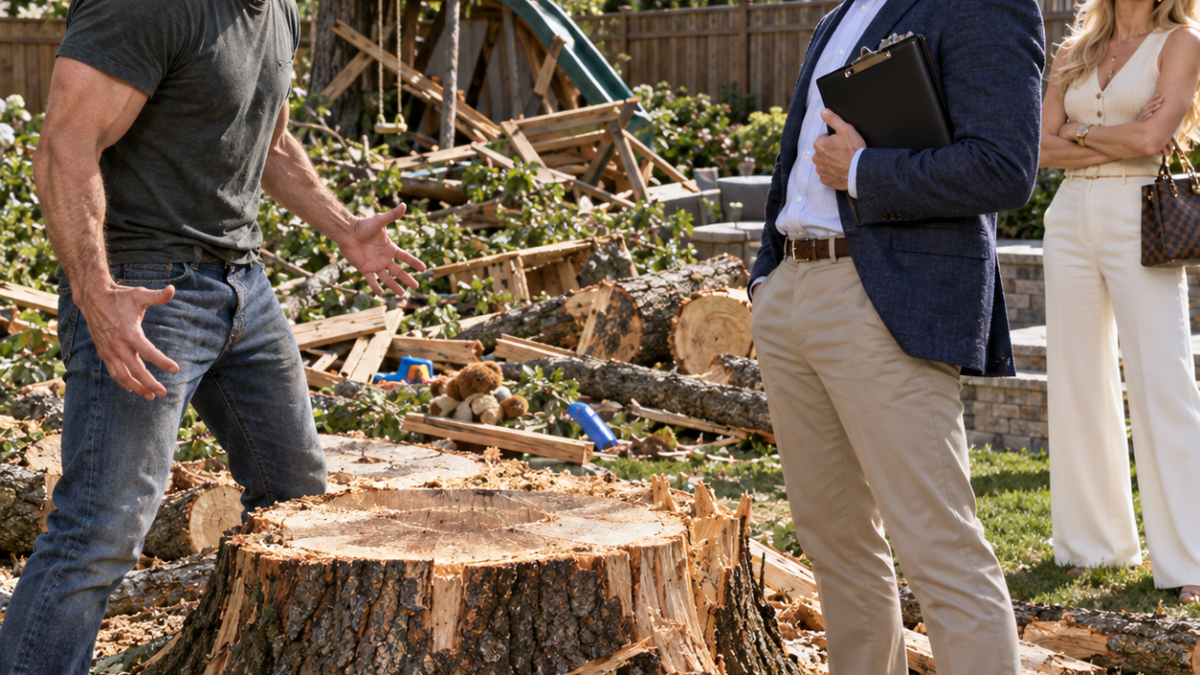
A flat pale stump sat in the ground like a wound. Sawdust covered the grass. The treehouse was scattered across the yard in broken boards, splintered railings, twisted screws, and crushed pieces of the little ladder my son had helped me sand. Deep tire tracks marked the lawn near the side access gate.
The tree was gone.
The treehouse was destroyed.
I stepped outside slowly, like moving too fast might make the scene real.
My hands went numb.
I remember standing over one of the broken boards and recognizing the blue paint Lily had picked for the inside wall. She had called it “secret sky.” Now it was cracked and dirty, lying in the grass.
At first, I thought maybe there had been a storm while I was gone.
But there had not.
No broken fences nearby. No damage to the house. No scattered branches. No signs of natural collapse. The stump had been cut clean and ground down. This was professional work. Expensive work. Deliberate work.
Someone had come onto my property while I was gone and paid a crew to remove my tree.
A sound came out of me then.
Not a word.
Just a low, shocked breath that felt like it scraped something raw on the way out.
A few minutes later, as I stood in the middle of my destroyed yard, Derek appeared two houses down.
He was watering shrubs near his driveway, though I doubt a single plant needed water at that exact moment. He looked over, saw me, and raised one hand.
“Looks like the HOA finally took care of that hazard,” he called.
I turned toward him.
For a moment, I could not speak.
He smiled.
Not a nervous smile.
Not a guilty smile.
A smug, satisfied smile.
Like a man admiring a job well done.
That was when I knew.
I did not yell. I did not walk over. I did not give him whatever scene he was hoping for.
I took out my phone and called the HOA office.
The woman who answered sounded bored until I gave her my address and asked who had authorized tree removal on my property.
Then she sounded confused.
“I’m sorry,” she said. “Tree removal?”
“Yes. My oak tree has been cut down while I was away.”
“Let me check.”
I stood in the sawdust while she typed.
“I’m not seeing any work order.”
“Check board approvals.”
More typing.
“No removal approval for your property.”
“Violation notice?”
“No.”
“Emergency hazard report?”
“No, sir.”
“Are you sure?”
She checked again.
“I’m sure. The HOA did not authorize any tree removal at your address.”
I looked toward Derek’s house.
He had gone inside.
Of course he had.
The kids were still at my mother’s, and that was the only mercy that day. I sat on the back step for a long time after the call ended, staring at the empty space where shade used to be.
How do you tell your children someone destroyed a place they loved because he did not like leaves?
How do you explain that an adult looked at their treehouse, their memories, their little handprints on painted boards, and decided none of it mattered because he wanted a cleaner view?
I picked them up that evening.
I thought about waiting until the next day to tell them, but that felt cowardly. They knew the yard. They would notice immediately.
When we got home, Ethan reached the back door first.
He opened it, stepped outside, and froze.
Lily bumped into him.
“What are you—”
Then she saw it.
Her face changed in a way I will never forget.
“Dad?” she whispered.
“I’m sorry,” I said.
That was all I had.
Ethan walked into the yard, silent, fists clenched at his sides. Lily started crying immediately. Not dramatic crying. Quiet, shocked crying that hurt worse. She picked up a broken piece of railing and held it like it was a dead bird.
“Who did this?” Ethan asked.
“I’m going to find out.”
But I already knew.
The next morning, I filed a formal complaint with the HOA.
I sent photos of everything: the stump, the sawdust, the tire tracks, the destroyed treehouse, the side gate area, the broken boards, the empty yard. I attached the old approval letter for the treehouse. I also included the original arborist appraisal, because something told me this was going to become much bigger than an HOA complaint.
It took them three days to respond.
Three days.
When they finally called, the board representative sounded like she was reading from a script someone had written after consulting fear, laziness, and liability.
They had spoken with Derek. He claimed the tree was a safety hazard. He claimed he believed action was necessary in the community’s best interest. He claimed the treehouse violated safety standards. The HOA acknowledged that no formal approval had been issued, but since he was a board member acting out of concern, they would treat it as unauthorized work and fine him a few hundred dollars.
A few hundred dollars.
For a fifty-thousand-dollar tree.
For my children’s treehouse.
For trespassing onto my property and erasing something irreplaceable.
I almost laughed because screaming would have made me sound unstable.
“That is not good enough,” I said.
“I understand you’re upset.”
“No. You don’t.”
“We consider this a civil matter between neighbors.”
“You have a board member who forged or misrepresented HOA authority to destroy property.”
“We don’t have evidence of forgery at this time.”
“You have evidence that he did not have approval.”
“That is why a fine is being issued.”
“A fine?”
“Yes.”
“For unapproved work?”
“Yes.”
I closed my eyes.
“Unapproved work is painting a fence the wrong color. This was property destruction.”
“I’m sorry you feel that way.”
The phrase hit me like a slap.
I’m sorry you feel that way.
People say that when they are not sorry at all.
After the call, I walked to Derek’s house.
I told myself to stay calm. I told myself every step not to say anything that could hurt me later. When Derek opened the door, he looked almost amused.
His wife, Miranda, appeared behind him, arms crossed, lips curved in the faintest smile.
“Can we help you?” Derek asked.
“You cut down my tree.”
He sighed dramatically.
“That old hazard needed to come down.”
“It was not a hazard.”
“You’re not an arborist.”
“I have reports from one.”
His jaw twitched.
Miranda leaned against the doorframe.
“Honestly, your yard looks cleaner now.”
I looked at her.
She shrugged.
“The treehouse was an eyesore.”
Something hot and dangerous moved through me.
I looked back at Derek.
“The HOA said they did not authorize removal.”
He smiled.
“They approved addressing hazards.”
“That is not the same thing.”
“I’m on the board. I know what was discussed.”
“You had no right to enter my property.”
“I acted in the community’s best interest.”
“You destroyed my kids’ treehouse.”
“Maybe you should have built something compliant.”
“It was approved in writing.”
His smile faded for half a second.
Then he recovered.
“Well, approvals can be revisited.”
“You are going to regret this,” I said.
Miranda laughed softly.
“Oh, please. It’s a tree.”
I took one step back.
Then another.
Because if I stayed, I was going to say something that belonged in an affidavit titled Plaintiff’s Emotional Outburst.
So I walked away.
That night, after the kids went to bed, I pulled out the folder.
Treehouse approval letter.
Original arborist report.
Photos from past years: the kids smiling in the treehouse, the oak full and green, birthday parties in the shade, Ethan reading on a branch, Lily painting the inside wall blue.
I spread everything across the kitchen table and sat there until after midnight.
I was not letting this go.
The next morning, I called the same arborist who had appraised the tree years earlier.
His name was Paul Hensley, and when I told him what happened, there was a long silence on the line.
“They removed the whole tree?” he asked.
“Yes.”
“Stump too?”
“Ground down.”
“Do you have photos?”
“Yes.”
“I’ll come out.”
He arrived two days later.
Paul was not dramatic. He was one of those calm, practical people who seemed more comfortable around roots and soil than human conflict. But when he stepped into my backyard and saw the empty space, his expression changed.
“Damn,” he said quietly.
That was the first honest reaction I had gotten from anyone outside my house.
He examined what remained of the stump and root area. He looked at old photos. He pulled up his previous report. He studied the sawdust, the cut patterns, the access route, the crushed grass where equipment had moved.
“This was professional,” he said.
“I figured.”
“Expensive.”
“I figured that too.”
He looked toward Derek’s house.
“Tree was healthy when I inspected it. Based on your recent photos, canopy looked full. No visible decline. No obvious structural failure.”
“Can you put that in writing?”
He looked at me like I had asked whether water was wet.
“Oh, absolutely.”
The updated report was better than I hoped.
It confirmed the prior appraisal. It stated that the oak had been healthy, mature, structurally sound, and valuable. Based on his previous inspection, my recent photographs, and remaining physical evidence, Paul concluded there was no visible indication the tree posed an imminent hazard requiring removal. He valued it at approximately fifty thousand dollars, potentially more given current replacement and landscape value considerations.
That report felt like oxygen.
Next, I started calling tree service companies.
A tree that large did not vanish by magic. Someone had brought equipment. Someone had scheduled the job. Someone had paid. Someone had received instructions.
It took eight calls.
On the ninth, the owner hesitated when I described the property.
“Was that the big white oak on Briar Lane?” he asked.
My grip tightened on the phone.
“Yes.”
Another pause.
“We did that removal.”
“Who hired you?”
“I’m not sure I can discuss client—”
“That was my tree on my property, removed without my permission.”
Silence.
Then he said, “Hold on.”
When he came back, his voice was different.
A lot less guarded.
“We were told it was an HOA removal.”
“By who?”
“A man named Derek Whitman. He gave us paperwork.”
“What paperwork?”
“HOA authorization. Letterhead. Said the owner had been notified repeatedly and the board had approved removal due to safety concerns.”
My vision narrowed.
“Do you still have it?”
“Yes.”
“I need a copy.”
“I think I need to talk to my lawyer.”
“That’s fine,” I said. “Because I’m calling mine.”
The tree service owner, to his credit, did not double down. Once he realized he had been used to remove someone else’s tree under false authority, he cooperated through proper channels. He provided a statement and a copy of the paperwork Derek had given him.
It was on HOA letterhead.
It referenced a removal approval that did not exist.
It claimed the tree had been deemed hazardous.
It listed Derek as an authorized board representative.
It was not just arrogance anymore.
It was fraud wearing a polo shirt.
My lawyer, Rebecca Sloan, read everything in silence.
I had hired her years earlier for a property boundary issue, and she was exactly the kind of attorney you want when someone has done something stupid with confidence. Calm. Precise. Merciless without being theatrical.
When she finished, she looked up.
“This is one of the cleaner cases of unauthorized tree removal I’ve seen.”
“Clean is good?”
“For us.”
“What can we do?”
“We sue for the appraised value of the tree, destruction of the treehouse, restoration costs, legal fees where available, and any additional damages supported by state law. Depending on local statutes, tree damage can sometimes carry enhanced damages.”
“Enhanced meaning?”
Her eyes narrowed slightly.
“Meaning Mr. Whitman may discover leaves were cheaper than litigation.”
I liked Rebecca.
We filed.
Derek was served the next week.
He tried to act unbothered. I saw him outside afterward, pacing his driveway, phone to his ear, gesturing like he was explaining a business inconvenience. But his face gave him away. The smugness was still there, but thinner now. Strained.
Miranda stopped smiling at me after that.
Good.
The weeks before court were tense. The neighborhood knew something was happening, though I did not go around announcing details. People saw Derek’s demeanor change. They saw me meeting with Rebecca. They saw the HOA suddenly act cautious in emails. In HOA communities, gossip moves faster than emergency alerts.
The kids asked often what would happen.
“Will he have to pay for it?” Ethan asked.
“I hope so.”
“Can we get the old tree back?” Lily asked once.
That one hurt.
“No, sweetheart.”
She nodded like she understood, but understanding did not make her less sad.
I promised them we would plant a new tree someday.
It felt inadequate.
It was inadequate.
But it was something.
When the court date finally came, I was nervous in a way I did not expect.
I had never sued anyone before. I was not a dramatic person. I did not enjoy conflict. Part of me still wished Derek would knock on my door, apologize sincerely, and offer to make it right.
He did not.
He arrived at court dressed like he was attending an investor meeting. Dark suit. Polished shoes. Expensive watch. Chin lifted. Miranda came with him in a cream dress and sunglasses she wore indoors until Derek’s lawyer whispered something to her. They sat at their table looking offended that consequences had required their attendance.
Derek’s lawyer argued first.
He painted Derek as a concerned neighbor and HOA board member who had acted in good faith after repeated worries about safety. He suggested the tree posed a risk to nearby homes. He argued the treehouse was unsafe and possibly noncompliant. He used phrases like community welfare and reasonable belief.
Listening to him, you would have thought Derek had heroically saved the neighborhood from a collapsing forest monster instead of hiring a crew to trespass while I was out of town.
Then Rebecca stood.
She did not raise her voice.
She did not need to.
She laid out the story in order.
My ownership of the property.
The original arborist appraisal.
The HOA’s written approval of the treehouse.
Photos showing the tree healthy and stable.
Proof that I was out of town when the removal occurred.
HOA confirmation that no removal authorization had been issued.
The updated arborist report.
The tree service statement.
The fake HOA paperwork Derek had provided.
The cost of the destroyed treehouse.
The emotional significance did not lead her argument.
The evidence did.
That made it stronger.
Paul testified plainly.
The tree had been healthy.
There was no basis, from any available evidence, to claim emergency removal was necessary.
The value was real.
The prior appraisal was legitimate.
The updated valuation was consistent.
The tree service owner testified too. He looked uncomfortable, which I understood. He had trusted paperwork and gotten dragged into someone else’s mess. But he told the truth. Derek hired them. Derek provided the HOA authorization. Derek said the homeowner had been notified.
Then the judge looked at Derek.
“Do you have any documentation from the HOA authorizing you to remove this tree?”
Derek’s lawyer stood.
“Your Honor, my client believed—”
“That is not what I asked,” the judge said.
Derek shifted in his seat.
The judge repeated, “Do you have documentation authorizing removal of a tree on the plaintiff’s property?”
Derek’s face tightened.
“No, Your Honor.”
“Did the plaintiff give you permission?”
“No.”
“Did the HOA issue an approval specific to this property?”
Derek’s lawyer tried again. “There were board discussions about hazardous—”
The judge looked at him.
“Counsel.”
He stopped.
Rebecca then presented the HOA letterhead Derek had given the tree service.
That was the moment the room changed.
Even the judge’s expression shifted.
Not dramatically. Judges are good at not giving you much. But the air sharpened.
Derek’s lawyer tried to call it a misunderstanding. A template used improperly. An informal communication. Good faith. Poor wording.
The judge was not interested.
“You cannot accidentally create paperwork purporting to authorize removal of someone else’s tree,” he said.
I looked down at my hands because if I looked at Derek, I might smile.
In the end, the ruling was clear.
Derek was liable.
He was ordered to pay the appraised value of the oak: fifty thousand dollars.
Additional damages for the destroyed treehouse.
Restoration costs.
Legal fees.
By the time the numbers were added, leaves had become very expensive.
When the judge read the decision, Derek stared straight ahead like he was trying to keep his face from cracking. Miranda whispered something to him, but he did not respond. His confidence had nowhere to go now. It sat beside him like a dead battery.
Outside the courthouse, Derek walked past me without looking.
I did not say a word.
I did not need to.
The judgment said everything.
News spread through the neighborhood within a week.
I did not tell people. I did not post online. I did not print flyers and drop them in mailboxes, tempting though that might have been.
But someone found out.
Then everyone found out.
The man who had appointed himself guardian of community standards had forged authority to cut down a neighbor’s tree and lost big in court. That kind of story grows legs in an HOA neighborhood. Then wings.
Derek changed almost overnight.
He stopped walking around with his clipboard. Stopped commenting on lawns. Stopped attending meetings like he owned the room. When he did show up, he sat in the back and left quickly. People avoided him, not because they were afraid of him anymore, but because association with him now carried the smell of legal stupidity.
The HOA removed him from the board.
Officially, the email said he had resigned from his position due to personal matters.
Nobody believed that.
A week later, the HOA sent a long message about updated governance procedures, documentation requirements, board authority limitations, and the need for written approvals before any action affecting private property. It was boring, defensive, and clearly written by a lawyer who had seen the judgment and aged ten years.
I saved that email too.
Old habit.
Derek’s yard began to decline after that.
At first, it was subtle. Grass a little long. Weeds near the mailbox. Half-finished landscaping near the front walk. Then the expensive SUV disappeared, replaced by an older sedan. Miranda stopped appearing at neighborhood gatherings. Their house, once spotless, started to look tense, if a house can look tense.
I heard he was struggling to pay the judgment.
I did not feel bad.
There are accidents in this world. Misunderstandings. Honest mistakes. Bad calls made under pressure.
This was not that.
Derek had waited until I was gone. He had hired a crew. He had used false paperwork. He had destroyed my property, my kids’ treehouse, and a living thing that had stood longer than any of us had been alive. Then he smirked across the yard and told me the HOA had handled a hazard.
No.
I did not feel bad.
A few months later, a For Sale sign went up in front of his house.
The morning the moving truck came, I was taking out the trash.
Derek stood in his driveway holding a box. For a second, our eyes met.
He looked away first.
After all his noise, all his arrogance, all his speeches about standards and hazards and community interest, he left quietly.
That silence felt better than any apology he could have given by then.
After Derek moved out, the neighborhood changed.
It relaxed.
People do not always realize how much tension one person can create until they are gone. The street felt lighter without him prowling for violations. The HOA became more careful. More boring. More accountable. Nobody tried to tell me what belonged in my yard for a long time.
The family that bought Derek’s house was normal, which felt miraculous.
A couple with a teenage daughter and a golden retriever. They waved. They minded their business. The husband once asked if I had a ladder tall enough to help him clean gutters, and when I lent it to him, he returned it with a six-pack and no commentary about my landscaping.
That alone made him better than Derek.
As for the yard, I avoided that empty spot for a while.
It hurt too much.
The first summer without the oak was brutal. The yard baked in direct sun. The grass struggled where shade had once protected it. The deck felt exposed. The house itself seemed hotter, brighter, less private. Sometimes I would stand at the kitchen window and still expect to see branches moving.
The kids missed it too.
Ethan pretended not to. He was at that age where sadness embarrassed him. But I caught him once standing near the stump area, hands in his pockets, staring at nothing.
Lily kept one piece of painted treehouse board in her room.
The blue one.
Secret sky.
Eventually, we planted a new tree.
Another oak.
Smaller, obviously. Almost comically small compared to what had been there before. The nursery worker helped us choose one that was healthy and suited to the yard. We planted it together on a Saturday morning. Ethan dug more aggressively than necessary. Lily placed the soil carefully around the base like she was tucking it in.
I used part of the settlement money to restore the yard and build a small freestanding play structure nearby. Not a true treehouse. Not yet. The new oak was far too young for that. But it had a little platform, a ladder, a shaded bench, and a plaque Lily made that said:
For the old oak.
I stood there reading those words longer than I expected.
It still was not enough.
But it was something.
The rest of the settlement went where responsible adult money goes: legal costs already covered, savings, repairs, college funds, and a little aside for something fun with the kids because they had lived through enough of the ugly part.
We took a weekend trip to the mountains.
On the second day, we hiked a trail through an old forest. Ethan walked ahead, pretending he was too cool to enjoy it. Lily took pictures of moss, bark, and every interesting leaf she saw. At one point, we stopped beneath a massive tree—not oak, but old, wide, and beautiful.
Lily looked up and said, “Do you think ours would have gotten this big?”
I swallowed.
“Maybe.”
Ethan, still looking up, said, “The new one will.”
I smiled a little.
“Not anytime soon.”
He shrugged.
“Still.”
That was the closest we got to closure.
I still miss the original oak.
I miss the shade. The sound of leaves in the wind. The way sunlight filtered through it onto the grass. The treehouse tucked in its branches. The feeling that something strong and old was watching over the yard.
But I do not feel powerless anymore.
That matters.
Derek thought I would yell, complain, maybe get a tiny HOA fine issued, then eventually give up. He thought destruction was easy because repair is hard. He thought money and board status made him untouchable. He thought if he said hazard enough times, the word would become truth.
He was wrong.
The truth was in the arborist report.
In the approval letter.
In the photos.
In the tree service statement.
In the forged paperwork.
In the stump.
And the truth, once organized properly, did more damage to him than rage ever could have.
That is the lesson I took from all of it.
Not that justice always happens. It does not. Not that courts fix every loss. They cannot bring back a tree. Not that money replaces memories. It does not replace a child’s favorite place, or years of shade, or the living presence of something old and beautiful.
But documentation matters.
Patience matters.
Walking away before you say something reckless matters.
Calling the expert matters.
Saving the letter matters.
Taking photos matters.
Because people like Derek count on emotion being messy and evidence being missing.
They count on you being too shocked to think clearly.
They count on everyone treating their violation like a neighborhood disagreement.
They count on phrases like community interest and safety concern making selfishness sound respectable.
Do not let them.
Call things what they are.
A destroyed tree is not unapproved work.
A forged document is not a misunderstanding.
A neighbor entering your property without permission is not community service.
And a man who destroys something your children loved because he dislikes leaves is not protecting standards.
He is a bully with a checkbook.
My new oak is growing well now.
Every spring, I check its leaves like a nervous parent. Every summer, I water it more than probably necessary. Every fall, when it drops its few little leaves, I rake them with a strange kind of pride.
The kids are older. They do not use the little platform much anymore, but sometimes Lily sits out there with a book. Sometimes Ethan leans against the young trunk and jokes that one day his kids will build something better in it.
Maybe they will.
Maybe decades from now, that tree will be wide enough to shade the yard the way the old one did. Maybe someone will look at it and feel, instantly, that this place is home. Maybe a child who has not been born yet will climb into its branches and believe the world is bigger, safer, and more magical because that tree exists.
That is what Derek could not understand.
He thought he was cutting down a nuisance.
He thought he was removing leaves, shade, inconvenience, and a structure he did not like seeing.
But he cut down history.
He cut down value.
He cut down my children’s memories.
And in the end, all he really managed to remove was himself.
𝗧𝗛𝗘 𝗘𝗡𝗗
My Neighbor Cut Down My $50,000 Oak While I Was Gone, Then Smirked Like I Couldn’t Touch Him
I left town for three days and came home to a stump where my children’s favorite place in the world used to be.
My neighbor said the HOA approved it, but the lie he used to destroy my tree was the same lie that destroyed him.
The oak tree was one of the reasons I bought the house.
That might sound strange if you have never loved a tree before. A tree is not usually what people mention first when they talk about choosing a home. They talk about square footage, school districts, kitchen counters, mortgage rates, commute times, and whether the roof looks like it might become a financial crime in the next five years.
But for me, it was the tree.
The first time I walked through the backyard with the real estate agent, I stopped beneath it and looked up.
It was enormous.
A white oak, old and broad and deeply rooted, with a canopy that spread over the yard like it had been built to shelter generations of ordinary afternoons. In summer, the shade was so thick and cool that stepping under it felt like entering another room. The trunk was massive, textured with age, wide enough that my kids could not wrap their arms around it even when they worked together and cheated by linking fingers. Its branches reached out over the grass with the slow confidence of something that had survived storms, droughts, bad winters, hot summers, and probably more family drama than I would ever know.
The house itself was nice. Not perfect, but good. Three bedrooms. A kitchen that needed updating. A garage with enough room for tools. A backyard big enough for my kids to run around in without feeling like they were trapped in a postage stamp.
But that tree made the property feel like home before I had even signed the papers.
I was a single dad then, and I still am. My kids were younger when we moved in, still at that age where a backyard could become an entire universe if you gave them enough sticks, imagination, and snacks. My son, Ethan, was the climber. My daughter, Lily, was the planner. He would get halfway up a low branch and declare himself king of the wilderness. She would stand below with a notebook, explaining that any proper kingdom needed laws, guards, and a snack schedule.
I watched them fall in love with that oak almost as quickly as I had.
So I bought the house.
The neighborhood was run by an HOA, but for the most part, it was not terrible. Annoying sometimes, sure. We got the usual reminders about trash bins, approved paint colors, lawn height, holiday decorations, and the proper number of days a basketball hoop could sit near the curb without offending civilization. But if you paid your dues, kept your property decent, and did not try to paint your house neon orange, they mostly left you alone.
At least, that was how it worked at first.
A few years after we moved in, I had some landscaping work done. Nothing major—some drainage fixes, mulch beds, and a little cleanup after a storm dropped a few smaller limbs. A friend of mine, who happened to work in insurance, was standing in the yard one afternoon when he looked up at the oak and asked, “Have you ever had that tree appraised?”
I laughed because I thought he was joking.
“Appraised? It’s a tree.”
“Exactly,” he said. “A huge old tree in good condition. That thing could be worth a lot more than you think.”
I told him I had no idea trees could have an official value.
He told me they absolutely could, especially mature trees that added real property value. Then he said something that stuck with me.
“If somebody damages it and you don’t already have documentation, you’ll wish you did.”
So I called an arborist.
I felt a little silly at first, paying someone to evaluate a tree that had been standing there long before I was born. But the arborist took it seriously. He measured, inspected, photographed, checked the canopy, the trunk, the root zone, signs of disease, structural issues, overall health. When he finished, he told me the oak was healthy, mature, and valuable.
Worth over fifty thousand dollars.
I remember staring at him.
“For a tree?”
He smiled.
“For that tree.”
I kept the report in a folder with other house documents, not because I expected to need it, but because my friend had made me nervous enough to be responsible.
That turned out to be one of the smartest things I ever did.
Part 2
A year or so later, I built the treehouse.
It was not some elaborate structure from a television show. No spiral slide. No rope bridge. No electricity. No secret trapdoor. Just a small, sturdy platform tucked into the lower branches, with railings, a little ladder, and enough room for Ethan and Lily to sit with books, snacks, and whatever treasures they collected from the yard.
I built it carefully.
More carefully than I had built anything in years.
I checked weight limits, used proper hardware, avoided damaging the tree, and made sure it could be removed someday without harming the oak. Because we had an HOA, I submitted the plans before building. I filled out the form, included sketches, listed materials, and waited.
To my surprise, the board approved it without drama.
The letter said the treehouse complied with community guidelines, provided it remained well maintained and did not extend beyond my property line. Fair enough. I kept that approval letter in the same folder as the arborist report.
For years, everything was fine.
The kids grew older, but they never really outgrew the treehouse. At ten and twelve, they used it differently than they had when they were little. Less pretending to be pirates, more sitting up there with tablets, books, sodas, and secret conversations they thought I could not hear from the deck. Sometimes Ethan would climb up there after school when he needed space. Sometimes Lily and her best friend would sit there with blankets, whispering like the treehouse was a private apartment.
That tree became part of our family’s rhythm.
In the fall, the kids complained about raking leaves, then jumped into the piles. In summer, we ate dinner under its shade. In spring, I watched new leaves appear and felt, every year, like the yard was starting over. When storms came through, I checked it nervously, but it never gave me trouble. The arborist came out every couple of years to inspect it, and the answer was always the same.
Healthy.
Stable.
Beautiful.
Then Derek moved in two houses over.
I noticed him before I met him properly because Derek seemed designed to be noticed. He was in his mid-forties, maybe, with the permanent tan of a man who spent money to look casual. He drove a black luxury SUV that he parked at a precise angle in his driveway, wore expensive watches even when doing yard work, and talked loudly into wireless earbuds while pacing the sidewalk like he was closing million-dollar deals on behalf of the entire street.
His wife, Miranda, was the same kind of polished. Blonde hair, fitness clothes that looked more expensive than my work shirts, sunglasses large enough to hide most of her face, and a smile she used only when someone important might be watching. Together, they seemed to view the neighborhood less as a place to live and more as a stage for demonstrating success.
At first, Derek was just annoying.
He had opinions about everything.
The neighbor across the street parked too close to the curb. The couple on the corner needed to pressure wash their walkway. The retired guy three houses down should have replaced his mailbox because it “brought down the visual tone.” He said visual tone like he was talking about a museum exhibit instead of a row of suburban houses built from the same three floor plans.
Within months, Derek joined the HOA board.
That was when annoying became dangerous.
Some people volunteer because they want to help. Others volunteer because authority, even tiny authority, feeds something hungry inside them. Derek was the second kind. He treated board membership like an elected office. Suddenly, he was walking the neighborhood with a clipboard, inspecting lawns, making notes, offering “friendly reminders” with a smile that never felt friendly.
He never confronted me directly at first.
He just made comments.
“That tree drops a lot of leaves,” he said one afternoon while I was loading groceries from the car.
I looked at the oak, then back at him.
“That’s what trees do.”
He gave me a tight smile.
“Some trees more than others.”
Another time, he stood near the sidewalk, staring into my yard.
“You ever think about trimming that thing back?”
“It gets inspected. It’s healthy.”
“Healthy doesn’t mean convenient.”
I should have taken that sentence more seriously.
Instead, I brushed it off. People complain about leaves. People complain about shade. People complain because the world does not arrange itself around them. I figured Derek was just another HOA warrior looking for something to feel important about.
Then I had to leave town for work.
It was nothing dramatic. A three-day trip to attend meetings at another office. My mother agreed to keep the kids because their school schedule was easier from her place, and honestly, they loved staying with her because she let them eat pancakes for dinner and pretended not to know how late they stayed up.
Before leaving, I did my usual routine.
Locked the shed.
Checked the side gate.
Brought in the trash bins.
Watered a few plants.
Walked through the backyard once, mostly out of habit.
The oak stood there like it always had, huge and quiet, the treehouse tucked into its arms. The weather forecast looked clear. No storms, no high winds, no reason to worry.
I remember glancing back at it before I got in the car.
I did not know it would be the last time I saw it alive.
When I came home three days later, the house looked normal from the street.
That is what I hate most about the memory.
The front yard was fine. Mail in the box. Porch light off. Driveway empty. Nothing warned me. Nothing prepared me. I carried my bag inside, dropped it by the stairs, and walked toward the back door, thinking about picking up the kids from my mother’s after I unpacked.
Then I opened the door.
And stopped.
For a few seconds, my brain refused to understand what my eyes were seeing.
The sky was wrong.
That was my first thought.
The backyard had too much sky.
Where the oak had been, there was nothing.
Not a damaged trunk.
Not fallen limbs.
Not a storm-broken disaster.
Nothing.
A flat pale stump sat in the ground like a wound. Sawdust covered the grass. The treehouse was scattered across the yard in broken boards, splintered railings, twisted screws, and crushed pieces of the little ladder my son had helped me sand. Deep tire tracks marked the lawn near the side access gate.
The tree was gone.
The treehouse was destroyed.
I stepped outside slowly, like moving too fast might make the scene real.
My hands went numb.
I remember standing over one of the broken boards and recognizing the blue paint Lily had picked for the inside wall. She had called it “secret sky.” Now it was cracked and dirty, lying in the grass.
At first, I thought maybe there had been a storm while I was gone.
But there had not.
No broken fences nearby. No damage to the house. No scattered branches. No signs of natural collapse. The stump had been cut clean and ground down. This was professional work. Expensive work. Deliberate work.
Someone had come onto my property while I was gone and paid a crew to remove my tree.
A sound came out of me then.
Not a word.
Just a low, shocked breath that felt like it scraped something raw on the way out.
A few minutes later, as I stood in the middle of my destroyed yard, Derek appeared two houses down.
He was watering shrubs near his driveway, though I doubt a single plant needed water at that exact moment. He looked over, saw me, and raised one hand.
“Looks like the HOA finally took care of that hazard,” he called.
I turned toward him.
For a moment, I could not speak.
He smiled.
Not a nervous smile.
Not a guilty smile.
A smug, satisfied smile.
Like a man admiring a job well done.
That was when I knew.
I did not yell. I did not walk over. I did not give him whatever scene he was hoping for.
I took out my phone and called the HOA office.
The woman who answered sounded bored until I gave her my address and asked who had authorized tree removal on my property.
Then she sounded confused.
“I’m sorry,” she said. “Tree removal?”
“Yes. My oak tree has been cut down while I was away.”
“Let me check.”
I stood in the sawdust while she typed.
“I’m not seeing any work order.”
“Check board approvals.”
More typing.
“No removal approval for your property.”
“Violation notice?”
“No.”
“Emergency hazard report?”
“No, sir.”
“Are you sure?”
She checked again.
“I’m sure. The HOA did not authorize any tree removal at your address.”
I looked toward Derek’s house.
He had gone inside.
Of course he had.
The kids were still at my mother’s, and that was the only mercy that day. I sat on the back step for a long time after the call ended, staring at the empty space where shade used to be.
How do you tell your children someone destroyed a place they loved because he did not like leaves?
How do you explain that an adult looked at their treehouse, their memories, their little handprints on painted boards, and decided none of it mattered because he wanted a cleaner view?
I picked them up that evening.
I thought about waiting until the next day to tell them, but that felt cowardly. They knew the yard. They would notice immediately.
When we got home, Ethan reached the back door first.
He opened it, stepped outside, and froze.
Lily bumped into him.
“What are you—”
Then she saw it.
Her face changed in a way I will never forget.
“Dad?” she whispered.
“I’m sorry,” I said.
That was all I had.
Ethan walked into the yard, silent, fists clenched at his sides. Lily started crying immediately. Not dramatic crying. Quiet, shocked crying that hurt worse. She picked up a broken piece of railing and held it like it was a dead bird.
“Who did this?” Ethan asked.
“I’m going to find out.”
But I already knew.
The next morning, I filed a formal complaint with the HOA.
I sent photos of everything: the stump, the sawdust, the tire tracks, the destroyed treehouse, the side gate area, the broken boards, the empty yard. I attached the old approval letter for the treehouse. I also included the original arborist appraisal, because something told me this was going to become much bigger than an HOA complaint.
It took them three days to respond.
Three days.
When they finally called, the board representative sounded like she was reading from a script someone had written after consulting fear, laziness, and liability.
They had spoken with Derek. He claimed the tree was a safety hazard. He claimed he believed action was necessary in the community’s best interest. He claimed the treehouse violated safety standards. The HOA acknowledged that no formal approval had been issued, but since he was a board member acting out of concern, they would treat it as unauthorized work and fine him a few hundred dollars.
A few hundred dollars.
For a fifty-thousand-dollar tree.
For my children’s treehouse.
For trespassing onto my property and erasing something irreplaceable.
I almost laughed because screaming would have made me sound unstable.
“That is not good enough,” I said.
“I understand you’re upset.”
“No. You don’t.”
“We consider this a civil matter between neighbors.”
“You have a board member who forged or misrepresented HOA authority to destroy property.”
“We don’t have evidence of forgery at this time.”
“You have evidence that he did not have approval.”
“That is why a fine is being issued.”
“A fine?”
“Yes.”
“For unapproved work?”
“Yes.”
I closed my eyes.
“Unapproved work is painting a fence the wrong color. This was property destruction.”
“I’m sorry you feel that way.”
The phrase hit me like a slap.
I’m sorry you feel that way.
People say that when they are not sorry at all.
After the call, I walked to Derek’s house.
I told myself to stay calm. I told myself every step not to say anything that could hurt me later. When Derek opened the door, he looked almost amused.
His wife, Miranda, appeared behind him, arms crossed, lips curved in the faintest smile.
“Can we help you?” Derek asked.
“You cut down my tree.”
He sighed dramatically.
“That old hazard needed to come down.”
“It was not a hazard.”
“You’re not an arborist.”
“I have reports from one.”
His jaw twitched.
Miranda leaned against the doorframe.
“Honestly, your yard looks cleaner now.”
I looked at her.
She shrugged.
“The treehouse was an eyesore.”
Something hot and dangerous moved through me.
I looked back at Derek.
“The HOA said they did not authorize removal.”
He smiled.
“They approved addressing hazards.”
“That is not the same thing.”
“I’m on the board. I know what was discussed.”
“You had no right to enter my property.”
“I acted in the community’s best interest.”
“You destroyed my kids’ treehouse.”
“Maybe you should have built something compliant.”
“It was approved in writing.”
His smile faded for half a second.
Then he recovered.
“Well, approvals can be revisited.”
“You are going to regret this,” I said.
Miranda laughed softly.
“Oh, please. It’s a tree.”
I took one step back.
Then another.
Because if I stayed, I was going to say something that belonged in an affidavit titled Plaintiff’s Emotional Outburst.
So I walked away.
That night, after the kids went to bed, I pulled out the folder.
Treehouse approval letter.
Original arborist report.
Photos from past years: the kids smiling in the treehouse, the oak full and green, birthday parties in the shade, Ethan reading on a branch, Lily painting the inside wall blue.
I spread everything across the kitchen table and sat there until after midnight.
I was not letting this go.
The next morning, I called the same arborist who had appraised the tree years earlier.
His name was Paul Hensley, and when I told him what happened, there was a long silence on the line.
“They removed the whole tree?” he asked.
“Yes.”
“Stump too?”
“Ground down.”
“Do you have photos?”
“Yes.”
“I’ll come out.”
He arrived two days later.
Paul was not dramatic. He was one of those calm, practical people who seemed more comfortable around roots and soil than human conflict. But when he stepped into my backyard and saw the empty space, his expression changed.
“Damn,” he said quietly.
That was the first honest reaction I had gotten from anyone outside my house.
He examined what remained of the stump and root area. He looked at old photos. He pulled up his previous report. He studied the sawdust, the cut patterns, the access route, the crushed grass where equipment had moved.
“This was professional,” he said.
“I figured.”
“Expensive.”
“I figured that too.”
He looked toward Derek’s house.
“Tree was healthy when I inspected it. Based on your recent photos, canopy looked full. No visible decline. No obvious structural failure.”
“Can you put that in writing?”
He looked at me like I had asked whether water was wet.
“Oh, absolutely.”
The updated report was better than I hoped.
It confirmed the prior appraisal. It stated that the oak had been healthy, mature, structurally sound, and valuable. Based on his previous inspection, my recent photographs, and remaining physical evidence, Paul concluded there was no visible indication the tree posed an imminent hazard requiring removal. He valued it at approximately fifty thousand dollars, potentially more given current replacement and landscape value considerations.
That report felt like oxygen.
Next, I started calling tree service companies.
A tree that large did not vanish by magic. Someone had brought equipment. Someone had scheduled the job. Someone had paid. Someone had received instructions.
It took eight calls.
On the ninth, the owner hesitated when I described the property.
“Was that the big white oak on Briar Lane?” he asked.
My grip tightened on the phone.
“Yes.”
Another pause.
“We did that removal.”
“Who hired you?”
“I’m not sure I can discuss client—”
“That was my tree on my property, removed without my permission.”
Silence.
Then he said, “Hold on.”
When he came back, his voice was different.
A lot less guarded.
“We were told it was an HOA removal.”
“By who?”
“A man named Derek Whitman. He gave us paperwork.”
“What paperwork?”
“HOA authorization. Letterhead. Said the owner had been notified repeatedly and the board had approved removal due to safety concerns.”
My vision narrowed.
“Do you still have it?”
“Yes.”
“I need a copy.”
“I think I need to talk to my lawyer.”
“That’s fine,” I said. “Because I’m calling mine.”
The tree service owner, to his credit, did not double down. Once he realized he had been used to remove someone else’s tree under false authority, he cooperated through proper channels. He provided a statement and a copy of the paperwork Derek had given him.
It was on HOA letterhead.
It referenced a removal approval that did not exist.
It claimed the tree had been deemed hazardous.
It listed Derek as an authorized board representative.
It was not just arrogance anymore.
It was fraud wearing a polo shirt.
My lawyer, Rebecca Sloan, read everything in silence.
I had hired her years earlier for a property boundary issue, and she was exactly the kind of attorney you want when someone has done something stupid with confidence. Calm. Precise. Merciless without being theatrical.
When she finished, she looked up.
“This is one of the cleaner cases of unauthorized tree removal I’ve seen.”
“Clean is good?”
“For us.”
“What can we do?”
“We sue for the appraised value of the tree, destruction of the treehouse, restoration costs, legal fees where available, and any additional damages supported by state law. Depending on local statutes, tree damage can sometimes carry enhanced damages.”
“Enhanced meaning?”
Her eyes narrowed slightly.
“Meaning Mr. Whitman may discover leaves were cheaper than litigation.”
I liked Rebecca.
We filed.
Derek was served the next week.
He tried to act unbothered. I saw him outside afterward, pacing his driveway, phone to his ear, gesturing like he was explaining a business inconvenience. But his face gave him away. The smugness was still there, but thinner now. Strained.
Miranda stopped smiling at me after that.
Good.
The weeks before court were tense. The neighborhood knew something was happening, though I did not go around announcing details. People saw Derek’s demeanor change. They saw me meeting with Rebecca. They saw the HOA suddenly act cautious in emails. In HOA communities, gossip moves faster than emergency alerts.
The kids asked often what would happen.
“Will he have to pay for it?” Ethan asked.
“I hope so.”
“Can we get the old tree back?” Lily asked once.
That one hurt.
“No, sweetheart.”
She nodded like she understood, but understanding did not make her less sad.
I promised them we would plant a new tree someday.
It felt inadequate.
It was inadequate.
But it was something.
When the court date finally came, I was nervous in a way I did not expect.
I had never sued anyone before. I was not a dramatic person. I did not enjoy conflict. Part of me still wished Derek would knock on my door, apologize sincerely, and offer to make it right.
He did not.
He arrived at court dressed like he was attending an investor meeting. Dark suit. Polished shoes. Expensive watch. Chin lifted. Miranda came with him in a cream dress and sunglasses she wore indoors until Derek’s lawyer whispered something to her. They sat at their table looking offended that consequences had required their attendance.
Derek’s lawyer argued first.
He painted Derek as a concerned neighbor and HOA board member who had acted in good faith after repeated worries about safety. He suggested the tree posed a risk to nearby homes. He argued the treehouse was unsafe and possibly noncompliant. He used phrases like community welfare and reasonable belief.
Listening to him, you would have thought Derek had heroically saved the neighborhood from a collapsing forest monster instead of hiring a crew to trespass while I was out of town.
Then Rebecca stood.
She did not raise her voice.
She did not need to.
She laid out the story in order.
My ownership of the property.
The original arborist appraisal.
The HOA’s written approval of the treehouse.
Photos showing the tree healthy and stable.
Proof that I was out of town when the removal occurred.
HOA confirmation that no removal authorization had been issued.
The updated arborist report.
The tree service statement.
The fake HOA paperwork Derek had provided.
The cost of the destroyed treehouse.
The emotional significance did not lead her argument.
The evidence did.
That made it stronger.
Paul testified plainly.
The tree had been healthy.
There was no basis, from any available evidence, to claim emergency removal was necessary.
The value was real.
The prior appraisal was legitimate.
The updated valuation was consistent.
The tree service owner testified too. He looked uncomfortable, which I understood. He had trusted paperwork and gotten dragged into someone else’s mess. But he told the truth. Derek hired them. Derek provided the HOA authorization. Derek said the homeowner had been notified.
Then the judge looked at Derek.
“Do you have any documentation from the HOA authorizing you to remove this tree?”
Derek’s lawyer stood.
“Your Honor, my client believed—”
“That is not what I asked,” the judge said.
Derek shifted in his seat.
The judge repeated, “Do you have documentation authorizing removal of a tree on the plaintiff’s property?”
Derek’s face tightened.
“No, Your Honor.”
“Did the plaintiff give you permission?”
“No.”
“Did the HOA issue an approval specific to this property?”
Derek’s lawyer tried again. “There were board discussions about hazardous—”
The judge looked at him.
“Counsel.”
He stopped.
Rebecca then presented the HOA letterhead Derek had given the tree service.
That was the moment the room changed.
Even the judge’s expression shifted.
Not dramatically. Judges are good at not giving you much. But the air sharpened.
Derek’s lawyer tried to call it a misunderstanding. A template used improperly. An informal communication. Good faith. Poor wording.
The judge was not interested.
“You cannot accidentally create paperwork purporting to authorize removal of someone else’s tree,” he said.
I looked down at my hands because if I looked at Derek, I might smile.
In the end, the ruling was clear.
Derek was liable.
He was ordered to pay the appraised value of the oak: fifty thousand dollars.
Additional damages for the destroyed treehouse.
Restoration costs.
Legal fees.
By the time the numbers were added, leaves had become very expensive.
When the judge read the decision, Derek stared straight ahead like he was trying to keep his face from cracking. Miranda whispered something to him, but he did not respond. His confidence had nowhere to go now. It sat beside him like a dead battery.
Outside the courthouse, Derek walked past me without looking.
I did not say a word.
I did not need to.
The judgment said everything.
News spread through the neighborhood within a week.
I did not tell people. I did not post online. I did not print flyers and drop them in mailboxes, tempting though that might have been.
But someone found out.
Then everyone found out.
The man who had appointed himself guardian of community standards had forged authority to cut down a neighbor’s tree and lost big in court. That kind of story grows legs in an HOA neighborhood. Then wings.
Derek changed almost overnight.
He stopped walking around with his clipboard. Stopped commenting on lawns. Stopped attending meetings like he owned the room. When he did show up, he sat in the back and left quickly. People avoided him, not because they were afraid of him anymore, but because association with him now carried the smell of legal stupidity.
The HOA removed him from the board.
Officially, the email said he had resigned from his position due to personal matters.
Nobody believed that.
A week later, the HOA sent a long message about updated governance procedures, documentation requirements, board authority limitations, and the need for written approvals before any action affecting private property. It was boring, defensive, and clearly written by a lawyer who had seen the judgment and aged ten years.
I saved that email too.
Old habit.
Derek’s yard began to decline after that.
At first, it was subtle. Grass a little long. Weeds near the mailbox. Half-finished landscaping near the front walk. Then the expensive SUV disappeared, replaced by an older sedan. Miranda stopped appearing at neighborhood gatherings. Their house, once spotless, started to look tense, if a house can look tense.
I heard he was struggling to pay the judgment.
I did not feel bad.
There are accidents in this world. Misunderstandings. Honest mistakes. Bad calls made under pressure.
This was not that.
Derek had waited until I was gone. He had hired a crew. He had used false paperwork. He had destroyed my property, my kids’ treehouse, and a living thing that had stood longer than any of us had been alive. Then he smirked across the yard and told me the HOA had handled a hazard.
No.
I did not feel bad.
A few months later, a For Sale sign went up in front of his house.
The morning the moving truck came, I was taking out the trash.
Derek stood in his driveway holding a box. For a second, our eyes met.
He looked away first.
After all his noise, all his arrogance, all his speeches about standards and hazards and community interest, he left quietly.
That silence felt better than any apology he could have given by then.
After Derek moved out, the neighborhood changed.
It relaxed.
People do not always realize how much tension one person can create until they are gone. The street felt lighter without him prowling for violations. The HOA became more careful. More boring. More accountable. Nobody tried to tell me what belonged in my yard for a long time.
The family that bought Derek’s house was normal, which felt miraculous.
A couple with a teenage daughter and a golden retriever. They waved. They minded their business. The husband once asked if I had a ladder tall enough to help him clean gutters, and when I lent it to him, he returned it with a six-pack and no commentary about my landscaping.
That alone made him better than Derek.
As for the yard, I avoided that empty spot for a while.
It hurt too much.
The first summer without the oak was brutal. The yard baked in direct sun. The grass struggled where shade had once protected it. The deck felt exposed. The house itself seemed hotter, brighter, less private. Sometimes I would stand at the kitchen window and still expect to see branches moving.
The kids missed it too.
Ethan pretended not to. He was at that age where sadness embarrassed him. But I caught him once standing near the stump area, hands in his pockets, staring at nothing.
Lily kept one piece of painted treehouse board in her room.
The blue one.
Secret sky.
Eventually, we planted a new tree.
Another oak.
Smaller, obviously. Almost comically small compared to what had been there before. The nursery worker helped us choose one that was healthy and suited to the yard. We planted it together on a Saturday morning. Ethan dug more aggressively than necessary. Lily placed the soil carefully around the base like she was tucking it in.
I used part of the settlement money to restore the yard and build a small freestanding play structure nearby. Not a true treehouse. Not yet. The new oak was far too young for that. But it had a little platform, a ladder, a shaded bench, and a plaque Lily made that said:
For the old oak.
I stood there reading those words longer than I expected.
It still was not enough.
But it was something.
The rest of the settlement went where responsible adult money goes: legal costs already covered, savings, repairs, college funds, and a little aside for something fun with the kids because they had lived through enough of the ugly part.
We took a weekend trip to the mountains.
On the second day, we hiked a trail through an old forest. Ethan walked ahead, pretending he was too cool to enjoy it. Lily took pictures of moss, bark, and every interesting leaf she saw. At one point, we stopped beneath a massive tree—not oak, but old, wide, and beautiful.
Lily looked up and said, “Do you think ours would have gotten this big?”
I swallowed.
“Maybe.”
Ethan, still looking up, said, “The new one will.”
I smiled a little.
“Not anytime soon.”
He shrugged.
“Still.”
That was the closest we got to closure.
I still miss the original oak.
I miss the shade. The sound of leaves in the wind. The way sunlight filtered through it onto the grass. The treehouse tucked in its branches. The feeling that something strong and old was watching over the yard.
But I do not feel powerless anymore.
That matters.
Derek thought I would yell, complain, maybe get a tiny HOA fine issued, then eventually give up. He thought destruction was easy because repair is hard. He thought money and board status made him untouchable. He thought if he said hazard enough times, the word would become truth.
He was wrong.
The truth was in the arborist report.
In the approval letter.
In the photos.
In the tree service statement.
In the forged paperwork.
In the stump.
And the truth, once organized properly, did more damage to him than rage ever could have.
That is the lesson I took from all of it.
Not that justice always happens. It does not. Not that courts fix every loss. They cannot bring back a tree. Not that money replaces memories. It does not replace a child’s favorite place, or years of shade, or the living presence of something old and beautiful.
But documentation matters.
Patience matters.
Walking away before you say something reckless matters.
Calling the expert matters.
Saving the letter matters.
Taking photos matters.
Because people like Derek count on emotion being messy and evidence being missing.
They count on you being too shocked to think clearly.
They count on everyone treating their violation like a neighborhood disagreement.
They count on phrases like community interest and safety concern making selfishness sound respectable.
Do not let them.
Call things what they are.
A destroyed tree is not unapproved work.
A forged document is not a misunderstanding.
A neighbor entering your property without permission is not community service.
And a man who destroys something your children loved because he dislikes leaves is not protecting standards.
He is a bully with a checkbook.
My new oak is growing well now.
Every spring, I check its leaves like a nervous parent. Every summer, I water it more than probably necessary. Every fall, when it drops its few little leaves, I rake them with a strange kind of pride.
The kids are older. They do not use the little platform much anymore, but sometimes Lily sits out there with a book. Sometimes Ethan leans against the young trunk and jokes that one day his kids will build something better in it.
Maybe they will.
Maybe decades from now, that tree will be wide enough to shade the yard the way the old one did. Maybe someone will look at it and feel, instantly, that this place is home. Maybe a child who has not been born yet will climb into its branches and believe the world is bigger, safer, and more magical because that tree exists.
That is what Derek could not understand.
He thought he was cutting down a nuisance.
He thought he was removing leaves, shade, inconvenience, and a structure he did not like seeing.
But he cut down history.
He cut down value.
He cut down my children’s memories.
And in the end, all he really managed to remove was himself.