𝙍𝙚𝙖𝙙𝙈𝙤𝙧𝙚👉 My Neighbor Claimed My Garage Was Hers—Then Parked Inside It the Morning I Left Town
𝗙𝗨𝗟𝗟 𝗦𝗧𝗢𝗥𝗬
I actually looked away for a second.
I couldn’t believe we were returning to this.
“Karen.”
“We’ve discussed this.”
“Yes.”
“This structure sits on my property line.”
“No.”
“It does.”
“No.”
“You know it does.”
“I paid for a survey.”
She waved one hand.
“That survey.”
“The certified survey.”
“The one you bought.”
“Yes.”
“Exactly.”
I stared.
“The garage is three feet inside my property.”
“According to your people.”
“According to the property line.”
She crossed her arms.
“My driveway is unavailable.”
“Park on the street.”
“I’m not leaving my car three blocks away.”
“Then park somewhere else.”
“Why would I when there’s an empty garage?”
“My garage.”
“You don’t even use this side.”
That sentence irritated me more than it should have.
Because it revealed exactly how she thought.
If I wasn’t using something in the way she considered proper, she believed it became available to her.
“I don’t have to use it.”
She rolled her eyes.
“It’s sitting empty.”
“Still mine.”
“My car isn’t hurting anything.”
“You’re inside a private building without permission.”
“I didn’t break in.”
“The door was open because I was loading.”
“Then clearly you weren’t concerned about security.”
“I was gone twenty minutes.”
“And now I’m using the space.”
I took a breath.
“Move the car.”
“No.”
Not even hesitation.
Just no.
I stepped closer.
“Karen.”
“What?”
“I’m leaving town.”
“So?”
“For a week.”
She shrugged.
“Have fun.”
“I’m locking the garage.”
Her smile changed.
Slightly.
“What?”
“My friends will be here in about thirty minutes. We’re leaving for seven days.”
She glanced toward the car.
Then back at me.
“I lock this garage when I’m gone.”
“You won’t lock my car inside.”
I said nothing.
She laughed.
Loud.
Mocking.
“Please.”
“I’m serious.”
“You cannot lock somebody’s vehicle in a building.”
“I am not leaving my garage unsecured for a week because you decided to park inside it.”
She shook her head.
“If you lock it, I’ll call the police.”
“Okay.”
“They’ll make you open it.”
“I’ll be four hours away.”
Her expression flickered.
“Then I’ll call a locksmith.”
“To break into my garage?”
“It’s my car.”
“Inside my building.”
She stepped closer.
“You’re trying to bully me.”
I almost laughed.
“I’m telling you what’s going to happen.”
“You think you’re clever.”
“No.”
“You think because you paid for that fake survey you can push me around.”
“No.”
“I’m not moving it.”
I looked straight at her.
“Final warning.”
She stared.
“Move your car.”
“No.”
“I’m closing the garage.”
“Go ahead.”
“Karen.”
She turned.
Took another sip.
Then started walking toward her house.
Over her shoulder, she called:
“Have a nice little boat trip.”
I stood there for maybe two minutes.
Angry enough that I could feel my heartbeat in my neck.
Then something changed.
The anger didn’t disappear.
It became clarity.
Karen knew exactly what I’d said.
She had been warned.
She understood I was leaving.
She understood the garage would be secured.
She believed I wouldn’t follow through because accommodating her was easier than dealing with the fight.
That assumption had powered almost every argument we’d ever had.
The source story establishes that the garage sat around three feet inside the narrator’s certified property boundary and that Karen knowingly parked inside it the morning of his week-long trip despite being directly told to remove the car.
I walked into the garage.
Looked at her sedan.
Then at the roll-up door.
My garage had a heavy steel security bar mounted inside the main door.
When engaged, it slid into both tracks.
Once locked into place, the door couldn’t simply be lifted from outside.
I grabbed the handle.
Pulled the large door down.
Sunlight narrowed to a strip.
Then disappeared.
I slid the bar across.
Clunk.
Main door secured.
Then I went to the side entrance.
The side door was solid wood.
Heavy deadbolt.
I stepped outside.
Closed it.
Locked the deadbolt.
Normally, that would’ve been enough.
That morning I wanted zero ambiguity.
I had a length of heavy steel chain in my work truck.
Also a weather-resistant padlock.
I looped the chain through the exterior steel handle and around a solid support post beneath the overhang.
Pulled it tight.
Snapped the lock closed.
Now anyone looking at that door would understand one thing.
Closed.
Then I thought about Karen telling me she’d call a locksmith.
I wasn’t going to leave a stranger interpreting this as some accidental lockout.
So I made a sign.
PRIVATE PROPERTY.
NO TRESPASSING.
I wrote that the garage and the land belonged exclusively to the owner of my house.
Any attempt to force entry, damage locks, or alter the structure would be treated as unauthorized entry and property damage.
I put the paper into a clear plastic sleeve.
Taped it beside the chain.
Then stepped back.
That still wasn’t enough for my mood.
I owned an older Ford F-250 work truck.
Big diesel.
Heavy.
Used it for construction-related jobs and hauling.
I started it.
Backed slowly toward the garage.
Stopped with less than two inches between the rear bumper and the roll-up door.
Parking brake.
Locked doors.
Keys in pocket.
Even if someone somehow defeated the internal bar, the door couldn’t rise because several thousand pounds of truck sat directly behind it.
I shut off the engine.
Silence.
My friend’s truck pulled up a few minutes later with the boat trailer.
Two other friends were inside.
One leaned out the window.
“You ready?”
I picked up my duffel.
“More ready than I’ve ever been.”
He looked toward my work truck.
“Why did you park like that?”
“Long story.”
“We have four hours.”
“You’ll hear it.”
As I climbed into the passenger seat, I looked toward Karen’s house.
She stood behind her front window.
Coffee mug raised.
Watching.
I smiled.
Lifted one hand.
Waved.
She glared.
Then we left.
I wasn’t reckless enough to believe she would simply accept the situation.
Karen had never accepted anything quietly.
So before leaving, I had checked all my security cameras.
One covered the front of the house.
One covered the driveway and main garage door.
Another covered the side entrance.
High-definition recording.
Motion alerts.
Remote access through my phone.
Two hours into the drive, my phone vibrated.
Motion alert.
I opened the app.
Karen.
She came down her driveway wearing a nicer outfit and carrying a handbag.
Probably heading to one of those errands she’d mentioned.
She walked toward my garage confidently.
Reached the front.
Stopped.
The camera angle showed her staring at the F-250.
Her head moved slowly from the truck to the garage.
Then back.
She walked around.
Reached the side door.
Saw the chain.
Stopped again.
Read the sign.
Even through a phone screen, I could see the color changing in her face.
One of my friends leaned over.
“What is she doing?”
“Learning.”
“Learning what?”
“That I wasn’t joking.”
I handed him the phone.
He laughed.
“That’s her car inside?”
“Yes.”
“You told her?”
“Several times.”
“She refused?”
“Repeatedly.”
He passed the phone to the back seat.
My other friend said:
“You realize she’s going to call somebody.”
As if on cue, Karen pulled out her phone.
I smiled.
“Apparently.”
Forty-five minutes later, another motion alert.
Sheriff’s cruiser.
We were already well down the highway.
I opened the camera app.
Audio.
Karen was standing beside the deputy.
She looked furious.
Her arms moved dramatically while she pointed at the truck, garage, side door, house.
The deputy was older.
Calm.
The kind of officer who had probably heard every possible version of a ridiculous neighbor dispute.
Karen’s voice came through the microphone.
“He locked my car in there!”
The deputy looked toward the garage.
“He actually locked it.”
Karen pointed.
“My vehicle is being held hostage.”
One of my friends started laughing.
I raised the volume.
“I have doctor appointments.”
Karen paced.
“Groceries. Errands. I need my vehicle.”
The deputy walked to the side door.
Read the sign.
Inspected the chain.
Looked at the house number.
Then the garage.
Then Karen.
“Is this your property, ma’am?”
Karen folded her arms.
“The garage sits on my property line.”
“That wasn’t exactly my question.”
“It is a shared structure.”
I laughed quietly.
Shared.
That was new.
The deputy asked:
“Do you own the garage?”
“It’s partly on my land.”
“Do you have documentation?”
Karen hesitated.
“There’s been a boundary dispute.”
There hadn’t.
There’d been a survey.
She just didn’t like the answer.
The deputy asked:
“Did the homeowner give you permission to park inside?”
Karen’s posture changed.
“I don’t need permission.”
My friends groaned in unison.
The deputy stared at her.
She continued:
“My driveway is being resealed.”
“Okay.”
“I couldn’t leave my vehicle outside.”
“Okay.”
“So I put it in here.”
“Did he tell you that was okay?”
“He knew.”
“That’s not what I asked.”
Karen’s voice sharpened.
“He doesn’t even use that side of the garage.”
The deputy nodded slowly.
“Did he tell you to move the car before he left?”
Silence.
Then:
“He was threatening me.”
“How?”
“He said he was going to lock it inside.”
One of my friends said:
“She’s making your case for you.”
I nodded.
The deputy said:
“So he told you he was leaving and securing his garage.”
Karen realized what she’d admitted.
“He did it maliciously.”
“Maybe.”
The deputy looked at the chain.
“But I cannot break into someone’s private building because you parked inside without authorization.”
Karen’s voice rose.
“You need to cut that.”
“No.”
“Call a tow truck.”
“The car is inside.”
“Then move his truck.”
“No.”
“Why not?”
“Because it’s his vehicle on his property.”
“He did that to trap me.”
The deputy remained calm.
“I understand you’re upset.”
“No, you don’t.”
“I understand the situation.”
“Then fix it.”
“There’s nothing I’m going to break here.”
Karen pointed toward the garage.
“He’s kidnapped my car.”
That nearly destroyed everyone in our truck.
My buddy was laughing so hard he had tears.
The deputy didn’t.
He said:
“Cars are not kidnapped.”
“You know what I mean.”
“I do.”
“Then get it out.”
“You’ll need to contact the homeowner or resolve the issue civilly.”
“He’s gone.”
“I understand.”
“For a week!”
The deputy paused.
“Then I would suggest in the future that you don’t park inside someone else’s garage when they’re leaving for a week.”
Silence.
Beautiful silence.
Karen finally said:
“This is unbelievable.”
The deputy turned.
“Have a good day, ma’am.”
She followed.
“You’re just leaving?”
He kept walking.
“You can’t leave.”
He got into the cruiser.
She stood in the driveway.
Hands on hips.
Then the cruiser left.
My friends exploded.
One said:
“Forget fishing. This is the trip.”
I took the phone back.
“She’ll try something else.”
She did.
Tuesday.
Motion alert.
Tow truck.
Flatbed.
Driver got out.
Karen immediately began pointing.
The man looked at my F-250.
Walked around it.
Looked at the roll-up door.
Looked at the side chain.
Then at Karen.
They talked for several minutes.
No audio from that angle.
Finally, the driver shook his head.
Karen pointed again.
He shook his head again.
Then climbed into the tow truck and left.
Apparently, “There’s another truck parked almost against a locked garage containing the car I want you to tow” wasn’t a job he wanted.
Wednesday brought another alert.
Karen and a man I didn’t recognize inspected the chain.
The man bent down.
Looked at the padlock.
Read the sign.
Then walked away from the door.
They argued.
He left.
Locksmith, I assumed.
Thursday was quiet.
Friday, Karen walked around the garage twice.
Didn’t touch anything.
Saturday, nothing.
I spent the week doing exactly what I’d planned.
Fishing.
Boating.
Eating terrible food.
Drinking beer around a fire at night.
I checked the cameras more than I probably should have.
My friends turned it into entertainment.
Every time the phone buzzed, someone shouted:
“Karen update!”
By the middle of the week, even I was starting to feel slightly ridiculous.
But I also remembered the conversation.
Move the car.
No.
I am leaving for a week.
You won’t lock it.
Move the car.
No.
She had known.
Every inconvenience that followed came after a direct, clear warning.
Sunday arrived.
We cleaned the cabin.
Loaded gear.
Hitched the boat.
Started the four-hour drive home.
I won’t pretend I wasn’t curious.
Karen had been without her vehicle for seven days.
No successful police intervention.
No tow.
No locksmith.
I expected anger.
Maybe legal threats.
Maybe screaming.
We turned onto my street around four in the afternoon.
Karen was on her porch.
She looked tired.
No coffee mug.
No smug smile.
When my buddy parked down the street, she stood immediately.
I got out.
Grabbed my bag.
Walked toward my driveway.
Karen came over.
Not running.
Not shouting.
That alone was strange.
“Are you going to open the garage?”
No hello.
No welcome home.
I smiled.
“Good afternoon, Karen.”
Her jaw tightened.
“Please.”
That word got my attention.
“The boating trip was great.”
She stared.
“Thanks for asking.”
“Can you open it?”
“In a minute.”
She looked toward the garage.
“I had to spend over four hundred dollars on ride shares and buses.”
“That’s unfortunate.”
“I missed two appointments.”
I said nothing.
“My whole week was ruined.”
“I’m sorry to hear that.”
“No, you’re not.”
“No.”
At least we agreed.
She looked exhausted.
“Just let me get my car.”
I set my duffel down.
“Before I open anything, I want to clarify something.”
Her eyes narrowed.
“What?”
“Whose garage is this?”
She said nothing.
I waited.
“Karen.”
She looked at the ground.
“Yours.”
I almost asked her to repeat it.
Didn’t.
“And the land beside it?”
“Yours.”
“The entire garage?”
“Yes.”
No argument.
No bribed surveyors.
No shared structure.
No visual interpretation.
Just reality.
I continued.
“Will you ever park inside my garage again without permission?”
“No.”
“Will you block the driveway?”
“No.”
“Will you tell me this structure belongs to you?”
“No.”
“Will you enter the garage because you think I don’t use part of it enough?”
“No.”
She looked up.
“Are we finished?”
“Yes.”
“Please open the door.”
“All right.”
I unlocked the F-250.
Started it.
Pulled forward.
Parked farther down the drive.
Then walked to the side entrance.
Removed the padlock.
Unwrapped the chain.
Unlocked the deadbolt.
Entered.
The garage smelled faintly of whatever air freshener Karen kept in her car.
Her sedan sat exactly where she’d left it.
Untouched.
No damage.
No scratches.
No missing property.
I walked to the main door.
Pulled the steel bar free.
Raised the roll-up door.
Sunlight filled the garage.
Karen didn’t say another word.
She went straight to the driver’s side.
Got in.
Started the engine.
Backed out so quickly the tires made a small chirp on the pavement.
Then she drove directly onto her own newly sealed driveway.
Apparently the sealant had cured.
She parked.
Got out.
Went inside.
Door slammed.
I stood in my driveway looking into the empty garage.
It had never looked better.
My friends were still watching from the street.
One shouted:
“Whose garage is it?”
I raised one finger.
“Don’t.”
They laughed.
For the next several days, Karen avoided me.
I expected something official.
Attorney.
Letter.
Police follow-up.
Civil complaint.
Something.
Nothing arrived.
What did happen was that the property-line argument disappeared completely.
No more comments.
No more gestures toward the garage.
No more “my side.”
No more claims that the survey was fake.
Apparently seven days without her vehicle had succeeded where certified property records had failed.
I didn’t celebrate openly.
That would’ve guaranteed another fight.
But I enjoyed the silence.
A week later, I was washing tools near the garage when Karen came outside.
She glanced toward me.
I waited.
She said:
“Your truck damaged the appearance of my driveway seal.”
I stared.
She lasted about two seconds.
Then actually smiled.
Not warmly.
But enough that I realized she knew how absurd it sounded.
I laughed.
She went inside.
That was probably the closest we ever came to peace.
A few neighbors heard what happened.
Of course they did.
Neighborhood information travels faster than emergency services.
One guy from across the street came over.
“Is it true?”
“What?”
“You locked Karen’s car in the garage for a week.”
“I locked my garage.”
He smiled.
“With her car inside.”
“Coincidence.”
He laughed.
“She told my wife you stole access to her vehicle.”
“I was four hours away.”
“She also said part of the garage is hers.”
“Did she?”
“Past tense.”
That made me smile.
Another neighbor said:
“You’re lucky she didn’t break in.”
“Cameras.”
“Still.”
“She saw the sign.”
He shook his head.
“I wouldn’t have had the patience.”
I thought about that.
Patience.
Was what I did patient?
Depends who you ask.
I didn’t damage the car.
Didn’t move it.
Didn’t enter it.
Didn’t sell it.
Didn’t hide it.
I secured my own building and left on a trip I’d already planned.
But I also knew exactly what would happen.
I knew she’d be stuck without the vehicle.
I knew she’d be furious.
I knew she wanted the convenience of parking somewhere she had no right to use.
There was malice in the compliance.
I’m not going to pretend otherwise.
She told me I wouldn’t dare lock the garage.
I did.
Sometimes people hearing the story focus on whether I should have called police before leaving.
Maybe.
That would’ve been cleaner.
I could have documented the car inside.
Called non-emergency.
Requested that Karen remove it.
Asked for a tow if allowed.
That would have created paperwork and witnesses.
Probably the smarter modern approach.
But in that moment, after two years of having a certified survey dismissed as corruption, I wasn’t interested in another debate.
The building was mine.
I had expensive tools inside.
I was leaving for seven days.
Leaving it open was never an option.
Karen had one simple way to avoid the entire problem.
Move the car.
She had thirty minutes before my friends arrived.
Her driveway wasn’t sealed yet.
She could’ve pulled the sedan out and temporarily left it on the street.
Could’ve asked a neighbor.
Could’ve rented space.
Could’ve used a parking lot.
Could’ve parked three blocks away despite her fear of scratches.
Instead, she chose my garage because she had spent years convincing herself it was partly hers.
That’s what really interested me afterward.
Karen’s entitlement wasn’t completely fake.
She had started believing her own argument.
The certified survey didn’t matter because accepting it would require admitting she’d been wrong for years.
That became impossible.
So she built another explanation.
Surveyors were corrupt.
Maps were wrong.
Property history supported her.
The building was “shared.”
I didn’t use half of it.
Therefore she could.
Every time reality challenged the belief, she added another reason rather than changing the belief.
Then came the car.
Physical reality.
The garage door closed.
The lock engaged.
The truck blocked access.
Police refused to break in.
Tow driver refused.
Locksmith apparently refused.
For seven days, reality stopped negotiating.
That’s why her answer on Sunday mattered.
Whose garage?
Yours.
Three years of arguing reduced to one word.
Yours.
I never needed an apology after that.
I needed recognition.
The survey had given me legal certainty.
Her answer gave me peace.
The story became a running joke among my boating friends.
Every year after that, when we planned another trip, one of them would ask:
“Did you check the garage for luxury vehicles?”
Another would say:
“Maybe Karen needs valet service.”
I threatened to stop inviting them.
Never did.
The next year, before leaving for the lake, I shut the garage door myself.
Locked it.
Checked cameras.
No sedan.
No argument.
Progress.
Karen still lived next door.
She was still difficult.
That didn’t magically change.
She complained once about leaves blowing from my tree.
Another time about noise from a project in the garage.
She thought my exterior light was too bright.
She had opinions about where my trash cans sat.
But whenever I said:
“My property.”
She stopped.
The garage incident had drawn a line stronger than paint or survey stakes.
Several years later, she eventually sold the house.
On moving day, a truck sat in her driveway.
Actual movers carried boxes.
I was in the garage when she walked over.
She stopped several feet away.
“You’re leaving?” I asked.
“Obviously.”
“Where?”
“Closer to my daughter.”
“Good.”
She looked at the garage.
Then at me.
For a second, I wondered whether she was going to restart the property argument one final time.
Instead she said:
“I always hated that garage.”
I laughed.
“I know.”
“It should’ve been farther from the line.”
“Probably.”
“Three feet is ridiculous.”
“But three feet.”
She sighed.
“Yes.”
“Three feet.”
“Don’t enjoy this too much.”
“I’m trying.”
She almost smiled.
Then said:
“You really left for the whole week.”
I nodded.
“You thought I’d come back?”
“I thought the police would make you.”
“Apparently not.”
She shook her head.
“I have never spent that much on transportation in one week in my life.”
“You could’ve parked three blocks away for free.”
Her eyes narrowed.
“Don’t start.”
I laughed.
She turned.
Walked back toward her house.
That was our last real conversation.
The new neighbor moved in a few weeks later.
His name was Aaron.
Normal guy.
Wife.
Two children.
On his second day, I saw him checking the side yard near the property line.
I walked over.
“Everything okay?”
“Yeah.”
He pointed.
“Just trying to figure out where the boundary runs.”
I braced myself automatically.
Then remembered Karen was gone.
“I have a certified survey.”
“Really?”
“Yeah.”
“Could I see it?”
That question alone felt revolutionary.
I brought out a copy.
Showed him the line.
He studied it.
“So the garage is yours and there’s about three feet here.”
“Correct.”
“Good to know.”
He handed the paper back.
“Thanks.”
That was it.
No conspiracy.
No bribed surveyors.
No claim that a building’s proximity somehow transferred ownership.
Two adults looking at a document.
Conversation over.
A few months later, Aaron asked if he could temporarily stack fence panels on part of that three-foot strip while replacing his fence.
He asked.
I said yes.
They were there for two days.
Then gone.
No drama.
That interaction showed exactly how unnecessary the entire war with Karen had been.
Permission changes everything.
“Can I?”
“Yes.”
Simple.
Karen didn’t like asking because asking means the other person can say no.
She preferred declaring.
The garage is mine.
The space is shared.
I can park here.
You won’t lock it.
The pattern wasn’t really about parking.
It was about her inability to tolerate someone else having final authority over something she wanted.
I think that’s why the Sunday conversation broke her resistance.
For seven days, every outside person she tried to involve ran into the same fact.
Not her building.
Not her lock.
Not her truck.
Not her property.
Eventually, even Karen had nowhere left to move the argument.
People sometimes ask whether I worried she would damage the garage.
Absolutely.
That’s why I had cameras.
The moment she had cut a lock or damaged the door, the situation would’ve changed completely.
Fortunately, she wasn’t that reckless.
Entitled, yes.
Stupid enough to attack a clearly secured building under camera coverage?
Apparently not.
The sign probably helped.
The truck definitely helped.
And maybe the deputy’s refusal made her realize that forcing entry wasn’t going to look like self-help.
It was going to look like exactly what it was.
Breaking into another person’s property to retrieve a car she’d put there without permission.
A bizarre situation created entirely by one decision.
No.
That’s not true.
Many decisions.
Years of refusing the survey.
Years of claiming the garage.
Watching me leave briefly.
Seeing the garage open.
Choosing to drive across my property.
Pulling fully into the bay.
Locking the sedan.
Walking away.
Refusing to move.
Ignoring the warning.
Laughing.
Daring me.
Every step was a choice.
People sometimes talk about consequences as if they arrive suddenly.
Usually they don’t.
Usually they’re visible from a long way off.
Karen’s consequence came with a thirty-minute warning.
She laughed at it.
I think that’s why I never felt guilty.
Not really.
Maybe I was petty.
Absolutely.
Maybe leaving for the trip instead of spending the morning calling authorities was aggressive.
Sure.
But she knew exactly what would happen.
I did not trick her.
Didn’t lie.
Didn’t wait until she was gone and secretly move the car into the garage.
She put it there.
I stood in front of her.
Told her:
I am leaving for a week.
I am locking the building.
Move the car.
She answered:
No.
Then told me I wouldn’t dare.
Sometimes the universe does not need a complicated response.
Sometimes it just needs you to stop preventing somebody from experiencing the consequences they chose.
Years later, I still owned that house.
The garage still stood exactly where the survey said it did.
Three feet inside.
The side chain eventually rusted and I replaced it.
The F-250 finally died after years of abuse.
I sold it to a younger guy who somehow believed fixing old diesel trucks was a relaxing hobby.
I bought another truck.
The garage remained.
Still workshop on one side.
Open space on the other.
Sometimes completely empty.
Nobody saw the empty bay and decided that made it public parking.
Funny how that works.
Whenever I pulled into the garage after Karen moved, I occasionally remembered her sedan sitting there that morning.
Perfectly polished.
Completely unauthorized.
The memory always made me shake my head.
Not because locking it in was the cleverest thing I’d ever done.
Probably wasn’t.
Because I still couldn’t understand what kind of person sees an open garage belonging to a neighbor, drives a car into it, and then argues that the garage somehow became theirs.
That requires a very specific relationship with reality.
But maybe entitlement always works that way.
It begins with convenience.
I need somewhere to park.
Then justification.
He isn’t using the space.
Then invented authority.
The garage is really on my property.
Then attack.
The survey is fake.
Then expectation.
He won’t stop me.
Then outrage.
How dare he stop me?
Every step protects the same basic belief.
My convenience matters more than your boundary.
Karen spent years operating from that belief.
The boating trip cured it.
Not completely.
People like Karen don’t usually transform after one conflict.
But she learned one specific boundary.
That garage.
Mine.
The final Sunday scene stayed with me longer than the laughter in the truck or the camera footage.
Karen standing there exhausted.
No performance left.
No gold-button authority.
No lecture.
No fake property theory.
Just:
“It is yours.”
That was all I’d wanted years earlier.
Recognition of the line.
I didn’t need her to like me.
Didn’t need friendship.
Didn’t need her to admire the surveyor.
Just accept reality.
Three feet.
Her property ended.
Mine began.
The garage stood inside mine.
Once she accepted that, the conflict disappeared.
I’ve kept a copy of the old survey in my files.
Not because Karen might come back.
Because property disputes teach you to love paperwork.
A good survey is boring.
Lines.
Measurements.
Stamps.
Coordinates.
No emotion.
That’s exactly why it’s useful.
Karen had arguments.
The survey had numbers.
For years, she thought saying something with enough confidence could overpower those numbers.
It couldn’t.
And when the morning finally came that she put a physical object inside the space those numbers described, everything stopped being theoretical.
Her car was inside my building.
I secured my building.
She spent a week learning the difference.
If I could go back, would I change anything?
Maybe I’d call the sheriff before leaving.
Get an incident number.
Make the record cleaner.
Maybe I’d have the vehicle towed if that was legally available.
Maybe I’d avoid giving Karen anything she could characterize as intentional retaliation.
Older me appreciates documentation more than younger me did.
But would I leave my garage open for seven days to protect her convenience?
Absolutely not.
Would I cancel the trip?
No.
Would I trust a woman who believed the garage belonged to her with unrestricted access to my tools while I was four hours away?
Not a chance.
Karen had alternatives.
I had one garage.
Securing it was not negotiable.
And that is probably why the story still makes me laugh.
She wasn’t trapped by some complicated revenge plan.
She trapped herself with certainty.
She was certain the survey didn’t matter.
Certain I wouldn’t lock the door.
Certain police would rescue her.
Certain a locksmith would open it.
Certain a tow company would solve it.
Certain her need for the space would eventually outrank my right to secure my property.
One by one, every certainty failed.
By Sunday afternoon, only the survey remained.
Whose garage?
Mine.
Whose land?
Mine.
Simple.
It had always been simple.
Karen was the one who spent years making it complicated.
𝗧𝗛𝗘 𝗘𝗡𝗗
My Neighbor Claimed My Garage Was Hers—Then Parked Inside It the Morning I Left Town
Karen had spent years insisting my detached garage sat on her land, even after a certified survey proved otherwise.
Then, on the morning I left for a week-long boating trip, I came home from one quick errand and found her luxury car parked inside it.
I had lived in that house for about six years by then.
It was the kind of suburban neighborhood people describe as quiet because, most of the time, nothing happened.
Kids rode bicycles in the street.
People washed their cars on Saturday mornings.
Dogs barked behind fences.
Everybody waved just enough to qualify as friendly without necessarily knowing much about one another.
My house wasn’t huge, but the property had one feature I’d loved from the day I bought it.
A detached oversized two-car garage at the back of the lot.
I used one side as a workshop.
Workbench.
Tool cabinets.
Shelves.
Fishing gear.
Automotive tools.
A compressor.
Boxes of things I didn’t want inside the house.
The other bay I usually kept open.
Sometimes I parked there.
Sometimes I used the extra space for projects.
It was mine, and I liked having room.
Unfortunately, the garage sat relatively close to the property line separating my lot from Karen’s.
Not on the line.
Not over the line.
About three feet inside my property.
That three-foot strip became the center of a completely irrational argument that lasted years.
The lots had originally been drawn in the 1950s.
Property boundaries in older neighborhoods can sometimes look strange compared with fences, driveways, landscaping, and whatever previous owners have done over decades.
Karen decided that because the garage looked close to her side, it belonged partly to her.
I still don’t know how she reached that conclusion.
She never produced a deed.
Never produced an easement.
Never produced a map supporting her position.
She simply said it.
Repeatedly.
And the more often she said it, the more certain she became.
Karen was around forty, blonde, extremely polished, and one of those people who could make an ordinary conversation feel like a meeting where she’d already decided the outcome.
She was attractive and knew it.
She often wore expensive-looking fitted outfits and had a particular fondness for a tight white military-inspired jacket with gold buttons, decorative epaulets, and a deep neckline over a fitted skirt.
She didn’t work in the military.
She didn’t hold public office.
She wasn’t on some property commission.
She just liked looking authoritative.
And when she spoke about property lines, she did it with the confidence of someone personally appointed to redraw the county.
When I first moved in, her comments were irritating but minor.
“That garage is awfully close.”
“Yes.”
“You know that’s partly on my side.”
“No.”
“My previous neighbor knew.”
“Then your previous neighbor was wrong.”
She would scoff.
“You’ll find out.”
Then walk away.
At first, I ignored it.
There was no reason to argue.
The garage had been standing for decades.
My closing documents didn’t show an encroachment.
The property description was clear enough.
But Karen kept mentioning it.
Sometimes while I was mowing.
Sometimes while getting mail.
Sometimes when she had visitors.
She once pointed toward the garage while talking to another woman and said loudly enough for me to hear:
“That’s the structure I told you about.”
I finally got tired of it.
Two years before the incident I’m telling you about, I hired a professional surveyor.
Not because I truly believed Karen.
I wanted the argument dead.
The survey crew came out.
Found the monuments.
Measured.
Staked the boundary.
Then gave me certified paperwork.
Garage entirely mine.
Approximately three feet inside the boundary.
No ambiguity.
No encroachment.
Nothing shared.
I remember feeling almost silly for paying the money.
Then I walked next door with a copy.
Karen opened the door.
“What’s this?”
“The survey.”
She frowned.
“What survey?”
“Property boundary.”
She looked at me as though I’d brought her a menu.
I pointed.
“Here’s the line.”
She said nothing.
“Here’s the garage.”
Nothing.
“It’s three feet inside my property.”
She looked at the official stamp.
Then at me.
Then back down.
“You paid them.”
“Yes.”
She gave me a triumphant smile.
“Exactly.”
I stared.
“That’s how surveys work.”
“No. You paid them to say what you wanted.”
For several seconds, I honestly had no response.
“You think I bribed a licensed survey company?”
“I think people do things for money.”
“Karen.”
She pushed the paperwork back toward me.
“That garage is on my side.”
I looked at the document.
Then at her.
“You’ve just been shown the certified boundary.”
“I don’t care what some man with a measuring device says.”
That was when I stopped trying.
There are disagreements.
And then there are people who don’t accept the existence of external reality.
Karen had moved into category two.
So I ignored her.
Mostly, that worked.
Until the boating trip.
Three close friends and I had planned it for months.
Seven days.
Cabin near a large lake about four hours away.
Fishing.
Boating.
Beer.
Bad food.
No work emails.
No neighborhood problems.
No Karen.
I owned the boat.
My friend had a heavy-duty truck better suited for pulling it long distance, so he was towing.
The morning we were supposed to leave, I was running around like someone who had somehow forgotten that trips require preparation.
Coolers.
Fishing rods.
Tackle.
Life jackets.
Clothes.
Tools.
Extra fuel.
Boat supplies.
Food.
I had both garage bays open because half the gear was stored inside.
My buddy’s truck and the trailer were down the street so the driveway would stay clear while we loaded.
At around nine that morning, I realized I was missing two things.
An extension cord.
And extra oil for the boat motor.
I had specifically told myself the night before not to forget the oil.
Naturally, I forgot the oil.
The marine supply store was about twenty minutes away.
I expected to be gone less than an hour.
The neighborhood was safe.
My garage door was already open.
Closing it, locking it, returning, unlocking it, and opening it again seemed pointless when my friends would be arriving soon.
So I left it open.
That was my mistake.
Twenty minutes later, I turned onto my street.
Pulled into the driveway.
Stopped.
There was a car inside my garage.
Not at the entrance.
Not partly inside.
Fully parked in the left bay.
Right beside my tool bench.
For a second, my brain rejected the image.
You know when you see something so unexpected that you have to wait for your mind to catch up?
That.
Then I recognized the car.
Karen’s.
A nice luxury sedan.
Clean.
Shiny.
Expensive.
Parked inside my building like she’d rented the space.
I shut off my truck.
Got out.
Walked toward the garage.
The car was locked.
Nobody inside.
I looked around.
Then heard Karen’s front door.
She stepped outside holding a coffee mug.
White fitted jacket.
Gold buttons.
Sunglasses pushed onto her head.
The smug expression arrived before she did.
I stood beside her car.
“Karen.”
“Morning.”
“Why is your car in my garage?”
She took a slow sip of coffee.
“My driveway is being resealed.”
I waited.
She continued.
“The contractors are coming soon.”
“Okay.”
“They told me I can’t use the driveway for three days while the sealant cures.”
“Fine.”
She smiled.
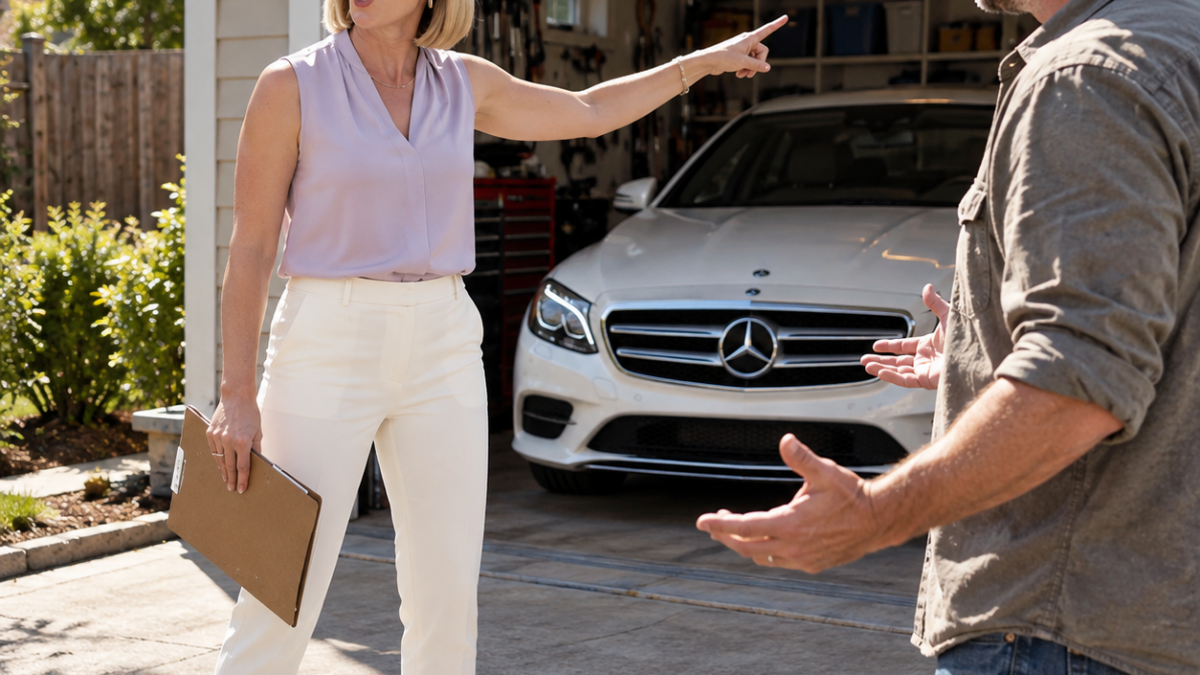
“So I needed somewhere to park.”
I looked at the car.
Then back at her.
“Why is that somewhere my garage?”
Her expression became almost amused.
“It’s not your garage.”
I actually looked away for a second.
I couldn’t believe we were returning to this.
“Karen.”
“We’ve discussed this.”
“Yes.”
“This structure sits on my property line.”
“No.”
“It does.”
“No.”
“You know it does.”
“I paid for a survey.”
She waved one hand.
“That survey.”
“The certified survey.”
“The one you bought.”
“Yes.”
“Exactly.”
I stared.
“The garage is three feet inside my property.”
“According to your people.”
“According to the property line.”
She crossed her arms.
“My driveway is unavailable.”
“Park on the street.”
“I’m not leaving my car three blocks away.”
“Then park somewhere else.”
“Why would I when there’s an empty garage?”
“My garage.”
“You don’t even use this side.”
That sentence irritated me more than it should have.
Because it revealed exactly how she thought.
If I wasn’t using something in the way she considered proper, she believed it became available to her.
“I don’t have to use it.”
She rolled her eyes.
“It’s sitting empty.”
“Still mine.”
“My car isn’t hurting anything.”
“You’re inside a private building without permission.”
“I didn’t break in.”
“The door was open because I was loading.”
“Then clearly you weren’t concerned about security.”
“I was gone twenty minutes.”
“And now I’m using the space.”
I took a breath.
“Move the car.”
“No.”
Not even hesitation.
Just no.
I stepped closer.
“Karen.”
“What?”
“I’m leaving town.”
“So?”
“For a week.”
She shrugged.
“Have fun.”
“I’m locking the garage.”
Her smile changed.
Slightly.
“What?”
“My friends will be here in about thirty minutes. We’re leaving for seven days.”
She glanced toward the car.
Then back at me.
“I lock this garage when I’m gone.”
“You won’t lock my car inside.”
I said nothing.
She laughed.
Loud.
Mocking.
“Please.”
“I’m serious.”
“You cannot lock somebody’s vehicle in a building.”
“I am not leaving my garage unsecured for a week because you decided to park inside it.”
She shook her head.
“If you lock it, I’ll call the police.”
“Okay.”
“They’ll make you open it.”
“I’ll be four hours away.”
Her expression flickered.
“Then I’ll call a locksmith.”
“To break into my garage?”
“It’s my car.”
“Inside my building.”
She stepped closer.
“You’re trying to bully me.”
I almost laughed.
“I’m telling you what’s going to happen.”
“You think you’re clever.”
“No.”
“You think because you paid for that fake survey you can push me around.”
“No.”
“I’m not moving it.”
I looked straight at her.
“Final warning.”
She stared.
“Move your car.”
“No.”
“I’m closing the garage.”
“Go ahead.”
“Karen.”
She turned.
Took another sip.
Then started walking toward her house.
Over her shoulder, she called:
“Have a nice little boat trip.”
I stood there for maybe two minutes.
Angry enough that I could feel my heartbeat in my neck.
Then something changed.
The anger didn’t disappear.
It became clarity.
Karen knew exactly what I’d said.
She had been warned.
She understood I was leaving.
She understood the garage would be secured.
She believed I wouldn’t follow through because accommodating her was easier than dealing with the fight.
That assumption had powered almost every argument we’d ever had.
The source story establishes that the garage sat around three feet inside the narrator’s certified property boundary and that Karen knowingly parked inside it the morning of his week-long trip despite being directly told to remove the car.
I walked into the garage.
Looked at her sedan.
Then at the roll-up door.
My garage had a heavy steel security bar mounted inside the main door.
When engaged, it slid into both tracks.
Once locked into place, the door couldn’t simply be lifted from outside.
I grabbed the handle.
Pulled the large door down.
Sunlight narrowed to a strip.
Then disappeared.
I slid the bar across.
Clunk.
Main door secured.
Then I went to the side entrance.
The side door was solid wood.
Heavy deadbolt.
I stepped outside.
Closed it.
Locked the deadbolt.
Normally, that would’ve been enough.
That morning I wanted zero ambiguity.
I had a length of heavy steel chain in my work truck.
Also a weather-resistant padlock.
I looped the chain through the exterior steel handle and around a solid support post beneath the overhang.
Pulled it tight.
Snapped the lock closed.
Now anyone looking at that door would understand one thing.
Closed.
Then I thought about Karen telling me she’d call a locksmith.
I wasn’t going to leave a stranger interpreting this as some accidental lockout.
So I made a sign.
PRIVATE PROPERTY.
NO TRESPASSING.
I wrote that the garage and the land belonged exclusively to the owner of my house.
Any attempt to force entry, damage locks, or alter the structure would be treated as unauthorized entry and property damage.
I put the paper into a clear plastic sleeve.
Taped it beside the chain.
Then stepped back.
That still wasn’t enough for my mood.
I owned an older Ford F-250 work truck.
Big diesel.
Heavy.
Used it for construction-related jobs and hauling.
I started it.
Backed slowly toward the garage.
Stopped with less than two inches between the rear bumper and the roll-up door.
Parking brake.
Locked doors.
Keys in pocket.
Even if someone somehow defeated the internal bar, the door couldn’t rise because several thousand pounds of truck sat directly behind it.
I shut off the engine.
Silence.
My friend’s truck pulled up a few minutes later with the boat trailer.
Two other friends were inside.
One leaned out the window.
“You ready?”
I picked up my duffel.
“More ready than I’ve ever been.”
He looked toward my work truck.
“Why did you park like that?”
“Long story.”
“We have four hours.”
“You’ll hear it.”
As I climbed into the passenger seat, I looked toward Karen’s house.
She stood behind her front window.
Coffee mug raised.
Watching.
I smiled.
Lifted one hand.
Waved.
She glared.
Then we left.
I wasn’t reckless enough to believe she would simply accept the situation.
Karen had never accepted anything quietly.
So before leaving, I had checked all my security cameras.
One covered the front of the house.
One covered the driveway and main garage door.
Another covered the side entrance.
High-definition recording.
Motion alerts.
Remote access through my phone.
Two hours into the drive, my phone vibrated.
Motion alert.
I opened the app.
Karen.
She came down her driveway wearing a nicer outfit and carrying a handbag.
Probably heading to one of those errands she’d mentioned.
She walked toward my garage confidently.
Reached the front.
Stopped.
The camera angle showed her staring at the F-250.
Her head moved slowly from the truck to the garage.
Then back.
She walked around.
Reached the side door.
Saw the chain.
Stopped again.
Read the sign.
Even through a phone screen, I could see the color changing in her face.
One of my friends leaned over.
“What is she doing?”
“Learning.”
“Learning what?”
“That I wasn’t joking.”
I handed him the phone.
He laughed.
“That’s her car inside?”
“Yes.”
“You told her?”
“Several times.”
“She refused?”
“Repeatedly.”
He passed the phone to the back seat.
My other friend said:
“You realize she’s going to call somebody.”
As if on cue, Karen pulled out her phone.
I smiled.
“Apparently.”
Forty-five minutes later, another motion alert.
Sheriff’s cruiser.
We were already well down the highway.
I opened the camera app.
Audio.
Karen was standing beside the deputy.
She looked furious.
Her arms moved dramatically while she pointed at the truck, garage, side door, house.
The deputy was older.
Calm.
The kind of officer who had probably heard every possible version of a ridiculous neighbor dispute.
Karen’s voice came through the microphone.
“He locked my car in there!”
The deputy looked toward the garage.
“He actually locked it.”
Karen pointed.
“My vehicle is being held hostage.”
One of my friends started laughing.
I raised the volume.
“I have doctor appointments.”
Karen paced.
“Groceries. Errands. I need my vehicle.”
The deputy walked to the side door.
Read the sign.
Inspected the chain.
Looked at the house number.
Then the garage.
Then Karen.
“Is this your property, ma’am?”
Karen folded her arms.
“The garage sits on my property line.”
“That wasn’t exactly my question.”
“It is a shared structure.”
I laughed quietly.
Shared.
That was new.
The deputy asked:
“Do you own the garage?”
“It’s partly on my land.”
“Do you have documentation?”
Karen hesitated.
“There’s been a boundary dispute.”
There hadn’t.
There’d been a survey.
She just didn’t like the answer.
The deputy asked:
“Did the homeowner give you permission to park inside?”
Karen’s posture changed.
“I don’t need permission.”
My friends groaned in unison.
The deputy stared at her.
She continued:
“My driveway is being resealed.”
“Okay.”
“I couldn’t leave my vehicle outside.”
“Okay.”
“So I put it in here.”
“Did he tell you that was okay?”
“He knew.”
“That’s not what I asked.”
Karen’s voice sharpened.
“He doesn’t even use that side of the garage.”
The deputy nodded slowly.
“Did he tell you to move the car before he left?”
Silence.
Then:
“He was threatening me.”
“How?”
“He said he was going to lock it inside.”
One of my friends said:
“She’s making your case for you.”
I nodded.
The deputy said:
“So he told you he was leaving and securing his garage.”
Karen realized what she’d admitted.
“He did it maliciously.”
“Maybe.”
The deputy looked at the chain.
“But I cannot break into someone’s private building because you parked inside without authorization.”
Karen’s voice rose.
“You need to cut that.”
“No.”
“Call a tow truck.”
“The car is inside.”
“Then move his truck.”
“No.”
“Why not?”
“Because it’s his vehicle on his property.”
“He did that to trap me.”
The deputy remained calm.
“I understand you’re upset.”
“No, you don’t.”
“I understand the situation.”
“Then fix it.”
“There’s nothing I’m going to break here.”
Karen pointed toward the garage.
“He’s kidnapped my car.”
That nearly destroyed everyone in our truck.
My buddy was laughing so hard he had tears.
The deputy didn’t.
He said:
“Cars are not kidnapped.”
“You know what I mean.”
“I do.”
“Then get it out.”
“You’ll need to contact the homeowner or resolve the issue civilly.”
“He’s gone.”
“I understand.”
“For a week!”
The deputy paused.
“Then I would suggest in the future that you don’t park inside someone else’s garage when they’re leaving for a week.”
Silence.
Beautiful silence.
Karen finally said:
“This is unbelievable.”
The deputy turned.
“Have a good day, ma’am.”
She followed.
“You’re just leaving?”
He kept walking.
“You can’t leave.”
He got into the cruiser.
She stood in the driveway.
Hands on hips.
Then the cruiser left.
My friends exploded.
One said:
“Forget fishing. This is the trip.”
I took the phone back.
“She’ll try something else.”
She did.
Tuesday.
Motion alert.
Tow truck.
Flatbed.
Driver got out.
Karen immediately began pointing.
The man looked at my F-250.
Walked around it.
Looked at the roll-up door.
Looked at the side chain.
Then at Karen.
They talked for several minutes.
No audio from that angle.
Finally, the driver shook his head.
Karen pointed again.
He shook his head again.
Then climbed into the tow truck and left.
Apparently, “There’s another truck parked almost against a locked garage containing the car I want you to tow” wasn’t a job he wanted.
Wednesday brought another alert.
Karen and a man I didn’t recognize inspected the chain.
The man bent down.
Looked at the padlock.
Read the sign.
Then walked away from the door.
They argued.
He left.
Locksmith, I assumed.
Thursday was quiet.
Friday, Karen walked around the garage twice.
Didn’t touch anything.
Saturday, nothing.
I spent the week doing exactly what I’d planned.
Fishing.
Boating.
Eating terrible food.
Drinking beer around a fire at night.
I checked the cameras more than I probably should have.
My friends turned it into entertainment.
Every time the phone buzzed, someone shouted:
“Karen update!”
By the middle of the week, even I was starting to feel slightly ridiculous.
But I also remembered the conversation.
Move the car.
No.
I am leaving for a week.
You won’t lock it.
Move the car.
No.
She had known.
Every inconvenience that followed came after a direct, clear warning.
Sunday arrived.
We cleaned the cabin.
Loaded gear.
Hitched the boat.
Started the four-hour drive home.
I won’t pretend I wasn’t curious.
Karen had been without her vehicle for seven days.
No successful police intervention.
No tow.
No locksmith.
I expected anger.
Maybe legal threats.
Maybe screaming.
We turned onto my street around four in the afternoon.
Karen was on her porch.
She looked tired.
No coffee mug.
No smug smile.
When my buddy parked down the street, she stood immediately.
I got out.
Grabbed my bag.
Walked toward my driveway.
Karen came over.
Not running.
Not shouting.
That alone was strange.
“Are you going to open the garage?”
No hello.
No welcome home.
I smiled.
“Good afternoon, Karen.”
Her jaw tightened.
“Please.”
That word got my attention.
“The boating trip was great.”
She stared.
“Thanks for asking.”
“Can you open it?”
“In a minute.”
She looked toward the garage.
“I had to spend over four hundred dollars on ride shares and buses.”
“That’s unfortunate.”
“I missed two appointments.”
I said nothing.
“My whole week was ruined.”
“I’m sorry to hear that.”
“No, you’re not.”
“No.”
At least we agreed.
She looked exhausted.
“Just let me get my car.”
I set my duffel down.
“Before I open anything, I want to clarify something.”
Her eyes narrowed.
“What?”
“Whose garage is this?”
She said nothing.
I waited.
“Karen.”
She looked at the ground.
“Yours.”
I almost asked her to repeat it.
Didn’t.
“And the land beside it?”
“Yours.”
“The entire garage?”
“Yes.”
No argument.
No bribed surveyors.
No shared structure.
No visual interpretation.
Just reality.
I continued.
“Will you ever park inside my garage again without permission?”
“No.”
“Will you block the driveway?”
“No.”
“Will you tell me this structure belongs to you?”
“No.”
“Will you enter the garage because you think I don’t use part of it enough?”
“No.”
She looked up.
“Are we finished?”
“Yes.”
“Please open the door.”
“All right.”
I unlocked the F-250.
Started it.
Pulled forward.
Parked farther down the drive.
Then walked to the side entrance.
Removed the padlock.
Unwrapped the chain.
Unlocked the deadbolt.
Entered.
The garage smelled faintly of whatever air freshener Karen kept in her car.
Her sedan sat exactly where she’d left it.
Untouched.
No damage.
No scratches.
No missing property.
I walked to the main door.
Pulled the steel bar free.
Raised the roll-up door.
Sunlight filled the garage.
Karen didn’t say another word.
She went straight to the driver’s side.
Got in.
Started the engine.
Backed out so quickly the tires made a small chirp on the pavement.
Then she drove directly onto her own newly sealed driveway.
Apparently the sealant had cured.
She parked.
Got out.
Went inside.
Door slammed.
I stood in my driveway looking into the empty garage.
It had never looked better.
My friends were still watching from the street.
One shouted:
“Whose garage is it?”
I raised one finger.
“Don’t.”
They laughed.
For the next several days, Karen avoided me.
I expected something official.
Attorney.
Letter.
Police follow-up.
Civil complaint.
Something.
Nothing arrived.
What did happen was that the property-line argument disappeared completely.
No more comments.
No more gestures toward the garage.
No more “my side.”
No more claims that the survey was fake.
Apparently seven days without her vehicle had succeeded where certified property records had failed.
I didn’t celebrate openly.
That would’ve guaranteed another fight.
But I enjoyed the silence.
A week later, I was washing tools near the garage when Karen came outside.
She glanced toward me.
I waited.
She said:
“Your truck damaged the appearance of my driveway seal.”
I stared.
She lasted about two seconds.
Then actually smiled.
Not warmly.
But enough that I realized she knew how absurd it sounded.
I laughed.
She went inside.
That was probably the closest we ever came to peace.
A few neighbors heard what happened.
Of course they did.
Neighborhood information travels faster than emergency services.
One guy from across the street came over.
“Is it true?”
“What?”
“You locked Karen’s car in the garage for a week.”
“I locked my garage.”
He smiled.
“With her car inside.”
“Coincidence.”
He laughed.
“She told my wife you stole access to her vehicle.”
“I was four hours away.”
“She also said part of the garage is hers.”
“Did she?”
“Past tense.”
That made me smile.
Another neighbor said:
“You’re lucky she didn’t break in.”
“Cameras.”
“Still.”
“She saw the sign.”
He shook his head.
“I wouldn’t have had the patience.”
I thought about that.
Patience.
Was what I did patient?
Depends who you ask.
I didn’t damage the car.
Didn’t move it.
Didn’t enter it.
Didn’t sell it.
Didn’t hide it.
I secured my own building and left on a trip I’d already planned.
But I also knew exactly what would happen.
I knew she’d be stuck without the vehicle.
I knew she’d be furious.
I knew she wanted the convenience of parking somewhere she had no right to use.
There was malice in the compliance.
I’m not going to pretend otherwise.
She told me I wouldn’t dare lock the garage.
I did.
Sometimes people hearing the story focus on whether I should have called police before leaving.
Maybe.
That would’ve been cleaner.
I could have documented the car inside.
Called non-emergency.
Requested that Karen remove it.
Asked for a tow if allowed.
That would have created paperwork and witnesses.
Probably the smarter modern approach.
But in that moment, after two years of having a certified survey dismissed as corruption, I wasn’t interested in another debate.
The building was mine.
I had expensive tools inside.
I was leaving for seven days.
Leaving it open was never an option.
Karen had one simple way to avoid the entire problem.
Move the car.
She had thirty minutes before my friends arrived.
Her driveway wasn’t sealed yet.
She could’ve pulled the sedan out and temporarily left it on the street.
Could’ve asked a neighbor.
Could’ve rented space.
Could’ve used a parking lot.
Could’ve parked three blocks away despite her fear of scratches.
Instead, she chose my garage because she had spent years convincing herself it was partly hers.
That’s what really interested me afterward.
Karen’s entitlement wasn’t completely fake.
She had started believing her own argument.
The certified survey didn’t matter because accepting it would require admitting she’d been wrong for years.
That became impossible.
So she built another explanation.
Surveyors were corrupt.
Maps were wrong.
Property history supported her.
The building was “shared.”
I didn’t use half of it.
Therefore she could.
Every time reality challenged the belief, she added another reason rather than changing the belief.
Then came the car.
Physical reality.
The garage door closed.
The lock engaged.
The truck blocked access.
Police refused to break in.
Tow driver refused.
Locksmith apparently refused.
For seven days, reality stopped negotiating.
That’s why her answer on Sunday mattered.
Whose garage?
Yours.
Three years of arguing reduced to one word.
Yours.
I never needed an apology after that.
I needed recognition.
The survey had given me legal certainty.
Her answer gave me peace.
The story became a running joke among my boating friends.
Every year after that, when we planned another trip, one of them would ask:
“Did you check the garage for luxury vehicles?”
Another would say:
“Maybe Karen needs valet service.”
I threatened to stop inviting them.
Never did.
The next year, before leaving for the lake, I shut the garage door myself.
Locked it.
Checked cameras.
No sedan.
No argument.
Progress.
Karen still lived next door.
She was still difficult.
That didn’t magically change.
She complained once about leaves blowing from my tree.
Another time about noise from a project in the garage.
She thought my exterior light was too bright.
She had opinions about where my trash cans sat.
But whenever I said:
“My property.”
She stopped.
The garage incident had drawn a line stronger than paint or survey stakes.
Several years later, she eventually sold the house.
On moving day, a truck sat in her driveway.
Actual movers carried boxes.
I was in the garage when she walked over.
She stopped several feet away.
“You’re leaving?” I asked.
“Obviously.”
“Where?”
“Closer to my daughter.”
“Good.”
She looked at the garage.
Then at me.
For a second, I wondered whether she was going to restart the property argument one final time.
Instead she said:
“I always hated that garage.”
I laughed.
“I know.”
“It should’ve been farther from the line.”
“Probably.”
“Three feet is ridiculous.”
“But three feet.”
She sighed.
“Yes.”
“Three feet.”
“Don’t enjoy this too much.”
“I’m trying.”
She almost smiled.
Then said:
“You really left for the whole week.”
I nodded.
“You thought I’d come back?”
“I thought the police would make you.”
“Apparently not.”
She shook her head.
“I have never spent that much on transportation in one week in my life.”
“You could’ve parked three blocks away for free.”
Her eyes narrowed.
“Don’t start.”
I laughed.
She turned.
Walked back toward her house.
That was our last real conversation.
The new neighbor moved in a few weeks later.
His name was Aaron.
Normal guy.
Wife.
Two children.
On his second day, I saw him checking the side yard near the property line.
I walked over.
“Everything okay?”
“Yeah.”
He pointed.
“Just trying to figure out where the boundary runs.”
I braced myself automatically.
Then remembered Karen was gone.
“I have a certified survey.”
“Really?”
“Yeah.”
“Could I see it?”
That question alone felt revolutionary.
I brought out a copy.
Showed him the line.
He studied it.
“So the garage is yours and there’s about three feet here.”
“Correct.”
“Good to know.”
He handed the paper back.
“Thanks.”
That was it.
No conspiracy.
No bribed surveyors.
No claim that a building’s proximity somehow transferred ownership.
Two adults looking at a document.
Conversation over.
A few months later, Aaron asked if he could temporarily stack fence panels on part of that three-foot strip while replacing his fence.
He asked.
I said yes.
They were there for two days.
Then gone.
No drama.
That interaction showed exactly how unnecessary the entire war with Karen had been.
Permission changes everything.
“Can I?”
“Yes.”
Simple.
Karen didn’t like asking because asking means the other person can say no.
She preferred declaring.
The garage is mine.
The space is shared.
I can park here.
You won’t lock it.
The pattern wasn’t really about parking.
It was about her inability to tolerate someone else having final authority over something she wanted.
I think that’s why the Sunday conversation broke her resistance.
For seven days, every outside person she tried to involve ran into the same fact.
Not her building.
Not her lock.
Not her truck.
Not her property.
Eventually, even Karen had nowhere left to move the argument.
People sometimes ask whether I worried she would damage the garage.
Absolutely.
That’s why I had cameras.
The moment she had cut a lock or damaged the door, the situation would’ve changed completely.
Fortunately, she wasn’t that reckless.
Entitled, yes.
Stupid enough to attack a clearly secured building under camera coverage?
Apparently not.
The sign probably helped.
The truck definitely helped.
And maybe the deputy’s refusal made her realize that forcing entry wasn’t going to look like self-help.
It was going to look like exactly what it was.
Breaking into another person’s property to retrieve a car she’d put there without permission.
A bizarre situation created entirely by one decision.
No.
That’s not true.
Many decisions.
Years of refusing the survey.
Years of claiming the garage.
Watching me leave briefly.
Seeing the garage open.
Choosing to drive across my property.
Pulling fully into the bay.
Locking the sedan.
Walking away.
Refusing to move.
Ignoring the warning.
Laughing.
Daring me.
Every step was a choice.
People sometimes talk about consequences as if they arrive suddenly.
Usually they don’t.
Usually they’re visible from a long way off.
Karen’s consequence came with a thirty-minute warning.
She laughed at it.
I think that’s why I never felt guilty.
Not really.
Maybe I was petty.
Absolutely.
Maybe leaving for the trip instead of spending the morning calling authorities was aggressive.
Sure.
But she knew exactly what would happen.
I did not trick her.
Didn’t lie.
Didn’t wait until she was gone and secretly move the car into the garage.
She put it there.
I stood in front of her.
Told her:
I am leaving for a week.
I am locking the building.
Move the car.
She answered:
No.
Then told me I wouldn’t dare.
Sometimes the universe does not need a complicated response.
Sometimes it just needs you to stop preventing somebody from experiencing the consequences they chose.
Years later, I still owned that house.
The garage still stood exactly where the survey said it did.
Three feet inside.
The side chain eventually rusted and I replaced it.
The F-250 finally died after years of abuse.
I sold it to a younger guy who somehow believed fixing old diesel trucks was a relaxing hobby.
I bought another truck.
The garage remained.
Still workshop on one side.
Open space on the other.
Sometimes completely empty.
Nobody saw the empty bay and decided that made it public parking.
Funny how that works.
Whenever I pulled into the garage after Karen moved, I occasionally remembered her sedan sitting there that morning.
Perfectly polished.
Completely unauthorized.
The memory always made me shake my head.
Not because locking it in was the cleverest thing I’d ever done.
Probably wasn’t.
Because I still couldn’t understand what kind of person sees an open garage belonging to a neighbor, drives a car into it, and then argues that the garage somehow became theirs.
That requires a very specific relationship with reality.
But maybe entitlement always works that way.
It begins with convenience.
I need somewhere to park.
Then justification.
He isn’t using the space.
Then invented authority.
The garage is really on my property.
Then attack.
The survey is fake.
Then expectation.
He won’t stop me.
Then outrage.
How dare he stop me?
Every step protects the same basic belief.
My convenience matters more than your boundary.
Karen spent years operating from that belief.
The boating trip cured it.
Not completely.
People like Karen don’t usually transform after one conflict.
But she learned one specific boundary.
That garage.
Mine.
The final Sunday scene stayed with me longer than the laughter in the truck or the camera footage.
Karen standing there exhausted.
No performance left.
No gold-button authority.
No lecture.
No fake property theory.
Just:
“It is yours.”
That was all I’d wanted years earlier.
Recognition of the line.
I didn’t need her to like me.
Didn’t need friendship.
Didn’t need her to admire the surveyor.
Just accept reality.
Three feet.
Her property ended.
Mine began.
The garage stood inside mine.
Once she accepted that, the conflict disappeared.
I’ve kept a copy of the old survey in my files.
Not because Karen might come back.
Because property disputes teach you to love paperwork.
A good survey is boring.
Lines.
Measurements.
Stamps.
Coordinates.
No emotion.
That’s exactly why it’s useful.
Karen had arguments.
The survey had numbers.
For years, she thought saying something with enough confidence could overpower those numbers.
It couldn’t.
And when the morning finally came that she put a physical object inside the space those numbers described, everything stopped being theoretical.
Her car was inside my building.
I secured my building.
She spent a week learning the difference.
If I could go back, would I change anything?
Maybe I’d call the sheriff before leaving.
Get an incident number.
Make the record cleaner.
Maybe I’d have the vehicle towed if that was legally available.
Maybe I’d avoid giving Karen anything she could characterize as intentional retaliation.
Older me appreciates documentation more than younger me did.
But would I leave my garage open for seven days to protect her convenience?
Absolutely not.
Would I cancel the trip?
No.
Would I trust a woman who believed the garage belonged to her with unrestricted access to my tools while I was four hours away?
Not a chance.
Karen had alternatives.
I had one garage.
Securing it was not negotiable.
And that is probably why the story still makes me laugh.
She wasn’t trapped by some complicated revenge plan.
She trapped herself with certainty.
She was certain the survey didn’t matter.
Certain I wouldn’t lock the door.
Certain police would rescue her.
Certain a locksmith would open it.
Certain a tow company would solve it.
Certain her need for the space would eventually outrank my right to secure my property.
One by one, every certainty failed.
By Sunday afternoon, only the survey remained.
Whose garage?
Mine.
Whose land?
Mine.
Simple.
It had always been simple.
Karen was the one who spent years making it complicated.