𝗙𝗨𝗟𝗟 𝗦𝗧𝗢𝗥𝗬 My Neighbor Built a Luxury Pool Across My Property Line—Then Told Me to Sue Her or Tear It Out Myself
𝗣𝗔𝗥𝗧 𝟮
The last conversation before my long work assignment should have warned me.
I was checking something near the wall when Karen appeared on her side.
She wore white trousers and one of those tight military-style jackets, open low at the front.
She looked over the concrete wall.
“Heading out again?”
“Next week.”
“How long?”
“About three months.”
Her expression changed.
Not much.
Just enough that I noticed.
“Kalimantan?”
“Yeah.”
“Long way.”
“It is.”
She rested one hand on the wall.
“You really should reconsider selling.”
“No.”
“You don’t even use most of this.”
“I use it by owning it.”
Karen laughed.
“That’s not use.”
“It’s enough for me.”
“We’ve been looking at improvements.”
“What kind?”
“Pool.”
I nodded.
“Nice.”
“Our yard is a little tight.”
I looked at her.
She smiled.
That was the warning.
I just didn’t understand it yet.
“Then build a smaller pool.”
Karen’s smile disappeared.
“You enjoy being difficult.”
“No. I enjoy owning my property.”
“Someday somebody is going to make better use of it.”
“Maybe after I’m dead.”
She stared at me for another second.
Then walked away.
I left for Kalimantan the following week.
Before long projects, I had a routine.
Check locks.
Shut off anything unnecessary.
Make sure important documents were secure.
Tell family where I would be.
And ask my elderly neighbor on the other side, Mrs. Sari, to keep an eye on the house.
Mrs. Sari had lived on the street longer than almost anyone.
She was in her seventies, tiny, observant, and absolutely incapable of missing neighborhood activity.
If a delivery truck arrived, she knew.
If somebody walked through my gate, she knew.
If a cat sneezed suspiciously at midnight, she probably knew.
I trusted her.
“Three months?” she asked.
“Approximately.”
“I’ll watch.”
“Thank you.”
“And your government princess?”
I laughed.
That was what she called Karen.
“Hopefully she stays on her side.”
Mrs. Sari made a face.
“I don’t like that woman.”
“You don’t like anybody.”
“Correct.”
Then she smiled.
For the first month, everything seemed normal.
Mrs. Sari sent occasional messages.
Rain.
Power outages.
One branch had fallen.
Nothing important.
My project kept me extremely busy.
The mining site was remote enough that some days I had reliable internet for less than an hour.
Phone reception came and went.
I worked long shifts.
Sometimes twelve hours.
Sometimes more.
Home felt very far away.
Around the sixth week, Mrs. Sari sent me a message.
A lot of construction next door.
I replied when I finally saw it.
House work?
She answered:
Big work. Machines.
I didn’t think much of it.
People renovate.
Karen had mentioned a pool.
Fine.
Let her build one.
Two days later, another message.
I don’t like where they are digging.
That got my attention.
What do you mean?
No immediate answer.
Hours later:
Close to your wall. Maybe too close.
I called.
Connection failed.
Tried again.
Nothing.
Finally, the next morning, we spoke for about three minutes before reception disappeared.
“They are removing part near the back.”
“Removing what?”
“I cannot see clearly.”
“Part of the wall?”
“Maybe.”
My stomach tightened.
“Take photos if you can.”
“I will.”
The photo arrived later that day.
I stared at my phone for almost a minute before I understood what I was looking at.
A massive excavation.
Steel reinforcement.
Concrete forms.
Workers.
And my property wall partially removed.
The pool wasn’t sitting beside my boundary.
It crossed it.
Clearly.
Not a few centimeters.
Not some questionable corner.
A large portion of the excavation extended onto my property.
I zoomed in.
My blood pressure rose.
At least a quarter.
Maybe more.
I called Karen immediately.
No answer.
Called again.
Nothing.
Sent a message.
Your pool construction is on my property. Stop work immediately and call me.
Read receipt eventually appeared.
No response.
I called her husband.
Nothing.
Called again.
Straight to voicemail.
For the next three days, I tried repeatedly.
Karen ignored everything.
Meanwhile, Mrs. Sari kept sending photos.
Each one was worse.
Concrete.
Plumbing.
Workers.
Reinforcement.
The pool shell forming.
They were moving fast.
Suspiciously fast.
I called the village head.
He listened.
“I will look into it.”
“Please tell them to stop.”
“I need to confirm.”
“My boundary wall is visible.”
“I understand.”
“They removed part of it.”
“I will visit.”
“When?”
“Soon.”
Soon is one of the most dangerous words in bureaucracy.
“What does soon mean?”
“Within a few days.”
“Construction is happening every day.”
“I understand.”
“Please stop it.”
He repeated that he would investigate.
Three days later, the pool walls had been poured.
I called him again.
“Did you go?”
“Yes.”
“And?”
There was a pause.
“Karen says she has permission.”
My grip tightened around the phone.
“From whom?”
“From you.”
I genuinely thought the connection had distorted his words.
“Say that again.”
“She says you agreed before leaving.”
“No.”
“She claims there was a verbal arrangement.”
“There wasn’t.”
“She says you agreed to let them use part of the land.”
“That’s a lie.”
Another pause.
“She seemed very certain.”
“Of course she did.”
I stood in a temporary office thousands of kilometers from home, looking at maps of mining operations while someone back in my town calmly explained that my neighbor had invented a conversation.
“I never gave permission.”
“Do you have anything in writing?”
“How do I have something in writing proving I never gave permission?”
He didn’t answer.
“Ask her for the agreement.”
“She says it was verbal.”
“Convenient.”
“I understand you’re upset.”
“I’m not upset.”
I was furious.
“She is building a swimming pool on my property.”
“Let me investigate.”
“You already did.”
“We need to handle this carefully.”
That was when I began understanding the real problem.
Karen didn’t necessarily need to prove anything immediately.
She only needed enough influence, confidence, and confusion to keep officials from stopping construction.
Time was helping her.
Every day the pool became more permanent.
Every day more money went into it.
I contacted a lawyer in Jakarta.
I sent him the photographs.
Property documents.
Old survey copies.
Everything available electronically.
He called me.
“You’re right. This looks bad.”
“Can we stop them?”
“Possibly, but I need current documentation.”
“I’m in Kalimantan.”
“I know.”
“Can you file something?”
“We can send notices.”
“Will construction stop?”
“Not necessarily.”
“Why?”
“Because if they claim permission and boundary ambiguity, local enforcement may call it civil until you’re physically present and an official survey confirms it.”
I wanted to throw my phone.
“There’s a concrete wall.”
“I know.”
“They cut through it.”
“I know.”
“How ambiguous is concrete?”
He sighed.
“I’m not defending them.”
“Then help me.”
“I am.”
The lawyer sent formal notices.
Karen ignored them.
I sent more messages.
Ignored.
Mrs. Sari became my eyes.
She photographed workers laying tile.
Installing filtration.
Pouring decking.
The pool wasn’t modest.
It was full-size.
Expensive.
Blue tile.
Broad concrete surround.
Landscaping.
Pump equipment.
The construction crew worked from dawn until evening.
Karen clearly wanted the pool completed before I returned.
By then, my lawyer estimated nearly thirty percent of the total pool area and surrounding deck crossed my legal boundary.
Thirty percent.
Imagine watching someone build a room inside your house through photographs while they ignore your calls.
That was what it felt like.
I was trapped.
Leaving the project early would have cost me a major contract and possibly future work.
Staying meant watching concrete harden over land my family had owned for decades.
Every morning, before checking project emails, I checked messages from Mrs. Sari.
More progress.
More anger.
Then came the photograph that changed something in me.
The completed pool.
Crystal-clear blue water.
Finished tile.
New plants.
Outdoor furniture.
A polished deck.
Honestly?
It was beautiful.
I’d be lying if I said otherwise.
Karen had spent real money.
The contractor had done good work.
The pool looked like something from an expensive villa.
And nearly one-third of it was sitting on my property.
The same afternoon, a neighborhood acquaintance messaged me.
You know Karen is bragging about this, right?
I stared at the screen.
About what?
Says she negotiated with you.
Then another message.
She’s telling people you agreed to let her use the land because you’re away all the time.
I felt sick.
A third message:
She joked you were stupid not to charge more.
That did it.
Until then, some part of me had still entertained the possibility that Karen would eventually pretend this was a misunderstanding.
Survey error.
Contractor mistake.
Miscommunication.
Something.
No.
She knew.
She had planned it.
She had lied to local officials.
And she was proud.
I had two weeks before returning.
I stopped contacting her.
That was deliberate.
No more warnings.
No more begging.
No more messages she could ignore.
I simply saved everything.
Photos.
Call logs.
Texts.
My original property documents.
Messages from Mrs. Sari.
Lawyer correspondence.
Anything that established I had objected.
Then I finished my contract.
Three months after leaving home, I flew back.
I barely slept on the trip.
When I finally reached my town, I didn’t even unpack.
I put my luggage inside.
Walked through the house.
Checked everything.
Then stepped into the yard.
The pool was enormous in person.
Photographs had not conveyed the scale.
Karen’s yard had been transformed into a resort-like space.
And the pool crossed the boundary so blatantly that anger almost became disbelief.
The concrete decking extended nearly two meters onto my side in places.
Part of the original wall was gone.
The pool itself crossed into my land.
There was no accidental misunderstanding.
You couldn’t build that by mistake.
I stood there staring.
Mrs. Sari called over from her yard.
“You’re home.”
“Yes.”
She came closer.
“I told them.”
“I know.”
“They didn’t care.”
“I know.”
“Government princess came every day.”
I looked at her.
“Every day?”
“Watching workers.”
That mattered.
Karen couldn’t later blame contractors.
She supervised.
“Thank you for the pictures.”
Mrs. Sari smiled.
“I took many.”
“You saved me.”
“No.”
She pointed toward Karen’s house.
“You save yourself now.”
I walked next door.
Knocked.
Karen’s husband answered.
His face changed the second he saw me.
Color drained from it.
“Oh.”
“Hello.”
“You’re back.”
“Clearly.”
He looked over his shoulder.
“Karen?”
His voice sounded uncertain.
Then, to me:
“We thought you knew.”
That sentence told me everything.
“Get Karen.”
He disappeared.
A minute later, she arrived.
White military-style jacket.
Gold buttons.
Deep neckline.
Blonde hair immaculate.
Fake smile.
“Welcome home.”
I stared at her.
“Really?”
She widened the smile.
“How was Kalimantan?”
“Long.”
“I imagine.”
She leaned against the doorway.
“You saw the pool?”
“Yes.”
“Beautiful, isn’t it?”
My anger sharpened.
“Part of it is on my property.”
Karen’s husband looked at the floor.
Karen’s smile changed.
“That’s not accurate.”
“It is.”
“The boundary in that section has always been unclear.”
“No.”
“Yes.”
“No, Karen.”
I pointed toward my yard.
“My wall marked it.”
“Your wall wasn’t necessarily built on the legal line.”
“Survey was.”
She sighed.
“You’re coming into this very aggressively.”
I actually laughed.
“You ignored my calls for six weeks.”
“I was busy.”
“My lawyer contacted you.”
“Your lawyer sent threatening letters based on incomplete information.”
“You told the village head I gave you permission.”
Karen crossed her arms beneath her chest.
“We discussed it.”
“No, we didn’t.”
“Before you left.”
“No.”
“You said you weren’t using the land.”
“I said I wasn’t selling it.”
“Same conversation.”
“Not remotely.”
Karen looked toward her husband.
He said nothing.
She continued.
“You were gone for months.”
“So?”
“We needed space.”
“You don’t get my land because I travel.”
“You’re being emotional.”
There it was again.
The word people use when facts become inconvenient.
I kept my voice level.
“You built without permission.”
Karen’s expression hardened.
“We invested a significant amount of money improving that area.”
“I didn’t ask you to.”
“The property line wasn’t clearly established.”
“It was.”
“That’s your opinion.”
“It’s a registered survey.”
“And we have our own information.”
“Show me.”
She hesitated.
“That’s not necessary.”
“Of course.”
Karen stepped closer.
Her perfume was strong.
She lowered her voice as if offering confidential advice.
“Let me explain reality.”
I almost smiled.
“Please.”
“You can object.”
“I do.”
“You can complain.”
“I have.”
“You can even sue.”
“I might.”
Her smile returned.
“But lawsuits take years.”
Her husband looked at her.
Karen kept going.
“They cost money.”
“I know.”
“You work away from home.”
“So?”
“How much time do you want to spend fighting over a section you weren’t even using?”
There was the truth.
She had calculated inconvenience.
Not ownership.
“You think because you built something, the land becomes yours?”
“Investment matters.”
“Not like that.”
“We improved the property.”
“My property.”
Karen rolled her eyes.
“I don’t think you understand adverse claims.”
I did.
Probably better than she did by then.
But I let her speak.
“You’ve left that area unused for years.”
“So?”
“We invested substantial money.”
“Still mine.”
“The law isn’t always that simple.”
“Interesting coming from someone who works for the government.”
Her face tightened.
“You should be careful with accusations.”
“Was that a threat?”
“No.”
“It sounded like one.”
“I am reminding you that I understand how these processes work.”
There it was.
The government job.
The implication.
Connections.
Delay.
Intimidation.
Karen looked directly into my eyes.
“If you have a problem, sue us.”
Her husband shifted.
She continued.
“Seriously.”
I said nothing.
“Take us to court.”
Still nothing.
“It’ll cost you more than that strip of dirt is worth.”
I stared at her.
“Anything else?”
Karen gave a confident little smile.
“Actually, yes.”
She pointed toward the pool.
“If you’re going to make this difficult, then your choices are simple.”
My pulse slowed.
People sometimes tell you exactly how to beat them because arrogance makes them careless.
“What choices?”
“Accept the boundary as it is now.”
“No.”
“Or remove the part of the pool you claim is yours yourself.”
Her husband looked at her sharply.
“Karen—”
She held up one hand.
“No.”
Then she looked at me.
“Those are your options.”
“You want me to remove it?”
“If you’re so convinced it’s on your property.”
“You’re serious?”
She laughed.
“Of course.”
“You don’t think I will.”
“I know you won’t.”
“Why?”
“Because demolition would probably cost more than the land.”
Karen leaned forward slightly.
“That’s why adults negotiate realistically.”
I nodded.
“Understood.”
She smiled.
“I’m glad.”
“No.”
Her smile faltered.
“I mean I understand my options.”
I turned and walked home.
Behind me, I heard her husband say:
“Why would you tell him that?”
Good question.
For the next several days, I did exactly what Karen expected least.
I became extremely boring.
No shouting.
No confrontation.
No threats.
Paperwork.
I went to the local land office.
Requested certified copies of my deed.
Historical survey.
Boundary records.
Then I paid for a new official survey.
Not a private guess.
Not someone with a measuring tape.
A licensed surveyor using recorded coordinates.
We walked the property carefully.
Markers were established.
Measurements checked.
The result was unequivocal.
Nearly thirty percent of Karen’s pool area crossed onto my land.
The concrete deck extended as much as two meters over the legal boundary.
The pool basin itself crossed substantially.
Pump-related work remained mostly on her side, but that didn’t matter.
Part of the structure was mine only in the sense that it physically occupied my property without permission.
I asked the surveyor:
“Any ambiguity?”
He looked at me.
“No.”
“None?”
“None.”
“Can you certify it?”
“Yes.”
I had everything stamped.
Recorded.
Copied.
My lawyer reviewed it.
“This is excellent evidence.”
“But court takes time.”
“Yes.”
“Karen already reminded me.”
He paused.
“What are you thinking?”
“Fence.”
Silence.
“What kind of fence?”
“A legal one.”
“That wasn’t the question.”
I smiled.
My property rights included fencing my boundary.
That wasn’t unusual.
Concrete posts.
Security fencing.
Barbed wire where permitted and properly installed.
The key was simple.
The legal boundary ran directly through the pool.
I wasn’t going around it.
Why should I?
Going around would surrender land.
I wasn’t moving the legal line because Karen’s contractor had poured expensive concrete across it.
The fence would follow the property boundary exactly.
Straight.
From front to rear.
Including through the swimming pool area.
My lawyer asked several questions.
Permits.
Safety.
Exact alignment.
Local requirements.
I checked everything.
Then I contacted fencing contractors.
The first contractor thought I’d explained the situation incorrectly.
“You want the fence beside the pool?”
“No.”
“Behind it?”
“No.”
“Where?”
I showed him the certified survey.
He stared.
“The line goes through the pool.”
“Exactly.”
“You want posts in the decking?”
“Along the boundary.”
He laughed nervously.
“Neighbor okay with this?”
“She told me to remove the part of her pool on my land.”
He declined the job.
The second contractor also declined.
The third man looked at the survey.
Then photographs.
Then legal permits.
Then at me.
And smiled.
“This is going to be interesting.”
“I thought you might say that.”
We planned carefully.
Concrete posts every several meters.
Strong enough for security wire.
The fence would run the entire length of my property boundary.
Where it crossed the pool, posts would be placed in the deck area according to the line and rise roughly two meters.
Multiple strands of barbed wire would cross about a meter above the water surface.
It would be ugly.
Extremely ugly.
That wasn’t illegal.
More importantly, the fence would make the pool impossible to use normally.
I pulled every permit required.
I filed the official survey.
I made sure the village office had the boundary record.
I wasn’t giving Karen a procedural opening.
Construction started Monday morning.
For the first section, nothing dramatic happened.
Workers installed concrete posts near the front.
Then down the side.
Karen noticed eventually.
She came outside.
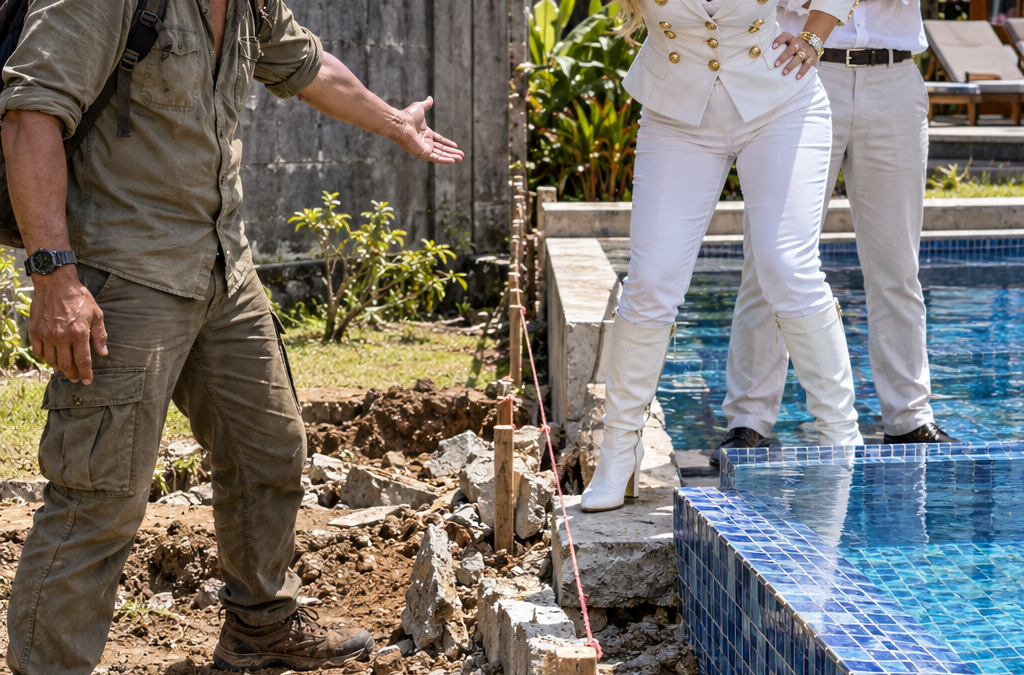
White trousers.
Tight white jacket.
Clipboard, naturally.
“What are you doing?”
“Building a fence.”
“Why?”
“Property security.”
She stared at the workers.
“You already have a wall.”
“Part of it disappeared while I was away.”
Her expression hardened.
“This looks excessive.”
“Good fences make good neighbors.”
Her eyes narrowed.
Then she noticed the stakes continuing toward the pool.
“What is that?”
“Fence line.”
“No.”
“Yes.”
Karen walked quickly toward the nearest marker.
“This doesn’t go there.”
“It does.”
“Your workers are on our pool deck.”
“My property.”
“Stop.”
I turned to the crew.
“Keep working.”
Karen stepped between them.
“Stop right now.”
The contractor looked at me.
I said calmly:
“Karen, don’t interfere with my workers.”
Her head snapped toward me.
“Your fence is going through my pool.”
“Correct.”
For a second, she seemed unable to speak.
“You can’t be serious.”
“Very.”
“You can’t put barbed wire through a swimming pool.”
“I can put a permitted fence on my legal property line.”
“You are destroying our pool.”
“You told me to remove the part on my property.”
“I didn’t mean this.”
“Then you should have been more specific.”
Her face reddened.
“This is childish.”
“Maybe.”
“Vindictive.”
“Possibly.”
“Illegal.”
“No.”
“I’ll call the police.”
“Please.”
Karen seemed disappointed that I didn’t panic.
She pulled out her phone.
Police arrived later.
Local officers.
Karen met them first.
Naturally.
She spoke quickly.
Gestured toward me.
Toward the workers.
Toward the pool.
One officer approached.
“You’re building the fence?”
“Yes.”
“Documents?”
I handed him a folder.
Deed.
Certified survey.
Permit.
Boundary confirmation.
He read carefully.
The second officer walked the line.
Checked markers.
Looked at the pool.
Came back.
“This is the boundary?”
“Official survey says yes.”
Karen stepped in.
“He is intentionally destroying my property.”
The officer looked at her.
“Why is the pool across the boundary?”
Karen’s mouth tightened.
“There was an agreement.”
“No,” I said.
She glared at me.
The officer asked:
“Written?”
Karen hesitated.
“Verbal.”
“Did he agree?”
I said, “Absolutely not.”
The officer looked through the paperwork again.
“His fence permit is valid.”
Karen crossed her arms.
“You can’t possibly allow barbed wire across a residential pool.”
The officer shrugged slightly.
“If it meets local fencing requirements and stays on his property, that’s a civil issue.”
“It’s dangerous.”
“Then don’t use the portion of the pool under the fence.”
Karen looked like she might explode.
I almost admired the officer’s calm.
He turned toward her.
“Why did you build across another person’s property?”
Karen said nothing.
He waited.
Still nothing.
Finally, she said:
“The boundary wasn’t clear.”
The officer held up the survey.
“It is now.”
That ended the police intervention.
Construction continued.
Word spread.
Fast.
By Wednesday, half the neighborhood knew.
People walked by more slowly than usual.
Motorcycles paused.
Someone stood near the road pretending to check his phone while very obviously watching.
Mrs. Sari was delighted.
She brought the workers cold drinks.
Then snacks.
Then fruit.
At one point, she pulled up a chair.
I laughed.
“Enjoying yourself?”
She nodded.
“Very much.”
Karen hated the attention.
Every morning she appeared outside.
Every morning another section of fence existed.
Concrete posts marched steadily toward the pool.
Then came the pool section.
That was when the entire thing became real.
The first post went through the decking.
Karen came storming over.
“STOP.”
The worker paused.
I shook my head.
He continued.
Karen pointed at me.
“This is vandalism.”
“No.”
“We can still settle this.”
That was new.
“Really?”
“Yes.”
“What happened to ‘sue me’?”
Her cheeks flushed.
“I’m trying to be reasonable.”
“And your other option?”
“What?”
“Remove the pool myself.”
“I was angry.”
“You seemed very calm.”
Karen took a breath.
“We can negotiate compensation.”
I almost smiled.
“I thought negotiation wasn’t an option.”
“It is now.”
“Interesting.”
“I’ll pay you.”
“For what?”
“The land.”
“Not for sale.”
“Rent, then.”
“No.”
“You’re being ridiculous.”
“No. I’m following your advice.”
Her voice lowered.
“How much?”
“It’s not about money.”
“Everything is about money eventually.”
“There you are.”
“What does that mean?”
“Nothing.”
I turned toward the workers.
“Continue.”
Karen grabbed my arm.
Not hard.
But enough.
I looked down at her hand.
Then at her.
“Take your hand off me.”
She did.
Her husband appeared behind her.
He looked terrible.
“Can we talk?”
Karen snapped:
“I’m handling it.”
He ignored her.
To me:
“We made a mistake.”
Karen turned.
“Don’t.”
He continued.
“We shouldn’t have built across the line.”
That was the first honest sentence from their household.
I nodded.
“Correct.”
“We can pay for moving the pool.”
Karen shouted:
“Stop admitting things.”
Her husband looked at her.
“Look at the fence.”
He pointed.
Concrete posts now stood directly beside the water.
“He has permits.”
Karen’s face went hard.
“We have rights too.”
“Not to his land.”
She stared at him as if he had betrayed her.
Then turned back to me.
“We’ll rent the area.”
“No.”
“We’ll buy it.”
“No.”
“We’ll pay to move the fence.”
“It’s where the boundary is.”
Karen’s husband rubbed his face.
She looked toward the workers.
Then at the pool.
For the first time, fear replaced arrogance.
“Don’t put wire over the water.”
I remembered her standing in the doorway telling me litigation would take years.
I remembered the messages she ignored.
The fabricated verbal agreement.
The bragging.
“You told me to remove the part on my land.”
“Please.”
It was the first time I’d heard Karen say that word to me.
Please.
I almost stopped.
Almost.
Then I remembered she had not approached me when the first excavation began.
She had not stopped after my calls.
She had not stopped after lawyer notices.
She had not stopped when the village head contacted her.
She had raced to finish before I returned.
This wasn’t an accident she regretted.
She regretted consequences.
“I’m sorry.”
Karen stared at me.
“But the fence goes up.”
Friday morning, workers began stringing wire.
Regular sections first.
Then toward the pool.
By lunchtime, we reached the deck.
The first strand crossed above the water.
Then another.
Then another.
Multiple lines of barbed wire.
Straight across the pool roughly one meter above the surface.
The result was worse than I imagined.
Not because it looked badly built.
The fence was excellent.
Perfectly aligned.
Strong posts.
Tensioned wire.
Professional installation.
The problem was exactly what Karen had feared.
The pool became unusable.
You couldn’t swim normally beneath the wire.
You couldn’t safely stand in parts of it.
The fence visually cut the entire recreational area in half.
What had been a beautiful blue pool now looked like somebody had accidentally built a luxury resort inside a security compound.
Karen watched from her window.
I saw her on the phone repeatedly.
Lawyer, probably.
Government colleagues.
Village officials.
Anybody she thought might stop me.
Nobody came.
Because I had done the paperwork before I started.
By late afternoon, the fence was complete.
I walked the entire line with the contractor.
Straight.
Legal.
Exactly where it belonged.
Mrs. Sari stood beside the pool section.
She shook her head.
“Very ugly.”
“Extremely.”
She smiled.
“I love it.”
Saturday morning, Karen came to my house.
No white military jacket.
No gold buttons.
No commanding posture.
She wore ordinary clothes.
Her blonde hair was pulled back.
She looked tired.
I opened the door.
“Can we talk?”
“Sure.”
Karen took a breath.
“We made a serious mistake.”
I said nothing.
“The contractor misunderstood the boundary.”
That was still a lie.
She had been supervising.
But it was closer to reality than anything she’d said previously.
“We should have waited until you returned.”
“Yes.”
“I should have answered your messages.”
“Yes.”
She looked irritated by my answers.
“We’re willing to fix it.”
“Good.”
“We will pay for the fence to be moved.”
“No.”
Her jaw tightened.
“I thought you wanted this resolved.”
“It is resolved.”
“That fence makes the pool unusable.”
“Correct.”
“That’s not a resolution.”
“It solved unauthorized use of my land.”
Karen’s old tone began creeping back.
“You cannot seriously intend to leave it like that.”
“I do.”
“We’ll pay you rent.”
“No.”
“Monthly.”
“No.”
“Above market rate.”
“No.”
“We’ll purchase the strip.”
“No.”
“What do you want?”
“My property.”
“You already have it.”
“Exactly.”
She stared at me.
“You’re enjoying this.”
“A little.”
At least I was honest.
Karen exhaled sharply.
“My children can’t use the pool.”
“You built thirty percent of it on someone else’s property.”
“My kids had nothing to do with that.”
“Then you should have thought about them before construction.”
Her face reddened.
“You don’t have to punish them.”
“I’m not.”
“The fence is punishment.”
“The fence is a boundary.”
She looked toward it.
Visible from my front door.
Concrete posts.
Wire.
Pool.
A monument to bad decisions.
Finally she said:
“We’ll remove the pool.”
“That’s your choice.”
“And rebuild it.”
“Also your choice.”
“On our land.”
“Excellent idea.”
She stared at me for a long moment.
Then left.
For the next several weeks, nothing happened.
The pool remained full.
Beautiful blue water beneath barbed wire.
The filtration system still ran.
Leaves still had to be cleaned.
Chemicals still had to be balanced.
They were maintaining an expensive swimming pool they couldn’t safely swim in.
That was the part I hadn’t anticipated.
The fence didn’t merely stop use.
It made maintenance difficult.
Cleaning equipment snagged.
Access to sections of the deck became awkward.
The wire dominated every photograph and every sightline.
People passing continued staring.
Someone posted pictures online.
The story spread locally.
The government employee who built a pool on her neighbor’s land.
The neighbor came home.
The certified survey.
The police.
The fence.
The barbed wire.
The photographs traveled faster than any version Karen could invent.
Suddenly her government position wasn’t intimidating people.
It was part of the joke.
Comments circulated about whether ministry connections could move property lines.
Someone referred to her house as “the prison resort.”
Another called it “Alcatraz swimming club.”
I didn’t contribute.
Didn’t need to.
Karen had built the story herself.
About a month after the fence went up, I was sitting outside reading when I heard equipment next door.
I stood.
Their pool was being drained.
Water level dropped slowly.
By evening, most of it was empty.
That somehow looked even more ridiculous.
A giant concrete basin.
Blue tile.
No water.
Security fence running directly through the center.
I walked over to the boundary.
Karen’s husband was outside.
He saw me.
“We’re done.”
“With the pool?”
He nodded.
“Can’t use it.”
“I know.”
He laughed without humor.
“We’ve gotten demolition estimates.”
“Expensive?”
He gave me a look.
“Very.”
“Sorry.”
“No, you’re not.”
“Not really.”
He almost smiled.
Then looked toward the house.
“She still thinks you could’ve handled this differently.”
I stared at him.
“I called.”
“I know.”
“I sent messages.”
“I know.”
“My lawyer contacted you.”
“I know.”
“She lied about permission.”
He said nothing.
“Then she told me to sue or remove it myself.”
He sighed.
“I know.”
“So yes.”
I looked at the empty pool.
“Could’ve gone differently.”
He nodded.
“Yeah.”
The financial damage kept growing.
Removing an in-ground pool isn’t cheap.
Breaking concrete.
Removing reinforcement.
Hauling debris.
Filling excavation.
Restoring drainage.
Then rebuilding another pool entirely inside their legal boundary would cost even more.
And their remaining yard wasn’t large enough for the same design.
Karen had built big because she assumed she could steal space.
Without my land, they had to shrink.
The dispute also became uncomfortable for her professionally.
I never contacted her ministry.
Never needed to.
The local story had spread widely enough that people connected the name themselves.
A government employee using her position and local connections to intimidate a property owner over an illegal encroachment wasn’t a good look.
I don’t know whether there was a formal investigation.
I won’t pretend I do.
I heard things.
Rumors.
Colleagues making comments.
Supervisors unhappy.
People laughing behind her back.
What I know is that Karen stopped mentioning her ministry around the neighborhood.
That alone told me something.
Six months after the fence was completed, a FOR SALE sign appeared in front of their house.
I wasn’t surprised.
Living beside me had probably become unpleasant.
Not because I harassed them.
I didn’t.
I barely spoke to them.
The problem was the backyard.
Every morning Karen could look outside and see the physical result of what she’d tried to do.
The drained pool.
Concrete.
Barbed wire.
Property line.
It wasn’t a wound I needed to reopen.
It reopened itself every time she looked out a window.
The house stayed listed for a long time.
Potential buyers would visit.
Walk inside.
Tour the rooms.
Then step into the backyard.
I could almost predict the moment.
They would see the pool.
Then the fence.
Then turn toward the agent.
Questions.
Lots of questions.
Some potential buyers apparently didn’t want to inherit the problem.
Understandable.
Either demolish the pool.
Or live with an unusable concrete pit bisected by a security fence.
Not exactly the luxury feature usually highlighted in a listing.
Eventually, the house sold.
For less than Karen had wanted, according to neighborhood gossip.
Again, I can’t verify the exact financial number.
What I know is that they left.
Moving day was strangely quiet.
No confrontation.
No final insult.
No dramatic threat.
Karen came outside in one of her familiar white military-style jackets.
Gold buttons.
Fitted waist.
Deep neckline.
The uniform of authority she had worn through so much of the conflict.
She stood near the car while movers loaded boxes.
For a moment, she looked toward the fence.
Then toward me.
I was watering plants.
We made eye contact.
Neither of us spoke.
What was there left to say?
She got into the car.
Drove away.
And that was the last time I saw her.
The new owners introduced themselves properly.
That alone felt refreshing.
They were a couple with a young child.
Friendly.
Normal.
And, most importantly, very interested in understanding the exact boundary before doing anything.
The husband walked over with a copy of the survey after they moved in.
“Can we compare this to yours?”
I nearly hugged him.
“Absolutely.”
We laid documents out.
Same line.
Same markers.
Same result.
He pointed toward the pool.
“So the fence stays.”
“Yes.”
“We’re demolishing the pool.”
“Probably wise.”
He laughed.
“The listing agent told us the story.”
“Which version?”
“Government lady steals neighbor’s land and gets a prison fence through the pool.”
“Mostly accurate.”
He looked at me.
“Did she really tell you to tear it out yourself?”
“She did.”
He shook his head.
“Wow.”
A few weeks later, demolition began.
Heavy machinery arrived.
Workers broke apart the pool shell.
Concrete cracked.
Tile shattered.
Reinforcement was cut.
Truckload after truckload left.
Watching it disappear felt strange.
For months, that pool had been the center of everything.
Anger.
Property.
Law.
Reputation.
Revenge.
Now it became rubble.
The new owners restored their side of the yard.
I restored mine.
Where the pool had crossed onto my property, I eventually planted grass and a few small trees.
The fence remained.
Not because I distrusted the new owners.
Because the boundary was now impossible to misunderstand.
And after everything, that felt healthy.
Mrs. Sari came over while I was planting.
She looked at the young trees.
“Better than pool.”
“Less maintenance.”
“No barbed wire over swimming.”
“Also true.”
She smiled.
“Government princess gone.”
“Yes.”
“Good.”
Then she went home.
Sometimes people who hear the story focus on the fence.
“Barbed wire through a pool?”
Yes.
They ask whether that was excessive.
Maybe.
They say I should have gone straight to court.
Maybe.
They point out safety issues.
Fair.
Barbed wire and swimming pools are not naturally compatible, which was exactly why nobody was allowed to use that pool once the fence went up.
If I were giving somebody legal advice today, I would tell them to speak to a lawyer first, document everything, confirm local rules, obtain a certified survey, and use formal enforcement whenever possible.
I did most of that before building.
But the story isn’t satisfying because the fence was clever.
It’s satisfying because Karen gave me every opportunity to be reasonable and rejected them.
I called from Kalimantan.
Ignored.
I contacted local officials.
She lied.
My lawyer sent notices.
Ignored.
I came home and spoke calmly.
She mocked me.
She invoked her government position.
She warned me lawsuits would cost years and money.
Then she gave me two choices.
Accept her stolen boundary.
Or remove the pool myself.
What she really meant was:
You can’t afford to fight me.
That was the mistake.
Karen thought the only form of power available was the kind she understood.
Official position.
Money.
Connections.
Delay.
Social confidence.
She underestimated preparation.
Documents.
Surveys.
Permits.
And stubbornness.
Once my certified survey established the line, I didn’t need to move the boundary around her investment.
Her investment had to live with the boundary.
That’s what people forget about property lines.
A wall can come down.
A pool can go up.
Landscaping can change.
Owners can lie.
But if the legal line hasn’t moved, expensive concrete doesn’t magically change it.
Karen thought pouring money into my land created a claim.
Instead, it created an expensive problem.
For months after everything ended, I kept photographs.
Not to brag.
Evidence had become a habit.
Photo of the original construction.
Photo of the pool crossing the line.
Survey markers.
Police visit.
Fence posts.
Completed fence.
Drained pool.
Demolition.
Eventually, I put them into one folder.
Then I stopped looking at them.
Life moved on.
My work still takes me away for long assignments.
Before leaving, I still ask Mrs. Sari to watch the property.
The first time I left after Karen moved away, she crossed her arms and said:
“If someone builds another pool, I call you.”
“Immediately.”
“Maybe I build fence myself.”
“No.”
She laughed.
Then became serious.
“New people good.”
“They seem good.”
“Good people ask before taking.”
That may be the simplest summary of the entire story.
Good people ask.
Karen never really asked.
Her early suggestions about buying land weren’t requests in the normal sense.
They were attempts to get agreement.
When I refused, she didn’t accept the refusal.
She waited until I was far away.
Built quickly.
Created a story about verbal permission.
Then counted on the completed project being too expensive and inconvenient to challenge.
That was the land grab.
Not soldiers.
Not forged deeds.
Not someone physically throwing me off the property.
A little concrete.
A little social pressure.
A lie told confidently to the right official.
Then an expensive structure designed to make resistance feel unreasonable.
People steal land that way all over the world.
Not always dramatically.
A fence moved thirty centimeters.
A driveway widened.
A shed crosses a line.
A retaining wall shifts.
A tree gets removed.
Then years pass.
Someone says:
“It’s always been like this.”
That’s why surveys matter.
That’s why records matter.
That’s why objecting early matters.
And that’s why arrogance is expensive.
Karen wanted a luxury swimming pool.
She got one.
For a few months.
Blue water.
Beautiful tile.
Professional landscaping.
The admiration of neighbors.
Then she got concrete posts.
Barbed wire.
Police asking why she had built on someone else’s property.
Online photographs.
A drained pool.
Demolition quotes.
A difficult home sale.
And finally a moving truck.
I got my land back.
That mattered more than the revenge.
One evening after the old pool had finally been demolished, I stood near the restored boundary.
The new owners were inside.
Their child was playing somewhere in their yard.
No shouting.
No contractors.
No officials.
No arguments.
My young trees moved slightly in the evening wind.
The security fence looked less dramatic without a swimming pool underneath it.
Just a fence.
Exactly where it belonged.
Mrs. Sari called over:
“Quiet again.”
I smiled.
“Finally.”
That was what I’d wanted from the beginning.
Not Karen’s money.
Not her house.
Not humiliation.
Not even the absurd sight of barbed wire slicing across blue water.
Just my property.
The same property I owned before leaving for work.
Karen could have had her pool.
I wouldn’t have cared.
She could have built the nicest pool in Indonesia on her own land and invited every government official she knew.
I might even have complimented it.
Instead, she looked at my empty yard and decided unused meant available.
Then she looked at my job and decided absent meant powerless.
Then she looked at her government position and decided connected meant untouchable.
Every assumption was wrong.
The funniest thing is that Karen herself handed me the answer.
“Accept the new property boundary,” she told me.
“Or remove the pool yourself.”
She expected me to accept option one because she had made option two sound impossible.
I didn’t tear up her entire pool.
I didn’t need to.
I simply enforced the exact line she had tried to erase.
Concrete post by concrete post.
Wire by wire.
Until the beautiful pool she had built partly on my land became completely useless.
Karen had wanted a new boundary.
In the end, I gave her one she could never pretend not to see.
𝗧𝗛𝗘 𝗘𝗡𝗗
My Neighbor Built a Luxury Pool Across My Property Line—Then Told Me to Sue Her or Tear It Out Myself
Karen thought her government job gave her enough influence to steal part of my yard while I was thousands of miles away.
By the time I came home, nearly a third of her beautiful new swimming pool sat on my property, and she was laughing about how expensive it would be for me to stop her.
Then she made one mistake.
She told me exactly what I was allowed to do.
I work as a consultant for mining operations in Indonesia.
It is one of those jobs that sounds more glamorous than it really is.
People hear mining consultant and imagine executive offices, expensive hotels, and boardrooms.
The reality is that I often spend months at a time in places where the internet barely works, roads disappear into mud during the rainy season, and a trip into town for supplies can take half a day.
The money is good.
I won’t pretend otherwise.
That’s one reason I have stayed with it.
But the tradeoff is time.
You spend long stretches away from home.
You miss birthdays.
You miss repairs.
You miss whatever neighborhood drama everybody else gets to watch from the beginning.
Most of the time, I considered that last part a benefit.
I lived in a small town outside Jakarta in a house I had inherited from my family.
Nothing extravagant.
It was a traditional home surrounded by a large yard.
The property had been in our family for years, and unlike many newer developments in the area, its boundaries were easy to understand.
A thick concrete wall ran around most of the perimeter.
Survey documents matched it.
Land records matched it.
There had never been a dispute.
I had enough yard for fruit trees, a little vegetable garden, storage, and more empty space than one person technically needed.
My neighbors noticed that.
Especially Karen.
Karen and her husband moved next door about two years before everything happened.
They had two teenage children who, to be fair, were never really the problem.
The parents were.
Karen worked for some kind of government ministry.
Not a high-ranking national official.
Nothing remotely that important.
But you would never know that from listening to her.
She spoke about “the ministry” the way other people might talk about the presidential palace.
She mentioned officials by name.
She referred to regulations nobody had asked about.
She dropped phrases like “I know people at the district office” into completely ordinary conversations.
Parking dispute?
Karen knew somebody.
Permit delay?
Karen knew somebody.
Contractor problem?
Karen had a contact.
It wasn’t necessarily that she possessed enormous power.
It was that she wanted everyone around her to believe she did.
Her husband did not work outside the home.
He mostly seemed to occupy himself with the children, social gatherings, and supporting Karen whenever she decided somebody else was wrong.
Karen was around forty.
Beautiful, in a polished, intimidating way.
Long blonde-dyed hair.
Sharp blue-gray eyes.
Carefully applied makeup even on ordinary mornings.
A tall, curvy figure with a particularly large chest she emphasized with the bizarre outfits she liked wearing.
Karen loved tight white military-style clothing.
Fitted jackets.
Gold buttons.
White trousers.
Occasionally a white skirt.
Deep necklines.
High boots.
She looked like she was permanently on her way to command a yacht fleet.
The first time she came to my house wearing one of those outfits, I thought there must have been a formal event somewhere.
There wasn’t.
That was simply how Karen liked being seen.
Authoritative.
Expensive.
In control.
Her personality matched.
She wasn’t openly hostile when they first arrived.
She was worse than that.
Condescending.
Our earliest conversations always had the same pattern.
A compliment followed by a suggestion.
“You have such a large yard.”
“Thanks.”
“Too large for one person, really.”
“I like it.”
“You travel so much.”
“Work.”
“It seems wasteful.”
That word appeared often.
Wasteful.
My empty land was wasteful.
My fruit trees were underutilized.
The side yard was wasted potential.
The rear garden was too large.
Once she walked along our shared boundary and said, almost casually:
“You should sell us that section.”
She pointed toward maybe twenty percent of my property.
I laughed.
“No.”
“I’m serious.”
“So am I.”
“We’d pay fairly.”
“I’m not interested.”
Karen smiled.
“You’re gone half the year.”
“Doesn’t mean I stop owning it.”
Her smile tightened slightly.
“You’d hardly notice.”
“I’d notice someone else owning my yard.”
She gave a small shrug.
“Think about it.”
I didn’t.
The subject came up again a month later.
Then again.
Different variations.
Sell them a strip.
Lease them space.
Move the boundary wall.
Let them use the back section.
Every time, I said no.
Not angrily.
Not dramatically.
Just no.
I thought eventually she would become bored.
Instead, my refusal seemed to offend her.
The last conversation before my long work assignment should have warned me.
I was checking something near the wall when Karen appeared on her side.
She wore white trousers and one of those tight military-style jackets, open low at the front.
She looked over the concrete wall.
“Heading out again?”
“Next week.”
“How long?”
“About three months.”
Her expression changed.
Not much.
Just enough that I noticed.
“Kalimantan?”
“Yeah.”
“Long way.”
“It is.”
She rested one hand on the wall.
“You really should reconsider selling.”
“No.”
“You don’t even use most of this.”
“I use it by owning it.”
Karen laughed.
“That’s not use.”
“It’s enough for me.”
“We’ve been looking at improvements.”
“What kind?”
“Pool.”
I nodded.
“Nice.”
“Our yard is a little tight.”
I looked at her.
She smiled.
That was the warning.
I just didn’t understand it yet.
“Then build a smaller pool.”
Karen’s smile disappeared.
“You enjoy being difficult.”
“No. I enjoy owning my property.”
“Someday somebody is going to make better use of it.”
“Maybe after I’m dead.”
She stared at me for another second.
Then walked away.
I left for Kalimantan the following week.
Before long projects, I had a routine.
Check locks.
Shut off anything unnecessary.
Make sure important documents were secure.
Tell family where I would be.
And ask my elderly neighbor on the other side, Mrs. Sari, to keep an eye on the house.
Mrs. Sari had lived on the street longer than almost anyone.
She was in her seventies, tiny, observant, and absolutely incapable of missing neighborhood activity.
If a delivery truck arrived, she knew.
If somebody walked through my gate, she knew.
If a cat sneezed suspiciously at midnight, she probably knew.
I trusted her.
“Three months?” she asked.
“Approximately.”
“I’ll watch.”
“Thank you.”
“And your government princess?”
I laughed.
That was what she called Karen.
“Hopefully she stays on her side.”
Mrs. Sari made a face.
“I don’t like that woman.”
“You don’t like anybody.”
“Correct.”
Then she smiled.
For the first month, everything seemed normal.
Mrs. Sari sent occasional messages.
Rain.
Power outages.
One branch had fallen.
Nothing important.
My project kept me extremely busy.
The mining site was remote enough that some days I had reliable internet for less than an hour.
Phone reception came and went.
I worked long shifts.
Sometimes twelve hours.
Sometimes more.
Home felt very far away.
Around the sixth week, Mrs. Sari sent me a message.
A lot of construction next door.
I replied when I finally saw it.
House work?
She answered:
Big work. Machines.
I didn’t think much of it.
People renovate.
Karen had mentioned a pool.
Fine.
Let her build one.
Two days later, another message.
I don’t like where they are digging.
That got my attention.
What do you mean?
No immediate answer.
Hours later:
Close to your wall. Maybe too close.
I called.
Connection failed.
Tried again.
Nothing.
Finally, the next morning, we spoke for about three minutes before reception disappeared.
“They are removing part near the back.”
“Removing what?”
“I cannot see clearly.”
“Part of the wall?”
“Maybe.”
My stomach tightened.
“Take photos if you can.”
“I will.”
The photo arrived later that day.
I stared at my phone for almost a minute before I understood what I was looking at.
A massive excavation.
Steel reinforcement.
Concrete forms.
Workers.
And my property wall partially removed.
The pool wasn’t sitting beside my boundary.
It crossed it.
Clearly.
Not a few centimeters.
Not some questionable corner.
A large portion of the excavation extended onto my property.
I zoomed in.
My blood pressure rose.
At least a quarter.
Maybe more.
I called Karen immediately.
No answer.
Called again.
Nothing.
Sent a message.
Your pool construction is on my property. Stop work immediately and call me.
Read receipt eventually appeared.
No response.
I called her husband.
Nothing.
Called again.
Straight to voicemail.
For the next three days, I tried repeatedly.
Karen ignored everything.
Meanwhile, Mrs. Sari kept sending photos.
Each one was worse.
Concrete.
Plumbing.
Workers.
Reinforcement.
The pool shell forming.
They were moving fast.
Suspiciously fast.
I called the village head.
He listened.
“I will look into it.”
“Please tell them to stop.”
“I need to confirm.”
“My boundary wall is visible.”
“I understand.”
“They removed part of it.”
“I will visit.”
“When?”
“Soon.”
Soon is one of the most dangerous words in bureaucracy.
“What does soon mean?”
“Within a few days.”
“Construction is happening every day.”
“I understand.”
“Please stop it.”
He repeated that he would investigate.
Three days later, the pool walls had been poured.
I called him again.
“Did you go?”
“Yes.”
“And?”
There was a pause.
“Karen says she has permission.”
My grip tightened around the phone.
“From whom?”
“From you.”
I genuinely thought the connection had distorted his words.
“Say that again.”
“She says you agreed before leaving.”
“No.”
“She claims there was a verbal arrangement.”
“There wasn’t.”
“She says you agreed to let them use part of the land.”
“That’s a lie.”
Another pause.
“She seemed very certain.”
“Of course she did.”
I stood in a temporary office thousands of kilometers from home, looking at maps of mining operations while someone back in my town calmly explained that my neighbor had invented a conversation.
“I never gave permission.”
“Do you have anything in writing?”
“How do I have something in writing proving I never gave permission?”
He didn’t answer.
“Ask her for the agreement.”
“She says it was verbal.”
“Convenient.”
“I understand you’re upset.”
“I’m not upset.”
I was furious.
“She is building a swimming pool on my property.”
“Let me investigate.”
“You already did.”
“We need to handle this carefully.”
That was when I began understanding the real problem.
Karen didn’t necessarily need to prove anything immediately.
She only needed enough influence, confidence, and confusion to keep officials from stopping construction.
Time was helping her.
Every day the pool became more permanent.
Every day more money went into it.
I contacted a lawyer in Jakarta.
I sent him the photographs.
Property documents.
Old survey copies.
Everything available electronically.
He called me.
“You’re right. This looks bad.”
“Can we stop them?”
“Possibly, but I need current documentation.”
“I’m in Kalimantan.”
“I know.”
“Can you file something?”
“We can send notices.”
“Will construction stop?”
“Not necessarily.”
“Why?”
“Because if they claim permission and boundary ambiguity, local enforcement may call it civil until you’re physically present and an official survey confirms it.”
I wanted to throw my phone.
“There’s a concrete wall.”
“I know.”
“They cut through it.”
“I know.”
“How ambiguous is concrete?”
He sighed.
“I’m not defending them.”
“Then help me.”
“I am.”
The lawyer sent formal notices.
Karen ignored them.
I sent more messages.
Ignored.
Mrs. Sari became my eyes.
She photographed workers laying tile.
Installing filtration.
Pouring decking.
The pool wasn’t modest.
It was full-size.
Expensive.
Blue tile.
Broad concrete surround.
Landscaping.
Pump equipment.
The construction crew worked from dawn until evening.
Karen clearly wanted the pool completed before I returned.
By then, my lawyer estimated nearly thirty percent of the total pool area and surrounding deck crossed my legal boundary.
Thirty percent.
Imagine watching someone build a room inside your house through photographs while they ignore your calls.
That was what it felt like.
I was trapped.
Leaving the project early would have cost me a major contract and possibly future work.
Staying meant watching concrete harden over land my family had owned for decades.
Every morning, before checking project emails, I checked messages from Mrs. Sari.
More progress.
More anger.
Then came the photograph that changed something in me.
The completed pool.
Crystal-clear blue water.
Finished tile.
New plants.
Outdoor furniture.
A polished deck.
Honestly?
It was beautiful.
I’d be lying if I said otherwise.
Karen had spent real money.
The contractor had done good work.
The pool looked like something from an expensive villa.
And nearly one-third of it was sitting on my property.
The same afternoon, a neighborhood acquaintance messaged me.
You know Karen is bragging about this, right?
I stared at the screen.
About what?
Says she negotiated with you.
Then another message.
She’s telling people you agreed to let her use the land because you’re away all the time.
I felt sick.
A third message:
She joked you were stupid not to charge more.
That did it.
Until then, some part of me had still entertained the possibility that Karen would eventually pretend this was a misunderstanding.
Survey error.
Contractor mistake.
Miscommunication.
Something.
No.
She knew.
She had planned it.
She had lied to local officials.
And she was proud.
I had two weeks before returning.
I stopped contacting her.
That was deliberate.
No more warnings.
No more begging.
No more messages she could ignore.
I simply saved everything.
Photos.
Call logs.
Texts.
My original property documents.
Messages from Mrs. Sari.
Lawyer correspondence.
Anything that established I had objected.
Then I finished my contract.
Three months after leaving home, I flew back.
I barely slept on the trip.
When I finally reached my town, I didn’t even unpack.
I put my luggage inside.
Walked through the house.
Checked everything.
Then stepped into the yard.
The pool was enormous in person.
Photographs had not conveyed the scale.
Karen’s yard had been transformed into a resort-like space.
And the pool crossed the boundary so blatantly that anger almost became disbelief.
The concrete decking extended nearly two meters onto my side in places.
Part of the original wall was gone.
The pool itself crossed into my land.
There was no accidental misunderstanding.
You couldn’t build that by mistake.
I stood there staring.
Mrs. Sari called over from her yard.
“You’re home.”
“Yes.”
She came closer.
“I told them.”
“I know.”
“They didn’t care.”
“I know.”
“Government princess came every day.”
I looked at her.
“Every day?”
“Watching workers.”
That mattered.
Karen couldn’t later blame contractors.
She supervised.
“Thank you for the pictures.”
Mrs. Sari smiled.
“I took many.”
“You saved me.”
“No.”
She pointed toward Karen’s house.
“You save yourself now.”
I walked next door.
Knocked.
Karen’s husband answered.
His face changed the second he saw me.
Color drained from it.
“Oh.”
“Hello.”
“You’re back.”
“Clearly.”
He looked over his shoulder.
“Karen?”
His voice sounded uncertain.
Then, to me:
“We thought you knew.”
That sentence told me everything.
“Get Karen.”
He disappeared.
A minute later, she arrived.
White military-style jacket.
Gold buttons.
Deep neckline.
Blonde hair immaculate.
Fake smile.
“Welcome home.”
I stared at her.
“Really?”
She widened the smile.
“How was Kalimantan?”
“Long.”
“I imagine.”
She leaned against the doorway.
“You saw the pool?”
“Yes.”
“Beautiful, isn’t it?”
My anger sharpened.
“Part of it is on my property.”
Karen’s husband looked at the floor.
Karen’s smile changed.
“That’s not accurate.”
“It is.”
“The boundary in that section has always been unclear.”
“No.”
“Yes.”
“No, Karen.”
I pointed toward my yard.
“My wall marked it.”
“Your wall wasn’t necessarily built on the legal line.”
“Survey was.”
She sighed.
“You’re coming into this very aggressively.”
I actually laughed.
“You ignored my calls for six weeks.”
“I was busy.”
“My lawyer contacted you.”
“Your lawyer sent threatening letters based on incomplete information.”
“You told the village head I gave you permission.”
Karen crossed her arms beneath her chest.
“We discussed it.”
“No, we didn’t.”
“Before you left.”
“No.”
“You said you weren’t using the land.”
“I said I wasn’t selling it.”
“Same conversation.”
“Not remotely.”
Karen looked toward her husband.
He said nothing.
She continued.
“You were gone for months.”
“So?”
“We needed space.”
“You don’t get my land because I travel.”
“You’re being emotional.”
There it was again.
The word people use when facts become inconvenient.
I kept my voice level.
“You built without permission.”
Karen’s expression hardened.
“We invested a significant amount of money improving that area.”
“I didn’t ask you to.”
“The property line wasn’t clearly established.”
“It was.”
“That’s your opinion.”
“It’s a registered survey.”
“And we have our own information.”
“Show me.”
She hesitated.
“That’s not necessary.”
“Of course.”
Karen stepped closer.
Her perfume was strong.
She lowered her voice as if offering confidential advice.
“Let me explain reality.”
I almost smiled.
“Please.”
“You can object.”
“I do.”
“You can complain.”
“I have.”
“You can even sue.”
“I might.”
Her smile returned.
“But lawsuits take years.”
Her husband looked at her.
Karen kept going.
“They cost money.”
“I know.”
“You work away from home.”
“So?”
“How much time do you want to spend fighting over a section you weren’t even using?”
There was the truth.
She had calculated inconvenience.
Not ownership.
“You think because you built something, the land becomes yours?”
“Investment matters.”
“Not like that.”
“We improved the property.”
“My property.”
Karen rolled her eyes.
“I don’t think you understand adverse claims.”
I did.
Probably better than she did by then.
But I let her speak.
“You’ve left that area unused for years.”
“So?”
“We invested substantial money.”
“Still mine.”
“The law isn’t always that simple.”
“Interesting coming from someone who works for the government.”
Her face tightened.
“You should be careful with accusations.”
“Was that a threat?”
“No.”
“It sounded like one.”
“I am reminding you that I understand how these processes work.”
There it was.
The government job.
The implication.
Connections.
Delay.
Intimidation.
Karen looked directly into my eyes.
“If you have a problem, sue us.”
Her husband shifted.
She continued.
“Seriously.”
I said nothing.
“Take us to court.”
Still nothing.
“It’ll cost you more than that strip of dirt is worth.”
I stared at her.
“Anything else?”
Karen gave a confident little smile.
“Actually, yes.”
She pointed toward the pool.
“If you’re going to make this difficult, then your choices are simple.”
My pulse slowed.
People sometimes tell you exactly how to beat them because arrogance makes them careless.
“What choices?”
“Accept the boundary as it is now.”
“No.”
“Or remove the part of the pool you claim is yours yourself.”
Her husband looked at her sharply.
“Karen—”
She held up one hand.
“No.”
Then she looked at me.
“Those are your options.”
“You want me to remove it?”
“If you’re so convinced it’s on your property.”
“You’re serious?”
She laughed.
“Of course.”
“You don’t think I will.”
“I know you won’t.”
“Why?”
“Because demolition would probably cost more than the land.”
Karen leaned forward slightly.
“That’s why adults negotiate realistically.”
I nodded.
“Understood.”
She smiled.
“I’m glad.”
“No.”
Her smile faltered.
“I mean I understand my options.”
I turned and walked home.
Behind me, I heard her husband say:
“Why would you tell him that?”
Good question.
For the next several days, I did exactly what Karen expected least.
I became extremely boring.
No shouting.
No confrontation.
No threats.
Paperwork.
I went to the local land office.
Requested certified copies of my deed.
Historical survey.
Boundary records.
Then I paid for a new official survey.
Not a private guess.
Not someone with a measuring tape.
A licensed surveyor using recorded coordinates.
We walked the property carefully.
Markers were established.
Measurements checked.
The result was unequivocal.
Nearly thirty percent of Karen’s pool area crossed onto my land.
The concrete deck extended as much as two meters over the legal boundary.
The pool basin itself crossed substantially.
Pump-related work remained mostly on her side, but that didn’t matter.
Part of the structure was mine only in the sense that it physically occupied my property without permission.
I asked the surveyor:
“Any ambiguity?”
He looked at me.
“No.”
“None?”
“None.”
“Can you certify it?”
“Yes.”
I had everything stamped.
Recorded.
Copied.
My lawyer reviewed it.
“This is excellent evidence.”
“But court takes time.”
“Yes.”
“Karen already reminded me.”
He paused.
“What are you thinking?”
“Fence.”
Silence.
“What kind of fence?”
“A legal one.”
“That wasn’t the question.”
I smiled.
My property rights included fencing my boundary.
That wasn’t unusual.
Concrete posts.
Security fencing.
Barbed wire where permitted and properly installed.
The key was simple.
The legal boundary ran directly through the pool.
I wasn’t going around it.
Why should I?
Going around would surrender land.
I wasn’t moving the legal line because Karen’s contractor had poured expensive concrete across it.
The fence would follow the property boundary exactly.
Straight.
From front to rear.
Including through the swimming pool area.
My lawyer asked several questions.
Permits.
Safety.
Exact alignment.
Local requirements.
I checked everything.
Then I contacted fencing contractors.
The first contractor thought I’d explained the situation incorrectly.
“You want the fence beside the pool?”
“No.”
“Behind it?”
“No.”
“Where?”
I showed him the certified survey.
He stared.
“The line goes through the pool.”
“Exactly.”
“You want posts in the decking?”
“Along the boundary.”
He laughed nervously.
“Neighbor okay with this?”
“She told me to remove the part of her pool on my land.”
He declined the job.
The second contractor also declined.
The third man looked at the survey.
Then photographs.
Then legal permits.
Then at me.
And smiled.
“This is going to be interesting.”
“I thought you might say that.”
We planned carefully.
Concrete posts every several meters.
Strong enough for security wire.
The fence would run the entire length of my property boundary.
Where it crossed the pool, posts would be placed in the deck area according to the line and rise roughly two meters.
Multiple strands of barbed wire would cross about a meter above the water surface.
It would be ugly.
Extremely ugly.
That wasn’t illegal.
More importantly, the fence would make the pool impossible to use normally.
I pulled every permit required.
I filed the official survey.
I made sure the village office had the boundary record.
I wasn’t giving Karen a procedural opening.
Construction started Monday morning.
For the first section, nothing dramatic happened.
Workers installed concrete posts near the front.
Then down the side.
Karen noticed eventually.
She came outside.
White trousers.
Tight white jacket.
Clipboard, naturally.
“What are you doing?”
“Building a fence.”
“Why?”
“Property security.”
She stared at the workers.
“You already have a wall.”
“Part of it disappeared while I was away.”
Her expression hardened.
“This looks excessive.”
“Good fences make good neighbors.”
Her eyes narrowed.
Then she noticed the stakes continuing toward the pool.
“What is that?”
“Fence line.”
“No.”
“Yes.”
Karen walked quickly toward the nearest marker.
“This doesn’t go there.”
“It does.”
“Your workers are on our pool deck.”
“My property.”
“Stop.”
I turned to the crew.
“Keep working.”
Karen stepped between them.
“Stop right now.”
The contractor looked at me.
I said calmly:
“Karen, don’t interfere with my workers.”
Her head snapped toward me.
“Your fence is going through my pool.”
“Correct.”
For a second, she seemed unable to speak.
“You can’t be serious.”
“Very.”
“You can’t put barbed wire through a swimming pool.”
“I can put a permitted fence on my legal property line.”
“You are destroying our pool.”
“You told me to remove the part on my property.”
“I didn’t mean this.”
“Then you should have been more specific.”
Her face reddened.
“This is childish.”
“Maybe.”
“Vindictive.”
“Possibly.”
“Illegal.”
“No.”
“I’ll call the police.”
“Please.”
Karen seemed disappointed that I didn’t panic.
She pulled out her phone.
Police arrived later.
Local officers.
Karen met them first.
Naturally.
She spoke quickly.
Gestured toward me.
Toward the workers.
Toward the pool.
One officer approached.
“You’re building the fence?”
“Yes.”
“Documents?”
I handed him a folder.
Deed.
Certified survey.
Permit.
Boundary confirmation.
He read carefully.
The second officer walked the line.
Checked markers.
Looked at the pool.
Came back.
“This is the boundary?”
“Official survey says yes.”
Karen stepped in.
“He is intentionally destroying my property.”
The officer looked at her.
“Why is the pool across the boundary?”
Karen’s mouth tightened.
“There was an agreement.”
“No,” I said.
She glared at me.
The officer asked:
“Written?”
Karen hesitated.
“Verbal.”
“Did he agree?”
I said, “Absolutely not.”
The officer looked through the paperwork again.
“His fence permit is valid.”
Karen crossed her arms.
“You can’t possibly allow barbed wire across a residential pool.”
The officer shrugged slightly.
“If it meets local fencing requirements and stays on his property, that’s a civil issue.”
“It’s dangerous.”
“Then don’t use the portion of the pool under the fence.”
Karen looked like she might explode.
I almost admired the officer’s calm.
He turned toward her.
“Why did you build across another person’s property?”
Karen said nothing.
He waited.
Still nothing.
Finally, she said:
“The boundary wasn’t clear.”
The officer held up the survey.
“It is now.”
That ended the police intervention.
Construction continued.
Word spread.
Fast.
By Wednesday, half the neighborhood knew.
People walked by more slowly than usual.
Motorcycles paused.
Someone stood near the road pretending to check his phone while very obviously watching.
Mrs. Sari was delighted.
She brought the workers cold drinks.
Then snacks.
Then fruit.
At one point, she pulled up a chair.
I laughed.
“Enjoying yourself?”
She nodded.
“Very much.”
Karen hated the attention.
Every morning she appeared outside.
Every morning another section of fence existed.
Concrete posts marched steadily toward the pool.
Then came the pool section.
That was when the entire thing became real.
The first post went through the decking.
Karen came storming over.
“STOP.”
The worker paused.
I shook my head.
He continued.
Karen pointed at me.
“This is vandalism.”
“No.”
“We can still settle this.”
That was new.
“Really?”
“Yes.”
“What happened to ‘sue me’?”
Her cheeks flushed.
“I’m trying to be reasonable.”
“And your other option?”
“What?”
“Remove the pool myself.”
“I was angry.”
“You seemed very calm.”
Karen took a breath.
“We can negotiate compensation.”
I almost smiled.
“I thought negotiation wasn’t an option.”
“It is now.”
“Interesting.”
“I’ll pay you.”
“For what?”
“The land.”
“Not for sale.”
“Rent, then.”
“No.”
“You’re being ridiculous.”
“No. I’m following your advice.”
Her voice lowered.
“How much?”
“It’s not about money.”
“Everything is about money eventually.”
“There you are.”
“What does that mean?”
“Nothing.”
I turned toward the workers.
“Continue.”
Karen grabbed my arm.
Not hard.
But enough.
I looked down at her hand.
Then at her.
“Take your hand off me.”
She did.
Her husband appeared behind her.
He looked terrible.
“Can we talk?”
Karen snapped:
“I’m handling it.”
He ignored her.
To me:
“We made a mistake.”
Karen turned.
“Don’t.”
He continued.
“We shouldn’t have built across the line.”
That was the first honest sentence from their household.
I nodded.
“Correct.”
“We can pay for moving the pool.”
Karen shouted:
“Stop admitting things.”
Her husband looked at her.
“Look at the fence.”
He pointed.
Concrete posts now stood directly beside the water.
“He has permits.”
Karen’s face went hard.
“We have rights too.”
“Not to his land.”
She stared at him as if he had betrayed her.
Then turned back to me.
“We’ll rent the area.”
“No.”
“We’ll buy it.”
“No.”
“We’ll pay to move the fence.”
“It’s where the boundary is.”
Karen’s husband rubbed his face.
She looked toward the workers.
Then at the pool.
For the first time, fear replaced arrogance.
“Don’t put wire over the water.”
I remembered her standing in the doorway telling me litigation would take years.
I remembered the messages she ignored.
The fabricated verbal agreement.
The bragging.
“You told me to remove the part on my land.”
“Please.”
It was the first time I’d heard Karen say that word to me.
Please.
I almost stopped.
Almost.
Then I remembered she had not approached me when the first excavation began.
She had not stopped after my calls.
She had not stopped after lawyer notices.
She had not stopped when the village head contacted her.
She had raced to finish before I returned.
This wasn’t an accident she regretted.
She regretted consequences.
“I’m sorry.”
Karen stared at me.
“But the fence goes up.”
Friday morning, workers began stringing wire.
Regular sections first.
Then toward the pool.
By lunchtime, we reached the deck.
The first strand crossed above the water.
Then another.
Then another.
Multiple lines of barbed wire.
Straight across the pool roughly one meter above the surface.
The result was worse than I imagined.
Not because it looked badly built.
The fence was excellent.
Perfectly aligned.
Strong posts.
Tensioned wire.
Professional installation.
The problem was exactly what Karen had feared.
The pool became unusable.
You couldn’t swim normally beneath the wire.
You couldn’t safely stand in parts of it.
The fence visually cut the entire recreational area in half.
What had been a beautiful blue pool now looked like somebody had accidentally built a luxury resort inside a security compound.
Karen watched from her window.
I saw her on the phone repeatedly.
Lawyer, probably.
Government colleagues.
Village officials.
Anybody she thought might stop me.
Nobody came.
Because I had done the paperwork before I started.
By late afternoon, the fence was complete.
I walked the entire line with the contractor.
Straight.
Legal.
Exactly where it belonged.
Mrs. Sari stood beside the pool section.
She shook her head.
“Very ugly.”
“Extremely.”
She smiled.
“I love it.”
Saturday morning, Karen came to my house.
No white military jacket.
No gold buttons.
No commanding posture.
She wore ordinary clothes.
Her blonde hair was pulled back.
She looked tired.
I opened the door.
“Can we talk?”
“Sure.”
Karen took a breath.
“We made a serious mistake.”
I said nothing.
“The contractor misunderstood the boundary.”
That was still a lie.
She had been supervising.
But it was closer to reality than anything she’d said previously.
“We should have waited until you returned.”
“Yes.”
“I should have answered your messages.”
“Yes.”
She looked irritated by my answers.
“We’re willing to fix it.”
“Good.”
“We will pay for the fence to be moved.”
“No.”
Her jaw tightened.
“I thought you wanted this resolved.”
“It is resolved.”
“That fence makes the pool unusable.”
“Correct.”
“That’s not a resolution.”
“It solved unauthorized use of my land.”
Karen’s old tone began creeping back.
“You cannot seriously intend to leave it like that.”
“I do.”
“We’ll pay you rent.”
“No.”
“Monthly.”
“No.”
“Above market rate.”
“No.”
“We’ll purchase the strip.”
“No.”
“What do you want?”
“My property.”
“You already have it.”
“Exactly.”
She stared at me.
“You’re enjoying this.”
“A little.”
At least I was honest.
Karen exhaled sharply.
“My children can’t use the pool.”
“You built thirty percent of it on someone else’s property.”
“My kids had nothing to do with that.”
“Then you should have thought about them before construction.”
Her face reddened.
“You don’t have to punish them.”
“I’m not.”
“The fence is punishment.”
“The fence is a boundary.”
She looked toward it.
Visible from my front door.
Concrete posts.
Wire.
Pool.
A monument to bad decisions.
Finally she said:
“We’ll remove the pool.”
“That’s your choice.”
“And rebuild it.”
“Also your choice.”
“On our land.”
“Excellent idea.”
She stared at me for a long moment.
Then left.
For the next several weeks, nothing happened.
The pool remained full.
Beautiful blue water beneath barbed wire.
The filtration system still ran.
Leaves still had to be cleaned.
Chemicals still had to be balanced.
They were maintaining an expensive swimming pool they couldn’t safely swim in.
That was the part I hadn’t anticipated.
The fence didn’t merely stop use.
It made maintenance difficult.
Cleaning equipment snagged.
Access to sections of the deck became awkward.
The wire dominated every photograph and every sightline.
People passing continued staring.
Someone posted pictures online.
The story spread locally.
The government employee who built a pool on her neighbor’s land.
The neighbor came home.
The certified survey.
The police.
The fence.
The barbed wire.
The photographs traveled faster than any version Karen could invent.
Suddenly her government position wasn’t intimidating people.
It was part of the joke.
Comments circulated about whether ministry connections could move property lines.
Someone referred to her house as “the prison resort.”
Another called it “Alcatraz swimming club.”
I didn’t contribute.
Didn’t need to.
Karen had built the story herself.
About a month after the fence went up, I was sitting outside reading when I heard equipment next door.
I stood.
Their pool was being drained.
Water level dropped slowly.
By evening, most of it was empty.
That somehow looked even more ridiculous.
A giant concrete basin.
Blue tile.
No water.
Security fence running directly through the center.
I walked over to the boundary.
Karen’s husband was outside.
He saw me.
“We’re done.”
“With the pool?”
He nodded.
“Can’t use it.”
“I know.”
He laughed without humor.
“We’ve gotten demolition estimates.”
“Expensive?”
He gave me a look.
“Very.”
“Sorry.”
“No, you’re not.”
“Not really.”
He almost smiled.
Then looked toward the house.
“She still thinks you could’ve handled this differently.”
I stared at him.
“I called.”
“I know.”
“I sent messages.”
“I know.”
“My lawyer contacted you.”
“I know.”
“She lied about permission.”
He said nothing.
“Then she told me to sue or remove it myself.”
He sighed.
“I know.”
“So yes.”
I looked at the empty pool.
“Could’ve gone differently.”
He nodded.
“Yeah.”
The financial damage kept growing.
Removing an in-ground pool isn’t cheap.
Breaking concrete.
Removing reinforcement.
Hauling debris.
Filling excavation.
Restoring drainage.
Then rebuilding another pool entirely inside their legal boundary would cost even more.
And their remaining yard wasn’t large enough for the same design.
Karen had built big because she assumed she could steal space.
Without my land, they had to shrink.
The dispute also became uncomfortable for her professionally.
I never contacted her ministry.
Never needed to.
The local story had spread widely enough that people connected the name themselves.
A government employee using her position and local connections to intimidate a property owner over an illegal encroachment wasn’t a good look.
I don’t know whether there was a formal investigation.
I won’t pretend I do.
I heard things.
Rumors.
Colleagues making comments.
Supervisors unhappy.
People laughing behind her back.
What I know is that Karen stopped mentioning her ministry around the neighborhood.
That alone told me something.
Six months after the fence was completed, a FOR SALE sign appeared in front of their house.
I wasn’t surprised.
Living beside me had probably become unpleasant.
Not because I harassed them.
I didn’t.
I barely spoke to them.
The problem was the backyard.
Every morning Karen could look outside and see the physical result of what she’d tried to do.
The drained pool.
Concrete.
Barbed wire.
Property line.
It wasn’t a wound I needed to reopen.
It reopened itself every time she looked out a window.
The house stayed listed for a long time.
Potential buyers would visit.
Walk inside.
Tour the rooms.
Then step into the backyard.
I could almost predict the moment.
They would see the pool.
Then the fence.
Then turn toward the agent.
Questions.
Lots of questions.
Some potential buyers apparently didn’t want to inherit the problem.
Understandable.
Either demolish the pool.
Or live with an unusable concrete pit bisected by a security fence.
Not exactly the luxury feature usually highlighted in a listing.
Eventually, the house sold.
For less than Karen had wanted, according to neighborhood gossip.
Again, I can’t verify the exact financial number.
What I know is that they left.
Moving day was strangely quiet.
No confrontation.
No final insult.
No dramatic threat.
Karen came outside in one of her familiar white military-style jackets.
Gold buttons.
Fitted waist.
Deep neckline.
The uniform of authority she had worn through so much of the conflict.
She stood near the car while movers loaded boxes.
For a moment, she looked toward the fence.
Then toward me.
I was watering plants.
We made eye contact.
Neither of us spoke.
What was there left to say?
She got into the car.
Drove away.
And that was the last time I saw her.
The new owners introduced themselves properly.
That alone felt refreshing.
They were a couple with a young child.
Friendly.
Normal.
And, most importantly, very interested in understanding the exact boundary before doing anything.
The husband walked over with a copy of the survey after they moved in.
“Can we compare this to yours?”
I nearly hugged him.
“Absolutely.”
We laid documents out.
Same line.
Same markers.
Same result.
He pointed toward the pool.
“So the fence stays.”
“Yes.”
“We’re demolishing the pool.”
“Probably wise.”
He laughed.
“The listing agent told us the story.”
“Which version?”
“Government lady steals neighbor’s land and gets a prison fence through the pool.”
“Mostly accurate.”
He looked at me.
“Did she really tell you to tear it out yourself?”
“She did.”
He shook his head.
“Wow.”
A few weeks later, demolition began.
Heavy machinery arrived.
Workers broke apart the pool shell.
Concrete cracked.
Tile shattered.
Reinforcement was cut.
Truckload after truckload left.
Watching it disappear felt strange.
For months, that pool had been the center of everything.
Anger.
Property.
Law.
Reputation.
Revenge.
Now it became rubble.
The new owners restored their side of the yard.
I restored mine.
Where the pool had crossed onto my property, I eventually planted grass and a few small trees.
The fence remained.
Not because I distrusted the new owners.
Because the boundary was now impossible to misunderstand.
And after everything, that felt healthy.
Mrs. Sari came over while I was planting.
She looked at the young trees.
“Better than pool.”
“Less maintenance.”
“No barbed wire over swimming.”
“Also true.”
She smiled.
“Government princess gone.”
“Yes.”
“Good.”
Then she went home.
Sometimes people who hear the story focus on the fence.
“Barbed wire through a pool?”
Yes.
They ask whether that was excessive.
Maybe.
They say I should have gone straight to court.
Maybe.
They point out safety issues.
Fair.
Barbed wire and swimming pools are not naturally compatible, which was exactly why nobody was allowed to use that pool once the fence went up.
If I were giving somebody legal advice today, I would tell them to speak to a lawyer first, document everything, confirm local rules, obtain a certified survey, and use formal enforcement whenever possible.
I did most of that before building.
But the story isn’t satisfying because the fence was clever.
It’s satisfying because Karen gave me every opportunity to be reasonable and rejected them.
I called from Kalimantan.
Ignored.
I contacted local officials.
She lied.
My lawyer sent notices.
Ignored.
I came home and spoke calmly.
She mocked me.
She invoked her government position.
She warned me lawsuits would cost years and money.
Then she gave me two choices.
Accept her stolen boundary.
Or remove the pool myself.
What she really meant was:
You can’t afford to fight me.
That was the mistake.
Karen thought the only form of power available was the kind she understood.
Official position.
Money.
Connections.
Delay.
Social confidence.
She underestimated preparation.
Documents.
Surveys.
Permits.
And stubbornness.
Once my certified survey established the line, I didn’t need to move the boundary around her investment.
Her investment had to live with the boundary.
That’s what people forget about property lines.
A wall can come down.
A pool can go up.
Landscaping can change.
Owners can lie.
But if the legal line hasn’t moved, expensive concrete doesn’t magically change it.
Karen thought pouring money into my land created a claim.
Instead, it created an expensive problem.
For months after everything ended, I kept photographs.
Not to brag.
Evidence had become a habit.
Photo of the original construction.
Photo of the pool crossing the line.
Survey markers.
Police visit.
Fence posts.
Completed fence.
Drained pool.
Demolition.
Eventually, I put them into one folder.
Then I stopped looking at them.
Life moved on.
My work still takes me away for long assignments.
Before leaving, I still ask Mrs. Sari to watch the property.
The first time I left after Karen moved away, she crossed her arms and said:
“If someone builds another pool, I call you.”
“Immediately.”
“Maybe I build fence myself.”
“No.”
She laughed.
Then became serious.
“New people good.”
“They seem good.”
“Good people ask before taking.”
That may be the simplest summary of the entire story.
Good people ask.
Karen never really asked.
Her early suggestions about buying land weren’t requests in the normal sense.
They were attempts to get agreement.
When I refused, she didn’t accept the refusal.
She waited until I was far away.
Built quickly.
Created a story about verbal permission.
Then counted on the completed project being too expensive and inconvenient to challenge.
That was the land grab.
Not soldiers.
Not forged deeds.
Not someone physically throwing me off the property.
A little concrete.
A little social pressure.
A lie told confidently to the right official.
Then an expensive structure designed to make resistance feel unreasonable.
People steal land that way all over the world.
Not always dramatically.
A fence moved thirty centimeters.
A driveway widened.
A shed crosses a line.
A retaining wall shifts.
A tree gets removed.
Then years pass.
Someone says:
“It’s always been like this.”
That’s why surveys matter.
That’s why records matter.
That’s why objecting early matters.
And that’s why arrogance is expensive.
Karen wanted a luxury swimming pool.
She got one.
For a few months.
Blue water.
Beautiful tile.
Professional landscaping.
The admiration of neighbors.
Then she got concrete posts.
Barbed wire.
Police asking why she had built on someone else’s property.
Online photographs.
A drained pool.
Demolition quotes.
A difficult home sale.
And finally a moving truck.
I got my land back.
That mattered more than the revenge.
One evening after the old pool had finally been demolished, I stood near the restored boundary.
The new owners were inside.
Their child was playing somewhere in their yard.
No shouting.
No contractors.
No officials.
No arguments.
My young trees moved slightly in the evening wind.
The security fence looked less dramatic without a swimming pool underneath it.
Just a fence.
Exactly where it belonged.
Mrs. Sari called over:
“Quiet again.”
I smiled.
“Finally.”
That was what I’d wanted from the beginning.
Not Karen’s money.
Not her house.
Not humiliation.
Not even the absurd sight of barbed wire slicing across blue water.
Just my property.
The same property I owned before leaving for work.
Karen could have had her pool.
I wouldn’t have cared.
She could have built the nicest pool in Indonesia on her own land and invited every government official she knew.
I might even have complimented it.
Instead, she looked at my empty yard and decided unused meant available.
Then she looked at my job and decided absent meant powerless.
Then she looked at her government position and decided connected meant untouchable.
Every assumption was wrong.
The funniest thing is that Karen herself handed me the answer.
“Accept the new property boundary,” she told me.
“Or remove the pool yourself.”
She expected me to accept option one because she had made option two sound impossible.
I didn’t tear up her entire pool.
I didn’t need to.
I simply enforced the exact line she had tried to erase.
Concrete post by concrete post.
Wire by wire.
Until the beautiful pool she had built partly on my land became completely useless.
Karen had wanted a new boundary.
In the end, I gave her one she could never pretend not to see.