FULL ENDING My HOA Told Me to Hide My Disabled Father in the Garage, So I Made Them Explain That in Writing
Part 2
The first letter arrived in a white envelope with the association logo in the corner.
I opened it standing in the kitchen while my dad watched television in the living room.
NOTICE OF VIOLATION.
Unauthorized exterior structure.
According to the letter, my wheelchair ramp altered the uniform appearance of the community and had been installed without prior approval from the architectural committee. I had fourteen days to remove it or bring the property into compliance. If I failed to do so, fines of two hundred dollars per day would begin.
Two hundred dollars.
Per day.
Over a wheelchair ramp.
At first, I thought I had misread it. I actually tilted the paper under the light like better lighting might turn the words into something less insane.
It did not.
At the bottom was the number for the management company. I called, navigated a phone tree clearly designed by someone who hated humanity, and eventually reached a woman whose voice had the exhausted cheerfulness of a person paid to absorb other people’s anger without authority to fix anything.
I gave her my name and address.
“Yes,” she said after pulling up the file. “The violation is for an unapproved exterior modification.”
“It’s a wheelchair ramp.”
“I see that note here.”
“For my disabled father.”
“I understand.”
No, I thought. You absolutely do not.
“I called the city before building it,” I said. “They sent guidelines. No permit was required, and I followed what they gave me. The ramp is safe, well-built, and necessary.”
“The board’s issue is not city code,” she replied carefully. “The board determined that the structure does not fit the architectural standards of the community, and it was installed without prior approval.”
“It allows my father to get in and out of the house.”
“I understand, but exterior modifications require architectural review.”
“So the HOA is really going to fine me two hundred dollars a day if I don’t remove my father’s wheelchair ramp?”
There was a pause.
Then she said, “Those are the fines specified in the current violation schedule.”
I closed my eyes.
“Who do I talk to?”
“You can request a hearing with the board. Their next meeting is next Thursday.”
“Put me on the agenda.”
“I can submit that request.”
“Do that.”
I hung up and stood there gripping the phone.
My dad had muted the television.
He was looking at me.
“What’s going on?”
I did not want to tell him. Not because he was fragile, but because I knew exactly where his mind would go. It would not go to anger first. It would go to guilt.
“The HOA sent a violation notice about the ramp.”
His face changed.
“What kind of notice?”
“They say it’s an unapproved structure.”
He looked down at his hands.
“Well,” he said quietly, “maybe we can figure something else out. I don’t want you getting in trouble because of me.”
That did it.
That was the moment the annoyance became something hotter.
“They want you to feel like this is your fault,” I said. “It’s not.”
“I’m just saying—”
“No. You are not crawling through some side entrance or waiting for me to drag out a portable ramp every time you want air because they don’t like seeing wood from the street.”
He gave me a tired half-smile.
“You always did get mouthy when you were mad.”
“I learned from you.”
“Then God help them.”
That night, I pulled out the thick binder from when I bought the house and actually read the HOA documents instead of pretending I had read them years earlier.
The CC&Rs were exactly as thrilling as expected. Paint colors. Fences. Sheds. Driveways. Garages. Landscaping. Holiday decorations. Basketball hoops. Satellite dishes. Trash containers. No commercial vehicles visible overnight unless approved. No exterior modifications without architectural approval.
There was nothing specific about wheelchair ramps.
Nothing about accessibility.
Nothing about disability accommodations.
Nothing about what happens when a resident needs safe access to their home.
I started a folder on my laptop and a physical manila folder on the kitchen table. Violation letter. City emails. Ramp photos from every angle. Measurements. Notes from my phone call. Date, time, name of the management company representative. Everything.
If they were threatening me with two hundred dollars a day, I was going to make sure the paper trail was thick enough to trip over.
I emailed the HOA board address that night.
I explained that my father was disabled, that the ramp was medically necessary for access, that I had followed city guidance, and that I was requesting the violation be withdrawn. I asked them to identify the specific rule the ramp violated and to provide any standards governing disability-related modifications.
No reply.
Three days later, I emailed again asking to be added to the meeting agenda.
No reply.
Fine.
I showed up anyway.
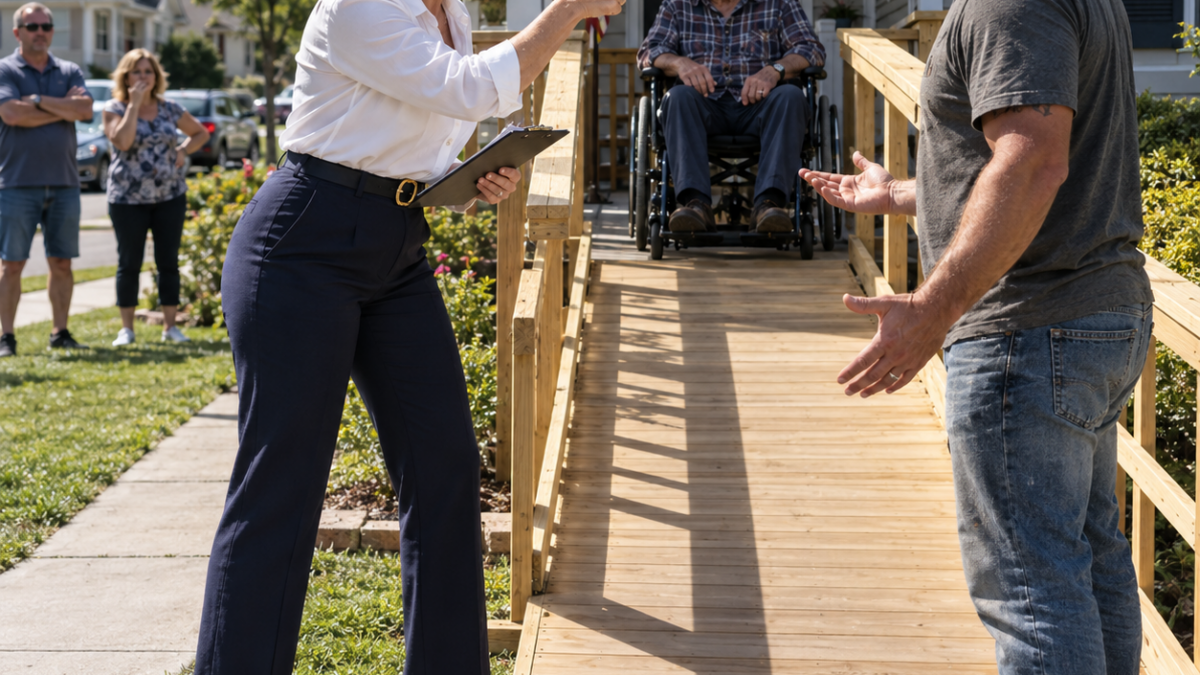
The meeting was held in the small clubhouse near the neighborhood entrance, the kind of building that exists mostly so HOA boards can sit behind folding tables and pretend they are running a municipality. About twenty homeowners sat in rows of metal chairs. At the front were five board members with binders, bottled water, printed agendas, and expressions ranging from bored to self-important.
Then there was the president.
Karen Whitmore.
I had seen her around but never dealt with her directly. She was in her late forties, polished in the way that looks effortless only if you do not count the effort. Sleek dark-blonde bob, crisp blue blouse, fitted white slacks, heels too elegant for a clubhouse floor, pearl earrings, perfect makeup, and a tight smile that seemed designed to communicate both welcome and warning. She was attractive, no question. She knew how to use it too—soft laugh, tilted head, a little hand touch on the arm of anyone she wanted to charm.
But her eyes were cold.
The meeting began with landscaping budgets, pool maintenance, trash bin complaints, and a heated argument about someone’s dog being off leash near the mailboxes.
I sat there waiting, feeling my patience grind down minute by minute.
Finally, they reached homeowner comments.
I raised my hand.
Karen looked at me like she already knew who I was and had already decided I was inconvenient.
“Yes,” she said. “Please state your name and address.”
I did.
Then I stood and explained the situation.
“My father recently moved in with me after a medical issue left him using a wheelchair. I built a ramp from my driveway to the front porch so he can safely enter and exit the home. Before building it, I contacted the city. They said no permit was required for this configuration, but sent safety guidelines. I followed those guidelines. The ramp is sturdy, safe, and necessary.”
Karen’s smile did not move.
“I received a violation notice threatening two hundred dollars per day in fines if I don’t remove it.”
A few people in the chairs shifted.
Someone murmured softly behind me.
I had my phone recording in my pocket. My state allowed one-party consent, and after the first letter, I had decided I was not trusting this board to summarize anything accurately.
Karen folded her hands over her binder.
“First, we do appreciate your father’s situation.”
No, you don’t, I thought.
“However,” she continued, “the issue before the board is not whether your father requires assistance. It is that you made a visible exterior modification without submitting an architectural request. We have processes for a reason.”
“I understand process,” I said. “But my father was being discharged from rehab. I was not going to leave him in a facility for weeks while a volunteer committee decided whether it liked the look of accessibility.”
Her smile tightened.
“The architectural committee usually responds promptly.”
“Usually is not a mobility plan.”
One of the board members, an older man with glasses, looked down at his papers and coughed like he was trying to hide agreement.
Karen noticed.
Her gaze flicked toward him.
He went still.
Then she looked back at me.
“You have to understand,” she said, her voice turning smooth and patient, “many families in this community deal with aging parents, mobility issues, things of that nature. Most find ways to accommodate those needs without altering the front appearance of the home.”
“What ways?”
“Well,” she said, “portable ramps are available.”
“They are not practical or safe for daily use in this situation.”
“Or family members can assist him up the steps.”
“My father is a grown man, not furniture.”
Her jaw tightened.
“We are simply discussing options.”
“What other options?”
She leaned back slightly.
“You could bring him in through the garage or a side entrance so the ramp is not so visible from the street.”
The room changed.
It was subtle but real.
A little silence opened up around those words.
Not so visible from the street.
A woman in the second row turned her head sharply. The man with glasses looked at Karen like he wished she had swallowed that sentence before it escaped. Someone behind me exhaled.
I let the silence sit for one second.
Then two.
Then I said, slowly, “So your solution is that my disabled father should be carried up steps or brought through the garage so people do not have to see his wheelchair at the front door.”
Karen’s eyes flashed.
“That is not what I said.”
“That is exactly what you said.”
“You are taking my words out of context.”
“What is the context where hiding him from the street sounds better?”
Her cheeks colored beneath her makeup.
“We have to balance individual circumstances with the overall aesthetic of the community.”
“The overall aesthetic of the community.”
“Yes.”
“My father’s access to his home is not an aesthetic problem.”
The room was fully awake now.
Karen knew it too, and the charm began to thin.
“Rules are rules,” she said. “You should have followed the established process. You may submit an architectural request now, and the board will review whether the ramp can remain, be modified, screened, relocated, or replaced with a less visible alternative.”
“There is no less visible alternative that gives him safe daily access.”
“That remains to be reviewed.”
I reached into my folder and held up the city email.
“The city gave me safety guidance. I followed it. The ramp is safe.”
“The city does not enforce our architectural standards.”
“And your architectural standards do not get to erase disabled people.”
Her smile vanished completely.
The room was silent again.
I knew I was done there.
Not because I had lost.
Because they had just handed me exactly what I needed to know: this was not about safety. Not really. It was not even about process anymore. It was about visibility. They did not like looking at disability from the street.
“All right,” I said. “Thank you for your time. I’ll be following up with the city and with people who understand disability law better than I do.”
Karen’s expression hardened.
“That is certainly your right.”
“Yes,” I said. “It is.”
On the drive home, I replayed her words over and over.
Bring him in through the garage.
Not so visible from the street.
By the time I pulled into my driveway, my anger had settled into something cleaner than rage.
Resolve.
The next morning, I took the day off work and went to the city building department in person.
I brought everything: HOA violation letter, photos, city email, ramp measurements, HOA documents, and notes from the meeting. The inspector at the counter was an older guy named Frank, with reading glasses on his head and a tape measure clipped to his belt. He listened without interrupting while I laid out the whole situation.
When I told him about the garage comment, his eyebrows rose.
He looked at the ramp photos.
Then the violation notice.
Then the city guidance email.
Then he did that long exhale professionals do when they are too disciplined to say, “You have got to be kidding me.”
“HOAs pull us into these fights more than you’d think,” he said.
“I’m worried they’re going to claim the ramp violates city code.”
He shook his head.
“From what you’ve shown me, we didn’t tell you to remove this. And if it matches the guidance we sent, I don’t see a city issue.”
“Would you inspect it?”
He looked up.
“The ramp?”
“Yes. Measure it. Confirm it follows the residential guidelines. Put it in writing if it does.”
Frank thought for a moment.
“Sure,” he said. “I can do that.”
Two days later, he came to the house.
My dad sat on the porch while Frank measured the slope, width, landings, handrail height, and how the ramp attached near the porch. He checked the surface, the footing, the clearance.
At the end, he nodded.
“This is well built,” he said.
My dad smirked.
“He gets that from me.”
Frank smiled. “I’ll put it on city letterhead. No permit required, no objection from us, consistent with residential accessibility guidance.”
A week later, the letter arrived by email.
Frank copied the HOA.
For two days, silence.
Then another envelope appeared in my mailbox.
The HOA acknowledged the city letter but stated that the ramp remained noncompliant with community architectural standards. I was instructed to remove the ramp, restore the front entrance, or relocate/screen the ramp so it was not prominently visible from the street. Fines would begin on a specific date.
Two hundred dollars per day.
They had seen the city letter.
They had confirmed it was safe.
They doubled down anyway.
That night, I opened my laptop and started searching.
HOA wheelchair ramp discrimination.
Reasonable accommodation HOA ramp.
Fair housing disability accessibility homeowners association.
I read government pages. Nonprofit guides. Case summaries. Legal explanations written in language normal people could understand if they had enough coffee. The phrase that kept appearing was reasonable accommodation.
Housing providers, including HOAs, often had obligations under fair housing and disability laws to allow reasonable accommodations or modifications for people with disabilities, especially when access to a home was involved.
I found a local disability rights organization with an intake form.
I uploaded everything.
The HOA letters.
The city inspector’s letter.
Photos of the ramp.
My written summary.
And, because I had it, the recording from the HOA meeting where Karen suggested bringing my father through the garage so the ramp was not visible from the street.
Two days later, I got an email asking to schedule a call.
The advocate’s name was Melissa, and she had the calm, direct voice of someone who had heard too many versions of the same cruelty.
I told her everything.
My dad’s condition.
Rehab.
Moving him in.
The ramp.
The city guidance.
The violation notice.
The meeting.
The garage comment.
The second notice.
When I finished, she was quiet for a moment.
Then she said, “There are several concerning facts here.”
That sounded very professional.
“What does that mean in normal language?”
“It means the HOA may have stepped into serious legal trouble.”
For the first time in weeks, I felt air enter my lungs properly.
She explained that wheelchair ramps were classic reasonable accommodation issues. She explained that an HOA could still require reasonable documentation, and sometimes design discussions were allowed, but punishing or refusing a necessary accessibility modification because it was visible from the street could be a major problem.
“And the president’s comment?” I asked.
Melissa paused.
“Suggesting that a disabled resident should use a less visible entrance is not helpful for them.”
“That’s one way to put it.”
“It is the polite way.”
I talked to my dad that evening.
He sat at the kitchen table, hands folded, jaw working the way it did when he was trying not to show emotion.
“They want to send a legal letter on your behalf,” I said. “Because you’re the person who needs the accommodation.”
He looked toward the front of the house.
“I hate this.”
“I know.”
“I hate needing it.”
“I know.”
“I hate that you’re fighting because of me.”
I leaned forward.
“I am fighting because of them.”
He looked at me then.
I saw the embarrassment in his face. The anger too. The grief he usually hid behind jokes and complaints about coffee.
“They really said the garage?” he asked.
“Yes.”
His eyes hardened.
That was the old Dad.
The one who once told a foreman to fire him if he wanted, but he was not sending younger guys onto unsafe scaffolding.
“If they’re going to treat me like something to hide,” he said, “then I’m not rolling over.”
I smiled.
“Poor choice of words.”
He glared at me for half a second.
Then he laughed.
“Send the letter.”
The disability rights organization had an attorney draft it.
The letter was clear and direct. My father was disabled and required a wheelchair for mobility. The ramp was necessary for safe access to his residence. The city had inspected and confirmed the ramp complied with residential safety and accessibility guidance. The HOA’s threats of fines and removal could violate fair housing and disability laws. The letter formally requested that the HOA approve the ramp as a reasonable accommodation, cease enforcement, and preserve all records relating to the matter.
The tone changed immediately.
The HOA emailed me three days later.
The board is reviewing this matter with counsel. Any fines will be held in abeyance pending review.
Translation: they panicked.
From that point forward, most of the fight moved above my pay grade.
The HOA’s attorney got involved.
Their insurance company got involved.
Melissa and the nonprofit’s attorney handled most communications. My job became sending documents, answering questions, confirming dates, and trying to keep my dad from stressing himself into another medical issue.
It dragged on for months.
That part surprised me.
I think when people imagine legal disputes, they picture dramatic confrontations and courtroom speeches. In real life, it is mostly email chains, waiting, document requests, and people arguing over phrases like policy revision and covered claim.
I went to one more HOA meeting during that time.
The ramp was not discussed openly, but everybody knew something was happening. The board looked tense. Karen looked flawless, as always, in a deep green blouse and gold earrings, but her smile had lost some of its shine. The man with glasses avoided looking at me. The treasurer looked like he had not slept well.
During the budget discussion, someone in the audience asked why projected legal expenses had increased.
The treasurer shifted.
“We’ve had unexpected legal costs related to a homeowner dispute.”
More than one person glanced at me.
I did not say anything.
Karen’s mouth tightened.
Good.
Eventually, Melissa called and said, “We think this is strong enough to move forward with a formal complaint and potentially a lawsuit if your father is willing.”
I relayed that to Dad.
He sat with it for a few days.
I did not push. This was his name, his disability, his humiliation being dragged into legal language. He deserved time to decide.
Finally, one evening, he rolled onto the porch and called me outside.
The sun was going down, and the ramp glowed warm in the light.
“If we let this go,” he said, “they’ll do it to the next person.”
“That’s what I think too.”
He nodded slowly.
“Then we see it through.”
There was no big trial.
In some ways, I almost wish there had been. I wanted to see Karen explain under oath why the neighborhood’s appearance mattered more than my father’s ability to enter his home. I wanted to play that recording in a courtroom and watch her polished face as everyone heard the words not so visible from the street.
But the HOA’s insurance company was not interested in letting pride become a larger payout.
Once the formal complaint was filed, settlement talks began seriously.
The nonprofit’s attorney pushed for more than money. That mattered to my dad. He did not want a check and silence. He wanted the rules changed so the next person would not have to fight the same fight from scratch.
The final settlement did several things.
My father received monetary compensation for what they had put him through. Not life-changing money, not private-island money, but real money. Enough that the HOA could not pretend it was nothing.
The ramp was formally approved in writing as a reasonable accommodation.
All threats of fines were withdrawn.
The HOA had to revise its policies to create a clear process for disability-related accommodations and modifications, including ramps, lifts, handrails, and other access features.
Board members had to complete fair housing and disability rights training.
And the HOA had to stop treating accessibility like a landscaping preference.
When the agreement was finalized, Dad read the approval letter twice.
Then he folded it and tapped it against the table.
“They should’ve just been decent in the first place,” he said.
“Would’ve been cheaper.”
He smiled.
“Expensive lesson.”
Very expensive, as it turned out.
Some of the settlement came through insurance, but not all of it. Legal costs had already hit the HOA budget. Policy revisions cost money. Training cost money. The insurance situation affected future costs. By the next budget cycle, dues went up enough for people to notice.
That was when the community really woke up.
Not when my father was humiliated.
Not when they threatened two hundred dollars per day over a wheelchair ramp.
When everyone’s bill changed.
I wish I could say that surprised me.
At the annual meeting, attendance was three times larger than usual. People who had never cared about HOA politics suddenly cared very much. The folding chairs filled. People stood along the back wall. The air felt different. Less bored. More combustible.
Karen sat at the front table in a fitted cream blazer, hair perfect, posture perfect, smile tight enough to crack.
The treasurer began reviewing the budget.
Hands went up immediately.
“Why are legal expenses so high?”
“What dispute caused this?”
“Are our dues going up because the board picked a fight?”
“Was this about the ramp?”
The word ramp moved through the room like a spark.
Karen tried to regain control.
“We cannot discuss confidential settlement details.”
A man near the front said, “You don’t have to. We know enough.”
Another homeowner stood. “My mother uses a walker. If she needs to move in with me one day, am I going to get fined for making my house accessible?”
“No one is opposed to accessibility,” Karen said smoothly.
I almost laughed.
An older woman with a cane stood in the back.
“You told him to bring his father through the garage.”
The room went silent.
Karen’s face changed.
Only for a second.
“I never said that.”
I stood.
My heart was beating hard, but my voice came out steady.
“I recorded the meeting.”
Karen’s eyes locked on mine.
There she was again. The real one beneath the polish.
“I said,” I continued, “that my father needed safe access to the front entrance. You suggested a side entrance or garage so the ramp would not be visible from the street.”
The woman with the cane turned toward the board.
“I care less about property values than I do about not treating disabled people like trash.”
People clapped.
Not everyone.
Enough.
Karen tried to speak over it, but the room had shifted beyond her reach.
A petition for a recall had already been circulating by then. People were angry about the dues, yes, but the ramp had become the symbol for everything they disliked about the board: petty enforcement, arrogance, legal ignorance, aesthetic obsession, and the kind of power trip that turned neighbors into problems to manage.
The special meeting was packed.
Fifty, maybe sixty people. More than I had ever seen in that clubhouse. Homeowners lined up to speak. Some talked about my dad. Some talked about violation letters for nonsense issues. Some talked about being afraid to ask for reasonable changes because the board treated every request like a threat to civilization. One man said he had voted for Karen because she promised to protect property values, not wage war on a wheelchair ramp.
Karen sat at the front, beautiful and furious.
When she finally spoke, she tried the same language she always used.
Community standards.
Consistent appearance.
Miscommunication.
Unfortunate misunderstanding.
Balancing needs.
Protecting values.
This time, people heard what those words were hiding.
The recall vote was not close.
Karen was removed.
The treasurer was removed.
Another board member resigned a week later.
The man with glasses, who had muttered about reasonable accommodation before Karen silenced him, stayed long enough to help transition documents, then stepped down quietly. I respected that more than the others. At least he seemed capable of shame.
New board members were elected over the following weeks. Normal people, mostly. Boring people. The best kind for an HOA. Their stated goals were keeping common areas maintained, making sure dues were used responsibly, and not getting the neighborhood sued over basic human decency.
A few months later, a For Sale sign appeared in Karen’s yard.
There was no dramatic goodbye.
No public apology.
No final confrontation in the street.
One day she lived there. Then movers came. Then she was gone.
I did not celebrate.
Not loudly.
But that evening, Dad and I sat on the porch. He drank coffee even though it was too late for coffee. I had a beer. The ramp stretched from the driveway to the porch in the soft evening light, sturdy and ordinary.
A neighbor walked by with a golden retriever.
“Evening,” he called.
Dad lifted a hand.
The dog sniffed the bottom of the ramp and moved on.
Dad watched them go.
“You know,” he said, “for something they hated so much, people sure use this ramp a lot.”
He was right.
Delivery drivers used it. Neighbors pushing strollers used it. Kids dragged scooters up it. The woman with the cane used it when she came by to bring a casserole after Dad had a rough week. Nobody treated it like an eyesore anymore. It became what it should have been from the beginning.
Part of the house.
Part of the neighborhood.
Part of life.
That was what Karen never understood.
Accessibility does not ruin a community.
It reveals one.
A ramp tells you who thinks inclusion is normal and who thinks dignity should be hidden behind a garage door. It tells you whether rules exist to help people live together or to protect some sanitized fantasy where nobody ages, limps, rolls, struggles, heals, or needs help.
My dad still lives with me.
He still complains about the weather.
He still insults television commercials like the actors can hear him.
He still sits on the porch and watches the street. Some mornings he has coffee out there before I leave for work. Some evenings, I find him talking to neighbors about tools, baseball, bad drivers, or how nobody knows how to build anything properly anymore.
He has a life beyond the walls.
That was the whole point.
The HOA tried to make the ramp a violation.
Then they tried to make it a visual problem.
Then they tried to make my father feel like an inconvenience.
In the end, they made it a monument to their own stupidity.
I keep the original violation letter in my folder.
I keep the city inspector’s letter too.
I keep the settlement approval, the revised accommodation policy, and the meeting notes from the recall. Every now and then, when some new HOA email arrives about mailbox maintenance or landscaping schedules, I remember the version of me who used to toss those papers into a drawer and assume none of it mattered.
Now I read everything.
Not because I am afraid of them.
Because I know how small abuses become large ones when nobody documents the first step.
Karen thought she could hide cruelty inside procedure.
She thought she could say process when she meant control.
She thought she could say aesthetics when she meant discomfort.
She thought my father would be embarrassed enough, and I would be intimidated enough, to make the ramp disappear.
Instead, the ramp stayed.
The fines disappeared.
The policy changed.
The board fell.
And my father still rolls out to the porch whenever he wants, visible from the street, exactly where he belongs.
𝗧𝗛𝗘 𝗘𝗡𝗗
My HOA Told Me to Hide My Disabled Father in the Garage, So I Made Them Explain That in Writing
They said my father’s wheelchair ramp ruined the look of the neighborhood.
Then their president suggested I bring him through the garage, where nobody on the street would have to see him.
I never thought much about my HOA until they decided my father’s wheelchair ramp was a bigger threat to the neighborhood than their own cruelty.
Before that, the association had mostly been background noise in my life. Annoying, sure, but not unbearable. They sent reminders about trash bins, paint colors, lawn height, holiday decorations, and the exact number of days a bag of mulch could sit in a driveway before civilization collapsed. I paid my dues, mowed my grass, kept my house clean, and tossed their newsletters into a kitchen drawer with all the other things adults pretend they will read later.
I had no interest in fighting with them.
I had more important things to worry about.
My dad’s health had changed fast.
That is the simplest way to say something that did not feel simple at all. One month, he was still the same stubborn man who insisted on fixing his own truck even when he could barely bend his knees. The next, he was in a hospital bed, angry at the ceiling, arguing with nurses because they would not let him stand up without help.
My father had worked blue-collar jobs his entire life. Warehouses. Machine shops. Construction sites. Delivery routes. If something broke, he fixed it. If a roof needed patching, he climbed up with tools before anyone could stop him. If a neighbor’s car made a strange noise, he listened to it for fifteen seconds and diagnosed the problem like the engine had confessed.
He was not a fragile man.
He was not helpless.
He hated being helped.
That made the wheelchair harder for him than it might have been for someone else. The medical issue that landed him there did not take his mind, his humor, or his temper. It took his legs in the way that mattered most. He could stand a little if he had something solid to grip. He could pivot with effort. But walking more than a step or two was over. Stairs might as well have been cliffs.
After the hospital came rehab.
After rehab came the conversation nobody wanted.
His old house was impossible. Too many steps. Narrow hallways. A bathroom that seemed designed by someone who had never imagined aging. Uneven flooring. Doorways too tight for a wheelchair. Every room was an obstacle course waiting to hurt him.
So I told him he was moving in with me.
He gave me the speech, of course.
“I’m not going to be a burden.”
“You’re not a burden.”
“I don’t want you changing your whole life because of me.”
“You changed yours for me when I was a kid.”
“That was different.”
“How?”
He looked away.
That was Dad. He could rebuild a carburetor, patch drywall, and argue with a doctor for twenty minutes about whether hospital coffee counted as coffee, but say one emotional thing to him and he suddenly needed to inspect the floor.
My house was not perfect for him, but it could work.
It was in a quiet suburb. One story except for a small step-up porch at the front. Open enough inside that we could widen a few pathways, move furniture, install grab bars, and make the bathroom safer. The real problem was the front entrance.
There were four steps from the walkway to the porch.
For most people, four steps are nothing.
For my father in a wheelchair, they were a wall.
At first, I looked into portable aluminum ramps. I thought maybe that would be easier, less permanent, less likely to annoy the HOA. But once I measured the rise properly, I realized a safe slope would require a longer ramp than I expected. Dragging it out, lining it up, securing it, and putting it away every time he wanted to leave or come home would be ridiculous. Worse, it would be unsafe. One rushed setup, one bad angle, one slippery morning, and my father could end up back in a hospital bed.
I was not gambling his safety on something flimsy because a committee liked clean sightlines.
So I decided on a permanent wooden ramp from the driveway up to the porch.
Sturdy.
Fixed.
Safe.
Nothing fancy. No decorative nonsense. Just pressure-treated wood, proper footings, non-slip treads, and a handrail. I am decent with tools, but I was not about to wing something my dad’s life would depend on. Before building anything, I called the city building department.
“Hey,” I told the guy who answered, “my father uses a wheelchair now, and I need to add a ramp to my front entrance. Do I need a permit? Are there rules I need to follow?”
He was nicer than I expected.
He asked a few questions about the house, the height of the porch, whether the ramp would attach to the structure, and whether it would block the sidewalk. Then he emailed me a set of residential accessibility guidelines: slope, width, landing depth, railing height, surface texture, all of it.
“For a small residential ramp like the one you’re describing,” he said, “we don’t require a formal permit, but follow these safety recommendations. They’re based on accessibility standards.”
So that was what I did.
I measured three times.
Then four.
Then again, because my father’s stubborn head was going to be on that ramp and I could already hear him yelling at me from the afterlife if I built it wrong.
Over one long weekend, I built the thing.
By Sunday afternoon, it was done.
It was solid. Clean. Not beautiful, maybe, but respectable. It followed the city’s guidance, fit the space neatly, and looked like what it was: a practical modification for a human being who needed access to his home.
The first time I pushed my dad up that ramp, he did not say anything at first.
He reached the porch, locked his wheels, and just sat there looking at the street.
Then he took a deep breath.
“Didn’t think I’d be going up steps again,” he said.
I had to look away.
After that, the porch became his place.
Every morning when the weather was decent, he rolled out there with coffee and sat like the neighborhood foreman. He watched dogs go by. He complained about teenagers driving too fast. He talked to delivery drivers. He learned which neighbor watered too much and which one pretended not to see weeds near the mailbox. For the first time since the hospital, he had a piece of normal life back.
For one week, everything felt okay.
Then the HOA noticed.
Part 2
The first letter arrived in a white envelope with the association logo in the corner.
I opened it standing in the kitchen while my dad watched television in the living room.
NOTICE OF VIOLATION.
Unauthorized exterior structure.
According to the letter, my wheelchair ramp altered the uniform appearance of the community and had been installed without prior approval from the architectural committee. I had fourteen days to remove it or bring the property into compliance. If I failed to do so, fines of two hundred dollars per day would begin.
Two hundred dollars.
Per day.
Over a wheelchair ramp.
At first, I thought I had misread it. I actually tilted the paper under the light like better lighting might turn the words into something less insane.
It did not.
At the bottom was the number for the management company. I called, navigated a phone tree clearly designed by someone who hated humanity, and eventually reached a woman whose voice had the exhausted cheerfulness of a person paid to absorb other people’s anger without authority to fix anything.
I gave her my name and address.
“Yes,” she said after pulling up the file. “The violation is for an unapproved exterior modification.”
“It’s a wheelchair ramp.”
“I see that note here.”
“For my disabled father.”
“I understand.”
No, I thought. You absolutely do not.
“I called the city before building it,” I said. “They sent guidelines. No permit was required, and I followed what they gave me. The ramp is safe, well-built, and necessary.”
“The board’s issue is not city code,” she replied carefully. “The board determined that the structure does not fit the architectural standards of the community, and it was installed without prior approval.”
“It allows my father to get in and out of the house.”
“I understand, but exterior modifications require architectural review.”
“So the HOA is really going to fine me two hundred dollars a day if I don’t remove my father’s wheelchair ramp?”
There was a pause.
Then she said, “Those are the fines specified in the current violation schedule.”
I closed my eyes.
“Who do I talk to?”
“You can request a hearing with the board. Their next meeting is next Thursday.”
“Put me on the agenda.”
“I can submit that request.”
“Do that.”
I hung up and stood there gripping the phone.
My dad had muted the television.
He was looking at me.
“What’s going on?”
I did not want to tell him. Not because he was fragile, but because I knew exactly where his mind would go. It would not go to anger first. It would go to guilt.
“The HOA sent a violation notice about the ramp.”
His face changed.
“What kind of notice?”
“They say it’s an unapproved structure.”
He looked down at his hands.
“Well,” he said quietly, “maybe we can figure something else out. I don’t want you getting in trouble because of me.”
That did it.
That was the moment the annoyance became something hotter.
“They want you to feel like this is your fault,” I said. “It’s not.”
“I’m just saying—”
“No. You are not crawling through some side entrance or waiting for me to drag out a portable ramp every time you want air because they don’t like seeing wood from the street.”
He gave me a tired half-smile.
“You always did get mouthy when you were mad.”
“I learned from you.”
“Then God help them.”
That night, I pulled out the thick binder from when I bought the house and actually read the HOA documents instead of pretending I had read them years earlier.
The CC&Rs were exactly as thrilling as expected. Paint colors. Fences. Sheds. Driveways. Garages. Landscaping. Holiday decorations. Basketball hoops. Satellite dishes. Trash containers. No commercial vehicles visible overnight unless approved. No exterior modifications without architectural approval.
There was nothing specific about wheelchair ramps.
Nothing about accessibility.
Nothing about disability accommodations.
Nothing about what happens when a resident needs safe access to their home.
I started a folder on my laptop and a physical manila folder on the kitchen table. Violation letter. City emails. Ramp photos from every angle. Measurements. Notes from my phone call. Date, time, name of the management company representative. Everything.
If they were threatening me with two hundred dollars a day, I was going to make sure the paper trail was thick enough to trip over.
I emailed the HOA board address that night.
I explained that my father was disabled, that the ramp was medically necessary for access, that I had followed city guidance, and that I was requesting the violation be withdrawn. I asked them to identify the specific rule the ramp violated and to provide any standards governing disability-related modifications.
No reply.
Three days later, I emailed again asking to be added to the meeting agenda.
No reply.
Fine.
I showed up anyway.
The meeting was held in the small clubhouse near the neighborhood entrance, the kind of building that exists mostly so HOA boards can sit behind folding tables and pretend they are running a municipality. About twenty homeowners sat in rows of metal chairs. At the front were five board members with binders, bottled water, printed agendas, and expressions ranging from bored to self-important.
Then there was the president.
Karen Whitmore.
I had seen her around but never dealt with her directly. She was in her late forties, polished in the way that looks effortless only if you do not count the effort. Sleek dark-blonde bob, crisp blue blouse, fitted white slacks, heels too elegant for a clubhouse floor, pearl earrings, perfect makeup, and a tight smile that seemed designed to communicate both welcome and warning. She was attractive, no question. She knew how to use it too—soft laugh, tilted head, a little hand touch on the arm of anyone she wanted to charm.
But her eyes were cold.
The meeting began with landscaping budgets, pool maintenance, trash bin complaints, and a heated argument about someone’s dog being off leash near the mailboxes.
I sat there waiting, feeling my patience grind down minute by minute.
Finally, they reached homeowner comments.
I raised my hand.
Karen looked at me like she already knew who I was and had already decided I was inconvenient.
“Yes,” she said. “Please state your name and address.”
I did.
Then I stood and explained the situation.
“My father recently moved in with me after a medical issue left him using a wheelchair. I built a ramp from my driveway to the front porch so he can safely enter and exit the home. Before building it, I contacted the city. They said no permit was required for this configuration, but sent safety guidelines. I followed those guidelines. The ramp is sturdy, safe, and necessary.”
Karen’s smile did not move.
“I received a violation notice threatening two hundred dollars per day in fines if I don’t remove it.”
A few people in the chairs shifted.
Someone murmured softly behind me.
I had my phone recording in my pocket. My state allowed one-party consent, and after the first letter, I had decided I was not trusting this board to summarize anything accurately.
Karen folded her hands over her binder.
“First, we do appreciate your father’s situation.”
No, you don’t, I thought.
“However,” she continued, “the issue before the board is not whether your father requires assistance. It is that you made a visible exterior modification without submitting an architectural request. We have processes for a reason.”
“I understand process,” I said. “But my father was being discharged from rehab. I was not going to leave him in a facility for weeks while a volunteer committee decided whether it liked the look of accessibility.”
Her smile tightened.
“The architectural committee usually responds promptly.”
“Usually is not a mobility plan.”
One of the board members, an older man with glasses, looked down at his papers and coughed like he was trying to hide agreement.
Karen noticed.
Her gaze flicked toward him.
He went still.
Then she looked back at me.
“You have to understand,” she said, her voice turning smooth and patient, “many families in this community deal with aging parents, mobility issues, things of that nature. Most find ways to accommodate those needs without altering the front appearance of the home.”
“What ways?”
“Well,” she said, “portable ramps are available.”
“They are not practical or safe for daily use in this situation.”
“Or family members can assist him up the steps.”
“My father is a grown man, not furniture.”
Her jaw tightened.
“We are simply discussing options.”
“What other options?”
She leaned back slightly.
“You could bring him in through the garage or a side entrance so the ramp is not so visible from the street.”
The room changed.
It was subtle but real.
A little silence opened up around those words.
Not so visible from the street.
A woman in the second row turned her head sharply. The man with glasses looked at Karen like he wished she had swallowed that sentence before it escaped. Someone behind me exhaled.
I let the silence sit for one second.
Then two.
Then I said, slowly, “So your solution is that my disabled father should be carried up steps or brought through the garage so people do not have to see his wheelchair at the front door.”
Karen’s eyes flashed.
“That is not what I said.”
“That is exactly what you said.”
“You are taking my words out of context.”
“What is the context where hiding him from the street sounds better?”
Her cheeks colored beneath her makeup.
“We have to balance individual circumstances with the overall aesthetic of the community.”
“The overall aesthetic of the community.”
“Yes.”
“My father’s access to his home is not an aesthetic problem.”
The room was fully awake now.
Karen knew it too, and the charm began to thin.
“Rules are rules,” she said. “You should have followed the established process. You may submit an architectural request now, and the board will review whether the ramp can remain, be modified, screened, relocated, or replaced with a less visible alternative.”
“There is no less visible alternative that gives him safe daily access.”
“That remains to be reviewed.”
I reached into my folder and held up the city email.
“The city gave me safety guidance. I followed it. The ramp is safe.”
“The city does not enforce our architectural standards.”
“And your architectural standards do not get to erase disabled people.”
Her smile vanished completely.
The room was silent again.
I knew I was done there.
Not because I had lost.
Because they had just handed me exactly what I needed to know: this was not about safety. Not really. It was not even about process anymore. It was about visibility. They did not like looking at disability from the street.
“All right,” I said. “Thank you for your time. I’ll be following up with the city and with people who understand disability law better than I do.”
Karen’s expression hardened.
“That is certainly your right.”
“Yes,” I said. “It is.”
On the drive home, I replayed her words over and over.
Bring him in through the garage.
Not so visible from the street.
By the time I pulled into my driveway, my anger had settled into something cleaner than rage.
Resolve.
The next morning, I took the day off work and went to the city building department in person.
I brought everything: HOA violation letter, photos, city email, ramp measurements, HOA documents, and notes from the meeting. The inspector at the counter was an older guy named Frank, with reading glasses on his head and a tape measure clipped to his belt. He listened without interrupting while I laid out the whole situation.
When I told him about the garage comment, his eyebrows rose.
He looked at the ramp photos.
Then the violation notice.
Then the city guidance email.
Then he did that long exhale professionals do when they are too disciplined to say, “You have got to be kidding me.”
“HOAs pull us into these fights more than you’d think,” he said.
“I’m worried they’re going to claim the ramp violates city code.”
He shook his head.
“From what you’ve shown me, we didn’t tell you to remove this. And if it matches the guidance we sent, I don’t see a city issue.”
“Would you inspect it?”
He looked up.
“The ramp?”
“Yes. Measure it. Confirm it follows the residential guidelines. Put it in writing if it does.”
Frank thought for a moment.
“Sure,” he said. “I can do that.”
Two days later, he came to the house.
My dad sat on the porch while Frank measured the slope, width, landings, handrail height, and how the ramp attached near the porch. He checked the surface, the footing, the clearance.
At the end, he nodded.
“This is well built,” he said.
My dad smirked.
“He gets that from me.”
Frank smiled. “I’ll put it on city letterhead. No permit required, no objection from us, consistent with residential accessibility guidance.”
A week later, the letter arrived by email.
Frank copied the HOA.
For two days, silence.
Then another envelope appeared in my mailbox.
The HOA acknowledged the city letter but stated that the ramp remained noncompliant with community architectural standards. I was instructed to remove the ramp, restore the front entrance, or relocate/screen the ramp so it was not prominently visible from the street. Fines would begin on a specific date.
Two hundred dollars per day.
They had seen the city letter.
They had confirmed it was safe.
They doubled down anyway.
That night, I opened my laptop and started searching.
HOA wheelchair ramp discrimination.
Reasonable accommodation HOA ramp.
Fair housing disability accessibility homeowners association.
I read government pages. Nonprofit guides. Case summaries. Legal explanations written in language normal people could understand if they had enough coffee. The phrase that kept appearing was reasonable accommodation.
Housing providers, including HOAs, often had obligations under fair housing and disability laws to allow reasonable accommodations or modifications for people with disabilities, especially when access to a home was involved.
I found a local disability rights organization with an intake form.
I uploaded everything.
The HOA letters.
The city inspector’s letter.
Photos of the ramp.
My written summary.
And, because I had it, the recording from the HOA meeting where Karen suggested bringing my father through the garage so the ramp was not visible from the street.
Two days later, I got an email asking to schedule a call.
The advocate’s name was Melissa, and she had the calm, direct voice of someone who had heard too many versions of the same cruelty.
I told her everything.
My dad’s condition.
Rehab.
Moving him in.
The ramp.
The city guidance.
The violation notice.
The meeting.
The garage comment.
The second notice.
When I finished, she was quiet for a moment.
Then she said, “There are several concerning facts here.”
That sounded very professional.
“What does that mean in normal language?”
“It means the HOA may have stepped into serious legal trouble.”
For the first time in weeks, I felt air enter my lungs properly.
She explained that wheelchair ramps were classic reasonable accommodation issues. She explained that an HOA could still require reasonable documentation, and sometimes design discussions were allowed, but punishing or refusing a necessary accessibility modification because it was visible from the street could be a major problem.
“And the president’s comment?” I asked.
Melissa paused.
“Suggesting that a disabled resident should use a less visible entrance is not helpful for them.”
“That’s one way to put it.”
“It is the polite way.”
I talked to my dad that evening.
He sat at the kitchen table, hands folded, jaw working the way it did when he was trying not to show emotion.
“They want to send a legal letter on your behalf,” I said. “Because you’re the person who needs the accommodation.”
He looked toward the front of the house.
“I hate this.”
“I know.”
“I hate needing it.”
“I know.”
“I hate that you’re fighting because of me.”
I leaned forward.
“I am fighting because of them.”
He looked at me then.
I saw the embarrassment in his face. The anger too. The grief he usually hid behind jokes and complaints about coffee.
“They really said the garage?” he asked.
“Yes.”
His eyes hardened.
That was the old Dad.
The one who once told a foreman to fire him if he wanted, but he was not sending younger guys onto unsafe scaffolding.
“If they’re going to treat me like something to hide,” he said, “then I’m not rolling over.”
I smiled.
“Poor choice of words.”
He glared at me for half a second.
Then he laughed.
“Send the letter.”
The disability rights organization had an attorney draft it.
The letter was clear and direct. My father was disabled and required a wheelchair for mobility. The ramp was necessary for safe access to his residence. The city had inspected and confirmed the ramp complied with residential safety and accessibility guidance. The HOA’s threats of fines and removal could violate fair housing and disability laws. The letter formally requested that the HOA approve the ramp as a reasonable accommodation, cease enforcement, and preserve all records relating to the matter.
The tone changed immediately.
The HOA emailed me three days later.
The board is reviewing this matter with counsel. Any fines will be held in abeyance pending review.
Translation: they panicked.
From that point forward, most of the fight moved above my pay grade.
The HOA’s attorney got involved.
Their insurance company got involved.
Melissa and the nonprofit’s attorney handled most communications. My job became sending documents, answering questions, confirming dates, and trying to keep my dad from stressing himself into another medical issue.
It dragged on for months.
That part surprised me.
I think when people imagine legal disputes, they picture dramatic confrontations and courtroom speeches. In real life, it is mostly email chains, waiting, document requests, and people arguing over phrases like policy revision and covered claim.
I went to one more HOA meeting during that time.
The ramp was not discussed openly, but everybody knew something was happening. The board looked tense. Karen looked flawless, as always, in a deep green blouse and gold earrings, but her smile had lost some of its shine. The man with glasses avoided looking at me. The treasurer looked like he had not slept well.
During the budget discussion, someone in the audience asked why projected legal expenses had increased.
The treasurer shifted.
“We’ve had unexpected legal costs related to a homeowner dispute.”
More than one person glanced at me.
I did not say anything.
Karen’s mouth tightened.
Good.
Eventually, Melissa called and said, “We think this is strong enough to move forward with a formal complaint and potentially a lawsuit if your father is willing.”
I relayed that to Dad.
He sat with it for a few days.
I did not push. This was his name, his disability, his humiliation being dragged into legal language. He deserved time to decide.
Finally, one evening, he rolled onto the porch and called me outside.
The sun was going down, and the ramp glowed warm in the light.
“If we let this go,” he said, “they’ll do it to the next person.”
“That’s what I think too.”
He nodded slowly.
“Then we see it through.”
There was no big trial.
In some ways, I almost wish there had been. I wanted to see Karen explain under oath why the neighborhood’s appearance mattered more than my father’s ability to enter his home. I wanted to play that recording in a courtroom and watch her polished face as everyone heard the words not so visible from the street.
But the HOA’s insurance company was not interested in letting pride become a larger payout.
Once the formal complaint was filed, settlement talks began seriously.
The nonprofit’s attorney pushed for more than money. That mattered to my dad. He did not want a check and silence. He wanted the rules changed so the next person would not have to fight the same fight from scratch.
The final settlement did several things.
My father received monetary compensation for what they had put him through. Not life-changing money, not private-island money, but real money. Enough that the HOA could not pretend it was nothing.
The ramp was formally approved in writing as a reasonable accommodation.
All threats of fines were withdrawn.
The HOA had to revise its policies to create a clear process for disability-related accommodations and modifications, including ramps, lifts, handrails, and other access features.
Board members had to complete fair housing and disability rights training.
And the HOA had to stop treating accessibility like a landscaping preference.
When the agreement was finalized, Dad read the approval letter twice.
Then he folded it and tapped it against the table.
“They should’ve just been decent in the first place,” he said.
“Would’ve been cheaper.”
He smiled.
“Expensive lesson.”
Very expensive, as it turned out.
Some of the settlement came through insurance, but not all of it. Legal costs had already hit the HOA budget. Policy revisions cost money. Training cost money. The insurance situation affected future costs. By the next budget cycle, dues went up enough for people to notice.
That was when the community really woke up.
Not when my father was humiliated.
Not when they threatened two hundred dollars per day over a wheelchair ramp.
When everyone’s bill changed.
I wish I could say that surprised me.
At the annual meeting, attendance was three times larger than usual. People who had never cared about HOA politics suddenly cared very much. The folding chairs filled. People stood along the back wall. The air felt different. Less bored. More combustible.
Karen sat at the front table in a fitted cream blazer, hair perfect, posture perfect, smile tight enough to crack.
The treasurer began reviewing the budget.
Hands went up immediately.
“Why are legal expenses so high?”
“What dispute caused this?”
“Are our dues going up because the board picked a fight?”
“Was this about the ramp?”
The word ramp moved through the room like a spark.
Karen tried to regain control.
“We cannot discuss confidential settlement details.”
A man near the front said, “You don’t have to. We know enough.”
Another homeowner stood. “My mother uses a walker. If she needs to move in with me one day, am I going to get fined for making my house accessible?”
“No one is opposed to accessibility,” Karen said smoothly.
I almost laughed.
An older woman with a cane stood in the back.
“You told him to bring his father through the garage.”
The room went silent.
Karen’s face changed.
Only for a second.
“I never said that.”
I stood.
My heart was beating hard, but my voice came out steady.
“I recorded the meeting.”
Karen’s eyes locked on mine.
There she was again. The real one beneath the polish.
“I said,” I continued, “that my father needed safe access to the front entrance. You suggested a side entrance or garage so the ramp would not be visible from the street.”
The woman with the cane turned toward the board.
“I care less about property values than I do about not treating disabled people like trash.”
People clapped.
Not everyone.
Enough.
Karen tried to speak over it, but the room had shifted beyond her reach.
A petition for a recall had already been circulating by then. People were angry about the dues, yes, but the ramp had become the symbol for everything they disliked about the board: petty enforcement, arrogance, legal ignorance, aesthetic obsession, and the kind of power trip that turned neighbors into problems to manage.
The special meeting was packed.
Fifty, maybe sixty people. More than I had ever seen in that clubhouse. Homeowners lined up to speak. Some talked about my dad. Some talked about violation letters for nonsense issues. Some talked about being afraid to ask for reasonable changes because the board treated every request like a threat to civilization. One man said he had voted for Karen because she promised to protect property values, not wage war on a wheelchair ramp.
Karen sat at the front, beautiful and furious.
When she finally spoke, she tried the same language she always used.
Community standards.
Consistent appearance.
Miscommunication.
Unfortunate misunderstanding.
Balancing needs.
Protecting values.
This time, people heard what those words were hiding.
The recall vote was not close.
Karen was removed.
The treasurer was removed.
Another board member resigned a week later.
The man with glasses, who had muttered about reasonable accommodation before Karen silenced him, stayed long enough to help transition documents, then stepped down quietly. I respected that more than the others. At least he seemed capable of shame.
New board members were elected over the following weeks. Normal people, mostly. Boring people. The best kind for an HOA. Their stated goals were keeping common areas maintained, making sure dues were used responsibly, and not getting the neighborhood sued over basic human decency.
A few months later, a For Sale sign appeared in Karen’s yard.
There was no dramatic goodbye.
No public apology.
No final confrontation in the street.
One day she lived there. Then movers came. Then she was gone.
I did not celebrate.
Not loudly.
But that evening, Dad and I sat on the porch. He drank coffee even though it was too late for coffee. I had a beer. The ramp stretched from the driveway to the porch in the soft evening light, sturdy and ordinary.
A neighbor walked by with a golden retriever.
“Evening,” he called.
Dad lifted a hand.
The dog sniffed the bottom of the ramp and moved on.
Dad watched them go.
“You know,” he said, “for something they hated so much, people sure use this ramp a lot.”
He was right.
Delivery drivers used it. Neighbors pushing strollers used it. Kids dragged scooters up it. The woman with the cane used it when she came by to bring a casserole after Dad had a rough week. Nobody treated it like an eyesore anymore. It became what it should have been from the beginning.
Part of the house.
Part of the neighborhood.
Part of life.
That was what Karen never understood.
Accessibility does not ruin a community.
It reveals one.
A ramp tells you who thinks inclusion is normal and who thinks dignity should be hidden behind a garage door. It tells you whether rules exist to help people live together or to protect some sanitized fantasy where nobody ages, limps, rolls, struggles, heals, or needs help.
My dad still lives with me.
He still complains about the weather.
He still insults television commercials like the actors can hear him.
He still sits on the porch and watches the street. Some mornings he has coffee out there before I leave for work. Some evenings, I find him talking to neighbors about tools, baseball, bad drivers, or how nobody knows how to build anything properly anymore.
He has a life beyond the walls.
That was the whole point.
The HOA tried to make the ramp a violation.
Then they tried to make it a visual problem.
Then they tried to make my father feel like an inconvenience.
In the end, they made it a monument to their own stupidity.
I keep the original violation letter in my folder.
I keep the city inspector’s letter too.
I keep the settlement approval, the revised accommodation policy, and the meeting notes from the recall. Every now and then, when some new HOA email arrives about mailbox maintenance or landscaping schedules, I remember the version of me who used to toss those papers into a drawer and assume none of it mattered.
Now I read everything.
Not because I am afraid of them.
Because I know how small abuses become large ones when nobody documents the first step.
Karen thought she could hide cruelty inside procedure.
She thought she could say process when she meant control.
She thought she could say aesthetics when she meant discomfort.
She thought my father would be embarrassed enough, and I would be intimidated enough, to make the ramp disappear.
Instead, the ramp stayed.
The fines disappeared.
The policy changed.
The board fell.
And my father still rolls out to the porch whenever he wants, visible from the street, exactly where he belongs.