𝗣𝗔𝗥𝗧 𝟮 My HOA President Bought My Exact Car, Broke Into My Garage, and Called 911 Saying I Had Stolen It
Part 2
I was awake late, like usual.
Bad habit, I know. Some people relax by sleeping at normal hours and making healthy choices. I relax by scrolling on my phone in the dark, reading articles I do not need to read, and telling myself I will go to bed after one more chapter, one more video, one more pointless argument in an online comment section.
My parents had gone to bed hours earlier.
The house was dark.
Quiet.
Then I heard the scraping.
At first, I thought it came from outside. Maybe a raccoon near the trash bins. Maybe a branch dragging against the siding. But then it happened again—metal on metal, sharp and ugly.
From downstairs.
I sat up.
My first thought was my parents.
They were older. Not helpless, but not young. If someone had broken in, I was the only person in the house who could respond fast enough to protect them.
Looking back, I was stupid.
I rushed downstairs without anything in my hands. No bat, no flashlight, no plan. Just adrenaline and fear. If there had been an armed burglar in the house, I would have been in real trouble. But fear for your family does not always leave room for strategy.
I turned on the hall light first.
Then the living room.
Then the kitchen.
Nothing.
The scraping came again.
From the garage.
I moved slowly toward the garage door, heart pounding so hard I could feel it in my throat. I opened the door and slapped the light switch.
The garage flooded with white light.
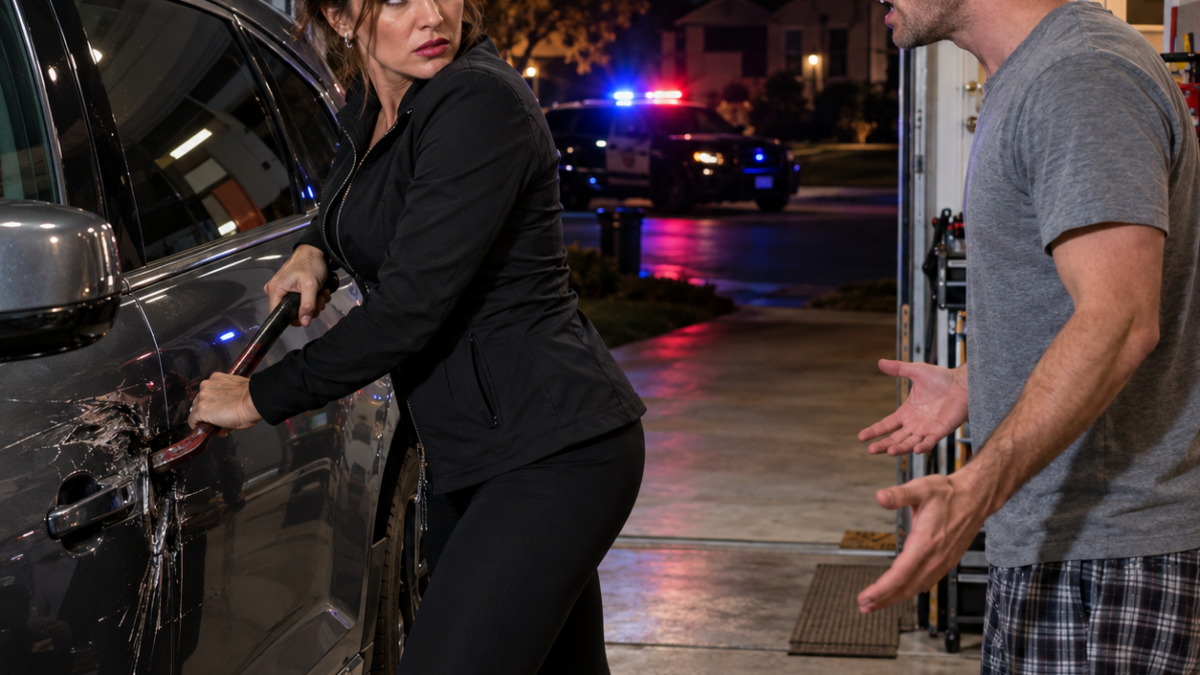
Karen Whitmore stood beside my Highlander with a crowbar in her hands.
For one frozen second, neither of us moved.
She was dressed in black leggings, a fitted dark jacket, and sneakers. Her hair was pulled back, but not messy. Even breaking into someone’s garage at two in the morning, Karen somehow looked put together. The crowbar was wedged near the driver’s door, where she had clearly been trying to pry it open. The paint was scratched badly around the lock area, and there were fresh dents in the door frame.
My brain rejected the scene.
It was too ridiculous.
Too insane.
Too Karen.
“What the hell are you doing?” I shouted.
She jumped but did not drop the crowbar.
Instead, she lifted her chin.
“Don’t you dare try to intimidate me.”
“In my garage?”
“I already called the police,” she snapped. “They’re on their way.”
For a second, I almost laughed.
Not because it was funny.
Because the logic was so broken my mind had nowhere else to go.
“You broke into my house, and you called the police?”
“You stole my car.”
I stared at her.
“What?”
“My Highlander,” she said, voice rising. “You stole it and hid it in here.”
I looked at my car.
Then back at her.
“Karen, that is my car.”
“Liar.”
“It is in my garage.”
“Because you stole it.”
“How did you get into my garage?”
She ignored the question.
“You thought you were clever. You thought nobody would notice.”
“You are holding a crowbar next to my damaged car.”
“You damaged it when you stole it.”
I took one step forward.
“Put the crowbar down.”
She gripped it tighter.
“Stay back.”
“I’m not going to ask again.”
Her eyes were wild in a way I had never seen before. Karen had always been controlling, arrogant, vindictive, and dramatic, but this was something else. She looked like someone standing inside a story she had rehearsed so many times she no longer understood reality could contradict it.
Sirens sounded in the distance.
That chilled me instantly.
I had no idea what she had told them.
A break-in? Car theft? Assault? Robbery in progress? If officers arrived expecting an active crime and found me yelling in a garage with a woman holding a crowbar, things could get dangerous fast.
I raised both hands.
“Karen, put it down before they get here.”
She smiled.
“They’re going to arrest you.”
“No,” I said quietly. “They’re going to ask why you’re inside my garage at two in the morning.”
She laughed.
“They’ll believe me.”
That sentence told me everything.
The first patrol car arrived less than a minute later.
Then another.
Then a third.
Because Karen had apparently reported a robbery in progress, they came fast and serious. Red and blue lights flashed against the garage walls. My parents woke up and came downstairs in robes, confused and scared. I told them to stay back, but my mother saw Karen and gasped.
“Why is she in our garage?”
Officers entered loudly.
“Hands where we can see them!”
My hands were already up.
Karen immediately started screaming.
“He stole my car! He stole my car and locked it in his garage!”
An officer moved between us.
“Ma’am, drop the crowbar.”
She hesitated.
“Drop it now.”
The crowbar clattered to the floor.
Another officer looked at me.
“Sir, step away from the vehicle.”
I complied.
“I live here,” I said. “She broke into my garage.”
“He’s lying!” Karen shrieked. “That is my car!”
My mother started talking at the same time.
“This is our house. He lives here. She broke in.”
My father, who had never liked Karen, pointed straight at her and said, “That woman is trespassing.”
Everything became noise for a few minutes.
Karen yelling about theft.
My parents trying to explain.
Officers separating us.
One asking me to step outside.
Another photographing the damage.
Because of how hysterical Karen was acting and because she had called in a serious report, the officers decided to take everyone’s statements more formally. They told me they wanted me to come down to the station to sort it out.
I was not formally arrested.
But being asked to come to the station at two in the morning while your HOA president accuses you of stealing a car is not exactly comforting.
I complied immediately.
Not because I was not angry.
Because I knew I had done nothing wrong, and the fastest way out was through documentation.
At the station, the officers interviewed me.
They were skeptical at first. Of course they were. From their perspective, they had responded to a report of a stolen vehicle and found two people claiming ownership of an identical Highlander. Karen was dramatic, but drama does not automatically make someone wrong. They had to verify facts.
I explained everything.
I lived in the house.
My parents lived there.
Karen was HOA president.
She had a history of making ridiculous complaints.
I had bought the Highlander weeks before.
She bought an identical one later.
I woke up to metal scraping and found her inside my garage with a crowbar trying to pry open my car.
The officer across from me leaned back.
“So you’re saying she broke into your garage to steal a car that she says you stole from her.”
“Yes.”
He looked tired.
I did not blame him.
My parents were interviewed too. They confirmed everything: I lived there, the car was mine, Karen had no business in our garage, and they had been asleep until the commotion woke them.
That helped.
So did Karen’s reputation.
Apparently, the station knew her.
Not in a criminal-mastermind way.
In a calls-all-the-time-over-nonsense way.
Parking complaints. Noise complaints. Kids playing. Dogs barking. Trash bins. “Suspicious” cars that belonged to residents. Officers had dealt with her enough that when my story sounded crazy, it at least sounded crazy in a Karen-specific direction.
Then they interviewed Karen.
From what I learned later, she insisted that her Highlander had been stolen from her driveway and hidden in my garage. She showed them pictures of her identical car as proof, which was not proof of anything except that she owned the same model. She demanded they check her driveway to verify that her car was missing.
So they did.
An officer drove to her house.
Her Highlander was sitting in her driveway.
Exactly where she normally parked it.
That should have ended the whole thing immediately, but police still had to rule out every possibility. Maybe there were two identical cars. Maybe keys had been swapped. Maybe registrations confused. Maybe she was delusional, lying, or both. They ran the VIN on my Highlander. They checked my registration and title paperwork from the folder I kept at home. They confirmed the purchase date.
My car was mine.
I bought it before Karen bought hers.
There was no theft.
No mix-up.
No missing vehicle.
Just Karen, a crowbar, a damaged SUV, and one of the worst plans anyone had ever tried to execute inside a garage.
When the officer came back with the confirmation, I felt my whole body loosen.
Not relief exactly.
Something close, but heavier.
Because being proven right does not erase the hour where someone’s lie might have sent your life sideways.
Karen did not take it well.
She argued. Then insulted the officers. Then accused them of protecting me. Then said they were incompetent. Then returned to insisting I had somehow stolen her car despite the fact that hers was in her driveway.
Eventually, she was charged.
Trespassing.
Attempted burglary or attempted vehicle break-in related to the crowbar and damage.
There may have been other smaller charges, but those were the main ones.
She did not spend serious time in jail. That part still frustrates me. She paid fines, got released, and within days was back in the neighborhood acting like she had survived some great injustice.
That was when things got worse.
The break-in spread through the neighborhood fast.
I told only a few people, but neighborhoods like ours have invisible communication systems more efficient than government agencies. By the end of the week, everyone knew Karen had been found in my garage at two in the morning with a crowbar, accusing me of stealing a car that was sitting in her own driveway.
People whispered.
People laughed.
People avoided her.
Karen could not stand humiliation.
So she turned it into revenge.
The violation notices began almost immediately.
Grass height violation.
My grass was not high. I had mowed two days earlier.
Improper parking violation.
My car was in my driveway, straight, legal, and nowhere near the sidewalk.
Noise violation.
For a night I had been asleep by ten.
Unapproved exterior storage.
For a garden hose on a reel I had owned for years.
Trash bin visibility.
The bins were behind the side fence where they always were.
Every few days, another letter.
Another fine.
Another threat.
And the amounts were strange. Different from normal HOA fines. Some were higher than the schedule allowed. Some referenced bylaw sections that did not exist. Some described rules so vaguely they sounded invented by someone typing angrily at midnight.
Because they were.
At first, I tried to go through the HOA board.
That was a joke.
Karen controlled the agenda. Karen answered emails. Karen signed the violation notices. When I asked for review, she sent more violations. When I requested copies of the rules, I got a PDF of the bylaws with no explanation. When I pointed out that certain cited sections did not exist, no one responded.
So I started documenting everything.
Every notice.
Every envelope.
Every date.
Every fine amount.
Every alleged bylaw.
I compared the fake notices to legitimate notices I had received years earlier under previous boards. The format was different. The wording was different. The fine schedule did not match. I asked neighbors I trusted to show me older notices they had received. Same pattern. Karen’s new notices were clearly not normal.
She was using the HOA like her personal weapon.
Then she trespassed again.
This time, it was not two in the morning with a crowbar.
It was 2:00 p.m. on a Saturday while I was mowing my backyard.
The side gate was unlocked because I had just finished mowing the front. That did not give Karen permission to walk through it.
I heard yelling behind me over the mower.
When I turned, there she was, standing in my backyard, red-faced, waving a paper.
“You are violating noise standards!”
I shut off the mower.
The sudden silence rang in my ears.
“It is two in the afternoon.”
“You have been running that machine for forty minutes.”
“It’s called mowing the lawn.”
“There are rules about excessive noise.”
“Not at two in the afternoon on a Saturday.”
“You think you’re above the rules.”
I pulled out my phone and started recording.
Her eyes flicked to it.
“You do not have permission to record me.”
“You are trespassing on my property. Leave.”
“I am here in my official capacity.”
“You have no official capacity in my backyard.”
She stepped closer.
“You need to learn some respect.”
“No,” I said. “You need to leave before I call the police and report you for trespassing again.”
That got through.
For a second, I saw the garage incident flash across her face. She turned and stormed out through the gate, yelling that I had not heard the last of this.
She was right.
But not in the way she hoped.
By then, my parents were stressed. My mother flinched every time the mail arrived. My father, who had never been intimidated by anyone, started checking the windows when dogs barked because he wondered if Karen was outside again. That was what enraged me most. She was not just targeting me. She was making my parents feel unsafe in the home where they had raised me.
I decided I had enough.
But I also decided not to move too fast.
Karen liked acting on impulse. I would not.
I let her keep going for another month.
Every fake notice went into a folder.
Every envelope got saved.
Every HOA email got printed.
Every fine got logged.
I saved the backyard video.
I got written statements from neighbors who had seen Karen harass others. I collected screenshots from the HOA Facebook group when a neighbor sent them to me.
That Facebook group became a gold mine.
Karen had been ranting there for months.
She posted long, angry paragraphs about disrespectful residents, people who thought they were above the law, neighbors ruining community standards, and certain households that needed to be “held accountable.” She avoided naming me directly, but her descriptions were obvious. My street. My car. My house. My supposed violations.
She wrote things like:
Some people believe they can steal, lie, and manipulate their way out of responsibility.
And:
I will personally make sure repeat offenders are exposed.
And:
The board has authority whether people like it or not.
The posts were unprofessional, obsessive, and clearly connected to the fake violations. Worse for her, they violated the HOA’s own code of conduct for board members, which required neutrality and prohibited targeting residents for personal disputes.
The neighbor who sent me screenshots wrote:
I thought you should have these. She’s been spiraling.
That was the word everyone started using.
Spiraling.
It fit.
Eventually, I filed a formal harassment complaint with the police.
I brought everything.
The report from the garage incident.
Photos of the damage to my Highlander.
Proof the car was mine.
The bogus violation notices.
The bylaw comparisons.
The backyard trespass video.
Facebook screenshots.
Statements from neighbors.
I expected skepticism.
Instead, the officer who took my complaint nodded like he had been waiting for someone to walk in with a complete folder.
“You’re not the only one,” he said.
Apparently, several residents had complained about Karen. Some had received fake fines. Others had been threatened. One elderly couple had been accused of improper holiday lighting in June. Another family had been fined for noise on a weekend they were out of town. A teenager had been reported as suspicious for sitting in his own car listening to music.
Karen had gone beyond annoying.
She had created a pattern.
The police took it seriously.
The final confrontation happened while I was at work.
I did not see it in person, but neighbors told me enough that I can picture it clearly.
Two officers went to Karen’s house to speak with her about the harassment complaints, the fake violation notices, and her online posts. They did not go in aggressively. From what I understand, it started as a conversation. They wanted her side. They wanted clarification. They probably expected defensiveness.
They got Karen.
At first, she denied everything.
Then she claimed the notices were valid.
Then she said residents were conspiring against her.
Then she accused the officers of being biased because of the garage incident.
When one officer told her that issuing fabricated fines could create legal problems, she snapped.
“You have no idea who you’re dealing with,” she said.
That sentence is apparently universal among people who absolutely should not say it to police.
She told them she knew the chief personally.
She said their badges would be gone by tomorrow.
She said they would pay for humiliating her.
She shouted loudly enough that neighbors came to windows.
One neighbor across the street told me later that Karen looked completely unhinged—hair perfect, makeup perfect, outfit perfect, but her voice and eyes totally out of control. Like the polished HOA president had cracked and something raw had climbed out.
Because of the threats, the documented harassment, and the way she was behaving, officers arrested her.
Then, according to neighbors, things got even stranger.
She became so erratic during the arrest that police called an ambulance. Instead of going straight to jail, she was taken to the hospital for evaluation. Later, I heard she was placed on some kind of mandatory psychiatric hold. I do not know the exact legal term in our state, and I am not going to pretend I do. All I know is that she was not allowed to simply walk out immediately.
That was the beginning of the end for Karen’s presidency.
The HOA could ignore complaints.
It could downplay fines.
It could pretend neighborhood gossip was exaggerated.
It could not ignore police reports, multiple residents coming forward, a prior trespass and vehicle break-in charge, fabricated notices, Facebook rants, and its president being hauled away after threatening officers.
The board called an emergency meeting.
This time, people showed up.
A lot of people.
I went with my parents. My mother held the folder like it was evidence in a murder trial. My father sat beside me, arms crossed, looking like he was hoping someone would try to defend Karen too enthusiastically.
The board looked terrified.
Good.
The vice president ran the meeting because Karen was obviously not there. He tried to keep his voice steady, but everyone could tell the situation was bigger than they wanted to admit.
They announced that Karen had been removed as HOA president pending further review.
People started clapping before he finished the sentence.
Then came the apology.
A formal email went out the next day, but at the meeting, the vice president said it out loud: the board regretted the improper notices, the confusion, the distress caused to homeowners, and the failure to properly supervise enforcement actions.
That wording was very legal.
Very sanitized.
Very “our attorney told us not to admit too much.”
Still, it was the closest thing to accountability we had gotten.
They also announced that all violation notices and fines issued during Karen’s presidency would be reviewed. Any fines found to be unsupported by actual bylaws would be refunded. Residents could submit disputes with documentation. The board would temporarily pause all new non-emergency enforcement actions until procedures were cleaned up.
The room erupted.
People were angry, relieved, and eager to tell their own stories.
One man stood and said Karen had fined him for parking a work truck he did not own.
A woman said Karen had threatened her teenage son for riding a skateboard.
An elderly neighbor said she had paid a fake fine because she was afraid of a lien.
My father stood up too.
He is not a public speaker. Never has been. But he stood, held up one of our notices, and said, “This woman broke into our garage, tried to frame my son, and then used this association to punish us for proving she lied. That should never have gotten past one letter.”
Nobody argued.
The refund process took about six weeks.
The board had to review records, compare every notice to actual bylaws, verify payments, recalculate amounts, and approve refund checks. I imagine it was a nightmare.
I did not feel bad.
Eventually, we got a check covering the bogus fines Karen had forced us to pay.
So did other families.
The HOA also changed procedures. No single board member could issue fines alone anymore. Violations required documentation, reference to an actual bylaw section, board review, and a clear appeal process. Emergency enforcement had to be reviewed by at least two officers. The Facebook group got new moderation rules, and board members were prohibited from posting personal accusations or vague public callouts.
In other words, they created rules that should have existed because Karen had proven exactly why they were needed.
The new HOA president was a retired accountant named Daniel Price.
He was boring in the best possible way.
He wore plain polo shirts, spoke in complete sentences, and seemed allergic to drama. His first message to the neighborhood was about transparency, proper documentation, and rebuilding trust. Nobody cheered. Nobody feared him. That was perfect.
The neighborhood got quieter after that.
Kids played outside again without Karen appearing like a suburban gargoyle. People parked without photographing their tires for evidence. Lawn mowing returned to being lawn mowing instead of an opportunity for confrontation. My parents stopped worrying every time an envelope arrived.
As for Karen, I did not see her for a while.
Then, months later, her house went up for sale.
No dramatic goodbye.
No public apology.
No final showdown.
Just a sign in the yard and a moving truck one morning. She stood near the driveway while movers carried boxes out, wearing sunglasses and a white tracksuit, looking every bit as polished as ever from a distance.
But from my driveway, I could see the difference.
She was not looking around to inspect anyone.
She was not giving orders.
She was not smiling.
For once, Karen Whitmore looked like someone who understood the neighborhood was no longer hers to control.
I stood beside my Highlander that morning.
The damaged door had been repaired by then. Insurance handled part of it, and Karen was ultimately responsible for costs through the legal process, though getting money from her was its own headache. Still, the car looked good again. Mine. Registered to me. Parked in my driveway, under my name, outside my home.
Karen glanced over once.
Our eyes met.
I expected anger. Or maybe another smug look. Or some final threat mouthed across the street.
Instead, she looked away.
That was better.
I still do not fully understand why she became obsessed with me.
Maybe it was because I had challenged her before.
Maybe because the police embarrassed her over the red curb incident.
Maybe because I bought a new car and she decided I did not deserve it.
Maybe because in her mind, buying the same Highlander gave her a way to create the perfect accusation: I stole hers, hid it, and thought I could get away with it.
A few neighbors told me later that before she bought her Highlander, she had posted vague comments online about “catching certain people in the act.” One said Karen had mentioned that some residents “needed to learn that stolen status symbols don’t make them respectable.”
That sentence chilled me.
Because it meant the plan may have started before the car even appeared in her driveway.
She saw something I owned and decided it could be used against me.
That is the part people miss about petty tyrants. They do not need a big kingdom. Give them a title, a rulebook, and a little social authority, and they will build a throne out of other people’s peace.
Karen’s throne collapsed in my garage at two in the morning.
Not all at once.
At first, she still thought the story would bend her way. She thought police would believe the crying HOA president over the guy she accused. She thought two identical cars would create enough confusion. She thought her reputation as a “community leader” would outweigh VIN numbers, registration records, purchase dates, witnesses, and the fact that her own supposedly stolen car was parked in her driveway.
Reality had other plans.
Documentation had other plans.
The truth had other plans.
I still keep records.
All of them.
The police report.
Photos of the damaged door.
Copies of the fake violations.
Screenshots.
Refund check stub.
HOA apology email.
Maybe that sounds paranoid.
I call it educated.
When someone shows you they are willing to break into your garage with a crowbar and accuse you of stealing your own car, you stop assuming common sense will protect you.
Common sense did not stop Karen.
Evidence did.
There is a lesson in that.
Maybe several.
Lock your doors.
Save your paperwork.
Know your bylaws.
Record encounters when legal.
Do not ignore the first sign that someone in authority is willing to lie, because small lies are often rehearsals for larger ones.
And never underestimate how far a person will go when they believe humiliation is something to avenge rather than something to learn from.
My Highlander still runs great.
Every time I start it, I think about that night less than I used to. At first, the memory came back constantly—the scraping sound, the garage light, Karen’s hand around the crowbar, the sirens, the station interview, the sick feeling of realizing how easily a lie can become your problem.
Now it comes back mostly when someone in the neighborhood jokes about identical cars.
One neighbor once said, “At least we know which Highlander is yours now.”
I said, “Mine is the one not used in a felony-level identity crisis.”
He laughed hard enough to drop his mail.
My parents are better too. My mother still double-checks the garage door at night, but she no longer freezes when HOA mail arrives. My father has returned to complaining about normal things, like cable prices and people who do not edge their lawns properly. Life has mostly settled.
The HOA is not perfect.
No HOA is.
But it is sane again.
The new president follows actual rules. Notices cite real bylaw sections. Fines are reviewed. People can appeal without being treated like criminals. Kids play in yards. Cars park on streets. Nobody has called the police on me for a nonexistent red curb in months.
That feels like victory.
Not loud victory.
Not cinematic victory.
Just the ordinary, priceless kind where your home feels like home again.
Sometimes I stand in the garage late at night when I take out recycling or grab something from the freezer. The light clicks on, and the Highlander sits there quietly, just a car. Not evidence. Not a setup. Not Karen’s obsession made physical.
Just mine.
I run my hand once over the repaired driver’s door sometimes. The paint is smooth now. You cannot see where the crowbar scratched it. You would never know what happened unless I told you.
But I know.
Karen tried to pry open my car and my life at the same time.
She failed at both.
And after everything she did—every lie, every fine, every fake notice, every threat, every public rant, every attempt to make me look like the problem—she was the one who left the neighborhood.
I stayed.
My parents stayed.
My Highlander stayed.
And the next time the HOA sent a letter to my house, it was not a violation notice.
It was a refund check.
𝗧𝗛𝗘 𝗘𝗡𝗗
My HOA President Bought My Exact Car, Broke Into My Garage, and Called 911 Saying I Had Stolen It
I woke up to metal scraping in my garage and found my HOA president trying to pry open my car with a crowbar.
The worst part was that she had already called 911 and told the police I was the thief.
I had lived in that neighborhood my entire life.
That was what made the whole thing so hard to believe at first. This was not some strange place where nobody knew me, where every face behind every curtain was unfamiliar, where I had moved in last month and accidentally offended the wrong person by parking too close to a mailbox. This was home. The sidewalk cracks, the old maple near the corner, the uneven curb in front of the Johnsons’ house, the smell of sprinklers running too early in the morning—every piece of it had been part of my life for as long as I could remember.
I grew up in the same house I live in now.
Some people hear that and assume things. They think I never launched. They think I’m one of those guys who failed to become an adult and simply stayed in the same bedroom forever while life passed him by. That is not what happened. I pay my bills. I work. I take care of myself. I help my parents, who are both in their sixties now and still live in the house because moving them somewhere else would make no sense. Housing is expensive, and my parents are getting older. Staying made practical sense.
It also made emotional sense.
I loved that house.
I loved the neighborhood.
When I was a kid, people actually knew each other. Mrs. Alvarez two doors down used to hand out popsicles in summer. Mr. Jenkins helped teach me how to ride a bike without training wheels. My parents’ friends became the background adults of my childhood, the ones who watched you grow up and still remembered the year you broke your arm falling off a scooter.
The HOA had always existed, but for most of my life, it was not the monster people joke about online.
It handled potholes. Organized cleanup days. Sent reminders when storm drains clogged. Made sure common areas did not fall apart. It could be annoying sometimes, sure, but not evil. Most board members were just neighbors taking turns doing boring volunteer work nobody else wanted.
That changed when Karen Whitmore became president.
Karen had wanted the position for years.
Everybody knew it. She showed up at meetings dressed like she was campaigning for Congress instead of trying to control trash bin placement. She was in her mid-forties, attractive in a sharp, polished way, with glossy brunette hair cut to her shoulders, expensive workout clothes that never looked like they had seen actual sweat, and a smile she used like a weapon. She had a curvy figure, perfect nails, and a way of standing with one hand on her hip that made every conversation feel like she was posing for a courtroom sketch.
For years, she lost HOA elections.
People did not dislike her enough to say so openly, but they knew what she was. She was intense. Controlling. The kind of woman who did not want to help the neighborhood as much as own it. Every election, someone calmer beat her.
Then, finally, enough people stopped paying attention.
Karen won.
The change was immediate.
The old HOA had sent reminders. Karen sent threats.
Kids playing in their own yards became a “noise issue.” A teenager’s basketball hoop became an “aesthetic concern.” A neighbor’s potted plants became an “unauthorized landscape alteration.” She fined people for rules that did not exist, quoted bylaws incorrectly, and acted as if being HOA president meant she had been granted emergency powers over suburban life.
She called the police constantly.
Not for crimes.
For annoyances.
If someone parked where she did not like, she called. If kids laughed too loudly, she called. If a dog barked twice, she called. One time, she called the cops on me because my car was parked on the street in front of my own house.
She claimed I was parked in a red curb zone.
There was no red curb.
There had never been a red curb.
The responding officer actually looked down at the ordinary gray curb, then at Karen, then at me, and said, with the tired patience of a man questioning all his career choices, “There is no parking restriction here.”
Karen crossed her arms.
“Well, there should be.”
That was Karen.
If reality failed to match her preferences, she treated reality like it needed a violation notice.
I tried to ignore her.
Most of us did.
But people like Karen do not interpret silence as peace. They interpret it as weakness.
Around that time, I bought a new car.
Not luxury. Not flashy. Just new to me and reliable enough that I no longer had to pray before turning the key.
For fourteen years, I had driven my parents’ old Toyota Camry. I got it when I turned eighteen, and by the time I was thirty-two, that poor car had given everything it had to give. The heater barely worked. The air conditioner had died years earlier. The ignition sometimes refused to start unless I sat there whispering threats. The mileage was so high it felt less like a car and more like a historical artifact.
I loved that Camry.
But love does not fix transmission problems.
So after saving carefully, researching, comparing prices, and test-driving enough cars to hate every dealership in the county, I bought a newer Toyota Highlander.
Dark gray.
Clean interior.
Good safety ratings.
Enough space to help my parents with errands, doctor appointments, and whatever furniture my mother suddenly decided needed to be moved from one room to another.
I was proud of it.
Not in a shallow way. It felt like proof that I had worked for something and gotten it. Every time I walked into the garage and saw it sitting there, I felt that quiet satisfaction people get from owning something stable after years of making do.
Three weeks later, Karen bought the exact same Highlander.
Same year.
Same color.
Same trim.
Same everything, as far as I could tell.
At first, I thought it was strange but not impossible. Toyota Highlanders are common. Dark gray SUVs are everywhere. Maybe she liked mine and decided she wanted one too. Maybe it was coincidence. Maybe I was letting my annoyance with her make me see patterns where there were none.
But Karen’s family never drove Toyotas.
Her driveway had always been full of Hondas. A Honda Pilot. A Civic her husband drove. An Accord that looked like it belonged to one of her older relatives. Then suddenly, weeks after I bought mine, she had an identical Highlander parked in her driveway.
I noticed it.
I did not understand it yet.
Looking back, I think she needed time.
Time to make the plan look believable. Time to own the car long enough that reporting it stolen would not seem immediately suspicious. Time to point at mine and claim confusion. Time to build a story in her head where she was the victim, I was the thief, and the police would finally give her the power she had been chasing for months.
At the time, though, I just thought she was weird.
Then came the night in the garage.
Part 2
I was awake late, like usual.
Bad habit, I know. Some people relax by sleeping at normal hours and making healthy choices. I relax by scrolling on my phone in the dark, reading articles I do not need to read, and telling myself I will go to bed after one more chapter, one more video, one more pointless argument in an online comment section.
My parents had gone to bed hours earlier.
The house was dark.
Quiet.
Then I heard the scraping.
At first, I thought it came from outside. Maybe a raccoon near the trash bins. Maybe a branch dragging against the siding. But then it happened again—metal on metal, sharp and ugly.
From downstairs.
I sat up.
My first thought was my parents.
They were older. Not helpless, but not young. If someone had broken in, I was the only person in the house who could respond fast enough to protect them.
Looking back, I was stupid.
I rushed downstairs without anything in my hands. No bat, no flashlight, no plan. Just adrenaline and fear. If there had been an armed burglar in the house, I would have been in real trouble. But fear for your family does not always leave room for strategy.
I turned on the hall light first.
Then the living room.
Then the kitchen.
Nothing.
The scraping came again.
From the garage.
I moved slowly toward the garage door, heart pounding so hard I could feel it in my throat. I opened the door and slapped the light switch.
The garage flooded with white light.
Karen Whitmore stood beside my Highlander with a crowbar in her hands.
For one frozen second, neither of us moved.
She was dressed in black leggings, a fitted dark jacket, and sneakers. Her hair was pulled back, but not messy. Even breaking into someone’s garage at two in the morning, Karen somehow looked put together. The crowbar was wedged near the driver’s door, where she had clearly been trying to pry it open. The paint was scratched badly around the lock area, and there were fresh dents in the door frame.
My brain rejected the scene.
It was too ridiculous.
Too insane.
Too Karen.
“What the hell are you doing?” I shouted.
She jumped but did not drop the crowbar.
Instead, she lifted her chin.
“Don’t you dare try to intimidate me.”
“In my garage?”
“I already called the police,” she snapped. “They’re on their way.”
For a second, I almost laughed.
Not because it was funny.
Because the logic was so broken my mind had nowhere else to go.
“You broke into my house, and you called the police?”
“You stole my car.”
I stared at her.
“What?”
“My Highlander,” she said, voice rising. “You stole it and hid it in here.”
I looked at my car.
Then back at her.
“Karen, that is my car.”
“Liar.”
“It is in my garage.”
“Because you stole it.”
“How did you get into my garage?”
She ignored the question.
“You thought you were clever. You thought nobody would notice.”
“You are holding a crowbar next to my damaged car.”
“You damaged it when you stole it.”
I took one step forward.
“Put the crowbar down.”
She gripped it tighter.
“Stay back.”
“I’m not going to ask again.”
Her eyes were wild in a way I had never seen before. Karen had always been controlling, arrogant, vindictive, and dramatic, but this was something else. She looked like someone standing inside a story she had rehearsed so many times she no longer understood reality could contradict it.
Sirens sounded in the distance.
That chilled me instantly.
I had no idea what she had told them.
A break-in? Car theft? Assault? Robbery in progress? If officers arrived expecting an active crime and found me yelling in a garage with a woman holding a crowbar, things could get dangerous fast.
I raised both hands.
“Karen, put it down before they get here.”
She smiled.
“They’re going to arrest you.”
“No,” I said quietly. “They’re going to ask why you’re inside my garage at two in the morning.”
She laughed.
“They’ll believe me.”
That sentence told me everything.
The first patrol car arrived less than a minute later.
Then another.
Then a third.
Because Karen had apparently reported a robbery in progress, they came fast and serious. Red and blue lights flashed against the garage walls. My parents woke up and came downstairs in robes, confused and scared. I told them to stay back, but my mother saw Karen and gasped.
“Why is she in our garage?”
Officers entered loudly.
“Hands where we can see them!”
My hands were already up.
Karen immediately started screaming.
“He stole my car! He stole my car and locked it in his garage!”
An officer moved between us.
“Ma’am, drop the crowbar.”
She hesitated.
“Drop it now.”
The crowbar clattered to the floor.
Another officer looked at me.
“Sir, step away from the vehicle.”
I complied.
“I live here,” I said. “She broke into my garage.”
“He’s lying!” Karen shrieked. “That is my car!”
My mother started talking at the same time.
“This is our house. He lives here. She broke in.”
My father, who had never liked Karen, pointed straight at her and said, “That woman is trespassing.”
Everything became noise for a few minutes.
Karen yelling about theft.
My parents trying to explain.
Officers separating us.
One asking me to step outside.
Another photographing the damage.
Because of how hysterical Karen was acting and because she had called in a serious report, the officers decided to take everyone’s statements more formally. They told me they wanted me to come down to the station to sort it out.
I was not formally arrested.
But being asked to come to the station at two in the morning while your HOA president accuses you of stealing a car is not exactly comforting.
I complied immediately.
Not because I was not angry.
Because I knew I had done nothing wrong, and the fastest way out was through documentation.
At the station, the officers interviewed me.
They were skeptical at first. Of course they were. From their perspective, they had responded to a report of a stolen vehicle and found two people claiming ownership of an identical Highlander. Karen was dramatic, but drama does not automatically make someone wrong. They had to verify facts.
I explained everything.
I lived in the house.
My parents lived there.
Karen was HOA president.
She had a history of making ridiculous complaints.
I had bought the Highlander weeks before.
She bought an identical one later.
I woke up to metal scraping and found her inside my garage with a crowbar trying to pry open my car.
The officer across from me leaned back.
“So you’re saying she broke into your garage to steal a car that she says you stole from her.”
“Yes.”
He looked tired.
I did not blame him.
My parents were interviewed too. They confirmed everything: I lived there, the car was mine, Karen had no business in our garage, and they had been asleep until the commotion woke them.
That helped.
So did Karen’s reputation.
Apparently, the station knew her.
Not in a criminal-mastermind way.
In a calls-all-the-time-over-nonsense way.
Parking complaints. Noise complaints. Kids playing. Dogs barking. Trash bins. “Suspicious” cars that belonged to residents. Officers had dealt with her enough that when my story sounded crazy, it at least sounded crazy in a Karen-specific direction.
Then they interviewed Karen.
From what I learned later, she insisted that her Highlander had been stolen from her driveway and hidden in my garage. She showed them pictures of her identical car as proof, which was not proof of anything except that she owned the same model. She demanded they check her driveway to verify that her car was missing.
So they did.
An officer drove to her house.
Her Highlander was sitting in her driveway.
Exactly where she normally parked it.
That should have ended the whole thing immediately, but police still had to rule out every possibility. Maybe there were two identical cars. Maybe keys had been swapped. Maybe registrations confused. Maybe she was delusional, lying, or both. They ran the VIN on my Highlander. They checked my registration and title paperwork from the folder I kept at home. They confirmed the purchase date.
My car was mine.
I bought it before Karen bought hers.
There was no theft.
No mix-up.
No missing vehicle.
Just Karen, a crowbar, a damaged SUV, and one of the worst plans anyone had ever tried to execute inside a garage.
When the officer came back with the confirmation, I felt my whole body loosen.
Not relief exactly.
Something close, but heavier.
Because being proven right does not erase the hour where someone’s lie might have sent your life sideways.
Karen did not take it well.
She argued. Then insulted the officers. Then accused them of protecting me. Then said they were incompetent. Then returned to insisting I had somehow stolen her car despite the fact that hers was in her driveway.
Eventually, she was charged.
Trespassing.
Attempted burglary or attempted vehicle break-in related to the crowbar and damage.
There may have been other smaller charges, but those were the main ones.
She did not spend serious time in jail. That part still frustrates me. She paid fines, got released, and within days was back in the neighborhood acting like she had survived some great injustice.
That was when things got worse.
The break-in spread through the neighborhood fast.
I told only a few people, but neighborhoods like ours have invisible communication systems more efficient than government agencies. By the end of the week, everyone knew Karen had been found in my garage at two in the morning with a crowbar, accusing me of stealing a car that was sitting in her own driveway.
People whispered.
People laughed.
People avoided her.
Karen could not stand humiliation.
So she turned it into revenge.
The violation notices began almost immediately.
Grass height violation.
My grass was not high. I had mowed two days earlier.
Improper parking violation.
My car was in my driveway, straight, legal, and nowhere near the sidewalk.
Noise violation.
For a night I had been asleep by ten.
Unapproved exterior storage.
For a garden hose on a reel I had owned for years.
Trash bin visibility.
The bins were behind the side fence where they always were.
Every few days, another letter.
Another fine.
Another threat.
And the amounts were strange. Different from normal HOA fines. Some were higher than the schedule allowed. Some referenced bylaw sections that did not exist. Some described rules so vaguely they sounded invented by someone typing angrily at midnight.
Because they were.
At first, I tried to go through the HOA board.
That was a joke.
Karen controlled the agenda. Karen answered emails. Karen signed the violation notices. When I asked for review, she sent more violations. When I requested copies of the rules, I got a PDF of the bylaws with no explanation. When I pointed out that certain cited sections did not exist, no one responded.
So I started documenting everything.
Every notice.
Every envelope.
Every date.
Every fine amount.
Every alleged bylaw.
I compared the fake notices to legitimate notices I had received years earlier under previous boards. The format was different. The wording was different. The fine schedule did not match. I asked neighbors I trusted to show me older notices they had received. Same pattern. Karen’s new notices were clearly not normal.
She was using the HOA like her personal weapon.
Then she trespassed again.
This time, it was not two in the morning with a crowbar.
It was 2:00 p.m. on a Saturday while I was mowing my backyard.
The side gate was unlocked because I had just finished mowing the front. That did not give Karen permission to walk through it.
I heard yelling behind me over the mower.
When I turned, there she was, standing in my backyard, red-faced, waving a paper.
“You are violating noise standards!”
I shut off the mower.
The sudden silence rang in my ears.
“It is two in the afternoon.”
“You have been running that machine for forty minutes.”
“It’s called mowing the lawn.”
“There are rules about excessive noise.”
“Not at two in the afternoon on a Saturday.”
“You think you’re above the rules.”
I pulled out my phone and started recording.
Her eyes flicked to it.
“You do not have permission to record me.”
“You are trespassing on my property. Leave.”
“I am here in my official capacity.”
“You have no official capacity in my backyard.”
She stepped closer.
“You need to learn some respect.”
“No,” I said. “You need to leave before I call the police and report you for trespassing again.”
That got through.
For a second, I saw the garage incident flash across her face. She turned and stormed out through the gate, yelling that I had not heard the last of this.
She was right.
But not in the way she hoped.
By then, my parents were stressed. My mother flinched every time the mail arrived. My father, who had never been intimidated by anyone, started checking the windows when dogs barked because he wondered if Karen was outside again. That was what enraged me most. She was not just targeting me. She was making my parents feel unsafe in the home where they had raised me.
I decided I had enough.
But I also decided not to move too fast.
Karen liked acting on impulse. I would not.
I let her keep going for another month.
Every fake notice went into a folder.
Every envelope got saved.
Every HOA email got printed.
Every fine got logged.
I saved the backyard video.
I got written statements from neighbors who had seen Karen harass others. I collected screenshots from the HOA Facebook group when a neighbor sent them to me.
That Facebook group became a gold mine.
Karen had been ranting there for months.
She posted long, angry paragraphs about disrespectful residents, people who thought they were above the law, neighbors ruining community standards, and certain households that needed to be “held accountable.” She avoided naming me directly, but her descriptions were obvious. My street. My car. My house. My supposed violations.
She wrote things like:
Some people believe they can steal, lie, and manipulate their way out of responsibility.
And:
I will personally make sure repeat offenders are exposed.
And:
The board has authority whether people like it or not.
The posts were unprofessional, obsessive, and clearly connected to the fake violations. Worse for her, they violated the HOA’s own code of conduct for board members, which required neutrality and prohibited targeting residents for personal disputes.
The neighbor who sent me screenshots wrote:
I thought you should have these. She’s been spiraling.
That was the word everyone started using.
Spiraling.
It fit.
Eventually, I filed a formal harassment complaint with the police.
I brought everything.
The report from the garage incident.
Photos of the damage to my Highlander.
Proof the car was mine.
The bogus violation notices.
The bylaw comparisons.
The backyard trespass video.
Facebook screenshots.
Statements from neighbors.
I expected skepticism.
Instead, the officer who took my complaint nodded like he had been waiting for someone to walk in with a complete folder.
“You’re not the only one,” he said.
Apparently, several residents had complained about Karen. Some had received fake fines. Others had been threatened. One elderly couple had been accused of improper holiday lighting in June. Another family had been fined for noise on a weekend they were out of town. A teenager had been reported as suspicious for sitting in his own car listening to music.
Karen had gone beyond annoying.
She had created a pattern.
The police took it seriously.
The final confrontation happened while I was at work.
I did not see it in person, but neighbors told me enough that I can picture it clearly.
Two officers went to Karen’s house to speak with her about the harassment complaints, the fake violation notices, and her online posts. They did not go in aggressively. From what I understand, it started as a conversation. They wanted her side. They wanted clarification. They probably expected defensiveness.
They got Karen.
At first, she denied everything.
Then she claimed the notices were valid.
Then she said residents were conspiring against her.
Then she accused the officers of being biased because of the garage incident.
When one officer told her that issuing fabricated fines could create legal problems, she snapped.
“You have no idea who you’re dealing with,” she said.
That sentence is apparently universal among people who absolutely should not say it to police.
She told them she knew the chief personally.
She said their badges would be gone by tomorrow.
She said they would pay for humiliating her.
She shouted loudly enough that neighbors came to windows.
One neighbor across the street told me later that Karen looked completely unhinged—hair perfect, makeup perfect, outfit perfect, but her voice and eyes totally out of control. Like the polished HOA president had cracked and something raw had climbed out.
Because of the threats, the documented harassment, and the way she was behaving, officers arrested her.
Then, according to neighbors, things got even stranger.
She became so erratic during the arrest that police called an ambulance. Instead of going straight to jail, she was taken to the hospital for evaluation. Later, I heard she was placed on some kind of mandatory psychiatric hold. I do not know the exact legal term in our state, and I am not going to pretend I do. All I know is that she was not allowed to simply walk out immediately.
That was the beginning of the end for Karen’s presidency.
The HOA could ignore complaints.
It could downplay fines.
It could pretend neighborhood gossip was exaggerated.
It could not ignore police reports, multiple residents coming forward, a prior trespass and vehicle break-in charge, fabricated notices, Facebook rants, and its president being hauled away after threatening officers.
The board called an emergency meeting.
This time, people showed up.
A lot of people.
I went with my parents. My mother held the folder like it was evidence in a murder trial. My father sat beside me, arms crossed, looking like he was hoping someone would try to defend Karen too enthusiastically.
The board looked terrified.
Good.
The vice president ran the meeting because Karen was obviously not there. He tried to keep his voice steady, but everyone could tell the situation was bigger than they wanted to admit.
They announced that Karen had been removed as HOA president pending further review.
People started clapping before he finished the sentence.
Then came the apology.
A formal email went out the next day, but at the meeting, the vice president said it out loud: the board regretted the improper notices, the confusion, the distress caused to homeowners, and the failure to properly supervise enforcement actions.
That wording was very legal.
Very sanitized.
Very “our attorney told us not to admit too much.”
Still, it was the closest thing to accountability we had gotten.
They also announced that all violation notices and fines issued during Karen’s presidency would be reviewed. Any fines found to be unsupported by actual bylaws would be refunded. Residents could submit disputes with documentation. The board would temporarily pause all new non-emergency enforcement actions until procedures were cleaned up.
The room erupted.
People were angry, relieved, and eager to tell their own stories.
One man stood and said Karen had fined him for parking a work truck he did not own.
A woman said Karen had threatened her teenage son for riding a skateboard.
An elderly neighbor said she had paid a fake fine because she was afraid of a lien.
My father stood up too.
He is not a public speaker. Never has been. But he stood, held up one of our notices, and said, “This woman broke into our garage, tried to frame my son, and then used this association to punish us for proving she lied. That should never have gotten past one letter.”
Nobody argued.
The refund process took about six weeks.
The board had to review records, compare every notice to actual bylaws, verify payments, recalculate amounts, and approve refund checks. I imagine it was a nightmare.
I did not feel bad.
Eventually, we got a check covering the bogus fines Karen had forced us to pay.
So did other families.
The HOA also changed procedures. No single board member could issue fines alone anymore. Violations required documentation, reference to an actual bylaw section, board review, and a clear appeal process. Emergency enforcement had to be reviewed by at least two officers. The Facebook group got new moderation rules, and board members were prohibited from posting personal accusations or vague public callouts.
In other words, they created rules that should have existed because Karen had proven exactly why they were needed.
The new HOA president was a retired accountant named Daniel Price.
He was boring in the best possible way.
He wore plain polo shirts, spoke in complete sentences, and seemed allergic to drama. His first message to the neighborhood was about transparency, proper documentation, and rebuilding trust. Nobody cheered. Nobody feared him. That was perfect.
The neighborhood got quieter after that.
Kids played outside again without Karen appearing like a suburban gargoyle. People parked without photographing their tires for evidence. Lawn mowing returned to being lawn mowing instead of an opportunity for confrontation. My parents stopped worrying every time an envelope arrived.
As for Karen, I did not see her for a while.
Then, months later, her house went up for sale.
No dramatic goodbye.
No public apology.
No final showdown.
Just a sign in the yard and a moving truck one morning. She stood near the driveway while movers carried boxes out, wearing sunglasses and a white tracksuit, looking every bit as polished as ever from a distance.
But from my driveway, I could see the difference.
She was not looking around to inspect anyone.
She was not giving orders.
She was not smiling.
For once, Karen Whitmore looked like someone who understood the neighborhood was no longer hers to control.
I stood beside my Highlander that morning.
The damaged door had been repaired by then. Insurance handled part of it, and Karen was ultimately responsible for costs through the legal process, though getting money from her was its own headache. Still, the car looked good again. Mine. Registered to me. Parked in my driveway, under my name, outside my home.
Karen glanced over once.
Our eyes met.
I expected anger. Or maybe another smug look. Or some final threat mouthed across the street.
Instead, she looked away.
That was better.
I still do not fully understand why she became obsessed with me.
Maybe it was because I had challenged her before.
Maybe because the police embarrassed her over the red curb incident.
Maybe because I bought a new car and she decided I did not deserve it.
Maybe because in her mind, buying the same Highlander gave her a way to create the perfect accusation: I stole hers, hid it, and thought I could get away with it.
A few neighbors told me later that before she bought her Highlander, she had posted vague comments online about “catching certain people in the act.” One said Karen had mentioned that some residents “needed to learn that stolen status symbols don’t make them respectable.”
That sentence chilled me.
Because it meant the plan may have started before the car even appeared in her driveway.
She saw something I owned and decided it could be used against me.
That is the part people miss about petty tyrants. They do not need a big kingdom. Give them a title, a rulebook, and a little social authority, and they will build a throne out of other people’s peace.
Karen’s throne collapsed in my garage at two in the morning.
Not all at once.
At first, she still thought the story would bend her way. She thought police would believe the crying HOA president over the guy she accused. She thought two identical cars would create enough confusion. She thought her reputation as a “community leader” would outweigh VIN numbers, registration records, purchase dates, witnesses, and the fact that her own supposedly stolen car was parked in her driveway.
Reality had other plans.
Documentation had other plans.
The truth had other plans.
I still keep records.
All of them.
The police report.
Photos of the damaged door.
Copies of the fake violations.
Screenshots.
Refund check stub.
HOA apology email.
Maybe that sounds paranoid.
I call it educated.
When someone shows you they are willing to break into your garage with a crowbar and accuse you of stealing your own car, you stop assuming common sense will protect you.
Common sense did not stop Karen.
Evidence did.
There is a lesson in that.
Maybe several.
Lock your doors.
Save your paperwork.
Know your bylaws.
Record encounters when legal.
Do not ignore the first sign that someone in authority is willing to lie, because small lies are often rehearsals for larger ones.
And never underestimate how far a person will go when they believe humiliation is something to avenge rather than something to learn from.
My Highlander still runs great.
Every time I start it, I think about that night less than I used to. At first, the memory came back constantly—the scraping sound, the garage light, Karen’s hand around the crowbar, the sirens, the station interview, the sick feeling of realizing how easily a lie can become your problem.
Now it comes back mostly when someone in the neighborhood jokes about identical cars.
One neighbor once said, “At least we know which Highlander is yours now.”
I said, “Mine is the one not used in a felony-level identity crisis.”
He laughed hard enough to drop his mail.
My parents are better too. My mother still double-checks the garage door at night, but she no longer freezes when HOA mail arrives. My father has returned to complaining about normal things, like cable prices and people who do not edge their lawns properly. Life has mostly settled.
The HOA is not perfect.
No HOA is.
But it is sane again.
The new president follows actual rules. Notices cite real bylaw sections. Fines are reviewed. People can appeal without being treated like criminals. Kids play in yards. Cars park on streets. Nobody has called the police on me for a nonexistent red curb in months.
That feels like victory.
Not loud victory.
Not cinematic victory.
Just the ordinary, priceless kind where your home feels like home again.
Sometimes I stand in the garage late at night when I take out recycling or grab something from the freezer. The light clicks on, and the Highlander sits there quietly, just a car. Not evidence. Not a setup. Not Karen’s obsession made physical.
Just mine.
I run my hand once over the repaired driver’s door sometimes. The paint is smooth now. You cannot see where the crowbar scratched it. You would never know what happened unless I told you.
But I know.
Karen tried to pry open my car and my life at the same time.
She failed at both.
And after everything she did—every lie, every fine, every fake notice, every threat, every public rant, every attempt to make me look like the problem—she was the one who left the neighborhood.
I stayed.
My parents stayed.
My Highlander stayed.
And the next time the HOA sent a letter to my house, it was not a violation notice.
It was a refund check.