𝗙𝗨𝗟𝗟 𝗦𝗧𝗢𝗥𝗬 My Dying K9 Refused to Leave the Bedroom That Had Been Empty for Seven Years
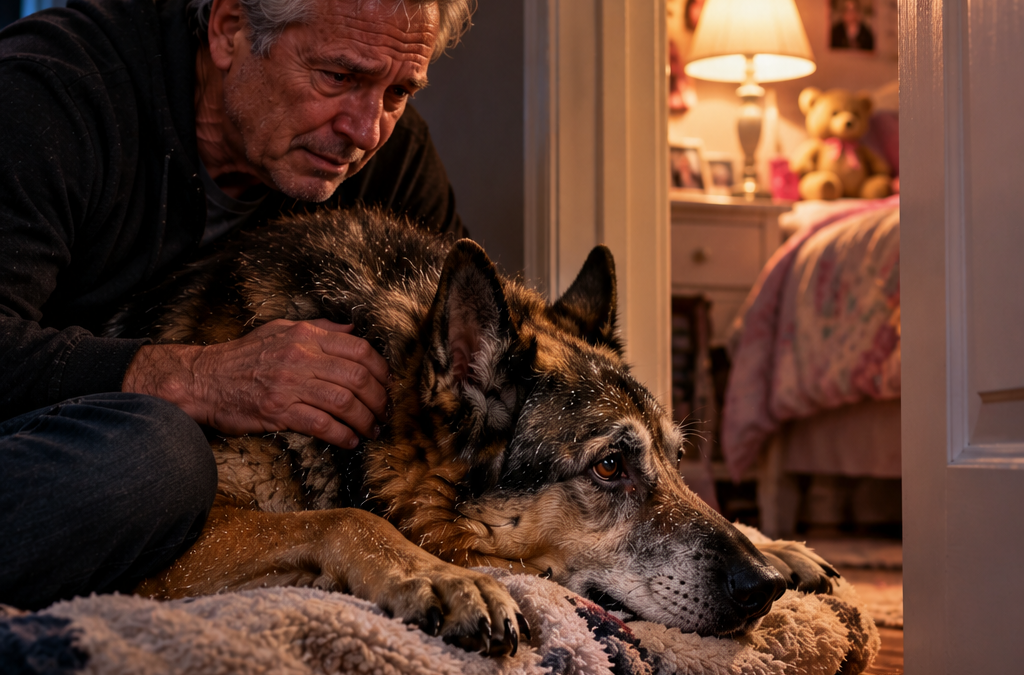
𝗙𝗨𝗟𝗟 𝗦𝗧𝗢𝗥𝗬
He closed his eyes.
And that was where he slept.
Night after night.
Whenever we were home.
At the time, it seemed like a harmless habit.
I didn’t know that within a year, that spot in the hallway would become the most important place in our house.
Claire began getting sick the following spring.
At first, we thought she was exhausted.
She’d been working long hours as an elementary school teacher.
She complained about stomach pain, but insisted it was probably stress.
Then she began losing weight.
The doctors ordered tests.
A scan.
A biopsy.
More appointments.
And finally, a diagnosis I still struggle to say aloud.
Pancreatic cancer.
By the time it was discovered, the disease had already spread.
I remember sitting beside her in the hospital, holding her hand while a specialist explained the treatment options.
I asked question after question.
Could they operate?
Was there another hospital?
Another treatment?
Anything?
The doctor spoke gently.
Claire listened quietly.
Then she squeezed my hand.
“Dan.”
I looked at her.
Her eyes were full of tears.
“Come here.”
I leaned closer.
She touched my cheek.
“We need to think about Leah.”
My throat tightened.
“We’re going to get you better.”
She closed her eyes.
“Daniel.”
I couldn’t look at her.
For thirty years, my job had been responding when something went wrong.
I’d walked into dangerous buildings.
Chased criminals through dark streets.
Pulled injured people from wrecked vehicles.
I knew how to do something.
But there was nothing I could do to arrest cancer.
Nothing I could threaten it with.
Nothing I could physically stand between it and my wife.
And that helplessness nearly destroyed me.
Claire died six months later.
Leah was twelve.
The night after the funeral, I found her sitting on her bedroom floor with Rex beside her.
She was wearing one of her mother’s old sweatshirts.
It hung past her knees.
Her eyes were swollen from crying.
I stood in the doorway.
“Sweetheart?”
She looked up.
“Why did everybody say she’s in a better place?”
I froze.
I had no answer.
She continued.
“Why would anywhere be better than here?”
I stepped into the room.
Sat on the floor beside her.
And tried to speak.
Nothing came.
Leah looked down at Rex.
“Mom promised she’d come to my school play.”
My throat tightened.
“I know.”
“She said she’d be there.”
I reached for her hand.
“She wanted to be.”
Leah pulled away.
“Then why isn’t she?”
The anger in her voice frightened me.
Not because I blamed her.
Because I felt the same anger.
I wanted to scream at the world.
At the doctors.
At God.
At anyone who told me to be grateful for the years we’d had together.
But my daughter was looking at me, waiting for an explanation that didn’t exist.
So I did the only thing I could.
I wrapped my arms around her.
“I’m sorry.”
She tried to pull away.
Then collapsed against my chest.
We sat on the bedroom floor and cried until neither of us had anything left.
Rex pressed himself against us.
His head rested across Leah’s legs.
At some point, she wrapped one arm around his neck.
“Don’t you leave too,” she whispered.
Rex lifted his head.
Then placed one enormous paw across her hand.
Leah began crying again.
I will never forget that moment.
Not the sound of her sobbing.
Not the sight of Claire’s sweatshirt hanging around her shoulders.
And not the way Rex remained beside her, still and patient, as though he understood that the only thing he could offer was his presence.
That night, Leah asked me to leave the hallway light on.
I did.
Then she asked if Rex could stay outside her room.
I looked at him.
He was already lying in his usual spot.
“Of course.”
Leah reached down and rubbed his ears.
“Will he be here when I wake up?”
I nodded.
“Yes, sweetheart.”
She looked at Rex.
“Promise?”
I smiled sadly.
“He’s pretty good at keeping watch.”
She knelt and kissed his forehead.
“Goodnight, Rex.”
His tail tapped the floor.
I turned off the bedroom light and closed the door most of the way.
Then I sat in the hallway beside him.
For nearly an hour, I listened to my daughter crying softly on the other side.
I wanted to go inside.
I wanted to hold her.
But sometimes, when I tried, she pushed me away because I reminded her too much of what we’d lost.
Rex didn’t have that problem.
He didn’t ask questions.
Didn’t try to explain death.
Didn’t tell her to be strong.
He simply stayed.
And slowly, the crying stopped.
That was the beginning of a ritual that lasted longer than I ever imagined.
Every evening, when Leah finished her homework, Rex would rise from his bed downstairs.
He’d follow her through the hallway.
Wait while she brushed her teeth.
Then settle outside her bedroom.
Sometimes she left the door open.
Sometimes she closed it.
It didn’t matter.
Rex remained there whenever he was home.
If I worked an overnight shift, he came with me, and Leah stayed with her grandmother.
On the nights we were home together, however, his place was outside her door.
When I returned from a late shift, he would usually check on me, eat, and then head upstairs again.
I once tried putting his bed in my room.
He carried the blanket out into the hallway.
I laughed.
“Really?”
He sat beside Leah’s door.
I pointed toward my bedroom.
“There’s more space in there.”
Rex looked at me.
Then lay down.
I shook my head.
“All right. You win.”
Looking back, I think he won far more important battles than that.
He helped my daughter through years when I was still learning how to be both her parents.
There were nights when Leah had nightmares.
She’d wake screaming for her mother.
Before I could reach the hallway, Rex would already be standing outside her door.
Sometimes he’d push it open with his nose.
Other times he’d wait until I arrived.
Then we’d go inside together.
I’d sit on the edge of her bed.
Rex would rest his head beside her pillow.
And somehow, after a few minutes of stroking his fur, her breathing would slow.
She’d look at me.
“Is he staying?”
I always answered the same way.
“As long as you need him.”
Rex grew into a powerful working dog during those years.
At the department, he was disciplined, fearless, and remarkably good at tracking.
We located missing people.
Recovered evidence.
Helped apprehend dangerous suspects.
Once, during a search for a missing elderly man in the woods, Rex worked for nearly four hours in freezing rain before finding him beneath a fallen pine tree.
The man was hypothermic.
Confused.
Barely able to speak.
While waiting for medical help, I knelt beside him and covered him with an emergency blanket.
Rex lay close, watching quietly.
The man reached out and touched his collar.
“Good dog,” he whispered.
I rubbed Rex’s ears.
“Best partner I’ve ever had.”
But at home, the same dog who could track a person through miles of woodland patiently endured Leah dressing him in a pink scarf for a school photograph.
When she entered middle school, she began having difficult days.
There were girls who mocked her for not having a mother.
Teachers who meant well but said things that made her feel different.
Mother’s Day assignments she hated.
School dances she wasn’t sure she wanted to attend.
Sometimes she came home angry.
Sometimes silent.
Sometimes she’d slam her bedroom door and refuse to speak to me.
Rex would approach the door.
Sit.
Wait.
Eventually, I’d hear it open.
Then Leah would whisper, “Come on, boy.”
He’d enter.
And an hour later, when I knocked, she’d be sitting on the floor with his head in her lap.
I’d ask whether she wanted dinner.
Sometimes she’d say no.
Sometimes she’d say yes.
And sometimes she’d look at me and ask a question she’d been carrying all day.
“Dad, do you think Mom would have liked my haircut?”
Or, “Do you think Mom was scared when she died?”
Or, “What if I forget what her voice sounded like?”
Those questions broke my heart.
But we talked.
And as Leah grew older, I began noticing something.
Rex didn’t make the pain disappear.
He made it possible for her to sit with it.
He gave her something steady to touch while she said things that frightened her.
Something warm and living beside her while she learned that grief didn’t mean love had ended.
And in the process, he was helping me too.
Because when Leah finally started talking, I had to learn to listen.
Not as a police officer.
Not as somebody trying to solve a problem.
But as a father whose daughter needed him to admit that some things couldn’t be fixed.
By the time she was sixteen, Leah had become confident, funny, and determined.
She was an excellent student.
She loved biology.
Wanted to become a nurse.
And had inherited her mother’s ability to argue with me until I ran out of sensible objections.
One evening, she came home carrying a stack of college brochures.
She spread them across the kitchen table.
“Dad, I want to show you something.”
I looked up from the newspaper.
“What?”
She pushed a brochure toward me.
A university in Oregon.
I frowned.
“Oregon?”
She nodded.
“They have a really good nursing program.”
I turned the brochure over.
“That’s clear across the country.”
“I know.”
“Pennsylvania has nursing programs.”
“I know that too.”
I looked at her.
“Then why Oregon?”
She hesitated.
Then said, “Because I want to see something different.”
The words hurt more than they should have.
I looked down at the brochure.
“Something wrong with here?”
Leah sighed.
“Dad.”
“What?”
“Nothing’s wrong with here.”
She paused.
“But I don’t want to live in Westbrook forever.”
I stared at her.
I thought about the house.
Her mother’s garden.
The school where she’d grown up.
The bedroom Rex guarded every night.
Everything I’d spent years trying to preserve.
And suddenly, I felt as though she were asking me to let go of the last part of Claire I still had.
I didn’t say that.
Instead, I became practical.
Too practical.
I talked about tuition.
Distance.
Airline tickets.
Safety.
Housing.
Every possible reason she should reconsider.
Finally, Leah stood.
“You’re not even listening.”
I looked up.
“I am listening.”
“No. You’re finding reasons to say no.”
I felt myself becoming angry.
“I’m your father. I’m allowed to worry.”
She crossed her arms.
“And I’m allowed to grow up.”
The kitchen became silent.
Rex lay beside the table, watching us.
Leah’s eyes filled.
Then she said something that stayed with me for years.
“I love this house, Dad. But sometimes it feels like we’re all waiting for our old life to come back.”
I stared at her.
She looked toward the hallway.
“Mom’s gone.”
My throat tightened.
“I know that.”
“I know you know.”
Her voice broke.
“But I don’t think you know how to let anything change.”
She gathered the brochures and went upstairs.
A moment later, her bedroom door closed.
Then I heard Rex rise.
His nails clicked across the hardwood floor.
He walked upstairs.
And settled outside her door.
I sat alone at the kitchen table.
For the first time, I wondered whether the comfort I’d spent years trying to give my daughter had slowly become something that made her feel trapped.
The next morning, I found Leah making coffee.
I sat across from her.
She looked nervous.
I took a breath.
“Tell me about the nursing program.”
Her face changed.
“What?”
“Oregon.”
She stared at me.
“You want to know?”
I nodded.
“Yeah.”
She slowly smiled.
Then began talking.
About the classes.
The hospitals.
The campus.
The opportunities.
I listened.
Really listened.
And when she finished, I looked at her.
“You’d be good at it.”
Her eyes filled.
“Thanks, Dad.”
I reached across the table.
“Your mother would be proud.”
Leah began crying.
I stood and embraced her.
Rex approached and pressed his head against our legs.
I laughed through tears.
“Apparently he approves too.”
Leah knelt and hugged him.
“What am I going to do without you?”
Rex licked her cheek.
She smiled.
“Guess you’ll have to protect Dad.”
I didn’t realize how seriously I’d take those words.
Two years later, Leah received her acceptance letter.
She was eighteen.
I was fifty-five.
Rex was getting older, though he still worked with remarkable enthusiasm.
The day Leah left for Oregon, the house seemed to hold its breath.
Her suitcases stood by the front door.
Boxes filled the trunk of my car.
Claire’s photograph sat on the kitchen counter because Leah wanted to take a smaller framed copy with her.
Rex followed her everywhere.
Whenever she stopped packing, he sat beside her.
Whenever she entered her bedroom, he followed.
Finally, she knelt in front of him.
“Hey, old man.”
His ears rose.
She wrapped her arms around his neck.
“I’m going to miss you.”
His tail moved.
She pulled back and looked into his eyes.
“You have to take care of Dad, okay?”
I stood in the doorway, trying not to cry.
Leah smiled through tears.
“And don’t let him work too hard.”
Rex placed his paw against her knee.
She laughed.
“Promise?”
He held it there.
Then she hugged him again.
At the airport, I tried to be cheerful.
I carried her bags.
Bought her a sandwich.
Asked whether she’d remembered her charger.
Checked her flight information three times.
Finally, she turned toward me.
“Dad.”
I stopped.
“What?”
She smiled sadly.
“I’m going to be okay.”
I swallowed.
“I know.”
She hugged me.
I held her longer than I intended.
Then she whispered, “I’m not leaving because I don’t love you.”
My chest tightened.
“I know that too.”
She pulled back.
“Do you?”
I looked at her.
For several seconds, I couldn’t answer.
Then I nodded.
“Yeah, sweetheart.”
I touched her cheek.
“Go build your life.”
She smiled through tears.
And walked toward security.
I watched until she disappeared.
Then I drove home.
The house was quiet when I entered.
Rex met me at the door.
He looked past me.
Toward the driveway.
Then back at me.
I crouched.
“She’s gone, buddy.”
His ears shifted.
I rubbed his neck.
“College.”
He looked toward the stairs.
I swallowed.
“She’s going to be gone a while.”
Rex turned.
Walked down the hallway.
Climbed the stairs.
And settled outside Leah’s bedroom.
I followed him.
The door was open.
Her bed was neatly made.
The shelves were half empty.
The glow-in-the-dark stars she’d stuck to the ceiling as a child were still there.
Rex lay in his familiar place.
Watching the room.
I sat beside him.
“She’s not coming home tonight.”
He looked at me.
I stroked his ears.
“Or tomorrow.”
He rested his head on his paws.
I sat there for a long time.
Then whispered, “I know, buddy.”
Because the truth was, I didn’t want to leave that doorway either.
For the first few months after Leah left, Rex behaved as though he expected her to return at any moment.
He listened whenever a car stopped outside.
If someone walked up the porch steps, his ears rose.
When the doorbell rang, he hurried toward the entrance, tail swinging, only to stop when he realized the visitor wasn’t Leah.
Then he’d turn away.
Not dramatically.
Not with any sound that suggested heartbreak.
He would simply return to whatever he’d been doing.
But every evening, he went upstairs.
The first night, I found him outside her bedroom at nine-thirty.
The second night, the same.
By the end of the first week, I stopped checking.
I knew where he’d be.
At first, I left the bedroom door open.
I thought he might eventually realize she wasn’t there and choose somewhere more comfortable.
But one evening, I discovered him lying just inside the room, his head resting beside the blue rabbit Leah had left on her bed.
Mr. Buttons.
The same rabbit she’d introduced to Rex years earlier.
Its fur was faded.
One ear had been repaired by Claire with thick white thread.
I sat beside the bed and picked it up.
“Remember this?”
Rex lifted his head.
I smiled.
“She used to make you protect this thing.”
He sniffed the rabbit.
Then rested his chin on my knee.
I looked around the room.
College photographs were taped to the mirror.
A faded school dance ticket sat beneath a jewelry box.
On the windowsill stood a little clay bowl Leah had made in fourth grade.
I remembered Claire praising it as though our daughter had created a priceless work of art.
Suddenly, the room felt unbearably full of people who weren’t there.
I placed the rabbit back on the bed.
“Come on, buddy.”
Rex stood.
Followed me into the hallway.
Then turned around and lay outside the door again.
I smiled sadly.
“All right.”
I scratched his head.
“You take first watch.”
That became our routine.
During the day, Rex worked beside me or rested at home.
At night, he returned to Leah’s doorway.
When he retired from the police department two years later, the ritual continued.
By then, his hips were beginning to ache.
He walked more slowly.
Needed help climbing into the truck.
And sometimes hesitated at the bottom of the stairs before beginning the climb.
I bought him an orthopedic bed and placed it near the fireplace.
He loved it during the day.
But every evening, he went upstairs.
Eventually, I carried the bed into the hallway.
That solved the problem.
At least for a while.
Leah came home during her first Christmas break.
I remember that afternoon clearly.
Snow was falling.
I’d been making coffee when Rex suddenly stood.
His ears rose.
He moved toward the front window.
A car pulled into the driveway.
Before I could stop him, he hurried toward the door.
His nails slipped against the hardwood.
I caught his collar.
“Easy, old man.”
Then I heard Leah outside.
“Dad?”
Rex’s entire body changed.
His tail began swinging.
His ears stood straight up.
He gave a sharp, excited bark.
And when I opened the door, he rushed toward her.
“Rex!”
Leah dropped her suitcase.
She knelt on the porch.
Rex buried his face against her chest.
She laughed and cried at the same time.
“Oh, my God. I missed you.”
He licked her cheek.
She wrapped both arms around his neck.
“Dad, look at him!”
I stood in the doorway with tears in my eyes.
“I see him.”
That evening, Rex refused to leave her side.
He followed her into the kitchen.
Waited while she unpacked.
Sat beside her during dinner.
And when she went upstairs, he settled outside her bedroom as though the last four months had never happened.
I stood in the hallway watching him.
Leah opened the door.
“Still guarding me, huh?”
Rex lifted his head.
She smiled.
“Some things never change.”
Then she looked at me.
“Dad?”
“Yeah?”
“Did he sleep here while I was gone?”
I nodded.
“Every night.”
Her smile faded slightly.
“Really?”
“Yep.”
She looked down at Rex.
“Sweetheart.”
She knelt and stroked his face.
“You know you don’t have to wait for me, right?”
Rex pressed his muzzle against her hand.
Leah swallowed.
Then whispered, “I’m always going to come back.”
I stood there listening.
I wanted to believe she could keep that promise.
But life doesn’t always give us the freedom to return when we want.
Over the next seven years, Leah’s world grew larger.
She finished college.
Completed her clinical training.
Became a pediatric nurse at a hospital in Portland.
Made friends.
Built a career.
Moved into her first apartment.
Then a better one.
She began dating a kind young man named Ethan, who worked as a physical therapist.
They adopted a cat.
Bought secondhand furniture.
Took weekend trips to the coast.
Her life was moving forward.
And I was proud of her.
I truly was.
But pride and loneliness can live inside the same heart.
Sometimes she’d call while driving home from work.
I’d hear traffic in the background.
Her voice sounded tired but happy.
She’d tell me about a difficult shift.
A child who had finally recovered.
A family she’d helped.
Something funny a coworker had said.
I’d listen, imagining the woman my little girl had become.
Then she’d ask, “How’s Rex?”
I’d look toward the hallway.
“Same as always.”
“Still sleeping outside my door?”
“Every night.”
She’d laugh softly.
“That dog is unbelievable.”
Then, after a pause, she’d ask, “How are you, Dad?”
And I’d give the same answer.
“Fine, sweetheart.”
It became so automatic that I sometimes said it before thinking.
I was fine.
The house was fine.
Rex was fine.
Everything was fine.
Except that Claire was gone.
My daughter lived more than two thousand miles away.
And the only creature who had shared nearly every difficult year of our lives was growing older faster than I wanted to admit.
Leah visited when she could.
At first, twice a year.
Then once.
Hospital shifts became harder to rearrange.
Airfare became expensive.
Her own responsibilities increased.
I understood.
But Rex didn’t know anything about airline prices or nursing schedules.
He only knew familiar footsteps.
Familiar voices.
And the room at the end of the hallway.
Even when Leah wasn’t there, he continued returning to it.
Sometimes he slept.
Sometimes he sat with his head raised, listening.
Other nights, when I came upstairs, I’d find him looking toward the empty bed.
I often wondered what he remembered.
The frightened twelve-year-old girl crying after her mother’s funeral?
The teenager doing homework on the floor?
The young woman laughing as she packed for college?
Perhaps dogs don’t remember people the way we do.
Perhaps familiar places simply make them feel safe.
I couldn’t know.
But I knew Rex had chosen that doorway long before Leah left.
And he’d never found a reason to abandon it.
When Rex turned twelve, Dr. Collins recommended moving his bed downstairs permanently.
His arthritis had worsened.
Climbing stairs was becoming difficult.
One evening, I tried gently guiding him toward the living room instead.
“Come on, buddy.”
He looked at me.
I patted his new bed.
“Right here.”
Rex approached.
Sniffed the blanket.
Lay down.
I thought we’d settled the matter.
But around midnight, I heard movement in the hallway.
I got up.
Rex was standing at the bottom of the stairs.
His front paws rested on the first step.
He looked upward.
I sighed.
“Really?”
His tail moved.
I walked over.
“You’re too old for this.”
He glanced at me.
Then toward the stairs again.
I couldn’t help smiling.
“Stubborn old fool.”
I supported his hips and helped him upstairs.
The following morning, I called a contractor.
Within a week, we had a safer stair arrangement, additional nonslip surfaces, and a supportive harness I could use when Rex needed help.
But as the years passed, even those accommodations became insufficient.
Eventually, I moved into the downstairs guest room with Rex.
And I began carrying him upstairs only when he was comfortable enough for a short visit.
I thought he would resist the change.
Instead, something surprised me.
Whenever I sat beside him in the evening and said, “Want to check on Leah’s room?” his ears lifted.
I’d help him upstairs.
He’d settle outside the door for a while.
Then, when he grew tired, he’d let me help him back down.
The ritual changed.
But it never disappeared.
I retired from the department at fifty-nine.
Without police work, Rex and I spent nearly every day together.
We took short walks.
Watched old movies.
Sat on the porch.
Sometimes I talked to him about Claire.
Sometimes about Leah.
Sometimes about nothing important.
He listened in the way dogs do, with complete attention until something more interesting moved outside.
I had grown used to his quiet companionship.
Maybe too used to it.
One Thanksgiving, Leah called and asked if I’d consider selling the house.
I was sitting beside Rex on the porch.
“What?”
“Dad, it’s a big house for one person.”
I looked toward the yard.
“It’s our home.”
“I know.”
“Your mother loved this place.”
“I know that too.”
She hesitated.
“But you’re getting older. And Rex needs more care.”
I felt irritation rising.
“We’re managing.”
“Dad.”
“What?”
“Would you ever consider moving closer to me?”
I became quiet.
She continued.
“You could have a smaller place. Somewhere with no stairs. We could see each other all the time.”
I looked down at Rex.
He was asleep beside my chair.
His gray muzzle rested against his paws.
“What about him?”
“We’d find somewhere that allows dogs.”
“He’s old, Leah. He doesn’t handle change well.”
There was a pause.
Then she said, “Are you sure you’re talking about Rex?”
The question stung.
I stared at the yard.
“What’s that supposed to mean?”
“Dad, you’ve spent years keeping everything exactly the same.”
I didn’t answer.
She continued gently.
“My room is still the same, isn’t it?”
I looked toward the house.
“Mostly.”
“Dad.”
“What?”
“I don’t need you to keep my bedroom waiting for me.”
My throat tightened.
“That’s not what I’m doing.”
She was quiet.
Then she whispered, “I worry about you.”
I looked at Rex.
“Don’t.”
“You’re my dad.”
“I know.”
“And sometimes I feel like you’re still standing in that hallway with Rex, waiting for the past to come home.”
I ended the call sooner than I should have.
Not because she was cruel.
Because she had found the one truth I didn’t know how to face.
Rex was waiting outside an empty bedroom.
But perhaps I was waiting too.
Not for Leah exactly.
She was alive, happy, and building a good life.
I was waiting for a time when Claire was still here.
When our daughter was little.
When the house was noisy.
When there was somebody at the kitchen table every morning.
I had never learned how to grieve the ending of that life without feeling as though I was betraying it.
And maybe Rex’s nightly watch had become an excuse to avoid learning.
I didn’t call Leah back that evening.
I should have.
Instead, I sat beside Rex and rubbed his ears.
“She thinks we’re a couple of old fools.”
He opened one eye.
I smiled sadly.
“Maybe she’s right.”
The following year, Rex’s health declined more quickly.
He was nearly sixteen, an extraordinary age for a German Shepherd, and his body had begun showing the cost of those years.
His hips were stiff.
His hearing had faded.
His eyesight was clouding.
He developed kidney problems and began losing weight.
Dr. Collins adjusted his treatment plan several times.
We focused on comfort.
He still enjoyed small meals.
Still liked lying in the sun.
Still wagged his tail when I scratched his chest.
But the walks became shorter.
Then disappeared entirely.
One afternoon, I tried taking him into the backyard.
He stood for several seconds.
Sniffed the air.
Then looked toward the house.
I understood.
“Okay, buddy.”
I helped him turn around.
“Let’s go inside.”
That evening, I noticed he hadn’t touched his dinner.
I offered chicken.
He turned away.
The next morning, he drank a little water but refused breakfast.
I called Dr. Collins.
She examined him.
Ran tests.
And sat beside me with the kind of expression I’d learned to fear.
His kidney disease had progressed significantly.
He was becoming dehydrated and nauseated despite treatment.
His strength was failing.
She explained that we could continue supportive care as long as he remained comfortable, but his condition was unlikely to improve.
Then came the words.
“Daniel, I think Rex is approaching the end.”
I stared at her.
“How long?”
She shook her head.
“I can’t tell you exactly. Possibly a few days.”
I looked toward Rex.
He was lying on his blanket.
Watching the hallway.
I swallowed.
“He’s still trying to get upstairs.”
Dr. Collins nodded.
“I know.”
“He wants to go to her room.”
She rested a hand against his shoulder.
“Then let’s make him comfortable there.”
We carried him upstairs that afternoon.
He settled outside Leah’s bedroom.
For the first time in several days, he seemed calm.
I sat beside him.
The hallway was quiet.
The same photographs hung on the walls.
Leah at twelve, smiling with braces.
Leah at sixteen, wearing her graduation gown from a summer academic program.
Leah at eighteen, standing beside Rex on the front porch before leaving for college.
I stared at that last photograph.
Rex was looking up at her.
His ears stood straight.
His tail was blurred from moving.
I looked down at the old dog beside me.
“She’s all grown up now.”
His ear moved.
I swallowed.
“You did a good job.”
He rested his chin on the blanket.
I took out my phone.
For several minutes, I stared at Leah’s number.
I was afraid to call.
Afraid she’d be frightened.
Afraid she’d blame herself for not visiting more.
Afraid she wouldn’t make it home in time.
But mostly, I was afraid that once I told her Rex was dying, there would be no way to pretend he wasn’t.
Finally, I pressed the call button.
She answered on the third ring.
“Hey, Dad.”
I heard voices and equipment in the background.
She was at work.
“Hey, sweetheart.”
She immediately noticed something.
“What’s wrong?”
I tried to speak.
Couldn’t.
“Dad?”
I looked at Rex.
His eyes were closed.
His breathing was slow.
“Leah, it’s Rex.”
Silence.
Then she whispered, “What happened?”
I told her.
The refusal to eat.
The tests.
The kidney failure.
The weakness.
The veterinarian’s warning.
I tried to stay calm.
But when I said he might have only a day or two, my voice broke.
Leah began crying.
“No.”
“I’m sorry, sweetheart.”
“No, Dad.”
I closed my eyes.
“She says he’s comfortable right now.”
Leah took a shaky breath.
“Can he hear you?”
“I think so.”
“Is he looking for me?”
I glanced toward the bedroom door.
My throat tightened.
“He’s outside your room.”
She began crying harder.
“Oh, Rex.”
I pressed my hand against his shoulder.
“He never stopped going there.”
Leah was quiet.
Then she said, “I’m coming home.”
“Sweetheart, you’re at work.”
“I’ll talk to my supervisor.”
“It’s a long flight.”
“I don’t care.”
I swallowed.
“Leah—”
“Dad, listen to me.”
Her voice trembled but became firm.
“He was there when Mom died.”
I closed my eyes.
“He was there when I couldn’t sleep.”
I nodded.
“He was there for every nightmare, every terrible day at school, every time I thought I couldn’t get through it.”
She began crying again.
“I’m not letting him leave without seeing me.”
I covered my face.
“Okay.”
She took a breath.
“Tell him I’m coming.”
I looked down at Rex.
Then whispered, “She says she’s coming, buddy.”
His ear moved.
I don’t know whether he recognized her name.
I don’t know whether he understood anything beyond the familiar sound of my voice.
But he seemed to settle a little more deeply into the blanket.
And for the first time that day, I felt a small, fragile hope.
Leah called me an hour later.
She’d arranged compassionate leave.
Booked the earliest available flight.
Her boyfriend was driving her to the airport.
She would arrive in Pennsylvania late that evening if everything went according to plan.
I looked at the clock.
Eleven hours.
Eleven hours suddenly felt like forever.
I spent the afternoon sitting beside Rex.
I brought water.
Helped him change position.
Gave him the medication Dr. Collins had prescribed.
And watched for signs of distress.
At one point, he became restless.
His breathing quickened.
I called the veterinarian.
She came back to check him and adjusted his comfort care.
Then she looked at me.
“Daniel, I know Leah is coming.”
I nodded.
“But if Rex becomes uncomfortable and we can’t relieve it, we need to help him. We can’t ask him to suffer simply to reach a particular hour.”
I swallowed.
“I know.”
She placed her hand on mine.
“He’s had a long, good life.”
I looked down at him.
“Not long enough.”
Her eyes softened.
“No. It never feels long enough.”
After she left, I opened Leah’s bedroom door.
The room looked much as she’d left it.
I’d washed the bedding over the years.
Dusted the shelves.
Replaced a broken lamp.
But the room still belonged to her.
Her old books lined the wall.
Photographs sat on the dresser.
A quilt Claire had sewn lay folded at the foot of the bed.
I picked it up.
It was blue and cream, stitched from pieces of fabric Claire had collected over the years.
She’d made it when Leah was little.
I carried it into the hallway.
Spread it gently over Rex’s blanket.
He sniffed it.
Then rested his head against the soft fabric.
I sat beside him.
“Remember this?”
His eyes opened.
I smiled sadly.
“Claire made it.”
I stroked the quilt.
“She used to say every house needed something handmade, so people would remember somebody had spent time loving them.”
My throat tightened.
“She would’ve loved the man you’ve become.”
I laughed softly.
“Well, maybe not a man.”
I rubbed his ears.
“The dog you’ve become.”
His tail moved faintly.
I stayed beside him until the sky darkened.
Around eight-thirty, Leah called from the airport.
Her voice was strained.
“The flight was delayed.”
My heart dropped.
“How long?”
“About an hour.”
I closed my eyes.
“Okay.”
“Dad, how is he?”
I looked toward Rex.
He was sleeping.
“Resting.”
“Is he comfortable?”
“Yes.”
There was a pause.
Then she whispered, “Please tell him not to be scared.”
I swallowed.
“I will.”
After we hung up, I knelt beside Rex.
“Your girl’s coming.”
His ear moved.
“She’s trying, buddy.”
I rested my hand against his chest.
“You don’t have to do anything. Just rest.”
For the next several hours, I listened to the clock.
Sometimes Rex slept.
Sometimes he opened his eyes and looked toward the bedroom.
Sometimes I talked to him.
I told him stories about Leah.
The night she made us sit through her school play.
The time she tried to teach him to shake paws with both feet.
The afternoon she decorated his collar with plastic flowers.
The day she graduated.
The morning she left for college.
I told him things I hadn’t said aloud in years.
That I was proud of her.
That I missed her.
That sometimes the house felt empty, but I knew she had to build a life beyond it.
I told him I was sorry I’d kept him climbing those stairs for so long.
Then I stopped.
Looked at him.
And realized I’d spent years trying to explain his loyalty as though it were something I needed to correct.
Maybe there was nothing wrong with loving a familiar place.
Maybe the mistake was believing that love had to keep us trapped there.
At eleven forty-seven, headlights swept across the bedroom wall.
I heard a car pull into the driveway.
My heart began pounding.
I looked down at Rex.
His ears moved.
Then I heard the front door opening.
“Dad?”
Leah’s voice.
The sound I’d heard through phones and videos for seven years, now filling the actual house again.
I stood too quickly.
My knees protested.
“Upstairs, sweetheart.”
Footsteps rushed through the hallway.
Then up the stairs.
I heard a suitcase strike the wall.
A breathless voice.
“Where is he?”
I stepped back.
Leah appeared at the top of the stairs.
She wore jeans, a gray sweatshirt, and a dark jacket.
Her hair was pulled into a loose ponytail.
She looked exhausted.
Older than the eighteen-year-old who had left that house.
But when she saw Rex, her face became the face of the little girl I’d held after Claire’s funeral.
“Oh, my God.”
She dropped her bag.
“Rex?”
He opened his eyes.
His ears lifted slightly.
Leah covered her mouth.
“No. Oh, sweetheart.”
She fell to her knees beside him.
Rex tried to raise his head.
His front legs trembled.
I reached toward him.
“Easy, buddy.”
But Leah was already there.
She slipped one hand beneath his muzzle.
“Don’t get up.”
Her voice broke.
“Please don’t get up.”
Rex sniffed her hand.
Then her sleeve.
His tail moved once.
Leah began sobbing.
“It’s me.”
She leaned closer.
“Rex, it’s Leah.”
His eyes followed her face.
He gave a small, breathy sound.
Then pressed his nose against her wrist.
Leah wrapped her arms carefully around him.
Just as she had when she was twelve years old.
Just as she’d done after nightmares.
After difficult days.
After every moment when the world had felt too big and frightening.
Only now, his body was thin and fragile beneath her arms.
“Oh, baby,” she whispered.
“I came back.”
Her tears fell into his gray fur.
“I’m here.”
I stood beside them, unable to move.
Leah stroked his face.
“I’m sorry I was gone so long.”
I closed my eyes.
Rex’s tail moved faintly.
She leaned her forehead against his.
“Do you remember me?”
He sniffed her hair.
Then closed his eyes.
Leah began crying harder.
I knelt beside her.
“He remembers.”
She looked at me.
“How can you know?”
I swallowed.
“Look at him.”
Rex had relaxed against her.
The restless movements of the afternoon were gone.
His head rested against her arm.
His breathing was tired but peaceful.
Leah looked down.
Then nodded through tears.
“Hi, old man.”
She gave a small, broken laugh.
“You always were stubborn.”
His ear moved.
She smiled.
“Still guarding my room?”
I rubbed his shoulder.
“Every night.”
Leah looked toward the white bedroom door.
Then at me.
“Seven years.”
I nodded.
“Seven years.”
She began crying again.
This time, I held her.
For several minutes, the three of us stayed together in the hallway.
Then Leah looked up.
“Dad?”
“Yeah?”
“Can we take him inside?”
I looked toward the bedroom.
The room he’d guarded for most of her childhood.
The room that had been empty for seven years.
I nodded.
“Of course.”
We moved Rex carefully onto Claire’s quilt.
Together, Leah and I carried him the few feet into her bedroom.
We placed him beside the bed.
The familiar blue rabbit still rested on a shelf.
Leah noticed it immediately.
She reached for it.
“Oh, my God.”
She held the rabbit against her chest.
“Mr. Buttons.”
I smiled.
“Couldn’t throw him away.”
She looked at me.
“Mom fixed his ear.”
“I remember.”
She sat beside Rex and placed the rabbit near his paws.
“Look who I found.”
Rex sniffed it.
His eyes softened.
Leah smiled through tears.
“You used to steal him from my bed.”
I laughed quietly.
“He did.”
She shook her head.
“Then you’d pretend you didn’t know where he was.”
I looked down.
“Maybe.”
“Dad.”
I smiled.
“Okay. Sometimes.”
For a moment, we laughed.
Really laughed.
And the sound seemed to change the room.
It was no longer only a place filled with memories.
It was a place where we were making one more.
Leah sat on the floor with her back against the bed.
I brought another pillow and settled beside her.
Rex lay between us on Claire’s quilt.
Outside, wind moved softly through the trees.
The house was quiet.
But this time, the quiet didn’t feel empty.
Leah rested one hand on Rex’s head.
After a while, she looked at me.
“Dad?”
“Yeah?”
“Why didn’t you tell me he was getting this bad?”
I stared at the floor.
“I didn’t want you to worry.”
She shook her head.
“You should’ve told me.”
“I know.”
“Not just about Rex.”
I looked toward her.
She continued quietly.
“About you.”
My throat tightened.
“What about me?”
“Dad, every time I call, you say you’re fine.”
I looked away.
“Most of the time I am.”
She gave me a sad smile.
“No, you’re not.”
I didn’t answer.
She stroked Rex’s ears.
“I know you miss Mom.”
My eyes filled.
“I miss her too.”
Leah looked around the bedroom.
“And I know this house means everything to you.”
She paused.
“But sometimes I feel like you don’t tell me when you’re lonely because you’re afraid I’ll feel guilty for leaving.”
I stared at my hands.
She was right.
I hated admitting it.
But she was right.
I took a breath.
“I never wanted you to think you had to stay here for me.”
Her eyes filled.
“I know.”
I looked at Rex.
“Your mother wanted you to have a life.”
Leah wiped her face.
“So did you.”
I nodded.
“Yeah.”
Then I laughed softly.
“I just didn’t know how much I’d miss having you around.”
She leaned against my shoulder.
“I miss you too, Dad.”
I swallowed.
“Then why does it sometimes feel like you’re so far away?”
She was quiet.
Then she whispered, “Because we both got used to pretending we didn’t need each other.”
The words hurt.
Because they were true.
For years, I’d been the strong father.
The retired officer.
The man who had everything under control.
And Leah had been the grown daughter.
The busy nurse.
The woman building a life across the country.
We loved each other.
But we’d slowly become careful with the truth.
Afraid that admitting how much we missed each other would somehow make the distance harder.
I looked at Rex.
He had never been careful about love.
He’d waited.
Followed.
Stayed.
Even when the person he loved was far away.
I took Leah’s hand.
“I’m sorry.”
She leaned closer.
“Me too.”
I shook my head.
“You don’t have anything to apologize for.”
She smiled sadly.
“Neither do you, Dad.”
We sat quietly for a while.
Then Leah looked toward the bedroom door.
“Do you know what I remember most about this room?”
I glanced around.
“What?”
“After Mom died, I used to wake up scared.”
I nodded.
“I remember.”
“Sometimes I couldn’t remember her voice.”
Her eyes filled.
“And I’d lie there thinking that if I forgot enough things, it would be like losing her all over again.”
I looked at her.
She continued.
“But then I’d hear Rex breathing outside the door.”
Her voice trembled.
“And I’d think, if he’s still here, maybe everything isn’t gone.”
I covered my face.
Leah took a breath.
“He made me feel safe when I didn’t know how to feel safe anymore.”
She looked down at Rex.
“I never forgot that.”
His eyes were closed.
She stroked his face.
“And I never forgot you.”
For the next hour, we shared memories.
The summer Leah tried to teach Rex to swim in the backyard pool.
The Halloween she dressed as a police officer and made him wear a matching hat.
The Christmas morning he stole an entire cinnamon roll from the kitchen counter.
The time Claire caught him sleeping on Leah’s bed and threatened to make him pay rent.
We laughed.
Sometimes the laughter turned into tears.
Sometimes the tears came without warning.
But nobody tried to hide them.
Around two in the morning, Rex became restless.
His breathing changed.
He shifted his head.
Tried to move his front legs.
I called Dr. Collins.
She listened to my description and came to the house.
After examining him, she explained that his body was weakening further.
She adjusted his comfort medication.
Then sat beside us.
“He’s very close,” she said gently.
Leah began crying.
I looked toward Rex.
“Is he hurting?”
“He’s comfortable at the moment. But his condition is progressing, and we need to keep watching him.”
I nodded.
Dr. Collins explained what to look for and reminded us that she could help him pass peacefully if distress developed.
Then she looked at Rex.
“He’s been very well loved.”
I swallowed.
“He deserves that.”
She smiled sadly.
“He does.”
After she left, Leah and I remained beside him.
Neither of us wanted to sleep.
At three-thirty, I brought a second quilt into the room.
We spread it across the floor.
Leah sat against the bed.
I settled on the other side.
Rex lay between us.
For a while, we listened to the wind.
Then Leah reached for my hand.
“Dad?”
“Yeah?”
“Do you think he waited for me?”
I looked down at Rex.
His breathing was slow.
His head rested against the quilt Claire had made.
I thought about seven years of seeing him outside that doorway.
Seven years of familiar habits.
Seven years of aging paws returning to the same spot.
“I don’t know exactly what he understood,” I said.
Leah nodded.
I continued.
“But I know he loved you.”
She began crying.
I squeezed her hand.
“And I know this room meant something to him.”
Leah looked down.
“Maybe he thought he still had to protect me.”
I smiled sadly.
“Maybe.”
She stroked his forehead.
“Then I wish I could tell him he did enough.”
I looked at her.
“You can.”
She leaned closer.
“Rex?”
His ear moved faintly.
She smiled through tears.
“You were the best guard dog a girl could ever have.”
Her voice broke.
“You kept me safe when I was little.”
She kissed his forehead.
“And you made sure Dad was okay when I moved away.”
I covered my eyes.
Leah continued.
“But we’re together now.”
She looked at me.
I nodded through tears.
She turned back to Rex.
“You don’t have to keep watch anymore.”
His breathing remained quiet.
She stroked his face.
“You can rest, sweetheart.”
I leaned closer.
For a moment, I remembered the frightened twelve-year-old girl asking whether Rex would still be outside her door when she woke up.
I remembered promising her he would.
Now, thirteen years after Claire’s death, I was sitting in that same bedroom watching my daughter say goodbye to the dog who had helped me keep that promise.
I placed my hand gently against Rex’s chest.
“You did good, partner.”
His eyes opened briefly.
I smiled through tears.
“You took care of my girl.”
His breathing was shallow.
“You took care of me too.”
I leaned down.
“Thank you.”
Leah rested her forehead against his.
We stayed like that.
The three of us.
In the room Rex had guarded for most of his life.
The room where my daughter had cried for her mother.
Where she’d done homework.
Where she’d grown from a frightened child into a brave young woman.
The room I’d kept unchanged because I was afraid that changing it meant letting go.
Outside, the first pale light of morning began touching the sky.
Rex’s breathing slowed.
There was a long pause between breaths.
Then another.
I looked toward Leah.
She was watching him.
“Dad?”
I nodded.
“I know.”
We leaned closer.
Rex opened his eyes one final time.
His gaze moved slowly.
First toward Leah.
Then toward me.
I rubbed his ears.
“Hey, buddy.”
His tail shifted faintly against the blanket.
Leah kissed his head.
“We love you.”
I swallowed.
“Always.”
Rex closed his eyes.
His body relaxed.
One last quiet breath left him.
And then he was still.
For several seconds, neither of us moved.
I rested my fingers against his chest.
Waited.
Then waited again.
But his breathing didn’t return.
I looked at Leah.
Her face crumpled.
“Dad.”
I nodded.
Tears ran down my face.
“He’s gone, sweetheart.”
She bent over him.
Wrapped her arms gently around his neck.
And cried.
I put my arms around both of them.
For a long time, we stayed on the floor.
Holding the dog who had once stood between my little girl and everything that frightened her.
I thought I would feel only emptiness.
And I did feel it.
A terrible, aching emptiness.
But beneath it was something else.
Gratitude.
Because Leah had made it home.
Because Rex hadn’t spent his final night alone.
Because the three of us had been together in the room that held so much of our family’s history.
I looked around.
The photographs.
The books.
The old blue rabbit.
Claire’s quilt.
And for a moment, I imagined my wife standing in the doorway, smiling the way she used to when she found Leah asleep with Rex beside her bed.
I closed my eyes.
“He’s off duty now,” I whispered.
Leah cried harder.
Then she nodded.
“Yeah, Dad.”
She kissed Rex’s forehead.
“He can sleep.”
Dr. Collins returned later that morning.
She confirmed that Rex had died and helped us make arrangements.
Before she left, she paused beside the doorway.
She looked down at the place where his bed had rested for so many years.
Then she said, “He must have felt very safe here.”
I looked toward Leah.
My daughter was sitting beside Rex’s quilt, holding Mr. Buttons against her chest.
I nodded.
“He did.”
But that wasn’t the whole truth.
This wasn’t only where Rex had felt safe.
It was where he’d made us feel safe.
And for thirteen years, that had been enough to hold a family together through things I once thought would destroy us.
The days after Rex’s death were difficult.
Leah stayed for a week.
We handled the arrangements together.
She helped me move his bed.
Fold his blankets.
Organize his medications.
I couldn’t bring myself to throw away his collar.
She didn’t ask me to.
Instead, we placed it in a wooden box beside the photograph of Claire.
Every morning, I caught myself listening for his paws in the hallway.
Every evening, I looked toward Leah’s bedroom expecting to see him lying outside the door.
The empty space hurt more than I can explain.
Sometimes I’d stand there for several minutes.
Remembering.
Leah would find me.
She never told me to move on.
Never said it was time to stop grieving.
She’d simply stand beside me.
Once, she reached for my hand.
“Dad?”
I looked at her.
“Yeah?”
“Can we leave his bed here for a little while?”
I swallowed.
“Of course.”
She nodded.
“I think I need to see it.”
I understood.
Some things become part of how we remember the people we love.
A photograph.
A blanket.
An old collar.
An empty place beside a bedroom door.
Those things can hurt.
But sometimes they also remind us that what we lost was real.
On the final evening before Leah returned to Oregon, we sat on the porch.
The sun was setting behind the trees.
For years, Rex had lain beside my chair in that exact spot.
Now the space was empty.
Leah looked toward the yard.
“Dad, I’ve been thinking.”
I smiled faintly.
“That sounds dangerous.”
She laughed.
“Very funny.”
Then she became serious.
“What if you came to stay with me for a while?”
I looked at her.
“In Oregon?”
She nodded.
“Just a visit. A couple of weeks.”
I hesitated.
“I don’t know.”
She smiled sadly.
“Dad, the house will still be here.”
I looked toward the front door.
Then toward the upstairs window.
The room where Rex had spent his last night.
“I know.”
Leah took my hand.
“You can miss him somewhere else too.”
The words made me laugh through tears.
She was right.
I had spent years believing that leaving this house would somehow mean leaving Claire behind.
Then, after Rex became old and frail, I’d convinced myself that moving would be unfair to him.
But now I was sitting beside my daughter, who had crossed the country to come home because she loved us.
And I realized that for years, I’d been so busy guarding our memories that I had nearly forgotten how to make new ones.
I looked at Leah.
“What’s Oregon like in the spring?”
Her eyes brightened.
“Beautiful.”
I smiled.
“Then maybe I’ll come.”
She hugged me.
“Really?”
I nodded.
“Really.”
Two months later, I flew to Portland.
It was my first trip there.
Leah met me at the airport.
When she saw me, she ran forward and wrapped her arms around me.
I laughed.
“Easy, sweetheart. I’m not as young as I used to be.”
She pulled back.
“You’re still my dad.”
I smiled.
“That I am.”
During my visit, she showed me her hospital.
Her favorite coffee shop.
The apartment she shared with Ethan.
The park where she liked to walk after difficult shifts.
We drove to the coast one afternoon and watched waves crash against the rocks.
Leah talked about her patients.
Her coworkers.
Her hopes for the future.
I listened.
And for the first time, I wasn’t simply hearing about her life through a phone.
I was part of it.
One evening, we sat on her balcony watching the sunset.
She brought out a small photograph.
It showed her at twelve years old, asleep on her bedroom floor with one arm around Rex.
Claire had taken it shortly before she became sick.
I stared at the picture.
“Where did you find this?”
Leah smiled.
“In an old album.”
I looked at Rex.
He was young.
Strong.
His ears upright even while lying beside her.
Leah pointed toward his face.
“He never really slept when I was scared.”
I nodded.
“Always listening.”
She looked at me.
“That’s what you did too, Dad.”
I frowned.
“What?”
She smiled sadly.
“You think Rex raised me by himself?”
I laughed softly.
“Some days it felt that way.”
She shook her head.
“You were there.”
I looked away.
“Not always.”
“Dad.”
She took my hand.
“You were working. You were grieving. You were trying to figure everything out.”
Her eyes filled.
“And you still came to every school play you could. You helped me with homework. You learned how to braid my hair, even though you were terrible at it.”
I laughed through tears.
“I was awful.”
She nodded.
“Completely awful.”
Then her voice softened.
“But you tried.”
I looked at her.
She continued.
“Rex made me feel safe. But you gave me a home.”
I closed my eyes.
For years, I’d believed I hadn’t been enough after Claire died.
That Rex had somehow filled the spaces where I’d failed.
But sitting beside my grown daughter, I began to understand something I’d never allowed myself to believe.
We had survived together.
Not perfectly.
Not without mistakes.
But together.
And Rex had been part of that survival.
Not a replacement for Claire.
Not a substitute for fatherhood.
A companion who helped us carry what we couldn’t carry alone.
When I returned to Pennsylvania, the house was still quiet.
But it no longer felt like a place where time had stopped.
I began making small changes.
I cleared out some old furniture.
Donated things we no longer needed.
Repaired the porch railing.
Planted new flowers beside Claire’s roses.
And one Saturday afternoon, I walked upstairs to Leah’s bedroom.
For seven years, I’d been afraid to change it.
Now I opened the curtains.
Sunlight filled the room.
I stood there for a long time.
Then I began moving a few things.
Not because I wanted to erase the past.
Because I wanted the room to have a future.
I kept Claire’s quilt.
Leah’s photographs.
The little clay bowl from fourth grade.
And, of course, Mr. Buttons.
But I made space for a comfortable chair and a small desk.
A place where Leah could stay when she visited.
Or where I could sit and write letters.
I left the old glow-in-the-dark stars on the ceiling.
Some things deserved to remain.
Outside the bedroom door, I placed a small framed photograph of Rex.
It showed him lying in the hallway, head raised, ears forward.
Watching.
Beneath the photograph was a simple wooden plaque.
REX
FAITHFUL PARTNER. FOREVER FAMILY.
I didn’t add a date.
Didn’t add a long inscription.
The photograph said enough.
Sometimes, when I pass that doorway, I still expect to see him.
The old German Shepherd with his gray muzzle resting on his paws.
The dog who watched my daughter grow up.
The dog who stayed when Claire died.
The dog who waited through seven years of quiet hallways and distant phone calls.
And when I remember his final night, I no longer think only about death.
I remember Leah coming up the stairs.
The sound of her voice filling the house.
The way Rex lifted his head.
The way his body relaxed when she held him.
And the three of us sitting together beneath the faded glow-in-the-dark stars Claire had helped her daughter stick to the ceiling so many years earlier.
I know some people might say Rex was simply following a habit.
That dogs become attached to familiar spaces.
That his nightly watch was nothing more than routine.
Maybe they’re partly right.
I can’t know everything Rex understood.
But I know that for a frightened little girl who had lost her mother, the sound of his breathing outside her door meant she wasn’t alone.
I know that for a widowed father struggling to raise his daughter, having that dog beside us made the impossible days a little easier.
And I know that when Leah finally returned, the old dog who could no longer stand still found the strength to lift his head toward her voice.
Those things are real.
They are enough.
On the first anniversary of Rex’s death, Leah came home again.
This time, she didn’t arrive in tears.
She came carrying a suitcase, a bag of groceries, and a smile that looked so much like Claire’s that I had to blink twice.
We cooked dinner together.
Talked about work.
Laughed about old memories.
Afterward, she went upstairs.
A few minutes later, I heard her call.
“Dad?”
I walked down the hallway.
She was standing beside her bedroom door.
Looking at Rex’s photograph.
She smiled through tears.
“You kept him here.”
I nodded.
“Of course.”
She touched the wooden frame.
Then looked into the room.
The new chair.
The open curtains.
The familiar quilt.
The old stars still on the ceiling.
Her smile widened.
“I like what you’ve done.”
I swallowed.
“Yeah?”
She nodded.
“It still feels like home.”
I looked toward the empty place where Rex used to sleep.
Then back at my daughter.
For years, I’d believed the most important thing was keeping that bedroom exactly as it had been.
Now I understood.
A home isn’t preserved by refusing to change it.
It’s preserved by giving the people we love somewhere they can return.
Leah stepped into the room.
Then turned around.
“Dad?”
“Yeah, sweetheart?”
She held out her hand.
“Come sit with me for a while.”
I took it.
We sat on the floor beside Claire’s quilt, just as we had done so many years earlier.
Only this time, there was no frightened twelve-year-old asking why her mother had died.
No exhausted father pretending he had all the answers.
And no old dog struggling to keep watch.
There was simply a father and his grown daughter.
Remembering the ones they loved.
Sharing the silence.
And understanding that neither of them had to carry it alone.
Before going downstairs, Leah touched Rex’s photograph one final time.
“Goodnight, old man,” she whispered.
I looked at the familiar brown eyes in the picture.
Then at my daughter.
And for the first time in seven years, I closed her bedroom door without feeling that someone had been left waiting outside.
Rex had spent most of his life making sure my little girl felt safe enough to sleep.
Then he’d spent seven years returning to the place where she’d once needed him.
And on his final night, she had come home and held him until he no longer had to fight for another breath.
I would always miss him.
I would always remember the sound of his paws in the hallway.
But I no longer saw that empty doorway as a reminder of everyone I’d lost.
I saw it as proof of something that time, distance, and death had never managed to destroy.
The love that had held our family together.
Rex had guarded my daughter’s door for nearly his entire life. In the end, he left us something more important than protection: the knowledge that even when someone leaves home, love can give them a reason to return.