𝙍𝙚𝙖𝙙𝙈𝙤𝙧𝙚👉 My Dying K9 Left His Favorite Ball at My Feet Every Morning, Waiting for Something I Had Forgotten
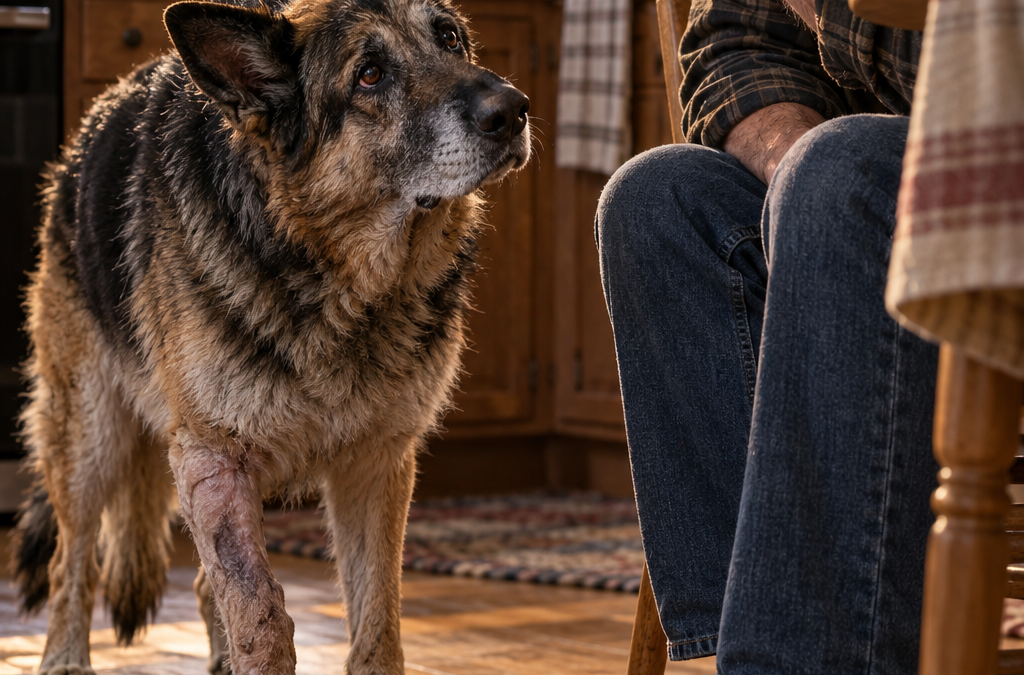
𝗙𝗨𝗟𝗟 𝗦𝗧𝗢𝗥𝗬 I took a scarf belonging to Margaret and let Buddy examine it.
His nose moved across the fabric.
Then he lifted his head.
I clipped on his tracking lead.
“Find her.”
Buddy moved toward a narrow trail behind the property.
We followed him through wet grass and beneath low tree branches.
The ground was muddy from the previous night’s rain.
After nearly an hour, Buddy stopped near a drainage ditch.
He raised his head.
Then pulled sharply toward the creek.
I heard a faint sound.
Someone was crying.
We found Margaret sitting beneath a fallen tree, her slippers soaked and her hands trembling.
She looked at me with frightened, confused eyes.
“Have you seen my husband?”
I knelt beside her.
“Ma’am, my name’s Rob. We’re here to help.”
She stared at Buddy.
“Is he yours?”
“He’s my partner.”
Buddy approached slowly.
Margaret reached toward him.
He lowered his head beneath her hand.
“What a beautiful boy,” she whispered.
Then she began crying.
I took off my jacket and wrapped it around her shoulders while backup made its way toward us.
Buddy remained beside her.
When the paramedics finally arrived, Margaret refused to release his collar until I promised he would be waiting when she reached the ambulance.
Afterward, back at our patrol vehicle, I gave Buddy his reward.
The orange rubber ball.
He took it with enormous satisfaction and settled into the back of the SUV.
I looked at him in the rearview mirror.
“Good job, partner.”
He squeezed the ball.
Squeak.
“Yeah, I know. You’re amazing.”
Squeak.
I laughed.
That sound became part of our life.
In the patrol vehicle.
In the training yard.
In my living room.
On the back porch after long shifts.
If Buddy had done something difficult, he wanted his ball.
If he was excited, he brought me his ball.
If I returned home in a bad mood, he sometimes appeared beside my chair carrying the same ridiculous orange thing, as though whatever troubled me could be resolved by spending a few minutes together.
My wife, Linda, used to say the ball was Buddy’s way of starting a conversation.
“He doesn’t care what kind of day you’ve had,” she told me once. “He’s inviting you to have a better one.”
I laughed at her.
“He’s inviting me to throw that thing until my shoulder falls off.”
“Maybe,” she said. “But you’re always smiling by the time you’re done.”
She was right.
Linda was right about most things involving Buddy.
She had loved him from the moment I brought him home.
During his working years, Buddy lived with us as part of the family.
He slept on a thick mat in the laundry room, stole socks whenever he could, and considered every visitor a potential source of food.
Our daughter, Grace, was nineteen when Buddy joined the family.
She was preparing to leave for college, and the dog quickly became her favorite excuse to visit home.
“I came to see Buddy,” she’d announce from the doorway.
I’d pretend to be offended.
“Nice to see you too, sweetheart.”
She’d hug me.
Then immediately drop to the floor to greet him.
Buddy adored her.
He adored Linda.
But he was always watching me.
If I moved from the kitchen to the garage, he followed.
If I sat down with a cup of coffee, he settled beside my feet.
If I fell asleep watching television, I’d wake with his head resting against my knee.
We belonged to each other’s routines.
I used to think that was ordinary.
Something all dog owners understood.
I didn’t realize how much of my life depended on those routines until the year everything changed.
The explosion happened on October 14, four years before Buddy’s diagnosis.
I remember the date more clearly than my own birthday.
It was a Thursday.
Cool enough for a jacket but not quite cold.
My partner on the evening shift was Deputy Daniel Ortiz, a thirty-eight-year-old father of two who had been with the department for twelve years.
Daniel wasn’t a K9 handler.
He was a patrol deputy assigned to assist with our search operation that night.
But we’d worked together often enough that I considered him one of my closest friends.
He was the kind of man who could make a bad shift bearable.
He always had coffee.
Always had a terrible joke.
And always found a reason to call his wife, Melissa, before the end of a long night.
“Marriage is like a patrol assignment,” he’d tell me. “You check in regularly or somebody starts wondering where you went.”
I would shake my head.
“Melissa deserves a medal.”
“She says that every day.”
That Thursday evening, we were dispatched to an abandoned packaging plant outside Millbrook.
A security company had reported signs of forced entry and a possible injured trespasser.
The building had been vacant for years.
Several homeless people had reportedly sheltered there during bad weather.
We weren’t expecting anything particularly unusual.
That was part of what made the night so terrible.
Daniel arrived first.
I pulled in a few minutes later with Buddy.
The building stood behind a rusted chain-link fence, its windows dark and many of its exterior lights broken.
Daniel approached my SUV carrying a flashlight.
“Your dog look bored tonight?”
I glanced toward Buddy.
He was already alert.
“He looks smarter than you.”
Daniel grinned.
“That’s a low bar.”
We entered with another deputy through an exterior service door.
The building smelled of old cardboard, damp concrete, and machinery that hadn’t been used in years.
Our flashlights swept across empty conveyor belts and stacks of discarded pallets.
Buddy began investigating near a row of storage rooms.
He showed interest in a narrow passage behind the main equipment area.
We moved toward it.
Somewhere ahead, I heard a metallic clatter.
Daniel raised his flashlight.
“Sheriff’s office! Anybody in here?”
No answer.
Buddy stiffened.
His ears rose.
I stopped.
Something felt wrong.
Not because I understood what was about to happen.
I didn’t.
But Buddy’s body had changed.
He was no longer simply searching.
He seemed agitated by something ahead.
I began backing toward the wider corridor.
“Daniel, hold up.”
Daniel turned.
“What?”
I never finished answering.
A deafening explosion ripped through the far end of the building.
The floor shook.
Light flashed through the darkness.
A wave of heat and pressure threw me against a concrete pillar.
I heard glass breaking.
Metal collapsing.
Buddy barking.
Then a terrible ringing filled my ears.
I was on the floor.
Dust hung so thick in the air that my flashlight beam could barely penetrate it.
My left shoulder burned.
Blood ran into my eye.
I tried to stand.
My legs barely held me.
“Daniel?”
My voice sounded distant.
“Daniel!”
There was no answer.
Buddy pulled against his harness, trying to reach a collapsed section of the corridor.
I followed him.
Through the dust, I saw part of Daniel’s uniform beneath fallen debris.
I dropped to my knees.
“Danny!”
His eyes were open.
He was badly injured.
I reached for his hand.
“Hey, look at me. Help’s coming.”
He tried to speak.
I leaned closer.
“Don’t move. Just stay with me.”
He gripped my wrist.
His mouth moved again.
I could barely hear him over the ringing in my ears.
“Melissa.”
I felt my chest tighten.
“She’s okay,” I told him. “We’re going to get you out.”
He stared at me.
“Kids.”
“Danny, listen to me. You hang on.”
Buddy was barking toward the broken corridor.
I called for backup over the radio.
My voice shook so badly that I had to repeat our location.
Daniel’s grip weakened.
“Tell them—”
“You’re going to tell them yourself.”
He looked at me.
There was fear in his eyes.
Not fear for himself.
Fear of everything he was leaving behind.
I pressed my hand against his.
“Stay with me, Danny.”
But he couldn’t.
Daniel died before the rescue crew reached us.
I remember somebody pulling me backward as firefighters moved through the damaged building.
I remember trying to go back.
I remember shouting that my friend was still inside.
And I remember Buddy pressing against my leg while I stood outside in the cold, unable to understand how I’d entered the building with a friend and come out without him.
Investigators later determined that an accumulation of flammable vapor from illegally stored materials had ignited. The explosion destroyed part of the plant.
They found evidence that the property had been used for unauthorized chemical storage.
There were hearings.
Reports.
Questions about building security and inspection failures.
None of those findings changed what mattered most to me.
Daniel was dead.
I was alive.
And I couldn’t stop wondering whether one different decision might have saved him.
What if I’d approached the building from another entrance?
What if I’d told him to stay outside?
What if I’d recognized the danger sooner?
What if I’d reached him five seconds earlier?
People told me there was nothing I could have done.
I heard those words so often that I began to hate them.
Because the part of me that had spent twenty-five years believing every emergency had an answer couldn’t accept an emergency that ended with my friend dying in front of me.
I attended Daniel’s funeral wearing my dress uniform.
Buddy was there beside me.
Melissa stood near the front of the church, holding the hands of their two children.
Their oldest son was eleven.
Their daughter was seven.
When the ceremony ended, the boy approached me.
He looked at Buddy.
“Did he try to save my dad?”
I couldn’t breathe.
I looked toward Melissa.
She was crying silently.
I crouched in front of the boy.
“He did everything he could.”
The boy reached toward Buddy’s head.
Buddy stood still while he stroked his ears.
Then the child asked something that followed me into every nightmare afterward.
“Why couldn’t you bring him home?”
I had no answer.
I still don’t.
I remember Melissa pulling her son close.
I remember her telling him that nobody had wanted this to happen.
But all I heard was the question.
Why couldn’t you bring him home?
For months, that sentence became the first thing I thought about when I woke and the last thing I heard before sleep.
I went on medical leave after the explosion.
My shoulder healed.
The cuts disappeared.
My hearing gradually improved.
But something inside me had changed in a way no surgeon could repair.
I stopped sleeping.
When I did sleep, I dreamed about the factory.
I heard the explosion again.
Felt the heat.
Saw Daniel reaching for me.
Some nights, I woke shouting his name.
Linda tried to help.
She sat beside me.
Encouraged me to see a counselor.
Asked whether I wanted to talk.
I told her I was fine.
I wasn’t.
I stopped answering calls from the department.
I avoided Daniel’s family because I couldn’t stand the thought of looking at Melissa.
I refused invitations.
Stopped attending church.
Stopped eating regular meals.
There were mornings when I lay in bed staring at the ceiling, unable to find one convincing reason to stand up.
The man who had spent his entire career searching for missing people was slowly disappearing inside his own home.
And the only creature who seemed to know how to reach him was a German shepherd carrying an orange rubber ball.
At first, Buddy didn’t understand why our mornings had changed.
For years, I’d been awake before sunrise.
By six, I was usually dressed, drinking coffee, and preparing his food.
Buddy knew the routine better than I did.
He would wait beside the bedroom door, ears raised, ready to begin the day.
After the explosion, the alarm still rang.
I simply stopped answering it.
I’d lie in bed with the curtains closed, staring at the ceiling.
Sometimes Linda came in and asked if I wanted breakfast.
I’d tell her no.
Sometimes she sat beside me and held my hand.
I usually turned away.
I wasn’t angry at her.
I was angry at myself, at the world, at the fact that Daniel had died and I had survived.
I knew Linda was frightened.
I could see it in her face.
But every time she asked what was wrong, I felt ashamed.
I’d been the man other people called when their lives fell apart.
Now I could barely leave my bedroom.
One morning, about six weeks after the explosion, Buddy appeared beside the bed with his orange ball.
I remember hearing it squeak.
I opened my eyes.
He was standing beside me, tail moving, the ball hanging from his mouth.
“Not now,” I muttered.
Buddy dropped it onto the blanket.
It rolled against my chest.
I picked it up.
“Go away, buddy.”
He didn’t.
He nudged my hand.
I put the ball on the floor.
Buddy picked it up again.
This time, he placed it directly beside my face.
I remember feeling irritated.
I wanted to sleep.
I wanted everyone to stop expecting things from me.
“Buddy, please.”
He sat beside the bed.
Waiting.
Finally, I sat up.
“What?”
His ears lifted.
I held up the ball.
“This what you want?”
His tail wagged.
I tossed it through the open bedroom doorway.
Buddy raced after it.
A moment later, he returned and dropped it into my lap.
I threw it again.
He brought it back.
After five or six throws, I realized I was sitting on the edge of the bed.
I hadn’t intended to get up.
I’d simply followed his game.
Buddy dropped the ball at my feet and looked toward the hallway.
I stood.
He hurried ahead of me.
I followed him into the kitchen.
Linda was standing at the counter.
She turned when she heard us.
For a second, she just stared.
“Rob?”
“Morning.”
Her eyes filled.
She looked down at Buddy.
He was standing beside me with the orange ball in his mouth.
Linda smiled.
“Well,” she whispered. “Somebody finally got you out of bed.”
I shrugged.
“He wouldn’t leave me alone.”
She walked toward me and kissed my cheek.
“I’m glad.”
That was the first morning.
The next day, Buddy did it again.
And the day after.
Sometimes I threw the ball.
Sometimes I only held it.
But Buddy kept bringing it.
If I ignored him, he’d push it against my fingers.
If I pulled the blanket over my head, he’d rest his chin against the mattress until I uncovered my face.
He didn’t bark.
He didn’t demand.
He simply waited.
Eventually, I began anticipating him.
I’d wake before the alarm and listen for his nails on the hallway floor.
Then came the squeak.
The orange ball.
The familiar face.
And one small reason to sit up.
Those mornings didn’t cure my depression.
They didn’t erase the explosion or bring Daniel back.
There were still nightmares.
Still terrible days.
Still afternoons when guilt seemed heavier than anything I could carry.
But Buddy’s routine interrupted the isolation.
After a few weeks, I began walking him to the mailbox.
Then around the block.
Then through the park.
The walks helped me rebuild a daily routine.
Linda helped me arrange treatment with a therapist who specialized in trauma among first responders.
I started attending appointments.
I spoke about the explosion, slowly and painfully.
I learned to recognize the difference between responsibility and the impossible expectation that I should have been able to control everything.
It took months before I could speak Daniel’s name without feeling physically sick.
It took longer before I visited his grave.
Buddy came with me.
I sat on the grass beside the headstone and cried.
He leaned against my shoulder.
His ball lay between his paws.
“I couldn’t save him,” I whispered.
Buddy pressed his nose against my cheek.
I looked at him.
“I know you tried.”
He rested his head against my chest.
And for the first time since the explosion, I allowed myself to grieve without treating grief as punishment.
Eventually, I returned to the department on limited duty.
Later, with the support of my medical team and supervisors, Buddy and I resumed appropriate K9 work.
I never became exactly the man I’d been before.
But I learned how to function again.
I learned how to laugh without immediately feeling guilty.
I learned how to sit at dinner with Linda and Grace instead of hiding in the bedroom.
And every morning, Buddy still brought me his ball.
Sometimes I threw it.
Sometimes I was already dressed and drinking coffee when he appeared.
It didn’t matter.
He’d drop it beside my feet, wait until I acknowledged him, and then settle down.
I came to think of it as one of his odd little habits.
I stopped remembering why it had begun.
Life moved forward.
The memory of Daniel never disappeared, but it stopped swallowing every other part of my life.
Eventually, Buddy retired.
Then I retired.
And the orange ball remained in our house, worn smooth by years of training and thousands of mornings together.
When Buddy was diagnosed with bone cancer, I thought I understood what was happening.
I knew he was losing strength.
I knew he missed running.
I knew he still loved that ball.
So when he began carrying it to me every morning, I assumed he wanted one more game.
It never occurred to me that he was continuing the same routine that had once helped me return to the world.
I didn’t understand until Linda found me sitting on the kitchen floor, crying beside his bed.
It was a rainy Wednesday, nine days after Dr. Caroline Whitaker told us Buddy’s condition was worsening.
His cancer had been discovered in the lower portion of his left front leg.
Earlier examinations had shown that it was an aggressive bone tumor, consistent with osteosarcoma.
Dr. Whitaker had referred us to a veterinary oncologist, and further testing confirmed the diagnosis.
We discussed surgery, chemotherapy, radiation, and palliative care.
But Buddy’s age, advanced arthritis, additional health problems, and declining mobility made aggressive treatment a difficult choice.
After reviewing his condition and consulting the specialists, we chose comfort-focused care.
I hated that decision.
I understood why it was appropriate.
But I hated it.
I wanted somebody to tell me there was a treatment that would give him another five years.
Another summer.
Another morning when he could carry his ball without pain.
Instead, we managed his symptoms and watched carefully for changes.
Buddy had some good days.
On those mornings, he ate breakfast, looked interested in the backyard, and seemed comfortable resting beside us.
But the cancer progressed.
Eventually, even standing became dangerous because the diseased bone was weak.
Dr. Whitaker warned us about the risk of a fracture.
We restricted his movement and helped him whenever he needed to change position.
Yet Buddy kept finding ways to reach his ball.
I’d move it beside his bed so he wouldn’t need to search for it.
By morning, he’d somehow have it in his mouth.
He’d take several careful steps toward my chair and set it down.
Then wait.
I wanted to believe he was asking me to throw it.
I wanted to believe the young working dog was still alive somewhere inside that failing body, desperate for one final chance to run.
One morning, I picked up the ball and held it in front of him.
“You miss it, don’t you?”
Buddy looked at me.
“Me too.”
I squeezed the rubber.
Squeak.
His ears shifted.
I smiled weakly.
“Remember how fast you used to be?”
He lowered his head.
“Nobody could catch you.”
I placed the ball beside him.
“I’m sorry, buddy. I wish I could give that back to you.”
His eyes followed my hand.
Then he looked at my face.
He didn’t seem interested in moving toward the toy.
He simply wanted to remain close.
I sat on the kitchen floor beside him.
“I don’t know what you want from me.”
My voice broke.
“I’m trying.”
Buddy pushed his nose against my wrist.
I began crying.
Not quietly.
Not with the controlled tears of a man who had spent decades learning to maintain his composure.
I cried because I was watching my best friend disappear a little more every day, and there was nothing I could do to stop it.
Linda entered the kitchen and found us there.
She didn’t speak immediately.
She lowered herself beside me and put a hand on my shoulder.
“Rob?”
I shook my head.
“He’s hurting.”
“I know.”
“And he keeps bringing me this stupid ball.”
I picked it up.
“Every single morning.”
Buddy lifted his head.
“I keep thinking he wants to play. But he doesn’t even try to chase it.”
Linda looked at the ball.
Then at Buddy.
Something changed in her expression.
She sat back against the cabinet.
“Rob,” she said softly, “do you remember when he started doing that?”
I frowned.
“He’s always liked that ball.”
“That’s not what I asked.”
I looked at her.
She reached for my hand.
“Do you remember the mornings after the explosion?”
My chest tightened.
I looked away.
“Linda, please.”
“Just listen.”
Her voice remained gentle.
“You wouldn’t get out of bed. Sometimes you barely ate. You wouldn’t answer the phone.”
I stared at Buddy.
“I remember.”
“Do you remember what Buddy did?”
I shook my head.
Linda’s eyes filled.
“He brought you that ball.”
I looked at the worn rubber in my hand.
She continued.
“Every morning. He carried it into the bedroom, put it beside your hand, and waited for you to sit up.”
A memory moved through me.
Faint.
Almost forgotten.
Buddy standing beside our bed.
The orange ball against my blanket.
Linda wiping tears from her face in the kitchen when I finally came downstairs.
“I thought he wanted to play,” I whispered.
Linda nodded.
“Maybe sometimes he did.”
She stroked Buddy’s head.
“But after a while, he didn’t care whether you threw it. He just wanted you to wake up, look at him, and get out of bed.”
I stared at the ball.
Linda’s voice trembled.
“Rob, he did that every morning until you started getting better.”
I looked at Buddy.
He was watching me.
“And now,” she whispered, “he’s doing it again.”
The words settled into the room.
I remembered the first weeks after Daniel’s death.
How Buddy had stood beside my bed.
How he had nudged the ball against my hand.
How he’d waited until I sat up.
How he’d kept following me into the kitchen even on mornings when I didn’t throw the ball.
I had always believed Buddy brought it because he wanted something from me.
But perhaps the routine had become his way of checking on me.
A familiar interaction between us.
A small ritual that began during the darkest period of my life and continued long after I started feeling better.
Even now, with his own body failing, he was reaching for the same object, seeking the same connection.
I couldn’t know exactly what Buddy understood.
I couldn’t know whether he remembered those mornings the way I did.
But I knew the pattern.
I knew the look on his face.
And suddenly I could see that he wasn’t waiting for me to throw the ball.
He was waiting for me to acknowledge him.
To speak.
To move toward him.
To be present.
I covered my mouth.
“Oh, buddy.”
My voice broke completely.
“You’ve been checking on me.”
Buddy’s tail moved once against the blanket.
I leaned forward and wrapped my arms gently around his shoulders, careful not to touch the painful leg.
“All this time.”
Linda began crying beside us.
I held Buddy as carefully as I could.
“I thought you wanted to play.”
His nose pressed against my shirt.
“And you’ve been bringing me back.”
I sat there for a long time, holding the ball in one hand and Buddy’s head in the other.
Four years earlier, I’d been the one who didn’t want to get up.
Now he was the one who could barely stand.
Yet every morning, somehow, he still tried to bring me the object that had become part of our way of looking after each other.
I placed the ball between us.
Then I leaned close to his ear.
“You don’t have to do that anymore.”
My voice trembled.
“You don’t have to get up for me.”
Buddy looked at me.
I scratched the fur behind his ear.
“I’m okay now.”
Tears ran down my cheeks.
“You helped me get here.”
I kissed his forehead.
“Let me take care of you.”
For the first time, I stopped thinking about how much I wanted another game.
And started thinking about what Buddy needed from me while he was still here.
That afternoon, I called Dr. Whitaker.
I told her about Buddy’s increasing pain, his difficulty standing, and the way he’d begun making unnecessary trips across the kitchen.
She listened carefully.
Then she asked a question I had been avoiding.
“Rob, are his comfortable hours still outnumbering the difficult ones?”
I looked at Buddy sleeping beside my chair.
I wanted to say yes.
I wanted to tell her he’d eaten breakfast, wagged his tail, and still recognized the sound of his favorite toy.
But I opened the notebook where Linda and I recorded his daily condition.
For the past five days, nearly every entry described pain, weakness, poor appetite, or difficulty resting.
I swallowed.
“No.”
There was a pause.
“I’m sorry, Rob.”
I stared at the page.
“He’s trying so hard.”
“I know.”
“He still gets up to bring me his ball.”
“That tells me the routine is important to him. But it doesn’t mean he’s physically comfortable enough to continue doing it.”
I closed my eyes.
Dr. Whitaker’s voice softened.
“You’ve spent years taking care of other people with Buddy beside you. Now you need to protect him from having to push through more pain.”
I looked at the orange ball resting on the rug.
“I don’t know how to say goodbye.”
“Nobody who loves an animal this much finds it easy.”
I wiped my face.
“What would you do?”
She took a moment before answering.
“I would look at the overall progression of his disease, the pain we’re struggling to control, and the things he can no longer comfortably do. I think we’re very close to the point where helping him pass peacefully would be kinder than asking him to continue.”
I didn’t respond immediately.
I looked at Buddy.
His eyes were closed.
His breathing was slow.
For fourteen years, he’d responded whenever I needed him.
He’d searched through forests.
Followed frightened strangers.
Waited beside hospital beds.
And helped me survive a period of my life when I had almost forgotten how to care about tomorrow.
Now he needed me to make the decision he couldn’t make for himself.
“Can we do it at home?” I asked.
“Yes,” she said. “If that’s what you want.”
I looked toward the window.
Buddy loved the patch of sunlight beside the living room couch.
It was where he slept every afternoon after retirement.
“I’d like him to be here.”
“Then we’ll arrange that.”
We scheduled a home visit for the following afternoon, with instructions to contact the emergency clinic sooner if his condition became acute.
When I ended the call, I sat in silence.
Linda joined me.
“What did she say?”
I could barely speak.
“Tomorrow.”
She closed her eyes.
Then she wrapped her arms around me.
For several minutes, we held each other.
When I finally pulled away, I looked toward Buddy.
“I want him to have a good last day.”
Linda nodded.
“Then we’ll give him the most peaceful day we can.”
We moved his bed closer to the living room window.
We placed soft blankets beneath him.
I brought his water close and stayed beside him whenever he was awake.
I didn’t try to make him eat.
I didn’t encourage him to stand.
I didn’t ask him to perform one final trick.
When he seemed comfortable, I offered him a little of the food he had always loved.
He accepted a few bites.
I smiled.
“Good boy.”
His tail moved gently.
I didn’t mistake that small moment for recovery.
I simply allowed myself to enjoy it.
Later that afternoon, Grace came over.
She had grown up with Buddy.
She knew him as the dog who slept beneath her desk when she was studying and waited beside the window whenever she came home from college.
When she saw him lying on his bed, she stopped in the doorway.
“Oh, Dad.”
Her eyes filled immediately.
She knelt beside him.
“Hey, sweetheart.”
Buddy lifted his head slightly.
Grace pressed her face into the fur around his neck.
“You remember me?”
His tail moved.
She began crying.
I watched them for a moment.
Then I sat beside her.
“He knows you’re here.”
She nodded.
“He looks so tired.”
I swallowed.
“He is.”
Grace touched his gray muzzle.
“I remember when he used to jump into my car every time I visited.”
I smiled.
“You kept leaving snacks on the passenger seat.”
She laughed through her tears.
“He knew a good opportunity when he saw one.”
Buddy closed his eyes.
Grace stayed beside him.
After a while, she noticed the orange ball resting near my foot.
“He still has that?”
I picked it up.
“He brought it to me this morning.”
She smiled faintly.
“Of course he did.”
I looked at her.
“You remember?”
“Dad, he used to bring that ball into your bedroom every morning after the explosion.”
My throat tightened.
“Mom told me.”
Grace looked at the toy.
“I remember coming home one weekend and finding him standing beside your bed with it.”
She paused.
“You wouldn’t talk to anybody that morning. But you got up for Buddy.”
I stared at the ball.
“I’d forgotten how bad those months were.”
Grace took my hand.
“We didn’t.”
I looked at her.
There was no accusation in her voice.
Only sadness.
And love.
“I’m sorry,” I whispered.
“Dad, you were hurting.”
“I shut you out.”
She nodded.
“Sometimes.”
I looked away.
Grace moved closer.
“But you came back.”
I covered my face.
“Buddy helped.”
She looked at the old dog sleeping between us.
“He sure did.”
Then she squeezed my hand.
“And Mom helped. And your therapist. And you did the hard work too.”
I lowered my hands.
She smiled through her tears.
“You didn’t get better in one morning. You kept trying.”
I looked down at Buddy.
For years, I’d thought about the ball as a silly habit.
But now I could see what those mornings had meant to the people around me.
Linda had watched me return to the kitchen.
Grace had watched me begin speaking again.
Buddy had been part of the routine that helped me take the first small steps toward recovery.
And somewhere along the way, I had stopped noticing how precious the habit was.
That evening, Grace stayed for dinner.
We ate in the living room so Buddy wouldn’t be alone.
Linda told stories about the first time he came home.
Grace remembered the day he stole an entire sandwich from her school bag.
I told them about Margaret Owens, the missing woman who had clung to his collar beside the creek.
We laughed.
We cried.
We remembered Buddy as he’d been throughout his life, not only as the sick dog lying before us.
After dinner, Grace kissed his forehead.
“Thank you for taking care of my dad,” she whispered.
I turned away.
When she left, I moved my chair beside Buddy’s bed.
The room was quiet.
Linda had gone upstairs to prepare for bed.
Outside, a light rain tapped against the windows.
Buddy opened his eyes when I touched his shoulder.
“Hey, partner.”
His tail moved.
I picked up the orange ball.
It looked smaller than I remembered.
The rubber had softened with age.
The squeaker was weak.
But when I squeezed it, the familiar sound filled the room.
Squeak.
Buddy’s ears shifted.
I smiled through my tears.
“You really love this thing, don’t you?”
He watched me.
I held it between my hands.
“I used to think it was just a reward.”
My voice trembled.
“Something you got after a good search.”
I looked at him.
“But you kept bringing it to me when I was the one who needed help.”
Buddy lowered his head.
I moved closer.
“You remember those mornings?”
I knew he couldn’t answer.
I didn’t need him to.
“I couldn’t get out of bed, buddy.”
I swallowed.
“I couldn’t even look Linda in the eye some days.”
The old memories returned.
Daniel’s funeral.
His son standing in front of me.
The question I’d never forgotten.
Why couldn’t you bring him home?
My eyes filled.
“I thought surviving meant I’d failed him.”
Buddy rested his muzzle against my hand.
I stared at the familiar gray face.
“You never treated me like a failure.”
I rubbed his ear.
“Not once.”
I began crying.
“You just kept showing up.”
Buddy closed his eyes.
I leaned closer.
“And now I need to show up for you.”
I placed the ball beside his front paw.
“No more carrying this across the house.”
My voice broke.
“You hear me? You’re off duty.”
I kissed his forehead.
“You can rest.”
I stayed beside him through most of the night.
Around three in the morning, I woke in my chair.
Buddy was looking toward me.
His eyes were tired.
But he was alert.
I reached for his head.
“Hey.”
He moved his nose against my fingers.
I smiled.
“I’m still here.”
He relaxed.
The orange ball lay between us.
For the first time in weeks, he didn’t try to stand.
He didn’t have to.
I was already beside him.
The following morning, I woke before sunrise.
At 6:17, I looked toward the living room.
No squeak.
No nails clicking across the floor.
No orange ball appearing beside my slippers.
For one terrible moment, panic rushed through me.
Then I saw Buddy.
He was still resting on his bed.
His eyes were open.
His breathing was slow.
I crossed the room and knelt beside him.
“Morning, partner.”
His tail moved faintly.
I picked up the ball.
“Look what I brought you.”
I placed it gently beside his front paw.
He touched it with his nose.
Then he looked at me.
I smiled through my tears.
“That’s right.”
I sat on the floor beside him.
“Today I brought it to you.”
Linda came downstairs a few minutes later.
She stopped when she saw us.
I was sitting beside Buddy, one hand on his shoulder and the other resting near the orange ball.
She walked over and sat beside me.
We stayed there together as sunlight slowly filled the room.
At two that afternoon, Dr. Whitaker arrived.
Buddy was resting comfortably on his favorite blanket.
Grace had returned.
Linda sat beside his bed.
Nobody wore a uniform.
There were no speeches.
No cameras.
No crowd of officers standing in formation.
Buddy had spent enough of his life working.
His final afternoon belonged to the family who loved him.
Dr. Whitaker examined him quietly.
Then she explained the procedure.
She would give him a sedative first so he could relax and fall into a deep sleep.
When he was fully comfortable, she would administer the medication that would allow him to pass peacefully.
I listened carefully.
Then I asked the question I had been afraid to ask.
“Can I hold him the whole time?”
She nodded.
“Of course.”
I looked down at Buddy.
“Okay.”
My voice trembled.
“Then that’s what we’ll do.”
Dr. Whitaker gave us a few minutes.
I sat beside Buddy and placed his head gently in my lap.
Grace held his right front paw.
Linda rested a hand against his back.
I picked up the orange ball.
“Hey, big guy.”
Buddy opened his eyes slightly.
I smiled.
“Remember our first day?”
His breathing was soft.
“You wouldn’t stop chasing this thing.”
I squeezed it.
A faint squeak escaped.
I laughed through my tears.
“You drove Frank absolutely crazy.”
Buddy looked toward my hand.
I rubbed his ear.
“Then we went looking for people.”
My voice began to break.
“And you found so many.”
I thought about Margaret beneath the fallen tree.
The children we’d searched for.
The frightened families waiting beside patrol cars.
The people who went home because Buddy had followed a scent nobody else could see.
“You were a good police dog.”
Tears slid down my face.
“The best.”
I leaned closer.
“But you know what?”
His eyes rested on mine.
“The most important person you ever helped find was me.”
Linda began crying.
I stroked Buddy’s face.
“I got lost after Daniel died.”
My voice shook.
“And you kept bringing me back.”
Buddy’s tail moved once.
A small, almost invisible movement.
I smiled through the tears.
“Yeah, buddy.”
I kissed his forehead.
“You did.”
Dr. Whitaker approached.
I nodded.
She gave the sedative.
Buddy gradually relaxed beneath my hands.
His breathing became calm.
His body, tense from pain for so long, finally rested without struggle.
I kept speaking to him.
“Good boy.”
I rubbed his ear.
“You don’t have to get up tomorrow.”
My tears fell into his fur.
“You don’t have to bring me anything.”
I pressed my cheek against his head.
“I’m going to be okay.”
I took a shaky breath.
“I promise.”
When Dr. Whitaker confirmed that he was deeply asleep, she asked if we were ready.
I looked at Linda.
Then Grace.
Both were crying.
I turned back toward Buddy.
“Yes,” I whispered.
I held him while the final medication was given.
His chest rose gently.
Then fell.
There was one last quiet breath.
And then stillness.
Dr. Whitaker listened to his heart.
After a moment, she looked at me.
“He’s gone, Rob.”
I didn’t move.
My hand remained against Buddy’s face.
He looked peaceful.
So peaceful that some part of me expected him to open his eyes and ask for breakfast.
I waited for the familiar squeak.
The rustle of his blanket.
The sound of his tail tapping against the floor.
But the room was quiet.
I bent forward and pressed my face into his fur.
“Thank you,” I whispered.
My voice broke.
“Thank you for coming back for me every morning.”
Linda wrapped her arms around me.
Grace lowered her head against Buddy’s shoulder.
We cried together.
After a long time, I picked up the orange ball.
I placed it beside Buddy’s paw.
Then I touched his forehead one final time.
“End of watch, partner.”
I swallowed.
“Good boy.”
The following weeks were some of the hardest I’d known since Daniel’s death.
The house felt empty in ways I hadn’t expected.
I missed the sound of Buddy drinking water in the kitchen.
The scrape of his bed against the floor.
The way he used to turn in three careful circles before lying down.
I missed hearing his nails against the hallway.
And more than anything, I missed that ridiculous squeak every morning.
At 6:17, I often woke automatically.
For a moment, I’d listen.
Then remember.
There would be no ball beside my slippers.
No gray muzzle looking up at me.
No familiar eyes asking me to begin the day.
Some mornings, the grief felt so heavy that getting out of bed reminded me of the months after the explosion.
But this time, I recognized what was happening.
I told Linda when I was struggling.
I returned to counseling for additional support.
I answered Grace’s phone calls.
I went outside.
I didn’t wait until the sadness disappeared.
I carried it with me while I kept living.
The orange ball stayed on my nightstand.
I couldn’t put it away.
Every morning, I looked at it.
Sometimes I held it for a while.
Sometimes I cried.
But eventually, I stood, got dressed, and went downstairs.
It was a small routine.
One that belonged to me now.
About two months after Buddy died, I received a letter from Melissa Ortiz.
I hadn’t seen her much since Daniel’s funeral.
Over the years, we’d exchanged occasional holiday messages, but I had never truly known how to speak to her without feeling the old guilt return.
Inside the envelope was a photograph.
Daniel stood beside my patrol SUV, laughing as Buddy jumped toward the orange ball in my hand.
I remembered the day.
It had been taken during a training exercise a few weeks before the explosion.
On the back, Melissa had written a note.
She said her son had found the picture while sorting through old family photographs.
She told me both children were doing well.
Her daughter had recently graduated from high school.
Her son was preparing for college.
Then she wrote something I hadn’t expected.
She said Daniel had always loved hearing my stories about Buddy.
That he’d spoken often about how well we worked together.
And that she hoped I remembered more than the terrible night that took him away.
I read the letter three times.
Then I sat at the kitchen table and cried.
I had spent years remembering Daniel’s final moments.
His hand gripping my wrist.
The dust.
The explosion.
The words he hadn’t been able to finish.
But the photograph reminded me of a different Daniel.
Laughing.
Smiling.
Teasing me about my dog.
A husband and father who had lived a full life before the night it ended.
I realized Buddy had helped me survive the guilt, but I still had work to do in remembering my friend without reducing his entire life to his death.
I called Melissa that afternoon.
My hands shook when she answered.
“Rob?”
“Hi, Melissa.”
There was a pause.
“Did you get the picture?”
“I did.”
My voice broke.
“Thank you.”
She was quiet for a moment.
Then she said, “Daniel loved working with you.”
I closed my eyes.
“I loved working with him too.”
We talked for almost an hour.
About Daniel.
About Buddy.
About the children.
About the terrible things that had happened and the years we’d spent trying to live afterward.
I didn’t ask Melissa to take away my guilt.
I didn’t ask her to tell me everything was fine.
I simply listened.
And when we hung up, I realized that for the first time in years, I had spoken about Daniel without feeling the need to punish myself for surviving.
That evening, I placed the photograph beside Buddy’s collar on the bookshelf.
Two partners.
Two lives that had changed mine.
Two losses I would carry forever.
But neither memory belonged only to tragedy.
That was something Buddy had been trying to teach me long before I understood it.
Three months later, Captain Wilkins called.
He had retired from the department but still volunteered with the regional search-and-rescue training program.
“Rob, I’ve got something to ask you.”
“That sounds dangerous.”
He laughed.
“You still remember how to work with a search dog?”
I looked toward Buddy’s photograph.
“I think so.”
“We’ve got new handlers coming through next month. Some of them need help understanding scent work and reward systems.”
I smiled faintly.
“So you’re calling the old guys.”
“I’m calling the guy who worked with one of the best search dogs I’ve ever seen.”
My throat tightened.
“Buddy was special.”
“He was.”
Wilkins paused.
“You interested?”
I almost refused.
For months, I’d avoided the training grounds because every corner reminded me of Buddy.
But then I looked at the orange ball on my nightstand.
I thought about the young German shepherd who had once stood in a training yard staring at that toy with complete determination.
And I remembered the first lesson he’d taught me.
Sometimes you had to begin with one small thing.
One step.
One morning.
One reason to get up.
“Yeah,” I said.
“I’d like that.”
On the morning of the training session, I woke at 6:17.
The bedroom was quiet.
I sat on the edge of the bed and looked at Buddy’s ball.
For a long moment, I didn’t move.
Then I picked it up.
The faded orange rubber rested in my palm.
I squeezed it gently.
Squeak.
The sound filled the room.
I smiled through sudden tears.
“Morning, partner.”
I got dressed.
Made coffee.
Kissed Linda goodbye.
And drove to the training facility.
Twelve young handlers waited in the yard with their dogs.
Some looked confident.
Others looked nervous.
One young German shepherd kept staring at the ball in his handler’s hand, pulling eagerly against his leash.
I laughed.
“Well, I know that look.”
The young deputy smiled.
“He’s obsessed with this thing.”
I reached into my pocket and touched Buddy’s old ball.
“That’s not always a bad thing.”
I spent the morning teaching them how to build trust through clear communication, consistency, and rewards.
I told them about Buddy’s first search.
About the missing woman near the creek.
About the difference between a dog who was simply excited and one who was truly working a scent.
Then I told them something I hadn’t planned to say.
“Your dog may spend years learning how to help you do your job.”
The handlers looked toward me.
I held up Buddy’s old ball.
“But don’t be surprised if one day you realize he’s been helping you in ways that have nothing to do with police work.”
I paused.
“Take care of him when his working days are over. Pay attention when he’s hurting. Don’t ask him to be strong just because he’s always been strong before.”
I looked at the worn orange toy.
“And don’t forget that the smallest routines can mean more than you understand.”
After the session, one of the younger handlers approached me.
His German shepherd sat beside him, watching every movement of the ball in his hand.
“Sir, can I ask you something?”
“Sure.”
“Do you think you’ll ever get another dog?”
I looked toward the training yard.
For months, I’d wondered the same thing.
Part of me was afraid that loving another dog would feel like replacing Buddy.
But Buddy had never treated love as something that became smaller when shared.
He had welcomed Linda.
Grace.
Every frightened child he’d found.
Every stranger who needed comfort.
He’d never acted as though loving someone new meant loving someone else less.
I smiled faintly.
“Maybe someday.”
The young handler nodded.
“I hope so.”
I looked at his dog.
The shepherd was sitting close to his leg, tail moving, eyes bright with anticipation.
I knelt slowly.
“What’s his name?”
“Scout.”
I held out my hand.
Scout sniffed my fingers.
Then pushed his head beneath my palm.
I laughed.
“Well, hello there.”
He wagged his tail.
For a brief moment, I felt the familiar warmth of a dog leaning into my hand.
It hurt.
But it also felt good.
And for the first time since Buddy died, I understood that both feelings could exist together.
I could miss him.
I could love him.
And I could still make room for another good thing in my life.
That evening, I returned home just before sunset.
Linda was sitting on the porch.
“How was it?”
I lowered myself into the chair beside her.
“Hard.”
She nodded.
I smiled.
“But good.”
She took my hand.
We watched the last light move across the yard.
Buddy’s favorite patch of grass lay beneath the old oak tree near the fence.
For years, he’d stretched out there after training, his orange ball resting between his paws.
I could almost see him.
His ears raised.
His tail tapping the ground.
Waiting for me to come outside.
I looked at Linda.
“I think I’m ready to start doing more.”
She smiled.
“I’d like that.”
I reached into my pocket.
The orange ball was still there.
I turned it slowly in my hand.
I thought about all the mornings Buddy had brought it to me.
When he was young and strong.
When I was broken by grief.
When we were both growing older.
And finally, when his own body was failing.
For so long, I’d believed he was asking me to throw it.
But the ball had become something else between us.
A small invitation.
A reason to connect.
A familiar way of saying that the day had begun and we still had each other.
I couldn’t know precisely what Buddy thought during those last mornings.
But I knew what he’d taught me through all the years before them.
When life becomes unbearable, sometimes surviving begins with something very small.
Getting out of bed.
Opening the curtains.
Answering a phone call.
Stepping outside.
Letting somebody love you.
Buddy had helped me do those things when I couldn’t imagine doing them for myself.
Now that he was gone, I wanted to honor him by continuing.
Not because I was finished grieving.
Not because life had suddenly become easy.
But because I finally understood that grief didn’t have to be the place where I stopped living.
I squeezed the ball once more.
Squeak.
Linda smiled through her tears.
“I still expect him to come running whenever I hear that.”
I looked toward the yard.
“Me too.”
We sat quietly for a while.
Then I placed the ball in my pocket, stood, and offered Linda my hand.
“Come on,” I said. “Let’s go inside.”
The next morning, I woke at 6:17 again.
There was no dog standing beside my bed.
No soft scrape of nails across the hallway.
No familiar muzzle pressing a rubber ball against my fingers.
Only the quiet beginning of another day.
I sat up.
Reached for Buddy’s ball.
Held it for a moment.
Then I stood.
Downstairs, Linda was making coffee.
Sunlight shone through the kitchen window.
I walked toward her and kissed her cheek.
“Morning.”
She smiled.
“Morning, Rob.”
I placed Buddy’s ball on the bookshelf beside his photograph.
Then I opened the back door and stepped onto the porch.
The air was cool.
Birds were singing in the oak tree.
Somewhere down the street, a dog barked.
I closed my eyes.
For a moment, I imagined Buddy standing beside me again, the old orange ball hanging from his mouth.
Not the sick dog who could barely walk.
The strong young shepherd who raced across the training field with his ears high and his tail swinging.
The dog who found missing people.
The dog who brought frightened strangers home.
The dog who found me when I had lost my way.
I smiled through my tears.
“I’m up, buddy.”
The wind moved gently through the trees.
I looked toward the place where he used to sleep in the morning sun.
“You don’t have to wake me anymore.”
My voice broke, but I kept smiling.
“I can do it now.”
I stood there for a few more minutes, breathing in the cool morning air.
Then I turned back toward the house.
Linda was waiting with two cups of coffee.
And for the first time since Buddy died, the morning didn’t feel like something I merely had to survive.
It felt like a life I was allowed to keep living.
I would always miss the weight of his head against my knee, his restless paws on the kitchen floor, and that ridiculous orange ball appearing at my feet.
But Buddy had given me something far greater than the years we spent together.
He’d helped me find my way back to the people who loved me.
And when his own strength was disappearing, he’d continued reaching for the familiar little ritual that had once helped me through the darkest mornings of my life.
I finally understood what I wanted to remember.
Buddy’s greatest gift wasn’t the hundreds of people he helped us search for.
It wasn’t the awards.
The successful missions.
Or the years he served beside me in uniform.
It was the simple fact that, when I couldn’t find a reason to get out of bed, a dog with an old orange ball kept coming to look for me.
And when his final morning came, I was there beside him, ready to give back the love that had carried me through mine.