𝗙𝗨𝗟𝗟 𝗦𝗧𝗢𝗥𝗬 My Dying K9 Kept Watching the Front Door While I Was Trapped in a Hospital Bed
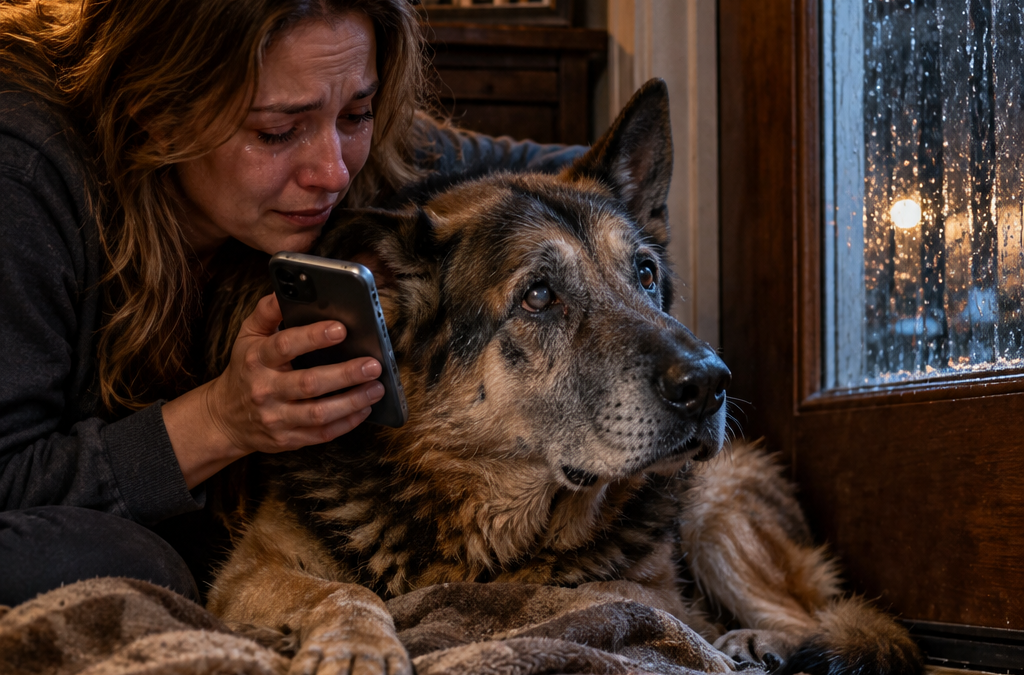
𝗙𝗨𝗟𝗟 𝗦𝗧𝗢𝗥𝗬
The boy sniffled.
“Who?”
“His name’s Boone. He’s a police dog.”
A small face appeared behind the broken window.
“Can he see me?”
I smiled.
“He can.”
Boone approached carefully.
The boy reached out through the opening.
Boone touched his fingers with his nose.
For the first time since we’d found him, Matthew stopped crying.
“Good dog,” he whispered.
The rescue team arrived a few minutes later.
They removed the obstruction and brought Matthew outside.
He ran straight into his mother’s arms.
Boone sat beside my leg while the family embraced.
I remember looking down at him.
“Good work, partner.”
He looked up.
Then did something unexpected.
He lifted one front paw and placed it gently on the back of my hand.
I laughed.
“What’s this?”
His tail moved.
I took his paw.
“Checking on me?”
He held it there for a moment.
Then lowered it.
It was such a small gesture that I didn’t think much of it.
But it happened again.
And again.
After difficult calls.
After long training exercises.
Sometimes when I sat alone in my patrol vehicle, staring at nothing.
Boone would lift his paw and rest it on my hand.
Eventually, I made a habit of taking it.
I’d squeeze gently and say, “All good, partner.”
Then he’d relax.
It became our private ritual.
Not part of his formal training.
Not something the department taught him.
Just a quiet exchange between two partners who had learned to look after each other.
I didn’t know how much that gesture would mean to me years later.
During our first eight years together, Boone and I became inseparable.
He worked beside me during night shifts and difficult searches.
He found evidence hidden beneath abandoned buildings.
Tracked suspects through fields and wooded areas.
Helped locate an elderly woman who had wandered from a nursing home during a snowstorm.
He even protected me during an incident that could have ended my career.
We were searching a vacant apartment building after a burglary suspect fled inside.
The lights were out.
Broken glass covered the hallway.
Boone stopped suddenly near a doorway.
His body went rigid.
I knew that posture.
Something was wrong.
I stepped back.
A man appeared from the shadows holding a metal pipe.
He lunged.
Boone responded instantly to the threat, giving me time to move clear and call for backup.
The suspect was taken into custody without serious injury.
Later, sitting in my patrol car, I realized how close I’d come to being struck.
My hands began shaking.
Boone watched me.
Then lifted his paw.
Placed it on my hand.
I laughed through the adrenaline.
“Yeah, buddy.”
I squeezed his paw.
“All good.”
But the truth was that Boone had saved me from a danger I hadn’t seen coming.
And it wouldn’t be the last time.
At home, Boone was a completely different animal.
My wife, Ellen, called him the world’s largest lapdog.
She wasn’t entirely wrong.
He weighed nearly ninety pounds but seemed convinced he belonged wherever I was sitting.
When I stretched out on the couch, he rested his head across my knees.
When I sat on the porch, he lay beside my boots.
When I worked in the garage, he positioned himself near the door so he could watch me without having to move.
Ellen used to laugh about it.
“That dog thinks you’re going to disappear.”
I’d look down at Boone.
“He’s just keeping an eye on things.”
She’d smile.
“Jack, he’s keeping an eye on you.”
Our daughter Maggie was already grown by then.
She lived a few miles away with her husband and their son, Noah.
But Boone adored her.
Whenever Maggie visited, he hurried toward the front door with his tail swinging.
When Noah was born, Boone became unusually gentle around him.
He would lie near the baby’s blanket and watch every movement.
As Noah grew into a toddler, he learned to walk by holding on to furniture while Boone followed him from room to room.
One afternoon, Ellen found Noah asleep on the living room rug with one small hand resting on Boone’s paw.
She took a photograph.
It became one of her favorites.
“That’s what family looks like,” she told me.
I agreed.
But I didn’t fully understand what she meant until our lives began changing.
Ellen became ill during Boone’s seventh year with the department.
It started with headaches and balance problems.
Then came an appointment with a neurologist.
Scans.
More tests.
A diagnosis that divided our lives into everything before and everything after.
A malignant brain tumor.
I remember sitting beside her in the doctor’s office while he explained the treatment options.
Ellen held my hand.
I kept asking questions.
There had to be another treatment.
Another hospital.
Another specialist.
Something we hadn’t tried.
Ellen finally squeezed my fingers.
“Jack.”
I turned toward her.
She looked exhausted.
“Listen to him.”
I wanted to argue.
But I stopped.
For the next year, we lived around appointments, medications, and hospital visits.
The department gave me leave whenever possible.
Maggie helped with meals and transportation.
Boone spent his off-duty hours beside Ellen.
He seemed to understand that she needed gentleness.
He stopped jumping toward her when she entered a room.
Instead, he approached slowly.
Rested his chin against her knee.
Waited for her to touch him.
During the final weeks, Ellen spent most of her time in a hospital bed we had arranged in the downstairs bedroom.
Boone slept beside it every night.
One evening, I found her stroking his face.
She looked up when I entered.
“He’s going to take care of you.”
I frowned.
“What?”
She nodded toward Boone.
“After I’m gone.”
My throat tightened.
“Ellen.”
She smiled sadly.
“You know what I’m talking about.”
I sat beside her.
“Don’t.”
She reached for my hand.
“Jack, listen to me.”
I couldn’t look at her.
“You’ve spent your whole life taking care of everybody else.”
Her voice was weak.
“Your officers. Your family. That dog.”
I swallowed.
She continued.
“But you don’t know how to let anybody take care of you.”
I tried to smile.
“That’s not true.”
She raised an eyebrow.
Even sick, she could still give me that look.
I laughed through tears.
She touched my cheek.
“When I’m gone, don’t shut everybody out.”
I shook my head.
“You’re not going anywhere.”
She closed her eyes.
For a few moments, neither of us spoke.
Then Boone lifted his paw and rested it against her hand.
Ellen smiled.
“See?”
She looked at me.
“Even he knows.”
She died six weeks later.
We had been married thirty-eight years.
I had spent more of my life with her than without her.
After the funeral, I moved through the house like a stranger.
Her favorite chair stood empty.
Her coffee mug remained in the kitchen cabinet.
Her gardening gloves hung beside the back door.
Maggie tried to help.
She cooked meals.
Called every evening.
Invited me to family dinners.
Most of the time, I said I was fine.
I wasn’t.
There were mornings when I couldn’t bring myself to get dressed.
Nights when I sat in the living room until the sun came up.
I stopped answering calls from friends.
Stopped going to church.
Stopped doing the things Ellen and I had enjoyed together.
But Boone didn’t let me disappear completely.
Every morning, he still needed breakfast.
Every evening, he needed medication or exercise.
Whenever I stayed too long in my chair, he’d approach and press his nose against my hand.
And on the worst nights, when grief made it hard to breathe, he’d lift one enormous paw and place it across my fingers.
I’d take it.
Hold it.
And whisper, “All good, partner.”
Sometimes those were the only words I spoke all evening.
Eventually, I returned to work.
Then, two years later, Boone retired.
His hips had become stiff.
His eyesight was changing.
He no longer recovered from long shifts the way he once had.
The department veterinarian said his working days should end before his body suffered a serious injury.
I didn’t argue.
I’d seen enough retired K9s struggle because somebody wanted one more year of service from a dog who had already given everything.
Boone deserved better.
We held a small ceremony in the station garage.
Frank presented him with a retirement certificate and a new collar.
Maggie brought Noah, who was seven by then.
Several officers lined up to take photographs.
Boone sat beside me wearing his working harness for the final time.
When the ceremony ended, I removed it.
He looked down at the harness.
Then at me.
“That’s it, buddy.”
I rubbed his ears.
“No more chasing anybody.”
His tail moved.
I smiled.
“You’ve earned your couch.”
For the next three years, we grew old together.
I retired from the department shortly afterward.
At first, the change was difficult.
I’d spent decades knowing where I needed to be and what people expected from me.
Without the job, the days felt strangely empty.
But Boone gave them structure.
We took slow morning walks.
I fed him breakfast while my coffee brewed.
He slept beside my chair as I read the newspaper.
Sometimes we drove to a quiet park outside town.
I’d sit on a bench while he investigated every tree with the seriousness of a detective examining evidence.
He became slower.
His muzzle turned gray.
The black fur along his back faded.
He developed arthritis and early kidney disease, both managed with veterinary care.
He still enjoyed his food.
Still wagged his tail when Maggie arrived.
Still followed me through the house whenever he felt strong enough.
And every evening, when I sat in my recliner, he’d rest beside my feet.
Sometimes he’d lift his paw.
I’d take it.
“All good, partner.”
He would close his eyes.
That was our life.
Not exciting.
Not remarkable.
But peaceful.
And after everything we’d lost, peace was enough.
Then my back began giving me trouble.
I’d injured it several times during my police career.
A fall during a foot pursuit.
A vehicle collision.
Years of wearing heavy equipment and getting in and out of patrol cars.
Eventually, the pain became constant.
It traveled down my left leg.
Some mornings, I could barely stand.
I tried physical therapy.
Medication.
Injections.
Rest.
Nothing helped for long.
An MRI showed significant spinal degeneration and nerve compression.
After months of treatment, my surgeon recommended an operation to relieve the pressure and stabilize part of my lower spine.
I hated the idea.
I had never been comfortable depending on other people.
But when my leg began giving way without warning, even I had to admit I needed help.
The surgeon expected me to spend several days in the hospital.
Then recover at home with assistance.
Maggie immediately offered to stay with Boone.
“You focus on getting better,” she told me.
“I can handle him.”
I looked toward the living room.
Boone was asleep beside the fireplace.
“He’s never been away from me that long.”
Maggie smiled.
“Dad, he’s known me his entire life.”
“I know.”
“He’ll be fine.”
I nodded.
But I was worried.
Not because I doubted my daughter.
Because Boone was old.
Fourteen years old.
His kidneys were worsening.
He slept more than he used to.
Some days, he needed help standing.
And for nearly his entire life, he’d followed the same man from room to room.
I didn’t know how he’d handle waking up without me.
The morning before surgery, I packed a small bag.
Boone watched from the bedroom doorway.
Every time I placed something inside, his ears moved.
When I picked up my shoes, he stood.
Then walked toward the front door.
I smiled sadly.
“Not today, partner.”
He looked back.
I crouched beside him.
“I’m going to be gone a few days.”
He rested his nose against my chest.
“Maggie’s going to stay here.”
His tail moved.
“You’re going to get spoiled rotten.”
I tried to laugh.
But my throat tightened.
I placed both hands against his face.
“Listen to me, buddy.”
His brown eyes settled on mine.
“I’ll be back.”
He lifted one paw.
Placed it on my hand.
I squeezed gently.
“That’s our deal, right?”
His tail moved once.
“You watch out for me. I watch out for you.”
I pressed my forehead against his.
“All good, partner.”
Maggie arrived half an hour later.
She brought groceries, extra blankets, and a bag of treats approved by Boone’s veterinarian.
When I left, Boone followed me to the front door.
I turned.
“Stay, buddy.”
He stopped.
I smiled.
“Guard the house.”
His ears lifted.
Then I stepped outside.
As Maggie closed the door, I saw Boone standing behind her.
Watching.
I lifted my hand.
He didn’t move.
That was the last time I saw him standing on his own.
The surgery lasted nearly five hours.
When I woke, I was in pain and deeply confused.
A nurse told me everything had gone as expected.
I remember asking about Boone.
Then falling asleep before she could answer.
The first two days passed in a haze of medication, examinations, and brief conversations with Maggie.
She told me Boone was eating.
Sleeping.
Going outside with help.
I felt relieved.
On the third day, complications began.
My blood pressure dropped.
I developed a fever.
The doctors ordered additional tests.
I was kept in the hospital for monitoring and treatment.
By the fifth day, I was improving, but I couldn’t walk safely without assistance.
The physical therapist told me I needed more time.
I became angry.
“I’ve been walking my whole life.”
She remained patient.
“I understand, Mr. Sullivan, but your body needs to recover.”
“I have to get home.”
“We’re working toward that.”
I looked away.
“You don’t understand.”
She sat beside my bed.
“Then tell me.”
I swallowed.
“My dog is waiting.”
She smiled gently.
“Someone’s taking care of him?”
“My daughter.”
“Then he’s in good hands.”
I knew she meant well.
But she didn’t understand Boone.
Not the way I did.
He had spent nine years waiting for me to return from difficult calls.
He knew the sound of my truck.
The movement of my keys.
The way I hung my jacket beside the door.
He had waited beside Ellen’s hospital bed.
Waited while I buried her.
Waited through the worst months of my grief.
And now he was waiting again.
Only this time, he was fourteen years old.
And I was beginning to fear he didn’t have much waiting left in him.
That evening, Maggie called.
She sounded tired.
“Dad?”
“How’s Boone?”
A pause.
“He’s okay.”
I stared at the ceiling.
“Maggie.”
“What?”
“Tell me the truth.”
She sighed.
“He didn’t eat much today.”
My stomach tightened.
“How much?”
“Maybe a few bites.”
“Did he drink?”
“A little.”
I closed my eyes.
“Is he walking?”
“Not much. He’s been lying near the front door.”
I gripped the phone.
“Did you call Dr. Wilson?”
“Yes. She wants to see him tomorrow.”
I swallowed.
“Okay.”
Maggie hesitated.
“Dad, he’s been looking for you.”
I turned toward the window.
She continued.
“Every time a car pulls into the driveway, he lifts his head.”
My throat tightened.
“And when it’s not you, he puts it back down.”
I couldn’t speak.
Maggie whispered, “I wish you were here.”
“So do I.”
The next morning, she took Boone to the veterinarian.
His blood tests showed that his kidney function had worsened significantly.
He was dehydrated.
Weak.
And losing weight.
Dr. Wilson started supportive treatment and medication for nausea.
She explained that the decline might have been developing for some time, and the disruption to Boone’s routine could be contributing to his refusal to eat.
But stress alone didn’t explain how sick he had become.
His body was failing.
Maggie called me from the parking lot.
Her voice trembled.
“Dad, Dr. Wilson says we need to prepare ourselves.”
I stared at the wall.
“For what?”
Silence.
Then she whispered, “He may not have much time.”
I felt my stomach drop.
“No.”
“Dad—”
“No. He was fine before I left.”
“He wasn’t fine.”
I sat completely still.
Maggie began crying.
“I’m sorry.”
I swallowed.
“What do you mean?”
She took a shaky breath.
“He was old, Dad. Really old. He’d been getting weaker for months.”
I closed my eyes.
I knew that.
Of course I knew.
I’d watched him struggle to climb the porch steps.
I’d helped him stand after naps.
I’d seen the gray spreading across his face.
But as long as he still wagged his tail when I came home, some part of me believed we had more time.
Maggie continued.
“Dr. Wilson says we can keep him comfortable, but we have to be honest about what’s happening.”
I looked toward the hospital door.
“When can I come home?”
“I don’t know.”
I pressed the call button beside my bed.
“Then somebody needs to find out.”
I spent the next two days trying to recover as quickly as possible.
I followed every instruction.
Every exercise.
Every breathing treatment.
Every painful walk down the hospital corridor with a walker.
The nurses encouraged me.
My physical therapist celebrated small improvements.
But I wasn’t thinking about my spine.
I was thinking about Boone.
Every time my phone rang, my heart stopped.
Every message from Maggie frightened me.
Sometimes she sent photographs.
Boone lying on his bed.
Boone resting beside the front door.
Boone with his gray muzzle against the blanket Ellen had bought years earlier.
In one photograph, his eyes were open.
He was looking directly toward the driveway.
I stared at it for nearly an hour.
Then I called Maggie.
“Why is he lying there?”
She hesitated.
“By the front window?”
“Yes.”
“Because that’s where he wants to be.”
I swallowed.
“He should be on his orthopedic bed.”
“I tried moving him.”
“And?”
“He got restless. He kept trying to stand.”
I closed my eyes.
Maggie’s voice broke.
“So I brought his bed to the window.”
I pressed my hand against my face.
“He thinks I’m coming.”
“Dad.”
“He thinks I’m coming home.”
My daughter began crying.
“I know.”
That night, I couldn’t sleep.
I thought about every time Boone had waited for me.
The nights I worked late.
The times I stayed at the hospital with Ellen.
The mornings when I left before sunrise.
He had always believed I would come back.
Because I always had.
And now, for the first time, I couldn’t tell him when.
On the eighth day, Maggie called just after six in the evening.
Her voice was shaking.
“Dad, he collapsed.”
I sat upright so quickly that pain shot through my back.
“What?”
“He tried to get up when a truck came down the driveway.”
I closed my eyes.
“He thought it was me.”
“He pushed himself up, but his back legs gave out.”
“Is he hurt?”
“I don’t think so. Dr. Wilson checked him.”
I swallowed.
“What did she say?”
There was a long pause.
Then Maggie began crying.
“She said we’re running out of time.”
I stared at the hospital ceiling.
“How much?”
“She can’t say.”
“Tomorrow?”
“I don’t know.”
“Next week?”
“Dad, please.”
Her voice broke.
“He’s not eating. He can barely stand. She’s helping us keep him comfortable, but she doesn’t think he’ll recover.”
I covered my face.
For several seconds, neither of us spoke.
Then Maggie whispered something that hurt more than anything else.
“He’s still watching the door.”
I began crying.
Not quietly.
Not carefully.
I cried so hard that a nurse came into my room.
She found me sitting on the edge of the bed, phone in my hand, unable to stop shaking.
“Mr. Sullivan?”
I looked up.
“My dog is dying.”
Her expression changed.
I tried to explain.
The surgery.
The complications.
The days away.
The way Boone had stopped eating.
The way he kept watching the driveway.
Halfway through, my voice broke again.
“He’s waiting for me.”
The nurse sat beside me.
She didn’t offer an easy answer.
She simply waited until I could breathe.
Then she said, “Let’s talk to your doctor in the morning. We’ll see what needs to happen for you to go home safely.”
I nodded.
But that night, I prayed for something I hadn’t asked for since Ellen was sick.
Just a little more time.
Not another year.
Not another month.
Just enough time to get home.
Enough time to put my hand against Boone’s face.
Enough time to tell him he hadn’t been forgotten.
That I hadn’t abandoned him.
That after everything he’d done for me, I was still trying to keep our promise.
The following morning, Maggie called while I was eating breakfast.
“He’s worse.”
I put down my spoon.
“What happened?”
“He barely slept.”
I closed my eyes.
“Did Dr. Wilson see him?”
“She’s here now.”
My heart pounded.
“Put her on.”
A moment later, the veterinarian came on the line.
“Jack?”
“Rachel.”
Dr. Rachel Wilson had treated Boone for almost ten years.
She knew him as a working dog.
She knew him as a retired companion.
And she knew how much he meant to me.
“Tell me what’s happening.”
Her voice was gentle.
“Boone’s kidneys are failing, and he’s becoming profoundly weak.”
I stared at the floor.
“Can you give him fluids?”
“We’ve been providing treatment, but his body isn’t responding the way we’d hoped.”
“What about the nausea medication?”
“We’ve adjusted it.”
“Something else?”
She paused.
“Jack.”
I closed my eyes.
“Don’t.”
“Listen to me.”
My hands began shaking.
“Please.”
She took a slow breath.
“Boone is nearing the end of his life.”
I covered my face.
She continued.
“He’s comfortable right now, but that can change quickly. We need to be prepared to help him peacefully if he begins suffering.”
I swallowed.
“Will he make it until I get home?”
Silence.
Then she said, “I can’t promise that.”
I bent forward.
The pain in my back was nothing compared with what was happening inside my chest.
“Rachel, he waited for me after every shift.”
“I know.”
“He waited through Ellen’s funeral.”
“I know, Jack.”
“He was there every morning when I didn’t want to get out of bed.”
My voice broke.
“I can’t let him die thinking I wasn’t coming.”
Rachel was quiet for a moment.
Then she spoke carefully.
“We don’t know exactly what Boone understands about your absence.”
I closed my eyes.
“But I know he loves you. And I know he’s receiving care from people who love him.”
I swallowed.
“Can we keep him comfortable until I get home?”
“We can continue comfort care while it helps him. But if he becomes distressed, we cannot ask him to suffer just to wait for a particular moment.”
I knew she was right.
That made it harder.
I had spent my career making difficult decisions.
Sometimes the right decision still broke your heart.
I looked toward the window.
“Okay.”
My voice trembled.
“Promise me you won’t let him suffer.”
“I promise we’ll do everything we can to keep him comfortable.”
I took a breath.
“And if he needs to go before I get there?”
Rachel was silent.
I forced the words out.
“Then help him.”
I began crying again.
“Don’t make him wait in pain because of me.”
After the call, I sat alone for a long time.
Then I asked to speak with my surgeon.
He came to my room that afternoon.
I explained the situation.
He listened without interrupting.
When I finished, he looked at my chart.
“Jack, you’re improving. But I need to know you can move safely before we discharge you.”
“I understand.”
“We also need your blood pressure stable and your medications sorted out.”
“I understand that too.”
He studied me.
“Can your family help at home?”
“Yes.”
“Can you arrange follow-up therapy?”
“Yes.”
He nodded.
“Then let’s evaluate you again tomorrow morning.”
I felt tears fill my eyes.
“Thank you.”
He raised a hand.
“I’m not promising discharge. I’m promising we’ll assess you fairly.”
I nodded.
That was enough.
That evening, Maggie sent me a video.
It was only twenty seconds long.
Boone was lying on his bed near the front door.
His head rested against Ellen’s old blanket.
Maggie held the phone beside him.
“Boone,” she said softly. “Look who’s here.”
My voice came through the speaker from a recording she’d made earlier.
“Hey, partner. It’s Jack.”
Boone’s ear moved.
He lifted his head perhaps an inch.
Then turned toward the phone.
His tail made one slow movement against the blanket.
Maggie began crying behind the camera.
“See, Dad? He knows.”
I watched the video seven times.
Then I turned off my phone and cried into my hospital pillow.
The next morning, I walked the length of the rehabilitation hallway twice.
It hurt.
Every step sent a deep ache through my back.
But I held the walker and kept moving.
My physical therapist stayed beside me.
“Slow down, Jack.”
“I have to get home.”
“I know. But falling will only delay that.”
I stopped.
Took a breath.
Then continued at the pace she set.
By noon, my surgeon agreed that I could be discharged with strict instructions, assistance at home, and follow-up care.
Maggie arranged everything.
Medications.
A walker.
A temporary bed on the ground floor.
Appointments.
She promised not to leave me alone during the first days of recovery.
When she arrived to collect me, I was already dressed.
She looked exhausted.
Dark circles lay beneath her eyes.
Her hair was pulled into a careless ponytail.
I suddenly realized how much she’d been carrying.
My hospital visits.
Boone’s medication.
Her son.
Her job.
Her own fear.
I reached for her hand.
“Maggie.”
She looked up.
“I’m sorry.”
Her face changed.
“For what?”
“For putting all this on you.”
She shook her head.
“Dad, you didn’t choose to need surgery.”
“I know.”
“And Boone didn’t choose to get sick.”
I swallowed.
“But you’ve been handling everything.”
She looked down.
For a moment, she seemed unable to speak.
Then she whispered, “I’m so tired.”
I pulled her gently toward me.
She leaned against my shoulder.
“I know, sweetheart.”
She began crying.
“I’ve been so scared.”
I closed my eyes.
“Me too.”
She stayed there for a long moment.
Then stepped back and wiped her face.
“Okay.”
She took a breath.
“Let’s get you home.”
The drive felt endless.
Every mile seemed longer than the last.
I watched familiar signs pass.
The grocery store where Ellen used to shop.
The diner where Boone and I sometimes stopped after early shifts.
The old bridge near the edge of town.
I hadn’t realized how much I missed those ordinary places.
Maggie drove carefully.
She knew every bump in the road hurt my back.
After twenty minutes, she glanced toward me.
“Dad?”
“Yeah?”
“I need to tell you what to expect.”
I stared through the windshield.
“Okay.”
“Boone looks different.”
My throat tightened.
“How different?”
“He’s lost weight. A lot.”
I nodded.
“He doesn’t stand anymore.”
I swallowed.
“And his breathing is slower.”
I looked at her.
She continued gently.
“Dr. Wilson came this morning. She says he’s resting comfortably, but he’s very weak.”
I turned away.
“Okay.”
Maggie hesitated.
“Dad, I don’t know how much longer he has.”
I closed my eyes.
“Just get me there.”
She didn’t say anything else.
When we turned onto my street, my heart began pounding.
I recognized every house.
Every mailbox.
Every tree.
The Johnsons’ blue pickup sat in their driveway.
Mrs. Keller’s porch light was still on.
A plastic bicycle lay in somebody’s front yard.
Everything looked exactly as it had before surgery.
As though the world hadn’t noticed that my life was about to change.
Maggie turned into our driveway.
I looked toward the living room window.
For years, Boone had waited there whenever I was away.
His ears raised.
His nose pressed against the glass.
His tail moving as soon as he recognized my truck.
Now the window was empty.
I felt my chest tighten.
Maggie turned off the engine.
Neither of us moved.
Then she whispered, “Ready?”
I looked at the front door.
“No.”
She took my hand.
“I know.”
I swallowed.
“But let’s go.”
She helped me out of the car.
Every movement hurt.
My legs felt weak.
I gripped the walker.
Maggie carried my hospital bag and opened the front door.
The familiar smell of home reached me immediately.
Coffee.
Wood polish.
The faint lavender scent of Ellen’s old blanket.
And something else.
The quiet, unmistakable scent of an old dog who had spent most of his life in those rooms.
I stepped inside.
“Boone?”
My voice sounded strange.
Too loud in the quiet house.
I looked toward the living room.
He was there.
Lying on his orthopedic bed beside the window.
For one terrible second, I couldn’t move.
Maggie had warned me.
But nothing could have prepared me.
Boone’s once-powerful body had become painfully thin.
His hips stood out beneath his fur.
His muzzle was almost entirely white.
His legs lay awkwardly beneath him.
The strong German Shepherd who had raced through forests and climbed fences now looked like a fragile shadow of the dog I’d known.
I felt my knees weaken.
Maggie caught my arm.
“Dad.”
I shook my head.
“Oh, Boone.”
His ears moved.
I stopped breathing.
His eyes opened.
Cloudy brown eyes.
Tired.
Uncertain.
Then they settled on me.
For a moment, nothing happened.
I stood in the doorway, unable to speak.
Then Boone lifted his head.
Only slightly.
Perhaps two inches above the blanket.
But he lifted it.
His ears shifted forward.
His nose moved.
I took a step.
“Hey, partner.”
His tail stirred.
Once.
Then again.
Maggie began crying.
“Dad, he knows.”
I tried to move faster.
Pain shot through my back.
Maggie held my arm.
“Slowly.”
I nodded.
With her help, I crossed the living room.
Every step felt like a mile.
Boone kept watching me.
His head trembled from the effort of holding it up.
“Don’t move, buddy.”
My voice broke.
“I’m coming.”
We reached his bed.
Maggie helped me lower myself into a sturdy chair beside him.
Then she moved the walker out of the way.
I leaned forward.
For the first time in eleven days, I touched my dog.
His fur felt thinner.
His bones sharper.
His skin warmer than I remembered.
I placed my hand against the side of his face.
“Hey, old man.”
He closed his eyes briefly.
Then opened them again.
I smiled through tears.
“You look terrible.”
His tail moved.
I laughed.
“So do I.”
He sniffed my hand.
Then my sleeve.
Then pressed his muzzle into my palm.
I began crying.
“I’m home.”
His eyes stayed on mine.
“I’m sorry it took so long.”
I stroked his face.
“I tried, buddy.”
He breathed slowly.
“I really tried.”
Then he did something I hadn’t seen him do in weeks.
His front leg moved.
At first, I thought he was trying to shift position.
His paw scraped against the blanket.
He lifted it.
The movement was small.
Weak.
But unmistakably deliberate.
I froze.
“Boone?”
He reached toward my hand.
His paw trembled in the air.
Then settled gently across my fingers.
The same way it had after we’d found Matthew in the rain.
The same way it had after the warehouse incident.
The same way it had during the worst nights after Ellen died.
For nine years on patrol, that gesture had meant we were together.
That one of us was checking on the other.
And now, with almost no strength left, Boone was doing it again.
I took his paw carefully.
“Oh, buddy.”
My voice shattered.
“All good, partner.”
His eyes remained on mine.
I squeezed gently.
“All good.”
His tail moved once.
Maggie lowered herself beside us.
She covered her mouth with both hands.
I could hear her crying.
But I couldn’t look away from Boone.
I bent forward as far as my recovering back allowed.
Rested my forehead against his.
“You waited.”
His breathing was slow.
“You waited for me.”
Tears fell into his fur.
“I’m here now.”
I held his paw between both hands.
“You don’t have to watch the door anymore.”
Boone sighed.
A long, quiet breath.
Then lowered his head onto the blanket.
His paw remained against my hand.
For several minutes, neither of us moved.
I sat beside him listening to the sound of his breathing.
Watching the gray fur along his muzzle.
Feeling the familiar weight of his paw.
I wanted to tell him everything.
How frightened I’d been.
How much I’d missed him.
How desperately I’d tried to get home.
But the words seemed unnecessary.
For most of our lives together, the important things had never needed much explanation.
I spoke.
He listened.
He stayed.
I stayed.
That was enough.
Then I noticed his breathing changing.
It became slower.
There were longer spaces between each breath.
I looked toward Maggie.
Her face changed.
“Dad?”
I turned back to Boone.
“Hey, partner.”
His eyes opened briefly.
I stroked his face.
“I’m right here.”
He looked at me.
His paw rested against my hand.
I felt one more small movement of his tail.
Then he closed his eyes.
His body relaxed.
His breathing became quieter.
I leaned closer.
“Boone?”
A long moment passed.
Then another.
I rested my hand gently against his chest.
“Buddy?”
There was no movement.
I looked toward Maggie.
She was already calling Dr. Wilson.
My hands began shaking.
I kept stroking Boone’s head.
“Come on, partner.”
I knew.
Even before the veterinarian arrived.
I’d been beside people who were dying.
I’d held Ellen’s hand during her final hours.
I recognized the stillness.
But recognizing it didn’t make me ready.
“Boone.”
My voice broke.
“Please.”
Maggie knelt beside me.
She placed a hand against my shoulder.
“Dad.”
I shook my head.
“Just one more minute.”
She began crying.
“Okay.”
I bent down.
Pressed my forehead against Boone’s.
And whispered the words I’d said to him thousands of times.
“All good, partner.”
But this time, my voice sounded different.
Because I was the one who needed to hear them.
Dr. Wilson arrived shortly afterward.
She examined Boone quietly and confirmed that his heart had stopped.
He was gone.
My partner had made it home.
Or perhaps it was more accurate to say that he had waited until I did.
I know a veterinarian couldn’t prove that.
I know old dogs can die suddenly when their bodies are failing.
I know love cannot reverse kidney disease or hold back time.
But I also know what happened in that living room.
Boone had spent eleven days watching the door.
He had barely eaten.
Barely moved.
And when I finally returned, he found enough strength to lift his head, look into my eyes, and place his paw across my hand.
Then he rested.
I will never forget that.
For a long time, I sat beside him.
Maggie brought me a blanket.
Dr. Wilson gave us privacy.
I didn’t want to move.
I couldn’t bear the thought of letting go.
My daughter sat on the floor beside me.
We cried together.
Eventually, she whispered, “Dad, he knew you came back.”
I looked at Boone.
His face was peaceful.
The tension that had been present during his final days was gone.
I stroked the white fur beneath his chin.
“Yeah.”
My voice trembled.
“He knew.”
Maggie rested her head against my shoulder.
Then she said something I hadn’t expected.
“I was angry with him.”
I looked at her.
“What?”
She wiped her face.
“When you first went into the hospital.”
I frowned.
“Why?”
She stared at Boone.
“Because he wouldn’t eat. He wouldn’t sleep properly. Every time I tried to help him, he kept looking toward the door.”
Her voice broke.
“I kept thinking I was doing something wrong.”
I took her hand.
“You weren’t.”
“I know that now.”
She looked at me.
“But I was so scared he’d die while you were gone. And I couldn’t fix it.”
I swallowed.
She began crying harder.
“I wanted him to understand that I loved him too.”
I closed my eyes.
“Oh, sweetheart.”
I reached for her.
She leaned against me.
“He knew you loved him.”
She shook her head.
“How can you know?”
I looked at Boone.
“Because he let you take care of him.”
Maggie grew quiet.
I continued.
“He trusted you when I couldn’t be here.”
My throat tightened.
“That’s how I know.”
She cried against my shoulder.
For several minutes, neither of us spoke.
Then I looked toward the front door.
The same door Boone had watched for eleven days.
The same door he’d guarded for years.
It was closed.
And for the first time in his life, he no longer needed to know what was on the other side.
He was home.
He was safe.
And he was no longer in pain.
The next morning, I woke at five-thirty.
My back ached.
My legs felt stiff.
I lay in bed listening to the house.
For nearly twelve years, I’d heard Boone moving through the hallway at that hour.
Sometimes he came to my bedroom door.
Sometimes he waited near the kitchen.
Sometimes he simply sighed from his bed and reminded me he was there.
Now there was nothing.
The silence was so complete that I could hear the refrigerator humming downstairs.
I stared at the ceiling.
Then turned toward the empty space beside the bed.
For a moment, I wanted to stay there forever.
I didn’t want breakfast.
Didn’t want coffee.
Didn’t want to face the living room.
But I remembered Boone’s paw resting against my hand.
The effort it had taken him.
The way he’d looked at me.
And I thought about the promise we’d made years earlier.
You watch out for me. I watch out for you.
I sat up carefully.
Reached for my walker.
And began the slow process of getting out of bed.
It hurt.
Everything hurt.
But I did it.
Downstairs, Maggie was making coffee.
She turned when she heard me.
“Dad?”
I nodded.
“Morning.”
She studied my face.
“How are you?”
I looked toward Boone’s empty bed.
My throat tightened.
“Not good.”
She came over and hugged me.
“I know.”
I rested my hand against her shoulder.
“But I’m up.”
She smiled sadly.
“That’s something.”
I nodded.
“Yeah.”
We ate breakfast together.
Neither of us said much.
Afterward, Maggie helped me arrange my medications and scheduled physical therapy.
Then she brought me the small box containing Boone’s collar.
Inside was the identification tag he’d worn during retirement.
The brass had been polished smooth along the edges.
His name was still clear.
BOONE.
K9 UNIT.
BROOKFIELD POLICE DEPARTMENT.
I held the collar for a long time.
Then looked at Maggie.
“There’s something I want to do.”
She waited.
“I want people to remember him.”
She smiled through tears.
“They will, Dad.”
I looked at the photograph of Boone and me on the mantel.
The one taken during our final year on patrol.
We were standing beside the police vehicle.
I was smiling.
Boone was sitting proudly with his ears raised.
My hand rested on his back.
“I don’t want them to remember only the dog who died waiting for me.”
I swallowed.
“I want them to remember how he lived.”
Maggie nodded.
“Then we’ll make sure they do.”
Two weeks later, the Brookfield Police Department held a small memorial ceremony for Boone.
Captain Ellis had retired by then, but he returned for the occasion.
Several former K9 handlers attended.
So did officers who had worked with Boone during his career.
They brought photographs.
Stories.
Memories.
One officer remembered Boone finding a missing elderly woman in a wooded area after midnight.
Another remembered him locating evidence that helped solve a violent robbery.
A dispatcher recalled how Boone used to sit beside my desk whenever I completed reports, watching me as though he were supervising the entire department.
Frank laughed.
“He probably was.”
For the first time since Boone died, I laughed without feeling guilty.
Maggie stood beside me.
Noah, now sixteen, carried Boone’s framed photograph to the front of the room.
He placed it beside the old working harness.
Then turned toward me.
“Grandpa?”
“Yeah, buddy?”
He looked at the photograph.
“Can I tell them something?”
I smiled.
“Of course.”
Noah stepped to the microphone.
He looked nervous.
For a moment, he stared at the floor.
Then he began.
“When I was little, I thought Boone was the biggest dog in the world.”
A few people smiled.
“He used to sleep outside my bedroom whenever I stayed at Grandpa’s house.”
Noah swallowed.
“I thought he was protecting me from monsters.”
There was gentle laughter.
He looked toward Boone’s photograph.
“Then I got older and learned what he did at work.”
His voice grew steadier.
“He found missing people. He helped police officers. He protected my grandpa.”
He paused.
“But I think the best thing he ever did was something nobody gave him a medal for.”
I felt my throat tighten.
Noah continued.
“After Grandma died, Grandpa was really sad.”
He looked at me.
“I remember visiting and seeing Boone sitting beside his chair.”
His voice broke.
“Sometimes Grandpa didn’t talk much. But Boone always stayed.”
Tears filled my eyes.
Noah swallowed.
“And when Grandpa was in the hospital, Boone waited for him.”
He looked down.
“I don’t know how dogs understand things.”
The room was silent.
“But I know Boone loved my grandpa.”
He wiped his face.
“And I think he wanted Grandpa to know that he hadn’t stopped.”
Noah stepped away from the microphone.
I stood with Maggie’s help and embraced him.
For a moment, I couldn’t speak.
Then I whispered, “Thank you, son.”
He held me tighter.
The ceremony ended with a final radio call honoring Boone’s years of service.
The dispatcher read his name.
His unit number.
The dates of his service.
Then came the words:
“K9 Boone, your watch has ended. Thank you for your faithful service.”
I closed my eyes.
I could almost hear his familiar bark.
Almost feel the leash tightening in my hand.
Almost see him standing beside my patrol car, waiting for another assignment.
But the memory that stayed with me wasn’t from his working years.
It was from the living room.
His tired eyes.
His gray muzzle.
His paw reaching toward mine.
That small final gesture meant more than every award he’d ever received.
After the memorial, Frank approached me.
He carried a photograph I’d never seen.
It showed Boone and me sitting outside the station late one evening.
I was leaning against the patrol vehicle, looking exhausted.
Boone rested beside me with one paw across my hand.
Frank smiled sadly.
“I took this after that warehouse call.”
I stared at the photograph.
I remembered the night.
The suspect.
The metal pipe.
The fear that had caught up with me afterward.
Frank pointed toward Boone’s paw.
“He always did that.”
I nodded.
“Yeah.”
Frank looked at me.
“I used to think you taught him.”
I smiled faintly.
“No.”
I touched the photograph.
“That was his idea.”
Frank was quiet for a moment.
Then he said, “He had a good one.”
I looked at Boone’s face.
The young dog in the photograph seemed impossibly far away from the fragile animal I’d held during his final minutes.
But his eyes were the same.
His trust was the same.
And somehow, despite everything age had taken from him, he’d still remembered the gesture that belonged to us.
I pressed the photograph against my chest.
“Yeah.”
My voice broke.
“He did.”
The weeks after Boone’s death were difficult.
Grief doesn’t disappear because a memorial has been held or because people have said kind things.
Sometimes it grows louder after everyone goes home.
I still found myself listening for his nails against the floor.
Sometimes I reached toward the place beside my chair where his head used to rest.
Once, while making breakfast, I caught myself preparing his bowl.
I stood there holding the food scoop until my hands began shaking.
Then I put it away and cried.
Maggie visited often.
Noah came over after school.
Frank called every Friday.
At first, I felt embarrassed by how much help I needed.
Then I remembered Ellen.
Her voice from all those years ago.
You don’t know how to let anybody take care of you.
She’d been right.
I had spent my life measuring myself by what I could do for other people.
Now, at sixty-six, recovering from surgery and grieving another loss, I was finally learning that accepting help didn’t make me weak.
It made me human.
Physical therapy was slow.
Some days, I hated it.
My back hurt.
My legs trembled.
I grew frustrated when I couldn’t do things that had once been effortless.
But whenever I felt like quitting, I thought about Boone.
The determination he’d shown during difficult searches.
The way he’d kept moving when the trail was faint.
The patience he’d shown during training.
And the final effort he’d made to lift his paw.
If my old partner could give everything he had to one last gesture of love, I could manage another walk down the hallway.
So I kept going.
Three months later, I was walking without the walker for short distances.
I still used a cane outside.
But I could reach the mailbox.
Walk around the garden.
Sit on the back porch without assistance.
One Sunday morning, Maggie brought Noah over.
He carried a small wooden plaque.
“Grandpa, we made you something.”
I looked at him.
“What is it?”
He handed it to me.
The wood had been stained dark brown.
A small brass plate was attached to the center.
Above it was a simple carving of a German Shepherd’s paw.
The inscription read:
BOONE
MY PARTNER. MY PROTECTOR. MY FAMILY.
Beneath it were five words.
All good, partner. I’m here.
I stared at the plaque.
My eyes filled.
Noah looked nervous.
“Do you like it?”
I pulled him close.
“More than you know.”
We placed the plaque beside the front door.
Not because Boone had died watching it.
But because that door had been part of our lives for so long.
He’d waited there when I went to work.
He’d welcomed me after difficult shifts.
He’d watched Ellen carry groceries inside.
He’d greeted Maggie and Noah whenever they visited.
And during those final eleven days, he’d looked toward it because somewhere beyond that door was the person he’d spent his life trusting.
I wanted to remember the love behind that waiting.
Not only the sadness.
On the first anniversary of Boone’s death, I woke early.
The house was quiet.
Sunlight filtered through the bedroom curtains.
For a moment, I lay still.
Then I got up.
Dressed.
Went downstairs.
Made coffee.
And walked toward the living room.
Boone’s photograph stood beside Ellen’s on the mantel.
His collar rested in a small wooden box.
The old working harness was stored carefully in the closet.
I picked up the photograph Frank had given me.
The one showing Boone’s paw resting across my hand.
I studied it for a long time.
Then I sat in my recliner.
The same chair where Boone had spent countless evenings beside me.
I thought about the day we met.
The training field.
The rain.
The stubborn young dog who refused to move until I learned how to ask properly.
I remembered Matthew’s frightened voice in the abandoned building.
The night Boone saved me from the man with the metal pipe.
The long months after Ellen died.
The quiet mornings of our retirement.
And finally, the day I returned from the hospital.
The look in his eyes.
The movement of his paw.
The peace that settled over him when I held his hand.
For months, I’d tortured myself with one thought.
What if I’d come home sooner?
What if I’d never had surgery?
What if I’d recognized how sick he was before I left?
Maybe we’d have had another week.
Another month.
Perhaps one more ordinary morning together.
But slowly, I began understanding that grief can turn love into a courtroom where we put ourselves on trial for things we could never fully control.
Boone was fourteen.
His kidneys were failing.
His body had reached the end of a long, demanding life.
My surgery hadn’t caused that.
And although I would always wish the timing had been different, I hadn’t abandoned him.
I’d been trying to get well.
Maggie had cared for him.
Dr. Wilson had kept him comfortable.
He had been surrounded by love.
And I had come home.
I looked at the photograph.
“Sorry it took so long, buddy.”
My voice was soft.
Then I stopped.
I thought about the last moment we’d shared.
Boone didn’t look angry.
He didn’t turn away.
He didn’t pull his paw back.
He reached for me.
After all the years of service, all the illness, all the mornings and nights we’d spent together, he used the last of his strength for the same small gesture he’d always given me.
And suddenly, I understood something that brought tears to my eyes.
I had spent eleven days worrying that Boone would think I’d forgotten him.
But perhaps that was never what he feared.
Perhaps the only thing that mattered, when he heard my voice and recognized my touch, was that we were together again.
Just as we’d always been.
I placed the photograph back on the mantel.
Then walked to the front door.
I rested my hand against the wooden plaque Noah had made.
“Morning, partner.”
The house was silent.
I smiled through tears.
“All good.”
I stood there for a moment.
Then opened the door.
The morning air was cool.
Birds moved through the trees.
A car passed slowly along the street.
The world was beginning another ordinary day.
I stepped outside with my cane.
I had promised Boone I would take care of myself.
That meant getting up.
Going to therapy.
Letting my daughter help.
Spending time with my grandson.
Remembering that life still held moments worth living, even after the ones who made it beautiful were gone.
I walked down the porch steps.
Slowly.
Carefully.
Then stopped beside the mailbox.
For years, Boone would have stood next to me, looking toward the road with his ears raised.
I could almost feel his shoulder brushing against my leg.
I looked down at the empty space.
And smiled.
“I made it, buddy.”
The wind moved gently through the leaves.
I took another step.
Then another.
I knew there would be mornings when I missed him so much that getting out of bed felt impossible.
There would be evenings when the silence hurt.
There would be moments when I’d reach for him and remember all over again that he was gone.
But I also knew I had been given something precious.
I had not missed our goodbye.
After eleven frightening days in a hospital, I had returned to find my oldest friend waiting.
And when I reached for him, he had placed his paw across my hand.
Not as a police dog following an order.
Not as a guardian reporting for duty.
But as my partner.
The same partner who had stood beside me through danger, grief, retirement, and old age.
I had worried that he’d die believing I wasn’t coming back.
Instead, he had looked into my eyes one final time.
And I had been able to tell him the truth.
I was home.
He was loved.
He had done enough.
I walked a little farther down the sidewalk.
Then turned toward the house.
The sun was rising above the trees.
I rested one hand against my cane and looked back at the doorway where Boone had spent his final days waiting.
For the first time, the memory didn’t feel like a punishment.
It felt like a gift.
One last act of trust.
One last moment of recognition.
One last chance to hold the paw that had steadied me through so many years.
I pressed my free hand against my chest.
“Thank you, Boone.”
My eyes filled.
“Thank you for waiting.”
Then I began walking home.
Because for nine years on patrol and three more in retirement, Boone had taught me that love wasn’t measured by how loudly someone called your name or how fiercely they could protect you.
Sometimes, it was measured by the smallest possible gesture.
A tired head resting against your knee.
A familiar pair of eyes watching the door.
A trembling paw reaching for your hand.
And a final moment of peace when the person you’ve loved your whole life comes home.
Boone spent his last strength reaching for me. I would spend the rest of my life remembering that I had been there to reach back.