𝗙𝗨𝗟𝗟 𝗦𝗧𝗢𝗥𝗬 My Dying K9 Kept Leaving Me at Night for a Room I Couldn’t Bear to Enter
𝗣𝗔𝗥𝗧 𝟮
I used to tease her about the piles of fabric.
She’d tease me about the expensive equipment I bought for the garage and rarely used.
We had our small disagreements.
I left coffee mugs in the wrong places.
She always misplaced her reading glasses.
I forgot anniversaries until the last minute.
She insisted on feeding birds even though the squirrels stole most of the seed.
But in forty-two years, we never went to bed without speaking to each other.
Not once.
That was our rule.
We could disagree.
We could be angry.
But before the lights went out, one of us always reached for the other’s hand.
When I brought Cooper home after our first month of training, Eleanor was waiting on the front porch.
She had a blue towel folded over one arm.
“That,” she said, looking at the enormous dog climbing out of my truck, “is not a dog.”
I laughed.
“What is he?”
“A horse with police credentials.”
Cooper sniffed her shoes.
Then the towel.
Then, without asking permission, pushed his huge head beneath her hand.
Eleanor looked down.
“Oh.”
She scratched his ears.
“Well, aren’t you something?”
Cooper wagged his tail.
I smiled.
“Be careful. He can be stubborn.”
She glanced at me.
“I’m married to you, William. I have experience.”
Within a week, Cooper adored her.
Within a month, he obeyed her household rules better than mine.
And within six months, I had accepted that I might be his partner at work, but Eleanor was the person he considered responsible for the important things in life.
Food.
Comfort.
Clean blankets.
And knowing when everybody needed to stop working.
Whenever I came home after a difficult shift, Cooper would jump from the cruiser and hurry toward the porch.
Eleanor usually stood in the doorway.
Sometimes she carried a towel.
Sometimes a bowl of water.
Sometimes nothing at all.
But she always greeted him the same way.
“There’s my handsome officer.”
Cooper’s tail would start moving before he reached her.
She’d kneel and hold his face between her hands.
“Did you take care of my husband?”
He’d lick her cheek.
She’d smile.
“Good. Now you’re off duty.”
Those words eventually became part of our home.
No matter how terrible the shift had been, no matter what I’d seen, no matter how exhausted we were, Eleanor would say them.
“You’re off duty now.”
And somehow, both Cooper and I understood that we could finally relax.
The first time I realized how deeply Cooper loved her was during our third winter together.
We’d worked a sixteen-hour shift searching for a missing boy near a frozen creek.
The child had wandered away from a family gathering and become trapped in a drainage ditch beneath fallen branches.
Cooper located him shortly after midnight.
By the time we returned to the station, both of us were soaked, exhausted, and shivering.
I finished the paperwork while a veterinarian checked Cooper’s paws and body temperature.
We didn’t reach home until almost four in the morning.
Eleanor was waiting.
She had turned on the porch light.
Two towels sat beside the door.
A pot of coffee was warming in the kitchen.
When Cooper climbed out of the cruiser, he limped slightly.
One of his paw pads had been cut by ice.
Eleanor saw it immediately.
“William.”
I knew that tone.
“What?”
“Why is he limping?”
“Minor cut. The vet checked him.”
She gave me the kind of look that meant she wasn’t interested in excuses.
“Bring him inside.”
She sat on the kitchen floor with an old quilt beneath Cooper.
For nearly half an hour, she gently cleaned the mud from his fur and checked around his bandage.
He lay perfectly still.
When she finished, he rested his head in her lap.
Eleanor brushed the fur around his ears.
“You brave, foolish boy.”
I stood in the doorway watching them.
She looked up at me.
“That applies to both of you.”
I smiled.
“Yes, ma’am.”
Then she said something I’ve never forgotten.
“Promise me something, Will.”
“Anything.”
“When he’s old and can’t do this anymore, don’t make him feel like he’s lost his purpose.”
I frowned.
“He won’t.”
She looked down at Cooper.
“He won’t understand why he can’t run. He’ll still want to work. He’ll still want to make you proud.”
She gently touched his muzzle.
“Promise you’ll teach him that being loved is enough.”
I nodded.
“I promise.”
At the time, Cooper was young and strong.
His chest was broad.
His eyes were bright.
His working years stretched ahead of him.
I couldn’t imagine the day Eleanor was talking about.
I certainly couldn’t imagine that she would be gone before him.
That promise stayed buried in my memory until the winter I found them both again in her sewing room.
Cooper went on to serve ten years.
He found missing hikers, children, and elderly residents who had wandered away from home.
He located evidence that helped close violent cases.
He searched abandoned factories and forest trails where armed suspects had fled.
He survived a fall through a rotten wooden floor and a winter rescue that left him hospitalized for dehydration and exhaustion.
But the assignment that changed our lives happened during his seventh year.
We received a call about a missing six-year-old girl named Abigail Turner.
Her family had been hiking near an old railroad tunnel when a sudden thunderstorm moved across the valley.
Abigail became separated from her parents.
By the time police arrived, the creek had flooded and visibility was poor.
Cooper and I searched for nearly five hours.
Rain washed over the trail.
Mud clung to our boots.
At one point, the search coordinator recommended waiting until daylight before entering a section of steep terrain.
But Cooper had picked up a scent near a broken fence.
He pulled toward a narrow gully.
I recognized the change in his behavior.
“He’s got something.”
Another officer shook his head.
“That route isn’t safe.”
I looked toward the darkness.
Then at Cooper.
“I know.”
But somewhere down there, a little girl might have been waiting.
We requested a technical rescue team and approached along the safer edge of the slope.
Cooper worked slowly.
Then he stopped.
Raised his nose.
And gave his trained alert.
A faint cry came from below.
Abigail was trapped on a ledge beside the swollen creek.
Her left foot was caught between two rocks.
Cold water surged just below her knees.
I radioed our location.
Rescue personnel began setting ropes.
But before they could reach her, a branch broke loose upstream and struck the ledge.
Abigail screamed.
Her body shifted toward the water.
I remember grabbing the safety rope.
I remember Cooper barking.
Then I was descending toward the child before the rescue crew had finished preparing the descent.
I reached her as another surge of water slammed against the rocks.
She wrapped both arms around my neck.
“Don’t let me go.”
I held her tightly.
“I won’t.”
Then the narrow section of ledge beneath my boots began to crumble.
I slipped.
My shoulder struck the rock.
The rope went taut.
Abigail cried out.
Above us, I heard frantic barking.
Cooper was standing near the edge, refusing to back away.
The rescue team hauled us toward safer ground.
As soon as Abigail was secure, Cooper rushed toward her.
He sniffed her face.
Her hands.
Her wet jacket.
Then he sat beside her while the medics wrapped her in warm blankets.
She reached toward his neck.
“Did your dog find me?”
I nodded.
“He sure did.”
She smiled through tears.
“Can I hug him?”
Cooper lowered his head.
Abigail wrapped her small arms around him.
And for a moment, all the danger and noise faded.
There was only a frightened child who was finally safe, and a dog who had refused to stop searching until he found her.
When we got home near dawn, Eleanor met us at the door.
She looked at my bruised shoulder.
Then at Cooper’s muddy coat.
Then she closed her eyes.
“William Carter.”
I raised both hands.
“I know.”
She shook her head.
“One day you two are going to give me a heart attack.”
But she was already reaching for the towels.
That night, after Cooper fell asleep beside the fireplace, Eleanor sat next to me on the couch.
She leaned her head against my shoulder.
“Was the little girl okay?”
I nodded.
“She’s going to be fine.”
Eleanor watched Cooper breathing softly on the rug.
Then she whispered, “He brings people home.”
I looked down at him.
“Yeah.”
She took my hand.
“And you bring him home.”
I smiled.
“That’s the arrangement.”
She squeezed my fingers.
“Make sure you keep your part.”
I promised.
I didn’t know then that, years later, keeping my part of that arrangement would mean sitting beside a dying dog in the room where my wife had left the last pieces of herself behind.
Cooper retired three years later, just before his twelfth birthday.
By then, arthritis had begun to affect his hips, and an injury to his right shoulder made long searches increasingly difficult.
The department could have assigned him lighter duties for a little longer, but I wasn’t interested in squeezing another few months of work out of a dog who had already given everything.
His last official day was in October.
The station held a small retirement ceremony.
Several officers attended, along with a few families Cooper had helped over the years.
Abigail Turner came with her parents.
She was nine then, all long legs and missing front teeth.
She brought Cooper a blue ribbon she’d made herself.
The words on it were crooked.
BEST HERO EVER.
When she pinned it to his harness, he sat so patiently that several officers began laughing.
I remember watching her hug him and realizing that every person Cooper had found was living an entire life beyond the moment of rescue.
Abigail would grow up.
Go to school.
Celebrate birthdays.
Maybe fall in love and have children of her own.
And somewhere beneath all those future memories would be one rainy night when a German Shepherd found her beside a flooded creek.
That was what Cooper had given people.
Not just survival.
Time.
When we returned home, Eleanor had transformed our living room.
There were balloons.
A homemade sign.
And a ridiculous cake shaped like a police badge.
She had also purchased a thick orthopedic bed large enough for a dog twice Cooper’s size.
I looked at it.
“Ellie, he’s not royalty.”
She folded her arms.
“He served ten years. He deserves a proper retirement.”
“He already has a bed.”
“He has a flattened mattress that smells like an old boot.”
Cooper sniffed the new bed.
Turned around twice.
Then lay down with a contented sigh.
Eleanor smiled triumphantly.
“See?”
I shook my head.
“Fine. He wins.”
She glanced at me.
“He always does.”
For the next three years, Cooper became Eleanor’s constant companion.
I still had two years left before my own retirement, which meant I continued leaving for work most mornings.
But Cooper stayed home.
At first, he hated it.
Every time I picked up my keys, he’d hurry toward the door.
His tail would lift.
He’d look toward the old harness hanging in the closet.
When I left without him, he sometimes stood watching the driveway until my car disappeared.
Eleanor told me he spent the first few weeks waiting beside the front window.
She began giving him small jobs.
Nothing strenuous.
Nothing that resembled police work.
She taught him to carry the newspaper from the porch.
To bring her soft fabric scraps from a basket.
To lie beside the sewing table while she worked.
Sometimes she placed a folded towel on his back and called him her assistant.
When I came home, I’d find him sleeping beneath the sewing-room window with colorful pieces of fabric scattered around him.
Eleanor would look up from her machine.
“You’re interrupting our shift.”
I’d laugh.
“What shift?”
“Cooper and I have been very busy.”
I glanced at the sleeping dog.
“Looks exhausting.”
She’d smile.
“Don’t criticize my employee.”
Cooper became part of the rhythm of her days.
He knew when she took her afternoon tea.
He knew which cupboard held his treats.
He knew that when she finished sewing and removed her glasses, it was time for a walk in the garden.
And when her arthritis began bothering her hands, he somehow learned to wait patiently while she struggled with buttons or dropped sewing supplies.
She talked to him constantly.
About customers.
About fabric.
About the weather.
About me.
Especially about me.
Once, I came home early and heard her speaking from the sewing room.
“Your father thinks he knows everything.”
Cooper was lying beside her chair.
“He doesn’t.”
His tail thumped.
Eleanor laughed.
“Exactly.”
I stood in the hallway.
“Should I be worried?”
She turned.
“Only if you’ve come home without milk.”
I looked down at my empty hands.
Cooper lifted his head.
Eleanor sighed.
“See what I mean?”
Those were happy years.
Ordinary years.
The kind you never realize are precious until they’re gone.
We didn’t take extravagant vacations.
We didn’t buy expensive things.
We spent afternoons gardening, watching old movies, and taking Cooper on slow walks near the lake.
Sometimes Eleanor brought her sewing outside and sat beneath the maple tree.
Cooper would lie at her feet while I worked nearby.
When his hearing began to fade, she taught herself the hand signals I’d used during training.
When his back legs grew weaker, she helped me build a ramp beside the porch.
And when he developed a heart murmur, she became more diligent about his medication than I’d ever been about my own.
“Did he have his morning pill?” she’d ask.
“Yes.”
“With food?”
“Yes.”
“Did he finish his breakfast?”
“Ellie.”
She’d lift an eyebrow.
I’d sigh.
“Every bite.”
She wasn’t being difficult.
She loved him.
That was all.
And Cooper loved her in a way that had little to do with commands or training.
He followed her because being near her made him happy.
He slept beside her because her presence meant safety.
He trusted her hands because those hands had spent years cleaning his wounds, brushing his coat, adjusting his blankets, and comforting him after difficult nights.
There are people who believe dogs attach themselves to whoever feeds them.
I think that’s far too simple.
Cooper knew who gave him food.
But he also knew who stayed beside him when he was sick.
He knew who made the house warm.
Who spoke softly when he was frightened.
Who wiped his paws after rain.
Who remembered that the first cold night of winter made his arthritis worse.
Eleanor had loved him through all the unremarkable moments between the extraordinary ones.
And I didn’t understand how deeply that mattered until she was gone.
The first sign that something was wrong with her came on a Tuesday morning.
She was standing in the kitchen, trying to open a jar of strawberry preserves.
I was reading the newspaper.
Cooper was asleep beneath the table.
Eleanor suddenly set the jar down.
“Will?”
I looked up.
Her face was pale.
“What’s wrong?”
She tried to answer.
The words came out strangely.
Slurred.
Then her right hand slipped from the counter.
The jar shattered against the floor.
She collapsed before I could reach her.
I called 911.
I remember kneeling beside her.
I remember Cooper standing a few feet away, whining.
I remember telling the dispatcher that my wife was having a stroke.
And I remember how frightened I became when Eleanor looked at me but couldn’t speak.
Forty-two years of marriage.
Thousands of conversations.
Every argument.
Every joke.
Every whispered goodnight.
And suddenly the woman who knew my voice better than anyone couldn’t answer me.
The ambulance arrived within minutes.
Cooper tried to follow as the paramedics carried her through the front door.
I had to hold his collar.
“Stay, buddy.”
He resisted.
His eyes never left Eleanor.
One paramedic paused.
“Is he okay?”
I looked down at my dog.
“That’s her boy.”
Cooper made a low, distressed sound.
The paramedic’s expression softened.
“We’ll take good care of her.”
I wanted to believe him.
At the hospital, doctors told me Eleanor had suffered a severe hemorrhagic stroke.
There was bleeding in her brain.
The next twenty-four hours would be critical.
I sat beside her bed.
Held her hand.
Talked to her.
Told her about the weather.
About Rachel calling.
About the birds gathering near the feeder.
About Cooper waiting at home.
I kept speaking because silence felt like surrender.
At one point, her eyes opened.
She looked toward me.
I leaned close.
“Ellie?”
Her fingers moved faintly against mine.
I began crying.
“I’m here, sweetheart.”
She tried to speak.
I couldn’t understand the words.
“Don’t worry,” I whispered. “You don’t have to talk.”
Her eyes remained on mine.
I kissed her forehead.
“I love you.”
Her fingers tightened around my hand.
Just once.
Then they relaxed.
Eleanor died the following morning.
The doctors explained what had happened.
They spoke kindly.
Carefully.
But I remember almost none of it.
I remember the sound of the monitor.
The weight of her hand.
The way a nurse quietly covered her with a clean blanket.
And the terrible moment when I realized that the woman I’d spent almost every day of my adult life with would never come home again.
Rachel drove me back.
I sat in the passenger seat staring through the windshield.
The world outside looked offensively ordinary.
People were shopping.
Traffic lights changed.
A man walked his dog beside a gas station.
Somewhere, somebody was laughing.
I remember feeling angry that the world could continue while mine had stopped.
When we reached the house, Cooper was waiting near the front door.
He struggled to stand.
His tail began moving when he saw me.
Then he looked past me.
Toward the driveway.
He waited.
I watched the movement slowly fade from his tail.
He stepped closer to Rachel.
Sniffed her coat.
Then returned to the doorway.
Looking for Eleanor.
I knelt beside him.
“Buddy.”
He looked at me.
I tried to speak.
Couldn’t.
Finally, I wrapped my arms around his neck.
“She’s not coming home.”
He pressed his nose against my shoulder.
I began crying.
I don’t know whether he understood the words.
But he understood that something had changed.
For several days, he searched the house.
He walked into the kitchen whenever someone opened a cupboard.
He waited near Eleanor’s chair at the dinner table.
Sometimes he stood outside her sewing room and sniffed beneath the door.
At night, he returned to his bed beside mine.
But he didn’t settle easily.
He would rise.
Walk into the hallway.
Stand quietly.
Then return.
I thought he was restless because our routine had changed.
I never imagined he was waiting for someone whose absence I couldn’t explain.
After the funeral, I closed the sewing-room door.
Rachel offered to help me sort Eleanor’s belongings.
I refused.
“Not yet.”
She nodded.
“Whenever you’re ready, Dad.”
But the weeks passed, and I didn’t become ready.
I couldn’t open her closet.
Couldn’t move her slippers.
Couldn’t wash the pillowcase she’d slept on.
I couldn’t even bring myself to change the calendar in the kitchen.
It still showed the month she’d died.
Her handwriting covered several squares.
Pick up fabric.
Call Rachel.
Cooper vet appointment.
There was even a small note beside our anniversary.
Dinner with my stubborn husband.
I stared at that note more times than I can count.
And every time, I wondered how a person could disappear while leaving so much of themselves behind.
Cooper changed during those weeks.
At first, I thought it was simply his heart disease getting worse.
He was fifteen.
His lungs sometimes filled with fluid despite medication.
His hind legs were weak.
He tired easily.
But there was something else.
He began sleeping less.
Some nights, he wandered into the hallway.
Other nights, I woke to find him standing near the sewing-room door.
He’d lower his nose to the floor.
Sniff.
Then settle outside it.
I assumed he was becoming confused because of age.
I’d seen old dogs lose their sense of direction.
I’d heard about cognitive decline.
And Cooper had begun hesitating at doorways or standing in rooms as though he’d forgotten why he’d entered.
So when he stopped sleeping beside my bed, I thought his mind was failing along with his body.
The first night, I found him in the hallway.
I guided him back.
“Come on, old man.”
He followed reluctantly.
The second night, he was near the sewing room.
The third night, he was gone again.
I began waking every few hours to check on him.
Sometimes I found him sitting outside Eleanor’s door.
Sometimes he was asleep against the wall.
Once, I discovered scratch marks near the bottom of the doorframe.
I sat beside him.
“Cooper, what are you doing?”
He looked up.
Then pressed his nose against the door.
I stroked his head.
“She’s gone, buddy.”
His ears lowered.
“She isn’t in there.”
He continued looking at the door.
And something about his persistence frightened me.
Not because he was behaving badly.
Because he seemed to be searching for something he could never find.
I understood that feeling.
I’d been doing the same thing in every room of the house.
On the forty-eighth day after Eleanor died, Cooper collapsed beside his water bowl.
I heard the sound from the kitchen.
A heavy thump.
Then the scrape of claws against tile.
I rushed toward him.
He was lying on his side, breathing rapidly.
His gums were pale.
I dropped to my knees.
“Cooper!”
His eyes were open.
But his body seemed limp.
I called Dr. Rebecca Hayes, his veterinarian, then carefully got him into the truck with help from my neighbor.
At the clinic, they provided oxygen and evaluated his heart.
Dr. Hayes had been managing his condition for nearly two years.
She knew him well.
When she returned to the examination room, her expression made my stomach tighten.
“William, Cooper’s heart failure is progressing.”
I stared at her.
“How bad?”
“His heart is significantly enlarged, and he’s retaining fluid again. We can adjust his medication, but we’re reaching the limits of what treatment can accomplish.”
I looked toward Cooper.
He lay on a thick blanket with an oxygen line nearby.
His eyes were half-closed.
“How long?”
Dr. Hayes hesitated.
“I can’t give you an exact prediction.”
I swallowed.
“Days? Weeks?”
“Possibly weeks. Maybe less, depending on how he responds.”
I stared at the floor.
Seven weeks after losing my wife, I was being told I might lose my dog too.
Dr. Hayes sat beside me.
“William, I know this is difficult.”
I laughed once.
A bitter, broken sound.
“Difficult?”
She waited.
I rubbed my face.
“That dog worked beside me for ten years.”
My voice trembled.
“He pulled me out of danger. He found children who were freezing in the woods. He helped people I couldn’t reach.”
I looked toward Cooper.
“And after he retired, my wife treated him like another member of the family.”
I swallowed.
“She’s been gone seven weeks.”
Dr. Hayes’s expression softened.
“I’m so sorry.”
I shook my head.
“He keeps looking for her.”
She was quiet.
“He stands outside her sewing room. He won’t sleep beside me anymore.”
I stared at my hands.
“I thought maybe he’s forgetting where he belongs.”
Dr. Hayes looked toward Cooper.
Then she said something I hadn’t considered.
“Sometimes, after a major loss, animals change their routines because the people and familiar cues they relied on are missing.”
I looked up.
“Are you saying he’s grieving?”
“It’s possible. We can’t know exactly what he’s thinking, and his medical condition may also be affecting his behavior. But dogs can respond strongly to the absence of someone they’re attached to.”
I thought about Eleanor.
Her hands.
Her voice.
The way Cooper followed her from room to room.
I swallowed.
“He loved her.”
Dr. Hayes nodded.
“I believe he did.”
I looked back at him.
He was lying quietly beneath a warm blanket.
And for the first time, I wondered whether the confusion I’d been seeing was something else entirely.
Whether Cooper wasn’t forgetting his home.
Whether he was trying to find the person who had made it feel like home.
We brought him back that evening.
Dr. Hayes had adjusted his medication and given me careful instructions.
Short, assisted trips outside.
No stairs.
No excitement.
No strenuous activity.
I was to monitor his resting breathing and call immediately if he showed signs of distress.
I promised.
When we reached home, I carried him carefully through the front door.
He had once weighed ninety pounds.
Now he felt frighteningly light.
I lowered him onto his bed beside mine.
He looked exhausted.
I sat beside him for nearly an hour.
Stroking his fur.
Listening to his breathing.
Begging silently for a little more time.
Around midnight, I finally climbed into bed.
I placed one hand near the edge of the mattress where he slept.
“Goodnight, partner.”
He opened his eyes.
His tail moved faintly.
I turned out the light.
At 2:17, I woke to the sound of his claws in the hallway.
I sat up.
“Cooper?”
No response.
I turned on the lamp.
His bed was empty.
I reached for my slippers and followed the sound.
The hallway was dark.
A faint light came from the sewing room.
The door stood slightly open.
I stopped.
I hadn’t entered that room since Eleanor’s funeral.
For weeks, I’d avoided even looking at it.
Now Cooper was inside.
I pushed the door gently.
It swung open.
And there he was.
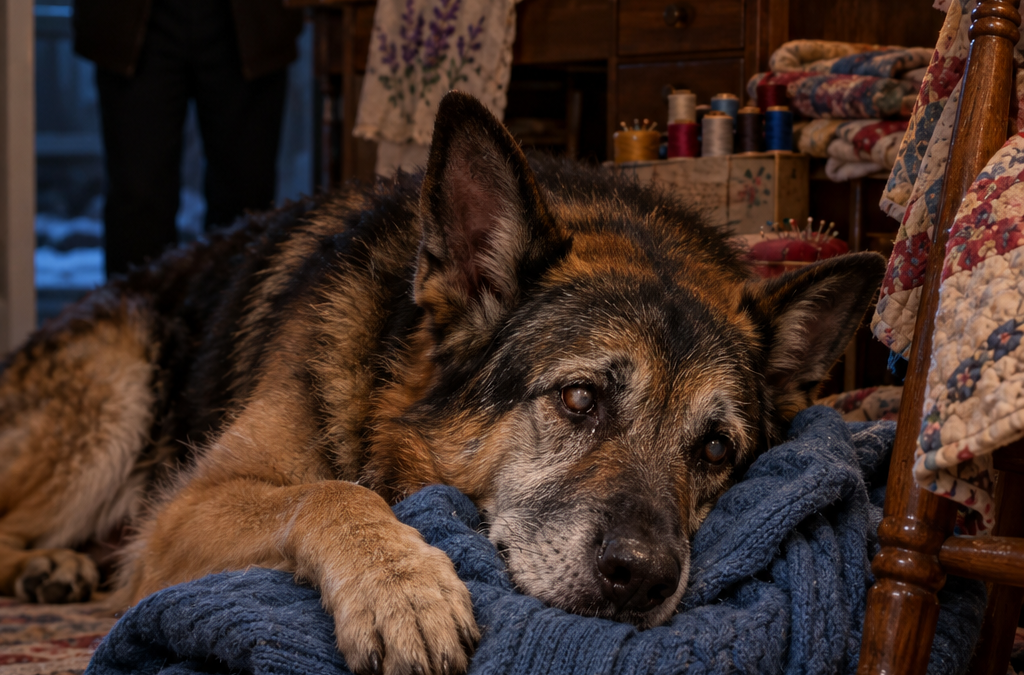
Lying beside Eleanor’s rocking chair.
His head resting on her blue cardigan.
One paw curled over the sleeve.
The fabric looked exactly as I remembered.
Soft blue wool.
A row of pearl-colored buttons.
A small repaired seam near the cuff where she’d caught it on a cabinet handle.
She’d been wearing it the morning she collapsed.
Later, when Rachel brought her belongings home from the hospital, the cardigan had been folded and placed on the sewing-room chair.
I hadn’t touched it.
Cooper had apparently found it.
Perhaps when the door had been left slightly open after Rachel checked the room.
Perhaps he had pushed his way through.
I didn’t know.
But he’d dragged it from the chair and gathered it beneath his head.
And now he was sleeping with his nose buried in the fabric.
I stood in the doorway.
Then the scent reached me.
Lavender.
Vanilla.
And something beneath it that no perfume bottle could ever reproduce.
Eleanor.
I felt my knees weaken.
For fifty-three days, I’d avoided that room because it reminded me too much of her.
Cooper had been going there because it reminded him of her.
I lowered myself onto the floor beside him.
“Buddy.”
He opened his eyes.
He didn’t try to stand.
He simply looked at me.
Then he moved his nose toward the cardigan.
I touched the sleeve.
The wool was warm beneath his cheek.
I lifted it gently toward my face.
And there she was.
Not really.
Not in the way I wanted.
But in the faint, familiar scent of the woman who’d spent forty-two years beside me.
I closed my eyes.
I could almost hear her laughing.
Almost feel her arms around my shoulders.
Almost hear her saying that I worked too hard, that Cooper needed his pills, that I should come inside before dinner got cold.
I pressed the sweater against my chest.
Then I broke down.
Not quietly.
Not with the controlled tears I’d allowed myself at the funeral.
I cried with the helplessness of a man who had spent seven weeks pretending he was doing better than he was.
Cooper lifted his head.
His breathing was shallow.
But he moved closer.
Pressed his muzzle against my hand.
And rested there.
I wrapped one arm around his neck.
With the other, I held Eleanor’s sweater.
For a long time, we stayed on that floor.
Two old men missing the same woman.
Neither of us able to ask her to come home.
Neither of us ready to let her go.
Finally, I whispered, “I’m sorry, Cooper.”
His ear moved beneath my hand.
“I didn’t know.”
I looked around the room.
The unfinished quilt on the sewing table.
Her glasses.
The little basket of buttons.
The measuring tape hanging from the chair.
All the things I’d been too frightened to see.
I swallowed.
“I thought you didn’t want to sleep with me anymore.”
Cooper pressed his head against the cardigan.
I stroked his muzzle.
“But you just wanted to be close to her.”
I looked toward the empty rocking chair.
And I realized that for weeks, I’d been asking him to leave the one place where he still seemed to find peace.
I had mistaken grief for confusion.
Longing for disobedience.
And the need for comfort for a sign that he no longer loved me.
I rested my forehead against his.
“I’m sorry, buddy.”
He breathed softly.
Then I whispered something I hadn’t been able to say since Eleanor died.
“I miss her too.”
I stayed in Eleanor’s sewing room until morning.
At some point, I must have fallen asleep sitting against the wall because I woke with my neck aching and the blue cardigan still clutched against my chest.
Cooper was beside me.
His head rested on my thigh.
The first pale light of morning was beginning to fill the room.
For a moment, I forgot Eleanor was gone.
I looked toward her rocking chair and expected to see her sitting there with her reading glasses perched on the end of her nose.
Then I remembered.
The grief came back.
But something had changed.
For the first time since her funeral, I didn’t feel the desperate need to leave the room.
I looked around.
Everything was exactly as she’d left it.
There were squares of yellow and blue fabric arranged beside the sewing machine.
A half-finished quilt hung over the back of the rocking chair.
A small paper cup held pins and needles.
Her favorite pair of scissors lay beside a handwritten list of measurements.
And on the wall was a photograph of Cooper standing beside her in the garden.
He was younger in the picture.
His muzzle was still mostly black.
Eleanor had wrapped a red scarf around his neck.
She was laughing because Cooper had apparently decided to lick her face just as I pressed the camera button.
I stared at that photograph for a long time.
Then I smiled.
It hurt.
But I smiled.
Cooper shifted against my leg.
I stroked his head.
“She loved you, buddy.”
His tail moved faintly.
I looked toward the rocking chair.
“She loved us both.”
Later that morning, I called Rachel.
She answered immediately.
“Dad? Everything okay?”
I looked down at Cooper.
He was sleeping peacefully on the cardigan.
“Can you come over?”
Her voice changed.
“Is Cooper worse?”
“Not exactly.”
“Then what is it?”
I hesitated.
“I need some help moving furniture.”
There was a pause.
“What furniture?”
I took a breath.
“My bed.”
“Dad?”
“I want to move it into your mother’s sewing room.”
She didn’t answer for several seconds.
Then she asked gently, “Why?”
I looked around the room.
At the chair.
The quilt.
The sweater beneath Cooper’s head.
“Because I think we’ve been sleeping in the wrong place.”
Rachel arrived that afternoon with her husband, David.
When I explained what I’d found, she stood quietly beside the sewing-room doorway.
Cooper was still lying near Eleanor’s chair.
The blue cardigan rested beneath his muzzle.
Rachel looked at him.
Then at me.
Her eyes filled.
“Oh, Dad.”
I nodded.
“I know.”
She stepped into the room and knelt beside him.
“Hi, sweetheart.”
Cooper opened his eyes.
Rachel stroked his ears.
“Have you been missing Grandma?”
His tail moved slightly.
Rachel covered her mouth.
I stood beside the doorway.
“He hasn’t been confused every night.”
She looked up.
“Some of it might be his age and illness.”
“I know.”
I swallowed.
“But this is where he wanted to be.”
Rachel looked around the room.
Her mother’s sewing room had always been her favorite place in the house.
As a child, she’d spent hours sitting beneath the table while Eleanor worked.
She’d learned to sew buttons there.
Made her first Halloween costume there.
Cried over her first broken heart there.
I saw all those memories moving across her face.
Then she approached the unfinished quilt.
Her fingers touched the fabric.
“Mom was making this for Ben.”
I looked at it.
“Was she?”
Rachel nodded.
“For his birthday.”
She lifted one corner.
The quilt was made from old family clothing.
Pieces of my favorite flannel shirts.
Fabric from Rachel’s childhood dresses.
A square cut from a faded blue picnic blanket we’d used when she was little.
In the center was a carefully embroidered sentence.
Every piece has a story.
Rachel began crying.
“She told me she wanted him to know where he came from.”
I stared at the quilt.
Eleanor had always believed ordinary things were worth preserving.
Old shirts.
Worn blankets.
Small scraps most people would discard.
She saw memories where other people saw fabric.
And somehow, with enough patience, she could turn them into something beautiful.
Rachel wiped her cheeks.
Then looked at me.
“Are you sure you want your bed in here?”
I nodded.
“Cooper doesn’t have much time.”
“I know.”
“He can’t keep walking down that hallway every night.”
Rachel placed her hand against my arm.
“And you?”
I looked toward Eleanor’s chair.
“I think I need to stop being afraid of this room.”
She hugged me.
For a long time, I held my daughter.
Then she whispered, “Okay, Dad.”
David helped us rearrange the furniture.
We moved Eleanor’s sewing table beneath the window.
The small cabinet went into the hallway.
We rolled up the old rug and cleaned the floor.
Then David and a neighbor carefully dismantled my bed and moved it from the bedroom into the sewing room.
It was a tight fit.
The room had never been intended for a bed, a sewing machine, and a fifteen-year-old German Shepherd with an orthopedic mattress the size of a small boat.
But we managed.
My bed stood along the far wall.
Eleanor’s rocking chair remained beside the window.
Cooper’s mattress rested between the bed and her chair.
And the blue cardigan stayed exactly where he wanted it.
When everything was finished, Rachel stepped back.
She studied the room.
Then she smiled sadly.
“Mom would’ve said we’ve ruined her workspace.”
I laughed.
“She would’ve complained about the bed blocking her fabric cabinet.”
Rachel nodded.
“Then she’d have made you all coffee.”
I looked toward the empty chair.
“Yeah.”
My voice weakened.
“She would have.”
That night, I slept in Eleanor’s sewing room for the first time.
I didn’t sleep particularly well.
My knees ached from moving around all day.
The old clock made a strange ticking sound.
And every shadow reminded me of something Eleanor had left behind.
But Cooper slept.
He rested with his head on the blue cardigan.
His breathing remained quiet for most of the night.
Whenever I woke, I reached down and touched his shoulder.
Sometimes his tail moved.
Sometimes he opened his eyes.
But he no longer wandered through the hallway searching for a place he couldn’t find.
He was already there.
For the next eleven days, the sewing room became our entire world.
I moved a small table beside my bed for Cooper’s medications.
Rachel brought us meals.
David installed a low night-light near the door so I could check on Cooper without disturbing him.
Dr. Hayes visited twice.
She monitored his breathing and adjusted his medication to keep him comfortable.
Cooper still had difficult hours.
Some mornings, he refused food.
Some evenings, he coughed and struggled to settle.
But whenever he rested on Eleanor’s sweater, he seemed calmer.
I couldn’t know what memories the scent brought him.
Perhaps he remembered her hands.
Perhaps the safety of their familiar routine.
Perhaps nothing as complicated as I imagined.
I only knew that the cardigan comforted him.
So I left it there.
And gradually, I discovered that it comforted me too.
Every morning, I opened the curtains and let sunlight fall across the room.
I made coffee.
Sat beside Cooper.
And told him stories about Eleanor.
Not police stories.
Not dangerous rescues.
Stories about our ordinary life.
The time she accidentally sewed the pocket shut on a pair of trousers I needed for work.
The afternoon she drove twenty miles to buy a particular kind of thread, then came home with three bags of groceries and no thread.
The Christmas she insisted on making Cooper a red bow tie, only for him to chew it off before the family photograph.
Sometimes I laughed.
Sometimes I cried.
Often I did both.
One morning, I found myself telling Cooper about the day I met her.
It was at a small diner outside Pittsburgh.
I was twenty-four.
Eleanor was twenty-two.
She worked there part-time while studying fashion design.
I stopped for coffee after an overnight shift.
I was exhausted.
She brought my order to the table.
Then looked at the notebook I’d left beside my cup.
“You’re a police officer?”
I nodded.
“Just started.”
She smiled.
“That explains why you look so miserable.”
I laughed.
“Long night.”
She glanced at the cold coffee beside me.
“Want a fresh cup?”
“Please.”
She returned with coffee and a slice of pie.
“I didn’t order pie.”
“I know.”
“Then what’s this?”
She smiled.
“You look like someone who needs feeding.”
I stared at her.
Then laughed.
Two months later, we were dating.
A year afterward, we were married.
Forty-two years later, I was sitting in her sewing room telling our dying dog that the best thing that ever happened to me began with a piece of apple pie.
Cooper opened his eyes.
I stroked his head.
“She took care of everybody, buddy.”
His tail moved faintly.
“Even people who didn’t know they needed it.”
As the days passed, I began opening the drawers in her sewing table.
Not to clear them.
Not to get rid of anything.
Just to remember.
I found old photographs tucked beneath fabric patterns.
Receipts from customers who’d become friends.
A box of buttons she’d collected for decades.
And a little notebook filled with measurements, reminders, and ordinary thoughts.
On one page, she’d written:
Cooper’s blanket—blue fleece. His hips are getting worse. Make it thick enough for winter.
I stared at those words.
Then I looked toward the old dog sleeping beside me.
Even when Eleanor knew her own hands were becoming stiff with age, she’d been planning ways to make his life easier.
I found the blue fleece blanket folded in a cabinet.
It was finished.
Soft.
Warm.
Carefully stitched around the edges.
I placed it over Cooper that afternoon.
He opened his eyes.
Sniffed the fabric.
Then rested his head again.
I watched him sleep.
And for the first time since Eleanor’s death, I felt something besides sorrow when I thought about her.
Gratitude.
Not because losing her had become easier.
It hadn’t.
But because I was beginning to understand how much love she’d left behind.
It was in the room.
In the quilts.
In the handwritten notes.
In the blue blanket.
And in the old dog who had spent his retirement at her feet.
On the ninth evening after moving my bed, Cooper struggled to stand.
I helped him carefully.
He tried to take a step toward the door.
His legs buckled.
I caught him.
“Easy, partner.”
He leaned heavily against me.
His breathing became fast and shallow.
I supported him until he settled back onto his mattress.
Then I called Dr. Hayes.
She came within an hour.
After examining him, she sat beside my bed.
Her face was serious.
“William, Cooper is nearing the end.”
I nodded.
Somewhere inside, I’d known.
But hearing it still hurt.
“How long?”
She looked toward him.
“I don’t think we’re talking about weeks anymore.”
I stared at my hands.
“Is he suffering?”
“He’s having periods of respiratory distress despite treatment. We may be able to keep him comfortable a little longer, but I don’t want him to experience a frightening emergency.”
I looked down at Cooper.
His head rested on Eleanor’s cardigan.
His eyes were half-closed.
I thought about the years he’d spent protecting people.
The flooded creek.
The missing children.
The dangerous searches.
The evenings he returned home exhausted and Eleanor knelt beside him with a towel.
He had given us so much.
And now his body was asking for rest.
I swallowed.
“Could you come back tomorrow?”
Dr. Hayes looked at me gently.
“If he remains comfortable through the night, yes. But if his breathing worsens, call me immediately. We shouldn’t allow him to struggle.”
I nodded.
She placed her hand over mine.
“We’ll do what’s kindest for him.”
That night, I barely slept.
I sat beside Cooper with Eleanor’s old sweater folded across my lap.
He rested quietly for several hours.
Whenever his breathing changed, I leaned closer.
Checked him.
Stroked his head.
Whispered that I was there.
Around two in the morning, he opened his eyes and looked toward the rocking chair.
I followed his gaze.
The chair sat beneath the window, illuminated by faint moonlight.
I could almost picture Eleanor there.
Her glasses perched on her nose.
A needle moving through fabric.
Her slipper tapping gently against the floor.
Cooper had spent years sleeping beside that chair.
Waiting for her to finish.
I looked down at him.
“She isn’t coming back, buddy.”
My voice trembled.
“I wish she were.”
He breathed softly.
I leaned closer.
“But you know something?”
His eyes moved toward me.
“I don’t think she’s as far away as I thought.”
I glanced around the room.
“She’s in everything she loved.”
I stroked his ear.
“And she loved you.”
Cooper’s tail shifted beneath the blanket.
I smiled through tears.
“Boy, did she love you.”
I stayed there until dawn.
At seven, I called Rachel.
I told her Dr. Hayes was coming.
She arrived with David shortly before noon.
Ben came too.
He was thirteen now, old enough to understand what was happening and young enough to wish understanding could change it.
He knelt beside Cooper’s bed.
“Hey, big guy.”
Cooper opened his eyes.
Ben stroked his ears.
“You remember when you stole my sandwich?”
I smiled.
That had happened the previous summer.
Ben had left a turkey sandwich on the coffee table.
Cooper, despite his age and arthritis, had somehow managed to pull the entire thing onto the floor.
Ben had been furious for approximately thirty seconds.
Then he’d declared Cooper the greatest criminal mastermind in family history.
Now my grandson was trying not to cry.
“You can have all my sandwiches in heaven,” he whispered.
I covered my mouth.
Cooper nudged his fingers weakly.
Ben began crying.
Rachel put an arm around him.
For a while, we all sat together.
Nobody tried to make the afternoon cheerful.
Nobody told jokes to hide the sadness.
We simply stayed.
At one-thirty, Dr. Hayes arrived.
She examined Cooper carefully.
His breathing had become more difficult.
He was too weak to stand.
The medication had helped him rest through the night, but his heart could no longer support his body adequately.
She looked at me.
I nodded before she spoke.
“I know.”
Her eyes softened.
I stroked Cooper’s head.
“He’s tired.”
“Yes.”
I swallowed.
“And keeping him here longer isn’t going to make him better.”
“No, William.”
I closed my eyes.
For a moment, I wanted to refuse.
I wanted to ask for another day.
Another week.
Another chance to watch his tail move when I entered the room.
But I remembered the promise I’d made Eleanor all those years earlier.
When he’s old and can’t do this anymore, don’t make him feel like he’s lost his purpose.
Teach him that being loved is enough.
I looked down at Cooper.
His gray muzzle rested on the blue sweater.
His eyes followed my hand.
I whispered, “You’ve done enough, buddy.”
Then I looked at Dr. Hayes.
“I’m ready.”
We kept Cooper on his own bed.
I sat on the floor beside him.
Rachel knelt on the other side.
Ben chose to stay nearby with David, holding his mother’s hand.
Dr. Hayes explained the process gently.
She would first give Cooper medication to help him relax into a deep, comfortable sleep.
Then, when we were ready, she would administer the final medication.
There would be no more fear.
No more struggling.
No more pain from his failing heart.
I nodded.
Then I reached for Eleanor’s cardigan.
I folded it carefully beneath Cooper’s cheek.
He sniffed it.
His eyes softened.
And I placed one hand against his chest.
For ten years, I’d used that touch at the end of a difficult shift.
It meant the search was over.
It meant we were safe.
It meant he could stop watching for danger.
I looked down at him.
“Hey, partner.”
His ears moved faintly.
I smiled through tears.
“Remember your first day?”
His nose twitched.
“You stole my glove.”
I laughed weakly.
“And I thought I’d been assigned the most stubborn dog in Pennsylvania.”
Rachel smiled through her tears.
I continued.
“You found people nobody else could find.”
My voice trembled.
“You brought children home.”
I looked toward the photograph of Eleanor above her sewing table.
“And you took care of her when I couldn’t be here.”
Cooper breathed softly.
I stroked his head.
“Then she took care of you.”
A tear fell onto the blue wool.
“And when she left, you kept looking for her.”
I paused.
I had spent so many nights wishing I could bring Eleanor back.
So many hours searching for some explanation that would make her absence easier to accept.
But now, sitting beside the last creature who had loved her as deeply as I did, I understood what had been waiting for me in that closed room.
We hadn’t needed to stop missing her.
We had needed to stop missing her alone.
I leaned forward and kissed Cooper’s forehead.
“Thank you for bringing me back to her.”
Dr. Hayes gave the first medication.
Cooper gradually relaxed.
His breathing eased.
His body settled against the mattress.
I kept stroking his ears.
I remembered Eleanor kneeling beside him when he came home muddy from work.
I remembered her laughing as he stretched across the couch.
I remembered the way she would say the same words whenever we returned from a long day.
I bent close to his ear.
“You’re off duty now, sweetheart.”
My voice broke.
“Both of us.”
Cooper’s eyes closed.
Dr. Hayes waited until I nodded.
Then she administered the final medication.
I held his head gently.
Felt one soft breath.
Then another.
A final, quiet exhale.
And Cooper was gone.
For a long time, nobody moved.
The old clock ticked above the sewing table.
Sunlight rested across the blue quilt.
Ben cried softly against his mother’s shoulder.
I kept my hand against Cooper’s chest, waiting for a movement I knew would never come.
Then I leaned forward and pressed my forehead against his.
“Good work, partner.”
The words barely came out.
“You brought her home to me.”
I stayed beside him until I was ready to let go.
We buried Cooper beneath the maple tree where Eleanor used to sit during summer afternoons.
His grave lay near the little flower garden she’d planted years earlier.
Rachel helped me choose a simple stone.
It carried his name, his years of K9 service, and a short inscription.
COOPER — FAITHFUL PARTNER, BELOVED FAMILY, ALWAYS HOME.
We placed his retired police badge in a small wooden box with his collar and kept it in the sewing room.
The blue cardigan remained there too.
I didn’t wash it.
Not because I believed the scent would last forever.
I knew it wouldn’t.
But it had become something more important than a piece of clothing.
It was a reminder of how much love could remain inside a home after the people and animals who gave it were gone.
I kept my bed in Eleanor’s sewing room.
At first, Rachel worried that surrounding myself with her belongings might make my grief harder.
But I told her the truth.
For fifty-three days after Eleanor died, I’d been sleeping in our old bedroom trying desperately not to think about her.
I avoided her chair.
Her sewing machine.
Her unfinished projects.
I closed doors.
Put away photographs.
And tried to convince myself that surviving meant learning to live without the reminders.
But Cooper had shown me something different.
Grief didn’t become smaller because I hid the things I loved.
It became lonelier.
In the sewing room, I could remember Eleanor without pretending she had never existed.
Some nights, I still cried.
Some mornings, I reached for Cooper before remembering his bed was empty.
But the room no longer felt like a place I needed to escape.
It felt like a place where I was allowed to remember.
Several weeks after Cooper died, Rachel came over with Ben.
She stood beside Eleanor’s unfinished quilt.
“Dad?”
I looked up from my chair.
“Yeah?”
“Do you think we could finish this?”
I studied the quilt.
The colorful squares.
The uneven stitching where Eleanor’s hands had begun trembling.
The carefully embroidered words.
Every piece has a story.
For a moment, I couldn’t speak.
Then I nodded.
“I think she’d like that.”
Rachel smiled.
She brought over the sewing basket.
Ben sat beside us and asked what each piece of fabric represented.
Rachel showed him the cloth from her childhood dress.
I pointed out the old flannel shirt I’d worn on our honeymoon trip.
We found a patch from a blanket Cooper used during his first winter at home.
And when Ben asked whether we could add something new, I reached toward the small basket beside the chair.
Inside was one of Cooper’s old blue bandanas.
It had been Eleanor’s favorite.
She used to tie it around his neck after brushing him.
The fabric was faded and worn.
I held it carefully.
Then I handed it to Rachel.
“Use this.”
She smiled through tears.
“Are you sure?”
I nodded.
“He belongs in the story too.”
She cut a square from the bandana and stitched it into the quilt.
It wasn’t perfectly aligned.
Eleanor would have noticed immediately.
She would have taken one look, adjusted her glasses, and explained that the corners needed to meet properly.
I could almost hear her.
I smiled.
“Your mother would make us redo that seam.”
Rachel laughed.
“She absolutely would.”
Ben looked between us.
“Should we?”
I shook my head.
“No.”
I touched the blue fabric.
“Leave it.”
Rachel raised an eyebrow.
“Dad?”
I smiled.
“Some things don’t have to be perfect to be worth keeping.”
She looked at me for a moment.
Then her eyes filled.
We finished the quilt over several Sunday afternoons.
I wasn’t much help with the actual sewing.
My hands weren’t steady enough for the smaller stitches.
But I could hold fabric.
Sort pieces.
Tell stories.
And remind Ben that his grandmother had once threatened to sew all my pockets shut if I kept leaving loose change in the laundry.
By the time we finished, spring had arrived.
The maple tree outside the window was covered in fresh green leaves.
Flowers were blooming near Cooper’s grave.
The house smelled of coffee again.
And laughter had returned to rooms I thought would remain silent forever.
On the first anniversary of Eleanor’s death, Rachel and Ben came over for dinner.
We ate at the old kitchen table.
I made roast chicken using Eleanor’s recipe.
It wasn’t nearly as good as hers.
Rachel told me so.
I pretended to be offended.
Ben asked for seconds anyway.
After dinner, I walked outside to the maple tree.
The air was warm.
A gentle breeze moved through the branches.
I stood between Eleanor’s flower garden and Cooper’s grave.
For a long time, I said nothing.
Then I reached into my pocket and took out a small photograph.
It showed Eleanor sitting in her sewing-room chair with Cooper lying beside her.
She was smiling.
His head rested on her lap.
The blue cardigan was draped across her shoulders.
I looked at the picture.
And I thought about the final weeks of Cooper’s life.
The nights he left his bed.
The way I’d followed him through the hallway.
The sweater beneath his head.
The first morning I woke in that room without feeling quite so alone.
I had spent so long believing Cooper was wandering away from me.
But he had been finding his way toward something we both needed.
I crouched carefully beside his stone.
“Hey, buddy.”
The wind moved through the grass.
I smiled.
“I think I finally understand.”
For ten years, Cooper had followed my commands.
He’d searched wherever I asked him to search.
He’d gone into danger because he trusted me.
But during the last weeks of his life, when his body was failing and his strength was disappearing, he gave me something no police academy could have taught.
He showed me that love doesn’t vanish when someone dies.
It changes shape.
It settles into familiar rooms.
Old photographs.
Folded sweaters.
Empty chairs.
The memories that catch us unexpectedly when we’re doing ordinary things.
And sometimes, it waits quietly behind a door we’re too frightened to open.
I rested my hand against Cooper’s grave.
“Good work, partner.”
Then I looked toward the house.
Through the window, I could see the old sewing room.
The lamp was on.
The finished quilt hung across the rocking chair.
Eleanor’s blue cardigan remained folded beside it.
And my bed was still there.
Waiting for me.
I stood slowly.
My knees ached.
The evening air was growing cool.
Inside, Rachel and Ben were laughing about something in the kitchen.
I could hear the warmth of a family continuing to live.
I took one last look at Cooper’s stone.
Then I whispered the words Eleanor had spoken to him after every long shift.
“You’re off duty now.”
I smiled through my tears.
“Rest easy, old boy.”
And I walked toward the light.
For the first time in a year, I didn’t feel that going back inside meant leaving the people I loved behind.
Eleanor was gone.
Cooper was gone.
I would miss them for the rest of my life.
But the room I’d once locked because it hurt too much to enter had become the place where I remembered them best.
And whenever I lay down at night, beneath the quilt we’d finished together, I could almost feel an old German Shepherd breathing beside my bed.
Not because I believed he’d returned.
But because fifteen years of love don’t disappear simply because the house grows quiet.
I had spent my life believing a good police dog was one who could always find his way home.
In his final days, Cooper taught me that home wasn’t only a place.
It was the people we loved.
The comfort we gave each other.
And the courage to keep our hearts open after saying goodbye.
He hadn’t left my side because he loved me less.
He had gone looking for the one person we were both missing.
And by following him into that room, I finally found the strength to remember her without running from the pain.
Cooper never found Eleanor again.
Neither did I.
But in that little sewing room, beside her old blue sweater, we found each other.
And when the time came for him to rest, neither of us had to face the goodbye alone.