𝗙𝗨𝗟𝗟 𝗦𝗧𝗢𝗥𝗬 My Dying K9 Hadn’t Eaten in Days, and I Was Afraid to Open the Box I’d Kept Since We Met
𝗣𝗔𝗥𝗧 𝟮
I recognized the handwriting.
Mine.
I sat on an old wooden crate and pulled the box toward me.
The tape had yellowed.
One corner was crushed.
I ran my thumb along the lid.
Then I opened it.
The first thing I saw was a photograph.
It showed me standing outside a training kennel beside a young German Shepherd.
I was fifty years old.
My hair was darker.
My shoulders were straight.
I wore a navy-blue police training jacket, and one hand rested awkwardly on the dog’s collar.
The German Shepherd stood beside me with enormous ears and an expression that suggested he wasn’t particularly impressed.
I stared at the picture.
Then I laughed.
A quiet, broken laugh.
“Oh, Chase.”
I had forgotten that photograph.
Forgotten how young he looked.
Forgotten how uncertain I’d been.
Beneath it lay a black training whistle attached to a worn leather cord.
The metal was scratched.
The leather had stiffened with age.
I lifted it carefully.
That whistle had been part of our first months together.
Not something I used during dangerous deployments, but a training tool that helped establish a reliable recall before voice commands and hand signals became second nature.
I turned it over in my hand.
And beneath the whistle, folded into a small square, was a blanket.
Gray and blue.
Soft cotton.
The edges frayed.
There was a tiny tear near one corner.
I recognized it immediately.
It was the blanket Chase had been lying on the first day I met him.
The one he’d refused to leave behind.
For several seconds, I simply stared.
Then I picked it up.
The fabric was thinner than I remembered.
It smelled of cardboard and years of storage.
There was no reason to believe it still carried the scents of that long-ago training kennel.
But I remembered it.
And suddenly, I remembered everything.
Fifteen years earlier, I had arrived at the regional K9 training facility feeling like a man who had made a terrible mistake.
I’d been a police officer for almost twenty years.
I knew how to handle a firearm.
How to secure a crime scene.
How to interview a suspect.
How to make decisions while everyone around me was panicking.
But I’d never worked with a police dog.
The department had selected me for a new K9 position because I had experience, patience, and a reputation for staying calm under pressure.
That last part made me laugh later.
Because nothing tested my patience quite like Chase.
Our training supervisor was a retired officer named Frank Moreno.
He was tall, broad-shouldered, and carried himself with the calm confidence of someone who had spent decades working with animals.
He met me beside the kennels.
“You’re Dawson?”
I nodded.
“That’s me.”
He shook my hand.
“Ever handled a working dog?”
“No.”
“Ever owned a shepherd?”
“No.”
He smiled.
“Well, this should be interesting.”
He led me past several barking dogs.
At the last kennel, a young German Shepherd lay on a gray-and-blue blanket.
His ears were alert.
His paws were enormous.
He watched us without moving.
“That’s Chase,” Frank said.
I studied him.
“Looks serious.”
“He is.”
“How old?”
“About eleven months.”
I looked through the fence.
“He’s still a puppy.”
Frank nodded.
“A very smart one.”
Chase stood, stretched, and approached the gate.
I crouched.
“Hey, buddy.”
He sniffed my fingers.
Then stepped backward and sat down.
Frank laughed.
“He doesn’t give his approval easily.”
I raised an eyebrow.
“Approval?”
“He’s been working with different trainers. He likes to decide whether somebody’s worth listening to.”
I looked at Chase.
He tilted his head.
“Well, that’s encouraging.”
The first training session was a disaster.
Chase pulled when I wanted him to walk slowly.
He stopped when I wanted him to move.
He ignored commands I’d practiced the night before.
And when I became frustrated, he seemed to become even more stubborn.
After twenty minutes, I looked toward Frank.
“This dog doesn’t listen.”
Frank folded his arms.
“Doesn’t he?”
“No.”
“Then why did he follow every command I gave him this morning?”
I stared at him.
Frank smiled.
“He’s listening, Dawson. He’s just not sure about you.”
I looked down at Chase.
His ears were raised.
His eyes were fixed on me.
“What am I doing wrong?”
Frank approached.
“You’re treating him like equipment.”
I frowned.
“He’s a police dog.”
“He’s also a living animal who needs to trust you.”
I looked away.
Frank continued.
“You’re used to telling people what to do. But a good K9 partnership isn’t built on one person doing all the thinking.”
He pointed toward Chase.
“That dog has instincts you don’t have. Your job is to understand them.”
I remembered feeling irritated.
I had spent two decades giving commands.
I was good at it.
Now a retired officer was telling me I needed to learn how to listen to a dog.
But something about Chase made me stay.
That afternoon, after the training session ended, I returned to his kennel.
Most of the dogs were resting.
Chase lay on his little blanket.
I sat outside the fence.
For a while, neither of us moved.
Then I began talking.
Not giving commands.
Just talking.
I told him my name.
Told him about the police department.
Told him I had a daughter named Rachel who was sixteen and thought I spent too much time at work.
I told him about my divorce.
About the empty house I went home to every evening.
About how I’d spent so many years working that I wasn’t entirely sure what else I knew how to do.
Chase watched me.
Occasionally, his ears moved.
After nearly half an hour, Frank appeared at the end of the kennel row.
“What are you doing?”
I shrugged.
“Getting to know him.”
Frank smiled.
“Good.”
Then he unlocked the gate.
Chase stepped outside.
He approached me slowly.
Sniffed my hand.
Then lowered himself onto the concrete beside my leg.
I touched his shoulder.
“Hey, partner.”
His tail moved once.
It wasn’t much.
But it was a beginning.
That evening, Frank handed me the little gray-and-blue blanket.
“Take this with you when you bring him home.”
I looked at it.
“Why?”
“It’s familiar.”
I shrugged.
“He’ll have a new bed.”
Frank shook his head.
“Doesn’t matter how expensive it is. Sometimes something familiar helps them settle when everything else changes.”
I folded the blanket.
“All right.”
Frank placed a small training whistle on the table.
“And keep this.”
I picked it up.
He explained how we’d use it during recall training.
Then he looked at Chase.
“You’re going to learn a lot from that dog, Dawson.”
I laughed.
“More than he learns from me?”
Frank smiled.
“Probably.”
He was right.
I carried the blanket and whistle into my new life with Chase.
And I had no idea how much that small bundle of ordinary things would someday mean.
Back in the attic, I sat holding the blanket against my knees.
The afternoon light had shifted.
Dust moved through the air.
For a long time, I couldn’t bring myself to stand.
I kept looking at the photograph.
At the young dog.
At the younger man beside him.
I remembered thinking our future stretched endlessly ahead.
Eleven years of service.
Hundreds of shifts.
Thousands of miles.
I hadn’t understood how quickly those years would disappear.
I pressed my hand against the blanket.
Then I gathered the photograph, whistle, and fabric and carried them downstairs.
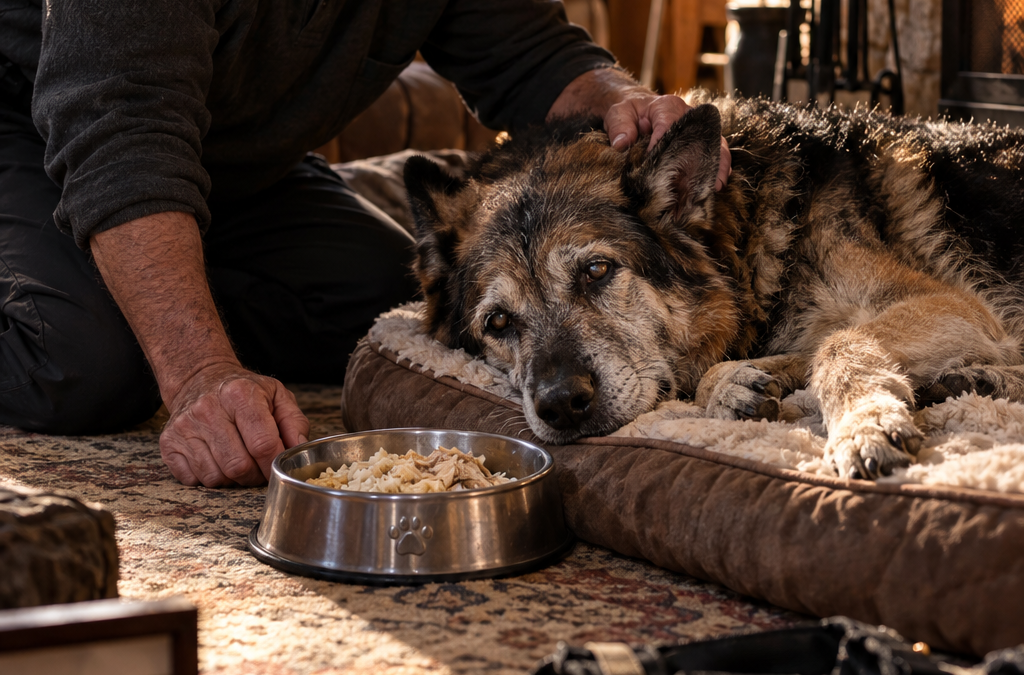
Chase was still lying beside the fireplace.
He hadn’t moved.
His water bowl sat untouched.
The chicken had gone cold.
I set everything on the coffee table and lowered myself beside him.
“Hey, partner.”
His eyes opened.
“Look what I found.”
I held up the old photograph.
He watched my hand without much interest.
I smiled sadly.
“That’s you.”
I brought it closer.
“Look at those ears.”
His tail moved faintly.
I knew he wasn’t admiring his own photograph.
He was responding to my presence.
But I couldn’t help smiling.
“You were a handsome little troublemaker.”
Then I unfolded the blanket.
The fabric opened slowly across my knees.
For a moment, I hesitated.
It felt foolish.
What was an old blanket supposed to accomplish?
The veterinarian had already explained what was happening.
Chase was dying.
A piece of cotton couldn’t repair his kidneys.
It couldn’t restore his appetite.
It couldn’t give him back the strength in his legs.
But I looked at him.
Then at the blanket.
And I thought about Frank’s words.
Sometimes something familiar helps them settle when everything else changes.
I spread the blanket gently on the floor in front of Chase.
“Remember this, buddy?”
His eyes moved toward it.
I waited.
At first, nothing happened.
Then his nose began moving.
He lifted his head.
Just an inch.
Maybe two.
I leaned forward.
“Chase?”
He sniffed the edge of the fabric.
Once.
Then again.
He pushed his muzzle closer.
I held my breath.
For nearly a minute, he investigated the blanket.
His nose moved along the worn stitching.
He paused near the little tear in the corner.
Then he took another long breath through his nose.
I didn’t know what he recognized.
Maybe the texture.
Maybe some faint trace of an old familiar association.
Maybe he was simply curious about something different in a room that had become painfully routine.
I couldn’t know.
But I knew what happened next.
Chase shifted his body.
He moved his front paws.
Then, with an effort that made my chest ache, he lowered his head onto the old blanket.
He let out a long, quiet breath.
His eyes closed.
And for the first time in days, the restless tension seemed to leave his body.
I stared at him.
“Oh, buddy.”
My voice broke.
“Oh, Chase.”
I rested my hand against his shoulder.
He didn’t move away.
I stroked his fur.
And suddenly, I was crying.
Not because he’d started eating.
He hadn’t.
Not because he was getting better.
He wasn’t.
I cried because for one small moment, I had been able to give him something that seemed to bring comfort.
After days of medicines, examinations, blood tests, and watching him struggle, I had finally done something that made him look peaceful.
And it was nothing more than laying an old blanket beneath his head.
I sat beside him until my knees began to ache.
Then I picked up the photograph again.
“Well, partner.”
I wiped my face.
“I guess we’ve got some catching up to do.”
Chase opened one eye.
I smiled.
“Remember our first day?”
His breathing remained steady.
“You wouldn’t listen to a word I said.”
I laughed softly.
“Frank thought it was hilarious.”
I set the picture beside his bed.
“Turns out you were smarter than both of us.”
I leaned back against the couch.
And I began telling him our story.
I started with the first night I brought him home.
The house had been quiet back then.
Too quiet.
Rachel lived mostly with her mother after our divorce, and the rooms that once held family dinners had become places where I stored things I didn’t know what to do with.
I worked long hours.
Ate takeout.
Watched television until I fell asleep.
I told everyone I enjoyed living alone.
The truth was that I had become accustomed to loneliness and mistaken it for independence.
Then Chase arrived.
I had bought him a large orthopedic dog bed and placed it in the laundry room.
There were bowls.
Toys.
A crate.
Everything the training supervisor recommended.
But that first night, Chase refused to settle.
He paced.
Whined.
Scratched at the door.
Finally, around midnight, I carried the little gray-and-blue blanket into the laundry room.
I spread it inside his crate.
Chase sniffed it.
Circled twice.
Then lay down.
For about ten minutes, he seemed comfortable.
I turned off the light and went upstairs.
The whining began again.
I tried to ignore it.
Then I remembered what Frank had said about trust.
So I went back downstairs.
Chase was sitting inside the crate, watching the doorway.
I opened it.
He stepped out.
I sat on the floor.
He approached, placed his chin against my knee, and looked up at me.
I remember laughing.
“You’re going to be trouble, aren’t you?”
His tail moved.
I leaned against the wall.
“All right. I’ll stay a while.”
I meant ten minutes.
Maybe fifteen.
But I fell asleep on the laundry-room floor.
When I woke the next morning, Chase was curled against my legs.
His little blanket lay beneath us.
Sunlight came through the window.
And for the first time in months, I didn’t wake to a house that felt empty.
I looked down at him.
“Morning, partner.”
His tail wagged.
I scratched his ears.
Then I made a promise.
Not a dramatic promise.
Not something I expected to remember.
I simply said, “You don’t have to do this alone anymore.”
Chase pressed his face against my hand.
At the time, I thought I was talking about the kennel.
About his unfamiliar surroundings.
About helping a young dog feel safe in a new home.
I didn’t understand that I was making a promise I would spend the next fourteen years trying to keep.
And I certainly didn’t understand how often he would keep that promise for me.
I looked down at Chase resting on his old blanket.
“Remember that first night?”
His chest rose slowly.
“I slept on the floor because you wouldn’t stop crying.”
I smiled through tears.
“Now look at us.”
I touched the edge of the fabric.
“Right back where we started.”
He opened his eyes briefly.
I leaned closer.
“Don’t worry, buddy.”
My voice trembled.
“I’m not going anywhere.”
For a while, we sat quietly.
Then I picked up the old training whistle.
The leather cord was brittle.
I turned it between my fingers.
I didn’t blow it.
Chase was exhausted, and I had no intention of turning our afternoon into another obedience exercise.
But holding that whistle brought back a memory I hadn’t thought about in years.
Our first successful tracking examination.
We’d failed the practice test the week before.
Not because Chase couldn’t follow a scent.
Because I kept interfering.
I rushed him through turns.
Misread his body language.
Tried to guide him toward locations I assumed were correct.
Frank finally stopped the exercise and pulled me aside.
“Michael, why won’t you trust him?”
I was irritated.
“I do.”
“No, you don’t.”
“He keeps stopping.”
“Because he’s thinking.”
I looked toward Chase.
He stood several yards away, calmly sniffing the ground.
Frank continued.
“You’ve spent your career believing leadership means knowing the answer before everybody else.”
I crossed my arms.
“That usually helps.”
“Not when somebody else has better information.”
I didn’t answer.
Frank pointed toward Chase.
“That dog knows things you don’t. Let him do his job.”
The following week, during the certification exercise, I loosened the leash.
I gave Chase the scent article.
Then I stopped trying to control every movement.
He worked slowly at first.
Then with growing confidence.
He followed the trail through tall grass.
Across a gravel path.
Behind a storage building.
At one point, he stopped near a row of dumpsters.
I thought he’d lost the scent.
But I said nothing.
I waited.
He circled.
Sniffed.
Then turned sharply toward an abandoned maintenance shed.
Thirty seconds later, he located the hidden training subject.
Frank clapped.
“That’s it!”
Chase began barking.
I laughed.
For the first time, the sound didn’t feel like noise.
It sounded like confidence.
I knelt beside him.
“Good boy!”
He pressed his head against my chest.
Frank walked over.
“Congratulations, Dawson.”
I looked up.
“For what?”
“You finally learned to trust your partner.”
I smiled.
Chase wagged his tail.
And from that day forward, something changed between us.
We stopped being a handler and a dog struggling to understand one another.
We became a team.
I looked at the whistle in my hand.
“Frank was right about you, buddy.”
Chase’s eyes remained closed.
“He was right about a lot of things.”
I set the whistle beside the photograph.
Then I leaned closer.
“You taught me how to listen.”
I paused.
“And I spent eleven years trying to deserve your trust.”
The afternoon sunlight moved slowly across the living room.
Chase slept for nearly twenty minutes.
I stayed beside him.
Occasionally, I checked his breathing.
Occasionally, I stroked his shoulder.
Once, I caught myself looking toward the kitchen, wondering whether I should try feeding him again.
Then I stopped.
Dr. Collins had already told me not to force food when nausea and weakness made eating uncomfortable.
I could offer.
I could make it available.
But I couldn’t turn his final days into a struggle over something his body could no longer accept.
That realization hurt.
I had spent my entire career solving problems.
If someone was missing, we searched.
If someone was injured, we called an ambulance.
If there was danger, we moved toward it.
I knew how to act.
I knew how to make decisions.
But Chase’s illness didn’t care about my experience.
There was no suspect to arrest.
No perimeter to establish.
No command I could give that would make his failing kidneys work again.
There was only an old dog who needed comfort.
And a man who was terrified that comfort might be the last thing he could offer.
Around two o’clock, Chase woke.
He lifted his head slightly and looked toward me.
I moved closer.
“Hey, buddy.”
His tail gave one small movement.
I smiled.
“There you are.”
I offered him water.
He took a few slow laps.
Then turned away.
I set the bowl down.
“That’s okay.”
I stroked his ear.
“You’re doing fine.”
He rested his head on the blanket.
I looked at the photograph again.
And another memory came back.
The night Chase found a missing little girl in the freezing woods.
Her name was Emma Reynolds.
She was seven years old.
It happened during our third winter together.
A storm had moved through Cedar Hollow all afternoon.
By evening, snow covered the roads, and the temperature had dropped into the teens.
Emma had been playing behind her grandparents’ house when she wandered into the woods looking for the family’s missing cat.
Her grandmother discovered she was gone shortly before sunset.
By the time our unit arrived, search teams had been working for nearly three hours.
Emma’s father stood beside a sheriff’s vehicle.
He looked as though he hadn’t taken a full breath since the search began.
When he saw Chase, he hurried toward us.
“Is that the dog?”
I nodded.
“Yes, sir.”
“Can he find her?”
I looked at the snow-covered tree line.
“We’re going to try.”
The man grabbed my sleeve.
“She’s seven.”
His voice broke.
“She doesn’t know those woods.”
I placed a hand on his shoulder.
“I understand.”
He shook his head.
“No. You don’t.”
Tears filled his eyes.
“She’s my little girl.”
I didn’t argue.
There was nothing useful I could have said.
I took Emma’s jacket and presented it to Chase.
He sniffed deeply.
Then raised his head.
His ears turned toward the woods.
I clipped on the tracking leash.
“Ready, partner?”
He pulled forward.
We entered the trees.
The snow was deep enough to slow me down.
Branches scraped my jacket.
The wind stung my face.
Chase worked with his nose low, occasionally stopping to investigate patches of disturbed snow.
We crossed a frozen drainage ditch.
Climbed a narrow bank.
Passed through a stand of pine trees.
After nearly an hour, my fingers had begun losing feeling despite my gloves.
The radio crackled.
“Dawson, command wants your status.”
I looked at Chase.
He was pulling harder.
“Still tracking.”
“Visibility’s getting worse. You may need to return and regroup.”
I looked toward the dark trees.
Then down at my dog.
He wasn’t wandering.
He was working.
“Negative. He’s still on something.”
We continued.
Ten minutes later, Chase stopped beside an old hunting blind.
He lifted his head.
Sniffed the air.
Then began barking.
I raised my flashlight.
At first, I saw nothing.
Then a small patch of pink appeared beneath the wooden platform.
I dropped to my knees.
“Emma?”
A tiny voice answered.
“Help.”
I felt my heart leap.
“Emma, sweetheart, I’m Officer Dawson.”
She began crying.
“I’m cold.”
I crawled toward her.
She was curled beneath the raised structure, partially sheltered from the wind but soaked and shivering.
Her boots were missing.
One glove had fallen off.
I radioed our location and pulled off my outer jacket.
I wrapped it around her.
Chase moved closer.
Emma looked at him.
“Is he nice?”
I smiled.
“He’s the nicest dog you’ll ever meet.”
She reached toward him.
Chase lowered his head.
She touched his fur.
Then she wrapped her arms around his neck and began crying.
For the next fifteen minutes, while we waited for the rescue team, she held onto him.
Every time her breathing became frantic, I told her to feel Chase’s warm coat.
To look at his face.
To stay with us.
Chase lay perfectly still.
He didn’t pull away.
He didn’t become restless.
He simply stayed beside that frightened little girl until the firefighters arrived.
When we carried Emma back to the command vehicle, her father ran toward us.
He gathered her into his arms and sank to his knees.
I stood a few feet away.
Chase sat beside my leg.
The man looked at us.
Then he began crying.
“Thank you.”
His voice shook.
“Thank you for bringing her home.”
I glanced down at Chase.
His tail moved once.
That was all.
He didn’t need applause.
He didn’t need to understand the words.
He only needed to know the search was over.
I brought him home after midnight.
Rachel was staying with me that weekend.
She had fallen asleep on the couch waiting for us.
When I opened the door, she woke immediately.
“Dad?”
“Hey, sweetheart.”
She looked at Chase.
“Did you find the girl?”
I nodded.
“Yeah.”
She stood and hurried toward us.
“Is she okay?”
“She’s at the hospital. They’re taking care of her.”
Rachel looked down at Chase.
Then she wrapped both arms around his neck.
“Good boy.”
He licked her cheek.
She laughed.
And I stood in the doorway watching my daughter hug the dog who had just helped save another father’s child.
I remember feeling proud.
But I also remember feeling ashamed.
Because that same week, I’d missed Rachel’s school performance.
I’d promised I would come.
Then an emergency call kept me at work.
It wasn’t the first time.
And it wouldn’t be the last.
That night, after Chase went to sleep, Rachel approached me in the kitchen.
“Dad?”
“Yeah?”
“Are you going to miss my birthday, too?”
I looked at her.
The question was so quiet that it hurt more than an accusation.
“I’ll do my best, honey.”
She lowered her eyes.
“That’s what you always say.”
Then she went upstairs.
I stood there for a long time.
I was good at rescuing people.
But I wasn’t always good at being present for the people who loved me.
Chase seemed to understand something I didn’t.
He never treated coming home as less important than going to work.
When Rachel visited, he greeted her as though she’d been gone for years.
He followed her through the house.
He slept beside her bedroom door.
And whenever she cried after another argument with me, he sat beside her until she calmed down.
For years, I told myself that Chase was my partner.
But sometimes I think he did more for my family than I ever did.
I looked down at the old dog resting on his blanket.
“You remember Rachel?”
His eyes opened slightly.
“She loved you from the beginning.”
I smiled sadly.
“Probably more than she liked me some days.”
I rubbed his chest.
“And I can’t blame her.”
I paused.
“I missed a lot, buddy.”
A tear slipped down my cheek.
“I thought being a good father meant working hard enough that she never needed anything.”
I swallowed.
“But she needed me.”
Chase breathed softly.
“She needed me to show up.”
I looked toward the window.
“I didn’t understand that until she was almost grown.”
I sat beside him for a while.
Then I reached for my phone.
Rachel was thirty-one now.
She lived about an hour away with her husband and their little daughter, Sophie.
We spoke often enough.
Birthdays.
Holidays.
Occasional dinners.
But I knew there were still things we had never said.
I called her.
She answered on the fourth ring.
“Hi, Dad.”
“Hey, sweetheart.”
“Everything okay?”
I looked toward Chase.
“Not really.”
Her voice changed.
“Is it Chase?”
“Yeah.”
There was a pause.
“How bad?”
I swallowed.
“Pretty bad.”
I explained what Dr. Collins had told me.
How Chase had stopped eating.
How weak he’d become.
How I wasn’t sure how much time we had left.
Rachel was quiet.
Then she said, “I’m coming.”
I looked at the clock.
“You’re at work.”
“I can leave.”
“Honey, you don’t have to—”
“Dad.”
I stopped.
Her voice was firm.
“I love that dog, too.”
My throat tightened.
“I know.”
“And I love you.”
I closed my eyes.
“Yeah.”
She took a breath.
“Please don’t make me find out afterward that you spent this whole day alone.”
For a moment, I couldn’t speak.
Then I whispered, “Okay.”
She arrived shortly after three.
Sophie came with her.
My granddaughter was six years old and carried a stuffed German Shepherd almost as big as her torso.
She hurried through the front door.
“Grandpa!”
I knelt and hugged her.
“Hey, peanut.”
Then she looked toward the fireplace.
“Where’s Chase?”
I pointed.
“Right there.”
She started toward him.
Rachel gently caught her shoulder.
“Slowly, sweetheart. Remember what we talked about.”
Sophie nodded.
She approached quietly and knelt beside the old dog.
“Hi, Chase.”
His eyes opened.
He looked at her.
His tail moved faintly.
Sophie smiled.
“I brought you a friend.”
She placed the stuffed dog beside his bed.
Chase sniffed it.
Then rested his head again.
Sophie looked at me.
“Why is he so tired?”
I swallowed.
“He’s very old, sweetheart.”
She frowned.
“Older than you?”
Rachel laughed softly.
I smiled through tears.
“In dog years, probably.”
Sophie touched his ear.
“Can he get better?”
I looked at Rachel.
She nodded gently.
I turned back to my granddaughter.
“The doctors have been helping him, but his body is very tired. We don’t think he’s going to get better this time.”
Sophie studied Chase.
Then she asked, “Is he going to die?”
The question struck me hard.
I wanted to protect her from the answer.
But I remembered the truth I’d learned too late with Rachel.
Love wasn’t only about keeping someone safe from difficult things.
Sometimes it meant being honest enough to let them understand.
I nodded.
“Yes, sweetheart. We think he will soon.”
Her eyes filled.
“But I don’t want him to.”
I pulled her gently into my arms.
“Neither do I.”
She began crying.
Rachel knelt beside us.
For a while, the three of us sat on the floor with Chase resting quietly nearby.
Then Sophie wiped her cheeks.
“Can I tell him goodbye?”
I nodded.
“Of course.”
She leaned forward.
Very gently, she kissed the white fur between his ears.
“Goodbye, Chase.”
Her voice trembled.
“Thank you for being Grandpa’s friend.”
I turned away.
I couldn’t stop the tears.
Rachel placed a hand on my shoulder.
She didn’t say anything.
She didn’t need to.
After a while, Sophie went into the kitchen to draw a picture.
Rachel sat beside me.
Her eyes moved toward the old blanket.
“Where did that come from?”
I looked down.
“Found it in the attic.”
She touched the frayed edge.
“Isn’t this the one from when you first brought him home?”
I nodded.
“Yeah.”
She smiled sadly.
“I remember it.”
I looked at her.
“You do?”
“Of course.”
She laughed softly.
“He carried it around the house for weeks.”
I stared at the blanket.
I’d forgotten that.
Rachel continued.
“Remember how he used to drag it into the living room whenever you were working late?”
I closed my eyes.
The memory returned.
A young German Shepherd pulling a little blanket through the hallway.
Curling on it beside the front door.
Waiting for my truck.
“Yeah,” I whispered.
“I remember.”
Rachel stroked Chase’s shoulder.
“He always waited for you.”
My throat tightened.
She looked at me.
“Even when I was mad at you for missing things, I liked watching him wait.”
I frowned.
“Why?”
She smiled faintly.
“Because I knew somebody was going to be really happy when you got home.”
I looked away.
A tear slid down my cheek.
Rachel took my hand.
“Dad, I know we had a lot of difficult years.”
I nodded.
“I know.”
“But I also know you loved me.”
I swallowed.
“I should’ve said it more.”
She squeezed my hand.
“Maybe.”
I looked at her.
She smiled through tears.
“But you can say it now.”
I bowed my head.
“I love you, Rachel.”
She leaned against me.
“I love you, too, Dad.”
For a moment, I forgot how frightened I was.
The room felt warm.
My daughter was beside me.
My granddaughter was drawing at the kitchen table.
And Chase rested peacefully on the little blanket that had followed us from the first day of our life together.
I realized then that even when I thought I had nothing left to give him, he was still giving something to me.
A reason to say the words I’d avoided.
A reason to bring my family closer.
A reason to stop pretending I could handle everything alone.
Later that afternoon, Rachel asked whether she could hear the story of Chase’s final patrol.
I looked at her.
“You’ve heard it.”
She nodded.
“I know.”
Then she glanced toward Chase.
“But I think maybe he should hear it again.”
I smiled sadly.
“All right.”
I sat closer to his bed.
The photograph from our first day lay on the coffee table.
The whistle rested beside it.
I looked at Chase.
“Remember that warehouse, buddy?”
His eyes opened slightly.
I swallowed.
“That cold night in November?”
The final patrol had happened almost three years earlier.
Chase was twelve then.
His muzzle had begun turning gray.
He still worked eagerly, but his hips were stiff after long shifts.
The department had already begun discussing retirement.
I kept delaying the decision.
I told myself he was still capable.
That we could limit difficult assignments.
That he wasn’t ready to stop.
The truth was that I wasn’t ready.
For eleven years, Chase and I had been a team.
I didn’t know who I would be without him.
That November night, officers were searching for a burglary suspect who had fled into an abandoned manufacturing warehouse.
The building was enormous.
Dark.
Cold.
Filled with old machinery and storage rooms.
We entered with a search team after the perimeter was secured.
Chase worked carefully.
His nose moved along the concrete floor.
He stopped near a row of empty shipping containers.
Then he raised his head.
I recognized the alert.
“Hold up.”
The officers behind me stopped.
I gave Chase a quiet hand signal.
He remained focused on the containers.
We called for the suspect to surrender.
There was no response.
Then something moved behind the last container.
An officer shouted.
A man suddenly emerged from cover.
The encounter became chaotic.
The suspect resisted arrest and tried to escape through a narrow service passage.
Chase alerted and helped the team locate his position, allowing officers to contain the area before taking him into custody.
No one was seriously injured.
But when the situation ended, I noticed Chase limping.
At first, I thought he’d strained a muscle.
I knelt beside him.
“Hey, buddy.”
He looked up.
His tail moved.
I asked him to walk.
He took three steps.
Then his hind leg buckled.
I caught him.
My heart sank.
“No.”
I checked his leg carefully.
He didn’t cry out, but I could see the pain in his face.
I radioed for assistance and carried him back to the patrol vehicle.
At the emergency veterinary hospital, the doctor found that a chronic joint problem had worsened.
There was no catastrophic injury.
But the strain had exposed how much his aging body was already struggling.
Continuing active duty would put him at serious risk.
I sat in the examination room staring at Chase.
He was lying on a blanket.
His eyes followed me.
“He’s not ready,” I told the veterinarian.
She looked at him.
Then at me.
“Michael, I think he is.”
I shook my head.
“He still wants to work.”
“I’m sure he does.”
“He’s been doing this eleven years.”
“I know.”
She lowered her voice.
“But wanting to work doesn’t mean his body can safely continue.”
I looked away.
She waited.
Then she said, “He’s trusted you to make the difficult decisions for him all these years. This is another one.”
I sat there for a long time.
Finally, I nodded.
Chase retired the following month.
The department held a ceremony.
There were speeches.
Photographs.
A plaque.
A cake decorated with his badge number.
Officers who had worked with us came to say goodbye.
Chase ate a hamburger and tried to steal a second one.
Everyone laughed.
I smiled for the photographs.
But when I removed his working harness for the final time, my hands shook.
I knelt beside him.
“That’s it, buddy.”
His ears rose.
He looked toward the patrol vehicle.
“No more calls.”
His tail moved.
I swallowed.
“You’re coming home with me.”
He didn’t understand.
Not then.
He still wanted to work.
He still turned toward the radio.
He still hurried toward the garage whenever I picked up my keys.
For weeks after retirement, he’d stand beside the old patrol vehicle and wait.
I watched him.
And I felt guilty.
As though I’d taken away the thing that gave his life meaning.
But gradually, he changed.
He began sleeping later.
He discovered that mornings could be spent in the backyard instead of a police vehicle.
He learned that he could lie beside me during football games without waiting for another call.
He became a dog again.
Not just a police dog.
A dog who liked warm blankets.
Slow walks.
Tennis balls.
And the sound of the refrigerator opening.
I retired six months later.
I told everyone I’d had enough of paperwork and overnight shifts.
That wasn’t entirely true.
The real reason was sitting beside my chair when I made the decision.
Chase had spent eleven years giving me his best.
I wanted to spend the rest of his life giving him mine.
Rachel listened quietly while I finished the story.
Then she looked at Chase.
“Best decision you ever made.”
I smiled.
“Retiring?”
“Bringing him home.”
I nodded.
“Yeah.”
My voice grew quiet.
“It was.”
Chase stirred on his blanket.
I leaned closer.
“Hey, buddy.”
His eyes opened.
I stroked his cheek.
“You hear that?”
I smiled through tears.
“Rachel says we did all right.”
His tail moved once.
And for one brief moment, I felt like the luckiest man alive.
By late afternoon, the sunlight had shifted away from the fireplace.
Sophie had fallen asleep on the couch.
Rachel sat beside me, holding a cup of coffee.
Chase rested with his head on the old blanket.
His breathing was slow.
Occasionally, his nose moved against the fabric.
I watched him carefully.
Then I picked up the photograph from our first day together.
I studied the younger version of myself.
The stiff posture.
The uncertain smile.
The hand resting awkwardly on Chase’s collar.
I thought about what I’d say if I could go back and speak to that man.
I’d tell him to slow down.
To trust the dog.
To stop believing every important thing in life came with a badge or a promotion.
I’d tell him to attend more of his daughter’s school events.
To apologize sooner.
To take more photographs of ordinary days.
I’d tell him that one day, the dog standing beside him would grow old.
That his hearing would fade.
His legs would weaken.
His muzzle would turn white.
And he’d need help with things he’d once done effortlessly.
I’d tell him not to be ashamed of that.
Not to see it as failure.
Because someday, helping that dog stand would become one of the most important things he ever did.
But most of all, I’d tell him to appreciate every moment.
Every ride home.
Every muddy paw print.
Every stolen sandwich.
Every night when Chase fell asleep beside the couch.
Because eventually, he’d give anything to have one of those ordinary days again.
I set the photograph down.
Rachel touched my arm.
“Dad?”
I looked at her.
“You okay?”
I stared at Chase.
“No.”
She nodded.
Then she moved closer.
I looked at her.
“I thought I was prepared.”
My voice shook.
“I knew he was getting old.”
She squeezed my hand.
“I know.”
“I knew this was coming.”
I swallowed.
“But every time I look at him, all I can see is the puppy who used to sleep beside my bed.”
Rachel’s eyes filled.
I rubbed my face.
“He trusted me with everything.”
I looked toward Chase.
“His whole life.”
My voice broke.
“And now I can’t fix what’s happening to him.”
Rachel waited until I finished.
Then she said, “Dad, maybe fixing it isn’t what he needs.”
I looked at her.
She nodded toward the blanket.
“Look at him.”
Chase was sleeping quietly.
His head rested against the faded fabric.
One front paw lay curled beneath his chest.
For the first time that day, his body looked relaxed.
Rachel continued.
“He’s home.”
I swallowed.
“You’re here.”
She touched my shoulder.
“And he’s comfortable.”
I looked down.
“Maybe that’s enough for today.”
I closed my eyes.
For years, I had measured success by what I could accomplish.
A rescued child.
An arrested suspect.
A completed mission.
A problem solved.
But sitting beside Chase, I began to understand something different.
Sometimes love doesn’t come with a solution.
Sometimes it comes with a chair pulled close to the bed.
A blanket placed beneath a tired head.
A hand resting gently against old fur.
Sometimes the most important thing you can give someone is the certainty that they don’t have to face the difficult moments alone.
I looked at the old blanket.
It had been with Chase on his first night in my home.
And now, fourteen years later, it was beneath his head again.
I reached toward him.
“Hey, partner.”
His eyes opened.
I stroked his ear.
“You don’t have to do anything else.”
My voice trembled.
“Do you hear me?”
He blinked.
“No more searches.”
I swallowed.
“No more patrols.”
A tear slipped down my cheek.
“No more trying to be strong for me.”
I leaned closer.
“You’ve done enough.”
Chase pressed his nose against my fingers.
I smiled through tears.
“That’s right, buddy.”
I kissed his forehead.
“Just rest.”
Rachel and Sophie stayed until evening.
Before leaving, Sophie knelt beside Chase one last time.
She placed her drawing on the coffee table.
It showed a police officer standing beside a large German Shepherd.
A bright yellow sun shone above them.
Across the top, in uneven purple letters, she’d written:
GRANDPA AND CHASE ARE HEROES.
I looked at the picture.
My throat tightened.
“That’s beautiful, sweetheart.”
Sophie smiled.
Then she looked at Chase.
“Can I leave it here so he can see it?”
I nodded.
“Of course.”
She gently touched his paw.
“Good night, Chase.”
His tail moved faintly.
Sophie smiled through tears.
Then she hugged me.
“Grandpa?”
“Yeah, peanut?”
“Will you call Mommy if you get sad?”
I looked at Rachel.
She was standing near the door with tears in her eyes.
I hugged Sophie tighter.
“Yeah, sweetheart.”
I swallowed.
“I promise.”
After they left, the house became quiet again.
I sat beside Chase.
The old box rested on the coffee table.
The photograph.
The whistle.
The blanket.
Three ordinary things that had survived fourteen years of moves, retirement, and changing seasons.
I picked up the whistle.
For a moment, I considered putting it back in the box.
Then I decided against it.
I placed it beside the photograph on the mantel.
Not because I expected to use it again.
Because I wanted to remember the part of our lives when Chase was young and eager and everything seemed possible.
But the blanket stayed where it was.
Beneath him.
I wasn’t taking that away.
Around nine o’clock, Chase became restless.
He shifted his head.
Tried to move his legs.
Then stopped.
I helped him settle.
His breathing was faster than before.
I checked him carefully and called Dr. Collins.
She listened to my description and asked several questions.
Then she said, “Michael, I’m concerned he’s approaching the end.”
I looked toward him.
He was watching me.
“Is he hurting?”
“His condition may be changing. I don’t want him to become distressed. I can come to the house.”
I swallowed.
“Tonight?”
“Yes.”
I looked down.
For a moment, I wanted to tell her to wait.
Just another day.
Another night.
Another morning.
But I remembered Chase refusing his food.
The weakness in his legs.
The way he’d struggled to settle.
And I remembered her warning that we couldn’t cure what was happening.
I looked at the old blanket.
Then at my best friend.
“Okay,” I whispered.
“Please come.”
Dr. Collins arrived just before ten.
She entered quietly and knelt beside Chase.
He opened his eyes.
She examined him carefully.
Listened to his heart.
Checked his breathing.
Then she looked at me.
“Michael, I think his body is very tired.”
I nodded.
My throat felt tight.
She continued gently.
“He’s not going to recover from this. I believe the kindest thing we can do now is help him pass peacefully.”
I stared at Chase.
He lay on the little blanket from our first day together.
His eyes were half closed.
His chest rose and fell with effort.
I wanted to be brave.
I wanted to answer like the police officer I’d been for thirty-three years.
Calm.
Decisive.
In control.
But I couldn’t.
I covered my face.
And I cried.
Dr. Collins stayed beside me.
She didn’t rush.
She didn’t tell me everything would be okay.
She simply waited.
Eventually, I looked at her.
“Can we do it here?”
She nodded.
“Of course.”
“On his blanket?”
“Yes.”
I swallowed.
“Can I hold him?”
Her eyes softened.
“Absolutely.”
I nodded.
Then I looked at Chase.
“Okay, buddy.”
My voice broke.
“Let’s get you comfortable.”
Dr. Collins explained the procedure.
She would first give medication to help him relax into a deep, peaceful sleep.
Then, when I was ready, she would administer the final medication.
I could stay beside him the entire time.
I pulled a pillow onto the floor and sat with my back against the couch.
Then I gently lifted Chase’s head into my lap.
He was so light.
That was what struck me.
For eleven years, he’d been ninety pounds of muscle and determination.
He could pull me through snow deep enough to reach my knees.
He could jump obstacles that made younger officers hesitate.
He could run faster than I ever could.
Now I could hold his head in one hand.
I stroked his face.
“Hey, partner.”
His eyes moved toward me.
I smiled through tears.
“Remember our first night?”
His breathing was slow.
I touched the blanket beneath him.
“This was yours.”
I swallowed.
“Frank gave it to me.”
I smiled sadly.
“He said something familiar might help you feel safe.”
I leaned closer.
“Guess he was right.”
A tear fell onto the fabric.
“You know, I thought I was taking care of you that night.”
I laughed softly.
“Didn’t know you’d spend the next fourteen years taking care of me.”
I looked at the old photograph on the mantel.
The younger man.
The young dog.
The beginning of everything.
Then I looked down at Chase.
“I need to tell you something.”
My voice trembled.
“I wasn’t a very good father when I met you.”
He watched me.
“I was divorced. Angry. Working too much.”
I wiped my eyes.
“And I kept telling myself I didn’t need anybody.”
I paused.
“Then you came along.”
Chase’s nose moved slightly against my hand.
“You needed breakfast.”
I smiled.
“Walks.”
I scratched his ear.
“Training.”
A tear slipped down my cheek.
“And somebody to sit beside you when you were scared.”
I swallowed.
“Somewhere along the way, I stopped feeling so alone.”
I leaned forward.
“You didn’t just become my partner.”
My voice broke.
“You became my family.”
I rested my forehead against his.
“And when I finally learned how to be a better father, a better friend, a better man…”
I closed my eyes.
“You were there for that, too.”
For several seconds, I couldn’t speak.
Then I whispered, “Thank you.”
Chase breathed slowly.
“Thank you for Emma.”
I stroked his shoulder.
“For every person we brought home.”
I paused.
“For every night you stayed beside me.”
My voice shook.
“For every ordinary morning.”
I kissed his forehead.
“And thank you for trusting me, even when I didn’t know what I was doing.”
Dr. Collins gently touched my arm.
“Michael, he’s ready for the first medication whenever you are.”
I looked down at Chase.
I knew the moment had come.
I didn’t want it.
I would never want it.
But I looked at his tired face and understood that asking him to stay would be for me.
Not for him.
I nodded.
“Okay.”
She administered the sedative.
Chase barely reacted.
His body slowly relaxed against my legs.
I kept stroking his ears.
“That’s it, buddy.”
My voice trembled.
“Just rest.”
His breathing became calm.
His eyes grew heavy.
I leaned closer.
“You know something?”
I smiled through tears.
“I never did figure out how you stole that chicken from the chief.”
I laughed once.
Then began crying again.
“Guess you can keep that secret.”
I held him gently.
Dr. Collins waited until he was deeply relaxed.
Then she looked at me.
“Are you ready?”
I stared at Chase.
For a moment, I saw every version of him.
The young dog sitting on the little blanket outside his kennel.
The energetic K9 leaping into the patrol vehicle.
The dog lying beside a frightened child in the snow.
The faithful companion waiting near my front door.
The old shepherd who had needed help standing but still greeted me with a wagging tail.
All of them were Chase.
Not just the hero.
Not just the police dog.
Not just the animal who had saved lives.
The dog who slept on the laundry-room floor.
The dog who stole food.
The dog who loved my daughter.
The dog who made my empty house feel like home.
I pressed my lips against his forehead.
“Good boy, Chase.”
My voice broke.
“You’re the best partner I ever had.”
I swallowed.
“You don’t have to work anymore.”
I looked down at the blanket.
The same one he’d slept on the first night we met.
“You’re home.”
I closed my eyes.
“And I’m right here.”
Then I nodded to Dr. Collins.
She administered the final medication.
I kept one hand against Chase’s chest and the other beneath his head.
His breathing slowed.
Then stopped.
Dr. Collins listened gently with her stethoscope.
After a moment, she looked at me.
“I’m so sorry, Michael. He’s gone.”
I didn’t move.
I couldn’t.
His body was still warm.
His head rested against my arm.
His white muzzle touched the edge of the little blanket.
I waited for him to breathe again.
To lift his head.
To press his nose against my fingers.
But he didn’t.
Chase was gone.
I bent forward and held him.
For a long time, I couldn’t speak.
I cried for the young dog who’d first trusted me fourteen years earlier.
I cried for every shift we’d worked.
Every life he’d helped save.
Every day I’d come home and found him waiting.
I cried because the dog who had filled my life with purpose was suddenly still beneath my hands.
And I cried because I had been given fourteen years with him, and somehow it still didn’t feel like enough.
Dr. Collins quietly stepped away to give me privacy.
I stayed on the floor.
My hand rested against Chase’s fur.
I looked at the old blanket.
Then I remembered our first night.
The unfamiliar house.
The frightened young dog.
The promise I’d made while sitting on the laundry-room floor.
You don’t have to do this alone anymore.
I touched his cheek.
“See, buddy?”
My voice shattered.
“I kept my promise.”
I bowed my head.
“You weren’t alone.”
I stayed with him until it was time for the veterinary aftercare team to take him.
Before they did, I gently pulled the blanket from beneath his head.
I hesitated.
For a moment, I wanted to let it go with him.
It had been his first comfort in my home.
It seemed right that it should remain with him.
But then I remembered something Frank Moreno told me years earlier.
“Sometimes the things we keep aren’t for the dog. They’re for the person who has to remember.”
I looked at the blanket.
Then at Chase.
I folded it carefully.
And held it against my chest.
Three days later, I brought Chase’s ashes home.
The wooden urn was small.
Far too small for a dog who had filled so much of my life.
I placed it on the mantel beside the photograph from our first day together.
Next to it, I put his old training whistle.
Then I folded the little gray-and-blue blanket and placed it beneath the photograph.
For a long time, I stood there.
The young dog stared back at me from the picture.
His ears raised.
His eyes bright.
His whole life waiting.
I touched the frame.
“Hey, partner.”
The house was quiet.
I looked toward the empty space beside the fireplace.
For almost fourteen years, Chase had slept there.
Now there was only the faint impression his bed had left on the rug.
I swallowed.
“I miss you.”
The words sounded small.
They were nowhere near enough.
But they were true.
That evening, Rachel called.
I answered immediately.
“Hey, sweetheart.”
“Hi, Dad.”
She hesitated.
“How are you doing?”
I looked toward the mantel.
“Having a hard day.”
“I’m sorry.”
I nodded.
“Yeah.”
There was a pause.
Then she said, “Sophie wants to know if you’ll come to her school performance next Friday.”
I closed my eyes.
For a moment, I was back in my kitchen years earlier.
Rachel standing in front of me.
Asking whether I was going to miss another important day.
Waiting for an answer she could believe.
I looked at Chase’s photograph.
Then I answered.
“I’ll be there.”
Rachel was quiet.
“Really?”
I swallowed.
“Front row.”
Her voice softened.
“She’ll love that.”
I smiled through tears.
“And Rachel?”
“Yeah?”
“I love you.”
There was a pause.
Then I heard her crying.
“I love you, too, Dad.”
The following Friday, I sat in the front row of a crowded school auditorium.
Sophie spotted me before the performance began.
Her face lit up.
She waved with both hands.
I waved back.
Rachel sat beside me.
She slipped her arm through mine.
And for the first time in many years, I understood that there were still important places I needed to be.
Not because someone needed rescuing.
Not because the radio was calling.
But because someone I loved was looking for me in the audience.
And I wanted her to find me there.
Spring arrived slowly that year.
The snow melted.
The trees turned green.
The grass began growing beneath the old maple tree where Chase used to sleep.
I kept expecting to see him lying there.
Sometimes, while making coffee, I’d glance toward the living room.
Sometimes I’d reach for his leash.
Sometimes I’d catch myself saving a piece of chicken from dinner.
Those little moments hurt.
But slowly, they began changing.
Instead of remembering only his final days, I started remembering the rest.
The stolen sandwiches.
The wet paw prints.
The way he’d bark at his reflection as a puppy.
The way he’d lean against Rachel whenever she was upset.
The time he jumped into the lake after a tennis ball and refused to come out until I walked into the water to retrieve him.
The day he retired.
The first morning he finally stopped waiting for the patrol vehicle and came to sit beside me on the porch instead.
I began understanding that grief had been showing me only the final pages of a much longer story.
A story filled with laughter.
Courage.
Mistakes.
Forgiveness.
And a friendship that had changed the direction of my life.
One afternoon, I took the old training whistle outside.
I sat on the porch where Chase used to rest during the summer.
The whistle lay in my palm.
I looked toward the yard.
I could almost see him running across it.
Young.
Strong.
Ears raised.
Waiting for another assignment.
I didn’t blow the whistle.
There was no reason to.
Instead, I placed it carefully in my pocket.
Then I looked at the little blanket folded beside his photograph through the living-room window.
I thought about that final afternoon.
The way he’d lifted his head.
The way he’d sniffed the fabric.
The way he’d rested against it as though, for a little while, the world had become easier.
I still don’t know what he recognized.
Maybe the blanket.
Maybe a familiar feeling.
Maybe nothing more than the comfort of something soft beneath his head.
But I’ve stopped needing an explanation.
Because the important part wasn’t whether Chase remembered his first day with me.
It was that I remembered.
I remembered the young dog who had been frightened in a strange house.
The man who’d sat beside him because he didn’t want him to be alone.
And the promise that began our life together.
Fourteen years later, when Chase was old and weak and his body had finally reached its limit, I sat beside him again.
On the floor.
With the same blanket.
And this time, I understood what the promise really meant.
Not that I could protect him from everything.
Not that I could keep him young.
Not that I could stop death.
Only that when his life became difficult, I would stay.
When he needed help, I would help.
When he was frightened, I would be there.
And when he couldn’t go any farther, I wouldn’t ask him to make the journey alone.
People sometimes ask me what the greatest thing Chase ever did was.
They expect a story about a missing child.
A dangerous arrest.
A rescue in terrible weather.
And I tell them those stories.
I’m proud of every one.
But when they ask which moment I would relive if I could have just one more hour with him, my answer is always the same.
I would choose that final afternoon.
Not because it was easy.
It was the hardest day of my life.
But because it was the day I finally stopped thinking about what Chase could no longer do.
And remembered everything he had already given me.
I would sit beside him again.
Unfold that little blanket.
Watch him gently investigate the fabric.
Then I’d tell him our story.
Every ordinary moment.
Every important mile.
Every time he made me laugh.
Every time he helped me find my way home.
And when the sunlight began moving across the floor, I’d place my hand against his shoulder and let him rest.
No commands.
No assignments.
No expectation that he needed to be strong.
Just an old man and his best friend, together one last time.
I still keep that photograph on my mantel.
Beside it rests the training whistle.
And beneath them lies the folded gray-and-blue blanket.
Sometimes, when the house becomes too quiet, I take it down and hold it.
The fabric is thin.
The stitching is worn.
One corner is torn.
It doesn’t look like much.
But to me, it holds fourteen years of love.
The beginning of a partnership.
The end of a long life.
And everything that happened between.
I used to believe the greatest promise I could make was that I’d bring my partner home.
Now I know there was another promise hidden inside it.
That home would always be a place where he was loved.
Even when he couldn’t run.
Even when he couldn’t work.
Even when he stopped eating.
Even when all he could do was rest his tired head against a little blanket from the beginning of his life.
Chase kept his side of our partnership for fourteen years.
He trusted me.
He protected me.
He gave me his courage, his loyalty, and every bit of strength his body had.
And on the last day, when he had nothing left to give, I was finally able to give him something in return.
A familiar blanket.
A quiet room.
A hand resting against his fur.
And the certainty that I would not leave him.
Sometimes I close my eyes and imagine that first night again.
A young German Shepherd curled beside my legs on the laundry-room floor.
His ears alert.
His breathing steady.
A little gray-and-blue blanket beneath us.
And a lonely police officer who had no idea how much his life was about to change.
I see myself reaching down to stroke his head.
I hear the words I spoke without understanding how important they would become.
“You don’t have to do this alone anymore.”
Then I remember the last night.
The same blanket.
The same promise.
A much older dog.
A much older man.
And a love that had outlasted every patrol, every rescue, every dangerous call, and every ordinary day we were lucky enough to share.
Good boy, Chase.
You don’t have to get up anymore.
You don’t have to wait by the door.
You don’t have to find another missing child or follow another scent through the woods.
Your work is finished.
You’re home.
And I hope that when you rested your head on that little blanket one last time, you felt what I had been trying to tell you since the day we met.
You were never just my police dog.
You were the friend who taught me how to trust.
The partner who taught me how to listen.
The family I didn’t know I needed.
And the reason I finally understood that the most important thing we can give someone isn’t another day.
It’s making sure the days we have together are filled with love.
I couldn’t give you more time, buddy.
But I could give you my heart.
And you had that from the very beginning.
You always will.