FULL ENDING My Dying K9 Cried at the Same Hour Every Night—and I Was Afraid to Learn Why
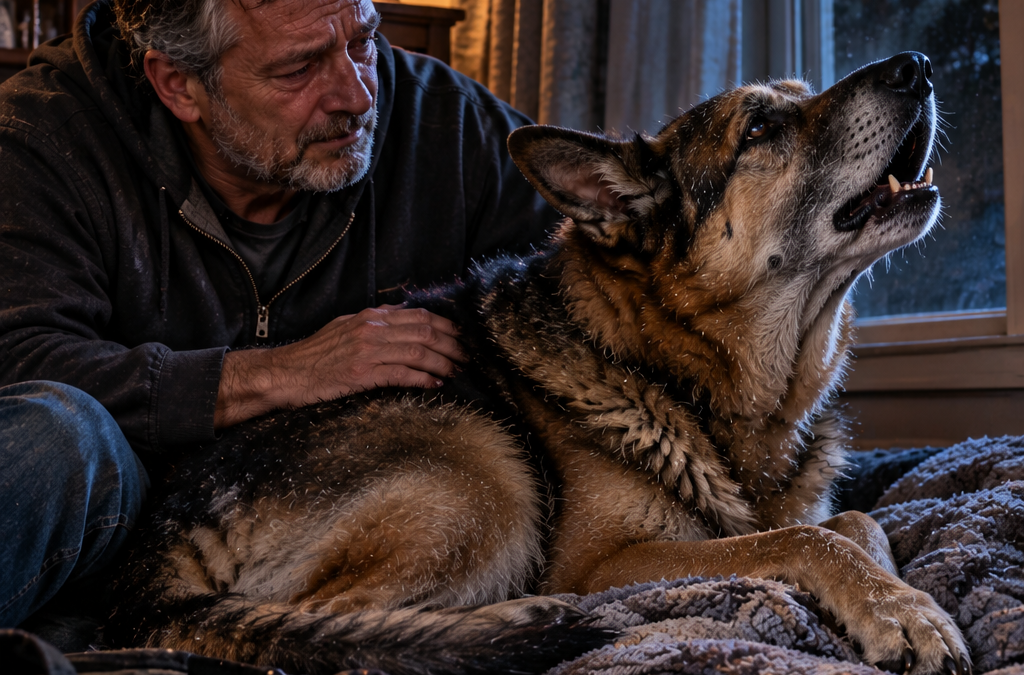
He followed Rebecca around the house, watched Ellen cook dinner, and insisted on sleeping close enough to hear me breathe.
At first, we placed his bed in the laundry room.
He tolerated that arrangement for approximately eleven minutes.
Then he began whining.
I went downstairs.
He was sitting beside the door, waiting.
“Zeus, it’s bedtime.”
He looked at me.
“Your bed is right there.”
Nothing.
I pointed.
“Bed.”
He stood, walked to the bed, turned around twice, then immediately followed me when I started toward the stairs.
I sighed.
“You’re impossible.”
He wagged his tail.
Eventually, we moved his bed beside ours.
That solved the problem.
From then on, every night before going to sleep, Zeus looked up from his bed until I said the same words.
“Everybody’s home, partner.”
Only then would he lower his head.
For years, I thought it was just a habit.
I didn’t understand how important those words would become.
Our first year together was exhausting.
We worked night shifts, trained constantly, and responded to everything from burglary alarms to missing-person searches.
Zeus learned quickly.
He also learned how to make me laugh when I needed it.
If I dropped my gloves, he’d pick them up.
If I left a sandwich unattended, he’d steal it.
And if I sat too long in the patrol car without speaking, he’d push his muzzle through the gap behind my seat until I acknowledged him.
He hated being ignored.
But he had one strange habit I never quite understood.
Whenever we parked somewhere dark, he watched me closely until I turned on the small amber lamp mounted near the center console.
It wasn’t part of our emergency lighting system.
It was a low, adjustable light I’d installed so I could read paperwork without flooding the interior with bright white light.
It gave the cabin a warm glow.
Zeus would look toward it, then toward me.
And eventually, he’d settle.
During long nighttime assignments, the amber light became part of our routine.
I’d park somewhere quiet.
Turn it on.
Complete my reports.
And Zeus would lie behind me, resting his head against the seat.
Sometimes we’d spend an hour that way.
Rain tapping against the windows.
The radio murmuring quietly.
My pen moving across paperwork.
The steady sound of Zeus breathing behind me.
Those were peaceful moments in a career that rarely offered much peace.
I remember one winter night especially clearly.
We had spent almost seven hours searching for a missing elderly woman with dementia.
Her family reported that she’d wandered away from home without a coat.
Snow was falling heavily.
The temperature was dropping.
We searched wooded areas, backyards, and narrow streets where the snow had erased almost every visible track.
Zeus finally located her beneath a covered porch behind an abandoned house.
She was confused and dangerously cold, but alive.
When paramedics took her to the hospital, her son hugged me so tightly I could barely breathe.
“Thank you,” he kept saying. “Thank you.”
I looked toward Zeus.
He was sitting beside the patrol car, watching me.
“Thank him,” I told the man.
The son knelt and wrapped his arms around Zeus.
My dog accepted the embrace with the quiet dignity of a creature who had already decided the next important thing in life was dinner.
Later that night, after the paperwork was finished, I sat in the patrol car with the amber lamp glowing beside me.
My hands were shaking.
Not from the cold.
From the realization of how close we’d come to finding that woman too late.
I rested my forehead against the steering wheel.
Zeus moved behind me.
His tags jingled.
Then his nose pressed against my shoulder.
I turned.
“Hey, buddy.”
He watched me.
I reached through the opening and stroked his muzzle.
“Good work tonight.”
His tail tapped the rear seat.
I looked toward the amber light.
Then back at him.
“Everybody’s going home.”
Zeus sighed and lowered his head.
I didn’t know then that the small lamp, those words, and the sight of me sitting close would become connected in his memory.
All I knew was that, at the end of difficult nights, we were together.
And that seemed like enough.
Over the next eleven years, Zeus and I developed a kind of understanding that I can’t fully explain to someone who has never worked with a dog.
It wasn’t mind reading.
It wasn’t magic.
It was thousands of hours spent paying attention to each other.
I knew the difference between the way Zeus breathed when he was searching and the way he breathed when he was frightened. I knew when his ears moved toward a distant sound and when he was simply annoyed by a fly.
And he knew me just as well.
He knew when I was pretending I wasn’t tired.
He knew when I was worried about a call.
He knew that when I grew very quiet, something was usually wrong.
During our sixth year together, we responded to a missing-child call that changed the way I thought about fear.
A seven-year-old girl named Sophie Miller had disappeared during a family gathering at a campground outside town.
The evening was cold and rainy. The campground bordered several hundred acres of wooded hills, and the search teams were struggling to cover the terrain before darkness fell.
Sophie’s father met us near the campground entrance.
He was shaking so badly he could barely hold the little pink jacket he gave me.
“She’s afraid of dogs,” he told me.
I glanced at Zeus.
“Okay.”
“Really afraid. A neighbor’s dog knocked her down when she was four.”
I nodded.
“Thanks for telling me.”
Zeus took the scent from the jacket and started working.
For nearly ninety minutes, we moved through wet brush and narrow trails. Twice, he stopped to investigate areas where Sophie might have passed. Then he followed the scent toward a steep gully.
I heard her before I saw her.
A small voice calling for her mother.
She was sitting beneath a fallen tree with one shoe missing and blood on her knee.
When Zeus appeared through the brush, she screamed.
“Get it away!”
He stopped immediately.
I gave him a quiet command to stay.
Then I moved toward her alone.
“Hey, Sophie. I’m Officer Hayes.”
She was crying.
“Don’t let him bite me.”
“He won’t.”
“He’s scary.”
I looked back at Zeus.
He stood completely still in the rain, watching us.
“He’s actually pretty gentle,” I said. “But he can stay right there.”
I wrapped my jacket around her and radioed our location.
While we waited for the rescue team, Sophie kept glancing toward Zeus.
“Why isn’t he moving?” she asked.
“Because I asked him to wait.”
“Does he want to come over?”
“Probably.”
“Why?”
I smiled.
“Because he likes people.”
She considered that.
Then she whispered, “Is he cold?”
I looked at Zeus.
Rain dripped from his ears.
His coat was soaked.
“Maybe a little.”
Sophie was quiet.
Then she said, “He can come closer. But not too close.”
I called Zeus forward a few feet and had him lie down.
He lowered his head between his paws.
Sophie watched him.
After several minutes, she reached toward him.
Then stopped.
“Will he move?”
“Not unless I tell him.”
She touched the top of his head.
Zeus remained still.
Her shoulders relaxed.
By the time the rescue team arrived, Sophie had one small hand resting against his ear.
She looked at me.
“I think he’s nice.”
I smiled.
“Me too.”
On the drive back to the station, Zeus lay quietly behind me.
I turned on the amber lamp.
I finished my paperwork.
Then I looked over my shoulder.
“You did good today.”
His tail moved.
“That little girl was scared of you.”
He lifted his head.
“But you gave her time.”
I smiled.
“Sometimes that’s all somebody needs.”
I had no idea that years later, I would be the one trying to comfort a frightened creature who couldn’t understand what was happening.
And I would have to learn that lesson all over again.
Zeus worked until he was twelve and a half.
By then, his muzzle was graying and his back legs had begun to stiffen after long shifts.
He still wanted to work.
That was never the problem.
His body simply couldn’t keep up with his determination.
The first serious warning came during a training exercise.
We were practicing a short obstacle course at the regional facility.
Zeus had completed the same course hundreds of times.
But when he stepped down from a low platform, his hind legs buckled.
He recovered immediately.
Then turned toward me, waiting for the next command.
I stood frozen.
The instructor beside me noticed.
“Bob?”
I shook my head.
“He slipped.”
“Maybe.”
“He’ll be fine.”
The instructor didn’t argue.
But when I took Zeus home, I noticed how slowly he climbed the porch steps.
That night, he struggled to stand after sleeping beside the couch.
I helped him up.
He leaned against me for a few seconds before walking toward his water bowl.
I remember feeling something cold move through my chest.
Zeus had always seemed indestructible.
Even after injuries, he’d recovered with an impatience that sometimes drove the veterinarians crazy.
Now I was watching him lose strength without any dramatic accident to explain it.
Just age.
Quietly taking what it wanted.
Our veterinarian, Dr. Caroline Reeves, confirmed severe arthritis in both hips and degenerative changes in his spine.
She explained that although treatment could help manage his discomfort, his working days needed to end.
I argued.
Of course I argued.
I asked about different medications, reduced assignments, rehabilitation, and more frequent rest periods.
She listened patiently.
Then she said, “Bob, what are you trying to give him?”
I frowned.
“What?”
“More work? Or more good years?”
I stared at her.
She continued.
“Zeus has served this department for eleven years. He deserves to enjoy retirement while he still can.”
I looked down at him.
He was lying on the examination-room floor with his head on my boot.
He trusted me completely.
And I realized I was so frightened of losing our working life that I was almost willing to ask him to endure pain to preserve it.
I scheduled his retirement.
The department held a ceremony on a sunny Thursday morning.
There were photographs, speeches, and a large cake that Zeus was not allowed to eat.
Our police chief presented him with a commendation.
Several officers who had worked beside us came to say goodbye.
Rebecca drove home from college for the occasion.
She stood beside Ellen, crying as the chief read a summary of Zeus’s service.
Eleven years.
Hundreds of deployments.
Missing-person searches.
Evidence recoveries.
Dangerous arrests.
Lives saved.
I stood with one hand resting on his head, struggling to keep my expression steady.
Then the chief handed me the microphone.
I had written a speech.
It was folded in my pocket.
I never took it out.
Instead, I looked down at Zeus.
He was watching the crowd with the patient seriousness he’d always displayed during ceremonies.
I smiled.
“Most of you know Zeus as a police dog.”
I paused.
“Some of you know him as the animal who stole half the sandwiches at last year’s department picnic.”
People laughed.
I swallowed.
“But I know him as the partner who came to work with me every day and never once asked whether the job was worth the risk.”
My throat tightened.
“He just trusted me.”
I looked down.
“And I hope I was worthy of that.”
Zeus leaned against my leg.
I couldn’t continue.
The officers stood and applauded.
I removed his black police harness.
Replaced it with a blue collar.
And bent close to his ear.
“You’re done, buddy.”
He looked at me.
“No more shifts.”
His tail moved.
I tried to smile.
“You’re going home.”
For the next three and a half years, he did exactly that.
He came home.
And slowly, our lives became smaller.
I retired from the department not long after he did.
Ellen and I began spending more time together. We traveled a little, visited Rebecca and her husband, and discovered that retirement was much less relaxing when you had no idea what to do with yourself.
Zeus seemed to enjoy it.
He loved our backyard.
He loved lying beneath the oak tree while Ellen gardened.
And he loved slow morning walks through the neighborhood.
He also discovered a talent for convincing people he hadn’t been fed.
I’d give him breakfast at seven.
At seven-fifteen, he’d approach Ellen with an expression of heartbreaking starvation.
She would look at him.
“Didn’t your father feed you?”
Zeus would stare.
She’d turn toward me.
“Bob?”
I’d shout from the kitchen, “Don’t fall for it!”
She usually did anyway.
Those were good years.
Not perfect.
His arthritis worsened, and eventually we needed a support harness to help him navigate the porch steps.
But he still enjoyed life.
He still recognized our routines.
He still rested his head against my knee when he wanted attention.
And at night, before sleeping, he still looked up at me until I said the words he’d heard since he was young.
“Everybody’s home, partner.”
Then he’d close his eyes.
I thought we had found a way to grow old together.
I hadn’t considered that there were different kinds of aging.
Different things that could disappear.
The first time Zeus failed to recognize our bedroom, I was standing in the hallway holding a basket of laundry.
It was early autumn.
He had been sleeping in the living room, and I called him to join me upstairs.
He stood.
Walked toward the hallway.
Then stopped at the bottom of the stairs.
His head moved slowly from side to side.
“Come on, Zeus.”
He didn’t respond.
I walked down to him.
“Hey, buddy.”
He looked at me.
For a moment, there was no recognition in his face.
Then I touched his shoulder.
His tail moved.
I guided him toward his bed on the ground floor, where he could sleep without using the stairs.
I told Ellen about it that evening.
She frowned.
“Maybe he didn’t hear you.”
“Could be.”
“His hearing’s getting worse.”
“I know.”
We dismissed it.
But two weeks later, I found him standing in the laundry room, facing the wall.
He had been there long enough that his hind legs were trembling.
I crouched beside him.
“Zeus?”
He startled.
Then turned toward my voice.
I guided him away from the wall.
He followed me into the kitchen and accepted a treat.
Again, the moment passed.
Again, I pretended it wasn’t important.
Then he began waking at night.
At first, it happened once or twice a week.
He would stand beside his bed, whining softly.
I’d assume he needed to go outside.
I’d help him into the yard.
He would sniff the grass, sometimes relieve himself, then return to bed.
But soon he began whining even after he’d been outside.
Then he started pacing.
Slowly.
Painfully.
He would walk from his bed to the hallway, pause, turn around, and return.
Sometimes he became trapped behind furniture.
Other times, he stood in the middle of the room with his eyes wide, staring into darkness.
I tried moving his bed.
I tried different blankets.
I gave him a late-night snack.
I checked his water.
Nothing helped consistently.
One night, at 12:07, he began crying so loudly that Ellen came downstairs in her robe.
“Bob, what’s wrong with him?”
I was kneeling beside Zeus.
“I don’t know.”
“Did he go outside?”
“Twice.”
“Did he eat?”
“Yes.”
“His hips?”
“I checked. He isn’t reacting the way he usually does when they’re hurting.”
She crouched beside me.
Zeus was trembling.
His head moved from side to side.
Ellen stroked his neck.
“Hey, sweetheart.”
He flinched.
She pulled her hand back.
“Oh.”
Her eyes filled.
“Bob…”
I looked at her.
She shook her head.
“He didn’t know it was me.”
I wanted to deny it.
I wanted to say she had startled him because his hearing was poor.
That he’d been half asleep.
That it meant nothing.
But I had seen the same thing.
And I knew we were losing something that medication couldn’t easily bring back.
The following morning, I called Dr. Reeves.
She examined Zeus carefully.
She reviewed his medications, evaluated his pain, checked for signs of infection or other medical problems, and asked detailed questions about his behavior.
When I described the nighttime crying, she became quiet.
“Has he started staring at walls?”
I nodded.
“Sometimes.”
“Getting trapped behind furniture?”
“Yes.”
“Does he seem confused about where he is?”
I looked down.
“At night, mostly.”
She took a breath.
“Bob, I’m concerned Zeus may be developing canine cognitive dysfunction.”
I stared at her.
“What does that mean?”
“It’s a condition that affects some older dogs. It can involve changes in memory, awareness, sleep patterns, and behavior.”
I looked toward Zeus.
He was lying beside my chair.
His breathing was calm.
“So he’s forgetting things?”
“Possibly. We’re seeing signs that fit, although we have to consider his vision, hearing, discomfort, and other health issues too.”
I swallowed.
“Is it like Alzheimer’s?”
“There are similarities, though they aren’t identical conditions.”
I looked down at his gray muzzle.
“He still knows me.”
Dr. Reeves’s expression softened.
“I’m sure he often does.”
I shook my head.
“No. He knows me.”
She leaned forward.
“Bob, a dog can still recognize familiar people and routines while experiencing confusion at other times. Those things aren’t mutually exclusive.”
I looked away.
My throat tightened.
“Can you fix it?”
She paused.
“We can try to reduce his anxiety and improve his comfort. There are supportive treatments, environmental changes, and sometimes medications that help. But we can’t promise to reverse the underlying changes.”
I stared at my hands.
“He’s already lost so much.”
She placed a hand on my arm.
“I know.”
“His hips. His hearing. His eyesight.”
My voice broke.
“And now this?”
She didn’t answer immediately.
Then she said, “Bob, I want you to remember something. Zeus isn’t choosing to become confused. If he seems frightened, it’s because the world may genuinely feel unfamiliar to him.”
I looked toward him.
He was watching the door.
She continued.
“He needs predictable routines, safe surroundings, and reassurance. And we need to keep monitoring his quality of life.”
I nodded.
But all I could think about was the dog who had once navigated miles of unfamiliar terrain using a single scent.
Now he sometimes couldn’t find his way around our living room.
We went home with a revised care plan.
I was determined to make it work.
I wrote down his medication schedule.
Bought nonslip mats for the hallway.
Blocked off the narrow space behind the couch where he sometimes became trapped.
Kept his water bowl in the same location.
And established a strict bedtime routine.
Every evening, I fed him at six.
Helped him outside at nine.
Gave him his prescribed medication.
Brushed his coat.
Then settled him on the orthopedic bed beside the living-room couch.
I sat beside him until he seemed comfortable.
Before going upstairs, I leaned close and said, “Everybody’s home, partner.”
Some nights, he slept peacefully.
But others were terrible.
And as November arrived, the terrible nights began coming more often.
Zeus would wake shortly after midnight.
Cry.
Pace if he could stand.
Sometimes he pressed his nose against the wall.
Sometimes he looked toward the hallway as though he expected someone to appear.
I tried leaving the television on.
The sound seemed to confuse him.
I tried playing soft music.
It made no difference.
I tried sitting with him until he fell asleep, then quietly returning upstairs.
Within minutes, he began crying again.
At first, I thought he was developing separation anxiety.
But even when I stayed nearby in the dark, he sometimes continued whining.
I couldn’t understand it.
I was there.
He could smell me.
He could hear my voice, at least when I spoke loudly enough.
Why didn’t he settle?
One night, after he cried for more than an hour, I lost my patience.
Not with him exactly.
With everything.
The lack of sleep.
The helplessness.
The fear.
I stood in the middle of the living room and shouted, “Zeus, please!”
He startled violently.
His ears flattened.
His body lowered.
And he looked at me with such naked confusion that I felt sick.
I dropped to my knees.
“Oh, buddy.”
My voice broke.
“I’m sorry.”
I reached toward him slowly.
He hesitated.
Then pushed his muzzle against my hand.
I wrapped my arms around his neck.
“I’m sorry. I’m so sorry.”
I had spent eleven years teaching him that my voice meant safety.
And now, in one exhausted moment, I’d made him afraid of it.
I held him until my breathing slowed.
Then I whispered, “You don’t have to understand what’s happening, buddy.”
Tears ran down my face.
“I just wish I did.”
Ellen found me there a little after two.
I was sitting on the floor with Zeus’s head in my lap.
She knelt beside us.
“Bob?”
I couldn’t answer.
She touched my shoulder.
“You’re exhausted.”
I nodded.
“You can’t keep doing every night alone.”
“I promised I’d take care of him.”
“You are taking care of him.”
I shook my head.
“Doesn’t feel like it.”
She sat beside me.
“He’s sixteen, Bob.”
“I know how old he is.”
My voice came out harsher than I intended.
Ellen flinched.
I closed my eyes.
“Sorry.”
She took my hand.
“Listen to me. You love him. Nobody doubts that. But you need rest, too.”
I stared at Zeus.
He was finally quiet.
She continued.
“We can take turns. We can talk to Dr. Reeves again. We can get help.”
I shook my head.
“I don’t want him waking up alone.”
“He isn’t alone.”
I looked at her.
She brushed my cheek with her fingers.
“But right now, you’re acting like if you sleep, you’re abandoning him.”
I tried to speak.
Nothing came out.
She leaned closer.
“Bob, you’re allowed to be tired.”
I looked down at Zeus.
His eyes were closed.
His breathing was slow.
And I realized that for the first time in my life, I was afraid of going to sleep.
Because every night, I wondered whether he’d wake up frightened.
Whether he’d forget where he was.
Whether he’d need me and I wouldn’t hear him.
Or whether one morning, I’d come downstairs and find that my old partner had died without anyone beside him.
I lowered my head.
“I’m scared, Ellen.”
She wrapped her arms around me.
“I know.”
I began crying.
“I don’t want him to die thinking he’s alone.”
She held me tightly.
“He won’t.”
But I didn’t know whether she could promise that.
And neither did she.
The following afternoon, Rebecca came over.
She found me asleep in the recliner with a half-finished cup of coffee balanced against my stomach.
I woke when she touched my shoulder.
“Dad?”
I blinked.
“What time is it?”
“Almost three.”
I sat upright.
“Zeus?”
“He’s okay. Mom’s with him.”
I rubbed my face.
Rebecca sat on the edge of the coffee table.
She was thirty now, married, and raising a little girl of her own. But at that moment, I saw the fourteen-year-old who had once curled up beside Zeus on the floor because she couldn’t bear to leave him alone.
“Mom says you’re not sleeping.”
“I’m sleeping.”
She raised an eyebrow.
“Three hours a night isn’t sleeping.”
I sighed.
“He’s having a hard time.”
“I know.”
I looked toward the living room.
“He’s scared, Becca.”
Her expression softened.
“I know, Dad.”
“I keep trying everything.”
She reached for my hand.
“Maybe you don’t have to figure it out all at once.”
I shook my head.
“You don’t understand. He wakes up and looks around like he doesn’t know where he is. Sometimes he doesn’t recognize me right away.”
My voice broke.
“Can you imagine what that must feel like?”
Rebecca was quiet.
Then she asked, “Do you remember when I was six and had that terrible fever?”
I frowned.
“Which time?”
“The one when I woke up crying because I didn’t recognize my bedroom.”
I thought for a moment.
Then I remembered.
She’d had a high fever and a frightening dream. I’d heard her screaming from the hallway and rushed in.
She’d been sitting upright in bed, terrified.
I turned on her lamp.
Sat beside her.
And held her until she recognized me.
Rebecca smiled sadly.
“You kept telling me where I was.”
I nodded.
“Yeah.”
“And you left my lamp on all night.”
I stared at her.
She squeezed my hand.
“Maybe Zeus needs something familiar when he wakes up.”
I thought about it.
“We’ve tried lights.”
“Maybe not the right kind.”
I looked toward the window.
I wanted that to be the answer.
But by then, I’d become afraid of hoping too much.
Every small improvement seemed to disappear a few nights later.
I thanked Rebecca.
Then we went into the living room.
Zeus was asleep beside Ellen.
Rebecca knelt carefully and stroked his shoulder.
“Hey, big guy.”
His ears moved.
He opened his eyes.
For a moment, he stared at her.
Then his tail began thumping against the blanket.
Rebecca smiled through tears.
“There you are.”
She pressed her forehead against his.
“I remember you, too.”
That evening, I went into the garage looking for a spare battery lantern.
The hallway night-light we’d tried had been too dim to illuminate Zeus’s bed clearly, and the overhead lights seemed harsh when he woke.
I wanted something softer.
Something I could leave on without disturbing Ellen’s sleep.
The garage was crowded with the usual evidence of a man who had spent a lifetime convincing himself he might someday need every broken tool he owned.
Old fishing rods.
Paint cans.
Boxes of Christmas decorations.
A lawnmower I’d promised to repair two summers earlier.
And along the far wall, several cardboard boxes filled with things I’d brought home when I retired.
Police manuals.
Old notebooks.
Training photographs.
Equipment that no longer had any practical purpose.
I hadn’t opened most of those boxes in years.
I pulled one onto the workbench.
Dust rose into the air.
Inside was my old leather notebook cover, a cracked coffee mug, a spare radio charger, and the emergency flashlight I used to keep in the patrol vehicle.
Then I saw it.
A small amber task lamp.
The same one I’d mounted beside the console during my years with Zeus.
I’d removed it from the vehicle when the department replaced the patrol fleet, then later used it with a portable power supply during training events. I’d checked and recharged the power supply only a few weeks earlier while cleaning the garage.
The lamp was scratched.
Its plastic casing had yellowed slightly.
A strip of electrical tape held one side of its adjustable neck together.
I smiled when I picked it up.
“Well, look at you.”
I turned it over in my hands.
I remembered filling out reports beneath its warm light.
Eating cold sandwiches while waiting for backup.
Listening to rain strike the roof of the cruiser.
And watching Zeus settle behind my seat after long nights.
I almost put it back.
Then I remembered Rebecca’s suggestion.
I carried the lamp and its power supply into the house.
I wasn’t expecting a breakthrough.
I simply wanted to see whether the amber light would be less startling than the overhead lamps.
I placed it on the small table beside my recliner.
Then I went upstairs to help Ellen with dinner.
At 11:45, Zeus was sleeping peacefully.
I sat beside him for a while.
Stroked his head.
Checked that his water was within reach.
Then I lowered the lights.
Ellen had gone to bed.
I stayed downstairs.
At 12:07, the crying began.
It started with a soft whine.
Then another.
Zeus lifted his head.
His eyes moved across the dark living room.
He began trembling.
I leaned forward.
“Hey, buddy.”
He didn’t settle.
I touched his shoulder.
He flinched.
My chest tightened.
“Zeus. It’s me.”
He stared toward the kitchen.
Then the hallway.
His breathing quickened.
I tried speaking softly.
Nothing.
I checked his position, made sure nothing was pressing painfully against his hips, and offered water.
He turned away.
Then he began crying harder.
The sound filled the room.
I sat back in the recliner, overwhelmed.
“Please, Zeus.”
He continued.
I reached toward the small table for my reading glasses.
My elbow bumped the amber lamp.
I caught it before it fell.
As I adjusted its neck, my thumb brushed the old switch.
A warm golden light spilled across the room.
It illuminated the side of my face.
The arm of the recliner.
The blanket covering my knees.
And the place where Zeus was lying.
His crying stopped.
Instantly.
I froze.
For several seconds, there was no sound except the ticking of the kitchen clock.
Zeus lifted his head.
His cloudy eyes searched the room.
Then he looked straight at me.
Not past me.
Not toward the hallway.
At me.
His ears shifted forward.
His trembling eased.
I leaned down.
“Zeus?”
His tail moved once.
Then he made a small, breathy sound.
Not a cry.
Something softer.
Almost a sigh.
I couldn’t move.
He kept looking at me.
I reached out my hand.
This time, he didn’t startle.
He pressed his muzzle against my fingers.
And suddenly, I remembered.
The patrol car.
The amber lamp.
The way he’d watched me from the back seat while I wrote reports.
The way he relaxed when I turned and spoke to him.
The thousands of nights when that little light meant we were parked somewhere safe, resting between calls.
I looked at the lamp.
Then at my old dog.
“Oh, buddy.”
My throat tightened.
“Is that what you’ve been looking for?”
Zeus kept his eyes on me.
I moved closer.
He leaned toward my hand.
And there, in the soft amber glow, the expression of fear finally disappeared from his face.
I knelt beside him.
My hands were shaking.
“You couldn’t see me.”
Tears gathered in my eyes.
“You woke up, and you couldn’t figure out where I was.”
I knew I couldn’t be certain of everything happening inside his aging mind. Dr. Reeves had warned us that changes in vision, hearing, sleep, and cognition could all contribute to his nighttime distress.
But in that moment, his reaction told me something important.
He could recognize me more easily when the room was softly illuminated.
And he seemed reassured by seeing me seated close beside him.
The darkness that had surrounded him every night no longer looked quite so empty.
I stroked his head.
“I’m right here, partner.”
Zeus lowered his muzzle against my palm.
His breathing slowed.
He closed his eyes.
Within minutes, he was asleep.
I remained kneeling beside him.
And I cried.
Not because I’d cured him.
I hadn’t.
His arthritis was still there.
His hearing was still fading.
His memory was still changing in ways I couldn’t stop.
But after weeks of watching him wake up frightened, I had finally found something that helped him feel safe.
I looked toward the old lamp.
Its golden glow spread softly across the living room.
And I remembered a younger Zeus lying behind my patrol seat after a long night, watching me beneath that same warm light.
I smiled through tears.
“Everybody’s home, partner.”
His tail tapped the blanket.
Then he slept.
For nearly five hours.
I sat beside him the entire time.
I didn’t dare move.
When Ellen came downstairs at six, she stopped in the doorway.
She looked at the lamp.
Then at Zeus.
Then at me.
“Bob?”
I turned.
She whispered, “Has he been sleeping?”
I nodded.
“Almost all night.”
Her eyes widened.
“How?”
I looked at the amber light.
Then down at our old dog.
“I think he needed to see me.”
Ellen crossed the room.
She sat beside me.
I explained everything.
The lamp.
The crying.
The moment he’d lifted his head.
The way he’d stopped trembling when the light illuminated my face.
She listened silently.
Then she reached toward Zeus.
He opened his eyes.
Recognized her.
And moved his tail.
Ellen began crying.
“Oh, sweetheart.”
She stroked his gray muzzle.
I looked at the little lamp.
For years, it had meant nothing more than a convenient way to complete paperwork in the dark.
Now it felt like a bridge between two versions of my best friend.
The young K9 who had trusted me through dangerous nights.
And the old dog who sometimes couldn’t remember where he was.
Ellen rested her head against my shoulder.
“You found him,” she whispered.
I looked down at Zeus.
His eyes were closing again.
I shook my head.
“No.”
I took his paw gently in my hand.
“He helped me find him.”
The next morning, I called Dr. Reeves.
I told her exactly what had happened.
She listened carefully.
Then she said, “That’s encouraging, Bob.”
I sat at the kitchen table with Zeus sleeping nearby.
“So you think he remembered the patrol car?”
“Possibly. Familiar sensory cues can sometimes help an older dog feel oriented and secure. The lighting may also make it easier for him to recognize you.”
I nodded.
“He stopped crying the moment he could see me.”
“Then keep using it, as long as it’s safe and comfortable for him.”
I looked toward the living room.
“Do you think he’s afraid of being left alone?”
She paused.
“He may become distressed when he wakes and can’t identify his surroundings or locate you. We can’t know exactly what he experiences, but his response suggests your visible presence is reassuring.”
I swallowed.
“Even after all these years?”
Her voice softened.
“Especially after all these years.”
We discussed his care plan again.
She reminded me that the light wouldn’t reverse the cognitive changes and that we needed to keep monitoring his pain, breathing, appetite, mobility, and overall quality of life.
I understood.
But that morning, for the first time in weeks, I felt something other than helplessness.
I had found a way to comfort him.
And I intended to keep doing it for as long as he needed me.
That afternoon, I moved the recliner closer to Zeus’s bed.
Not across the room.
Not beside the television.
Right next to him.
Close enough that I could reach down and touch his shoulder without standing.
I placed the amber lamp on the table beside the chair, secured its cord, and adjusted the light so it illuminated my face and the area around his bed without shining directly into his eyes.
Ellen watched from the doorway.
“You’re moving in?”
I smiled.
“Looks that way.”
She folded her arms.
“Your back is going to hate you.”
“My back already hates me.”
She laughed.
Then her expression softened.
“You don’t have to do every night alone.”
I nodded.
“I know.”
“And if you need to sleep upstairs, I’ll sit with him.”
I reached for her hand.
“Thank you.”
She looked at Zeus.
He was watching me rearrange the blankets.
“You two have always had your own little world.”
I smiled sadly.
“Yeah.”
She rested her head against my shoulder.
“Just don’t forget the rest of us are here, too.”
I kissed her forehead.
“I won’t.”
That night, I settled into the recliner just before eleven.
Zeus lay beside me.
The amber light glowed softly.
I stretched one hand toward him.
He lifted his paw.
Not much.
Only enough for me to slide my fingers beneath it.
I held it gently.
His breathing slowed.
“Everybody’s home, partner.”
He closed his eyes.
At 12:07, I woke automatically.
For weeks, my body had learned to expect the crying.
I sat upright.
Looked at the clock.
Then down at Zeus.
He was awake.
His cloudy eyes were open, and he was looking at me.
But he wasn’t whining.
He wasn’t trembling.
He simply watched me for a moment.
I smiled.
“Hey, buddy.”
His tail tapped the blanket.
I squeezed his paw gently.
“Right here.”
He lowered his head.
And went back to sleep.
I sat there in the quiet living room, listening to the soft ticking of the clock.
For the first time in weeks, midnight passed without fear.
It wasn’t a cure.
There were still difficult nights.
Sometimes Zeus woke disoriented despite the light. Sometimes arthritis made it hard for him to settle. Occasionally, his breathing became uncomfortable and I had to help him change position or call Dr. Reeves for advice.
But the crying no longer ruled every night.
Most evenings, when he woke and saw me sitting beside him, he relaxed.
Sometimes all I needed to do was speak.
Other times, I reached down and touched his paw.
Eventually, he began falling asleep with one front paw resting against my hand.
It became our new ritual.
For eleven years, he’d watched over me in the patrol car.
Now I watched over him in the living room.
And slowly, I stopped thinking of those hours as something I had to endure.
I began thinking of them as time we’d been given.
One evening, Rebecca visited with my granddaughter, Lily.
Lily was four and absolutely adored Zeus.
She approached his bed carrying a small pink blanket.
“Grandpa?”
“Yeah, sweetheart?”
“Is Zeus cold?”
I smiled.
“Sometimes.”
She looked down at the blanket.
“Can he have this?”
I nodded.
“Of course.”
She carefully placed it over his back.
Zeus lifted his head.
Lily crouched.
“Goodnight, Zeus.”
He sniffed her hand.
She smiled.
Then she looked at me.
“Grandpa, why do you sleep in the chair?”
I glanced at Rebecca.
Her eyes were already wet.
I looked back at Lily.
“Because Zeus gets scared sometimes when he wakes up.”
She frowned.
“But you’re right here.”
I nodded.
“That’s right.”
She considered that.
Then she reached for my hand.
“Then he doesn’t have to be scared.”
My throat tightened.
“No, sweetheart.”
I looked at the old dog resting beneath her pink blanket.
“He doesn’t.”
After they left, I sat in the recliner and thought about what Lily had said.
Four years old.
She understood something that had taken me weeks of sleepless nights to recognize.
Zeus didn’t need me to make the darkness disappear.
He needed help finding something familiar inside it.
The following weeks passed quietly.
December arrived.
Snow covered the backyard.
Ellen hung Christmas lights along the porch.
Rebecca brought Lily over to decorate the tree.
Zeus spent most of his days sleeping, but he still enjoyed small moments.
He liked the smell of chicken cooking.
He liked the warmth of the fireplace.
He liked when Lily sat beside him and read picture books aloud.
And at night, he liked the amber lamp.
Sometimes, while I sat beside him, I thought about the young dog I’d met at the training facility fifteen years earlier.
The one who had approached me cautiously.
Sniffed my pocket.
And decided a tennis ball was enough reason to give me a chance.
I thought about all the times he’d protected me.
The nights he’d stayed alert while I was exhausted.
The searches he’d completed when my own senses couldn’t tell me where to go.
The frightened people he’d found.
And the quiet moments in the patrol car when we’d sat together beneath that warm golden light.
Back then, I’d thought I was taking care of him.
Now I understood how much he’d been taking care of me.
One night, while snow tapped softly against the window, I spoke to him about it.
“Remember the old cruiser, buddy?”
His ears shifted.
“Unit Twenty-Seven.”
I smiled.
“That thing had two hundred thousand miles on it by the time they replaced it.”
Zeus rested his head against his blanket.
“The heater barely worked. The driver’s window got stuck every winter. And you somehow managed to leave enough hair in the back seat to make three more dogs.”
I laughed softly.
He moved his tail.
“But we had some good nights in there.”
My voice became quieter.
“Some hard ones, too.”
I stroked his paw.
“Remember how I’d turn on this light and tell you everybody was going home?”
His eyes opened slightly.
I leaned closer.
“Well, buddy, everybody’s home now.”
He watched me.
“Nobody’s waiting for us to answer another call.”
I swallowed.
“You can rest.”
Zeus closed his eyes.
And I stayed beside him until morning.
After Christmas, his health began declining more rapidly.
He ate less.
His legs became weaker.
There were days when he could barely lift his head.
His cognitive confusion grew more frequent, even during daylight.
Sometimes he looked toward me and hesitated before recognizing my voice or touch.
But at night, the familiar routine still helped him.
The lamp.
The chair.
My hand beneath his paw.
It didn’t always remove his discomfort, but it gave him moments of peace.
I held on to those moments.
Perhaps too tightly.
One afternoon, Dr. Reeves came to examine him at home.
She listened to his heart and lungs, checked his joints, and reviewed the notes I’d been keeping about his good and bad days.
When she finished, she sat beside me.
“Bob, I want to talk about where we are.”
I looked down at Zeus.
“He’s getting worse.”
She nodded.
“Yes.”
I stared at my hands.
“How much time?”
“It’s difficult to predict. But his quality of life is declining, and I think we’re getting close to the point where we need to help him pass peacefully.”
I closed my eyes.
“I know.”
She waited.
I swallowed.
“I just wanted him to have a few more good nights.”
Her voice softened.
“I understand.”
I looked toward the amber lamp.
“He finally stopped being afraid.”
Dr. Reeves placed a hand on my shoulder.
“And that’s a beautiful thing you’ve been able to give him.”
I looked at her.
“But we can’t let that become the reason we ask him to endure more than he should.”
The words hurt.
Because they were true.
I had been so focused on helping Zeus feel safe at night that I was struggling to accept how much his body was failing during the day.
He could no longer enjoy the backyard.
He barely ate.
Getting comfortable had become difficult.
And even when he recognized me, he often looked exhausted.
Dr. Reeves spoke gently.
“Bob, the most loving thing you can do now may be to make sure his final morning is peaceful.”
I looked down at Zeus.
He was lying beside the chair.
His cloudy eyes were open.
He was watching me.
For fifteen years, he’d trusted me to decide where we went and when it was safe to stop.
Now I had one last decision to make.
I reached down and touched his paw.
“Okay,” I whispered.
Dr. Reeves nodded.
We arranged for her to return the following morning.
She would come to the house.
Zeus wouldn’t have to travel.
He could remain on his bed, beneath the soft amber light, with the people he loved surrounding him.
That evening, Rebecca came home.
She brought Lily, who kissed Zeus’s forehead and gave him one final drawing.
It showed a large brown dog standing beside a man in a blue police uniform.
Above them, in crooked purple letters, she’d written:
GRANDPA AND ZEUS.
I held the picture for a long time.
Then I placed it on the table beside the lamp.
After Lily went home with her father, Rebecca stayed.
She sat on the floor beside Zeus and cried quietly.
Ellen brought blankets.
We talked about old memories.
The time Zeus stole an entire Thanksgiving turkey breast from the counter.
The summer he jumped into the swimming pool after Rebecca, convinced she needed rescuing.
The afternoon he fell asleep during a department awards ceremony and began snoring loudly enough to interrupt the police chief.
We laughed.
Then we cried.
Then we laughed again.
Around ten, Zeus became tired.
Rebecca kissed his forehead.
“Goodnight, sweetheart.”
Ellen stroked his ears.
“We love you, old boy.”
Then she looked at me.
“Are you coming upstairs?”
I shook my head.
“Not tonight.”
She nodded.
She knew.
She kissed me.
Then went upstairs with Rebecca.
I settled into the recliner.
Adjusted the amber lamp.
And reached down for Zeus’s paw.
He placed it in my hand.
I swallowed.
“Hey, partner.”
His eyes moved toward me.
I smiled through tears.
“Looks like we’ve got one more night shift.”
His tail moved faintly.
I leaned back.
“Don’t worry. I’ll handle the paperwork.”
For a while, I talked to him.
About our first day.
About Dennis Cole.
About Rebecca growing up.
About the searches.
The patrol car.
The hundreds of nights we’d spent together.
Then I grew quiet.
The clock reached midnight.
12:01.
12:05.
12:07.
Zeus opened his eyes.
He looked toward the amber light.
Then at me.
I smiled.
“Right here, buddy.”
His tail tapped the blanket once.
I squeezed his paw gently.
“Everybody’s home.”
He lowered his head.
And went back to sleep.
I cried silently.
Not because he was frightened.
Because he wasn’t.
After so many terrible nights, my old partner was resting peacefully.
And I knew it would be our last one together.
Around three in the morning, he stirred.
I leaned forward.
“Hey, Zeus.”
He looked at me.
His eyes seemed tired.
I stroked his head.
“You remember when you used to watch over me?”
His ears shifted.
I smiled sadly.
“Well, it’s my turn now.”
He rested his muzzle against my knee.
I bent down and kissed the top of his head.
“You don’t have to worry about anything anymore.”
My voice broke.
“I’ve got you.”
For the rest of the night, I barely slept.
I held his paw.
Listened to him breathe.
And watched the soft amber light fall across his face.
Just before sunrise, the sky outside turned pale blue.
Snow covered the lawn.
The world was still.
Zeus opened his eyes one more time.
He looked toward me.
I leaned close.
“Morning, partner.”
His tail moved.
Just once.
I smiled through tears.
“Good morning, buddy.”
He pressed his muzzle weakly against my hand.
Then rested his head again.
At eight-thirty, Dr. Reeves arrived.
Ellen and Rebecca sat beside us.
The veterinarian examined Zeus carefully, then explained what she would do.
First, medication to help him fall into a deep, peaceful sleep.
Then, when we were ready, the final medication.
I nodded.
My hand never left Zeus’s paw.
Dr. Reeves administered the first medication.
Gradually, the tension disappeared from his body.
His breathing became slower and more relaxed.
Ellen kissed his forehead.
Rebecca whispered that she loved him.
I leaned closer.
For a moment, I couldn’t speak.
Then I remembered the first night Zeus had slept beside our bed.
The young German Shepherd who had refused to settle until he knew where I was.
I smiled through tears.
“Hey, partner.”
His eyes were closed.
“You did good.”
My voice shook.
“Eleven years on duty. All those people you brought home.”
I brushed my fingers through the white fur along his muzzle.
“And fifteen years of putting up with me.”
I laughed softly.
Then I began crying.
“Thank you.”
I rested my forehead against his.
“Thank you for trusting me.”
When Dr. Reeves asked whether we were ready, I looked at Ellen.
She nodded.
Rebecca held Zeus’s other paw.
I swallowed.
Then I whispered the words he’d waited to hear every night of his life.
“Everybody’s home, partner.”
I kissed his forehead.
“You can rest now.”
Dr. Reeves administered the final medication.
I held Zeus close.
I felt his breathing slow.
Then stop.
She listened carefully with her stethoscope.
After a moment, she looked at me.
“I’m so sorry, Bob.”
I closed my eyes.
My old partner was gone.
For several minutes, I couldn’t move.
I kept holding his paw.
It was warm.
So familiar.
The same paw that had crossed frozen fields.
Climbed rubble.
Scratched at my patrol car door.
Rested against my knee when I was tired.
Now it was still.
I bent over him.
And cried the way I hadn’t cried since my father died.
No badge.
No rank.
No attempt to be strong.
Just an old man holding the friend who had trusted him for almost fifteen years.
Dr. Reeves gave us all the time we needed.
When I finally lifted my head, morning sunlight was coming through the windows.
The amber lamp was still glowing beside the chair.
I reached toward it.
Then stopped.
For weeks, I’d used that light to help Zeus recognize where he was.
Now I wasn’t ready to turn it off.
Ellen sat beside me.
She placed her hand over mine.
“Bob?”
I looked at her.
She glanced toward the lamp.
“It’s okay.”
I swallowed.
She squeezed my hand.
“He’s not scared anymore.”
I stared at Zeus.
At his peaceful face.
At the gray muzzle I’d kissed thousands of times.
Then I nodded.
“Yeah.”
My voice broke.
“I know.”
I turned off the lamp.
And the room filled with ordinary morning light.
The following days were harder than I expected.
I still woke automatically at midnight.
Sometimes at 12:07 exactly.
I’d sit upright in bed, certain I’d heard Zeus crying.
Then I’d remember.
And the silence would hurt all over again.
His bed remained beside my chair for nearly three weeks.
I couldn’t move it.
His water bowl stayed near the kitchen.
His leash hung beside the back door.
And the little amber lamp sat on the table where I’d left it.
One evening, Rebecca came to visit.
She found me sitting in the recliner, staring at the empty bed.
She sat beside me.
“Dad?”
I looked up.
“Yeah?”
“Do you still hear him sometimes?”
I nodded.
“Every night.”
She reached for my hand.
“I miss him, too.”
I swallowed.
“I keep thinking about those weeks when he was crying.”
She listened.
“I wasted so much time trying to figure out what was wrong.”
Rebecca shook her head.
“Dad, you were trying to help him.”
“I should’ve understood sooner.”
She squeezed my hand.
“You did understand.”
I looked at her.
“Eventually.”
She nodded.
“And he got to spend his last nights knowing you were right beside him.”
My eyes filled.
She continued.
“That’s what matters.”
I looked toward the amber lamp.
For eleven years, Zeus had watched over me during dangerous shifts.
For nearly four more, he’d waited beside my bed while we both grew older.
And at the end, when his mind could no longer make sense of familiar rooms, I’d finally learned to meet him where he was.
Not where I wished he could still be.
Not where he’d been when he was young.
But where he was.
An old dog.
A frightened dog.
A dog who needed to see a familiar face when he opened his eyes.
I reached toward the lamp.
Turned it on.
The warm golden light spread across the room.
For a moment, I could almost see him there.
His gray muzzle resting against the blanket.
One tired paw extended toward my chair.
His cloudy eyes lifting when I spoke.
I smiled through tears.
“Hey, partner.”
The room was quiet.
I looked toward the place where he used to sleep.
“Everybody’s home.”
Then I turned off the lamp.
Not because I wanted to forget him.
But because I finally understood that the promise I’d made to Zeus had been fulfilled.
He had not spent his last night lost in darkness.
He had not been left crying for someone who never came.
He had opened his eyes and found me sitting exactly where he needed me to be.
For most of our lives, Zeus had followed me wherever I asked him to go.
Across roads.
Through woods.
Into danger.
Toward people who needed help.
But during those final weeks, he couldn’t follow me anymore.
So I stopped asking.
I brought my chair to him.
I turned on the little light.
I took his tired paw in my hand.
And I stayed.
Until the final morning.
Until his breathing stopped.
Until the dog who had spent a lifetime protecting me no longer needed protection from anything.
I couldn’t give Zeus back his youth.
I couldn’t restore his memory.
And I couldn’t keep him beside me forever.
But I could make sure that when the darkness frightened him, he didn’t have to face it alone.
After thirty-four years as a police officer, that may have been the most important duty I ever performed.
And it required no uniform, no badge, and no courage beyond the willingness to remain beside someone I loved.
Just an old chair.
A small amber light.
My hand holding his.
And the promise I’d made to him on the very first night we became a family.
Everybody’s home, partner.
You can rest now.