𝗙𝗨𝗟𝗟 𝗦𝗧𝗢𝗥𝗬 My Deaf K9 Kept Watching My Hands—And I Was Terrified of What I’d Have to Tell Him
𝗙𝗨𝗟𝗟 𝗦𝗧𝗢𝗥𝗬
He obeyed immediately.
Walter smiled.
“Seems to listen just fine.”
I clenched my jaw.
“Then why does he keep refusing to follow me during the tracking exercises?”
Walter knelt beside Titan.
He scratched the dog’s chest.
“Because you keep trying to tell him where the scent is.”
I frowned.
“I’m supposed to be handling him.”
“That’s right.”
“So?”
“So handling isn’t the same as thinking for him.”
Walter stood.
“Listen, Daniel. That dog has a better nose than you, better hearing than you, and probably better instincts than you.”
I sighed.
“Anything else?”
“Yeah.”
He looked me straight in the eye.
“He needs you to understand him before you expect him to understand you.”
That sentence stayed with me for thirteen years.
But it wasn’t until Titan lost his hearing that I truly understood what Walter had been trying to teach me.
During training, we learned to communicate in two ways.
Voice commands were useful when Titan could hear me but couldn’t see me.
Hand signals were essential when we needed to work quietly or communicate across a short distance without shouting.
A raised palm meant stay.
Two fingers moving toward my eyes meant watch me.
A sweeping motion toward my chest meant come.
A flat hand lowered toward the ground meant down.
And an open hand moving outward from my chest meant the work was finished.
We called that last signal “all done.”
It wasn’t complicated.
Walter had insisted that we practice every command until Titan could respond without hearing a single word.
I remember complaining about it.
“Why do I need to teach him everything twice?”
Walter raised an eyebrow.
“Because someday you might not be able to talk.”
I laughed.
“What’s going to stop me?”
“Gunfire. Distance. Noise. Smoke. Take your pick.”
I shrugged.
“Fair enough.”
Then Walter said something I would remember much later.
“And someday he might not be able to hear you.”
I looked at Titan.
His ears stood tall and alert.
Every time someone dropped a metal bowl or opened a kennel gate, they turned instantly toward the sound.
I couldn’t imagine that dog ever being deaf.
So I smiled.
“That’ll be the day.”
Walter didn’t smile back.
“Nothing stays young forever, Daniel.”
I wish I’d listened more carefully.
Our first year together was difficult.
We had to learn each other’s habits.
Titan discovered that I hated being late.
I discovered that he hated having his paws handled.
He learned the exact sound of my truck approaching the house.
I learned the difference between the low growl he made when something worried him and the impatient whine he made when he wanted to work.
My wife, Margaret, learned everything else.
She met Titan on a Saturday afternoon when I first brought him home.
She was standing in the kitchen wearing an old yellow sweater.
Our daughter, Rebecca, was sixteen.
They had spent the morning preparing a bed for him beside the fireplace.
Margaret opened the front door.
“Oh, look at him.”
Titan stood beside me.
His ears lifted.
Margaret crouched.
“Well, hello, handsome.”
He approached her.
Sniffed her fingers.
Then pressed his enormous head against her shoulder.
She laughed.
“Oh, you’re a sweetheart.”
I shook my head.
“Don’t let him fool you. He’s a working dog.”
Margaret scratched behind his ears.
“Is that right?”
“He needs structure.”
“Of course.”
“Boundaries.”
“Absolutely.”
“No furniture.”
She looked at me.
Then at Titan.
Then back at me.
“Daniel, he’s standing on my foot.”
I sighed.
“That’s not the point.”
Within three weeks, Titan had his own blanket on the couch.
Within two months, Margaret was cooking extra chicken for him.
By Christmas, Rebecca had bought him a stocking with his name embroidered across the front.
I never won another argument about the furniture.
But I didn’t mind.
Because something happened to our house after Titan arrived.
It became a happier place.
Rebecca was at an age when she barely wanted to speak to her parents.
Margaret and I had begun arguing about my shifts.
I was frequently exhausted, distracted, and impatient.
But Titan seemed to make everyone slow down.
Rebecca would come home from school and sit on the floor beside him.
Margaret would tell him about her day while preparing dinner.
And when I walked through the front door after a difficult shift, he’d greet me as though nothing in the world could possibly be more important.
For the first time in years, I looked forward to going home as much as I looked forward to going to work.
Titan’s first major rescue came during a storm in November.
An eight-year-old girl named Lily Parker disappeared near an old lumber mill after school.
She and two friends had taken a shortcut through a wooded area beside the creek.
Heavy rain began falling.
The girls became frightened and separated.
Two made it home.
Lily didn’t.
By the time we arrived, the creek had swollen over its banks.
Volunteers were searching the nearby trails.
Firefighters were checking the water.
Lily’s father stood beside a command vehicle, soaked to the skin.
He approached me as soon as he saw Titan.
“Is that the search dog?”
I nodded.
“Yes, sir.”
His hands trembled.
“Can he find her?”
I looked toward the woods.
“We’re going to do everything we can.”
The man grabbed my sleeve.
“She’s eight.”
His voice broke.
“She gets scared in the dark.”
I placed a hand on his shoulder.
“I understand.”
He shook his head.
“No, you don’t.”
Tears streamed down his face.
“She’s my little girl.”
I didn’t argue.
Because he was right.
I didn’t understand what he was feeling.
Not completely.
But I understood what it meant to look at someone you loved and know you couldn’t bear to lose them.
I took Lily’s jacket and gave Titan the scent.
He pressed his nose against the fabric.
Then lifted his head.
I clipped on his tracking leash.
“Ready, partner?”
His ears rose.
He pulled toward the trees.
We entered the woods.
Rain struck the leaves so hard it sounded like gravel.
Mud covered my boots.
Branches scraped my jacket.
Titan worked steadily, stopping occasionally to investigate disturbed ground or scent trapped beneath fallen branches.
After forty minutes, the trail led toward the creek.
The water was rising.
I could hear it rushing over rocks.
Titan pulled harder.
I followed him down a narrow bank.
Suddenly, he stopped.
His body stiffened.
He looked toward a collapsed section of wooden fencing near the old mill.
Then he barked.
Three sharp barks.
I raised my flashlight.
There was nothing.
Titan barked again.
I moved closer.
That’s when I saw a small pink sleeve beneath a fallen wooden beam.
“Lily?”
A frightened voice answered.
“Help!”
My heart jumped.
I scrambled toward her.
She was trapped on a narrow strip of muddy ground between the creek and the remains of the fence.
One leg was pinned beneath a loose plank.
Cold water swirled dangerously close to her boots.
“Hey, sweetheart,” I said. “I’m Officer Foster.”
She looked at Titan.
“Doggy?”
I smiled.
“That’s Titan.”
Her face crumpled.
“I’m scared.”
“I know.”
I glanced at the water.
Then at the unstable fencing.
I needed the firefighters.
I couldn’t safely move the beam alone.
I radioed our location and asked for assistance.
Then I looked at Titan.
He was standing beside me, ears raised, waiting.
I gave him the hand signal for stay.
He sat.
The rain was so loud I could barely hear my own radio.
Lily began crying.
“I want my daddy.”
I knelt where she could see me.
“Your daddy’s waiting for you.”
“Is he mad?”
“No, sweetheart.”
I swallowed.
“He’s just scared because he loves you.”
She reached toward Titan.
“Can he come here?”
I looked at the unstable ground.
I couldn’t let him get too close to the creek.
So I moved him to a safe spot beside the girl and gave him the command to lie down.
He obeyed.
Lily reached out and touched his fur.
Titan remained perfectly still.
She wrapped one hand around his collar.
“He’s warm.”
I smiled.
“Yeah. He’s a good boy.”
The firefighters arrived minutes later.
They stabilized the broken fencing, freed Lily’s leg, and carried her to safety.
When we reached the command vehicle, her father ran toward us.
He grabbed his daughter and held her so tightly that she began laughing through her tears.
“Daddy, you’re squeezing me.”
He loosened his arms.
Then he looked at Titan.
For a moment, he couldn’t speak.
He knelt in the mud.
“Thank you.”
His voice cracked.
“Thank you for finding my little girl.”
Titan licked his hand.
The man began crying again.
I turned away.
Not because I was embarrassed.
Because I knew I was witnessing something private.
A father getting back the child he thought he might never hold again.
That night, I drove home with Titan sleeping in the rear of the patrol vehicle.
The rain had stopped.
The roads were quiet.
I glanced into the mirror.
“Good job, buddy.”
His ears moved.
He lifted his head.
“Good boy, Titan.”
His tail thumped against the floor.
I smiled.
I had no idea that one day those same words would become sounds he could no longer hear.
Or how badly that would hurt.
Over the next decade, Titan and I worked hundreds of calls.
We searched for missing children, located elderly people who had wandered from their homes, and assisted officers during dangerous arrests.
He once found a confused seventy-eight-year-old man hiding beneath a bridge in freezing weather.
Another time, he located a burglary suspect concealed inside an abandoned warehouse.
And during a violent confrontation outside a farmhouse, his warning gave our team time to recognize a threat before anyone was seriously injured.
People praised him.
The department gave him awards.
Local newspapers printed his photograph.
But Titan didn’t care about any of it.
He cared about work.
Food.
Tennis balls.
And the people he loved.
Especially Margaret.
Whenever she came home from the grocery store, Titan would stand beside the kitchen counter and watch her unload the bags.
He knew there was always something for him.
A piece of chicken.
A small dog biscuit.
Sometimes a carrot, which he accepted with obvious disappointment.
Margaret used to laugh and say, “You can’t fool me, mister. I know you’re spoiled.”
He’d wag his tail.
And she’d give him another treat.
Those ordinary moments became the center of our lives.
But they were also the moments I took for granted.
I missed Rebecca’s high school awards ceremony because of a late-night search.
I missed Margaret’s fiftieth birthday dinner because our unit was called to assist another department.
I missed Christmas breakfast twice.
Every time, I had a reason.
A legitimate reason.
Someone needed help.
An officer needed backup.
A family was waiting for news.
But one evening, after I’d missed another dinner, Margaret looked at me across the kitchen table.
“Daniel, do you ever think about how much time you’ve given this job?”
I sighed.
“You know why I do it.”
“I know.”
“People depend on us.”
She nodded.
“And we depend on you.”
I looked away.
She reached for my hand.
“I’m proud of you.”
Her voice softened.
“I really am.”
Then she looked toward Titan.
He was sleeping beside the refrigerator.
“But someday that badge is going to come off. And I hope you’ll still know how to be here.”
I didn’t answer.
Because I didn’t know how.
I had spent so long being a police officer that I barely understood who I was without the work.
Titan was the same way.
When my shift ended, he still listened for the radio.
When my boots moved toward the door, he stood.
Whenever the patrol vehicle started, he hurried toward the garage.
Our lives had become defined by being needed.
And neither of us understood how to stop.
The first sign that Titan was losing his hearing came when he was almost thirteen.
He had recently retired after twelve years of service.
His hips had grown stiff, and the veterinarian warned that continued police work could cause serious injury.
The department held a retirement ceremony.
There were speeches.
Photographs.
A blue ribbon.
A hamburger that Titan swallowed almost whole.
Everyone laughed.
But when we got home, he walked straight toward the garage and waited beside the patrol vehicle.
I stood behind him.
“Come on, buddy.”
He looked at the car.
“Titan.”
Nothing.
I frowned.
“Come inside.”
He didn’t move.
I assumed he was being stubborn.
He’d never understood why retirement meant he couldn’t come to work anymore.
I walked closer.
“Hey.”
He turned as soon as I touched his shoulder.
I smiled.
“There you are.”
At the time, I thought nothing of it.
But the episodes continued.
He no longer woke when I opened the refrigerator.
He slept through the doorbell.
He stopped reacting when the mail carrier drove into the yard.
Sometimes I would call his name from across the room, and he wouldn’t respond until I walked into his line of sight.
Margaret noticed before I admitted anything was wrong.
One morning, she stood beside the kitchen sink and said, “Daniel, I think Titan’s hearing is going.”
I looked toward him.
He was sleeping near the fireplace.
“He’s just tired.”
She turned off the faucet.
“Yesterday I dropped a pan right beside him.”
“Okay?”
“He didn’t move.”
I shrugged.
“Maybe he was sleeping deeply.”
She looked at me.
“Daniel.”
“What?”
“He used to hear your truck before you turned onto our road.”
I glanced toward Titan.
His ears were relaxed.
His head rested on his paws.
“He’ll be fine.”
Margaret didn’t argue.
She simply said, “You need to have him checked.”
We visited Dr. Hart the following week.
She examined his ears and reviewed his medical history.
There was no obvious infection or blockage explaining the problem.
After watching his responses to different sounds and visual cues, she told us his hearing loss was substantial and likely related to age.
She suggested a veterinary specialist if we wanted more precise assessment.
I sat beside Titan while she explained how to adjust our routines.
Avoid startling him from behind.
Use visual signals.
Approach where he could see us.
Use gentle floor vibrations to get his attention when appropriate.
And most importantly, remember that losing hearing didn’t mean losing his ability to understand us.
I nodded politely.
But inside, I was furious.
Not at the veterinarian.
Not at Titan.
At time.
At the unfairness of watching something so essential to him disappear.
For twelve years, that dog had listened to the faintest change in my voice.
He knew when I was frightened.
When I was frustrated.
When I was proud.
I could whisper “good boy” across a quiet room, and his tail would move.
Now I could stand beside him and say his name without receiving anything in return.
Driving home, I looked at him in the rearview mirror.
“Titan.”
He didn’t move.
I tried again.
“Buddy?”
Nothing.
My throat tightened.
“Can you hear me?”
He watched the passing trees through the window.
I turned back toward the road.
And for the first time since his retirement, I cried.
Not because he was in pain.
Not because he was dying.
But because a small piece of our partnership had disappeared, and I didn’t know how to get it back.
For the next several weeks, I made a mistake that I am still ashamed of.
I kept calling him.
Every morning, I’d stand in the kitchen and say, “Titan, breakfast.”
He wouldn’t respond.
I’d call again.
Louder.
Sometimes three or four times.
Then I’d walk over, touch his shoulder, and watch him turn toward me.
His tail would wag.
He’d look happy.
And I’d feel angry.
Not with him.
Never with him.
I was angry because the dog who had once known my voice better than any other sound in the world could no longer recognize it.
One afternoon, Rebecca came to visit with her six-year-old son, Caleb.
She found me standing in the backyard, calling Titan.
He was lying near the maple tree, watching the grass move in the breeze.
“Titan!”
Nothing.
“Come on, buddy!”
He didn’t move.
I raised my voice.
“Titan!”
Rebecca approached quietly.
“Dad.”
I turned.
“What?”
“Why are you shouting?”
I gestured toward the dog.
“He can’t hear me.”
She looked at Titan.
Then back at me.
“I know.”
I swallowed.
“Every day it’s something else.”
She waited.
“He used to come running when I called him.”
My voice broke.
“Now he doesn’t even know I’m here.”
Rebecca looked at me for a long moment.
Then she said something that stopped me.
“Dad, he’s not ignoring you.”
I stared at her.
“I know that.”
“Then why do you keep treating his silence like he’s refusing to answer?”
I opened my mouth.
Nothing came out.
She walked toward Titan, making sure he could see her approach.
Then she crouched several feet away.
She raised one hand and curled her fingers toward herself.
Titan lifted his head.
His tail moved.
Slowly, carefully, he stood and walked toward her.
Rebecca stroked his face.
“There you are, sweetheart.”
Then she looked at me.
“See?”
I stood motionless.
“He knows you’re there when you show him.”
She smiled sadly.
“You’re the one who keeps trying to talk to him the old way.”
I wanted to argue.
I wanted to tell her that she’d never spent twelve years working beside a police dog.
That she didn’t understand what it meant to lose something as important as his hearing.
But I stopped.
Because the truth was standing right in front of me.
Titan was resting his head against my daughter’s knee.
Perfectly content.
He wasn’t grieving the loss of my voice the way I was.
He was responding to the world he still had.
I was the one refusing to change.
That evening, after Rebecca and Caleb left, I went into the garage.
I opened an old metal cabinet beside my workbench.
Inside were the things I hadn’t been able to throw away after retirement.
My police boots.
An old radio.
Training notebooks.
A faded K9 unit patch.
And a small black binder filled with photographs and notes from Titan’s early training.
I carried it into the kitchen.
Margaret was making tea.
“What’s that?”
“Training records.”
She smiled.
“Haven’t seen those in years.”
I sat at the table and opened the binder.
There were pages of commands.
Tracking exercises.
Certification dates.
Photographs of Titan standing beside obstacles and searching training buildings.
Then I found a page written in Walter Briggs’s unmistakable handwriting.
HAND SIGNALS — OBEDIENCE AND CONTROL.
Below it were drawings of the gestures we’d practiced thousands of times.
I stared at the page.
A raised palm.
Two fingers toward the eyes.
A sweeping motion toward the chest.
An open hand moving outward.
I remembered how impatient I’d been during those lessons.
How Walter had made us practice without speaking.
How he’d told me that a good handler needed to communicate in more than one way.
I closed the binder.
Then I looked toward Titan.
He was sleeping beside the fireplace.
I stood and walked where he could see me.
His eyes opened.
I raised two fingers toward my eyes.
Watch me.
His ears shifted slightly.
He lifted his head.
My heart began pounding.
I raised my hand again.
Then I slowly curled my fingers toward my chest.
Come.
Titan struggled to stand.
I waited.
He took a few steps.
Then a few more.
When he reached me, I dropped to my knees.
“Good boy.”
He couldn’t hear the words.
So I gave him another signal.
A thumbs-up.
During training, we’d paired that gesture with praise and rewards.
Titan stared at my hand.
His tail moved.
I touched his chest.
Then gently scratched behind his ears.
“That’s right.”
I smiled through tears.
“You remember.”
He pressed his forehead against me.
And for the first time in months, I felt something other than grief when I looked at my old partner.
I felt hope.
We began practicing every morning.
Not like police training.
There were no timed exercises.
No obstacle courses.
No certification standards.
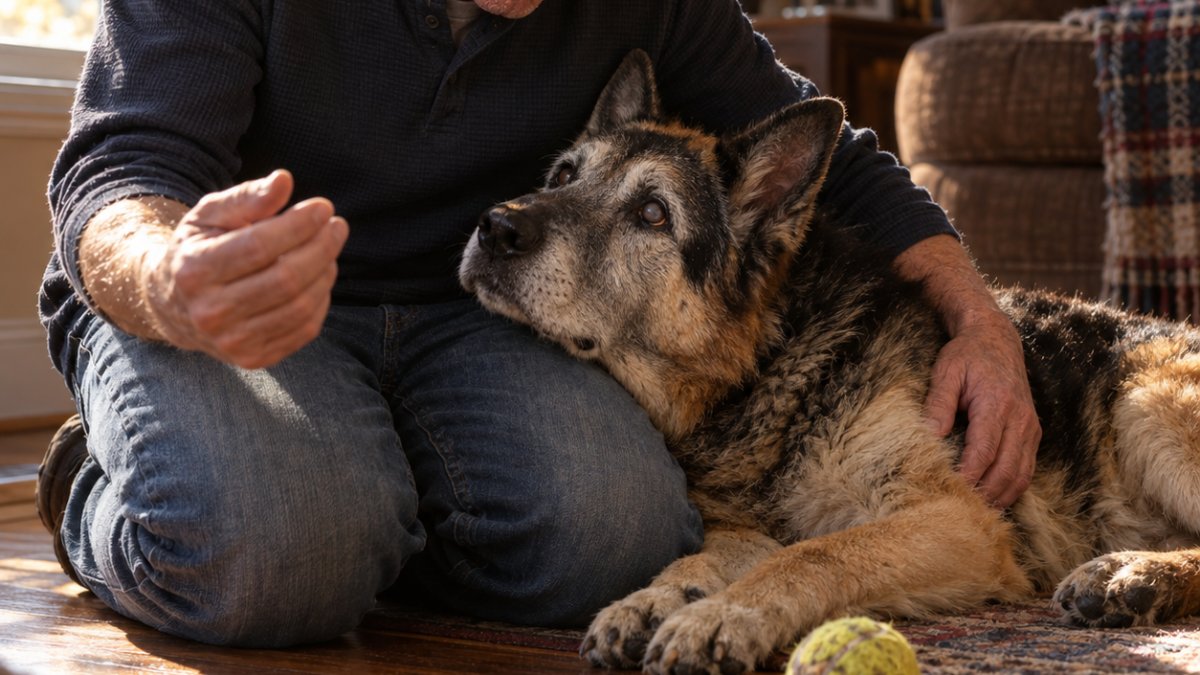
Just an old man sitting on the living room floor with an aging German Shepherd.
I’d wait until Titan was looking at me.
Then I’d raise my hand.
He’d respond.
Sometimes immediately.
Sometimes slowly.
Sometimes not at all.
On the days when his hips hurt, I’d bring the reward to him instead of making him stand.
When his eyesight began worsening, I moved closer.
I learned to keep the gestures broad and slow.
I learned that waving my arms too quickly only confused him.
And I learned to reward him with touch.
A scratch behind the ears.
A gentle rub across the chest.
The familiar pressure of my palm against his forehead.
Margaret watched from the couch one afternoon.
“You two look like you’re working again.”
I smiled.
“In a way, we are.”
Titan was sitting in front of me.
I raised my hand.
He lowered himself carefully onto his blanket.
I gave him the thumbs-up.
His tail thumped.
Margaret laughed.
“Look at him.”
I looked down.
For an instant, I saw the young dog he’d once been.
Proud.
Focused.
Waiting for the next instruction.
Then he struggled to adjust his hind legs, and the moment passed.
I helped him settle.
Margaret came over and sat beside us.
She stroked his shoulder.
“You know, Daniel, he doesn’t need to be young to know he’s loved.”
I looked at her.
She smiled sadly.
“And you don’t have to hear somebody say something to know they mean it.”
I thought about those words for a long time.
A week later, Rebecca brought Caleb over again.
He watched me give Titan his hand signals.
Then he asked, “Grandpa, is Titan learning sign language?”
I smiled.
“Sort of.”
“Can I learn?”
“Of course.”
I showed him the signal for come.
He practiced it with exaggerated seriousness.
Titan watched him.
Then slowly approached.
Caleb laughed.
“He listened to me!”
I knelt beside them.
“He sure did.”
Caleb looked at his hands.
“Does that mean he can understand me even though he can’t hear?”
I nodded.
“Some things, yes.”
He considered that.
Then he asked, “How do you tell him you love him?”
I opened my mouth.
And stopped.
I knew how to tell Titan to sit.
To stay.
To come.
To search.
To stop working.
I knew how to give commands across a field without making a sound.
But after twelve years of working together and nearly another year of retirement, I had never taught him a gesture that simply meant love.
I looked at Caleb.
“That’s a good question.”
He frowned.
“You don’t know?”
I shook my head.
“Not yet.”
That evening, I sat beside Titan’s bed thinking about it.
I could have used the familiar handshape for “I love you” from American Sign Language.
But Titan hadn’t been trained to understand that gesture.
I didn’t want another symbol that meant nothing to him.
I wanted something connected to our life together.
Something he already knew.
Then I remembered a ritual from our working years.
Whenever we returned home after a difficult shift, I would remove Titan’s harness, place my right hand against my chest, and extend it toward him.
It had begun as a simple gesture to encourage him closer while I praised him.
Over the years, it became part of our routine.
I’d make the motion.
He’d approach.
I’d rub his chest and say, “We’re home, partner.”
He’d relax.
The day was finished.
The danger was behind us.
We were together.
I hadn’t used that gesture in years.
I stood and moved in front of his bed.
Titan opened his eyes.
I placed my right hand against my chest.
Then slowly moved it toward him.
His eyes followed my hand.
I waited.
He raised his head.
Then pressed his nose against my palm.
My throat tightened.
“There it is.”
I sat beside him.
“That’s our sign.”
He rested his head against my leg.
I stroked his ears.
From then on, I used that gesture every evening.
Hand to my chest.
Hand toward him.
Then a gentle touch.
I didn’t pretend Titan understood the words I attached to it.
But I knew he remembered the routine.
It meant I was near.
It meant the work was finished.
It meant he was safe enough to rest.
And for me, it meant something I had never been very good at saying.
I love you.
For several months, that became our language.
I no longer shouted his name across the house.
I walked where he could see me.
I learned to touch the floor gently near his bed if he was facing away, so the vibration might catch his attention without frightening him.
I used lights carefully.
I gave him time to recognize my face.
When his vision became cloudy, I moved my hands closer.
And when even that was difficult, I placed my palm where he could smell it.
He would touch his nose to my fingers.
The same way he’d done when he was seventeen months old.
Some things changed.
Others remained.
We still took rides in the truck.
I lifted him onto the back seat using a support harness.
We drove slowly along the country roads.
Sometimes we stopped beside the lake where we’d walked during our retirement mornings.
I’d open the window.
Titan would raise his nose toward the breeze.
His ears no longer followed the birds.
He couldn’t hear the water or the distant traffic.
But he could smell the grass.
The trees.
The damp earth.
He watched the world with those cloudy eyes, and I sat beside him trying to memorize every second.
One evening, we parked near the old wooden bridge.
The sunset reflected across the lake.
I reached back and touched his shoulder.
He turned.
I placed my hand against my chest.
Then extended it toward him.
Titan slowly pressed his nose against my palm.
I smiled.
“We’re home, buddy.”
Of course, we weren’t home yet.
But we were together.
And that was what the gesture had come to mean.
By autumn, Titan’s health had begun declining more seriously.
His heart condition had progressed despite medication.
He tired after only a few minutes of standing.
Some nights, he coughed and struggled to settle comfortably.
His appetite became unpredictable.
One morning, he refused his breakfast.
I warmed it.
Added a little chicken.
Placed the bowl closer.
He sniffed it and turned away.
I sat beside him.
“Come on, partner.”
Then I stopped myself.
He couldn’t hear me.
I moved into his line of sight and gave the familiar encouraging signal.
Titan looked at my hand.
Then at the food.
But he didn’t eat.
I took him to Dr. Hart that afternoon.
She examined him carefully.
After reviewing his condition and bloodwork, she explained that his heart disease and declining kidney function were making treatment increasingly difficult.
Additional aggressive treatment might create more discomfort without giving him a meaningful recovery.
I sat opposite her.
“How long?”
She hesitated.
“I can’t tell you exactly.”
“Months?”
“That may be more than he has.”
My stomach tightened.
“Weeks?”
“Possibly.”
I stared at the examination table.
Titan lay on a blanket, watching me.
Dr. Hart leaned forward.
“Daniel, I know how hard this is.”
I shook my head.
“He’s been with me thirteen years.”
“I know.”
“He worked twelve of them.”
She nodded.
“He served a long time.”
“He found missing kids. He protected officers. He did things other dogs couldn’t do.”
My voice rose.
“He never quit.”
Dr. Hart waited until I stopped.
Then she said quietly, “I know you’re proud of him.”
I swallowed.
“But?”
She looked toward Titan.
“But he deserves to be loved for who he is now, too. Not just for what he used to be able to do.”
I looked away.
Her words struck deeper than I wanted to admit.
Because even after all our years together, some part of me was still searching for the strong police dog I’d known.
The one who ran toward danger.
The one who responded to my voice.
The one who could leap into the patrol vehicle without help.
But that dog had grown old.
And the dog lying in front of me needed something different.
Not another command.
Not another assignment.
He needed comfort.
Patience.
Protection.
He needed me to be the partner he’d always believed I was.
Dr. Hart helped us make a care plan focused on his comfort.
She explained the signs that would indicate his condition was becoming unmanageable.
She also offered to come to our home when the time arrived.
I thanked her.
Then I carried Titan to the truck.
He rested against my chest.
I remembered carrying him after an injury during our working years.
Back then, he’d struggled to get down.
He wanted to run.
Now he barely lifted his head.
I tightened my arms around him.
“Easy, buddy.”
He couldn’t hear me.
But I said it anyway.
The next morning, I called Rebecca.
She answered while driving to work.
“Hey, Dad.”
“Hi, sweetheart.”
“Everything okay?”
I looked toward Titan.
He was sleeping beside the fireplace.
I swallowed.
“Not really.”
Her voice changed.
“Is it Titan?”
I nodded, forgetting she couldn’t see me.
“Yeah.”
I told her what the veterinarian had said.
For a long moment, she didn’t speak.
Then I heard her crying quietly.
“Oh, Dad.”
“I don’t know how to do this.”
My voice broke.
“I don’t know how to lose him.”
She took a shaky breath.
“You’re not going to do it alone.”
I looked down.
“Rebecca—”
“No.”
Her voice was firm.
“You spent your whole life trying to protect everybody. Let us be there for you.”
I closed my eyes.
“I don’t want Caleb to see him suffering.”
“Neither do I.”
She paused.
“But he loves Titan. And he deserves a chance to say goodbye while Titan can still enjoy being with him.”
I looked toward my old partner.
His chest rose and fell beneath the blanket.
“Okay,” I whispered.
That weekend, Rebecca and Caleb came over.
They brought a small photo album they’d made together.
Inside were pictures of Titan from different years.
Titan wearing his police harness.
Titan standing beside me at his retirement ceremony.
Titan sleeping on the couch with Margaret.
Titan lying beneath the kitchen table while Rebecca did her homework.
Titan beside Caleb on the day we first brought our grandson home from the hospital.
I sat on the floor and turned the pages.
Every photograph felt like a piece of time I couldn’t get back.
Caleb sat beside me.
“Grandpa?”
“Yeah?”
“Can Titan still see my hands?”
I looked toward the dog.
“Some, buddy. We just have to get close enough.”
Caleb crawled carefully toward him.
He waited until Titan was looking.
Then he placed his little hand against his chest.
He extended it toward Titan.
The gesture we’d practiced.
Our special sign.
Titan slowly lifted his muzzle.
His nose touched Caleb’s palm.
My grandson smiled.
Then he began crying.
I moved closer.
“Hey, buddy.”
He looked at me.
“Does Titan know that means I love him?”
I stared at the little hand resting against my dog’s muzzle.
I thought about the thousands of commands Titan had followed.
The signals he’d learned.
The moments he’d trusted me without needing an explanation.
Then I put my arm around Caleb.
“I think he knows it means something good.”
Caleb looked down.
Titan was still touching his hand.
“Good,” he whispered.
“Because I love him a lot.”
That evening, after Rebecca and Caleb left, Margaret found me sitting beside Titan’s bed.
She lowered herself into the chair across from me.
“You’re thinking about something.”
I nodded.
“I’ve been thinking about the day he finally stopped hearing me.”
She waited.
“I thought I’d lost the most important part of our partnership.”
Margaret looked at Titan.
“And now?”
I watched him sleeping.
“Now I think I was wrong.”
She smiled sadly.
“You weren’t losing him because he couldn’t hear.”
I shook my head.
“No.”
I placed my hand against his blanket.
“I was just losing the way I was used to reaching him.”
Margaret leaned forward and touched my cheek.
“Then I’m glad you found another way.”
I held her hand.
For a long time, neither of us spoke.
Titan slept between us.
And the house felt peaceful.
It was one of the last peaceful evenings we had.
Three days later, Titan collapsed beside the back door.
I’d just helped him outside.
He’d stood for a few moments on the grass, looking toward the maple tree.
Then his legs buckled.
I caught him with the support harness before he struck the ground.
His breathing was rapid.
His eyes looked frightened.
I carried him inside and called Dr. Hart.
She came within the hour.
Margaret sat beside Titan while the veterinarian examined him.
I stood by the window, gripping the back of a chair.
Dr. Hart listened to his chest.
Checked his circulation.
Watched his breathing.
Then she looked at me.
“Daniel, can we talk?”
I knew.
Before she said another word, I knew.
We stepped into the kitchen.
She spoke quietly.
“His condition has deteriorated significantly.”
I stared at the floor.
“Can you help him?”
“We can ease his discomfort.”
“But can he recover?”
She paused.
“Not in a way that would return him to a comfortable, stable life.”
I rubbed my face.
“How long?”
“His breathing and weakness tell me we’re very close to the end.”
I looked through the doorway.
Titan lay on his blanket.
Margaret stroked his head.
He looked exhausted.
I swallowed.
“Is he in pain?”
“He’s struggling, Daniel. We can relieve his distress, but I don’t want to ask him to endure another crisis.”
I sat down.
For a moment, I couldn’t breathe.
Then I whispered, “I promised I’d take care of him.”
Dr. Hart pulled out the chair beside me.
“And you have.”
I shook my head.
“I don’t know how to say goodbye.”
She waited.
I looked at her.
“He can’t hear me.”
My voice broke.
“I used to talk to him before every assignment. I’d tell him everything was going to be okay.”
I wiped my eyes.
“Now he doesn’t even know when I’m saying his name.”
Dr. Hart placed a hand on my arm.
“Daniel, he still knows your presence.”
I stared at her.
“He recognizes your smell. Your touch. The way you approach him. The routines you’ve shared.”
She paused.
“Your relationship with him was never only about your voice.”
I looked toward the living room.
Titan’s eyes were half closed.
Margaret was speaking softly to him.
Even though he couldn’t hear a word.
Dr. Hart continued.
“If you’d like, we can give him some medication to keep him comfortable tonight, and I can return in the morning. But if his breathing worsens or he becomes distressed, call me immediately. We shouldn’t make him wait through suffering.”
I nodded.
I wanted one last night.
One last opportunity to sit beside him.
To remember.
To love him without rushing.
But I also understood that it could not be at the expense of his comfort.
Dr. Hart adjusted his care and stayed until he was settled.
Before leaving, she rested a hand on my shoulder.
“He’s had a remarkable life.”
I looked toward Titan.
“Yeah.”
My voice trembled.
“He has.”
That night, Margaret and I carried his bed into the living room.
We placed it beside the fireplace.
I spread his favorite blue blanket over it.
It was the same blanket Rebecca had given him when he retired.
The edges were worn.
One corner had been repaired twice.
Titan had slept on it almost every night for two years.
I lowered him carefully onto the bed.
He looked around.
Then settled.
Margaret brought water.
I sat beside him.
She knelt on the other side.
For a while, the three of us remained quiet.
Then Margaret touched his muzzle.
“Hey, handsome.”
Her voice shook.
“You’ve been such a good boy.”
Titan blinked.
She smiled through tears.
“I know you can’t hear me anymore.”
She stroked his ears.
“But I’m going to tell you anyway.”
Her voice broke.
“Thank you for taking care of our family.”
I looked away.
Margaret kissed his forehead.
Then she stood and hugged me.
“I’ll be right upstairs.”
I nodded.
“Okay.”
She hesitated.
“Please wake me if you need anything.”
“I will.”
She looked down at Titan one last time.
Then went upstairs.
I was alone with my partner.
For the first time in thirteen years, there was nothing left I could ask him to do.
No search.
No patrol.
No command.
No reason for him to stand or follow me.
I lowered myself onto the floor beside his bed.
My knees protested.
My back ached.
But I didn’t care.
I placed my hand gently against his shoulder.
He opened his eyes.
I moved into his line of sight.
Raised two fingers toward my eyes.
Watch me.
His cloudy eyes followed my hand.
I smiled.
“There you are.”
Then I gave him the thumbs-up.
Good boy.
His tail moved faintly.
I began crying.
Not because the gesture was dramatic.
It wasn’t.
It was something we’d practiced thousands of times.
But now, with his life nearing its end, I understood how much those movements had come to mean.
They were the language of our trust.
The language we’d built long before either of us understood that one day words wouldn’t be enough.
I sat beside him and remembered our first patrol.
The way he’d leaped into the vehicle.
The way his ears turned toward my voice.
The way he’d looked at me while waiting for the next command.
I remembered Lily Parker, frightened beneath the broken fencing near the creek.
I remembered the old man Titan found beneath the bridge.
I remembered the officers who got home because Titan recognized danger before they did.
I remembered the mornings when he’d wake me before sunrise.
The evenings when he’d fall asleep with his head against my boot.
I remembered his retirement ceremony.
The way he’d looked back at the patrol vehicle, confused because he couldn’t understand why we were leaving without another assignment.
And I remembered the first day he failed to respond when I called his name.
How frightened I’d been.
How angry.
How I’d spent weeks trying to make him hear a voice that was already beyond his reach.
I leaned closer.
“I’m sorry, buddy.”
He couldn’t hear me.
But I needed to say it.
“I’m sorry I kept shouting.”
I stroked his cheek.
“I’m sorry I didn’t understand.”
His eyes moved toward mine.
I took a breath.
Then I raised my hand.
Slowly.
Carefully.
Two fingers toward my eyes.
Watch me.
Titan focused.
I brought my hand close enough for him to see.
Then I gave the thumbs-up.
Good boy.
His tail moved once.
A sob escaped my chest.
“That’s right.”
I touched his forehead.
“That’s my boy.”
For a while, I simply sat beside him.
The fire burned low.
The clock moved past midnight.
Rain began falling against the windows.
Titan’s breathing was slower.
He looked tired.
So terribly tired.
I checked him carefully, as Dr. Hart had instructed.
He remained settled, but I knew the morning was close.
I pulled the blanket gently over his back.
Then I placed my hand against my chest.
I paused.
Moved it slowly toward him.
Our sign.
The one that had once meant our patrol was finished.
The one we’d used after every difficult shift.
The one that now meant something much deeper.
Titan watched my hand.
His cloudy eyes followed it as far as they could.
Then he lifted his muzzle slightly.
His nose touched my palm.
I closed my eyes.
A tear fell onto his blanket.
“That’s right, partner.”
I pressed my forehead gently against his.
“We’re home.”
I stayed there until my legs went numb.
Then I began talking again.
Not because Titan could hear.
Because I finally understood that speaking was something I needed, too.
I told him about the first time I’d brought him home.
About Margaret’s ridiculous rules that lasted less than a week.
About Rebecca falling asleep beside him on the carpet.
About the winter he stole an entire roast chicken from the kitchen counter.
I laughed through tears.
“Still don’t know how you managed that.”
I remembered the night he refused to leave my side after a particularly difficult call.
The time he’d leaned against my leg while I sat in the garage, trying to find the strength to go inside and act like everything was normal.
I had never explained what happened that night.
Not to Margaret.
Not to Rebecca.
Not to anybody.
But Titan had stayed.
He hadn’t needed an explanation.
He had simply rested his head against my knee until I could breathe normally again.
I touched his shoulder.
“You know, buddy, I always thought I was the one protecting you.”
His eyes were closed.
I smiled sadly.
“But I think you were protecting me long before I realized it.”
The clock reached two in the morning.
Titan shifted.
His breathing became uneven.
I moved closer.
His eyes opened.
For a moment, he looked frightened.
I placed my hand beneath his muzzle.
He recognized the touch.
His body relaxed slightly.
I reached for my phone and called Dr. Hart.
She listened to my description and told me she was coming.
Then I woke Margaret.
She came downstairs immediately.
We sat on either side of Titan.
She held his front paw.
I stroked his head.
Neither of us tried to pretend the moment was anything other than what it was.
The end of a long, beautiful life.
Dr. Hart arrived shortly afterward.
She examined Titan and listened to his chest.
Then she looked at us.
“His heart is struggling. I think helping him now is the kindest thing we can do.”
Margaret began crying.
I looked at Titan.
He lay between us.
The dog who had spent twelve years helping people survive danger now needed us to protect him from suffering.
I nodded.
“Okay.”
My voice barely worked.
“Let’s help him.”
Dr. Hart explained the procedure.
She would give him a sedative first so he could relax deeply.
Then, once he was peaceful, she would administer the final medication.
She told us we could hold him the entire time.
I moved closer.
My hands were shaking.
I looked into Titan’s cloudy eyes.
“Hey, buddy.”
He couldn’t hear me.
I knew that.
So I raised my hand.
Two fingers toward my eyes.
Watch me.
His gaze moved toward my fingers.
I swallowed.
Then I gave him the thumbs-up.
Good boy.
His tail moved weakly.
I began crying.
Margaret placed her hand against my back.
I looked down at Titan.
I remembered that first day at the training facility.
Walter Briggs telling me that a good handler needed to understand his dog.
I remembered every time Titan had trusted my judgment.
Every search.
Every dangerous call.
Every moment when he had looked toward me, waiting to know what came next.
And now, one final time, he was watching my hands.
Waiting.
Trusting.
I brought my right hand against my chest.
Held it there.
Then slowly moved it toward him.
Titan’s eyes followed.
He raised his muzzle the smallest amount.
His nose touched my palm.
The movement was weak.
Almost nothing.
But I felt it.
I felt the warmth of his breath.
The gentle pressure of his nose.
The familiar gesture he’d made thousands of times.
And I understood that I didn’t need him to hear my voice.
I didn’t need him to understand a complicated goodbye.
He knew my hands.
He knew my touch.
He knew I was there.
I leaned forward and kissed his forehead.
Then I gave him the signal we’d used at the end of every shift.
My open hand moved slowly outward from my chest.
All done.
I had never imagined using that gesture in this room.
Not like this.
For twelve years, it had meant the search was finished.
The patrol was over.
The danger had passed.
We were going home.
Now I was using it to tell him something I had no words for.
You have done enough.
You don’t have to work anymore.
You don’t have to stand.
You don’t have to listen.
You don’t have to search for me.
You can rest.
My tears fell freely.
“Good boy,” I whispered.
Then I showed him the thumbs-up again.
I repeated the gesture slowly, keeping my hand close enough for him to see.
“Good boy, Titan.”
His eyes rested on my face.
I don’t know exactly what he understood.
I don’t know whether he recognized the meaning I’d attached to our final gesture.
But I knew he recognized me.
And I knew he was not alone.
Dr. Hart gave him the sedative.
I kept my palm beneath his muzzle.
Margaret stroked his shoulder.
Titan’s body relaxed.
His breathing became calm.
His eyes grew heavy.
I leaned closer.
“That’s it, buddy.”
My voice broke.
“Just rest.”
I placed my hand against my chest one last time.
Then extended it toward him.
He was too deeply relaxed to respond.
So I gently rested my palm against his cheek.
I held it there.
The same hand that had given him thousands of commands.
The same hand that had fastened his harness.
The same hand that had guided him through dark woods and dangerous buildings.
The same hand that had helped him stand when his legs grew weak.
Now it had one final responsibility.
To make sure he felt someone he loved beside him.
When Dr. Hart asked if we were ready, I looked at Margaret.
She nodded through tears.
Then I looked at Titan.
I kissed his forehead.
“I love you, partner.”
I knew he couldn’t hear the words.
But my hand remained against his face.
And this time, that was enough.
Dr. Hart administered the final medication.
Titan’s breathing slowed.
Then stopped.
She listened gently with her stethoscope.
After a moment, she looked at us.
“I’m so sorry. He’s gone.”
I stared at my dog.
His eyes were closed.
His body was peaceful.
His head rested against my arm.
I didn’t move.
I couldn’t.
For thirteen years, Titan had been beside me.
In the patrol vehicle.
In the woods.
At the dinner table.
In the living room.
Beside my bed.
And now he was gone.
I bent forward and held him.
Margaret wrapped her arms around both of us.
We cried together.
There were no sirens.
No flashing lights.
No final radio transmission.
Only the quiet sound of rain against the windows and the terrible stillness of a house that had just lost one of its most beloved members.
I stayed beside Titan long after Dr. Hart confirmed his passing.
I touched the white fur around his muzzle.
The small patch above his left eye.
The worn leather collar that had rested against his neck for years.
Then I raised my right hand.
My fingers trembled.
I gave him one last thumbs-up.
“Good boy.”
And after all those years of worrying that he could no longer hear my praise, I finally understood something.
The love between us had never depended on sound.
It had always lived in trust.
In patience.
In showing up.
In the quiet certainty that we belonged beside each other.
The weeks after Titan died were harder than I expected.
Every morning, I woke at the same time.
I still looked toward the bedroom door.
I still reached for his food bowl.
I still caught myself stepping around the place where his bed used to be.
Sometimes I would enter the living room and instinctively raise my hand.
The signal for come.
Then I’d remember.
There was nobody waiting to respond.
Those moments hurt more than I can explain.
Not because they were dramatic.
Because they were ordinary.
The simplest habits had become reminders of someone I would never see again.
Margaret helped me through those weeks.
Rebecca called every evening.
Caleb came over on weekends.
One afternoon, he asked whether we could look through Titan’s photographs again.
We sat at the kitchen table with the old training binder.
Caleb turned the pages slowly.
Then he stopped at a picture from Titan’s first year.
The dog stood beside me on a training field.
Young.
Strong.
Ears raised.
Eyes bright.
Caleb touched the photograph.
“Grandpa?”
“Yeah, buddy?”
“Can you show me all the hand signs Titan knew?”
I swallowed.
Then smiled.
“Sure.”
We went into the backyard.
I stood beside the maple tree where Titan used to sleep in the afternoons.
I showed Caleb the signal for watch me.
Then come.
Then stay.
Then down.
He practiced each one carefully.
When we reached the final signal, I stopped.
My open hand moved slowly outward from my chest.
“That means all done,” I explained.
Caleb copied it.
Then he looked at me.
“What about the one that means love?”
My throat tightened.
I placed my hand against my chest.
Then slowly extended it toward him.
Caleb smiled.
He copied the gesture.
“Like this?”
I nodded.
“Exactly.”
He came closer and rested his little hand against my chest.
I looked down at him.
Tears filled my eyes.
“Grandpa?”
I swallowed.
“Yeah?”
“Does it still mean love if Titan isn’t here?”
I stared at my grandson.
For a moment, I couldn’t answer.
Then I knelt and wrapped my arms around him.
“Yeah, buddy.”
My voice broke.
“It always will.”
That evening, after Rebecca took Caleb home, I sat beside the fireplace holding Titan’s old collar.
I looked at the photograph on the mantel.
My partner stood beside the patrol vehicle.
His ears were raised.
His eyes were focused on me.
He looked ready for another assignment.
I remembered all the times I’d called his name.
Thousands of times.
During training.
On patrol.
Across the backyard.
From the kitchen.
Sometimes urgently.
Sometimes affectionately.
Sometimes just because I wanted him near me.
I remembered the day he stopped responding.
How deeply it had hurt.
How I’d felt as though a door had closed between us.
But that door had never truly closed.
I’d simply needed to find another way through it.
Titan had spent twelve years learning my voice.
When his hearing faded, I had to learn his silence.
And in that silence, I found something I hadn’t expected.
A quieter kind of closeness.
One that required me to slow down.
To pay attention.
To move gently.
To stop assuming that being heard was the same as being understood.
I had spent my life giving commands.
Titan taught me to communicate without demanding a response.
I had spent my career believing strength meant being able to act.
Titan taught me that sometimes strength means being patient enough to wait.
And I had spent months mourning the fact that he could no longer hear me say his name.
But in his final moments, I realized he hadn’t needed that sound to know who I was.
He had recognized my hands.
My face.
My touch.
The simple gestures we’d practiced together for more than a decade.
The language of our partnership had survived the loss of his hearing.
And when his eyesight began to fade, we found yet another way.
A hand beneath his muzzle.
A gentle touch against his chest.
The familiar presence of someone who had loved him through every stage of his life.
Young and strong.
Old and tired.
Alert and fearless.
Deaf and nearly blind.
He had always been Titan.
And I had always been his partner.
Several months later, I returned to the police training facility where we’d first met.
Walter Briggs had retired years earlier, but one of the instructors had invited me to speak with a group of new K9 handlers.
I brought Titan’s old collar.
His training binder.
And a photograph from our first certification.
The young officers listened as I told them about our work.
The missing children.
The dangerous calls.
The importance of trusting a dog’s instincts.
But when I finished, I told them something that wasn’t written in any training manual.
“Your dog will spend years learning how to understand you.”
I looked around the room.
“Make sure you spend those years learning how to understand him.”
Several officers nodded.
I continued.
“One day, if you’re lucky, he’ll grow old.”
My throat tightened.
“He might not hear you anymore. He might not be able to run. He might need your help just to stand.”
I looked at Titan’s collar.
“And when that day comes, don’t mistake his weakness for the loss of everything that made him special.”
I swallowed.
“The dog who once protected you will still be there.”
The room was quiet.
“He’ll just need you to protect him.”
After the presentation, a young officer approached me.
He had recently been paired with a two-year-old German Shepherd named Ranger.
The dog stood beside him, full of energy.
His ears turned toward every sound.
His tail moved constantly.
He reminded me painfully of Titan.
“Sergeant Foster?”
I smiled.
“Retired Sergeant.”
The officer laughed.
“Sorry, sir.”
“Don’t worry about it.”
He looked at Titan’s training binder.
“I wanted to ask about the hand signals.”
I nodded.
“Sure.”
“Do you really think they’re as important as voice commands?”
I looked down at Ranger.
The young dog was watching his handler.
Waiting.
Eager.
Confident.
I thought about Titan lying beside the fireplace.
Watching my hands during the final moments of his life.
“More important than you might ever realize,” I said.
The officer nodded thoughtfully.
Then he looked down at Ranger.
He raised two fingers toward his eyes.
The young dog immediately focused on him.
I smiled.
For a brief moment, I felt as though something of Titan was still working in that room.
Not his body.
Not his voice.
But the lessons he’d left behind.
The patience.
The trust.
The quiet understanding that communication was never just about being heard.
On the first anniversary of Titan’s death, Margaret and I visited the memorial garden where his ashes had been placed.
Rebecca and Caleb came with us.
The morning was cool.
The trees were beginning to turn gold.
A gentle breeze moved through the grass.
Titan’s stone marker stood beneath a small maple tree.
His photograph was engraved into the granite.
Below it were his name and service dates.
Then the words I’d chosen.
K9 TITAN
TWELVE YEARS OF SERVICE. A LIFETIME OF LOYALTY. FOREVER MY PARTNER.
I knelt beside the stone.
My knees ached.
My hands trembled slightly.
But I smiled.
“Hey, buddy.”
The words came naturally.
Even though I knew he couldn’t hear them.
Even though I knew he was gone.
I touched the photograph.
“I still miss you.”
Behind me, Margaret rested a hand on my shoulder.
Caleb placed a small yellow tennis ball beside the marker.
Then he stepped back.
“Grandpa?”
I looked at him.
“Yeah?”
“Can we do Titan’s sign?”
My throat tightened.
I stood slowly.
Margaret moved beside me.
Rebecca took Caleb’s hand.
And there, beneath the maple tree, the four of us raised our right hands.
Each of us placed a hand against our chest.
Then slowly extended it toward Titan’s stone.
No one said anything.
We didn’t need to.
For a moment, I could almost see him standing there.
Young.
Strong.
Ears raised.
Tail moving.
Waiting for me to give the next command.
But there was no command left to give.
His work was finished.
His pain was gone.
And the people he’d loved were still standing together because of the life he’d shared with us.
I looked at the photograph.
“Thank you, partner.”
A tear slipped down my cheek.
“Thank you for listening when I couldn’t find the words.”
I lowered my hand.
Then I gave him one last thumbs-up.
Good boy.
Caleb copied me.
Margaret smiled through tears.
Rebecca leaned against my shoulder.
And for the first time since Titan died, I understood that I didn’t have to keep searching for a way to reach him.
He had already reached me.
In every lesson.
Every memory.
Every person he’d helped bring home.
Every quiet moment when I remembered to slow down and pay attention to someone I loved.
I still talk to Titan sometimes.
When I sit beside the lake.
When I find one of his old tennis balls.
When a police cruiser passes and I remember the way his ears used to rise at the sound of the radio.
I still say his name.
I still tell him he’s a good boy.
And on certain evenings, when the house is quiet and the last sunlight falls across the living room floor, I stand beside his photograph and make our old gesture.
Hand against my chest.
Hand extended toward him.
The same sign that once meant our shift was finished.
The same sign that helped us communicate after his hearing disappeared.
The same sign I gave him when his eyes were closing for the final time.
For thirteen years, I thought the most important thing my dog knew was the sound of my voice.
But the older we became, the more I realized that he had learned something far deeper.
He knew when I was near.
He knew when I was frightened.
He knew when I needed him.
And somehow, even when the sounds of the world disappeared, he never stopped finding his way back to me.
I spent twelve years leading him through darkness.
In the end, when he could no longer hear and could barely see, he trusted my hands to guide him through one final goodbye.
I couldn’t give him his hearing back.
I couldn’t make him young again.
I couldn’t stop time.
But I could kneel beside him.
I could let him feel my touch.
I could show him the familiar gestures that had carried us through a lifetime of service.
And I could make sure that, when his final moment came, he wasn’t searching for someone who had disappeared.
He knew I was there.
He knew he was safe.
And I hope, in whatever way dogs understand the deepest things in life, he knew how much he was loved.
Sometimes people ask me what I miss most about Titan.
They expect me to say his bark.
Or the sound of his paws racing down the hallway.
Or the way he’d whine impatiently when he wanted to go for a ride.
I miss all of those things.
But what I miss most is the way he looked at me.
Even after his hearing was gone.
Even after his eyes grew cloudy.
He would lift his head and search for my face.
And when he found me, his tail would move.
Just a little.
As though my presence was enough.
I hope that, in the end, mine was enough for him, too.
Good boy, Titan.
You don’t have to watch the door anymore.
You don’t have to wait for my voice.
You don’t have to find your way back to me.
Your work is finished.
You’re home.
And for the rest of my life, whenever words fail me, I’ll remember the old dog who taught me that love doesn’t need a sound to be understood.
I’ll place my hand against my chest.
I’ll reach it toward the place where you used to stand.
And I’ll know exactly what I’m saying.
I love you, partner.
I always will.