𝗙𝗨𝗟𝗟 𝗦𝗧𝗢𝗥𝗬 I Reached for the Tiny Kitten the Moment Phoenix Raised His Paw
𝗙𝗨𝗟𝗟 𝗦𝗧𝗢𝗥𝗬
But there was no dramatic moment when he suddenly understood.
He didn’t leap into my arms.
He didn’t begin purring because someone finally loved him.
He didn’t look at me with shining eyes, grateful for a second chance.
Mostly, he slept.
He ate when he was able.
He allowed us to care for him.
And then he slept again.
His body began responding to treatment, little by little.
That mattered.
Every improvement mattered.
But I soon learned there was an important difference between keeping an animal alive and watching that animal begin to enjoy being alive.
Phoenix was surviving.
I wanted more for him.
I wanted him to feel comfortable enough to stretch in the sunlight. I wanted him to discover the pleasure of a warm bed and a full stomach. I wanted him to lift his head when someone entered the room because he was curious, not because he was checking for danger.
Most of all, I wanted to see him choose something.
Anything.
A toy.
A favorite place to sleep.
A person he wanted to approach.
I wanted some sign that the world still held something he cared about.
But Phoenix asked for nothing.
As his condition became more stable and he was able to spend time around the other cats, I hoped companionship might help.
Our rescue center was full of different personalities.
Some cats demanded attention the moment a person entered the room. Others preferred high shelves or quiet corners. A few were endlessly curious about newcomers, approaching carefully with their tails raised.
Phoenix attracted their attention almost immediately.
I remember watching one friendly cat approach him, nose twitching with curiosity.
Phoenix opened his eyes.
The other cat paused, waiting for some response.
Phoenix looked at him for a second.
Then he turned his head away.
That was it.
No greeting.
No attempt to investigate.
No interest.
A little later, another cat came closer.
Phoenix did the same thing.
He acknowledged the movement, then withdrew into himself.
When the others played, he stayed where he was.
When someone brought out toys, he didn’t move.
When cats hurried toward their food, he showed no interest in joining the excitement. He would eat what we provided, but he didn’t compete for it or act as though mealtime was something to look forward to.
Eventually, he found a corner he seemed to prefer.
It wasn’t the warmest place in the room.
It wasn’t particularly sunny.
It wasn’t near the windows where the other cats liked to watch birds.
It was simply a quiet space where nobody bothered him very much.
And that was where Phoenix spent most of his time.
I began checking that corner before I checked anywhere else.
Every morning, I would come through the door, glance toward it, and see the same familiar shape curled against the wall.
“Good morning, Phoenix.”
Sometimes one ear moved.
Sometimes he lifted his head.
Most of the time, nothing happened.
Still, I greeted him.
I couldn’t bear the thought of him spending another day without someone acknowledging that he mattered.
Weeks passed.
His skin slowly improved with treatment. He began to regain some of the weight he had lost. His physical recovery was not instant, and there were days when he looked exhausted, but we could see progress.
Yet emotionally, he remained distant.
One afternoon, I sat on the floor beside him with a soft toy.
It was nothing special, just something lightweight that most cats liked to bat around.
I moved it gently across the floor.
Phoenix watched it pass.
I tried again.
The toy slid close to his paw.
He looked down at it.
For a moment, I thought he might reach out.
Instead, he closed his eyes.
I sat there feeling foolishly disappointed.
My coworker noticed me and came over.
“Any luck?”
I shook my head.
“Not even a little.”
She crouched beside us.
“Maybe he just isn’t a playful cat.”
“Maybe.”
She watched Phoenix for a moment.
“Some cats are like that.”
I knew she was right.
Not every cat wanted to chase toys. Some preferred peace and quiet, and there was nothing wrong with that.
But there was something about Phoenix that made me wonder whether this was preference or resignation.
He didn’t seem peacefully content.
He seemed absent.
“I just wish I knew what he wanted,” I said.
My coworker rested a hand on my shoulder.
“Maybe he doesn’t know yet.”
I thought about that conversation long after she walked away.
Maybe he doesn’t know yet.
I wondered whether an animal could become so accustomed to losing things that he stopped expecting anything good to happen.
I wondered whether Phoenix had spent so long simply surviving that he had forgotten how to ask for anything else.
I didn’t have an answer.
All I could do was keep showing up.
So I did.
I cleaned his space.
I monitored his food.
I sat beside him when the center was quiet.
Sometimes I told him about the other cats.
Sometimes I told him how much better his skin looked.
Sometimes I said ridiculous things, the sort of nonsense people say to animals because they don’t expect an answer.
“One day, you’re going to surprise us, Phoenix,” I told him.
He blinked slowly.
I smiled despite myself.
“That’s right. I’m talking to you.”
But when I stood to leave, he never followed.
He never called after me.
He simply settled back into his corner.
After a while, I stopped expecting a breakthrough.
I still hoped for one.
But hope had become something quiet, something I carried into the room without asking Phoenix to carry it with me.
Then we received another phone call.
At the time, there was nothing unusual about it.
Someone had found a litter of newborn kittens in a backyard.
They were tiny, vulnerable, and in desperate need of help.
We were already caring for several animals, and space was always a concern, but situations involving newborn kittens couldn’t simply be ignored.
Young kittens can deteriorate frighteningly quickly.
They cannot regulate their bodies the way adult cats can, and even a short period without proper care can become dangerous.
When the kittens arrived, we immediately began assessing them.
Most needed the careful attention that very young kittens require.
But one little girl was in far worse condition than the others.
I remember the moment I first held her.
She was so small that she seemed to disappear inside my hands.
Her body felt fragile, and she had almost no strength.
When I adjusted the soft towel beneath her, she barely reacted.
“Oh, sweetheart,” I whispered.
She was severely dehydrated.
She was weak enough that even standing was difficult.
And she wasn’t eating.
That was what frightened me most.
An animal can be thin and still have a little strength left to fight.
But when a kitten that small refuses food, every hour starts to feel important.
We began providing the care she needed and followed the veterinary guidance for her condition.
I tried not to let myself become overwhelmed.
Panic doesn’t help a sick animal.
She needed warmth, nourishment, careful monitoring, and calm hands.
But I would be lying if I said I wasn’t scared.
I was terrified.
She fit into my palm, and yet the responsibility of keeping her alive felt enormous.
One of my coworkers stood nearby as we watched her.
“She’s so little,” she said.
I nodded.
The kitten’s eyes looked tired.
Her movements were weak.
I could feel the faint motion of her breathing against my hand.
“Come on, baby,” I whispered. “Stay with us.”
We named her Ruby.
I don’t remember the name arriving with any grand explanation. It simply seemed to belong to her.
Ruby.
A tiny, precious life that had come frighteningly close to disappearing before she’d even had a chance to experience the world.
For the next several days, I found myself worrying about her constantly.
I worried when she was too quiet.
I worried when she struggled to take nourishment.
I worried when she slept longer than I expected.
I worried when she seemed a little weaker than she had the day before.
Even when everything appeared stable, I caught myself looking over to check that she was breathing.
There were moments when I prepared myself for the possibility that we might lose her.
I hated admitting that.
But anyone who has cared for critically weak kittens knows that love cannot guarantee survival.
You can do everything right.
You can follow every instruction.
You can stay attentive and gentle and hopeful.
And still, sometimes, a little body simply doesn’t have enough strength.
One evening, after a particularly difficult day, I sat beside Ruby and watched her sleeping.
She looked impossibly small against the towel.
I had been trying to remain practical, focusing on the next feeding and the next small step.
But exhaustion has a way of lowering the walls you build around your heart.
I touched one finger gently to the edge of her bedding.
“Please,” I whispered.
It wasn’t a command.
It wasn’t even a proper sentence.
I just didn’t know what else to say.
“Please keep fighting.”
I knew Ruby couldn’t understand the words.
But I said them anyway.
I thought about all the things she hadn’t experienced.
She had never chased a toy across a room.
Never climbed onto a chair and discovered that getting down was harder than getting up.
Never curled beside another cat and fallen asleep feeling safe.
Never learned that a human hand could mean warmth instead of danger.
Her whole life had been reduced to the struggle to survive.
And I wanted her to have more than that.
The next morning, Ruby surprised us.
She ate a few bites on her own.
They were tiny bites.
So small that someone unfamiliar with her condition might not have understood why I became emotional.
But I had spent days watching her struggle.
I knew what those few bites meant.
“Look at you,” I whispered.
Ruby kept eating.
I turned toward my coworker.
“She’s doing it.”
She came closer.
For a moment, we both stood still, afraid that making too much noise might somehow interrupt the miracle happening in front of us.
Then my coworker smiled.
“She is.”
I could barely believe it.
I wanted to laugh.
I wanted to cry.
Mostly, I wanted Ruby to keep going.
“That’s it, baby,” I said softly. “Just a little more.”
She didn’t suddenly become healthy overnight.
There were still difficult moments.
She still needed close attention, careful feeding, and time.
But that morning marked a turning point.
She had shown us she was not finished fighting.
The next day, she was a little stronger.
Then stronger again.
Gradually, the exhausted kitten who could barely stand began moving around with purpose.
At first, her explorations were hesitant.
A few uncertain steps.
A pause.
Another step.
Then she would settle down, as if she had used every bit of energy she possessed.
I watched each tiny accomplishment with more excitement than I thought possible.
“Look at those legs,” I told her one morning.
She wobbled forward.
“Yes, those are yours. You’re learning how to use them.”
Ruby paid no attention to my commentary.
She was too busy discovering that the world extended beyond her bedding.
As the weeks passed, her personality began to emerge.
And what a personality it was.
The kitten who had once seemed too weak to survive apparently had no intention of wasting another moment being still.
She wanted to explore everything.
If something moved, she wanted to chase it.
If there was a new object in the room, she needed to investigate.
If another kitten was sleeping, Ruby seemed convinced that this was the perfect opportunity to start a game.
She was curious about every sound.
Every corner.
Every passing shadow.
And everyone she met.
I sometimes watched her race across the floor and thought about how close we had come to losing her.
It was almost impossible to reconcile the two versions of Ruby in my mind.
The first had lain weak and motionless in my hands.
The second treated every ordinary moment as an adventure.
She had survived the most dangerous part of her beginning, and now she seemed determined to make up for lost time.
“Where are you going now?” I would ask as she hurried past.
Ruby never stopped to explain.
She had places to be.
Important kitten business to attend to.
And apparently, the entire rescue center was hers to explore.
I laughed more during those weeks than I had in a long time.
Caring for animals can be emotionally exhausting.
For every happy recovery, there are frightened faces, difficult decisions, and moments when you wonder whether you can keep carrying all the suffering you see.
Ruby brought something bright into those days.
She made us smile when we were tired.
She interrupted our routines with her ridiculous little adventures.
She reminded me that the reward for fighting so hard to save a life was not always something dramatic.
Sometimes it was simply watching a kitten become strong enough to make a harmless mess.
Sometimes it was seeing her discover a toy.
Sometimes it was hearing a coworker laugh because Ruby had decided that the most important thing in the world was a piece of fabric moving across the floor.
Through all of this, Phoenix continued living quietly on the other side of our daily routine.
His physical condition was improving.
His skin was healing under treatment.
He was no longer the painfully thin cat we had first carried away from the apartment complex.
But he still preferred his corner.
He still showed little interest in the others.
He still seemed to spend most of his time watching life happen around him rather than participating in it.
There were moments when I looked from Ruby to Phoenix and felt a strange sadness.
Ruby seemed to want everything.
Phoenix seemed to want nothing.
One had arrived in our care barely able to survive, yet she now approached the world with endless curiosity.
The other had endured more than we could understand, and although his body was recovering, he remained emotionally distant.
I thought about how unfair life could be.
Two animals.
Two different kinds of suffering.
One still at the beginning of her life.
The other carrying a history we would never fully know.
At that point, I never imagined their stories would become connected.
Ruby had other plans.
The first time she noticed Phoenix, I was nearby.
By then, she had grown strong enough to enjoy supervised time exploring the room.
She was still tiny compared with the adult cats, and I watched her carefully.
Most of the other cats had become accustomed to her curiosity.
Some tolerated her.
Some moved away when she became too energetic.
A few seemed happy to interact with her.
Ruby treated all of them as potential friends.
Then she spotted Phoenix.
He was resting in his usual place, his long tail stretched out behind him.
I noticed Ruby turning toward him and felt an immediate flicker of concern.
“No, no, little one,” I murmured.
She kept walking.
“Ruby.”
She didn’t even glance at me.
Her attention was fixed on Phoenix.
I knew he had never been particularly interested in the other cats.
He usually turned away when they approached.
And while he had never shown us serious aggression, I didn’t know how he would react to a kitten who had no understanding of personal boundaries.
Ruby was smaller than him by such a dramatic margin that even an impatient swat could hurt her.
I moved closer.
“Sweetheart, let’s leave him alone.”
Ruby continued straight toward him.
Phoenix lifted his head.
I stopped breathing for a moment.
He watched her approach.
Ruby reached his tail and immediately decided it was the most wonderful toy she had ever encountered.
She batted at it with one tiny paw.
I stared.
“Ruby.”
Another little swat.
Phoenix turned his head.
I moved my hand toward them.
“Okay, that’s enough.”
But Ruby seemed completely unconcerned.
She leaned forward and tried again.
Phoenix pulled his paw back and shifted slightly.
I could see that he was aware of her.
I could also see that she had no intention of leaving.
He gave her a gentle nudge.
Ruby moved back a few inches.
Then she came forward again.
I remember thinking that this was exactly why tiny kittens needed supervision.
They were fearless in the most inconvenient ways.
They could walk up to an animal several times their size, ignore every warning to back away, and behave as though friendship were something that simply happened because they wanted it badly enough.
“You’re going to wear out your welcome,” I whispered.
Phoenix nudged her away again.
Still gentle.
Still controlled.
But I could feel myself becoming more anxious.
He was much stronger than she was.
She was a kitten who had only recently recovered from a life-threatening condition.
The last thing I wanted was for her to get hurt because she had mistaken a lonely adult cat for another playmate.
I held my hand in front of Phoenix, ready to separate them.
He lifted one paw.
My heart jumped.
“Easy, Phoenix,” I said.
Ruby paused.
For the first time since approaching him, she seemed to notice the difference in their size.
Phoenix looked down at her.
I expected him to push her away.
I expected him to stand up and leave.
I expected that familiar expression of indifference to return to his face.
Instead, he lowered his head.
Very slowly, he moved closer to Ruby.
Then he gently drew her toward him.
And began to groom her.
I froze.
For a moment, I genuinely didn’t understand what I was seeing.
Phoenix, the cat who had ignored every attempt at friendship, was carefully licking the tiny kitten who had just spent several minutes bothering him.
Ruby stood still beneath his attention.
Her little body looked almost absurdly small beside his.
Phoenix continued grooming her, patient and deliberate, as though caring for this kitten was the most natural thing in the world.
My coworker came toward us.
“Is he…?”
I nodded without taking my eyes off them.
“He’s grooming her.”
She stopped beside me.
We watched in silence.
I don’t know how long the moment lasted.
It may have been less than a minute.
But I remember every detail.
The way Phoenix lowered his head.
The way Ruby finally stopped moving.
The gentleness of his touch.
The complete absence of the distant, disconnected behavior we had come to expect from him.
For the first time since I had met Phoenix, he wasn’t merely allowing something to happen around him.
He was actively choosing to care for another living creature.
That difference was everything.
My coworker whispered, “I’ve never seen him do that.”
“Neither have I.”
I felt my throat tighten.
Ruby shifted closer.
Phoenix continued cleaning her.
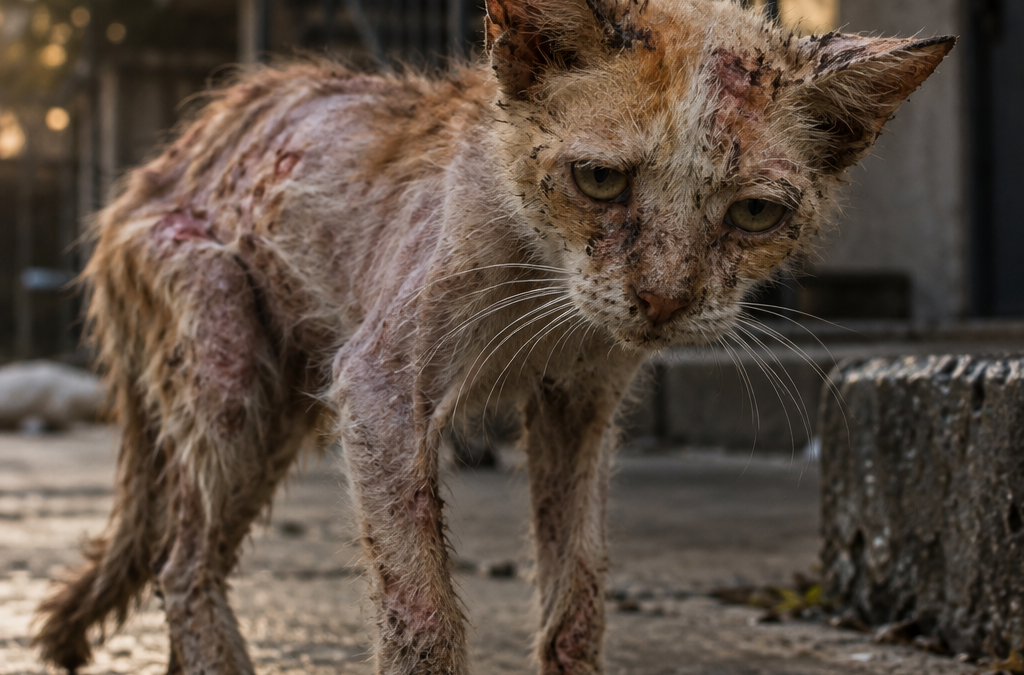
I thought of the cat we had found beside the apartment building.
The sores.
The thin body.
The eyes that seemed to hold no expectation of kindness.
And now those same eyes were focused on a tiny kitten.
Not with fear.
Not with irritation.
With attention.
With tenderness.
I slowly pulled my hand away.
A few minutes earlier, I had been ready to protect Ruby from Phoenix.
Now I was watching Phoenix protect her with a gentleness I hadn’t known he possessed.
I sat back on the floor.
“Oh, Phoenix,” I whispered.
He didn’t look at me.
He was too busy taking care of Ruby.
Something about that made the moment even more beautiful.
He wasn’t performing for us.
He didn’t know we were watching in amazement.
He had simply decided that this small, persistent kitten belonged close enough to him to be cared for.
And for reasons I would never fully understand, Ruby had chosen him.
I went home that evening thinking about what I’d witnessed.
I kept replaying it in my mind, trying to understand why Ruby had succeeded where every other cat had failed.
She hadn’t approached Phoenix cautiously.
She hadn’t waited for permission.
She hadn’t seemed concerned by his silence.
She had looked at him and apparently decided that he was someone worth knowing.
Perhaps that confidence mattered.
Perhaps her size awakened some instinct in him.
Perhaps he recognized that she needed gentleness.
Or perhaps there was no complicated explanation at all.
Maybe Ruby had simply appeared in front of him at the right moment, and for the first time in a long while, Phoenix had felt the desire to respond.
I didn’t know.
What I did know was that the next morning, when I entered the rescue center, something was different.
Phoenix wasn’t alone.
Ruby was sleeping beside him.
She was curled close to his body, tucked into the safe space he had made for her.
Phoenix lay quietly, his head lifted just enough to watch the room.
I stopped in the doorway.
For a moment, I didn’t say anything.
I was afraid that if I spoke, one of them would move and the scene would disappear.
Then I smiled.
“Well,” I whispered, “look at you two.”
Phoenix glanced toward me.
He didn’t get up.
He didn’t move away from Ruby.
He simply watched me for a moment before settling again.
It was such a small thing.
But I knew him well enough to understand how much had changed.
The cat who had spent weeks choosing isolation had allowed another animal to sleep against him.
And he looked completely comfortable with it.
Over the following days, I began noticing Ruby and Phoenix together more often.
At first, I tried not to read too much into it.
One affectionate interaction didn’t necessarily mean Phoenix had transformed.
Animals have good days and difficult days.
Sometimes a relationship develops.
Sometimes it doesn’t.
I didn’t want to turn one beautiful moment into an expectation that Phoenix was required to fulfill.
But the pattern continued.
Ruby would wander across the room, chasing whatever caught her attention, and Phoenix would lift his head to follow her movements.
If she moved farther away, he sometimes got up and followed.
Not in a frantic way.
He didn’t chase her.
He simply seemed to want to know where she was going.
When she stopped to investigate something, he waited nearby.
When she finally settled down to sleep, he curled up beside her.
The first time I saw Phoenix leave his corner specifically to follow Ruby, I almost couldn’t believe it.
I watched her trot across the room toward a table.
She looked up at it, considered her options, and began trying to climb.
“Ruby,” I called, “what are you doing?”
She ignored me.
Of course she did.
She was determined to reach the top.
After a little effort, she succeeded.
I moved closer to make sure she was safe.
Then I noticed Phoenix.
He was sitting beneath the table.
His eyes were fixed on Ruby.
He didn’t seem worried in any dramatic, human way, but he was clearly paying attention to her.
Ruby walked along the tabletop, investigating the world from her exciting new height.
Phoenix remained below.
When she moved toward the edge, he stood.
I reached out to guide her safely down.
Phoenix watched until all four of her paws were back on the floor.
Then he followed her again.
I laughed softly.
“You’re her babysitter now?”
He gave me no answer.
Ruby hurried away.
Phoenix went after her.
And I found myself smiling so hard that my cheeks hurt.
It became difficult to imagine one without the other.
Ruby brought movement into Phoenix’s life.
Phoenix brought calm into Ruby’s.
She approached the world as though every new thing was an invitation.
He approached it more carefully, studying her from nearby.
She was small and impulsive.
He was quiet and patient.
She seemed to believe that there was always something worth investigating.
He seemed content simply to make sure she could investigate it safely.
Watching them together, I started seeing parts of Phoenix that had been invisible to us before.
He was gentle.
He was attentive.
He was surprisingly tolerant.
And beneath that withdrawn exterior, there was still an enormous capacity for affection.
It had been there all along.
We just hadn’t known how to reach it.
One afternoon, Ruby discovered a toy and began batting it across the floor.
It skittered toward Phoenix.
Normally, he would have watched it pass and returned to sleep.
But this time, he lifted his paw.
He touched the toy.
Ruby stopped.
I stopped too.
Phoenix nudged it back toward her.
Ruby immediately attacked it with all the seriousness of a kitten facing a dangerous enemy.
The toy rolled away.
She chased it.
Phoenix watched.
Then, to my astonishment, he got up and followed.
“Wait,” I said quietly.
My coworker looked over.
“What?”
“Look at Phoenix.”
We both watched as Ruby pushed the toy across the floor.
Phoenix reached out and batted it back.
Ruby pounced.
Then Phoenix moved again.
A few seconds later, the two of them were playing.
Not just Ruby playing while Phoenix tolerated her.
Phoenix was participating.
He followed the toy.
He reached for it.
He changed direction as Ruby scrambled around him.
At one point, he lowered his front half toward the floor, clearly inviting more interaction.
I pressed a hand over my mouth.
My coworker began laughing in disbelief.
“Is that really Phoenix?”
I couldn’t answer immediately.
I was too busy watching.
I had spent so many days trying to interest him in the simplest toys.
I had sat beside him, moving them across the floor, hoping for a single curious paw.
And now here he was, playing because Ruby had asked him to.
Not with words.
Not even with much thought.
She had simply made the world interesting enough for him to join her.
My eyes filled with tears.
I tried to laugh them away.
“He’s actually playing.”
My coworker nodded.
“He looks happy.”
Those words hit me harder than I expected.
Happy.
For weeks, I had avoided using that word about Phoenix.
I had said he was improving.
Recovering.
Stable.
Comfortable.
Those were things I could observe.
But happiness felt like something I had no right to assume.
Now, watching him move across the floor with Ruby, I finally allowed myself to hope that he was beginning to feel it.
I knew one playful afternoon didn’t erase everything he had endured.
I knew his recovery still depended on proper care.
But I also knew I was watching a cat who had once seemed unwilling to take an interest in anything discover a reason to move.
Ruby chased the toy.
Phoenix chased Ruby.
And for a few minutes, the room was filled with the kind of ordinary joy I had wanted for him from the beginning.
After that, his changes became harder to miss.
He started spending less time in his corner.
Sometimes he rested where Ruby liked to play, watching her with quiet interest.
Sometimes he moved closer to the other cats without immediately turning away.
And sometimes, when Ruby was especially energetic, he joined her.
There were mornings when I entered the room and found him already awake.
Not because someone had disturbed him.
Not because food had arrived.
But because Ruby was moving around, and he wanted to be part of whatever she was doing.
It sounds like such a small thing.
A cat getting up in the morning.
A cat following a kitten.
A cat chasing a toy.
But when you have watched an animal spend so long withdrawn from the world, those ordinary behaviors become extraordinary.
I started looking forward to seeing what Phoenix would do next.
One day, I watched him roll onto his side while Ruby bounced around him.
She made a clumsy little leap toward his paws.
Phoenix lifted one paw and touched her gently.
Ruby rolled.
Then she sprang back up.
He reached toward her again.
They continued like that, playing a game whose rules seemed obvious to them and mysterious to everyone else.
I sat on the floor, laughing.
“Be gentle, big guy.”
Phoenix was gentle.
He seemed to understand the difference in their size.
When Ruby became too enthusiastic, he sometimes paused or moved his paw away.
When she came close again, he allowed her to.
He never seemed interested in dominating her.
He was simply there, patiently accepting her impossible amount of energy.
Eventually, Ruby grew tired.
She climbed against him and curled into a tiny ball.
Phoenix lowered his head and began grooming her.
The transition was so natural that it caught me off guard.
One moment they were playing.
The next, he was taking care of her.
I watched Ruby’s eyes close.
She looked completely at peace.
And Phoenix, who had once been the loneliest cat in the room, settled beside her as though this was where he had always been meant to rest.
I thought about the first day we met him.
How he hadn’t leaned into my hand.
How he hadn’t seemed to want comfort.
Now he had someone who came looking for him every day.
Someone who climbed against him without hesitation.
Someone who treated his presence as a source of safety.
He didn’t have to ask Ruby to stay.
She simply did.
That became the most moving part of their relationship for me.
Ruby had no idea what Phoenix had been through.
She didn’t know about the apartment complex.
She didn’t know that he had spent more than a year wandering there while his condition worsened.
She didn’t know about his damaged skin or the empty look in his eyes when we found him.
She couldn’t understand how close he had come to losing everything.
And she didn’t need to.
She never treated him like a broken animal.
She didn’t approach him with pity.
She didn’t seem to believe he was different from the other cats.
To Ruby, Phoenix was simply Phoenix.
He had a tail worth chasing.
He had paws worth batting.
He had warm fur to sleep against as his coat recovered.
And he had a patient, gentle nature that made him the perfect companion for a kitten determined to explore every inch of the world.
I found myself thinking about how differently we had approached him.
We had looked at Phoenix and seen everything that was wrong.
The illness.
The loneliness.
The emotional distance.
We had tried to imagine what might make him feel better.
Ruby had looked at him and seen someone she wanted to be near.
There was something humbling about that.
We had given Phoenix medicine, food, shelter, and time.
Those things were essential.
Without them, he might not have survived.
But Ruby had given him something we couldn’t prescribe.
A relationship that asked him to participate in life again.
I remember one particularly quiet afternoon when I found the two of them resting together.
The room was peaceful.
Several cats were sleeping.
Ruby had curled against Phoenix, her small body moving gently with each breath.
Phoenix lay beside her, eyes half closed.
I sat nearby without disturbing them.
For a while, I simply watched.
Then I whispered, “You love her, don’t you?”
Phoenix lifted his head.
He looked at me for a moment.
Then he lowered his face toward Ruby and began grooming the top of her head.
I smiled.
“Yeah,” I murmured. “I thought so.”
I know animals don’t experience every emotion the way humans do.
I know there are limits to what we can understand from their behavior.
But I didn’t need to imagine words inside Phoenix’s mind to see the bond between them.
He sought Ruby out.
He stayed close to her.
He cared for her.
And when she was nearby, he behaved like a cat who had found something valuable.
That was enough for me.
The more time I spent watching them, the more I began to think of Phoenix as a father figure to Ruby.
He wasn’t her biological father.
He hadn’t known her when she was born.
He had entered her life entirely by chance.
Yet there he was, grooming her, following her, resting beside her, and patiently tolerating the endless mischief that came with being a kitten.
Sometimes Ruby seemed determined to test every limit of his patience.
She would wake him when he was sleeping.
She would pounce toward his tail.
She would climb over him when a perfectly clear path existed around his body.
And Phoenix, who once wanted nothing to do with any other cat, rarely seemed to mind.
When she became too persistent, he gently redirected her.
When she settled, he relaxed.
There was no grand transformation that happened all at once.
There was just a series of small choices.
Phoenix choosing to stay.
Phoenix choosing to follow.
Phoenix choosing to play.
Phoenix choosing to care.
And with every choice, a little more of the cat we had first met seemed to return.
His personality began to reveal itself.
He could be patient, but he could also be playful.
He liked quiet moments, but he no longer seemed trapped inside them.
He still enjoyed resting, but he wasn’t interested only in being left alone.
And when Ruby appeared, he nearly always paid attention.
One morning, I found myself standing in the room with a toy in my hand.
Phoenix was nearby.
Ruby was busy investigating something farther away.
Without thinking much about it, I moved the toy across the floor.
Phoenix looked at it.
I paused.
For a second, I remembered all the times I had done exactly this before.
All the times he had ignored me.
Then Phoenix reached out.
His paw touched the toy.
I stared at him.
He batted it again.
A laugh escaped me.
“Phoenix!”
He looked up.
“You did it!”
He returned his attention to the toy.
I moved it a little farther.
He followed.
And there, in that quiet moment, I realized something that made my chest ache.
He was beginning to enjoy things even when Ruby wasn’t directly involved.
Her companionship hadn’t made him dependent on constant attention.
It seemed to have helped him rediscover a part of himself.
The part that could be curious.
The part that could play.
The part that could look at something unfamiliar and decide it might be worth investigating.
I knelt on the floor with him for several minutes.
It was the kind of ordinary play session that happens in rescue centers every day.
But to me, it felt like a gift.
When he finally lost interest and walked away, I didn’t feel disappointed.
He had made a choice.
And that was everything I had once wanted for him.
As the weeks went by, Ruby continued growing stronger.
She was no longer the kitten we had feared losing.
She ate well.
She played constantly.
She explored with the confidence of an animal who had never seriously considered that the world might be dangerous.
Every new accomplishment made me proud.
But her growth also brought us closer to a day I had been trying not to think about.
The day she would be ready for adoption.
At our rescue center, finding permanent homes for animals was one of the most important parts of our work.
We could offer safety and care.
We could help them recover.
But our hope was always that they would eventually find families who would love them for the rest of their lives.
Ruby was exactly the kind of kitten people fell in love with quickly.
She was lively.
Friendly.
Curious.
And irresistibly affectionate.
I knew that once she was old enough and ready to leave, finding someone interested in adopting her would probably not be difficult.
Under ordinary circumstances, that would have been wonderful news.
A tiny kitten who had nearly died now had the chance to grow up in a loving home.
It was everything we had fought for.
But whenever I imagined Ruby leaving, I saw Phoenix.
I pictured his corner.
The place where he had once spent almost every hour of every day.
I pictured him waking up and looking around for the kitten who always came to bother him.
I pictured him waiting while the other cats moved through the room.
And I wondered what would happen when Ruby didn’t appear.
The thought frightened me.
I tried to tell myself that I was being overly emotional.
Phoenix had improved.
He was healthier.
He was more confident.
Perhaps his relationship with Ruby had helped him recover enough that he would adjust to her absence.
Perhaps he would make friends with another cat.
Perhaps he would continue playing.
Perhaps he would be fine.
But I couldn’t ignore what I had seen.
Phoenix hadn’t simply tolerated Ruby.
He had built his days around her.
Where she went, he often followed.
When she settled, he settled beside her.
When she wanted to play, he responded.
She had become part of his daily life in a way no other animal had managed.
And after everything he had already endured, the idea of making him experience another separation felt unbearable.
One afternoon, a coworker mentioned that Ruby would soon be ready to begin the next stage of finding her forever home.
I felt my stomach tighten.
“Already?”
She looked at me.
“She’s growing up.”
“I know.”
I glanced toward the cats.
Ruby was batting at a toy while Phoenix watched nearby.
My coworker followed my gaze.
“Oh,” she said quietly.
I nodded.
“Exactly.”
For a moment, neither of us spoke.
Then she asked the question I’d been avoiding.
“What are we going to do about Phoenix?”
I didn’t have an answer.
That was the problem.
We couldn’t keep every animal at the rescue center forever.
Ruby deserved a permanent home.
Phoenix deserved one too.
And the longer I watched them together, the harder it became to imagine that either of them would be truly happy if we separated them.
I thought about the practical side.
Adult rescue cats, especially those with difficult medical histories, can face a longer wait for adoption.
Kittens often attract attention more quickly.
If we made Ruby’s adoption dependent on Phoenix’s, we might make it harder for her to find a home.
That mattered.
I didn’t want to deny Ruby an opportunity simply because I had become emotionally attached to the image of her and Phoenix together.
But there was another side to the decision.
What if we allowed Ruby to leave alone and Phoenix withdrew again?
What if he stopped playing?
What if he returned to that corner and spent his days staring at the room as though nothing in it mattered?
I knew we couldn’t predict his response with certainty.
Still, the possibility troubled me deeply.
That evening, I stayed a little longer after my usual work was finished.
Ruby and Phoenix were sleeping together.
The room was quiet enough that I could hear the soft movements of the other cats shifting in their beds.
I sat nearby and studied them.
Ruby had tucked herself close to Phoenix’s body.
He rested his head beside her.
I thought about the day we rescued him.
The woman at the apartment complex had been afraid he wouldn’t survive much longer.
I remembered carrying him away, painfully thin and covered in sores.
I remembered promising him that he was safe.
At the time, I had thought safety meant removing him from danger.
Giving him treatment.
Providing enough food and somewhere warm to sleep.
I still believed those things were essential.
But looking at him beside Ruby, I understood that his sense of safety had grown to include something else.
Someone he trusted.
Someone whose presence had become familiar.
Someone who never seemed to question whether he was worth loving.
I watched Ruby stir in her sleep.
Phoenix lifted his head slightly, then settled again when she became still.
It was such a tiny gesture.
But it told me more than I could put into words.
I whispered, “I don’t know what we’re supposed to do.”
Neither cat answered.
I looked at Phoenix.
“I can’t promise that nothing will ever change,” I said softly. “But I don’t want you to lose her.”
My throat tightened.
“You’ve already been through enough.”
The next day, we began talking seriously as a team.
There were practical questions.
Would we be able to find a family willing to adopt two cats?
Would someone who came looking for a kitten be open to bringing home an older cat with a difficult history?
Could we explain why these two belonged together without making potential adopters feel pressured?
We talked about Ruby’s needs.
We talked about Phoenix’s needs.
We talked about the responsibility we had to both of them.
One coworker pointed out what we all knew.
“Ruby could probably find a home quickly.”
Nobody disagreed.
Another said, “Phoenix might have to wait much longer on his own.”
That was true too.
I looked around at the people who had helped care for both cats.
They had watched Ruby struggle to survive.
They had helped Phoenix through his recovery.
They had seen the first moment he groomed her.
They had watched his behavior change as their bond deepened.
Everyone understood what was at stake.
But understanding didn’t make the choice easy.
I finally spoke.
“What if we don’t separate them?”
The room went quiet.
I continued.
“What if we make it clear that they’re a bonded pair? That anyone who wants to adopt Ruby needs to understand that Phoenix is part of her life?”
Someone asked, “Do you think people will be willing to take both?”
“I don’t know,” I said.
And that was the truth.
I couldn’t promise that the right family would appear quickly.
I couldn’t promise that the wait would be easy.
I couldn’t guarantee that everyone would understand why we were making this decision.
But I could tell them what I had seen.
“I’ve watched Phoenix change because of her,” I said. “He went from spending almost every day alone in that corner to following her around, grooming her, and playing. He’s finally interested in being alive.”
My voice wavered.
I looked down for a moment.
“I know Ruby deserves a home. I want that for her more than anything. But I don’t think we have to decide that a home is only good for her if Phoenix isn’t part of it.”
One of my coworkers nodded.
“They’re happy together.”
“More than happy,” another said. “They’re attached.”
I took a breath.
“Then why would we separate them?”
We discussed it carefully.
We didn’t want emotion alone to dictate an adoption decision.
We wanted to make the choice that best supported their welfare.
But the more we considered the bond we’d seen develop, the clearer our answer became.
Phoenix and Ruby would be adopted together.
Not because we wanted to make adoption more complicated.
Not because we believed every pair of cats should remain inseparable.
But because these two had shown us, day after day, that their relationship was an important part of their lives.
Ruby had grown up with Phoenix as her constant companion.
Phoenix had rediscovered affection, curiosity, and play through his relationship with Ruby.
Separating them simply because one was easier to adopt felt wrong.
So we made the decision.
They would leave our rescue center together, when the right family came along.
I remember the feeling that settled over me afterward.
It wasn’t the excitement of solving every problem.
We still had to find a home.
We still had to make sure any potential adopters understood their needs.
Phoenix would still require the care appropriate for his health, and both cats would need patient, responsible people who were prepared to give them a permanent place in their lives.
There was work ahead.
But for the first time since realizing Ruby was growing old enough to leave, I could look at the two of them without feeling that familiar knot of dread.
We had chosen not to break apart the bond that had brought so much life back into Phoenix.
And that mattered more to me than I could explain.
After the decision, I went to see them.
Ruby was awake, naturally.
She was busy exploring something that seemed utterly fascinating to her.
Phoenix lay nearby, watching.
I crouched beside him.
“Well, big guy,” I said softly. “We figured something out.”
He blinked.
I smiled.
“You’re not getting rid of her that easily.”
Ruby came trotting toward us.
She brushed against Phoenix and immediately became interested in his tail.
I laughed.
“See? She’s still going to drive you crazy.”
Phoenix shifted slightly, then lowered his head toward her.
Ruby paused just long enough to receive a few gentle licks.
Then she wriggled away to resume whatever adventure had been occupying her.
Phoenix watched her go.
After a moment, he rose and followed.
I stayed crouched on the floor, watching them move across the room.
And I realized that the decision we had spent so much time worrying about meant absolutely nothing to the cats themselves.
They didn’t understand adoption policies.
They didn’t know that people had been discussing their future.
They didn’t know how difficult it could be to find the right home for an adult cat with a complicated past.
They only knew the life they had built together.
Ruby knew that Phoenix was there.
Phoenix knew that Ruby would come looking for him.
And for now, that was enough.
As I continued caring for them, I found myself thinking more deeply about what rescue really means.
People often imagine it as a single dramatic moment.
An animal is found in terrible condition.
Someone reaches out.
The animal is carried to safety.
And the story changes.
Sometimes, that first rescue is dramatic.
Sometimes it really does happen in a matter of minutes.
But recovery is rarely so simple.
Phoenix didn’t become happy the day we removed him from the apartment complex.
He didn’t become healthy the moment we placed him in a clean bed.
And Ruby didn’t become strong because we wanted her to survive.
Both of them needed time.
They needed consistent care.
They needed people willing to keep showing up even when there was little immediate progress.
With Ruby, every improvement felt like a victory.
The first time she ate.
The first time she stood more steadily.
The first time she explored without seeming exhausted.
Her recovery was visible in the energy she gained.
With Phoenix, the changes were harder to recognize.
His skin improved.
His body became stronger.
But the emotional distance remained.
For a long time, I worried that the withdrawn cat in front of me might be the only Phoenix we would ever know.
And I had to learn to accept that possibility.
He didn’t owe us affection.
He didn’t owe us playfulness.
He didn’t owe us a cheerful personality simply because we had helped him.
If he spent the rest of his life preferring peace and quiet, he still deserved the same care and love.
That was something I believed even before Ruby arrived.
But watching the two of them together taught me something different.
It taught me how much of an animal’s personality can remain hidden until the right environment or relationship allows it to emerge.
We hadn’t known Phoenix could be so patient with a kitten.
We hadn’t known he would enjoy following someone from one end of a room to the other.
We hadn’t known that beneath his withdrawn behavior was a cat who could become a playful, affectionate companion.
And we certainly hadn’t known that a kitten who had nearly died would be the one to help us discover those things.
I sometimes wondered whether Phoenix understood, in whatever way cats understand their own experiences, that Ruby had changed his life.
Of course, he didn’t know the story the way we did.
He didn’t know that we had sat around discussing his behavior.
He didn’t know how worried we had been.
He didn’t know how many times I had looked at him and wondered whether he would ever feel joy again.
He only knew Ruby.
The little creature who had marched up to him without hesitation.
The one who had treated his tail like a toy.
The one who had refused to be discouraged when he nudged her away.
The one who now slept beside him as though there was nowhere else in the world she wanted to be.
And maybe that was all he needed to know.
There was another part of their story that stayed with me.
Ruby had needed us to survive.
When she arrived, she could barely stand.
She was dehydrated, weak, and refusing to eat.
Without proper care, her chances were frighteningly poor.
I remembered holding her in my palm, almost afraid to move because she felt so delicate.
I remembered asking her to keep fighting.
And now, every time I watched her race across the floor, I felt that same gratitude return.
She had been given a chance.
She had taken it.
And somehow, the life we had struggled to save had become a source of comfort for another animal.
I never wanted to turn that into a story about Ruby being responsible for Phoenix’s happiness.
She was only a kitten.
She deserved to be carefree.
She deserved to play and sleep and grow without carrying the weight of another creature’s recovery.
What made their bond beautiful was that neither cat seemed burdened by it.
Ruby didn’t spend her days trying to make Phoenix happy.
She simply lived.
She explored.
She played.
She curled beside him when she was tired.
And Phoenix responded to her presence with an affection that grew naturally.
There was no sacrifice in the way they cared for each other.
Only companionship.
Only trust.
Only the quiet comfort of knowing that someone familiar was close.
One afternoon, while I was cleaning nearby, Ruby climbed onto a table again.
I looked up just in time to see her peering down at the floor.
“Ruby,” I said, “you really do love being up there.”
Phoenix was sitting beneath her.
I smiled at the familiar sight.
He had done this so many times that it had become almost routine.
Ruby explored.
Phoenix watched.
When she returned to the floor, he followed her.
Sometimes I wondered whether he felt protective of her.
Sometimes I wondered whether he simply enjoyed her company.
Perhaps it was both.
I didn’t need a perfect explanation.
What I could see was enough.
He no longer chose isolation over every opportunity for connection.
He was participating in the ordinary life of the rescue center.
And for a cat who had once seemed to have given up, that was extraordinary.
I remember another morning when I arrived and found Phoenix playing before I had even finished greeting the cats.
Ruby was running after a toy.
Phoenix was following.
She swerved.
He turned.
The toy bounced away, and they both hurried after it.
I stood there laughing.
“Good morning to you too.”
Phoenix barely looked at me.
He was busy.
I thought about how different that was from our old routine.
There had been a time when I walked into the room and immediately looked toward his corner, hoping to see him lift his head.
Now, some mornings, I had to search the room because he wasn’t in that corner at all.
He was wherever Ruby had led him.
And sometimes, even when she wasn’t nearby, he was investigating a toy or moving around with a curiosity I hadn’t seen before.
The change hadn’t happened in one miraculous instant.
It had grown from something simple.
A kitten approaching.
A gentle grooming session.
A shared sleeping place.
A game.
Then another.
Day by day, Phoenix had begun showing us that he still had so much life left inside him.
There was no way to know exactly what he had lost before we found him.
I still thought about the apartment complex sometimes.
I thought about the woman who had watched him deteriorate for more than a year.
I wondered whether she would recognize him now.
Would she recognize the cat who followed Ruby across the floor?
The cat who rolled onto his side to play?
The cat who carefully groomed a kitten as though she were his own?
Would she believe he was the same animal who had stood beside the apartment building, barely reacting when I touched him?
Sometimes I struggled to believe it myself.
But I knew that the Phoenix we had rescued and the Phoenix we were watching now were the same cat.
One hadn’t replaced the other.
The playful, affectionate Phoenix had existed somewhere inside that exhausted body all along.
He had simply needed care, stability, and eventually a connection that made him feel safe enough to show us.
That realization changed the way I looked at him.
I no longer thought of his earlier behavior as proof that something essential had disappeared from him forever.
I thought of it as the behavior of an animal who had endured too much and needed time.
And I was grateful that we had never given up trying to make his life better, even when he gave us no obvious sign that our efforts were reaching him.
The strongest reminder came during a quiet moment near the end of another busy day.
Most of the work was finished.
The room had settled.
Ruby had finally exhausted herself after a long afternoon of playing.
She was curled against Phoenix, sleeping deeply.
Phoenix lay beside her, his body relaxed.
I sat a short distance away.
The light was soft, and the rescue center had grown unusually peaceful.
For a while, I simply watched them breathe.
Ruby’s tiny body rose and fell against his side.
Phoenix rested his chin nearby.
Every so often, he opened his eyes, glanced around the room, and settled again.
I thought about the first time I had crouched beside him at the apartment complex.
I remembered the sores on his skin.
His thin body.
The way he had allowed me to touch him without leaning toward me.
I remembered how badly I had wanted him to show some sign that he still cared.
Then I looked at him beside Ruby.
And suddenly, the difference overwhelmed me.
I realized I was crying.
Not because anything sad had happened.
Not because they were in danger.
But because they weren’t.
For once, I was looking at Phoenix without being afraid for him.
I wasn’t wondering whether he would survive the night.
I wasn’t worrying about whether he had eaten enough.
I wasn’t searching his face for some tiny indication that he felt safe.
I could simply look at him and see a cat resting beside someone he trusted.
A cat whose body had grown stronger.
A cat who played.
A cat who cared for another creature.
A cat who had discovered that life could hold something beyond pain and waiting.
I wiped my eyes before anyone noticed.
Then I laughed at myself.
After all the difficult moments I had managed to get through, it was the sight of two sleeping cats that finally broke me.
But I think that was when I fully understood what their bond meant to me.
We had been so focused on saving lives that we sometimes forgot how extraordinary it was to witness those lives becoming ordinary again.
Ruby wasn’t lying weakly in my hands anymore.
Phoenix wasn’t standing alone beside an apartment building.
They were safe.
They were together.
And they had a future we were determined to protect.
I reached out slowly and stroked Phoenix’s head.
He opened his eyes.
For a second, he looked directly at me.
Then he leaned gently into my hand.
It was a small movement.
So small that someone else might not have noticed it.
But I did.
I remembered the day we met, when he had allowed me to pet him without responding.
Now he was choosing to meet my touch.
I smiled through the tears I hadn’t quite managed to stop.
“Hey, handsome.”
Phoenix closed his eyes again.
I scratched gently behind his ear.
“You’ve come a long way.”
Ruby stirred against him.
He shifted carefully, making room for her without pulling away from my hand.
And I sat there feeling a kind of peace I hadn’t expected when either of them first arrived.
I knew their story wasn’t finished.
The right adoptive family still had to be found.
There would be new surroundings to adjust to.
New people to learn to trust.
A new home filled with unfamiliar sounds and smells.
I knew enough about rescue to understand that even wonderful changes can be stressful for animals.
But I also knew that when that day came, Phoenix and Ruby would face it together.
They would have something familiar in an unfamiliar place.
A companion who already knew their habits.
Someone to sleep beside.
Someone to seek out when everything else felt new.
And I hoped that whatever home they eventually entered would be filled with the simple joys they had taught us to appreciate.
A safe window to watch.
Comfortable places to rest.
Food they could count on.
Toys scattered across a floor.
People who understood that affection could take many forms, and that trust was something worth earning gently.
I imagined Ruby racing through a new room, eager to inspect every corner.
I imagined Phoenix following at a calmer pace, stopping occasionally to look around.
I imagined her discovering a favorite sleeping place and him settling beside her.
And I imagined the person who adopted them watching those two cats together and understanding why we had refused to separate them.
Those were hopes, not promises.
I couldn’t know exactly what their future would look like.
But I could help protect what they already had.
That was our responsibility.
And it was one I took seriously.
Sometimes people asked why we cared so much about keeping two cats together when one of them would probably have been adopted more quickly alone.
I understood the question.
Rescue centers have limited space.
There are always more animals needing help.
Every successful adoption creates an opportunity to care for another life.
Those realities never disappear.
But neither does our responsibility to consider the emotional needs of the animals already in our care.
Phoenix and Ruby weren’t simply two cats who happened to share a room.
They had formed a strong, consistent bond.
We had watched it develop.
We had seen how naturally they sought each other out.
We had seen the joy, comfort, and confidence that accompanied their companionship.
For them, staying together wasn’t a sentimental idea we had invented.
It was a decision grounded in what their daily behavior had shown us.
And once we understood that, the choice became clear.
We would keep looking until we found a home prepared to love both of them.
I wasn’t interested in giving Phoenix another temporary attachment that might disappear as soon as life became inconvenient.
He had already endured enough uncertainty.
I wanted the next home he entered to be the one where he could finally settle.
Where he wouldn’t have to wonder whether someone was coming back.
Where Ruby could grow from a mischievous kitten into an adult cat with her favorite companion still beside her.
Where their bond would be welcomed rather than treated as an inconvenience.
I wanted someone to look at Phoenix and see more than his past illness.
Someone who wouldn’t be discouraged by the fact that he had once been withdrawn.
Someone who would recognize the gentle cat he had become and give him the time and space he needed.
And I wanted that same person to appreciate Ruby for everything she was.
Not merely the kitten who had helped Phoenix.
But a joyful, curious little life who had fought her own battle to survive.
They both deserved to be loved as individuals.
And they deserved to keep loving each other.
I often returned to the thought that had troubled me when Phoenix first arrived.
What had happened to him?
Where had he come from?
Who had he known?
Had there been someone he waited for?
Those questions never received answers.
I learned to accept that they probably never would.
And eventually, I stopped feeling that I needed them answered in order to understand the most important part of his story.
Whatever had happened before, Phoenix was here now.
He was no longer alone.
The cat who had once seemed completely disconnected from the world was building new experiences, one ordinary day at a time.
And beside him was a little kitten who had once been so weak that I feared she might never experience any of those things herself.
Two fragile lives had crossed paths.
Not because anyone planned it.
Not because we had carefully chosen them for each other.
But because one day, after both had survived their own dangerous beginnings, Ruby saw Phoenix resting quietly and decided to approach him.
I had tried to stop her.
That detail still made me smile.
I remembered how worried I had been when she began batting at his tail.
How quickly I had reached forward.
How certain I was that Phoenix would become annoyed.
I had expected him to reject her.
Instead, he had lowered his head and begun grooming her.
That small, unexpected moment changed the way I understood everything that followed.
It reminded me that we don’t always recognize the beginning of something important while it is happening.
Sometimes it looks like a kitten being a nuisance.
Sometimes it looks like an older cat tolerating one more interruption.
Sometimes it looks so ordinary that you almost miss it.
And then, weeks later, you realize that the animal who once spent his days in isolation is running across the floor.
You realize that he is sleeping beside someone.
You realize that he is no longer looking at the world with the same exhausted indifference.
And you remember the moment it began.
One tiny kitten.
One patient cat.
One gentle act of affection.
I never stopped being grateful for that moment.
There are still days when caring for rescued animals feels overwhelming.
There are still stories that hurt.
Animals arrive frightened, ill, abandoned, or injured, and we do our best to give them a chance.
We cannot always know whether they will recover.
We cannot always undo what happened before they reached us.
And we cannot promise that every rescue will end the way we hope.
Phoenix and Ruby didn’t change those realities.
But they reminded me why the work mattered.
Because sometimes a sick cat survives long enough to discover happiness again.
Sometimes a weak kitten becomes strong enough to run.
Sometimes two animals who have suffered in completely different ways find comfort in each other.
And sometimes the greatest reward isn’t a dramatic rescue or a miraculous recovery.
It’s walking into a room and finding that the cat who once refused every invitation to play has already started a game without you.
It’s watching a kitten sleep without worrying that she might not wake up.
It’s seeing two animals choose each other, again and again, when nobody is asking them to.
That was what Phoenix and Ruby gave me.
Not a perfect explanation of love.
Not a guarantee that every broken heart will heal.
But proof that a life can change in ways we never expect, even after we have begun to believe that change is impossible.
The last time I sat beside them and thought about everything they had overcome, Ruby was resting against Phoenix.
She had finally tired herself out after another afternoon of exploring.
Phoenix was awake, quietly watching over her.
I lowered myself to the floor.
“Hey, you two.”
Ruby opened her eyes briefly, then decided sleep was more important.
Phoenix looked toward me.
I smiled.
“You know, I was really worried about both of you.”
Of course, he didn’t understand the story I was telling.
But I told him anyway.
“When we found you, I didn’t know whether you’d ever feel better. And when Ruby came in, I wasn’t sure she’d survive.”
I looked at the little kitten curled beside him.
“But here you are.”
Phoenix lowered his head and gently groomed her.
I felt that familiar tightness in my chest.
“You take good care of her,” I whispered.
He continued grooming.
“And I think she takes pretty good care of you too.”
After a moment, I stood.
I had other animals to check on and work that still needed to be done.
Before leaving, I looked back one more time.
Ruby had settled closer.
Phoenix was resting beside her.
Neither of them had any idea how much they had changed my understanding of the work I did.
And perhaps that was the most beautiful part.
They weren’t trying to teach anyone a lesson.
They were simply living.
Ruby was a kitten who had survived and discovered the joy of being alive.
Phoenix was a cat who had endured terrible suffering and slowly rediscovered his place in the world.
Together, they had found a kind of comfort neither had been able to create alone.
I turned off the light as I left them to rest.
I knew there would be more challenges ahead.
I knew that somewhere, a family still had to make room in their lives for two very different cats.
I knew we might have to wait longer than we wanted.
But I was no longer afraid of what would happen when Ruby became ready for a home.
We had made our decision.
Phoenix and Ruby would leave together, or they would stay safely with us until someone was ready to welcome them both.
That was the ending I could give them for now.
A promise that neither would be left behind simply because the other was easier to choose.
When I think about Phoenix today, I no longer picture the sick, lonely cat standing outside that apartment building.
I remember him lowering his head toward a tiny kitten who wouldn’t leave him alone.
I remember his first gentle lick against her fur.
I remember the day he chased a toy across the floor.
And I remember the quiet sight of them sleeping together, Ruby tucked against the cat who had once seemed determined never to let anyone close.
We had rescued Phoenix because his body was failing.
We had rescued Ruby because her tiny life was slipping away.
Medical care, patience, and dedication gave them the chance to survive.
But somewhere along the way, they gave each other something just as precious.
Ruby found a protector who made her feel safe.
Phoenix found a companion who made the world worth exploring again.
And when the day finally comes for them to leave our rescue center, I hope their new family understands that they aren’t bringing home a kitten and an older cat.
They’re welcoming two lives that have already become deeply intertwined.
Two lives that came dangerously close to ending before they had a chance to find each other.
Two lives that remind me why I still believe in second chances.
Because sometimes healing doesn’t arrive in a dramatic moment.
Sometimes it arrives quietly, on four tiny paws, completely unaware of the heart it is about to touch.
And sometimes the clearest sign that a broken heart has begun to heal is not that it has forgotten the past.
It’s that, after everything, it has found the courage to love again.