FULL ENDING Karen Turned My Ranch Into HOA Parking, Then Twelve Tow Trucks Taught Her What Private Property Means
part2
The letter arrived three weeks before the Fourth of July.
It came in an envelope so formal it looked like it expected me to stand when I opened it. Heavy paper. HOA logo embossed in blue. My name typed correctly, which somehow made it worse because it meant Karen had put effort into being wrong.
I opened it at my kitchen table after morning chores, still smelling like hay and sweat.
The letter informed me that, according to original neighborhood development planning documents, my field adjacent to the clubhouse had been designated as auxiliary community space for HOA events.
I read that sentence twice.
Then a third time, just to appreciate the audacity.
Auxiliary community space.
My pasture had apparently received a promotion without consulting me.
The letter went on to explain that I was obligated to facilitate community harmony by allowing vehicles to park in the field during the upcoming Fourth of July event and all future events as needed. They had even included a photocopied clause from some old development document, the kind of vague legal language people love when they hope confusion will do the heavy lifting.
It said underutilized space within community boundaries could be designated for community benefit during special events.
There were two problems.
First, my land was not underutilized.
Second, my land was not within their community boundaries.
I leaned back in my chair and looked out the kitchen window toward the field in question. A flatbed trailer sat near the far fence. Two water troughs were stacked beside the equipment lane. Beyond them, one of my horses flicked his tail at flies like he had just learned he was standing on community parking.
I almost laughed.
Almost.
Then I imagined cars lined across that ground. Oil leaks. tire ruts. people wandering near animals. kids climbing fences. drunk adults after fireworks. Karen standing there with a clipboard acting like my ranch had finally been civilized.
The laugh died.
I set the letter aside, finished my coffee, and decided not to answer immediately.
That was mistake number one, according to Karen.
Two days later, she called.
I recognized the number only because it had appeared on the letterhead. Against my better judgment, I answered.
“This is Luke.”
“Mr. Callahan,” she said, voice already halfway to annoyed. “This is Karen Whitmore, president of the Maple Ridge Homeowners Association.”
“I figured.”
“I’m calling to confirm you received our notice regarding Fourth of July parking.”
“I got it.”
“Good. We will have volunteers arrive early that day to set cones and direct vehicles so the process remains organized.”
I looked at the phone.
“No.”
There was a pause.
“I’m sorry?”
“No. Nobody is parking in my field.”
Her voice sharpened.
“Mr. Callahan, perhaps you did not understand the letter.”
“I understood it. It was wrong.”
“The development clause is very clear.”
“It is not.”
“Your property falls within the HOA planning area.”
“No, Karen. Your clubhouse borders my ranch. That does not make my ranch part of your association.”
She gave a small, impatient sigh.
“Look, we are not asking you to contribute money or volunteer time. We are simply asking you to do the neighborly thing.”
“That would have been a better way to start,” I said.
“What?”
“Asking. Not sending a letter telling me my property is community overflow.”
“We have rights too.”
“Not to my land.”
“This event is important to our community.”
“Then hold it on community property.”
“You are being unnecessarily difficult.”
“No, I am being clear. That field is private property. I use it for livestock and equipment. If cars park there, they will be towed.”
Her tone changed.
It became colder, flatter.
“We are going to proceed according to the development plan.”
“Then I will proceed according to property law.”
She hung up.
I sat there for a moment with the phone still in my hand, listening to the empty line.
Then I did what I should have done immediately.
I went to the county clerk’s office.
If you have never spent a morning digging through property records, imagine being punished for a crime you do not remember committing. It is fluorescent lights, forms, old maps, parcel numbers, plat books, and a printer that sounds like it is slowly dying under the weight of bureaucracy.
Fortunately, the clerk who helped me had the patient expression of someone who enjoyed watching arrogant organizations be wrong on paper.
We pulled my deed.
The HOA plat.
The original development documents.
Boundary maps.
Easement records.
Everything.
The truth was boring, which is often the best kind of truth.
My ranch was not part of Maple Ridge.
Never had been.
The clause Karen quoted applied only to parcels inside the subdivision. It had no legal power over my property. There was no parking easement, no event access easement, no shared-use agreement, no community boundary claim, and absolutely nothing that turned my field into auxiliary anything.
I paid for copies.
Then I scanned everything at home and sent an email to the HOA board.
I kept it professional.
My land is private property and not part of the HOA subdivision.
The cited development clause does not apply to my parcel.
No permission is granted for parking, foot traffic, event setup, signage, cones, volunteers, or any other HOA use of my land.
Any vehicles parked on my property without permission will be towed at the owner’s expense.
I included the towing company’s contact information because I wanted there to be no confusion later.
Karen replied within an hour.
She copied the whole board, which I appreciated.
Her message said I was misinterpreting the documents, being obstructionist, and refusing to support community harmony. She wrote that Maple Ridge would continue with its approved event plan and that “real neighbors understand cooperation.”
I saved the email.
Then I called the towing company.
The man who answered sounded like he had dealt with HOAs before because the moment I explained the situation, he chuckled.
“Fourth of July overflow parking dispute?”
“Something like that.”
“Private property?”
“Yes.”
“Got records?”
“Yes.”
“You warned them in writing?”
“Yes.”
“Then if they park there, we can tow. Holiday’s busy, though. How many cars are we talking?”
“I’m hoping zero. But if Karen does what she says she’s doing, maybe a lot.”
He paused.
“Karen?”
I smiled despite myself.
“HOA president.”
“Oh, yeah. We know that type.”
We made an arrangement. If cars started showing up, I would call. If nobody parked there, I would let them move on to other holiday calls. But he promised he could keep a truck near the area around event time if I genuinely expected multiple vehicles.
Two days before the Fourth, I saw Karen in my field.
Not near my field.
In it.
She had parked a golf cart by the clubhouse fence and was walking across my grass with a bundle of orange cones. She wore white pants, red sandals, a navy blouse, and sunglasses that made her look like she was auditioning to supervise a yacht club. A teenage boy trailed behind her, carrying a stack of small signs.
I walked out from the barn, wiping my hands on a rag.
“Karen.”
She looked up like I had interrupted her in her own yard.
“Mr. Callahan.”
“What are you doing?”
“Setting up overflow parking.”
“On my property.”
She placed another cone.
“According to the plan.”
“The plan I told you was illegal.”
She straightened and smiled, but it was not friendly.
“We have reviewed our documents.”
“No, you ignored mine.”
“Your interpretation is not the only interpretation.”
“It is when I own the field.”
The teenage boy looked between us, suddenly very interested in being anywhere else.
I pointed toward the clubhouse.
“Pick up the cones and leave.”
Karen crossed her arms.
“Or what?”
There it was.
Not misunderstanding.
Not confusion.
Challenge.
“Or every car that parks here gets towed.”
“You would not dare.”
I laughed then.
I could not help it.
Karen’s face flushed.
“You think this is funny?”
“I think you’re making a mistake.”
“I think you are selfish,” she snapped. “Our community is celebrating Independence Day, and you are hoarding empty land like some feudal lord.”
“It is not empty.”
“It is grass.”
“It is my grass.”
The boy made a sound like a cough.
Karen shot him a look.
I stepped closer, keeping my voice calm.
“I am telling you one last time. Move the cones. Do not send people onto my land.”
Karen lifted her chin.
“We’ll see what the board has to say.”
“You already copied them on the email.”
Her expression flickered.
Just barely.
Enough.
I realized then that maybe the board did not know as much as she wanted me to think.
But Karen recovered fast.
“We will proceed,” she said.
“Then so will I.”
I turned and walked back toward the barn.
I did not remove the cones.
People later asked why.
Why not pull them up? Why not block the field? Why not put out huge signs? Why not park equipment across the entrance? Why not build a temporary barrier?
The answer is simple.
Because I had already said no.
Because it was not my job to spend money, time, sweat, and fuel solving Karen’s decision to trespass.
Because if I let her force me into defensive labor every time she invented authority, she had already won part of the fight.
And because, if I am being honest, part of me wanted her to learn in public.
The Fourth of July arrived hot and bright.
By noon, the air shimmered over the road. By four, I could hear activity at the clubhouse—music testing, kids shouting, generators humming, the dull thump of coolers being unloaded. The smell of grilled meat drifted across the fence, mingling with dust and hay.
I finished chores early, brought the animals in from the field nearest the clubhouse, and moved equipment that I did not want near strangers. Then I sat on my porch with iced tea and waited.
The official event started at five.
The clubhouse parking lot was full by five-twenty.
By five-thirty, cars had filled both sides of the street.
By five-forty, a silver sedan turned into my field between Karen’s cones.
I watched it stop exactly where she had marked the first space.
A man got out wearing a flag shirt and cargo shorts. His wife climbed out beside him with a tray of cupcakes. Two kids tumbled from the backseat and ran toward the clubhouse.
I walked out.
“Hey,” I called. “You can’t park there.”
The man looked confused.
“The HOA lady said this was overflow.”
“It’s my private property.”
He glanced at the cones.
“She said it was approved.”
“It was not.”
His wife shifted the cupcake tray from one hand to the other.
“Can we just stay for a little while? The kids are already excited.”
“No. I use this field. You need to move.”
The man’s expression hardened a little.
“Look, I’m not trying to get involved in some neighbor dispute.”
“Then don’t park on my land.”
He looked toward the clubhouse, where music was starting and more families were arriving.
“We’ll be quick,” he said.
Then he walked away.
That was the moment my last trace of guilt left.
Three more cars pulled in before I reached the gate.
I tried one more time.
A woman in a minivan rolled down her window and said, “Karen told us this was HOA parking.”
“It isn’t.”
“Well, there are cones.”
“They’re trespassing cones.”
She stared at me like I had spoken another language.
Behind her, another SUV honked, impatient to get into the field.
I stepped back.
Time to make the call.
The towing company answered immediately.
“How many?”
“Four already. More coming.”
“We’ll be there in fifteen.”
By the time the tow truck arrived, there were seven cars in my field.
The driver, a broad man named Ray with tattooed forearms and a calm, practical expression, stepped out and looked across the field.
“Well,” he said, “that’s bold.”
“I warned them.”
“Got the records?”
I handed him copies.
He looked them over, nodded, and began with the silver sedan.
The music at the clubhouse was loud enough that nobody noticed at first. People were inside, or gathered around food tables, or watching kids play lawn games. Ray hooked up the sedan, took photos, logged everything, and drove away.
One down.
When he returned for the second car, a couple people noticed but seemed unsure what was happening. By the third car, murmurs had started. Someone pointed. Someone else pulled out a phone. A teenager yelled, “Mom, I think cars are getting towed!”
That finally brought Karen.
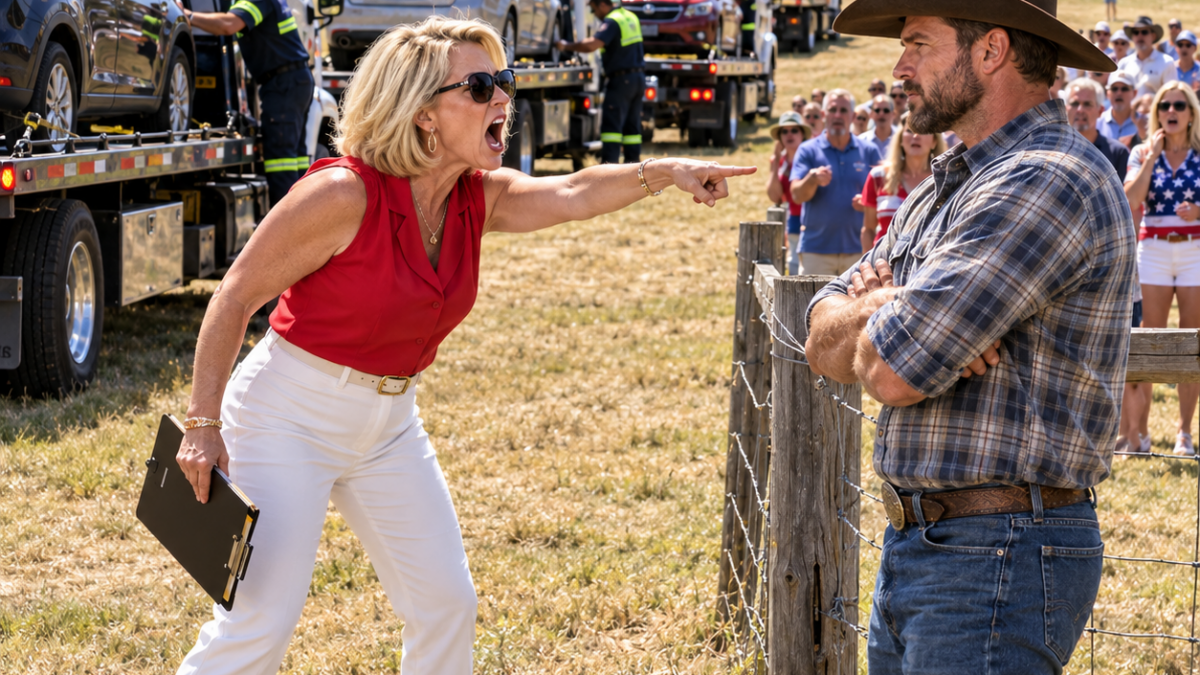
She came storming across the grass from the clubhouse patio like an offended general. Red, white, and blue scarf around her neck. Clipboard in hand. Sunglasses pushed up into her hair. Her mouth was already moving before she reached us.
“What do you think you’re doing?”
Ray looked at her, then at the car he was loading.
“Towing.”
“You cannot tow these vehicles.”
“They’re parked on private property.”
“This is community event parking.”
“No,” I said. “It isn’t.”
Karen spun toward me.
“You are stealing people’s cars.”
“I am removing cars from my land exactly like I told you I would.”
People were gathering now. A man holding a paper plate. A woman with a toddler on her hip. Two board members I vaguely recognized. Several people whose cars were still waiting in the field like sheep that had not yet realized the wolves were paperwork and consequences.
Karen turned to Ray.
“You need to stop this immediately. I am the HOA president.”
Ray tightened a chain.
“Good for you.”
“This land falls under community-use designation.”
He pulled out the property records I had given him.
“Ma’am, I’ve got county records here. This is his property. He requested private-property towing. We’re good.”
Karen’s face flushed deep red.
“You are taking his word over mine?”
Ray finally looked at her fully.
“I’m taking the county’s word over yours.”
That got a few quiet reactions from the crowd.
Karen heard them.
Her smile snapped into place, fake and strained.
“Everyone, please remain calm. There appears to be a misunderstanding.”
“No misunderstanding,” I said loudly. “I sent the HOA board the property records. I told Karen in writing nobody could park here. I told her every car would be towed.”
One of the men nearby frowned.
“What email?”
Karen ignored him.
Ray finished hooking up the third car.
A woman rushed forward.
“That’s my car!”
Ray paused.
“Ma’am, this vehicle is illegally parked on private property.”
“No, Karen said we could park here.”
All eyes went to Karen.
Karen’s explanation began changing shape immediately.
“I said this area was designated for overflow based on development documents.”
The woman stared at her.
“So you said we could park here.”
“It was a good-faith interpretation.”
I almost admired how fast she found phrases that meant nothing.
The woman looked at me.
“Can you please just let me move it?”
I felt bad for her.
I did.
But the car was already hooked. And more importantly, if I let one person go because they looked embarrassed, the entire thing would collapse into negotiation. Karen would win by making me absorb the cost of her lie.
“You need to talk to Karen,” I said. “I warned the HOA.”
The woman turned on Karen.
“You told us this was fine.”
Karen lifted both hands.
“This man is choosing to be punitive.”
“No,” I said. “I am choosing not to be used.”
Ray drove away with the third car.
That was when the event truly fell apart.
People began running from the clubhouse to check the field. Some realized their cars were still there and moved them fast. Others discovered theirs were already gone. The air filled with anger, confusion, and the kind of panic that happens when a nice holiday party suddenly costs a family a hundred and fifty dollars.
The fourth and fifth cars caused shouting.
One man came out just as Ray returned and started hooking his SUV.
“Hey! Hey! That’s mine!”
Ray kept his voice calm.
“Sir, this vehicle is on private property.”
“The HOA said this was overflow.”
“Then your issue is with the HOA.”
The man looked at Karen.
“You told us to park here.”
Karen’s voice went high.
“I said this was the designated plan, yes, but he is refusing to cooperate.”
The man pointed at me.
“He owns it?”
“Yes,” I said.
“And he told you no?”
Karen hesitated.
That pause did more damage than any speech I could have given.
The man’s face darkened.
“Are you kidding me?”
A board member stepped forward then. His name, I later learned, was Richard. He wore a polo shirt with the HOA logo and the expression of a man discovering live ammunition in his lunchbox.
“Karen,” he said carefully, “what email was he talking about?”
“This is not the time.”
“What email?”
She glared at him.
“I handled it.”
Richard looked at me.
“Did you send documentation to the board?”
“Yes. I copied the board address.”
“I never saw it.”
Another board member, a woman in a blue sundress, checked her phone right there.
“I didn’t either.”
Karen’s jaw clenched.
I watched the entire crowd understand at different speeds.
Some people got it instantly.
Karen had not shared my warning.
Others took longer because believing authority is easier than realizing authority got you towed.
By the eighth car, people had stopped yelling at me and started yelling at Karen.
By the tenth, Ray had to call in a second driver because the pace was too much for one truck.
By the twelfth, the field was clearing fast as owners scrambled to move anything still on my property.
Karen threatened lawsuits.
She threatened police.
She threatened to file complaints against the towing company.
Ray gave her the same answer every time.
“Ma’am, call whoever you want.”
She did not call the police.
I think even Karen understood the risk of officers arriving and asking why she had directed people to trespass after receiving written notice.
By then, the Fourth of July celebration had lost its shine.
The music still played, but nobody listened. The food line sat half-empty. Kids still ran around because kids are resilient and hot dogs outrank adult conflict, but the adults clustered in angry groups. I heard pieces of conversations drifting across the grass.
“One hundred fifty dollars?”
“She said it was approved.”
“Why didn’t she tell us?”
“My car seat is in there.”
“I’m not paying for her mistake.”
Karen stood near the clubhouse steps, surrounded by people demanding answers. Her scarf had slipped sideways. Her sunglasses were in one hand. For the first time since I had known of her, she looked less like a queen and more like a woman whose throne had wheels and had just been towed.
I should have felt triumphant.
I did, a little.
But mostly I felt tired.
I had not wanted their holiday ruined. I had not wanted regular people spending money because Karen lied to them. I had not wanted a public spectacle next to my ranch.
What I wanted was simple.
My land left alone.
But simple boundaries become complicated when people decide they are optional.
The next morning, I found three angry notes taped to my gate.
One said I was a bad neighbor.
One called me greedy.
One said I should be ashamed for ruining a family event.
No names, of course.
Cowards love anonymous morality.
I took photos and threw them away.
By noon, the neighborhood gossip chain had done what gossip chains do best. I heard from two different residents that there had been an emergency board meeting. I heard people demanded reimbursement for towing fees. I heard Karen blamed me, the tow company, the county records office, the former developer, poor communication, unclear boundaries, and “rural hostility toward community values.”
I appreciated that last one.
Rural hostility toward community values sounded much more sophisticated than get off my property.
Two days later, Richard from the board came by.
He parked on the road, not in my driveway, which I respected. Then he walked to the gate and called out instead of letting himself in.
Already an improvement.
I met him there.
“Mr. Callahan,” he said, “I wanted to apologize.”
I leaned on the gate.
“For what specifically?”
He winced.
“For the parking incident. For Karen’s handling of it. For the association’s failure to verify the property records before allowing residents to park there.”
“Karen had the records.”
“I know that now.”
“Did she hide the email?”
His face answered before his mouth did.
“She forwarded it to the board after the event,” he said. “Claimed she had meant to send it earlier.”
I laughed once.
Richard did not.
“A lot of people are angry,” he said.
“At me?”
“At first. Less so now.”
“Good.”
He cleared his throat.
“The board wants to assure you that your land is private property and will not be used for HOA parking or any other HOA purpose.”
“I already knew that.”
“Yes. Well. We wanted to state it formally.”
“Put it in writing.”
“We will.”
“And Karen?”
He looked toward the clubhouse, though it was mostly hidden by trees.
“There will be a vote.”
The vote happened within two weeks.
Karen lost her position as HOA president.
From what I heard, it was not only the parking disaster. Apparently, the field incident opened a door people had been leaning against for years. Residents started talking about other unilateral decisions. Emails she had not shared. Complaints she had ignored. Fines she had pursued without full board approval. Vendors she had chosen without bids. Petty personal crusades dressed up as policy.
The twelve towed cars became the final straw because money has a way of making people brave.
One hundred and fifty dollars per car.
Twelve cars.
Eighteen hundred dollars of collective outrage.
Enough to do what years of irritation had not done.
Karen tried to defend herself, of course. She claimed she had acted in good faith. She claimed the development documents were ambiguous. She claimed I had been unreasonable and hostile from the beginning. She claimed real neighbors would have found a cooperative solution.
Nobody wanted to hear it.
Especially not the people who had spent part of their holiday at an impound lot.
She was removed by a wide margin.
I did not attend the meeting, but I did sit on my porch that night and listen to the clubhouse parking lot empty afterward. For once, nobody came near my field.
A few days later, the new HOA president came to my ranch.
Her name was Linda Hartwell, and she had the exhausted but sincere energy of someone who had just inherited a room full of leaking pipes. She arrived with a folder, no clipboard, no cones, and no attitude. That helped.
She stopped at the gate.
“Mr. Callahan?”
“That’s me.”
“I’m Linda, the new Maple Ridge HOA president.”
“My condolences.”
She smiled despite herself.
“Fair.”
I walked down to meet her.
“I’m here to apologize,” she said. “Officially and personally.”
“That’s a good start.”
She handed me a letter.
It stated, in plain language, that Maple Ridge HOA acknowledged my property was private, outside HOA boundaries, and not available for parking or community use without my express written permission. It also stated that the HOA would not represent my land as community property in any future communications.
I read it right there.
It was lawyerly, but clear enough.
“Thank you,” I said.
Linda nodded.
“We are also reviewing the clubhouse parking situation. Expansion may be possible, but it will take funding and county approval.”
“That sounds like an HOA problem.”
“It is.”
She looked embarrassed but did not argue.
That made me respect her more.
“What about the people who got towed?” I asked.
Her face tightened.
“That is complicated.”
“I bet.”
“There was debate about reimbursement. Ultimately, the board decided not to use HOA funds. Karen acted outside board approval and against notice. People may pursue her individually if they choose.”
“That won’t make them happy.”
“No,” she said. “But using everyone’s dues to pay for her unauthorized decision would create its own problem.”
For the first time, I felt a little sympathy for the board.
Not much.
A little.
Linda looked past me toward the field.
“I understand why you did what you did.”
“Some people don’t.”
“I know.”
“I tried warning drivers at first.”
“I heard.”
“They pointed at the cones.”
She sighed.
“I’m sorry.”
There was not much else to say.
Before she left, she asked if there was any arrangement I would ever consider for future overflow parking—paid use, formal agreement, limited section, liability coverage, something negotiated properly.
I appreciated the fact that she asked.
Still, I said no.
Maybe if Karen had started there, years earlier, with respect, insurance, compensation, fencing, security, and a plan that protected my animals, I might have considered it.
Maybe.
But after being steamrolled, lied to, and challenged on my own land, no was the only answer that protected the future.
Because that is what people like Karen never understand about boundaries.
The first violation is rarely the last if it succeeds.
Let one event park in your field, and the next event assumes access. Let one committee call your pasture “community benefit,” and the next one wants signage. Let one neighbor treat your property as a convenience, and suddenly refusal becomes the offense.
No.
That word saved me more trouble than any compromise would have.
The next HOA event happened in October.
Some kind of harvest festival, which felt ironic considering none of them harvested anything except newsletter drama. I was working near the barn that afternoon, repairing a gate latch, when cars began arriving.
The clubhouse lot filled.
Then the street.
Then people drove slowly past my field.
Not one turned in.
A few drivers looked at the new signs I had posted after the Fourth.
PRIVATE PROPERTY.
NO PARKING.
UNAUTHORIZED VEHICLES WILL BE TOWED.
One man slowed, read the sign, then kept going with the careful expression of someone remembering an expensive lesson.
I smiled and went back to work.
That was peace.
Not friendship.
Not unity.
Not a glossy HOA flyer about community values.
Just people recognizing where their rights ended.
I still hear different opinions about what happened.
Some people think I did exactly right.
Others think I should have been more flexible, that the car owners were innocent, that I should have blocked access more clearly, that I should have charged ten dollars a car and made the best of it. A few are still mad at me because anger seeks the nearest face, and mine was easier to find than Karen’s accountability.
I understand some of that.
I do.
If you were one of those families who showed up for hot dogs and fireworks and ended up paying $150 to get your car back, you probably did not feel like the villain. You trusted the HOA president. You followed cones. You parked where someone in authority told you to park.
But here is the part nobody likes hearing.
When you park on land that does not belong to you, the risk is yours too.
Cones do not create ownership.
A clipboard does not create permission.
And if someone tells you a private field is public parking while the owner is standing there saying no, maybe listen to the owner.
After everything settled, one of the towed residents came by.
He was the man with the flag shirt from the first car. The silver sedan. The cupcakes.
I saw him at the gate one Saturday morning. He looked sheepish, which is not an emotion people enjoy wearing.
“Mr. Callahan?”
“Yes.”
“I wanted to apologize.”
I waited.
“My wife told me I was rude to you when you tried to warn me.”
“You were.”
He nodded.
“I was frustrated and thought you were just having some fight with the HOA. Karen had told everyone it was approved.”
“I know.”
“I still should have moved.”
“Yes.”
He looked down.
“Cost me one-fifty.”
“Expensive parking.”
That got a reluctant laugh out of him.
“Yeah. My wife said the same thing, but with more profanity.”
I smiled.
He shifted his weight.
“For what it’s worth, I voted against Karen.”
“That is worth something.”
He held out a hand.
I shook it.
No grand friendship came from that. We did not suddenly become barbecue buddies. But I respected the apology, and I think he respected the boundary. Sometimes that is enough.
Karen never apologized.
I did not expect her to.
I saw her once afterward, months later, at the feed store of all places. She was standing near the checkout with a man I assumed was her husband, wearing a cream sweater, sunglasses perched on her head, mouth pressed thin as a blade. When she saw me, her posture stiffened.
I tipped my hat.
“Karen.”
Her face tightened.
“Mr. Callahan.”
“How’s parking?”
The cashier made a sound and turned it into a cough.
Karen walked out without buying anything.
That carried me through the whole week.
She eventually stopped being president, but she did not stop being herself. People like Karen rarely transform. They just lose access to certain tools. Without the title, without the board behind her, without people believing every word she said, she became what she probably always feared being.
Just another neighbor with opinions.
The ranch stayed the same in all the ways that mattered.
The field beside the clubhouse still grows grass. Sometimes equipment sits there. Sometimes livestock rotates through. Sometimes it looks empty to people who do not understand land. But empty-looking land can be resting, recovering, draining, growing, waiting, serving a purpose invisible from a patio.
That is true of people too, I guess.
Quiet does not mean available.
Open does not mean public.
Unfenced does not mean unowned.
I have thought a lot about why the incident bothered me as much as it did.
It was not only the cars.
It was the assumption.
Karen looked at my ranch and saw convenience. Not labor. Not ownership. Not animals. Not liability. Not the years I spent keeping it functioning. Not the early mornings, late nights, busted knuckles, vet calls, repair bills, hay deliveries, tax payments, and weather worries.
She saw grass.
She saw space.
She saw something she wanted to use.
Then she built a story where wanting became rights.
That is the dangerous part.
Most people do not steal land by saying, “I want to take this.”
They say it is underutilized.
They say it serves the community.
They say it is just for one night.
They say you are selfish if you refuse.
They say cooperation while meaning surrender.
Karen did not think of herself as a trespasser. I believe that. In her mind, she was a leader solving a parking problem. My refusal made me the villain because she had already decided her goal was good, and people like that can justify almost anything.
That is why I had the cars towed.
Not for revenge.
Though I would be lying if I said there was no satisfaction in watching that third truck pull away.
I had them towed because words had failed, documents had failed, warnings had failed, and Karen had chosen to test whether I meant what I said.
I meant it.
The funny thing is, after the dust settled, the neighborhood became easier to deal with.
Linda kept her word. The HOA stopped sending random complaints my way. No more fence color nonsense. No more remarks about equipment visibility. No more residents asking to park in the field before events. They eventually expanded the clubhouse parking lot by a modest amount—not enough for every event, but enough to reduce the worst chaos.
People learned to carpool.
Imagine that.
A miracle of modern community planning.
A few residents even became regular customers. One family buys eggs every other week. Another buys beef when I have it available. A retired couple brings their grandkids to look at the horses from the proper side of the fence, and the kids always ask before reaching out.
That is all I ever wanted.
Ask.
Respect the answer.
Leave things as you found them.
My ranch does not need to be loved by the HOA.
It does not need to be included in their community vision.
It does not need to serve their convenience or solve their planning mistakes.
It just needs to be left alone.
On the next Fourth of July, I sat on my porch again.
The clubhouse threw another party. Smaller maybe, or maybe just better organized. Music drifted across the fence. Kids laughed. Fireworks cracked in the distance after dark. Cars filled the official lot and the street, but not my field.
Not one.
I had moved the horses to the back pasture earlier, just in case the noise spooked them. The air smelled like smoke, grilled meat, clover, and warm dust. I poured myself iced tea and watched taillights move slowly along the road.
At one point, I saw a car slow near my field entrance.
Brake lights glowed.
For a second, old irritation rose in me.
Then the driver continued down the street and found somewhere else.
I raised my glass in a silent toast.
To boundaries.
To county records.
To tow trucks.
To the beautiful educational power of consequences.
Later that night, after the fireworks ended and the subdivision quieted down, I walked out to the field. Moonlight lay pale over the grass. The cones were long gone. The signs stood steady by the entrance. In the distance, the clubhouse lights clicked off one by one.
I stood there for a while, listening.
Crickets.
A horse snorting softly beyond the barn.
Wind moving through grass Karen once called underutilized.
I thought about my father, who had taught me that land is never just land. It is work, responsibility, memory, and future all under your boots. You do not have to be sentimental to protect it. You only have to understand that if you let other people define what your property is for, sooner or later they will define what you are allowed to keep.
Karen tried to turn my ranch into a parking lot.
For one evening, twelve people believed her.
Then twelve tow receipts told the truth.
And after that, nobody forgot it.
𝗧𝗛𝗘 𝗘𝗡𝗗
Karen Turned My Ranch Into HOA Parking, Then Twelve Tow Trucks Taught Her What Private Property Means
Karen told an entire neighborhood they could park on my ranch because she had decided my land belonged to the HOA.
By the time the twelfth car disappeared on a tow truck, everyone at that Fourth of July party knew exactly who had lied to them.
I own a ranch on the kind of border that causes trouble.
Not the dramatic kind of border with signs and checkpoints. I mean the quiet, annoying kind where one side of the road still smells like hay, livestock, engine oil, and creek mud, while the other side has matching mailboxes, approved paint colors, decorative streetlamps, and a clubhouse pretending it has always belonged there.
My land sits right at the edge of that change.
To the west, there are pastures, a barn, my equipment shed, a long gravel drive, and enough fence line to make my back hurt just thinking about repairs. To the east, there is suburbia. Nice houses. Clean lawns. Identical shutters. Sprinklers timed so precisely you could set a watch by them. Their streets curl around cul-de-sacs with names like Maple Hollow Court and Liberty Pointe Lane, even though the whole thing used to be grazing land less than twenty years ago.
I do not hate the people who live there.
That is important.
Some of them are perfectly decent. A few wave when they pass. Some buy eggs from me. A couple of kids like watching the horses from the sidewalk, and their parents are careful enough to remind them not to climb the fence. I have no problem with people wanting a clean neighborhood, a quiet house, and a place to raise families.
What I do have a problem with is anyone looking at my ranch and deciding it is just empty space waiting for their permission to matter.
The HOA next door had tried little things over the years.
Not big fights at first. Mostly misunderstandings. A man from their architectural committee once told me my fence was the wrong color. I told him it was the color of weathered wood and private ownership. He checked his paperwork, realized my land was not inside their association, and apologized. Another person once complained that my tractor was visible from the clubhouse patio. I said the tractor was visible because tractors are tall and fields are open. That person also went away.
Those interactions annoyed me, but I could forgive confusion.
Then there was Karen.
Karen Whitmore was the HOA president, and she had the personality of a parking ticket wearing perfume. I knew her before I ever had a direct fight with her because everybody knew Karen. She was the kind of woman who turned board membership into royal blood. Loud, polished, relentless, and convinced that every disagreement was a personal attack on civilization itself.
I had heard stories.
Karen fined people for leaving trash cans out an hour early. Karen made a retired man repaint his mailbox because the black was “insufficiently satin.” Karen yelled at a mother because a child’s bicycle had been left on the front lawn for fifteen minutes. Karen once tried to regulate what color Christmas lights people could use because she said warm white created a more cohesive holiday experience.
That was the phrase I heard from a neighbor.
A more cohesive holiday experience.
I remember thinking that anyone who said those words out loud should never be trusted with authority.
The clubhouse sat right beside my ranch.
That was the source of everything.
When the subdivision was built, whoever planned it apparently believed everyone would walk to community events like they were living in some wholesome brochure where nobody gets old, tired, or lazy. The clubhouse itself was fancy enough—stone front, wide windows, little event lawn, flags near the entrance—but the parking lot was laughably small.
For normal meetings, it was fine.
For big holidays, it became chaos.
Memorial Day. Labor Day. Halloween. Christmas market. And worst of all, the Fourth of July.
Every year, they threw a huge neighborhood party at the clubhouse. Food trucks, music, games for kids, fireworks if the county allowed it, flags everywhere, and not nearly enough parking. Cars lined the streets, blocked driveways, parked half on curbs, and occasionally ended up with two tires on grass that did not belong to them.
A few times, people asked me politely if they could park in my field beside the clubhouse lot.
I always said no.
Not because I wanted to be difficult. Because it was not an empty field. I used it. Sometimes for equipment, sometimes for livestock rotation, sometimes for temporary feed storage. Even when it looked open, it was still working land.
Most people understood.
Karen did not.
part2
The letter arrived three weeks before the Fourth of July.
It came in an envelope so formal it looked like it expected me to stand when I opened it. Heavy paper. HOA logo embossed in blue. My name typed correctly, which somehow made it worse because it meant Karen had put effort into being wrong.
I opened it at my kitchen table after morning chores, still smelling like hay and sweat.
The letter informed me that, according to original neighborhood development planning documents, my field adjacent to the clubhouse had been designated as auxiliary community space for HOA events.
I read that sentence twice.
Then a third time, just to appreciate the audacity.
Auxiliary community space.
My pasture had apparently received a promotion without consulting me.
The letter went on to explain that I was obligated to facilitate community harmony by allowing vehicles to park in the field during the upcoming Fourth of July event and all future events as needed. They had even included a photocopied clause from some old development document, the kind of vague legal language people love when they hope confusion will do the heavy lifting.
It said underutilized space within community boundaries could be designated for community benefit during special events.
There were two problems.
First, my land was not underutilized.
Second, my land was not within their community boundaries.
I leaned back in my chair and looked out the kitchen window toward the field in question. A flatbed trailer sat near the far fence. Two water troughs were stacked beside the equipment lane. Beyond them, one of my horses flicked his tail at flies like he had just learned he was standing on community parking.
I almost laughed.
Almost.
Then I imagined cars lined across that ground. Oil leaks. tire ruts. people wandering near animals. kids climbing fences. drunk adults after fireworks. Karen standing there with a clipboard acting like my ranch had finally been civilized.
The laugh died.
I set the letter aside, finished my coffee, and decided not to answer immediately.
That was mistake number one, according to Karen.
Two days later, she called.
I recognized the number only because it had appeared on the letterhead. Against my better judgment, I answered.
“This is Luke.”
“Mr. Callahan,” she said, voice already halfway to annoyed. “This is Karen Whitmore, president of the Maple Ridge Homeowners Association.”
“I figured.”
“I’m calling to confirm you received our notice regarding Fourth of July parking.”
“I got it.”
“Good. We will have volunteers arrive early that day to set cones and direct vehicles so the process remains organized.”
I looked at the phone.
“No.”
There was a pause.
“I’m sorry?”
“No. Nobody is parking in my field.”
Her voice sharpened.
“Mr. Callahan, perhaps you did not understand the letter.”
“I understood it. It was wrong.”
“The development clause is very clear.”
“It is not.”
“Your property falls within the HOA planning area.”
“No, Karen. Your clubhouse borders my ranch. That does not make my ranch part of your association.”
She gave a small, impatient sigh.
“Look, we are not asking you to contribute money or volunteer time. We are simply asking you to do the neighborly thing.”
“That would have been a better way to start,” I said.
“What?”
“Asking. Not sending a letter telling me my property is community overflow.”
“We have rights too.”
“Not to my land.”
“This event is important to our community.”
“Then hold it on community property.”
“You are being unnecessarily difficult.”
“No, I am being clear. That field is private property. I use it for livestock and equipment. If cars park there, they will be towed.”
Her tone changed.
It became colder, flatter.
“We are going to proceed according to the development plan.”
“Then I will proceed according to property law.”
She hung up.
I sat there for a moment with the phone still in my hand, listening to the empty line.
Then I did what I should have done immediately.
I went to the county clerk’s office.
If you have never spent a morning digging through property records, imagine being punished for a crime you do not remember committing. It is fluorescent lights, forms, old maps, parcel numbers, plat books, and a printer that sounds like it is slowly dying under the weight of bureaucracy.
Fortunately, the clerk who helped me had the patient expression of someone who enjoyed watching arrogant organizations be wrong on paper.
We pulled my deed.
The HOA plat.
The original development documents.
Boundary maps.
Easement records.
Everything.
The truth was boring, which is often the best kind of truth.
My ranch was not part of Maple Ridge.
Never had been.
The clause Karen quoted applied only to parcels inside the subdivision. It had no legal power over my property. There was no parking easement, no event access easement, no shared-use agreement, no community boundary claim, and absolutely nothing that turned my field into auxiliary anything.
I paid for copies.
Then I scanned everything at home and sent an email to the HOA board.
I kept it professional.
My land is private property and not part of the HOA subdivision.
The cited development clause does not apply to my parcel.
No permission is granted for parking, foot traffic, event setup, signage, cones, volunteers, or any other HOA use of my land.
Any vehicles parked on my property without permission will be towed at the owner’s expense.
I included the towing company’s contact information because I wanted there to be no confusion later.
Karen replied within an hour.
She copied the whole board, which I appreciated.
Her message said I was misinterpreting the documents, being obstructionist, and refusing to support community harmony. She wrote that Maple Ridge would continue with its approved event plan and that “real neighbors understand cooperation.”
I saved the email.
Then I called the towing company.
The man who answered sounded like he had dealt with HOAs before because the moment I explained the situation, he chuckled.
“Fourth of July overflow parking dispute?”
“Something like that.”
“Private property?”
“Yes.”
“Got records?”
“Yes.”
“You warned them in writing?”
“Yes.”
“Then if they park there, we can tow. Holiday’s busy, though. How many cars are we talking?”
“I’m hoping zero. But if Karen does what she says she’s doing, maybe a lot.”
He paused.
“Karen?”
I smiled despite myself.
“HOA president.”
“Oh, yeah. We know that type.”
We made an arrangement. If cars started showing up, I would call. If nobody parked there, I would let them move on to other holiday calls. But he promised he could keep a truck near the area around event time if I genuinely expected multiple vehicles.
Two days before the Fourth, I saw Karen in my field.
Not near my field.
In it.
She had parked a golf cart by the clubhouse fence and was walking across my grass with a bundle of orange cones. She wore white pants, red sandals, a navy blouse, and sunglasses that made her look like she was auditioning to supervise a yacht club. A teenage boy trailed behind her, carrying a stack of small signs.
I walked out from the barn, wiping my hands on a rag.
“Karen.”
She looked up like I had interrupted her in her own yard.
“Mr. Callahan.”
“What are you doing?”
“Setting up overflow parking.”
“On my property.”
She placed another cone.
“According to the plan.”
“The plan I told you was illegal.”
She straightened and smiled, but it was not friendly.
“We have reviewed our documents.”
“No, you ignored mine.”
“Your interpretation is not the only interpretation.”
“It is when I own the field.”
The teenage boy looked between us, suddenly very interested in being anywhere else.
I pointed toward the clubhouse.
“Pick up the cones and leave.”
Karen crossed her arms.
“Or what?”
There it was.
Not misunderstanding.
Not confusion.
Challenge.
“Or every car that parks here gets towed.”
“You would not dare.”
I laughed then.
I could not help it.
Karen’s face flushed.
“You think this is funny?”
“I think you’re making a mistake.”
“I think you are selfish,” she snapped. “Our community is celebrating Independence Day, and you are hoarding empty land like some feudal lord.”
“It is not empty.”
“It is grass.”
“It is my grass.”
The boy made a sound like a cough.
Karen shot him a look.
I stepped closer, keeping my voice calm.
“I am telling you one last time. Move the cones. Do not send people onto my land.”
Karen lifted her chin.
“We’ll see what the board has to say.”
“You already copied them on the email.”
Her expression flickered.
Just barely.
Enough.
I realized then that maybe the board did not know as much as she wanted me to think.
But Karen recovered fast.
“We will proceed,” she said.
“Then so will I.”
I turned and walked back toward the barn.
I did not remove the cones.
People later asked why.
Why not pull them up? Why not block the field? Why not put out huge signs? Why not park equipment across the entrance? Why not build a temporary barrier?
The answer is simple.
Because I had already said no.
Because it was not my job to spend money, time, sweat, and fuel solving Karen’s decision to trespass.
Because if I let her force me into defensive labor every time she invented authority, she had already won part of the fight.
And because, if I am being honest, part of me wanted her to learn in public.
The Fourth of July arrived hot and bright.
By noon, the air shimmered over the road. By four, I could hear activity at the clubhouse—music testing, kids shouting, generators humming, the dull thump of coolers being unloaded. The smell of grilled meat drifted across the fence, mingling with dust and hay.
I finished chores early, brought the animals in from the field nearest the clubhouse, and moved equipment that I did not want near strangers. Then I sat on my porch with iced tea and waited.
The official event started at five.
The clubhouse parking lot was full by five-twenty.
By five-thirty, cars had filled both sides of the street.
By five-forty, a silver sedan turned into my field between Karen’s cones.
I watched it stop exactly where she had marked the first space.
A man got out wearing a flag shirt and cargo shorts. His wife climbed out beside him with a tray of cupcakes. Two kids tumbled from the backseat and ran toward the clubhouse.
I walked out.
“Hey,” I called. “You can’t park there.”
The man looked confused.
“The HOA lady said this was overflow.”
“It’s my private property.”
He glanced at the cones.
“She said it was approved.”
“It was not.”
His wife shifted the cupcake tray from one hand to the other.
“Can we just stay for a little while? The kids are already excited.”
“No. I use this field. You need to move.”
The man’s expression hardened a little.
“Look, I’m not trying to get involved in some neighbor dispute.”
“Then don’t park on my land.”
He looked toward the clubhouse, where music was starting and more families were arriving.
“We’ll be quick,” he said.
Then he walked away.
That was the moment my last trace of guilt left.
Three more cars pulled in before I reached the gate.
I tried one more time.
A woman in a minivan rolled down her window and said, “Karen told us this was HOA parking.”
“It isn’t.”
“Well, there are cones.”
“They’re trespassing cones.”
She stared at me like I had spoken another language.
Behind her, another SUV honked, impatient to get into the field.
I stepped back.
Time to make the call.
The towing company answered immediately.
“How many?”
“Four already. More coming.”
“We’ll be there in fifteen.”
By the time the tow truck arrived, there were seven cars in my field.
The driver, a broad man named Ray with tattooed forearms and a calm, practical expression, stepped out and looked across the field.
“Well,” he said, “that’s bold.”
“I warned them.”
“Got the records?”
I handed him copies.
He looked them over, nodded, and began with the silver sedan.
The music at the clubhouse was loud enough that nobody noticed at first. People were inside, or gathered around food tables, or watching kids play lawn games. Ray hooked up the sedan, took photos, logged everything, and drove away.
One down.
When he returned for the second car, a couple people noticed but seemed unsure what was happening. By the third car, murmurs had started. Someone pointed. Someone else pulled out a phone. A teenager yelled, “Mom, I think cars are getting towed!”
That finally brought Karen.
She came storming across the grass from the clubhouse patio like an offended general. Red, white, and blue scarf around her neck. Clipboard in hand. Sunglasses pushed up into her hair. Her mouth was already moving before she reached us.
“What do you think you’re doing?”
Ray looked at her, then at the car he was loading.
“Towing.”
“You cannot tow these vehicles.”
“They’re parked on private property.”
“This is community event parking.”
“No,” I said. “It isn’t.”
Karen spun toward me.
“You are stealing people’s cars.”
“I am removing cars from my land exactly like I told you I would.”
People were gathering now. A man holding a paper plate. A woman with a toddler on her hip. Two board members I vaguely recognized. Several people whose cars were still waiting in the field like sheep that had not yet realized the wolves were paperwork and consequences.
Karen turned to Ray.
“You need to stop this immediately. I am the HOA president.”
Ray tightened a chain.
“Good for you.”
“This land falls under community-use designation.”
He pulled out the property records I had given him.
“Ma’am, I’ve got county records here. This is his property. He requested private-property towing. We’re good.”
Karen’s face flushed deep red.
“You are taking his word over mine?”
Ray finally looked at her fully.
“I’m taking the county’s word over yours.”
That got a few quiet reactions from the crowd.
Karen heard them.
Her smile snapped into place, fake and strained.
“Everyone, please remain calm. There appears to be a misunderstanding.”
“No misunderstanding,” I said loudly. “I sent the HOA board the property records. I told Karen in writing nobody could park here. I told her every car would be towed.”
One of the men nearby frowned.
“What email?”
Karen ignored him.
Ray finished hooking up the third car.
A woman rushed forward.
“That’s my car!”
Ray paused.
“Ma’am, this vehicle is illegally parked on private property.”
“No, Karen said we could park here.”
All eyes went to Karen.
Karen’s explanation began changing shape immediately.
“I said this area was designated for overflow based on development documents.”
The woman stared at her.
“So you said we could park here.”
“It was a good-faith interpretation.”
I almost admired how fast she found phrases that meant nothing.
The woman looked at me.
“Can you please just let me move it?”
I felt bad for her.
I did.
But the car was already hooked. And more importantly, if I let one person go because they looked embarrassed, the entire thing would collapse into negotiation. Karen would win by making me absorb the cost of her lie.
“You need to talk to Karen,” I said. “I warned the HOA.”
The woman turned on Karen.
“You told us this was fine.”
Karen lifted both hands.
“This man is choosing to be punitive.”
“No,” I said. “I am choosing not to be used.”
Ray drove away with the third car.
That was when the event truly fell apart.
People began running from the clubhouse to check the field. Some realized their cars were still there and moved them fast. Others discovered theirs were already gone. The air filled with anger, confusion, and the kind of panic that happens when a nice holiday party suddenly costs a family a hundred and fifty dollars.
The fourth and fifth cars caused shouting.
One man came out just as Ray returned and started hooking his SUV.
“Hey! Hey! That’s mine!”
Ray kept his voice calm.
“Sir, this vehicle is on private property.”
“The HOA said this was overflow.”
“Then your issue is with the HOA.”
The man looked at Karen.
“You told us to park here.”
Karen’s voice went high.
“I said this was the designated plan, yes, but he is refusing to cooperate.”
The man pointed at me.
“He owns it?”
“Yes,” I said.
“And he told you no?”
Karen hesitated.
That pause did more damage than any speech I could have given.
The man’s face darkened.
“Are you kidding me?”
A board member stepped forward then. His name, I later learned, was Richard. He wore a polo shirt with the HOA logo and the expression of a man discovering live ammunition in his lunchbox.
“Karen,” he said carefully, “what email was he talking about?”
“This is not the time.”
“What email?”
She glared at him.
“I handled it.”
Richard looked at me.
“Did you send documentation to the board?”
“Yes. I copied the board address.”
“I never saw it.”
Another board member, a woman in a blue sundress, checked her phone right there.
“I didn’t either.”
Karen’s jaw clenched.
I watched the entire crowd understand at different speeds.
Some people got it instantly.
Karen had not shared my warning.
Others took longer because believing authority is easier than realizing authority got you towed.
By the eighth car, people had stopped yelling at me and started yelling at Karen.
By the tenth, Ray had to call in a second driver because the pace was too much for one truck.
By the twelfth, the field was clearing fast as owners scrambled to move anything still on my property.
Karen threatened lawsuits.
She threatened police.
She threatened to file complaints against the towing company.
Ray gave her the same answer every time.
“Ma’am, call whoever you want.”
She did not call the police.
I think even Karen understood the risk of officers arriving and asking why she had directed people to trespass after receiving written notice.
By then, the Fourth of July celebration had lost its shine.
The music still played, but nobody listened. The food line sat half-empty. Kids still ran around because kids are resilient and hot dogs outrank adult conflict, but the adults clustered in angry groups. I heard pieces of conversations drifting across the grass.
“One hundred fifty dollars?”
“She said it was approved.”
“Why didn’t she tell us?”
“My car seat is in there.”
“I’m not paying for her mistake.”
Karen stood near the clubhouse steps, surrounded by people demanding answers. Her scarf had slipped sideways. Her sunglasses were in one hand. For the first time since I had known of her, she looked less like a queen and more like a woman whose throne had wheels and had just been towed.
I should have felt triumphant.
I did, a little.
But mostly I felt tired.
I had not wanted their holiday ruined. I had not wanted regular people spending money because Karen lied to them. I had not wanted a public spectacle next to my ranch.
What I wanted was simple.
My land left alone.
But simple boundaries become complicated when people decide they are optional.
The next morning, I found three angry notes taped to my gate.
One said I was a bad neighbor.
One called me greedy.
One said I should be ashamed for ruining a family event.
No names, of course.
Cowards love anonymous morality.
I took photos and threw them away.
By noon, the neighborhood gossip chain had done what gossip chains do best. I heard from two different residents that there had been an emergency board meeting. I heard people demanded reimbursement for towing fees. I heard Karen blamed me, the tow company, the county records office, the former developer, poor communication, unclear boundaries, and “rural hostility toward community values.”
I appreciated that last one.
Rural hostility toward community values sounded much more sophisticated than get off my property.
Two days later, Richard from the board came by.
He parked on the road, not in my driveway, which I respected. Then he walked to the gate and called out instead of letting himself in.
Already an improvement.
I met him there.
“Mr. Callahan,” he said, “I wanted to apologize.”
I leaned on the gate.
“For what specifically?”
He winced.
“For the parking incident. For Karen’s handling of it. For the association’s failure to verify the property records before allowing residents to park there.”
“Karen had the records.”
“I know that now.”
“Did she hide the email?”
His face answered before his mouth did.
“She forwarded it to the board after the event,” he said. “Claimed she had meant to send it earlier.”
I laughed once.
Richard did not.
“A lot of people are angry,” he said.
“At me?”
“At first. Less so now.”
“Good.”
He cleared his throat.
“The board wants to assure you that your land is private property and will not be used for HOA parking or any other HOA purpose.”
“I already knew that.”
“Yes. Well. We wanted to state it formally.”
“Put it in writing.”
“We will.”
“And Karen?”
He looked toward the clubhouse, though it was mostly hidden by trees.
“There will be a vote.”
The vote happened within two weeks.
Karen lost her position as HOA president.
From what I heard, it was not only the parking disaster. Apparently, the field incident opened a door people had been leaning against for years. Residents started talking about other unilateral decisions. Emails she had not shared. Complaints she had ignored. Fines she had pursued without full board approval. Vendors she had chosen without bids. Petty personal crusades dressed up as policy.
The twelve towed cars became the final straw because money has a way of making people brave.
One hundred and fifty dollars per car.
Twelve cars.
Eighteen hundred dollars of collective outrage.
Enough to do what years of irritation had not done.
Karen tried to defend herself, of course. She claimed she had acted in good faith. She claimed the development documents were ambiguous. She claimed I had been unreasonable and hostile from the beginning. She claimed real neighbors would have found a cooperative solution.
Nobody wanted to hear it.
Especially not the people who had spent part of their holiday at an impound lot.
She was removed by a wide margin.
I did not attend the meeting, but I did sit on my porch that night and listen to the clubhouse parking lot empty afterward. For once, nobody came near my field.
A few days later, the new HOA president came to my ranch.
Her name was Linda Hartwell, and she had the exhausted but sincere energy of someone who had just inherited a room full of leaking pipes. She arrived with a folder, no clipboard, no cones, and no attitude. That helped.
She stopped at the gate.
“Mr. Callahan?”
“That’s me.”
“I’m Linda, the new Maple Ridge HOA president.”
“My condolences.”
She smiled despite herself.
“Fair.”
I walked down to meet her.
“I’m here to apologize,” she said. “Officially and personally.”
“That’s a good start.”
She handed me a letter.
It stated, in plain language, that Maple Ridge HOA acknowledged my property was private, outside HOA boundaries, and not available for parking or community use without my express written permission. It also stated that the HOA would not represent my land as community property in any future communications.
I read it right there.
It was lawyerly, but clear enough.
“Thank you,” I said.
Linda nodded.
“We are also reviewing the clubhouse parking situation. Expansion may be possible, but it will take funding and county approval.”
“That sounds like an HOA problem.”
“It is.”
She looked embarrassed but did not argue.
That made me respect her more.
“What about the people who got towed?” I asked.
Her face tightened.
“That is complicated.”
“I bet.”
“There was debate about reimbursement. Ultimately, the board decided not to use HOA funds. Karen acted outside board approval and against notice. People may pursue her individually if they choose.”
“That won’t make them happy.”
“No,” she said. “But using everyone’s dues to pay for her unauthorized decision would create its own problem.”
For the first time, I felt a little sympathy for the board.
Not much.
A little.
Linda looked past me toward the field.
“I understand why you did what you did.”
“Some people don’t.”
“I know.”
“I tried warning drivers at first.”
“I heard.”
“They pointed at the cones.”
She sighed.
“I’m sorry.”
There was not much else to say.
Before she left, she asked if there was any arrangement I would ever consider for future overflow parking—paid use, formal agreement, limited section, liability coverage, something negotiated properly.
I appreciated the fact that she asked.
Still, I said no.
Maybe if Karen had started there, years earlier, with respect, insurance, compensation, fencing, security, and a plan that protected my animals, I might have considered it.
Maybe.
But after being steamrolled, lied to, and challenged on my own land, no was the only answer that protected the future.
Because that is what people like Karen never understand about boundaries.
The first violation is rarely the last if it succeeds.
Let one event park in your field, and the next event assumes access. Let one committee call your pasture “community benefit,” and the next one wants signage. Let one neighbor treat your property as a convenience, and suddenly refusal becomes the offense.
No.
That word saved me more trouble than any compromise would have.
The next HOA event happened in October.
Some kind of harvest festival, which felt ironic considering none of them harvested anything except newsletter drama. I was working near the barn that afternoon, repairing a gate latch, when cars began arriving.
The clubhouse lot filled.
Then the street.
Then people drove slowly past my field.
Not one turned in.
A few drivers looked at the new signs I had posted after the Fourth.
PRIVATE PROPERTY.
NO PARKING.
UNAUTHORIZED VEHICLES WILL BE TOWED.
One man slowed, read the sign, then kept going with the careful expression of someone remembering an expensive lesson.
I smiled and went back to work.
That was peace.
Not friendship.
Not unity.
Not a glossy HOA flyer about community values.
Just people recognizing where their rights ended.
I still hear different opinions about what happened.
Some people think I did exactly right.
Others think I should have been more flexible, that the car owners were innocent, that I should have blocked access more clearly, that I should have charged ten dollars a car and made the best of it. A few are still mad at me because anger seeks the nearest face, and mine was easier to find than Karen’s accountability.
I understand some of that.
I do.
If you were one of those families who showed up for hot dogs and fireworks and ended up paying $150 to get your car back, you probably did not feel like the villain. You trusted the HOA president. You followed cones. You parked where someone in authority told you to park.
But here is the part nobody likes hearing.
When you park on land that does not belong to you, the risk is yours too.
Cones do not create ownership.
A clipboard does not create permission.
And if someone tells you a private field is public parking while the owner is standing there saying no, maybe listen to the owner.
After everything settled, one of the towed residents came by.
He was the man with the flag shirt from the first car. The silver sedan. The cupcakes.
I saw him at the gate one Saturday morning. He looked sheepish, which is not an emotion people enjoy wearing.
“Mr. Callahan?”
“Yes.”
“I wanted to apologize.”
I waited.
“My wife told me I was rude to you when you tried to warn me.”
“You were.”
He nodded.
“I was frustrated and thought you were just having some fight with the HOA. Karen had told everyone it was approved.”
“I know.”
“I still should have moved.”
“Yes.”
He looked down.
“Cost me one-fifty.”
“Expensive parking.”
That got a reluctant laugh out of him.
“Yeah. My wife said the same thing, but with more profanity.”
I smiled.
He shifted his weight.
“For what it’s worth, I voted against Karen.”
“That is worth something.”
He held out a hand.
I shook it.
No grand friendship came from that. We did not suddenly become barbecue buddies. But I respected the apology, and I think he respected the boundary. Sometimes that is enough.
Karen never apologized.
I did not expect her to.
I saw her once afterward, months later, at the feed store of all places. She was standing near the checkout with a man I assumed was her husband, wearing a cream sweater, sunglasses perched on her head, mouth pressed thin as a blade. When she saw me, her posture stiffened.
I tipped my hat.
“Karen.”
Her face tightened.
“Mr. Callahan.”
“How’s parking?”
The cashier made a sound and turned it into a cough.
Karen walked out without buying anything.
That carried me through the whole week.
She eventually stopped being president, but she did not stop being herself. People like Karen rarely transform. They just lose access to certain tools. Without the title, without the board behind her, without people believing every word she said, she became what she probably always feared being.
Just another neighbor with opinions.
The ranch stayed the same in all the ways that mattered.
The field beside the clubhouse still grows grass. Sometimes equipment sits there. Sometimes livestock rotates through. Sometimes it looks empty to people who do not understand land. But empty-looking land can be resting, recovering, draining, growing, waiting, serving a purpose invisible from a patio.
That is true of people too, I guess.
Quiet does not mean available.
Open does not mean public.
Unfenced does not mean unowned.
I have thought a lot about why the incident bothered me as much as it did.
It was not only the cars.
It was the assumption.
Karen looked at my ranch and saw convenience. Not labor. Not ownership. Not animals. Not liability. Not the years I spent keeping it functioning. Not the early mornings, late nights, busted knuckles, vet calls, repair bills, hay deliveries, tax payments, and weather worries.
She saw grass.
She saw space.
She saw something she wanted to use.
Then she built a story where wanting became rights.
That is the dangerous part.
Most people do not steal land by saying, “I want to take this.”
They say it is underutilized.
They say it serves the community.
They say it is just for one night.
They say you are selfish if you refuse.
They say cooperation while meaning surrender.
Karen did not think of herself as a trespasser. I believe that. In her mind, she was a leader solving a parking problem. My refusal made me the villain because she had already decided her goal was good, and people like that can justify almost anything.
That is why I had the cars towed.
Not for revenge.
Though I would be lying if I said there was no satisfaction in watching that third truck pull away.
I had them towed because words had failed, documents had failed, warnings had failed, and Karen had chosen to test whether I meant what I said.
I meant it.
The funny thing is, after the dust settled, the neighborhood became easier to deal with.
Linda kept her word. The HOA stopped sending random complaints my way. No more fence color nonsense. No more remarks about equipment visibility. No more residents asking to park in the field before events. They eventually expanded the clubhouse parking lot by a modest amount—not enough for every event, but enough to reduce the worst chaos.
People learned to carpool.
Imagine that.
A miracle of modern community planning.
A few residents even became regular customers. One family buys eggs every other week. Another buys beef when I have it available. A retired couple brings their grandkids to look at the horses from the proper side of the fence, and the kids always ask before reaching out.
That is all I ever wanted.
Ask.
Respect the answer.
Leave things as you found them.
My ranch does not need to be loved by the HOA.
It does not need to be included in their community vision.
It does not need to serve their convenience or solve their planning mistakes.
It just needs to be left alone.
On the next Fourth of July, I sat on my porch again.
The clubhouse threw another party. Smaller maybe, or maybe just better organized. Music drifted across the fence. Kids laughed. Fireworks cracked in the distance after dark. Cars filled the official lot and the street, but not my field.
Not one.
I had moved the horses to the back pasture earlier, just in case the noise spooked them. The air smelled like smoke, grilled meat, clover, and warm dust. I poured myself iced tea and watched taillights move slowly along the road.
At one point, I saw a car slow near my field entrance.
Brake lights glowed.
For a second, old irritation rose in me.
Then the driver continued down the street and found somewhere else.
I raised my glass in a silent toast.
To boundaries.
To county records.
To tow trucks.
To the beautiful educational power of consequences.
Later that night, after the fireworks ended and the subdivision quieted down, I walked out to the field. Moonlight lay pale over the grass. The cones were long gone. The signs stood steady by the entrance. In the distance, the clubhouse lights clicked off one by one.
I stood there for a while, listening.
Crickets.
A horse snorting softly beyond the barn.
Wind moving through grass Karen once called underutilized.
I thought about my father, who had taught me that land is never just land. It is work, responsibility, memory, and future all under your boots. You do not have to be sentimental to protect it. You only have to understand that if you let other people define what your property is for, sooner or later they will define what you are allowed to keep.
Karen tried to turn my ranch into a parking lot.
For one evening, twelve people believed her.
Then twelve tow receipts told the truth.
And after that, nobody forgot it.